PART2:HOA Queen Stole My Dead Wife’s Lake House and Gave It to Her Son—Then the Judge Opened the Probate File She Thought Was Gone
PART2
Lakeview Shores had forty-four homes spread over sixty acres.
Clubhouse.
Marina.
Rental slips.
Fresh landscaping.
The kind of development where every mailbox matched and every entrance sign looked like somebody had held three meetings about the font.
Grayson Whitfield was the developer.
His wife Pamela ran the HOA.
Blonde.
Pressed white linen.
Pearl earrings large enough to notice from across a parking lot.
White Mercedes GLS.
Leather portfolio tucked under one arm everywhere she went.
She had been HOA president from the beginning and carried herself like the title gave her authority over the entire south shore.
The first time she came to my cabin, she walked to the end of Uncle Neil’s dock before introducing the reason for her visit.
She told me Lakeview Shores was extending its governance framework to what she called “Legacy Lake Front properties.”
The phrase sounded official.
That was the point.
She wanted my dock registered through the HOA marina office.
Annual shoreline assessment:
$3,200.
Quarterly exterior inspections.
I told her the property predated Lakeview Shores by forty-four years.
She smiled.
“Waterfront standards apply to everyone, Mr. Briggs. The lake doesn’t care when you got here.”
I did not register.
I did not pay.
And because I had spent most of my adult life dealing with inspectors, permits, engineers, administrators, and people who loved making simple things sound complicated, I assumed Pamela would eventually discover the limits of her authority.
I underestimated what happens when somebody has spent years surrounded by people who find compliance easier than resistance.
For a while, nothing happened.
Then I took a twelve-day electrical job in Richmond.
A boutique hotel on East Main Street needed its electrical system rewired.
Harper stayed with my sister in Roanoke.
The job finished two days ahead of schedule.
I loaded my van and drove straight to Smith Mountain Lake.
Two and a half hours.
I-81.
Then the winding roads through Bedford County.
Dogwood.
White oak.
Leaves beginning to turn.
Goldenrod beside the asphalt.
I remember being tired but relieved.
The cabin had become the place I wanted to reach after difficult jobs.
Then I turned into the gravel drive at four that afternoon.
And saw the sign.
Freshly painted.
White cursive on navy.
Mounted on two posts beside my front steps.
FUTURE HOME OF TREVOR AND KELSEY WHITFIELD
I sat in the van.
Engine running.
Thirty seconds.
Maybe longer.
There are moments when the brain refuses information because accepting it would require too many other things to be true.
I knew the address.
Knew the driveway.
Knew every cedar board on that porch.
Yet somebody had planted another family’s future in front of it.
I got out.
My front-door key did not work.
New deadbolt.
Brushed nickel.
Through the window, I could see the living room had changed.
Annie’s wicker chairs were gone.
A drafting table stood where they had been.
Fabric samples.
Paint swatches.
Contractor estimates.
A binder labeled:
WHITFIELD LAKE HOUSE RENOVATION PLAN
My first emotion was not rage.
It was disbelief.
Rage came later.
I walked around toward the water.
Trevor Whitfield stood at the end of my dock with Kelsey.
He looked about twenty-seven.
Clean-cut.
Boat shoes.
Quarter-zip pullover.
He was pointing toward the boathouse and talking about converting the lower level into a gym.
He turned when my boots struck the dock planks.
“Can I help you?”
I told him he was standing on my property.
He blinked.
Then reached into his back pocket.
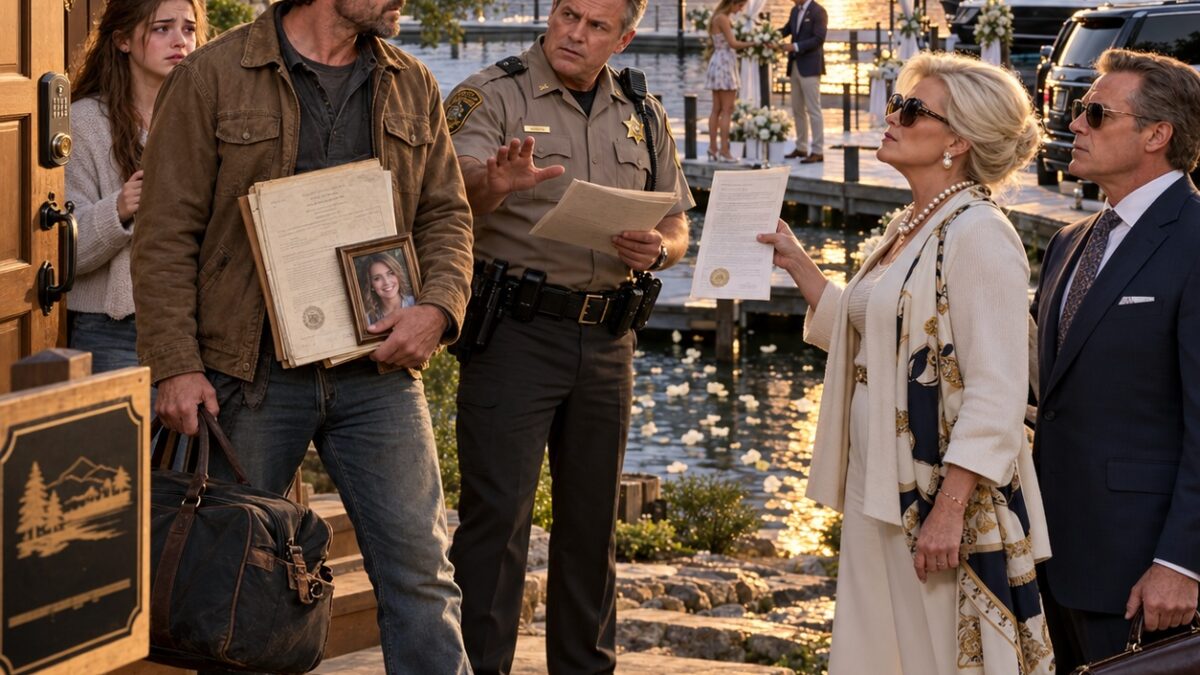
The document he handed me was a warranty deed.
Recorded through Bedford County.
Correct legal description.
Correct parcel.
Wrong owner.
It transferred title from something called Lakeview Shores HOA Common Holdings to Trevor Allen Whitfield.
Notary stamp:
Grayson Whitfield’s law office.
Recording date:
Three weeks earlier.
“My parents gave me this place as a wedding gift.”
The strangest part was his tone.
He was not mocking me.
He genuinely believed what he was saying.
I called the Bedford County Sheriff’s Department from the dock.
Deputy Toliver arrived about thirty minutes later.
Young.
Uncomfortable before he even reached us.
I showed him Uncle Neil’s will.
My recorded deed.
Probate paperwork.
Property-tax records.
Trevor showed him the new deed.
Toliver read both.
Rubbed the back of his neck.
Then said the sentence I would come to hate.
“Sir, this is a civil matter.”
I asked how filing a false deed on property I legally owned qualified as a civil misunderstanding.
He said he could not determine which deed controlled.
That was for a judge.
Then he left.
Just like that.
Cruiser disappearing down the road.
Me standing on a dock where I had scattered Annie’s ashes.
Trevor holding a deed saying my home belonged to him.
Kelsey was the first person on their side who seemed uncomfortable.
She pulled lightly at Trevor’s sleeve.
“Maybe we should talk to your parents about this.”
Trevor shook his head.
“It’s handled, Kels. Mom said the transfer was clean.”
Then he looked at me with something almost like sympathy.
“I’m sorry about the confusion, Mr. Briggs, but you should probably talk to a lawyer.”
A twenty-seven-year-old stranger was advising me to hire an attorney so I could prove I belonged on the land where I had learned to swim.
I felt my jaw tighten.
I walked away.
There are arguments you win by speaking.
Others you win by refusing to give the other person something they can later use against you.
I drove to Roanoke.
That night I called property attorneys until my phone felt hot in my hand.
Most could not see me for weeks.
At eleven, one called back.
Vivian Shaw.
Her voice had the clipped patience of someone who had spent decades in courtrooms and had no interest in hearing a story told twice.
“Mr. Briggs, what you’re describing sounds like deed fraud. Can you be here at eight tomorrow?”
I was there at 7:45.
Vivian spent three hours with my documents.
She did not begin with theories.
She began with dates.
Uncle Neil’s death.
Probate closing.
Deed recording.
Grayson’s quiet-title filing.
Court order.
HOA resolution.
Trevor’s new deed.
By noon, the mechanism was clear.
Grayson had pulled Uncle Neil’s probate record.
He found what he claimed was a technical defect.
His argument was that the executor, a Roanoke attorney named Philip Crane, had recorded the new deed eleven days outside a statutory deadline.
If the transfer failed, Grayson argued, the property never properly became mine.
From there, he claimed it reverted to unencumbered common property adjacent to Lakeview Shores.
Then Pamela’s HOA board passed a resolution assigning it to Trevor.
Paper followed paper.
Court filing.
HOA resolution.
Warranty deed.
Recording stamp.
Everything had been constructed to look legitimate.
But Vivian found the first weakness almost immediately.
The quiet-title action had been filed ex parte.
I had not been present.
Had not been notified.
Had not been given an opportunity to contest the claim.
Grayson’s filing said diligent efforts had been made to find me.
The evidence of that diligence?
One letter.
Sent to a Roanoke address I had not used in four years.
They did not try the cabin.
Did not contact my electrical business.
Did not call the number listed on the property-tax file.
Vivian read the notification section again.
Then looked at me.
“They didn’t want to find you.”
That sentence was more frightening than if she had told me Grayson had simply made a mistake.
Mistakes happen.
This looked designed.
We began building the challenge.
At the same time, Trevor began spending money.
A lot of money.
The cabin had been built by a retired submariner who valued durability more than fashion.
Uncle Neil’s kitchen was simple.
Heart-pine floors.
Wood cabinets.
Functional appliances.
Trevor’s renovation crew treated it like a blank canvas.
Within two weeks, the kitchen had been gutted.
Custom cabinetry arrived.
Quartzite countertops.
Six-burner Wolf range.
Uncle Neil’s heart-pine floors came out.
Engineered white oak with radiant heat went in.
A crew demolished the back living-room wall and replaced it with floor-to-ceiling glass facing the lake.
I watched from across the cove.
Binoculars.
Notebook.
Camera.
Truck after truck.
Plumbers.
Electricians.
Tile setters.
Carpenters.
One crew spent three days extending Uncle Neil’s dock another forty feet.
Then installed a covered boat lift rated for twelve thousand pounds.
A stone patio appeared above the shoreline.
Built-in fire pit.
Seating for twenty.
Later came custom lighting.
Smart-home systems.
A jacuzzi on the back deck.
Every day, I documented.
Contractor names.
License plates.
Dates.
Work completed.
Estimated value.
My electrician’s brain liked the discipline even when everything else in me hated what I was watching.
Vivian gave me the reason to continue.
Permanent improvements affixed to real property generally become part of the real property.
If my title was restored, the improvements stayed.
Trevor could spend whatever he wanted.
Money did not convert a bad deed into a good one.
I could have tried to stop construction.
Vivian made that clear.
Emergency motion.
Injunction.
Possible.
I chose not to.
Trevor had resources.
His father was a real-estate attorney.
A title search before spending six figures would have exposed questions immediately.
He trusted his parents instead.
I did not believe I had an obligation to protect him from every consequence of that trust.
Pamela made restraint difficult.
The week Trevor’s demolition began, she sent me an official HOA notice.
Heavy cardstock.
Gold Lakeview Shores seal.
I was banned from all HOA common areas.
Including shoreline access within two hundred feet of what the notice called the Whitfield property.
Then she posted the notice publicly.
Community bulletin board.
Mass email.
Subject line:
DISGRUNTLED FORMER OWNER HARASSING NEW RESIDENT
Former owner.
That phrase carried more insult than anything else she had written.
Then Pamela filed a formal trespass warning with the sheriff.
She claimed I had been loitering around Trevor’s property.
Claimed I had made threatening statements.
I had not.
I had barely spoken to Trevor since the first day.
But the warning entered the system.
And once something enters an official system, it gains weight simply by existing.
Now deputies responding to a complaint would see my name beside the word trespass.
Pamela’s story was becoming the official story before my case ever reached a judge.
To the sixty-three Lakeview Shores families, I was the bitter man who had lost a cabin and refused to accept it.
To me, I was the legal owner watching people renovate stolen property.
Then Pamela held Trevor and Kelsey’s engagement party on my dock.
That night was harder than any legal filing.
Saturday.
Mid-October.
Three weeks after I found the sign.
I parked at the public access lot half a mile south.
From there, I could see lights along the shoreline.
Paper lanterns had been tied to Uncle Neil’s dock railing.
A catering tent stood on the new stone patio.
Live acoustic guitar drifted over the water.
About eighty people.
Laughter.
Glasses.
Music.
People celebrating love on land taken from a widower whose wife had asked for her ashes to be scattered there.
I called Harper.
She answered quickly.
“Dad, are you okay?”
I told her I was fine.
It was a lie.
She was sixteen.
Had already buried her mother.
She did not need to carry the full weight of what I felt.
I told her I loved her.
Hung up before my voice broke.
I stayed another hour.
The music ended around eleven.
Lights remained until after midnight.
Pamela’s laugh carried across the water.
Confident.
Untroubled.
The laugh of someone who believed reality rearranged itself when she signed enough documents.
My hands tightened around the steering wheel.
Then loosened.
I drove away.
Sunday morning, I returned.
The party remained in pieces.
Champagne cork in the dock.
Tiki-torch stakes beside the shoreline.
Cigarette butts.
Napkins.
Plastic.
Then I saw Annie’s flowers.
Black-eyed Susans.
She planted them the last spring she was alive.
Flattened beneath party shoes.
I crouched beside them.
A person can understand intellectually that flowers are not memories.
Grief does not care.
I picked up every piece of trash I could find.
Then walked to the dock.
Gray water.
Low mist.
Blue heron standing near the boathouse.
I ran my hand over the railing.
Uncle Neil had sanded it in 1998.
I was fourteen.
He taught me how to follow the grain so the paper would not tear up the surface.
Everything worth building is worth finishing right.
The paper lanterns had been attached with zip ties.
When I cut them off, pale gouges remained underneath.
Marks in the finish.
Some damage can be sanded out.
Some stays.
Pamela arrived while I was still there.
White Mercedes.
Yoga pants.
Cashmere wrap.
Travel mug.
She came down the slope.
“Mr. Briggs, you are trespassing on my son’s property.”
I held up the trash.
“Your party left a mess on my dock.”
“It’s not your dock anymore, Colton. The sooner you accept that, the easier this will be for everyone.”
I looked at her.
Really looked.
Not at the linen.
Not the pearls.
Not the Mercedes.
At the certainty.
She believed the system was already finished with me.
“Pamela, you should be more careful about what you give away.”
She frowned.
I left.
Three days later, Vivian called.
This time there was energy in her voice.
“Colton, I need you in my office now.”
I reached Roanoke in ninety minutes.
Three documents lay across her desk.
She picked up the first.
A codicil.
An amendment to Uncle Neil’s will.
Filed with Bedford County Probate Court six months before he died.
It specifically addressed the recording timeline.
The executor was authorized to record the deed at any time within twelve months after probate closing.
Signed.
Witnessed.
Notarized.
Accepted by the probate court.
I read it twice.
Then again.
“If this exists, there was never an eleven-day defect.”
“Correct.”
“My title—”
“Was valid.”
“Always?”
“Always.”
For the first time since I found the sign, the room felt like it had more air.
Then came the second part.
Why had the codicil not appeared in Grayson’s quiet-title filing?
Because he had not included it.
Not because he could not find it.
The codicil was in the probate file he accessed.
His argument failed if the judge saw it.
So the filing presented the chain of title without the document that destroyed his case.
Vivian called it what it was.
Fraud on the court.
When an attorney asks a judge to decide title, he cannot deliberately hide known documents that contradict the claim.
Grayson had not cut a small procedural corner.
He had created a false version of the record.
Then Vivian showed me the third document.
Virginia State Bar history.
Three complaints against Grayson over six years.
Two dismissed.
One private reprimand.
Failure to disclose material documentation in a real-estate transaction.
Same type of conduct.
Different victim.
I asked Vivian to search other lakefront transfers connected to Pamela and Grayson.
Forty-eight hours later, we had two more.
Evelyn Caldwell’s cottage.
East shore.
Thirty-one years of ownership.
Transferred in 2021 to Pamela’s college roommate.
Quiet-title proceeding.
Technical probate problem.
Ex parte.
Weak notification.
Then the Ashford cabin.
Peninsula.
Transferred in 2022 to Grayson’s law partner.
HOA abandonment resolution.
Again:
Older owners.
Paper technicality.
Little meaningful notice.
Property moved away from a family and toward someone connected to the Whitfields.
Pamela and Grayson were not merely trying to steal my cabin.
The evidence suggested a method.
A system.
Grayson found technical weaknesses.
Pamela provided HOA authority.
Court documents made everything look official.
Then valuable lakefront property shifted toward people in their circle.
Three families.
More than half a million dollars in stolen equity.
All hidden behind letterhead and recorded instruments.
That discovery changed my anger.
Before, I wanted my property back.
Now I wanted the entire pattern exposed.
We moved carefully.
First, Vivian filed a motion to vacate the quiet-title judgment based on fraud.
Uncle Neil’s codicil became Exhibit A.
She filed a lis pendens against the property.
Trevor could not sell.
Refinance.
Transfer.
The wedding gift was legally frozen.
Second, we contacted the other families.
Evelyn Caldwell was seventy-eight and living with her son in Charlottesville.
She listened to everything.
Then said:
“I knew something was wrong. I just didn’t have the energy to fight it.”
She had owned her cottage thirty-one years.
Her husband built their dock.
They lost it because somebody understood exhaustion can be more effective than force.
Evelyn signed an affidavit that afternoon.
Tom Ashford had already died.
His widow Doreen lived in a nursing home in Winchester.
Her daughter drove to Vivian’s office.
When she saw the records, she cried.
“Dad died thinking he’d done something wrong with the paperwork.”
She wiped her face.
“He blamed himself.”
That sentence changed the case again for me.
Property fraud does not only remove ownership.
It rewrites the victim’s understanding of what happened.
Tom Ashford died carrying shame that belonged to Grayson Whitfield.
Doreen’s daughter signed the affidavit under power of attorney.
Third, Vivian filed a formal State Bar complaint.
Three real-estate matters.
Repeated omission of material documents.
The investigation meant Grayson’s files could be subpoenaed.
Fourth, I completed the renovation ledger.
Three weeks of photographs.
Contractors.
Deliveries.
Visible costs.
By the time I totaled it, Trevor had invested about $183,000 in permanent improvements.
The kitchen.
Quartzite island.
Heated floors.
Glass wall.
Extended dock.
Boat lift.
Patio.
Lighting.
Smart-home system.
Jacuzzi.
I remember watching four men carry a ten-foot quartzite island through the doorway Uncle Neil framed with his own hands.
Two thousand pounds of stone.
An expensive symbol of just how certain the Whitfields were.
Pamela discovered the lis pendens on Monday.
Trevor called.
“My mother says you filed something that’s blocking the title.”
“Yes.”
“She says it’s harassment.”
“Ask your father to show you Uncle Neil’s full probate file.”
Pause.
“All of it.”
“What am I looking for?”
“The codicil.”
Another pause.
“What codicil?”
I knew then he had never seen it.
Trevor was not pretending.
His father had hidden the document from the court.
Apparently he had hidden it from his own son too.
The knowledge complicated everything.
Trevor had replaced floors in a house that was not his.
He had torn out Uncle Neil’s kitchen.
He had hosted a party that crushed Annie’s flowers.
But he had also been handed a recorded deed by a lawyer father and an HOA-president mother.
He believed them.
Pamela answered the lis pendens with retaliation.
Formal HOA complaint.
Harassment.
Property fraud.
Malicious interference with community governance.
Emergency board meeting.
Permanent ban from every Lakeview Shores amenity.
Then she tried to have my septic permit revoked.
Claimed my system contaminated Smith Mountain Lake.
The county health department sent an inspector.
Two hours.
Probe.
Testing.
Uncle Neil had overbuilt the drain field.
The system passed easily.
The inspector told me, quietly, he had tested three actual failing systems in Lakeview Shores the previous year.
Pamela had never complained about those.
Her septic accusation joined the evidence file.
Then she went after my livelihood.
Letters to three electrical clients.
She told them I was under investigation for property fraud.
Suggested they reconsider doing business with me.
Two clients called.
One hospital almost pulled a thirty-thousand-dollar rewiring contract.
Vivian sent Pamela a cease-and-desist over interference with my business.
Pamela ignored it.
That decision became evidence too.
The more pressure failed, the more she created records showing pressure.
Grayson moved to dismiss our case.
His argument:
The codicil was invalid.
Vivian responded with a certified probate copy.
Accepted.
Recorded.
Incorporated into the final probate order five years earlier.
The court had already recognized it.
Grayson knew.
Then discovery produced the moment Vivian later described as the point where Grayson stopped being a lawyer who had a problem and became a man with a criminal one.
She requested Uncle Neil’s original probate file.
The clerk sent it.
The codicil was gone.
Not misplaced.
Missing.
The Clerk’s Office checked its logs.
The document had been present six months earlier.
Who last requested the file before it disappeared?
Grayson Whitfield.
His signature sat on the checkout record.
The original was missing.
We no longer needed it.
The certified copy remained.
The probate system held its own record.
The State Bar subpoena had captured another version.
And now we possessed a timeline connecting Grayson directly to the file before the disappearance.
Vivian filed for sanctions.
Requested criminal referral for tampering with public court records.
She looked at the access log.
“He’s not a lawyer anymore. He just doesn’t know it yet.”
If Grayson panicked, Pamela became reckless.
Two weeks before our court date, she drove to Harper’s high school.
Bedford County High.
Wednesday afternoon.
3:15.
Harper was walking toward the bus when the white Mercedes pulled along the curb.
Pamela got out.
“Harper, sweetheart, I just want to talk to you for a minute about your dad.”
Harper did not get into the vehicle.
Did not argue.
Did not stop long enough for Pamela to pull her into anything.
She walked to the bus.
Sat down.
Called me.
“Dad, that woman from the lake was at my school.”
Everything inside me changed.
Not the same anger as the deadbolt.
Not the dock.
Not Annie’s flowers.
Harper was sixteen.
She had lost her mother at fourteen.
She did not deserve one more adult inserting themselves into her grief for leverage.
I called Vivian.
She filed for an emergency protective order within an hour.
The judge granted it the following morning.
Pamela had to remain five hundred feet from Harper.
From the school.
From our Roanoke home.
Violation meant immediate arrest.
Unable to reach Harper directly, Pamela went public.
Lakeview Shores Facebook group.
She called me dangerous and unstable.
Claimed I was using my daughter as a pawn.
Claimed my documents were fabricated.
Claimed I was trying to steal Trevor’s lawful home.
Forty-seven people liked the post.
Twelve wrote supportive comments.
None had seen the codicil.
None had seen the access log.
None had seen the other victims’ files.
Dale Kessler had.
Dale was an investigative reporter at WSLS in Roanoke.
I had contacted him after Vivian uncovered the broader property pattern.
I gave him forty pages.
He called the next morning.
“This is a three-part series.”
I asked him to wait until the case was ready.
He did.
When Pamela posted about Harper, Dale screenshotted it before it disappeared.
The post became Exhibit J.
Then another homeowner contacted me.
Cheryl Burke.
Her husband had died two years earlier.
Pamela had been approaching her about “helping manage” the lakefront parcel.
Grayson had offered to handle the paperwork as a courtesy.
Cheryl had not signed.
Now she wanted to know whether the offer was related to what had happened to me.
I sent her message to Vivian.
Another potential victim.
Another family with a dead spouse.
Another valuable lakefront parcel.
The pattern was no longer merely history.
It appeared to be continuing.
A week before court, Trevor called again.
His voice had changed.
Quieter.
Older, somehow.
“Mr. Briggs, I looked at the probate file.”
I waited.
“I found the certified codicil in my father’s office.”
“Where?”
“His desk drawer.”
Pause.
“Under HOA minutes.”
Then:
“I didn’t know.”
I believed him.
“I swear to you. I didn’t know.”
“I believe you.”
He apologized for the sign.
For Annie’s flowers.
For everything.
I told him the case could not be stopped.
“I know.”
After the call ended, I sat inside my van in the driveway.
The streetlight came on.
Orange glow across the dash.
I thought about Trevor’s situation without excusing it.
Twenty-seven.
Preparing for marriage.
Parents hand him a lakefront cabin.
Recorded deed.
Lawyer father.
HOA-president mother.
Everything appears legitimate.
He spends his savings.
Chooses countertops with Kelsey.
Builds a patio.
Imagines a family.
Then some electrician he barely knows appears and tells him the entire gift was constructed on fraud.
He should have checked title.
Absolutely.
But people make different mistakes when they believe the people lying to them love them.
I drove to the public beach that evening.
Watched Canada geese cross the water in a line.
Thought about the difference between an enemy and a victim who has not yet realized he is one.
November 14 arrived cold.
Bedford County Circuit Court.
Wood-paneled walls.
Old varnish.
Radiator heat.
Judge Helen Thatcher presiding.
Thirty-one years on the bench.
Reputation for having very little patience for procedural games.
Pamela sat beside Grayson at the respondent’s table.
Navy blazer.
Pearls.
Grayson wore a charcoal suit.
Their attorney, Carter Pool, had come from Richmond.
Trevor and Kelsey sat in the gallery behind them.
Trevor never once looked directly at his parents.
Vivian sat beside me.
Behind us sat Evelyn Caldwell.
Her son.
The Ashford daughter.
Dale Kessler with a notebook and court-approved recording device.
Harper sat in the back beside my sister.
Around her neck was the necklace Annie had given her for her thirteenth birthday.
Vivian started with the document everything depended on.
Uncle Neil’s codicil.
It appeared on the courtroom screen.
Signature.
Witnesses.
Notary.
Filing stamp.
She walked Judge Thatcher through the dates.
Probate.
Closing.
Recording.
Authority granted to the executor.
There was no eleven-day defect.
No failed inheritance.
No reversion.
No common land.
My deed was valid.
Always had been.
Then Vivian put Grayson’s filing beside the probate record.
Quiet-title complaint.
No codicil.
Notification mailed to an obsolete address.
No cabin attempt.
No business address.
No tax-record number.
Nothing resembling a genuine effort to reach the property owner.
Then came the clerk’s access log.
Grayson had accessed the file before filing the quiet-title action.
The codicil existed then.
The original later disappeared.
Vivian did not raise her voice.
She did not need to.
“Your Honor, Mr. Whitfield did not simply overlook a document damaging to his argument. The evidence before this court shows that he had access to it, omitted it from a filing where it was material, and that the original later disappeared after his access to the public file.”
Carter Pool objected.
Judge Thatcher overruled.
Then Evelyn Caldwell’s case.
Another property.
Another quiet-title process.
Another owner deprived of meaningful notice.
Then the Ashfords.
Another lakefront cabin.
Another technicality.
Another transfer toward someone in Grayson and Pamela’s circle.
The courtroom became quieter with each document.
The case was no longer:
Who owns Colton Briggs’s cabin?
It had become:
How many times did this happen?
Pamela’s jaw tightened.
Grayson stopped taking notes.
Then Vivian introduced the renovation ledger.
$183,000.
Permanent improvements.
Photographs.
Dates.
Contractors.
Kitchen.
Flooring.
Glass.
Patio.
Dock extension.
Boat lift.
Custom lighting.
Jacuzzi.
Trevor’s money.
My land.
Vivian asked the court to vacate the deed to Trevor.
Restore legal title to me.
Recognize the permanent improvements as part of the property.
Refer Grayson for criminal prosecution.
Refer him to the State Bar.
Judge Thatcher removed her reading glasses.
Looked directly at Grayson.
Nobody moved.
Then she spoke.
“In thirty-one years on this bench, I have never seen a more calculated abuse of the legal system by a licensed attorney.”
The radiator hummed.
Dale’s pen moved.
Judge Thatcher continued.
Grayson had not simply defrauded a neighbor.
He had defrauded the court.
Removed—or been directly connected to the disappearance of—material evidence from a public file.
Filed sworn documents contradicted by evidence he had accessed.
Used his wife’s HOA position to make the actions appear legitimate.
Then she issued the ruling.
My title restored.
Trevor’s deed vacated.
Permanent improvements legally part of the property.
Criminal referral for Grayson.
Tampering with court records.
Fraud on the court.
False instruments.
State Bar referral.
Every Lakeview Shores resolution relating to my property void.
Pamela stood.
“This is outrageous. That property was properly—”
Judge Thatcher did not look up.
“Mrs. Whitfield, sit down or I will hold you in contempt.”
Pamela sat.
That was the explosion I had waited months for.
Not screaming.
Not revenge.
A judge reading facts into a permanent record while Pamela could do nothing except listen.
I did not need to say a word.
I turned toward Harper.
She was crying.
Not like the night Annie died.
Not like the mornings grief returned without warning.
These were tears of something being returned.
She pressed Annie’s necklace against her collarbone.
Evelyn Caldwell had her eyes closed.
Hands together.
The Ashford daughter gripped the armrest so tightly the wood creaked.
Then Trevor stood.
He looked at his mother.
Then his father.
No anger that I could read.
No words.
He turned.
Walked out.
Kelsey followed.
The courtroom door closed softly.
Pamela watched her son leave.
For the first time since I had known her, she had nothing to say.
Dale’s story ran that evening.
The fallout came fast.
Grayson was indicted by a Bedford County grand jury on four felony counts described in the case.
Two fraud-on-the-court counts.
One count involving tampering with public records.
One filing a false instrument.
The Virginia State Bar suspended his license pending disciplinary proceedings.
Within three months, he voluntarily surrendered it.
He never practiced law again.
Pamela’s HOA control collapsed almost immediately.
Two weeks after the ruling, Lakeview Shores held a special meeting.
Vote:
51 to 6.
Pamela removed as president.
The new board rescinded every resolution she had passed against my property.
Then they hired an independent auditor.
Five years of records.
The audit found another $18,000 in unaccounted expenditures routed through what Pamela called the lakefront beautification fund.
Trevor’s engagement-party catering.
A payment toward Pamela’s Mercedes lease.
A family trip to Hilton Head.
Each discovery made the phrase community governance sound more absurd.
Evelyn Caldwell’s fraudulent deed was vacated.
Her title restored.
She returned to the cottage that spring.
Seventy-eight years old.
The first week back, she planted a garden.
The Ashfords received a $240,000 settlement through Grayson’s malpractice insurance.
Doreen was too frail to return to the cabin.
Her daughter called me afterward.
“Dad didn’t make a mistake.”
Pause.
“Someone stole from him.”
That sentence might have been the most satisfying outcome of all.
Tom Ashford had died believing paperwork failure on his part had cost his family its home.
Now his daughter knew the truth.
The shame went where it belonged.
Three weeks after my ruling, Trevor called.
This time there was no anger.
No mention of harassment.
No attempt to defend his parents.
“Mr. Briggs, I know I have no right to ask this.”
I listened.
“Kelsey and I love that cabin.”
He paused.
“I put everything I had into it.”
Another pause.
“I know it’s yours. I know what my parents did was wrong.”
Then he asked whether I would consider allowing them to stay as tenants.
He would pay whatever I thought was fair.
I did not answer immediately.
For two days, I thought about it.
Talked with Harper.
Talked with Vivian.
Thought about Trevor’s first day on the dock.
Thought about his arrogance.
Then his confusion.
Then the phone call when I first mentioned the codicil.
Then the call after he found it hidden in Grayson’s desk.
He had benefited from the fraud.
But the evidence I had seen did not show he created it.
His parents had handed him a poisoned gift.
He had been careless enough to accept it without checking.
That was not the same thing as stealing it.
I called him back.
“Ten thousand a month.”
No argument.
“First and last up front.”
“Okay.”
“Twelve-month lease.”
“Yes.”
“You maintain the property.”
“Yes.”
“You pay the dock fees.”
“Yes.”
“And your mother never sets foot on that shoreline again.”
He answered immediately.
“Done.”
Trevor paid on the first.
Every month.
Never late.
Never short.
He and Kelsey got married at the courthouse.
Small ceremony.
Quiet.
Nothing resembling the eighty-person lakefront celebration Pamela had imagined on property that never belonged to her.
They became good tenants.
Kept the cabin immaculate.
Then Kelsey planted black-eyed Susans along the dock path.
She had no idea Annie had planted the same flowers there before the engagement party destroyed them.
She simply thought they looked right beside the lake.
When Harper saw them, she stopped.
Looked down.
Then smiled.
“Mom would have liked that.”
Pamela had to drive past the cabin every time she entered or left Lakeview Shores.
Her son’s car sat in the driveway.
The property she had tried to give away as a wedding present now belonged unquestionably to me.
And Trevor paid $10,000 every month for the privilege of living there.
That was $120,000 a year.
I did not use the first year’s rent to buy a boat.
Did not remodel my house.
Did not spend it trying to make the Whitfields feel anything.
I created the Smith Mountain Lake Property Rights Clinic.
Free legal consultations for lakefront homeowners facing HOA overreach.
Deed fraud.
Title manipulation.
Probate problems.
Official-looking letters designed to frighten people who did not know what authority actually existed behind them.
Vivian volunteered two Saturdays a month.
Evelyn Caldwell baked cookies for the waiting room.
That detail would have made Uncle Neil laugh.
His cabin had almost been stolen through paperwork.
Now money generated by that same cabin paid to help other people read theirs.
The clinic mattered because the Whitfield scheme depended on one assumption more than any other.
That people would not check.
That elderly owners would be too tired.
That grieving families would be overwhelmed.
That out-of-state heirs would trust the first official-looking paper.
That an HOA seal looked enough like authority.
That a lawyer’s signature looked enough like truth.
Pamela and Grayson did not need every victim to be ignorant.
They only needed them exhausted.
Evelyn knew something was wrong.
She simply did not have the strength to fight.
Tom Ashford believed he had failed.
Cheryl Burke almost signed paperwork because Grayson called it a courtesy.
That is how these schemes survive.
Not because the paperwork is flawless.
Because the target assumes somebody else already checked it.
I thought about that often while working at the clinic.
A person would arrive carrying an envelope.
Scared.
Angry.
Confused.
Sometimes the answer was complicated.
Sometimes it was shockingly simple.
Pull the deed.
Check the probate record.
Read the easement.
Verify who owns what.
Ask whether the person demanding money actually has contractual authority.
People often relaxed the moment somebody explained the paper in ordinary language.
I understood that feeling.
The first night after I saw Trevor’s deed, I had felt almost powerless despite holding my own recorded title.
A piece of paper can make reality feel uncertain if you do not know how the paper was created.
The clinic existed to shorten that period.
Harper helped sometimes.
Not with legal work.
She was still in school.
But she came by.
Talked with Evelyn.
Brought coffee.
She had changed too.
Losing Annie at fourteen forced her to become older in ways I hated.
Then Pamela tried to pull her into a property fight at sixteen.
I worried that all of it would make Harper distrustful.
It did not.
Cautious, maybe.
More interested in understanding what people meant rather than simply believing titles.
That was not the worst lesson.
One Saturday, months after Trevor started paying rent, Harper and I drove to Smith Mountain Lake.
We initially parked at the public access lot out of habit.
The same lot where I had sat listening to the engagement party.
Harper looked at me.
“Dad.”
“What?”
“You own it.”
I laughed.
Started the van again.
Drove to the cabin.
Trevor and Kelsey were away that morning.
The property looked familiar and unfamiliar at the same time.
Grayson’s fraud had not frozen construction in reverse.
The quartzite counters were still there.
The heated white-oak floors.
Glass wall.
Patio.
Extended dock.
Boat lift.
The house Uncle Neil built had changed.
Getting title back did not magically return every heart-pine board.
It did something more important.
It returned the right to decide what happened next.
We walked toward the shoreline.
Black-eyed Susans moved beside the path.
Harper touched one lightly.
“Mom would have liked that Trevor’s wife planted her flowers back.”
“She would.”
Harper picked up a flat stone.
Turned it in her fingers.
Then skipped it.
One bounce.
Two.
Three.
Four.
The stone disappeared into silver water.
Ripples spread.
The morning smelled like pine bark and wet stone.
Exactly the way childhood had smelled.
I stood on Uncle Neil’s dock and thought about everything that had happened there.
Learning to swim.
First bass.
Annie.
Harper’s first bluegill.
Ashes scattered into the lake.
Pamela’s lanterns.
Party shoes crushing flowers.
Trevor’s contractors.
Then the courtroom.
A place can carry contradictory memories.
That does not make any of them less real.
Uncle Neil used to say the lake was the one thing that never let him down.
For a while, I thought even that had failed.
I thought paperwork had reached backward and taken the place where Annie’s memory felt safest.
But the lake had never gone anywhere.
The cabin had never stopped being mine.
The truth had not changed because somebody recorded a lie beside it.
The Whitfields did not create ownership.
They created confusion.
And confusion has an expiration date when somebody is willing to read.
That became the lesson I carried from the whole ordeal.
Not that I had been smarter than Pamela.
I had not.
Not at first.
She acted before I even knew there was a fight.
Grayson understood legal procedure well enough to make a fraudulent claim look legitimate.
They had experience.
They had used similar tactics before.
Their real mistake was believing nobody would keep reading once official paper said the matter was settled.
Vivian kept reading.
She found the notification problem.
Then the codicil.
Then Grayson’s disciplinary history.
We kept going.
Caldwell.
Ashford.
Cheryl.
Access logs.
State Bar records.
Renovation receipts.
Facebook posts.
Septic complaint.
Client letters.
Protective order.
Every new attempt by Pamela and Grayson to strengthen their position produced another document showing what they were willing to do.
That is what eventually buried them.
Not anger.
Not a confrontation on the dock.
Not some dramatic act of revenge.
Records.
The same kind of patient detail that had defined my trade for twenty-two years.
When I wire a commercial panel, I label everything.
Circuits.
Breakers.
Loads.
A year later, somebody should be able to open that panel and understand what happened.
Grayson depended on the opposite.
Missing information.
Hidden lines.
Old addresses.
Documents nobody checked.
The difference between us was not intelligence.
It was what we believed details were for.
I used them to make systems safer.
He used them to make theft look lawful.
Eventually those choices reached the same courtroom.
One held.
One failed.
I never forgot Pamela’s first visit.
The way she stood on Uncle Neil’s dock and told me the lake did not care when I got there.
She had been right about one thing.
The lake did not care.
It did not care who had the prettier stationery.
Did not care about the HOA seal.
Did not care that Grayson was a lawyer.
Did not care about Pamela’s pearls.
It did not care whose name was on a fraudulent deed.
Water remained water.
Land remained land.
Ownership remained what the lawful chain of title said it was.
The people were the ones who had to catch up.
Pamela lost the presidency.
Grayson lost the legal career he had used to construct the scheme.
Evelyn got her cottage back.
The Ashford family got the truth Tom had died without.
Trevor lost the gift he thought he had been given.
Then earned the right to stay there by paying rent to the actual owner.
That ending satisfied me more than throwing him out would have.
Not because I forgot the damage.
I did not.
Uncle Neil’s floors were gone.
Annie’s original flowers were gone.
The cabin had been changed without my consent.
But revenge would have required pretending Trevor knew everything from the beginning.
The evidence did not support that.
The first time he showed me the deed, he genuinely believed it.
The first time I told him about the codicil, he did not know what I meant.
When he found the certified copy hidden in Grayson’s desk, something in his relationship with his parents broke.
I did not need to add to that unnecessarily.
Consequences were enough.
Ten thousand dollars a month.
Maintenance.
Dock fees.
Respect for boundaries.
No Pamela on the shoreline.
Clear terms.
Written lease.
Proper paperwork.
Funny how peaceful things become when the documents tell the truth.
By the eleventh month, Trevor had never been late.
Kelsey maintained the flower beds.
Harper stopped referring to them as “those people in Mom’s cabin.”
She called them Trevor and Kelsey.
That was progress I had not expected.
I still did not call the cabin theirs.
It was not.
That distinction no longer needed anger.
The Property Rights Clinic grew.
Word spread around the lake.
Some cases were not fraud.
Sometimes the HOA was right.
Sometimes homeowners had signed covenants and forgotten what they agreed to.
Vivian never promised people the answer they wanted.
She promised them the answer the documents supported.
I respected that.
The whole Whitfield disaster had begun because Grayson treated the law as something to manipulate toward a preferred result.
The clinic had to do the opposite.
Read first.
Decide second.
Evelyn usually arrived before everyone on the Saturdays she brought cookies.
Seventy-eight years old.
Back in her cottage.
New garden.
She would arrange a plate in the waiting room and then complain if nobody ate enough.
The first time I visited her restored property, she stood beside the dock her husband had built.
She ran one hand over the railing.
I understood the gesture immediately.
People think real estate is dirt and structures.
It is.
Legally.
Humanly, it is also where people remember who stood beside them.
That was what Pamela and Grayson never understood.
To them, lakefront property was equity.
Transfer value.
Development potential.
Influence.
To Evelyn, it was thirty-one years with her husband.
To the Ashfords, it was Tom’s belief that he had protected his family.
To me, it was Uncle Neil.
Annie.
Harper.
You cannot measure that on a comparative-market analysis.
Which is why taking it through procedural fraud caused damage no settlement could completely repair.
The new Lakeview Shores board knew that too.
Their audit kept uncovering smaller examples of Pamela treating association money like a personal account.
Eighteen thousand dollars does not sound enormous beside stolen lakefront property.
It mattered.
Engagement-party catering.
Mercedes payment.
Hilton Head vacation.
Those expenditures showed how routine entitlement had become.
She was not stealing because of one crisis.
She had stopped believing there was a meaningful line between community resources and what she wanted.
That was the culture the new board had to rebuild.
I did not join it.
I wanted no title.
No committee.
No revenge campaign.
They had their own work.
My work was the clinic.
My business.
Harper.
And occasionally standing on the dock without feeling like I needed to prove anything.
Dale Kessler finished all three parts of his investigative series.
The coverage widened the story beyond my property.
People who initially believed Pamela’s Facebook posts saw the court record.
Saw Evelyn.
Saw the Ashfords.
Saw Grayson’s access log.
A public story built on private manipulation collapsed under public evidence.
Some Lakeview Shores residents apologized.
Others never did.
I stopped caring.
People are often embarrassed by how easily they believed something.
Embarrassment can make an apology harder.
I did not need one from sixty-three families.
I needed the record corrected.
It was.
One resident told me later that Pamela’s authority had seemed absolute because she always knew which document to produce.
Violation notice.
Board resolution.
Trespass warning.
Letter from Grayson.
She never arrived empty-handed.
That was intentional.
Official-looking paper makes ordinary people second-guess themselves.
The scheme depended on paperwork not because the truth was on Pamela’s side.
Because paper can create hesitation faster than truth can be verified.
That was the reason I funded the clinic.
Shorten the hesitation.
Help people understand the difference between a letter and law.
A board vote and ownership.
A recorded instrument and a valid chain of title.
A lawyer’s confidence and a lawyer’s integrity.
If someone had done that for Evelyn earlier, maybe she would never have lost the cottage.
If someone had done it for Tom Ashford, maybe he would not have died blaming himself.
I could not change those years.
I could use Trevor’s rent to help the next family before the damage became permanent.
There was a certain symmetry in that.
Pamela intended the cabin as a wedding gift.
Instead, the improvements became part of my property.
The rent funded lawyers for other homeowners.
Every first of the month, the same property her scheme targeted produced another payment toward preventing the same scheme from working elsewhere.
I never needed to explain that to Pamela.
I assumed she understood.
She still had to pass the property when entering or leaving Lakeview Shores.
Sometimes I wondered what she thought when she saw Trevor’s car.
Maybe anger.
Maybe humiliation.
Maybe she blamed me.
It did not matter.
For months, I had given Pamela too much space in my thoughts.
After court, she became less important.
That surprised me.
I expected victory to feel like watching her lose.
Instead, it felt like Harper walking down a dock without asking whether we were allowed to be there.
It felt like Evelyn planting a garden.
It felt like Kelsey’s black-eyed Susans.
It felt like Vivian helping a frightened homeowner understand a deed.
It felt like ordinary things returning.
The criminal and disciplinary outcomes belonged to the systems responsible for them.
Grayson’s bar suspension.
His surrendered license.
Grand-jury indictments.
Those were consequences.
I did not need to turn them into entertainment.
The courtroom ruling had already given me the thing I had gone there for.
Truth in the record.
One afternoon, I opened the same folder I carried to Deputy Toliver on the first day.
Uncle Neil’s will.
My deed.
Probate documents.
They had not changed.
That struck me.
The papers I possessed before hiring Vivian already contained most of the truth.
What I lacked was the codicil and the context.
A fraudulent deed can make legitimate paperwork feel suddenly weak.
But legitimacy had not disappeared.
We simply had to reconstruct the chain Grayson tried to break.
Uncle Neil had been careful.
Six months before his death, he signed the codicil.
Maybe his attorney suggested it.
Maybe he worried about delays.
Whatever the reason, that page protected everything.
And because the page was filed properly, Grayson could hide the original but he could not erase every copy.
Redundancy.
Electricians understand redundancy.
Hospitals especially.
One system fails, another carries the critical load.
Uncle Neil’s legal record had redundancy.
Certified copies.
Court entries.
Probate order.
Grayson treated one physical file like it was the entire truth.
It was not.
The system remembered.
I wished Uncle Neil could have seen Judge Thatcher’s ruling.
Not because he liked courtrooms.
He would have hated them.
He liked boats.
Coffee.
Quiet.
But he would have appreciated the idea that finishing paperwork correctly mattered years after he was gone.
Everything worth building is worth finishing right.
That had been about sanding a railing when he told me.
It turned out to apply to wills too.
Harper finished the school year stronger than I expected.
The protective order remained.
Pamela never approached her again.
I was grateful.
No sixteen-year-old should have to think about whether a stranger will appear outside school because of a title dispute.
The fact Pamela crossed that line probably damaged her credibility more than she understood.
People can rationalize aggressive property behavior.
Approaching a grieving teenager is harder to explain away.
Dale’s screenshot preserved the public retaliation that followed.
Again:
Evidence.
The thing Pamela never respected until too much existed.
Vivian sometimes joked that Pamela litigated against herself through behavior.
Every escalation answered a question we might otherwise have had trouble proving.
Did she knowingly intimidate?
Look at the school incident.
Did she spread false claims?
Facebook.
Did she interfere with my livelihood?
Client letters.
Did she misuse HOA authority?
Board resolutions.
Did Grayson know about the codicil?
Access log.
Office copy.
Probate record.
The scheme eventually became impossible to explain as coincidence.
That is what patterns do.
One event can be misunderstood.
Ten related events begin telling their own story.
Three properties made Grayson’s conduct larger than mine.
Cheryl’s near-miss suggested it might have continued.
Once other victims existed, Pamela could no longer frame me as one disgruntled man refusing to accept a technical problem.
I became one name in a method.
That was strategically important.
Emotionally, it was awful.
Finding out you are not alone can be comforting.
Finding out others suffered before you because nobody connected the pattern sooner is not.
Evelyn had lost years.
The Ashfords lost something they could never fully recover.
Tom never got to see the truth.
That remained the darkest part of the outcome.
A satisfying ending does not mean every loss is repaired.
Some justice arrives after the person who needed it most is gone.
Doreen’s daughter understood that.
Her satisfaction came from restoring her father’s reputation inside the family.
“He didn’t make a mistake.”
That sentence carried more than the $240,000 settlement.
Money can replace equity.
It cannot replace how a man understood himself during his last year.
The clinic kept Tom’s story with me.
Whenever a widow or older owner arrived carrying confusing papers, I thought about him.
Read everything.
Do not assume the technical language means somebody else must be right.
Do not sign because you are tired.
Get help before exhaustion makes the decision.
That became the practical legacy of the case.
Trevor, ironically, learned the same lesson at the highest possible price.
His parents gave him a deed.
He trusted it.
He spent $183,000.
The improvements stayed.
He then paid $10,000 a month to live among them.
He did not complain.
Not to me.
Maybe he understood that compared with Evelyn and the Ashfords, rent was a gentler consequence.
Kelsey seemed to understand even more.
She never defended Pamela.
Never asked me to soften the lease.
She took care of the cabin.
Planted flowers.
Built a quieter life there.
I respected that.
The first engagement party had eighty people.
Their actual wedding happened in a courthouse.
Small.
Maybe that was what they wanted by then.
Something untouched by Pamela’s performance.
I never asked.
Some parts of their recovery did not belong to me.
That boundary mattered.
Ownership did not give me ownership of their lives.
Just the land.
By then, the cabin generated $120,000 each year.
That number would have sounded absurd to Uncle Neil.
He probably would have told me anyone paying that much needed their head examined.
Then he would have taken the rent.
He was practical.
Harper joked once that Pamela had accidentally turned the cabin into the most profitable electrical job I never wired.
She was not wrong.
The irony was satisfying.
But the income itself was not the point.
What mattered was where it went.
Property-rights consultations.
People who could not afford a lawyer for a complicated HOA letter.
Widows.
Retirees.
Families suddenly confronted with liens or title questions.
The Whitfields had used complexity as a weapon.
We used the rent to make complexity understandable.
That felt like the right ending for the money.
My electrical business recovered too.
The hospital contract that nearly disappeared stayed.
Once the court ruling became public, the clients who had worried about Pamela’s accusations understood what happened.
I never sued every person who believed her.
I did not need to.
Business returned to being business.
Hospitals still needed wiring.
Schools still needed panels replaced.
Commercial kitchens still overloaded circuits because chefs believe electrical capacity is a suggestion.
Normal work felt good.
After months of legal strategy, there was comfort in copper conductors and measurable voltage.
A circuit does not care about gossip.
It works or it does not.
That honesty had always attracted me to the trade.
The lake offered the same kind of honesty.
That morning with Harper, after she skipped the stone, we stayed on the dock for a while.
No speech.
No need for one.
I looked at the far shore.
At the area where I once parked and watched strangers celebrate on my property.
From the dock, the public access lot looked small.
I thought about the man sitting there gripping the steering wheel while Pamela laughed across the water.
He had believed patience was almost unbearable.
He had no idea patience was the thing protecting him.
If I had broken the new deadbolt, Pamela would have called police.
If I had threatened Trevor, the trespass narrative would have become stronger.
If I had crashed the engagement party, sixty people might have remembered me as unstable.
If I had confronted Grayson before Vivian found the codicil, he might have had more time to alter the record.
Instead, we documented.
Waited.
Filed.
Let each move become evidence.
Patience did not mean passivity.
That distinction matters.
Behind the waiting was work.
Vivian reading.
Me photographing renovations.
Victims signing affidavits.
Bar complaints.
Title searches.
Access logs.
Dale reviewing documents.
Protective orders.
Court motions.
The quiet period was not empty.
It was construction.
Just like wiring behind a wall.
Nobody sees the system until the lights come on.
November 14 was when the lights came on.
Judge Thatcher did not create the truth.
She recognized it.
That was why the ruling felt so complete.
The title had always been mine.
The court corrected the record.
Trevor’s deed had never carried the legitimacy his family claimed.
Pamela’s HOA resolutions had always exceeded what she could do.
Grayson’s legal tricks had hidden reality, not changed it.
There is power in understanding that.
A fraudulent document can create enormous practical damage without becoming truth.
Sometimes the fight is simply making institutions see the difference.
The law had failed me initially in one sense.
Deputy Toliver could not resolve competing deeds at roadside.
I hated that.
Later, I understood why.
A deputy should not decide complex title litigation based on who sounds most convincing beside a dock.
The problem was not that he refused to choose.
The problem was that Grayson had weaponized the civil system to create fraudulent evidence of ownership before anyone arrived.
The correct remedy required court.
Slow.
Frustrating.
But ultimately capable of undoing the fraud.
Judge Thatcher did.
The State Bar did its part.
The new HOA board did its part.
The malpractice insurer did its part.
No system was perfect.
Together, once supplied with complete information, they produced something resembling justice.
That was better than the alternative.
Harper eventually asked whether I would ever move back into the cabin.
I did not know.
Trevor and Kelsey were good tenants.
The lease worked.
The clinic benefited from the income.
And the cabin no longer needed me living there to prove it was mine.
That was another form of freedom.
During the dispute, every day away from the property felt like surrender.
After the ruling, I could leave without fear that somebody would change the lock and claim absence meant abandonment.
Ownership was secure.
The place could breathe.
So could I.
Annie’s ashes remained part of the lake.
Nothing Pamela did changed that.
Party shoes crushed flowers.
Kelsey planted new ones.
That did not replace Annie.
But it restored something gentle to the path.
I found myself liking the fact that Kelsey chose black-eyed Susans without knowing.
Coincidence, probably.
Still beautiful.
Harper saw continuity instead of violation.
That mattered more than whether the flowers were the originals.
The originals died.
So did Annie.
The goal was never to freeze the world at the last moment she touched it.
That would have turned the cabin into a mausoleum.
Annie had loved the place because it felt alive.
People fishing.
Sunsets.
Burgers.
Homework on the porch.
The new flowers belonged to that living version.
I think that is why Harper smiled.
She understood before I did.
A satisfying ending is not getting everything back exactly the way it was.
Sometimes that is impossible.
It is getting back the right to choose what happens next.
That was what the Whitfields took.
Choice.
They changed locks.
Moved furniture.
Tore up floors.
Held parties.
Filed deeds.
Declared me former owner.
Each act told me the future of the cabin would proceed without my permission.
The ruling returned that permission to me.
Then I chose to lease the property.
Chose the rent.
Chose the rules.
Chose the clinic.
Chose to let Trevor stay.
Choice is what ownership had meant all along.
Pamela never understood the difference between controlling something and caring for it.
She wanted authority over shoreline properties because authority felt like ownership.
Grayson made paperwork serve that desire.
Trevor, after the truth came out, learned something different.
He maintained the cabin because the lease required it.
Paid because someone else owned it.
The relationship became honest.
That was healthier than the gift his parents tried to create.
Nothing hidden.
Nothing ex parte.
No old address.
No missing codicil.
A lease with two names and clear terms.
The beauty of boring paperwork.
Vivian would appreciate that phrase.
She believed good property law should be boring.
Clear title.
Recorded interests.
Notice.
Consent.
The excitement usually means somebody failed one of those things.
She was right.
The Smith Mountain Lake Property Rights Clinic became busier than I expected.
Not because every HOA was corrupt.
Most were not.
Most disputes were ordinary.
Fence.
Dock.
Tree.
Easement.
Assessment.
But fear makes ordinary disputes feel catastrophic when someone does not understand the document.
We helped people separate legitimate obligations from intimidation.
Sometimes we told homeowners the HOA was correct.
They did not always like that.
The clinic was not an anti-HOA operation.
It was a clarity operation.
Read.
Verify.
Explain.
That mattered to me.
I did not want my experience to turn into a belief that every board president was Pamela.
That would simply be another form of refusing evidence.
Facts first.
Always.
Evelyn remained my favorite volunteer despite having no official role.
Cookies.
Coffee.
Stories.
Homeowners saw an elderly woman who had actually gotten her cottage back after fraudulent title proceedings.
That gave them hope no lawyer’s brochure could provide.
She never dramatized it.
She would simply tell people she wished she had asked for help earlier.
That was enough.
Her garden grew.
She sent Harper pictures once.
Flowers.
Vegetables.
A little path toward the dock.
Her husband had been gone for years, but the place still carried him.
The Ashford daughter visited the clinic too.
Not regularly.
She once brought a framed photograph of Tom at their old cabin.
She wanted us to hang it.
We did.
Underneath, no long explanation.
Just his name.
Sometimes people asked.
Then we told the story.
A man who died believing he had made a paperwork mistake.
He had not.
That photograph reminded everyone why details mattered.
It reminded me too.
The last stage of anger left slowly.
Not forgiveness.
I never had a dramatic moment where I forgave Pamela and Grayson.
The source of peace was simpler.
They stopped determining my next action.
For months, every choice reacted to them.
Pamela sends a letter.
Respond.
Grayson files.
Respond.
Pamela attacks business.
Respond.
Pamela approaches Harper.
Respond.
Court ended that cycle.
Afterward, my choices belonged to me again.
Work.
Harper.
Clinic.
Lake.
That was enough.
One evening, I stood at the cabin after Trevor and Kelsey had gone out.
The glass wall they installed reflected the sunset.
Uncle Neil would probably have hated the modern look.
Maybe.
He also liked clear views.
Hard to say.
I ran my hand over the new white-oak floor.
Not his heart pine.
Still solid.
The quartzite island sat in the kitchen.
Ten feet.
Massive.
I remembered those four workers carrying it through the doorway while I watched from across the cove.
Back then it looked like evidence of loss.
Now it was simply part of my property.
That change in meaning felt almost absurd.
Objects do not know who paid for them.
They wait for law to decide who owns the land beneath them.
Trevor’s $183,000 renovation had become one of the most expensive consequences of trusting his parents without verifying title.
I never gloated about that to him.
No reason.
The monthly transfer said enough.
Pamela’s Mercedes lease had shown up in HOA spending.
Later her son’s rent arrived in my account.
Life has a sense of irony too clean to improve with words.
The best moment was still not financial.
It remained Judge Thatcher telling Grayson he had defrauded the court.
Why?
Because Grayson had built the scheme around the authority of the legal system.
He was a lawyer.
He used procedure because victims respect courts.
He used a notary because people respect documents.
He used ex parte filings because the absence of the owner was useful.
He made theft wear a suit.
When the judge spoke, that disguise disappeared.
Not only for me.
For Evelyn.
For the Ashfords.
For Cheryl before she became another victim.
The courtroom was where the system he abused named the abuse.
That was the real explosion.
Pamela could fight with me.
She could call me unstable.
She could try to damage my business.
She could attempt to turn neighbors against me.
She could not argue the codicil out of existence once it was projected fifteen feet wide behind Vivian.
She could not erase Grayson’s signature from the file-access log.
She could not make three similar property transfers look like coincidence forever.
She could not stop Trevor from discovering the copy in his father’s desk.
She could not shout over Judge Thatcher.
When she stood and tried, the judge told her to sit.
And she did.
That was the first time I saw Pamela obey a boundary she had not created herself.
It was satisfying.
Not because she was humiliated.
Because somebody finally enforced a line she could not redraw.
The rest flowed from that.
51–6.
Out as president.
Audit.
Money exposed.
Grayson’s license gone.
Evelyn’s cottage restored.
Ashford settlement.
Clinic.
Trevor paying rent.
The ending became larger than getting my cabin back.
It became proof the scheme had not been permanent.
Paper created the theft.
Paper reversed it.
The difference was truth.
That is what I tell people now.
Do not fear a document simply because it looks official.
Respect it enough to read it.
Check who issued it.
Check what authority supports it.
Check whether the chain behind it is complete.
The Whitfields counted on the intimidation of official appearance.
Pamela’s HOA seal.
Grayson’s notary stamp.
County recording.
Court judgment.
All real forms.
Used to support a false story.
The correct response was not to ignore paperwork.
It was more paperwork.
The complete record.
Uncle Neil’s codicil.
Probate copies.
Access logs.
Affidavits.
Title history.
That is how fraud was separated from legitimacy.
Harper learned that too.
Years later, she may remember the case differently than I do.
For me, it began with a sign.
For her, maybe it began when I called during the engagement party pretending I was fine.
Or when Pamela appeared at school.
Or when Judge Thatcher restored the property and Harper cried with Annie’s necklace in her hand.
I hope the last image becomes strongest.
Not Pamela.
Not the deadbolt.
The lake.
Black-eyed Susans.
Four skips.
Ripples.
Because that is where the story truly ended.
Not with the Whitfields.
With us.
Father and daughter standing on a dock our family had built, looking across water that had carried Annie’s ashes and Uncle Neil’s reflection and decades of ordinary summers.
Nothing about the lake knew a court case had happened.
The water kept moving.
The ridgeline stayed where it had always been.
Pine trees shifted in the wind.
Harper’s stone disappeared.
Ripples widened.
Then flattened.
I thought about Uncle Neil.
His Navy cap.
Tin mug.
That sentence about the lake never letting him down.
For a while, I thought he had been wrong.
But the lake had never been the problem.
Neither had the cabin.
The people who tried to turn them into something they could steal were the problem.
The truth had been there from the beginning.
Filed.
Signed.
Witnessed.
Notarized.
Waiting for somebody to read all of it.
I looked at Harper.
Then the flowers.
Then the silver water.
Uncle Neil had finished the paperwork correctly.
Annie’s memory was still there.
The cabin was still standing.
And for the first time since I found that navy-blue sign beside my front steps, nobody else’s name had the power to tell me where I belonged.








