PART2:HOA Queen Padlocked My Water in a 108° Heat Wave—She Forgot Her Entire 200-Home Subdivision Drank From My Well
PART2
My family’s land sat about forty-five minutes southeast of Phoenix in Pinal County.
Flat desert.
Creosote.
Mesquite.
Saguaro standing against the horizon like old men who had seen everything and were unimpressed.
My grandfather Henry Ellison bought forty-five acres there in 1961.
He was the first Black landowner in that immediate area.
People told him he was making a mistake.
Too dry.
Too remote.
Too much caliche.
Too little water.
Henry did not listen much when people told him what could not be done.
He hired a drilling crew.
They went down six hundred feet through caliche and sandstone.
Then they hit the aquifer.
Cold.
Clear.
Clean enough to drink straight from the ground.
That well changed the property.
Horses.
Cattle.
Garden.
Fruit trees that had no business surviving in that heat.
A real ranch house with a wraparound porch.
My grandmother planted desert willows along the fence the following spring.
Pale pink flowers.
Almost vanilla in the evening air.
She said the land deserved something beautiful after giving the family something useful.
By the time I was born, the well was simply part of life.
Pump humming in the distance.
Metallic mineral taste in a glass.
Cold water from a tap even when the outside temperature felt like the inside of an oven.
Henry never treated the well like treasure.
At least not in the selfish sense.
During the 2011 drought, private wells across Pinal County began failing.
Municipal restrictions tightened.
Families came from miles away.
Pickup trucks.
Plastic barrels.
Milk jugs.
Coolers.
Anything that could hold water.
Grandpa was eighty-six.
He sat in a folding chair beside the road while a garden hose ran into a spigot he had rigged for the line of cars.
He did not charge anyone.
Not once.
I asked him about it.
I was thirty then and already working for Phoenix Water.
“You could at least cover electricity.”
Henry shook his head.
“Water isn’t something you own.”
I looked at the well house.
“Technically, you do.”
He laughed.
“You steward it.”
Then he pointed toward the cars.
“Big difference.”
That sentence stayed with me.
When Henry died, the ranch went to my father.
When Dad died, it came to me.
By 2018, the family held more acreage than we could reasonably work.
Pinnacle Development offered to buy forty acres.
They wanted a master-planned subdivision.
Copper Ridge Estates.
Two hundred homes.
Parks.
Pool.
Community center.
We kept five acres.
The original ranch house.
Barn.
Corral.
And the well.
Especially the well.
Our attorney drafted the water-supply agreement.
Copper Ridge would purchase water from the Ellison well.
The family property would receive water at no charge.
Copper Ridge would pay monthly distribution fees.
Maintenance responsibilities were divided clearly.
And then there was Clause 14.
Our attorney read it aloud during closing.
If the association or any community entity interferes with, restricts, or impairs the owner’s water access, property rights, or quiet enjoyment, the owner may suspend all water distribution services upon thirty days written notice.
The attorney tapped the paragraph.
“That’s your nuclear clause.”
I remember laughing.
“I’m never going to use that.”
He looked at me.
“Then everybody behaves and we all go home happy.”
For years, that was exactly what happened.
Copper Ridge grew.
Families moved in.
Kids rode bikes.
Our distribution checks arrived.
The well ran.
I retired early from Phoenix Water at forty-three after twenty-two years in municipal water systems.
Design.
Maintenance.
Pressure regulation.
Backflow protection.
Emergency distribution.
I knew water infrastructure the way some people know sports statistics.
Lorraine kept teaching eighth-grade science.
Tess was finishing eighth grade herself.
Fourteen.
Smart enough to make me uncomfortable.
She tested the pH of our tap water for fun.
Built filtration experiments at the kitchen table.
Asked questions about aquifer recharge that made adults at water conferences stop and think.
Life was quiet.
Then Brenda Lockhart drove onto my ranch.
Late May.
White Lincoln Navigator.
Dust following it up the driveway.
She stepped out wearing a white blouse, expensive sunglasses, platinum hair shellacked into place despite the heat.
Clipboard.
Of course.
She looked at my barn.
Then the corral.
Then the horses.
Then the house.
Her face made it clear she disliked all of it.
“Mr. Ellison?”
“That’s me.”
“I’m Brenda Lockhart, president of Copper Ridge Estates Homeowners Association.”
She did not offer a hand.
Instead, she looked toward the barn.
“That ranch is an eyesore.”
I set down the screen frame I had been repairing.
“When are you planning to sell?”
“I’m not.”
She smiled.
“Everyone has a price.”
“My grandfather didn’t.”
Then:
“My father didn’t.”
I picked up my screwdriver.
“You’re welcome to keep looking, though.”
Her smile thinned.
She got back into the Navigator.
Drove away.
The engine ticked as it cooled while dust settled behind her.
That evening, Earl Compton walked over.
Early seventies.
Retired rancher.
Had known Henry.
Skin weathered by Arizona sun.
Hands that still looked capable of throwing a rope around anything with horns.
He leaned against the fence.
“Watch the Lockharts, Wade.”
“Why?”
“Craig wants the well.”
Craig Lockhart.
Brenda’s husband.
“Why?”
“Thirty more houses north of the ridge.”
“Not my problem.”
Earl shook his head.
“They pushed the Delgados out last year.”
I looked at him.
“Code violations.”
“Real ones?”
Earl gave me a look.
“Six months of inspections. Complaints. Delays.”
“What happened?”
“They sold.”
He leaned closer.
“Craig’s been asking people what your ranch is worth.”
I thanked him.
Went inside.
Did not think much more about it.
That was my first mistake.
The HOA letters started in June.
Copper-colored logo.
Official letterhead.
First:
Unapproved structure.
The barn.
Built in 1974.
Second:
Unauthorized livestock.
Two horses.
On five acres zoned agricultural.
Third:
Exterior modification without architectural review.
I had painted one porch railing.
I drove to the Pinal County Recorder.
Pulled the plat.
Copper Ridge boundary.
My five acres sat entirely outside.
Not partly.
Not overlapping.
Outside.
I printed the map.
Highlighted my parcel.
Wrote Brenda a calm response.
Certified mail.
My property was not subject to Copper Ridge declarations.
Not a member parcel.
No HOA jurisdiction.
I thought that would end it.
Three days later, my envelope returned.
Brenda had written across it in red marker:
REJECTED — NON-COMPLIANT
I stood beside the mailbox in hundred-degree heat.
Read it twice.
Almost laughed.
Then I filed it.
The fines began.
Fifty dollars a day for the barn.
Twenty-five for the horses.
End of the first month:
Eighteen hundred dollars.
My attorney told me the fines were meaningless against a nonmember property.
I knew that.
Still, I kept everything.
Date.
Amount.
Envelope.
Certified receipt.
I did not yet know how large the file would become.
Then Craig appeared inside the well enclosure.
Seven in the morning.
I found him taking photographs.
Pressure tank.
Pump housing.
Distribution manifold.
Tape measure in his hand.
The chain-link gate stood open behind him.
Lock broken.
“This is private property, Craig.”
He turned.
Big man.
Ruddy face.
Work boots that looked expensive enough never to have touched real construction.
“This well services our community.”
“So?”
“We have a right to inspect it.”
“No.”
I pointed toward the broken lock.
“The agreement gives you water. It does not give you access.”
He smiled.
“Just being neighborly.”
“Neighborly people knock.”
He left.
I replaced the lock.
That night, I sat at the kitchen table.
Water-supply agreement open.
Glass of well water beside me.
The faint iron-and-mineral taste I had known my entire life.
I read every clause.
Every subclause.
Then I opened a file folder.
Black marker.
LOCKHART
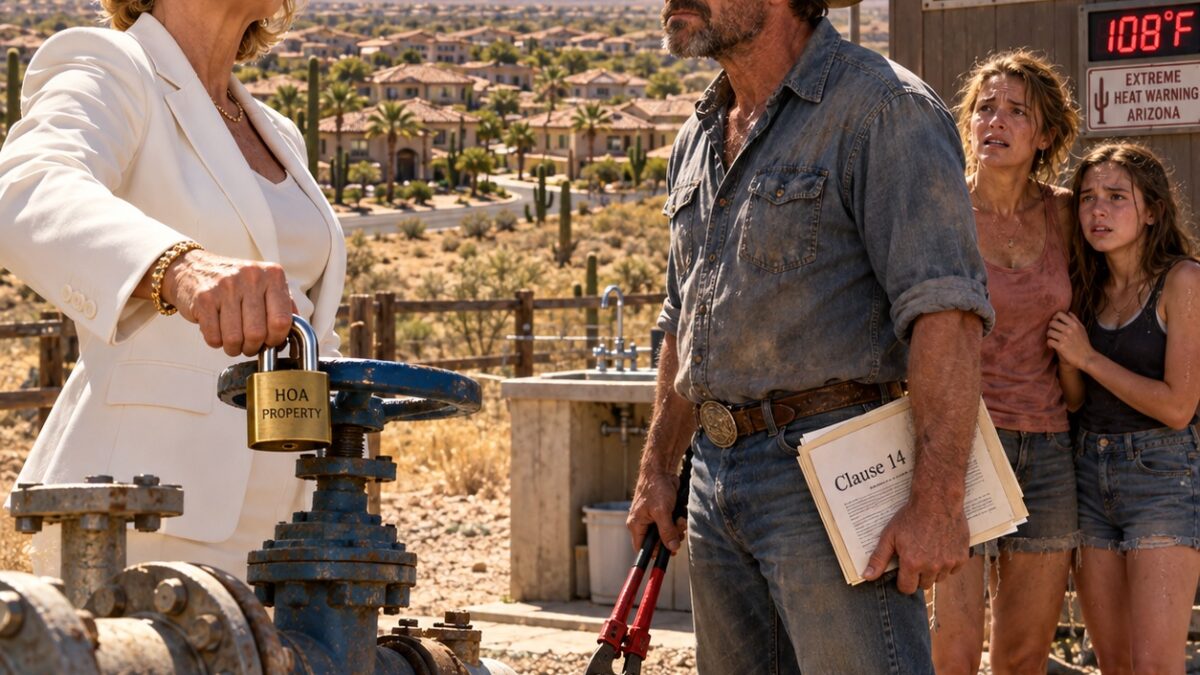
Four weeks later, Brenda padlocked our water valve.
After restoring service, I drove to the sheriff’s substation.
Deputy Nolan Griffith took the report.
Young.
Careful.
I showed him photographs.
Explained the heat.
My wife.
My daughter.
The valve.
He nodded.
“I believe you.”
Then:
“Proving who actually turned it without footage is going to be hard.”
“I know.”
A report without evidence is only a starting point.
But a report with a date, time, photographs, and deputy number is the first brick.
I went home.
Bought a forty-seven-dollar trail camera.
Pointed it at the valve.
If anybody touched that valve again, I wanted a face.
That night Lorraine asked:
“Are you worried?”
“No.”
She gave me the look she used on eighth graders who claimed their printer mysteriously deleted only the homework assignment.
“Wade.”
I kissed her forehead.
“I’m prepared.”
“There’s a difference?”
“Big one.”
Two weeks later, another attack.
Pinal County Environmental Health notice taped to the well gate.
Anonymous contamination complaint.
The county sent a technician.
She took water at three points.
Wellhead.
Distribution branch.
Kitchen faucet.
Five days later:
Coliform absent.
Nitrates low.
Arsenic nondetect.
pH 7.4.
The well did not merely pass.
It exceeded drinking-water standards.
Twenty-two years as a water engineer meant I treated that system like a surgical instrument.
But Brenda had not waited for results.
The same week she filed the complaint, she emailed every resident.
URGENT: COMMUNITY WATER SUPPLY MAY BE CONTAMINATED
Buy bottled water immediately.
Two hundred families.
Children.
Elderly residents.
People panicked.
Three families installed whole-house filtration systems.
Five hundred dollars each.
For water that was already cleaner than many municipal systems.
Three days later, I saw Brenda at the mailbox cluster.
She held a bundle of HOA envelopes.
Looked directly at me.
“Maybe if your family maintained that well properly, people wouldn’t be afraid.”
I stared.
Then she added:
“But I suppose maintenance isn’t really your strong suit.”
The words were slow.
Deliberate.
I knew exactly what she was implying.
That our family had neglected the thing feeding her community.
That somehow Henry’s legacy was dirty.
I said nothing.
Walked to my truck.
Dust hung in the air.
Her white Navigator reflected sunlight so brightly it hurt to look at.
All around Copper Ridge, residents were pouring out perfectly clean water because Brenda told them to fear it.
I sat on my porch for a long time that evening.
The pump cycled beneath the ground.
Steady.
Low.
Almost like a heartbeat.
I considered calling a lawyer then.
Did not.
My father used to say:
“When someone is digging their own grave, don’t grab the shovel.”
So I waited.
Earl came by after sunset.
He looked worried.
“Craig’s talking to the county.”
“About what?”
“Emergency water district.”
I understood immediately.
“Eminent domain.”
He nodded.
The plan was simple.
Declare the Ellison well a critical community asset.
Use a manufactured public-health emergency.
Move toward government acquisition.
Seize the well.
Then Craig could supply not only Copper Ridge but the thirty-home expansion he wanted north of the ridge.
Public safety language wrapped around private profit.
Then Tess came home from basketball camp.
Dropped her bag.
Sat on the couch.
Quiet.
Lorraine looked at me.
I sat across from her.
“What happened?”
“A girl said our water is poison.”
I felt something tighten in my chest.
“She said her mom said our family is making everybody sick.”
Fourteen years old.
Sitting inside the home Henry built.
Being told her family legacy was toxic.
Lorraine sat beside her.
I stood in the doorway.
That night I could not sleep.
Ceiling fan.
Coyotes far away.
Lorraine breathing beside me.
I thought about Tess learning to ride horses.
Her science fair projects.
Her excitement when she understood aquifer filtration.
Then some parent repeated Brenda’s lie to a child.
And that lie followed Tess into school.
That was the line.
Not the barn.
Not the fines.
Not even the water valve.
My daughter.
The next morning I called Nash Webb.
Old colleague from Arizona Department of Water Resources.
He owed me a favor from a 2016 distribution failure in Maricopa.
“I need records.”
“What kind?”
“Everything involving Copper Ridge, Pinnacle, and any water-district filings tied to the Ellison well.”
He whistled.
“That sounds cheerful.”
“It isn’t.”
Friday, he called.
“You sitting down?”
That is rarely a good question.
He sent the documents.
I spread them across the kitchen table Saturday morning.
Lorraine brought coffee.
Clause 14 was exactly where I remembered it.
Then came the real discovery.
Pinnacle Development went bankrupt in 2021.
Its assets were sold.
The development rights and HOA management contract were purchased by:
RIDGELINE HOLDINGS LLC
Single-member Arizona company.
Owner:
Craig Lockhart.
I looked at Lorraine.
“Craig owns the management company.”
She read the page.
“So Brenda…”
“Isn’t just a volunteer president.”
She was effectively working inside a management structure controlled by her husband.
Then we pulled financial statements.
HOA dues up twenty-two percent over three years.
About forty-seven thousand dollars paid to Ridgeline Holdings for:
INFRASTRUCTURE MAINTENANCE ASSESSMENTS
I drove through Copper Ridge.
Playground equipment rusting.
Pool pump grinding.
Landscaping dying.
Forty-seven thousand dollars paid.
Almost nothing visibly maintained.
The Lockharts were not only trying to pressure us into selling.
They were pulling money out of the HOA while positioning themselves to seize the well for a second development.
The ranch was not an eyesore.
It was an obstacle.
The well was not contaminated.
It was profitable.
The violation letters were not about compliance.
They were leverage.
For the first time, every piece fit.
I sat at the table looking at Henry’s name on the original agreement.
My grandfather had bought that land when people told him a Black man had no business putting money into desert property.
He held it when banks treated him differently.
When neighbors did not always welcome him.
When the county office tried directing him somewhere else.
Dad kept it through recessions.
Henry kept the well running through drought.
Now Craig Lockhart thought an LLC, a friendly commissioner, and a manufactured emergency could take it.
Wrong family.
Monday morning, I called Jill Weaver.
Water-rights attorney in Tucson.
Sharp.
Patient.
Had met her at a conference years earlier.
She answered:
“Tell me everything.”
I did.
Every letter.
Every fine.
Craig inside the well enclosure.
Padlocked valve.
Contamination report.
Mass email.
Shell company.
Maintenance payments.
Eminent-domain plan.
When I finished, Jill remained silent.
Then:
“You want Clause 14.”
“Yes.”
“You understand what you’re asking.”
“Two hundred houses.”
“In July.”
“I know.”
“If you invoke it, you need to follow it perfectly.”
“Thirty days written notice.”
“Certified.”
“Yes.”
“Document every violation.”
“Already started.”
Jill laid out the plan.
Evidence package.
Formal ADWR complaint.
Clause 14 notice.
No shortcuts.
No emotional language.
We spent three days building the binder.
Lorraine helped.
Tess helped.
That part made me proud and angry at the same time.
My fourteen-year-old daughter organized photographs.
Post-it labels.
Dates.
Locations.
She treated it like lab work.
Violation notices.
Returned envelope with Brenda’s red marker.
Craig trespass.
Padlock.
Police report.
Water tests.
Contamination email.
Financial records.
Ridgeline documents.
Everything numbered.
Tabbed.
Cross-referenced.
Jill told me:
“A judge should understand this case in five minutes.”
I built it so a judge could understand it in three.
Four copies.
Jill.
County.
ADWR.
Mine.
Then I went back to engineering.
Digital well monitoring.
Remote master valve.
Encrypted controls.
Flow sensors on every distribution branch.
Four weatherproof cameras.
Well house.
Access road.
Both sides of the easement.
From my phone I could see:
Pressure.
Flow.
Valve position.
Consumption.
I had designed municipal systems serving thousands.
This was the most personal water system I had ever built.
I could isolate Copper Ridge without interrupting the Ellison ranch.
That mattered.
Groundwater rights in Arizona are complicated, but one principle in our situation remained clear:
Copper Ridge did not own the well.
Its access came from contract.
Craig’s emergency-district proposal could not simply erase ownership without proper legal process.
And the process he was trying to invoke required safeguards he was attempting to avoid.
I contacted the three families who bought filtration systems.
Showed them the county tests.
Clean.
One man, Keith Palmer, stared at the report.
Then at me.
“We spent five hundred dollars.”
“I know.”
“Brenda knew?”
“The final results were available before her mass email.”
His expression changed.
Not shouting.
Worse.
Quiet anger.
Earl contacted people who remembered Henry during the drought.
Six of them agreed to attend future meetings.
“Your grandfather never turned anybody away,” Earl said.
“They need to remember.”
The night before I mailed the Clause 14 notice, Lorraine sat on the edge of our bed.
Fan turning slowly above us.
Coyote somewhere outside.
She asked:
“Is shutting off water to two hundred families the right thing?”
I sat beside her.
“I’m not trying to punish them.”
“But they’ll lose water.”
“For a short period.”
“In July.”
“I know.”
She looked at me.
“So tell me why.”
“Because Craig is trying to make them believe he controls the well.”
I paused.
“He doesn’t.”
“And if they blame you?”
“I’ll be the villain for thirty days.”
Lorraine frowned.
“That is not reassuring.”
“The water will come back.”
I took her hand.
“But if we keep giving in, Craig takes the well. Then it never comes back to us.”
The next morning, I mailed the notice personally.
Certified.
Return receipt.
Tracking number.
Thirty-day clock.
Brenda received it Thursday.
By Friday she was knocking on doors.
Earl called every two hours with updates.
Her message:
Wade Ellison is holding your community hostage.
Wade is threatening children.
Wade is using water as leverage.
Craig filed for an emergency injunction.
Monday.
Pinal County Superior Court.
Wednesday hearing.
His attorney argued:
Two hundred families.
Extreme heat.
Public danger.
Irresponsible private well owner.
Jill waited.
Then stood.
Water agreement.
Clause 14.
She read it aloud.
Presented:
Padlock photographs.
Police report.
False contamination complaint.
County tests.
The judge listened.
Then denied the injunction.
“The contract is clear.”
She looked toward Craig’s side.
“Mr. Ellison followed the agreed notice procedure after documented interference with his property rights.”
Then:
“This court will not rewrite a valid contract simply because one party now dislikes the consequence.”
Craig’s face went dark red.
Brenda sat behind him gripping her clipboard hard enough to bend the metal clip.
They retaliated that night.
Next morning, ranch fence cut in three places.
Clean bolt-cutter marks.
Duke and Penny gone.
My horses.
Penny had reached the county road.
A thousand-pound horse standing near traffic before sunrise.
Lorraine could have hit her driving home.
Tess could have.
Anyone.
I found Duke farther down the wash.
Spent three hours repairing wire in 110-degree heat.
Leather gloves soaked through.
Fence wire almost too hot to touch.
Lorraine brought water twice.
Cold.
From our well.
Tasted like home.
I installed four more trail cameras.
Overlapping angles.
Infrared.
No dead zones.
Three nights later:
2:14 a.m.
Two men.
Dark clothes.
Bolt cutters.
Infrared image clear enough to read the logo on one man’s jacket.
Truck parked down the road.
Registration traced to:
LOCKHART CONSTRUCTION LLC
I backed the footage up three times.
Cloud.
External drive.
Phone.
That evidence was never disappearing.
Brenda escalated against Tess.
Contacted a school-board acquaintance.
Claimed I had threatened to poison the community water supply.
The board member called the principal.
The principal pulled Tess out of biology class.
Asked whether our family was having “difficulties.”
That evening, Tess sat at the kitchen table surrounded by her science-fair materials.
pH strips.
Filtration samples.
Data charts.
She looked at me.
“They think we’re the bad guys.”
I had been repairing fence all morning.
The smell of hot metal and dust still clung to my shirt.
“Nineteen more days.”
“And then what?”
“Then everybody gets the same evidence.”
She looked down.
“The truth?”
“The whole thing.”
Heat worsened.
No monsoon.
Clouds formed every afternoon.
Then disappeared.
Tess put a calendar on the refrigerator.
Counted down.
Day 30 marked with a blue water drop.
Day 25, Craig filed the formal emergency water-district paperwork.
He described:
Public-health threat.
Critical infrastructure.
Vulnerable residents.
Emergency need.
But Nash had already flagged the application.
When the filing reached ADWR, investigators were waiting.
Ridgeline Holdings.
Craig’s ownership.
Forty-seven thousand dollars.
Maintenance invoices.
Second development.
Attempted well acquisition.
The same man asking government to seize a private well also secretly controlled the HOA management contract and stood to profit from expanding service to additional houses.
Commissioner Phil Reeves had been friendly with Craig.
Golfed with him for three years.
ADWR called Reeves.
Eleven-minute conversation.
Next morning, Reeves withdrew support.
Public statement:
Proper procedural safeguards must be observed in matters affecting essential water infrastructure.
Political translation:
I am getting away from this.
Craig was suddenly alone.
Injunction denied.
County support gone.
Shell company exposed.
Contamination claim disproven.
And the clock kept moving.
Day 28, I drove past Copper Ridge.
Sprinklers running.
Kids at the splash pad.
Pool full.
Water everywhere.
My family’s water.
I did not feel good about what was coming.
But I no longer doubted it.
Every drop came from infrastructure Henry built.
The people controlling Copper Ridge had tried to use that generosity as a weapon against his family.
The community needed to understand the distinction.
Day 29.
Brenda called an emergency HOA meeting.
More than 150 residents packed the community center.
Fans humming.
Heat trapped inside.
Brenda stood at the microphone.
White blouse.
Hair perfect.
Full command voice.
“This man, Wade Ellison, is holding our water hostage.”
Murmurs.
“He is threatening children.”
More.
“He is trying to bully this community into surrender.”
Then she asked residents to authorize further legal action.
But the room had changed.
Keith Palmer sat in the third row.
Arms crossed.
He stood.
“Mrs. Lockhart.”
Brenda looked annoyed.
“You told us the water was contaminated.”
“We acted out of an abundance of caution.”
“My family spent five hundred dollars on a filtration system.”
“I’m sorry you feel—”
“Did you have the county test results when you sent that email?”
She blinked.
“The results came after—”
“No.”
Keith held up paper.
“I checked. They were posted before your email.”
The room shifted.
Not loudly.
Chairs.
Whispers.
People turning toward one another.
Then Earl stepped forward.
Two pages in his hand.
“County test.”
He held one up.
“Clean.”
Then another.
“Brenda’s email.”
He looked around.
“She lied.”
Vote.
Authorize additional action against me?
One hundred twelve:
No.
Thirty-eight:
Yes.
Brenda’s face tightened.
“Fine.”
She gripped the podium.
“When your faucets run dry tomorrow, remember who you sided with.”
I had been standing near the back.
Arms folded.
I waited until the room settled.
Then said:
“Tomorrow is day thirty.”
Everybody turned.
“I’m not the one you should be afraid of.”
Then I left.
My shoes squeaked on the linoleum.
Noise exploded behind me.
Day 30.
Forecast:
112 degrees.
I reached the well house at five in the morning.
Sky black fading into purple above the Superstitions.
Phone:
Pressure normal.
Flow normal.
Reservoir stable.
I entered the code.
Opened the well house.
The pump hummed.
Same low mechanical sound I had heard since childhood.
Master manifold.
Two branches.
Copper Ridge.
Ellison Ranch.
I put my hand on the Copper Ridge valve.
For a second I saw Henry.
Eighty-six.
Folding chair beside the road.
Giving water away.
Water is something you steward.
I closed the valve.
Phone screen updated.
COPPER RIDGE DISTRIBUTION: 0 GPM
ELLISON RANCH: NORMAL
I locked the well house.
Walked outside.
A roadrunner crossed the gravel.
Stopped.
Looked at me.
Kept going.
Desert did not care.
I drove home.
Made coffee.
Sat beside Lorraine.
Sunrise lit the desert willows.
Neither of us talked much.
Somewhere in Copper Ridge, a shower valve opened.
Nothing.
By seven, phone calls.
By nine, residents gathering.
By ten, emergency meeting.
This time:
About 250 people.
More than the subdivision had homes because spouses, family members, and others had come.
Reporter from the Pinal County Independent.
Deputy Griffith.
Brenda at the microphone.
She looked different.
Fear underneath anger.
“He’s a terrorist.”
The room reacted.
She pointed toward the door.
“Deputy, arrest him.”
Then the door opened.
I walked in beside Jill Weaver.
Jill carried a leather portfolio.
I carried nothing.
She took the microphone.
“My name is Jill Weaver.”
Silence.
“I represent Wade Ellison, owner of the Ellison well.”
She placed the recorded water agreement on the table.
“This is the contract Copper Ridge accepted when the development was created.”
Then she read Clause 14.
Every word.
People listened.
Then came the evidence.
Photograph:
Brenda’s padlock on my valve.
Police report.
Temperature:
108 degrees.
My wife and fourteen-year-old daughter inside.
Water-test results.
Clean.
Brenda’s mass email.
Sent after those results were available.
Trail-camera images.
Two men cutting our ranch fence.
Lockhart Construction truck.
Ridgeline Holdings.
Craig as sole owner.
HOA management contract.
Forty-seven thousand dollars in maintenance payments.
Lack of maintenance.
Every document landed like a card.
Jill did not raise her voice.
Did not need to.
Then I stepped forward.
Two hundred fifty faces.
Some angry.
Some embarrassed.
Some frightened.
I looked at Brenda.
Then the residents.
“I didn’t cut your water first.”
I pointed toward Brenda.
“She did.”
The room stayed silent.
“Six weeks ago, Brenda Lockhart padlocked my family’s water line during a 108-degree heat wave.”
I looked toward the back.
“My wife and daughter were inside.”
Then:
“She filed a false contamination complaint.”
Next document.
“She told you the water was unsafe after county testing showed it was clean.”
Next.
“Craig trespassed on my well property.”
Next.
“His company’s truck was recorded while men cut my fences and released my horses.”
Next.
“His shell company received forty-seven thousand dollars of your HOA money through maintenance charges.”
Then the water-district filing.
“And he attempted to use an emergency government process to take my family’s well while planning another development that would need this water.”
I paused.
Portable fan cycling in the corner.
“I followed the contract.”
Thirty days.
Certified notice.
No hidden move.
No midnight shutoff.
No padlock.
“Every word.”
Deputy Griffith stepped away from the door.
Walked toward the front row.
Craig was sitting there trying to make a large man look small.
“Mr. Lockhart.”
Craig looked up.
“Stand up.”
The handcuffs closed.
That sound changed the room.
Not applause.
Not yet.
Understanding.
Craig faced charges tied to water-supply tampering, fraud, criminal damage, and the evidence under investigation.
Brenda remained at the podium.
Clipboard hanging from one hand.
She looked as if someone had unplugged her.
Deputy Griffith turned toward her.
She was cited in connection with the false government report, HOA financial misconduct, and conspiracy involving interference with utility service.
I leaned toward the microphone once more.
“The water comes back on in one hour.”
Several people looked at me.
“It always belonged to this community under our agreement.”
I looked at Brenda.
“But it never belonged to her to control.”
Then I walked outside.
112 degrees.
Heat hit like a wall.
For some reason it felt lighter.
Two women stopped me near the parking lot.
One was crying.
“We didn’t know.”
I nodded.
“We didn’t know what they were doing to your family.”
“The water will be back.”
She grabbed my hand with both of hers.
“Thank you.”
Then:
“And thank your grandfather.”
I sat in the truck.
The steering wheel was too hot to hold.
Wrapped my shirt around my hand.
Started the engine.
Drove home with the windows open.
Hot desert air filled the cab.
Dry.
Honest.
11:47 a.m.
I sat on the porch.
Glass of well water sweating in my hand.
Lorraine beside me.
Tess inside working on her science project.
I opened the control app.
Selected Copper Ridge.
OPEN MASTER DISTRIBUTION VALVE?
I tapped yes.
Flow increased.
Ten gallons per minute.
Forty.
One hundred.
Pressure began rising downstream.
Two hundred homes filled with the sound of pipes waking up.
I drank from my glass.
Cool.
Mineral.
Home.
The Lockharts’ consequences continued after that day.
Craig faced felony water-tampering and fraud charges.
ADWR referred the larger file to the state attorney general.
Ridgeline.
Invoices.
Attempted seizure.
Fence cutting.
It was all documented.
Brenda was removed as HOA president by emergency vote that same week.
The Lockhart house went on the market in September.
Then came the independent audit.
Forty-seven thousand dollars in homeowner money missing or misused through three years of supposed infrastructure work.
The money should have repaired the playground.
Instead, rusted bolts remained exposed.
Should have fixed the pool pump.
It had been grinding for months.
Should have restored landscaping along the boulevard.
Brenda blamed that failure on water pressure.
Which was particularly rich after she had been the one manipulating water access.
The new board issued refunds.
Some small.
Hundred dollars.
Two hundred.
The amounts mattered less than what they represented.
People began showing up to meetings.
Reading budgets.
Asking questions.
That may have been the best result of the entire fight.
Copper Ridge had spent years trusting Brenda and Craig because challenging them felt exhausting.
Now people wanted to see invoices.
Contracts.
Votes.
Water-quality reports.
Transparency.
In October, Copper Ridge voted to form a water cooperative.
The Copper Ridge Water Cooperative.
I kept ownership of the well.
That was nonnegotiable.
Henry’s well.
Ellison land.
But distribution management moved to an elected board.
Transparent budget.
Quarterly water-quality reports.
Publicly posted.
Flow and maintenance records.
Our supply agreement was updated.
Not erased.
Clause 14 remained, but we added clearer notice and dispute procedures so no future board and no future well owner could easily drag two hundred families into another crisis.
That mattered to me.
I had used Clause 14 because the Lockharts left me no safe alternative.
I did not want Tess someday inheriting a weapon disguised as a contract.
I wanted her inheriting a system that made the weapon unnecessary.
Keith Palmer joined the cooperative board.
The same man who had stood up to Brenda at the emergency meeting.
The three families who had bought unnecessary filtration systems received refunds.
Two came from Brenda’s personal settlement.
The cooperative covered the third as a goodwill measure.
People asked me whether I resented paying anything through cooperative funds.
No.
The family had been lied to.
Fix the damage.
Then move forward.
The well had always been about taking care of people.
Henry would have understood that.
In November, I created the Henry Ellison STEM Scholarship.
Fifteen hundred dollars a year.
Pinal County student pursuing water science, environmental engineering, hydrology, or something related.
The first recipient was seventeen.
Family could not afford community-college tuition.
She wanted to become a hydrologist.
I met her at a small ceremony.
She shook my hand.
Nervous.
Then asked about the Ellison well.
“How deep?”
“About six hundred feet.”
“What formation?”
I smiled.
“Now you’re asking the right questions.”
Henry would have loved her.
He drilled that well so his family could live on land everybody else said was worthless.
Then he spent decades using the same water to help other people.
The scholarship felt like the same idea through different plumbing.
The well gave water.
The scholarship gave opportunity.
Same source.
Different pipes.
Tess’s story changed too.
That spring, she entered the Pinal County Science Fair.
Her project:
Groundwater Filtration Efficiency in Arid Aquifer Systems.
Our kitchen became a laboratory for two months.
Sand.
Gravel.
Charcoal.
pH strips.
Conductivity meter.
Plastic columns.
Lorraine threatened to move dinner permanently to the porch.
Tess built her display board herself.
At the center was an old photograph of Henry.
Standing beside the newly completed well.
Squinting against the Arizona sun.
One hand on the pump housing.
Smile on his face like a man who had struck gold.
In a way, he had.
Tess won.
First place.
I tried not to embarrass her.
Failed.
Took too many photographs.
The girl from basketball camp—the one who had said our water was poison—found Tess afterward.
I saw them talking from across the room.
Later, Tess told me:
“She apologized.”
“What did you say?”
“I said okay.”
“That’s it?”
“She asked if we could be lab partners next year.”
“And?”
“I said yes.”
I looked at her.
“That was generous.”
She shrugged.
“She was repeating what adults told her.”
Fourteen years old.
Already understood something people twice her age did not.
Some evenings Lorraine and I still sit on the porch.
The Lockhart signs are gone.
Their Navigator is gone.
Craig’s trucks no longer come near the property.
The desert willows cast long shadows.
Duke and Penny stand in the corral.
The pump hums beneath everything.
Most of the time, you stop hearing it.
Then something makes you listen.
The sound is low.
Steady.
Sixty-five years.
I keep one object from the whole conflict in a drawer.
Brenda’s padlock.
Cut clean through the shackle.
I did not keep it as a trophy.
I keep it because it reminds me how close arrogance can come to becoming dangerous when nobody challenges it.
Fifteen dollars of brass.
That was all it took to turn off our house.
A woman with no jurisdiction believed authority came from deciding she had it.
That belief almost pushed our home into dangerous heat.
Set off a false contamination panic.
Put horses on a county road.
Dragged Tess into school gossip.
And nearly became the pretext for taking a family well.
The danger was never the padlock itself.
It was the belief behind it.
Brenda thought:
If I can physically close the valve, the water belongs to me.
Craig thought:
If I can get a county form signed, the well becomes mine.
They both confused access with ownership.
Influence with law.
Pressure with consent.
My grandfather had understood the difference decades before them.
That is why he kept the well when we sold the forty acres.
Why our attorney wrote Clause 14.
Not because Henry hated Copper Ridge.
Copper Ridge did not even exist yet.
Because stewardship requires boundaries.
He shared water freely during drought.
That did not mean anyone had the right to seize the pump.
Generosity is not surrender.
I thought about that during the thirty-day notice.
Some residents later asked why I did not simply sue Brenda and leave the water running.
I could have.
Jill and I discussed it.
The problem was Craig’s eminent-domain push.
Every day the subdivision continued drinking while the Lockharts told everyone I was unreliable strengthened their public narrative.
They were trying to turn a private well into something the government supposedly needed to rescue.
Clause 14 forced the issue into daylight.
For thirty days, everybody knew the exact deadline.
Craig went to court.
Lost.
The residents voted.
Brenda lost.
ADWR investigated.
Craig lost county support.
By the time I closed the valve, the argument was no longer:
Can Wade legally do this?
The court had already answered that.
The question became:
Why did the contract give him this right?
That question led everybody back to Brenda’s padlock.
And that was the truth she had spent six weeks trying to bury.
I never enjoyed the hour those homes were dry.
I want that understood.
Children lived there.
Older people.
Families who had never met me.
Most had done nothing wrong.
That is why I restored service when I said I would.
The point was never to leave them thirsty.
The point was to stop one couple from using their need for water as justification to take the source from my family.
After the cooperative formed, I attended the first meeting.
No elevated stage.
No Brenda.
No white Navigator idling outside.
Just folding chairs.
Residents.
Keith holding a budget sheet.
Quarterly quality report projected on the wall.
Coliform:
Absent.
Nitrates:
Safe.
Arsenic:
Nondetect.
pH:
7.4.
Somebody laughed when that number appeared.
People remembered the contamination scare.
Keith looked at me.
“Anything you want to add?”
I shook my head.
“The water speaks for itself.”
That got another laugh.
I liked that meeting more than I expected.
Not because everyone suddenly loved me.
They did not.
A few residents remained angry about the shutoff.
I understood.
Trust does not rebuild in one hour.
But people were asking useful questions.
Where does maintenance money go?
When was the pump last serviced?
What happens if an emergency valve fails?
Who has access?
Who reviews invoices?
Good.
That was what governance should look like.
Not one woman saying:
The board disagrees.
A board where people could actually see the disagreement.
Lorraine once asked me whether I would have invoked Clause 14 if Brenda had never cut our water.
“No.”
“What if she had stopped after the violation letters?”
“No.”
“Contamination complaint?”
I thought about it.
“Probably still no.”
“Fence?”
“That changed things.”
“Tess?”
I looked at her.
“That changed me.”
Lorraine nodded.
She knew.
There are moments in conflict when the subject stops being money or property and becomes what you are willing to teach your child.
If I had sold after Tess was told our family was poisoning people, what would she have learned?
That a lie repeated loudly enough becomes title?
That inherited land only belongs to you until somebody with more connections wants it?
That Henry’s generosity made us vulnerable?
No.
I wanted her to learn a different lesson.
Documents matter.
Process matters.
Evidence matters.
Your voice does not need to be the loudest if the truth can survive scrutiny.
That is what she saw at the community center.
Not her father screaming.
Not threatening anyone.
Jill reading a contract.
Water tests.
Camera footage.
Bank records.
Then the deputy doing his job.
Paperwork sounds boring until somebody uses power against you.
Then paperwork becomes architecture.
Every letter I saved became a beam.
Every photograph a brace.
Police report.
County lab report.
Corporate filing.
Trail-camera footage.
By the end, the evidence held itself up.
I did not have to shout.
That was the part Henry would have appreciated.
He was never a loud man.
During the 2011 drought, people sometimes tried paying him.
He refused.
One man slipped twenty dollars under the folding chair.
Henry found it.
Made me drive to the man’s house to return it.
“He needs that money more than this well does.”
That was Henry.
He never confused kindness with weakness either.
A neighbor once tried moving a fence forty feet onto our property.
Grandpa quietly hired a surveyor.
Reset the corner.
Then built a new fence exactly on the line.
When the neighbor complained, Henry handed him the survey.
No argument.
No insult.
Just:
“That’s where the land ends.”
I think about that a lot.
The Lockharts came at us with noise.
Emails.
Violation notices.
Emergency claims.
County pressure.
Threats.
Henry would have hated all of it.
Not because he was afraid of conflict.
Because he disliked wasted motion.
He would have wanted one thing.
Where is the line?
Clause 14 was the line.
The deed was the line.
The well ownership was the line.
Brenda crossed it when she padlocked our water.
Everything afterward was consequence.
The desert has a way of making lines clear.
Shade or sun.
Water or no water.
Rain or drought.
You learn quickly that the environment does not care about your titles.
You either understand the system or the system punishes you.
That is why Craig’s plan offended me professionally as much as personally.
He treated water like real-estate inventory.
Thirty more houses.
Thirty more connections.
More fees.
More profit.
But aquifers are not magic.
Pumping matters.
Recharge matters.
Capacity matters.
Expansion without proper analysis can damage everyone.
He wanted the well because Henry had done the expensive part decades ago.
Find the aquifer.
Drill.
Maintain.
Protect.
Craig wanted to inherit the benefit without respecting the stewardship.
The new cooperative changed that conversation.
Before any future expansion, they would need engineering review.
Capacity study.
Water-rights analysis.
Transparent vote.
I insisted on it.
The board agreed.
If Copper Ridge ever grows, it should happen because the system can support it.
Not because one developer sees empty desert and calculates roofs.
That was one of the quiet victories.
Not dramatic.
But important.
Tess eventually began helping with quarterly sampling.
Not because anyone required it.
She wanted to.
Gloves.
Sterile bottles.
Chain-of-custody forms.
She loved the procedure.
The first time she collected a sample from the wellhead after winning the science fair, she held it up to the light.
“Clear.”
“Scientific observation.”
She rolled her eyes.
“You know what I mean.”
“Write it down.”
“Dad.”
“Data.”
She smiled.
Then wrote:
Sample visually clear. No observable sediment.
Exactly what I would have done.
Lorraine watched us from the porch.
“Two water nerds.”
“Engineers.”
“Tess isn’t an engineer.”
“Yet.”
Tess looked over.
“I said hydrology.”
I raised my hands.
“Sorry.”
That became another gift from the whole mess.
Before Brenda’s contamination lie, Tess liked science.
Afterward, water became personal.
She wanted to understand not only what came from the tap but how misinformation spreads around science.
Her project included a section on public trust.
That was hers.
I did not help.
She wrote:
A water system depends on chemistry, infrastructure, and public confidence. If one fails, people stop trusting the others.
Fourteen.
I still think about that sentence.
Brenda damaged confidence more quickly than she ever damaged the water.
A false email made clean water feel unsafe.
That is why transparent reporting mattered afterward.
The cooperative could not simply tell residents the water was good.
It had to show them.
Numbers.
Dates.
Independent tests.
Trust requires evidence once someone has abused it.
Maybe communities are not that different from water systems.
Pressure has to be controlled.
Valves need limits.
Redundancy matters.
No single point should be allowed to fail catastrophically.
Under the Lockharts, Copper Ridge had a single point of failure.
Them.
Brenda controlled messaging.
Craig controlled management money.
Their connections influenced county action.
Nobody else had visibility.
The cooperative distributed control.
Elected board.
Published budget.
Independent testing.
Separate well ownership.
Better system.
An engineer could not have designed the lesson more clearly.
One afternoon Earl came to the ranch carrying an old photograph.
Henry.
1970s, maybe.
Standing beside a line of horses.
Earl said:
“Found this in my wife’s things.”
I took it.
Grandpa looked younger than I remembered.
Broad shoulders.
Work shirt.
Hands on hips.
Behind him, the desert willows were barely taller than fence posts.
“You think he’d approve?”
Earl looked toward Copper Ridge.
“Of what?”
“All of it.”
He scratched his chin.
“He’d probably say you made too much noise.”
I laughed.
“He’d be right.”
“Then he’d ask whether everyone had water.”
I looked toward the well.
“Yeah.”
“They do.”
“Then he’d go inside for dinner.”
Exactly.
The story became larger than Henry would have liked.
Newspaper.
County meeting.
Legal filings.
People talking.
He would have been embarrassed by the scholarship name.
Would have tried renaming it after somebody else.
That is probably why we kept his name on it.
The first scholarship recipient sent Tess a message months later.
She had enrolled.
Intro hydrology.
Loved it.
Tess printed the email and put it on the refrigerator.
Right beside the old thirty-day countdown calendar.
The blue water drop was still drawn on day 30.
I had almost thrown that calendar away.
Did not.
It reminded me how differently the same symbol can feel.
During the conflict, the blue drop meant confrontation.
Later it meant something else.
Water still flowing.
School.
Opportunity.
A future.
That is a better use.
The Lockhart house sold.
New family moved in.
They came to the ranch one evening.
Man and woman.
Two kids.
They looked nervous.
The husband said:
“We wanted to introduce ourselves.”
“Come in.”
They had heard the story.
Of course.
Everyone had.
He said:
“We’re not like them.”
I smiled.
“You don’t have to prove anything to me.”
His wife looked toward the well house.
“So that’s it?”
“That’s it.”
“The well?”
“Yep.”
Their son asked:
“Does all our water come from there?”
“Most of it.”
“Can I see it?”
His mother immediately said:
“No.”
I laughed.
“Maybe someday with your parents.”
The boy looked disappointed.
Good.
Healthy curiosity.
Not fear.
That was another sign Copper Ridge had moved on.
Children growing up without understanding the well as a weapon.
Just infrastructure.
Exactly as it should be.
I kept the cameras.
Not all eight.
The well-house cameras stayed.
So did the remote valve system.
Engineering improvements do not become unnecessary just because bad actors leave.
But I removed most of the trail cameras along the fence.
Duke and Penny seemed happier not triggering infrared lights every time they walked near mesquite.
I repaired the fence permanently.
New wire.
New posts where necessary.
Craig’s men had left scars in the old line.
Those repairs remained visible for a while.
Bright metal against weathered fence.
Eventually dust dulled them.
That is what time does.
Makes repairs belong.
The same thing happened inside our family.
For weeks after the water shutdown, Tess checked the kitchen faucet more than she needed to.
Turn it on.
Turn it off.
Almost unconscious.
Lorraine noticed too.
One evening, she asked:
“You checking it?”
Tess looked embarrassed.
“No.”
Water still dripped from the faucet.
I understood.
When something essential disappears unexpectedly, your body remembers even after the problem is gone.
So I started showing her the system.
Not just telling her it was safe.
Phone dashboard.
Pressure reading.
Tank status.
Pump cycles.
If she woke worried, she could check.
Eventually she stopped.
Knowledge restored trust.
That mattered more than reassurance.
Lorraine had her own version.
During the worst weeks, she kept bottled-water cases in three rooms.
Kitchen.
Laundry.
Bedroom closet.
After everything ended, she kept buying them.
I never mentioned it.
Months later, I noticed only one case remained.
Then none.
Healing is often boring.
No announcement.
One day you realize nobody is preparing for disaster anymore.
I think that was when the ranch became fully ours again.
Not legally.
It had always been ours.
Emotionally.
No one watching for the Navigator.
No inspection letters.
No rumors from school.
Just desert.
Horses.
Well.
Family.
Some people asked whether I ever considered selling after all that.
No.
Not once after discovering Craig’s plan.
Before?
Maybe.
Land is work.
Five acres does not sound like much until something breaks.
Barn roof.
Fence.
Pump maintenance.
Horses.
Dust.
Heat.
But once somebody tried to pressure us off it, the meaning changed.
This was not only real estate.
It was Henry’s decision in 1961.
Dad’s decision after him.
Our family’s proof that they could tell a man the land was worthless and he could make it sustain four generations anyway.
That does not mean inherited land must never be sold.
Families change.
Needs change.
But if the Ellisons ever sold, it would be because an Ellison decided.
Not because a Lockhart manufactured enough fear.
That distinction mattered.
The water cooperative invited me to speak at its first anniversary meeting.
I almost declined.
Lorraine told me to go.
“You started it.”
“No.”
“The Lockharts started it.”
She frowned.
“You know what I mean.”
The meeting was full.
Not tense.
People brought food.
Kids ran outside.
Keith presented the budget.
No missing money.
Water quality all green.
Maintenance schedule funded.
Then he asked me to say something.
I stood.
Looked around.
The same community that had once believed our well might be poisoning them.
I did not mention Brenda.
Did not mention Craig.
I talked about Henry.
Six hundred feet.
How the drillers thought they might miss.
How Grandma planted willows.
How people lined up during the drought.
Then I said:
“My grandfather believed water was something you steward.”
I looked toward the residents.
“That does not mean nobody owns infrastructure.”
A few people smiled.
“He was practical.”
Then:
“But it does mean water should not become one person’s weapon.”
That was all.
No applause needed.
They applauded anyway.
Afterward, an older woman approached.
She had lived in Copper Ridge since the first year.
“I signed Brenda’s petition against you.”
I nodded.
“I know.”
She looked surprised.
“How?”
“Public record.”
Of course.
“I’m sorry.”
“You thought your water was at risk.”
“I believed her.”
“That was the point.”
“She made us afraid.”
“Yes.”
The woman looked toward the ranch.
“Henry really gave water away during the drought?”
“Every day.”
She smiled sadly.
“I wish I’d known.”
Now she did.
That was enough.
There is a temptation after something like this to divide everyone into heroes and villains.
Life was not that clean.
Brenda and Craig made deliberate choices.
Documented ones.
They deserve responsibility for those choices.
But most residents were just scared.
Commissioner Reeves made the correct choice eventually, even if self-preservation helped him reach it.
County technicians did their jobs.
Deputy Griffith did his.
Jill protected the contract.
Nash followed records.
Earl remembered history.
Keith asked a question at the right moment.
Lorraine held our family steady.
Tess organized evidence when she should have been thinking about basketball and school.
Nobody fixed the situation alone.
That is something people miss when they hear a dramatic version.
They imagine one man turns a valve and defeats an HOA.
No.
The valve was the visible moment.
The real work happened earlier.
Henry drilling.
Attorney writing Clause 14.
Me saving letters.
County testing water.
Deputy documenting the shutoff.
Nash finding Ridgeline.
Jill building the case.
ADWR flagging the seizure request.
Residents asking questions.
Everything connected.
Systems matter.
That is another thing engineers believe.
A single valve rarely explains a whole failure.
Trace upstream.
Trace downstream.
Find every pressure point.
By the time I closed Copper Ridge’s valve on day 30, the system was already exposing itself.
The shutoff forced everyone to see it at once.
That is why I have never described the water as revenge.
Revenge would have been leaving it off.
Making Brenda beg.
Charging residents extra.
I did none of that.
The contract allowed suspension.
I used it.
Then restored service.
The goal was correction.
Not suffering.
That distinction is important to me because of Henry.
If I had used the well only to punish people, I would have betrayed the same legacy I claimed to protect.
He gave water during drought.
I could not turn his pump into an instrument of cruelty.
One hour was enough.
Enough to force the meeting.
Enough to break the narrative.
Enough for everyone to understand where the real authority came from.
Then water returned.
The new cooperative eventually installed a small plaque near the well road.
I argued against it.
Lost.
It reads:
HENRY ELLISON WELL
DRILLED 1961
IN SERVICE TO FAMILY AND COMMUNITY
No mention of me.
Good.
One day Tess stood beside it.
Took a photograph for a school project.
I looked at the words.
“Too sentimental.”
She laughed.
“You literally created a scholarship in his name.”
“Different.”
“How?”
“I don’t know.”
She took another picture.
“Exactly.”
She was right.
The plaque stayed.
The desert willows are much taller now.
Grandma planted them when she was young.
Their roots reached water somehow.
Every spring the flowers return.
Pale pink.
Sweet smell in the evening.
I think about her choosing beauty after utility.
The well made the land livable.
She still thought usefulness was not enough.
That is an Ellison lesson I did not understand until I got older.
Survival gets you through.
Then you build something worth surviving for.
House.
Family.
Trees.
Scholarship.
A cooperative that tells the truth about its water.
Those are the things that lasted after the Lockharts left.
Not the conflict.
That is good.
Some evenings, the sky turns orange behind the mountains.
Then purple.
Then deep indigo.
Heat finally lets go.
Duke and Penny stand in the corral.
Tails flicking.
Tess studies at the kitchen table.
Lorraine reads beside me.
The well pump cycles.
Low hum.
I take a glass from the pitcher.
Cold.
Clear.
Faintly mineral.
Sixty-five years from that aquifer and counting.
One evening Lorraine said:
“Your grandfather would be proud.”
I shook my head.
“He’d tell me I made too much trouble.”
“He’d be proud anyway.”
I drank.
Looked toward the well house.
Henry never wanted a subdivision.
Never wanted an HOA.
Never wanted his name on a scholarship.
He wanted land.
Family.
Water.
People taken care of.
That is what remained.
The Lockharts thought patience meant weakness.
They believed enough letters, fines, rumors, inspections, and pressure would make a family sell.
Instead, every one of those actions became another page in a binder.
That binder still sits in my office.
Thick.
Tabbed.
I rarely open it.
No need.
The well still runs.
Copper Ridge still drinks.
Tess’s science-fair ribbon hangs above her desk.
The scholarship sends a student to school every year.
And somewhere inside the original water agreement, Clause 14 remains exactly where it has always been.
I hope nobody ever needs it again.
That would be the best outcome.
Because the most powerful part of that contract was never the right to shut the water off.
It was the reminder that nobody—not an HOA president, not a developer, not a county official—gets to take control of what another family built simply because they believe pressure will work.
Henry understood that before any of us.
Water is something you steward.
So is land.
So is power.
And sometimes stewardship means opening the valve.
Sometimes it means knowing exactly when you are finally allowed to close it.
That evening, Lorraine rested her hand over mine.
The pump hummed beneath the desert.
I looked at the willows.
At the corral.
At the house.
Then took another sip of the same clean water my grandfather pulled out of the ground in 1961.
“He’d say we just did what the well was built to do,” I told her.
“What’s that?”
“Take care of people.”
And after everything Brenda and Craig had tried to do, that was exactly what it was still doing.








