PART2:HOA Queen Moved Her Family Into My Cabin While I Was Out of State—Then I Found My Dead Wife’s Letters in a Trash Bag in the Rain
PART2
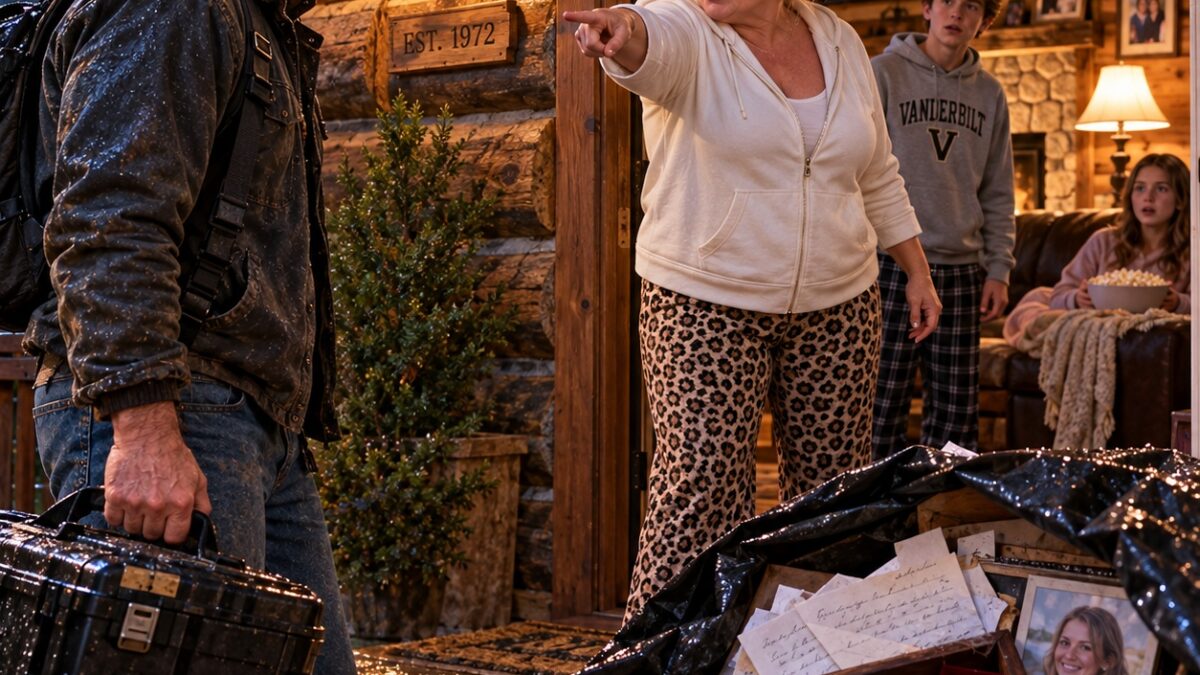
Brenda opened the door.
No surprise.
No fear.
No apology.
Just a slight tilt of the head.
“Oh,” she said. “You’re back early.”
I looked past her.
Children’s shoes near my fireplace.
Backpacks against Dad’s bookcase.
A blanket on Sarah’s sofa.
My kitchen light on.
“You’re in my house.”
She folded her arms.
“The board classified the property as abandoned under HOA Bylaw 14.7.”
“My property isn’t in your HOA.”
“We’ve updated the community boundaries.”
“No, you haven’t.”
She smiled.
“The board authorized temporary occupancy to prevent deterioration.”
I stared at her.
“Temporary occupancy.”
“That’s correct.”
“You changed my locks.”
“For safety.”
“You moved your family into my father’s cabin.”
“To preserve the property.”
Behind her, one of the kids called:
“Mom, where’s the popcorn?”
Brenda never looked away from me.
I pulled out my phone.
Called the sheriff.
Deputy Sellers arrived around forty minutes later.
Brenda had been waiting.
She handed him a folder before he finished getting out of his cruiser.
Printed HOA resolution.
Letter declaring my cabin abandoned.
Authorization for emergency lock replacement.
Everything formatted professionally.
Official logo.
Signatures.
Dates.
The deputy read it.
Then looked at me.
“Do you have the deed?”
“Not on me.”
“Anything proving the HOA doesn’t have jurisdiction?”
“At the county.”
Brenda said:
“I’ve already shown you the board authorization.”
I looked at Sellers.
“She broke into my house.”
He looked miserable.
“I understand what you’re saying.”
“Then remove her.”
“Mr. Callaway, with competing documents and an occupancy claim, I can’t determine title authority on the side of the road.”
“It is my house.”
“I’m not saying it isn’t.”
Brenda leaned against the doorway.
Sellers continued.
“This needs a judge.”
I wanted to argue.
Every muscle in me wanted to.
Instead, I looked at Brenda.
She was waiting for exactly that.
For anger.
A threat.
Anything she could later describe as dangerous.
So I nodded.
“Fine.”
Turned around.
Walked back to my truck.
Behind me, the door closed.
Then the deadbolt turned.
My deadbolt.
Inside my door.
In my father’s house.
I slept in the truck that night.
Fifteen feet from my porch.
The seat barely reclined.
October cold crept through the cab around two in the morning.
Every few hours I woke and looked at the windows.
Lights off.
Then on again when somebody used the bathroom.
Once, I saw Brenda cross my living room carrying a glass of water.
It is difficult to explain what that does to your mind.
A burglary is violation.
Somebody takes things.
Leaves.
You deal with loss.
This was different.
My home was occupied.
My memories rearranged around strangers.
And I was close enough to touch the porch rail but legally being told to wait.
At eight the next morning, I was inside the Blount County Courthouse.
Emergency possession request.
Unlawful detainer.
I explained everything to the clerk.
She listened.
Frowned.
Helped me with forms.
The judge was less sympathetic.
Tennessee procedure required written notice, waiting periods, and a formal hearing.
Brenda had documents claiming HOA authorization.
Fraudulent or not, those documents had to be challenged.
Fourteen days before a hearing could realistically happen.
I left court with paperwork in my hand and a feeling I had not experienced since Sarah’s diagnosis.
Powerlessness.
I hated it.
So I stopped thinking like a homeowner.
I started thinking like a welder.
If a structure is carrying load in the wrong place, you do not beat it with a hammer until it feels fair.
You find where the load transfers.
Then you take that support away.
I drove back toward the cabin.
Did not enter.
Parked down the road.
Used binoculars.
Wade Hargrove’s pickup arrived around noon.
He unloaded a drill.
Circular saw.
Hardware boxes.
Then he started modifying my home.
I watched him drill mounting brackets directly into Dad’s chestnut logs for a flat-screen television.
Every rotation of the bit sounded through the valley.
Whine.
Pressure.
Pop.
He screwed a shoe rack into the bedroom door.
Installed a towel bar in the bathroom and cracked a section of original tile Dad laid in 1974.
I sat in the truck and photographed everything I could.
That same afternoon, Brenda filed three county code complaints.
Overgrown vegetation.
Dangerous roof.
Unpermitted root cellar.
Then she posted them on Eagle Bluff’s Facebook page.
Protecting our neighborhood from neglect. #communityfirst
Thirty-two likes.
Four comments thanking her.
Most of those people had never walked my property.
The county inspector came two days later.
Mountain laurel:
Normal.
Roof:
Replaced eighteen months earlier.
I had the receipt.
Root cellar:
Legal grandfathered structure dating to the cabin.
All complaints cleared.
The inspector handed me the report.
Shook his head.
“Between us?”
“Yeah?”
“I’ve never seen three complaints this weak filed on the same property in one day.”
“Get used to her name.”
He gave me a tired look.
“I already am.”
Hank called that evening.
Wade’s kids had been riding bicycles down the gravel path from the cabin to the creek.
That path mattered.
Sarah and I walked it after dinner for nearly twenty years.
Some nights we talked about everything.
Some nights nothing.
During her cancer treatment, when she was strong enough, we walked halfway down.
Then sat on the old stone wall and listened to water.
Hank said quietly:
“They look settled in.”
I closed my eyes.
“How settled?”
“Like they don’t plan on leaving.”
Next morning, certified letter.
Eagle Bluff HOA.
Emergency maintenance assessment.
$1,800 lien.
Pay in thirty days or face foreclosure action.
I read it twice.
A woman occupying my house without permission had now filed a lien against me for failing to maintain the house she had taken over.
That was when Hank told me about the Petersons.
We were standing near the gas station on Highway 321.
He kept his voice low.
“Same thing happened to Ed.”
“What?”
“Peterson place.”
I knew it.
Small cabin on Laurel Fork Road.
“Ed went to Knoxville to stay with his daughter for three weeks.”
Hank looked around.
“Came back, Brenda’s cousin was living there.”
My stomach tightened.
“What happened?”
“Five months of fighting.”
“Then?”
“He sold.”
“To who?”
Hank looked at me.
“Wade.”
Then the Dunlaps.
Then old Clem Renshaw.
Three families.
Same pattern.
For the first time, I understood that Brenda was not improvising.
She had a process.
Owners left.
She declared the property abandoned.
Board resolution.
Unauthorized occupancy.
False liens.
Code complaints.
Pressure.
Then Wade bought cheaply.
Not random abuse.
A business model.
I called my attorney.
Eleanor Vance.
Knoxville.
Sharp enough to make most opposing counsel regret talking too much.
She filed for temporary supervised access so I could retrieve belongings.
Judge granted thirty minutes.
Deputy Sellers met me at the cabin.
Brenda opened the door with her arms crossed.
I carried one cardboard box.
The living room smelled wrong.
Not dirty.
Wrong.
Heavy floral perfume in the curtains.
Furniture rearranged.
Dad’s black-walnut rocking chair shoved in a corner beneath a laundry basket.
His handmade bookcase packed with Brenda’s romance novels and Wade’s hunting magazines.
My mother’s wedding quilt—the one she made for Sarah and me—wadded beneath the coffee table.
Then I looked at the walls.
Every photograph was gone.
Sarah and me on our wedding day.
Sarah holding Levi as a newborn.
Dad in Army dress uniform.
Granddad standing beside the cabin frame during construction.
All removed.
In their place:
Brenda at Disney World.
Wade holding a largemouth bass.
Their children on a slip-and-slide.
Family Christmas photo.
Their faces smiling from my walls.
I walked toward the bedroom.
Sarah’s reading chair was gone.
Portable crib in its place.
Plastic stars hanging above it.
Blackout curtains over the east window.
The window Sarah watched sunrise through on the morning she died.
A baby monitor sat on the sill.
Closet open.
Sarah’s sweaters gone.
Brenda’s blazers.
Yoga pants.
Shoes.
I kept breathing.
Deputy Sellers stood nearby.
“Twenty-two minutes.”
“I know.”
I went outside.
Back porch.
Six black trash bags lined along the rail.
Rain from the night before had soaked them.
Something inside me already knew.
I opened the first.
Sarah’s memory box.
Wooden chest I had made from leftover chestnut when she was pregnant.
I lifted it.
Water ran down the sides.
Opened the lid.
Her engagement ring.
She had stopped wearing it near the end because her fingers got too thin.
Letters to Levi.
One for every birthday until eighteen.
She wrote them during her last month.
Sealed.
Dated.
His first ultrasound picture.
Lock of her hair tied with blue ribbon from before the last round of chemo.
A birthday card for me she never got to give.
The envelopes were damp.
Ink beginning to bleed.
I stood there holding the box.
Brenda was in the kitchen doorway.
“If you had maintained the property,” she said, “we wouldn’t have needed to clean all this up.”
I looked at her.
For one second, I stopped hearing everything else.
No rain.
No deputy.
No birds.
Nothing.
I wanted to answer.
I did not.
Because if I said what was inside me, Brenda would use it.
That had become obvious.
I carried the memory box to the truck.
Thanked Deputy Sellers.
Drove a mile.
Pulled onto a gravel turnout overlooking the valley.
Then I sat there until dark.
One envelope at a time.
Drying Sarah’s letters against my shirt.
I did not scream.
Did not punch anything.
Did not cry until later.
I simply understood something.
Getting the cabin back was no longer enough.
If Hank was right, Brenda had done this to people before.
And she would do it again.
The next morning I went to the Register of Deeds.
Peg worked the counter.
Older woman.
Glasses on a chain.
Had been there since Ronald Reagan was president.
“Garrett Callaway.”
“Morning, Peg.”
“Haven’t seen you in here since your daddy’s estate.”
“I need everything on the cabin.”
She studied my face.
“Trouble?”
“Enough.”
She disappeared into the back.
Returned with an old folder.
The paper smelled like dust and age.
Inside:
Federal land patent.
Bureau of Land Management.
Granting Earl Callaway full title to 11.3 acres in the Chilhowie Mountain District.
My grandfather.
The patent predated Eagle Bluff by forty-seven years.
Predated its roads.
Utilities.
Subdivision plat.
Everything.
Then came the decisive part.
My parcel was never annexed.
Never included in the HOA plat.
No recorded declaration.
No consent.
No amendment.
Nothing.
Brenda’s HOA authority stopped before it reached my property line.
Her abandoned-property resolution was legally meaningless against the cabin.
So was her lien.
Her occupancy authorization.
Everything.
I should have felt relief.
Instead, Hank’s words kept bothering me.
Three families.
I asked Peg:
“Can you pull Peterson?”
She raised one eyebrow.
Then Dunlap.
Then Renshaw.
Three more folders landed on the counter.
The numbers told the story.
Peterson cabin.
Sold 2021.
$68,000.
Assessed value:
$195,000.
Buyer:
Hargrove Development LLC.
Dunlap property.
Sold 2022.
$54,000.
Assessed:
$170,000.
Buyer:
Hargrove Development LLC.
Renshaw property.
Sold 2023.
$41,000.
Assessed:
$210,000.
Buyer:
Hargrove Development LLC.
Three families.
Hundreds of thousands in lost equity.
Same buyer.
I pulled HOA meeting records.
Same rhythm.
Owner leaves.
Emergency abandonment resolution.
Occupancy.
Complaints.
Liens.
Sale.
Wade’s company purchases.
Then I saw it clearly.
Brenda was using the HOA to manufacture distress.
Wade was monetizing it.
I spent four hours in that office.
Three hundred twelve photographs on my phone.
Deeds.
Minutes.
Sales records.
Liens.
Assessments.
Peg brought me coffee twice.
Black.
No sugar.
Never asked what I was building.
She probably knew.
When I finally left, I no longer felt helpless.
I felt clear.
I drove straight to Eleanor.
Spread the records across her conference table.
She read.
For ninety minutes, neither of us spoke.
Then she removed her glasses.
“Garrett.”
“Yeah.”
“This is not an HOA dispute.”
“I figured.”
“This is organized theft.”
She tapped the Peterson deed.
Then Dunlap.
Then Renshaw.
“We are not going to spend months arguing with Brenda’s HOA lawyer.”
“What are we doing?”
“We go above them.”
That week Eleanor filed three things.
Quiet-title action confirming my parcel remained outside Eagle Bluff.
Criminal-trespass complaint naming Brenda and Wade.
Formal referral to the Tennessee Attorney General’s Consumer Protection Division.
Forty pages.
Four properties.
Pattern.
False liens.
Below-market acquisitions.
Unauthorized occupancy.
Everything.
Then we built evidence.
I bought four trail cameras.
Motion-activated.
Infrared.
Cloud upload.
Mounted one covering the front driveway.
One covering the north side and crawl-space access.
One on the south side aimed toward the porch and creek path.
One farther back covering the full clearing.
My property.
My cameras.
Every image timestamped.
Every frame saved off-site.
If Brenda’s family sneezed near the cabin, I wanted a record.
Next came witnesses.
Ed and June Peterson lived in a small Maryville apartment.
Twenty-two years in their cabin.
Gone.
June cried before I finished explaining why I had come.
“Nobody believed us.”
Ed stared at the floor.
“They kept saying misunderstanding.”
They signed affidavits that afternoon.
Glenn Dunlap had moved to Chattanooga.
When I called, he said:
“I’ve been waiting three years for somebody to ask.”
He drove up that weekend.
Signed.
Clem Renshaw was eighty-four.
Living with his daughter in Johnson City.
His wife died the year after they lost the property.
His daughter said losing that house broke something inside him.
Clem’s hands shook while he signed.
But he signed.
Then press.
WVLT investigative reporter Colleen Drake.
I called her.
Gave the outline.
She said:
“Documentation?”
“How much do you want?”
“All of it.”
I sent fifty photographs.
She called the next morning.
“We’re in.”
Then Eleanor looked at the HOA calendar.
Quarterly meeting.
October 19.
Brenda’s usual pattern suggested she would push for condemnation.
Three weeks.
Three weeks to let Brenda keep talking.
Three weeks to make sure every claim she made became something we could compare to the record.
I stopped contacting her.
Stopped driving past.
Stopped sending letters.
Silence.
Brenda noticed.
People like her always do.
Resistance disappearing does not reassure them.
It makes them wonder what replaced it.
She began going door to door.
Petition to condemn the Callaway cabin.
Unsafe roof.
Cracked foundation.
Black mold in the root cellar.
All false.
Forty-three people signed.
Most had never set foot on the property.
She hosted a catered coffee morning.
Linen tablecloths.
Printed pamphlets.
Photograph of my cabin shot from an angle that made mountain laurel look like neglect.
Title:
PROTECTING EAGLE BLUFF PROPERTY VALUES
Wade’s construction-company logo on the back.
The irony was almost elegant.
His company intended to profit from whatever happened next.
Then Brenda approached me directly.
Texaco on Highway 321.
I was fueling my truck.
She pulled in.
Escalade.
Got out.
Walked toward me.
“Just sell it, Garrett.”
Her voice was softer than usual.
“Wade will make you a fair offer.”
I kept the nozzle in the tank.
“You can get a place closer to town.”
I looked at her.
“Better schools for Levi.”
“Levi’s school is fine.”
“A fresh start.”
“How much did Wade give the Petersons?”
Her face changed.
It was small.
A flicker.
But I saw it.
“What?”
“How much did he pay Ed Peterson?”
“I don’t know what you’re talking about.”
“Dunlaps?”
Silence.
“Renshaws?”
She recovered.
Crossed her arms.
“You’re harassing me.”
Then she got in the Escalade.
Pulled out hard enough to chirp the tires.
My hands remained steady.
That mattered.
Forty-eight hours later, Brenda filed an injunction accusing me of harassment and intimidation.
False claims.
Threatening calls I had never made.
Improper surveillance.
Interference with HOA governance.
Eleanor read it.
Then smiled.
“What?”
“She just swore under oath that your property is inside the HOA.”
“So?”
“So now she has committed herself to a lie in a court filing.”
The injunction filing became evidence.
Brenda had signed statements claiming:
My cabin was within Eagle Bluff.
The board had valid authority.
The lien was legitimate.
The occupancy was properly approved.
All provably false.
“She keeps helping us,” Eleanor said.
“Let her.”
Wade tried a different approach.
Rezoning.
He filed a petition asking the Blount County Planning Commission to incorporate unincorporated parcels beside Eagle Bluff into the subdivision boundary.
Including mine.
If approved, it could give the HOA authority going forward.
And he hoped it would muddy everything Brenda had already done.
Public hearing October 12.
One week before the HOA meeting.
Eleanor filed a seventeen-page objection the first morning comments opened.
Land patent.
Existing property rights.
Lack of consent.
Procedural problems.
Everything.
Wade’s lawyer had not expected opposition that fast.
Then came the sabotage.
Sunday night.
Twelve days before the meeting.
I was at my mother’s house helping Levi build a science project.
Saturn.
Foam board.
Glue.
Too much glitter for anything involving outer space.
My phone buzzed.
Trail camera alert.
North side.
I opened the live feed.
Two men.
Dark clothes.
Toolbox.
Plastic jug.
I angled the screen away from Levi.
The truck sat at the bottom of the drive.
Silver Dodge Ram.
Wade’s.
My stomach went cold.
The men wore work jackets.
Hargrove Development logos.
They went to the crawl space.
One crawled underneath.
Metallic sound.
Pipe cutter.
Then water began spraying.
Main line severed.
They moved around the back.
One hammer.
Two windows shattered.
Then the jug.
The label became visible when one man set it down.
Industrial bleach.
He walked into my living room.
Poured it across the chestnut hardwood.
Dad had sanded those floors by hand.
Sarah walked barefoot across them every morning.
Levi took his first steps there.
I watched white liquid spread across dark wood.
Forty minutes.
I did not leave my mother’s kitchen.
Could not.
Levi was ten feet away gluing rings onto Saturn.
Mom asleep down the hall.
Apple pie smell still in the house.
I let the cameras record.
Every second.
Wade’s truck.
Their faces.
Jackets.
Tools.
Damage.
Then they drove away.
I saved the footage to three cloud accounts.
Downloaded a local copy.
Sent it to Eleanor.
Colleen Drake.
State investigator Diana Cross.
Then I sat still.
Levi looked over.
“You okay, Dad?”
“Yeah.”
He studied me.
“You don’t look okay.”
“I’m just tired.”
He nodded.
Went back to Saturn.
The next morning, Brenda filed an emergency HOA motion.
Callaway cabin suffered catastrophic structural failure.
Immediate danger.
Recommended emergency demolition at owner’s expense.
Filed 9:15 a.m.
The sabotage had occurred twelve hours earlier.
That timing was the mistake.
Because now the destruction and her demolition plan sat beside each other.
Camera footage showed Wade’s company employees causing damage.
Brenda used the damage as the basis for condemnation.
Conspiracy stopped being difficult to explain.
Eleanor called.
“The AG has enough.”
“Meaning?”
“Warrants.”
Then Colleen Drake.
“We’ll be at the meeting.”
October 19.
Eagle Bluff Community Center.
Cinder-block building.
Folding chairs.
Fluorescent lights.
Stale coffee.
Floor wax.
Brenda had prepared everything.
Podium.
Projector.
Printed agendas.
Item seven:
MOTION TO CONDEMN AND DEMOLISH CALLAWAY PROPERTY — EMERGENCY SAFETY MEASURE
She also had architectural renderings.
Three-story townhomes.
Premium mountain views.
Wade was planning the replacement before he owned the land.
One hundred twenty residents came.
Brenda wore a navy blazer.
Pearls.
Smiled at people.
Wade sat in the front.
Sport coat.
Relaxed.
They thought the meeting belonged to them.
Then the back door opened.
I walked in.
Sheriff Tom Burwell behind me.
Two deputies.
State Investigator Diana Cross.
Then Colleen Drake and a WVLT cameraman.
Red recording light already on.
The room went quiet.
Brenda’s smile stopped.
“This meeting is for Eagle Bluff residents only.”
Sheriff Burwell stepped forward.
“He owns property in Blount County, ma’am.”
“He is not a member.”
“He still has a right to address matters involving his property.”
I walked toward the projector.
“May I?”
Brenda did not move.
One deputy looked at her.
She stepped aside.
I connected my laptop.
First slide.
Federal land patent.
Earl Callaway.
11.3 acres.
“This is my grandfather’s title.”
I looked around the room.
“It predates Eagle Bluff Estates by forty-seven years.”
Next:
Recorded subdivision plat.
My parcel outside the line.
“No HOA covenant was ever recorded against my land.”
Then I showed Brenda’s altered map.
Her version extended Eagle Bluff’s boundary over my cabin.
Unrecorded.
Unapproved.
Fabricated.
People started whispering.
Third slide.
Trail-camera video.
No narration.
No music.
Just darkness.
Wade’s truck.
Two men.
Water line.
Windows.
Bleach.
The room watched all forty minutes in shortened clips.
Nobody needed me to explain.
Wade stared straight ahead.
Hands clamped onto his knees.
A woman in the third row covered her mouth.
Fourth slide.
Peterson.
Dunlap.
Renshaw.
Purchase price beside assessed value.
Hargrove Development LLC.
Then the sequence.
Abandonment resolution.
Occupancy.
Lien.
Sale.
Purchase.
Repeat.
Brenda grabbed the microphone.
“This is misleading.”
I ignored her.
Fifth slide.
Financial audit investigators had begun assembling.
Forty-seven thousand dollars in HOA dues diverted over five years to:
BLUFF ADMINISTRATIVE SERVICES
Registered to Brenda’s sister.
No employees.
No office.
No documented service.
That was when the room erupted.
“That’s our money!”
“Forty-seven thousand?”
“What did they pay for?”
Brenda struck the podium.
“This is defamation!”
Diana Cross stood.
“Mrs. Hargrove.”
Brenda looked at her.
“Mr. Hargrove.”
Diana opened her briefcase.
Two folded documents.
“I have warrants for your arrest.”
The room went silent again.
“Felony theft of property, criminal trespass, filing false liens, embezzlement of HOA funds, and conspiracy to commit real-estate fraud.”
Brenda’s mouth opened.
Nothing came out.
Wade started to stand.
Then sat.
The deputies moved forward.
I reached into my bag.
Pulled out Sarah’s wedding portrait.
The one Brenda removed from my wall.
I held it.
“You moved your family into my wife’s home.”
Brenda looked at me.
“You put your pictures where hers were.”
No one moved.
“You threw her memory box into the rain.”
My voice stayed level.
“You slept in the room where she died.”
One deputy placed cuffs on Brenda.
“You thought nobody would come back early.”
The handcuffs clicked.
Wade followed thirty seconds later.
WVLT filmed everything.
Outside, Colleen Drake stood before the camera.
Her first line aired at six that evening:
An HOA president arrested during her own board meeting tonight, accused of using neighborhood authority to steal homes from local families.
The story led local news.
Then state news.
The charges held.
Brenda was indicted on twelve counts.
Four false liens.
Three criminal trespass counts.
Two embezzlement counts.
Two real-estate fraud counts.
One conspiracy count.
Wade faced eight counts.
The vandalism footage carried most of that case.
The two men from the trail-camera video were identified.
Arrested.
Charged as co-conspirators.
All four eventually accepted plea deals.
Brenda received five years in state prison and full restitution.
Wade received four years and a lifetime ban on holding a Tennessee real-estate license.
Hargrove Development LLC was dissolved by court order.
Assets liquidated.
Victim restitution.
Then came the part I cared about more.
The Petersons.
The court voided their fraudulent sale.
Returned title to Ed and June.
I drove out the morning they got possession.
Ed stood on the porch.
The front steps had been removed during Wade’s renovation.
We rebuilt them together.
Pressure-treated stringers.
White-oak treads.
Ed worked slowly.
Age.
Hands stiff.
When we finished, he sat on the second step.
Looked at the mountains.
Did not say anything for several minutes.
I sat beside him.
Finally, June came outside.
Placed one hand on his shoulder.
Ed whispered:
“I thought I’d never sit here again.”
That was enough.
The Dunlaps did not return.
Their old house had changed too much.
Instead, they received settlement money equal to the lost market value plus damages.
Glenn bought two acres a couple miles from where they had lived.
Started building again.
He sent me a photograph when the foundation went in.
No message.
Just dirt.
Concrete.
Rebar.
A beginning.
Clem Renshaw never moved back either.
Eighty-four.
Too tired.
His daughter handled settlement.
When I called him, he said:
“I didn’t need the house anymore.”
Pause.
“I just needed somebody to say it wasn’t right.”
I understood that better than I wanted to.
Sometimes justice cannot return the years.
Cannot restore health.
Cannot undo humiliation.
But acknowledgment matters.
Truth put into the public record matters.
Someone officially saying:
This happened.
It was wrong.
You were not crazy.
That can repair things money cannot.
Eagle Bluff held a special election three weeks after the arrests.
New board.
Their first action was a formal apology to the Petersons, Dunlaps, Renshaws, and me.
Second:
Reduce annual dues forty percent.
Exactly the portion that had been vanishing into Brenda’s fake administrative company.
Third:
Independent annual audit.
Full results posted to residents.
The community pool finally received new filters.
Road repairs actually happened.
People started attending meetings.
Not many.
But enough.
The new president called me once.
“Would you consider joining the board?”
“No.”
He laughed.
“That was quick.”
“I already have a full-time job.”
“You’re not welding full time right now.”
“I have enough trouble without voluntary government.”
He laughed again.
Fair enough.
I got the cabin back on a Saturday morning in November.
Court order.
Full possession.
A moving crew hired under the recovery arrangement removed every item belonging to the Hargroves.
Furniture.
Clothing.
Toys.
Television.
Food.
Everything.
I waited at Hank’s until they finished.
Then I walked up alone.
Front door open.
No Escalade.
No strangers.
No voices.
Just mountain air moving through the damaged back windows.
I stepped inside.
The cabin looked wounded.
Water stain near the crawl-space break.
Two boarded windows.
Bleach damage across the hardwood.
Drill holes in Dad’s logs.
Cracked bathroom tile.
Scratches.
Missing hardware.
But the stone fireplace remained.
The chestnut walls remained.
The east window remained.
I walked into the bedroom.
Pulled down Brenda’s blackout curtains.
Morning light filled the room.
I stood there.
Same ridge.
Same valley.
Same horizon Sarah had watched.
I closed my eyes.
For the first time since the night she died, that bedroom felt like hers again.
Mine too.
Ours.
I spent three weeks repairing everything I could.
Bleach stains came out of most of the hardwood after careful sanding.
Not all.
If you know where to look, faint pale shadows remain in the front room.
I considered replacing the boards.
Decided not to.
Scars are still part of the material.
The floor survived.
That mattered.
I patched Wade’s drill holes using matching chestnut plugs.
Took time to align the grain.
My father would have complained if he could see the repair.
Then admitted it was good.
Replaced the broken windows.
Repaired the water line.
Found matching tile as close as I could.
Not exact.
Close.
Then the photographs.
Dad in Army uniform.
Granddad beside the cabin frame.
Sarah holding Levi.
Wedding portrait.
I rehung every one.
Same locations.
Her reading chair returned to the east window.
Glasses back on the nightstand.
The memory box went on the mantel.
Not hidden.
Not in the bedroom closet.
On the mantel where I could see it from the living room.
I checked the letters one at a time.
Some ink had blurred around the edges.
The contents survived.
Every birthday letter to Levi remained readable.
I did not open them.
They belonged to him on the dates Sarah chose.
That was one promise Brenda had almost destroyed without ever knowing it existed.
Eleanor helped me create another thing that December.
The Smoky Mountain Property Defense Fund.
Free legal consultations.
Emergency filing help.
Rural homeowners dealing with fraudulent liens, HOA intimidation, false abandonment claims, property-title coercion.
I used part of my settlement.
So did several community donors after the story spread.
Ed Peterson volunteered at the intake desk every Wednesday.
First year:
Nineteen families.
Not all dramatic.
Most were not.
That is important.
No handcuffs.
No television.
Just a retired couple who did not understand a lien notice.
A widow being pressured over an access easement.
A farmer facing boundary intimidation.
Someone receiving a certified letter designed to scare them before they could ask questions.
We helped them ask questions.
Sometimes that was enough.
The last thing I wanted was to spend the rest of my life making Brenda Hargrove the center of it.
She had already taken too much space.
My goal was never to become “the guy who fought the HOA.”
I was a welder.
A father.
A widower.
A son.
A man trying to keep one promise to his dad.
Keep her standing.
So eventually, ordinary life returned.
Slowly.
Levi began spending more weekends with me at the cabin again.
At first, he was uneasy.
Could not explain why.
He would look around the living room.
At the repaired floor.
The walls.
Sometimes he asked:
“Did they sleep here?”
“Yes.”
“In Mom’s room?”
I hated that one.
“Yes.”
“Why?”
“Because they thought they could take the house.”
He frowned.
“But it’s ours.”
“Exactly.”
That was enough for a child.
For a while.
One Saturday, he helped me rebuild part of the porch railing Wade’s crew had damaged.
White oak.
I shaped the top rail with Dad’s old block plane.
Levi sanded.
Too much pressure.
I showed him again.
“Let the paper do the work.”
“That sounds like Grandpa.”
“My dad or your grandpa?”
“Both.”
Fair.
We sealed it with tung oil.
Same finish Dad used.
The wood darkened beautifully.
That railing became my favorite repair.
Not because it was difficult.
Because Levi helped.
Sarah used to say the cabin only mattered if the family kept making memories there.
Otherwise it was just old wood.
I had forgotten that after she died.
I preserved everything so carefully that the cabin had started becoming a museum of loss.
Brenda violated that museum.
Cruelly.
But once I got the place back, I understood something.
Restoration did not mean freezing it exactly as Sarah left it.
Levi was growing.
I was growing older.
Life had to continue.
Her glasses could stay on the nightstand.
Her letters could stay safe.
But new scratches were allowed.
New photographs.
New meals.
New mornings.
That realization hurt.
Then helped.
The first Christmas after getting the cabin back, Mom came.
Hank too.
Eleanor stopped by for an hour and refused every offer to discuss legal strategy.
“Today I’m eating pie.”
Levi hung lights along the porch.
Crooked.
I left them.
Sarah would have fixed them.
Then denied fixing them.
After dinner, we sat around the fireplace.
The same stone Dad laid.
Smoke rose through the chimney.
Outside, the ridge was black against a cold clear sky.
No Escalade.
No clipboard.
No sheriff.
Just home.
Hank raised his coffee mug.
“To getting your house back.”
I shook my head.
“To Dad building one too stubborn to disappear.”
That got a laugh.
Later, after everyone went to bed, I stood alone in front of the mantel.
Sarah’s memory box.
Wedding photo.
The cabin quiet.
I touched the edge of the box.
“I’m sorry.”
I do not know exactly what I meant.
Sorry I had been gone.
Sorry strangers touched her things.
Sorry I could not stop it sooner.
Sorry the letters got wet.
Grief is full of apologies nobody asked for.
Then I looked around.
Her portrait was back.
Levi was asleep down the hall.
House warm.
Maybe that was enough.
The Hargroves had expected me to react differently.
That became clear during discovery.
Emails between Brenda and Wade.
One message said:
Callaway works out of town constantly. He’ll get tired of this.
Another:
If we keep the pressure up, he’ll sell before Christmas.
They had studied me.
Work schedule.
Absences.
Grief.
They thought all of it made me weak.
What they never understood was that welding had taught me patience.
Steel tells you when it is ready.
Too cold and the weld fails.
Too hot and you damage the material.
You prep.
Clean.
Align.
Tack.
Then make the joint.
Brenda expected heat.
I gave her structure.
Every time she lied, I documented.
Every time Wade touched the cabin, I recorded.
Every lien.
Every complaint.
Every deed.
Every witness.
By October 19, I barely had to accuse them.
Their own documents did it.
That became the rule we used at the Property Defense Fund.
Do not begin with:
“How do I destroy them?”
Begin with:
“What can I prove?”
A frightened homeowner would arrive carrying a letter.
I would tell them:
“Put the anger over here.”
Then point to the document.
“Now read this.”
Who signed it?
What authority is cited?
Is your property actually inside the declaration?
Is the lien recorded?
Was there a hearing?
What does the deed say?
What happened to the people before you?
Questions.
Questions are dangerous to people who rely on fear.
Brenda had survived because the Petersons thought their case was unique.
The Dunlaps thought theirs was unique.
Clem thought he was alone.
None of them compared stories.
Once we did, the system became visible.
That may be the part I regret most.
Not finding them sooner.
But regret is useful only when it changes what you do next.
So the fund keeps records.
Patterns.
Names.
Companies.
Law firms.
Repeat tactics.
Sometimes one homeowner’s strange letter turns out to match another homeowner’s letter thirty miles away.
Then the problem gets larger.
Exactly like Brenda.
I visited Ed and June periodically.
Their cabin slowly became theirs again.
Ed repaired the porch.
June replanted flowers.
One afternoon she showed me where Brenda’s cousin had mounted security cameras without permission.
The holes remained.
“Want me to patch those?”
June shook her head.
“No.”
“Why?”
She touched one.
“I want to remember we got back in.”
I understood.
Scars are not always failures.
Sometimes they are proof possession returned.
Clem’s story stayed with me longest.
Maybe because he did not get the cinematic ending.
No return to his old porch.
No rebuilding.
Time had moved too far.
His wife had died.
His health was poor.
Money could not restore that.
When the settlement came, his daughter called.
“He smiled.”
“That’s good.”
“He said Garrett made them say it.”
“Say what?”
“That they stole it.”
That was enough for Clem.
Truth.
Official.
Recorded.
He died the following spring.
His daughter sent a card to the fund.
Inside:
Dad died knowing he wasn’t crazy. Thank you.
I keep that card in my desk.
It reminds me that winning is not always getting the property back.
Sometimes it is getting your reality back.
Brenda took that from people first.
She told them:
You misunderstand.
You are noncompliant.
You abandoned the property.
The lien is valid.
The board has authority.
The sale is your best option.
People heard official language repeated until they doubted themselves.
That was her real tool.
Not the HOA.
Certainty.
She sounded certain.
Wade supplied documents that looked certain.
Most ordinary people do not spend their lives reading deeds and court filings.
They trust official-looking paper.
Until someone teaches them not to confuse appearance with authority.
Peg at the Register of Deeds helped more than she probably realized.
Three cups of black coffee and access to public files.
That was where the whole thing turned.
Not the arrest.
Not the cameras.
The records office.
A sixty-year-old land patent sitting quietly in a folder.
The Peterson deed.
Dunlap.
Renshaw.
Paper does not shout.
It waits.
Dad believed in records.
He kept every receipt for the cabin.
Lumber.
Roof shingles.
Window glass.
A handwritten notebook listing which trees became which logs.
I found it while repairing the house.
One page said:
East wall — chestnut from lower creek. Best grain. Save for bedroom side.
That was the wall beside Sarah’s bed.
The east wall.
Dad had selected the best wood for a room decades before Sarah ever slept there.
I sat on the floor holding that notebook.
Cried harder than I had when Brenda was arrested.
That surprised me.
But arrests are endings for other people.
Dad’s handwriting was mine.
I took the notebook home to Mom for a week so she could read it.
Then put it in the memory box beside Sarah’s things.
Different generations.
Same cabin.
One day Levi will own those stories.
I do not know whether he will want the property forever.
I hope he never feels trapped by my promise to Dad.
“Keep her standing” did not mean force the next generation to live there.
It meant take care of what was entrusted to me.
If Levi someday chooses differently, that will be his decision.
Not Brenda’s.
Not Wade’s.
That distinction is everything.
That spring, the Property Defense Fund handled its nineteenth case.
A woman from rural Monroe County.
Her husband had died.
A neighborhood association claimed she owed thousands in road fees.
She was terrified.
Eleanor reviewed the deed.
Association had no recorded authority over her parcel.
One letter ended the matter.
The woman cried anyway.
Not because she almost lost.
Because for three months she had believed she was foolish for not understanding the paperwork.
I told her:
“You are not supposed to be a property lawyer.”
She laughed through tears.
“Then why do they write everything like one?”
“Because confusion helps people who want you scared.”
She sat quietly.
Then:
“Did that woman really move into your house?”
“Yes.”
“With her kids?”
“Yes.”
“What kind of crazy person does that?”
I had no answer.
Sometimes the simplest question is hardest.
By the following autumn, I was taking fewer out-of-town jobs.
Not none.
I still welded.
I still loved the work.
But I stopped volunteering for every assignment.
Levi was getting older.
The cabin had taught me something Sarah probably would have told me if she were alive.
Working constantly was not the same as moving forward.
Sometimes I had been running from the bedroom.
The grocery list.
The glasses.
The silence.
Brenda forced me back into the cabin under the worst possible circumstances.
But afterward, I stayed.
Not every night.
Enough.
I learned to sleep there again.
The first night alone after restoration was difficult.
I lay in our old bed.
East window uncovered.
Around four, I woke.
Could not go back to sleep.
Sat in Sarah’s reading chair.
Dark ridge outside.
Then a gray line appeared.
Morning.
Exactly like her last day.
For a while, I could barely breathe.
Then the sun rose.
The room turned gold.
Nothing dramatic happened.
No sign.
No voice.
Just sunrise.
I understood why she chose that room.
I sat until the light reached the opposite wall.
Then made coffee.
That became a ritual.
When I stayed at the cabin, I opened the east curtain before bed.
No blackout fabric ever again.
The Hargroves’ family photographs were returned with the rest of their possessions.
I considered throwing them away.
For about five seconds.
Then realized that would make me like Brenda.
Those pictures belonged to their children.
Whatever their parents had done, the kids did not choose it.
So I boxed them carefully.
Labeled them.
Let the movers take them.
That mattered to me.
Maybe nobody else.
I did not want this fight turning me into someone who found satisfaction in damaging memories.
Sarah deserved better than that too.
Wade’s flat-screen bracket holes were another story.
I patched every one.
The patched spots remain slightly darker.
Levi once asked why.
“Bad decisions.”
He laughed.
“Whose?”
“Several adults.”
That was enough.
The Eagle Bluff residents changed too.
At first, some avoided me.
Embarrassment.
Forty-three had signed Brenda’s petition.
Others had liked her Facebook posts.
A few had thanked her for protecting property values while she was sitting inside my house.
Eventually one couple came to the cabin.
Brought pie.
Very awkward.
“We signed it.”
“I know.”
“We believed her.”
“I know.”
The husband looked at the porch.
“We never came down here.”
“That was part of the problem.”
His wife nodded.
“I’m sorry.”
I accepted.
What else was I going to do?
People can be wrong without being evil.
Brenda had counted on people reacting to fear before checking facts.
That was different from creating the lie.
The new HOA board invited me to one meeting.
Not to join.
To explain property boundaries.
I brought the recorded plat.
Showed them where Eagle Bluff ended.
“This line.”
Someone asked:
“What about the aesthetic influence zone?”
I laughed.
“There is no legal thing called an HOA aesthetic influence zone over neighboring land.”
Several people looked embarrassed.
Good.
Learning occasionally feels like that.
The new board eventually placed a copy of the recorded plat on the association website.
Front page.
No mystery.
No altered boundary.
That may have prevented another future Brenda more effectively than a hundred speeches.
Transparency makes invented authority harder.
The community also stopped using Hargrove Development for maintenance contracts.
Independent bidding.
Real invoices.
Actual work.
Road drainage improved.
Pool equipment fixed.
Dues dropped.
Funny how much money appears when it stops disappearing.
I drove past Eagle Bluff one afternoon and saw children using the pool.
Clean water.
New filter system.
Ordinary.
That was satisfying.
Not because I had fixed their HOA.
They did.
But because the scandal had not destroyed the neighborhood.
It forced it to become more honest.
My father’s cabin never joined.
Never will as long as I own it.
Some boundaries are useful.
Hank still lives down the road.
He takes more credit for the case every year.
According to his latest version, he personally uncovered the entire conspiracy because he noticed the locksmith van.
I let him have it.
He did notice.
If Hank had not texted me, Brenda might have had another eleven days before I returned.
More damage.
More time to manufacture documents.
Maybe even an attempt to sell before I knew.
Small acts matter.
A neighbor noticing something wrong.
Sending a text.
That started everything.
Hank says the message should be framed.
I told him I deleted it accidentally.
He said that was irresponsible evidence preservation.
Fair.
He now volunteers with the fund whenever Ed is unavailable.
Mostly because he likes telling callers:
“Don’t panic. We’ve seen crazier.”
Usually true.
Eleanor remains on the board of the fund.
She refuses any title containing the words “founding counsel.”
Says it sounds pretentious.
I call her that whenever I want to annoy her.
Colleen Drake did two follow-up stories.
The second focused on rural homeowners who do not understand HOA boundaries.
She asked me on camera what advice I would give.
I told her:
“Before paying a fine, find out whether they have authority over your property.”
She waited.
“That’s it?”
“Mostly.”
“You don’t want to say anything dramatic?”
“No.”
“About standing up to bullies?”
“No.”
“Fighting for memories?”
I looked at her.
“That sounds like television.”
She laughed.
Fair enough.
But privately, there was another lesson.
Do not let people hurry you into a mistake.
Brenda kept escalating because she wanted panic.
Panic sells cheap houses.
Panic signs bad agreements.
Panic says something threatening in front of a deputy.
Panic accepts $68,000 for a property worth $195,000 because the owner just wants the nightmare to stop.
I understood why the Petersons sold.
I might have too without the land patent and Eleanor.
That is why the fund exists.
Not because everyone should fight forever.
Because nobody should have to fight alone long enough that surrender becomes the only affordable option.
We cannot save every property.
Sometimes the law is not what a homeowner hopes.
Sometimes the HOA really does have authority.
Sometimes the lien is valid.
When that happens, we tell them.
Truth works both directions.
The fund is not an anti-HOA revenge machine.
It is a place where people can find out what the documents actually say before fear decides for them.
Dad would have understood that.
He hated crooked measuring.
Carpentry does not tolerate it.
One bad angle travels.
A quarter-inch mistake at the foundation becomes inches at the roof.
Brenda’s entire system began with one crooked premise:
If people believe I have authority, I have authority.
Everything built from there drifted farther out of square.
False boundary.
False abandonment.
False lien.
False complaints.
Forced sale.
Eventually the structure could not stand.
All we did was put a level against it.
The most painful part never became part of the court record in the way I felt it.
Sarah’s memory box.
The prosecutors included it as evidence of how Brenda had treated property.
But law reduces emotion into categories.
Personal effects.
Damaged items.
Wrongful disposal.
That language cannot explain what those letters meant.
Sarah wrote eighteen.
One for every birthday Levi would reach without her until adulthood.
She had barely enough strength to hold a pen during some of them.
I remember sitting outside the bedroom while she wrote.
She would not let me read them.
“Not yours.”
“I know.”
“Don’t cheat.”
“I won’t.”
“You absolutely will.”
“I won’t.”
She smiled.
“Garrett.”
I raised both hands.
“Fine.”
I never opened a single one.
Still have not.
Each birthday, Levi gets one.
The first after Brenda’s arrest, he opened his letter at the cabin.
Sat on the porch.
I went inside.
Gave him privacy.
After fifteen minutes, he came in.
Eyes red.
Handed me the envelope.
Not the letter.
Just envelope.
“Mom said you’d try to pretend you’re okay.”
I laughed.
Then cried.
“What else?”
He shook his head.
“Not yours.”
That was Sarah.
Still enforcing boundaries from a letter she wrote years earlier.
I thought about Brenda throwing those envelopes away.
Not knowing.
Not caring.
And for a moment anger returned.
Then Levi hugged me.
The letters survived.
That was enough.
Some damage deserves restoration more than revenge.
The cabin became increasingly lived-in again.
New grocery lists covered Sarah’s old one eventually.
I moved hers into the memory box before the writing faded.
Levi left shoes on the porch.
I complained.
Mom brought too much food.
Hank opened the refrigerator without asking.
The house smelled like pancakes and wood smoke instead of floral perfume.
One weekend, Levi asked if we could move Sarah’s reading chair.
I froze.
“Why?”
“Sun hits my laptop screen when I sit there.”
My instinct was immediate.
No.
Then I stopped.
It was a chair.
Sarah had loved it.
She also would have told me I was being ridiculous.
So we moved it four feet.
That sounds small.
It was not.
The room did not collapse.
Memory survived.
I think that was when I finally stopped preserving grief and started preserving family.
There is a difference.
Brenda could not understand that because to her a house was leverage.
Square footage.
Resale value.
Townhome renderings.
For me, the value was people.
Dad’s hands in the logs.
Sarah at the east window.
Levi learning to walk.
Mom’s quilt.
The physical structure mattered because it held all of that.
That is why losing it would have hurt.
And why getting it back mattered.
But the house itself was never the entire point.
That is also why the Property Defense Fund became the right ending to the fight.
If I had only restored my cabin and stopped, Brenda would still have taken years from the Petersons, Dunlaps, and Clem.
We could not restore every year.
But we could make those losses visible.
And maybe stop the next one earlier.
Ed enjoys the intake desk too much.
Every Wednesday.
Coffee.
Reading glasses.
He tells callers:
“First thing, don’t sign anything.”
Eleanor corrects him.
“First thing, let us read it.”
He grumbles.
Same difference.
June volunteers occasionally.
Clem’s daughter donated part of his settlement after he died.
Not much.
Enough to cover emergency filing fees for several families.
Her note said:
Use it before somebody else gets tired enough to give up.
We did.
The fund’s nineteenth case closed quietly.
No television.
A forged lien removed.
Homeowner stayed.
That was better than a dramatic ending.
Drama usually means damage already happened.
Prevention is boring.
I have come to appreciate boring.
Boring cabin.
Boring deed.
Boring Saturdays.
Pancakes.
Fog.
Levi complaining that I burn the first batch every time.
The older I get, the more boring starts looking like success.
A few weeks ago, Levi and I drove up on a Saturday morning.
Cold.
Fog hanging low in the valley.
Pine sap.
Wet leaves.
We made pancakes on Dad’s old cast-iron griddle.
First batch burned.
Naturally.
Second decent.
We carried our plates onto the porch.
The white-oak railing we had built was damp from fog.
Levi leaned against it.
Looked toward the mountains.
He had grown enough that sometimes I caught Sarah in his face unexpectedly.
Not constantly.
Just certain expressions.
That morning he took a bite.
Chewed.
Then said:
“Mom would’ve liked the new railing.”
I looked at the wood.
Hand-sanded.
Tung oil.
Same finish Dad used fifty years earlier.
“Yeah.”
Levi kept looking at the ridge.
I thought about everything the cabin had survived.
Dad coming home from Vietnam.
Decades of storms.
Sarah’s illness.
Two years of my grief.
Brenda.
Wade.
Drills.
Bleach.
False liens.
Strangers sleeping in our rooms.
Then repairs.
Court orders.
New railing.
Pancakes.
Fog.
I set my plate down.
“She would’ve liked that we fought for it.”
Levi nodded.
Nothing else needed saying.
We sat there together.
The valley slowly appearing as the fog lifted.
Dad’s porch beneath us.
Sarah’s memory behind us.
White oak under my hand.
And for the first time in a long time, the cabin did not feel like something I was guarding from loss.
It felt like home again.








