PART2:HOA Queen Gave My Lake House to Her Son While I Was Away—Then I Read the Probate File She Thought I’d Never See
PART2
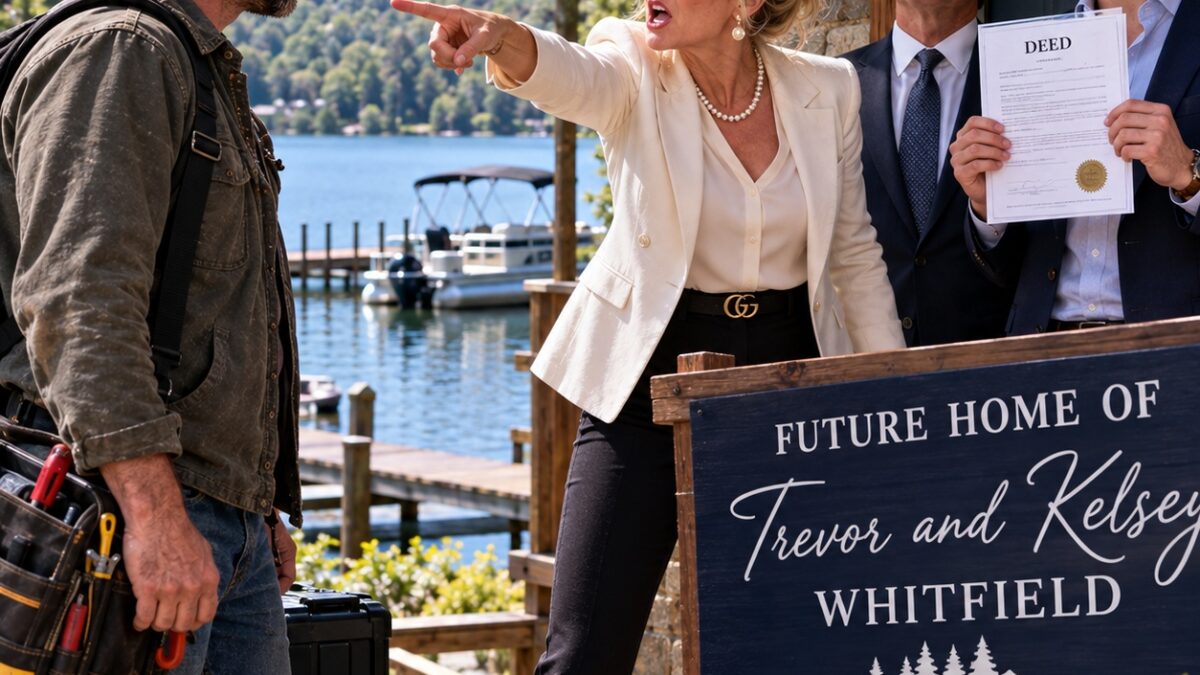
I sat in my van for almost thirty seconds staring at that sign.
The trip from Richmond had taken about two and a half hours.
I had finished a boutique-hotel rewiring job two days early, loaded my tools, and driven straight to the lake.
Harper was staying with my sister in Roanoke.
The leaves along the two-lane roads through Bedford County were just beginning to turn.
Gold at the edges.
Some red.
The kind of early autumn afternoon when the whole drive smells like cooling asphalt, dogwood, and dry leaves.
I had spent most of the trip thinking about getting back to the cabin.
Then I turned into the gravel drive and saw someone else’s future announced on my property.
I got out.
Walked toward the front steps.
The deadbolt was new.
Brushed nickel.
Expensive.
My key would not enter it.
Through the front window, I could see that the living room had been rearranged.
Annie’s old wicker chairs were gone.
A drafting table stood in their place.
Fabric samples.
Paint swatches.
A thick binder.
I leaned closer to the glass.
WHITFIELD LAKE HOUSE RENOVATION PLAN
A tape measure lay across Uncle Neil’s kitchen counter beside contractor estimates.
For a moment, I wondered whether I had somehow made a mistake.
Wrong house?
Wrong driveway?
Impossible.
I knew every line of that cabin.
Every knot in the cedar.
Every slight sag in the porch.
I walked around toward the dock.
That was where I found Trevor.
He stood near the end with a woman I did not recognize.
Kelsey, his fiancée.
They were pointing toward the boathouse.
I heard Trevor say something about converting the lower level into a gym.
He looked twenty-seven.
Clean-cut.
Boat shoes.
Quarter-zip pullover.
Not the image I had built in my head during the walk from the front door.
He turned when my boots hit the dock.
“Can I help you?”
I remember that sentence because of how normal he sounded.
Not aggressive.
Not mocking.
He genuinely thought I was the visitor.
“You’re standing on my dock.”
He blinked.
Then looked at Kelsey.
Then back at me.
“This is my property.”
“No. It isn’t.”
He reached into his back pocket.
Pulled out a folded document.
Warranty deed.
Recorded with the Bedford County Clerk’s Office.
The property description was Uncle Neil’s land.
My address.
Transferor:
Lakeview Shores HOA Common Holdings
Transferee:
Trevor Allen Whitfield
Notary:
Grayson Whitfield’s law office.
Recording date:
Three weeks earlier.
Trevor held it like proof that the conversation was finished.
“My parents gave me this place as a wedding gift.”
There was no triumph in his voice.
That mattered later.
At the time, all I heard was the sentence.
Wedding gift.
My uncle’s cabin.
The place where Annie’s ashes entered the lake.
Gift-wrapped by strangers.
I called the Bedford County Sheriff’s Department from the dock.
A young deputy named Toliver arrived about thirty minutes later.
I had gone back to my van and pulled the folder I kept with important property documents.
Uncle Neil’s will.
My recorded deed.
Probate paperwork.
Tax records.
I showed everything.
Trevor showed his deed.
Toliver read both.
Rubbed the back of his neck.
Then gave me the answer nobody wants when somebody has apparently stolen their house through paperwork.
“Sir, this is a civil matter.”
“How?”
“I can’t determine which deed controls.”
“One deed came from an estate five years ago. The other came from an HOA that never owned the property.”
“I understand.”
“Do you?”
He looked uncomfortable.
“That’s for a judge.”
Then he left.
Kelsey tugged Trevor’s sleeve.
“Maybe we should talk to your parents.”
Trevor shook his head.
“It’s handled, Kels. Mom said the transfer was clean.”
He looked at me.
“I’m sorry about the confusion, Mr. Briggs. You should probably talk to a lawyer.”
I almost laughed.
Instead I walked away.
Not because he had won.
Because I could feel anger getting ahead of judgment.
I had spent twenty-two years wiring systems where one careless move could destroy weeks of work.
This was no different.
Do not touch anything until you understand the circuit.
That night in Roanoke, I called every property attorney I could find.
Most said they could not see me for weeks.
At eleven, my phone rang.
Vivian Shaw.
Her voice sounded like she had spent her career billing by the hour and resenting anyone who wasted one.
“Mr. Briggs, what you’re describing sounds like deed fraud.”
“Yes.”
“Can you be in my office at eight?”
“I’ll be there.”
I arrived at 7:45.
Vivian spent three hours reading.
Not talking.
Reading.
She lined the documents across her desk.
Probate.
Deed.
New deed.
Quiet-title filing.
Recording dates.
By noon, she understood what Grayson had done.
He had pulled Uncle Neil’s probate file from Bedford County.
Then he found what he claimed was a technical defect.
Under the legal argument he filed, the executor had recorded the deed transferring the cabin to me eleven days outside a required statutory window.
Based on that supposed defect, Grayson filed a quiet-title action.
His theory was that Uncle Neil’s transfer to me had failed.
If the deed failed, he argued, the property reverted to unencumbered common land adjacent to Lakeview Shores.
Then the HOA board Pamela controlled passed a resolution assigning that land to Trevor.
Calculated.
Documented.
Recorded.
On paper, if you saw only the papers Grayson wanted you to see, it almost looked legitimate.
Vivian found the first problem in the notification section.
“The quiet-title action was ex parte.”
“What does that mean?”
“They proceeded without you.”
“They never notified me.”
“Exactly.”
She pointed to a line.
The filing showed one attempt to notify me.
A letter mailed to an old Roanoke address I had not used in four years.
Nothing sent to the cabin.
Nothing to my electrical business.
Nothing to the phone number attached to my property-tax account.
“They weren’t trying to find you.”
Vivian tapped the filing.
“They were trying to show the court that they had tried.”
That was the first crack.
Not enough yet to destroy everything.
But enough for Vivian to know where to keep looking.
While we built the case, Trevor began renovating my cabin.
Not repainting.
Not changing a faucet.
Gutting it.
A Lynchburg crew arrived.
Custom cabinetry.
Quartzite counters.
Six-burner Wolf range.
Uncle Neil’s heart-pine floors came out.
Engineered white oak with radiant heat went in.
I watched from across the cove through binoculars.
Truck after truck.
Plumbers.
Tile setters.
Carpenters.
The back wall of the living room was removed and replaced with floor-to-ceiling glass facing the lake.
Then they extended the dock forty feet.
Added a covered boat lift rated for twelve thousand pounds.
Built a stone patio.
Fire pit.
Seating for twenty.
Smart-home systems.
Custom lighting.
A jacuzzi on the rear deck.
Every improvement hurt in two ways.
First because they were changing Uncle Neil’s work.
Second because they were doing it as though I no longer existed.
Vivian told me to document.
So I did.
Spreadsheet.
Date.
Contractor.
License plate.
Visible work.
Estimated value.
Photographs.
Every day.
“Permanent improvements become part of the real property,” Vivian told me.
“If we restore your title, they stay with the land.”
I understood.
Trevor was spending money on a house he believed belonged to him.
If the deed collapsed, ownership of those permanent additions would follow the property.
I could have asked Vivian for an emergency order to stop the renovations.
She told me that option existed.
I did not pursue it then.
Trevor had access to lawyers.
His father was a lawyer.
Before pouring six figures into a lakefront property, he could have conducted an independent title examination.
He did not.
He trusted his parents.
That decision belonged to him.
Pamela made waiting much harder.
She sent an HOA notice on embossed cardstock.
I was permanently banned from Lakeview Shores common areas.
Roads.
Marina.
Shoreline within two hundred feet of what she called the Whitfield property.
Then she emailed all sixty-three Lakeview Shores families.
Subject:
DISGRUNTLED FORMER OWNER HARASSING NEW RESIDENT
Former owner.
That phrase made my stomach turn.
She filed a formal trespass warning with the sheriff.
Claimed I had been loitering near Trevor’s property.
Claimed I had made threatening statements.
I had not threatened anybody.
Had barely spoken to Trevor since the day on the dock.
But now my name sat inside a law-enforcement system beside the word trespass.
If I drove the wrong road or approached the cabin the wrong way, somebody could treat me like the criminal.
Pamela controlled the story because she spoke first.
That is one of the most dangerous forms of power.
Not legal power.
Narrative power.
By the time anyone hears your side, they have already been told what kind of person you are.
Then came the engagement party.
Saturday night.
Three weeks after I found the sign.
Pamela threw it at my cabin.
On my dock.
The dock Uncle Neil had built with pressure-treated pine and galvanized steel bolts he ordered from a marine supply catalog.
The same dock where Annie and I used to watch thunderstorms move across the lake.
The same dock where Harper caught her first bluegill and screamed so loudly somebody across the cove shouted asking if everything was okay.
I parked at a public access lot half a mile south.
I could see lights from there.
Paper lanterns along the rail.
Catering tent on the new stone patio.
Live acoustic guitar drifting across the water.
About eighty guests.
Glasses clinking.
People laughing.
Celebrating a wedding gift that had been stolen through paperwork.
I called Harper.
She answered on the second ring.
“Dad, are you okay?”
She always knew.
Annie had been the same way.
I told her I was fine.
She was sixteen.
She had already lost her mother.
She did not need my anger.
“I love you.”
“Love you too.”
I ended the call before my voice changed.
The music stopped around eleven.
The lights stayed on past midnight.
Pamela’s laugh carried across the lake.
High.
Confident.
I gripped the steering wheel until my hands hurt.
Then let go.
Started the van.
Drove back to Roanoke.
The next morning, I returned.
The party had left itself everywhere.
Champagne cork between dock boards.
Cigarette butts.
Tiki-torch holes.
Napkins.
A crushed cup near the path.
Then I saw Annie’s black-eyed Susans.
She had planted them the last spring she was alive.
Flattened by shoes.
I stood over them longer than I should have.
A flower bed is not a person.
I knew that.
But grief does not care about logic.
I picked up every piece of trash.
Then walked to the end of the dock.
The lake was gray.
Mist floated just above the surface.
A blue heron stood in the shallows.
I put one hand on Uncle Neil’s railing.
I had helped sand that rail when I was fourteen.
He taught me to follow the grain.
“Everything worth building is worth finishing right.”
Paper lanterns had been zip-tied around it.
The plastic had cut into the finish.
I took out my pocketknife.
Cut every tie.
The gouges underneath were pale.
Some things can be sanded smooth.
Some keep a mark.
Pamela arrived while I was still there.
White Mercedes.
Yoga pants.
Cashmere wrap.
Travel mug.
She walked down the slope.
“Mr. Briggs, you are trespassing on my son’s property.”
I held up the trash bag.
“Your party left a mess on my dock.”
“It isn’t your dock anymore, Colton.”
She tilted her head.
“The sooner you accept that, the easier this will be for everyone.”
I looked at her.
Morning sun behind her.
For a second she was just an outline.
A person whose certainty depended entirely on nobody examining what she had done.
“Pamela, you should be more careful about what you give away.”
She frowned.
I left.
Not because she was right.
Because Vivian called three days later.
And that phone call changed everything.
“Colton. I need you in my office now.”
Her voice was different.
Not worried.
Excited.
I reached Roanoke in ninety minutes.
Vivian had three documents on her desk.
She picked up the first.
“Your uncle filed a codicil.”
I stared at her.
“Six months before he died.”
The amendment specifically addressed the recording timeline.
Uncle Neil had authorized his executor to record the transfer at any time within twelve months after probate closed.
Signed.
Witnessed.
Notarized.
Filed.
“If that’s valid…”
“It is.”
“Then the eleven-day defect doesn’t exist.”
“It never existed.”
My title was valid.
Always had been.
The entire quiet-title action depended on pretending the codicil was not there.
I asked the obvious question.
“Why didn’t Grayson include it?”
Vivian picked up the second document.
“Because he chose not to.”
The codicil had been part of the same probate file Grayson pulled.
He had access to it.
His legal argument could not survive it.
So he filed without mentioning it.
Vivian did not call that a mistake.
She called it fraud on the court.
Then she picked up the third paper.
Virginia State Bar record.
Three complaints against Grayson in six years.
Two dismissed.
One private reprimand.
Reason:
Failure to disclose a material document in a real-estate transaction.
Same kind of conduct.
Different property.
I felt the whole story change shape.
Pamela’s aggression was not random.
Grayson’s filing was not a one-time clever trick.
There might be a pattern.
I asked Vivian to pull other lakefront transfers tied to them.
Within forty-eight hours, we found two.
The Caldwell cottage on the east shore.
Transferred in 2021 to one of Pamela’s college friends through another quiet-title action.
Evelyn Caldwell had owned it thirty-one years.
Older.
Living away from the property.
Technical probate question.
Poor notice.
Transfer.
Then the Ashford cabin on the peninsula.
Transferred in 2022 to Grayson’s law partner through what was labeled an HOA abandonment resolution.
Again:
Older owners.
Technical paperwork.
Little meaningful notification.
Property leaving one family and appearing in the orbit of Pamela and Grayson.
Tom Ashford died the following year.
His wife Doreen eventually entered a nursing facility.
Their daughter told us Tom had died believing the loss was his own fault.
He thought he had failed his family by mishandling paperwork.
That sentence stayed with me.
The Whitfields had not simply taken land.
They had taken people’s confidence in their own memories.
The next three weeks were controlled.
I thought about them the way I approached a high-voltage panel.
Sequence matters.
First:
Vivian filed a motion to vacate the quiet-title judgment.
Exhibit A:
Uncle Neil’s codicil.
She also filed a lis pendens.
The title was now formally disputed.
Trevor could not sell.
Refinance.
Transfer.
Nothing.
The property was frozen.
Second:
We found the prior victims.
Evelyn Caldwell was seventy-eight and living with her son in Charlottesville.
She listened while I explained what we had found.
Then stayed silent.
Finally:
“I knew something was wrong. I just didn’t have the energy to fight.”
Thirty-one years.
Her husband had built the dock.
She signed an affidavit.
The Ashfords were harder.
Tom was gone.
Doreen was too frail to travel.
Her daughter came to Vivian’s office with power of attorney.
When she saw the records, she cried.
“Dad died thinking he’d done something wrong.”
Then again:
“He blamed himself.”
She signed for Doreen.
Third:
Vivian filed a formal complaint against Grayson with the Virginia State Bar.
Multiple real-estate transactions.
Material documents omitted.
Pattern.
Once the bar investigation began, Grayson’s files could be examined.
Fourth:
The renovation ledger.
I kept watching.
Every day.
By the time the three-week documentation period ended, my ledger showed about $183,000 in permanent improvements.
Kitchen.
Floors.
Dock extension.
Boat lift.
Stone patio.
Lighting.
Smart systems.
Jacuzzi.
The law did not care who wrote the checks if those items became part of the real property.
Title controlled.
Trevor was building equity into land that was still mine.
Pamela found out about the lis pendens on a Monday.
Trevor called me.
His voice was tight.
“My mother says you filed something blocking the title. She says it’s harassment.”
“Ask your father to show you the original probate file.”
“What am I looking for?”
“The codicil.”
Silence.
“What codicil?”
That was the first time I knew Trevor truly had no idea.
His own father had apparently hidden the critical document not only from the court, but from him.
I almost felt sorry for him.
Then I remembered Annie’s flowers.
The sign.
The way he told me to get a lawyer while standing on Uncle Neil’s dock.
The sympathy did not disappear.
But it remained complicated.
Pamela responded within forty-eight hours.
Formal HOA complaint.
Property fraud.
Harassment.
Malicious interference with community governance.
Emergency board meeting.
Permanent ban from all Lakeview Shores common areas.
Roads.
Marina.
Beach.
Then she tried to have my septic permit revoked.
She claimed the system was contaminating the lake.
A county health inspector spent two hours on the property.
Probe.
Clipboard.
Tests.
Uncle Neil had over-engineered the drain field.
The system performed better than minimum requirements.
Before leaving, the inspector looked toward Lakeview Shores.
“Between you and me, I tested three systems over there last year that were actually leaking.”
He paused.
“None got complaints from the HOA president.”
Pamela also contacted my electrical clients.
Three of them.
She told them I was under investigation for property fraud.
Suggested they reconsider doing business with me.
Two called.
One hospital contract worth around thirty thousand dollars nearly fell apart.
Vivian sent a cease-and-desist for interference with my business relationships.
Pamela ignored it.
The letter went into the file.
Grayson escalated legally too.
He moved to dismiss our fraud challenge by claiming the codicil had been executed improperly.
Vivian responded with a certified copy from the probate court showing the document had already been accepted, recorded, and incorporated into the final probate order.
Five years earlier.
Grayson knew.
Then he made the mistake that pushed the case into something much darker.
Vivian requested the original probate file.
When the clerk sent it, the codicil was missing.
Gone.
The clerk confirmed it had been present six months earlier.
The last person to request the file before it disappeared:
Grayson Whitfield.
His signature sat in the access log.
Vivian filed for sanctions.
Requested criminal referral for tampering with court records.
The missing original did not destroy our proof.
We already had a certified copy.
The probate system had another.
The bar investigation had another.
And now we had the courthouse access record.
Grayson had tried to erase a document and left his name beside the disappearance.
Vivian stared at the log.
“He’s not a lawyer anymore.”
Then:
“He just doesn’t know it yet.”
Two weeks before the hearing, Pamela went after Harper.
That was the moment the property stopped being the thing I cared about most.
Wednesday.
3:15 in the afternoon.
Bedford County High School.
Harper was walking toward the bus when Pamela’s white Mercedes pulled up.
Pamela stepped out.
Pearl earrings.
“Harper, sweetheart, I just want to talk to you for a minute about your dad.”
Harper did exactly what I hoped she would do.
Did not get into the vehicle.
Did not argue.
Walked to the bus.
Called me.
“Dad, that woman from the lake was at my school.”
I stopped what I was doing.
“She tried to talk to me about you.”
The anger was immediate.
Different from the cabin.
Different from the deed.
Different from Annie’s flowers.
Harper had already lost her mother.
No adult was going to pull her into this.
I called Vivian.
She filed for an emergency protective order within an hour.
The judge granted it the next morning.
Pamela had to remain five hundred feet from Harper.
Her school.
Our Roanoke residence.
Violation meant arrest.
Pamela responded publicly.
Lakeview Shores Facebook group.
She called me dangerous.
Unstable.
Said I was using Harper as a pawn.
Accused me of fabricating documents to steal Trevor’s home.
Forty-seven people liked the post.
Twelve left supportive comments.
Then Dale Kessler from WSLS saw it.
He had been working on the real-estate story.
He screenshotted everything before Pamela could remove it.
Exhibit J.
Three days later, another Lakeview Shores homeowner contacted me.
Cheryl Burke.
Her husband had died two years earlier.
Pamela had recently been suggesting the HOA could help “manage” Cheryl’s lakefront property.
Grayson had offered to handle the paperwork as a courtesy.
She had not signed anything.
Now she was afraid to.
I forwarded the message to Vivian.
Potential fourth victim.
Same structure beginning again.
A week before court, Trevor called.
This time his voice sounded different.
Quiet.
“Mr. Briggs, I looked at the probate file.”
I waited.
“I found a certified copy of the codicil in my father’s office.”
Pause.
“It was in his desk.”
Another pause.
“I didn’t know.”
I believed him.
“I swear to you.”
“I believe you.”
He breathed out.
Then apologized.
For the sign.
For Annie’s flowers.
For everything.
I told him I could not stop what was coming.
“I know.”
We ended the call.
I sat in my van afterward.
Thought about Trevor.
Twenty-seven.
About to get married.
His parents hand him keys to lakefront property.
His father is a lawyer.
His mother runs the HOA.
The deed is recorded.
Why would he assume the gift is stolen?
He picks countertops with Kelsey.
Extends the dock.
Builds a patio.
Imagines children there.
Then a stranger arrives and says everything is based on fraud.
Trevor was not his parents.
He had made careless decisions.
He should have run his own title search.
But there is a difference between an enemy and a victim who does not yet understand he has been used.
November 14.
Bedford County Circuit Court.
Old wood paneling.
Radiator heat.
Judge Helen Thatcher.
Pamela sat at the respondent’s table in a navy blazer and pearls.
Grayson wore charcoal.
Their attorney was Carter Pool, a Richmond real-estate litigator.
Trevor and Kelsey sat behind them.
He did not look at his parents.
I sat with Vivian.
Behind us:
Evelyn Caldwell and her son.
The Ashford daughter with power of attorney.
Dale Kessler with his court-approved recorder.
Harper beside my sister.
She wore the necklace Annie gave her for her thirteenth birthday.
Vivian opened with the codicil.
Projected on the courtroom screen.
Uncle Neil’s signature.
Witnesses.
Notary.
Filing date.
Then the probate order.
The timeline.
The executor’s authority.
The legal conclusion was not complicated.
My transfer was valid.
Always had been.
Then Vivian showed the quiet-title filing.
Codicil omitted.
Ex parte proceeding.
Bad notice sent to an old address.
Then the clerk’s log.
Grayson checking out the probate file before filing the action.
Codicil present.
Later missing.
“Your Honor,” Vivian said, “Mr. Whitfield did not merely fail to disclose a document that damaged his argument. The evidence indicates that document was removed from the public file after his access.”
Carter objected.
Judge Thatcher overruled.
Then Evelyn Caldwell.
Her affidavit.
Thirty-one years of ownership.
Lost through a similar procedure.
Then the Ashford family.
Another elderly owner.
Another property.
Another technicality.
Another transfer toward someone connected to the Whitfields.
Grayson stared down at the table.
Pamela’s jaw remained tight.
Then Vivian presented my renovation ledger.
About $183,000.
Photographs.
Contractors.
Permanent improvements.
She asked the court to vacate Trevor’s deed.
Restore my title.
Recognize the permanent improvements as part of the real property.
Refer Grayson’s conduct for criminal investigation.
Send the matter to the State Bar.
Judge Thatcher removed her glasses.
Looked directly at Grayson.
Her voice was controlled.
That made the words worse.
“In thirty-one years on this bench, I have never seen a more calculated abuse of the legal system by a licensed attorney.”
No one moved.
She described what he had done.
Withheld evidence.
Filed sworn claims contradicted by a document he had accessed.
Used his wife’s HOA position to make private conduct look legitimate.
Then she read the ruling.
Title restored to Colton Briggs.
Trevor’s deed vacated.
Permanent improvements deemed part of the property belonging to the lawful title holder.
Me.
Criminal referral for Grayson.
Fraud on the court.
Tampering.
False instruments.
State Bar referral.
All HOA resolutions connected to my property void.
Pamela stood.
“This is outrageous. That property was properly—”
Judge Thatcher did not even raise her voice.
“Mrs. Whitfield, sit down or I will hold you in contempt.”
Pamela sat.
I did not say anything.
There was nothing I could add.
I turned toward Harper.
She was crying.
Not the tears she cried after Annie died.
Different tears.
She held Annie’s necklace against her collarbone.
Evelyn Caldwell had her eyes closed.
The Ashford daughter gripped the wooden armrest.
Then Trevor stood.
He looked at Pamela.
Then Grayson.
Turned.
Walked out.
Kelsey followed.
The courtroom door closed softly.
Pamela watched him leave.
For the first time since I met her, she had nothing to say.
Dale Kessler’s first story ran that evening.
The aftermath moved quickly.
Grayson was later indicted on four felony counts tied to the conduct described in the case.
Two fraud-on-the-court counts.
One involving tampering with public records.
One filing-false-instrument count.
The Virginia State Bar suspended his license while disciplinary proceedings moved forward.
Within three months, he surrendered it.
He never practiced law again.
Pamela lost the HOA presidency two weeks after the ruling.
Vote:
51 to 6.
The new board rescinded every resolution she had pushed through against my property.
Then they ordered an independent five-year audit.
That audit uncovered another $18,000 in unexplained expenditures through Pamela’s lakefront beautification fund.
Trevor’s engagement-party catering.
A Mercedes lease payment.
A family trip to Hilton Head.
The more people looked, the less anything about Pamela’s leadership resembled community service.
Evelyn Caldwell got her cottage back.
Same court.
Fraudulent deed vacated.
Title restored.
She returned the following spring.
Seventy-eight years old.
The first thing she did was plant a garden.
The Ashford family received a $240,000 settlement from Grayson’s malpractice coverage.
Doreen was too frail to return to the cabin.
Her daughter told me the money was not the thing that mattered most.
“Dad didn’t make a mistake.”
She paused.
“Someone stole from him.”
That difference mattered.
For years, Tom had carried shame that did not belong to him.
The truth arrived too late for him.
But it arrived.
Three weeks after the ruling, Trevor called.
No anger.
No defensiveness.
“Mr. Briggs, I know I have no right to ask this.”
I waited.
“Kelsey and I love the cabin.”
Silence.
“I put everything I had into it.”
I said nothing.
“I know it’s yours. I know what my parents did was wrong.”
Then he asked.
Would I consider letting them stay as tenants?
“I’ll pay whatever you think is fair.”
I told him I needed time.
For two days, I thought about it.
Talked to Harper.
Talked to Vivian.
Thought about the night Trevor called after finding the codicil in Grayson’s desk.
He had been handed a poisoned gift.
He had failed to verify it.
That was true.
He had also believed the two people most children are taught to trust.
His parents.
Finally I called.
“Ten thousand a month.”
Pause.
“First and last month up front.”
“Okay.”
“Twelve-month lease.”
“Okay.”
“You maintain the property.”
“Yes.”
“You pay dock fees.”
“Yes.”
“And Pamela Whitfield never sets foot on that shoreline.”
He did not hesitate.
“Done.”
He paid on the first every month.
Never late.
Never short.
Trevor and Kelsey eventually married in a courthouse ceremony.
Small.
Quiet.
Nothing like the lakefront wedding Pamela had planned around stolen property.
They were good tenants.
Kept the cabin immaculate.
Then Kelsey planted black-eyed Susans beside the dock path.
She did not know Annie had planted the same flowers there.
She simply thought they would look good beside the water.
The first time Harper saw them, she stopped.
Looked down.
Then smiled.
“Mom would’ve liked that.”
She was right.
Pamela still had to drive past the cabin whenever she left Lakeview Shores.
She knew her son was living in the property she had tried to give him.
And every month the rent left Trevor’s account.
Ten thousand dollars.
One hundred twenty thousand a year.
I did not use the first year’s rent for another boat.
Did not remodel my house.
Did not spend it celebrating.
I created the Smith Mountain Lake Property Rights Clinic.
Free legal consultations for lakefront owners dealing with HOA overreach, deed fraud, suspicious title manipulation, and property disputes they could not afford to understand alone.
Vivian volunteered two Saturdays each month.
Evelyn Caldwell brought cookies for the waiting room.
I helped where I could.
Mostly I listened.
Because I had learned how frightening official-looking paper can be when somebody is counting on you not knowing what it means.
One Saturday, Harper and I drove to the lake.
We parked at the public access lot.
Old habit.
Then she looked at me.
“Dad.”
“What?”
“You own it.”
I laughed.
We drove the rest of the way.
The cabin looked different from Uncle Neil’s version.
There was no denying that.
White-oak floors where heart pine had been.
Glass wall facing the lake.
Quartzite.
Extended dock.
Boat lift.
Stone patio.
You do not restore title and automatically restore the past.
Some things had been changed forever.
But the choice was mine again.
That mattered.
We walked down the dock.
Kelsey’s black-eyed Susans moved lightly beside the path.
Harper picked up a flat stone.
Skipped it.
One.
Two.
Three.
Four.
It disappeared.
The lake was flat and silver.
Pine bark and wet stone in the air.
Harper looked toward the flowers.
“Mom would’ve liked that Trevor’s wife planted her flowers back.”
“She would.”
I looked toward the water.
Thought about Uncle Neil in his Navy cap.
Tin mug.
The man who always said the lake was the only thing that never let him down.
For a while, I had believed the lake was the one thing somebody had finally managed to take too.
I was wrong.
The lake was still there.
So was the cabin.
So was the truth.
Uncle Neil had finished the paperwork correctly before he died.
All I had to do was read all of it.








