PART2:HOA Queen Called the Police to Throw Me Off My Own Lakefront—She Had No Idea I Was the County Sheriff
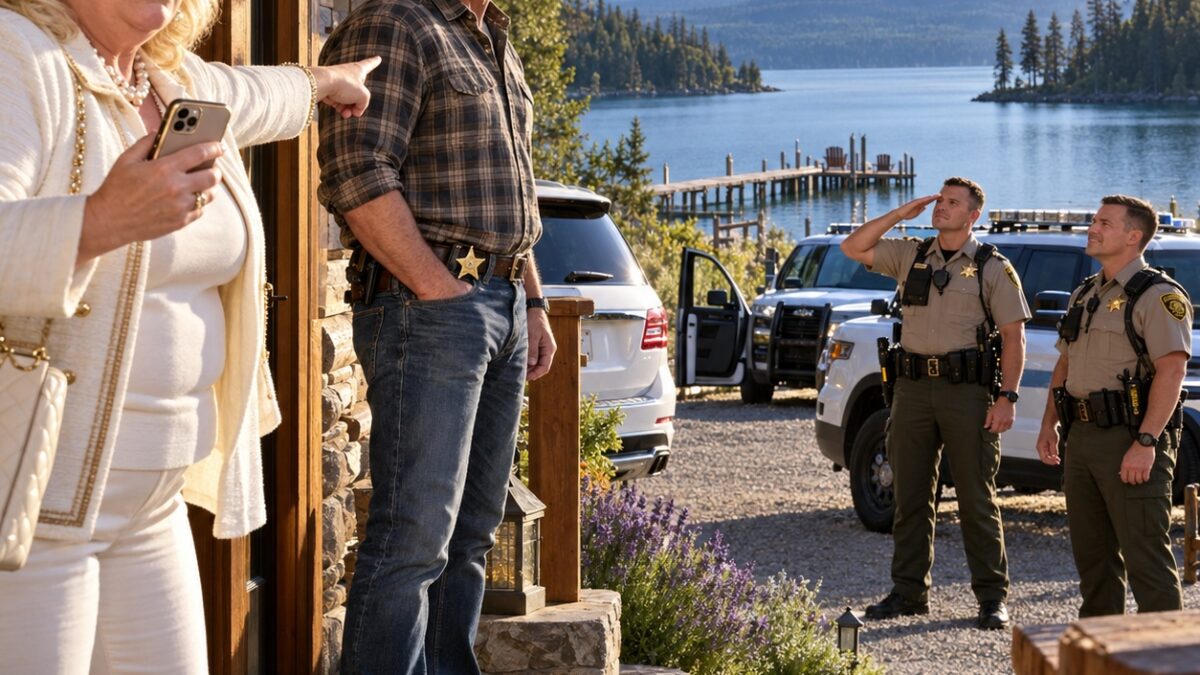
PART2
Ignoring Shelby was my first mistake.
I had spent almost three decades in law enforcement learning how people react when they do not get the response they expect.
Some back off.
Some rethink.
Others escalate because every unanswered challenge feels like disrespect.
Shelby belonged to the third category.
Still, at first I tried to be reasonable.
I sanded the porch.
Primed it.
Painted every board until the cedar looked warm and clean in the afternoon sun.
I moved Dad’s old Ford into the equipment shed behind the cabin.
Pulled weeds from the walkway Sandra had lined with river stones during the last summer she had enough strength to work outside.
It was not surrender.
It was choosing peace.
At least that was what I told myself.
If the HOA wanted the porch cleaned up, fine.
If seeing an old truck offended someone’s sense of aesthetics, I could move it.
There were battles worth fighting.
I did not think this was one yet.
Two weeks after I finished the porch, another letter arrived.
Four new violations.
The chimney cap was discolored.
The equipment-shed door did not align with community aesthetic guidelines.
My firewood stack sat too close to what they called the primary structure.
And Dad’s dock was still an unauthorized lakefront modification.
This time they demanded a retroactive permit.
Review fee:
$2,000.
That changed my mood.
I had been a cop too long not to recognize pressure disguised as procedure.
But I also knew that charging headfirst into an HOA fight is a little like wrestling a pig.
You both get dirty.
The pig enjoys itself.
So I started doing what I had taught detectives to do.
Document.
I photographed every alleged violation.
The chimney.
Shed.
Firewood.
Dock.
I kept the letters.
Dated everything.
Then I wrote one calm page requesting the specific covenant provisions supporting each violation.
No accusations.
No threats.
Just:
Show me the rule.
Shelby never answered.
Instead, she sent surveyors.
I came home one morning after a supply run and found two men in hard hats pounding stakes around my land.
Orange flags snapped in the breeze.
Laser equipment stood on tripods.
They were moving quickly.
I walked over.
“Who hired you?”
The taller man barely looked up.
“HOA.”
“For what?”
“Full boundary survey. Lakefront compliance review.”
I watched for maybe ten minutes.
At first, nothing looked obviously wrong.
Then I noticed the southern boundary.
Between the cabin and the water.
The stakes were not off by a few inches.
They were off by about twelve feet.
Twelve feet does not sound like much until twelve feet takes your dock.
Your boat ramp.
A strip of shoreline your father maintained for forty years.
If that survey were recorded as accurate, everything between the false line and the water could suddenly be labeled common area.
Controlled by the HOA.
Encroachment fraud is not sophisticated in theory.
Move a line.
Get someone to accept it.
Record it.
Wait.
Then make the owner spend years proving what had already been true.
I told the men to stop.
They looked at each other.
“Sir, we have authorization from the homeowners association.”
“And I have authorization from the deed recorded in 1981 saying every inch of this land belongs to me.”
I kept my voice level.
“Pack up your stakes.”
Then pointed toward the flags already in the ground.
“Leave those.”
The taller man frowned.
“Why?”
“For photographs.”
That changed the conversation.
They packed quickly.
Four minutes.
One man dropped a business card in the mud.
I picked it up.
Wiped it with my thumb.
Puit Land Services — Kalispell.
On the back:
Todd Puit, Managing Partner.
Of course.
I photographed every orange flag.
Every stake hole.
Every tire impression in the soft earth.
Recorded GPS coordinates on my phone.
Wrote down both license plates.
Then I called the county recorder.
I gave the clerk my parcel number.
Asked whether anybody had filed a new survey.
“Nothing recorded yet,” she said.
Then paused.
“But there was a preliminary filing inquiry last week.”
“From who?”
“Lakeidge Holdings.”
Not Puit Land Services.
Different company.
I wrote it down.
Circled the name twice.
That evening I sat on the porch with coffee.
One orange flag remained near the south line.
I had deliberately left it.
The wind snapped the plastic against the dark tree line.
Across the lake, a loon called.
That long, wavering sound always reminded Sandra of something lonely.
I did not yet know what Lakeidge Holdings was.
But I knew what patterns felt like.
My entire career had been spent finding relationships between events that looked harmless when viewed separately.
A strange survey.
An unrecognized company.
An HOA president demanding control of an old dock.
Her husband’s business on the survey card.
One thing might be coincidence.
Four things begin to deserve attention.
Three weeks later, Shelby called an emergency HOA meeting.
One agenda item.
Lakefront Compliance Review — Vote to Reclaim Unauthorized Structures.
Translation:
She wanted the HOA to seize my dock.
I had never attended one of their meetings before.
No reason.
My property predated the association.
But that Thursday, I put on a clean shirt and drove to the community hall.
Low ceiling.
Cinder-block walls.
Folding chairs.
Fluorescent lights buzzing overhead.
A pot of coffee that smelled like it had been brewed during a previous presidential administration.
About sixty people sat scattered through the room.
At the front was a card table.
Shelby behind it.
Wooden gavel.
Stack of handouts.
She saw me enter.
For half a second her jaw tightened.
Then came the smile.
Professional.
Pleasant.
Dead behind the eyes.
She tapped the gavel.
“Let’s get started.”
I understood within ten minutes why she had lasted nine years.
Shelby did not run meetings.
She performed conclusions.
Landscaping.
Budget.
Common-area rules.
She talked.
People nodded.
Questions never gained enough room to become discussions.
Then the lakefront item appeared.
She connected a laptop to the projector.
My dock filled the wall.
Then my boat ramp.
Then the shoreline.
Each photograph had a red label.
UNAUTHORIZED STRUCTURE.
NONCOMPLIANT ACCESS.
PRESERVATION CONCERN.
“These modifications were never approved by the HOA architectural review committee.”
Dad built the dock in 1981.
The HOA did not exist until 1996.
I raised my hand.
Shelby ignored it.
She talked about liability.
Property values.
Lakefront preservation.
Then said:
“I’d like to call for an immediate vote.”
“Point of order.”
I stood.
Twenty-eight years of commanding briefing rooms teaches you how to project without yelling.
The whole room turned.
“Before you vote on removing my property, I’d like the board to review the deed recorded with Flathead County in 1981. It establishes the dock, boat ramp, and shoreline access as permanent fixtures associated with my parcel. They predate this HOA by fifteen years.”
Shelby’s smile changed.
Not gone.
Spoiled.
“Mr. Haynes, you can submit documents through the proper channels.”
“I brought copies.”
I held up a folder.
“One for anybody who wants to read it.”
That was when Earl Whitfield stood.
Seventy-four.
Vietnam veteran.
Thin as a fence post.
He had lived there twenty-two years.
By every account, Earl almost never spoke at HOA meetings.
He gripped the back of the chair in front of him.
“This woman did the same thing to my family three years ago.”
The room changed.
Shelby looked at him.
“Earl—”
“Same letters. Same fines. Same threats.”
He continued.
“We almost sold.”
Then he named others.
Vince Hargrove.
Patty Williams.
The Sullivans.
At least two more families.
Each one had been hit with violations.
Pressure.
Fines.
Threats.
Then each one sold below market value.
Murmurs moved through the room.
Shelby slammed the gavel.
“That’s enough.”
Nobody stopped whispering.
“We are here to vote, not listen to conspiracy theories.”
She forced the vote forward.
Thirty-four in favor.
Twenty-eight against.
Fifty-eight homeowners absent.
She declared victory.
But I was watching something else.
Quorum.
With 120 homes, they needed at least sixty-one owners present or represented.
They barely had sixty-two.
Four proxy votes came from vacant cabins.
Those cabins were owned by the company already circled in my notebook.
Lakeidge Holdings.
I did not challenge the vote.
Not that night.
I wrote down the numbers.
Shook Earl’s hand in the parking lot.
Drove home.
The truck headlights caught the orange survey flag still standing near the southern boundary.
I had left it there as a reminder.
Now Earl had given me something better.
A pattern.
Three weeks later, the electricity went out.
I had been in town most of the day.
County business.
Hardware store.
Then dinner at a diner where the chicken-fried steak was better than anything served under fluorescent lighting had a right to be.
By the time I returned, the cabin windows were dark.
Power outages happened.
Old lines.
Wind.
Winter branches.
I grabbed a flashlight.
Walked around back.
The breaker panel was open.
Not tripped.
Not damaged.
Someone had manually flipped the main breaker off.
Then padlocked it.
Brass Master Lock.
Not mine.
I stood there with the flashlight beam centered on the lock.
The first real anger of the entire dispute rose in my chest.
Not because I could not turn on a lamp.
Because of Sandra’s freezer.
After she died, I had kept several things in the chest freezer.
Three loaves of sourdough she baked the week before her diagnosis.
Wrapped in foil.
Her handwriting on the labels.
A container of tomato soup.
A bag of lavender from the garden.
I understood how irrational that might sound.
They were food.
Plants.
Frozen things.
Except they were not.
Not anymore.
They were objects she had touched when she was still herself.
Before doctors.
Before morphine.
Before goodbye.
I got bolt cutters.
Removed the lock.
Flipped the breaker.
Then went inside.
The freezer had been without power at least twelve hours.
The bread had thawed.
Soft.
The soup had leaked.
The lavender felt damp.
Its smell faded.
I sat down on the kitchen floor.
Did not move for a long time.
I had survived Sandra’s diagnosis.
Her treatments.
Her death.
The funeral.
Moving away from our house.
I had not expected an HOA dispute to reach into a freezer and find something I had not been ready to lose.
The next morning, I called the power company.
A billing employee named Denise pulled the account.
“Sir, we received a disconnection request Monday from the Lidge Trail Estates HOA.”
“Reason?”
“Unpaid maintenance assessments resulting in utility suspension under covenant section fourteen.”
“I’ve paid every assessment.”
“I’m sure you have, sir. But we process HOA disconnection requests as a courtesy.”
“You verify them?”
Silence.
“No, sir.”
So an HOA president could tell the power company to disconnect someone and nobody would confirm whether the debt existed.
The utility company had not physically placed the padlock.
But its process had helped create the opening.
In many circumstances, manually interfering with someone’s electricity, gas, or water is not a neighborhood disagreement.
It is a criminal matter.
In my case, there was another complication.
I was the county sheriff.
I did not want my office handling a dispute where I was the victim unless there was no alternative.
So I approached it the way I would have advised anyone else.
Document first.
I installed four trail cameras.
Utility panel.
Dock.
Driveway.
Wide-angle view of the cabin.
Wireless.
Motion activated.
Cloud backup.
Timestamp.
The same kind of setup I had recommended for stalking and domestic-violence cases.
Then I photographed the lock.
Breaker.
The ruined contents of Sandra’s freezer.
Evidence bags.
Dates.
Receipts.
I filed a formal complaint with the utility company.
Then sent the HOA a certified request for seven years of financial records.
Shelby received it Monday.
No response.
I did not expect one.
The bread changed something in me.
It was never really about bread.
Shelby had reached into my home and destroyed something private she did not even know existed.
Not because she had authority.
Because she had become accustomed to behaving as if authority and desire were the same thing.
Nine years of getting away with it had taught her that lesson.
I decided it was time someone taught her another.
Connie Whitfield called on a Sunday morning.
Earl’s wife.
Seventy-one.
Quiet.
Sharp.
Former HOA treasurer.
She had served three years before Shelby replaced her with a bookkeeper who happened to be Todd Puit’s cousin.
“I kept copies,” Connie said.
“Copies of what?”
“Everything.”
She arrived that afternoon carrying a cardboard box.
Financial statements.
Bank reconciliations.
Vendor invoices.
Board minutes.
Quarter by quarter.
Her handwriting filled the margins.
Notes.
Dates.
Question marks.
I cleared Dad’s oak dining table.
The same table where he had taught me chess.
We spread the paperwork beneath the lamp.
Within two hours, I knew this was no longer an HOA dispute.
Annual assessments averaged around $96,000.
Eight hundred dollars per household.
One hundred twenty homes.
Over six years:
Roughly $576,000 collected.
Actual spending on maintenance, landscaping, insurance, and legitimate management:
About $236,000.
Difference:
Approximately $340,000.
The missing money had not disappeared.
It had been invoiced.
Puit Land Services billed the HOA eleven times.
Survey work.
Land assessment.
Total:
$89,000.
Another vendor, Lakeidge Maintenance Group, billed for common-area restoration fourteen times.
Total:
$112,000.
No website.
No listed business phone.
No reviews.
No visible operating presence.
I opened the Montana Secretary of State registry.
Lakeidge Maintenance Group was registered to Kelsey Puit.
Todd’s twenty-six-year-old daughter from his first marriage.
Puit Land Services belonged to Todd.
Lakeidge Holdings—the company controlling proxy votes and buying distressed cabins—also traced to Todd through a Bozeman attorney.
I sat back.
The pattern stopped being subtle.
Shelby used the HOA to create pressure.
Violations.
Fines.
Threats.
Police calls.
Families reached the point where they wanted out.
Todd’s company appeared.
Bought their cabins below market.
At the same time, HOA funds flowed into companies tied to the Puit family through invoices for work that either could not be verified or did not appear to exist.
Seven families sold in six years.
Average price:
Roughly $140,000 below comparable lakefront property.
Todd flipped three of those cabins within eighteen months.
Combined profit:
More than $400,000.
Then I found the Sullivans.
Elderly couple.
In the community since 1998.
Mrs. Sullivan had dementia.
Her husband cared for her full-time.
Shelby reported them for suspected elder abuse.
The allegation was never substantiated.
But the investigation terrified them.
They sold the cabin at a $60,000 loss.
Moved to a one-bedroom apartment in Missoula.
Never returned.
I stared at that file longer than the others.
There is something uniquely ugly about identifying a vulnerable family’s fear and using it as leverage.
This was not an unpleasant HOA president.
Not merely a bully.
It looked like organized real-estate fraud using neighborhood authority as the pressure mechanism.
I stayed at the table until midnight.
Coffee went cold twice.
Loons called across the water.
Dad’s voice came back in my memory.
When somebody shows you who they are, believe them.
Shelby had shown me.
Now I had documentation.
I called Darren Lusk.
Darren had been one of my deputies fifteen years earlier.
Methodical.
Honest.
The kind of investigator who would rather spend six hours proving one fact than six minutes guessing ten.
He had later joined the Montana Department of Justice Bureau of Criminal Investigation.
White-collar fraud.
I explained the records.
Shell companies.
Cabin purchases.
False violations.
The utility incident.
The survey.
The 911 activity Earl described.
When I finished, Darren was quiet.
Then:
“Garrett, this is textbook embezzlement and fraud. If the emergency calls check out, misuse of emergency services. Property transfers could turn it into organized real-estate fraud.”
“How soon do you want the files?”
“Yesterday.”
I drove to Missoula the next morning with Connie’s box and my own records.
Darren spent four hours going page by page.
By the end of the day, he had opened a preliminary case.
Meeting with his supervisor scheduled.
Then he gave me advice I had given investigators a hundred times.
“Do nothing.”
I knew what he meant.
Do not confront.
Do not warn the targets.
Do not make them defensive before subpoenas arrive.
Let the case mature.
Patience is a weapon.
Evidence is ammunition.
Timing decides whether either is useful.
Over the next six weeks, Darren worked quietly.
Subpoenas for four HOA bank accounts.
Property records for every cabin Todd’s companies purchased.
911 logs tied to my address.
Complaints involving former homeowners.
The pattern grew worse.
Twenty-three false or exaggerated 911 calls in five years.
Three families moved within sixty days of police showing up at their homes.
The Sullivans were there.
Others too.
While Darren built the state case, I built the human one.
I visited former homeowners individually.
No group meeting.
No email chain.
Nothing Shelby could hear about.
Vince Hargrove was first.
Fifty-eight.
Electrician.
Hands rough as saddle leather.
Three years earlier, Shelby accused him of operating an unlicensed commercial business from his cabin.
His crime?
Helping a neighbor rewire a porch light for free.
The pressure escalated.
Vince sold.
Below market.
When I showed him the financial and property records, his hands shook.
“She took my home, Garrett.”
Then:
“My wife cried for a month.”
Patty Williams had run a bait shop at the south end of the lake.
The shop existed twenty years before the HOA.
County business license.
Shelby cited her for unauthorized signage and commercial activity in a residential zone.
Patty fought.
Then got tired.
Sold at a loss.
Moved to Whitefish.
She signed her statement at the counter of the gas station where she now worked part-time.
Five of the seven displaced families agreed to testify.
Two had moved out of state and could not be reached.
Every story differed in details.
Every pattern was the same.
Violation.
Escalation.
Pressure.
Sale.
Then, somewhere in the paperwork, Todd’s people.
A realtor text.
A quick buyer.
A company offering to make the problem disappear.
Each former owner had saved something.
Letter.
Fine notice.
Voicemail.
Text message.
One fragment means little.
Five families holding matching fragments create a timeline.
Then I contacted Nora Beckett.
Investigative reporter at the Flathead Beacon.
Mid-thirties.
Relentless.
She had been tracking HOA-abuse complaints around the county for two years but never had enough documentation to publish a full investigation.
We met away from the development.
I laid out the evidence.
Her expression changed as she read.
“This is the whole thing.”
“Yes.”
“You’re giving this to me?”
“Eventually.”
She looked up.
“What does eventually mean?”
“Hold it until the state moves.”
“How long?”
“Weeks. Maybe a month.”
She agreed.
We shook hands in the parking lot of a coffee shop about twenty miles from Lidge Trail.
No photographs.
No announcement.
No reason for Shelby to know.
Darren’s next major step was the search warrant.
He took seventy-two pages to Judge Stanton Crowe.
Financial records.
Witness statements.
911 logs.
Property transfers.
Judge Crowe signed Friday afternoon.
That evening I sat on the cabin porch.
Coffee.
Stars.
Pine.
Cold lake air.
Trace of smoke from the fire I had built that morning.
An owl called once.
Everything was ready.
Witnesses.
Reporter.
Search warrant.
Documents.
All I needed was for Shelby to keep behaving like Shelby.
She did.
Three weeks after the emergency HOA meeting, I came home and found the cabin vandalized.
Dad’s front wall.
Western red cedar.
Hand-fit boards I could still remember him measuring with a carpenter’s pencil tucked behind one ear.
Red spray paint covered it.
GET OUT
Below:
TRESPASSER
Paint ran down the grain in thin red lines.
I went around back.
The dock was worse.
Someone had taken a reciprocating saw to two main support beams.
White oak Dad had selected because it could survive Montana winters.
Clean cuts.
Fresh pale wood exposed inside.
Sawdust scattered over the remaining planks.
I stood on the shoreline looking at it.
The anger was not hot.
Hot anger wants immediate movement.
This was colder.
Heavy.
Patient.
Recognition.
I had dealt with vandals, burglars, violent offenders, and people who destroyed other people’s lives for almost three decades.
This felt familiar.
I checked the cameras.
2:14 a.m.
Two figures.
Dark hoodies.
One carrying spray cans.
One carrying a cordless reciprocating saw with a bright yellow DeWalt housing.
They worked fast.
Eleven minutes.
The first figure pulled his hood back to wipe sweat.
The infrared image caught his face.
Tyler Puit.
Twenty-three.
Todd’s son from his first marriage.
I recognized him from the HOA meeting.
He had spent most of it in the back row looking at his phone.
The second figure kept his face covered.
But the vehicle did not.
Lifted Dodge Ram.
Custom bumper sticker:
PUIT CONSTRUCTION
Subtle.
I saved the footage three places.
Cloud.
USB in the truck safe.
Email to Darren.
Subject:
Additional evidence — vandalism / Puit connection.
Then I called Glenn, a contractor I knew through church.
Thirty years restoring historic cabins.
Quiet man.
Excellent work.
He repaired the damage.
Cost:
$4,200.
Every invoice saved.
Every receipt copied.
The next afternoon Shelby drove past in her white Escalade.
Slow.
She looked toward the scaffolding.
Slower at the driveway.
Through the tinted window I could see her smiling.
Small smile.
Satisfied.
She thought the damage had hurt me.
What she did not know was every act of retaliation made Darren’s file stronger.
I did not confront Tyler.
Did not call Shelby.
Did not even tell Earl immediately.
I kept the footage.
Documented everything.
Let the pattern grow.
The following morning, while I was sanding replacement cedar Glenn had installed, a county building inspector arrived.
White truck.
Hard hat.
Clipboard.
Complaint about unpermitted construction.
I already knew the answer when I asked.
“Who filed it?”
He checked.
“HOA president. Mrs. Puit.”
I gave him the repair scope.
Glenn’s license.
Insurance certificate.
Damage photographs.
He walked the property.
Ten minutes.
Everything passed.
At the truck he hesitated.
“For what it’s worth, Sheriff, she’s filed eleven complaints against homeowners this year.”
“How many resulted in violations?”
“This is the sixth one I’ve closed with nothing.”
Eleven complaints.
At least six baseless.
I wrote it down.
Government enforcement used as harassment leaves records too.
Two weeks later, I submitted a legitimate county permit application.
Roofing.
Porch reinforcement.
Dock restoration.
Licensed contractors.
Everything within code.
Denied.
Reason:
Setback noncompliance.
I stared at the denial.
The cabin had occupied the same location since 1981.
Forty-three years.
Passed every previous inspection.
Now suddenly too close to the property line.
I drove to the planning office.
Requested the file.
A young clerk handed me the paperwork.
Inside was a handwritten notation.
Denied per updated setback review. See development overlay map revision dated March.
March.
Three months before my permit.
Someone had revised the Lidge Trail development overlay to apply new setback standards retroactively.
I pulled the Planning Commission minutes.
Vote:
Three to two.
Tuesday session.
Five commissioners present.
Zero public attendance.
No public notice posted beforehand, even though Montana open-meeting requirements applied.
Then I checked campaign-finance filings.
Two commissioners who supported the revision stood out.
Dale Overton.
Christine Hail.
Each had received $15,000 in contributions connected to Lakeidge Holdings and related Puit-controlled entities.
Structured as separate checks.
Careful enough to avoid obvious attention.
Todd was not simply purchasing distressed cabins.
The evidence suggested he was also spending money around officials capable of changing rules affecting those properties.
I sent the records to Darren.
He called within an hour.
“Garrett.”
“Yeah?”
“This is public corruption now.”
“I know.”
“I’m bringing in Public Integrity.”
“Do it.”
“Sit tight.”
I sat tight.
Shelby did not.
The following Tuesday evening, I was grilling king salmon on the back porch.
Salt.
Pepper.
Lemon.
Nothing fancy.
The fish had just begun turning opaque when blue and red lights flickered between the trees.
Two deputies.
Jennings got out looking embarrassed.
“Chief, I’m sorry.”
“What now?”
“We got two calls.”
I held the spatula.
“Go ahead.”
“First says intoxicated male causing a disturbance.”
He looked at me.
“No offense.”
“None taken.”
“Second came ten minutes later. Reported gunshots.”
Deputy Trent was at the cruiser checking caller information.
She looked up.
“Both calls from the same number.”
I already knew.
“Shelby?”
“Registered to Shelby Puit.”
Two false 911 calls in one night.
Plus the earlier trespassing call.
Three targeting my property.
Twenty-three total across five years in the community.
False reports are not harmless.
A gunshot call sends armed officers.
People can get hurt.
Families can be traumatized.
Real emergencies can wait while deputies chase invented ones.
Jennings looked at me.
“Chief, off the record, you want us to move on this now?”
“Not yet.”
He frowned.
“Save everything.”
“Dispatch audio?”
“Everything. Caller ID. Time. Recording. Notes.”
He nodded.
“Understood.”
They left.
My salmon was overcooked.
I ate it anyway.
Sat on the porch steps.
One by one, lights appeared around the shoreline.
Tiny reflections on the black water.
I could feel the case closing.
The annual HOA meeting came on the third Saturday in September.
Same cinder-block hall.
Same bad coffee.
Same fluorescent lights.
Different crowd.
Ninety-four homeowners.
Largest turnout in HOA history.
Earl had spent two weeks quietly making phone calls.
Parking lot full before the doors opened.
Shelby sat at the front.
Cream blazer.
Pearls.
Todd beside her.
Navy polo.
Arms crossed.
She started normally.
Landscaping.
Road maintenance.
Holiday party.
Breezy confidence.
For a while, if you ignored the tension in the room, it could have been any ordinary HOA meeting.
Then she opened the floor for new business.
I raised my hand.
Her eyes shifted toward me.
For the first time, I saw something close to uncertainty.
Only a second.
“The chair recognizes Mr. Haynes.”
I stood.
I had rehearsed nothing complicated.
No speech.
No outrage.
Facts.
Documents.
Numbers.
I opened my laptop.
Connected to the projector.
Shelby started to object.
Too late.
The room was already looking at the screen.
Slide one.
HOA financial summary.
Six years.
$576,000 collected.
$236,000 documented legitimate community expenses.
Approximately $340,000 unexplained through ordinary operations.
“These numbers come from HOA records and bank documentation reviewed by state investigators.”
Nobody moved.
Slide two.
Vendor invoices.
Puit Land Services.
Lakeidge Maintenance Group.
Companies connected to Todd Puit and his daughter.
Invoices totaling hundreds of thousands of dollars.
Work that could not be verified.
The silence changed.
Not boredom.
Not skepticism.
Betrayal.
Slide three.
Property transfers.
Seven cabins.
Each preceded by fines, complaints, pressure, or enforcement activity.
Each eventually purchased below market by Lakeidge Holdings.
Todd-connected entity.
Then resales.
Profits.
“These families were not simply unlucky in the market.”
I looked around the room.
“They were pressured until leaving felt easier than staying.”
Vince Hargrove sat in row three.
Eyes red.
Slide four.
911 activity.
Twenty-three calls.
Five years.
No legitimate arrest or substantive violation resulting from the pattern.
Three calls directed at my property.
One claiming an armed disturbance while I had been sitting outside with coffee.
Shelby stood.
Her face had gone pale.
“This is defamation.”
Nobody turned toward her.
“This is harassment. My attorney will—”
The back door opened.
Darren Lusk entered.
Badge on belt.
Three Montana BCI investigators behind him.
Two Flathead County deputies.
The room became completely still.
Darren walked down the center aisle.
Stopped at the front table.
“Shelby Puit?”
She stared.
“I’m Special Agent Darren Lusk with the Montana Department of Justice.”
Todd shifted in his chair.
Darren continued.
“You are under arrest for embezzlement, fraud, filing false police reports, and conspiracy to commit real-estate fraud.”
No one gasped.
The room seemed to inhale and forget how to exhale.
Deputy Kyle Jennings stepped forward.
The same deputy Shelby had sent to my cabin with false 911 reports.
“Ma’am, please stand and place your hands behind your back.”
Shelby looked at Todd.
Todd looked toward the exit.
Deputy Trent was already there.
Darren looked at him.
“Mr. Puit, I also have a warrant for your arrest. Please remain seated.”
Jennings read Shelby her rights.
Nora Beckett stood in the back with her camera.
Recording.
Pearl earrings flashed beneath the fluorescent lights when Shelby turned.
Handcuffs closed.
They walked her through ninety-four homeowners.
Past Earl.
Connie.
Vince Hargrove.
Patty Williams, who had driven from Whitefish specifically to attend.
Nobody spoke.
Outside, a tow truck was already hooking up the white Escalade.
The charges expanded from there.
Shelby faced fourteen counts tied to embezzlement, wire fraud, false police reports, conspiracy, and misuse of HOA authority.
Todd faced twelve counts involving real-estate fraud, money laundering, and campaign-finance violations.
Tyler pleaded guilty to felony vandalism.
Sentence:
Two years probation.
Three hundred hours of community service.
Planning commissioners Dale Overton and Christine Hail resigned before the ethics investigation concluded.
The court ordered restitution of the $340,000 to the Lidge Trail HOA.
The property portfolio tied to Lakeidge Holdings was liquidated to fund settlements for displaced families.
Four of the seven families eventually bought back their cabins.
Vince Hargrove returned in October.
I helped carry boxes.
He walked through the front door.
Put one hand against the wall.
Stayed there without speaking.
His wife entered behind him.
Looked around.
Started crying.
Not the kind I had seen at crime scenes.
The other kind.
The kind that means somebody has returned to a place they thought had been taken forever.
Nora’s investigation became a four-part series in the Flathead Beacon.
The headline centered on a nine-year HOA fraud scheme.
Associated Press picked it up.
The series spread across eleven states.
Within a month, three other Montana HOA communities announced independent financial audits.
That surprised me.
One neighborhood’s records had made people elsewhere ask their own questions.
After Shelby’s arrest, Lidge Trail held a special election.
I did not want the job.
I had spent my career running an organization with ninety-four deputies.
Retirement was supposed to involve fewer meetings.
But the community needed someone willing to clean up the structure without treating the position as personal property.
So I agreed to serve as interim HOA president for one year.
My first act was simple.
Open the books.
Every dollar.
Every invoice.
Every contract.
Posted where homeowners could see them.
No private accounting.
No family vendors hidden behind shell-company names.
Second:
Term limits.
Two terms maximum.
No exceptions.
No one should control a homeowners association for nine years simply because everyone else becomes too tired to challenge them.
Third:
Independent annual financial audits.
Outside firm.
No relationship to any board member.
No cousin.
No spouse.
No company linked through a daughter or business partner.
Then I used my personal settlement from the vandalism and harassment claims to create the Clayton Haynes Lakeside Legal Fund.
Dad’s name.
Free legal consultations for homeowners facing HOA abuse anywhere in Flathead County.
Illegal fines.
Fraudulent liens.
Unauthorized seizures.
Boundary disputes.
People who receive official-looking letters and do not know whether the person sending them actually has authority.
In its first six months, the fund helped eleven families.
That meant more to me than any headline.
I had spent twenty-eight years enforcing laws.
The fund was another version of the same work.
Give people access to facts before fear makes the decision for them.
The next June, Lidge Trail held its first lake festival in nine years that did not belong to Shelby.
Tables along the shoreline.
Potato salad.
Coleslaw.
Grilled trout.
Earl’s smoked elk sausage.
Black pepper.
Campfire flavor.
Kids ran through sprinklers on the common lawn.
Someone brought a guitar.
Folk songs drifted over the grass as the sun lowered.
I grilled fish on the rebuilt dock.
Glenn had restored it using white oak to match Dad’s original design.
Every joint tight.
Planks sanded smooth.
Bolts countersunk the way Dad would have done it.
I spent part of that afternoon running my hand along the railing.
It was new.
Not Dad’s exact wood.
Not the same boards Sandra had touched.
But it belonged.
That mattered.
When everything ended, people asked what made me realize Shelby was more than an overbearing HOA president.
There was no single moment.
That is how patterns work.
The first violation letter could have been incompetence.
The second could have been aggression.
The survey might have been a property dispute.
The power shutoff might have been retaliation.
The fake invoices might have been accounting misconduct.
The distressed cabin purchases might have been opportunistic business.
The false 911 calls might have been harassment.
The planning donations might have been corruption.
But put them together.
Same people.
Same families.
Same direction of benefit.
Same escalation.
The picture changed.
That is why documenting matters.
Memory is emotional.
Evidence is patient.
A letter does not forget what it said because the sender later claims something different.
A bank transfer does not care whether someone appears respectable at an HOA meeting.
A trail camera does not care whose son is standing in front of it.
A campaign-finance record does not become less relevant because the contributor calls it routine.
The case survived because facts could be placed next to other facts.
I had known that professionally for decades.
Living through it personally was different.
When investigators tell victims to save everything, the advice can sound almost insulting.
A person is scared or furious and you tell them to preserve emails.
Photograph damage.
Keep envelopes.
Record dates.
Ask for receipts.
It feels inadequate.
Then months later, those boring little records become a structure no lie can hold up against.
Shelby assumed emotion would defeat people.
Make them tired.
Afraid.
Embarrassed.
Expensive enough to surrender.
That method worked on several families.
She never expected patience to answer.
I did not beat her because I was sheriff.
Being sheriff gave me experience.
Contacts.
Knowledge about procedure.
But my badge did not prove the survey wrong.
The deed did.
My badge did not trace the $340,000.
Bank records did.
My title did not identify Tyler.
The camera did.
The displaced families did not need me to tell them what had happened.
Their letters and property records showed the same pattern.
The strongest part of the case was not power.
It was accumulation.
One kitchen table after another.
One document after another.
One person deciding to talk.
Connie bringing the box might have been the turning point.
She had kept those files quietly.
Quarter after quarter.
Numbers annotated in her careful handwriting.
She could have thrown them out after Shelby removed her as treasurer.
She did not.
Maybe she did not know exactly why she kept them.
Suspicion.
Habit.
Both.
Years later, that cardboard box gave investigators a road map.
I often thought about the Sullivans too.
Mrs. Sullivan had dementia.
Her husband was already carrying one of the hardest burdens a spouse can carry.
Caregiving.
Watching someone you love become less able to recognize the world.
Then an HOA president used an elder-abuse allegation as pressure.
The investigation found nothing.
But fear does not disappear simply because an allegation is false.
They sold.
Moved into a small apartment.
Never came back.
When people talk about HOA abuse as petty neighborhood drama, I think about them.
Power does not become harmless because the office is unpaid.
A false complaint can still bring police.
A fine can still threaten someone living on a fixed income.
A fabricated survey can still put property at risk.
A lie typed onto official-looking stationery can still frighten an older couple into leaving their home.
Shelby understood that.
That was why the scheme worked.
She did not need to win every legal argument.
She only needed to make staying feel unbearable.
Todd handled what came next.
Quick buyer.
Shell company.
Below-market purchase.
Then resale.
The HOA became the pressure arm of a real-estate operation.
Once Darren understood that, every old complaint mattered differently.
Twenty-three 911 calls.
Imagine that number.
Each call consumed dispatch resources.
Deputies.
Time.
Each created anxiety for whoever opened the door.
Three targeted at my property alone.
One evening I was grilling salmon.
Another time sitting peacefully.
Shelby could make a phone call and armed officers arrived.
That is power.
Not legitimate power.
But practical power.
The dangerous part was that for years she used public systems like private tools.
Police.
Code enforcement.
Planning.
Utility processes.
Every institution trusted the appearance of legitimacy.
HOA president.
Commission connection.
Official letter.
Most people assume someone has verified the claim before authority reaches their door.
Sometimes nobody has.
I thought about Denise at the utility company.
“We process HOA requests as a courtesy.”
Courtesy to whom?
Certainly not the person sitting in a dark house with a freezer full of memories thawing.
The power-company incident changed me because Sandra was no longer there to lose anything else.
Or so I thought.
Then I opened that freezer.
Her handwriting.
Bread.
Soup.
Lavender.
Grief is strange.
You can know intellectually that a loaf of frozen sourdough is not your wife.
Then still feel devastated when it becomes unusable.
It was a connection.
A physical thing from before the diagnosis.
Shelby had no idea it existed.
That almost made the act worse.
She was willing to invade someone’s life without knowing what might be damaged.
Control mattered more than consequence.
I kept Sandra’s rocking chair for the same reason.
It was not rare.
Not valuable.
Just hers.
When I moved to the cabin, I placed it beside the front window.
The lake turned gold from there at sunset.
She used to sit with coffee.
Sometimes a blanket over her knees.
The chair survived everything.
Letters.
False calls.
Vandalism.
Investigations.
Arrests.
By the time the lake festival arrived, it felt like the one object that had watched the whole story without changing.
That evening, after everyone left, I walked back to the cabin.
The festival was still audible below.
A few voices.
Someone packing tables.
Children being called by parents.
The smell of grilled trout and cedar floated uphill.
Sandra’s lavender was blooming again.
I had replanted it that spring.
Same variety.
Same place.
The original plants had not survived neglect after she died.
The new lavender was not hers.
I knew that.
Still smelled familiar.
I sat in her rocking chair.
The wood was warm from the day.
Through the trees, the dock was visible.
Solid again.
White oak.
Dad’s design.
Lights along the shoreline came on one by one.
The same way they had the night months earlier when I sat outside eating overcooked salmon after another false 911 call.
Back then those lights felt like witnesses.
Now they just looked like homes.
That difference mattered.
A community is not its worst leader.
Lidge Trail had spent years under one family’s control.
People had become quiet.
Some had participated.
Some had looked away.
Some had been afraid.
After Shelby and Todd were gone, the residents still had to decide what kind of place remained.
Open books helped.
Term limits helped.
Audits helped.
But rules only work if people care enough to use them.
Earl cared.
Connie cared.
Vince returned.
Patty testified.
Nora published.
Darren investigated.
Jennings and Trent preserved calls.
Families showed up.
Ninety-four people attended the annual meeting.
The corruption was not exposed by one heroic act.
It was broken by people choosing, at different moments, not to stay silent.
That is the part I remember most.
Not the handcuffs.
The kitchen tables.
Vince’s hands shaking over the documents.
Patty signing at a gas-station counter.
Connie carrying a cardboard box into my dining room.
Earl standing in that first meeting and saying:
She did this to us too.
Those moments built the case.
The arrest only made the conclusion visible.
Shelby’s pearl earrings flashed when Jennings placed the cuffs on her.
That image ended up everywhere after Nora’s reporting.
People liked the symbolism.
Power collapsing under fluorescent lights.
I understood.
But the more important image came weeks later.
Vince placing his hand against the wall of the cabin he had bought back.
His wife crying behind him.
Justice is incomplete if it only removes someone bad.
The better question is what comes back afterward.
Homes.
Trust.
Money.
Choice.
That was why I agreed to serve as interim president.
I hated the idea.
But leaving the HOA leaderless after exposing the fraud would have created another kind of damage.
So I gave it one year.
One.
Not nine.
The term-limit rule applied to me too.
That was intentional.
Anyone who believes rules are important should begin by making themselves subject to them.
The independent audits mattered for the same reason.
Good people do not eliminate the need for oversight.
If an organization depends on one person staying good forever, the organization is badly designed.
Shelby’s nine years taught us that.
The Clayton Haynes Legal Fund came from the same lesson.
Dad never knew what an HOA fraud case was going to do to his cabin.
He built the place in 1981 because he liked wood, the lake, and working with his hands.
But his name ended up attached to a fund helping people protect homes from people misusing rules.
I think he would have liked that.
Not the legal part.
The stubbornness.
Dad respected stubbornness when it was attached to something worth protecting.
In the first six months, eleven families received help.
Some disputes were serious.
Others ended with one attorney letter.
That was the beautiful part.
Sometimes abuse survives only because the target believes fighting will cost more than surrendering.
Give them twenty minutes with a lawyer and the power balance changes.
A fake fine stops looking like law.
A fraudulent lien becomes something challengeable.
A property-seizure threat meets an actual deed.
Knowledge gives people back choices.
Shelby’s method depended on removing choices.
Pay.
Sell.
Leave.
Be quiet.
The fund existed to put choices back.
I never expected the story to spread beyond Flathead County.
Nora’s series changed that.
Other HOA communities began reviewing finances.
Not because every HOA is corrupt.
Most are not.
Most are boring organizations trying to figure out roofs, roads, common landscaping, and whether somebody can paint a garage door purple.
But concentrated authority without transparency creates opportunity.
If nobody checks vendors, related-party contracts become easy.
If nobody reads minutes, fake decisions become easier.
If one president controls complaints, finances, proxies, and enforcement, people begin confusing the person with the institution.
That happened at Lidge Trail.
Shelby did not believe she served the HOA.
She believed the HOA was an extension of herself.
Todd believed the neighborhood was a pipeline.
Pressure homeowners.
Acquire property.
Invoice the association.
Make money at every stage.
Elegant.
Until documentation connected the stages.
The campaign-finance issue was the part I had not expected.
I had spent my career around local government.
I knew influence existed.
Campaign contributions are legal when properly handled.
But the timing around the overlay revision mattered.
A development map changed.
Existing cabins suddenly faced retroactive setback problems.
Two commissioners supporting the change had received money connected to Todd’s entities.
Then my permit was denied under that revision.
Darren was right.
Public corruption changes the scale.
A crooked HOA can hurt homeowners.
Corrupted government can make the victim believe there is nowhere left to appeal.
That is why public integrity exists.
The planning commissioners resigned.
The investigation continued.
I did not need to know every internal detail after that.
The machine had been exposed.
That was enough for my part.
Tyler’s role saddened me more than angered me by the end.
Twenty-three.
He had taken a saw to Dad’s dock.
Sprayed my cabin.
Felony vandalism.
Two years probation.
Three hundred hours of community service.
The footage was undeniable.
I never talked to him about why.
Maybe loyalty to his father.
Maybe anger.
Maybe money.
The source never gave me an answer, and I stopped needing one.
Adults make choices.
His choice had consequences.
I did appreciate one irony.
The dock he helped damage was restored more carefully than before.
Glenn matched Dad’s original design.
White oak.
Tight joinery.
Countersunk hardware.
Destroying it did not erase it.
It created evidence.
Then restitution.
Then restoration.
That became a pattern too.
Shelby tried to erase residents.
Four returned.
She tried to erase my ownership.
The deed became central evidence.
She tried to use police against me.
The call logs became part of the case.
She tried to use government complaints.
The dismissal pattern became evidence.
She tried to scare me through vandalism.
The trail cameras gave investigators a face and a truck.
Overreach kept producing its own paper trail.
The larger the retaliation, the larger the record.
That is why Darren kept telling me to wait.
I understood intellectually.
Emotionally, waiting is hard.
You watch someone smile after your cabin is vandalized.
You know who is connected.
And you do nothing visible.
That feels like weakness if you confuse action with progress.
But investigation taught me long ago that the most satisfying confrontation can be the worst tactical choice.
The goal is not to win an argument.
The goal is to establish what happened well enough that denial becomes irrelevant.
By the annual meeting, denial was irrelevant.
Shelby tried anyway.
Defamation.
Harassment.
Attorney.
Words.
Then Darren walked in with warrants.
No speech could undo the bank records.
That was the moment she discovered the difference between controlling a meeting and controlling reality.
Outside, the Escalade was towed.
People remembered that detail because the vehicle had become part of Shelby’s image.
White.
Perfect.
Never dusty.
For years, residents watched it arrive when a fine or complaint was coming.
Seeing it on a tow hook felt symbolic.
I was less interested.
Cars are cars.
The important things were in the bankers’ boxes and hard drives.
Bank statements.
Property transfers.
Campaign records.
911 audio.
Evidence is not cinematic most of the time.
It is rows.
Dates.
Signatures.
Numbers.
That was what took the kingdom apart.
After I became interim president, I spent the first week reviewing systems.
Not people.
I did not want to create a reverse purge.
Shelby supporters did not automatically lose committee roles simply because they had voted with her.
The question was conduct.
Had someone participated in fraud?
Retaliation?
Self-dealing?
If not, they could stay.
Some resigned anyway.
Embarrassment.
Fine.
Others remained and worked honestly.
Good.
Communities cannot heal if everyone is permanently assigned a side from an old conflict.
The financial audit gave us a baseline.
What existed.
What was missing.
What vendors were real.
Which contracts needed cancellation.
No drama.
Spreadsheets.
I loved spreadsheets.
They do not care about charisma.
Term limits passed overwhelmingly.
The annual audit requirement did too.
For once, an HOA meeting ended with people complaining mostly about how long it took.
That felt healthy.
Sandra would have found the whole thing ridiculous.
She had a talent for reducing my professional seriousness to its proper size.
If I came home from a difficult case talking like every decision was historic, she would listen.
Then ask whether I had remembered milk.
I missed that.
At the cabin, I could almost hear her doing it.
Sheriff.
Fraud investigation.
State agents.
Newspaper.
Fine.
Did you water the lavender?
That was why I replanted it.
Not as a grand memorial.
Because she would have hated the path empty.
The first blooms after the case ended were smaller than hers had been.
But the scent reached the porch.
That was enough.
The rocking chair stayed by the window.
Then, during the festival, I moved it outside.
I sat there after sunset.
Warm wood.
Lavender.
Grilled fish.
Cedar.
Cold lake air.
The cabin wall had been repaired.
No red paint.
Dock solid.
Shoreline lights appearing.
For the first time since the violations began, I was not scanning.
Not thinking about cameras.
Not wondering which county office would call next.
Not checking whether headlights at the road belonged to Shelby.
That was when the place returned.
Not when she was arrested.
Not when restitution was ordered.
When my body stopped waiting for the next thing.
Safety is sometimes measured by what you no longer anticipate.
The cabin felt like Dad’s again.
Like Sandra’s.
Like mine.
I thought about Dad cutting those cedar logs in 1981.
Mule.
Flatbed.
Four friends.
Olympia beer.
He could not have imagined any of this.
A future HOA.
Shell companies.
Trail cameras uploading to a cloud.
Campaign-finance databases.
State fraud investigators.
He built well anyway.
That cabin survived because he cared about the joint even where nobody could see it.
There was a lesson in that.
Integrity is often hidden work.
The visible result lasts because somebody did something correctly before anyone thought it mattered.
Connie’s copies.
Dad’s joinery.
My photographs.
Darren’s subpoenas.
Nora waiting to publish.
Same principle.
Do the hidden work.
Eventually it carries weight.
I stopped thinking about Shelby as the center of the story.
She was the reason the investigation began.
She was not the reason anything worth saving existed.
Dad existed before her.
Sandra.
The Hargroves.
Patty.
Earl and Connie.
A hundred ordinary households.
The lake.
The cabin.
All of those things were larger.
That mattered because conflict distorts scale.
For months, one antagonist can occupy your whole mental map.
Then the fight ends and you realize they were temporary.
The place remains.
I kept one of Shelby’s first violation letters in the file.
Not as a trophy.
Because it showed how small the beginning was.
Porch.
Dock.
Truck.
Two hundred dollars a week.
If I had paid everything without asking questions, maybe nothing else would have surfaced.
If the survey had gone unnoticed, perhaps my shoreline would have become another asset disputed long enough to wear me down.
If Connie had thrown away her records, Darren’s job would have been harder.
Big cases often depend on ordinary moments.
A business card dropped in mud.
A proxy vote tied to the wrong company.
A treasurer who kept copies.
An inspector casually mentioning eleven complaints.
A handwritten note in a permit file.
One camera catching a face.
None dramatic alone.
Together, devastating.
That is why I tell people facing any kind of organized pressure:
Do not wait for the one perfect piece of proof.
Build chronology.
Save what happens.
One truthful detail can connect to another months later.
I never expected the survey company card to matter.
Then Puit Land Services appeared in HOA invoices.
I never expected Lakeidge Holdings to matter when the recorder first said the name.
Then it appeared in proxy votes.
Property purchases.
Campaign money.
Every thread joined.
The false 911 calls may have been Shelby’s most reckless habit.
Not because they involved the most money.
Because armed law enforcement is not a toy.
As sheriff, I spent years reminding the public that deputies responding to reported gunfire arrive prepared for danger.
A false report changes how everyone enters the scene.
The homeowner may be confused.
The deputy thinks there may be a weapon.
One misunderstanding can become irreversible.
Shelby had sent that risk toward families repeatedly.
Twenty-three calls.
She used fear of police as another enforcement mechanism.
That angered me professionally in a way the fines did not.
Deputies exist to protect people.
Turning them into intimidation tools damages trust on both sides.
Jennings felt it.
So did Trent.
That was why the annual meeting arrest mattered to them too.
Not personal revenge.
Closing a loop.
They had been sent into people’s homes based on lies.
Now the lies were documented.
When Jennings read Shelby her rights, his voice was controlled.
Professional.
That is how it should be.
The law does not need theatrical anger.
It needs accuracy.
That became the best part of the outcome.
Nobody had to become Shelby to defeat Shelby.
No one needed fake complaints against her.
No vandalism.
No anonymous threats.
No manufactured fines.
We used records.
Warrants.
Court orders.
Audits.
Voting.
The same systems she weaponized, used correctly.
That distinction matters.
Power is not the enemy.
Unaccountable power is.
An HOA needs authority to enforce legitimate common rules.
A sheriff needs authority.
Courts.
Planning commissions.
Utilities.
All institutions need enough authority to function.
The danger comes when a person treats institutional power as personal property.
Shelby did.
Todd did.
The campaign-finance evidence suggested others did too.
The reforms were not designed to make the HOA powerless.
They made power visible.
Open books.
Outside audit.
Term limits.
That is a better protection than hoping the next president has a nicer personality.
I served exactly one year.
Then left the board.
I had promised myself.
Someone suggested an exception.
I refused.
Two-term maximum did not matter to my one-year interim position, but staying longer after creating term limits would have sent the wrong message.
Institutions remember hypocrisy.
I went back to the cabin.
Fishing.
Occasional work with the legal fund.
Retirement finally started resembling retirement.
The community kept functioning.
That was the proof.
No indispensable president.
No kingdom.
People voted.
Budgets passed.
Roads were maintained.
Christmas decorations appeared.
Arguments happened about stupid things.
Normal.
One family wanted solar panels.
Another complained about a boat trailer.
For once, nobody’s house was secretly being acquired by a board member’s shell company.
Progress.
Vince invited me over after he settled back into his cabin.
His wife had unpacked the kitchen.
Photographs on the wall.
He stood on the porch and looked toward the lake.
“Feels smaller than I remember.”
“You got older.”
He laughed.
Then became serious.
“I never thought I’d see it again.”
I did not know what to say.
So I said:
“Glad you’re home.”
That was enough.
The Sullivans did not return.
Not every loss can be reversed.
That stayed with me.
Justice arrived too late for some people to recover the exact life taken from them.
Their settlement mattered.
Truth mattered.
But time matters too.
You cannot refund years.
That is another reason early resistance matters.
Patterns become more expensive the longer institutions tolerate them.
Shelby had nine years.
Imagine if someone had forced open the books in year two.
How many families stay?
How much money remains?
No answer.
Only responsibility going forward.
The legal fund was partly my answer to that.
Help people earlier.
Before a fake violation becomes a forced sale.
Before a fraudulent lien becomes foreclosure fear.
Before a survey line becomes accepted fact.
Before someone leaves a home they legally could have kept.
Prevention is less dramatic than prosecution.
Usually more valuable.
Nora visited once after the series ended.
Not for an interview.
Coffee.
She sat on the porch.
Looked at Sandra’s chair.
Asked whether I regretted giving her the records.
“No.”
“Even with all the attention?”
“No.”
She nodded.
The series had made her name bigger too.
She knew that.
But she had waited when I asked.
Published when the state moved.
That restraint mattered.
A premature story might have warned Shelby.
She understood the case was more important than being first by three weeks.
Good reporters, like good investigators, know timing.
Eventually attention faded.
Another scandal happened somewhere else.
Then another.
Television stopped calling.
Internet comments moved on.
I was relieved.
Real life returned after the audience left.
That is when outcomes matter most.
The cabin wall still needed maintenance.
The dock still needed to survive winter.
Legal-fund families still needed lawyers.
The HOA still needed audits.
Headline over.
Work continuing.
Sandra’s lavender grew.
I sometimes cut a little and bring it inside.
I do not freeze it.
Learned that lesson.
The original damp bag from the freezer was gone.
I hated throwing it away.
Eventually I did.
Holding spoiled lavender did not keep Sandra.
The living plants along the path did something better.
They changed with weather.
Needed water.
Bloomed.
Died back.
Returned.
A memory that requires care instead of preservation.
That felt healthier.
I kept one of her sourdough labels.
Small piece of foil with her handwriting.
That was enough.
Grief does strange accounting.
You think you must save everything.
Then one small thing carries more than a freezer full.
The cabin became less museum-like over time.
That was Sandra’s influence too.
She would have hated living in a shrine to herself.
Her chair stayed.
Some boundaries remain.
But I used the kitchen.
Opened windows.
Invited people.
Let Earl bring smoked elk sausage that made the whole place smell like pepper for two days.
Life moved back in.
That was what justice looked like to me.
Not Shelby losing the Escalade.
Not the handcuffs.
A cabin feeling inhabited.
Families returning.
Kids at the lake festival.
Financial statements online.
A homeowner calling the legal fund before paying an illegal fine.
Good things functioning again.
The festival ended late.
Most people left around sunset.
A few stayed to pack.
The guitar stopped.
Sprinklers off.
Coolers carried away.
I walked up from the dock.
The new white oak felt solid beneath my feet.
Dad would have approved of Glenn’s work.
I passed the lavender.
Reached the porch.
Sandra’s chair waited.
I sat.
The wood still held the day’s warmth.
Below, the last smells of grilled fish and smoke drifted up.
Cedar from the cabin.
Lavender.
Cold lake air.
The front wall was clean.
No red paint.
The shoreline lights came on one after another.
I rocked slowly.
Water moved against the dock.
Nothing dramatic.
No sirens.
No warrants.
No gavel.
No patrol cars rolling into my driveway because someone wanted to prove she mattered.
Just Flathead Lake.
Dad’s cabin.
Sandra’s chair.
And the sound of a place that had finally become itself again.
For the first time in a long time, I did not feel like I was defending anything.
I was simply there.
And that was enough.








