PART2:HOA Queen Bulldozed 15 Graves on My Land for Her Golf Course—She Never Read the Clause That Put All 180 Homes Back in My Hands
PART2
Deputy Dale Hoskins arrived about forty minutes later.
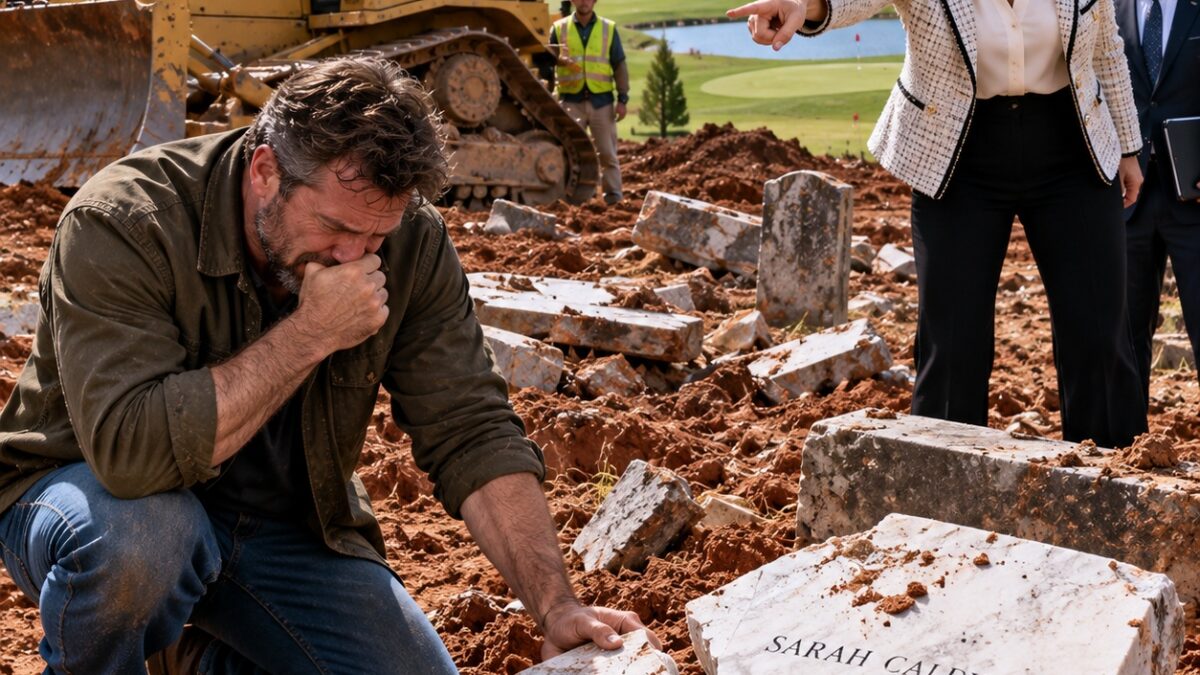
He walked the cemetery slowly.
Photographed the bulldozer.
The broken stones.
The wall.
Sarah’s marker.
He shook his head.
I had seen that kind of reaction before.
A man who understood something terrible had happened but was already trying to decide how little responsibility he could take for it.
Then Victoria arrived.
White Escalade.
She came up the golf-course service road and parked twenty feet from the bulldozer.
White sneakers.
Clipboard.
Not one visible trace of regret.
“This is community open space under the master development plan.”
She spoke to the deputy.
Not to me.
“We’re extending the fourteenth and fifteenth fairways. The board approved it in March.”
She unfolded a plat.
Garrett’s development plan.
The cemetery parcel was colored blue.
Label:
UNDEVELOPED GREEN SPACE — FUTURE GOLF USE
The deputy studied it.
Looked at Victoria.
Then me.
“Ma’am has a plat. You have a claim.”
He rubbed his jaw.
“That’s probably a courthouse issue, Mr. Caldwell. Not a badge issue.”
I almost laughed.
Instead, I asked:
“Deputy, is it a badge issue in Georgia when somebody bulldozes fifteen marked graves without a court order?”
He paused.
Victoria’s smile tightened.
The deputy looked back at the graves.
“I’m sorry about your wife.”
His voice was quieter.
“But I can’t arrest someone over a property-line dispute.”
Then he told me to speak with a judge.
And left.
Victoria stayed.
She looked across the destruction like someone inspecting a completed landscaping project.
I said nothing.
She expected anger.
I think she wanted it.
A threat.
A confrontation.
Something she could quote later.
I gave her nothing.
Georgia law has a specific process for disturbing burial grounds.
Victoria had not followed it.
No court authorization.
No proper relocation proceeding.
Nothing.
But that afternoon was not the time to explain all of that to her.
I spent the next two hours documenting everything.
Every stone.
Every track.
Every damaged grave.
Every section of wall.
Every angle of the bulldozer.
Every mark on Garrett’s plat.
I found the two largest pieces of Sarah’s headstone.
Lifted them into my truck bed.
One piece still held part of her name.
The marble was warm from the sun.
That night I sat alone on the porch.
The creek ran below the ridge.
Crickets started after dark.
Sarah’s broken stone sat on the kitchen table.
I did not sleep.
I planned.
Two weeks later, Stone Ridge sent me another letter.
Cream paper.
Embossed crest.
Board of Directors.
They demanded I remove all “debris, construction waste, and non-conforming material” from the cemetery area within ten days.
Debris meant shattered headstones.
Construction waste meant Elijah’s stone wall.
The letter threatened $500 daily fines beginning on day eleven.
Again:
I was not in their HOA.
My land was not part of their subdivision.
I had never signed their covenants.
But Victoria had exercised authority for so long that she had apparently forgotten authority had boundaries.
Three days later, the county joined her.
Habersham County Planning and Zoning.
Potential blight violation.
The cemetery debris supposedly presented a public-health concern.
“Uncontained biological material.”
Thirty days to remediate.
Signed by Commissioner Wade Jennings.
Victoria’s brother-in-law.
He had married her sister twelve years earlier.
Victoria filed the complaint.
Jennings approved it.
Family pressure disguised as county procedure.
I went to the planning office.
Jennings was supposedly unavailable all week.
I left a written response.
Then requested a certified copy of the complaint.
Victoria Ashworth.
Originating complainant.
Wade Jennings.
Approving official.
Useful.
Then came the social campaign.
Forty-seven homeowners signed a petition asking me to clean up or sell.
Victoria laminated it and posted it at the country club entrance.
Then she started telling residents the cemetery contained dangerous biological material.
Possible groundwater contamination.
Health risk.
Children should not play nearby.
It was nonsense.
But fear works faster than evidence.
Neighbors who had waved at me for years began avoiding my truck.
That was when I went to Pastor Jean Whitfield.
He had led the local church for thirty-one years.
He knew my grandfather.
Officiated Sarah’s funeral.
Had stood in rain beside me while I shoveled dirt onto her grave.
I told him everything.
The bulldozer.
Victoria.
The county letter.
The groundwater rumors.
He listened.
Then closed his eyes for several seconds.
Finally:
“Your grandfather recorded everything.”
“Harlon?”
“Everything.”
He leaned forward.
“He didn’t trust filing cabinets. He trusted public record.”
My grandfather Harlon Caldwell had been one of those men who believed anything important should survive the person who signed it.
Pastor Whitfield said:
“If he wrote something into a document, Ethan, it was there for a reason.”
I had inherited boxes of papers.
Deeds.
Maps.
Tax records.
Old agreements.
But I had never gone through them the way an engineer reviews a failing system.
That night I sat at my kitchen table.
Yellow legal pad.
Black coffee.
Sarah’s broken marble beside me.
I made a list.
Original Caldwell deed chain.
Stone Ridge development permits.
Subdivision plats.
Road records.
Any document Harlon had ever signed involving the land south of the cemetery.
Measure twice.
Cut once.
Three days later, Garrett Ashworth came to my house.
Gunmetal Range Rover.
Expensive enough to buy several houses outside his own subdivision.
He walked toward my porch with the polished confidence of somebody who had practiced being reasonable in front of hostile people.
“Mr. Caldwell.”
“Mr. Ashworth.”
“I think we’ve gotten off to a rough start.”
He offered his hand.
I shook it.
Did not invite him inside.
He pulled a paper from his jacket.
Purchase offer.
Five thousand dollars.
For the cemetery parcel.
A quarter acre.
“Fair market value,” he said, “considering the soil has already been disturbed and has limited development potential.”
I looked at him.
“Fifteen graves are worth more than your fairway.”
His smile changed.
Not disappeared.
Changed.
“You’re sitting on a quarter acre surrounded by a four-hundred-million-dollar community.”
He folded the offer.
“Every month you hold out costs me tee times, memberships, resale value.”
Then:
“You really think stubbornness is a long-term strategy?”
“I think bulldozing a cemetery is a short-term one.”
He left.
Three days later, I learned how far they were willing to go.
I drove toward the ranch and found three concrete Jersey barriers blocking the private gravel road.
Behind them:
Chain-link gate.
Padlock.
New sign.
STONE RIDGE GOLF ESTATES
PRIVATE ROAD
AUTHORIZED VEHICLES ONLY
TRESPASSERS WILL BE TOWED
They had landlocked me.
Two hundred forty acres.
And I could not reach my own house by vehicle.
I called the sheriff again.
Victoria appeared fifteen minutes after the deputy.
Too fast to be coincidence.
She showed him a road-maintenance agreement signed by Garrett claiming Stone Ridge had built and maintained the road since 2004.
The deputy looked tired before the argument started.
This time I did not argue at all.
After everyone left, I walked the road.
Handheld Trimble GPS.
Survey-grade habit from decades with the Corps.
When you need to know where you stand—
Measure.
The road ran roughly 1,100 feet through my deeded property.
Not beside it.
Through it.
Every Stone Ridge resident.
Every delivery truck.
Every golfer.
Every service vehicle entering the development used a road that crossed Caldwell land.
Victoria had put barriers on my land to keep me from using the same road Stone Ridge needed to reach theirs.
That changed the problem.
I filed a formal complaint.
Then finally went to the county records vault.
The vault sat in the basement of the old courthouse annex.
Cinder-block walls.
Fluorescent lights.
Metal shelves.
Deed books dating into the nineteenth century.
Mildew.
Paper.
Preservation chemicals.
I spent almost three weeks there.
Every day.
Same thermos.
Same reading glasses.
Same process.
Start with known facts.
Trace backward.
Document every link.
Caldwell deed chain:
Clean from 1843 forward.
Stone Ridge permits:
Filed by Piedmont Valley Development Corporation in 2001.
Approved 2002.
Garrett acquired development rights in 2003.
Construction began 2004.
Then I found the document that changed everything.
Deed Book 147.
Page 312.
March 14, 1968.
A ninety-nine-year ground lease.
Grantor:
Judge Harlon Caldwell.
Grantee:
Piedmont Valley Development Corporation.
I sat there reading the first page.
Then the second.
Then back to the first because I thought I had misunderstood.
The lease covered 196 acres.
Exactly the footprint that later became Stone Ridge Golf Estates.
My grandfather had never sold the land.
He leased it.
Twelve thousand dollars a year.
Adjusted for inflation.
Annual payment to the Caldwell Family Trust.
The fee-simple title—the actual ownership of the dirt beneath everything—stayed with the Caldwell family.
Every home.
Every fairway.
Every pool.
Country club.
All of it stood on leased Caldwell ground.
Then I reached Article 9, Section 3.
Title:
SACRED GROUND PROVISION
I read it once.
Twice.
Then a third time.
My grandfather had written that if any cemetery, burial ground, or memorial site located on the leased premises—or adjacent Caldwell property—was intentionally damaged, disturbed, or desecrated by the lessee or any successor in interest, the lease terminated immediately and automatically.
And all improvements on the leased property reverted to the lessor or heirs.
I leaned back in the metal chair.
The fluorescent light buzzed above me.
For several seconds I heard nothing else.
My grandfather had built a dead man’s switch into the lease.
Touch the cemetery.
Lose the land.
Not a fine.
Not damages.
Automatic termination.
Then I checked the payment records.
Garrett had taken over the lease in 2003.
Payments:
Then nothing.
Twelve years of default.
Article 7 contained a second termination mechanism.
Failure to make lease payments for twenty-four consecutive months constituted forfeiture.
Two independent triggers.
One had been quietly sitting there for years.
The other Victoria had activated the moment her bulldozer touched the first grave.
I copied the entire lease.
Every page.
Then drove home.
Late afternoon sun angled through the pines.
I placed the documents on the kitchen table.
Beside Sarah’s broken headstone.
Her birth year still visible.
I put one hand on the marble.
“I told you I’d keep this place whole.”
Then I called Lloyd Greer.
Lloyd practiced title law in Gainesville.
Seventy-one.
Suspenders.
Office above a converted grain warehouse.
He had spent decades handling ground leases and title disputes.
I placed the lease on his desk.
He read it silently.
Twelve minutes.
I watched the old railroad clock behind him.
Tick.
Tick.
Tick.
When he finished, he removed his glasses.
“Ethan.”
“Yes?”
“Do you understand what you have?”
“I think so.”
“This isn’t a lawsuit to terminate a lease.”
He tapped the page.
“This is a reversion.”
I said nothing.
“The lease is already terminated.”
He pointed first to Article 7.
“Payment default.”
Then Article 9.
“Cemetery desecration.”
“Independently?”
“Independently.”
He leaned back.
“You don’t need a judge to cause termination.”
“What do I need?”
“A judge to confirm what already happened.”
Then came the sentence that would have sounded impossible three weeks earlier.
“You already own everything sitting on that leased property.”
“One hundred eighty homes.”
“Yes.”
“Golf course.”
“Yes.”
“Country club.”
“Yes.”
I looked through the warehouse window toward the railroad tracks below.
“Then we do this right.”
Lloyd nodded.
“What does right mean to you?”
“It means those families did not bulldoze Sarah’s grave.”
“No.”
“They probably don’t know any of this.”
“Most likely.”
“I’m not destroying one hundred eighty households because Garrett Ashworth lied to them.”
Lloyd studied me.
Then nodded once.
“Good.”
Because the homeowners were not the enemy.
That mattered from the beginning.
Garrett and Victoria had sold them an illusion.
The residents had bought homes believing they owned the ground beneath them.
They had mortgages.
Savings.
Retirement plans.
Children.
Some had been there over a decade.
I wanted truth.
Not mass punishment.
We hired Nina Torres.
Forensic accountant.
Atlanta.
Mid-forties.
Extremely sharp.
Lloyd described her as someone who treated spreadsheets like crime scenes.
Once the quiet-title filing gave us access to financial records, Nina started pulling threads.
What she found made the land problem look almost simple.
Stone Ridge had collected roughly $3,200 per home in annual HOA dues.
One hundred eighty homes.
Nine years.
About $5.18 million.
Approximately $4.7 million had been transferred to Stone Ridge Golf LLC.
Garrett’s company.
Residents believed their dues funded roads.
Landscaping.
Amenities.
Common infrastructure.
Instead, massive amounts had flowed toward the private golf operation.
A golf course homeowners did not own.
A golf course they could not even use without paying separate membership fees.
A golf course sitting on Caldwell land.
Nina laid transactions across Lloyd’s conference table.
Shell companies.
Internal transfers.
Inflated maintenance invoices.
Golf LLC billing the HOA.
The same money circulating.
“This is self-dealing.”
Her voice was clinical.
No drama.
That made it worse.
Lloyd built our strategy.
First:
Quiet-title action confirming lease termination.
Both triggers.
Cemetery clause.
Payment default.
Second:
Historic protection for the Caldwell cemetery.
Whatever happened around it, nobody was ever putting a bulldozer there again.
Third:
Lis pendens on all 180 Stone Ridge parcels.
Public notice that title was under legal challenge.
That meant no clean sales.
No refinancing.
No equity lines until the dispute was resolved.
Fourth:
Certified letters to every homeowner.
They deserved to know.
Fifth:
Criminal referrals.
Cemetery desecration.
Potential real-estate fraud.
Financial misconduct.
Forgery if the evidence supported it.
I wrote the homeowner letter myself.
Two nights.
I revised every sentence.
I did not want to sound threatening.
I did not want people opening a certified envelope and believing some angry widower wanted their house.
The final version was simple.
You were sold a home on leased land.
The ground beneath your home is subject to a recorded Caldwell ground lease.
The developer did not disclose the title condition accurately.
I am not seeking to harm your family.
Please verify the documents independently with your own attorney.
Pastor Whitfield helped with elderly residents.
He visited them personally.
Sunday suit.
Calm voice.
Explained what was happening.
Lloyd’s printer produced 180 letters.
I signed every one by hand.
The mail tray weighed eleven pounds.
Then we waited.
Within forty-eight hours, Lloyd’s office started receiving calls.
Eleven the first wave.
Then more.
Residents pulled closing files.
Called title attorneys.
Checked county records.
And discovered the same thing.
Their documents did not convey simple ownership of the ground the way they thought.
The phrase ground lease conveyance appeared inside paperwork most people had never examined closely.
The homeowners owned improvements.
They did not own the land beneath them.
Victoria called an emergency HOA meeting.
Country club ballroom.
About 120 residents.
She stood at the podium in a cream blazer with gold buttons.
Garrett beside her.
“This is a scam.”
She told them I was trying to extort the neighborhood.
Their titles were clean.
Their attorney had reviewed everything.
Then a woman in the back raised her hand.
She had printed the ground lease herself.
“If our titles are clean, why does the county record show this lease on every parcel?”
Victoria gave the worst possible answer.
“That document is outdated.”
By the end of the week, multiple homeowners had hired independent title lawyers.
Every search came back the same.
Lease.
Caldwell title.
No clean fee-simple ownership in the residents.
Garrett panicked.
He tried contacting the successor to the original lessee.
Piedmont Valley Development Corporation.
Problem:
The company had dissolved in 1994.
There was nobody to negotiate a retroactive extension with.
Commissioner Wade Jennings tried something even stranger.
He went to county records and asked the clerk to reclassify the 1968 ground lease as a historical document with no current legal force.
The clerk, Doris Peton, had worked there twenty-seven years.
She looked over her reading glasses.
“Wade, I don’t reclassify recorded deeds.”
Then:
“Judges do that.”
So Garrett created another solution.
Payment receipts.
He produced records supposedly proving lease payments from 2005 through 2016.
The exact years Nina had identified as default.
If those receipts were genuine, Article 7 might become more complicated.
Nina examined them.
Less than an hour.
Then called us.
The bank account numbers belonged to accounts that had been closed in 2003.
Some before the dates on the supposed receipts by years.
Routing information did not match.
Fabricated.
And badly.
Garrett had taken a title problem and turned it into potential evidence of forgery.
That evening he came to my fence.
Not the Range Rover.
Pickup.
Unshaven.
Sleeves rolled.
“You have no idea what you’re starting.”
I leaned against the fence post.
“I’ll bury you in litigation for twenty years.”
I waited.
“I’ll make this property worthless.”
Nothing.
“I’ll make your life hell until you take a deal.”
I looked toward the ridge.
Then back at him.
“Your wife already buried fifteen people on my land.”
Pause.
“How’d that work out?”
He left.
Victoria launched a public campaign the next morning.
Yard signs.
SAVE OUR HOMES
STOP CALDWELL
Facebook group.
She posted an old photograph of Sarah and me at the county fair.
Sarah had already been sick.
Caption:
THIS MAN WANTS TO STEAL YOUR HOME
That one hurt.
Not because of what Victoria said about me.
Because she used Sarah’s face.
For a few minutes, I wanted to respond.
Lloyd told me not to.
Nina told me not to.
Pastor Whitfield said:
“Let the paperwork do its work.”
So I did.
Something happened Victoria did not expect.
The yard signs disappeared.
Not because I touched them.
Homeowners removed them.
One after another.
Their attorneys had read the lease.
The silence became more damaging to Victoria than anything I could have posted online.
She filed for a restraining order.
Claimed my certified letters were harassment.
Emotional intimidation.
Financial panic.
Judge Patricia Linden heard the motion.
She read my homeowner letter aloud in court.
Every line.
Factual.
Recorded deed references.
Invitation to seek independent legal counsel.
No threat.
When she finished, she looked at Victoria’s attorney.
“Informing property owners about a recorded defect in title is not harassment.”
Motion denied.
Victoria went to television.
She called an Atlanta station.
Pitched the story as:
Local man terrorizes golf community.
Threatens 180 homes.
Elderly residents afraid.
The reporter was Claire Pennington.
Investigative journalist.
And unlike the county officials Victoria was used to manipulating, Claire did something dangerous.
She checked.
Ground lease.
Development permits.
HOA finances.
Homeowner interviews.
The first couple she interviewed had lived in Stone Ridge eleven years.
Paid more than $35,000 in HOA dues.
They had just learned from their own attorney that they did not own the dirt beneath their house.
The wife cried on camera.
The husband held his closing documents.
Pointed to the phrase buried in small print.
Ground lease conveyance.
When Claire called Victoria for comment, Victoria gave the same argument she had been using for months.
“This is a vendetta by a man who cannot accept progress.”
She called my land an eyesore.
Called the lease outdated.
Said I was terrorizing hardworking families.
Claire waited.
Then asked:
“Mrs. Ashworth, can you explain why your husband sold homes to one hundred eighty families on land he held under a ground lease that had not been paid for twelve years?”
Four seconds.
That is how long Victoria stayed silent.
Four seconds does not sound long.
On television, it is an abyss.
Finally:
“I’m not going to discuss my husband’s business dealings.”
Claire answered:
“The county records suggest they are the same dealings.”
Victoria ended the interview.
The segment ran at six.
Headline:
180 FAMILIES MAY NOT OWN THEIR LAND
The report showed my cemetery.
Eight full seconds.
Red clay.
Broken marble.
The shattered stones.
Then Nina at a whiteboard following millions in HOA money.
Then homeowners holding their closing papers.
Then Victoria’s four seconds of silence.
By nine that night, the story had been shared more than a thousand times.
Another station picked it up.
By morning, Commissioner Jennings released a statement claiming he had been unaware of title irregularities.
He did not mention his relationship to Victoria.
Did not mention approving her blight complaint against me.
Nobody needed me to point that out anymore.
Stone Ridge residents were doing their own research.
Victoria’s Facebook group turned on her.
The Stop Caldwell posts vanished.
In their place:
Title-search screenshots.
HOA payment records.
Questions.
A thread appeared:
WHERE DID OUR MONEY GO?
More than a hundred comments by sunrise.
Garrett hired a criminal-defense attorney.
Stopped returning calls.
Stopped visiting the country club.
The Range Rover disappeared into his garage.
Victoria still believed she could control a room.
That ended at the Habersham County Board of Commissioners meeting.
The old courthouse room held about 140 people comfortably.
More than two hundred tried to get inside.
Residents lined walls.
Some sat in the aisle.
WGCL.
WSB.
Camera lights.
County attorney.
Sheriff Dale Hoskins near the side door.
This time he was not there to call the matter a property dispute.
The district attorney had requested his presence.
Victoria and Garrett sat in front.
Garrett had his defense attorney beside him.
Victoria wore a navy blazer.
Pearl earrings.
Handbag in her lap.
She looked like she expected to take control once the meeting started.
I walked in with Lloyd and Nina.
One manila folder in my hand.
Lloyd had a banker’s box.
Nina had her laptop.
The commission chair called my name at 6:22.
I walked to the podium.
The room became quiet enough that I could hear the fluorescent lights.
I placed four pieces of evidence in front of me.
First:
The ground lease.
Deed Book 147.
Page 312.
I read the sacred-ground provision.
Every word.
No paraphrasing.
When I finished, no one spoke.
Second:
The photographs.
I held up Sarah’s broken marker.
White marble.
Her name.
Diagonal fracture.
The word BELOVED missing beneath churned clay.
I did not explain what people were looking at.
I did not need to.
A woman in the third row covered her mouth.
Third:
Nina took the microphone.
$5.18 million in dues.
$4.7 million transferred toward Garrett’s golf entity.
Inflated maintenance invoices.
Shell-company transfers.
Dates.
Amounts.
Accounts.
Eleven minutes.
No theatrics.
She destroyed the financial story simply by showing the numbers.
Fourth:
Garrett’s payment receipts.
Beside them:
Bank records showing the listed accounts had been closed years before the supposed transactions.
Lloyd stood.
One sentence.
“Mr. Ashworth submitted fabricated financial records during a lawful title inquiry.”
Then the county attorney stood.
Adjusted his glasses.
The district attorney’s office had reviewed the evidence.
Charges would be filed.
Against Victoria:
Felony cemetery desecration.
Criminal trespass.
Conspiracy relating to destruction of the protected burial sites.
Against Garrett:
Real-estate fraud.
Wire fraud.
Embezzlement.
Forgery.
The room exhaled.
Victoria started to stand.
Garrett’s attorney caught her arm.
“Victoria.”
Quiet but firm.
“Sit down. Don’t say a word.”
She sat.
For nine years, every neighborhood meeting had belonged to her.
She controlled who spoke.
How long.
What counted.
Who was embarrassed.
Who was fined.
That night she controlled nothing.
Then an older man stood in the back.
I recognized him.
Early Stone Ridge buyer.
Retired teacher.
Had lived there since 2005.
His voice cracked.
“Mr. Caldwell.”
I turned.
“Are you going to take our homes?”
The room froze.
That was the question underneath everything.
Not the lease.
Not Victoria.
Not even Garrett.
One hundred eighty families wanted to know whether my grief was about to become their disaster.
I looked at him.
“No, sir.”
A woman began crying somewhere near the front.
“Your homes are yours.”
I paused.
“They always should have been.”
Then:
“I’m here to make sure they actually are.”
Someone clapped.
Then another.
The sound spread.
I saw Pastor Whitfield near the door.
Hands folded.
He nodded once.
Sheriff Hoskins walked toward Garrett.
Stopped in front of him.
“Hands behind your back, sir.”
The handcuffs clicked.
Garrett did not resist.
Victoria watched.
Completely still.
The man who had enabled her power was led through the side door.
The meeting adjourned at 7:14.
The cameras kept running.
Six weeks later, Superior Court confirmed the lease reversion.
Both termination triggers stood.
Payment default.
Sacred-ground provision.
On paper, the Caldwell Family Trust now controlled 196 acres beneath one hundred eighty houses, the clubhouse, pool, roads, and golf course.
Legally, the leverage was enormous.
Morally, the answer was easy.
I was not evicting those families.
Lloyd and I created what we called the Caldwell Homestead Conversion.
Every homeowner could obtain a clean fee-simple deed to the lot beneath their house.
Real ownership.
No ground lease.
Price:
Forty percent of current market land value.
Not free.
Because land still has value.
But dramatically below what a hostile new owner could have demanded.
The price also reflected the damage Garrett’s fraud had already caused.
Seventy-four families accepted within sixty days.
The others negotiated different arrangements.
Every homeowner ultimately received clear title.
For the first time since Stone Ridge was built, they actually owned the ground beneath their homes.
That was the result I cared about.
Not becoming a landlord to one hundred eighty frightened families.
Not vengeance.
Correcting the lie.
The golf course changed.
Eighteen holes became nine.
The reclaimed portion around the Caldwell cemetery became something else.
We called it the Caldwell Heritage Preserve.
The fairway disappeared.
Native grasses returned.
Hardwoods were replanted.
Walking trails crossed the meadow.
Interpretive markers told the history of the land.
Elijah Caldwell.
The original farm.
The cemetery.
The creek.
A stone bench was installed near the trailhead overlooking the place my family had worked since 1843.
The cemetery itself required specialists.
A historic-preservation firm came from Savannah.
Ground-penetrating radar.
Archaeological guidance.
Careful recovery.
Every one of the fifteen burial locations was identified.
The remains were reinterred properly.
New headstones were carved to resemble the originals.
The old stone wall was rebuilt by hand using the same dry-stack style Elijah had used.
I watched most of it.
Not every day.
I could not.
Some things hurt even when they are being repaired.
Sarah’s marker came last.
I drove back to Elberton.
Same as before.
Walked through rows of white Georgia marble.
Put my hand on one slab.
Then another.
I felt foolish doing it a second time.
Stone is stone.
But grief gives objects weight.
Eventually I found one.
Smooth.
Cool.
Fine grain.
The mason asked about the inscription.
I already knew.
Sarah Caldwell.
Dates.
And beneath:
BELOVED
Nothing else.
The new stone went into the same place.
I stood there after the crew left.
For the first time since the bulldozer, the hillside looked recognizable.
Not identical.
It never would.
You cannot run a D8 through a cemetery and later pretend nothing happened.
The replacement stones were too clean.
The rebuilt wall too straight.
The new grass too young.
But the dead were where they belonged.
And the ground was protected.
I had kept the promise as well as I could.
Settlement money funded another promise.
The Sarah Caldwell Memorial Scholarship.
Ten thousand dollars a year.
Habersham County student.
Historic preservation.
Archaeology.
Conservation.
The first recipient was nineteen.
From Clarkesville.
Wanted to specialize in cemetery restoration.
When I read the application, I had to put it down for a while.
Sarah would have loved that.
She believed useful work mattered.
Work that left something better after you were gone.
Restoring what other people had forgotten fit her.
Victoria eventually pleaded to and was convicted over the cemetery desecration.
Her sentence included probation and five hundred hours of community service.
The assignment had a kind of symmetry nobody could have planned better.
County cemetery maintenance.
Two days a week.
Weeding.
Cleaning.
Helping care for public burial grounds.
I did not go watch.
People expected me to.
Why?
To see her polishing headstones?
To enjoy it?
I had no interest.
The point of accountability is not to create a spectator sport.
The cemetery was restored.
Sarah was back where she belonged.
Victoria’s punishment belonged to the court.
Garrett’s consequences were more severe.
Real-estate fraud.
Wire fraud.
Embezzlement.
Seven years in federal prison.
$4.7 million restitution.
His Range Rover was seized.
Commissioner Wade Jennings resigned.
He was never criminally charged in the source events, but his political career ended.
The HOA dissolved.
Unanimous vote.
Stone Ridge residents replaced it with a voluntary neighborhood association.
No mandatory dues.
No enforcement power.
No clipboard patrols.
The first resolution honored the Caldwell family’s role in the county.
They hung it in the community center beside a photograph of Harlon Caldwell.
The man whose lease had outlived almost everyone who thought they could ignore it.
I visited Stone Ridge occasionally after that.
Not often.
The neighborhood felt different without Victoria driving through twice a day.
People still mowed grass.
Still argued about landscaping.
Still cared about property values.
But ordinary disagreement had replaced fear.
That mattered.
One homeowner stopped me near the former fourteenth hole.
He was the retired teacher who had asked whether I would take their homes.
He held out his hand.
I shook it.
“Got the deed yesterday.”
“Good.”
“My wife cried.”
“I understand.”
He looked toward the preserve.
“I owe you an apology.”
“No.”
“I signed Victoria’s petition.”
I remembered.
“Forty-seven names.”
“Mine was number nineteen.”
“You didn’t know.”
“I should’ve asked.”
Maybe.
But I understood how fear works.
Victoria had told them graves were contaminating groundwater.
That I was a health risk.
Then later that I wanted their homes.
People protect their families before they investigate their neighbors.
That instinct can be manipulated.
Victoria was good at manipulation.
I was not going to make every resident carry her guilt.
The man looked toward the trail.
“What happens to the rest of the land?”
“Trees.”
He smiled.
“Better than golf?”
“For that section?”
I looked toward Sarah’s hill.
“Much.”
The restored preserve became more popular than I expected.
Families walked there.
Students came on history trips.
Older residents read the markers.
Sometimes people left flowers at the cemetery wall.
I appreciated the intention.
But I also worried about turning my family’s graves into a public attraction.
So access remained controlled.
Respectful.
The cemetery itself stayed protected behind a low boundary wall.
The trail passed nearby.
Not through it.
That distinction mattered.
The land could teach history without treating the dead like scenery.
That had been Victoria’s original failure.
She saw graves as visual clutter.
Something between a golfer and a view.
Sarah’s stone was an obstacle.
Elijah’s marker an eyesore.
She looked at history and saw bad landscaping.
I do not think she understood the difference until consequences arrived.
Maybe she still does not.
That is no longer important to me.
The legal system did not require enlightenment.
Only accountability.
I had spent almost three decades building infrastructure designed to withstand forces people hoped would never come.
Floodwalls.
Levees.
Bridges.
The principle was always the same.
You design for failure before failure happens.
My grandfather had done that in 1968.
He could not predict Victoria Ashworth.
Could not know an HOA would exist.
Could not know an eighteen-hole golf course would rise over leased pasture.
He only knew one thing:
Developers change.
Companies dissolve.
Money changes hands.
Promises weaken.
So he wrote the cemetery protection into the document itself.
Not a handshake.
Not family tradition.
Recorded language.
That was engineering of another kind.
Build the protection into the system.
The sacred-ground clause sat quietly for more than half a century.
Nobody needed it.
Then a bulldozer crossed a line.
And the clause did exactly what Harlon designed it to do.
People later called that poetic justice.
I understand why.
The woman who destroyed graves to extend a golf course activated the provision that destroyed her family’s control of the golf course.
That sounds written.
But the truth was less magical.
It was planning.
My grandfather wrote carefully.
That is all.
Careful people sometimes look paranoid while nothing is wrong.
Then something goes wrong.
And suddenly everyone understands why the clause existed.
The same was true of the payment records.
Garrett apparently assumed the old lease had become irrelevant.
Piedmont dissolved.
Harlon died.
Years passed.
Stone Ridge grew.
Nobody challenged him.
The development looked permanent.
That appearance became dangerous.
He stopped making payments.
Sold homes.
Moved money.
And the longer nobody objected, the more he behaved as though silence had converted leasehold into ownership.
It hadn’t.
Time can change many things.
Recorded title is not automatically one of them.
The homes were expensive.
The country club was polished.
The golf greens were immaculate.
None of that changed the dirt beneath them.
That realization frightened residents.
Understandably.
They had been taught to think property ownership meant the building.
The kitchen.
Bedrooms.
Garage.
Backyard.
But land is the foundation beneath every one of those ideas.
Once title to the ground became uncertain, everything above it became uncertain too.
That was why I refused to weaponize their fear.
Garrett had already done that.
He sold certainty he did not possess.
I was not going to correct him by creating another version of the same abuse.
So the conversion program had one goal.
Make reality match what those families reasonably believed they bought.
House plus land.
Clean deed.
Done.
Some lawyers told me we could have extracted more.
Much more.
I knew.
A hostile owner holding reversion rights over one hundred eighty luxury lots could have demanded extraordinary sums.
That was not what Sarah asked me to protect.
She said:
“Keep this place whole.”
Not:
Become rich.
The land was whole when the cemetery was restored.
The families getting deeds did not weaken that.
If anything, it ended the conflict my grandfather had tried to guard against.
The Caldwell family retained what mattered.
The preserve.
Cemetery.
Ranch.
History.
The homeowners received what Garrett should have sold them legally in the first place.
That was enough.
One afternoon, Nina visited the preserve after the criminal cases were nearly finished.
She had never seen the restored cemetery.
We walked the trail.
She stopped at the stone wall.
“You rebuilt it exactly?”
“As close as possible.”
She looked at Elijah’s new marker.
Then Sarah’s.
“I spent months looking at this place as numbers.”
“Five point one eight million.”
“Four point seven transferred.”
She smiled.
“Exactly.”
Then she touched the wall lightly.
“It’s strange seeing what the numbers were actually attached to.”
That stayed with me.
Forensic accounting can make harm abstract.
Accounts.
Entities.
Amounts.
But money always represents something.
Homeowner dues.
People’s salaries.
Retirement checks.
Mortgage budgets.
Garrett’s transfers were not simply cells in a spreadsheet.
They were residents believing they were maintaining their community while funding his private golf operation.
Likewise, the ground lease was not only legal language.
It represented Harlon’s decision not to sell ancestral land.
The sacred-ground clause represented people with names.
Elijah.
My parents.
My grandparents.
Sarah.
Documents are dry only until you understand what they protect.
The broken headstone fragment stayed in my house.
I could have discarded it after Sarah’s new marker was installed.
I did not.
It sits on a shelf in my study.
The piece with her birth year.
Not because I want to relive the bulldozer.
Because it reminds me what happens when people treat history as disposable.
The fragment is damaged.
The new marker is whole.
Both are true.
Restoration does not erase destruction.
It gives destruction an answer.
That principle became important to me.
The preserve was not an attempt to pretend Victoria never touched the cemetery.
One of the interpretive signs explains that the burial ground was illegally disturbed during a development dispute and later restored.
No names.
No public shaming.
Just fact.
Future visitors should know why the protection exists.
Systems forget lessons if nobody records the failure.
My grandfather recorded the protection.
I recorded the breach.
Maybe somebody fifty years from now will read both and understand.
The final time I saw Victoria was not dramatic.
No courtroom.
No handcuffs.
I was leaving the county administration building.
She was coming in for something related to her supervision.
We saw each other across the lobby.
She looked older.
Not transformed.
Not humbled in some cinematic way.
Just older.
We did not speak.
I walked past.
That surprised me.
For months I had imagined what I would say if we were ever face-to-face after everything.
Sarah’s grave.
The lies.
The petition.
The road.
The television campaign.
When the moment came, there was nothing left.
Words belong to unfinished arguments.
Ours was finished.
The cemetery existed.
The lease reversion was confirmed.
The residents had deeds.
The preserve was protected.
Garrett was in prison.
Victoria was living inside the consequences chosen by the court.
Anything I said would only reopen something I had spent too much energy closing.
So I kept walking.
That felt better than victory.
It felt like freedom.
The private road changed too.
After the title resolution, access was rewritten properly.
No more Jersey barriers.
No false Stone Ridge ownership sign.
The road across Caldwell property remained documented with the appropriate access rights needed by the converted parcels.
Again:
Boring.
Legal.
Clear.
Boring documents are underrated.
They prevent dramatic stories.
I would have preferred no story at all.
Sarah alive.
Cemetery untouched.
Stone Ridge homeowners holding clean deeds from day one.
No television.
No court.
No bulldozer.
People sometimes told me:
“Everything worked out.”
I never liked that phrase.
Sarah’s original marker was destroyed.
Graves were disturbed.
Families learned their biggest financial assets had defective title.
Millions were mishandled.
People went to prison.
That is not everything working out.
It is people doing the best they can after something that should not have happened.
There is a difference.
A good ending does not require a good beginning.
It requires enough people to choose repair once damage becomes undeniable.
Doris refused to alter the public record.
Judge Linden refused Victoria’s harassment theory.
Claire Pennington checked the facts instead of airing the pitch Victoria gave her.
Nina followed money.
Lloyd understood the lease.
Pastor Whitfield helped frightened residents.
Homeowners hired their own counsel.
The court confirmed the title.
Preservation specialists restored the graves.
No one person fixed everything.
That is how real systems recover.
Piece by piece.
I still walk to Sarah’s grave most Sundays.
Not every Sunday.
I am not that disciplined.
But often.
The trail passes wildflowers where part of the old golf course used to be.
In spring, the meadow becomes yellow and purple.
Native hardwoods are growing back.
Young trees.
They will be taller than I am someday.
Maybe taller than the country club.
The creek still murmurs below the ridge.
That sound survived everything.
Sarah loved it.
On one Sunday in late October, I walked up alone.
The morning was cool.
Fog low in the valley.
Two red-tailed hawks were circling on the rising air.
Sarah’s replacement headstone looked slightly less new than it had the year before.
Weather beginning its work.
That made me happy.
I never wanted the stone to remain perfect.
Weather belongs there.
I had brought wildflowers.
Nothing arranged professionally.
Just a handful from the edge of the meadow.
I placed them against the marble.
Then stood there.
Years earlier, when I buried her, I had promised to keep the place whole.
For a long time after the bulldozer, I believed I had failed.
The grave was broken.
Wall destroyed.
Ground churned.
How do you keep something whole after somebody tears through it with sixty thousand pounds of steel?
Eventually I understood Sarah had not been asking me to preserve every stone exactly as it was forever.
Nothing stays unchanged.
Trees fall.
Walls need repair.
People die.
She had been asking me not to surrender what the place meant.
Family.
Memory.
Continuity.
The right of the dead to remain undisturbed.
The responsibility of the living to remember.
That could be repaired.
Not perfectly.
Enough.
I thought about Harlon.
Sitting somewhere in 1968 with a legal pad or typewriter.
Writing Article 9, Section 3.
Maybe someone asked why such a dramatic clause was necessary.
Maybe no one did.
He knew developers.
He knew time.
He knew promises fade when the people who made them are dead.
So he wrote one that could survive him.
Fifty-eight years later, his words had more force than Victoria’s board votes, Garrett’s money, Jennings’s county title, and a D8 Caterpillar combined.
That is why I still tell younger engineers that strength is rarely about size.
A levee can be miles long and fail because of one poorly protected section.
A two-paragraph clause can control 196 acres.
A headstone can carry an entire marriage in one word.
Beloved.
Small things hold surprising loads.
People do too.
I did not feel strong when I saw Sarah’s grave broken.
I felt hollow.
I did not feel powerful sitting in the records vault.
I felt tired.
I did not feel triumphant when Garrett was handcuffed.
I felt relieved.
The story became much larger publicly than it ever felt inside me.
To television, it was 180 homes.
A corrupt developer.
A cemetery.
Millions.
To me, most of the time, it remained one promise to one woman.
Keep this place whole.
Everything else grew from that.
The scholarship grew too.
The first recipient sent me a letter after her first semester.
She had been studying burial-ground conservation.
Soil disturbance.
Stone preservation.
Historical mapping.
She wrote that Sarah’s story helped her understand why the work mattered.
I sat on the porch and read the letter twice.
Then put it in the same drawer as Sarah’s old medical bracelet.
Life connects things strangely.
Cancer.
A grave.
A bulldozer.
A ground lease.
A young student learning how to preserve cemeteries.
None of those things belong together naturally.
But once events happen, we decide what the consequences will build.
Garrett built a golf course on a lie.
I tried to build something better from the collapse.
That is all.
Stone Ridge still exists.
The name eventually stayed, despite some residents wanting to change it.
Nine-hole course.
Smaller.
The neighborhood association handles voluntary projects.
No mandatory clipboard patrol.
No grass ruler.
No wind-chime tonality enforcement.
People somehow survive.
Property values recovered once titles were cleaned up.
That made sense.
Certainty has value.
Real certainty.
Not Garrett’s sales pitch.
The homeowners own their land now.
Some sold later.
They could.
Clean titles.
Others refinanced.
They could.
A few built additions.
Their land.
Their decision, subject to ordinary county law.
That is what ownership was supposed to be from the beginning.
The retired teacher once sent me a Christmas card.
Inside he wrote:
First Christmas we’ve spent here knowing the dirt under the tree belongs to us.
I kept that card.
Not because I needed thanks.
Because it confirmed we had chosen the correct remedy.
I could have become the villain Victoria accused me of being.
Legally owning 180 homes would have made a great revenge fantasy.
Evict everyone.
Take the country club.
Lock the gates.
Watch values collapse.
But revenge is a terrible land-management policy.
Those families had done nothing to Sarah.
Some had signed Victoria’s petition.
Some believed her rumors.
That hurt.
It did not make them responsible for cemetery desecration or fraud.
Responsibility needs accurate boundaries too.
Engineers understand that.
Load goes where load goes.
You do not blame an entire structure for one failed connection.
You isolate the failure.
Repair it.
Garrett.
Victoria.
Their financial network.
The improper county pressure.
Those were the failures.
The homeowners were largely the people standing downstream.
Protect them.
That is what we did.
Sometimes I wondered what Harlon would have done.
Would he have offered deeds at forty percent?
Lower?
Higher?
Would he have kept the golf course?
I will never know.
The dead leave documents.
Not instructions for every future moral choice.
At some point, the living have to decide.
I decided the family land mattered more than extracting maximum value.
The cemetery mattered more than golf.
The residents’ stability mattered more than humiliating Garrett.
Sarah’s name mattered more than Victoria’s.
Those priorities made the decisions surprisingly easy.
The hardest decision had already been made by someone else.
Victoria touched the graves.
After that, the paperwork spoke.
One of the young Corps engineers I used to supervise came to see me after the preserve opened.
We walked the restored wall.
He had heard the story.
“Colonel, this is the craziest failure analysis you’ve ever done.”
I laughed.
“No.”
“What beats this?”
“Mississippi flood-control gate, 1997.”
He shook his head.
“One hundred eighty houses reverting because of a cemetery clause?”
“Paperwork.”
“Exactly.”
“Engineering is paperwork with consequences.”
He laughed.
But I meant it.
Drawings.
Specifications.
Contracts.
Deeds.
Leases.
People mock documentation until they need it.
Then every comma matters.
Harlon had understood that.
Garrett learned it too late.
The final document Lloyd prepared for me was the updated Caldwell Family Trust package.
New title maps.
Preserve protection.
Homeowner conversions.
Access rights.
Cemetery restrictions.
Everything organized.
Digitized.
Multiple certified copies.
When he handed me the box, he said:
“Your grandfather would approve.”
“Because it’s legally sound?”
“No.”
He pointed at the box.
“Because there are three copies of everything.”
That made me laugh harder than it should have.
Harlon absolutely would have approved.
I keep one set in a fire-rated cabinet.
One with Lloyd’s successor firm.
One in secure off-site storage.
No future Caldwell should have to spend three weeks in a fluorescent basement discovering what we already know.
That was another way to keep the place whole.
Make knowledge inheritable.
Not just land.
When people ask what I learned, they usually expect something about HOAs.
I could give them that.
An HOA only has the authority its governing documents and law actually provide.
Confidence does not expand jurisdiction.
A board vote does not create ownership of somebody else’s cemetery.
A developer’s plat does not erase an older title instrument.
Those things matter.
But the larger lesson was about records.
And patience.
Victoria moved quickly.
Letter.
Threat.
Bulldozer.
Blight complaint.
Petition.
Barriers.
Television.
Every time she felt resistance, she increased force.
I did the opposite.
Photograph.
Measure.
Retrieve.
Read.
Compare.
File.
That looked weak at first.
It was not.
Patience is powerful when evidence is accumulating.
A bulldozer can destroy a stone in seconds.
Restoration takes months.
A lie can frighten a neighborhood in one email.
Correcting title takes lawyers, courts, surveys, and time.
Destruction is usually faster than repair.
That does not make destruction stronger.
The cemetery exists again.
Victoria’s fairway does not.
Time revealed which thing had durability.
The same red Georgia clay she churned with a D8 now grows wildflowers.
That is not cosmic justice.
It is soil doing what soil does when people stop abusing it.
I like that explanation better.
Land does not care about revenge.
It responds to what you plant.
We planted grass.
Hardwoods.
Flowers.
And stone markers.
Then left it alone.
Sarah’s grave faces the creek again.
Her marble catches afternoon light.
Sometimes visitors read the word beneath her name.
BELOVED.
They do not know why I chose only one word.
They do not need to.
It was between us.
The public story grew huge.
Our marriage was small.
Private.
One word is enough.
The last time I stood there, I did not speak.
When Sarah was dying, silence had become our language.
It still worked.
I put the wildflowers down.
Touched the top edge of the marble.
Cool.
Smooth.
Weather beginning to soften it.
Then I stepped back.
Behind me, the preserve spread across land where golfers once complained about seeing graves.
No carts.
No tee markers.
No D8.
Just meadow.
Trees.
Creek.
History.
The promise was not untouched.
Nothing survives life untouched.
But it held.
Some promises are kept with love.
Some with endurance.
Mine required county records, forensic accountants, title lawyers, judges, and more certified mail than I ever wanted to see again.
Still counts.
I looked once more at Sarah’s name.
Then walked home.
The road was open.
The cemetery was protected.
The families next door owned their homes.
And the hillside my wife had asked me to keep whole was finally quiet again.








