PART2:HOA Queen Broke My Dead Father’s Fishing Rod and Stole My Kayak—She Never Checked What Kind of Badge Was in My Truck.v
PART2
I did not argue with Shelby on the dock.
I had spent too many years in law enforcement to mistake argument for evidence.
I took the notice.
Read it.
Five thousand dollars.
Unauthorized recreational use of a community-managed waterway.
No covenant number.
No board-resolution reference.
No hearing date.
No appeal instructions.
Just Shelby Kincaid’s signature.
The next morning, I wrote her a formal response.
Certified mail.
Return receipt.
Polite.
Precise.
The same way I wrote enforcement reports after eighteen years of knowing every word might someday be read aloud in court.
I cited Articles 4 through 9 of the recorded CC&Rs.
Not one contained a fishing-permit requirement.
No lake-access charge.
No five-thousand-dollar fishing penalty.
I requested the exact covenant, bylaw, or properly adopted board resolution authorizing her fine.
Fourteen days to respond.
Shelby answered six days later.
Not with legal authority.
With another violation.
Five thousand two hundred dollars now.
She had added the two-hundred-dollar permit fee I still had not paid.
The notice also accused me of:
FAILURE TO COMPLY WITH BOARD DIRECTIVE.
No case number.
No meeting minutes.
No vote.
No other board signature.
Just Shelby.
I stared at it at my kitchen table.
Then laughed.
Not because it was funny.
Because the document had the same energy as a parking ticket written by someone who had watched three courtroom dramas and decided she was now judge, jury, prosecutor, and meter maid.
I called the HOA management company listed on Lake Shelby Estates’ website.
Disconnected.
Tried the backup number.
Disconnected.
The annual disclosure listed an office near Branson.
I drove there.
Strip mall.
Nail salon.
Tax service.
Empty suite.
The woman at the nail salon said:
“That office?”
“Yes.”
“Nobody’s been there for years.”
“How many?”
“Three, maybe.”
There was no functioning management company.
Shelby ran everything.
Fines.
Rules.
Collections.
Complaints.
Money.
And according to the HOA documents, payments were being routed through a post-office box registered in her name.
That evening, I sat on Wade Parrish’s screened porch.
Wade lived four cabins down.
Sixty-something.
Retired electrician.
Huge hands.
Quiet man.
The kind of person who could probably rewire your house while speaking fewer than twenty words.
He poured black coffee into a dented tin camping mug.
“How long has she been doing this?”
Wade stared across the lake.
“Nine years.”
“Everybody knows the fishing permit isn’t in the CC&Rs?”
“Some know.”
“And everybody pays anyway?”
He looked at me.
“Everybody pays.”
“Why?”
“Her husband.”
“Dwayne?”
Wade nodded.
“County planning commissioner.”
He took a drink.
“You fight Shelby, code enforcement shows up.”
Another drink.
“You appeal a fine, suddenly your dock permit needs review.”
He pointed toward the road.
“You complain at a meeting, your septic inspection gets delayed six months.”
He looked at me.
“She’s the toll booth.”
Then toward the county road.
“Dwayne’s the road.”
Wade went inside.
Returned carrying a shoe box.
He placed it on the table.
Inside were violation notices.
Eleven.
Four years.
Wrong kayak color.
Unapproved wind chimes.
Garden flag two inches above maximum height.
One notice claimed his porch light emitted an “excessively warm color temperature.”
I read that one twice.
“Section 9F.”
Wade nodded.
“There is no 9F.”
“I checked.”
“Course you did.”
Not one of the notices cited a legitimate provision.
Not one had a board-vote number.
No hearing record.
No meaningful due process.
Just Shelby’s signature.
Here is what most homeowners do not know.
An HOA does not gain unlimited power simply because it uses formal-looking paper.
A valid fine has to come from actual governing authority.
Defined rule.
Proper procedure.
Notice.
Opportunity to be heard.
Shelby had spent nine years training people to confuse intimidation with law.
The system worked because most people wanted peace more than they wanted a legal fight.
Two hundred dollars here.
Three hundred there.
Eight hundred for a bird feeder.
Eventually writing the check seemed cheaper than spending months proving the woman was wrong.
I drove home with Wade’s shoe box on the passenger seat.
Something had changed.
I was not angry.
Not yet.
I had felt the same way on certain investigations.
A poacher tells a story that almost works.
A landowner claims a fence has always been in one place.
A man says the rifle in his truck is not his.
One detail does not fit.
Then another.
The feeling is cold.
Focused.
Something is wrong here.
Pay attention.
The following Saturday, I woke at five.
Coffee.
Dad’s rod.
Walked to the community boat ramp on the south side of the lake.
The gate had been open every day since I bought the cabin.
Not anymore.
Brand-new chain.
Padlock almost the size of my fist.
Laminated sign.
Naturally.
Red letters:
LAKE ACCESS RESTRICTED
HOA MEMBERS WITH ACTIVE FISHING PERMITS ONLY
BY ORDER OF THE BOARD PRESIDENT
Not board vote.
Not HOA resolution.
By order of the board president.
Shelby had appointed herself harbormaster of a forty-acre Ozark lake.
At the bottom:
VIOLATORS SUBJECT TO IMMEDIATE TOWING OF WATERCRAFT AND MINIMUM $1,000 FINE.
I stood there in fog.
Wet limestone smell.
Pine bark.
Water invisible beyond the gate.
And understood what Shelby had built.
Every lock was a cash register.
Every sign was a price tag disguised as governance.
I went home.
Opened my state databases.
Started with Lake Shelby.
Forty-two acres.
Natural spring-fed lake.
Outflow connected to Cedar Creek.
Cedar Creek emptied into Table Rock Lake.
A heavily regulated navigable waterway.
Then I checked Missouri conservation records.
Lake Shelby had been receiving state fish stockings every year since 2011.
Largemouth bass.
Channel catfish.
Hybrid bluegill.
State hatcheries.
State trucks.
State biologists.
Taxpayer-funded management.
Shelby’s “private community lake” had been actively managed by the Missouri Department of Conservation for fifteen years.
I sat back.
Then pulled access records.
Lake Shelby’s natural connection into a navigable system meant the HOA did not have the unlimited exclusion rights Shelby claimed.
A private association could not simply chain off a state-managed waterway and sell fishing permission as a personal HOA product.
I filed a formal complaint with the Missouri Department of Natural Resources.
Three pages.
Photographs.
Chain.
Sign.
Stocking records.
No adjectives.
No ranting.
Facts.
They acknowledged it within forty-eight hours.
That same week, Connie knocked on my door.
Mid-fifties.
ER nurse on night shift at Mercy Hospital in Springfield.
She looked exhausted.
Her yard was one of the best in Lake Shelby Estates.
Tomatoes.
Herbs.
Sunflowers.
Stone birdbath shaped like an angel.
Shelby had fined her eight hundred dollars.
“For what?”
“Bird feeder.”
I waited.
“Unapproved wildlife attractant.”
I stared.
Connie nodded.
“Visual disruption to the community aesthetic.”
“What happened when you refused?”
“She smiled.”
Connie hugged her arms across herself.
“That smile.”
Then Shelby had said:
I’d hate for your driveway permit to get reconsidered. Dwayne handles those, you know.
There he was again.
Dwayne.
Every time somebody challenged Shelby, a county process suddenly became complicated.
Permit.
Inspection.
Variance.
Review.
The pattern was too consistent.
Shelby invented authority.
Dwayne supplied consequences.
That evening, I watched sunset from my porch.
Cicadas screaming.
Air warm with pine and cut grass.
A bass broke the water somewhere offshore.
Big one from the sound.
Nobody in the neighborhood was allowed to catch it without paying Shelby Kincaid two hundred dollars for permission she had invented.
I opened my laptop.
Created a folder.
KINCAID.
Then things became personal.
I came home after a twelve-hour patrol shift.
Two poaching complaints.
One warning to a bass tournament crew that had forgotten a required permit.
Long day.
I pulled into my driveway.
Looked toward the dock.
Something was missing.
My kayak.
Green Old Town Vapor.
I had owned it since my twenties.
Dad had helped me choose it.
My daughter Lily sat in the front the previous summer, laughing every time boat wake rocked us sideways.
Gone.
I checked the shoreline.
Nothing.
Called Wade.
“Did you see anything?”
“Eight-thirty this morning.”
“What?”
“White pickup. Two men. Trailer.”
I gripped the phone.
“They took it off my dock?”
“Loaded it right up.”
“Who was there?”
Long pause.
“Shelby.”
“What was she doing?”
“Pointing.”
“Pointing?”
“Full arm. Like traffic control at a parade.”
Then Wade added:
“Pretty sure she had the blazer.”
I called Shelby.
Second ring.
She answered like she had been waiting.
“Your watercraft violated community aesthetic standards.”
“Where is it?”
“Secure HOA storage.”
“You removed it from my private dock.”
“It did not conform to approved waterfront color and vessel-profile guidelines.”
“Where is it?”
“You may retrieve it once your account is current.”
“How much?”
“Five thousand fine. Two hundred permit. Four hundred retrieval fee.”
“Five thousand six hundred dollars.”
“Correct.”
“For my own kayak.”
Silence.
“From my own dock.”
She said:
“I enforce community standards, Mr. Tanner.”
Then:
“If you disagree, address the board at next month’s meeting.”
The calmness bothered me more than the amount.
She had done this before.
You could hear it.
Rehearsed voice.
Standard process.
Take someone’s property.
Create a fee.
Wait for them to surrender.
I attended the next HOA meeting.
The community room sat behind the mailbox cluster.
Cinder-block building.
Old carpet.
Fluorescent lights.
The lingering smell of every casserole served there since the development opened.
At the front was a table elevated four inches higher than the rest.
I measured later because it annoyed me.
Shelby sat behind it.
Brass nameplate.
Personal microphone.
Mahogany gavel.
An actual gavel.
For an HOA with forty-five cabins.
She ran the meeting like the Senate Judiciary Committee.
Every motion formal.
Every vote dramatic.
She referred to herself in the third person.
Twice.
“The chair recognizes…”
She was the chair.
Open comment arrived.
I stood.
“I’d like to address removal of personal property from my dock.”
Shelby never looked up.
Gavel.
One crack.
“The member at Lot 17 is not in good standing.”
“I have a right to—”
“Accounts with outstanding balances may not address the board.”
“That isn’t in—”
“Motion to remove the noncompliant member from the floor.”
Four hands rose behind her.
“All in favor?”
Four.
“Motion carries.”
She finally looked at me.
“Please exit, Mr. Tanner.”
I walked outside.
Gravel under my boots.
Pine trees black against the purple evening sky.
Hank Jessup stood beside his truck.
Seventy-two.
Retired postal worker.
Lived at Lake Shelby longer than anyone.
He watched the light spilling through the community-center windows.
“She’s been doing this since 2015.”
“I know.”
“Nobody’s beaten her.”
He looked toward the lake.
“Dwayne makes sure of that.”
My dock was visible through the trees.
Empty.
No kayak.
No chair.
No rod holder.
Just boards.
That was the moment I decided this was not about my kayak anymore.
Not the five thousand dollars.
Not even my cabin.
For nine years, Shelby had taught decent people to be afraid inside property they owned.
Dad did not leave me that lake so I could watch someone lock it and sell the key.
I went home.
Opened my state laptop.
Logged into the conservation-agent system.
Badge 4471.
Up to that point, I had investigated Shelby as a homeowner who knew how to read records.
Now I started looking at her as a law-enforcement officer.
Within forty-eight hours, the picture changed.
First:
Fish stocking.
Fifteen years.
State-funded.
State-managed.
Shelby’s fishing permit was fiction.
Her locked gate created an actual conservation enforcement problem.
Second:
Water connection.
Cedar Creek.
Table Rock Lake.
Public and state-managed waterway implications.
Shelby’s lock was not merely rude HOA policy.
It was obstructing access she did not have unilateral authority to block.
Third:
Money.
I pulled HOA annual financial disclosures.
Lake Shelby Estates had forty-five owners.
Standard income listed.
Annual dues.
Special assessments.
Reserves.
Maintenance.
I searched nine years.
Not once did I find:
LAKE MAINTENANCE FEE.
Yet Wade had receipts.
So did Connie.
Two hundred dollars annually.
Forty-five homes.
Nine years.
Eighty-one thousand dollars.
Collected.
Where had it gone?
The payment instructions led to a post-office box registered to Shelby.
Not one cent appeared in official HOA reporting.
I sat in the dark cabin.
Laptop light on the table.
Frogs loud outside.
Screech owl across the water.
Eighty-one thousand dollars.
From people she had spent nine years bullying.
And that still was not the worst part.
I pulled zoning records from Dwayne’s planning office.
Six months earlier, Dwayne had personally signed a zoning variance for developer Todd Renfro.
Commercial marina.
Northeast side of Lake Shelby.
Three acres.
Boat slips.
Fuel dock.
Retail space.
Commercial waterfront operation.
The problem:
Those three acres were protected by a federal conservation easement.
Permanent conservation restriction.
Changing use required more than a county commissioner’s signature.
State conservation approval.
Federal oversight.
Dwayne had authorized commercial development on protected land anyway.
I read the document twice.
His signature was right there.
The woman who had been fining me five thousand dollars for fishing was married to the county official helping a developer commercialize protected lakefront.
I picked up the phone.
Called FBI Agent Colleen Brewer in Springfield.
I knew her from a previous wildlife-trafficking matter.
She answered.
“Brewer.”
“Colleen, it’s Garrett Tanner.”
“What happened?”
“I think a county planning commissioner just signed himself into a federal conservation-fraud case.”
Silence.
Then:
“Start at the beginning.”
Over the next three weeks, I built the case the way I built every case.
Quietly.
Dates.
Documents.
Witnesses.
No grandstanding.
First:
Missouri Conservation Commission.
Formal enforcement complaint.
Locked gate.
Stocking records.
Fake fishing permits.
Photographs.
They assigned an investigator.
They were not amused.
When the state spends fifteen years stocking a lake and someone chains it off and charges private admission, officials become interested quickly.
Second:
FBI.
I sent Agent Brewer the conservation easement.
Dwayne’s signed variance.
Todd Renfro’s application.
Every county approval.
Brewer opened a formal inquiry.
Third:
Missouri Attorney General’s Office.
Eighty-one thousand dollars in unreported fees.
Private PO box.
No board authorization.
No financial disclosure.
Consumer Protection opened a file.
Then I started working the neighborhood.
Wade came first.
Shoe box.
Canceled checks.
Receipts.
Every notice.
Then he handed me something I did not expect.
Spreadsheet.
Forty-seven fines.
Nine years.
Wade had tracked them himself.
Wrong kayak colors.
Wind chime frequency.
Garden flag height.
Porch-light temperature.
Only three of the forty-seven had any clear CC&R basis.
The rest were Shelby inventions.
“Why’d you keep this?”
Wade looked almost embarrassed.
“Electrician.”
“So?”
“I like things wired right.”
That made sense.
Connie gave me her notices.
Statement about Dwayne and the driveway permit.
Then she introduced me to Genevieve Alcott.
Retired teacher.
Fined for a decorative wind spinner.
Then the Prestons.
Young couple.
Dwayne delayed a building permit for six months after they disputed an HOA complaint involving pool chemicals.
Hank was last.
Hardest.
We sat on his porch.
He stared at the lake for a long time.
“Three families left.”
“Which?”
“Bowmans. Clayborns. Fentons.”
“Because of Shelby?”
He nodded.
“Harassment. Permits. Fines.”
He rubbed one hand over the porch rail.
“They sold cheap.”
“How cheap?”
“Real cheap.”
“Who bought?”
Hank looked at me.
“Shelby’s college friend bought two.”
“For how much?”
“About thirty cents on the dollar.”
“And the third?”
“Todd Renfro.”
The marina developer.
He had bought the Fenton cabin at a distressed price beside his planned commercial project.
The scheme started looking less like isolated HOA abuse and more like a system.
Harass.
Complicate permits.
Drive owners toward sale.
Friendly buyers acquire distressed property.
Developer gains strategic lakefront.
County commissioner approves commercial variance.
Shelby keeps neighbors obedient.
Everything connected through the Kincaid household.
I installed trail cameras.
One on my dock.
One at the community boat ramp.
Legal under my property rights and enforcement work.
Then I filed a public-records request for communications between Dwayne and Todd Renfro.
Emails.
Memos.
Variance discussions.
The county had thirty days.
The annual Lake Shelby Estates meeting was scheduled for the second Thursday of August.
Every owner usually attended.
Shelby treated it like a coronation.
Budget.
Board re-election.
New rules.
Compliments to herself.
This year, the agenda would be different.
I coordinated with Agent Brewer.
Two FBI agents.
Plainclothes.
Inside the room.
Missouri Conservation would send an officer.
No announcement.
Let Shelby open the meeting.
Let her have the microphone.
Let her swing the gavel.
Let her feel exactly as powerful as she had felt for nine years.
Then show her what actual authority looked like.
I printed forty-five evidence packets.
One for each homeowner.
Financial disclosures.
Stocking records.
Conservation easement.
Fine history.
Witness statements.
Zoning variance.
The printer ran until four in the morning.
Cabin smelled like warm toner.
Somewhere during those weeks, I heard Shelby had ordered herself a new gavel.
Amazon.
Mahogany.
Forty-seven dollars.
Engraved:
SK
Same-day delivery.
That detail told me everything I needed to know about her emotional state.
She was preparing a ceremony.
I was preparing a case.
Three weeks before the annual meeting, Shelby realized something was wrong.
I never found out who told her.
Small community.
Secrets travel faster than bass boats.
Her Escalade started passing my cabin twice a day.
No wave.
Her face through tinted glass looked different.
Less confident.
More calculating.
Then she struck.
Tuesday.
I was forty miles away on patrol.
When I returned at 5:30, my dock was buried.
Two tons of gravel and crushed limestone.
Dumped directly across the cedar planks.
Rock spilled into the lake on both sides.
Boards cracked.
Rail collapsed.
One support post snapped.
That dock mattered.
Dad and I had sat there decades earlier when the old property owner allowed local kids to fish.
I had rebuilt parts of it after buying the cabin.
Lily had sat beside me there.
Now it looked like somebody had driven an avalanche onto it.
A note was stapled to the one upright post.
EMERGENCY EROSION REPAIR
AUTHORIZED BY BOARD PRESIDENT
MAINTENANCE DIRECTIVE 2024-09
NO HOMEOWNER ACTION REQUIRED
I read it twice.
Emergency erosion repair.
Two tons of gravel dumped on a private dock.
It was like calling arson a heating improvement.
I did not call Shelby.
Did not yell.
Photographed everything.
Wide shots.
Close-ups.
Cracked boards.
Collapsed railing.
Gravel.
Tire tracks.
Directive.
Then I pulled the trail-camera card.
Perfect footage.
10:14 a.m.
Shelby’s Escalade.
Blue dump truck.
Two men.
Shelby standing on the bank.
Linen blazer.
Clipboard.
Pointing toward my dock like a general directing artillery.
Truck bed lifted.
Gravel fell.
Cedar cracked.
The men drove away.
Shelby followed.
She never once looked for a camera.
Nine years of getting away with everything had made her careless.
Absolute confidence does that.
I backed up the video.
Added it to the file.
Kept quiet.
One week later, Dwayne used the county.
Code inspector.
Tyler.
Twenty-eight.
New.
He arrived with clipboard and tape measure.
Looked like he wished he had called in sick.
“Routine compliance inspection.”
“Routine?”
“Yes, sir.”
“This cabin passed inspection three months ago.”
Tyler swallowed.
“I’m following up on concerns.”
He measured dock setbacks.
Shed height.
Septic distance.
Everything twice because his hands shook.
I had just returned from patrol.
Still wearing my conservation uniform.
I stood five feet away while a man with three months’ county experience tried desperately to find a violation on property that did not have one.
When he finished, I asked:
“Who flagged these concerns?”
“I’d rather not say.”
“County planning commissioner?”
Silence.
His face answered.
Next morning, I called the chief building inspector.
Asked whether a formal complaint existed.
He checked.
“No.”
“Inspection request?”
“No.”
“Then why was Tyler at my house?”
Pause.
“It appears to have been informal.”
“Informal inspection ordered by a county official targeting a homeowner in an active dispute.”
Another pause.
“I’ll note your concern.”
“So will I.”
I documented the retaliation.
Under federal civil-rights law, using government authority to retaliate against a citizen can create personal liability.
Dwayne had just added another problem.
Two weeks before the annual meeting, Shelby mailed an emergency safety alert.
Red border.
Bold capital letters.
It described an unnamed resident—but referred repeatedly to “the occupant of Lot 17.”
Threatening behavior.
Unauthorized surveillance.
Repeated confrontation with HOA leadership.
Residents should exercise caution.
Report suspicious activity directly to Shelby.
She posted the same language on the private Facebook group.
Please be careful around Lot 17. Your safety is my top priority.
I read it sitting on my porch.
The woman who stole my kayak, destroyed my dock, created fake fees, locked residents away from a state-managed lake, and helped run three families out of their cabins was now telling neighbors that I was dangerous.
Wade called.
“She’s scared.”
“Seems that way.”
“I’ve never seen her do this.”
“Is it working?”
“Some people believe anything printed on red paper.”
I smiled.
“Others?”
“Starting to ask questions.”
That was enough.
Three days later, Deputy Kyle Osterhaus pulled into my driveway.
Mid-thirties.
Buzz cut.
Professional.
Hand near his belt.
Not on it.
“Mr. Tanner?”
“Yep.”
“Taney County Sheriff’s Office. We received a complaint from Mrs. Kincaid regarding alleged harassment and trespassing.”
“Come up.”
I was on the porch.
Boots off.
Coffee.
Possibly the least threatening image I had presented all week.
He started asking questions.
I stopped him politely.
“Before we go further.”
I pulled my badge.
Missouri Conservation Agent.
He stared at it.
His posture shifted.
Not fear.
Professional recognition.
“You’re law enforcement?”
“Eighteen years.”
“I had no idea.”
“That’s okay.”
I gave him the short version.
Fake fines.
Locked waterway.
Unreported fees.
Federal easement.
Dock destruction on video.
Retaliatory inspection.
He listened.
Then said carefully:
“We get calls from Mrs. Kincaid.”
“How frequently?”
He looked toward the road.
“Frequently enough dispatch recognizes the number before it finishes ringing.”
He left with a handshake.
I later learned he briefed the sheriff directly.
The sheriff knew Dwayne.
Had for years.
He did not appreciate discovering the department might have been used as Shelby’s personal complaint service.
The night before the meeting, I visited Hank.
He sat on his porch in the dark.
Bourbon on the railing.
Lake silver under the moon.
“You ready?”
Hank did not answer immediately.
Then:
“My wife loved this lake.”
I waited.
“Eleanor.”
His voice softened.
“Heart gave out two years ago.”
He looked toward the water.
“She sat right here every evening.”
Then he said:
“The month after her funeral, Shelby raised my dues two hundred dollars.”
“For what?”
“Infrastructure improvements.”
He laughed once.
No humor.
“I never saw an improvement.”
His eyes filled.
“Just watched my savings shrink and Eleanor’s lake get locked behind a chain.”
I had no response.
“I’m seventy-two.”
He wiped his face.
“I’ve been scared of that woman for nine years.”
“You won’t be after tomorrow.”
Hank looked at me.
Then nodded.
Slow.
Steady.
The way a man nods when he is finally done surrendering.
I drove home.
Forty-five packets stacked in rows.
Badge in my pocket.
Videos backed up twice.
Dad’s broken rod still beside the workbench.
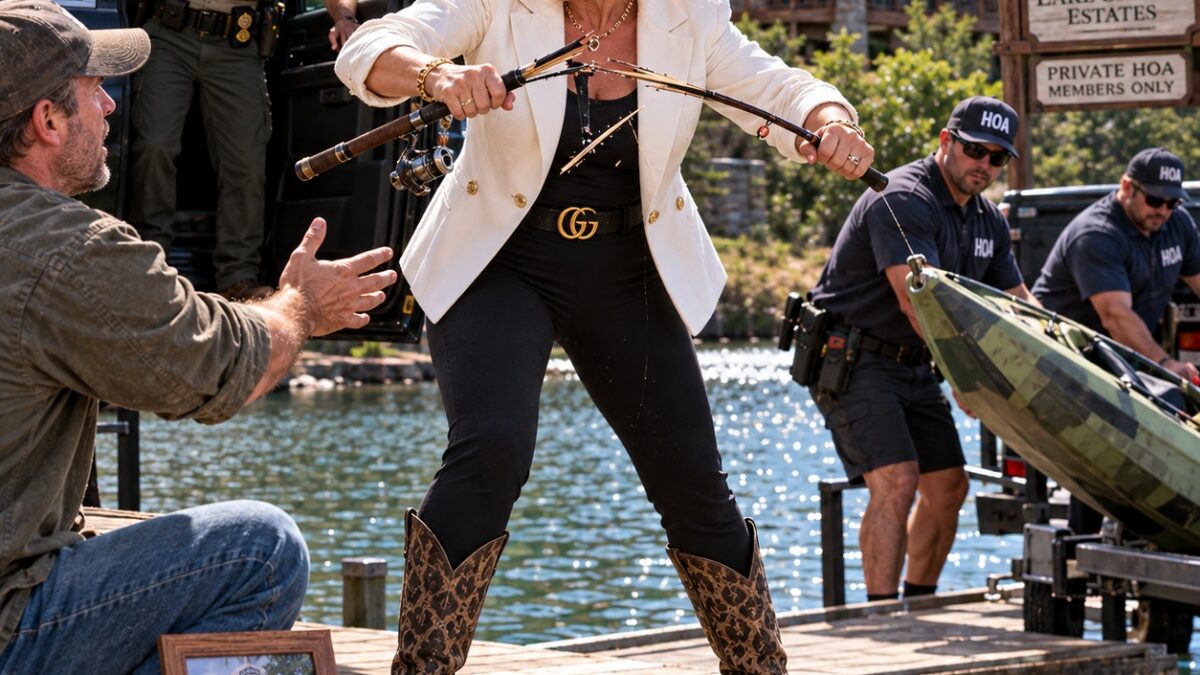
Shelby had destroyed it during one of her earlier confrontations, grabbing it on my dock, snapping it across her knee, and throwing the pieces into the lake as if breaking something sentimental would prove jurisdiction.
I had recovered one section.
The cork handle.
Dad’s fingerprints long gone, of course.
Still felt like him.
I picked it up.
Thought about the hospital.
Buy that cabin, son. Fish our lake.
“I’m trying, Dad.”
Then I went to sleep.
The annual meeting started at seven.
I arrived at 6:45.
Forty-three of forty-five homeowners.
More than any gathering since I moved in.
Folding chairs.
Fluorescent tubes humming.
Carpet saturated with twenty years of potluck dinners.
At the front:
The elevated table.
Brass nameplate.
Personal microphone.
Bottled water with homemade HOA stickers.
And the new gavel.
Mahogany.
Engraved SK.
Resting on a little felt pad like the scepter of a very small kingdom.
Shelby wore a cream blazer.
Gold earrings.
Hair armor freshly reinforced.
Laminated agenda in hand.
Naturally laminated.
In case someone spilled accountability on it.
She struck the gavel.
“I call this meeting to order.”
Then:
“The chair recognizes the agenda before us.”
The chair.
Meaning herself.
First ten minutes:
Budget summary read quickly enough to discourage questions.
Maintenance report composed mostly of complaints.
Board election.
Unopposed.
Then new business.
Shelby lifted the gavel.
“Motion to increase penalties associated with Lot 17’s outstanding violations to ten thousand dollars and initiate formal lien proceedings.”
Murmurs.
I sat in the back.
Jeans.
Flannel.
No uniform.
Nothing identifying me as law enforcement.
Then I stood.
Shelby pointed the gavel.
“Sit down, Mr. Tanner. You are not in good standing and you are not permitted—”
“Ma’am.”
She stopped.
“I’m not here as a homeowner tonight.”
The room changed.
I could hear somebody shift in a chair three rows ahead.
I reached into my back pocket.
Pulled my badge.
Held it where everyone could see.
“My name is Garrett Tanner.”
Shelby stared.
“I’m a conservation agent with the Missouri Department of Conservation.”
Her mouth opened.
“Badge number 4471.”
I continued.
“I carry full peace-officer authority in the state of Missouri.”
Nothing.
For the first time in nine years, Shelby Kincaid had nothing to say.
I walked toward the front.
Placed an evidence packet on the first chair.
Wade stood.
Started passing them back.
One by one.
Paper moving through the room.
“What you’re holding is a summary of nine years of illegal activity, financial misconduct, conservation violations, and abuse of public office involving your board president and County Planning Commissioner Dwayne Kincaid.”
Shelby found her voice.
“This meeting will not—”
I held up one hand.
Not dramatic.
Professional.
She stopped.
“Lake Shelby has been stocked with fish using state resources every year since 2011.”
People looked down at the first section.
“Your so-called HOA fishing permit does not exist anywhere in the recorded CC&Rs.”
Pages turned.
“The annual two-hundred-dollar lake-maintenance fee was collected from forty-five households.”
More pages.
“Nine years.”
I looked directly at Shelby.
“Eighty-one thousand dollars.”
Someone behind me whispered:
“Oh my God.”
“Those fees do not appear in any annual HOA financial disclosure.”
Shelby’s face reddened.
“The payment address is a private PO box registered to Shelby Kincaid.”
More murmurs.
“That matter has been referred to the Missouri Attorney General.”
Shelby stood.
“You have no right—”
I continued.
“Next.”
I clicked the projector.
Map.
Three-acre northeast lakefront parcel.
“Six months ago, County Planning Commissioner Dwayne Kincaid approved a commercial marina variance for developer Todd Renfro.”
Dwayne sat in the front row.
He stopped moving.
“Boat slips.”
Click.
“Fuel dock.”
Click.
“Retail structure.”
Click.
Then the conservation easement.
“This property is federally protected conservation land.”
Silence.
“The required state and federal approvals were never obtained.”
I looked toward Dwayne.
“That matter has been referred for federal investigation.”
Now people were staring at him.
Dwayne’s face had gone pale.
Shelby grabbed the microphone.
“This is slander.”
Her voice cracked.
“I will sue every—”
The side door opened.
Agent Colleen Brewer entered.
Dark suit.
Badge on her belt.
Second FBI agent behind her.
Then a Missouri conservation officer.
Green uniform.
Flat-brim campaign hat.
Shelby’s mouth stopped.
Agent Brewer looked toward the front row.
“Dwayne Kincaid?”
He stood slowly.
“Federal Bureau of Investigation.”
The second agent stepped closer.
“You are under arrest in connection with conservation-easement fraud, permit conspiracy, and related conduct. Please place your hands behind your back.”
The handcuffs clicked.
Metal.
Sharp.
The room was so silent the sound seemed to echo.
Shelby stared at her husband.
Then the conservation officer stepped toward her.
“Mrs. Kincaid.”
Shelby looked at him.
He began reading her rights.
The charges under investigation included misappropriation of HOA funds, unlawful restriction of a state-managed waterway, filing false reports, destruction of private property, and other related conduct.
Shelby did not respond.
That was the part I remember.
For nine years, she had an opinion on everything.
Dock paint.
Kayak color.
Wind chimes.
Garden flags.
Bird feeders.
Porch lights.
Curtains.
Fishing rods.
She always had words.
Now none.
I looked at her.
“You fined me five thousand dollars for fishing at my own cabin.”
She finally looked at me.
“But the fishing was never the real problem.”
Wade started clapping.
One pair of hands.
Then Connie.
Hank.
Seventy-two years old.
Tears on his face.
Clapping like he had been holding his breath for nine years.
Then the whole room.
I glanced at Shelby’s laminated agenda.
Last item:
COMMUNITY APPRECIATION AWARD — BOARD PRESIDENT
Self-nominated.
She never reached it.
The consequences unfolded over the following months.
Dwayne faced federal charges involving conservation-easement fraud, conspiracy, and abuse of office.
His attorneys tried negotiating.
Federal prosecutors had plenty of paper.
Signed variance.
Protected land.
Communication with Todd Renfro.
Retaliatory county activity.
Dwayne was looking at serious prison exposure.
Shelby faced charges and civil consequences related to the eighty-one thousand dollars, false reports, illegal water-access restrictions, vandalism, and destruction of property.
Her first attorney withdrew.
Then another.
Eventually the third negotiated a plea.
Full restitution.
Three years’ probation.
Permanent prohibition against serving on an HOA board in Missouri.
Every dollar of the eighty-one thousand had to be repaid.
Todd Renfro faced his own conspiracy and permit-fraud problems.
The commercial marina died before a shovel touched the protected parcel.
The easement was reaffirmed.
Those three acres stayed exactly what they were supposed to be.
Trees.
Water.
Wildlife.
No fuel dock.
No retail storefront.
No rows of slips.
Within ninety days, restitution checks went out.
Forty-five households received money back.
People Shelby had fined under imaginary rules received additional reimbursement.
The Prestons settled separately with the county over the building-permit interference.
Genevieve received her wind-spinner fine back with interest.
The new board sent her a handwritten apology.
And yes, there was a new board.
Real election.
Open nominations.
Independent property-management company.
Meeting minutes published within seventy-two hours.
No elevated table.
No brass nameplate.
No personal microphone.
There was still a gavel.
Shelby’s forty-seven-dollar mahogany gavel eventually came out of evidence storage after the legal proceedings allowed it.
The new board held a vote on what to do with it.
Unanimous.
It now sits by the front door of the community room.
As a doorstop.
Best forty-seven dollars Shelby ever spent.
The chain came off the boat ramp the day she was arrested.
Wade removed it.
Bolt cutters.
He later told me he had bought them the day after Shelby first locked the gate.
“You had them that whole time?”
“Yep.”
“Why didn’t you cut it?”
He looked embarrassed.
“I was scared.”
Then he smiled.
“Knew somebody would need them eventually.”
My kayak came back too.
Investigators found it in a storage shed behind Shelby’s cabin.
Except it was not alone.
Three kayaks.
Two canoes.
Paddleboard.
Solar string lights.
A ceramic garden gnome.
Property confiscated over years of manufactured violations.
The garden gnome apparently violated a rule against unauthorized ornamental figures.
I loaded everything into Wade’s truck.
We spent the afternoon returning property.
One woman cried when she saw her canoe.
Another had assumed her paddleboard had been sold.
Genevieve laughed so hard over the garden gnome that she had to sit down.
We placed it beside her steps.
Nobody asked whether it was approved.
Then I rebuilt Dad’s dock.
My dock now.
But in my mind, always partly his.
I used cedar from a storm-felled tree at the back edge of my property.
Cut every plank myself.
Sanded them smooth.
Drilled new bolts.
Replaced support posts.
Two weekends.
One perfect Sunday.
Air smelled like fresh sawdust and lake water.
Cicadas were so loud they nearly covered the drill.
Lily helped.
Twelve years old.
Stubborn.
She handed me tools, then complained I was doing everything too slowly.
“You sound like your grandfather.”
“Was Grandpa slow?”
“Painfully.”
“Maybe he was just doing it right.”
I stopped.
Looked at her.
“That sounds exactly like him too.”
When the dock was finished, I sat on the end.
Same lake.
Same oak ridge.
Same water Dad had brought me to as a boy.
I thought rebuilding it would feel triumphant.
It did not.
It felt peaceful.
Better.
That fall, I established the Lake Shelby Conservation Fund.
Nothing huge.
Community-supported.
Free fishing clinics for kids.
Rods.
Reels.
Bait.
Basic conservation education.
How to tie knots.
How to handle fish properly.
Why limits matter.
Why water quality matters.
Why a lake belongs to more than whoever happens to own the nearest house.
First clinic had fourteen kids.
They sat along the community dock.
Lines in the water.
Fingers getting tangled in monofilament.
Half of them could not remember the Palomar knot five minutes after I showed them.
Exactly like I had been at seven.
Lily joined them.
She insisted she did not need instruction.
Then tied the knot wrong.
I did not say anything.
She noticed.
“Dad.”
“Yes?”
“You’re smiling.”
“No.”
“You are.”
“Fix the knot.”
She did.
October.
Saturday morning.
Mist over the water.
Lily’s rod bent nearly double.
At first she thought she had snagged something.
Then the line moved.
“Dad!”
“Keep the tip up.”
“I am!”
“No, you’re not.”
“It’s pulling!”
“That’s generally what fish do.”
She screamed something I will not repeat because I was technically representing the state.
The largemouth broke the surface.
Water sprayed.
Lily laughed so hard she nearly lost control of the rod.
I moved beside her.
“Easy.”
“I’ve got it.”
“Let it run.”
“I know.”
“Don’t horse it.”
“I know!”
The fish came close.
I netted it.
Lily stared.
Her first largemouth.
Healthy.
Thick-bodied.
Beautiful dark lateral line.
She held it carefully.
I took the photograph.
Later, I printed it.
Framed it.
Put it on the mantle beside an old picture of Dad.
Clayton Tanner.
Standing at Lake Shelby roughly forty years earlier.
Holding the same species.
Same water.
Same stupidly proud smile Lily had.
That evening, after Lily went inside, I sat alone at the end of the new dock.
Sun lowered behind the oaks.
Water turned gold.
Then copper.
Then dark.
A bass jumped somewhere near the far shore.
Frogs began.
Pine.
Wet stone.
Cedar.
I had spent months thinking the fight was about authority.
Who could lock the gate.
Who could write the fine.
Who could call the sheriff.
Who could issue the permit.
Who had the badge.
In the end, none of that was why I stayed.
I stayed because of Dad.
Because he had spent thirty-one years delivering other people’s mail and still found a way every Saturday to drive his son forty-five minutes to this lake.
Because he taught me patience here.
Because he told me from a hospital bed to come back.
Because silence on Lake Shelby was one of the few places in my life that had never asked me to be anything except present.
Shelby treated the lake as property to control.
Dwayne treated protected shoreline as something to convert into profit.
Todd Renfro saw marina slips.
Fuel sales.
Retail.
Dad saw water.
A rod.
A son.
An afternoon.
That was the difference.
I thought about Hank too.
Nine years afraid to fish in the lake his wife loved.
Wade paying fines because fighting seemed impossible.
Connie threatened over a bird feeder.
The Prestons.
Genevieve.
Families driven out.
Forty-five households gradually taught that peace depended on obedience.
That was Shelby’s real power.
Not the binder.
Not the gavel.
Not even Dwayne.
Fear.
She convinced people every small resistance would trigger something worse.
A fine becomes a permit problem.
A complaint becomes an inspection.
An appeal becomes harassment.
Eventually people stop asking whether she has authority.
They only ask what will happen if they say no.
That is how petty power becomes durable.
Not because it is legally strong.
Because it is exhausting to resist.
I had an advantage most of my neighbors did not.
I knew how systems worked.
I knew how to write a complaint that another agency could use.
I knew which database to search.
I knew the difference between a rumor and admissible documentation.
I had professional relationships.
A badge.
Years of enforcement experience.
Shelby assumed I would react like everyone else.
Write a check.
Mutter about it.
Go home.
Instead, I did what law enforcement teaches you.
Document.
Verify.
Preserve.
Follow money.
Find jurisdiction.
Contact the agency that actually has authority.
No screaming match would have produced the eighty-one-thousand-dollar discrepancy.
No angry Facebook post would have exposed Dwayne’s signature on the conservation variance.
No threat could have replaced trail-camera footage of Shelby directing two men to destroy my dock.
The evidence mattered because it could survive me.
I could get emotional.
Forget a date.
Describe something badly.
Video could not.
Bank records could not.
A recorded conservation easement could not.
That is why Shelby lost.
Not because I was tougher.
Not because I had been a Marine.
Not because I carried a gun.
Because nine years of confidence had made her careless, and I was patient enough to let her keep creating evidence.
One morning, months after everything ended, I saw Wade at the boat ramp.
Gate wide open.
He carried an old fishing rod.
Tackle box.
Coffee.
“You going out?”
He nodded.
“First time in years.”
“You paid your permit?”
He stared at me.
I tried not to smile.
Then Wade laughed.
A full laugh.
Big enough that it echoed off the water.
“Go to hell, Garrett.”
“Have fun.”
He walked down the ramp.
I watched until he reached the shoreline.
That moment meant almost as much as getting my own kayak back.
The lake looked normal again.
Which is something people underestimate.
Normal can be extraordinary after years of control.
A gate open.
A kayak in the water.
A bird feeder with sparrows around it.
A garden flag two inches too high.
An excessively warm porch light.
A gnome nobody approved.
Those things are not rebellion.
They are life.
Shelby had turned ordinary choices into tests of loyalty.
The new board understood how poisonous that had been.
They kept necessary rules.
Septic maintenance.
Road assessments.
Actual safety matters.
But if somebody wanted a green kayak?
Buy a green kayak.
Wind chimes?
Keep the volume reasonable.
Bird feeder?
Enjoy the birds.
The board no longer needed a personality cult.
That helped.
No elevated table.
No president calling herself “the chair.”
No portrait.
No personalized bottled water.
No gavel except the doorstop.
Wade eventually agreed to serve on a committee.
He said yes only after being promised no one would give him a title with more than three words.
Hank refused every position.
“I spent nine years surviving HOA government.”
Fair.
He preferred fishing.
Connie volunteered for the conservation fund.
ER nurses apparently do not sleep anyway.
She helped with first-aid stations during children’s clinics.
Genevieve taught the kids to identify native birds.
Her wind spinner remained in the yard.
Somebody jokingly nominated it for landmark protection.
The Prestons finally completed the improvements Dwayne had delayed.
Ordinary life returned piece by piece.
The criminal cases took longer.
They always do.
Public excitement fades quickly.
Court calendars do not.
Dwayne’s attorneys fought.
Motions.
Challenges.
Negotiation.
The evidence did not disappear.
His signature remained.
The easement remained.
His communication with Renfro remained.
Federal investigators followed the permit process.
Money.
Contacts.
Intent.
I testified where needed.
Then went back to work.
Shelby’s restitution plan continued.
Checks went out.
I received reimbursement for the kayak retrieval fee I never paid, damage to the dock, and related losses.
The broken fishing rod could not be replaced.
That mattered more than anything with a dollar amount attached.
Dad’s rod had not been expensive.
Old fiberglass.
Cork handle darkened from decades of use.
A modern rod would outperform it in every measurable category.
Still, I would have traded every restitution check for the original.
That is how sentimental things work.
Their value is irrational.
Which makes them impossible to compensate properly.
I kept the surviving handle.
Mounted it horizontally above the cabin fireplace.
Not like a trophy.
More like a marker.
Lily asked why I did not throw it away.
“Because Grandpa held it.”
“So?”
I looked at her.
“Someday you’ll understand.”
She rolled her eyes.
“Adults always say that when they don’t have an answer.”
Fair.
A few weeks later, she asked me to tell her again how Dad taught me to fish.
So I did.
Seven years old.
Could not sit still.
Lost three bobbers in trees.
Tangled line constantly.
Dad never raised his voice.
He would just take the rod.
Untangle everything.
Hand it back.
“Again.”
Patience.
That was his method.
Again.
Maybe that is why Shelby never understood me.
She thought every delay meant weakness.
Dad taught me patience is often preparation.
When she raised the fine, I documented.
When she took the kayak, I investigated.
When she locked the gate, I checked jurisdiction.
When she destroyed the dock, I saved video.
When Dwayne sent Tyler, I documented retaliation.
When she mailed the safety alert, I waited.
Every escalation felt, to Shelby, like pressure.
To me, it was evidence arriving free of charge.
The conservation fund expanded in its second year.
More families donated equipment.
Local bait shop gave us hooks and line.
One retired teacher taught aquatic ecology.
A conservation biologist came out and showed kids how fish stocking works.
We kept it simple.
No speeches about Shelby.
The point was not turning a children’s fishing clinic into a lecture about HOA corruption.
The point was the lake.
The thing that had been lost behind all the fighting.
One Saturday, fourteen children sat along the shore.
Lines out.
Talking too loudly.
One kid asked:
“Mr. Tanner, who owns the fish?”
I smiled.
“Nobody owns a wild fish swimming in the lake.”
“So if I catch it, it’s mine?”
“If it’s legal to keep and within limits.”
“What if I put it back?”
“Then it’s still swimming.”
He thought about that.
“So the lake owns it?”
I laughed.
“Ask me again when you’re older.”
Maybe that is what Dad would have said.
Some things do not need legal language.
The lake existed before Shelby.
Before me.
Before Dad.
It will exist after Lily.
The best any of us can do is avoid pretending temporary control equals permanent ownership.
That had been Dwayne’s mistake too.
A planning-commission seat feels powerful when people need your signature.
But a government position is borrowed authority.
It belongs to the public.
Not the person sitting in the chair.
Dwayne used his seat as a family business tool.
Permit pressure.
Retaliation.
Commercial variance.
Eventually the office he thought protected him became part of the case against him.
Again, paper.
His own signature.
That theme kept repeating.
Shelby believed paper gave her power.
Fake permits.
Fake fines.
Laminated signs.
Safety alerts.
Dwayne believed signatures could make protected land developable.
But legitimate records eventually beat invented ones.
A real easement outranked his variance.
Real financial disclosures exposed fake lake fees.
Real stocking records outranked Shelby’s fishing permit.
Real camera footage outranked her maintenance directive.
You can manufacture authority for a while.
Reality tends to keep receipts.
I thought about that one morning while replacing a board at the end of the dock.
Lily was nearby.
She had become genuinely good at casting.
Not great.
I told her this.
She disagreed.
“You almost hit the tree.”
“I did not.”
“The lure is hanging in it.”
“That doesn’t prove anything.”
Dad and I had probably had the same argument.
I climbed onto a bench.
Freed the lure.
Handed it back.
“Again.”
She looked at me.
Then smiled.
“Grandpa used to say that?”
“All the time.”
She cast.
Perfect.
The line landed ten feet from the reeds.
“See?”
“Luck.”
“Skill.”
“Luck.”
She stuck her tongue out.
I sat down.
The water was still.
For a second, three generations seemed to occupy the same dock.
Dad in memory.
Me.
Lily.
That is what Shelby nearly ruined without understanding what she was touching.
To her, Dad’s rod was “unsightly equipment.”
The kayak was an unauthorized vessel color.
The dock was a place she could bury under gravel if I resisted.
She looked at objects and saw compliance categories.
People like that miss what makes homes matter.
Value is not only square footage.
A dock can hold forty years.
A rod can contain every Saturday of a childhood.
A lake can sound like a dead man’s voice.
That does not mean rules never apply.
It means authority should be exercised carefully around lives you do not understand.
Shelby did the opposite.
Everything was about demonstrating control.
If someone questioned a fine, increase it.
If someone appealed, threaten permits.
If someone spoke at a meeting, silence them.
If someone refused a fishing fee, take the kayak.
If someone investigated, destroy the dock.
Power like that always needs escalation because it has no legitimacy underneath.
The moment people stop being afraid, it collapses fast.
That was the annual meeting.
Not my badge.
The badge mattered.
The federal agents mattered.
The conservation officer mattered.
But the real moment was when forty-three homeowners opened the packets.
Pages turning.
People realizing they had not imagined the abuse.
Wade’s kayak fine.
Connie’s bird feeder.
Genevieve’s wind spinner.
Hank’s extra fees.
The Prestons’ permit.
Suddenly separate humiliations became one pattern.
That is what authoritarians hate most.
Comparison.
One victim can be dismissed as difficult.
Forty-five people comparing records becomes evidence.
The new board understood that too.
Financial statements became available to everyone.
Minutes published.
Fees explained.
Board votes recorded.
Outside management handled money.
Transparency feels unnecessary when people are trustworthy.
That is exactly when it is easiest to establish.
You do not build oversight because everyone is corrupt.
You build it so one corrupt person cannot quietly take over later.
Shelby had nine years because nobody had insisted on structure.
One person controlled rule-making.
Collection.
Enforcement.
Records.
Complaints.
Too many roles.
Too little sunlight.
The replacement board separated those functions.
Not glamorous.
Effective.
Hank told me once:
“Could’ve used you nine years ago.”
I shook my head.
“No.”
“Why not?”
“You could have done it.”
He looked offended.
“I didn’t have a badge.”
“You had neighbors.”
He thought about that.
“And bolt cutters.”
He smiled.
“Those too.”
I was not blaming him.
Fear changes how people calculate risk.
But Lake Shelby eventually learned something useful.
No single neighbor has to become the hero if everyone starts talking.
That lesson mattered more than my case.
I continued patrol work.
Poachers did not stop because my HOA collapsed.
One morning, six months after the arrests, I was forty miles away checking illegal turkey bait when my phone buzzed.
Text from Wade.
Photo.
Boat ramp.
Gate open.
Three kids fishing.
Caption:
No permits. Society still standing.
I laughed loud enough to scare a turkey.
Another message from Connie.
Bird feeder.
Covered in cardinals.
Unauthorized wildlife attractants everywhere.
Then Genevieve.
Wind spinner turning in sunlight.
Nothing else.
Those pictures became a private joke.
But underneath it was relief.
People were rediscovering small freedoms.
That is what recovery looked like.
Not monuments.
Not victory speeches.
Ridiculous little acts becoming ordinary again.
The gavel-doorstop became famous locally after Jenna, a reporter who covered the case, mentioned it in a follow-up story.
Visitors to the community room started taking pictures.
The board eventually put a tiny brass label beside it:
FORMERLY USED FOR EXCESSIVE GOVERNANCE.
I told them that was childish.
Then took a picture.
Sent it to Lily.
She replied with six laughing emojis.
Fair.
I never saw Shelby after her sentencing.
Somebody told me she moved out of Lake Shelby Estates.
I did not ask where.
I had spent enough time knowing her movements.
Dwayne’s case continued through federal court.
Todd Renfro’s plans vanished.
The protected shoreline slowly stopped feeling like the site of a proposed marina.
It went back to being trees.
That is one thing nature does better than people.
If you stop disturbing it, it does not hold press conferences.
It just continues.
Spring returned.
Dogwoods.
Fish spawning.
Rain.
The three acres Shelby and Dwayne viewed as commercial opportunity looked more valuable to me precisely because nothing had been built.
The conservation fund used part of its money to install educational signs.
Not many.
One near the public-access path explaining the easement.
One about fish habitat.
No mention of Shelby.
No need.
I did not want her name permanently attached to the shoreline.
Why give her that?
The best answer to destructive people is sometimes letting the place heal until their presence becomes irrelevant.
My dock weathered too.
Fresh cedar lost its bright color.
Silvered slowly.
That pleased me.
New things look temporary.
Weather makes them belong.
The picture of Lily’s first largemouth stayed on the mantle beside Dad’s old photograph.
Visitors noticed the similarity.
Same lake.
Same species.
Same expression.
Dad in an old cap.
Lily in a hoodie.
Forty years between them.
Sometimes I catch myself staring.
Grief changed after buying the cabin.
Dad was still gone.
Nothing fixes that.
But Lake Shelby gave the loss a location that was not the hospital.
For two years, when I thought about Dad, the first image was oxygen tubing.
Gray skin.
Hospital sheets.
“Buy that cabin, son.”
After moving, other images came back.
Dad laughing because I dropped a worm.
Dad burning hot dogs over a camp stove.
Dad pretending a three-pound bass was five.
Dad drinking terrible instant coffee before sunrise.
Memory widened.
That alone made the cabin worth every dollar I spent.
Shelby nearly turned the place into another source of anger.
For a while, every time I looked across the lake I thought about her.
That passed.
Good.
The lake deserved better.
Eventually, mornings became mornings again.
No investigation.
No packet.
No camera footage.
Just coffee.
Rod.
Mist.
One morning, Hank paddled past in an old canoe.
“Permit?”
I shouted.
He raised one finger.
Not the polite one.
Seventy-two years old.
Still had range.
I laughed until coffee came out my nose.
Dad would have loved him.
Sometimes people asked whether I regretted using my badge at the annual meeting.
No.
But I am careful about what that moment means.
I did not use law-enforcement authority to win a private argument.
The private argument had uncovered legitimate state and federal violations.
Once evidence crossed that line, my professional obligation mattered.
That distinction is important.
A badge is not a personal weapon.
Shelby thought Dwayne’s public office was.
That was exactly the problem.
I involved agencies because the conduct fell within their jurisdictions.
Conservation Commission for waterway access.
Attorney General for financial misconduct.
FBI for the federal easement and related permit issues.
Sheriff for private-property damage and false complaints.
Each part went to the people authorized to handle it.
That is how the system is supposed to work.
Not perfectly.
Not quickly.
But structurally.
The annual meeting looked dramatic.
The weeks before it were paperwork.
Most justice is paperwork before it becomes dramatic.
That is another thing television leaves out.
People like scenes.
Badge on table.
Handcuffs clicking.
President speechless.
But cases are built at kitchen tables.
Receipts.
Copies.
Phone logs.
Maps.
Screenshots.
Statements.
Backups.
The printer running at three in the morning.
That was the real work.
If I had walked into that meeting with only anger, Shelby would have called security.
Instead, forty-five homeowners held copies of her own numbers.
FBI agents held documents.
Conservation held records.
The gavel could not compete.
That remains one of my favorite images.
Not Shelby being arrested.
The packets moving hand to hand.
Paper.
People reading.
Fear turning into understanding.
Hank later told me that was the exact moment he stopped being afraid.
Not when he saw the FBI.
When he saw his own canceled checks listed beside everyone else’s.
“Wasn’t just me.”
“No.”
“I thought I was stupid for paying.”
“You weren’t.”
“I thought everyone else knew something I didn’t.”
“They thought the same thing.”
That is how isolation protects abuse.
Everyone believes they are the only one confused.
Then somebody compares notes.
The structure breaks.
The conservation fund’s third summer clinic drew twenty-two children.
Too many for one dock.
We split them into groups.
Lily helped teach knots.
She had become better than me at explaining them.
More patient.
Which I refused to admit publicly.
One little boy kept failing the Palomar knot.
Lily untangled it.
Showed him again.
He failed.
She showed him again.
Third time worked.
I watched from ten feet away.
Dad’s voice appeared in my head.
Again.
Lily looked up.
“What?”
“Nothing.”
She narrowed her eyes.
“You have that weird face.”
“What weird face?”
“The Grandpa face.”
I laughed.
There are worse things to inherit.
After class, she sat beside me.
“Do you think Grandpa would like the fund?”
“Yes.”
“Why?”
“Kids fishing his lake.”
“It wasn’t his lake.”
I looked at her.
She smiled.
“You’re always saying nobody owns the fish.”
“Smart kid.”
“He’d like it though.”
“Yes.”
“He’d probably tell you you’re tying the knot wrong.”
“Also yes.”
That evening, when the children were gone, I stayed alone.
Sunset.
Water changing color.
Gold to copper to black.
Bass somewhere near the far bank.
Frogs.
Pine.
Wet stone.
I felt something I had not felt the day I signed the deed.
Home.
At first, the cabin had been Dad’s last instruction.
A grief project.
A place I was trying to make myself deserve.
Then Shelby arrived and turned it into a battlefield.
Afterward, slowly, it became mine.
Not replacing Dad.
Continuing something.
That is what inheritance should feel like.
Not an object frozen in time.
A thing passed forward and used.
The rod was broken.
But the knot remained.
The dock was destroyed.
I rebuilt it.
The lake was chained.
Wade cut the chain.
The community was afraid.
People started fishing again.
That is continuity.
Not keeping everything untouched.
Keeping what matters alive.
I once thought Dad’s final words were about real estate.
Buy the cabin.
Now I think he was telling me to return to something that had always steadied me.
Maybe he knew.
Maybe dying people do not become mystical.
Maybe he simply remembered how happy I was there as a kid.
Either way, he was right.
I needed the lake.
Even the fight, strangely, forced me to understand why.
Shelby saw Lake Shelby as a source of leverage.
Permit fees.
Fines.
Property manipulation.
Control.
The conservation easement reminded me that some places are valuable precisely because we refuse to maximize what can be extracted from them.
No marina.
No fuel dock.
No retail storefront.
Trees.
Water.
Wildlife.
You could call that unused land if you measure value only in revenue.
Dad would have called it a good fishing spot.
I trust his judgment.
Years later, the gavel is still a doorstop.
Wade still fishes.
Connie still feeds birds.
Genevieve’s wind spinner still turns.
The Prestons’ cabin looks better after the addition Dwayne tried to block.
Lily still believes she catches more bass than I do.
She does not.
Yet.
The green kayak is scratched from use.
Exactly how a kayak should look.
My cabin porch still leans slightly, though less than when I bought it.
The dock has settled.
Cedar silvering.
Dad’s broken rod handle still hangs above the fireplace.
And the gate remains open.
No laminated fishing-permit sign.
No padlock.
No board president waiting to collect two hundred dollars from someone who wants to cast a line.
Sometimes new residents ask about the old bolt marks in the gatepost.
Wade usually answers before I can.
“Historical stupidity.”
Good enough.
The people who lived through Shelby’s reign remember more.
But we do not talk about her constantly.
That would mean she still controlled the community in a different way.
No.
Lake Shelby moved on.
That is important.
Accountability should free people from the past, not require them to keep worshiping the conflict.
The annual meeting where Shelby fell became one story among many.
Kids catching fish became newer stories.
Better stories.
One summer morning, I woke before dawn.
Walked down to the dock with coffee.
No rod.
Just sat.
Mist lifted.
The lake slowly brightened.
A truck moved somewhere far off.
Birds started.
I thought about Iraq.
Dad.
Shelby.
The badge.
Everything that had led me there.
Then a fish surfaced.
Tiny circle expanding through the water.
That was all.
For an hour, nobody asked anything of me.
No fine.
No report.
No evidence.
No duty.
Just silence.
The exact kind I had been looking for when I bought Lot 17.
Dad had given me that silence when I was seven.
Forty years later, I finally understood why he thought it was worth protecting.
Not because a lake belongs to one man.
Because some places remind you how small all the people who claim ownership really are.
Shelby said:
Every inch of this lake answers to me.
No.
The lake never answered to her.
It did not answer to me either.
That was her mistake.
She confused control with ownership.
A gavel with law.
A laminated sign with jurisdiction.
Her husband confused office with permission.
The developer confused protected land with unrealized profit.
Eventually every one of those assumptions met the same thing.
Records.
Jurisdiction.
Evidence.
Reality.
And reality won.
I do not keep Shelby’s five-thousand-dollar fishing violation framed anywhere.
I considered it.
Wade suggested hanging it beside the gavel-doorstop.
But I decided no.
Dad’s photograph is on the mantle.
Lily’s is beside it.
The broken rod above them.
That is enough.
The people who matter get the wall space.
Shelby gets the story.
And even the story ends where it should.
Not with handcuffs.
Not with applause.
Not with a gavel used as a doorstop.
It ends on the dock.
The sun going down behind the oaks.
A bass jumping near the far bank.
Frogs starting up.
Pine and wet stone in the evening air.
My daughter’s first largemouth framed beside my father’s.
And me sitting where Dad once sat, finally able to hear the quiet again.
He would have said nothing for an hour.
Then smiled.
So I smiled for him.








