PART2:For Four Months, He Stopped Every Woman on the Road and Studied Her Face—Then We Found a Number Hidden Inside His Ear
PART2
Our first day observing Chunjang told us why the neighbors had struggled.
From a distance, he seemed social enough.
He did not flee simply because people existed nearby.
A woman who had been feeding him walked down the road carrying a small container.
Chunjang saw her.
His posture changed.
Ears slightly higher.
Head forward.
She placed food where he was accustomed to eating.
Then stepped back.
Chunjang approached.
Slowly.
He smelled the food.
Looked at her.
Ate.
The woman spoke softly.
She had apparently done this many times.
He knew her voice.
Maybe even liked her.
Then she tried moving one hand toward him.
Chunjang immediately stepped away.
Not panicked.
Not terrified.
A boundary.
You can feed me.
You can stand there.
Do not touch.
The woman stopped.
“He always does that.”
“How long have you been feeding him?”
“Almost since he appeared.”
“And he’s never let you pet him?”
She thought.
“Once I touched his back when he was eating. He moved away.”
No aggression.
No bite.
No growl.
Only distance.
That gave us some options, but it also told us force would be a mistake.
A dog who survives four months near a road learns routines.
Learns escape routes.
Learns exactly how close people can get before danger becomes possible.
Chunjang knew the area better than we did.
If we chased him, we might push him into traffic.
If we frightened him badly enough, he might leave the neighborhood completely.
So we watched first.
Hours.
One of the hardest things for a television crew is accepting that nothing happening can be the most important footage.
Chunjang resting.
Chunjang eating.
Chunjang walking.
Then a woman passed.
His head lifted.
He followed.
That was the behavior we had heard about.
Seeing it was different.
The woman was middle-aged.
Carrying a bag.
She noticed Chunjang behind her and slowed.
He moved closer.
Not directly to her hand.
Toward the side.
Trying to see her face.
She turned.
Chunjang looked up.
For maybe three seconds, dog and stranger faced one another.
His tail did not wag wildly.
He did not jump.
He just looked.
Then something in his posture dropped.
The woman continued.
Chunjang watched her leave.
One of our team members whispered:
“He thought she was someone.”
I did not answer.
We could not know that yet.
But it felt that way.
Another woman passed later.
Same.
A younger woman this time.
Chunjang followed farther.
Looked.
Stopped.
We began wondering whether whatever story had brought him there involved a woman he remembered.
But memory is difficult to infer from animal behavior.
We had to be careful.
Dogs recognize people through smell, movement, voice, context—not faces alone.
Yet Chunjang’s pattern was unmistakable enough that the residents had noticed without prompting.
He was searching through people.
For what?
That question drove the rest.
The capture took patience.
Residents he already knew became essential.
Their presence kept his stress lower.
Food was placed strategically.
The capture enclosure was introduced without sudden movement.
Chunjang approached.
Left.
Returned.
Approached again.
I remember holding my breath even though I was nowhere near him.
You feel ridiculous during moments like that.
As though the dog could somehow hear your lungs from across a road.
One paw inside.
Then out.
Food.
Another attempt.
The neighborhood residents stood farther back.
No one tried to rush him.
Eventually Chunjang entered far enough.
The enclosure closed.
For one second, he exploded backward.
Fear.
His body hit the side.
Then he turned.
Looked for an exit.
My stomach tightened.
This is the part of rescue videos people sometimes misunderstand.
Capture looks frightening because, temporarily, the animal does not know rescue is rescue.
Chunjang did not understand that we planned veterinary care.
He understood:
I was free.
Now I am contained.
So we kept everything as quiet as possible.
No celebration.
No crowding.
A familiar resident spoke.
Chunjang looked toward the voice.
Slowly, he stopped throwing his body against the enclosure.
His breathing remained fast.
But he listened.
We moved him carefully.
I sat near enough during transport to watch him.
He did not relax fully.
Every turn of the vehicle made him adjust.
His eyes tracked movement.
I wondered what he thought.
Was this another abandonment?
Had a vehicle once carried him away from home?
Were we repeating something frightening?
We had no history.
That ignorance is one of the hardest parts of animal rescue.
The dog arrives carrying an entire past nobody can interview.
All you have is behavior.
Body.
Marks.
Medical clues.
Sometimes, if you are lucky, one tiny piece of identification.
At the veterinary clinic, Chunjang underwent a full examination.
Long coat.
Body condition.
Skin.
Teeth.
Ears.
We looked for a microchip.
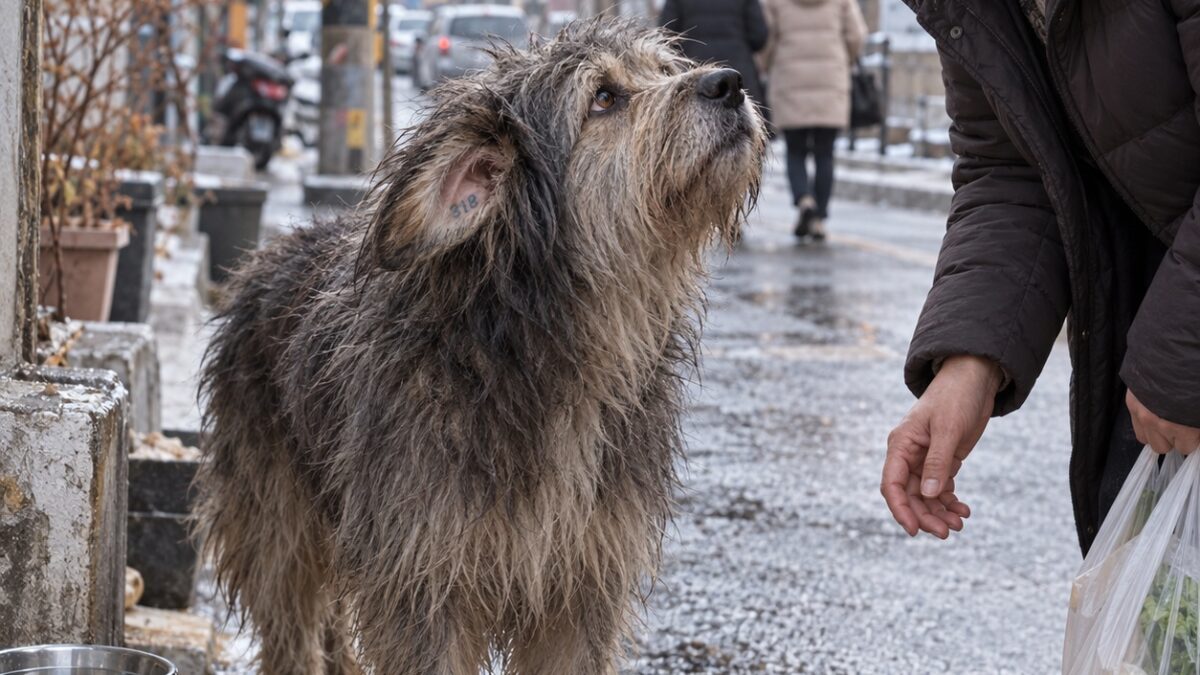
Then someone noticed something inside his ear.
At first it looked like a dark irregular mark.
The veterinarian adjusted the angle.
Cleaned the area enough to see.
Numbers.
An identification tattoo.
I leaned closer.
“What is that?”
The doctor looked again.
“Registration.”
That single word changed everything.
A stray dog can have an unknown past.
A registered dog has a trail.
Maybe old.
Maybe broken.
But a trail.
Chunjang was identified as a registered Sapsal.
That mattered for another reason.
Sapsals are a recognized Korean dog breed with a long history in the country.
But in that moment, cultural history mattered less than one practical fact:
The tattoo had a number.
We had something searchable.
Something traceable.
Someone had once taken enough responsibility for this dog to register him.
That meant Chunjang had not always been the nameless dog beside the road.
Somewhere, he had belonged.
We began tracing the information.
Administrative searches are rarely cinematic.
Phone calls.
Records.
Numbers copied carefully.
Addresses.
Verification.
You can spend hours working toward a result that eventually appears as one line on a screen.
Then we had it.
An address.
More than an hour’s drive away.
I stared at it.
One of the team members said:
“So how did he get here?”
Nobody answered.
That was the next mystery.
More than an hour by car is a very different distance for a dog.
Had Chunjang walked?
Been transported?
Changed owners?
Escaped from somewhere in between?
We could not yet know.
But we had an address linked to his past.
We drove.
I kept thinking about the women on the road.
If this address led nowhere, what then?
Old registration records can become useless.
People move.
Phone numbers change.
Dogs change homes.
Sometimes you arrive and learn the registered owner died years earlier.
Sometimes nobody wants the animal back.
Finding an owner is not always the same thing as finding home.
That distinction mattered.
We reached the address.
A couple lived there.
They did not initially understand why a television rescue team was at their door.
We explained.
A Sapsal.
Identification tattoo.
Registration connected to them.
The woman’s expression changed before we even showed the video.
“You mean Chunjang?”
There it was.
A name.
Not one we had invented.
His.
“Chunjang?”
“Yes.”
She looked toward her husband.
Then back at us.
“Where is he?”
I remember the exact emotional shift in the space.
Until that second, Chunjang had been our rescued stray.
Then a woman said his name like it belonged inside her mouth.
History entered the room.
We showed them footage.
The road.
The long coat.
The dog following women.
The woman watched without speaking at first.
Then she covered her mouth.
Her eyes filled.
“That’s him.”
Her husband leaned closer.
She said it again.
“That’s Chunjang.”
Then she cried.
Not television crying.
No dramatic sobbing.
The quiet kind.
Recognition mixed with guilt and relief.
The couple explained that they had raised Chunjang as a puppy.
He had lived with them.
They knew his habits.
His face.
His body.
Then, at some point later, they had entrusted him to someone they knew.
That was the crucial break.
They had believed he was being cared for.
Now the dog they remembered from puppyhood had appeared in footage living beside a road, more than an hour away.
The woman watched again.
Chunjang following a stranger.
Trying to see her face.
She cried harder.
“Was he looking for me?”
I could not answer that as fact.
Nobody could.
But the question sat heavily between us.
Maybe.
Maybe some combination of memory, scent, association, and longing had driven the behavior.
Maybe Chunjang approached women because one familiar woman had once represented home.
What we did know was that the woman watching the footage recognized him immediately.
And she wanted him back.
Her husband agreed.
“We’ll bring him home.”
There was no hesitation after the decision.
But decisions are easy to make from a living room.
The dog has his own answer.
That is why I tried not to imagine the reunion too early.
People expect reunion stories to be instant.
Dog sees former owner.
Dog runs.
Music.
Crying.
Embrace.
Sometimes.
Other times, years or trauma or confusion sit between recognition and action.
Chunjang had spent four months surviving near a road.
Before that, he had been entrusted to another person.
We did not know exactly what happened during that period.
We could not assume he would understand immediately that this older familiar home was his again.
Animals do not read our story structure.
They respond to what they feel in the moment.
So when the reunion day came, we watched.
Chunjang arrived.
The couple waited.
The woman was visibly emotional.
She wanted to go to him.
You could see it in her whole body.
But Chunjang stopped near the entrance.
He did not rush.
He did not drag toward them.
He stood.
Cautious.
Looking.
My stomach tightened.
The woman called softly.
His name.
“Chunjang.”
He looked.
That itself mattered.
Again.
She approached slowly.
No grabbing.
No dramatic embrace.
Chunjang remained where he was.
She bent.
Reached gently.
Touched him.
One stroke.
He lifted his head.
Looked at her face.
And suddenly the four months beside the road seemed to collapse into one moment.
Because Chunjang did what we had watched him do with stranger after stranger.
He looked.
But this time, he did not turn away.
This face was different.
This voice.
This hand.
Something registered.
His posture changed.
His tail began moving.
The caution broke.
Chunjang moved toward her.
Then jumped into her arms.
The woman cried out.
Not from fear.
Joy.
She caught him.
Held him.
The dog who had stepped away from so many human hands pressed himself into hers.
He became almost puppy-like.
Affection poured out of him all at once.
He leaned.
Moved around her.
Rolled onto his back.
Exposed his belly.
Pressed against both members of the couple.
Every few seconds he looked up again.
As if confirming.
You.
Still you.
I watched through the camera monitor and forgot for a moment that we were filming.
That happens rarely.
Television work teaches you to observe through equipment.
Framing.
Sound.
Sequence.
But there are moments when the story becomes bigger than production.
Chunjang’s reunion was one.
The woman rubbed his head.
His long fur moved beneath her hand.
She kept saying his name.
Maybe apologizing too.
The words blurred.
Her husband touched him.
Chunjang accepted him immediately after the first breakthrough.
Soon he was rolling.
Tail.
Body relaxed.
The cautious roadside dog disappeared.
Not permanently, perhaps.
Trauma does not evaporate in one embrace.
But another version emerged.
The remembered dog.
Their dog.
The couple made a promise.
They would not send him away again.
This time, Chunjang would remain with them.
I have thought about that promise often.
Promises after mistakes are complicated.
It would be easy to turn the couple into villains.
They had entrusted Chunjang to someone else.
He eventually ended up living beside a road.
But the source did not tell us they knowingly abandoned him there.
They believed another person would care for him.
Whatever decisions led to that situation, seeing him again clearly devastated them.
The most important question became not:
Who can we blame forever?
But:
What happens to Chunjang now?
Now, they said, he stays.
Home.
With them.
The first hours were almost overwhelming for the woman.
Chunjang followed.
Accepted touch.
Rolled over.
She laughed through tears.
Every affectionate behavior seemed to confirm something she had feared might be gone.
Memory.
Connection.
Trust.
I wondered whether Chunjang remembered their home layout.
Specific smells.
Rooms.
Objects.
Dogs can retain associations for astonishingly long periods.
But again, I cannot tell you exactly what his mind held.
I can tell you what his body did.
Caution.
Recognition.
Approach.
Contact.
Then release.
That was enough.
Afterward, we returned to the road.
The neighbors deserved to know.
These people had kept Chunjang alive when they had no idea who he was.
That matters.
They were not able to take him home.
Could not easily touch him.
Could not solve the mystery.
Still, they left food.
Water.
Watched.
Noticed.
Eventually raised enough concern that our team became involved.
Rescue is often imagined as one heroic person.
Chunjang’s rescue was a chain.
A neighborhood.
Residents.
Television team.
Capture.
Veterinary examination.
A tattoo.
Records.
An address.
Family.
Remove one link and the ending changes.
We filmed a follow-up for TV Animal Farm.
When residents heard Chunjang had been traced back to a family, their faces changed.
Relief.
Surprise.
One woman asked:
“They recognized him?”
“Immediately.”
“He’s staying?”
“Yes.”
She put one hand against her chest.
“Good.”
Then, after a pause:
“He always looked so lonely.”
Another resident described leaving water during warm days.
Someone else remembered Chunjang waiting near the road.
They had all seen parts of his story.
None had known the beginning.
Now they knew the ending.
One elderly neighbor said something simple.
“I’m glad he found where he belongs.”
That was Chunjang’s story in one sentence.
But living inside it had been far more complicated.
Four months.
Imagine four months through a dog’s routine.
Morning.
Road.
People.
Food if someone leaves it.
Water.
Noise.
Cars.
Weather.
Women passing.
Look.
Not her.
Wait.
Another.
Look.
Not her.
Evening.
Sleep wherever feels safe enough.
Then repeat.
We do not know whether Chunjang consciously believed his original owner would walk down that road.
That would be a human interpretation.
But whatever drove him, the behavior carried longing.
He sought faces.
Maintained distance from hands.
Wanted information from people without fully surrendering himself to them.
That combination affected me.
He was not feral.
Not disconnected from humanity.
He was a dog who seemed to remember belonging while no longer having it.
That is a particular kind of loneliness.
A dog born on the street builds a world from the street.
A dog who once slept near familiar people can know there is something missing.
Again, we cannot narrate his internal thoughts with certainty.
But his reaction at reunion tells us familiarity mattered.
The woman’s touch meant something no stranger’s touch had.
The first time I watched raw footage from the roadside beside reunion footage, the contrast felt almost unbearable.
Roadside Chunjang:
Head up.
Woman passes.
Follow.
Look.
Stop.
Reunion Chunjang:
Woman approaches.
Touch.
Look.
Move forward.
Jump.
Stay.
The same basic sequence.
Different ending.
For months, the pattern had always ended with separation.
Now the face remained.
That is why I think the reunion felt so powerful.
Not because Chunjang needed a dramatic television conclusion.
Because his repetitive behavior finally changed at the exact place where the old pattern had hurt him.
Look.
Recognize.
This time, do not be left behind.
The couple prepared to care for him.
They understood his life had not been simple.
You do not take a dog who has lived independently near a road for months and assume one affectionate reunion solves everything.
Routine would matter.
Security.
Food at regular times.
Boundaries.
Veterinary care.
Patience.
Most of all, consistency.
Chunjang needed to learn that staying was real.
A promise means nothing to a dog until repeated behavior proves it.
Day one.
They are still there.
Day two.
Still.
Day ten.
Still.
A month.
Still home.
That is how trust becomes permanent.
I often think people underestimate ordinary consistency because it makes poor television.
A dramatic reunion fits into minutes.
Real repair takes months.
The camera eventually leaves.
The family remains.
That is where the important part begins.
Chunjang had been entrusted away once.
Whatever emotional meaning he attached to that transition, his future now depended on a different pattern.
No more handoff.
No more unknown destination.
No more roadside waiting.
The couple said they would keep him.
For Chunjang, their words would eventually become:
Same doorway.
Same bowls.
Same voices.
Same hands.
Every day.
That is home.
Not architecture.
Repetition.
During the follow-up, we saw a dog far more relaxed than the one we first captured.
He stayed near his family.
Sought contact.
His body language no longer carried the same constant calculation.
You could see affection easily now.
He rolled.
Approached.
Accepted hands.
I remembered trying to get near him beside the road.
The distance.
The immediate step backward.
This was not a dog who hated touch.
He had been selective.
Maybe careful.
Maybe uncertain.
Maybe simply waiting for touch that meant something familiar.
When he found it, he gave himself fully.
That thought made the neighbors emotional too.
One woman who had fed him said:
“I always wanted to pet him.”
She laughed.
“He never let me.”
Then she saw footage of Chunjang pressing against his owner.
“Oh.”
Not offended.
Understanding.
“He had someone.”
Yes.
He had someone.
Then lost access to them.
Then found them again.
That distinction changed how we saw his months on the road.
Before identification, Chunjang was a stray.
After identification, every old clip became a lost-dog story.
Same footage.
New context.
That is why identification matters so much.
Microchips.
Tags.
Tattoo systems.
Registration.
A small mark inside an ear can hold an entire route home.
Without that tattoo, we might never have known.
Chunjang could have gone into rescue placement.
Maybe a good home.
Maybe an excellent one.
He could have been safe.
Loved.
But his original history would remain invisible.
Instead, somebody years earlier had registered him.
That act waited silently inside his ear until the day it became necessary.
A number.
An address.
Tears.
Home.
It made me think differently about how much information animals carry without our seeing it.
A scar can tell a story.
A behavior.
A tattoo.
A reaction to a voice.
Rescue requires curiosity.
Do not stop at what the animal looks like now.
Ask:
Where did you come from?
Is someone looking?
Is there identification?
What clues are here?
Sometimes there is no answer.
Chunjang had one.
I also kept thinking about the distance.
More than an hour by car.
How had he arrived at that road?
The story we had confirmed was that his original family had entrusted him to someone they knew.
At some point after that, Chunjang ended up far away, wandering.
The exact path between those facts was less clear.
I learned long ago that uncertainty tempts people to invent.
Do not.
The confirmed story is already enough.
He had a family.
He was transferred to another person.
Later he was alone far from the original home.
The tattoo led us back.
Anything more would be speculation.
The emotional truth does not require fabrication.
The woman’s reaction told us how unexpected his condition was to her.
The dog’s reaction told us he remembered something important about her.
That is powerful without assigning scenes we never witnessed.
One afternoon during follow-up, Chunjang rested near the woman.
She stroked the top of his head.
Nothing dramatic.
He closed his eyes.
That image became more important to me than the jump into her arms.
The jump was reunion.
The resting was home.
Anybody can have an emotional moment.
Staying relaxed beside someone afterward means the nervous system has begun to believe the moment will continue.
The woman spoke quietly.
She said they would not let him go again.
Chunjang’s eyes remained closed.
He could not understand the sentence.
Not linguistically in the way we did.
But over time, he could understand what it meant.
She wakes.
Still there.
He eats.
Still there.
Night.
Still there.
Tomorrow.
Still there.
That is how humans translate promises for animals.
With repetition.
I thought about the roadside neighbors doing something similar.
Their kindness was also repetition.
Food.
Again.
Water.
Again.
They could not promise forever.
They did not know his past.
But for four months, enough people kept noticing him that he survived long enough for the tattoo to be found.
That is not small.
Sometimes saving a life means solving everything.
Sometimes it means placing a bowl so the animal survives until somebody else can solve more.
There is dignity in being one link.
The neighbors were.
The veterinary team was.
We were.
The family was.
Chunjang’s happy ending did not belong to any one of us.
Maybe that is why the follow-up mattered.
Television stories can accidentally make rescue teams seem central.
Camera arrives.
Dog saved.
Credits.
But Chunjang’s story started long before us.
A resident watching from a window.
Someone saying:
“That dog is still there.”
A bowl.
Another bowl.
Concern spreading.
By the time we arrived, the neighborhood had already been keeping him alive.
We helped connect the clues.
That is different from owning the rescue.
When we returned to thank them, I felt like we were closing a circle.
The dog who had occupied their road was no longer there.
That absence was good.
Still, some residents admitted missing him.
“He used to sit there.”
One pointed.
The place looked ordinary without Chunjang.
Cars.
Pavement.
Nothing.
Strange how quickly a living creature can become part of a landscape.
Then leave.
The road did not change.
The meaning did.
For four months:
That’s where the lost dog waits.
After:
That’s where Chunjang waited before he went home.
Those are different stories.
The second allows relief.
I have often wondered whether Chunjang ever thought about the road after returning home.
Probably not in the narrative way we do.
Maybe a smell or environment triggered memory.
Maybe not.
Dogs live so much more directly than us.
That may be merciful.
Humans revisit.
Could I have done something sooner?
Why did we send him away?
How did he get there?
What if no one had found the tattoo?
The couple carried those questions.
Chunjang seemed interested in what came next.
Food.
Affection.
Familiar voices.
Rest.
He was teaching them, unintentionally, not to make guilt the center.
Guilt can be useful if it changes behavior.
After that, it becomes another form of self-focus.
Chunjang needed present care.
So care for him.
Keep him.
That is the apology an animal can actually understand.
Not words.
Consistency.
The woman clearly carried regret.
You could see it when she watched the roadside video.
She saw her dog approaching strangers.
Whatever she thought while watching, it hurt.
Maybe because she remembered puppyhood.
Maybe because she imagined what he had experienced.
She wiped her face.
Then reached for him at reunion.
I was glad Chunjang decided for himself.
No one forced his body into hers.
He hesitated.
Looked.
Received one gentle touch.
Then moved.
That sequence matters.
If he had stayed distant, the family would have needed to respect that.
A reunion should not become a performance for cameras.
But Chunjang answered in his own time.
Caution first.
Recognition second.
Affection third.
His choice made the scene true.
The instant he jumped toward her, the woman’s face changed.
Grief to relief.
Her hands went around him.
Chunjang’s long coat almost hid his body between them.
His tail moved.
Then he rolled.
A dog showing belly can mean different things depending on context, but here his body looked loose.
Comforted.
Seeking interaction.
The couple laughed.
It was the first time I saw them laugh after learning where he had been.
That laughter mattered.
Guilt had been dominating the room.
Chunjang interrupted it.
Dogs do that.
Humans build emotional monuments.
Dogs knock them over by wanting their stomach rubbed.
I have seen people crying beside a rescued animal only for the dog to steal food and completely destroy the solemnity.
Good.
Animals do not need to remain symbols of suffering so we can feel properly moved.
Chunjang deserved to become inconvenient again.
Hungry.
Hairy.
Needing walks.
Leaving fur.
The ordinary obligations of keeping him were the point.
I hoped the couple would eventually complain about him.
That sounds strange.
But when a rescued animal becomes safe enough that the family can say:
“He keeps doing this annoying thing,”
without every conversation returning to trauma, that is progress.
Chunjang had already spent enough time being the lonely roadside dog.
He deserved to be Chunjang.
That was all.
Sapsals themselves are visually memorable dogs.
Long coat.
Distinctive appearance.
But Chunjang’s identity had been hidden behind neglect of circumstance.
The tattoo confirmed his registered status.
More importantly, it confirmed continuity.
The dog in front of us had a before.
His family had photographs and memories of the puppy he had been.
I watched some of those older images.
Younger Chunjang.
Clean coat.
Home.
The contrast was difficult.
Again, people wanted to ask:
What exactly happened?
A fair question.
But the part we could change was future.
There are stories where investigation reveals a satisfying explanation.
Chunjang’s was more about rediscovery.
The identifier did not explain every lost month.
It answered the most urgent question.
Where is home?
An address.
That was enough.
Later, one team member said:
“Imagine if the tattoo had faded.”
I hated the thought.
Identification systems fail sometimes.
Numbers become hard to read.
Records become outdated.
But this one had held.
A tiny mark no neighbor could see while leaving food.
No camera picked up from the road.
Hidden inside an ear.
All along, Chunjang carried his address with him.
He just could not tell anyone.
That image is heartbreaking to me.
Four months moving through strangers.
The route home physically written on his body.
Unread.
Until someone finally looked closely enough.
There is a lesson there about rescue.
Look closely.
Not only emotionally.
Literally.
Scan.
Examine.
Check ears.
Check tags.
Check scars.
Ask residents.
Ask records.
The answer might be small.
Chunjang’s was.
After he returned home, neighborhood residents asked for updates.
We showed some.
Chunjang with the couple.
Relaxed.
Safe.
One resident smiled at the screen for a long time.
Then said:
“He doesn’t have to look at women anymore.”
The sentence caught me.
Maybe not.
Whatever drove that behavior, the searching period had ended.
He had the familiar woman again.
But I was careful with how we told it.
It is tempting to say with absolute certainty:
He spent four months looking for his mom.
We cannot scientifically know the exact content of Chunjang’s mind.
What we can say is what happened.
He repeatedly approached women and looked at their faces.
When his original female caregiver saw the footage, she recognized him and cried.
When reunited, Chunjang was cautious at first.
After her gentle touch and a moment looking at her, he became intensely affectionate.
That sequence allows viewers to feel the connection without us pretending Chunjang narrated his motives.
Truth is powerful enough.
I think responsible animal storytelling owes animals that restraint.
They are not humans in costumes.
Their emotions are real.
Their cognition is their own.
Respect both.
Chunjang did not need us to put a human monologue in his head.
His body told plenty.
Distance from strangers.
Attention toward passing women.
Caution at reunion.
Then surrender into familiar touch.
That is story.
When the couple promised never to send him away again, I believed they meant it.
People make mistakes.
Sometimes decisions that seem reasonable at the time create consequences nobody expected.
Entrusting an animal to someone else is serious.
If you do it, you are placing a life in another person’s hands.
The couple now understood that viscerally.
Chunjang’s four months beside a road became part of their responsibility whether they had intended it or not.
The promise to keep him was not meant to erase that.
It was meant to change what came next.
I respected that.
Accountability without redemption becomes punishment.
Redemption without accountability becomes denial.
The best we can do is hold both.
Yes, this dog ended up alone after leaving your care.
Now what?
Keep him.
Protect him.
Do better.
Chunjang accepted the present without requiring a legal argument about the past.
Lucky us.
The first night back with the couple must have been strange.
I was not inside their home for every hour, so I will not invent details.
But I imagine the practical work.
Where will he sleep?
Will he eat?
Will he pace?
Will he settle?
Does he remember the space?
What frightens him now?
Those questions matter more than dramatic reunion after the camera leaves.
Any dog who has lived uncertainly for months may need decompression.
Even a familiar home can feel different.
People smell different with time.
Furniture changes.
Routines change.
Chunjang himself had changed.
Homecoming does not mean rewinding.
It means building a new present with old familiarity inside it.
The follow-up showed us that the process was taking hold.
Chunjang remained close.
Affectionate.
The couple attentive.
That was enough.
I remember watching the woman stroke his head.
Her hand moved slowly through his long fur.
Chunjang lifted his face toward her, then relaxed.
No roadside traffic.
No strangers passing.
No searching.
A familiar hand.
That final image became the ending in my mind.
People love movement in endings.
Running into arms.
Doors opening.
Cars driving away.
I prefer stillness.
A dog staying.
Staying is the opposite of Chunjang’s four months.
Women moved past him.
Cars moved.
Days moved.
He stayed on the road.
Then finally he moved home.
And everyone else stayed.
That reversal is enough.
Months after filming, Chunjang’s story stayed with me more than I expected.
Not because it was the most medically dramatic rescue.
No major surgery.
No horrifying injury dominating every frame.
It was emotionally quiet.
A dog waiting.
People feeding him.
A tattoo.
An address.
A reunion.
But quiet stories sometimes sink deeper.
Chunjang raised a question I kept asking myself.
How many lost animals still remember a home nobody thinks they are looking for?
How many behaviors we label “stray behavior” are actually fragments of an old routine?
How many people see an animal wandering and assume someone else will deal with it?
The neighbors did not.
They could not catch Chunjang.
They still fed him.
That kept the possibility of home alive.
Compassion does not require complete control over an outcome.
Do what you can.
Water.
Food.
Report.
Observe.
Remember patterns.
Their observations became evidence.
Four months.
Women.
Faces.
Same road.
Those details helped our team understand this was not simply a dog passing through.
He had anchored himself there.
Why that particular place remained uncertain.
Maybe something had happened nearby.
Maybe it was where he felt safest.
Maybe it connected to his last known experiences.
We do not know.
Not knowing did not prevent helping.
People sometimes hesitate because they think they need the whole story before acting.
You rarely get it.
Act on what you can verify.
There is a dog here repeatedly.
He needs food.
He avoids capture.
Call people with equipment.
Then investigate.
That is rescue.
Not certainty first.
Action with humility.
When I tell Chunjang’s story now, I think about one afternoon beside the road before capture.
A woman walked toward us from a distance.
Chunjang noticed before I did.
He stood.
Walked after her.
She slowed because she saw cameras.
Chunjang moved to the side.
Looked up.
The woman smiled uncertainly.
“Hello.”
His head tilted.
Then he stopped.
She walked on.
Chunjang remained.
I watched him watch her.
At the time, it was sad.
After reunion, that memory became almost unbearable.
Because now I knew the face of the woman he once lived with.
Was he comparing them?
Again, we cannot know.
But emotionally, the parallel is difficult to ignore.
Then I remind myself the pattern ended.
He no longer has to do it.
Stories can hurt differently once they are resolved.
Pain becomes survivable because you know where it leads.
During filming, we did not.
That uncertainty kept all of us careful.
The family could have refused him.
It happens.
Registered owner located.
New life.
No space.
No interest.
Complicated circumstances.
We did not know until we arrived.
When the woman cried and said his name, my whole body relaxed.
Not finished.
But hope changed.
Then she said they wanted him home.
Another step.
Then reunion.
Chunjang could have remained wary.
He did not.
Each stage offered another door.
Each opened.
That is luck too.
Rescue requires competence, but chance remains everywhere.
Neighbors noticed.
TV team heard.
Capture succeeded.
Tattoo readable.
Records traceable.
Address current enough.
Family present.
Recognition.
Acceptance.
Reunion.
Think how many ways the chain could break.
It did not.
That is worth gratitude.
But again, not destiny.
I do not like saying:
Everything happened exactly as it was supposed to.
Chunjang was not supposed to be alone for four months.
We should not romanticize suffering because the ending is good.
The good ending repairs something.
It does not justify the pain.
The neighbors’ kindness matters because Chunjang should not have needed it.
The tattoo matters because he should not have been lost.
The reunion matters because separation had happened.
We can celebrate without pretending the road was necessary.
That is an important distinction in rescue stories.
People sometimes love the transformation so much they accidentally bless the suffering.
“He had to go through it to get home.”
No.
He had a home.
He lost it.
People helped him return.
That is enough.
Chunjang’s family likely carried their own version of this understanding.
Their promise not to send him away again came from seeing consequences.
A promise born from regret can still become something good.
Only time proves it.
From the follow-up, the signs were encouraging.
Home.
Contact.
Continuity.
Chunjang had what he needed.
Another thing stayed with me.
His breed.
A registered Sapsal.
There was almost irony in it.
Here was a dog with formal identity, traceable enough that one mark could lead across distance to an old home, living for months as though he belonged to nobody.
Paper identity and lived reality can diverge terribly.
Registration does not feed a lost dog.
A tattoo cannot call an owner.
Systems need people to notice and use them.
The tattoo became powerful only because:
Neighbors cared.
Rescuers captured safely.
Veterinarian examined closely.
Team followed records.
Family answered.
Tools require humans.
Compassion activates information.
That is why I never credit only the number.
The number was a bridge.
Someone still had to cross it.
We drove the hour.
Knocked.
Explained.
Showed footage.
Waited.
Sometimes rescue is a sequence of people doing boring things correctly.
That may be less exciting than heroism.
It is more reproducible.
Good.
We need reproducible compassion.
Not exceptional saints.
Ordinary neighbors who refill water.
Ordinary professionals who check identification.
Ordinary families who admit:
We need to take him back and keep him.
That can save animals.
Chunjang’s follow-up also gave residents closure.
I think that mattered.
They had watched him so long that concern had become routine.
When a street animal disappears suddenly after rescue, people sometimes wonder.
Did he survive?
Was he adopted?
Did the capture hurt him?
We returned with answers.
He survived.
He had a name.
He had history.
He had family.
He was home.
One woman laughed.
“I thought we were his family.”
In a way, for those four months, they were.
Temporary community.
No single household.
But care distributed across people.
That is a form of belonging too.
Imperfect.
Enough to bridge the gap.
Chunjang had more than one family in his story.
The first couple.
The informal roadside network.
The rescue team.
Then the first couple again.
Lives are not always neat.
Maybe belonging can be layered.
The important part is whether the animal receives care.
He did.
Eventually, permanent care again.
I watched a resident collect an empty food bowl from near the road.
No need anymore.
That visual stayed with me.
A bowl that had existed because Chunjang was lost.
Picked up because he was home.
Sometimes success looks like equipment becoming unnecessary.
No bowl by the road.
No capture enclosure.
No search.
No identification investigation.
Just a home.
Likewise, the woman did not need to watch footage anymore.
Chunjang was in front of her.
You can touch the dog instead of crying at a screen.
That is resolution.
Years may pass.
Chunjang may grow older.
His long coat may gray.
The road may change.
Buildings.
Traffic.
Neighbors move.
The tattoo remains one part of his body.
I wonder if the woman sometimes looked at his ear afterward.
That little mark.
All along, the thing that brought him back had been there.
Maybe she felt gratitude.
Maybe pain.
Probably both.
Animals carry our mistakes and our salvation sometimes in the same body.
A scar from one day.
A tag from another.
A tattoo that becomes an address.
Chunjang’s ear carried proof he had once belonged.
Then people made belonging real again.
I do not know whether he ever stopped approaching unfamiliar women with curiosity.
Maybe the behavior faded once home.
Maybe he remained social in that particular way.
Behavior can persist after its original context changes.
If it did, the family would learn.
But the emotional urgency had changed.
He no longer needed the road.
That is the central fact.
When I think of Chunjang’s four months, I often imagine nighttime.
The source gives us daytime behavior.
Roadside faces.
Neighbors.
Food.
But nights existed too.
Cold or warm depending on season.
Traffic thinning.
Where did he sleep?
How deeply?
What noises woke him?
We did not document every night.
I refuse to invent specifics.
But we know he endured them.
That makes the family home feel more significant.
A predictable night.
A door.
People known.
Even if Chunjang did not conceptualize safety as we do, his body could experience the difference.
No traffic beside him.
No need to keep distance from hands.
No waiting for the next bowl.
That is what home offers animals.
Predictability.
Humans often think home means affection first.
For animals, predictability may come before love.
Food at times.
Water always.
Same people.
Rest without vigilance.
Touch that stops when you move away.
Then affection deepens.
Chunjang had old affection to reactivate.
That gave him an advantage.
He recognized.
The reunion was not building from zero.
A buried bridge remained.
The woman’s hand found it.
One stroke.
Head lift.
Look.
Jump.
It is difficult to explain how quickly a dog’s body can transform when fear gives way.
Chunjang seemed physically lighter.
His movements changed.
Before:
Measure distance.
After:
Close distance.
That is what trust does.
It changes geometry.
Strangers require space.
Home invites proximity.
Chunjang pressed close.
I will always remember that.
The couple’s promise also made me think about how we speak around animals.
“They’ll never send him away again.”
Chunjang did not know the future.
Neither do we.
Humans cannot truly promise never.
Illness.
Death.
Life changes.
But the ethical meaning was clear:
We will not voluntarily pass responsibility away again.
We understand now.
That is a promise people can work to keep.
And according to the follow-up, they were keeping it.
That is where accountability becomes action.
I liked that ending more than punishment.
A dog returned.
A family corrected course.
Neighbors relieved.
No one needed dramatic condemnation.
Chunjang got the thing that mattered.
Sometimes we confuse emotional satisfaction with justice for an animal.
We want somebody blamed.
Sometimes necessary.
Cruelty requires accountability.
But this source centered reunion, not prosecution.
The family had entrusted him elsewhere.
The chain failed.
The repair was home.
Keep the story where the evidence supports it.
Chunjang deserves truth.
Another thing Chunjang taught me:
Do not assume an animal’s avoidance means rejection.
For months he moved away when residents tried to touch.
Yet he followed women.
He was simultaneously seeking and avoiding.
Behavior can hold contradiction.
So can people.
He wanted connection.
Needed control over distance.
Both.
That is common in frightened animals.
They approach to gather information, then retreat when contact feels too risky.
Humans often respond by trying harder.
“Come here.”
Hand extended.
Closer.
That can push the animal away.
Chunjang needed us to respect his boundary enough to capture through planning rather than chasing.
Later, he chose contact with the familiar woman.
Choice mattered.
If people learn anything practical from his story, I hope that is part of it.
Trust is not proven by how quickly an animal lets you touch.
The neighbors helped without touch.
That is legitimate care.
You can love a street dog from six feet away if six feet is what lets him eat.
Compassion adapts to the recipient.
It does not demand gratitude in your preferred form.
Chunjang never owed the neighbors petting rights because they fed him.
They seemed to understand.
That humility likely helped keep him nearby.
Had someone repeatedly chased him for affection, he might have left.
Instead, food remained safe enough.
Water safe enough.
Neighborhood safe enough.
He stayed until help could come.
The rescue enclosure was frightening but controlled.
Then clinic.
Tattoo.
Home.
Each stage depended on not asking Chunjang to understand more than he could.
We understood for him.
That is our responsibility.
I once rewatched the reunion footage alone after the episode work was finished.
No editing timeline.
No team.
Just the raw sequence.
Chunjang standing.
Woman approaching.
Touch.
Look.
Then the jump.
I rewound to the look.
Again.
Again.
There is no way to know exactly what happened inside his mind.
But there is a visible moment where his body decides something.
That is the frame I would freeze.
Not the embrace.
The decision before it.
Recognition is too simple a word maybe.
Memory plus smell plus voice plus emotional association.
Whatever it was, Chunjang went from caution to action.
His face lifted.
Then he closed the space.
That second connected puppyhood to the present.
The months between remained.
But the bridge held.
I thought:
Animals remember us in ways we do not fully understand.
We should behave as though it matters.
Because it does.
When you take responsibility for an animal, you become part of its emotional geography.
Voice.
Smell.
Routine.
Touch.
Home.
If you later send that animal elsewhere, the transition may be manageable.
Many dogs adjust beautifully to responsible rehoming.
Sometimes rehoming is necessary and compassionate.
But it must be done carefully.
Chunjang’s eventual roadside state reminds us how dangerous informal transfer can become if responsibility is not verified.
“Someone I know will take him” is not the end of obligation.
Follow up.
Confirm.
Make sure the animal remains safe.
That is an inference people can draw responsibly without inventing blame.
Chunjang paid the price of a broken chain of care.
Then a new chain brought him back.
I hope the couple carried that lesson.
Their promise suggests they did.
The original woman kept touching his head during reunion as though confirming his physical reality.
He is here.
Not video.
Not memory.
Here.
Her crying changed too.
At first:
Shock.
Then guilt.
Then relief.
Chunjang rolled near her.
She laughed.
Emotion is allowed to change quickly when an animal interrupts.
That was good.
I did not want her trapped forever in guilt while Chunjang was trying to be loved.
Dogs can be merciful without intending to be.
They do not require us to perform penance.
They respond to present behavior.
Chunjang gave her a path:
Touch me.
Keep me.
Start now.
That is a more useful apology than endless self-punishment.
The husband’s reaction was quieter.
He touched Chunjang.
Watched his wife.
You could see responsibility in his face.
They had both raised him.
They both agreed he would stay.
Different people express guilt differently.
What mattered was shared decision.
A dog needs all household members committed when possible.
Especially a dog returning after instability.
Their home had to become secure.
Not one person’s emotional impulse.
The husband’s agreement made the ending stronger.
This was not:
She wants him.
It was:
We are taking him home.
Family decision.
Chunjang belongs.
The phrase “belong” can sound like ownership.
I mean it differently.
To belong somewhere is to have your needs included in the future planning of that place.
Food purchased with you in mind.
Door opened for you.
Vet bills expected.
Vacations planned around care.
Hair tolerated.
Noise.
Aging.
Belonging means inconvenience has been budgeted.
The couple accepted Chunjang again.
That is what needed to happen next.
I hope their promise grew into all those boring details.
That is where love proves itself.
Not reunion day.
The next 3,000 ordinary days.
The first TV episode made Chunjang visible.
The follow-up made his caregivers visible.
I liked that.
Stories often end at adoption.
We need more follow-ups.
Did the home hold?
Did the behavior change?
Did the community know?
Chunjang’s follow-up returned to the neighbors.
Good.
They deserved confirmation.
Their bowls had mattered.
Their observation had mattered.
Sometimes a person helps an animal without ever getting the emotional reward of physical affection.
No tail wag for them.
No cuddle.
Still important.
That is mature compassion.
Do the good thing without requiring the animal to validate you.
Chunjang’s neighbors did.
When they saw him affectionate with his old family, they seemed happy rather than jealous.
That told me something about them.
They had not fed him to make him theirs.
They fed him because he was hungry.
Exactly right.
One resident said:
“I’m glad he’s not here anymore.”
Then quickly clarified:
“You know what I mean.”
We did.
Absence can be success.
An empty roadside corner.
A removed bowl.
No dog waiting.
Good.
Chunjang should not have become a permanent neighborhood mascot simply because people cared about him.
He needed a secure home.
Community feeding can save lives.
It is not always the final solution.
The community recognized that.
Called for help.
Perfect.
I think about the television audience too.
Viewers saw a dog apparently checking faces.
Then identification.
Then family.
Stories like that can trigger people to look more carefully at strays near them.
That is good if it leads to responsible action.
Not every roaming dog is searching for a former owner.
Not every friendly animal should be grabbed.
But check for identification.
Report lost animals.
Photograph safely.
Ask local residents.
Use proper rescue support when capture is difficult.
Chunjang’s case demonstrates the value.
The most important technological moment was not sophisticated.
A tattoo.
Old-school identification.
Still effective.
Perhaps the couple had forgotten it was there.
Maybe not.
Chunjang certainly could not point to it.
Veterinary examination revealed it.
That is another reason newly rescued animals deserve medical evaluation even when they look outwardly okay.
Medical care, yes.
Identification too.
The body contains information.
One number reopened a family story.
Imagine telling the roadside neighbors on month one:
The answer is inside his ear.
Nobody would believe you.
Yet there it was.
I love rescue stories with clues.
Not because life is a mystery novel.
Because careful observation matters.
The hero is often attention.
Someone notices a behavior.
Someone checks an ear.
Someone searches a number.
Attention compounds.
Chunjang survived because enough people paid attention at different scales.
Road scale:
He is still here.
Body scale:
There is a mark.
Record scale:
This number links to an address.
Emotional scale:
The dog recognizes this person.
Each layer moved us closer.
When I think of Chunjang now, I do not first see the roadside version.
That surprised me.
For months of his life, that was the story people knew.
But memory has replaced it.
I see him looking up at the woman during reunion.
That first gentle stroke.
Then movement.
His body saying what no record could.
This matters.
I know something here.
Then the jump.
I have seen many reunions.
Some immediate.
Some uncertain.
Some disappointingly neutral because people expect a dog to perform a movie scene.
Dogs are allowed not to.
Memory can be complicated.
But Chunjang gave us a clear enough emotional response that nobody in the room doubted the relationship had meaning.
That was a gift.
Not necessary for legitimacy, but beautiful.
The woman did not need Chunjang to “prove” he remembered for us to confirm records.
Still, when he pressed close, her guilt softened.
Maybe that helped her become a better caregiver.
Love can motivate responsibility when not used as a substitute for it.
They had both now.
Emotion.
Commitment.
That is promising.
One evening, long after the filming was complete, I passed another stray dog in a different neighborhood.
No connection to Chunjang.
I noticed myself looking at the ears.
Funny.
The dog had a collar.
Someone nearby called him.
Not lost.
I smiled.
Chunjang had changed my visual habits.
Every animal became a question:
What information are you carrying?
That is not a bad way to move through the world.
Curiosity before assumption.
A dirty coat does not mean lifelong stray.
A fearful dog does not mean unsocialized from birth.
A dog following women may have a history.
Look for evidence.
Chunjang taught us.
I also became less impatient with ambiguity.
At the beginning, everyone wanted to explain the behavior.
“He’s looking for his female owner.”
Maybe.
Then identification gave context supporting that interpretation, but still not complete certainty.
I learned to let maybe be enough.
Humans hate maybe.
Animals live inside it easily.
Maybe Chunjang remembered her face.
Maybe scent and voice were stronger.
Maybe the women on the road resembled her in some general way.
Maybe female humans had simply been safer in his experience.
We do not know.
But the reunion demonstrated strong familiarity or attachment.
That is the grounded conclusion.
It is beautiful without pretending more.
Truth can carry emotion.
We do not need fiction where reality already works.
The couple’s puppy memories also mattered.
They had not met Chunjang as an adult.
They had raised him.
That creates a particular kind of bond.
Watching a puppy become an adult means your household shapes formative experience.
The woman’s voice may have been encoded from early life.
Her smell.
Touch.
Cadence.
No surprise that a reunion could unlock something.
Dogs often retain long-term social memories.
But even without scientific explanation, the body response was enough.
Old relationship reactivated.
Home reopened.
That is what viewers needed to see.
If Chunjang had been capable of understanding our editing room, he probably would have been bored.
Humans analyzing.
He had already solved his problem.
Stay near familiar people.
Eat.
Rest.
Be stroked.
Dogs move on faster from narrative.
Lucky creatures.
We should learn selectively from that.
Not forget responsibility.
But stop rehearsing suffering once safety is established.
Chunjang deserved present tense.
He is home.
Not only:
He was abandoned.
Language matters.
Past suffering can trap rescued animals in a permanent identity.
“The abandoned dog.”
“The abused dog.”
“The road dog.”
Then years later, they are healthy and sleeping on couches while humans continue introducing them by trauma.
I prefer:
Chunjang.
Formerly lost.
Now home.
That is enough.
His roadside period is history, not identity.
The family seemed to understand that as affection returned.
They called his name normally.
Not constantly apologizing.
Good.
A dog needs routine more than emotional intensity.
The promise:
We’ll never send you away again.
Then live normally.
That is the best apology.
Feed him.
Brush that Sapsal coat.
Walk.
Vet.
Let him sleep.
Repeat.
I hope Chunjang’s later life was boring.
I mean that lovingly.
No more TV rescue.
No capture.
No dramatic searching.
I hope the biggest problem became grooming his long fur.
I hope he took inconvenient naps.
I hope he followed the woman around the house until she complained.
I hope he learned exactly which family member gave better treats.
Ordinary life is the reward.
People think happy endings need fireworks.
A dog asleep while someone cooks dinner is better.
Chunjang had spent enough time waiting for faces.
Let him stop paying attention to strangers.
Let the world shrink to family in the good way.
Predictable.
Familiar.
Safe.
When we finished the follow-up, I stood outside for a moment.
Chunjang was inside with the couple.
The road from his wandering place was more than an hour away.
Distance that had once represented separation now meant nothing.
He did not need to travel it again.
We did.
Crew vehicle.
Equipment.
Back toward the neighborhood.
I watched scenery through the window.
Thought about the first drive from the tattoo address to the family.
At that time, we carried questions.
Now answers.
What was his name?
Chunjang.
Did he have a family?
Yes.
Would they recognize him?
Immediately.
Would they take him?
Yes.
Would he recognize them?
His reaction strongly suggested deep familiarity.
Would he stay?
That was the promise and the follow-up showed him home.
Questions closed.
Not all.
But enough.
Rescue rarely gives total closure.
We still did not know every detail of his path to the road.
I accepted that.
You do not need every missing page to finish a chapter.
You need enough to make the next chapter safe.
We had that.
At the neighborhood, the empty spot remained.
One bowl gone.
Someone swept near the area.
Life moving.
Residents asked:
“Did he look happy?”
“Yes.”
That was the question beneath all others.
Not:
Was the registration accurate?
Did the camera get the shot?
Would the episode perform?
Happy?
He looked relieved.
Affectionate.
Settled.
I said yes.
One woman smiled.
“Then that’s enough.”
Again, neighbors with the best lines.
Maybe because they had lived the waiting.
No need for overanalysis.
Dog gone from roadside because home found.
Good.
I sometimes imagine Elaine-like neighbors in other stories—people watching a routine, feeding an animal, noticing patterns.
They matter more than they know.
The world is full of suffering too large for one person to solve.
That can make people do nothing.
Chunjang’s neighbors remind me:
You do not have to solve everything.
Notice.
Do one piece.
Food.
Water.
Call.
Keep watching.
Your small action may become the bridge to somebody else’s larger action.
That philosophy applies beyond animals.
But Chunjang taught it concretely.
A water bowl can be part of a rescue chain.
Do not underestimate small competent kindness.
The rescue team’s work also depended on residents knowing Chunjang.
He trusted their presence more than ours.
Community relationships helped guide him into the capture enclosure.
Without them, the process could have been riskier.
That is why professionals should listen to local people.
They know animal routines.
Times.
Safe spots.
Behavior.
Rescue is collaborative.
Cameras do not make us omniscient.
I remember one resident saying:
“He’ll come closer if she stands there.”
Pointing to another woman.
We followed that advice.
It helped.
Humility saves time.
Sometimes lives.
Chunjang’s tattoo was the dramatic clue, but neighborhood knowledge was the practical key that got him close enough for us to reach the clinic.
Again, chain.
Every link.
After filming, I wrote notes about the story.
Not for publication.
Personal.
I wrote:
He kept looking at faces until one looked back and knew his name.
That is more poetic than scientific.
I know.
But it captures something.
On the road, strangers saw a dog.
At the address, a woman saw Chunjang.
Names are recognition.
Not only labels.
When she said his name, he became part of a history again.
That mattered to me.
For months, neighbors probably called him whatever made sense.
Dog.
Stray.
Maybe nicknames.
Then one number restored:
Chunjang.
A puppy once.
A family member.
Registered.
Remembered.
There is power in being known specifically.
The woman knew the way he looked as a puppy.
The husband knew.
The tattoo matched records.
Chunjang did not have to be invented into a new identity.
His old one was waiting.
That is rare and beautiful.
Still, I would not say the old life resumed exactly.
Impossible.
Everyone had changed.
Chunjang had lived through separation.
The couple had lived without him.
Reunion creates a third thing.
Not past restored.
Future rebuilt.
That is healthier.
If they tried treating him exactly like the puppy they remembered, they could miss the adult dog in front of them.
Good caregivers update.
Observe current Chunjang.
What does he need now?
His affectionate response gave clues.
His past wandering gave others.
Security.
Consistency.
No casual transfer.
Those were obvious.
Beyond that, let him show them.
I hope they did.
The follow-up suggested warmth.
That is what we can responsibly say.
Years later, viewers may remember the dramatic hook:
Dog follows women, searching faces.
But the quiet foundation matters equally.
People fed him.
Identification worked.
Family accepted responsibility again.
There is a temptation in viral animal stories to rely entirely on emotional mystery.
“Who is he looking for?”
Great hook.
But the deeper value is practical.
Register animals.
Maintain records.
Use identification.
Check found animals thoroughly.
Support local rescuers.
Do not abandon responsibility when rehoming.
Feed vulnerable animals safely until professional help arrives.
Stories can move hearts and teach behaviors without preaching.
Chunjang did both.
I did not need to add a moral when his life already demonstrated one.
The family’s final image says enough.
Hand on head.
Dog close.
No road.
No searching.
If I had to choose one photograph for the entire story, that is it.
Not the tattoo.
Not capture.
Not even the jump.
Hand on head.
Why?
Because touch had been the boundary for months.
Neighbors could feed him but rarely touch.
We could capture only through careful planning.
At reunion, one familiar hand crossed that boundary.
Chunjang accepted.
Then sought more.
The hand represents restored trust without pretending all humans were suddenly safe.
One specific relationship.
That is more believable.
More intimate.
He did not need to trust the world.
He needed home.
Sometimes healing is smaller than universal confidence.
A dog can remain wary of strangers and live beautifully.
Success is not turning every rescued animal into a social butterfly.
Success is giving them a life compatible with who they are.
Chunjang had family familiarity.
Use it.
Let that be enough.
I remember the woman’s hand disappearing into his long fur.
Sapsal coats are thick.
Her fingers moved slowly.
Chunjang lifted his chin.
Eyes soft.
That body had stood beside roads under open sky.
Now touch anchored him.
The camera stayed rolling.
Nobody spoke for a few seconds.
Those silent seconds were the most truthful.
Human speech often makes moments smaller.
So we let it breathe.
Then Chunjang rolled.
Everybody laughed.
Perfect.
He broke the solemnity himself.
He was done being an emotional metaphor.
He wanted a belly rub.
That is how I prefer endings.
A rescued animal returns to animalhood.
Not symbolhood.
Chunjang spent months functioning as a neighborhood mystery.
Then an episode.
Then a reunion.
Finally, just a dog again.
Best possible result.
There is a phrase people use:
“Forever home.”
I like the intention.
Life cannot guarantee forever.
But responsibility can aim for permanence.
The couple’s promise had that spirit.
No more voluntary sending away.
No more handing him off because another arrangement seems convenient.
He stays within their care.
That is the kind of “forever” humans can offer animals.
Not immortality.
Commitment.
Day after day until circumstances beyond control intervene.
I hope they kept it.
The follow-up gives us reason to believe they embraced him again.
We do not need to invent later decades.
The source ends with family ready to keep him close.
Stay there.
Honest hope.
Chunjang had already traveled far enough.
In one sense, his entire story moved in circles.
Home.
Away.
Road.
Tattoo.
Home.
But circles can be healing when the return point has changed.
The family had new knowledge.
The dog had survived.
The neighbors had become part of the story.
The couple’s home was not the same as before because now permanence carried urgency.
They understood what absence looked like.
Maybe that made their care stronger.
Sometimes we learn the value of a routine only after it breaks.
Chunjang’s routine beside the road showed them the consequence of separation.
Now the routine at home could become sacred.
Meals.
Walks.
Grooming.
Sleeping.
Ordinary things.
I have seen families become intensely grateful after recovering a lost pet.
For a while, every nap feels miraculous.
Then ordinary returns.
That is not ingratitude.
Ordinary is the goal.
You do not want to spend ten years emotionally reenacting the reunion.
You want to complain that the dog sheds.
Ordinary means danger has receded.
I hope Chunjang became ordinary quickly.
I hope the woman stopped crying every time she touched him.
I hope he learned:
You do not have to look at her face constantly.
She will still be here after you sleep.
That is trust.
Not vigilance.
Maybe he followed her room to room at first.
Maybe not.
We should not invent.
But if he did, she would understand.
Give him time.
Repeated returns.
Humans underestimate how much stable routine can do.
You cannot explain:
You’re safe now.
You can perform it.
Again.
Again.
Eventually the body believes.
That is what I wanted for Chunjang.
Not one reunion high.
Nervous-system certainty.
You wake.
Same person.
You eat.
Same place.
Door opens.
You go out.
You come back in.
No one sends you away.
That is how four months of roadside uncertainty becomes history.
Time can heal through replacement of pattern.
Not erasing memory.
Building stronger current evidence.
Chunjang’s new-old family had the opportunity.
They seemed determined to use it.
One of the last times I saw Chunjang during the follow-up, he was near the couple.
No dramatic behavior.
He was simply there.
The woman reached down absentmindedly and touched him while talking.
That detail hit me harder than the emotional reunion.
Absentminded affection.
You only do that when touch has become normal.
Not a ceremony.
Home is the place where love stops needing to announce itself every time.
Chunjang leaned into her.
She continued speaking.
Exactly right.
Their connection was becoming ordinary again.
I looked at the camera operator.
He saw it too.
Kept filming.
Sometimes the B-roll tells the real ending.
Not the interview.
The hand touching the dog without thought.
Dog staying.
There.
That is the story.
Four months earlier, Chunjang had watched strangers leave.
Now the person touching him was not going anywhere.
At least not in that moment.
Moment by moment is how permanence gets built.
When we packed equipment, Chunjang watched.
Not with the same fixation he had shown passing women beside the road.
Just curiosity.
We left.
He stayed.
That reversal made me happy.
On rescue day, Chunjang left with us because we had to take him somewhere unknown.
On follow-up day, we were the people leaving.
Chunjang remained home.
Exactly where he should.
The car pulled away.
I looked back.
House.
No Chunjang running after us.
Good.
The road disappeared behind.
I sat with the quiet satisfaction that comes when a case does not need you anymore.
Rescuers should want to become unnecessary.
The best outcome is not lifelong dependence on the rescue team.
It is safe transfer to stable care.
Chunjang did not need television anymore.
He had family.
I thought about the neighbors one last time.
They had also become unnecessary.
No bowls.
Good.
Everyone’s temporary role had succeeded.
The family’s role was the one meant to continue.
That is the architecture of a good rescue.
Temporary support converging toward permanent responsibility.
Chunjang got it.
That night, after returning, I reviewed notes.
The phrase four months kept appearing.
Four months is short compared with a dog’s life.
Long when you are lost.
Long enough for weather to change.
Long enough for routines to become habits.
Long enough for people in a neighborhood to start expecting you at a certain corner.
Long enough to look at hundreds of faces.
Then one day, after all that time, your ear contains the answer.
No fairy tale.
Just identification and people willing to follow it.
I like that.
Hope does not always look mystical.
Sometimes it looks bureaucratic.
A registration number.
Database.
Address.
Drive.
Knock.
Practical systems can create emotional miracles.
We should maintain them.
I thought of the person who originally tattooed the identification number.
Probably routine work.
No idea that years later, strangers would rely on those marks to reunite Chunjang with people who knew his name.
Small actions travel forward in time.
Registration.
Feeding.
Calling a TV rescue team.
One gentle touch.
All invisible in advance.
Then suddenly decisive.
That is humbling.
We rarely know which ordinary act will matter later.
Do the responsible thing anyway.
I know that sounds like a moral.
Maybe it is.
Chunjang earned one.
Still, when people ask me what affected me most, I do not talk about the tattoo first.
I talk about faces.
He looked.
Again and again.
Then at reunion, he looked once more.
This time the search stopped.
That narrative symmetry is almost too perfect.
But it happened in behavior.
Road:
Look.
Not her.
Road:
Look.
Not her.
Home:
Look.
Her.
Approach.
Stay.
You could not script it better without becoming unbelievable.
Reality did the work.
That is why I protect the truth of it.
No invented secret route.
No imagined abuse.
No claim that he consciously spent every day thinking:
My mother will come.
We know enough.
Let the uncertainty breathe.
It makes the genuine recognition more powerful.
The woman’s crying also deserves honest interpretation.
Guilt.
Shock.
Relief.
Love.
Probably all mixed.
Human emotions rarely arrive one at a time.
She watched a dog she had raised living alone.
That would devastate anyone.
Then found out he was alive.
Could come home.
Hope.
Then reunion.
Forgiveness perhaps, though animals do not adjudicate the way humans do.
Chunjang’s affection offered acceptance of the present.
That was enough.
The couple did not need viewers to declare them perfect.
They needed to care for the dog.
Do that.
Stories sometimes become public trials.
Who deserves sympathy?
Who failed?
Internet audiences simplify.
I resist.
The confirmed facts are more useful.
They raised him.
Entrusted him to someone known to them.
Later discovered him in footage as a roadside dog.
Recognized him.
Took him back.
Promised to keep him.
Follow-up showed the reunion had become ongoing care.
That is what we can discuss.
People can draw lessons without inventing malice.
Chunjang benefits from accuracy.
All animals do.
By the time the episode aired, viewers knew the outcome.
I wondered how many watched the early roadside scenes differently because they had already seen promotional images of the reunion.
Suspense changes when you know.
But emotion can deepen.
You notice every failed face.
Every bowl.
Every step backward from hands.
Then the tattoo becomes not only clue but relief.
An address.
Somewhere to go.
I still felt nervous watching the reunion even though I had been there.
Memory reproduces uncertainty.
Chunjang hesitates.
Come on.
Woman touches.
He looks.
Then jump.
Every time.
Release.
That is storytelling, but also nervous-system memory.
Our team had wanted the dog to be safe.
Watching later, my body still waits for confirmation.
He is.
Good.
The follow-up completed another emotional need.
The neighborhood gets thanked.
Viewers see Chunjang still with family.
Promises become evidence.
Not forever evidence.
But enough at that moment.
Stories should follow up when possible.
Happy endings are stronger when they survive beyond the first afternoon.
Chunjang’s did long enough to be revisited.
That matters.
The neighbors’ kindness did not disappear from the narrative just because family was found.
Also important.
We often erase temporary caregivers once an owner appears.
Do not.
Those people filled the gap.
They mattered.
Chunjang’s survival required them.
Family gratitude should extend to them.
The reunion would not exist without four months of food and water.
People kept a dog alive for someone they had never met.
That is community at its best.
No reward expected.
The neighbors did not know a television story would happen.
They did not feed him for praise.
They fed him because he was there.
That kind of kindness restores my faith more than dramatic heroism.
A bowl after work.
Another person noticing water is empty.
Quiet.
Repeated.
Same principle as home.
Consistency.
Chunjang’s story begins and ends with ordinary repetition.
Roadside repetition kept him alive.
Household repetition would keep him secure.
Different settings.
Same mechanism.
Care again tomorrow.
That may be the simplest definition of love an animal can measure.
Not intensity.
Return.
Food again.
Hand again.
Voice again.
Morning again.
Still here.
Chunjang finally had that.
I imagine his old family rediscovering him slowly.
Not only the emotional version.
Habits.
Does he still like the same things?
Does he respond to old cues?
Which behaviors changed?
There would be surprises.
A dog after months away is not a preserved memory object.
He has lived.
Adapted.
The best reunion respects that.
“You are Chunjang, and you are also who you became while gone.”
Both.
Humans also need this after separation.
Do not demand the old person immediately.
Meet the current one.
The couple’s gentle approach at the entrance seemed to honor that.
No grabbing.
She approached.
Touched.
Waited.
Chunjang completed the distance.
Beautiful.
If I could advise anyone reuniting with a lost animal after a long period, I would point to that.
Let recognition unfold.
Do not overwhelm.
Familiar voice.
Smell.
Space.
The animal may need seconds.
Minutes.
Days.
Love is not measured by speed of reaction.
Chunjang happened to respond quickly after initial caution.
That was his path.
Another dog may not.
Still love.
Still memory.
Behavior is complex.
Chunjang reminds us to watch, not force.
I have returned mentally to the moment inside the veterinary clinic many times.
Ear.
Mark.
Numbers.
The veterinarian saying identification.
Everyone moving closer.
In a movie, music would start.
In reality, someone wrote down the digits.
Checked them twice.
That is rescue.
Emotion sits on top of clerical accuracy.
Get one number wrong and maybe you drive to the wrong address.
So we copied carefully.
Boring competence.
I love boring competence.
It saves more lives than dramatic improvisation.
The team traced.
Verified.
Drove.
Knocked.
The rest became emotional.
But none without the correct digits.
Respect paperwork.
A strange lesson from a lost Sapsal.
Chunjang’s registered status also reminded viewers that responsible ownership includes identification.
Collars come off.
Dogs slip leashes.
People change circumstances.
Permanent identification can persist.
Maintain contact details where systems allow.
Tattoo records in this case stayed useful enough.
Modern microchips serve similar purposes.
Again, practical.
A happy reunion starts years earlier when someone bothers to register.
The couple had done at least that.
It mattered.
Their earlier care left a breadcrumb to them.
That breadcrumb survived the separation.
When the woman recognized him from video, I saw memory perform its own identification.
Technology gave us the address.
Her tears confirmed the relationship.
Then Chunjang’s reaction added another layer.
Three systems agreeing:
Record.
Human memory.
Animal response.
Strong.
That triangulation made the reunion feel grounded.
Not coincidence.
Home.
I sometimes wonder what the passing women thought after the story aired.
Did any recognize themselves from seeing Chunjang?
Maybe someone realized:
That was the dog who followed me.
What an odd experience.
To learn you were briefly one face in an animal’s unknown search.
You might have felt guilty for walking away.
They should not.
He was not theirs.
They did not know.
The neighborhood network already supported him.
The lesson is not:
Every stranger must adopt every dog that looks at them.
The lesson is:
When repeated vulnerability becomes visible, connect it to help.
Chunjang eventually got professional assistance because residents escalated concern.
That is sustainable compassion.
Boundaries matter.
Otherwise helpers burn out or create unsafe situations.
Chunjang’s capture required planning for exactly that reason.
Do not chase a wary dog into traffic because your heart wants immediate rescue.
Patience can be life-saving.
Residents helped us understand timing and trust.
Another good lesson.
If Chunjang could speak, maybe he would care about none of these lessons.
He would probably ask for food.
Which is why I do not want to turn his life into a seminar.
He was a dog.
Not a moral delivery system.
Everything I learned came because I watched him.
He owed us nothing.
We owe him accurate memory.
So I return to the confirmed ending.
Chunjang at home.
Woman nearby.
Her hand on his head.
His body close.
The family promises he will not be sent away again.
Neighbors relieved.
Follow-up confirms the story continues beyond reunion.
That is enough.
One evening after the project, I saw a long-haired dog from a distance and thought of Chunjang immediately.
For a second, I expected the dog to approach a woman and look up.
It did not.
I smiled at myself.
Stories create patterns in our perception.
Chunjang had become part of mine.
Now, when I see a stray, I ask more questions.
When I hear someone say:
“That dog has been there for weeks,”
I hear urgency.
Weeks become months quickly.
Every day survived increases risk.
Traffic.
Illness.
Weather.
Disappearance.
Chunjang made four months.
We should not treat that as proof road life was sustainable.
He was fortunate enough to have neighbors providing basics.
Still, he needed resolution.
Getting him home mattered.
Street survival is not the same as welfare.
Food and water were bridge care.
A secure family was the goal.
The neighbors understood.
Good.
When Chunjang’s family reopened their home, they also reopened responsibility for veterinary care, grooming, nutrition, safety, identification, and emotional stability.
Love is expensive in boring ways.
I hope viewers understood that beneath the tears.
Reunion is not the finish line.
Commitment starts there.
Their promise had to become work.
The follow-up gave a glimpse that it did.
That is all the source gives, and all we need.
I do not want to invent a decade of perfection.
Life is not like that.
Families struggle.
Dogs age.
But Chunjang was home at the close of the documented story.
Keep him there.
That ending is honest.
There is one more detail I remember from the roadside.
A woman who had fed Chunjang crouched farther away than usual.
She set the bowl down.
Then turned her body sideways instead of facing him.
Chunjang came.
She did not look directly.
He ate.
That woman had learned his comfort zone without any formal training.
Compassion through observation.
I respected her immensely.
She wanted to pet him.
Did not.
Because wanting contact was her need, not his.
Later, when she saw Chunjang happily receiving touch from his original caregiver, she smiled.
No jealousy.
She had served her role.
That is selfless animal care.
Sometimes you are not the home.
You are the bridge.
Bridges are important.
Do not confuse not being permanent with not mattering.
Chunjang walked across many bridges.
Neighbor to rescue.
Rescue to vet.
Tattoo to records.
Records to family.
Then home.
His story was a network, not a hero.
I prefer network stories.
They are more truthful.
One person rarely saves a complex case alone.
We need ecosystems of care.
Neighborhood awareness.
Media sometimes.
Veterinary infrastructure.
Identification systems.
Families willing to take responsibility.
Remove one.
Outcome uncertain.
Chunjang’s network held.
Celebrate that.
I also think the television platform mattered.
SBS’s TV Animal Farm had resources and audience to follow the case.
But media responsibility is delicate.
An animal’s distress should not become spectacle.
We needed the capture to happen safely whether or not footage was dramatic.
We needed to respect the family’s emotions.
The ending helped justify telling the story because visibility created wider awareness.
Still, Chunjang was never content.
He was a living dog first.
That order matters in animal media.
Rescue first.
Story second.
A camera can wait.
A dog near traffic cannot.
I am proud our case centered getting him secure and identified.
The emotional footage followed reality.
Not the other way around.
If viewers cried, good.
If they checked their own pets’ identification afterward, better.
If they left water for a vulnerable dog and called proper help, better still.
Emotion should move toward useful care.
Chunjang’s story can do that.
But even if it does nothing beyond one family appreciating their dog more, maybe enough.
Not every story needs societal transformation.
Sometimes the value is simply:
Look closely at the animal beside you.
Do you know where he is?
Does his identification still connect to you?
If you rehome, have you confirmed safety?
If you see a wandering dog repeatedly, have you told anyone?
Simple.
Chunjang’s four months were made of simple things overlooked until they accumulated.
Likewise, the solution emerged from simple things done correctly.
I suppose that is why the story remains believable despite its emotional symmetry.
Nothing supernatural.
People.
Records.
Dog memory.
Home.
Real life can be beautiful without magic.
The woman’s final hand on Chunjang’s head becomes symbolic because everything before it makes touch meaningful.
Not because fate arranged it.
Because people eventually corrected a broken chain.
That is more empowering.
If fate solves stories, humans can relax.
If attention solves them, we have responsibility.
I prefer responsibility.
Chunjang would probably prefer dinner.
Fair.
The last day we filmed him, he seemed uninterested in our equipment.
Good sign.
A dog obsessed with cameras would be strange.
He stayed near his people.
I watched from farther away.
The woman spoke.
Chunjang looked at her.
Not scanning.
Not studying uncertainty.
Just responding to a known voice.
That difference was subtle.
On the road, his attention to women had urgency.
Here, familiarity.
He did not need to move close just to inspect.
He already knew.
That may be my favorite evidence of home.
Recognition no longer requires investigation.
The face is known.
You can relax.
Humans know this too.
A room full of strangers keeps part of your nervous system alert.
Then one familiar person enters.
Shoulders lower.
Chunjang’s body seemed to understand that.
When the couple stroked him, he stayed.
I thought:
Good.
Keep doing exactly this for years.
Nothing exciting.
Just stay.
There is no better instruction for someone taking responsibility back.
Stay.
When he gets inconvenient, stay.
When grooming takes forever, stay.
When vet bills come, stay.
When he ages, stay.
When the emotional drama of reunion disappears and he is simply another household responsibility, stay.
That is what the promise means.
Not endless intense affection.
Continued responsibility after novelty.
The couple said they would.
Chunjang had reason to believe only through time.
The follow-up showed time beginning to support them.
Good.
I hope that became his permanent reality.
But again, the documented ending stops where certainty stops.
Family ready to keep him close.
That is a strong ending.
The road does not need another chapter.
Sometimes people ask whether happy animal stories make rescue workers forget the ones without happy endings.
Never.
If anything, Chunjang reminds us what is possible and therefore what is lost when systems fail.
Not every stray has readable identification.
Not every owner wants reunion.
Not every capture succeeds.
Not every animal survives.
That is why we celebrate without becoming naive.
One successful return matters individually.
Chunjang is not a statistic.
One dog.
One life.
Enough.
The woman’s tears mattered because her dog was alive.
The neighbors’ care mattered because that dog was hungry.
Rescue scales through individual attention.
Do not let big numbers numb you.
Chunjang spent four months being one dog beside one road.
Eventually enough people treated him like one life worth solving.
That is the whole thing.
I have told his story many ways in my head.
Mystery:
Why does this dog follow women?
Rescue:
How do we safely capture him?
Investigation:
What is the tattoo?
Reunion:
Will the family recognize him?
Emotional:
Will Chunjang recognize them?
Community:
Who kept him alive?
Responsibility:
Will they keep him now?
All valid.
But the version I return to is simplest.
A dog once had a home.
Then he was away from it.
He survived through community kindness.
A small mark allowed people to trace his past.
His old family wanted him back.
He hesitated.
Then recognized enough to close the distance.
He stayed.
End.
Sometimes simplicity honors a story more than drama.
Still, if you had stood beside that road and watched Chunjang inspect face after face, you would understand why the ending felt enormous.
The difference between one stranger walking away and one familiar person kneeling down can contain four months of longing.
Chunjang did not need millions of people.
One familiar hand.
That was enough.
I think about the moment before the woman touched him.
Chunjang still uncertain.
All possibilities open.
What if he stepped away?
Fine.
We would have adjusted.
Given him space.
But she moved slowly.
Hand.
Fur.
Chunjang lifts his head.
Looks.
I always stop there in memory.
Because the next moment is the reward, but this one is choice.
He had spent months controlling distance.
Now he chose to reduce it.
Trust reclaimed.
Then the jump.
Beautiful.
The woman held him.
Her husband touched him.
Chunjang rolled over.
And suddenly there was no mystery dog.
Only Chunjang.
Maybe that is what rescue ultimately does.
It converts an anonymous problem into a specific life.
Not “a stray.”
Chunjang.
Not “some family.”
The people who raised him.
Not “food left by residents.”
Acts that kept Chunjang alive.
Specificity creates care.
Names matter.
His name had been waiting at that address.
He got it back.
One day, long after, I passed the footage archive label.
Chunjang.
Just the name.
I smiled.
A whole road, tattoo, family, months of waiting compressed into one folder.
Humans archive.
Dogs live.
I hope at that exact moment Chunjang was doing something ordinary and inconvenient.
Maybe sleeping.
Maybe being brushed.
Maybe demanding food.
Whatever.
Not searching.
That is my hope.
No more faces.
No more roadside waiting.
No more wondering through behavior whether the next woman might be familiar.
Just one household where recognition is no longer rare.
The woman’s face every day.
The man’s voice.
Hands.
Meals.
Home.
The neighbors eventually stopped putting out food for him.
The rescue team moved to other cases.
The cameras turned elsewhere.
That is how you know the ending worked.
Chunjang did not need us anymore.
He had arrived somewhere our help could become unnecessary.
A family ready to keep him close.
That is success.
Not dependence.
Belonging.
When I tell the final scene, I do not picture him running dramatically across a field.
Nothing like that happened in the source, and nothing more is needed.
I picture Chunjang close to the woman.
Her hand resting on his head.
His long fur under her fingers.
He looks up.
Not at a stranger.
Not checking.
Not comparing.
Just looking at someone who knows his name.
For four months, Chunjang stood beside a road while unfamiliar faces came and went.
This one stayed.
And this time, so did he.







