PART2:Everyone Wanted the Cream-Colored Puppy—But We Couldn’t Walk Away From the Sister Nobody Asked About
PART2
The practical argument was easy.
One puppy would be simpler.
One adoption fee.
One leash.
One set of puppy needs.
One dog learning the rhythms of the house.
People had already shown interest in Maisie, so even if we did nothing, she was probably going home soon.
Mabel might eventually find someone too.
That was the reasonable version.
The version that sounded responsible.
The version we tried to tell ourselves.
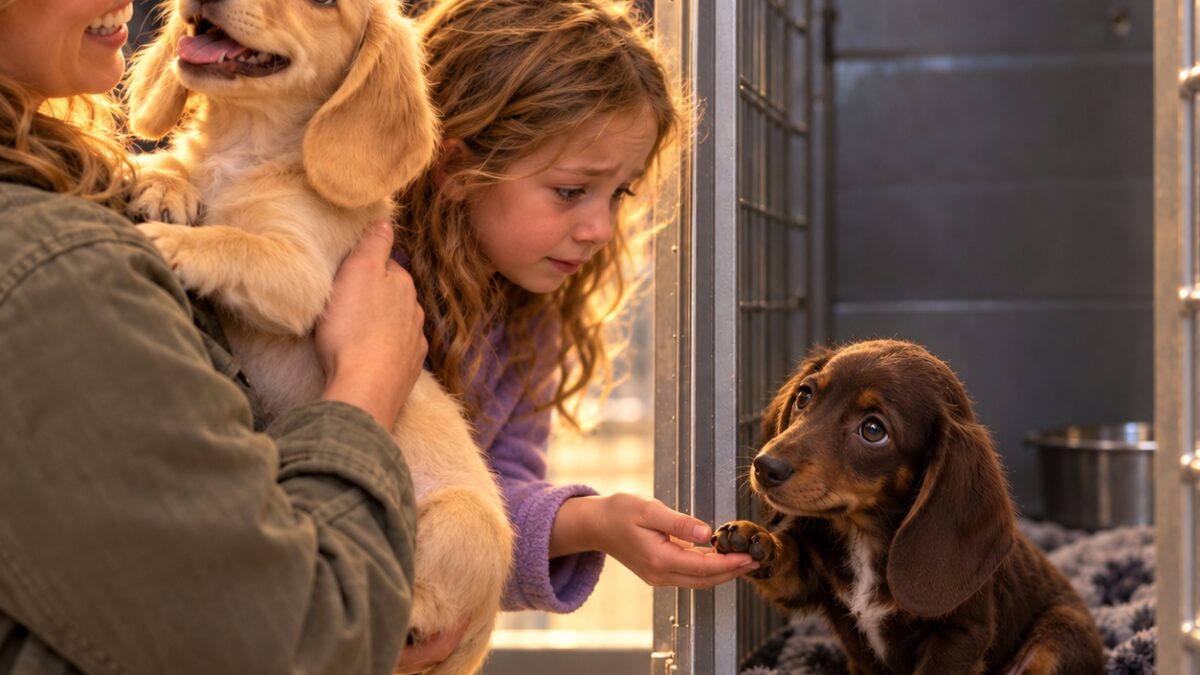
Then I pictured the kennel after Maisie left.
Not because I thought Mabel would somehow be unable to survive without her.
I did not know that.
I did not want to invent some dramatic dependency the shelter had never claimed.
But we had seen how she watched her sister.
We had seen the quiet nudges.
The way she moved closer when Maisie became anxious.
The way Mabel seemed to check that Maisie was okay before relaxing herself.
These puppies had already lost their previous home together.
Now one was being chosen quickly while the other remained almost invisible.
I kept hearing that sentence.
Finding a home for the dark one won’t be easy.
The dark one.
Not Mabel.
Not the gentle puppy.
Not the sister who stayed close when Maisie became nervous.
Just the dark one.
The less marketable one.
The one people assumed would be harder to place.
There was no cruelty in her behavior.
No medical problem in the source.
No difficult temperament.
People simply looked longer at Maisie.
That was it.
Color.
First impression.
Attention.
Sometimes unfairness does not arrive with a villain.
Sometimes it arrives as preference repeated by enough people that one life keeps getting passed over.
We went back.
The puppies were still together.
Maisie came forward quickly.
Mabel watched.
We asked more questions.
Not because we were searching for an excuse to adopt one instead of two.
Because bringing home animals is a commitment, and emotion should not replace responsibility.
Two puppies would mean more work than one.
That was obvious.
They would both need time.
Routine.
Training.
Adjustment.
They were only around twelve weeks old.
They had already moved from one life into another.
Whatever we decided had to be something we could actually sustain.
But each time we tried to imagine choosing only one, the decision felt wrong.
Not because adopting one puppy is wrong.
It is not.
Not because every bonded-looking pair must automatically stay together.
That would be too broad a claim.
It felt wrong because of these two specific puppies and what we had already watched between them.
Maisie attracted people.
Mabel anchored Maisie.
The shelter environment seemed to make that dynamic easier to see.
The pale puppy was the obvious choice.
The dark puppy was the quiet reason we kept standing there.
Eventually the decision stopped feeling like a decision.
We completed the application for both.
Maisie.
And Mabel.
The staff reaction told us something.
They beamed.
There was visible relief in the way they responded.
Not because Maisie had been difficult to place.
Quite the opposite.
She had options.
The relief was that Mabel no longer had to wait for somebody willing to look beyond the first few seconds.
And the sisters would not have to be separated.
When the adoption was finalized, a staff member brought out two leashes.
Matching.
I remember that detail because suddenly the whole thing became real.
Two leashes.
Two puppies.
Both going home.
The kennel gate opened.
Maisie did exactly what Maisie did.
She rushed forward.
Everything outside the gate seemed interesting.
New smells.
New movement.
New people.
Her whole little body leaned into the next thing.
Mabel did not.
She hesitated.
Just for a moment.
Then she looked toward Maisie.
Checked where her sister was.
Maisie was there.
Close.
Only then did Mabel step forward.
That tiny pause stayed with me.
It matched everything we had already noticed.
Mabel did not enter the world dramatically.
She checked first.
Then followed.
I remember thinking that people who had walked past her had missed so much.
Not because she was secretly better than Maisie.
That would have turned one unfair comparison into another.
Maisie was wonderful.
Bright.
Friendly.
Easy to notice.
Mabel was wonderful too.
Just differently.
That was the point.
One puppy announced herself.
The other revealed herself if you stayed.
We walked out of the shelter with both.
I wish I could tell you we knew exactly what the next six months would look like.
We did not.
You can plan for puppies.
You cannot completely plan their personalities.
You learn them.
Day after day.
Maisie made herself easy to understand.
She still treated new people as if an old friend had arrived.
Someone came through the door and Maisie was ready.
Her cheerfulness had not been only shelter behavior.
That was simply her.
Open.
Social.
Interested.
If attention existed, she seemed willing to participate.
Mabel was more measured.
Not afraid in some dramatic way.
Just observant.
She noticed people.
She noticed Maisie.
She noticed the emotional temperature of the room.
And the quality we had first seen at the shelter did not disappear after adoption.
She remained a watcher.
A caretaker in her own small way.
I started calling her our gentle guardian.
Not because she guarded the house like some intimidating dog.
She was a Dachshund puppy.
Nothing about the phrase needed to be literal.
She guarded connection.
She kept track of where everyone was.
She seemed to notice when someone was left outside the center of attention.
That felt appropriate for the puppy who had once been the one left outside everyone else’s attention.
Six months passed.
The puppies grew.
Their personalities became even clearer.
Maisie still greeted guests as though each person had been personally invited for her benefit.
The door would open, and whatever else was happening seemed temporarily less important than the arrival.
Mabel would be there too.
Watching.
Making sure everyone was accounted for.
It was easy to understand how shelter visitors had reached quick conclusions.
If you spend thirty seconds beside a kennel, Maisie wins those thirty seconds.
She presents herself instantly.
Mabel asks for more time.
And that is the strange disadvantage quiet animals sometimes have in adoption environments.
People often arrive wanting to feel an immediate connection.
They want the dog who approaches first.
The puppy who looks distinctive.
The one whose photograph catches attention.
There is nothing wrong with being drawn to that.
Maisie deserved every bit of affection she received.
But Mabel reminded us how incomplete first impressions can be.
The things that made her extraordinary were not things visible in a photograph.
You had to watch interactions.
Who moved closer when another dog became anxious?
Who nudged instead of escalating?
Who checked on her sister before stepping through the open kennel gate?
Those were the details.
None fit on a simple kennel card.
None made her coat lighter.
None changed that white patch on her chest.
But those details became the reason our house would feel incomplete without her.
Sometimes I thought about what might have happened if we had followed the advice.
Pick the cream-colored puppy.
Maybe Maisie would still have come home with us.
Maybe Mabel would have been adopted the next day.
Maybe a wonderful family would have eventually chosen her.
That is entirely possible.
I do not need to create a tragic alternate ending to justify our choice.
The point is not that we were the only people who could have loved Mabel.
The point is that we almost allowed someone else’s assumption to decide which dog deserved our attention.
Once we actually paid attention ourselves, the assumption stopped making sense.
Mabel did not need pity.
She needed someone to notice her.
There is a difference.
Pity says:
Poor dark puppy nobody wants.
Attention says:
Who are you?
That question gave us the real dog.
Steady.
Tender.
Watchful.
Deeply connected to her sister.
We became grateful that the shelter had allowed us enough time to see it.
I have thought a lot about appearance since then.
Dog adoption is emotional.
People respond to faces.
Colors.
Size.
Expressions.
A photograph can decide whether someone clicks or scrolls.
Shelter workers know that.
Rescuers know that.
Certain dogs attract attention faster.
That does not mean the people doing the choosing are cruel.
Humans are visual.
We notice what stands out.
Maisie stood out.
Cream fur among ordinary kennel colors.
Long ears.
Cheerful face.
Mabel blended into the dim background.
Dark coat.
Small white patch.
Quiet posture.
You could walk past and honestly believe you had seen both puppies.
But seeing is not always noticing.
We saw Mabel only after we stayed.
That is something I will always remember.
When we first stood outside the kennel, I could have described Maisie immediately.
Cream.
Cheerful.
Beautiful.
Mabel took longer.
Then eventually I had more to say about her.
She watches Maisie.
She settles her.
She nudges her when noises make her bark.
She is calm.
She is gentle.
She seems to check before she moves.
Character takes longer than color.
That may be the whole story.
There was another part of adopting them together that mattered.
They did not have to process another separation immediately after losing their previous home.
Again, I cannot claim exactly what they understood about their owner entering assisted living.
They were puppies.
We do not know how they interpreted the change.
But the facts were simple.
They had lived together.
They arrived at the shelter together.
Then they went home together.
One piece of continuity remained intact.
Sometimes that is all you can preserve for an animal whose world is changing.
A familiar sibling.
A familiar scent.
A familiar body nearby.
Maisie got that.
Mabel got that.
And watching them grow side by side made us even more grateful for the choice.
They did not become identical because they stayed together.
Quite the opposite.
Their differences became easier to appreciate.
Maisie could be Maisie.
She did not need to become cautious.
Mabel could be Mabel.
She did not need to perform cheerfulness to compete.
There was room for both.
That became one of my favorite things about them.
People sometimes imagine dogs from the same litter as interchangeable.
Same age.
Same breed.
Same background.
These two destroyed that idea immediately.
They were sisters, not copies.
Maisie entered a room like something good was definitely about to happen.
Mabel seemed to enter asking whether everyone else was okay first.
Neither approach was better.
Together, they made sense.
The adoption story began with appearance.
Our life with them quickly stopped being about appearance at all.
Within weeks, nobody in the house was thinking:
cream dog and dark dog.
They were Maisie and Mabel.
That is what names do when you live with someone.
They replace categories.
The coat becomes only one detail among hundreds.
Maisie was the one greeting everyone.
Mabel was the one monitoring.
Maisie was immediate.
Mabel was depth.
Eventually, the original advice sounded almost absurd.
Finding a home for the dark one won’t be easy.
Maybe that had been statistically practical in some sense.
Maybe darker-coated dogs truly did receive less attention in that shelter environment.
I do not know beyond what we observed.
But from inside our home, Mabel was not difficult to want.
The difficulty had been seeing her fully before knowing her.
Once we knew her, leaving her behind felt impossible.
That is why six months later I still thought about the kennel.
There were moments at home when Mabel would look around the room in that watchful way.
Everyone accounted for.
Maisie nearby.
Us nearby.
Then she would relax.
And I would picture her behind the gate.
People stopping for Maisie.
Moving on.
Mabel waiting.
I wished I could go back and tell that puppy:
You are not the one nobody wants.
You are simply waiting for somebody to stay long enough to meet you.
Of course she did not need those words.
She needed the outcome.
And she got it.
Home.
Sister.
People.
No more strangers choosing between them through wire.
I sometimes wondered whether Maisie knew how much Mabel had steadied her.
Again, dogs do not narrate relationships.
We only see behavior.
At the shelter, Mabel moved close when Maisie became anxious.
She nudged her when noises triggered barking.
That was enough for us to recognize care.
At home, their relationship continued in its own rhythm.
We did not turn every interaction into a symbolic moment.
Most life with dogs is ordinary.
That is what you want.
Eat.
Sleep.
Play.
Watch the door.
Meet visitors.
Rest.
The shelter should become history rather than identity.
Maisie and Mabel did not need to remain “the two puppies who almost got separated.”
They became our dogs.
That was better.
But the origin story still mattered to us because it changed the way we looked at other animals.
Whenever I see a shelter photograph now, I think about the animal just outside the frame.
The one who does not come forward.
The dog whose coloring does not photograph dramatically.
The puppy who waits behind the enthusiastic sibling.
The animal someone describes as harder to place.
Maybe there is nothing extraordinary hiding there.
Maybe there is.
You cannot know from five seconds.
Mabel made me suspicious of five-second decisions.
That is probably healthy.
I also became more careful about the language people use around adoptable animals.
“Easy.”
“Hard.”
“Popular.”
“Pretty.”
“Perfect.”
Those words can shape outcomes.
The person beside the kennel probably thought they were helping.
Pick Maisie.
Mabel will be harder.
But imagine being reduced to the thing that makes strangers hesitate.
Not temperament.
Not behavior.
Not health.
Color.
Mabel did not know people were making that comparison.
Thankfully.
She was simply sitting with her sister.
That innocence made the human judgment seem even more unnecessary.
Dogs do not stand in mirrors comparing coats.
Maisie did not know cream was considered desirable.
Mabel did not know dark brown could make visitors move along.
Those values existed only outside the kennel.
Once both dogs crossed into our home, the hierarchy vanished because it had never belonged to them.
It belonged to us.
Humans.
That realization made me grateful we had stepped outside it.
Not perfectly.
We noticed Maisie first too.
I think admitting that matters.
We were not somehow more enlightened from the beginning.
The same visual instinct worked on us.
Maisie drew our eyes.
Then Mabel drew our attention.
There is a difference.
Eyes are immediate.
Attention requires time.
We gave time.
She gave us everything else.
Six months is not an entire lifetime.
The puppies were still young.
The future would bring more changes.
But six months was enough to make one thing certain.
There was no version of home that felt complete without both.
That may be the deepest difference between adoption-day logic and family.
At the shelter, we were asking:
Can we handle two puppies?
Months later, the idea of having chosen only one felt impossible to picture.
Because once a living being becomes part of the structure of your day, removing them mentally leaves a hole.
Mabel had become that deeply integrated.
She was no longer the extra dog in the decision.
There had never really been an extra dog.
There were two sisters.
That is how we should have thought from the beginning.
Maisie gave people immediate joy.
Mabel gave something quieter.
She made you feel watched over.
Again, not in some grand protective-dog sense.
She paid attention.
There is comfort in an animal who notices.
If somebody entered, Mabel noticed.
If Maisie reacted, Mabel noticed.
If the room changed, Mabel noticed.
That attentiveness became part of the emotional rhythm of the house.
Maisie filled space.
Mabel held it together.
I know that sounds sentimental.
It is still the best description I have.
Sometimes guests would come in and naturally respond first to Maisie.
The same pattern as the shelter.
Maisie welcomed them enthusiastically.
Then, after a little time, they would notice Mabel.
And that was always interesting to watch.
The second look.
The hand eventually reaching toward her.
The realization that the quieter puppy had been nearby the whole time.
I never needed guests to prefer one.
That would have recreated the problem.
I liked watching them discover both.
That was what we had done.
Sometimes the strongest bond does not begin with a rush.
It begins with observation.
Mabel taught us that.
If Maisie was love at first sight, Mabel was love built from noticing.
Both are real.
One simply makes a better shelter photograph.
There is also something worth saying about the previous owner.
The source tells us only that the owner entered assisted living and could no longer keep the puppies.
That is sad in its own way.
Not abandonment in the careless sense.
A life circumstance changed.
Someone could no longer provide the care the puppies needed.
Maisie and Mabel lost their home because human life had changed around them.
That happens.
It is one reason shelters exist.
I do not turn the previous owner into a villain.
We know too little, and nothing in the source supports that.
Instead, I think about the puppies experiencing a change they could not understand.
One day, familiar life.
Then shelter.
Through that transition, they still had each other.
Preserving that bond where possible felt compassionate.
That is what we were really choosing.
Not just two dogs.
Continuity.
They had already lost enough familiar structure.
Why remove the one familiar relationship we could keep?
That question eventually outweighed the inconvenience of two puppies.
Not because inconvenience disappeared.
Two puppies are two puppies.
But responsibility is not the same thing as inconvenience.
If we could responsibly do it, the answer became clear.
The shelter staff understood immediately.
Their smiles when those matching leashes came out are still part of the memory.
Staff see more goodbyes and uncertain outcomes than adopters do.
They know which animals receive inquiries.
Which wait.
Which pairs may be separated.
Seeing Mabel leave with Maisie probably meant something to them beyond one successful adoption.
It meant one less night of wondering who would finally ask about the darker puppy.
I am glad we gave them that moment.
More glad that we gave Mabel hers.
She hesitated at the gate.
Checked for Maisie.
Then stepped out.
What a perfect first action for her.
Even freedom came second to knowing her sister was close.
I sometimes replay it.
Maisie moving forward immediately.
Mabel checking.
Then following.
Same open gate.
Two ways of entering the next life.
Nothing could describe them better.
At home, we never tried to make Mabel more like Maisie.
That was important too.
Quiet dogs are often encouraged to become more outward because outward behavior is easier for humans to read.
We did not need Mabel to greet people first.
Did not need her to compete.
Her steadiness was enough.
The things people had ignored became exactly the things we valued.
Tenderness.
Awareness.
Patience.
That is one reason the phrase “flawless-looking puppy” stayed with me.
What does flawless mean?
A particular coat?
Symmetry?
A certain expression?
None of those things matter when you are six months into living with a dog.
What matters is who they are inside the household.
Does the dog trust you?
Do you understand each other?
What small habits have become indispensable?
Mabel’s white patch did not make her less perfect.
It made her Mabel.
Eventually I stopped even thinking of it as unusual.
That is what familiarity does.
Difference becomes identity.
The dark coat people overlooked became the coat we recognized instantly from across the room.
The puppy who blended into the shelter background became impossible to miss at home.
Context changes everything.
At the kennel, Mabel was one dark puppy among many visual distractions.
At home, Mabel was Mabel.
No competition.
No comparison.
That is perhaps the greatest gift adoption gives an overlooked animal.
They stop auditioning.
No more waiting for someone to choose.
No more needing to stand out.
No more strangers deciding whether another dog is prettier.
They simply belong.
That is what I wanted for both sisters.
Especially Mabel.
A life where she never had to compete with Maisie’s coat for attention again.
Not because Maisie’s beauty was a problem.
Because sisters should not have to become rivals for safety.
At home, Maisie could be adored for being Maisie.
Mabel could be adored for being Mabel.
Love was not limited to one kennel spot.
We had room for both.
That simple fact resolved the whole dilemma.
I sometimes imagine what might have happened the first night if Maisie had left alone.
Mabel in the kennel.
Different sounds around her.
The sister who had always been beside her missing.
Again, I do not dramatize that into permanent trauma because the source does not tell us it happened.
It did not happen.
That is the point.
We had the ability to prevent the separation.
So we did.
Sometimes happy endings are not about repairing damage afterward.
They are about noticing a preventable hurt before it happens.
This was one of those times.
No dramatic rescue vehicle.
No emergency veterinary room.
No dog pulled from a highway.
Just a decision.
Two leashes instead of one.
That is all.
Yet six months later, those two leashes felt like one of the best decisions we had made.
There is something deeply satisfying about a happy ending that looks ordinary afterward.
Maisie greeting people.
Mabel watching over the room.
No one talking about adoption probability anymore.
No one calling one easy to place and the other difficult.
Just family.
The best outcomes often lose their drama with time.
That is success.
If we were still constantly talking about Mabel as the unwanted puppy, maybe we would be keeping her emotionally trapped in the kennel for our own storytelling.
She is not unwanted.
Not overlooked.
Not the “dark one.”
She is Mabel.
Our dog.
Maisie’s sister.
Gentle guardian.
That is enough.
The original advice eventually became a family story.
Sometimes we repeat it and laugh a little.
“Pick the cream-colored puppy.”
Imagine.
As though we could choose now.
As though a home containing Maisie but not Mabel would somehow feel like the same home.
It would not.
That does not mean Maisie alone would not have been wonderful.
It means our actual life formed around both.
Love is like that.
Once the relationship exists, alternatives become emotionally meaningless.
You stop evaluating.
You simply know.
I am grateful the person said the sentence where we could hear it.
Not because it was good advice.
Because it forced us to look directly at the assumption.
Would Mabel really be harder to love?
We stayed long enough to discover the answer.
No.
Harder to notice quickly, perhaps.
Not harder to love.
Those are completely different problems.
One belongs to a shelter environment.
The other belongs to relationship.
Mabel solved the second the moment we began paying attention.
I wish every overlooked animal got enough time for that.
Not every family can adopt two.
Not every pair should necessarily remain together.
Not every dark-coated dog has the same story.
I do not make Mabel into a universal rule.
Her story is specific.
Two twelve-week-old Dachshund sisters.
Previous owner entering assisted living.
One cream-colored and immediately popular.
One deep brown with a white chest marking and almost no inquiries.
One afternoon when adoption readiness threatened to separate them.
One family deciding to apply for both.
Two matching leashes.
Six months together.
That specificity is what makes the story honest.
No need to inflate it.
No need to claim we rescued Mabel from some terrible future.
We gave her the future we could see was right for us.
And it turned out to be right for her sister too.
That is enough.
The phrase I keep returning to is:
Nobody gets overlooked.
That became Mabel’s nature in our home.
She had once been the one people overlooked.
Now she was the dog who seemed to notice everyone.
There is something poetic about that, but I do not need to pretend she consciously transformed pain into compassion.
She was already gentle at the shelter.
We saw it there.
That was who she was before adoption.
Her new life simply gave that personality somewhere permanent to exist.
That makes me love her even more.
She did not become tender because we saved her.
We noticed tenderness that was already there.
Adoption did not create her worth.
It revealed it to us.
That distinction matters in every rescue story.
Animals are not unfinished until humans choose them.
They are already themselves.
Sometimes we are simply late to notice.
We were almost late with Mabel.
Thankfully, not quite.
Today, six months after that afternoon, the matching leashes are no longer the most important symbol.
The dogs themselves are.
Maisie still rushes toward connection.
Mabel still checks.
If someone enters, Maisie celebrates.
Mabel watches the whole room.
Different.
Complementary.
Exactly themselves.
I sometimes sit and watch them together and remember the kennel.
Wire between us.
Shelter lights making Mabel’s coat look almost black.
Maisie drawing eyes.
People walking on.
Then I look at them now.
No gate.
No comparison.
No one choosing.
Both already chosen.
That is the ending.
Not that we found the better dog hidden behind the prettier one.
There was never a better dog.
There were two puppies.
Each worth seeing.
Each worth knowing.
Each carrying something the other did not.
The happy ending was never deciding which sister deserved the home more.
It was realizing the question itself had become wrong for us.
We did not need to choose between them.
We could choose them.
Both.
Maisie walked through the shelter gate first.
Mabel checked that she was there, then followed.
Six months later, that tiny moment still describes everything.
Maisie moves toward the world.
Mabel makes sure no one she loves gets left behind.
And because we brought them home together, neither sister had to learn what it felt like to look back and discover the other one was gone.







