PART2:Every Pickup Made the Old Dog by Our Ice Machine Look Up—Then I Read the Note Under His Collar
PART2
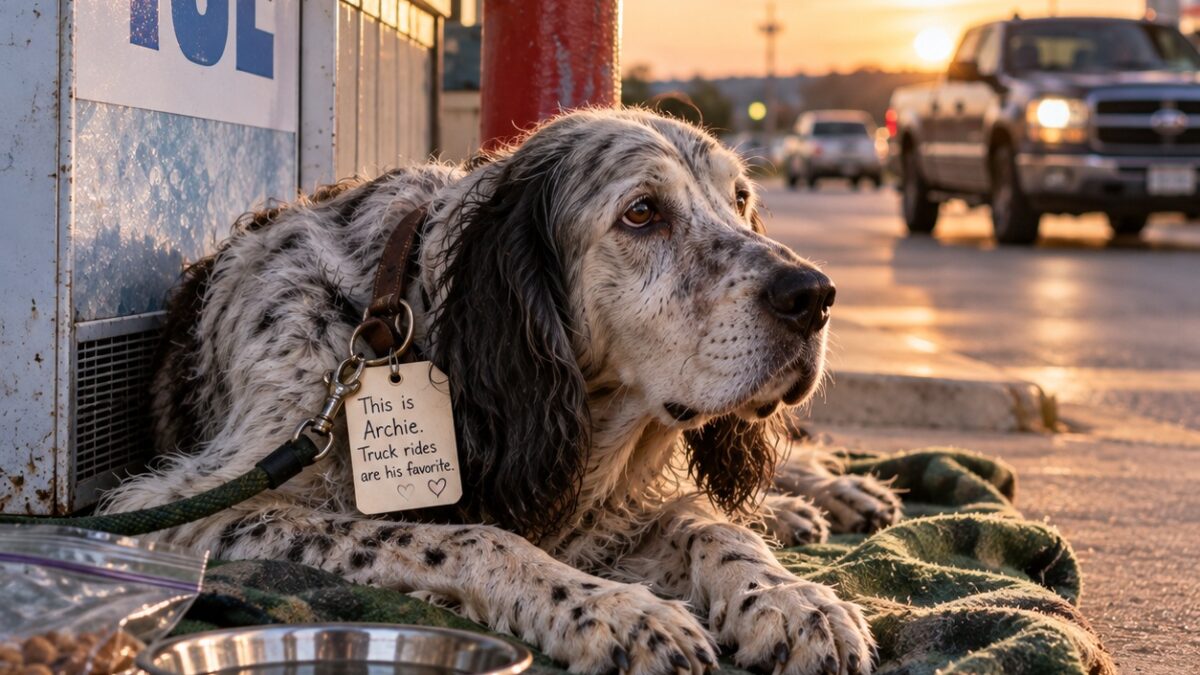
Once you understand that an animal is waiting, every passing vehicle starts to feel personal.
I went back inside because I had work to do, but I kept looking through the window.
Pickup.
Archie looks up.
Wrong truck.
Head down.
Delivery van.
Barely a reaction.
Another pickup.
Tail moves.
Driver walks past.
Stillness again.
There was something about the repetition that made it harder to watch each time.
Hope is easy to romanticize when you are not the one carrying it.
For Archie, it was work.
His joints clearly bothered him.
Every time he pushed himself upright, his legs took a moment to steady.
Yet he did it anyway.
Because maybe this one was the truck.
Maybe this door would open and the right pair of boots would hit the pavement.
Maybe somebody would whistle.
Maybe somebody would say his name the way he knew it.
I had no idea whether that was what he imagined.
Dogs do not explain themselves to us.
But behavior tells you plenty.
Archie did not care much about the customers walking past him.
He did not wander around the lot smelling trash cans.
He did not try to follow people into the store.
He watched the entrance road.
More specifically, he watched trucks.
The luggage tag kept echoing in my head.
Truck rides are his favorite.
That line felt different now.
At first it sounded like the kind of note an owner writes because they want a stranger to know something sweet about their dog.
Now it felt almost painful.
Somewhere in Archie’s life, trucks meant belonging.
Passenger seat.
Road.
His person beside him.
Maybe that was why he kept reacting.
I stayed outside with him whenever the counter was quiet.
He let me sit nearby.
Never pushed for attention.
Never climbed into my lap.
Never acted desperate.
He was dignified in that strange way some old dogs become.
As if they have learned there is no point wasting energy on things they cannot control.
I offered some food.
He ate a little.
Water too.
Then his eyes went back to the driveway.
Eventually I called the animal clinic a couple of miles away.
Dr. Ellis answered.
I explained what we had.
Older English Setter.
Blanket.
Food.
Water.
Luggage tag.
No owner.
No contact information.
Waiting for hours.
“Bring him in,” she said. “Let’s see whether he’s chipped.”
That sounded simple enough.
The only question was how I was going to convince Archie to leave the spot he seemed determined to guard.
I brought my pickup around.
Opened the passenger door.
I barely needed to ask.
Archie stood.
It took him a moment.
His joints were stiff.
But then he walked straight to the truck.
No hesitation.
I helped him up.
He settled into the passenger seat like he had done it a thousand times.
That nearly got me.
Not the sadness.
The familiarity.
He knew exactly where a dog belonged in a pickup.
I folded the green blanket and placed it behind the seat.
Put the food and bowl with it.
Then drove toward the clinic.
Archie sat upright beside me.
The travel center disappeared behind us.
He watched through the windshield.
At every red light, he looked sideways.
Traffic moved around us.
If a pickup stopped beside us, his tail made that same hopeful little movement.
Once, a dark truck pulled alongside.
Archie leaned toward the window.
Driver turned his head.
Not the person.
Archie settled back.
I wanted to tell him something.
I did not know what.
“Maybe we’ll find him.”
Maybe.
That was all I had.
At the clinic, the waiting continued in a different form.
The entrance bell rang whenever someone came through the door.
Every time it happened, Archie raised his head.
A woman carrying a cat carrier.
Not his person.
A man with a terrier.
Not his person.
A delivery driver.
Not his person.
Head down.
Bell again.
Head up.
It was impossible not to notice.
Dr. Ellis scanned him.
There was a microchip.
For about thirty seconds, that felt like the answer.
Then she checked the registration.
Outdated.
Phone number disconnected.
No useful current contact.
Back to nothing.
Dr. Ellis examined him.
Teeth.
Eyes.
Heart.
Joints.
She estimated Archie was around thirteen.
His teeth showed his age.
Arthritis had begun affecting him.
That explained the slow rise every time a truck entered Dawson’s lot.
But otherwise, considering everything, he was in surprisingly good condition.
Someone had cared for this dog.
That was obvious.
His body did not look like thirteen years of neglect.
He was not starving.
His coat had not been allowed to collapse into mats.
The supplies at the travel center also suggested preparation rather than random abandonment.
Blanket.
Water.
Food.
Lead.
Label.
None of it made sense yet.
Dr. Ellis finished the exam.
“What he needs is fairly simple,” she said. “Comfortable bedding, gentle exercise and somebody dependable.”
I smiled.
“He can stay with me while we look for his people.”
I said it casually.
Temporary.
That was the word.
I repeated it to Dr. Ellis.
Repeated it to coworkers.
Repeated it to customers.
A few nights.
Maybe a week.
We would find whoever belonged to the dead phone number.
Someone would see a notice.
Archie would go home.
Simple.
That evening, I brought him to my house.
I laid a quilt on the floor near the sofa.
Thick enough for his joints.
Warm.
Easy to get onto.
Archie walked toward it.
Sniffed once.
Then continued.
He made a slow circuit of the living room.
Hallway.
Kitchen.
Stopped at one doorway.
Looked inside.
Moved on.
He checked windows.
He paused at each one for a few seconds.
Not anxious exactly.
Searching.
At the front door, he stopped longest.
Then turned once.
Lowered himself carefully.
And settled facing the entrance.
I stood there looking at the untouched quilt.
Of course.
He was not ready to sleep comfortably in a strange home.
He was waiting for the door to open.
I moved the quilt closer.
Not right beneath him.
Near enough.
He ignored it at first.
Later, sometime close to midnight, I woke to a soft sound from the living room.
I got up quietly.
Archie had moved onto the bedding.
He was asleep.
His feet twitched.
His tail brushed lightly against the quilt.
Every so often, he made a soft, contented breath.
No crying.
No distress.
Just sleep.
I stood in the doorway longer than I needed to.
Maybe he was dreaming.
I found myself imagining a truck.
Passenger seat.
Window cracked.
His person driving.
Archie watching the road from the place he understood.
That was my imagination, not fact.
But it was difficult not to picture.
The note had given me just enough information to make the missing parts hurt.
Truck rides are his favorite.
We started searching the next morning.
Dawson’s was the obvious place to begin.
Customers talk.
Especially regulars.
I put Archie’s picture where people could see it.
Old English Setter found beside the ice dispenser.
Microchip information outdated.
Call us if you recognize him.
A photo went onto neighborhood notices too.
Dr. Ellis checked what she could.
We tried working backward through the chip registration.
No luck.
For a while, every call made me hopeful.
Then most turned into nothing.
Someone thought they had seen a similar dog three towns over.
Wrong dog.
Someone knew a family with an English Setter.
Young dog.
Someone asked whether Archie was available for adoption.
Not yet.
“He has people somewhere.”
I kept saying that.
At night, Archie stayed with me.
The first few days, he continued sleeping near the front door.
During the day, if a truck passed slowly outside, his head lifted.
At my house, there were fewer pickups than at the travel center.
At work, there were hundreds.
I started taking him with me when it seemed reasonable.
He loved the truck.
That was not merely something written on the luggage tag.
The moment I opened the passenger door, Archie became more animated.
He would climb in with whatever help he needed, settle beside me, and watch the world.
That was when I saw the younger dog hidden inside the thirteen-year-old body.
His arthritis did not disappear.
His muzzle did not become less gray.
But in the passenger seat, he seemed engaged.
Interested.
As if travel itself made sense.
Maybe the familiar routine comforted him.
Maybe he had spent years riding exactly that way.
I could not know.
I only knew he wanted to come.
So he came.
Back at Dawson’s, some customers recognized him from the notices.
“Any luck?”
“Not yet.”
“What are you going to do if nobody comes?”
“Keep looking.”
I did not answer the second half.
What happens after that?
Because by the end of the first week, the temporary arrangement had already become routine.
Archie knew where the water bowl was.
He knew where I kept his food.
He had finally started using the quilt near the sofa sometimes.
But he still liked the front door.
In the evening, he might settle beside me for a while, then eventually reposition himself where he could see the entrance.
Waiting had not disappeared.
It had become quieter.
That worried me more in some ways.
At the travel center, hope had been visible.
Pickup enters.
Ears up.
Tail.
At my house, waiting blended into rest.
Sometimes I wondered whether I was imagining meaning that was not there.
Maybe an old dog simply liked the cooler spot by the door.
Maybe he liked seeing outside.
I reminded myself not to turn every movement into grief.
Then a pickup would pull into my driveway for some ordinary reason and Archie would struggle upright with that same expression.
And I knew.
He was still looking.
Week two passed.
No owner.
The microchip remained useless.
More notices.
More conversations.
I began to consider what “temporary” might mean if no one ever came.
I would look at Archie asleep and think:
Thirteen.
Arthritis.
He could have years.
Could have much less.
Would I keep him?
The answer kept becoming more obvious.
Yes.
I had not said it aloud yet.
There seemed something disloyal about deciding he was mine while he was still waiting for somebody else.
So I did not claim him.
I simply cared for him.
Comfortable bed.
Gentle walks.
Food.
Truck rides.
Dependability.
Exactly what Dr. Ellis had prescribed.
Dependability turned out to be the most important part.
Morning.
I was there.
Evening.
I was there.
Truck ride ended.
We came home together.
Front door opened.
Same house.
Same person.
Archie learned my routines.
I learned his.
He liked moving slowly in the morning.
He needed time for his joints to loosen.
He preferred riding to walking longer distances.
He still monitored trucks.
Some habits remained fixed.
Then, during the third week, one of Dawson’s regular customers stopped in.
He had seen the neighborhood notice.
Archie’s photograph.
The name.
Something about it had bothered him.
He looked at me.
“I think I know that dog.”
Everything in me sharpened.
“You’re sure?”
“Pretty sure.”
Then he gave us the first real lead we had had in three weeks.
An elderly man.
Recent emergency surgery.
Assisted living.
Dog named Archie.
Things moved quickly after that.
We confirmed enough to understand what had happened.
Archie’s owner had suffered a medical emergency and needed surgery.
Afterward, he had moved into assisted living.
His daughter had asked another person to care for Archie during the transition.
Somewhere in that chain, something had gone terribly wrong.
A misunderstanding.
A handoff that did not happen the way it was supposed to.
And Archie had ended up outside Dawson’s Travel Center.
That knowledge changed everything.
For three weeks, I had looked at the blanket, food, water, and luggage tag and tried to understand what kind of person would leave an elderly dog beside an ice machine.
Now the picture became more complicated.
Archie had not simply been casually discarded by the man he loved.
The man he loved had been in crisis himself.
Emergency surgery.
New residence.
Dependence on other people to make arrangements.
Somewhere, communication failed.
Archie paid the price.
I felt angry about the failure.
But mostly I felt relief.
Because one question finally had an answer.
There was someone.
Someone Archie belonged to.
Someone who might still be waiting too.
We arranged a meeting at the assisted-living residence.
I drove Archie there in my pickup.
Passenger seat.
Of course.
I was more nervous than I expected.
What if I was wrong?
What if Archie did not react?
What if the man was too ill?
What if three weeks had changed something?
Archie watched the road.
Same as always.
Traffic.
Pickups.
Intersections.
We pulled into the residence.
I parked.
Helped Archie down.
He stood beside me.
Old legs.
Gray face.
Waiting.
Then the doors opened.
An elderly man appeared in a wheelchair.
I looked at Archie.
The transformation was immediate.
No uncertainty.
No cautious sniffing.
No slow evaluation.
Archie knew him.
His entire body seemed to come alive at once.
His tail did not merely wag.
His whole body rocked with it.
For a thirteen-year-old dog with arthritic joints, he moved faster than I had seen him move in three weeks.
Toward the wheelchair.
Toward the man.
Toward the person every pickup had failed to contain.
I stayed back.
Archie reached him.
Then gently laid his head across the man’s knees.
That was all.
No dramatic barking.
No wild jumping.
He simply placed his head there.
The man bent over him.
And they stayed that way.
For a long time.
Employees stood inside the entrance watching.
Nobody interrupted.
I stood near my pickup.
I looked down at my phone.
There was nothing on it I needed to see.
I just needed somewhere else to put my eyes.
There are moments too private even when they happen in public.
That felt like one.
For three weeks, I had been the person Archie relied on.
Food.
House.
Truck.
Walks.
A bed.
And I had started to love him.
There was no point pretending otherwise.
But watching Archie with his owner made one thing completely clear.
I had not been replacing anybody.
I had been keeping a place warm until the right person became reachable again.
There is dignity in that role.
Temporary finally meant what I had claimed it meant from the beginning.
Archie’s owner still loved him.
Archie clearly still loved him.
The problem had never been a lack of family.
The problem had been getting them back to each other.
That reunion also changed how I thought about the first morning.
Every pickup.
Every tail tap.
Every slow effort to stand.
Archie had not been waiting for some abstract idea of home.
He had been waiting for him.
The wheelchair did not matter.
The building did not matter.
The man looked different from someone climbing out of a pickup, I am sure.
Archie did not care.
Recognition happened before any of those details.
That is one of the things dogs do better than people.
They identify relationship beneath circumstance.
Hospital.
Wheelchair.
New residence.
None of it erased:
There you are.
I went home that day to a quieter house.
Archie’s quilt remained near the sofa.
For a few seconds, seeing it felt strange.
I had spent three weeks adjusting the house around an elderly dog.
Now there was no dog.
I missed him.
Of course I did.
But missing him felt clean.
There was no worry in it.
No question about whether he was safe.
He was where he had been trying to get from the first moment I saw him.
That was worth the empty quilt.
I left it there for a couple of days before moving it.
Habit.
Maybe sentiment.
Probably both.
Customers at Dawson’s kept asking.
“Did you find his people?”
“Yes.”
I loved answering that.
Not:
He got adopted.
Not:
Nobody ever came.
We found his owner.
The story could have ended there.
For me, it almost did.
Then about a month later, I visited the assisted-living residence.
I wanted to see Archie.
Maybe I wanted reassurance that the reunion had become a life and not merely one emotional afternoon.
I found him easily.
He had a job.
No one officially hired him, as far as I know.
Archie had appointed himself.
Welcome committee.
Mornings began with a stroll through the corridors beside his owner.
Slow pace.
Perfect for both of them.
During the day, Archie often slept near the sunroom where residents gathered.
He had comfortable places to rest.
People nearby.
Hands reaching down to pet him.
Conversation around him.
Then in the evening, he sometimes walked beside residents heading back toward their rooms.
Wheelchairs moving slowly.
Archie keeping pace.
That image affected me more than I expected.
The dog I had first known as the one waiting had become the one accompanying.
For hours at Dawson’s, every pickup had made Archie wonder whether someone was coming back for him.
Now he moved through a building full of people whose own lives had changed.
People dealing with age.
Illness.
Reduced independence.
New rooms.
New routines.
And Archie was there.
Not curing any of it.
Just beside them.
Sometimes beside is enough.
I watched him follow one wheelchair down the corridor at the exact pace required.
No hurry.
Old dog.
Older residents.
Everyone moving at a speed the world outside might call slow.
Inside that building, it fit.
Archie had found a place where his age was not an inconvenience.
His gentleness was useful.
His love of companionship was useful.
Even his slow walking worked.
He had spent thirteen years becoming exactly the dog those hallways needed.
I looked at his owner.
There was a different ease between them now.
The reunion excitement had settled into routine.
That was what I wanted to see.
Archie did not spend every second staring at the man as though afraid he would disappear again.
He could wander a little.
Nap nearby.
Visit other people.
Then return.
That told me something.
Waiting had ended.
The first morning beside our ice dispenser, Archie could not relax when a pickup entered the lot.
Every engine contained a possibility.
Now engines outside the residence meant nothing.
His person was already there.
That is the difference between hoping for home and living in it.
I stayed for a while.
Not long.
I did not need to turn the visit into a reunion of my own.
Archie recognized me.
That was enough.
I scratched him gently.
Talked to his owner.
Then stepped back.
I had once imagined Archie might end up staying with me permanently.
There had been evenings when I thought:
Maybe this is how it happens.
An old dog appears.
Nobody claims him.
Temporary becomes forever.
I had already started building that future in my head.
It would not have been a bad future.
I would have cared for him.
He would have had truck rides.
Soft bedding.
Gentle walks.
Dependability.
But it would have been the wrong happy ending.
That is something rescue stories do not always acknowledge.
Sometimes we become attached to the version where we get to be the answer.
We find the dog.
We keep the dog.
We become the family.
That makes a satisfying story.
Archie did not need a replacement family.
He needed help getting back to the family he already had.
My job was not to become more important than his owner.
My job was to keep Archie safe long enough for the truth to catch up with him.
Once I understood that, letting him go was easy and hard at the same time.
Hard because I loved having him.
Easy because I had seen his tail when that wheelchair appeared.
Nothing I could offer competed with that.
Nor should it.
Love is not a contest.
Three weeks with me did not cancel thirteen years with someone else.
It simply protected the bridge between them.
I became grateful for that.
The green picnic blanket came to mind sometimes.
I had kept it with Archie’s things.
At Dawson’s, it had seemed almost like evidence.
Proof that someone had at least tried to leave him with basic comfort.
Once we learned what happened, I saw it differently.
Everything about that setup suggested Archie had been part of some attempted arrangement.
Someone packed food.
Water bowl.
Blanket.
Leash.
Name tag.
The handoff failed disastrously.
But the objects themselves were fragments of care mixed with confusion.
That does not excuse the outcome.
An elderly dog should never have been left sitting beside a roadside ice machine with no reliable person responsible for him.
But understanding matters.
The source did not give me a villain.
So I did not need to invent one.
There had been an emergency.
A family trying to manage an elderly man’s surgery and transition into assisted living.
Another person asked to care for the dog.
A misunderstanding.
Then Archie waiting.
Real life is often messier than a simple abandonment story.
People fail without necessarily intending cruelty.
Communication breaks.
Responsibility gets assumed rather than confirmed.
A vulnerable animal falls into the gap.
Archie fell into that gap.
Fortunately, he landed somewhere people noticed.
I think about that too.
What if I had assumed all morning that somebody was inside?
What if no one looked closely at the luggage tag?
What if we never scanned the chip because the number was old?
What if the regular customer never saw the notice?
The chain could have broken at many points.
Instead, enough people paid attention.
That is usually how lost-animal reunions happen.
Not through one miracle.
Through several small acts.
Notice the dog.
Bring water.
Read the tag.
Call the clinic.
Scan the chip.
Post the photo.
Keep posting.
Let regular customers see it.
Someone recognizes him.
Follow the lead.
Arrange the meeting.
Small steps.
Archie did not understand any of those logistics.
He only understood waiting.
We handled the rest.
When I think about the old tag now, the second line is what remains with me.
Truck rides are his favorite.
Such a simple thing to tell a stranger.
Not:
He has arthritis.
Not:
Please call this person.
Not:
He belongs to an elderly man recovering from surgery.
Just something affectionate.
A detail.
Whoever wrote it knew Archie as a personality, not an object.
And they were right.
Truck rides really were his favorite.
That tag gave me one of the first clues that Archie had been loved somewhere.
Loved dogs have trivia.
Favorite places.
Favorite routines.
Little habits that only matter because someone noticed them over time.
Archie had a favorite kind of ride.
That meant a history existed.
We just had to find it.
The microchip frustrated me at first.
What is the point of a chip if the phone number does not work?
But even that frustration taught me something.
Information ages.
People move.
Numbers change.
Medical emergencies happen.
Systems that are supposed to reconnect animals and owners depend on humans keeping them current.
Archie was chipped.
The chip was not enough.
Community filled the gap.
Dawson’s regulars.
Neighborhood notices.
A person recognizing his face.
Sometimes technology gets you partway.
People finish the job.
I still see abandoned items every day at the travel center.
Phones.
Toys.
Cups.
Jackets.
Nothing changed about travelers.
But I never look at the space beside the ice machine quite the same way.
For three weeks after Archie left, I would glance there in the morning.
Empty.
Just concrete bollards.
Ice dispenser humming.
People buying bags for coolers.
No green blanket.
No old dog.
I was glad it was empty.
Sometimes absence is good news.
Archie no longer needed to watch that driveway.
The first time I saw him, I thought maybe he was simply resting.
Then I realized every pickup contained hope.
The last time I saw him at the residence, he was resting too.
But it was a completely different kind of rest.
No ears lifting at every arrival.
No struggle to stand each time an engine passed.
He could sleep because the person he was waiting for was already nearby.
That is safety.
Not never hearing strange noises.
Knowing you do not have to react to all of them.
Archie had earned that peace.
I sometimes tell customers the story when they ask about dogs.
I try not to make it more dramatic than it was.
The truth is already enough.
An old dog waited.
A travel-center employee noticed.
A chip failed.
A neighborhood notice worked.
An elderly man recovered from emergency surgery enough to reunite with his dog in a new home.
Archie adjusted.
Then made himself useful to everybody else.
That last part is almost too perfect, but it happened.
After all that waiting, he became the dog who kept other people company.
I do not pretend he consciously decided:
I know what loneliness feels like, therefore I shall comfort assisted-living residents.
That is human storytelling.
Archie was simply social.
Gentle.
Comfortable around people.
The environment suited him.
Still, the image has meaning whether Archie intended it or not.
He once lay alone beside an ice machine waiting for a familiar person.
Later, he walked beside wheelchairs so other people did not have to travel hallways alone.
That is beautiful enough without assigning him a philosophy.
Dr. Ellis’s words also stayed with me.
Comfortable bedding.
Gentle exercise.
Somebody dependable.
At first I thought she was prescribing care for an elderly dog.
Later I realized those three things described his life at the residence almost perfectly.
Soft places to sleep.
Slow corridor walks.
His owner nearby.
Dependability restored.
The medical needs were simple because the real crisis had never been his body.
It was separation.
Arthritis could be managed.
Gray hair did not bother him.
What destabilized Archie was not knowing where his person had gone.
Once that problem was solved, the rest became ordinary aging.
That was almost a relief.
Old dogs do not need their youth restored.
They need their old age respected.
Archie had sore joints.
So people moved slowly with him.
He needed comfortable bedding.
He got it.
He loved companionship.
The residence was full of people.
His owner needed assisted living.
Archie adjusted to that environment too.
It worked because nobody demanded that either of them return to the exact life they had before surgery.
Their life had changed.
But they could still share it.
That may be my favorite part.
The happy ending was not taking the man back to his old house with Archie in the passenger seat and everything magically restored.
That was not possible.
He had moved into assisted living for a reason.
The ending respected that reality.
Wheelchair.
New residence.
Different daily routine.
Archie did not need the old house.
He needed the old relationship.
Dogs understand something we often struggle with.
Home can change shape.
House.
Apartment.
Assisted living.
Pickup.
It is not the building.
It is the person.
Archie proved that the instant he saw the wheelchair.
For three weeks, I had given him a house.
Food.
Blanket.
Truck rides.
He was safe.
But safety and home were not identical for him.
Home appeared in a wheelchair.
The body rocked.
Tail going so hard it moved everything else.
Head on knees.
That was home.
I stood beside the pickup and looked at my phone because I knew I was witnessing something that belonged mostly to them.
I am glad I stayed far enough away.
Some moments deserve space.
The staff understood that too.
They watched through the entrance.
No one rushed in.
No one turned it into a performance.
An old man.
An old dog.
Three weeks of confusion collapsing into recognition.
That was enough.
I imagine the owner had wondered where Archie was during those weeks.
The source does not give me his exact thoughts, so I will not invent them.
But he had undergone emergency surgery.
Moved out of his old life.
Trusted someone else to care for his dog.
Then whatever information reached him afterward clearly failed to produce a quick reunion.
He had been vulnerable too.
That is important.
Archie was not the only one whose life had suddenly changed.
They were two aging companions separated during a medical crisis neither had chosen.
Reunion fixed something for both.
When Archie laid his head across the man’s knees, I wondered whether that was the first familiar thing either of them had felt in weeks.
Again, I cannot know.
But the image carried that weight.
Familiarity.
Same dog.
Same person.
New building.
Different circumstances.
Still us.
One month later, that bond had expanded instead of shrinking.
Archie’s owner shared him with the community.
Not formally.
Archie simply moved through the building.
People greeted him.
He greeted them.
He rested near the sunroom.
Walked halls.
The residence that might have seemed like the end of an independent life became a place where Archie had more people than ever.
That made me happy for his owner too.
A dog opens conversations.
Residents know the dog’s name before they know one another’s.
People bend down.
Ask questions.
Tell stories about pets they once had.
A dog can become social glue without realizing it.
Archie seemed naturally built for that role.
Thirteen years of knowing how to stay near people.
Now a whole building benefited.
I went back to Dawson’s afterward feeling lighter.
For a while, I had carried a little sadness because Archie did not stay with me.
I admitted that to myself.
It is easy to become attached when an old dog sleeps near your door.
When you lift him into your truck.
When he looks at every vehicle beside you.
Care creates attachment.
That is normal.
But seeing his life at the residence replaced the sadness with something better.
Satisfaction.
Not pride.
I had not “saved” Archie in some grand sense.
I had been dependable at the moment he needed dependability.
That is enough.
Sometimes helping means becoming permanent family.
Sometimes it means keeping someone safe until permanent family becomes reachable again.
Both matter.
You do not need to be the ending to be essential to the middle.
Archie taught me that.
The travel center still gets forgotten property.
Nothing as memorable as Archie since then.
At least not yet.
Whenever I find something beside the register, I still assume someone will return.
Usually they do.
A phone rings.
A parent calls.
A driver turns around for a jacket.
Archie changed the meaning of waiting for me.
Objects do not care who picks them up.
Dogs do.
An old English Setter can watch twenty pickups and know twenty times that the wrong person has arrived.
That is what I witnessed.
Recognition is specific.
Love is specific.
Dependability is specific.
Archie did not want a person.
He wanted his person.
That is why his story could never truly end with me keeping him.
I was safe.
I was kind.
I had a pickup.
He liked me.
None of that made me the man he had spent thirteen years beside.
You cannot manufacture history in three weeks.
You can build a new relationship.
We did.
But it was a bridge relationship.
Important precisely because it led somewhere else.
There is no insult in that.
I am honored by it.
If Archie had never been reunited, I would have kept him.
I know that now.
The “temporary” explanation would have eventually stopped fooling anyone, including me.
But I am glad I did not have to.
Because the best home available to Archie was the one where his owner still was.
Not the old house.
Not my house.
The place where that man lived now.
That distinction is important.
People sometimes think older owners entering assisted living automatically means pets must be separated.
Sometimes circumstances make that unavoidable.
In Archie’s case, somehow they found a way to be together.
That was the right answer.
Archie did not care that the halls were unfamiliar.
He learned them.
He did not care that his owner used a wheelchair.
He adjusted his pace.
He did not care that the old pickup routine had changed.
He had the person.
Dogs are remarkably adaptable when the essential bond remains.
The rest becomes scenery.
I think of that whenever I picture the first note.
Truck rides are his favorite.
Truck rides were important.
But they were not the deepest thing.
The person inside the truck was.
That was what Archie had been waiting for.
Maybe the trucks triggered him because that was how the person often returned in his world.
Vehicle.
Door.
Boots.
Voice.
But when the reunion finally happened, there was no pickup involved.
Only a wheelchair.
Archie recognized home anyway.
That tells you everything.
The vehicle had been routine.
The man was meaning.
I saw Archie once more after that visit.
Same building.
Same relaxed old dog.
By then, his role as unofficial greeter seemed firmly established.
A resident reached down from a wheelchair to touch his head.
Archie leaned slightly toward the hand.
Then continued beside his owner.
Slow.
Steady.
His arthritis was still there.
Age had not reversed because his emotional problem had been solved.
That mattered to me too.
Happy endings do not require impossible transformations.
Archie did not become young again.
He did not suddenly sprint through fields.
He remained thirteen.
Teeth showing their years.
Joints aching.
An old dog.
But now he was an old dog where he belonged.
That is a complete happy ending.
Sometimes enough is more powerful than miraculous.
Comfort.
Gentle movement.
Dependable companionship.
The basics.
That is what Dr. Ellis said.
That is what Archie received.
If I ever see another dog waiting beside Dawson’s ice machine, I know I will react faster.
Not because every dog there will have an Archie story.
Most will not.
But I learned what quiet waiting can hide.
An animal does not have to bark frantically to be in trouble.
Archie was calm.
Prepared supplies beside him.
No visible injury.
Easy to dismiss as someone else’s responsibility.
The clue was time.
Five minutes.
Fifteen.
An hour.
Then trucks.
Hope.
Disappointment.
Patterns tell stories.
Pay attention long enough and you start hearing them.
That morning, the most important thing I did was notice that the pattern did not fit.
Traveling dog?
Owner should return.
No owner.
Free dog?
Should probably move eventually.
Archie stayed.
Hungry stray?
Would likely focus on food.
Archie focused on pickups.
The behavior told me the story before the tag did.
The tag only gave him a name.
Archie.
Once something has a name, indifference becomes harder.
Maybe that is why whoever wrote it included one.
Not “dog.”
Not breed.
Not age.
“This is Archie.”
Personhood, in the small way we extend it to animals we love.
He was someone.
Not something left beside ice.
And truck rides were his favorite.
I still smile at that line now.
The sadness left it after the reunion.
Now I picture Archie in my passenger seat.
Old nose toward the window.
Traffic reflected in his eyes.
Tail moving at pickups.
Later, I picture the wheelchair.
That tail again.
Same hope finally landing in the right place.
Then hallways.
Sunroom.
Residents.
An old dog who no longer watches every door as though his world might reappear through it.
He already has his world.
That is how I remember him.
Not abandoned beside an ice dispenser.
Not as the dog I almost adopted.
As the dog who waited long enough for people to reconstruct the road back to someone who had never stopped being his person.
I brought Archie home believing he might need a new family.
For three weeks, I gave him a temporary one.
Then we discovered the truth.
Archie had never needed us to replace the man he loved.
He needed us to keep him safe until we could put them in the same place again.
And the moment that wheelchair came through the entrance, the old dog who had spent every pickup looking for home stopped waiting.
He had found it.







