PART2:Every Morning at 7:15, I Carried My 85-Pound Retired Police Dog Into the Yard—Then My Neighbor Filmed 38 Seconds That Changed Everything
PART2
The veterinarian had been kind.
I remember that because kindness can sometimes make bad news harder to hear.
She did not dramatize Duke’s condition.
Did not tell me he was suddenly dying.
Did not turn him into a tragedy.
She showed me the images.
Explained what advanced arthritis had done to his hips.
Inflammation.
Degeneration.
Pain management.
Mobility.
Quality of life.
The words were clinical.
Necessary.
I understood every one.
I hated all of them.
“How long?” I asked.
The veterinarian paused.
That pause told me more than the answer.
“I can’t give you a clean number.”
“Months?”
“Could be.”
“Years?”
She looked at Duke.
He was lying on the floor beside my chair.
Head up.
Listening.
“Possibly, with the right care. But mobility will likely continue declining.”
Duke looked toward me.
I reached down.
Rubbed behind his left ear.
The old scar was still there.
A little ridge beneath the fur from years before.
His eyes closed.
The veterinarian continued.
“He still has interest in things.”
“Food?”
“Yes.”
“Outside?”
“You tell me.”
I looked down.
Duke loved mornings.
Always had.
When we were working, mornings meant the start of a shift.
Harness.
Vehicle.
Air coming through an open window before Tucson heat took over the day.
In retirement, mornings became the backyard.
Mesquite tree.
Grass.
Birds.
The faint movement of neighborhood life waking up.
He would go outside and lie beneath the same tree for an hour or two.
Sometimes longer.
Watch.
Smell.
Listen.
Do nothing.
I had never understood how important doing nothing was until I retired.
Working dogs and police officers share a problem.
When the job ends, silence arrives all at once.
Duke handled it better than I did.
He seemed content to exchange searches and pursuits for grass and shade.
I struggled.
The body heals more slowly when the identity behind it has no idea what it is supposed to become.
My back hurt every day.
The shoulder never felt right.
Physical therapy helped.
Medication helped.
Time helped.
But I still woke at shift-change hours.
Still listened for a radio that was no longer on my belt.
Still caught myself studying cars in parking lots.
Duke never asked why we had stopped working.
He simply followed me into retirement.
Maybe that was why I could not accept the idea that his world should shrink to the hard floor inside my house simply because his hips had betrayed him.
The veterinarian said:
“If he wants to be outside, let him be outside.”
“He can’t get there anymore.”
“Then you’ll have to help him.”
Simple sentence.
I nodded.
Paid.
Loaded Duke into the truck.
Then sat there.
Ten minutes.
Maybe more.
I remember looking through the windshield at people entering and leaving the clinic.
A woman carrying a cat in a plastic carrier.
A man with a terrier pulling against a red leash.
A family walking with an old Labrador.
Normal veterinary life.
Duke lay in the back.
Quiet.
I kept thinking about the beginning.
When he had first been assigned to me, I helped lift him into vehicles while he learned commands.
Lifted him onto examination tables.
Guided him over obstacles.
Then for years, he had needed almost nothing.
Jumped.
Ran.
Climbed.
Exploded out of the vehicle when released.
His body had been pure purpose.
Now I was facing the possibility that lifting Duke would become something reserved for the final chapter.
Old dog.
Too weak.
Carry him because he cannot move.
I hated that image.
I did not want every future lift to mean decline.
I wanted carrying him to mean participation.
Access.
You still get to go where you want.
You still get mornings.
You still get grass.
The arthritis did not get to take everything at once.
That was the promise I made in the truck.
Not some grand oath.
Just:
I’ll get you outside.
Every day.
As long as you still want to go.
The first morning, Duke tried to stand before I reached him.
His front legs braced.
His back end lifted halfway.
One paw slid.
Then the other.
He collapsed onto his hip.
No cry.
That made it worse.
Duke had always been stoic.
Working dogs are often trained through discomfort in controlled ways.
They learn to move forward.
But this was not a training obstacle.
This was his own body refusing.
He tried again.
“Stop.”
Duke looked at me.
I moved closer.
“Stop trying.”
He did not understand.
Or did not agree.
He planted his front paws again.
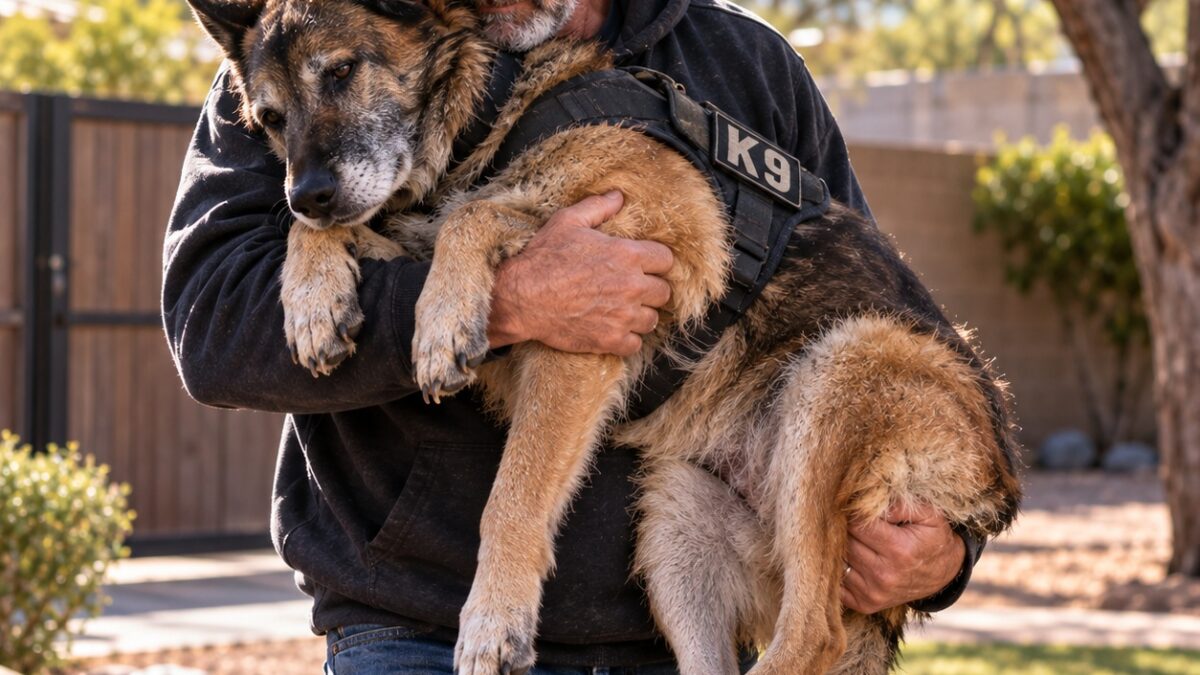
I slid one arm under his chest.
Another beneath his hindquarters.
Eighty-five pounds.
Even retired, even older, Duke was not small.
And I had a damaged shoulder.
A damaged back.
This was not the smartest arrangement.
Duke looked at me as I adjusted my grip.
“Don’t make this harder.”
His ears lifted.
“You’ve been making my life harder for twelve years.”
Tail moved once.
I stood.
Pain shot across my lower back immediately.
“Great.”
Duke’s body settled against my chest.
His head came near my shoulder.
For a moment, we stayed still.
I had carried him injured before.
That was different.
Urgency makes you stronger.
Fear makes pain irrelevant.
This was slow.
Deliberate.
A new routine being born.
I eased open the sliding door with my foot.
One step down.
Then another.
Our patio had two small steps before the lawn.
I had walked them thousands of times.
That morning, they felt like a tactical problem.
My footing.
Duke’s weight.
My back.
His hips.
“Easy.”
Mostly to myself.
We crossed the patio.
Then grass.
The mesquite stood twenty yards away.
Not far.
Twenty yards is nothing until you carry eighty-five pounds through it every morning.
Duke smelled outside air.
His head lifted.
That alone made it worth it.
“Yeah.”
We reached the tree.
I lowered him carefully.
Front legs first.
Then back.
Adjusted his hips so he was comfortable.
Duke sighed.
The sound went through me.
Sunlight filtered between mesquite branches.
Tucson mornings can be gentle before the heat arrives.
Dry air.
Cooler shade.
Birds moving along walls and roofs.
Duke lifted his nose.
He looked toward the fence.
Toward the alley beyond.
Listened.
The retired police dog came back for a few seconds.
Not physically.
In attention.
He surveyed.
I crouched.
Rubbed behind his left ear.
The scar.
That spot had always been his favorite.
“You can count on me, buddy.”
I do not remember planning the sentence.
I just said it.
Duke closed his eyes.
I left him there.
Went inside.
Made coffee.
Stood at the kitchen window watching.
He stayed beneath the tree.
No distress.
No struggle.
Just Duke.
Outside.
Where he wanted to be.
That afternoon, I carried him back in.
The next morning:
7:15.
Again.
Why 7:15?
No meaningful reason at first.
My body woke early.
I needed time to stretch my back.
Medication.
Coffee.
Feed Duke.
Let the sun rise enough to warm the grass.
7:15 simply became the point where all those things met.
Within two weeks, Duke knew.
At 7:10, he watched me differently.
At 7:13, head up.
At 7:15, I moved toward him.
He did not try standing as often after the first month.
That realization hurt.
But there was trust in his stillness too.
He knew I would come.
I slid my arms beneath him.
Lifted.
Door.
Steps.
Grass.
Tree.
Lower.
Left ear.
“You can count on me, buddy.”
Every day.
Some mornings my shoulder complained more.
Some mornings my back spasmed before we reached the grass.
I learned technique.
Kept Duke close to my center.
Breathed through the lift.
Installed a better grip mat at the sliding door.
Considered building a ramp.
Then realized the issue was not only stairs.
Duke could not reliably support his hips even on level ground.
I bought mobility harnesses.
Tried supports.
They helped for bathroom trips.
Short distances.
But for the morning journey, Duke seemed calmer in my arms.
So I carried him.
Eighty-five pounds.
People later asked why I did not use a cart.
Sometimes we did use support equipment.
Life with an arthritic dog is not one dramatic method.
It is adaptation.
But that morning ritual became ours.
A carry.
Not because technology was wrong.
Because it worked.
Because Duke relaxed.
Because I could still do it.
And because I needed it as much as he did.
That last part took me longer to admit.
Retirement had taken my uniform.
My patrol schedule.
The regular calls.
The feeling that someone depended on me professionally.
Duke’s declining mobility created dependence again.
Not the way I would have chosen.
But every morning, there was one thing I knew I could do.
Get my partner outside.
For a man who had spent three years wondering what usefulness looked like after injury, that mattered.
I was caring for him.
He was giving structure back to me.
Same as always.
Partnership does not become one-directional just because one partner gets old.
For the first several months, I thought no one noticed.
My backyard had privacy fencing along most of it, but one side opened visually enough that the neighboring kitchen window could see part of the patio and mesquite.
Elaine lived next door.
Sixty-seven.
Widowed.
Sharp.
The kind of neighbor who knew when your trash can had been left out too long but never complained about it.
She baked too much and used me as disposal.
I repaired her gate once.
That was our relationship.
Friendly.
Not close.
I had no idea she watched Duke and me every morning.
She never mentioned it.
Later she told me it began accidentally.
She was making coffee.
Looked through the window.
Saw me carrying Duke.
At first, she assumed he had just undergone surgery.
Then it happened the next day.
And the next.
Week after week.
She said she began noticing the time.
7:15.
Almost exact.
Sometimes 7:14.
Sometimes 7:16.
Never much different.
I carried Duke outside.
Under the mesquite.
Set him down.
Touched his ear.
Then went back in.
Elaine watched for ten months.
I find that strange even now.
We are often unaware when the most private routines of our lives become meaningful to someone else.
To me, carrying Duke was not beautiful.
It was necessary.
There were mornings when I cursed under my breath because my back hurt.
Mornings Duke had an accident inside first.
Mornings medication schedules went wrong.
Mornings I was tired.
One morning I nearly slipped on wet patio stone and said several things not fit for viral video.
Elaine saw none of that as failure.
She saw consistency.
I saw responsibility.
Maybe both were true.
In October, Duke was having a good morning.
Cool air.
Clear desert sky.
He had eaten breakfast.
His eyes were bright.
I lifted him at 7:15.
Did not know Elaine had picked up her phone.
I opened the sliding door.
Stepped down.
Duke’s head rested against my chest.
His front paws folded near me.
His back legs hung more than they used to.
That was one of the changes arthritis had brought.
The mesquite leaves moved slightly.
I crossed the lawn.
Elaine filmed from the kitchen.
Thirty-eight seconds.
That was all.
Thirty-eight seconds of something I had done hundreds of times.
I lowered Duke beneath the tree.
Adjusted him.
Crouched.
Rubbed behind his left ear.
I said the same thing.
“You can count on me, buddy.”
Elaine’s phone apparently picked it up faintly.
Then the video ended.
She posted it later that day.
I did not know.
I was not on social media much.
After years in police work, putting my private life online held very little appeal.
The next morning, I carried Duke out.
Same.
The day after.
Same.
Then my phone began behaving strangely.
Texts.
Calls.
Unknown numbers.
A former officer sent:
Dude are you viral?
I replied:
What disease?
He called laughing.
“Check your phone.”
“I am checking my phone.”
“No. Social media.”
“I don’t—”
“Your neighbor posted you carrying Duke.”
I went silent.
“What?”
“Millions of views.”
“What?”
“Like a lot.”
“How many?”
“Last I checked, eleven million.”
“That’s stupid.”
“It’s eleven million, Daniel.”
“People have too much time.”
By the third day after Elaine posted the clip, it had crossed fifteen million views.
Fifteen million.
I cannot picture that many people.
My police department had served a city, but numbers like that remain abstract.
What I could picture was Elaine standing on my porch looking terrified.
She knocked around noon.
I opened the door.
She held both hands together.
“I need to apologize.”
“For what?”
“The video.”
I stared at her.
“You did that?”
She winced.
“I should have asked.”
“Yes.”
“I know.”
I looked toward Duke.
He was asleep.
I looked back at Elaine.
“Why?”
She swallowed.
“Because it was beautiful.”
I almost laughed.
“No, it isn’t.”
“Yes, it is.”
“I’m carrying my dog outside.”
“Every morning.”
“So?”
“For ten months.”
I shrugged.
Elaine’s eyes filled.
“He carried you for years.”
That shut me up.
I looked away.
Elaine continued.
“I didn’t mean to invade anything.”
I believed her.
“And if you want me to delete it, I will.”
“It’s already everywhere?”
“Yes.”
“Then deleting yours isn’t doing much.”
“No.”
I sighed.
“Don’t film through my kitchen windows next.”
She laughed through tears.
“Deal.”
That should have been the end.
It wasn’t.
Seventy-two hours after the clip went online, a local reporter knocked on my door.
I almost didn’t answer.
I opened it enough to see a microphone.
Closed it.
The reporter called through the door:
“Mr. Reynolds?”
“No.”
Pause.
“We just wanted to ask about Duke.”
“No.”
Another pause.
Then:
“We can leave.”
“Good.”
I waited.
Footsteps.
Then looked through the side window.
The reporter genuinely left.
That should have satisfied me.
Instead, guilt arrived.
Not toward the reporter.
Toward Duke.
The story circulating online was becoming something without context.
People were calling him an elderly dog.
A disabled Malinois.
A viral pet.
Duke had not spent eight years working beside me to become “that dog from the video.”
So I called the station.
Asked whether they knew the reporter.
They did.
I called him.
“One interview.”
He agreed.
“No filming inside my house.”
Agreed.
“No dramatizing the shooting.”
He paused.
“Understood.”
“No asking me to cry.”
He laughed nervously.
“Okay.”
The interview happened on the back patio while Duke rested beneath the mesquite.
The reporter asked why I carried him outside every morning.
I had thought about the answer.
Still, what came out was simpler.
“When life was hardest, he got me through it.”
I looked toward Duke.
“I get to do that for him now.”
The reporter waited.
Probably expecting more.
There wasn’t more.
That was the truth.
After the 2020 shooting, Duke recovered faster emotionally than I did.
People praised me.
“You handled it well.”
No.
I returned to work.
That is not the same thing.
For months after Duke was shot, the sound of a gunshot in training sent something cold through me.
Every time Duke disappeared around a corner during a search, I saw blood.
The department offered support.
I used some.
Not enough.
Police officers are often excellent at helping strangers through crisis and terrible at admitting when crisis has remained inside them.
Duke did not ask.
He simply existed near me.
At home, he followed.
At work, he performed.
He made normal possible before I felt normal.
Then my own injuries ended my career.
Again Duke was there.
No uniform?
He did not care.
No badge?
Irrelevant.
Could not lift the way I used to?
He adjusted.
Could not run?
Duke had begun slowing too.
He did not mourn my retirement.
That helped me stop mourning it every minute.
So when his hips failed, the arrangement seemed clear.
He had carried parts of my life I could not carry alone.
Now I carried him.
Simple.
The internet tried making it symbolic.
Maybe it was.
I did not need it to be.
Attention changed almost nothing.
People mailed things.
Dog beds.
Supplements we had not requested.
Letters.
One child sent a drawing of me carrying Duke under a bright yellow sun.
Someone mailed a police K9 patch.
Another sent a letter saying she had started carrying her old Labrador into the yard after seeing the video.
That one stayed with me.
Not because carrying is always the answer.
Because she had noticed her dog still wanted outside.
Sometimes viral attention is mostly noise.
Sometimes one person uses it to care more carefully.
I kept that letter.
Most I stored away.
Duke did not know he had fifteen million views.
He did not know people called him brave.
He had spent his career without needing public approval.
Retirement did not change that.
7:15.
Lift.
Door.
Steps.
Grass.
Tree.
Ear.
“You can count on me, buddy.”
The routine continued.
Autumn cooled.
Then winter.
Tucson winter is not northern winter.
But mornings can bite.
I added a blanket beneath Duke on colder days.
Sometimes the sun took longer to reach his spot.
I adjusted.
If it was too cold, we waited.
The ritual served Duke.
Duke did not serve the ritual.
That distinction mattered.
His health declined slowly.
Then faster.
Arthritis progressed.
Muscle loss increased because reduced mobility always has consequences.
He needed more help shifting position.
More help getting outside for bathroom breaks.
More pain-management discussions with the veterinarian.
We monitored appetite.
Interest.
Sleep.
Comfort.
I knew the quality-of-life conversation was coming.
Knowing does not make it easier.
The veterinarian asked questions I already asked myself.
Does he still eat?
Yes.
Engage?
Yes.
Enjoy being outside?
Absolutely.
Any uncontrolled pain?
Not with the medication plan at that stage.
Good days versus difficult days?
More good.
For now.
Those two words became our territory.
For now.
A working dog teaches you to respond to what is actually happening, not what fear predicts.
I tried applying that.
Today Duke ate.
Today he enjoyed the tree.
Today he leaned into my hand.
Today mattered.
Tomorrow could come tomorrow.
By January, the carry felt heavier even though Duke had lost weight.
Because I knew the number of carries left was shrinking.
We never know the last times while they happen.
Last full-speed pursuit.
Last shift.
Last time he jumped into a patrol vehicle.
Last time he climbed the porch step without help.
Then eventually:
Last morning.
I began noticing everything.
The warmth of his chest against mine.
How his muzzle had grayed.
The old scar behind the ear.
The weight distribution as I lowered him.
His smell.
His breathing.
I wanted to memorize him before memory was the only place left.
That instinct is useless.
No one can consciously store a living being whole.
After they are gone, the strangest details survive.
A nail click.
A sneeze.
A particular look.
The way fur feels behind one ear.
Not the things you choose.
I told Duke more things during those months.
Working years.
Calls.
People.
My failures.
The shooting.
Retirement.
“Remember when you ruined the back seat?”
Duke breathed.
“I blamed the rookie.”
Tail movement.
“You owe him.”
Nothing.
“Still no remorse.”
The tree heard everything.
If mesquites could testify, mine would have enough material to end several police careers.
Elaine sometimes watched.
After the video, she stopped filming.
Good.
Sometimes she waved from her window.
I waved back.
One morning she came over with coffee after I lowered Duke.
She stood several feet away.
“Can I sit?”
I looked at Duke.
“Ask him.”
She laughed.
Sat in a patio chair.
Duke barely opened one eye.
Elaine said:
“Famous people are rude.”
“He was rude before fame.”
We sat quietly.
Then she asked:
“Are you okay?”
I hated that question.
Not because she meant badly.
Because the truthful answer was becoming complicated.
“Yeah.”
She knew I was lying.
Older women have that skill.
She did not press.
Instead:
“He looks peaceful out here.”
I looked at Duke.
“Yes.”
That was everything.
Peaceful.
Old age in animals becomes a negotiation between time and comfort.
You cannot win against time.
You can protect comfort for as long as possible.
That became my job.
Not to defeat arthritis.
Not to force Duke to stay.
To notice.
The same attention he had given me for eight working years, I owed him now.
Dogs communicate constantly.
People fail to listen because we want language.
Duke told me in appetite.
Eyes.
Breathing.
Willingness to engage.
How he settled.
How he looked at me.
The final week was different.
Subtle at first.
He ate more slowly.
Slept deeper.
The tree still interested him, but less intensely.
His head rested sooner.
He seemed tired.
Not the tired of exercise.
The tired of a body approaching its limit.
The veterinarian examined him.
We talked.
No emergency.
No dramatic crisis requiring immediate euthanasia that day.
But we both understood the horizon had moved close.
“I don’t want him to suffer.”
“I know.”
“I don’t want to wait too long.”
“I know.”
“I don’t want to do it too early.”
The veterinarian sat beside me.
“That’s the impossible part.”
“What would you do?”
She looked at Duke.
“I’d watch him.”
“I am.”
“I know.”
Her voice softened.
“You know him better than anyone.”
That felt less reassuring than she intended.
Responsibility often does.
I drove home.
Duke lay in the back.
At a stoplight, I looked in the mirror.
His eyes met mine.
I said:
“Don’t make me decide.”
His ears moved.
“Coward.”
I was talking to myself.
That evening, Duke ate half his dinner.
Then finished the rest an hour later.
Good.
He drank.
Good.
Slept.
At 7:15 the next morning, I carried him outside.
His head rested more heavily against me.
We reached the tree.
Sunlight filtered down.
I rubbed his ear.
“You can count on me, buddy.”
His tail moved once.
That became precious.
The next few days followed.
Then February gave us one completely still morning.
No wind.
No clouds.
The sort of desert morning where sound seems farther away than usual.
I woke before the alarm.
5:40.
Duke was sleeping.
I watched him from the doorway.
His breathing looked steady.
I made coffee.
Took medication.
Stretched my back.
Fed him.
He ate a little.
Not much.
I sat beside him.
“You want outside?”
The word outside still produced a response.
Eyes.
Small head lift.
That answered me.
7:15.
I moved into position.
Duke did not attempt to rise.
I slid my arms beneath him.
Lighter than he had been.
That hurt more than weight.
I lifted.
His head settled against my chest.
We went through the sliding door.
Down the steps.
Across the lawn.
I took my time.
No rush.
When we reached the mesquite, the sun was already entering through the branches.
I lowered Duke onto the blanket.
His body relaxed immediately.
I adjusted his hips.
He sighed.
Rubbed behind the left ear.
Scar.
Fur.
Warmth.
“You can count on me, buddy.”
Duke’s eyes opened.
He looked at me.
There are moments we later convince ourselves contained messages.
Goodbye.
Thank you.
I love you.
Maybe.
Maybe not.
Duke looked at me.
That is all I know.
I sat down.
Usually I went inside after settling him.
That morning, I stayed.
No reason I could explain.
Maybe the stillness.
Maybe his breathing.
Maybe sixteen years in law enforcement had taught me to notice when ordinary patterns shifted.
I leaned against the tree.
Duke rested beside me.
One hand on his coat.
The neighborhood woke.
Garage door.
Distant vehicle.
Birds.
Elaine’s blinds moved.
I looked toward her window.
She did not wave.
Good.
This was not a moment for phones.
Duke’s eyes closed.
He looked comfortable.
I felt his breathing beneath my hand.
Slow.
Steady.
Longer pauses.
I knew.
Not suddenly.
Knowing arrived gradually, like sunrise.
“Okay.”
My voice broke.
Duke’s ear shifted.
“You’re okay.”
I kept my hand on him.
Memories came violently.
Not in order.
Training yard.
First day.
Duke younger.
Teeth around a sleeve.
Vehicle.
Drug searches.
A rooftop.
Hospital floor after the shooting.
Adoption paperwork in the parking lot.
Backyard.
Every morning.
I bent closer.
“You did enough.”
The sentence sounded familiar.
Maybe because I had been waiting years to say it.
“You did more than enough.”
Duke breathed.
I rubbed the scar.
“You don’t have to carry anything else.”
One more breath.
Then another.
Long pause.
Another.
I put my face close to his head.
“I’ve got you.”
That was all.
No speeches.
No promise that sounded bigger than reality.
I’ve got you.
Duke exhaled.
His body softened.
Then the next breath did not come.
I waited.
Hand on his ribs.
Nothing.
I knew death.
Police work gives you more experience with it than anyone needs.
That knowledge did not prepare me.
Because this was Duke.
I pressed my palm against him.
Still.
Warm.
Gone.
I do not know how long I sat before I cried.
Maybe immediately.
Maybe minutes.
Time stopped meaning much.
I had spent years controlling emotion in public.
Scenes.
Hospitals.
Families.
Court.
You learn where to place your face so other people can survive their worst day without worrying about your reaction.
There was nobody there except Duke.
So I let it happen.
Bent over him.
Hand on his coat.
I cried until my back hurt.
Then continued.
Elaine later told me she saw us from the window and knew something was wrong because I never went inside.
She did not come over.
I will always love her for that.
She turned away from the window.
Gave us privacy.
The same woman who had unknowingly shared our routine with millions understood when the final version belonged to two.
Sun moved higher.
Duke’s fur warmed beneath my palm.
It seemed impossible.
A body warm in sunlight can fool some primitive part of the mind.
Sleeping.
He is sleeping.
Call his name.
He will lift his head.
I said it once.
“Duke.”
Nothing.
I rubbed his ear.
No response.
That silence was different from every silence we had shared before.
I knew.
Still, I waited.
There was no hurry.
That had always been the gift of the mesquite tree.
No tasks.
No calls.
No next thing.
Duke could simply be.
So I let him remain there.
His final moments had not come on a hard floor inside.
Not alone.
Not in a sterile room away from the place he knew.
He had been under his tree.
Warm.
Outside.
My hand on him.
That thought mattered.
Not because death becomes beautiful when we arrange the scenery.
Death hurts.
But comfort matters until the final second.
Duke had comfort.
Eventually, I stood.
My body protested.
Back stiff from sitting on the ground.
Shoulder aching.
I looked down.
The last carry.
That realization nearly put me back on the grass.
For ten months, lifting Duke had meant continuation.
We’re going outside.
We’re coming in.
Another morning.
Another afternoon.
Now I had to lift him with no return trip attached.
I whispered:
“No.”
Not to anyone.
The situation.
The universe.
Whatever.
I wanted someone else to come.
Not because I could not physically lift him.
Because I did not want the final image to belong to carrying Duke after he was gone.
Then I remembered the truck ten months earlier.
My promise.
I did not want lifting him to belong only to beginning and ending.
It hadn’t.
Hundreds of carries stood between.
Morning after morning.
The final one could not erase them.
I slid my arms beneath him.
Same position.
Chest.
Hindquarters.
His body felt different.
Heavier and lighter simultaneously.
No tension.
No participation.
I closed my eyes.
“Come on, partner.”
I lifted.
Pain moved across my back.
I welcomed it.
Something physical to focus on.
His head rested against my arm.
We crossed the grass.
Twenty yards.
The longest twenty yards of my life.
Up the patio.
Steps.
Sliding door.
Inside.
I carried Duke to the place where his bed waited.
Lowered him.
Then sat beside him on the floor.
The house was silent.
No patrol.
No radio.
No nails.
No breathing.
I put my hand on his shoulder.
“You got me through it.”
I laughed once through tears.
“Every damn time.”
Losing Duke felt different from losing a pet.
That does not mean deeper.
People love their animals in ways nobody else gets to rank.
But our history carried professional weight too.
I had trusted Duke with my physical safety.
He had trusted me with his.
We had entered places together where both of us could have died.
Then we had entered retirement together.
That arc made grief complicated.
I had not only lost my dog.
I had lost the last living partner connected directly to the version of myself that wore a badge every day.
Duke carried my working years inside him.
When he died, part of that world closed.
The department contacted me.
Former partners.
Handlers.
Chief.
People offered memorials.
Ceremony.
I said yes to some things.
No to others.
Duke deserved recognition.
But I did not want my private grief turned into a production.
The viral video resurfaced.
Of course.
Millions watched again.
Now with captions about Duke’s death.
People I would never meet cried for him.
Sent messages.
I read more than I expected.
Most kind.
Some people shared photographs of their own old dogs.
Working dogs.
Farm dogs.
Family pets.
They understood the part that mattered.
Eventually every strong animal becomes fragile if we are lucky enough to have them long enough.
That is the bargain.
We spend their younger years depending on them.
Then one day, if life is kind, they depend on us.
The roles reverse so gradually you hardly notice until you are carrying them.
A woman wrote:
My shepherd can’t get up the porch anymore. After watching you and Duke, I stopped being sad every time I lifted her. Now I think of it as helping her stay in the life she still wants.
I printed that message.
It said everything the original video could not.
Care should not feel like evidence of failure.
Lifting an old dog is not necessarily a tragedy.
It can be access.
Participation.
Love made practical.
Duke had taught people that without trying.
He had taught me first.
The day after he died, I woke at 5:40.
Automatic.
Made coffee.
Automatic.
Stretched.
Took medication.
Automatic.
Fed no dog.
That was the first break.
I stood in the kitchen holding a bowl I had taken from the cabinet out of habit.
Duke’s bowl.
I put it down.
At 7:10, I found myself watching the clock.
That angered me.
I went outside early.
Then came back in.
7:15 arrived.
I could not stay inside.
So I opened the sliding door.
Walked down the steps.
Crossed the lawn.
No eighty-five pounds in my arms.
My body did not know what to do with the lightness.
The mesquite stood where it always had.
I stopped beneath it.
The blanket had been removed.
Grass still pressed where Duke had lain.
I put one hand against the trunk.
And stood.
No speech.
No dramatic goodbye.
I stood until 7:30.
Then went inside.
Next morning, same.
7:15.
Tree.
Pause.
For weeks.
People found out eventually.
Elaine noticed.
Of course.
One morning she met me at the fence afterward.
“You still go out.”
“Yes.”
“Does it help?”
“No.”
She nodded.
That answer did not surprise her.
Then:
“Do you want it to?”
I thought.
“Maybe later.”
She smiled sadly.
“Fair.”
Grief rituals do not always soothe at first.
Sometimes they simply give pain a place to arrive.
7:15 became that place.
Inside the house, grief was everywhere.
Empty bed.
Unused bowls.
Hair stuck beneath furniture.
Leash.
Old harness.
Medications.
Outside under the mesquite, grief became specific.
Here.
This time.
This tree.
Stand.
Remember.
Then leave.
Structure had saved me after retirement.
It saved me again after Duke.
Eventually the pain changed.
Not smaller exactly.
Less sharp.
I could stand beneath the tree and remember things besides the final morning.
Duke younger.
Rolling in grass.
Watching birds.
Pretending not to notice squirrels because police dogs are above such nonsense.
One morning I laughed.
First time.
I remembered him trying to catch a lizard and falling into a bush during his first retirement summer.
He emerged looking deeply offended.
I had laughed then too.
Memory widened.
Death stopped occupying every inch.
That is what healing did.
It did not move Duke farther away.
It let more of him return.
People still contacted me because of the video.
Some wanted interviews.
I mostly declined.
One reporter asked:
“What do you hope people learned?”
I almost said nothing.
I was tired of lessons.
Not every private act needs to become a moral.
Then I thought about the messages from people caring for old animals.
So I answered:
“Pay attention to what they still enjoy.”
The reporter waited.
“That’s it?”
“Yes.”
Because that was the core.
Duke could no longer stand on his own.
Some people might have looked at that and seen only loss.
But he still enjoyed outside.
Sun.
Grass.
The tree.
Smells.
My hand near his ear.
Quality of life is made of specific things.
When one ability disappears, we can become so focused on what is gone that we stop noticing what remains.
Duke taught me to look at what remained.
And help him reach it.
There were difficult conversations near the end.
I will not romanticize that.
Caring for an elderly dog is not always peaceful.
Pain management.
Accidents.
Sleep disruption.
Watching muscles disappear.
Wondering daily whether you are selfishly holding on.
Anyone who has loved an old dog knows that fear.
Am I asking for one more day because he wants it?
Or because I do?
There is no perfect formula.
We watched.
We adjusted.
We listened to the veterinarian.
We listened to Duke.
And in the end, Duke made the final decision in the gentlest way possible.
He went to sleep in the place he loved.
I stayed.
That was all he needed from me at the end.
Presence.
The same thing he had given me thousands of times.
Months after Duke died, I found his old adoption papers.
Parking lot signature.
My handwriting hurried.
I remembered the day.
I had retired unwillingly.
My shoulder hurt.
Back worse.
I felt stripped of identity.
Then somebody handed me a clipboard.
Ownership transfer.
Handler adoption.
I signed so fast the pen tore the paper slightly.
Duke was mine legally.
As though eight years of partnership had not already settled that.
I smiled at the memory.
On the bottom of one page was a note about retirement care responsibilities.
Veterinary care.
Housing.
Liability.
All important.
None mentioned the tree.
None said:
One day he may not be able to rise.
You will carry him.
You will learn the exact weight of love in your damaged shoulder.
You will measure mornings by twenty yards of grass.
A neighbor will film you.
Millions will watch.
None said:
Eventually he will die beneath a mesquite while you keep your hand on him.
Contracts never include the real terms.
The real contract had been simpler.
You can count on me.
That sentence had existed between us long before I spoke it every morning.
When Duke searched a building:
You can count on me.
When I released him:
I count on you.
When he was shot:
Stay with me.
When I retired:
Come home.
When his hips failed:
I’ll carry you.
When he died:
I’ve got you.
Partnership compressed into four words.
You can count on me.
I understand now why Elaine’s video struck people.
It was not the physical strength.
An injured retired cop carrying an eighty-five-pound dog is visually emotional, sure.
But fifteen million people were not watching a feat of strength.
They were seeing a promise kept after usefulness ended.
That matters in a world obsessed with performance.
Duke had worked.
Protected.
Found drugs.
Caught suspects.
Took a bullet.
If his value had been based only on what he could do, retirement would have made him less valuable.
Old age would have made him nearly worthless.
Instead, the opposite happened.
The less Duke could do, the more clearly I understood that nothing he had ever done was the reason I loved him.
Those things were part of our history.
Not his price.
He did not have to earn the tree.
He did not have to earn my back pain.
He did not have to earn one more morning.
Care after usefulness is one of the purest forms of loyalty I know.
Police culture talks a lot about loyalty.
Partners.
Brotherhood.
Never leave someone behind.
Duke taught me that loyalty is easiest to admire when both partners are strong.
The real test comes when one can no longer contribute equally.
When the dog cannot run.
When the officer cannot serve.
When the body becomes inconvenient.
Who stays then?
We did.
For each other.
First Duke stayed through my retirement.
Then I stayed through his decline.
That was the balance.
People told me:
“You gave Duke a beautiful retirement.”
Maybe.
He gave me one too.
I had imagined retirement as loss.
Duke turned it into routine.
Walks.
Backyard.
Vet appointments.
Coffee beside his bed.
Morning carries.
He kept me responsible to something beyond my pain.
That gift does not look impressive on a résumé.
It saved me anyway.
One morning, about six months after Duke died, I went out at 7:15 and found Elaine standing by the mesquite.
I stopped.
“What are you doing?”
She held two coffees.
“I brought one.”
“This is trespassing.”
“You left the gate open.”
“Still.”
She handed me the cup.
We stood beneath the tree.
She said:
“I never asked you something.”
“What?”
“Did you hate me for posting the video?”
I considered lying.
“A little.”
She laughed.
“Fair.”
“At first.”
“And later?”
I looked at the tree.
“I don’t know.”
“You read the messages?”
“Some.”
“People loved him.”
“They didn’t know him.”
“No.”
She sipped coffee.
“But maybe they recognized something.”
That was probably right.
Most viewers never knew Duke.
They knew their own aging parent.
Old dog.
Sick spouse.
Friend.
Partner.
The act of carrying translated.
Everyone eventually carries someone.
Or needs carrying.
Maybe that was why thirty-eight seconds mattered.
Elaine said:
“I almost didn’t post it.”
“Probably should’ve asked first.”
“I know.”
I smiled.
“I’m glad you did.”
She looked surprised.
“Don’t make me say it twice.”
We drank coffee.
At 7:30, she went home.
I stayed another minute.
Then left.
The yard changed over time.
Grass filled back in where Duke had rested.
Mesquite shed leaves.
Seasons moved.
One day I realized the indentation beneath the tree was gone.
That hurt.
Physical evidence disappears.
Hair gets vacuumed.
Scratches fade.
Beds are donated.
Bowls put away.
The world does not preserve grief for us.
Memory has to carry more.
I kept Duke’s collar.
His badge.
A photograph from our working years.
One picture from retirement.
No shrine.
Duke would have hated clutter.
Or eaten it.
The 7:15 ritual remained longest.
Eventually not every day.
That surprised me.
One morning I slept until 7:22.
Woke in panic.
Sat up.
Clock.
7:22.
For months, missing the time would have felt like betrayal.
Instead, I sat there.
Listened.
House quiet.
Then smiled.
Maybe grief had loosened another grip.
I still went outside.
7:30.
Tree still there.
Duke was not keeping score.
That realization mattered.
Ritual had served me.
I did not have to become its prisoner.
Some mornings I went at 7:15.
Some later.
Some not at all.
Love remained.
Time changed.
That is healthier than freezing.
I began volunteering occasionally with retired K9 support groups.
Nothing dramatic.
Talking with handlers facing retirement transitions.
Sometimes older dogs.
Sometimes officers being forced out by injuries.
I did not become inspirational.
Still hate speeches.
Mostly I said:
“The dog will adapt faster than you.”
Usually true.
And:
“Plan for the physical aging early.”
Ramps.
Non-slip flooring.
Weight control.
Veterinary care.
Mobility tools.
Practical things.
One handler asked:
“How do you know when it’s time?”
I hated the question because I knew why he asked.
His retired shepherd was declining.
I did not offer certainty.
I said:
“Watch what he still wants.”
He looked at me.
“And when he stops wanting it?”
I swallowed.
“Then you listen.”
The hardest kindness is attention.
Not optimism.
Not refusing death.
Attention.
Duke taught me that too.
Years of police work had trained me to notice threats.
Duke’s old age trained me to notice comfort.
That skill may have been harder.
One warm morning, long after the viral attention disappeared, I sat under the mesquite alone.
Sunlight came through the branches.
Exactly the way it had on Duke’s final day.
I put my hand on the grass.
No reason.
Just contact.
The old scar behind his ear appeared in memory so vividly I could feel it beneath my thumb.
That is the strange cruelty and mercy of grief.
The body is gone.
Touch sometimes remains in the nervous system.
I closed my eyes.
“Good boy.”
First time I had said it aloud in months.
Wind moved leaves.
No answer.
None needed.
I used to think partnership ended when the work ended.
Then I thought it ended when Duke died.
Now I think certain partnerships simply stop requiring physical presence.
He changed how I live.
How I understand duty.
Aging.
Worth.
Loyalty.
That continues.
I still catch myself choosing the slower route because my back hurts.
Then remember Duke.
No shame.
Adapt.
I ask for help more easily.
That would amuse everyone who knew me before.
Duke accepted help without embarrassment.
Why couldn’t I?
He never apologized for needing to be carried.
Never looked humiliated.
He simply trusted.
That may have been his final professional lesson.
Trust is not only letting someone follow you into danger.
Sometimes trust is letting them hold your full weight.
Working years taught us the first version.
Retirement taught us the second.
I value the second more now.
People occasionally recognize me.
Not often.
A man at a hardware store once stared.
Then said:
“You’re the dog guy.”
Worst possible description.
I replied:
“Which dog?”
“The one you carried.”
“Duke.”
“Yes.”
He nodded.
“My Lab’s fourteen.”
I immediately understood.
“How’s he doing?”
“Can’t do stairs.”
“Build a ramp.”
“Already did.”
“Good.”
He hesitated.
“That video helped.”
I nodded.
That was enough.
No selfies.
No inspirational quote.
Two men talking about old dogs and ramps.
Exactly how Duke would have wanted fame to be used.
Another woman stopped me outside a grocery store.
Told me she watched the clip while caring for her father after a stroke.
She said:
“I don’t know why, but seeing you carry Duke made me stop being angry that Dad needed help.”
I did not know what to say.
She continued:
“I realized needing help wasn’t him failing.”
There it was again.
The thing Duke kept teaching strangers.
Dependence is not failure.
A body weakening is not a moral event.
Care is not pity.
I thanked her.
Then sat in my truck afterward longer than necessary.
Same way I had after that veterinary appointment years earlier.
Life has symmetry sometimes.
Not perfect.
Enough.
I thought about that original decision.
I couldn’t bear the thought that lifting Duke would belong only to the beginning and end.
I had wanted carrying him to be life.
Access.
Ten months.
Hundreds of mornings.
It became exactly that.
By the time the final carry came, it did not define the act.
The act already meant:
We’re going where you want to go.
The last time, where Duke needed to go was inside after death.
I hated it.
But I carried him.
Same arms.
Same promise.
You can count on me.
That is what people saw without knowing.
Thirty-eight seconds.
Daniel carrying Duke.
Daniel lowering Duke.
Daniel rubbing the ear.
They did not see the eight working years.
The shooting.
Retirement.
Arthritis.
Vet appointment.
Truck.
Back pain.
Afternoons.
Accidents.
Medication.
The last morning.
They saw only a sliver.
Sometimes a sliver is enough.
Elaine once asked if I wished the clip had been longer.
“No.”
“Why?”
“Because that was the whole thing.”
Carry him out.
Set him down.
Stay reliable.
You do not need ten minutes to explain loyalty if someone is actually watching.
Thirty-eight seconds did it.
Duke never cared.
That may be the best part.
Fame could not improve his morning.
Neither could it ruin it.
Tree.
Sun.
Grass.
Me.
That was his wealth.
I think about that when I catch myself complicating life.
Working years trained me to chase outcomes.
Arrests.
Seizures.
Cases.
Retirement forced stillness.
Duke mastered stillness first.
Under the tree, he never needed the day to produce anything.
Warmth was enough.
Presence enough.
I learned late.
But I learned.
If I could return to one morning with him, I would not choose the shooting and change it.
Of course I wish it had never happened.
But I would not revisit danger.
I would not choose some dramatic successful operation.
Not even his final morning.
I would choose an ordinary one from the middle.
Maybe month five.
October.
Before I knew Elaine was watching.
Before millions knew Duke’s name.
I would lift him at 7:15.
Complain about my shoulder.
Duke would ignore me.
Cross the lawn.
Set him beneath the mesquite.
Rub the scar.
“You can count on me, buddy.”
Then I would sit for a few extra minutes.
Nothing would happen.
That is exactly why I would choose it.
We spend too much of life valuing moments because they are firsts or lasts.
The middle is where love actually lives.
Repeated.
Unremarkable.
Unseen.
Ten months of middle.
That is what I miss.
People still ask whether Duke knew what I was doing for him.
I do not know.
Dogs do not conceptualize sacrifice like humans.
Duke knew pattern.
My arms.
The door.
The tree.
The sun.
He knew when 7:15 came, I arrived.
Maybe that is enough.
Dependability is a language animals understand better than promises.
Show up.
Again.
Again.
Again.
Duke had done it for me.
Every shift.
Every call.
Every injury.
Every bad night.
He showed up.
I learned the language from him.
In February, when he fell asleep beneath the tree, I think something in me wanted the ritual to keep him alive.
That is the trap love sets.
We confuse care with control.
If I do everything right, maybe nothing will end.
Not true.
I carried Duke outside.
Managed pain.
Visited veterinarians.
Stayed.
Still, he died.
Love cannot stop mortality.
It can change the conditions around it.
That is enough.
Duke did not die wondering where I was.
He did not die abandoned by usefulness.
He did not die isolated from the life he enjoyed because mobility had failed.
He died beneath the mesquite.
Warm.
My hand on him.
The same hand that had held a leash.
Pressed against a wound.
Signed adoption papers.
Lifted him every morning.
That continuity comforts me.
My responsibility had changed form over the years.
It never disappeared.
Trainer.
Handler.
Partner.
Owner.
Caregiver.
Witness.
Then survivor.
That last role is the one nobody wants.
The person left remembering.
I am better at it now.
Not good.
Better.
At first, every memory ended at his death.
Now most continue backward.
I see the young Malinois.
Focused.
Impossible.
I hear a trainer yelling because Duke ignored a command he believed was beneath him.
I remember drug searches.
Fence jumps.
The weight of him landing against me in training.
The way he looked in the rearview mirror.
I remember the day he came home from the hospital after being shot.
He moved carefully.
I slept on the floor beside him.
He recovered.
We returned to work.
I remember retirement paperwork.
Parking lot.
Signing.
I remember his first morning beneath the mesquite.
The internet does not own Duke’s story.
The viral clip is one sentence.
I have the book.
That is enough.
One afternoon, Elaine invited me over for coffee.
Her kitchen window faced the yard.
I had never stood at the exact spot where she filmed.
She pointed.
“Here.”
I looked through the glass.
My yard.
Patio.
Mesquite.
The path I had carried Duke.
From her perspective, it looked different.
Longer somehow.
I pictured myself crossing it.
Duke against my chest.
Elaine said:
“You always looked like it hurt.”
“It did.”
“You never stopped.”
“No.”
“Why didn’t you ask someone to help?”
That was a fair question.
I thought about it.
“Because I could still do it.”
“Stubborn.”
“Yes.”
Then:
“And because it was ours.”
She nodded.
Understood.
Some care tasks become intimacy.
Feeding.
Lifting.
Bathing.
Medication.
Outsiders see labor.
The people inside the relationship feel connection.
The weight mattered.
Duke trusting himself into my arms mattered.
I did not want to outsource all of it while I could physically continue.
Had I become unable?
I would have asked.
Eventually.
Probably later than sensible.
But care is not only efficiency.
It is relationship.
Elaine asked:
“Do you wish I hadn’t watched?”
“No.”
That surprised me too.
Then I looked out the window.
“I’m glad somebody saw him.”
Not me.
Him.
Duke at the end of a life defined by service, still deserving attention when all he could do was lie beneath a tree.
The video had unintentionally documented that.
A working dog’s life after the medals, demonstrations, arrests, applause.
Old.
Arthritic.
Dependent.
Still loved.
That part needs seeing too.
We celebrate service animals while they perform.
We owe them when they stop.
Not because they earned basic care through work.
Because commitment does not expire at retirement.
I had signed the paperwork.
But the real obligation existed long before ink.
If you ask an animal to enter danger for you, you should be prepared to enter old age with them.
That is how I see it.
Not everyone will carry eighty-five pounds.
Bodies differ.
Resources differ.
Use carts.
Ramps.
Harnesses.
Veterinary support.
Ask family.
Ask friends.
The point is not copying the method.
The point is protecting access to what still gives the animal life.
For Duke, it was the mesquite.
For another dog, maybe porch.
Car ride.
Favorite room.
Short walk.
Window.
Food.
Company.
Pay attention.
People ask what I would tell someone caring for an old working dog.
I say:
Stop comparing him to the dog he was.
Look at the dog he is today.
That was hard for me.
I kept seeing Duke at three.
Five.
Eight.
Jumping.
Running.
Powerful.
Then looking at Duke unable to rise felt like loss in every frame.
Eventually, I learned to see current Duke.
Old.
Gray.
Slow.
Still interested.
Still himself.
That shift made caregiving gentler.
I stopped treating every limitation like an insult to his past.
A heroic working dog is allowed to become an old dog.
He does not owe us strength forever.
Neither do people.
I needed that lesson personally.
My retirement injuries had made me compare myself to who I was at thirty.
Bad idea.
I could not win.
Duke did not compare me.
Why was I?
He accepted my slower body.
I learned to accept his.
Partnership again.
Years after the video, people will probably remember only:
Man carries police dog every morning.
Good.
But I hope someone remembers the reason.
Not heroism.
Not internet fame.
Reciprocity.
“When life was hardest, he got me through it. I get to do that for him now.”
I said it once.
People quoted it everywhere.
For a while I became tired of hearing my own sentence.
Then Duke died.
Now I understand why it stayed.
It was the whole relationship.
Get each other through.
No guarantee of equal timing.
Sometimes one carries more.
Then roles switch.
Keep going.
I still walk into the yard some mornings.
I do not check the clock as much.
Old habit brings me.
The mesquite is larger now.
Or maybe I notice it differently.
I stand beneath it.
Sometimes place my hand where Duke used to lie.
Not because I think he is there.
I am not confusing memory with presence.
I go because places hold versions of us.
Under that tree, I was caregiver.
Duke was old dog.
We were still partners.
That version deserves visiting occasionally.
Then I go inside.
Life continues.
I have coffee.
Appointments.
People.
Work of a different kind.
Duke remains part of it without controlling it.
That is what grief eventually becomes when it goes well.
Integration.
Not disappearance.
The last thing I want is for Duke’s story to become a sad story.
His death was sad.
His arthritis was sad.
But his life?
No.
It was full.
Work.
Purpose.
Speed.
Food.
Bad behavior.
Success.
Pain.
Recovery.
Retirement.
Sun.
An absurd amount of stubbornness.
If I reduce him to the old dog I carried, I do him a disservice.
That image matters because of everything underneath it.
The eighty-five pounds in my arms had once launched through doors.
Jumped fences.
Chased danger.
Taken a bullet.
Then age asked him to surrender mobility.
He did not surrender dignity.
That was our job to protect.
The final morning, dignity looked like rest.
I did not ask him to stand.
Did not ask him to fight.
Did not say:
One more day for me.
I said:
You did enough.
That was the hardest command I ever gave.
And the only one I hope he ignored until he was ready.
Duke fell asleep.
Sun on his coat.
My hand resting where he could feel it.
No crowd.
No cameras.
No fifteen million viewers.
Just us.
The way important things usually happen.
Then I carried him inside.
That was the last time.
But when memory brings back the weight now, it does not begin with death.
It begins at 7:15.
Sliding door.
Patio step.
Twenty yards.
Mesquite.
Warm grass.
Duke’s head against my chest.
Back aching.
Shoulder complaining.
His old scar beneath my fingers.
“You can count on me, buddy.”
And every morning, without words, Duke had already answered the same thing.
I know.
That was why he let me carry him.
That was why I kept doing it.
Not because millions of people were watching.
Because for ten months, I believed no one was.
And it still mattered exactly the same.







