PART2:A Man Drove a Knife Into My German Shepherd’s Skull—The X-Ray Showed Why the Vet Couldn’t Believe He Was Still Alive
PART2
Waiting is different when the person—or dog—you love is behind a closed door.
During the attack, I had something to do.
Follow him.
Support him.
Get him into the car.
Tell my friend where to drive.
Keep Duke conscious.
Do not touch the knife.
Move.
Action gives fear somewhere to go.
The waiting room gave it nowhere.
I sat.
Stood.
Sat again.
Walked three steps.
Turned.
Looked toward the treatment doors.
Nobody came out.
I checked the time without registering it.
I remember seeing blood on my hands.
Duke’s blood.
It had dried into the lines of my skin.
I stared at it.
A staff member came over.
“Would you like to wash your hands?”
I looked at her.
I had forgotten she was there.
“No.”
She seemed surprised.
I did not want it gone.
That probably makes no sense.
But at that moment, washing Duke’s blood away felt like admitting he might not come back.
So I sat with it.
My friend sat beside me.
Neither of us knew what to say.
Eventually, a veterinarian came through the doors.
Dr. Zheneta Stoynova.
Her face was serious.
“Gino?”
I stood.
“How is he?”
“We’re still assessing him.”
“Is he alive?”
“Yes.”
That word almost dropped me.
Alive.
Still alive.
She continued.
“The knife is deeply embedded. We need X-rays before we attempt removal.”
I nodded too quickly.
“Do whatever you need.”
“We will.”
“Will he make it?”
She paused.
I hated that pause.
“We need to see exactly where the blade is.”
I looked toward the treatment area.
“His brain?”
“That is what we need to evaluate.”
There are questions you ask even when the answer could destroy you.
“Could it be in his brain?”
“Yes.”
She did not lie.
I appreciated that later.
At the time, honesty felt cruel.
Dr. Stoynova went back inside.
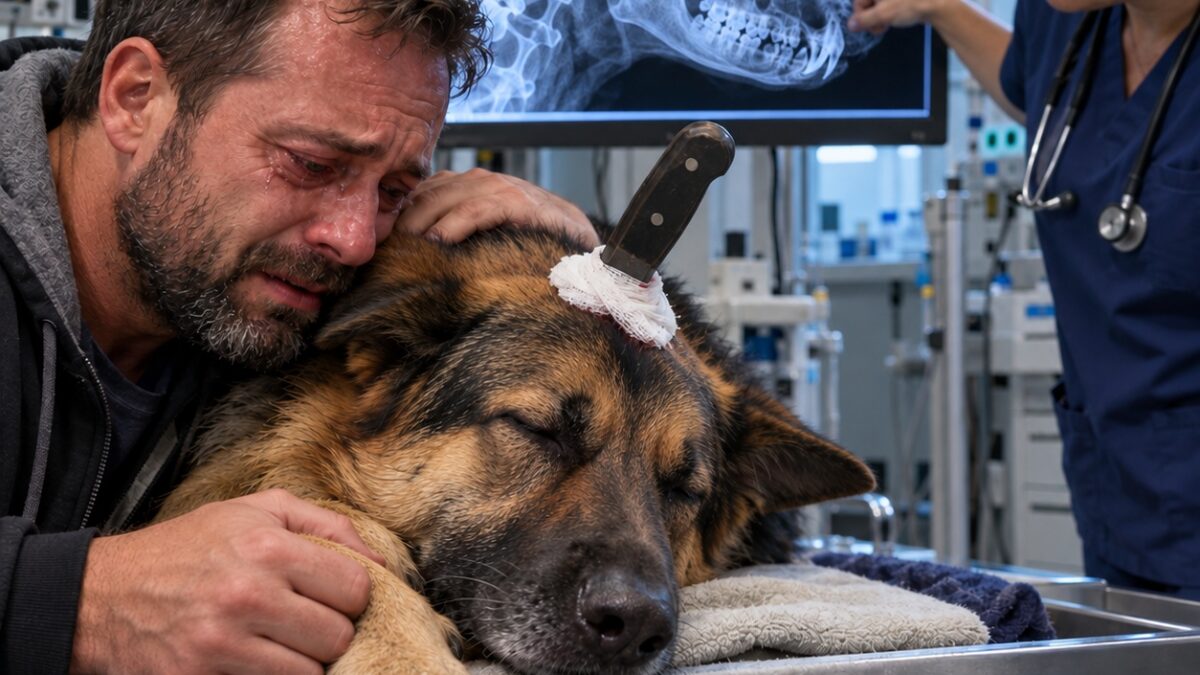
The X-rays were taken with the knife still in place.
That image has never left me either.
A dog’s skull.
Bone.
Eye socket.
And this long foreign object where no object should ever be.
When they finally called me in to explain what they found, I prepared myself for the worst.
Dr. Stoynova brought up the image.
She pointed at the blade.
“This is unusual.”
My eyes locked onto the screen.
“What?”
“The knife bent.”
I looked at her.
“Bent?”
“On impact.”
She showed me the path.
The blade had entered Duke’s skull.
Then, instead of traveling straight toward the brain, it had bent.
Turned.
Its direction shifted toward his right eye socket.
My stomach turned.
“So it hit his eye?”
“No.”
She pointed again.
“It missed the brain.”
I stared.
I understood the words individually.
Not together.
“The knife went into his skull.”
“Yes.”
“But missed his brain?”
“Very narrowly.”
“How?”
She looked at the X-ray.
“Luck.”
Maybe anatomy.
Angle.
Physics.
Bone.
The exact way the knife struck.
Whatever combination had occurred, it had created a margin between Duke and death so narrow I still cannot think about it without feeling cold.
The blade had bent.
If it had remained straight—
I stopped that thought.
You can torture yourself forever with one inch.
One centimeter.
One degree.
A different angle.
A stronger impact.
A different turn of Duke’s head.
I forced myself to look at the X-ray we actually had.
The blade had missed the brain.
Duke was alive.
There was a surgical path.
Dr. Stoynova said:
“We need to remove it carefully.”
“Do it.”
“We will need to anesthetize him.”
“Do whatever.”
She looked at me.
“Gino.”
I stopped.
“This is still serious.”
“I know.”
“The removal needs to be controlled. There could be bleeding. There could be damage we haven’t fully seen.”
I nodded.
“But he has a chance?”
“Yes.”
That was enough.
A chance.
People who have never stood outside an emergency surgery sometimes imagine you want reassurance.
You don’t.
Not really.
You want a door that is not completely closed.
That was what Duke had.
A door.
Narrow.
But open.
They prepared him.
The surgical team worked around the blade.
I was told later how carefully they had to control every movement.
The thing that had nearly killed Duke could not simply be pulled out like a splinter.
Its path had to be understood.
His head stabilized.
The wound managed.
The blade removed along the safest route possible.
I did not see any of it.
I sat outside and imagined all of it.
That may have been worse.
Every time a door opened, I looked up.
Every staff member who walked past became a possible messenger.
My phone rang once.
I ignored it.
Someone texted.
Ignored that too.
The whole world had reduced itself to one question.
Is Duke alive?
Eventually, Dr. Stoynova came back.
I stood so fast the chair moved behind me.
She looked tired.
But different.
Less guarded.
“The knife is out.”
I exhaled.
I had not realized I was holding my breath.
“He’s alive?”
“Yes.”
“His brain?”
“No direct brain injury from the blade.”
I covered my face.
I think I cried then.
I know I did at some point.
There are parts of that day that come back as photographs rather than continuous memory.
The X-ray.
Duke on the stretcher.
My hands.
Dr. Stoynova saying missed his brain.
Then the words:
“The knife is out.”
I asked if I could see him.
“Not yet.”
“When?”
“When he is awake enough and stable.”
“Can I wait?”
“Of course.”
So I waited.
For hours, I think.
Eventually they allowed me near him.
Duke looked nothing like the dog who had left home for a walk earlier that day.
Shaved area.
Bandaging.
Medication.
Eyes heavy.
He looked exhausted.
But alive.
I approached slowly.
“Duke.”
His eyes shifted.
There.
Recognition.
His tail moved.
Barely.
I went to him.
“Hey.”
I touched his neck.
He leaned, even medicated.
I could not stop crying.
“I’m here.”
Duke tried to rise.
A staff member immediately stopped him.
“Easy.”
He looked toward me.
Tried again.
“He wants you,” she said.
“I know.”
I crouched closer.
“You’re not going anywhere yet.”
Duke’s eyes remained on me.
He wanted home.
That became obvious almost immediately.
Not because he understood hospital discharge.
Because home meant me.
Familiar scent.
Familiar room.
Normal.
The staff later described him as overjoyed when I returned.
That sounds dramatic until you saw Duke.
A German Shepherd who had been stabbed in the skull and undergone emergency surgery, still finding enough energy to make his entire face change when I entered.
I will never forget that.
Humans carry trauma into the future.
We replay.
Predict.
Ask why.
Dogs are different.
Duke saw me.
That was his whole world for that moment.
I was there.
He was alive.
Good.
The medical team kept him where he needed to be.
Monitoring.
Pain control.
Wound care.
Antibiotics.
Rest.
I went home without him.
That night was terrible.
His bed was there.
Water bowl.
Leash.
The leash.
I looked at it and saw the attack again.
Duke moving toward the school.
Knife in his head.
I sat on the floor beside his empty bed.
I do not know how long.
There are people who will read a story like this and think the most frightening part was seeing the knife.
For me, the most frightening part came later.
Silence.
Because once Duke was safe enough that doctors were watching him, my brain finally had time to understand what almost happened.
I almost lost him.
The sentence would not stop.
I almost lost him.
Again.
Again.
Again.
I tried sleeping.
Could not.
Every time I closed my eyes, I saw the handle.
Then I imagined versions that had not happened.
Knife straight.
Brain.
Duke falling.
No hospital.
No tail movement.
I got out of bed.
Turned on lights.
Made coffee at 2:00 in the morning.
Did not drink it.
At sunrise, I called the hospital.
“How is Duke?”
“Stable.”
“Awake?”
“Yes.”
“Eating?”
“A little.”
“Can I come?”
They laughed gently.
“You were going to anyway.”
“Yes.”
I was there as soon as I could be.
Duke saw me.
His body changed again.
He tried to move toward me.
“Hey.”
Tail.
That tail.
It was not strong.
But it was Duke.
I touched the side of his face away from the injury.
“You scared me.”
He breathed against my hand.
“You hear me?”
Tail.
“You never do anything halfway.”
Staff smiled.
I knew they had seen hundreds of owners talk to dogs.
Still, nobody mocked me.
Duke stayed under care until the team believed he was stable enough to go home.
By February 7, we got the news.
Discharge.
Antibiotics.
Pain medication.
Instructions.
Follow-up.
Stitch removal later.
I listened to everything as though I were preparing for an exam.
Dose.
Time.
Warning signs.
Activity restriction.
Wound care.
Return appointment.
I repeated parts back.
The staff assured me they would write it down.
I still repeated.
Fear turns people into terrible note-takers and obsessive students at the same time.
Then someone brought Duke out.
He saw me.
And there are no words I can use that will improve the truth.
He was happy.
Completely.
Overwhelmingly.
His body still hurt.
His head still had stitches.
He had survived emergency surgery only days earlier.
None of that stopped the joy.
His tail moved.
He pulled toward me.
I dropped to my knees.
“Easy.”
Duke pressed against me.
I buried my face in his neck.
People stood nearby.
I did not care.
“You’re coming home.”
Duke licked my face.
I laughed.
Then cried again.
“You’re coming home.”
We left the Animal Welfare Society together.
That simple walk toward the vehicle felt impossible.
A few days earlier, I had arrived wondering if Duke would leave that building alive.
Now he was beside me.
Slower.
Bandaged.
But walking.
Every step mattered.
I opened the vehicle.
Helped him in carefully.
Duke turned immediately to look at me.
I got in.
He relaxed.
That was the first moment since the attack when my body relaxed too.
Not completely.
But enough to feel how exhausted I was.
We drove home.
No dramatic music.
No cheering crowd.
Traffic.
Cape Town.
Ordinary streets.
Duke lying beside me.
That was perfect.
The world had become ordinary again.
When we reached home, I opened the door.
Duke stepped out carefully.
He smelled the yard.
Then the doorway.
Then inside.
His bed.
Water.
Everything exactly where it had been.
He walked through the house as if confirming that his world had not disappeared while he was gone.
Then he turned and looked at me.
I sat.
Duke came over.
Lay near my feet.
Close.
Closer than before.
That became the next chapter.
After the attack, Duke did not want me out of sight.
At first I thought it was because he was injured.
Dogs often seek familiar people when they hurt.
But the behavior continued.
Kitchen?
Duke.
Bathroom door?
Duke.
Bedroom?
Duke.
If I stood, his eyes opened.
If I moved rooms, he tried to follow.
Even when I told him:
“Stay.”
His ears went back.
He wanted me.
I started adjusting.
I moved his bed so he could see me better.
Sat near him.
Kept doors open.
Limited his activity as instructed.
Sometimes I would get up only to refill water and Duke would struggle to follow.
“Stop.”
He looked at me.
“I’m coming back.”
That became a phrase.
I’m coming back.
I wondered whether he was afraid I wouldn’t.
The attack had changed something.
Before, Duke trusted departure.
I could leave a room.
Leave home.
Return.
Normal.
Afterward, separation carried a different weight.
I could not know what he remembered.
Dogs do not tell us.
Maybe he associated the walk with danger.
Maybe the pain had made him more dependent.
Maybe the hospital separation made him clingy.
Maybe he simply felt vulnerable.
Whatever the reason, Duke wanted contact.
So I gave it.
The first night home, I slept near him.
Not because the doctor ordered it.
Because neither of us was ready to be in different rooms.
Duke settled on bedding beside me.
I woke repeatedly.
Checked his breathing.
Checked the wound.
Checked nothing.
Then went back to sleep.
At 3:00 a.m., I woke and found Duke’s eyes open.
Watching me.
“You good?”
Tail tap.
“I’m here.”
He closed his eyes.
So did I.
Recovery came in quiet pieces.
Medication times.
Meals.
Short controlled movement.
Follow-up appointments.
Stitches.
Healing.
The swelling improved.
The wound changed.
Duke’s energy returned slowly.
Every improvement made me grateful and nervous.
Because once you almost lose something, good moments can become frightening.
You start waiting for reversal.
One day Duke ate with his old appetite.
I smiled.
Then thought:
What if something changes tonight?
Another day he moved more easily.
I thought:
What if infection appears?
Fear had become its own injury.
Duke recovered physically faster than I recovered emotionally.
He did not seem to spend every day anticipating another knife.
I did.
Walking outside became difficult for me.
Not physically.
Mentally.
The first time I clipped Duke’s leash on after the veterinarian allowed proper walks again, my hand shook.
Duke noticed.
Of course he did.
He looked at me.
“What?”
He waited.
I almost unclipped him.
The memory was too close.
Same leash.
Same door.
Same afternoon light.
Then I looked at Duke.
He was ready.
Not reckless.
Not frightened.
Ready to go outside.
I realized something.
If I never walked him again because I was afraid, then the attacker would keep taking things from Duke long after the knife was gone.
No.
We stepped outside.
I scanned everything.
Every person.
Every corner.
My body was tense.
Duke sniffed.
He stopped at a patch of ground.
Urinated.
Moved on.
Ordinary.
We went only a short distance.
Returned.
Nothing happened.
The next day, again.
Then farther.
I did not become fearless.
I became functional.
Duke helped.
Same as always.
He simply moved through the world in front of me.
That forced my attention toward the real present instead of imagined danger.
People heard about what happened.
News spread.
A German Shepherd surviving a knife embedded in his skull is not the kind of story that stays private.
Some called Duke a hero.
I understood.
He had reacted to protect me.
He had taken the injury during a confrontation with an armed man.
But hero is a heavy word to put on a dog.
Duke had not made a speech about sacrifice.
He had not calculated risk.
He saw me in danger.
He responded as Duke.
That was enough.
The heroic part, if you want to call it that, was not that he felt no fear.
We cannot know what he felt.
It was that his attachment to me guided his action.
Afterward, mine had to guide my care.
People focused on the knife.
I focused on medication.
That is how love works after dramatic events.
The headline is:
Dog survives knife in skull.
The actual recovery is:
Did he take the antibiotic?
Is he scratching at the stitches?
Did he eat?
Is he resting?
Does the wound look okay?
Can I leave the room without him trying to follow?
What time is the next dose?
Real love is often boring after emergency.
That is good.
Boring is what you want.
I wanted boring mornings.
Boring walks.
Boring feeding.
A dog asleep on the floor.
No blood.
No hospital.
No X-ray.
No knife.
Every ordinary day felt extraordinary because we nearly lost the right to have them.
I started noticing Duke’s small habits again.
The way he turned twice before lying down.
How he watched the gate when someone passed.
The exact spot beside the couch he preferred.
How he pressed his head into my leg when he wanted attention but refused to admit he wanted attention.
Things I had taken for granted.
Near-death makes ordinary behavior shine too brightly for a while.
You think:
He is drinking water.
Thank God.
He is barking at something stupid.
Thank God.
He is stealing my place.
Thank God.
Eventually gratitude calms.
That is healthy too.
Living permanently at emotional maximum is exhausting.
Duke needed life, not endless memorializing while alive.
So we returned to routine.
But one thing never returned completely to normal.
He stayed close.
Very close.
Gino gets up?
Duke gets up.
Gino goes outside?
Duke follows.
Gino moves to another room?
Duke watches.
If a door closed between us, he sometimes waited directly outside.
I began talking to him when leaving.
“I’m going to the shop.”
Ears.
“I’ll be back.”
He looked unconvinced.
“I always come back.”
That was not literally true.
None of us can promise always.
But I came back that day.
And the next.
And the next.
Repetition rebuilt what violence had shaken.
That became our healing.
Not forgetting the attack.
Creating enough safe departures and returns that the attack stopped being the only pattern.
Duke’s stitches were eventually removed.
Another milestone.
Dr. Stoynova looked at his healing wound.
“Good.”
I smiled.
“That’s it?”
“What do you want, a certificate?”
“Yes.”
She laughed.
“He’s healing well.”
I touched Duke’s back.
“Tell him.”
She crouched.
“You’re healing well.”
Duke sniffed her pocket.
“He wants payment.”
“Of course.”
She found something appropriate.
Duke accepted.
Then immediately looked at me.
I saw that behavior everywhere after the attack.
Other person.
Then me.
Check.
Still there.
I was.
The X-ray stayed in my mind.
I had seen it enough.
Still, sometimes I asked to see it again.
That bent blade.
The path.
The right eye socket.
The missed brain.
People called it miraculous.
I understand why.
But miracles can be uncomfortable words.
They make survival sound ordained.
As though Duke was meant to live.
Then what does that say about animals who do not?
No.
Duke was incredibly fortunate.
The blade bent.
The trajectory shifted.
The veterinary team acted quickly.
Surgery succeeded.
He survived.
I am grateful without needing to believe the universe selected him.
Luck does not reduce gratitude.
It makes it sharper.
Because you understand nothing was guaranteed.
One slightly different angle and there might have been no recovery story.
That fact made me hold Duke differently.
Not tighter.
More consciously.
When I touched his head near the healed wound, I thought about what rested beneath my fingers.
Bone.
Scar.
And one absurdly narrow path around death.
Duke did not care.
He leaned into scratches.
Humans are the ones who burden scars with meaning.
Dogs live inside bodies and move on.
Perhaps that is healthier.
I was the one who replayed.
Duke was the one who followed me into the kitchen because something smelled good.
When people asked what changed between us after the attack, I used to say:
“He became clingy.”
That was true but incomplete.
I changed too.
Before, I thought of protecting Duke as ordinary ownership responsibility.
Food.
Shelter.
Vet.
Safe handling.
Afterward, protection became emotional.
I wanted to know where he was constantly.
If he slept too quietly, I checked.
If he disappeared into the yard, I looked.
If someone unfamiliar approached during a walk, my body changed.
Duke may have followed me everywhere.
I was tracking him just as much.
We had both learned that ordinary afternoons can break open without warning.
The challenge was not letting that lesson destroy ordinary afternoons.
That took time.
The first day I truly relaxed during a walk came months later.
We were outside.
Duke stopped.
Sniffed something for an embarrassingly long time.
I stood waiting.
Normally, hypervigilance had me scanning.
That day, I noticed sunlight.
A child riding a bicycle farther away.
Wind.
No danger.
I realized I had not been afraid for several minutes.
Then I laughed because noticing ended it.
Still, those few minutes mattered.
Trauma loosens gradually.
You do not wake cured.
You discover gaps.
Five minutes without fear.
Then twenty.
Then a whole walk.
Duke was patient.
Not intentionally.
He simply needed walks.
His needs kept pulling me into recovery.
There are stories where a dog saves a person physically.
Duke did that during the confrontation.
But animals sometimes save us again afterward in less visible ways.
Routine.
Presence.
Demand.
He required me to keep living normally enough for him.
I could not spend every day sitting inside replaying the attack because Duke needed to go out.
Needed food.
Needed attention.
Needed his person to be more than scared.
So I became more.
Slowly.
There was a day when someone asked:
“Would you still take him on that walk if you could go back?”
What kind of question is that?
Of course I would want to prevent the attack.
I would choose another street.
Another time.
Stay home.
Anything.
But I understood what they meant underneath.
Did the trauma change how I felt about taking Duke into the world?
No.
A safe life cannot mean no life.
Duke loved walks.
The answer to violence cannot be permanent confinement.
We became careful.
Not imprisoned.
That mattered.
Months later, Duke was almost entirely back to himself physically.
The wound healed.
Hair grew.
Unless you knew where to look, you might not notice.
I noticed.
Every time.
There was a subtle change in fur and skin.
I touched it sometimes.
Duke tolerated me.
Then walked away.
“Fine.”
He had no interest in my sentimentality.
Good.
Dogs prevent self-indulgence.
One afternoon he rolled in something horrible.
I stared at him.
“You survived a knife in the skull for this?”
Duke looked delighted.
The bath took forty minutes.
I complained the whole time.
That was healing too.
The ability to be annoyed at him.
For weeks after the attack, every behavior was precious.
Eventually Duke regained the right to irritate me.
Steal.
Refuse.
Pull.
Make messes.
A survivor should not be forced into permanent sainthood.
Duke was still a dog.
Thank God.
The Animal Welfare Society staff remembered him.
At one follow-up, someone from reception saw us.
“That’s Duke?”
“Yes.”
She came around the desk.
“He looks amazing.”
Duke accepted attention.
Then leaned against me.
“He still stays close?”
“All the time.”
She smiled.
“Can’t blame him.”
I thought about that.
Couldn’t blame either of us.
Proximity had become safety.
Maybe eventually it would loosen.
Some of it did.
Not all.
Duke still watched doors.
Still tracked me.
But that had always been part of him.
The line between personality and trauma became impossible to define.
I stopped trying.
If staying close comforted him and did not hurt his life, fine.
He could stay.
There is a human tendency to make recovery mean returning exactly to who you were before.
That is impossible.
Duke and I did not return.
We continued.
Different.
That was okay.
Before the attack, our bond was familiar.
After, there was knowledge.
He had put himself between me and danger.
I had watched a surgical team carry him back from the edge.
Those facts changed how we understood each other even if only one of us could articulate them.
I never saw Duke as invincible again.
That may have been healthy.
German Shepherds look powerful.
Strong jaw.
Athletic body.
Alert posture.
It is easy to forget how vulnerable any living thing is.
One blade.
One second.
Suddenly strength means nothing.
Afterward, I cherished vulnerability more.
Duke sleeping.
Duke trusting me enough to expose his stomach.
Duke letting me clean near the healing wound.
Duke resting instead of guarding.
Strength is impressive.
Trust is more intimate.
The story spread beyond people I knew.
Strangers wrote messages.
Some from South Africa.
Some farther away.
People shared stories of dogs protecting owners.
Of animals surviving terrible injuries.
Some called Duke lucky.
Correct.
Some called him brave.
Fair.
A few called him a miracle.
Maybe.
I called him Duke.
That was enough.
I did not want what happened to become his whole identity.
He had been my puppy first.
Then my companion.
Then protector.
Then patient.
Then companion again.
Violence was one chapter.
A terrible one.
Not the book.
I kept thinking about the school he ran toward.
That part confused me for a long time.
Why there?
Was he disoriented?
Seeking people?
Just moving along the nearest route?
No idea.
People like narratives.
Maybe they wanted me to say Duke knew help would be there.
I cannot.
What I know is his leash came loose.
He moved.
I followed.
A friend helped.
We got him to the hospital.
That is enough.
Truth does not need magic added.
The actual survival is extraordinary already.
A knife penetrated his skull.
Bent.
Redirected toward the right eye socket.
Missed the brain.
Surgery.
Home.
No embellishment required.
I still had the discharge medications lined up on my counter for days after they were finished.
Empty bottles.
I did not throw them away immediately.
Why?
Evidence, maybe.
Proof that the hospital chapter had ended.
Eventually I cleared them.
Kept the paperwork.
The X-ray copy too.
Years later, if I look at it, my stomach still tightens.
But I also see something else.
Not only the blade.
The space.
The tiny spared area.
The brain untouched.
The route life took instead of death.
I have learned not to stare too long at margins.
You can become obsessed with near misses.
Almost.
Almost.
Almost.
There is no life inside almost.
Duke survived.
That is where I try to stay.
One morning after he had fully recovered, I woke before him.
That rarely happened.
Duke slept near the bed.
Head on paws.
I got up quietly.
Made coffee.
When I returned, his eyes were open.
Watching.
“You thought I left?”
He stood.
Came to me.
Pressed his head against my leg.
I scratched behind his ears.
“I’m here.”
That phrase became as important as I’m coming back.
I’m here.
Present.
No knife.
No emergency.
Today.
Duke followed me into the kitchen.
Of course.
He had food interests.
We went through our routine.
Breakfast.
Water.
Walk.
Ordinary.
And I realized the greatest thing the surgeons had given us was not dramatic survival.
It was repetition.
Another morning.
Then another.
Then enough ordinary mornings that the terrible one became a smaller percentage of our time together.
That is healing through arithmetic.
One awful day.
Then ten safe ones.
A hundred.
More.
The past never disappears.
It becomes outnumbered.
Duke lived those days fully.
That helped me do the same.
I sometimes imagine the knife as a line dividing my life.
Before Duke was stabbed.
After.
But maybe that gives the attacker too much power.
Duke’s life was not organized around him.
Mine should not be either.
So I think in other divisions.
Before I had Duke.
After.
Puppy.
Adult.
The day he protected me.
The day he came home.
The first walk after recovery.
All part of one continuous relationship.
The attacker gets one paragraph.
Duke gets the rest.
That is the ending I choose.
Not a courtroom.
Not revenge.
Not fear.
Home.
Duke following me through a hallway.
Head near my leg.
Every time I turned, there.
Some people might call that anxiety.
Maybe some of it was.
I called it companionship.
After what happened, I did not mind.
There was one evening when I sat outside.
Duke lay beside my chair.
Sun going down.
Cape Town sky changing color.
He had been home long enough that the stitches were gone.
The wound healed.
I looked at him.
His eyes closed.
Breathing slow.
I reached down.
Touched the fur near the scar.
Duke opened one eye.
“Do you know what you did?”
No response.
“You saved me.”
His eye closed.
“And then nearly killed me from stress.”
Tail tap.
“I’m serious.”
Nothing.
I smiled.
What else could I do?
Gratitude toward an animal has nowhere sophisticated to go.
You feed them.
Care for them.
Stay.
Maybe that is enough.
Duke did not need a medal.
He needed dinner.
I gave him dinner.
He followed me to the bowl.
Perfect.
People sometimes say dogs would die for us.
That phrase makes me uncomfortable now.
I do not want Duke dying for me.
I wanted him living with me.
Protective instinct is powerful.
Beautiful in its own way.
But survival is better.
I would rather have had an ordinary dog who never had to prove anything.
That option was taken.
So instead, I became grateful that after everything, he got to return to ordinary.
That is the real victory.
Not that Duke faced a knife.
That he later got to lie on my floor and beg for food as if nothing in the world was urgent.
I learned to appreciate uneventful days.
Maybe more than before.
I looked at his head sometimes and thought:
There could have been no Duke here.
Then stopped.
There was Duke.
Present tense.
Use it while you have it.
That lesson reaches beyond dogs.
We spend too much life rehearsing loss before it arrives.
Fear pretends rehearsal will prepare us.
It doesn’t.
It only steals from the current moment.
Duke did not know how close he came to death.
Lucky him.
He knew:
Gino.
Home.
Food.
Walk.
Rest.
That was a better philosophy.
I tried borrowing it.
The world continued.
News moved on.
People stopped asking about the attack as often.
Good.
Duke became my dog again instead of a headline.
Better.
At the clinic, new staff sometimes did not know the story.
I preferred that.
They saw a German Shepherd.
Examined him.
Talked to me.
No shocked face.
No:
Is that the knife dog?
He was not the knife dog.
He was Duke.
When someone did recognize him, I corrected gently if needed.
“Yes, he survived.”
Then moved the conversation to how he was doing now.
The present deserves more attention than the injury.
That was another lesson.
At home, Duke’s closeness slowly became less frantic.
He could stay in a room when I left.
Not always.
But more.
If I said:
“I’m coming back.”
He watched.
Waited.
Eventually relaxed.
Those small changes meant his nervous system was learning again.
Mine too.
I could go to the shop without checking the rearview mirror for imaginary threats every thirty seconds.
Could take him outside without my heart racing.
Could watch a stranger pass and not immediately calculate distance.
Healing.
Not erasure.
The attack never became a good thing.
I reject that idea.
Nothing about stabbing an animal is a blessing because something meaningful came afterward.
Duke did not need trauma to prove loyalty.
I did not need trauma to appreciate him.
The violence was simply wrong.
The meaning came from our response.
Veterinary skill.
Care.
Patience.
Return.
That distinction matters.
People love saying:
Everything happens for a reason.
I don’t.
Sometimes terrible things happen because somebody does something terrible.
The reason comes later when we decide how to live after it.
Duke chose, in the only way dogs choose, to keep living.
The veterinary team gave his body the chance.
I chose not to let fear turn our home into a prison.
Those were the meaningful parts.
If I could speak to the version of myself in the waiting room, I would not tell him everything will be okay.
I did not know that.
False certainty would have been cruel.
I would tell him:
The blade bent.
It missed the brain.
They can operate.
Duke is still fighting.
Stay until you know more.
One fact at a time.
That is how we survived the day.
One fact.
Alive.
X-ray.
Missed brain.
Surgery.
Knife out.
Awake.
Home soon.
Discharged.
Eating.
Walking.
Healing.
Life rebuilt itself through facts.
The same way fear later unwound.
Today nothing happened.
Again.
Again.
Ordinary.
Eventually ordinary stopped feeling temporary.
The first anniversary of the attack arrived.
I remembered the date without trying.
February.
Same season.
I woke.
Duke beside me.
I did not want to commemorate it.
No sad post.
No dramatic visit.
We took a walk.
That was all.
Same type of thing we had been doing when the attack occurred.
Someone might think returning to that routine was frightening.
It was.
Which was exactly why we did it.
Duke walked beside me.
Older by one year.
Strong.
Scar hidden under fur.
We passed children.
Cars.
People.
Nothing happened.
At one point, Duke stopped to sniff a wall for so long I became impatient.
“Come on.”
He ignored me.
I laughed.
Anniversary complete.
Life had reclaimed the date.
Afterward, I gave him extra food.
Do not tell the veterinarian.
Years will do what years do.
Duke grew older.
That is another gift survival gave us.
Age.
Gray fur.
Slower mornings.
More naps.
People sometimes mourn aging.
After almost losing Duke at four, I saw gray differently.
Every gray hair was time the knife failed to take.
I loved them.
If his steps slowed, good.
He had steps.
If he slept more, fine.
He was sleeping at home.
If he needed more veterinary care, we went.
I had already seen the alternative.
Old age became privilege.
That perspective does not eliminate the sadness of decline.
But it changes it.
Years later, when Duke rested his head against me, I sometimes touched the place the blade had entered.
Not obsessively.
Just enough to remember.
The body keeps history.
Scars become quiet.
They do not vanish.
Neither do we.
The attack changed both of us.
But it did not own us.
That is what survival really means to me.
Not returning untouched.
Continuing while carrying the mark.
Duke’s scar was under fur.
Mine was inside.
Both softened.
One afternoon, someone asked me whether Duke had become more protective after the attack.
I thought about it.
“No.”
“Really?”
“He stayed Duke.”
That was the answer.
He did not turn into a movie character.
Did not become vicious.
Did not patrol the house with revenge in his heart.
He stayed close.
Yes.
But his temperament remained his own.
He accepted familiar people.
Enjoyed affection.
Loved food.
Wanted walks.
That mattered.
Because trauma does not always produce dramatic personality changes.
And when it does, those animals deserve patience too.
Duke happened to return toward his baseline with closeness layered on top.
We respected it.
I was not interested in testing him.
No staged confrontations.
No forcing him to “get over” anything.
Recovery is not proving fear wrong through overwhelm.
It is giving the nervous system repeated evidence of safety.
That is what we did.
One walk.
One visitor.
One departure.
One return.
Again.
Again.
Duke taught me patience I did not know I had.
Maybe because guilt was involved.
I felt guilty he was hurt protecting me.
People told me:
“It wasn’t your fault.”
That phrase did not help.
Responsibility and guilt are messy.
I had taken him on the walk.
He responded because I was threatened.
He was stabbed because he intervened.
Intellectually, I knew the blame belonged to the armed man who used the knife.
Emotionally, my brain kept building different versions.
If I had gone another way.
If I had reacted faster.
If I had kept him behind me.
Pointless.
Counterfactuals are grief’s favorite weapon.
Duke did not participate.
He looked at me with no accusation.
Stayed close.
That eventually became permission to forgive myself.
Not because I concluded I had done everything perfectly.
Because replay had stopped being useful.
We had survived.
Now care for what survived.
Simple.
One day, I was sitting with Duke when the thought came clearly:
He does not need me to punish myself for loving him.
That changed something.
Guilt loosens when you realize it has become another way of centering yourself.
Duke needed presence.
Not my suffering.
So I chose presence.
More walks.
More sitting.
More ordinary life.
Years later, if somebody asks me what I remember most, they expect:
The knife.
But no.
I remember Duke wanting to go home.
That moment after surgery.
His body battered.
His head treated.
Eyes on me.
Trying to get closer.
Home.
That is what he wanted.
Not revenge.
Not understanding.
Home.
I think that is why the ending of this story matters to me.
Duke got it.
He got to leave the hospital.
Walk through our doorway.
Sleep near me.
Follow me everywhere.
Annoy me.
Age.
Live.
A headline might stop at survival.
My story begins again there.
He survived.
Then he lived.
Those are not the same.
Survival is one medical outcome.
Living is all the mornings afterward.
The water bowl.
The leash.
The yard.
The shadow at my feet.
The body following mine through the house because after one terrible day, distance had become unacceptable.
I never complained.
Well.
Sometimes I complained.
“Duke, I’m going to the bathroom.”
He followed.
“Seriously?”
He sat outside.
“I’m coming back.”
Tail.
“You don’t believe me?”
He waited.
I came out.
Duke stood.
Followed me.
I laughed.
That was our new normal.
There are worse problems.
If you ask me whether Duke knew he had almost died, I cannot answer.
If you ask whether he remembered the man, the knife, the pain, I cannot answer.
If you ask whether he followed me because he was afraid, bonded, protective, or simply liked being near me, I can only say:
Probably some combination.
But I know what it meant to me.
Every time I reached down and touched him, I got something I had almost lost.
Another day.
Another contact.
Another ordinary interaction.
I stopped taking them for granted.
Not perfectly.
Humans always eventually normalize blessings.
That is okay.
Normalization is part of healing.
You cannot cry with gratitude every time your dog walks into a room.
You would get nothing done.
But somewhere underneath, I remembered.
The X-ray.
The bent blade.
The right eye socket.
The missed brain.
The surgical doors.
Then Duke in my house.
That contrast never fully disappeared.
I kept the first collar he wore as a puppy.
A small one.
Years later, I found it in a drawer.
Held it beside his adult collar.
Hard to believe the same dog.
I remembered carrying him home when he was small.
No idea what he would become.
I had thought I was choosing a pet.
Life had different plans.
He became companion.
Protector.
Patient.
Teacher.
Still just Duke.
That is the privilege of raising a dog from puppyhood.
You witness every version.
No single event gets the whole claim.
The knife was dramatic.
Puppy days mattered more.
The hospital was terrifying.
Home mattered more.
That is how I choose memory.
I do not let the worst moment outrank the longest ones.
When I think of Duke now, I see him walking beside me before the attack.
Then after.
I see him asleep.
Waiting.
Following.
Alive.
That is the ending.
Not the weapon.
Not the wound.
Not even the surgery.
The ending is companionship restored.
The same dog beside the same person.
Maybe closer.
Maybe changed.
But together.
The morning Duke came home, I reached down and stroked his head carefully, avoiding the healing area.
He pressed into my palm.
I said:
“You’re not leaving my side again, are you?”
Tail wag.
I smiled.
“Fine.”
Years later, I understood I had said the wrong thing.
It was never Duke refusing to leave my side.
It was both of us.
I watched him too.
Followed him into the yard.
Checked where he slept.
Adjusted my day.
We became two creatures who had seen what separation might cost and quietly decided proximity was easier.
People might call that trauma.
Maybe.
I call it love shaped by survival.
Not perfect.
Not necessarily forever.
But real.
There was an evening, long after the stitches came out, when Duke fell asleep with his head on my foot.
I was reading.
Did not notice at first.
Then my leg went numb.
I looked down.
Duke.
Heavy.
Comfortable.
I could have moved.
Didn’t.
I sat there another hour because waking him felt criminal.
That is what nearly losing someone does.
It changes the cost of inconvenience.
A numb foot?
Nothing.
Dog alive?
Everything.
I smiled.
Reached down.
Touched the scar.
Duke opened one eye.
“Go back to sleep.”
He did.
And for the first time in a long time, when I looked at the scar, I did not see the knife.
I saw healing.
That was progress.
Maybe the final kind.
The scar stopped being evidence of violence.
It became evidence of time afterward.
Skin closed.
Fur returned.
Dog lived.
That is what scars can become if we are fortunate.
Not reminders only of what hurt us.
Proof that hurting stopped.
Duke’s did.
Mine did too.
When people tell his story, they sometimes start:
“A German Shepherd survived a knife in his skull.”
True.
But I would start earlier.
A puppy came home with me.
I raised him.
He learned my footsteps.
I learned his moods.
We took walks.
One terrible afternoon, he protected me.
A man stabbed him.
The blade bent.
Veterinarians saved him.
Then Duke came home.
And followed me everywhere.
That last part is the part I treasure.
Because survival gave us time.
Time is the thing no headline can measure.
One more morning.
One more walk.
One more night.
One more time his tail moved when I walked through the door.
The attack tried to end the story in February 2019.
It failed.
Dr. Stoynova and her team made sure of that.
Duke’s body made sure of that.
Luck made sure of that.
And every ordinary day afterward became a quiet refusal to let one violent moment define the rest of his life.
If I learned anything, it is this:
The extraordinary part was never only that the knife missed his brain.
It was that after surviving something extraordinary, Duke got to become ordinary again.
A dog in a house.
Beside his person.
Waiting for food.
Wanting walks.
Following too closely.
Falling asleep against my leg.
That is where I leave him when I remember.
Not bleeding.
Not on an X-ray.
Not beneath surgical lights.
Home.
I reach down.
Stroke the head I nearly lost.
Duke looks up.
Tail moves.
Then he follows me into the next room.
And I let him.
Every single time.







