PART 2: The Night My Son’s Bride Seized the Microphone and Called Me “Baggage,” I Finally Saw What Thirty Years of Sacrifice Had Bought
𝗙𝗨𝗟𝗟 𝗦𝗧𝗢𝗥𝗬 


My name is Anelise Prescott.
Before I became Jackson’s mother, I was a math teacher.
Before that, I was a girl who believed adults knew what they were doing.
Life cured me of that belief early.
I grew up in Connecticut, went to college on a combination of grants, student work, and stubbornness, and started teaching high school mathematics when I was twenty-three.
I loved numbers because numbers were honest.
Two plus two did not become five because somebody was charming.
An equation did not change because a person cried, manipulated you, or told you that you were too sensitive.
There was comfort in that.
People were harder.
I met William when I was twenty-seven.
He played guitar in a local band on weekends and worked various jobs during the week.
He was handsome in the effortless way some men are handsome before responsibility asks anything of them.
He made me laugh.
He wrote songs.
He talked about traveling.
He talked about recording albums.
He talked about a future in which something extraordinary was always about to happen.
I mistook dreaming for ambition.
We married.
Jackson was born three years later.
For a while, William tried.
He held our baby.
Changed diapers when reminded.
Played guitar beside the crib.
Sometimes Jackson would fall asleep against his chest while William hummed.
Those memories made what happened later more painful.
When Jackson was four, William decided family life was “constraining.”
That was the word he used.
Constraining.
He had been offered a chance to travel with musicians he knew.
There was no contract.
No guaranteed income.
Just possibility.
I asked how long he planned to be gone.
He said he didn’t know.
I asked what that meant for us.
He said he needed to “find himself.”
The next morning, he packed a duffel bag.
His guitar.
A denim jacket.
Two pairs of jeans.
He left while Jackson was at preschool.
He didn’t even say goodbye to his son.
For months afterward, Jackson would look out the front window when cars pulled into the neighborhood.
“Is Daddy coming back?”
Sometimes children ask questions no adult answer can make gentle.
“I don’t know, sweetheart.”
That was all I could say.
Child support came sporadically for about a year.
Then stopped.
Phone calls became rare.
Birthday cards disappeared.
Eventually William became less a father than a story about someone who had once lived in our house.
From then on, it was Jackson and me.
My teaching salary covered the mortgage, utilities, groceries, insurance, and not much else.
So I tutored.
Weekdays after school.
Weekends.
Sometimes four students in one evening.
Our kitchen table became a classroom.
Jackson would sit in the living room coloring, reading, or watching cartoons quietly because he knew Mom was working.
During summers, while other teachers traveled or rested, I taught remedial math at the local community college.
Every extra dollar had a purpose.
Emergency savings.
School clothes.
Dental work.
Jackson’s college fund.
I was tired most of the time.
But he was worth it.
Jackson was sensitive.
Sweet.
A little anxious.
Desperate to belong.
I noticed that when he was very young.
When he was seven, several neighborhood children had a birthday party and didn’t invite him.
He came home pretending not to care.
I found him sitting on the edge of his bed.
“You okay?”
“Yeah.”
“You sure?”
He nodded too quickly.
Then his lower lip began trembling.
I sat beside him.
He whispered, “Why don’t they like me?”
My heart broke.
Children can survive being told no.
What they struggle with is being told, silently or otherwise, that they do not belong.
I held him.
“Not everyone will see how wonderful you are.”
“Why?”
“Because people are strange.”
That made him laugh through his tears.
But from that day on, I watched how hard he worked for approval.
Middle school made it worse.
Brand names appeared.
Shoes mattered.
Phones mattered.
Gaming systems mattered.
Suddenly childhood had a price list.
One Christmas, Jackson wanted a gaming console every boy at school seemed to own.
I looked at the price and nearly laughed.
Then I saw his face.
So for months, I added tutoring sessions.
Sometimes I ate ramen noodles or toast after Jackson went to bed because I had spent grocery money elsewhere.
Christmas morning, when he opened that box, he shouted so loudly I thought the neighbors would come over.
He hugged me.
“You got it!”
That joy became my justification for every sacrifice.
If Jackson was happy, I had done my job.
That idea followed me for far too long.
In high school, he became more concerned with fitting in.
I learned to shop clearance racks a year early.
I once sewed the patch from an expensive brand onto a pair of discount jeans.
I am not proud of that.
I wanted him to learn that character mattered more than labels.
Yet I was helping him fake a label.
Motherhood is full of contradictions.
He was not a brilliant student, but he worked hard.
I pushed him toward debate because he feared public speaking.
He hated me for about three weeks.
Then he discovered he was good at it.
When his university acceptance letter arrived, we danced in the kitchen.
He lifted me off the floor.
“Put me down before you break your back!”
“You’re tiny, Mom.”
“I am not tiny.”
He laughed.
That night, after he went upstairs, I opened the financial aid packet.
My celebration ended.
Even after scholarships, grants, and part-time work, we would be short about thirty thousand dollars over four years.
The following morning, I met with my retirement adviser.
I remember him saying:
“Anelise, you need to think about your future too.”
“I am.”
“You’re withdrawing money meant for retirement.”
“My son’s education is his future.”
“And yours?”
“I’ll work longer.”
He frowned.
I signed anyway.
Jackson went to State University.
At first, he called daily.
Then every few days.
Then weekly.
Sophomore year, he joined a fraternity.
“It’s networking, Mom.”
“How much does networking cost?”
He told me.
I nearly fell over.
He promised he would work extra.
He did some.
I covered the rest.
That was another pattern.
Jackson had a need.
I solved it.
He never demanded cruelly.
That made it easier.
He asked with embarrassment.
Gratitude.
Love.
I said yes.
Again and again.
By graduation, I had less retirement savings than I should have.
But my son had a degree.
Marketing.
He found a job in Chicago.
When he told me, I hugged him.
Then cried in the bathroom after he left.
Chicago felt impossibly far from our little Connecticut town.
At first, he called every Sunday.
Then he became busy.
Work.
Coworkers.
Networking.
Restaurants.
Events.
New friends.
He began describing places where dinner cost more than my weekly grocery budget.
That did not bother me.
I was proud.
What bothered me was how much the price seemed to matter to him.
Six months after moving, he called.
“I’m bringing someone home for Thanksgiving.”
My heart lifted.
“Someone?”
“Her name is Tiffany.”
The way he said her name told me everything.
He was in love.
I spent three days cleaning.
I changed the guest towels.
Polished furniture nobody cared about.
Cooked Jackson’s favorite stuffing, pie, roasted vegetables, turkey, mashed potatoes.
I even bought wine that cost more than I normally spent because I wanted Tiffany to feel welcomed.
She arrived carrying a designer handbag that probably cost more than my mortgage payment.
Tall.
Blonde.
Polished.
Beautiful.
Her handshake was quick.
“Anelise.”
“Welcome.”
She scanned the living room.
I saw the assessment immediately.
Old sofa.
Bookshelves.
Family photos.
My handmade curtains.
Nothing matched the sleek world Jackson had described in Chicago.
Tiffany smiled.
“What a cozy little house.”
Cozy.
People often use that word when they mean small.
Throughout the weekend, I watched her control conversations with tiny gestures.
When Jackson told childhood stories, her hand would land on his arm.
He stopped talking.
If I mentioned his old friends, she redirected toward their new social circle.
When he showed her his bedroom, I heard her whisper:
“You really grew up in this tiny room?”
Jackson laughed.
But not comfortably.
At Thanksgiving dinner, Tiffany complimented the food.
Then added:
“My family usually has ours catered. But this is so… rustic.”
Jackson looked embarrassed.
That hurt.
I had cooked that meal for two days.
He did not say:
“My mom makes the best Thanksgiving dinner I know.”
He changed the subject.
Later, before leaving, Tiffany hugged me stiffly.
“Your house is so authentic.”
I smiled.
“What does that mean?”
She blinked.
“Oh, just… you clearly don’t care about trends.”
Then she smiled.
“Which must be freeing.”
After their car disappeared down the street, I went into Jackson’s old room.
I sat on his childhood bed.
And I cried.
Not because Tiffany was wealthy.
Not because she was beautiful.
Not because I resented my son loving someone.
I cried because I had watched him become embarrassed by the life that had raised him.
One month later, Jackson called to say they would spend Christmas with Tiffany’s family at their lake house in Michigan.
Our first Christmas apart.
I said:
“Of course.”
I decorated anyway.
I hung the paper ornaments Jackson had made in elementary school.
One was supposed to be Santa but looked more like a tomato wearing cotton.
I baked his favorite cookies.
Wrapped a sweater I had saved for.
They came December 26.
Stayed for dinner.
Then Jackson took Tiffany’s hand.
“Mom, we have news.”
Tiffany extended her left hand.
The diamond nearly blinded me.
“We’re engaged.”
I hugged them.
Truly.
Because his happiness still mattered more than my doubts.
When Tiffany went to the bathroom, I pulled Jackson aside.
“Your grandmother’s sapphire ring is yours if you want it.”
The ring had belonged to my mother.
Sapphire center.
Small diamonds.
Three generations.
Jackson looked uncomfortable.
“Thanks, Mom.”
“But?”
“Tiffany had her heart set on a certain cut.”
I looked at the enormous diamond.
“I see.”
“She’s particular.”
“Yes.”
That became another word I learned to interpret differently.
Particular.
Their wedding was nine months away.
I thought marriage planning might bring us closer.
I called Jackson the next morning.
“I’d love to help.”
“Of course.”
“What do you need?”
“Well, Tiffany’s parents are handling most things.”
“That’s fine. I can help wherever.”
“We’ll include you.”
I waited.
Weeks passed.
I discovered the venue through social media.
The florist through social media.
The caterer through social media.
Even the engagement photographs through social media.
One evening, I finally joined a planning call.
I suggested a lakeside state pavilion for the rehearsal dinner.
Affordable.
Beautiful.
Meaningful.
Tiffany laughed.
“Oh, Anelise.”
Those two words somehow contained an entire insult.
“We’re way beyond parks and pavilions.”
Her father had reserved a private dining room at LeBlanc, one of Chicago’s most exclusive restaurants.
“All right,” I said.
“Maybe I could help address invitations. I’ve always been told my handwriting is lovely.”
Tiffany smiled toward the camera.
“We’re using a professional calligrapher.”
“Of course.”
“This isn’t a backyard barbecue.”
Jackson stared at the screen.
I waited.
Nothing.
Then:
“Mom, I have another call.”
The video ended soon afterward.
A few weeks later, I saw photographs of Tiffany trying on wedding gowns.
Her mother.
Bridesmaids.
Champagne.
Flowers.
I had not been invited.
I called Jackson.
“It was last minute, Mom.”
“She chose her dress?”
“Yeah.”
“Then it wasn’t just window shopping.”
He sighed.
“They had a cancellation.”
“Jackson, I would have traveled.”
“We’ll do another appointment.”
They never did.
I told myself Dorothy was right.
Dorothy had been my closest friend for thirty years.
“Girls plan weddings with their mothers,” she said. “You raised a son.”
Maybe.
But I knew exclusion when I saw it.
Four months before the wedding, Jackson called sounding desperate.
“Mom, I need help.”
My heart immediately tightened.
“What happened?”
“The wedding is getting out of control.”
“How much?”
He hesitated.
“Ninety thousand.”
I nearly dropped the phone.
“For a wedding?”
“Tiffany’s parents are paying sixty percent.”
“That still leaves—”
“About thirty-five thousand for me.”
Silence.
“I can’t do it, Mom.”
“What does Tiffany say?”
“She says her parents shouldn’t cover my part.”
I closed my eyes.
He continued.
“I’m already carrying credit card debt from the ring.”
“Jackson.”
“I know.”
“How much?”
He told me.
My stomach turned.
Then he said:
“Could you help?”
I had roughly forty thousand dollars left in one accessible retirement account.
Not everything I owned.
But most of what remained liquid after years of helping Jackson.
At sixty-five, I should have protected every dollar.
Instead, I asked:
“How much?”
“Thirty-five.”
I closed my eyes.
“I can help.”
His breath released.
“Mom, thank you.”
“I mean it as a loan.”
“Absolutely.”
“I need you to understand I don’t have endless money.”
“I know.”
“I’m serious.”
“I promise.”
The next day, I authorized the withdrawal.
Fees included.
When I told Jackson, he put me on speakerphone.
Tiffany was there.
I expected gratitude.
Instead:
“Thank you for contributing your fair share, Anelise.”
I stared at the wall.
“My fair share?”
“My parents were worried they’d end up covering Jackson’s portion too.”
Jackson interrupted quickly.
“Tiff—”
“What? I said thank you.”
I wanted to say:
I just emptied nearly all of my retirement savings.
Instead:
“You’re welcome.”
That should have been the moment I stopped.
It wasn’t.
The bridal shower happened without me.
I found out online.
Flowers.
Games.
Gifts.
Tiffany’s mother.
Her friends.
Coworkers.
I called Jackson.
“It wasn’t traditional.”
“They’re opening bridal gifts.”
“It was more of a work thing.”
“There are relatives there.”
“Maybe your invitation got lost.”
We both knew it hadn’t.
Months later, I bought my mother-of-the-groom dress.
Navy blue.
Elegant.
Simple.
It cost more than I normally spent on clothes in an entire year.
Two days later, Tiffany emailed a “Wedding Color Scheme Guidance.”
Approved:
Blush.
Gold.
Sage.
Specifically prohibited:
Navy.
I stared at the email.
She knew.
Someone had told her.
I could not return the dress.
Exchange only.
So I bought another.
Sage green.
On credit.
Around the same time, I saw photographs of Jackson’s Las Vegas bachelor weekend.
Tiffany’s Miami bachelorette weekend.
I hadn’t known about either.
At church, a friend named Paula asked:
“How’s planning the rehearsal dinner?”
“I’m not planning it.”
Her eyes widened.
“But the groom’s family traditionally handles that.”
“Tiffany’s father arranged it.”
Paula’s expression told me more than her words.
I went home and cried again.
Still, I prepared a wedding gift.
Fifteen thousand dollars I had scraped together through tutoring during the months before the wedding.
I wrote a letter.
I rewrote it three times.
I wanted my words to be loving, not resentful.
Then, one week before the wedding, Jackson called.
“Mom, one more thing.”
I nearly laughed from dread.
“What?”
“Our honeymoon package has an optional private island excursion.”
“How optional?”
“Ten thousand.”
“Jackson.”
“I know.”
I rubbed my forehead.
“We’d be so grateful.”
I looked at my bank balance.
There wasn’t enough.
I took a small loan against my house.
Then I increased the wedding gift check.
Thirty-five thousand dollars.
The same amount I had already contributed to the wedding.
Between the wedding contribution and gift, I had given or borrowed seventy thousand dollars for a celebration where I was barely acknowledged.
Even writing that now makes me ashamed.
Not of giving.
Of believing I had to.
The rehearsal dinner was at LeBlanc.
I arrived early.
Sage dress.
Shoes that hurt.
Credit card balance I didn’t want to think about.
Tiffany’s parents looked like people in a magazine.
Her mother wore diamonds.
Her father wore a suit that probably cost more than my monthly salary.
“Ah,” Mrs. Lancaster said when I introduced myself. “Jackson’s mother.”
Not Anelise.
Jackson’s mother.
“How nice you could make it.”
Then she asked if I owned vacation property.
Before I could answer, she turned away.
At dinner, I was seated at the far edge of the private room.
Not with Jackson.
Not with close family.
Distant cousins.
A couple associated with the venue.
The main table laughed beneath the chandelier.
I sat alone among strangers.
Then I overheard Tiffany.
She was speaking with bridesmaids.
“I had no choice about including Jackson’s baggage.”
My fork stopped.
One bridesmaid laughed.
Tiffany continued.
“Mom said we had to at least pretend to include her or it would look bad.”
Baggage.
I had heard insults before.
But that word entered me differently.
I was the woman who had raised the groom alone.
I had worked decades.
Paid tuition.
Funded this wedding.
And I was baggage.
The toasts began.
Tiffany’s father.
Mother.
Best man.
Maid of honor.
I had prepared remarks.
When the maid of honor finished, I stood.
Notes in hand.
Mr. Lancaster immediately announced:
“And now, the groom.”
Everyone applauded.
I slowly sat.
Jackson took the microphone.
He never noticed.
Or pretended not to.
Later, I stood near the bar fighting tears.
Someone touched my shoulder.
“Mrs. Prescott?”
I turned.
Michael.
Jackson’s childhood best friend.
He had practically lived at our house during high school.
“Michael.”
He hugged me.
“It’s good to see you.”
“You too.”
“I still remember your chocolate chip cookies.”
“That is because you ate half of every batch.”
He smiled.
Then lowered his voice.
“Are you okay?”
I nearly broke.
“What do you mean?”
He looked toward Tiffany.
“Everything.”
I forced a smile.
“Jackson is an adult.”
Michael frowned.
“He wasn’t like this before.”
“He’s happy.”
“Is he?”
I had no answer.
Michael squeezed my arm.
“If you ever need anything…”
His kindness hurt more than cruelty.
I excused myself.
Cried in the restroom.
Then returned with my face composed.
Jackson left with Tiffany and her parents.
He hugged me quickly.
“See you tomorrow, Mom.”
Tomorrow.
The wedding.
Back at my hotel, I considered not going.
For almost an hour, I sat on the bed in my dress.
I could stay away.
I could drive home.
Avoid humiliation.
Then I remembered the day Jackson was born.
The promise I made while holding his tiny body.
I would love him forever.
I had confused that promise with another for years.
I would tolerate anything forever.
At the time, I still didn’t understand the difference.
Wedding morning arrived clear and bright.
I woke determined to be gracious.
Then I made one final mistake.
I added another ten thousand to the gift check.
Thirty-five thousand.
My last savings.
I wrote:
My dearest Jackson,
From your first steps to this moment, I have loved you with all my heart.
Marriage is built on respect, kindness, and mutual support.
May you and Tiffany build a home filled with the same love and acceptance I have always tried to give you.
Love always, Mom.
I put the card and check in my purse.
At the church, I arrived an hour early hoping to see him.
A wedding planner checked her clipboard.
“The groom is only seeing the wedding party.”
“I’m his mother.”
“Family will connect after.”
Family.
Apparently I was family when the schedule allowed.
I sat alone.
The church filled.
An usher approached.
“Bride or groom?”
“Groom.”
“Relation?”
“I’m his mother.”
He looked surprised.
That expression told me everything about how carefully I had been included in the plans.
He eventually escorted me to the front row.
Alone.
Tiffany’s side filled quickly.
Family hugged.
Whispered.
Took pictures.
I sat with my purse on my lap.
When Jackson appeared, our eyes met.
For one heartbeat, I saw my little boy again.
Then he looked toward the altar.
Tiffany entered.
She was beautiful.
I won’t lie.
The gown.
The train.
The cathedral veil.
Her father proudly walking beside her.
When the minister asked who gave her away, her father said:
“Her mother and I do.”
I felt something strange.
Not jealousy.
Awareness.
Tiffany had parents who stood visibly inside every part of this day.
I had spent years standing invisibly behind the man she was marrying.
When Jackson said his vows, I cried.
Real tears.
Because love is complicated.
You can be wounded by someone and still love them beyond reason.
Afterward came photographs.
Bride with parents.
Bride with siblings.
Bride’s extended family.
Wedding party.
Groom with friends.
Then:
“Groom’s mother.”
I hurried forward.
They placed me at the far edge.
Five photographs.
“Okay, we’re done with you.”
Done with you.
That phrase seemed to summarize the entire event.
The reception was at the Grand Meridian.
A ballroom transformed into something unreal.
Trees strung with lights.
Flowers hanging from the ceiling.
Gold candelabras.
Hand-painted china.
A sixteen-piece orchestra.
I searched the family tables for my card.
Nothing.
Finally, the seating chart.
Table 19.
The farthest family-related table from Jackson.
Tiffany’s second cousins sat closer.
A woman beside me asked:
“Aren’t you the groom’s mother?”
“Yes.”
“Why are you back here?”
“I imagine space was limited.”
She looked toward the front.
“There are people at the head tables I’m pretty sure Tiffany barely knows.”
I changed the subject.
During cocktail hour, Mrs. Lancaster eventually passed with Jackson and Tiffany.
She gestured at me.
“And this is Jackson’s mom.”
Still no name.
Jackson hugged me.
“Hi, Mom.”
“Jackson, I wanted to—”
Tiffany touched his arm.
“Daddy wants you to meet someone.”
They left while I was still speaking.
Dinner came.
Seven courses.
Wine pairings.
Beautiful food.
I barely tasted anything.
Then the first dance.
Jackson and Tiffany moved across the floor.
He danced beautifully.
I had taught him.
Before his first middle school dance, he complained boys didn’t need to know how to waltz.
I made him practice in our living room.
“Left.”
“Mom!”
“Right.”
“This is stupid.”
“One day you will thank me.”
Watching him glide across that ballroom, I smiled.
For several minutes, my pride was pure.
I had raised him.
Alone.
Through heartbreak.
Money problems.
Teenage insecurity.
College.
I had done something extraordinary.
I had brought a little boy into adulthood.
Then Tiffany began drinking.
Her laugh grew louder.
Her movements less controlled.
She became possessive of Jackson.
Whenever someone approached him, she inserted herself.
Eventually, she went to the restroom with bridesmaids.
I saw Jackson alone.
I walked over.
“The wedding is beautiful.”
He smiled.
A real smile.
“Thanks, Mom.”
“You look happy.”
“I am.”
“That’s all I’ve ever wanted.”
For one moment, there he was.
My son.
Then Tiffany returned.
Her eyes narrowed.
She placed herself between us.
“Darling, Daddy is about to make the investment announcement.”
Jackson became anxious.
“Right.”
“What investment?” I asked.
Neither answered.
Jackson said:
“Mom, I need to—”
Tiffany cut him off.
“He doesn’t have time for this.”
I stared at her.
“This?”
“This is our wedding.”
“I know.”
“Not a family reunion.”
I took a breath.
“I wanted one moment with my son.”
Her face hardened.
“That is exactly the problem.”
“Tiffany.”
“You always need one more moment.”
Jackson touched her arm.
“Tiff.”
She shook him off.
“No.”
People were starting to notice.
“I’m tired of pretending.”
My face became hot.
“Tiffany, you’ve been drinking.”
“And you’ve been sulking.”
“I have not.”
“You’ve been miserable because nobody made this about you.”
That was when something in me finally responded.
“I have been excluded from nearly everything.”
Her eyes flashed.
“And yet you’re still here.”
“I am his mother.”
“And?”
I stared.
“I contributed thirty-five thousand dollars to this wedding.”
Her expression changed.
Then she turned toward the DJ.
She signaled.
The music stopped.
Every conversation faded.
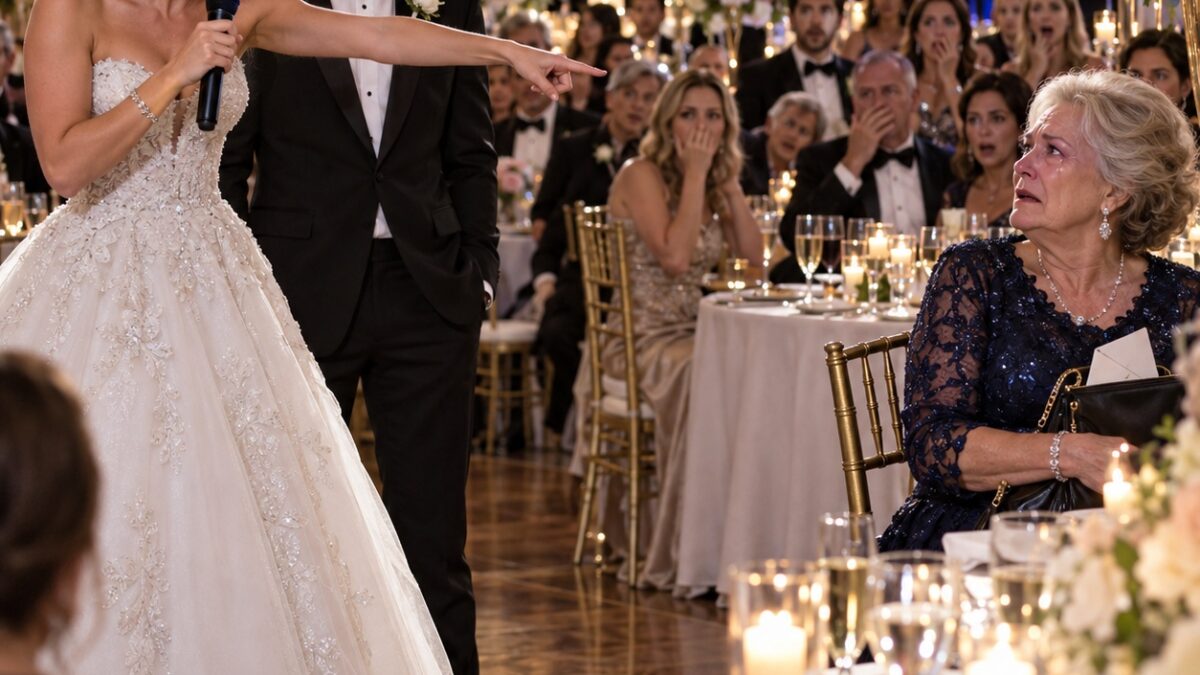
Before I understood what she was doing, she grabbed a microphone.
“May I have everyone’s attention?”
Jackson went pale.
“Tiffany.”
She pointed at me.
“For those who don’t know, that woman is Jackson’s mother.”
And the nightmare began.
She accused me of interfering.
Undermining.
Trying to control Jackson.
Then:
“You’re not welcome here, old lady.”
My chest tightened.
“This is my wedding. My husband. My day.”
I looked at Jackson.
His eyes went to the floor.
And with that, something inside me died.
Not my love for him.
My illusion.
I understood suddenly that the greatest damage in our relationship had not happened today.
It had happened slowly.
Every time I tolerated disrespect.
Every time Jackson apologized privately but remained silent publicly.
Every time I solved his financial problem.
Every time I confused giving with loving.
Every time I made myself smaller so he would not be uncomfortable.
My purse felt heavy.
The check.
I stood.
Walked toward Tiffany.
She looked almost triumphant.
I held out my hand.
“May I?”
She blinked.
“What?”
“The microphone.”
Maybe she expected me to beg.
Maybe cry.
Maybe apologize.
Instead, she gave it to me almost automatically.
I turned toward the guests.
My voice surprised me.
Steady.
“Thank you, Tiffany.”
Her smile faltered.
“For finally making your feelings clear.”
The room was silent.
“I have spent a very long time confused about where I stood in my son’s new life.”
Jackson looked up.
“Tonight, I am no longer confused.”
“Mom,” he whispered.
I looked at him.
Then back at the room.
“I raised Jackson alone from the age of four.”
Murmurs.
“His father left.”
Jackson closed his eyes.
“I taught high school mathematics during the day. I tutored nights. I taught summers.”
Tiffany folded her arms.
“I did not do those things because my son owed me.”
I paused.
“I did them because I loved him.”
My throat tightened.
“I used retirement savings to help him through college.”
Jackson stared at me.
“I contributed thirty-five thousand dollars to this wedding.”
People turned toward Tiffany.
“And one week ago, I took a loan against my house to help pay for their honeymoon.”
Her face changed.
“Anelise—”
I reached into my purse.
“Today, I planned to give my son and his new wife another thirty-five thousand dollars.”
The room erupted into whispers.
I held up the envelope.
“My last savings.”
Jackson’s face drained.
“Mom, no.”
I looked at him.
“Yes.”
I pulled out the check.
“I thought love meant giving until there was nothing left.”
My hands were trembling now.
“I thought if I helped enough, supported enough, stayed quiet enough, eventually there would be room for me again.”
I looked at Tiffany.
“But respect cannot be purchased.”
Then Jackson.
“And neither can courage.”
His face crumpled.
I tore the check in half.
Gasps.
Then again.
And again.
Small pieces fell onto the dance floor.
Like ugly little snowflakes.
Tiffany lunged forward.
“What are you doing?”
I let the pieces fall.
“Ending a misunderstanding.”
“That money was for us.”
“No.”
I looked at her.
“It was mine.”
She stared.
“I was choosing to give it.”
Her face reddened.
“You can’t embarrass us like this.”
I almost laughed.
“You stopped your wedding to announce publicly that I was unwanted.”
“This is different.”
“No, Tiffany.”
I handed the microphone back toward her.
“This is consequence.”
Then I looked at Jackson.
“I love you.”
Tears stood in his eyes.
“I always will.”
He stepped forward.
“Mom, please.”
I raised one hand.
“No.”
He stopped.
“You made a choice tonight.”
“I froze.”
“You stood silent.”
“I didn’t know what to do.”
“You knew I was being humiliated.”
He shook his head.
“I—”
“And you looked at the floor.”
His mouth closed.
“That tells me what I need to know right now.”
“Mom.”
“Not forever.”
His eyes lifted.
“But right now.”
I turned toward the guests.
“Please enjoy the rest of your evening.”
Then I walked away.
As I passed Table 3, Michael stood.
Not dramatically.
Respectfully.
Then an older woman stood.
Tiffany’s grandmother.
Then another guest.
I did not need applause.
I did not need anyone to choose sides.
But those small gestures kept me from collapsing.
I left the ballroom.
Did not look back.
The moment the doors closed behind me, my knees shook.
Freedom does not always feel triumphant.
Sometimes freedom feels like grief.
I drove back to Connecticut alone.
I cried so hard twice that I pulled onto the shoulder.
My phone vibrated constantly.
Jackson.
Again.
Again.
Again.
I turned it off.
By the time I reached home, it was late.
I was still wearing the sage dress.
I kicked off my shoes.
Lay across the bed.
I slept for fourteen hours.
The next morning, my phone showed dozens of messages.
The first ones were angry.
How could you do that in front of everyone?
Then defensive.
You don’t understand the pressure I’ve been under.
Then confused.
Then apologetic.
Mom, please answer.
I’m sorry.
Please.
I read every message.
Answered none.
For my entire life as Jackson’s mother, whenever he hurt, I ran toward him.
This time, I allowed him to hurt.
Not as punishment.
As consequence.
Dorothy arrived with coffee and muffins.
She hugged me before saying anything.
Then sat at my kitchen table.
“You know what amazes me?”
“What?”
“How long you tolerated it.”
I stared at my coffee.
“The Anelise I knew when we were twenty-five would have eaten Tiffany alive before dessert.”
I laughed.
“Motherhood softened me.”
“No.”
Dorothy shook her head.
“Motherhood erased you.”
That hurt.
She immediately reached across the table.
“I’m sorry.”
“No.”
I swallowed.
“You’re right.”
Somewhere between William leaving and Jackson growing up, I had turned sacrifice into identity.
I was proud of how much I could endure.
Proud of needing little.
Proud of giving.
I had never asked whether giving everything was healthy.
Over the next week, people came.
A former colleague brought soup.
My neighbor John mowed the lawn.
Michael visited with his fiancée and a chocolate cake.
“I wanted to check on you.”
“You don’t have to.”
“I know.”
That sentence stayed with me.
I know.
He wasn’t helping because obligation demanded it.
He wanted to.
I began noticing how much community existed around me.
People I had neglected because all my emotional energy had gone toward my son.
Seven days after the wedding, someone knocked.
I knew it was Jackson.
He stood alone.
No Tiffany.
Wrinkled shirt.
Unshaven.
Eyes red.
“Can I come in?”
I stepped aside.
We sat in the living room.
The same room where he once built forts.
The same sofa where he slept with fever at age nine.
He looked older.
“Mom.”
I waited.
“I’m sorry.”
I said nothing.
“What Tiffany did…”
He rubbed his face.
“It was disgusting.”
I remained quiet.
“What I did was worse.”
My heart tightened.
“I should have stopped her.”
“Yes.”
His eyes filled.
“I froze.”
“Yes.”
“I kept thinking if I said something, everything would explode.”
“It exploded anyway.”
“I know.”
He looked toward me.
“I’ve spent years doing that.”
“What?”
“Avoiding conflict.”
I waited.
“If Tiffany was rude to you, I told you not to take it personally.”
“Yes.”
“If you complained, I told you she was stressed.”
“Yes.”
“If she wanted something ridiculous, I tried to make it happen.”
“Yes.”
He started crying.
“I kept choosing whatever prevented the next argument.”
“And who paid for that peace?”
He looked at me.
“You.”
“Yes.”
He nodded slowly.
“I told Tiffany she owes you an apology.”
I almost smiled.
“Jackson.”
“What?”
“I don’t want an apology she was ordered to give.”
He looked down.
“She wants to talk.”
“I don’t.”
“Okay.”
“I need time.”
His face tightened.
“How much?”
“I don’t know.”
“Mom, please.”
“I spent more than thirty years putting you first.”
He flinched.
“I need to understand who I am when I’m not doing that.”
“You’re my mother.”
“That’s part of who I am.”
He stared.
“Not all.”
He began crying harder.
“I can’t lose you.”
“You are not losing me.”
“It feels like it.”
“I love you.”
He looked up.
“But loving you does not mean giving you unlimited access to me.”
That sentence felt foreign.
Powerful.
“I need behavior, Jackson.”
“I know.”
“Not promises.”
He nodded.
“I need consistent change.”
“Anything.”
“And I need you to handle your financial life without me.”
His face flushed.
“I’ll pay everything back.”
“That’s your responsibility.”
“I will.”
“And no more emergency requests.”
“Understood.”
“No asking me to rescue plans you cannot afford.”
He nodded.
“No asking me to borrow against my future so you can live beyond your present.”
Tears rolled down his face.
“I understand.”
“I hope so.”
He stood to leave.
At the door:
“Will you talk to me again?”
“Yes.”
“When?”
“When I’m ready.”
His face crumpled.
Then he nodded.
“All right.”
After he left, I cried.
Boundaries do not remove love.
Sometimes they hurt precisely because love is still there.
The following weeks were strange.
Quiet.
I joined a support group for parents struggling with adult children.
At first, I felt ridiculous.
Then I heard other stories.
Parents who had funded houses and been cut off.
Parents who could not see grandchildren.
Parents who had enabled addiction.
Parents who controlled children financially and were shocked when those children rebelled.
It was not a group about blaming adult children.
It was about seeing patterns.
My pattern became clear.
I had made Jackson responsible for my sense of purpose.
Then I had made myself responsible for his comfort.
That was too much weight for both of us.
I dug out my old watercolor paints.
I used to paint before motherhood.
Nothing impressive.
Landscapes.
Flowers.
Harbors.
I set up near the window.
My first painting looked terrible.
I laughed.
Then painted another.
Dorothy dragged me on a weekend trip to the coast.
I protested.
“Too expensive.”
“You just saved thirty-five thousand dollars by tearing up a check.”
I stared at her.
She grinned.
“Pack.”
We stood on the beach at sunrise.
I had not taken a real vacation in more than ten years.
The ocean looked enormous.
My problems looked smaller.
I was sixty-five.
For years, that number had sounded like an ending.
Suddenly it sounded like time.
Three months after the wedding, a letter arrived.
Handwritten.
Jackson.
I almost put it away unopened.
Then I read.
He did not ask for forgiveness.
Not immediately.
He described therapy.
He wrote that he had started counseling because he wanted to understand why approval mattered so much.
Why Tiffany’s family had made him feel successful.
Why my simpler life had begun to embarrass him.
He wrote:
I think I spent my childhood afraid of being the kid who didn’t belong, and I never really grew out of it.
That line broke me.
I remembered the seven-year-old boy excluded from the birthday party.
The lip trembling.
“Why don’t they like me?”
I had seen the wound decades before.
I had simply never imagined where it could lead.
He continued.
I allowed Tiffany to turn your love into something I treated as embarrassing because it reminded me of the life I was trying to prove I had outgrown.
I cried.
The final paragraph said:
I don’t know if we can go back. I’m beginning to understand that going back may not be healthy anyway. But I hope we can build something new based on mutual respect. I love you. I am sorry for every time I asked you to become smaller so I could feel more accepted somewhere else.
I called him.
We talked for three hours.
I established rules.
We would meet once a month initially.
Without Tiffany.
No financial requests.
No pressure.
No manipulating me through guilt.
If Tiffany wanted a relationship with me, she would have to build it herself.
Jackson accepted every condition.
During our first lunch, he said his marriage was struggling.
I resisted giving advice.
That was new.
“Tiffany thinks I betrayed her.”
“How?”
“By apologizing to you.”
I sipped coffee.
“What do you think?”
“I think she humiliated you.”
I nodded.
“She says you were trying to turn me against her.”
“What do you think?”
He smiled sadly.
“You’re really not going to tell me what to do.”
“No.”
“That’s weird.”
“For both of us.”
He laughed.
“I think I need to figure this out.”
“Yes.”
That was all I said.
Meanwhile, I built a life.
I volunteered teaching math to adults studying for GED exams.
The first evening, a forty-three-year-old woman named Rosa stared at fractions and said:
“I’m stupid.”
I said:
“No.”
She shook her head.
“I’ve failed this twice.”
“That means the method failed twice.”
She stared at me.
“Not you.”
We worked for an hour.
When she finally solved the problem correctly, she covered her mouth.
I remembered why I had become a teacher.
There is nothing like watching someone realize they are capable.
I redecorated my house.
Yellow kitchen.
Blue bedroom.
Bold colors.
For years I had chosen neutral paint because of “resale value.”
One afternoon, I stood holding a bright red pillow and thought:
Who am I preserving this house for?
I bought the pillow.
John from next door began stopping by.
At first, practical things.
Gutter.
Lawn mower.
Then coffee.
Eventually:
“Would you like dinner sometime?”
I stared at him.
“Are you asking me on a date?”
His ears turned red.
“I suppose I am.”
I laughed.
We went.
Nothing dramatic happened.
No whirlwind romance.
It was simply pleasant.
A man asked about me.
Not my son.
Not my sacrifices.
Me.
“What books do you like?”
“When did you start painting?”
“Where would you travel if money didn’t matter?”
I realized how rarely anyone had asked those questions in decades.
Jackson and I continued meeting.
Slowly.
Some lunches were easy.
Some painful.
He paid back portions of the wedding money.
I told him not to destroy himself doing it.
He said:
“This is not about the money.”
I understood.
He needed to become responsible for the cost of his choices.
Months later, he admitted he and Tiffany had started marriage counseling.
I nodded.
No celebration.
No criticism.
“What do you want from counseling?”
He thought.
“To understand whether there’s enough respect left.”
Good answer.
I never asked whether they would stay together.
That was their marriage.
What mattered to me was that Jackson was finally making decisions rather than surrendering them.
One year after the wedding, I looked at the sage dress hanging in the back of my closet.
I had not worn it since.
For months, seeing it hurt.
Then Dorothy invited me to a charity dinner.
I wore it.
She stared.
“You sure?”
“Yes.”
“That dress has history.”
“So do I.”
I put it on.
Looked in the mirror.
The woman staring back was not the woman from Table 19.
Not because my face had changed.
Because my posture had.
I stood straighter.
The wedding became less a wound and more a dividing line.
Before.
After.
Before, I believed a good mother sacrificed automatically.
After, I understood sacrifice should be chosen consciously.
Before, I thought saying no was selfish.
After, I understood every yes costs something.
Before, I believed unconditional love meant unconditional access.
After, I learned that love can remain even when a door closes.
Jackson once asked:
“Do you regret raising me the way you did?”
“No.”
“Even with everything?”
“You were loved.”
He looked down.
“I mean giving up so much.”
“That is more complicated.”
He waited.
“I regret teaching you that I would always rescue you.”
He flinched.
“I did teach you that.”
“I took advantage of it.”
“Yes.”
He looked surprised by my honesty.
“Not maliciously.”
“That doesn’t make it okay.”
“No.”
“I also took advantage of your need for me.”
He frowned.
“How?”
“By making motherhood my entire identity.”
He stared.
“That sounds like your fault.”
“It was.”
He almost laughed.
I did.
“We can both be responsible for different parts of the same unhealthy pattern.”
That became one of the best conversations we ever had.
Tiffany never gave me the apology Jackson initially promised.
Not really.
Months after the wedding, she sent a message:
I’m sorry things got out of control.
That was not:
I’m sorry I publicly humiliated you.
So I did not pretend it was.
I responded:
I appreciate you reaching out. I hope with time we can interact respectfully.
Nothing more.
I did not need her to confess.
I did not need vindication.
The ballroom had already made everything clear enough.
Over time, Jackson became less defensive about Tiffany.
Also less eager to complain about her to me.
That was healthy.
I refused to become the emotional third person in their marriage.
When he tried once:
“She doesn’t understand why I still visit you so much.”
I said:
“Talk to your wife.”
He stared.
“You really changed.”
“Yes.”
“Do you like yourself better?”
I thought.
“Yes.”
That answer surprised both of us.
My relationship with Jackson became something new.
He called because he wanted to talk, not because he needed money.
Sometimes weeks passed.
I survived.
Sometimes I said:
“I can’t this weekend.”
The first time, he sounded shocked.
“You have plans?”
I laughed.
“I have a life.”
“I know.”
“You sound surprised.”
“A little.”
“Rude.”
He laughed.
That laughter felt more loving than many sacrifices I had made.
Eventually, he asked me to tell him about William.
Not the sanitized story.
The real one.
“Did Dad leaving destroy you?”
“For a while.”
“Did you hate him?”
“Yes.”
He looked surprised.
“You never said that.”
“You were a child.”
“Do you still?”
“No.”
“Why?”
“I stopped giving him that much space.”
He nodded.
“Do you think I’m like him?”
The question hurt.
“No.”
“Sometimes I worry.”
“Your father ran from responsibility.”
“And me?”
“You avoided conflict.”
“Different?”
“Very.”
I smiled.
“You are here.”
He looked at me.
“You came back to the relationship and tried to repair it.”
Tears filled his eyes.
“That matters.”
My life continued expanding.
I painted.
Taught.
Traveled with Dorothy.
Had dinner with John.
Sometimes John and I went three weeks without seeing each other.
Sometimes twice in one week.
No pressure.
No labels we didn’t want.
It was astonishing how peaceful companionship could feel when neither person was trying to own the other.
At sixty-six, I took a train trip through New England just because I wanted to.
I bought a good camera.
I took terrible pictures.
I learned.
At sixty-seven, Rosa from my GED class passed her exam.
She brought me flowers.
“You changed my life.”
I shook my head.
“You did the work.”
“You made me believe I could.”
I went home and cried.
Those tears felt nothing like wedding tears.
I finally understood something fundamental.
For decades, I believed Jackson was the proof that my life mattered.
His success.
His happiness.
His need for me.
But a meaningful life cannot rest entirely inside another person’s choices.
Not even your child’s.
Maybe especially not your child’s.
I had value before becoming a mother.
I had value while being a mother.
I had value when Jackson disappointed me.
I had value when he needed me less.
I had value completely separate from whether Tiffany approved of me.
That sounds obvious.
It did not feel obvious until I had lived sixty-five years.
Two years after the wedding, Jackson came over one Sunday.
He carried a box.
“What’s that?”
“Something I found.”
Inside were photographs from his childhood.
School plays.
Birthdays.
Hiking trips.
Christmases.
One photograph showed us in the kitchen after his university acceptance.
Jackson holding the letter.
Me laughing.
He touched it.
“You look happy.”
“I was.”
“I didn’t understand what you gave me.”
“You don’t need to spend your life apologizing.”
“I know.”
He looked at me.
“But I need to remember.”
We sat on the floor going through pictures.
At one point he found one from middle school.
Him wearing discount jeans with the expensive patch I had sewn on.
He stared.
“Wait.”
I started laughing.
“What?”
“These weren’t real?”
I laughed harder.
He looked horrified.
“Mom!”
“We were broke.”
“You lied.”
“I improvised.”
“That is fraud.”
“That is parenting.”
We laughed until we cried.
Then he grew quiet.
“I was so desperate to fit in.”
“I know.”
“I still am sometimes.”
“I know.”
He looked at me.
“You always knew?”
“You were seven when I first saw it.”
His eyes softened.
“The birthday party.”
I nodded.
“You remember?”
“Of course.”
He stared at the photograph.
“I think I’ve spent my whole life trying not to be the kid who wasn’t invited.”
That sentence explained so much.
Tiffany’s family.
The exclusive places.
The money.
The image.
The wedding.
And my son’s silence.
He had been terrified of losing the world he had finally entered.
So when that world demanded he distance himself from where he came from, he did.
Not consciously.
But effectively.
“What do I do with that?” he asked.
“Keep working on it.”
“That’s it?”
“Therapy.”
He smiled.
“Very inspiring.”
“I’m your mother, not your therapist.”
“Finally.”
I threw a pillow at him.
Our relationship did not return to the past.
Thank God.
The past had contained love, but also dependency.
What we built was better.
Adult.
Imperfect.
More honest.
Sometimes he disappointed me.
Sometimes I disappointed him.
We said it.
Then repaired.
That was healthier than pretending.
As for Tiffany, their marriage remained strained for a long time.
Jackson never shared every detail.
I never asked.
I knew they were still in counseling.
I knew he stopped allowing her to control access to me.
I knew she became more careful about how she spoke in my presence.
Whether that came from growth or consequence did not matter immediately.
Respectful behavior was a minimum.
Trust would require much more.
The first time we all sat together again was almost eighteen months after the wedding.
Emma—Michael’s fiancée, not a relative—was hosting a small engagement party, and Jackson asked whether I would be comfortable attending if Tiffany was there.
I said yes.
Tiffany approached me.
No champagne.
No audience.
No dramatic apology.
She simply said:
“Anelise.”
“Tiffany.”
She swallowed.
“I know I never properly apologized.”
I waited.
“What I did at the wedding was cruel.”
My chest tightened.
She continued.
“I was angry, drunk, and insecure.”
I said nothing.
“Those things explain it.”
She looked directly at me.
“They don’t excuse it.”
That mattered.
“I humiliated you.”
“Yes.”
“And Jackson.”
“Yes.”
“And myself.”
“Yes.”
She almost smiled.
“I deserve that.”
I waited.
“I don’t expect you to forgive me.”
“I appreciate the apology.”
She nodded.
“That’s fair.”
Then she walked away.
I did eventually forgive her.
But forgiveness did not mean closeness.
We were never mother and daughter.
We became two women connected through someone we both loved, capable of civility.
Sometimes that is enough.
Forgiveness is not always reconciliation.
It is often simply choosing not to carry poison.
Three years after the wedding, I stood in my kitchen preparing dinner.
Jackson was coming over.
Not because he needed something.
Because Sunday dinner had become ours again.
Different from the old days.
Sometimes John joined.
Sometimes Dorothy.
Sometimes Jackson cooked.
Badly.
I looked around the house.
Bright walls.
Paintings.
Books.
Photographs.
My life.
On one shelf was a framed picture from my first trip to the coast after the wedding.
I was standing barefoot at sunrise.
Hair wild.
No makeup.
Laughing.
Dorothy had taken it.
That woman looked freer than I had at forty-five.
I thought about Table 19.
The microphone.
The check.
For a long time, I told myself Tiffany had given me freedom by humiliating me.
That was not entirely true.
She gave me pain.
What I did with it became freedom.
That distinction matters.
Pain does not automatically make people stronger.
Sometimes it simply hurts.
Strength comes from what we choose afterward.
I chose boundaries.
I chose therapy and support.
I chose painting.
Teaching.
Friendship.
Travel.
I chose not to finance my son’s adulthood.
I chose to love him without organizing my entire life around him.
And Jackson chose to grow too.
That mattered.
The night of his wedding, I thought his silence told me everything I needed to know.
It told me everything I needed to know then.
People can change.
But only when change becomes visible in behavior.
Words are easy.
I had spent years accepting words.
“Sorry, Mom.”
“She didn’t mean it.”
“I’ll pay you back.”
“I’ll call more.”
“I’ll include you.”
After the wedding, I learned to watch actions.
Jackson repaid the wedding contribution gradually.
Not the gift.
That check had been destroyed.
He repaid the money I had pulled from retirement.
It took years.
I never reminded him.
Every transfer arrived.
He never asked for praise.
When my roof needed repair, he offered money.
I said:
“No.”
He laughed.
“Are you sure?”
“Yes.”
“You know I can help.”
“I know.”
“That feels good.”
“What?”
“You not needing me.”
He shook his head.
“That isn’t what I mean.”
I looked at him.
“You letting me offer without either of us turning it into obligation.”
I smiled.
That was growth.
On my seventieth birthday, I had a party.
Nothing like the Grand Meridian.
No trees wrapped in fairy lights.
No seven-course meal.
No orchestra.
We held it in my backyard.
String lights.
Potluck food.
My old colleagues.
Dorothy.
John.
Michael and his wife.
Rosa.
Neighbors.
Former students.
Jackson.
Even Tiffany came.
At one point, I stood on the porch looking over everyone.
Jackson came beside me.
“What?”
“Nothing.”
“You’re doing that emotional face.”
“I do not have an emotional face.”
“You absolutely do.”
I smiled.
“I was just thinking.”
“About?”
“How many people I almost forgot I had.”
He followed my gaze.
“Because of me.”
“Not entirely.”
“Mostly.”
“Don’t make everything about yourself.”
He laughed.
“Fair.”
Then he grew serious.
“I’m glad you tore up that check.”
I looked at him.
“Really?”
“No.”
I laughed.
“Thirty-five grand, Mom.”
“Still painful?”
“Very.”
I hit his arm.
He smiled.
Then:
“But yes.”
He looked toward the people gathered in the yard.
“If you had given us that money…”
“What?”
“I think it would have told me nothing had to change.”
That was true.
My sacrifice had often protected him from consequences.
The shredded check was the first consequence I ever refused to soften.
“You know,” I said, “I almost didn’t tear it.”
He turned.
“What?”
“I almost put it back in my purse.”
“Why?”
“Because I loved you.”
He looked down.
“And then?”
“I realized loving you was exactly why I had to stop.”
His eyes filled.
We stood quietly.
Then Dorothy shouted from the yard:
“Are you two going to brood all night or come eat cake?”
I shouted back:
“We’re coming.”
Jackson smiled.
“Some things never change.”
“Thank God.”
That evening, after everyone left, I sat alone beneath the string lights.
Seventy years old.
I thought about William.
Jackson.
Tiffany.
Every version of myself.
The young woman who believed love could save a marriage.
The single mother who believed sacrifice could guarantee a good child.
The older woman who believed enough generosity could preserve closeness.
I had been wrong about all three.
Love is powerful.
It is not magic.
It cannot control another person’s character.
It cannot prevent betrayal.
It cannot guarantee gratitude.
And real love sometimes requires allowing someone to experience the consequences you once would have rushed to erase.
I still love Jackson unconditionally.
That phrase means something different to me now.
It means my love does not disappear when he disappoints me.
It does not mean my boundaries disappear.
It means I want good things for him.
It does not mean I must finance every good thing he wants.
It means I can forgive.
It does not mean I have to forget.
It means I can leave a ballroom when staying would require abandoning myself.
Sometimes parents are told that setting boundaries with adult children is cruel.
Sometimes adult children are told they owe parents everything because they were raised.
Both ideas can become unhealthy.
Relationships work when love moves in both directions.
Not equally every day.
But genuinely.
Respect.
Effort.
Care.
Accountability.
That is what I wanted from Jackson.
Not repayment for diapers.
Not compensation for college tuition.
Not worship because I was his mother.
Basic respect.
The night Tiffany seized that microphone, my son failed to give it.
For a long time, that was the most painful memory of my life.
Now it is also one of the clearest.
Because when he looked at the floor, I finally looked at myself.
Really looked.
I saw a sixty-five-year-old woman who had spent three decades proving love by disappearing into sacrifice.
I saw someone terrified that if she stopped giving, people might stop staying.
And I decided to find out.
I stopped giving money.
Some people stayed.
I stopped solving every problem.
Some people stayed.
I stopped apologizing for having needs.
Some people stayed.
I said no.
Some people stayed.
Those were my people.
Jackson, eventually, was one of them.
And the people who only wanted the version of me that gave endlessly?
They had never truly been staying for me anyway.
The $35,000 check is gone.
The pieces were probably swept from the Grand Meridian floor that same night.
For all I know, some exhausted waiter threw them into a garbage bag beside wilted flowers and champagne bottles.
Sometimes I wish I had kept one piece.
Not because of the money.
As a reminder.
Then I realize I do not need paper.
I remember exactly what it felt like to stand under those ballroom lights.
To hear Tiffany say:
“You’re not welcome.”
To see my son look away.
To feel the envelope in my purse.
To understand that I had one choice left nobody else could make for me.
Stay small.
Or stand up.
I stood.
And my life did not end because my son was angry.
It did not end because Tiffany hated me.
It did not end because a wedding turned into a public disaster.
My life became larger.
More honest.
Mine.
At seventy, I teach twice a week.
I paint badly and happily.
I travel when I can.
John and I still have dinner sometimes.
Dorothy still tells me uncomfortable truths.
Jackson calls without needing anything.
Some Sundays, he cooks.
The food has improved.
Tiffany and I are civil.
Occasionally warm.
Never close.
I can live with that.
And when I think about the woman sitting alone at Table 19, clutching a purse containing the last of her savings, I wish I could sit beside her.
I would take her hand.
I would tell her:
You are not baggage.
You are not an inconvenience.
You are not valuable because you paid tuition.
You are not valuable because you funded a wedding.
You are not valuable because your son needs you.
You were valuable before any of that.
Then I would tell her something she would not yet believe.
This wedding is going to hurt.
More than you think you can bear.
But one day you will look back and realize that the worst thing that happened in that ballroom was not being publicly rejected.
The worst thing was discovering how thoroughly you had rejected yourself long before anyone else did.
And the best thing?
You stopped.
That was the real beginning.
Not when I tore up the check.
Not when I took the microphone.
Not when I walked out.
The beginning came when I finally understood that love should never require me to disappear.
I had spent thirty years making sure my son had a life.
At sixty-five, I finally began building one for myself.
And for the first time, that did not feel selfish.
It felt overdue.





