𝗙𝗨𝗟𝗟 𝗦𝗧𝗢𝗥𝗬: My HOA Fined Me $500 Over a Tiny Antenna—So I Started Reading the Rules They Thought I’d Never Understand
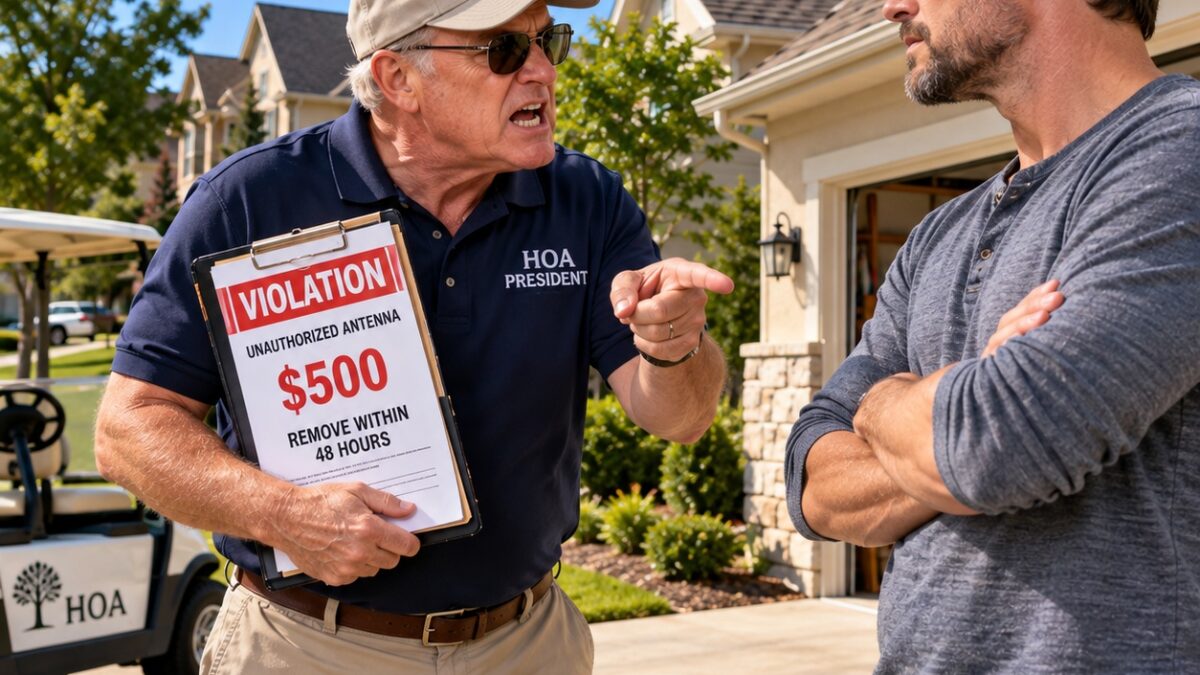
𝗙𝗨𝗟𝗟 𝗦𝗧𝗢𝗥𝗬 𝗜𝗦 𝗜𝗡 𝗧𝗛𝗘 𝗙𝗜𝗥𝗦𝗧 𝗖𝗢𝗠𝗠𝗘𝗡𝗧


I spent the first hour being angry.
The second hour calculating.
Five hundred dollars was not ruinous.
But it was enough to make me feel insulted.
I had paid for the house.
Paid the mortgage.
Paid property taxes.
Paid HOA dues.
Kept the grass at regulation height.
Used one of the approved exterior colors.
Stored my trash bins exactly where Whispering Pines required.
And now a retired office manager with wraparound sunglasses had decided a piece of aluminum smaller than some television antennas was an existential threat to property values.
At first, I thought about appealing.
Then I pulled out the covenants.
Richard had quoted them correctly.
That irritated me even more.
The language was broad.
No exterior metallic protrusions, wires, large satellite dishes, or aerial transmission devices without prior architectural approval.
He was stretching the spirit of the rule.
But technically?
He had something.
I could argue that my dipole was a receiver rather than a transmitter.
I could argue it was barely visible.
I could argue selective enforcement.
None of those arguments guaranteed victory.
And Richard had one advantage I did not.
The HOA could spend community money on lawyers.
I could spend mine.
The difference mattered.
So I did what I do for a living.
I stopped thinking emotionally and started looking for structure.
Who had jurisdiction?
What rules controlled which other rules?
Where did HOA authority end?
Could any outside authority supersede it?
I already knew about PRB-1.
Any amateur-radio operator eventually learns about it.
The FCC had long recognized that state and local governments must reasonably accommodate amateur-radio communications.
That sounded promising for about fifteen minutes.
Then I read the cases.
PRB-1 largely dealt with government regulation.
Cities.
Counties.
Zoning authorities.
An HOA was different.
When I bought my house, I had voluntarily agreed to private deed restrictions.
Courts generally treated those as contracts.
Richard could not easily tell the federal government what to do.
But he could enforce the private agreement I had signed.
That avenue looked bad.
I kept reading.
Federal communications regulations.
Emergency systems.
Auxiliary communications.
Disaster response.
Civil emergency infrastructure.
Hours passed.
My work spreadsheets sat untouched on a second monitor.
Coffee became lunch.
Lunch became more coffee.
Then I found the concept that changed everything.
Emergency communications networks.
Not hobby radio.
Not a man talking to another ham operator three states away.
Actual disaster-response redundancy.
The kind of communications infrastructure counties relied on when storms, grid failures, damaged cell towers, or overloaded networks made normal systems unreliable.
If a private site became officially integrated into recognized emergency communications infrastructure, the legal analysis changed dramatically.
At least according to the framework I was reading.
I leaned closer to the screen.
I read it again.
Then again.
And a very bad idea began becoming an extremely organized plan.
I could not simply place a sticker on my radio room and declare myself national infrastructure.
I needed legitimacy.
Training.
Equipment.
An official relationship with the county emergency management system.
And, most importantly, actual usefulness.
If I was going to do this, I could not build a fake emergency site purely to antagonize Richard.
It would have to work.
It would have to meet technical standards.
It would need real emergency communications capability.
That meant more than the ten-foot receiver on my chimney.
Much more.
The first step was obvious.
I needed my Amateur Extra license.
I already held a lower-class amateur license.
I understood radio fundamentals.
But Amateur Extra demanded more.
Advanced electrical theory.
Propagation.
Circuit design.
Frequency privileges.
Safety.
It was the highest amateur class.
Passing would give me broader operating capability and, just as importantly, credibility when I approached emergency officials.
I looked out the window.
Richard’s golf cart was two streets away.
He was standing beside somebody’s mailbox.
I imagined him measuring its angle.
Then I looked back at the citation.
Unauthorized metallic protrusion.
I started laughing.
Not because the situation was funny.
Because I had just realized exactly what I was going to do.
Richard wanted the little antenna gone.
Fine.
It would be gone.
Friday morning, two hours before the deadline, I climbed onto my roof.
The air was cool.
The mast came down in less than twenty minutes.
I unscrewed the brackets.
Disconnected the coax.
Lowered the antenna carefully.
Placed it on a shelf in my garage.
Then I went to the bank.
I bought a cashier’s check for exactly $500.
Not $499.99.
Not one cent less.
I placed it in a white envelope.
Drove to the clubhouse.
Dropped it into the payment slot.
Compliance.
Perfect compliance.
Richard won.
The ten-foot pole was gone.
The skyline of Whispering Pines Estates had been saved.
I drove home.
Opened my laptop.
Registered for the Amateur Extra exam.
Then I began drafting an email to Hamilton County emergency communications.
The subject line was intentionally boring.
PRIVATE-PUBLIC AUXILIARY COMMUNICATIONS REDUNDANCY PROPOSAL — NORTHERN SECTOR.
Nobody in government trusts exciting subject lines.
The proposal described a gap I believed existed in county emergency coverage.
I offered to fund a fixed amateur emergency relay facility at my own expense.
Equipment.
Tower.
Backup power.
Maintenance.
Insurance.
No taxpayer capital cost.
In exchange, I wanted the county to evaluate the property as a recognized emergency communications node and execute a memorandum establishing its operational role.
My motives were mixed.
I admit that.
Part civic interest.
Part technical obsession.
Part stubbornness.
And a very large amount of spite.
But the system would be real.
That distinction mattered.
For the next month, my dining room stopped being a dining room.
It became a study station.
Technical manuals.
FCC rules.
Practice exams.
Scratch paper.
Smith charts.
Empty coffee mugs.
I spent eight hours a day dealing with logistics, then came home and studied radio theory until midnight.
Sometimes one.
Sometimes two.
Whenever exhaustion hit, I remembered Richard holding that yellow citation.
Forty-eight hours.
It was surprisingly motivational.
The exam took place at an old VFW hall outside Carmel.
The room smelled like floor wax and decades of cigarettes that had supposedly stopped being smoked there years ago.
Three volunteer examiners sat behind folding tables.
One of them, Earl, was probably in his seventies.
Thick glasses.
Gray mustache.
He looked at my paperwork.
“Going for Extra?”
“Yes.”
“That’s a lot of math for a Saturday morning.”
“I’ve made questionable life choices.”
He laughed.
“Sit down.”
The exam was harder than the practice sets.
Antenna loading.
Impedance.
Propagation.
Circuit behavior.
Safety.
I finished uncertain.
Earl graded the sheet with a red overlay.
He looked down.
Then up.
Then down again.
“Well.”
My stomach tightened.
“You missed one.”
“One?”
“One.”
He smiled.
“Congratulations.”
I actually exhaled.
“You’re an Extra.”
I drove home with temporary proof of the upgrade sitting on the passenger seat.
Phase one done.
Now came the harder part.
Government.
I spent three days figuring out exactly who in Hamilton County would care.
Eventually, I found Director David Gable.
Emergency communications.
I did not call.
I emailed.
Government officials are busy.
A cold phone call from a stranger saying, “I would like to put a giant radio tower in my suburban backyard” sounds like the beginning of a difficult afternoon.
A twelve-page technical proposal sounds like work.
Work gets forwarded.
Two days later, my phone rang.
“This the guy who wants to build me a free radio site?”
The voice was rough.
Tired.
“Yes.”
“This is David Gable.”
“Director Gable.”
“Dave.”
He paused.
“I read your proposal.”
“That’s encouraging.”
“It’s thorough.”
“Also encouraging.”
“It’s expensive.”
“That part is less encouraging.”
He laughed.
“You understand the county is not buying this equipment?”
“Yes.”
“You’d fund construction?”
“Yes.”
“Backup power?”
“Yes.”
“Maintenance?”
“Yes.”
“Insurance?”
“Yes.”
Another silence.
Then:
“You live in Whispering Pines.”
I smiled.
“I do.”
“I know that neighborhood.”
“Then you understand the difficulty.”
“My sister-in-law lives near there.”
Dave sounded amused now.
“You can’t install a birdhouse without somebody reviewing the color.”
“That is an exaggeration.”
“Barely.”
He continued.
“Your HOA will fight this.”
“That is why the legal classification matters.”
He became quieter.
“You’re using emergency communications authority to get around your HOA.”
I leaned back.
“I’m offering Hamilton County a self-funded, hardened backup communications node in a part of the county where your own planning documents identify redundancy concerns.”
“That is true.”
“The equipment will be real.”
“Yes.”
“The public benefit will be real.”
“Yes.”
“Then my motivation does not change the capability.”
Dave laughed.
It was not a polite laugh.
It was the laugh of a man who had just understood the entire situation.
“You really hate your HOA president.”
“I wouldn’t say hate.”
“What would you say?”
“I am highly motivated by administrative inconsistency.”
He laughed harder.
Then sighed.
“Build it to spec.”
My heart kicked.
“What?”
“If engineering approves the location.”
“If the legal office approves the arrangement.”
“If the station meets our operational standards.”
“And if you understand we owe you nothing financially.”
“I do.”
“Then I’m interested.”
The next three weeks were the least glamorous part of revenge anyone has ever experienced.
Forms.
Meetings.
Insurance questions.
Site drawings.
Engineering requirements.
Grounding.
Generator capacity.
Duty obligations.
Access protocols.
Emergency activation procedures.
County attorneys.
Risk managers.
Communications staff.
I took half-days from work.
Used vacation hours.
Sat under fluorescent lights while people discussed liability.
Nobody was impressed by my feud with Richard.
Good.
I needed the project evaluated on its usefulness.
Dave made that clear.
“If this is only a legal trick.”
He told me during one meeting.
“I’m out.”
“It isn’t.”
“You’ll respond during emergencies?”
“Yes.”
“You’ll maintain the system?”
“Yes.”
“You’ll participate in drills?”
“Yes.”
“You’ll let the county inspect?”
“Yes.”
“Then we have something.”
Eventually, after engineering review and county legal review, Dave handed me the executed paperwork.
I remember the envelope.
Thick.
Official.
Boring.
Beautiful.
My property had been accepted into the county’s auxiliary emergency communications framework as an emergency relay site subject to the terms we had spent weeks negotiating.
I held the packet.
“This is final?”
“Signed.”
“Filed.”
“Operational once your equipment passes acceptance testing.”
Dave leaned back.
Then smiled.
“God help your HOA.”
I went directly to a print shop.
Made certified-quality copies.
Organized everything inside a heavy binder.
Site agreement.
Technical drawings.
County approvals.
Emergency communications designation.
Construction engineering.
Operational standards.
Contact information.
If Richard wanted paperwork, I was about to become paperwork.
Then I needed a tower.
Not the tiny mast he hated.
A real one.
Sixty feet.
Galvanized steel lattice.
Commercial-grade structure.
Engineered foundation.
Multiple antennas.
Lightning protection.
Grounding system.
Backup power.
Weather monitoring.
The first three residential contractors I called thought I was joking.
“Where is this going?”
“Backyard.”
“What type of property?”
“Residential subdivision.”
Click.
Another laughed.
“You want sixty feet?”
“Yes.”
“In an HOA?”
“Yes.”
“No.”
Then I found Ironclad Tower Erectors.
Their office sat in an industrial area outside Indianapolis.
Diesel trucks.
Gravel lot.
Metal building.
The man behind the desk looked like he could personally lift one end of my house.
His name was Mike.
“I need a tower.”
He barely looked up.
“We don’t do TV antennas.”
“It isn’t a TV antenna.”
I unrolled the drawings.
His expression changed.
He traced the foundation.
“Commercial spec.”
“Yes.”
“Emergency relay?”
“Yes.”
“Where?”
I gave the address.
He typed it into a map.
The satellite image appeared.
Perfect curving streets.
Small yards.
Beige houses.
He stared.
Then turned toward me.
“This is a subdivision.”
“I’m aware.”
He pointed at the screen.
“You’re putting this there?”
“Yes.”
“HOA?”
“Yes.”
He sat back.
“No.”
I smiled.
“No?”
“I am not mobilizing a crane, excavator, concrete truck, and crew so some retired insurance salesman can wave a covenant at us and shut the job down.”
“That’s reasonable.”
I placed the binder on his desk.
“Read the first section.”
Mike looked skeptical.
Then he read.
His eyes slowed.
He flipped the page.
Read more.
Looked at the engineering letter.
County agreement.
Operational designation.
Then back at the map.
Finally, a grin spread across his face.
“Oh.”
“Yes.”
“Oh.”
I nodded.
“You’re serious.”
“Painfully.”
He rubbed his beard.
“My brother-in-law lives in an HOA.”
“That explains the emotional investment I hear developing.”
“They fined him because his mailbox leaned.”
“How much?”
“Four hundred dollars.”
Mike closed the binder.
“I’m in.”
Construction planning began immediately.
The tower itself cost a fortune.
Then foundation work.
Equipment.
Grounding.
Generator.
Cables.
Engineering.
I knew this made no financial sense as revenge.
If my goal had been saving $500, I had failed spectacularly.
But by then, the money was not about the fine.
I was building something I genuinely wanted.
Something useful.
Something technically challenging.
And yes, something Richard could not casually erase with a neon-yellow sheet.
Two weeks before construction, utility crews marked underground lines.
Bright paint appeared across my lawn.
That was all it took.
Late afternoon.
The electric whine of Richard’s golf cart.
He stopped in front of my house.
Stared at the markings.
Then at me.
“What is happening?”
“Utility marking.”
“I can see that.”
“Then we agree.”
“Are you installing a pool?”
“No.”
“You have not submitted architectural review documentation.”
“I know.”
His face tightened.
“What are you building?”
“Some infrastructure.”
“That is not an answer.”
“It’s the one I have today.”
Richard stepped onto the driveway.
“Any excavation exceeding two feet requires board approval.”
“Noted.”
“If contractors arrive here without authorization, I will stop the work.”
“Noted.”
“I will fine you for every violation.”
“Noted.”
He stared.
He could feel something.
Not what.
That uncertainty bothered him more than open defiance.
“You’re planning something.”
“Yes.”
“What?”
“You’ll see tomorrow.”
I have rarely watched a man dislike a sentence more.
The next morning, I woke at 5:30.
Fog hung over the neighborhood.
At six, I heard diesel.
Then headlights turned onto Elmwood Court.
Mike’s truck came first.
Mini excavator behind it.
Then concrete equipment.
Flatbed carrying tower sections.
Then the crane.
One by one, lights turned on in neighboring houses.
Curtains moved.
Garage doors opened.
A neighborhood designed around quiet visual consistency suddenly looked like the staging area for an industrial project.
Mike climbed out.
Hard hat.
Safety vest.
Enormous grin.
“Morning.”
“Morning.”
“Where do you want the hole?”
I pointed toward the backyard.
“Exactly where the engineer marked.”
“Let’s ruin some grass.”
His crew removed my fence gate.
The excavator rolled across the lawn.
Tracks dug into Kentucky bluegrass Richard had probably admired.
Within seven minutes, we heard the golf cart.
Richard came around the corner so fast I thought he might tip it.
He wore plaid pajama pants.
White undershirt.
No polo.
No khakis.
No sunglasses.
It was the least organized I had ever seen him.
He jumped out.
“STOP!”
The excavator kept moving.
“STOP THIS IMMEDIATELY!”
Mike walked toward him.
“Can I help you?”
“I am the president of this homeowners association.”
Mike nodded.
“Congratulations.”
“You are operating unauthorized commercial machinery.”
“This property is residential.”
“You are trespassing.”
Mike looked at me.
I nodded once.
He looked back at Richard.
“We have permission from the homeowner.”
“You do not have permission from me.”
Mike blinked.
“That sounds like a personal problem.”
Richard’s face turned red.
“I am calling the police.”
Mike shrugged.
“Call them.”
Then:
“Tell them to bring coffee.”
Richard pulled out his phone.
“You’re finished!”
He shouted at me.
“I’m having you arrested.”
“I’m having these trucks impounded.”
“I’m having your property seized.”
I raised my coffee.
“Please tell dispatch it’s not an emergency.”
He did not appreciate that.
Twelve minutes later, three Carmel police cruisers arrived.
Red and blue lights reflected across the beige houses.
By then, half the cul-de-sac was outside.
Brenda from four houses down stood holding a tiny Pomeranian.
Gary the retired dentist hovered behind Richard.
Four officers stepped out.
The lead was a broad-shouldered sergeant with gray at his temples.
He looked at the crane.
Excavator.
Tower sections.
Concrete equipment.
Then Richard.
Finally:
“Who owns this property?”
I raised my hand.
“That would be me.”
The sergeant approached.
“We received a call regarding illegal construction, trespassing, and property destruction.”
Behind him, Richard was nearly vibrating.
“He has no permits.”
The sergeant looked at me.
“Do you?”
“I don’t have city zoning permits.”
Richard made a sound of triumph.
“Aha!”
I held up one finger.
“I do, however, have something else.”
I picked up the binder.
Handed it to the sergeant.
“Start with tab one.”
He opened it.
Read.
Then looked at me.
Then read more.
His expression changed from irritation to concentration.
I explained.
“This property has been accepted as an emergency auxiliary communications relay site under a county agreement.”
“The tower, backup-power system, and associated communications equipment are part of that installation.”
“The engineering and approvals are in the binder.”
He flipped pages.
Richard tried looking over his shoulder.
“This is nonsense.”
He said.
“This is still Whispering Pines.”
The sergeant held up a hand.
“Sir.”
“Please let me read.”
Richard backed away.
Barely.
The sergeant radioed dispatch.
Asked them to contact the county emergency communications office.
We waited.
That ten minutes felt longer than the entire month I had spent preparing.
Mike’s crews stood still.
Neighbors whispered.
Richard paced.
Finally, the sergeant’s radio crackled.
County confirmation.
Active emergency communications project.
Documentation valid.
Coordination confirmed.
The sergeant looked at me.
Then Mike.
“Your crew can continue.”
Richard stared.
“What?”
The sergeant turned toward him.
“This is a documented county emergency communications installation.”
“You cannot stop it through police action.”
Richard pointed toward my backyard.
“The HOA has private covenants.”
“I am not enforcing HOA covenants.”
The sergeant said.
“If you believe there is a civil dispute, speak with counsel.”
Richard’s voice rose.
“Then arrest him for nuisance.”
“No.”
“Property destruction.”
“It’s his property.”
“Unauthorized excavation.”
The sergeant’s patience disappeared.
“Sir.”
He said.
“The police are not your HOA enforcement department.”
Richard froze.
Then the sergeant added:
“And do not interfere physically with a documented emergency communications project.”
“Do we understand each other?”
Silence.
Only the concrete equipment.
The excavator’s reverse alarm.
Wind.
Richard looked at the steel.
Then the police.
Then me.
All the air seemed to leave his body.
He turned.
Walked toward his golf cart.
Plaid pajama pants moving around his ankles.
No speech.
No threat.
He drove away.
Mike came up beside me.
“Well.”
“Yes.”
“That went well.”
“It did.”
“You want the concrete?”
“Every pound.”
They dug the foundation.
Installed the grounding grid.
Poured the base.
For three days, the neighborhood went strangely quiet.
People drove slowly past my house.
Richard’s golf cart stayed in his driveway.
No citations.
No notes.
No clipboard visits.
Friday morning, the crane arrived.
The first twenty-foot section went up.
Then the second.
Then the third.
By late afternoon, sixty feet of galvanized steel stood above Whispering Pines.
It dwarfed the houses.
There was no pretending otherwise.
The little antenna Richard had called a visual catastrophe would have disappeared beside it.
Mike’s crew mounted the emergency antennas.
Directional equipment.
Dual-band systems.
Weather monitoring.
Lightning protection.
Heavy coax.
Everything engineered and documented.
As the sun went down, the tower caught orange light.
Mike slapped the steel.
“She’ll survive wind that’ll make your roof nervous.”
I handed him the final payment.
It hurt.
A lot.
“You regret it?”
He asked.
I looked up.
“No.”
And I meant it.
The next two days, I turned a spare room into a radio room.
Transceiver.
Power supply.
Amplifier.
Digital interface.
Grounding bus.
Battery backup.
County communications hardware.
Then came the generator.
Commercial-grade diesel.
Automatic transfer.
Loud.
Expensive.
Required under the operational plan because an emergency relay that dies during a power outage is mostly decorative.
The first official systems test happened Sunday night.
I sat at the desk.
Headphones on.
Hands slightly nervous.
The neighborhood outside was quiet.
Tower beacon blinking.
I tuned the designated county frequency.
Pressed the microphone.
“Hamilton County Control, this is Node Alpha Seven, Whispering Pines relay conducting initial systems test.”
I released the button.
Static.
Two seconds.
Three.
Then:
“Node Alpha Seven, Hamilton County Control.”
The signal came in perfectly.
“Reading you loud and clear.”
I smiled.
“Copy.”
“Welcome to the grid.”
That sentence did something to me.
Because suddenly the entire absurd journey became real.
This was no longer a stunt.
No longer an argument about a tiny antenna.
The equipment worked.
The county could use it.
I could assist during emergencies.
I had built something useful.
That mattered more than Richard.
For about two weeks, Whispering Pines remained silent.
Then the lawsuit arrived.
Thick envelope.
Expensive Indianapolis law firm.
Whispering Pines Estates Homeowners Association versus me.
Breach of covenant.
Public nuisance.
Intentional infliction of emotional distress.
Mandatory removal of the tower.
Eighty thousand dollars in damages.
I sat at my kitchen table reading it.
My stomach turned.
I had known this was possible.
Still, official legal papers feel different when your name is on them.
There is no satisfying movie soundtrack.
Just pages telling you somebody wants money and a court order.
Part of me wondered whether I had gone too far.
Maybe I should have paid the $500 and forgotten all of it.
Then I looked through the window.
Tower light blinking.
County test logs on my desk.
Operational documentation.
I remembered Richard’s smile when he handed me the citation.
Learn to respect the community.
I opened my binder.
Started preparing my response.
I represented myself initially.
Maybe arrogant.
Maybe foolish.
But the threshold question seemed straightforward enough for a motion to dismiss based on the government agreement and preemption arguments underlying the approved project.
The hearing was scheduled for late November.
Hamilton County Courthouse.
Cold Tuesday morning.
I wore the best suit I owned.
Richard sat at the plaintiff’s table with two attorneys who looked far more expensive than my entire radio room.
He wore a navy blazer.
Hair perfectly arranged again.
The pajamas were gone.
So was the uncertainty.
He looked confident.
That bothered me.
Judge Davies entered.
Older woman.
Reading glasses.
No patience for theater.
She opened the file.
Read quietly.
Three minutes.
Then looked at the HOA attorneys.
“Counsel.”
“Yes, Your Honor.”
“Explain why this case should not be dismissed.”
The lead attorney stood.
He argued exactly what I expected.
I had agreed to private covenants.
The tower violated them.
It changed the appearance of the neighborhood.
It diminished visual harmony.
It created a nuisance.
Judge Davies listened.
Then asked:
“Are you disputing the county emergency communications designation?”
The lawyer hesitated.
“We dispute its effect on the private restrictions.”
“Do you dispute the installation is active?”
“No.”
“Do you dispute the county accepted it?”
“No.”
She turned several pages.
“Do you dispute the underlying federal communications framework relied upon in the agreement?”
The lawyer tried reframing.
The judge stopped him.
Richard suddenly stood halfway from his chair.
“Your Honor, this is a residential backyard.”
Judge Davies looked at him over her glasses.
“Are you counsel?”
“No.”
“Then sit down.”
He did.
She turned back.
The exchange became increasingly uncomfortable for the HOA.
The court had the county agreement.
Operational documentation.
Emergency designation.
My system had already been tested and integrated.
The judge was not interested in re-litigating the HOA’s preference for roofline aesthetics against the government communications framework before her.
Finally, she closed the file.
“The motion to dismiss is granted.”
My heartbeat stopped for a second.
“With prejudice.”
Richard went still.
“The plaintiff will bear the defendant’s recoverable court costs.”
Gavel.
Done.
Fourteen minutes.
That was all.
Months of studying.
Meetings.
Engineering.
Construction.
Police.
Lawyers.
Fourteen minutes.
I closed my briefcase.
I did not look at Richard.
I wanted to.
God, I wanted to.
But somehow looking would have cheapened the moment.
I walked out.
Cold air hit my face.
I stood on the courthouse steps.
And for the first time since the yellow citation appeared, I felt the fight leave my shoulders.
That evening, central Indiana weather decided subtlety was unnecessary.
A winter storm moved in fast.
Wind.
Heavy snow.
Temperature dropping.
By nine, the roads were disappearing.
The power flickered once.
Twice.
Then everything outside went black.
Whispering Pines vanished.
Streetlights.
Homes.
Christmas decorations.
HVAC systems.
Everything.
My house went dark too.
For about two seconds.
Then the automatic transfer switch engaged.
The generator started.
Deep diesel rumble.
Lights returned.
Heat came back.
My radio room powered up.
The red beacon atop the tower continued flashing through the snow.
I sat down.
County traffic was already increasing.
Outages across the northern part of the county.
Cell networks under stress.
Utility crews moving.
I keyed the microphone.
“Hamilton County Control, Alpha Seven.”
“Municipal power lost in my sector.”
“Backup generation online.”
“Station fully operational.”
The reply came almost immediately.
“Copy, Alpha Seven.”
“Multiple outages.”
“Glad to have you.”
That sentence hit differently than the first test.
Because now the system was doing what it had been built to do.
Not proving a point.
Serving a purpose.
For the next several hours, I remained at the station.
Relaying status.
Monitoring.
Passing traffic.
Helping maintain redundancy.
Outside, snow buried Richard’s golf cart.
The irony was not subtle.
But eventually, even I stopped thinking about him.
That surprised me.
For months, Richard had occupied more space in my head than he deserved.
Every technical exam question.
Every permit discussion.
Every contractor call.
Every dollar I spent.
Somewhere along the process, the tower stopped being about him.
It became mine.
My project.
My skill.
My contribution.
That was the part I had not expected.
The next morning, the neighborhood was still without grid power.
My generator continued running.
I stepped outside.
Cold hit hard.
Snow deep.
Across the street, Gary was trying to clear his walkway.
He saw me.
Then looked at the tower.
“Generator?”
“Yes.”
“Can I charge my phone?”
I laughed.
“Come over.”
Within an hour, several neighbors were using outlets in my garage.
Phones.
Medical devices.
Battery packs.
Coffee.
One woman needed to power a nebulizer briefly until her family could pick her up.
I ran extension cables safely.
Nobody mentioned visual harmony.
Nobody cared that the tower was ugly.
They cared that something in the neighborhood still worked.
Around noon, Richard appeared.
On foot.
No golf cart.
No clipboard.
Heavy winter coat.
Hat pulled low.
He stopped near my driveway.
I was carrying a power strip into the garage.
For a moment, neither of us said anything.
Then he looked at the generator.
Then at the people inside.
Finally:
“How long can you run?”
“Several days if necessary.”
He nodded.
His face looked older.
Not defeated.
Just tired.
“County using the station?”
“Yes.”
Another nod.
He glanced up at the tower.
Snow collected along the steel.
The red beacon blinked steadily.
“I still think it’s ugly.”
I laughed.
That surprised him.
“You probably always will.”
Richard almost smiled.
Almost.
Then:
“My wife’s phone is dead.”
There it was.
A smaller man might have enjoyed that moment too much.
A meaner man might have reminded him about the $500.
Or the lawsuit.
Or the police.
I thought about it.
For maybe one second.
Then I pointed toward the garage.
“Bring it over.”
He looked at me.
“You’re serious?”
“Yes.”
He disappeared.
Returned ten minutes later with the phone.
He did not apologize.
Not that day.
But he did say:
“Thank you.”
That was enough for the storm.
Power returned late the next evening.
The generator shut down automatically.
For the first time in nearly two days, Whispering Pines became quiet.
No diesel.
No emergency radio traffic.
Just normal suburban life returning.
I sat in my kitchen with a cup of coffee.
Same spot where this had started.
I looked out the window.
Tower visible behind the house.
Huge.
Impossible to ignore.
I thought about the tiny antenna that used to sit beside the chimney.
Three pounds.
Ten feet.
Richard could barely see it.
He had forced me to remove it because it violated the skyline.
Now sixty feet of steel stood behind my house legally operating as part of an emergency communications network.
I should have felt pure triumph.
Instead, I felt something more complicated.
Pride.
Exhaustion.
Amusement.
And, if I am being completely fair, embarrassment at how much money I had spent proving a point.
The $500 fine had become tens of thousands of dollars in equipment and construction.
That is not rational revenge.
But rationality was never the whole story.
Richard tried to use rules to make me feel small.
I responded by learning the rules more deeply than either of us expected.
That changed me.
Before this, I had treated the HOA like weather.
Annoying.
Unavoidable.
Something you complained about but accepted.
Afterward, I started attending meetings.
Not to torment Richard.
Mostly.
I read budgets.
Asked questions.
Reviewed amendments.
And I noticed something.
Richard was not uniquely powerful.
He was powerful because nobody else cared enough to participate.
Most homeowners wanted somebody else to handle the boring stuff.
Landscaping.
Insurance.
Road maintenance.
Architectural standards.
Richard loved the boring stuff.
So he accumulated influence.
That was not entirely his fault.
Some of it was ours.
We had handed an ambitious man a clipboard and then acted shocked when he started believing the neighborhood existed inside it.
The lawsuit embarrassed the board.
Legal fees angered residents.
People asked why the HOA had spent community money challenging an installation already documented through the county.
Richard defended the decision.
Some agreed with him.
Many did not.
He remained president through the rest of his term.
That surprised people who expected a dramatic removal.
Life is usually less cinematic.
But he changed.
Or at least, his behavior did.
Citations became less theatrical.
Architectural notices became more careful.
Board discussions included actual counsel before threats.
He stopped blocking driveways with the golf cart.
A small miracle.
The following spring, Richard came to my house.
No clipboard.
That alone made me nervous.
I opened the door.
“Yes?”
He looked up toward the tower.
Then back at me.
“I owe you something.”
He held out an envelope.
I took it.
Inside:
A check for $500.
I stared.
“What is this?”
“The board voted to refund the original antenna citation.”
“Why?”
He looked uncomfortable.
“Because the enforcement action became…”
He searched.
“Counterproductive.”
I smiled.
“That is a very Richard word.”
He did not smile.
Then:
“And because the board concluded the penalty was excessive.”
That part meant more.
I looked at the check.
“I paid it.”
“I know.”
“You were very happy when I paid it.”
“I remember.”
“You told me I needed to respect the community.”
His jaw tightened.
“I remember that too.”
I waited.
He looked toward the street.
Then finally:
“I handled it badly.”
There are apologies that sound beautiful.
And apologies that cost a person everything to say because they have no practice.
Richard’s was the second kind.
I could have made him work harder.
Instead:
“Yes.”
He looked at me.
“That’s it?”
“What else do you want?”
“I don’t know.”
“Neither do I.”
He nodded.
Then started toward the sidewalk.
“Richard.”
He turned.
“I’m keeping the tower.”
“I assumed.”
“I’m also keeping the little antenna.”
He frowned.
“Where?”
“Garage shelf.”
“Good.”
I laughed.
He did not.
But six months later, I caught him staring at satellite imagery on my laptop during a neighborhood emergency-preparedness event.
“What is that?”
He asked.
“Infrared weather image.”
“You receive that directly?”
“Yes.”
“From space?”
“Yes, Richard.”
“Space.”
He leaned closer.
“That’s actually…”
He stopped.
I waited.
“Actually what?”
“Interesting.”
I nearly fell out of my chair.
Over time, the tower became part of Whispering Pines.
Not beloved.
Never beautiful.
But accepted.
Birds landed on it.
Children used it as a landmark.
Delivery drivers learned to say:
“The house with the big radio tower?”
Yes.
That one.
County emergency exercises used the node several times each year.
I participated.
Maintained equipment.
Replaced cables.
Tested backup power.
The system became work.
Real responsibility.
And that responsibility mattered.
Because one evening during a severe thunderstorm, the regional network again lost several links.
Our node helped route communications while crews restored service.
No applause.
No dramatic news story.
Just useful.
I liked that.
The older I got, the less satisfying spite became compared with competence.
Spite had started the project.
Purpose kept it alive.
That might be the real ending.
Not Richard losing.
Not me winning.
A tiny argument about an antenna pushed me into studying something I had always loved more seriously.
I earned the highest amateur license.
Learned emergency communications.
Built an operational station.
Met people I never would have met.
Became useful to my county during bad weather.
And discovered that rules are not automatically the enemy.
Ignorance is.
Richard’s mistake was not caring about rules.
My entire victory came from caring about them even more.
His mistake was believing the first rule he found was the last rule that mattered.
Life rarely works that way.
Neighborhood covenants exist inside larger systems.
Local authority inside state authority.
Private contracts beside public obligations.
Every piece has limits.
The dangerous person is not somebody who reads the rules.
It is somebody who stops reading as soon as they find a sentence that gives them power.
I kept Richard’s original yellow citation.
It lives in the same binder as the emergency communications agreement.
First page.
Unauthorized metallic protrusion.
$500.
Forty-eight hours.
The paper has faded slightly.
Sometimes people ask why I keep it.
Because it reminds me where all of this started.
Not with a federal communications project.
Not with a sixty-foot tower.
Not with police cars.
Not with a lawsuit.
With one man standing in my driveway telling me:
You have forty-eight hours.
And me realizing I had two choices.
I could spend those forty-eight hours complaining.
Or I could start reading.
So I read.
I complied.
I took down the tiny antenna.
Paid the fine.
Did exactly what Richard demanded.
Then I went deeper.
Studied harder.
Asked better questions.
And eventually built something so legitimate, useful, and thoroughly documented that the same neighborhood which once fined me for a three-pound piece of aluminum ended up relying on my backyard during a blackout.
That winter storm remains my favorite memory of the entire thing.
Not the police.
Not the court.
Not the tower going up.
The storm.
Whispering Pines was dark.
Wind howling.
Snow piling against doors.
Every perfectly regulated porch light gone.
Every synchronized sprinkler buried.
Every approved shade of beige invisible.
And above all of it, one red beacon blinked through the snow.
The beacon on the tower Richard had sworn would destroy the neighborhood.
Inside my radio room, a dispatcher’s voice came through clearly.
“Alpha Seven, glad to have you online.”
I remember leaning back.
Listening to the generator.
Looking out toward the dark houses.
And understanding something I had not understood when I first started this ridiculous crusade.
The best answer to someone who tells you your harmless passion has no place is not always to argue that it is harmless.
Sometimes the better answer is to build it into something useful enough that nobody can call it pointless again.
Richard wanted visual harmony.
I gave him infrastructure.
He wanted the little antenna gone.
I removed it.
He wanted compliance.
He got compliance so precise it became almost malicious.
And in the end, the sixty-foot tower stayed.
Not because I shouted louder.
Not because I had more money.
Not because the HOA suddenly liked antennas.
It stayed because I had learned the one lesson Richard never expected me to learn.
If someone wants to control your life with rules, sometimes the strongest thing you can do is read every single one.








