HOA Queen Fined Me $3.1 Million Over a 62-Sq-Ft Workshop—Then I Found Her House Was Built on Land Her Family Was Never Allowed to Develop
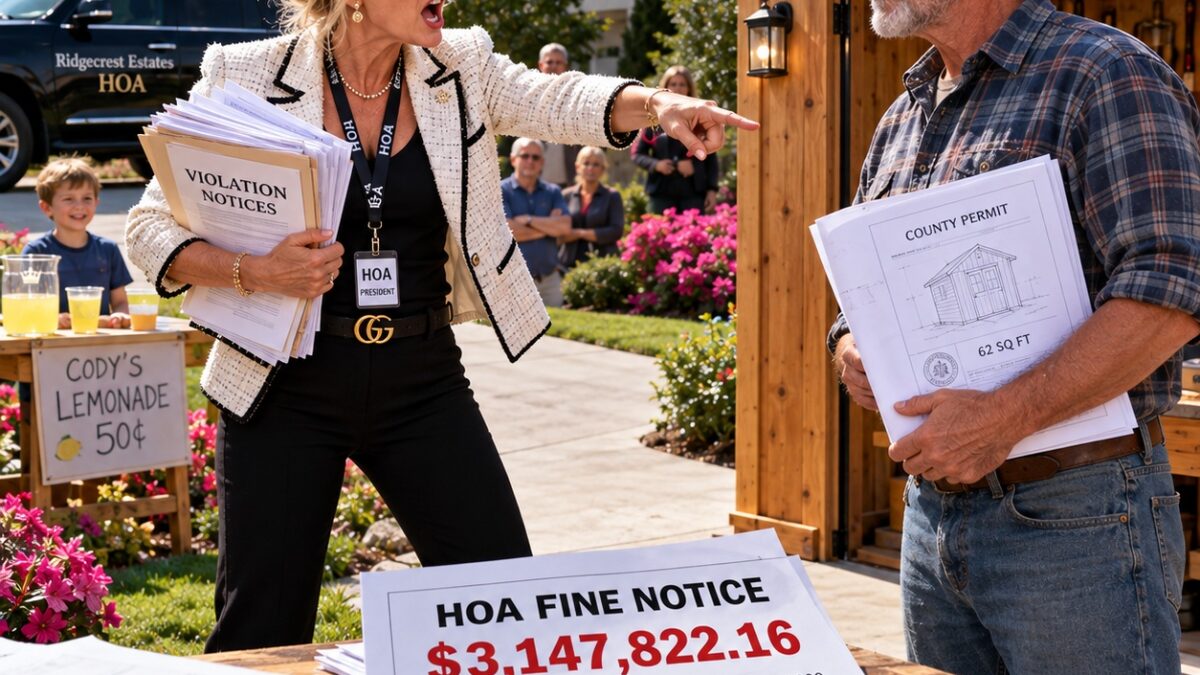
HOA Queen Fined Me $3.1 Million Over a 62-Sq-Ft Workshop—Then I Found Her House Was Built on Land Her Family Was Never Allowed to Develop
Tammy Burkhart stood in my driveway, pointed at the little cedar workshop I had built after my wife died, and told me that in Ridgecrest Estates, county permits meant nothing because her signature decided what was legal.
Three months later, she had invented enough fines to claim I owed the HOA $3,147,822.16, filed a lien against my house, and threatened foreclosure over a pickup truck, azaleas, a trash can, an old TV antenna, and my seven-year-old grandson’s lemonade stand.
What Tammy never expected was that I had spent thirty-two years as a county land surveyor—and when I stopped reading her violation notices and started reading the land records beneath her neighborhood, I discovered her entire little kingdom had been built on a lie.
My name is Garrett Shelton.
I moved to Ridgecrest Estates in the spring of 2022.
Eight months earlier, my wife Beth had died from pancreatic cancer.
Fourteen months from diagnosis to funeral.
That was all we got.
Fourteen months.
The house we had shared in Raleigh still smelled like her lavender lotion.
Not everywhere.
Just in certain places.
The hallway closet.
Her side of the bathroom cabinet.
One old sweater I could not bring myself to wash.
Grief is strange like that.
You can survive a funeral.
Sign paperwork.
Thank people for casseroles.
Answer sympathy cards.
Then one morning you open a closet, smell the person you lost, and suddenly standing upright becomes the hardest thing you have done all week.
My daughter Elaine lived about ten minutes from Ridgecrest.
She was a nurse.
Married.
Two children.
Cody was seven.
Harper was five.
Elaine never directly told me to move closer.
That would have sounded too much like she thought I was falling apart.
Instead, she sent listings.
One after another.
Three bedrooms.
Quiet street.
Small yard.
Big yard.
Near the hospital.
Near the school.
Then she sent me the house at the end of a Ridgecrest cul-de-sac.
Three bedrooms.
Deep backyard.
A row of white oaks along the rear fence.
I drove out alone.
Stood in the yard.
Listened to wind move through those trees.
And for the first time in months, I could picture living somewhere that did not contain Beth in every room.
I wrote a check that week.
The first thing I built was the workshop.
Sixty-two square feet.
Cedar frame.
Tin roof.
Workbench along one wall.
Vise.
Hand tools.
Small window facing the oaks.
Nothing fancy.
I did not build it because I needed storage.
I built it because woodworking was the only thing that made my brain quiet.
The smell of fresh-cut cedar dragged me into the present.
And after Beth died, the present was the only place that did not hurt.
I was halfway through building a rocking chair for Harper when the white Escalade arrived.
It did not pull into my driveway normally.
It stopped sideways across the entrance like a barricade.
Driver door opened.
A woman stepped out wearing a linen blazer over yoga pants.
Fresh blonde highlights.
Gucci sunglasses pushed onto her forehead.
Clipboard in her left hand.
HOA lanyard around her neck.
She walked toward me with the posture of someone serving a warrant.
“Mr. Shelton?”
“That’s me.”
“I’m Tammy Burkhart, president of the Ridgecrest Estates Homeowners Association.”
I had heard the name.
Everyone in Ridgecrest had.
Tammy had been HOA president since 2015.
Nine years.
People described her in the careful tone usually reserved for unstable relatives and aggressive dogs.
I wiped cedar dust from my hands.
“What can I do for you?”
She looked past me.
Straight at the workshop.
“That structure violates Article 14.3B of the CC&Rs.”
“No, it doesn’t.”
She blinked.
I think most people waited until at least the second sentence before disagreeing with her.
She opened the clipboard.
“No accessory structures exceeding sixty-four square feet may be constructed without prior approval from the architectural review committee.”
“That’s correct.”
She looked satisfied.
“My workshop is sixty-two.”
The satisfaction disappeared.
I walked inside.
Returned with the county permit.
“Measured twice. County inspected it.”
Tammy did not even glance at the paper.
“County permits don’t override HOA covenants, Mr. Shelton.”
“I didn’t say they did.”
“You built without approval.”
“The covenant you just quoted says approval is required for structures exceeding sixty-four square feet.”
She stared at the workshop.
“Your measurements may be inaccurate.”
“I spent thirty-two years as a county land surveyor.”
That should have ended the conversation.
Instead, Tammy smiled.
The kind of smile people use when they believe they are speaking to someone who has not yet accepted reality.
“Documentation does not frighten me.”
She tapped the clipboard.
“I am the documentation.”
I almost laughed.
She continued.
“I decide what is compliant in this neighborhood.”
I looked at her.
“My county permit says sixty-two square feet.”
“My signature says violation.”
Then she taped a notice to my front door.
Fourteen days to comply.
She walked back to the Escalade.
Halfway into the street she stopped.
Adjusted her side mirror.
Not to check traffic.
To examine her jawline.
She tilted her chin.
Pursed her lips.
Gave herself a small approving nod.
Then eased backward at roughly two miles per hour.
The whole departure took almost ninety seconds.
I timed it.
My mailbox deserved overtime pay for how long she hovered beside it.
I was still standing outside when my neighbor Dwight Parnell walked over.
Sixty-three.
Retired electrician.
Built like a man who had spent forty years carrying conduit up ladders.
Coffee mug in one hand.
Expression on his face said he knew exactly what had just happened.
“She get your workshop?”
“She tried.”
Dwight sipped his coffee.
“She did the same thing to the Hendersons.”
“What did they build?”
“Nothing at first.”
He nodded toward Tammy’s disappearing Escalade.
“She fined them for a basketball hoop. Then a garden hose. Then their mailbox.”
“What happened?”
“They sold.”
He looked at the violation notice.
“She’s been running Ridgecrest like her personal kingdom for nine years.”
Then Dwight lowered his voice.
“She has a framed photograph of herself hanging in the HOA meeting room.”
I looked at him.
“She hung it there herself.”
That was the moment I should have realized this was going to get interesting.
Instead, I folded the violation notice.
Put it in my pocket.
Went back to sanding Harper’s rocking chair.
The cedar dust settled across my arms.
Evening light came through the little workshop window.
And I had no idea Tammy Burkhart had just made the worst decision of her nine-year reign.
She had picked a fight with a man who had spent his entire career reading fine print.
And the fine print beneath Ridgecrest Estates was about to become a very serious problem for her.
PART2
The notices began arriving like subscription boxes nobody had ordered.
Week one after the workshop:
My Ford F-150 violated “residential vehicle aesthetic standards.”
The truck was two years old.
Clean.
Registered.
North Carolina plates.
No commercial lettering.
No modifications.
I photographed nine other trucks in Ridgecrest.
Older.
Rustier.
Louder.
One had a cracked tailgate held shut with a bungee cord.
Nobody else received a violation.
I mailed Tammy a certified response with the photographs.
Return receipt requested.
Week two:
My azalea bushes were classified as “non-conforming landscaping species.”
Azaleas.
In North Carolina.
You could drive half an hour in any direction and see enough azaleas to supply a garden center.
So I printed guidance from the North Carolina State Extension Service.
Native and commonly cultivated species.
Then I photographed the identical azaleas growing in the HOA-maintained planter near the entrance.
Paid for with HOA funds.
Same species.
Probably same nursery.
Certified mail.
Return receipt.
Week three:
Workshop paint color.
Unauthorized earth tone.
I had painted it Sherwin-Williams Warm Stone.
Color number four on Ridgecrest’s approved exterior palette.
I photographed the paint can beside the printed CC&R color chart.
Added a ruler for scale.
Exact match.
In fact, the HOA’s paper chart had faded enough that my paint was probably closer to the original specification than their own copy.
Certified mail.
Return receipt.
Week four:
Trash cans visible after collection hours.
Pickup occurred at 7:12 a.m.
I brought the cans inside at 7:31.
Tammy’s notice cited 7:35.
Dwight had seen her parked three houses down inside the Escalade.
He took a photograph.
In it, Tammy was holding up her phone.
Apparently timing me.
So now I had a picture of Tammy taking a picture of my trash cans.
I printed it.
Added the date.
Placed it in a three-ring binder.
Dwight started calling that binder the Tammy Chronicles.
I hated the name.
Then I started using it too.
Every notice.
Every response.
Every postal receipt.
Every photograph.
Every date.
Tab after tab.
What interested me was not the number of complaints.
It was the wording.
Tammy used legal phrases that sounded impressive until you read them carefully.
“Noncompliant curtilage utilization.”
“Pattern of aesthetic derogation.”
“Community standing nuisance.”
She was copying language from somewhere without understanding it.
The documents had the shape of law.
Not the substance.
That mattered to me.
Surveyors live inside details.
You learn very quickly that a line can look correct on a drawing and still be wrong on the ground.
Tammy’s authority felt the same way.
Official from a distance.
Crooked when measured.
Then one Saturday afternoon I heard voices behind the workshop.
I stepped outside.
Two men stood in my backyard.
Khaki pants.
Polo shirts.
Measuring tape stretched from the fence toward my workshop.
“Can I help you?”
The taller man looked at me.
“Mrs. Burkhart sent us.”
“For what?”
“She said your property line might be encroaching on common area.”
That sentence almost qualified as performance art.
I walked toward them.
The tape extended from the fence to a point about six feet inside my yard.
The actual common area sat roughly forty feet in the opposite direction.
“Gentlemen.”
They stopped.
“I surveyed land for this county for thirty-two years.”
The shorter man looked down at the tape.
“The recorded property line is exactly where that fence sits.”
I pointed.
“And right now both of you are standing on my property.”
The shorter one began retracting the tape.
Click.
Click.
Click.
The metal snapped back into the case.
“She told us you’d be difficult,” the tall one said.
“I’m not difficult.”
I smiled.
“I’m accurate.”
They left.
I filed a formal HOA complaint for unauthorized entry.
The Ridgecrest board consisted of five people on paper.
In practice, three.
Tammy.
Donna Sprague.
Patty Yardley.
Donna and Patty approved whatever Tammy proposed with the speed of a reflex.
My complaint was “noted and filed.”
In Tammy’s system, that meant buried.
So I called the county surveyor’s office.
Janet answered.
I knew her from years ago.
She pulled the original Ridgecrest plat.
Then my lot.
Ten minutes.
“Garrett, your fence is on the recorded line.”
“I know.”
“No encroachment.”
“I know.”
“You need that in writing?”
“Yes.”
An email arrived within the hour.
I printed two copies.
One went into the binder.
One went to the HOA.
That evening, I sat on the porch with sweet tea.
Blue Ridge light fading.
Crickets loud.
Honeysuckle in the air.
My phone buzzed inside.
Probably another HOA email.
I did not check.
I opened the binder instead.
Added the county confirmation.
Wrote the date on the tab.
Patterns were forming.
And patterns were my profession.
Six weeks in, Tammy stopped pretending to be an inspector.
She became a legislature.
She called what she described as an “emergency board session.”
No notice to homeowners.
No posted agenda.
No email.
No announcement.
Just Tammy, Donna, and Patty inside the community center.
Same room with Tammy’s portrait on the wall.
The three of them supposedly voted unanimously to create a special penalty.
The new language said any homeowner with an unresolved violation older than thirty days would owe:
$500 per day per violation.
Retroactive.
Effective immediately.
Applicable to outstanding complaints.
I did the math.
Four violations.
Five hundred dollars each.
Forty-seven days.
Ninety-four thousand dollars.
For a truck.
Azaleas.
Paint.
Trash cans.
I requested the minutes.
Two days later, the HOA emailed me a polished document.
Blue seal.
Professional formatting.
At the top:
Five board members present.
Motion carried unanimously.
Five.
That was a problem.
Dwight had mentioned the other two board members, Vernon Cross and Lynette Palmer.
Neither had attended meetings for almost a year because Tammy kept scheduling sessions during their work hours.
I called Vernon.
“Did you attend an emergency HOA meeting last Tuesday?”
Long silence.
“What emergency meeting?”
Then Lynette.
Same answer.
“She never called me.”
“Email?”
“No.”
“Text?”
“No.”
“How did you hear about it?”
“Donna’s daughter posted ‘productive session today’ on Facebook with a smiley face.”
I asked both to give me dated written statements.
They did.
I printed the official minutes.
Highlighted:
FIVE BOARD MEMBERS PRESENT.
Placed Vernon and Lynette’s statements beside them.
Another tab.
Tammy had falsified the minutes.
Not a misunderstanding.
Not sloppy paperwork.
A false official record presented to the membership.
I knew enough corporate law to understand how serious that could become.
But I did not file suit.
Not yet.
I wanted to see what she did next.
I did not wait long.
Tammy began walking door to door.
The Escalade rolled behind her at idle like a suburban presidential motorcade.
She told neighbors I was lowering property values.
Refusing to meet community standards.
Displaying “chronic noncompliance.”
Some people believed her.
Two stopped waving.
Someone slipped an anonymous note into my mailbox.
FOLLOW THE RULES LIKE EVERYONE ELSE.
Connie Voss, a schoolteacher three houses down, told me Tammy cornered her at the mailboxes.
“She asked me to sign a petition to have you formally censured.”
“For what?”
“She said accountability.”
Connie shook her head.
“I think it means she’s mad.”
I thanked her.
Went back to the workshop.
The rocking chair was almost finished.
Long curls of cedar came off the hand plane.
Evening light turned the floor gold.
Beth would have loved that chair.
I could almost hear her saying I had sanded it too much.
My binder had become thick.
My patience thinner.
But I still had no plan beyond documenting.
Three months after the first visit, Tammy went nuclear.
I came home from Elaine’s house on a Thursday and found a thick envelope on my porch.
Eleven pages.
Heavy stock.
Black binder clip.
Embossed HOA seal.
Not stamped.
Embossed.
It looked like somebody had combined a legal pleading with a wedding invitation.
The cover read:
FINAL COMPLIANCE DEMAND
LOT 47
RIDGECREST ESTATES
SHELTON, G.
I sat in the finished rocking chair.
Opened a bottle of Cheerwine.
Started reading.
Six violations now.
The original four.
Plus:
Unauthorized satellite dish.
The “satellite dish” was a twenty-year-old TV antenna bolted to the back of the house before I bought it.
Then:
Commercial activity on residential property.
That one took me a second.
Then I remembered Cody.
My seven-year-old grandson had set up a lemonade stand the previous Saturday.
He made eleven dollars.
Gave Harper half for holding the sign.
According to Tammy Burkhart, my grandson was now a commercial enterprise.
Six violations.
Five hundred dollars per day.
Then the masterpiece.
Tammy had added compound interest.
One-point-five percent monthly.
Retroactive.
According to her calculation, my outstanding balance was:
$3,147,822.16.
I read the number twice.
Three point one million dollars.
For a sixty-two-square-foot workshop.
A truck.
Azaleas.
Paint.
Trash cans.
An antenna.
And lemonade.
I did the per-square-foot calculation because if someone hands you stupidity on that scale, you might as well measure it.
More than fifty thousand dollars per square foot for the workshop.
Tammy had apparently transformed my cedar shed into the most valuable structure in North Carolina.
But attached to the notice was something not funny.
A lien.
Filed at the Catawba County courthouse.
My property.
Three-million-dollar claim.
Behind it:
A letter from an attorney named Rick Osteen threatening foreclosure if I did not pay within ninety days.
That night I could not sleep.
Not because I believed Tammy could collect three million dollars.
Because something did not fit.
At two in the morning I got up.
Made coffee.
Spread the CC&Rs across the kitchen table.
Tammy cited Section 22.7.
Compound interest on unpaid assessments.
I found it in the digital version from the HOA website.
Clear as day.
Then I pulled the original CC&Rs from my closing documents.
The recorded version.
Section 22.7 did not exist.
I compared both line by line.
The online document contained an entire paragraph absent from the county-recorded copy.
Same font.
Same spacing.
Same style.
Somebody had typed a new clause into the digital CC&Rs and presented it as binding law.
I put the documents side by side.
Highlighted the added language.
That was forgery territory.
And something changed inside me.
Not fear.
Not even anger.
Curiosity.
Professional curiosity.
The same feeling I used to get when a boundary description did not close.
Something beneath Ridgecrest was structurally wrong.
Tammy’s fake clause was not the foundation.
Just a crack.
I wanted the foundation.
I called Elaine the next morning.
She started crying before I finished.
“Dad, they can’t take your house, can they?”
“Honey.”
I looked at Beth’s photograph beside the phone.
“Nobody’s taking anything.”
“But three million—”
“Your father has been reading fine print longer than that woman has been playing president.”
I paused.
“And I just found out she’s been writing her own.”
After the call, I drove to the Catawba County Register of Deeds.
I was done investigating violations.
I wanted the dirt underneath them.
The office smelled like old paper and floor wax.
Fluorescent lights.
Government beige.
Doreen worked the counter.
She had been there since the nineties.
“Garrett Shelton.”
She smiled.
“Back from retirement. What are you hunting?”
“History.”
I started with the Ridgecrest subdivision plat.
Recorded 2012.
Developer:
Lyle Burkhart Development LLC.
Tammy’s brother-in-law.
Forty-seven lots.
Community center.
Pool.
Common areas.
Everything neat.
Then I worked backward.
Lyle bought the property from the Caldwell family estate in 2010.
The Caldwells had owned it since the 1940s.
Cotton.
Cattle.
Christmas trees.
The last living Caldwell descendant still connected to the property was Earl Haywood.
Seventy.
Living in Marion.
Then I found an attachment buried inside the older deed chain.
Recorded in 1967.
North Carolina Land Trust.
Conservation easement.
Forty acres.
Creek corridor.
Southern fields.
Timber ridge.
Restrictions:
No subdivision.
No commercial development.
No permanent structures except agricultural use.
Signed by Lorraine Caldwell.
I adjusted my glasses.
Read again.
Doreen leaned over.
“Find something?”
I did not answer.
I searched amendments.
Releases.
Court orders.
Extinguishment documents.
Nothing.
The easement had never been released.
Still active.
Still enforceable.
Sitting in public record for more than fifty years.
I overlaid the easement boundary with Ridgecrest.
Twenty-three of the forty-seven lots fell inside it.
The clubhouse.
The pool.
The community center where Tammy held meetings under her own portrait.
And Lot 31.
Tammy Burkhart’s house.
Three thousand two hundred square feet of colonial revival.
Built on land legally promised to remain undeveloped.
I sat back.
Doreen looked at me.
“Garrett?”
I pointed to the map.
“This neighborhood should never have been built like this.”
I dug deeper.
Lyle had paid $480,000 for the entire property.
Forty-seven potential homesites in a growing county with good schools and mountain views.
Far below comparable market value.
Why so cheap?
Because the land was encumbered.
The easement made huge parts effectively unbuildable.
Then I pulled planning commission minutes.
2011 subdivision approval.
Five commissioners.
Passed four to one.
One yes vote:
Wade Burkhart.
Tammy’s husband.
Lyle’s brother.
No recusal.
No conflict disclosure.
Wade had helped approve his own brother’s development on restricted land.
Then purchased three lots inside the subdivision shortly afterward.
I walked out of the courthouse.
Sat in my truck.
Did not start the engine.
For three months Tammy had been trying to charge me millions over a sixty-two-square-foot legal workshop.
Meanwhile, her own house stood inside a conservation easement.
Her authority came from CC&Rs recorded against a subdivision plat created on land that should not have been developed that way in the first place.
She had built a kingdom on a legal fault line.
And she had chosen a retired surveyor to antagonize.
For the first time in months, I smiled.
A real one.
The next three weeks were the quietest and busiest of my life.
First call:
North Carolina Land Trust.
Their Asheville office.
Program director Patricia Hale agreed to meet.
I brought the 1967 easement.
Ridgecrest plat.
My hand-drawn overlay.
Patricia stared at the map for ten seconds.
Her expression changed.
“We monitor this easement by aerial photography.”
“How often?”
“Every three years.”
She pulled up old images.
“The tree canopy along the creek has gotten so thick that some of these southern lots were obscured.”
She looked back at the map.
“We had no idea.”
“The easement?”
“Still active.”
“Any release?”
“No.”
“Court extinguishment?”
“No.”
She sat back.
“Mr. Shelton, this is not a technical violation.”
I waited.
“If a developer knowingly built permanent residential structures inside protected acreage without Land Trust approval, that is an enforcement matter.”
“How serious?”
“It could affect title to every lot inside the boundary.”
I let that sit.
Then asked:
“If this becomes public, will you attend the meeting?”
Patricia nodded.
“I’ll come myself.”
Second call:
Bryce Tillman.
Real-estate attorney.
Newton.
Sixty-one.
Suspenders.
Office overlooking the courthouse.
Shelves bowed under North Carolina property law.
He read the binder in one sitting.
Every notice.
Forged minutes.
Altered CC&Rs.
Lien.
Conservation easement.
Planning vote.
When he finished, he removed his glasses.
“Garrett.”
“Yes?”
“This is not an HOA dispute.”
“I know.”
“This is systematic fraud.”
He tapped the documents.
“The developer built on restricted land.”
Another tap.
“A planning commissioner approved his own brother’s project without recusing.”
Another.
“The HOA president altered governing documents and fabricated meeting records.”
Then:
“And somebody recorded a three-million-dollar lien using those alterations.”
He leaned back.
“What do you want?”
“My house left alone.”
“That’s the easy part.”
“I don’t want innocent homeowners destroyed.”
“That’s the hard part.”
I nodded.
Bryce smiled slightly.
“Good. At least you’re thinking about the right problem.”
He asked for three weeks.
While he handled law, I handled people.
Dwight.
Connie.
Vernon.
Lynette.
Tuesday night at my kitchen table.
Pizza.
Laptop.
Maps.
I projected the conservation easement in red.
Subdivision in blue.
Twenty-three overlapping lots.
Connie stared.
“So the playground she made me tear down…”
“Was on land that technically should never have been developed.”
Dwight leaned back.
“How many people has Tammy fined for violations inside this area?”
“At least fourteen from what I’ve found.”
Vernon shook his head.
“And Wade voted yes on the subdivision?”
“Yes.”
“His brother built it?”
“Yes.”
“And Tammy’s house is inside the easement?”
“Yes.”
Nobody spoke for several seconds.
Then Dwight said:
“Well.”
That one word carried a lot.
I filed public-records requests.
Planning documents.
Financial disclosures.
Inspection records.
Transfer records.
Permit files.
Public records are boring until somebody starts hoping you will not read them.
Then they become fascinating.
The last call was Jenna Coates.
Investigative reporter for the Hickory Daily Record.
She had already received complaints about Tammy.
When I told her about the easement, she went silent.
“Mr. Shelton.”
“Yes?”
“Can you send me everything?”
I did.
That night.
Then I installed cameras.
Four Ring cameras.
Porch.
Workshop.
Driveway.
Back fence.
One hidden trail camera facing the access road.
I had a feeling Tammy’s behavior would get worse once she realized I was digging.
I was right.
The rocking chair was finished by then.
I placed it on the porch.
Sat in it one evening.
Crickets.
Blue Ridge sky.
Cedar smell.
Somewhere down the valley, chimney smoke.
Beth would have loved it.
For the first time since she died, I did not feel lost.
Still lonely.
Still grieving.
But pointed somewhere.
Tammy found out.
Monday morning the community center manager called.
“Mr. Shelton, your meeting-room reservation next Tuesday has been canceled.”
“Why?”
“Maintenance.”
I drove by that afternoon.
Lights on.
Donna Sprague arranging chairs for bunco night.
Tuesday:
HOA email blast.
Subject:
PROTECTING OUR COMMUNITY FROM INTERNAL THREATS
Tammy accused me of undermining property values.
Refusing to pay lawful assessments.
Jeopardizing Ridgecrest’s financial health.
She called me a “chronic non-compliant resident.”
Fourteen grammatical errors.
Three legal terms used incorrectly.
One sixty-seven-word sentence without a period.
She used “cease and desist” once as a noun and once as an adjective.
The literary equivalent of a dog wearing a necktie.
Wednesday:
My workshop lost water.
The hose bib fed from a common utility line.
Valve turned off.
Not broken.
Turned.
I called the community center.
The manager sounded uncomfortable.
“Mrs. Burkhart authorized suspension due to unpaid assessments.”
An HOA cannot simply disconnect a homeowner’s utility as a punishment.
I photographed the valve.
Recorded video.
Timestamp.
Added everything to the binder.
Thursday night.
2:14 a.m.
Trail camera triggered.
I slept through it.
Next morning, I watched the footage over cereal.
Dark Ford Ranger.
No headlights.
Driver in a hoodie.
He approached the workshop.
Spray can.
Red letters across the cedar door.
DEADBEAT
Then he turned toward the road.
Dwight’s motion light came on.
For about a second, the truck’s side panel became visible.
Faded company lettering.
LYLE BURKHART DEVELOPMENT LLC
I paused the video.
Zoomed.
Saved copies.
Emailed Bryce.
Tammy’s war had just gained a vehicle.
The following week she threatened Connie.
“If you keep talking to that man, I’ll make sure your lease renewal gets a very thorough review.”
Connie stared at her.
“Tammy, I own my house.”
Tammy answered:
“We’ll see about that.”
Dwight found a flyer on his windshield.
GARRETT SHELTON IS DESTROYING YOUR PROPERTY VALUES. ASK THE BOARD FOR THE TRUTH.
Comic Sans.
Of course.
I added it to the binder.
Tabs A through Q.
Every action Tammy took made my file thicker.
She thought she was fighting a grieving retiree with a woodworking hobby.
She did not understand she was fighting somebody who had spent thirty-two years making sure property records could survive scrutiny.
Then Wade got nervous.
I returned to the Register of Deeds.
Doreen lowered her voice.
“Garrett, someone from the commissioner’s office called yesterday.”
“About what?”
“You.”
I waited.
“They asked why you’ve been pulling Burkhart records.”
“Did you tell them?”
“It’s public information. I had to.”
She frowned.
“But nobody has ever asked me to track a citizen’s requests before.”
Wade was watching.
Files began taking longer to retrieve.
Ten-minute records became one-hour records.
One was “temporarily unavailable.”
Another “misfiled.”
Government language for delay.
Not disappearance.
You cannot erase public records easily.
You can make somebody work harder to get them.
Bryce called that afternoon.
“Garrett, Rick Osteen contacted me.”
“Tammy’s lawyer?”
“Lyle’s.”
“What does he want?”
“Settlement.”
Two days later, Osteen sat across from us in Bryce’s office.
Suit probably cost more than my truck payment.
Shoes had never touched gravel.
His client wanted to resolve matters “amicably and privately.”
Offer:
One hundred fifty thousand dollars.
They would remove Tammy’s lien.
I would drop all claims.
And sign an NDA covering:
The easement.
Wade’s vote.
Wade’s lot purchases.
Forged minutes.
Altered CC&Rs.
Everything.
Osteen folded his hands.
“My client believes this is generous.”
I looked at Bryce.
He gave a slight nod.
My decision.
I turned back.
“Tell your client I didn’t spend thirty-two years reading maps to be bought off by a man who can’t read an easement.”
Osteen’s expression barely changed.
“And tell him next time he sends someone to paint my workshop at two in the morning, he should choose a truck without his company logo.”
His pen stopped.
That was all.
Afterward, I dug deeper into Wade.
County GIS.
Transfer history.
Financial disclosures.
Lyle bought the Caldwell acreage for $480,000.
Comparable undeveloped land should have been closer to $1.2 million.
That discount only made sense if the conservation restriction had materially depressed value.
Meaning Lyle knew.
Or should have known.
Then Wade’s disclosure.
Three Ridgecrest lots.
Purchased within sixty days of his vote approving the development.
Lots 9, 15, and 22.
Current combined value roughly $1.2 million.
Purchase price:
Forty-one thousand each.
Insider pricing.
Sitting planning commissioner.
Brother’s project.
No recusal.
No disclosure.
Then he bought into the development he had helped approve.
I sent the documents to Bryce.
His reply contained four words.
This changes the case.
Jenna’s response was shorter.
Story is ready.
The annual HOA meeting was twelve days away.
Tammy had scheduled it.
Set the agenda.
Booked the community center.
Ordered refreshments.
She planned to use the meeting to authorize foreclosure against me.
She had no idea she had built the stage for her own removal.
Saturday.
October.
Community center smelled like industrial carpet cleaner and leftover microwave popcorn from the kids’ movie night.
Rows of folding chairs.
Podium.
Projector.
Printed agenda at every seat.
Cheese cubes.
Fruit trays.
Sparkling water.
One hundred twenty-seven homeowners showed up.
Largest turnout Ridgecrest had ever seen.
Tammy opened at ten sharp.
Navy blazer.
Pearls.
Confidence.
She spoke for five minutes about community integrity.
Property values.
Shared standards.
Then agenda item seven.
“I move that the board authorize foreclosure proceedings against Lot 47, the Shelton property, for failure to pay assessments totaling three million one hundred forty-seven thousand eight hundred twenty-two dollars and sixteen cents.”
Donna seconded.
I stood.
“Madam President.”
Tammy stopped.
“Article 9.2 gives any homeowner the right to address membership before a vote affecting their property.”
Her smile tightened.
“You have three minutes.”
“I’ll need seven.”
A few people laughed.
“But I think everyone here will want to hear it.”
I walked to the podium.
No notes.
Just a flash drive.
I plugged it into Tammy’s projector.
Slide one.
Ridgecrest Estates subdivision plat.
“This is the recorded Ridgecrest plat.”
Click.
Red boundary appeared.
“And this is a conservation easement recorded in 1967 by the Caldwell family with the North Carolina Land Trust.”
Twenty-three lots lit up inside the overlap.
The room changed.
No coughing.
No whispering.
“This easement prohibits subdivision, commercial development, and permanent structures except agricultural use.”
I looked at the crowd.
“It has never been released.”
Then:
“Twenty-three homes in Ridgecrest, along with the clubhouse, pool, community center, and the house belonging to our HOA president, were built inside land legally protected from development.”
Tammy’s face lost color.
I clicked again.
Wade’s planning vote.
No recusal.
Then his financial disclosure.
Three lots.
Insider prices.
Then the forged board minutes.
Official copy:
Five members present.
Vernon and Lynette’s signed statements:
They were never notified.
Then the CC&Rs.
Recorded version on the left.
Tammy’s altered website version on the right.
Yellow highlight over her homemade compound-interest clause.
Then the trail-camera footage.
Dark truck.
Red spray paint.
DEADBEAT
The frame froze.
Lyle Burkhart Development logo visible.
Every click was another piece of structure falling away.
A man in the third row stood.
“Are you saying my title might not be clean?”
I looked at him.
“I’m saying the people who developed this neighborhood knew or should have known about the easement and built anyway.”
Another homeowner:
“What happens to our mortgages?”
“That is being reviewed.”
Tammy slammed one hand on the podium.
“This is misinformation.”
Then the back door opened.
Jenna entered with a cameraman.
Behind her:
A Catawba County sheriff’s deputy.
Tammy snapped around.
“Who called them? This is a private meeting.”
Bryce stood from the second row.
“This is a meeting of a nonprofit corporation governed under North Carolina planned-community law.”
He nodded toward Jenna.
“The press may attend.”
Then toward the deputy.
“And the deputy is responding to complaints filed this morning.”
Tammy looked at Wade.
“Tell them this is ridiculous.”
Wade stood.
Looked at the conservation-easement map.
Looked at the deputy.
Then walked out the side door.
His folding chair caught his leg and tipped over.
Metal slammed against the floor.
That sound cut through the room like a verdict.
Tammy called after him.
“Wade.”
He did not turn.
The deputy approached.
“Mrs. Burkhart, I have some questions regarding complaints filed by the North Carolina Land Trust and your association’s counsel.”
Tammy pointed at me.
“He is the one you should investigate.”
Her voice had changed.
Sharp.
“He owes this community more than three million dollars.”
I looked at her.
“Ma’am, I didn’t do anything to you.”
The room stayed quiet.
“Your family built this neighborhood on a lie.”
I held up the old easement.
“I just found the receipt.”
The room erupted.
Not screaming.
Recognition.
One hundred people suddenly understanding that the woman who had spent years measuring their grass and threatening them over paint had less legitimate authority than she pretended.
Someone in the back stood and applauded.
Then another.
Then another.
The applause rolled forward.
Tammy stood alone at the podium.
Clipboard on the floor.
Cheese cubes untouched.
Sparkling water sweating under fluorescent lights.
Her portrait still hanging behind her.
By Monday, it was gone.
The fallout came quickly.
Wade resigned from the planning commission three days later.
The district attorney opened a preliminary inquiry into the subdivision approval and Wade’s financial disclosures.
His three investment lots were flagged.
The North Carolina Land Trust served Lyle Burkhart Development with an enforcement action.
Patricia Hale eventually stood in court explaining why forty acres of protected land had houses on it.
Lyle’s attorney filed six delay motions.
The judge denied all six in one afternoon.
Tammy faced a removal vote.
119 to 3.
The three were Tammy, Donna, and Patty.
Donna cried.
Patty reportedly asked whether they still got to keep the community-center key.
Somebody in the back shouted:
“Lady, the biggest mistake was giving you a clipboard.”
Even the deputy smiled.
Every fine against me was voided.
The three-million-dollar demand disappeared.
The lien came off my property.
The forged minutes and altered CC&Rs were referred for investigation.
Jenna’s story ran above the fold.
Shared thousands of times.
But none of that was the hardest part.
The hardest part was the twenty-three families inside the easement.
People who had done nothing wrong.
Some had retirement savings tied up in those homes.
Some had mortgages.
Some had children.
They woke up one morning and discovered the dirt beneath their largest financial asset carried a legal restriction that predated their subdivision by decades.
I was not going to let them become collateral damage.
Bryce.
Patricia.
The Land Trust.
We negotiated for two months.
The eventual solution was practical.
The Land Trust agreed to amend the conservation easement.
Residential lots already developed would be released.
In exchange:
Permanent conservation protection over the creek corridor.
And fifteen acres along the ridge.
Lyle funded the resolution.
Cost:
About $1.2 million.
Almost exactly the current value of Wade’s three insider lots.
Every affected title was cleared.
Every mortgage remained intact.
Nobody lost a home.
Property values eventually recovered.
Some even increased because Ridgecrest finally had clean title and transparent governance.
Vernon Cross became HOA president.
His first action:
Abolish compound fines.
Second:
Approve a community workshop space.
Connie put her children’s playground back up.
Dwight rehung his American flag.
Nobody wrote either of them a violation.
I proposed something else.
The Caldwell Conservation Fund.
Named for the family who had recorded that easement in 1967.
Its purpose was simple.
Protect agricultural and conservation land in Catawba County so another developer could not quietly build first and ask questions later.
Earl Haywood came to the ribbon cutting.
Caldwell Feed and Supply cap.
Looked like it had survived every summer since 1975.
He shook my hand with both of his.
“My grandmother would have liked you.”
That was enough.
My workshop remained standing.
Sixty-two square feet.
Still Warm Stone.
Still legal.
The word DEADBEAT disappeared from the door.
I sanded it off one Saturday morning.
Cody handed me sandpaper.
Harper sat on the porch swing eating a Popsicle.
“Why did somebody write that?” Cody asked.
“Because they were mad.”
“At you?”
“Yes.”
“Were you a deadbeat?”
“No.”
He thought about that.
“Then why’d they write it?”
I smiled.
“Sometimes people write things because they hope paint can make them true.”
Cody accepted that.
Harper did not care.
She was more interested in whether we could build a birdhouse.
So now I teach woodworking in that little shop on Saturday mornings.
Six neighborhood kids.
Birdhouses.
Small shelves.
One wobbly stool that required emergency screws.
Cody says his birdhouse is a bird mansion.
Harper says hers is for butterflies.
“Butterflies don’t live in houses.”
She looked at me like I was stupid.
“They do in mine.”
Beth would have loved that.
Tammy moved into a two-bedroom apartment in Hickory.
Last I heard, she had already written formal complaints to her landlord about hallway noise, carpet stains, and one neighbor’s welcome mat being “visually aggressive.”
Some habits survive relocation.
Donna and Patty resigned from everything.
Committees.
Board.
Volunteer groups.
I see them sometimes at the Piggly Wiggly.
Whenever I round a corner, they suddenly become very interested in canned vegetables.
I never confront them.
There is nothing left to say.
That is the part of stories like this people misunderstand.
They imagine the satisfying ending is watching somebody humiliated.
Maybe it feels good for five minutes.
But the real victory is quiet.
The good kind.
No certified letters.
No Escalade parked three houses down photographing trash cans.
No fake legal language.
No forged minutes.
No three-million-dollar lien sitting on your home.
Just ordinary life.
That is what I wanted from the beginning.
Some evenings I sit in Harper’s rocking chair on the porch.
The last sunlight settles behind the Blue Ridge.
Crickets start.
Honeysuckle in the air.
Cedar smell drifting from the workshop.
Sometimes Cody and Harper leave scraps of wood everywhere and I complain even though I secretly like seeing them.
Elaine comes by.
Dwight walks over with coffee even when it is too late in the day for coffee.
And sometimes, when the light hits the porch just right, I think about Beth.
Not only the hospital.
Not only cancer.
The good years.
Her laughing because I measured a picture frame three times before hanging it.
Her telling people I could find a property corner in a hurricane but could never find my car keys.
Her hand on mine.
The ordinary things grief almost erased at first.
That workshop helped me find those memories again.
Which is why Tammy’s first violation bothered me more than I admitted.
It was not just a shed.
It was the first thing I built after Beth died.
The first place where I could sit alone without feeling like I was drowning.
Tammy saw sixty-two square feet.
I saw survival.
Maybe that is why I kept answering every stupid notice instead of selling like the Hendersons.
I was tired of losing things.
Beth was enough.
Tammy did not get the workshop too.
Still, I did not beat her because I was more stubborn.
Stubbornness helped.
But the thing that ended her reign was documentation.
Certified letters.
Timestamps.
Photographs.
County confirmation.
Recorded CC&Rs.
Signed board statements.
Trail-camera footage.
Old deeds.
Public financial disclosures.
A conservation easement nobody had bothered to read in fifty-five years.
Paper.
Boring paper.
Tammy loved paperwork when she believed she controlled it.
She told me that first day:
“I am the paperwork.”
She was wrong.
No person is the paperwork.
The record exists outside whoever currently holds the clipboard.
That is the beauty of it.
Tammy could rewrite the digital CC&Rs.
She could invent a board meeting.
She could send legal threats.
She could file a lien.
But the recorded copy at the courthouse did not change because she wanted it to.
The 1967 easement did not disappear because Lyle ignored it.
Vernon and Lynette did not magically attend a meeting because Tammy typed their names into minutes.
Public records are patient.
They can sit quietly for fifty years.
Then one person asks the right question.
That was all I did.
Asked.
Does this line close?
Was this vote valid?
Where is the recorded clause?
Who owned the land before Ridgecrest?
What restrictions traveled with it?
Why was the purchase price so low?
Who voted for approval?
What did he buy afterward?
Survey work taught me that good investigations begin with something not matching.
You do not immediately decide who lied.
You follow discrepancy.
The first discrepancy was sixty-two versus sixty-four.
Then approved paint called unapproved.
Native azaleas called nonconforming.
Five board members supposedly present when only three existed in the room.
A compound-interest clause that appeared in one version of the CC&Rs and not another.
Each inconsistency pointed downward.
Eventually we reached the foundation.
The easement.
That is why I tell people not to panic when someone sends official-looking paper.
Read it.
Compare it.
Ask where it came from.
Authority should survive verification.
If asking for the original document makes someone angry, ask harder.
Tammy’s authority depended on people not checking.
For nine years, she had conditioned neighbors to believe resistance was more expensive than compliance.
Basketball hoop?
Take it down.
Flag?
Pay the fine.
Mailbox?
Replace it.
Garden hose?
Hide it.
Every victory taught the neighborhood another lesson.
Tammy decides.
Then she came to my house.
And I had spent my career learning the opposite lesson.
The line is not wherever the loudest person says it is.
The line is where the evidence puts it.
That difference ended everything.
I never considered myself brave.
I was retired.
Grieving.
Building furniture for grandchildren.
But grief had already taught me one thing about fear.
You can be afraid and continue anyway.
The night I saw the three-million-dollar lien, I was afraid.
Of course I was.
Anybody who tells you a lien against your house does not scare them is either lying or does not understand liens.
Elaine was afraid.
I heard it immediately.
But fear is not the same as defeat.
Sometimes fear tells you to stop arguing and start verifying.
So I did.
That changed my life.
It changed Ridgecrest too.
The new board began publishing minutes.
Real minutes.
Board members actually attended.
Votes happened.
Records were accessible.
The HOA did not disappear.
This was not a story where every rule vanished.
People still needed pool hours.
Common-area budgets.
Road maintenance.
Architectural review for actual large projects.
The difference was boring procedure.
Boring procedure is underrated.
It keeps power from becoming personal.
Vernon once called me after taking office.
“Garrett, somebody wants to paint their front door purple.”
“What are you calling me for?”
“You know the documents.”
“I know where property lines are.”
“Same thing.”
“No.”
He laughed.
“So what do I do?”
“Read the covenant.”
“And if purple is prohibited?”
“Then follow the procedure.”
“What if I hate purple?”
“Doesn’t matter.”
Pause.
“You’re no fun.”
“That’s why you elected Vernon instead of me.”
He never called about paint again.
Connie’s playground became popular with neighborhood children.
Dwight’s flag still hangs.
The community workshop now holds tools donated by residents.
Some Saturdays my six woodworking kids walk there with me.
Harper still insists butterflies need houses.
I stopped arguing.
The Caldwell Conservation Fund grew slowly.
Not huge.
Enough.
It helped educate landowners about conservation easements.
Paid for title reviews in a few cases.
Partnered with local groups protecting creek corridors.
Earl Haywood attended the first annual meeting.
Sat in the back.
Said almost nothing.
Afterward, he stood beside the creek.
“You know my grandmother used to bring us down here when we were kids.”
“Lorraine?”
He nodded.
“She loved this ridge.”
“Why’d she record the easement?”
Earl looked toward the trees.
“She watched two neighboring farms get cut into subdivisions.”
He took off his cap.
“She said someday money would get louder than memory.”
I looked at him.
“And she wanted paper louder than money.”
He smiled.
“Something like that.”
That sentence stayed with me.
Lorraine Caldwell had never met Tammy.
Never met Lyle.
Never met Wade.
She did not know what Ridgecrest Estates would become.
She simply understood that land outlives people.
And promises need more than good intentions.
So she recorded one.
Half a century later, it stopped a lie.
Not before damage occurred.
But in time to repair it.
That is what good documents do.
They give future people something solid to stand on.
Beth understood that kind of thinking too.
She used to tease me about saving every receipt.
Every instruction manual.
Every warranty.
“Garrett, nobody needs documentation for a toaster.”
Then when the toaster broke, she would hand it to me and say:
“Find the paperwork.”
I miss that.
Little arguments.
Ordinary sarcasm.
The things you never imagine becoming precious.
Maybe that is why the binder became emotionally important.
It was not only evidence.
It was proof that I had not disappeared inside grief.
I was paying attention again.
Making dates.
Cross-references.
Questions.
Something in me had turned back on.
Tammy certainly did not intend to help me.
But fighting her forced me out of the fog.
I will give her exactly that much credit.
No more.
Jenna wrote a follow-up article a year after the annual meeting.
She asked me whether I felt vindicated.
I hated the word.
“Not really.”
“Why?”
“Because twenty-three families spent months terrified about their titles.”
“But you won.”
“I got my lien removed.”
“And exposed fraud.”
“Yes.”
“And Tammy was removed.”
“Yes.”
She waited.
“So what do you call that?”
I thought about it.
“Cleanup.”
Jenna laughed.
“Cleanup?”
“That’s what it was.”
The mess already existed.
The easement.
The bad approvals.
The altered documents.
I did not create the scandal.
I found it.
Then people cleaned it up.
Land Trust.
Lawyers.
Homeowners.
County officials.
New board.
The most satisfying outcome was not Tammy moving away.
It was those twenty-three families receiving clean titles.
I had watched some of them arrive at the annual meeting angry at me.
By the end, they understood I was the person who had told them the truth.
That did not make me a hero.
It made me the messenger.
And I was glad we found a solution that did not punish them for someone else’s fraud.
There was one couple in particular.
Retired.
Lot 18.
Inside the easement.
Their mortgage represented most of their life savings.
The wife called me after the amendment was finalized.
“We got the letter.”
“Good.”
“Our title is clear?”
“Yes.”
Long pause.
Then I heard crying.
“Thank you.”
“You don’t owe me that.”
“We signed Tammy’s petition against you.”
I remembered their names.
“It’s okay.”
“No.”
She sniffed.
“It isn’t.”
“You believed what you were told.”
“We should’ve asked.”
Maybe.
But communities run on trust.
You cannot personally audit every claim your board makes.
That is why leadership matters.
Tammy exploited trust.
The residents were not stupid.
They were busy.
Jobs.
Children.
Mortgages.
You assume the woman who calls herself HOA president is at least reading the covenants she quotes.
You assume the developer’s lawyer checked title.
You assume planning commissioners disclose conflicts.
Civilization would be impossible if nobody could trust any process.
The answer is not permanent suspicion.
It is transparency.
Verification when something looks wrong.
Consequences when trust is abused.
Ridgecrest learned that.
So did I.
The three-million-dollar lien became a joke eventually.
Dwight had a coffee mug made.
$3,147,822.16
Printed across the side.
Underneath:
VALUE OF ONE NORTH CAROLINA LEMONADE STAND
He gave it to Cody.
Elaine made him keep it at my house because she said she was not explaining it to his teacher.
Cody thought it was hilarious.
Harper wanted one with butterflies.
Naturally.
The old violation binder sits on a shelf in the workshop now.
A through Q.
I do not open it often.
Sometimes one of the older neighborhood kids asks.
“What’s that?”
“History.”
“Boring.”
“Very.”
That is exactly where I want it.
Boring.
Done.
No longer alive inside the house.
Beth’s rocking chair still creaks slightly at the right rear joint.
I could fix it.
I do not.
The imperfection reminds me I built it during a time when my hands were steadier than the rest of me.
Harper has mostly outgrown sitting in it.
Sometimes she still does.
Her feet almost touch the floor now.
Cody builds things that look increasingly like actual objects instead of piles of nailed wood.
Elaine brings lunch.
Dwight complains that I teach kids to over-sand everything.
I tell him he is an electrician and therefore unqualified to discuss finishing.
He calls me a retired dirt measurer.
Normal.
Good.
That is the word I keep returning to.
Normal.
For nine months, my life revolved around Tammy Burkhart.
Certified mail.
Cameras.
Lawyers.
Records.
Meetings.
Every day brought some new absurdity.
Then suddenly it ended.
Quiet returned.
And I realized quiet was what I had wanted since Beth died.
Not emptiness.
Quiet.
There is a difference.
Emptiness feels like something missing.
Quiet feels safe.
The porch gives me that now.
Last light behind the Blue Ridge.
Crickets.
Honeysuckle.
Cedar.
The neighborhood beyond the cul-de-sac.
People living.
Kids yelling.
Someone mowing too late.
Dog barking.
No Escalade creeping past.
No clipboard.
Sometimes I still look toward the driveway expecting white headlights.
Old habits.
Then I laugh at myself.
Tammy is gone.
The workshop remains.
That is enough.
If there is one thing I learned from thirty-two years of surveying and nine months dealing with an HOA president who thought her signature outranked public record, it is this:
The loudest claim is not necessarily the strongest one.
Property lines are quiet.
Deeds are quiet.
Recorded easements are quiet.
Meeting minutes are quiet.
Bank records are quiet.
A return receipt from certified mail is very quiet.
But when conflict reaches a courtroom or a public meeting, those quiet things suddenly become the only things that matter.
Tammy spent nine years teaching Ridgecrest to fear her voice.
I spent a few months collecting paper.
Paper won.
Not because paperwork is magical.
Because evidence does not need charisma.
That first morning, Tammy told me:
“I am the paperwork.”
I think about that sentence sometimes.
She truly believed it.
That was her fatal mistake.
People in authority sometimes start believing the institution exists because they occupy the chair.
The board becomes my board.
Rules become my rules.
The neighborhood becomes my community.
Then disagreement becomes disobedience.
Records become obstacles.
Procedure becomes optional.
And eventually they forget something simple.
The chair existed before them.
It will exist after them.
The documents do not belong to them.
Neither do the people.
Tammy was temporary.
So was Wade’s commission seat.
So was Lyle’s development company.
The conservation easement had already outlived half the people who signed it.
That perspective helps.
Power looks smaller when you compare it with time.
The white oaks behind my workshop were there before Ridgecrest was built.
If disease or lightning leaves them alone, some will be there after I am gone.
Harper may inherit the rocking chair.
Cody may remember building birdhouses.
Elaine will remember worrying somebody was going to take her father’s home over fake fines.
And maybe nobody will remember Tammy Burkhart except as a story people tell when somebody gets too impressed with a clipboard.
That seems fair.
I once asked Earl Haywood whether Lorraine Caldwell had been difficult.
He laughed.
“Terribly.”
“Good.”
“She argued with everybody.”
“Even family?”
“Especially family.”
“What did she argue about?”
“Land.”
Of course.
He looked toward the ridge.
“She used to say developers could promise anything because they’d be gone by the time the promise mattered.”
That sounded exactly like the woman who recorded a conservation easement in 1967.
She had understood something Tammy did not.
Real authority is not about being obeyed today.
It is about creating rules strong enough to remain legitimate tomorrow.
Lorraine did.
Tammy didn’t.
That was the difference.
The Caldwell easement was amended eventually, yes.
But not secretly.
Not by one person typing a new paragraph into a website.
Land Trust.
Attorneys.
Affected owners.
Public record.
Permanent replacement conservation.
Creek corridor protected.
Ridge land protected.
Court-recognized process.
That is what lawful change looks like.
Slower.
Messier.
More boring.
And because it is slower and messier, it lasts.
The ridge is still green.
The creek still runs.
Homes remain.
The workshop remains.
That is a better ending than any revenge story.
Tammy could have avoided every part of it.
That may be the strangest thing.
If she had looked at my permit.
Read Article 14.3B correctly.
Measured sixty-two square feet.
And driven away—
I might never have examined anything.
If she had stopped after the first failed violation—
Maybe nothing.
If she had not forged meeting minutes—
Maybe nothing.
If she had not altered the CC&Rs—
Maybe nothing.
If she had not filed a ridiculous three-million-dollar lien—
I probably never would have gone to the Register of Deeds looking for the foundation beneath Ridgecrest.
Tammy had exit after exit.
She chose escalation every time.
That is how people like her eventually expose themselves.
They believe every resistance is proof they have not applied enough pressure.
So they apply more.
The extra pressure creates records.
Witnesses.
Mistakes.
Eventually evidence.
She tried to bury me under paperwork.
Instead, she created the index to her own downfall.
I do not hate her.
People find that surprising.
Dwight says I am lying.
Maybe a little.
But hate is work.
I already spent too much time on Tammy.
She does not deserve retirement space inside my head.
I keep the important lessons.
Not the anger.
Beth taught me life is short in a way no motivational phrase ever could.
One year you are deciding whether to repaint the kitchen.
Fourteen months later you are holding a funeral program.
That changes your standards for what deserves permanent emotional rent.
Tammy does not.
Harper does.
Cody does.
Elaine.
Beth.
The workshop.
The white oaks.
The rocking chair.
Those stay.
A woman with an Escalade and a fake compound-interest clause?
Temporary.
That is why the final thing I did after everything settled was not file another complaint.
Not post online.
Not demand an apology.
I finished a small cedar shelf for the workshop.
On it I placed three things.
The original county permit.
A copy of Lorraine Caldwell’s conservation easement.
And Dwight’s ridiculous $3.1 million lemonade mug.
That is the whole story, really.
A legal sixty-two-square-foot workshop.
A fifty-five-year-old document nobody bothered to read.
And a little humor once the danger passed.
Some evenings I sit in the rocking chair outside the workshop.
The new board has long since stopped talking about Tammy.
New families moved in who barely know the story.
That is good.
Communities should not remain trapped inside scandals forever.
Kids ride bicycles through the cul-de-sac.
Connie’s playground gets used.
Dwight’s flag moves in the breeze.
The common-area azaleas bloom every spring.
Same variety Tammy once fined me for planting.
Nobody has cited them.
Sometimes I look at those flowers and smile.
Not because they represent victory.
Because now they are just flowers again.
That is how you know a conflict is really over.
Ordinary things become ordinary.
The workshop is just a workshop.
The truck is just a truck.
Trash cans come in when I remember.
Not when somebody times me from an Escalade.
Cody may set up another lemonade stand someday.
If he does, I hope he raises the price.
Inflation.
Harper will probably build a butterfly mansion.
I will help.
And if somebody asks why a retired surveyor keeps a thick binder labeled TAMMY CHRONICLES above his workbench, I will tell them the simplest version.
A woman once tried to fine me $3.1 million because she thought she controlled the neighborhood.
I checked the records.
She didn’t.
Her family had built nearly half the subdivision on land they were never supposed to develop.
Twenty-three families almost paid the price.
We fixed it.
Then we went back to living.
That last part matters most.
Not the meeting.
Not the applause.
Not Tammy’s removal.
Living.
Because after Beth died, I did not know if I would ever feel like I was living normally again.
Then came cedar.
A workshop.
A rocking chair.
Two grandchildren.
A ridiculous HOA president.
And eventually a reason to pay attention to the world around me again.
Life has a strange sense of timing.
I would never thank Tammy for what she did.
But I can acknowledge what I found while resisting her.
Purpose.
Not a grand purpose.
Nothing cinematic.
Just something to solve.
A line to follow.
A document to read.
A lie to measure against the truth.
That was enough to bring part of me back.
So now when I sit outside in the evening, I sometimes run my hand along the rocking-chair arm.
Cedar smooth beneath my palm.
Beth’s absence still there.
Always.
But no longer the only thing in the room.
Cody’s laughter.
Harper arguing that butterflies need houses.
Elaine calling from the kitchen.
Dwight walking across the lawn with coffee.
Crickets.
Honeysuckle.
The white oaks.
A quiet neighborhood finally acting like a neighborhood instead of one woman’s private courtroom.
That is the ending I care about.
Tammy thought the most powerful document in Ridgecrest was whatever paper carried her signature.
She was wrong.
The most powerful document had been sitting at the courthouse since 1967.
Yellowing.
Ignored.
Patient.
The truth was never loud.
It did not need to be.
It was already recorded.








