FULL ENDING:“You Embarrass Me. I’m Disgusted by You.” My Daughter-in-Law Said It at My Grandson’s Graduation Dinner, Never Realizing I Had Spent Months Preparing for That Exact Moment
 Thank you

Twenty-two years earlier, Amanda had walked into my house carrying a bottle of wine and wearing a cream-colored dress.
My son David was twenty-eight.
He had already established himself as an engineer and was doing better financially than his father John and I ever had at that age.
He was confident.
Independent.
Thoughtful.
And hopelessly in love.
“Mom,” he whispered while Amanda was talking to John in the living room, “this is the one.”
I smiled.
“You’ve known her how long?”
“Four months.”
“That long?”
He laughed.
“I knew you’d say that.”
“I’m your mother. Skepticism is part of the job.”
He glanced toward the living room.
Amanda was laughing at something John had said.
She was beautiful.
Perfect blonde hair.
Blue eyes.
Elegant without looking as though she was trying.
She worked in marketing and seemed to possess an instinctive understanding of how to make people feel interesting.
At dinner, she asked about our marriage.
David’s childhood.
My work.
John’s career.
She complimented the roast.
Admired family photographs.
Listened closely when John told embarrassing stories about David at age six.
When they left, John closed the door and looked at me.
“He found himself a keeper.”
“I think so.”
And I meant it.
Six months later, David proposed.
That was when the first small warning signs appeared.
Amanda wanted a spectacular wedding.
Not beautiful.
Spectacular.
The most expensive venue available.
A custom designer gown from New York.
Imported flowers.
Ice sculptures.
A string quartet.
A twelve-tier cake that looked more architectural than edible.
Whenever David mentioned cost, Amanda became wounded.
“This is the only wedding I’m ever going to have.”
Eventually David would sigh.
Then agree.
John once whispered to me:
“They’re spending the down payment on a small house.”
“Don’t interfere.”
“I didn’t say anything.”
“Your face did.”
We helped financially.
More than we should have.
I told myself it was a gift.
A beginning.
The wedding was breathtaking.
During the reception, Amanda thanked her parents.
Her sister.
Her closest friends.
Her coworkers.
She barely mentioned John or me.
That hurt.
But I told myself not every omission meant something.
Later, I complimented her dress.
She touched the necklace at her throat.
“The original gown would have looked better with this necklace.”
I stared at her.
“I thought this was the original gown.”
“No. I had to compromise because David got nervous about the budget.”
Then she smiled.
“Marriage.”
That was the first time I remember feeling something cold move through me.
A year later, she became pregnant.
Whatever doubts I had disappeared beneath excitement.
I knitted blankets.
Bought tiny clothes.
Started imagining weekends with a grandchild.
Then Amanda announced:
“We’re converting the guest room into the nursery.”
“That sounds lovely.”
“So we won’t have room for overnight visitors anymore.”
Their house had four bedrooms.
I said nothing.
A few weeks before the baby was due, she added:
“We’d also like some time alone after the birth.”
“Of course.”
“Maybe wait a few weeks before visiting.”
That hurt too.
But first-time parents deserve space.
So I waited.
Jake was born healthy.
Beautiful.
He had David’s eyes and a little dimple in his chin.
The first time I held him, I cried.
“Hello, sweetheart.”
His hand closed around one of my fingers.
“Grandma’s going to spoil you terribly.”
Amanda immediately reached for him.
“Actually, let’s not use Grandma.”
I thought she was joking.
“What?”
“It sounds old.”
I laughed uncertainly.
“I am his grandmother.”
“How about Betty?”
I stared.
“My first name?”
“It’s simpler.”
I looked toward David.
He gave me an apologetic smile.
“Amanda has strong feelings about labels.”
Labels.
My title in my grandson’s life had become a label.
I swallowed my disappointment.
“Whatever makes you comfortable.”
That sentence became the foundation of the next fifteen years.
Whatever makes you comfortable.
Two-hour visits?
Of course.
No unscheduled calls?
Of course.
Christmas at Amanda’s parents’ house?
Of course.
Jake too tired to visit?
Of course.
Birthday parties where my arrival time was deliberately scheduled after most guests had left?
Of course.
Every concession was small enough to seem unreasonable to challenge.
Together, they built a wall.
When Jake was eight, I saved for months to buy him the bicycle he had been talking about.
Blue.
Twenty-one speeds.
He saw the wrapped box and nearly exploded with excitement.
Amanda stepped between us.
“We already bought him a bicycle.”
I smiled awkwardly.
“Oh.”
“From us and my parents.”
“I didn’t know.”
“You should have checked.”
Jake touched the wrapping.
“Can I have two?”
Amanda gave him a look.
“No.”
I asked quietly:
“What would you like me to do?”
“Return it.”
She shrugged.
“Get something smaller.”
I returned the bicycle.
That evening, while Amanda was speaking with guests, Jake found me in the kitchen.
“Grandma?”
He called me Grandma when she wasn’t listening.
“Yes?”
“Can I sleep at your house sometime?”
My heart leapt.
“Anytime.”
“Tommy stays with his grandma all the time.”
“I would love that.”
When I asked David and Amanda, her face immediately changed.
“Actually, Betty, we need to talk.”
I knew that tone.
“What about?”
She exchanged a glance with David.
“We’ve noticed some behaviors.”
I frowned.
“What behaviors?”
“Forgetfulness.”
“I forget where I leave my glasses occasionally.”
“Emotional outbursts.”
“What emotional outbursts?”
Amanda looked at David.
“See?”
My stomach tightened.
“See what?”
“She doesn’t remember.”
“Remember what?”
“The picnic last month.”
I searched my memory.
“What picnic?”
“Jake didn’t want to sit beside you and you became angry.”
“That never happened.”
“You raised your voice.”
“No.”
“My mother was uncomfortable.”
“I never yelled at Jake.”
Amanda tilted her head.
Concern entered her expression.
Perfect concern.
“Betty, maybe you don’t remember.”
I looked at David.
“You were there.”
He stared at his hands.
“David?”
“We’re just concerned, Mom.”
“You saw me yell at Jake?”
He hesitated.
That hesitation told me the truth.
He hadn’t.
But he wouldn’t contradict Amanda.
“We think overnight visits should wait,” she said.
“Until?”
“Until you’ve spoken to someone about these memory issues.”
I drove home crying.
That was the first time I understood Amanda was not merely keeping distance.
She was creating a story about me.
And David was beginning to believe it.
I refused to disappear from Jake’s life.
I sent cards.
Called.
Attended school events whenever I learned about them.
Sometimes I found out through friends whose grandchildren went to the same school.
At a fourth-grade play, Jake spotted me in the audience.
“Grandma!”
He ran toward me after the curtain call.
Amanda’s face tightened.
That single hug made every insult worth enduring.
Years passed.
David became distant.
Our phone calls shrank to birthdays and holidays.
Sometimes I wondered whether I had imagined how close we’d once been.
Then I would find old photographs.
David at twelve asleep against my shoulder.
David calling me after his first serious breakup.
David dancing with me at his wedding.
That relationship had existed.
Amanda had simply convinced him that loving me required defending himself against me.
When I turned sixty, my best friend Judy threw a small birthday party.
I expected David and Amanda to decline.
They came.
So did twelve-year-old Jake.
For the first hour, everything felt almost normal.
David laughed.
Jake gave me a handmade birthday card.
Amanda was quiet.
Watching.
When Judy carried out my chocolate cake, everyone sang.
I leaned toward the candles.
Something struck the back of my chair.
Hard.
I pitched forward.
My face landed directly in the cake.
For one second, nobody made a sound.
Then Amanda gasped.
“Oh my God!”
She rushed toward me.
“Betty!”
Judy and another friend helped me upright.
Chocolate frosting covered my hair.
My nose.
My blouse.
Amanda stood nearby holding a napkin.
“David,” she said loudly, “she lost her balance again.”
Again.
“Remember Christmas?”
Nothing had happened at Christmas.
I looked at David.
He looked worried.
Not suspicious of Amanda.
Worried about me.
That frightened me more than the fall.
Amanda had created an incident in front of witnesses.
I didn’t accuse her.
Not then.
I knew how it would sound.
A week later, I stopped at David’s house to leave thank-you notes.
I still had a spare key then.
I called out.
No answer.
As I placed the envelopes on the kitchen counter, I heard Amanda speaking in the family room.
“Your grandmother has always been jealous of me.”
Jake said:
“Why?”
“Because your father chose me.”
I froze.
“She tried to convince him not to marry me.”
My mouth went dry.
That was completely false.
“She told people I was after his money.”
Another lie.
Then Amanda said something I could not ignore.
“She made your grandfather miserable too.”
John had been dead eight years.
He had loved me for forty years.
“She controlled his money. Controlled everything. That’s probably why he was so unhappy before he died.”
I stepped into the doorway.
“That is not true.”
Amanda jumped.
Jake looked startled.
Amanda recovered almost instantly.
“Betty.”
Her eyes went to the key in my hand.
“I didn’t hear you come in.”
“I called out.”
“You used your key without calling.”
“I came to leave notes.”
I turned toward Jake.
“Your grandfather and I loved each other very much.”
Amanda sighed.
“Here we go.”
“We had a happy marriage.”
“Betty.”
“And I never tried to stop your parents from marrying.”
Jake looked between us.
Amanda softened her voice.
“See what I mean, honey?”
I stared at her.
“These memory problems.”
She looked almost sad.
“She doesn’t remember.”
My hands shook.
Not from confusion.
Rage.
Then she held out her hand.
“I think we should have the key back.”
That evening David called.
“Mom, Amanda told me what happened.”
“What happened?”
“You entered our house without permission.”
“I used the key you gave me.”
“We think it’s better if you return it.”
“So I’m no longer welcome?”
“No one said that.”
“You want your key back.”
“We’re worried you might come over when you’re confused.”
I went silent.
“Mom?”
“I heard Amanda lying to Jake.”
“She said you misunderstood.”
“I did not.”
“Can we not do this?”
There it was again.
Peace at any cost.
Except I was always the one paying.
I returned the key.
That Thanksgiving, they said they were keeping dinner small.
Later I saw photographs online.
Amanda’s parents.
Her siblings.
Cousins.
Friends.
Twenty people.
The only small thing about it was the space they had left for me.
Depression followed.
I stopped sleeping well.
Stopped cooking proper meals.
Spent hours studying photographs, wondering how my family had vanished while everyone was still alive.
Judy refused to let me disappear.
She showed up with groceries.
Dragged me outside.
One afternoon, sitting in my garden, I asked:
“What did I do?”
“Nothing.”
“There has to be something.”
“No.”
“She hates me.”
Judy took my hand.
“This is emotional abuse.”
I almost laughed.
“That seems dramatic.”
“It isn’t.”
“She isolates you. Lies about you. Makes you question your memory. Uses David and Jake as leverage.”
“Why?”
“Control.”
That answer seemed too simple.
But sometimes the simplest answer is the one we avoid because it means there is no magical thing we can fix.
I made one final attempt with David.
Lunch.
Neutral location.
Just us.
He accepted.
For ten minutes we discussed weather.
Work.
Nothing.
Then I said:
“I miss you.”
He stared at his plate.
“I miss Jake.”
“Mom.”
“I miss having a family.”
“We’re busy.”
“It’s not that.”
His face hardened.
I continued carefully.
“Amanda has been cutting me out for years.”
“Stop.”
“She tells lies.”
“This is what she warned me you’d do.”
“What?”
“She said eventually you’d blame her for everything.”
“I’m telling you what I have experienced.”
“You’ve always been jealous.”
The accusation stunned me.
“Jealous?”
“Of Amanda.”
“I helped pay for your wedding.”
“That doesn’t mean—”
“I defended her when friends criticized her spending.”
He pushed his chair back slightly.
“Mom, I think you need therapy.”
I stared.
“Amanda found information about elderly paranoia.”
I almost laughed.
“I’m sixty-five.”
“Age isn’t really the point.”
“No. Apparently sanity is.”
“That’s not what I meant.”
“I am not paranoid.”
He stood.
“I’m not going to sit here while you attack my wife.”
“David.”
“This lunch was a mistake.”
He left.
Two untouched meals remained on the table.
That night, I understood something painful.
I could not talk David out of a story he had spent years accepting.
I needed facts.
Around the same time, Jake’s school emailed about the honor roll.
His name was listed.
I felt proud enough to cry.
On impulse, I contacted the institution handling a college account John and I had established when Jake was born.
We had deposited money regularly.
After John died, I continued.
There should have been more than forty thousand dollars.
The statement showed less than ten.
I stared at the figure.
There had been withdrawals.
Repeated withdrawals.
More than thirty thousand dollars missing.
My signature appeared on authorizations.
Except I had never authorized them.
I examined the copies.
Someone had forged my name.
The room seemed to tilt.
This wasn’t emotional manipulation anymore.
Money had been stolen from Jake.
I wanted to confront Amanda immediately.
Then I imagined her response.
Betty is confused.
Betty forgot.
Betty is paranoid.
She had prepared for exactly this.
So I did nothing.
At least visibly.
Then Jake called me.
An unfamiliar number.
“Grandma?”
My heart stopped.
“Jake?”
He was sixteen.
His voice had changed.
But I knew it.
“Can we meet?”
“Of course.”
“Just us?”
“Yes.”
We met near his high school.
He had become taller than David.
Serious.
Thoughtful.
After ordering, he said:
“I got your card.”
“What card?”
“For debate.”
“You won.”
He smiled.
“Mom doesn’t know I got it.”
That sentence told me everything.
“She checks the mail.”
I waited.
Jake leaned forward.
“She says you’re losing your memory.”
“I know.”
“She says you make things up.”
“I know.”
“I don’t believe her.”
I stared at him.
“Why?”
“Because I remember.”
He looked almost embarrassed.
“I remember you coming to my plays.”
My eyes filled.
“I remember you calling. I remember Mom saying you forgot birthdays, but then I found cards she’d never given me.”
My chest tightened.
“Jake.”
“She talks like you’re crazy.”
He shook his head.
“But when I’m with you, you’re exactly the same.”
Relief hit me so hard I almost became dizzy.
Then he told me something else.
“I heard Mom on the phone.”
“With who?”
“I don’t know.”
“What did she say?”
Jake hesitated.
“She laughed about ‘managing the old lady.’”
My hands tightened around my coffee cup.
“She meant you.”
For two hours, we compared memories.
I was careful.
Amanda was still his mother.
I refused to make him my weapon.
But Jake was old enough to recognize patterns.
We began meeting.
Lunch.
Ice cream.
Walks.
He asked about John.
David as a child.
Our family.
He wanted history Amanda had kept from him.
Eventually she discovered our messages.
Jake called.
“She went through my phone.”
“How bad?”
“Bad.”
“What did David say?”
“He took her side.”
I closed my eyes.
“But I told them I’m sixteen.”
Pride filled me.
“I told them I have a right to know my grandmother.”
Two days later Amanda emailed me.
Threats.
Accusations.
Legal action.
Judy’s friend, a family attorney, reviewed the email.
“She has almost no basis.”
So I kept seeing Jake.
One afternoon, I showed him the college-fund statement.
He stared.
“Mom told me there was hardly anything in the account.”
“There should be more than forty thousand.”
He looked at the forged withdrawals.
“Someone stole it.”
“Yes.”
“You think Mom did.”
It wasn’t a question.
“I don’t know yet.”
Jake sat silently.
Finally:
“What do we do?”
“We find the truth.”
The next piece came almost by accident.
A woman approached our table.
Dark hair.
Nervous expression.
“Are you Betty?”
“Yes.”
“David’s mother?”
“Yes.”
“My name is Linda Morgan.”
Jake looked at me.
Linda continued.
“I was Amanda’s college roommate.”
We invited her to sit.
Within twenty minutes, my understanding of the past twenty years changed.
Amanda had once dated Linda’s brother Tom.
According to Linda, Amanda gradually isolated him from friends.
Then convinced him to put twenty thousand dollars into a business opportunity.
The business was fake.
The money disappeared.
So did Amanda.
When Tom accused her, Amanda said he had voluntarily given her the money.
Linda tried warning David later.
Amanda intercepted attempts to contact him.
“There were always different versions of her,” Linda said.
“One for different people.”
Jake listened quietly.
Linda looked at him.
“I’m sorry.”
“For what?”
“For not trying harder.”
Then, two days later, Linda called again.
“I found something else.”
“What?”
“Amanda has a boyfriend.”
My skin went cold.
“Are you sure?”
“His name is Ryan Cooper.”
She said the relationship predated David.
That Amanda and Ryan had apparently remained connected over the years.
Hotels.
Restaurants.
Trips.
Then Linda said:
“The last time I saw them, they were arguing.”
“About what?”
“Money.”
She hesitated.
“I heard Amanda say something about waiting until after graduation.”
Jake’s graduation was three months away.
“And something about taking half.”
That was when I hired Sarah Daniels.
Private investigator.
Direct.
Sharp.
Not sentimental.
“I hate domestic drama cases,” she told me.
“This isn’t domestic drama.”
I placed the bank statements in front of her.
“There is financial fraud.”
She looked at them.
Then at me.
“Start from the beginning.”
I did.
A month later, Sarah showed me photographs.
Amanda entering a hotel with Ryan.
Amanda leaving his office.
Amanda kissing him in a parking garage.
My stomach turned.
Not because I cared about Amanda’s fidelity personally.
Because of David.
My son had spent twenty years defending her against me.
Meanwhile she had apparently been betraying him.
Then came the financial records.
Credit cards opened in David’s name.
Transfers from joint accounts.
Over sixty thousand dollars moved gradually into Amanda’s private account.
Ryan’s investment firm managing the funds.
Sarah pointed toward the spreadsheet.
“She took small amounts.”
“To avoid detection?”
“Exactly.”
“And Jake’s account?”
“Still working.”
We spoke with family members.
My sister Carol admitted Amanda had told people I was developing dementia.
Cousins heard similar stories.
My brother had been told I was paranoid.
Everyone received a slightly different version.
Same purpose.
Discredit me before I could challenge her.
I invited David to dinner.
He came only because Jake pushed him.
I made pot roast.
His favorite.
He looked exhausted.
Older.
“David.”
“Mom.”
“I need to tell you things you will not want to hear.”
His expression immediately closed.
“If this is about Amanda—”
“It is about you.”
He stopped.
“And Jake.”
I told him.
College fund.
Forged signatures.
Credit cards.
Secret bank account.
Ryan.
He stared at me.
“No.”
“I have evidence.”
“No.”
“I’m sorry.”
“She wouldn’t.”
“David.”
“She couldn’t hide this for twenty years.”
“What if she did?”
He stared at his plate.
Then something changed.
“There have been strange statements.”
I stayed quiet.
“She says they’re errors.”
“Maybe they aren’t.”
He looked at me.
“Do you have proof?”
“Yes.”
I could have shown him then.
I didn’t.
Too much truth can feel like attack when someone is still defending the lie.
“When you’re ready.”
He stood.
“I need to go.”
At the door, I said:
“I love you.”
He nodded.
Two days later, Sarah called.
“We have the college withdrawals.”
My breath caught.
“A bank employee remembers Amanda.”
She had personally processed several withdrawals.
My forged signature had been used.
Then Sarah told me the rest.
Amanda and Ryan were planning to leave after Jake graduated.
Money had already been moving overseas.
A divorce was being prepared.
The timing aligned with the twentieth anniversary of the marriage.
Amanda intended to maximize what she could claim.
Sarah had recordings.
Emails.
Evidence.
A plan twenty years in the making.
Then Jake called.
“Grandma?”
“Yes?”
“Graduation dinner is at Oak Tree.”
I smiled.
John and I had loved that restaurant.
“Mom invited everybody.”
“That sounds nice.”
“She invited you.”
I went still.
Amanda had kept me away from family events for years.
Now, suddenly, she wanted me in the largest private dining room in town.
“Did she seem happy about inviting me?”
Jake laughed uneasily.
“Actually, yes.”
I understood immediately.
Amanda was going to finish what she started twenty years earlier.
Publicly discredit me.
Make sure relatives saw me as unstable.
Maybe because she sensed David was beginning to doubt.
Maybe because she knew Jake no longer believed her.
Whatever the reason, she wanted witnesses.
For once, so did I.
“I’d be delighted to attend.”
Afterward I called Sarah.
“I need one more thing.”
“What?”
“A presentation.”
Sarah was silent.
Then laughed.
“What are you planning?”
“The last conversation Amanda and I are ever going to have about whether I’m imagining things.”
Marcus, the Oak Tree manager, remembered John and me.
When I explained what I needed, he listened carefully.
“We have audiovisual equipment.”
“Perfect.”
Linda agreed to attend.
Through a mutual connection, Ryan received an invitation too.
I doubted Amanda knew he had accepted.
The night before graduation, I couldn’t sleep.
I knelt beside my bed.
I hadn’t prayed seriously since John died.
“Give me strength.”
I swallowed.
“Not for revenge.”
Then corrected myself.
“Maybe a little revenge.”
I almost laughed.
Then whispered:
“But mostly truth.”
Graduation morning was beautiful.
I wore a blue suit John had always liked.
At the ceremony, Amanda sat several rows ahead beside David.
Perfect hair.
Perfect dress.
Perfect mother.
When Jake walked across the stage, none of it mattered.
I stood and applauded until my hands hurt.
Afterward, he found me.
“Grandma!”
He hugged me.
“You came.”
“I wouldn’t miss this.”
David approached.
“Thanks for coming, Mom.”
Amanda kissed the air beside my cheek.
“Betty. How lovely.”
“Family is everything.”
Our eyes met.
She heard the meaning.
At the Oak Tree, Amanda had seated me as far from Jake as possible.
Linda sat beside me.
Ryan sat three seats away.
Amanda didn’t see him immediately.
When she did, her smile nearly cracked.
During dinner, I made polite conversation with Ryan.
“You work in finance?”
“Yes.”
“Do you know Amanda?”
His fork paused.
“I don’t believe so.”
Across the table, Amanda watched us.
I smiled.
Ryan lied almost as smoothly as she did.
Dessert arrived.
Amanda stood.
Tapped her glass.
She toasted Jake.
Beautiful speech.
Pride.
Future.
Family.
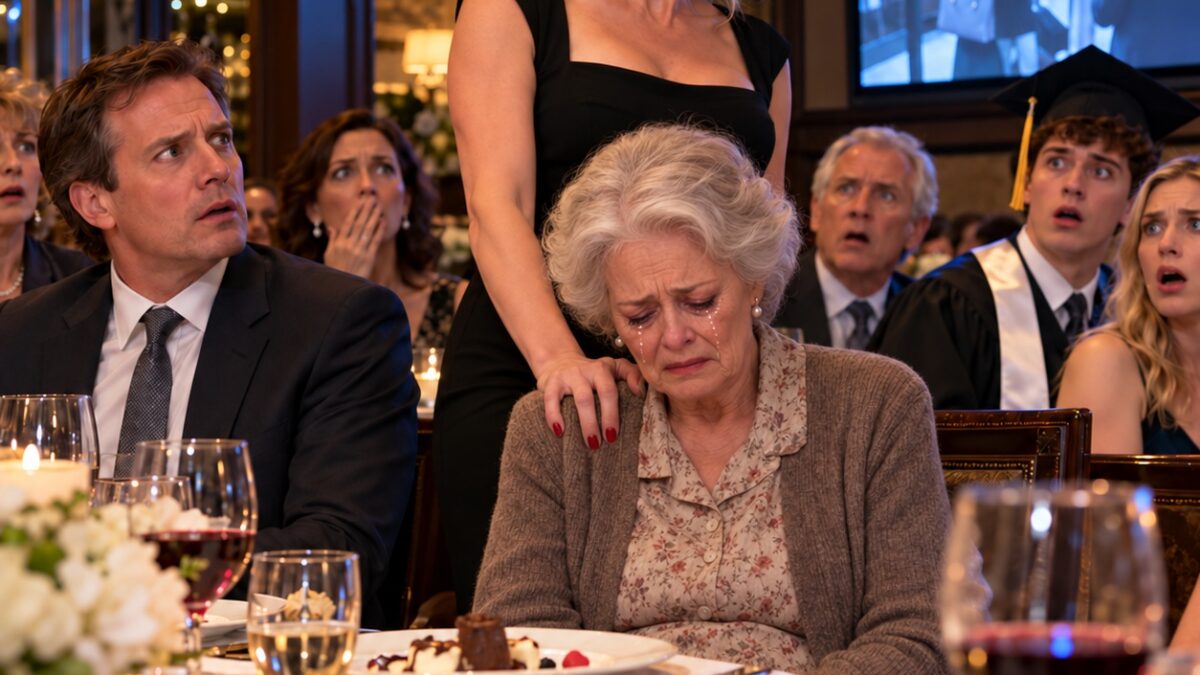
Then she came behind my chair.
Her hand landed on my shoulder.
And twenty years of calculated humiliation finally arrived at its destination.
“Before we finish,” she said, “I need to talk about family honesty.”
Jake frowned.
David looked tired.
Amanda began.
My memory problems.
My confusion.
My paranoia.
My lies.
Her patience.
Her suffering.
Then:
“You embarrass me.”
Silence.
“I’m disgusted by you.”
I smiled.
Because she had just given me exactly what I needed.
An audience.
“You’re right.”
She hesitated.
“This needs to stop.”
I stood.
“The lies.”
Her face changed.
“The manipulation.”
David looked up.
“The forged signatures.”
Jake stopped breathing.
“The theft.”
Ryan shifted.
“The affair.”
Amanda went white.
I raised my hand.
Marcus gave the signal.
The screen came down.
“What is this?”
“The truth.”
The first slide displayed the college fund.
Original deposits.
Expected balance.
Withdrawals.
Copies of my forged signature.
A handwriting expert’s analysis.
Then the bank employee’s statement.
Amanda shook her head.
“Fake.”
The next slide showed transfers from David’s accounts.
Thousands.
Tens of thousands.
Amanda’s private account.
Ryan’s financial firm.
David stared at the screen.
His face hardened.
Amanda turned.
“David, this is fabricated.”
He didn’t answer.
Then the photographs appeared.
Amanda and Ryan entering a hotel.
Holding hands.
Kissing.
Amanda made a sound.
Ryan stood halfway.
“I should leave.”
I looked at him.
“Stay.”
Everyone turned toward him.
“You are important.”
Then the recording played.
Amanda’s voice filled the room.
Clear.
Unmistakable.
Talking about divorce after graduation.
Talking about money.
Talking about the twenty-year marriage.
Talking about taking what she could.
Then Ryan’s voice.
Calling it their longest con.
Nobody spoke.
Amanda lunged toward the equipment.
A waiter stepped between her and the controls.
“Turn it off!”
“No.”
“This is illegal!”
“Your attorney can discuss that later.”
She turned toward David.
“Honey.”
He stood.
For once, he did not look confused.
“Stop.”
Amanda blinked.
“What?”
“Stop.”
“I can explain.”
“I checked the accounts.”
She froze.
My heart tightened.
David continued.
“After Mom spoke to me, I started looking.”
Amanda’s face collapsed.
“The cards are real.”
“David—”
“The transfers are real.”
“Listen—”
“The debt in my name is real.”
She stepped toward him.
He moved back.
That small movement seemed to terrify her.
“You’ve lied to me.”
“It’s not what you think.”
“For twenty years.”
“David.”
Then Jake spoke.
“Mom.”
Amanda turned desperately.
Jake looked devastated.
“I found Grandma’s letters.”
She froze.
“What?”
“In your desk.”
Silence.
“Birthday cards.”
His voice broke.
“Christmas cards. Letters. Things she sent me for years.”
Amanda’s mouth opened.
“All unopened.”
“Jake—”
“You told me she forgot.”
“I was protecting you.”
“From what?”
No answer.
“You?”
Amanda’s expression became rage.
She turned toward me.
“You did this.”
“No.”
“You turned them against me!”
“You did.”
“You bitter old woman.”
There she was.
No concern.
No polish.
No performance.
“You couldn’t stand that David chose me.”
She stepped closer.
“You’ve hated me since the beginning.”
“I welcomed you.”
“You wanted him for yourself.”
“He’s my son.”
“You never accepted that I came first.”
David spoke.
“Amanda.”
She ignored him.
“You spent twenty years trying to break us.”
I looked at her.
“No.”
My voice was almost gentle.
“I spent twenty years trying not to.”
That silenced her.
“I kept quiet because I was afraid of losing him.”
I looked at David.
“I lost him anyway.”
His eyes filled.
I looked back at Amanda.
“The difference is that today I stopped being afraid.”
Amanda turned toward Ryan.
“We’re leaving.”
Ryan backed away.
“No.”
Her face twisted.
“What?”
“I’m going.”
“You said—”
“Not with you.”
“You coward.”
Everyone heard.
“After everything we planned?”
The room erupted.
Ryan closed his eyes.
Amanda realized what she’d admitted.
Too late.
For twenty years she had survived by controlling every room.
That evening, the room no longer belonged to her.
Nobody believed her.
Nobody defended her.
Nobody needed her version.
Her face changed.
Hatred disappeared.
Then fear.
Then emptiness.
“You think you won.”
She looked at me.
“You destroyed your son’s life.”
I shook my head.
“This was never about winning.”
“Liar.”
“It was about ending the lie.”
Her knees buckled.
Amanda collapsed.
Chaos followed.
Water.
Calls for an ambulance.
Her parents rushing toward her.
David knelt beside the woman who had just shattered his understanding of twenty years.
That image stayed with me.
Because truth does not make love disappear instantly.
Even betrayed love grieves.
Jake placed his hand on David’s shoulder.
Father and son looked at each other.
I knew then that exposure had been the easy part.
Healing would take longer.
Amanda eventually regained consciousness.
Her parents took her home.
Ryan disappeared before the evening ended.
David and Jake came home with me.
The first night, none of us slept much.
David sat at my kitchen table at two in the morning.
“I should have known.”
“No.”
“I took her side every time.”
“Yes.”
He looked up.
I would not lie to comfort him.
“I did.”
“You did.”
His eyes filled.
“You missed years with Jake because of me.”
“Yes.”
“I let her convince me you were unstable.”
“Yes.”
He covered his face.
“I’m sorry.”
I sat beside him.
“I know.”
“How can you forgive me?”
“I haven’t forgotten.”
He looked at me.
“Forgiveness doesn’t mean pretending nothing happened.”
“Then what does it mean?”
“For me?”
I took his hand.
“Choosing not to waste whatever time we have left punishing you for time we already lost.”
He cried.
So did I.
The legal aftermath took months.
Amanda saw the evidence through her attorney.
Forgery.
Financial fraud.
Unauthorized accounts.
Transfers.
The college fund.
She negotiated.
Much of the stolen money was returned.
The divorce was uncontested.
Her claims were limited.
She moved to Arizona near her parents.
Ryan disappeared from her life almost immediately.
That surprised no one.
David had the hardest time accepting how thoroughly he’d been deceived.
Some mornings he was furious.
Other days he remembered a vacation.
A birthday.
A quiet dinner.
Then wondered whether any happy memory had been real.
I told him something Judy once told me.
“A lie surrounding a moment does not automatically make every feeling inside that moment false.”
He looked at me.
“So I was happy?”
“Sometimes.”
“With someone who was lying?”
“Yes.”
“That feels worse.”
“I know.”
Jake struggled differently.
One afternoon, we sorted family photographs.
He held a picture of himself at five sitting on Amanda’s lap.
“Do you think Mom ever loved me?”
My heart broke.
“Yes.”
“How can you know?”
“I don’t.”
I answered carefully.
“But I believe she loved you as much as she knew how.”
He looked down.
“That doesn’t sound like real love.”
“Maybe it wasn’t healthy love.”
He looked at me.
“Is there a difference?”
“A very important one.”
“Do I have to forgive her?”
“No.”
“Do I have to see her?”
“No.”
“Is it bad that I don’t want to?”
“No.”
He nodded slowly.
“I’m angry.”
“You’re allowed.”
“I miss her.”
“You’re allowed that too.”
Healing began there.
Not in forcing emotions into neat categories.
In allowing contradictory ones to exist.
David worked with forensic accountants.
Most of the missing money was traced.
Jake’s college fund was largely restored.
More importantly, Jake knew the truth about where the money had originally come from.
His grandfather John.
Me.
Years of monthly deposits.
Years of love.
He was accepted to Stanford.
The day the letter arrived, he drove straight to my house.
He burst through the door waving the envelope.
“Grandma!”
I cried before he even told me.
“I got in!”
I hugged him.
John should have been there.
That ache never disappeared.
But somehow grief and joy learned to sit beside each other.
Jake spent the summer reconnecting with relatives Amanda had kept away.
Cousins.
Aunts.
My sister Carol.
People who had been told Jake was too busy.
Or uninterested.
He discovered an entire family waiting for him.
David rebuilt too.
He removed the immaculate furniture Amanda had chosen.
Repainted rooms.
Made his house look lived in.
Warm.
Messy.
Human.
And for the first time in years, I could visit without asking for an approved two-hour window.
Sometimes I stayed for dinner.
Sometimes Jake called:
“Grandma, come over.”
And I did.
The first time I used David’s front door after everything, I stopped.
Years earlier, he had taken my spare key away because Amanda said I might wander in confused.
Now David held out a new key.
“For you.”
I stared at it.
“Are you sure?”
He smiled sadly.
“I should have never taken the first one.”
I placed it in my purse.
I rarely used it without knocking.
Not because Amanda had been right.
Because boundaries work both ways.
Linda became my friend.
She had spent years feeling guilty for failing to warn David.
I told her:
“Amanda was good at making people give up.”
Sarah, the investigator, remained in my life too.
Coffee occasionally.
Stories.
She once laughed:
“I still tell people about the grandmother who turned a graduation dinner into an evidentiary hearing.”
“I prefer multimedia family intervention.”
“That’s worse.”
One year after the confrontation, we returned to Oak Tree.
Same private room.
Different dinner.
Jake had completed his first year at Stanford.
David had been promoted.
There were fewer people.
Only those who actually loved one another.
The room sounded different.
No careful performance.
No watching every word.
People laughed.
Jake teased David.
My sister told embarrassing stories.
I ate dessert without anyone accusing me of dementia.
After coffee was served, David stood.
He tapped his glass.
I groaned.
“Oh no.”
Everyone laughed.
He smiled.
“I want to make a toast.”
“To Jake?”
“To my mother.”
The room became quiet.
David looked at me.
“Mom.”
My throat tightened.
“One year ago, in this room, you did something I didn’t understand at first.”
He paused.
“You told the truth when telling the truth was going to hurt.”
I looked down.
“You had every reason to walk away from us years before.”
His voice cracked.
“You didn’t.”
Jake stood beside him.
David continued.
“You fought for a family that had stopped fighting for you.”
Tears blurred my vision.
“You taught me that love isn’t agreeing with someone because you’re afraid to lose them.”
His eyes held mine.
“Love sometimes means being willing to tell someone the truth even when they might hate you for it.”
He raised his glass.
“To my mother.”
Jake raised his.
“To Grandma Betty.”
Everyone joined.
This time, when twenty people looked at me around that table, I did not feel humiliated.
I felt seen.
Later, Jake pulled me aside.
“I have news.”
“What?”
“I applied for an ethics and justice scholarship.”
“That sounds extremely serious.”
He grinned.
“I wrote about you.”
“Oh, no.”
“The dinner.”
“Absolutely not.”
“They loved it.”
“Wonderful. My public humiliation is financing higher education.”
He laughed.
“I got it.”
I stopped.
“What?”
“Full funding for sophomore year.”
I wrapped my arms around him.
“Jake.”
He hugged me.
“Grandpa would be proud, right?”
I closed my eyes.
“Yes.”
“I wish I remembered him better.”
“You carry him.”
“How?”
“Your integrity.”
Jake smiled.
“Your stubbornness.”
“Grandma.”
“That too.”
Driving home, I thought about Amanda.
I no longer hated her.
That surprised me.
I didn’t forgive everything.
I didn’t want reconciliation.
But hatred requires energy.
I had spent enough of my life giving Amanda energy she had not earned.
Wherever she was, I hoped she eventually learned how to build a life that didn’t depend on controlling other people.
Mostly, I thought about myself.
For years, I had believed silence was dignity.
Sometimes it is.
Sometimes silence is fear wearing good manners.
I had stayed quiet because I didn’t want to become the stereotypical interfering mother-in-law.
I accepted insult after insult because I loved David.
I accepted distance because I loved Jake.
I allowed Amanda to define the terms of my own family relationships because I believed resistance would make things worse.
It did not protect my family.
It only protected the lie.
What finally saved us was not revenge.
Not the private investigator.
Not the screen at the restaurant.
Those were tools.
What saved us was truth becoming stronger than fear.
Amanda had told everyone I was losing my mind.
I almost lost confidence in it.
She said I was jealous.
For a while, I searched my heart wondering whether she was right.
She called me unstable.
I began measuring every emotional response because I feared reacting too strongly would prove her point.
That is what prolonged manipulation does.
It makes you become your own interrogator.
You start asking whether your memories are real.
Whether your pain is reasonable.
Whether your instincts can be trusted.
For years, I asked myself:
What if Amanda is right?
The better question would have been:
What if I am?
I was right about the isolation.
Right about the lies.
Right about my grandson wanting a relationship with me.
Right about my own memory.
Right to question missing money.
Right to worry about David.
But being right did not make the outcome painless.
My son discovered that twenty years of marriage contained deception.
My grandson discovered his mother had intercepted years of love meant for him.
A family collapsed.
Then rebuilt differently.
Truth often does that.
It destroys structures that were only standing because no one was allowed to look closely at the foundation.
I used to wish I could recover those lost years.
Jake at eight.
Ten.
Twelve.
Christmas mornings.
Birthdays.
Ordinary weekends.
I cannot.
Neither can David.
Regret is useless unless it teaches you how to treat the time still available.
So now, when Jake calls, I answer.
When David invites me to dinner, I go.
When something bothers me, I say it.
No more twenty-year silences.
One Sunday, David was repairing a cabinet at my house.
He looked over.
“You know what I regret most?”
“What?”
“That I stopped trusting my own memories of you.”
I put down my coffee.
He continued.
“I knew you.”
“I should hope so.”
“I mean really knew you.”
He shook his head.
“You raised me. You never screamed. Never manipulated me. Never demanded money. Never tried to control who I dated.”
He looked ashamed.
“And somehow Amanda told me you were this completely different person, and I believed her.”
“Slowly.”
“What?”
“She didn’t ask you to believe it all at once.”
He nodded.
“She changed one memory at a time.”
“Yes.”
He leaned back.
“I don’t want that to happen again.”
“It won’t if you learn the right lesson.”
“What lesson?”
“Don’t trust me because I’m your mother.”
He frowned.
“Trust evidence.”
I smiled.
“Trust patterns. Trust your own observations. Ask questions even when the answers make people uncomfortable.”
He laughed.
“You sound like Jake.”
“Good.”
A few months later, Jake called from Stanford.
“Grandma.”
“What happened?”
“How do you always know something happened?”
“Your hello had three syllables.”
He laughed.
Then told me he was considering law school eventually.
“Why?”
“I think I like figuring out how systems can protect people.”
“That sounds noble.”
“Also, I like arguing.”
“That sounds hereditary.”
“From you?”
“Your grandfather.”
“Sure.”
I smiled after the call ended.
Amanda had tried to erase John from Jake’s life by rewriting our marriage and minimizing my role.
Instead, Jake was beginning to know his grandfather through stories.
That felt like justice too.
Not punishment.
Restoration.
My relationship with David will never be exactly what it was before Amanda.
I wouldn’t want it to be.
That earlier closeness contained assumptions.
Now ours contains honesty.
We disagree sometimes.
He tells me when I’m overstepping.
I tell him when he’s avoiding.
Neither of us disappears.
That is healthier.
And Jake?
He calls me Grandma openly now.
The first time he did it in front of a large family gathering, I caught myself smiling.
“What?” he asked.
“Nothing.”
“You look weird.”
“Thank you.”
He shook his head.
“Grandma.”
There it was again.
A word Amanda once told me sounded too old.
Now it sounded like victory.
Not because I defeated her.
Because she had failed to erase the relationship behind the word.
I turned sixty-six shortly after Jake left for college.
Judy organized dinner.
Small.
Simple.
Chocolate cake.
When they brought it out, David suddenly stood behind my chair.
I looked at him.
“Don’t.”
He raised both hands.
“I wasn’t going to do anything.”
Jake laughed over video call.
“Grandma, keep your eye on him.”
We laughed until I cried.
That was another sign of healing.
A memory that once humiliated me could become funny again because it no longer belonged to Amanda.
It belonged to us.
Sometimes I still think about that graduation dinner.
The instant Amanda said:
“You embarrass me. I’m disgusted by you.”
For years, words like that would have destroyed me.
That night, they freed me.
Because once she said them in front of everyone, she stopped pretending.
For a moment, the compassionate daughter-in-law disappeared.
People saw what I had seen privately for years.
Contempt.
Control.
Rage when control failed.
And when the screen came on, I did not feel powerful because I had secrets.
I felt powerful because I no longer needed Amanda to validate reality.
That is the lesson I carry.
If someone spends years convincing you that your memory is false, your feelings are unreasonable, your boundaries are selfish, and your objections prove something is wrong with you, the greatest act of resistance may be very simple.
Trust yourself enough to investigate.
Not react.
Not retaliate.
Investigate.
Write things down.
Look at patterns.
Ask questions.
Find evidence.
Because truth does not need the loudest voice.
It needs somewhere to stand.
Amanda had spent twenty years controlling the story.
All I did was give the truth a screen.
The rest belonged to her own actions.
One autumn evening, Jake came home from college.
The three of us were sitting on my porch.
David asked:
“Do you ever wish you hadn’t done it publicly?”
I knew exactly what he meant.
“The dinner?”
“Yes.”
I thought for a moment.
“I wish it hadn’t become necessary.”
Jake nodded.
“But do you regret it?”
“No.”
David looked toward the yard.
“It destroyed my marriage.”
“No.”
He looked at me.
“The truth revealed that your marriage was already being destroyed.”
He was quiet.
“That distinction took me a while.”
“I know.”
Jake leaned back.
“Mom was going to embarrass Grandma publicly anyway.”
David sighed.
“I know.”
“She wanted witnesses.”
“So did I,” I said.
They both looked at me.
I smiled.
“Turns out witnesses can work both ways.”
Jake laughed.
David shook his head.
“You’re terrifying.”
“I taught middle school summer classes for twelve years. Amanda never had a chance.”
We laughed.
Then fell quiet.
The sunset turned the sky orange.
I thought about John.
How much he would have loved Jake.
How furious he would have been about Amanda.
How proud of David for rebuilding himself.
How he would have teased me mercilessly for orchestrating a video presentation at a restaurant.
Sometimes grief changes.
It never disappears.
But the sharp edges soften.
John was no longer only the man I lost.
He was also the man whose values remained in us.
Integrity.
Patience.
Loyalty.
And a stubborn refusal to abandon family when family became difficult.
Amanda had misunderstood loyalty.
To her, loyalty meant taking her side.
Never questioning.
Never challenging.
Keeping secrets.
Accepting her version.
That isn’t loyalty.
That’s obedience.
Real loyalty can survive disagreement.
Real love can survive truth.
Anything that requires lies to survive is not being protected.
It is being prolonged.
When I pulled into my driveway after that first anniversary dinner at Oak Tree, I sat in the car for several minutes.
The house looked exactly the same as it had twenty years earlier.
Same porch.
Same front windows.
Same tree John had planted.
But I was different.
For years, I had thought Amanda possessed some power I lacked.
She was younger.
Polished.
Quick.
Socially confident.
She knew exactly what to say.
I had mistaken manipulation for strength.
Real strength looked less glamorous.
It looked like asking a bank for records.
Sitting with uncomfortable truths.
Hiring help.
Waiting for evidence.
Refusing to turn Jake against his mother even when she had done exactly that to me.
Looking my son in the eye and telling him something that might make him hate me.
Standing at a graduation dinner while twenty people watched and refusing to crumble.
Most of all, strength looked like knowing when the fight was over.
I did not chase Amanda to Arizona.
I did not call her friends.
I did not spend my remaining years making sure everyone knew what she had done.
The people who mattered knew.
The money was largely recovered.
The legal issues were resolved.
David was free.
Jake was moving forward.
That was enough.
I went inside.
On the mantel was a photograph.
John and me.
David as a boy.
Another beside it showed Jake in his graduation gown.
Three generations.
Not a perfect family.
There is no such thing.
A real family.
Damaged.
Repaired.
Still learning.
I touched John’s photograph.
“You missed quite a year.”
In my imagination, I could hear him.
You always did know how to make an entrance.
I smiled.
“No.”
I looked at Jake’s photograph.
“At sixty-five, I finally learned how to stop making exits.”
For twenty years, whenever Amanda pushed me away, I retreated.
Whenever she accused me, I defended quietly.
Whenever she changed the rules, I adjusted.
Whenever she closed a door, I waited politely outside.
The graduation dinner was the first time I stopped leaving the room she controlled.
I stayed.
And once I stayed, so did the truth.
Amanda had wanted that dinner to become the final proof that I was confused, bitter, unstable, and embarrassing.
Instead, it became the moment my family finally understood that the person they had been taught not to trust had been telling the truth all along.
But when I think back on that night now, my favorite moment isn’t Amanda seeing the screen.
It isn’t Ryan trying to escape.
It isn’t even David finally telling his wife to stop.
It happened much later.
After the shouting.
After Amanda collapsed.
After everyone left.
Jake came to me outside the restaurant.
Still wearing the suit he’d worn beneath his graduation gown.
He hugged me.
Then whispered:
“I knew you weren’t crazy, Grandma.”
I held him tighter.
“I know.”
“No.”
He pulled back.
“I really knew.”
His eyes filled.
“I just wish I had figured it out sooner.”
I touched his cheek.
“Sweetheart, you were a child.”
“What if I had stood up to her earlier?”
“That was never your job.”
“What if Dad had?”
“That was his lesson to learn.”
“What about you?”
I smiled.
“I learned mine.”
“What was it?”
I looked through the restaurant window.
Amanda’s parents were helping her.
David was standing alone.
The television screen had gone dark.
Then I looked back at my grandson.
“That being loving and being silent are not the same thing.”
Jake nodded.
I continued.
“And sometimes the person who calls you embarrassing is only embarrassed because you finally stopped helping them hide the truth.”
One year later, when we sat inside that same restaurant laughing together, I realized something else.
Amanda had told me she was disgusted by me.
At the time, she meant it as a weapon.
Now, strangely, I am grateful she said it.
Because after twenty years of carefully disguised contempt, she finally spoke honestly.
And honesty—even ugly honesty—gave me something I could work with.
It gave everyone a glimpse behind the mask.
The rest came from evidence.
The truth did not return every lost birthday.
It did not restore my marriage years with John.
It did not erase David’s regret.
It did not give Jake a childhood untouched by manipulation.
Truth cannot rewrite time.
But it can stop the lie from owning the future.
Jake has his future.
David has his freedom.
I have my son back.
I have my grandson.
And more importantly, I have myself back.
That is enough.
More than enough.
So when people ask me what I remember most about my grandson’s graduation dinner, they expect me to mention the humiliation.
The insult.
The screen.
The photographs.
Amanda’s face when the recording played.
But what I remember most is the moment after she told me she was disgusted by me.
I smiled.
Not because I knew I was about to destroy her.
That was never what I wanted.
I smiled because for the first time in twenty years, I was no longer afraid of what she could make people believe about me.
I knew who I was.
I knew what I remembered.
I knew what I had found.
And this time, I had proof.
There is an extraordinary kind of peace that comes when you stop begging someone else to confirm your reality.
Amanda lost her power over me before the screen ever turned on.
Everything after that was simply everyone else catching up.
And that, more than any public exposure or legal victory, was the moment I finally became free.





