FULL ENDING: Our HOA President Called 911 on a 78-Year-Old Fisherman—She Never Asked Why He Kept an Old Deed in His Tackle Box
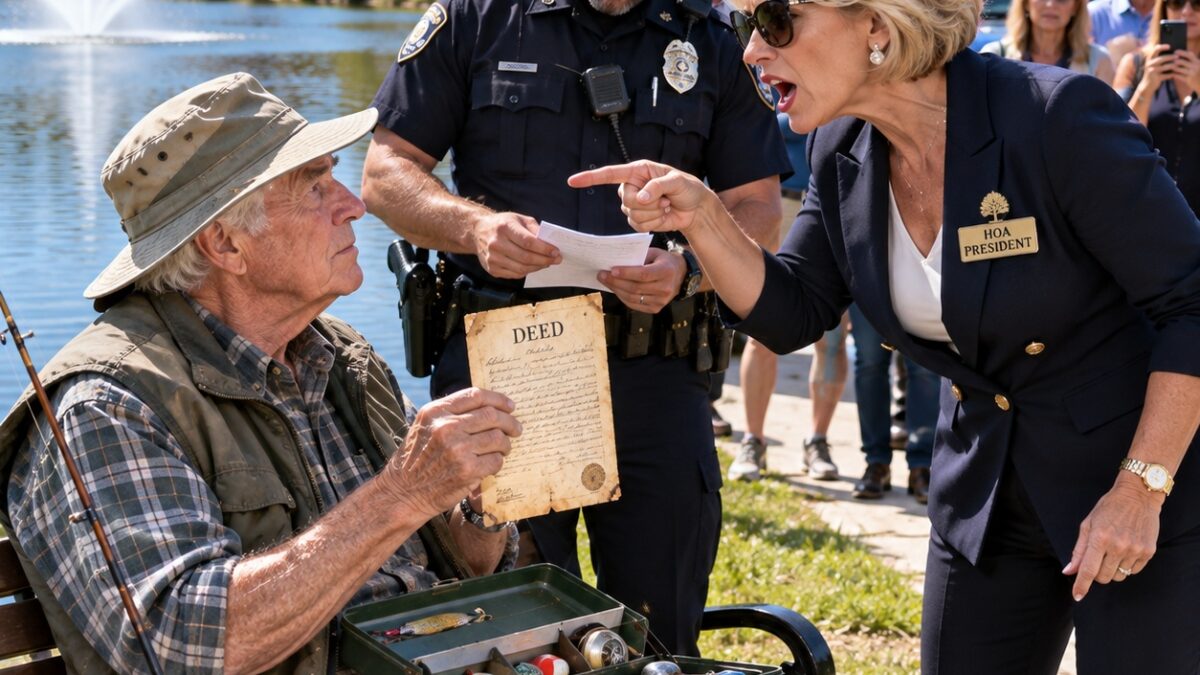
PART 2 and FULL ENDING  Thank you

“Ma’am.”
The officer said.
Brenda immediately straightened.
“Yes?”
He looked at the deed again.
Then at the folder she had handed him.
“County records do not show this pond as property owned by the homeowners association.”
Nobody moved.
For one second, even the birds seemed to stop.
Brenda blinked.
“What?”
“There appears to be a title issue dating back to the development.”
“That’s impossible.”
She snapped.
“The HOA has maintained this pond for decades.”
The officer nodded.
“I understand.”
“Then obviously we own it.”
His expression changed.
Not disrespectful.
Just puzzled.
“Maintenance doesn’t necessarily establish title.”
Brenda stared at him.
I almost laughed.
Not because any of this was funny.
Because she genuinely seemed offended by the concept that cutting grass around something did not automatically make it yours.
The officer continued.
“The county record indicates that the pond and approximately fifty feet around the shoreline were never legally transferred into HOA ownership when Pinerest Meadows was incorporated.”
Someone behind me whispered:
“Oh my God.”
Brenda stepped toward him.
“You’re mistaken.”
“I’m telling you what the preliminary county record shows.”
She waved her folder.
“These are the association documents.”
He glanced at them.
“They may address maintenance and community use.”
“But they do not appear to establish ownership.”
Brenda’s face reddened.
Then the officer turned toward Arthur.
“And Mr. Pendleton’s deed contains a recorded access provision tied to his parcel.”
Arthur nodded.
Brenda slowly looked at him.
“What access provision?”
Arthur smiled faintly.
“My family kept fishing rights.”
She stared.
“Your family?”
“Yes.”
The officer clarified.
“Permanent fishing and access rights appear to have been retained under the recorded deed.”
Brenda’s mouth opened.
Closed.
Then:
“So he can fish?”
“At this point, I have no legal basis to remove him.”
The crowd erupted.
Not cheering exactly.
More like twenty different conversations exploding at once.
“Wait.”
A man near the path said.
“We paid permit fees.”
Someone else:
“Do we get refunds?”
Another woman shouted:
“Brenda, you fined my son for fishing here!”
Nancy, who had been walking her dog when the whole thing started, lifted her phone higher.
“Did you know about this?”
Brenda turned sharply.
“Nothing has been established.”
She announced.
“This officer is not an expert in HOA law.”
The young officer’s ears turned red.
But he held his ground.
“I’m not interpreting HOA law, ma’am.”
“I’m telling you I cannot verify your ownership claim through county records.”
She demanded his supervisor.
He radioed.
Then Arthur did the one thing that made Brenda look more ridiculous than anything else could have.
He picked up his fishing rod.
Cast his line back into the pond.
And waited.
No speech.
No victory smile.
No argument.
Just fishing.
I had known Arthur for years without really knowing him.
He was one of those neighbors everybody recognized.
He waved when you drove past.
Helped jump batteries.
Grew tomatoes.
Showed children how to bait hooks.
He had never struck me as confrontational.
If anything, he was so quiet people often forgot he was sitting nearby.
Brenda had mistaken quiet for weakness.
That was becoming obvious.
About an hour later, two county vehicles arrived.
The officer had apparently escalated the issue because Brenda refused to accept what he was telling her and continued demanding that Arthur be removed.
The woman leading the county team stepped out carrying a binder.
Her name was Eleanor Sterling.
Mid-fifties.
Dark suit.
Silver-framed glasses.
A voice so calm it made Brenda’s loudness sound childish.
“Who is representing the homeowners association?”
Brenda stepped forward.
“I am.”
“Name?”
“Brenda Vance.”
“I’m Eleanor Sterling with county property administration.”
She held out her hand.
Brenda shook it.
Her entire posture changed.
Not much.
Just enough.
People like Brenda understand hierarchy.
They may resent it.
But they recognize it.
Eleanor asked for Brenda’s paperwork.
Then Arthur’s deed.
Then she made two phone calls while standing beside the water.
We waited.
Finally, she returned.
“The county has confirmed that Pinerest Meadows Homeowners Association does not hold title to this pond.”
The words hit harder coming from her.
Brenda crossed her arms.
“We insure it.”
“That will require review.”
“We maintain it.”
“That does not transfer ownership.”
“We have collected fees.”
Eleanor looked up immediately.
“How much?”
Brenda hesitated.
“Permit fees.”
“That was not my question.”
“I don’t have the total with me.”
Eleanor closed the binder.
“Then you should obtain it.”
Brenda’s expression hardened.
Eleanor continued.
“Effective immediately, the association is directed to cease representing itself as owner of the pond until the title record is formally resolved.”
“You can’t—”
“I can direct correction of an inaccurate county property representation.”
Eleanor said.
“All pond-related enforcement should stop.”
“No fines.”
“No trespass directives based solely on alleged HOA ownership.”
“No new permit collection.”
Then:
“And I want an accounting of every dollar collected in connection with pond access.”
The crowd became louder again.
Eleanor raised one hand.
“This is not a celebration.”
People slowly quieted.
“This is an administrative problem.”
“It will be handled through records.”
Then she turned toward Brenda.
“Do you understand?”
Brenda’s jaw tightened.
“Yes.”
“You will also provide residents with written notice that the ownership status is under correction.”
“I’ll speak to counsel.”
“You should.”
Eleanor replied.
“Today.”
For the first time since I met Brenda, I saw something beneath her anger.
Fear.
Arthur still had his line in the water.
Eleanor walked toward him.
“Mr. Pendleton.”
“Yes, ma’am?”
“I understand you may have raised this issue previously.”
Arthur glanced at Brenda.
“She was busy.”
A few people laughed.
Eleanor almost smiled.
“What did you show her?”
“The same deed.”
“When?”
“Months ago.”
That changed Eleanor’s face.
Old title mistakes happen.
Property records are complicated.
Developments evolve.
Documents get misfiled.
Nobody expected an HOA president to remember every deed from the 1980s.
But being shown a deed directly and then refusing to investigate it?
Different story.
“Was anybody else present?”
Eleanor asked.
Arthur pointed toward Nancy.
“She was walking that little terrorist she calls a dog.”
Nancy’s terrier barked.
“His name is Winston.”
She protested.
Arthur shrugged.
“Exactly.”
Everyone laughed.
Even the officer.
Then Nancy nodded.
“I was there.”
“What did Ms. Vance say?”
Nancy hesitated.
Brenda spoke first.
“I don’t think we need to turn this into a trial beside the pond.”
Eleanor looked at her.
“It isn’t.”
Then back to Nancy.
“What did she say?”
Nancy swallowed.
“She told Arthur that old-timers needed to accept that things change.”
The laughter disappeared.
Brenda closed her eyes for half a second.
Arthur looked back toward the water.
That was the moment I realized the dispute was not really about fishing.
It was about something uglier.
Brenda had seen an old man holding old paperwork and decided she understood his property better than he did.
That afternoon should have ended the story.
The HOA should have apologized.
Stopped collecting fees.
Fixed the records.
Refunded everyone.
Brenda should have admitted she made a mistake.
We all should have gone home.
But power rarely disappears the first time it is challenged.
That evening, the HOA called an emergency board meeting.
Normally, maybe fifteen people attended.
That night, the clubhouse was overflowing.
Residents stood against the walls.
Some brought pond permits.
Some carried fine notices.
One man had printed bank statements showing months of fifty-dollar charges.
Arthur arrived last.
He sat in the back.
Brenda arrived seven minutes late.
Same blazer.
Same heels.
No smile.
Melissa Gardner, the treasurer, began.
“We need to address today’s county findings.”
Brenda immediately leaned toward the microphone.
“I will explain the situation.”
Melissa looked irritated.
“Brenda—”
“I said I will explain it.”
There it was.
That tone.
The tone we had tolerated for two years.
Not:
I’m one board member.
Not:
Let’s review what happened.
But:
I decide when everyone else speaks.
Brenda stood.
“This afternoon’s incident arose because of incomplete county records and an old clerical problem.”
Arthur raised his hand.
She ignored him.
“The association has maintained and improved that pond for decades.”
A resident shouted:
“Maintained or owned?”
Brenda glared.
“I am speaking.”
Someone booed.
Then somebody else.
I had never heard homeowners boo anyone at a board meeting.
Brenda’s face tightened.
“Our legal counsel will review the historical documents.”
Nancy raised her hand.
“Did Arthur show you his deed months ago?”
“I was shown an old document whose applicability was uncertain.”
Arthur spoke from the back.
“You told me old-timers needed to accept that things change.”
The room became quiet.
Brenda stared at him.
“That is not how I remember the conversation.”
Nancy stood.
“That’s exactly what you said.”
Murmurs.
Brenda sat.
Melissa took over.
“We need documents.”
She said.
“Not memories.”
That sentence rescued the meeting.
The board voted to hire independent counsel.
Not Brenda’s usual attorney.
Independent counsel.
Then Melissa asked:
“How much has the HOA collected through pond permits?”
The property manager looked uncomfortable.
“I don’t have a final number tonight.”
“Find it.”
“What about fines?”
“Same.”
“Improvement costs?”
“I’ll pull them.”
Arthur leaned back.
He looked exhausted.
After the meeting, I sat beside him.
“You okay?”
“I was fine until everybody decided fishing needed accounting software.”
I laughed.
Then:
“Why didn’t you push harder when Brenda ignored you?”
Arthur studied the floor.
“People hear what they’re ready to hear.”
“That sounds depressing.”
“It’s practical.”
He looked across the room.
“I handed her the deed.”
“She decided her title mattered more than mine.”
Then:
“I’m too old to wrestle with people who insist on learning things the expensive way.”
That sentence stayed with me.
The next week was chaos.
Outside counsel started tracing the property history.
The county did the same.
What they found was far larger than a forgotten fishing clause.
Arthur’s family had once owned most of the farmland underneath Pinerest Meadows.
Before Maple Ridge Court.
Before the clubhouse.
Before our entrance gates.
Before Brenda’s McMansion.
The Pendleton family had farmed that land for generations.
When developers arrived during the 1980s, Arthur’s father sold most of the acreage.
But he refused to give away everything.
The pond mattered.
Not because it was worth millions.
At the time, it probably was not.
It mattered because locals had used it for decades.
Farmworkers.
Families.
Children.
Older men who sat beside the water because they had nowhere else quiet to go.
Arthur’s father negotiated two conditions.
The first:
The pond would remain under a public-use trust arrangement instead of becoming exclusive private property.
The second:
The Pendleton family retained permanent fishing and access rights connected to Arthur’s three-acre parcel.
It was recorded.
Not an oral promise.
Not a handshake.
Recorded.
When Pinerest Meadows later formed, the HOA began maintaining the shoreline.
Then landscaping it.
Then insuring improvements.
Over time, paperwork simply started treating the pond as though it belonged to the association.
Nobody challenged it.
Why would they?
Access had remained relatively open for years.
The mistake sat quietly.
Then Brenda arrived and tried turning the mistake into power.
If she had never created the permit program, the ownership problem might have remained buried another generation.
Her attempt to control the pond exposed the fact she had no ownership to control.
Residents reacted badly.
The permit program had collected more than fifteen thousand dollars.
Fifty dollars a month.
Guest passes.
Fines.
Administrative penalties.
Every dollar now had to be reviewed.
Refunds.
Interest.
Then there was the two-million-dollar problem.
Brenda had proudly told the police officer the pond was worth over two million dollars.
She was not entirely wrong about estimated land and amenity value.
The HOA had listed the pond in financial planning.
Insurance schedules.
Reserve discussions.
Certain disclosures connected to home sales.
It had been treated as a major community asset.
Outside counsel now had to explain something nobody wanted to hear.
The association had not suddenly lost two million dollars in cash.
It had lost the right to claim a two-million-dollar asset it never legally owned.
That distinction did not make residents feel better.
Questions exploded.
“Does this affect property values?”
“Could buyers sue?”
“What about insurance?”
“What about the loan?”
Loan.
That word became the next problem.
The association had borrowed money for pond improvements.
Bank reinforcement.
Path lighting.
A small fountain.
Landscaping.
Brenda had pushed hard for those improvements.
At the time, residents approved them because improving a two-million-dollar waterfront amenity sounded reasonable.
Now the lender was asking:
If the HOA does not own the pond, exactly what did we finance?
The association still owed the money.
The improvements still existed.
Nothing magically disappeared.
But ownership representations in related documents had to be reviewed.
That was when insurance investigators became involved.
Then the state.
Not because one property mistake automatically means fraud.
It does not.
But there was a problem with timing.
Arthur had warned Brenda before some of those representations were made.
He had proof.
The faded envelope held more than the deed.
Inside was a copy of a letter.
Dated months before the police incident.
Dear Ms. Vance,
As discussed today, I am providing the recorded deed and family agreement confirming permanent fishing rights and public-status restrictions concerning the pond.
Please review these documents before issuing additional access rules.
Sincerely,
Arthur Pendleton.
At the bottom:
RECEIVED — PINEREST MEADOWS HOA OFFICE.
Date stamped.
There was no pretending anymore.
Brenda might have honestly believed the HOA owned the pond before Arthur confronted her.
After that letter?
She had a duty to check.
Instead, she created permits.
Collected money.
Issued violations.
And eventually called police.
She still insisted she had acted in good faith.
“The HOA had treated that pond as common property for decades.”
She told investigators.
That was true.
“I relied on long-standing practice.”
Also partly true.
But there was one question she could never answer convincingly.
Why did you not investigate after Arthur showed you the deed?
Her answers shifted.
She thought it was outdated.
She thought the association documents superseded it.
She thought Arthur was confused.
Then someone leaked the sentence Nancy had heard.
Old-timers like you need to accept that things change.
The local newspaper ran with it.
Soon local television picked up the story.
That was when many of us learned Arthur had served in Vietnam.
He had never told me.
Most people did not know.
The headline was brutal.
HOA PRESIDENT CALLS POLICE ON 78-YEAR-OLD VETERAN OVER POND ASSOCIATION DID NOT OWN.
I asked Arthur:
“You never told anybody you served?”
He frowned.
“Why would I?”
“I don’t know.”
“People like stories.”
He looked at the water.
“I prefer fish.”
That was Arthur.
His service had no legal relevance to the deed.
But emotionally, it made Brenda’s behavior look even worse.
She had treated a seventy-eight-year-old veteran whose family once owned the land as though he were a trespasser.
And she had done it after he tried to explain the history.
Then the audit expanded.
That was where Brenda’s presidency truly began collapsing.
If this had been one bad pond decision, maybe residents would have forgiven her.
But once people began reviewing her record, other things surfaced.
Cease-and-desist letters threatening lawsuits the board had never formally authorized.
Fines based on aggressive interpretations.
Residents threatened with liens over minor violations.
A disabled veteran had been warned that his wheelchair ramp violated architectural standards.
Brenda later claimed the issue concerned railing design.
Maybe that was technically true.
But the letter had been written so aggressively that even the new board’s lawyer looked embarrassed reading it.
Then came the mailbox.
A woman named Carol stood at the next meeting holding a paint sample.
“This.”
She shouted.
“THIS COST ME FIVE HUNDRED DOLLARS.”
Everybody looked.
Beige.
It was absolutely beige.
Brenda had called it an unauthorized warm neutral.
If rebellion had a color, apparently it was slightly warm beige.
People laughed.
Carol did not.
“I paid because you threatened another five hundred dollars.”
She said.
Brenda tried defending the architectural guidelines.
It did not help.
Then somebody mentioned trash cans.
Another holiday lights.
Another lawn decorations.
Another bird feeder.
One man shouted:
“You threatened a lien over a bird feeder!”
“That is not an accurate characterization.”
Brenda replied.
“It was a bird feeder!”
The room erupted.
But beneath the absurd stories sat serious financial exposure.
Outside counsel estimated that once refunds, interest, legal expenses, insurance issues, loan corrections, and potential claims were combined, maximum exposure could approach eight hundred thousand dollars.
Maximum exposure.
Not guaranteed damages.
But try explaining that distinction to three hundred terrified homeowners.
Rumors became insane.
Brenda was going to prison.
Arthur secretly owned the entire neighborhood.
The state was taking the clubhouse.
Every resident would owe ten thousand dollars.
None of that had been established.
The attorney general’s office had requested records.
Brenda’s real-estate license was being reviewed.
Certain asset statements were under investigation.
That did not mean conviction.
I began correcting people when they exaggerated.
One neighbor said:
“She stole two million dollars.”
“No.”
I told him.
“The pond was valued around two million.”
“That’s different.”
“Barely.”
“No.”
“It isn’t.”
I did not defend Brenda because I liked her.
I defended facts because the whole disaster began when somebody decided facts mattered less than certainty.
We did not need to become the same thing we were criticizing.
The special membership meeting arrived two weeks later.
I had never seen the clubhouse so full.
Every chair taken.
People standing in hallways.
Residents carrying documents.
Brenda arrived with a thick folder.
She looked exhausted.
For the first time, she was not wearing the ridiculous HOA president badge.
Melissa stood at the front.
“I’m going to present the current financial findings.”
Nobody interrupted.
Pond fee refunds.
Fine reviews.
Legal fees.
Loan restructuring.
Insurance reserves.
Title correction expenses.
Potential claims.
Then:
“Our maximum potential financial exposure currently under review approaches eight hundred thousand dollars.”
The room gasped.
Brenda immediately grabbed the microphone.
“That number is speculative.”
Melissa looked at her.
“I said potential exposure.”
“You’re frightening residents.”
“No.”
Melissa replied.
“I’m telling them what they should have been told earlier.”
Applause.
Brenda’s face hardened.
Then homeowners stood one after another.
Mailbox fine.
Wheelchair ramp.
Fence.
Christmas lights.
Garden ornaments.
Trash containers visible too early.
A retired teacher described receiving a legal threat after questioning a fine.
Then Arthur stood.
Nobody asked for quiet.
The room became quiet on its own.
He walked slowly toward the front.
No notes.
No lawyer.
No dramatic anger.
He looked at Brenda.
“I told you.”
Three words.
That was all.
And somehow, they carried more weight than every accusation before them.
Brenda stared.
Arthur continued.
“I brought you my deed.”
“You wouldn’t look.”
“You called the police.”
“You charged people for something the HOA didn’t own.”
He paused.
Then:
“I’m not here to punish anybody.”
“I want the pond left alone.”
“I want people refunded.”
“And I want the board to stop pretending rules create ownership.”
He returned to his chair.
That was Arthur’s entire speech.
The first motion came five minutes later.
Remove Brenda Vance as HOA president and board member.
Ballots were counted.
Two hundred twelve in favor.
Three against.
When the number was announced, the room released one enormous breath.
Not exactly cheering.
Relief.
Brenda stood behind the podium.
Frozen.
She looked toward the board.
Nobody moved to save her.
That was the true end of her presidency.
Not the number.
The moment she realized her authority had existed partly because people had agreed to follow it.
Now they did not.
Then came a second motion.
Authorize independent counsel to pursue Brenda personally for losses resulting from unauthorized enforcement, negligence, and material misrepresentation to whatever extent the law supported.
One hundred ninety-eight yes.
Seventeen no.
That vote was less comfortable.
Some residents believed the board had enabled her.
They were right.
Power rarely becomes abusive without other people surrendering responsibility.
Board members approved budgets.
Managers processed fines.
Homeowners stayed silent when enforcement affected somebody else.
Brenda drove the system.
But the system allowed her to drive it.
Outside counsel explained that her potential personal civil exposure might exceed three hundred thousand dollars depending on insurance findings and legal determinations.
Someone shouted:
“The state’s investigating fraud!”
Another:
“She can get five years!”
The attorney raised his hand sharply.
“Stop.”
The room quieted.
“There is an investigation.”
He said.
“There is no criminal conviction.”
“Do not turn possible statutory penalties into a sentence that has not occurred.”
I respected that.
Truth does not become optional because the person in question behaved badly.
Brenda gathered her papers.
Her hands shook.
The anger disappeared.
For the first time, she looked afraid.
Human.
Then she walked out.
Her heels struck the clubhouse floor rapidly.
Doors opened.
Closed.
A minute later, her Mercedes pulled away.
Some people laughed.
Arthur did not.
He put on his jacket.
“You leaving?”
I asked.
“Going home.”
“What are you doing tomorrow?”
He looked confused.
“Fishing.”
“After all this?”
“What else would I do?”
That answer stayed with me.
Brenda had built her identity around authority.
Arthur built his around living.
Only one of those survived the vote.
Harold Bennett eventually became HOA president.
Retired engineer.
Quiet.
Methodical.
His first meeting lasted nearly four hours because he insisted every enforcement power discussed be tied to an actual provision.
Residents complained.
Someone shouted:
“Would you rather have Brenda?”
The room became incredibly patient.
The permit program ended permanently.
Refund checks went out.
Some were small.
Others were substantial.
Interest was added where legally required.
The old pond sign disappeared.
PINEREST MEADOWS PRIVATE AMENITY
PERMIT REQUIRED
Gone.
The replacement said:
PUBLIC POND ACCESS
DAWN TO DUSK
PLEASE RESPECT ADJOINING PROPERTY
NO LITTERING
Arthur stared at it.
“Too many words.”
“What would you write?”
I asked.
“Fish.”
“That’s it?”
“If people can’t figure out what water is for, another sentence won’t help.”
I laughed.
The HOA loan had to be reworked.
The neighborhood still owed money.
We had benefited from some improvements.
The path existed.
Lighting existed.
The shoreline stabilization existed.
Losing the ownership claim did not erase legitimate obligations.
Dues rose temporarily.
That made some people furious.
A neighbor said:
“If Arthur had just paid the fifty dollars, we wouldn’t be dealing with this.”
I stared.
“You’re blaming Arthur?”
“He opened the whole mess.”
“No.”
I said.
“The mess already existed.”
“He just found it.”
“It cost us money.”
“So your solution is to keep paying people for property they don’t own because fixing the mistake is expensive?”
He had no answer.
That conversation taught me something uncomfortable.
People love justice until they receive the invoice.
Then principle becomes negotiable.
Arthur handled complaints better.
“Truth didn’t create the debt.”
He said.
“It found it.”
Simple.
Annoyingly perfect.
The county completed the title audit.
A few smaller problems surfaced.
Walking-path easements.
Old landscaping strips.
Nothing remotely as serious as the pond.
The new board corrected everything.
For the first time in years, we knew what Pinerest Meadows actually owned.
Not what a brochure claimed.
Not what a president assumed.
What the documents showed.
The public trust arrangement around the pond was formally clarified.
Arthur’s permanent fishing rights remained.
His family access rights could not simply be voted away.
Public-use rights were confirmed.
Our “exclusive luxury amenity” became what it had been before our gates existed.
A pond.
People came.
Not thousands.
Not tour buses.
Normal people.
Parents.
Children.
Retired men.
Teenagers.
Some caught fish.
Most did not.
Nobody destroyed civilization.
Nobody invaded private yards.
They parked where permitted.
Used the water.
Left.
Arthur showed kids how to tie hooks.
Sometimes life becomes easier when you stop inventing reasons ordinary things need permission.
I started visiting Arthur.
His house surprised me.
Simple ranch.
Wood-paneled den.
Family photos.
His late wife Joan.
Two sons.
Grandchildren.
Military photographs tucked among everything else.
One afternoon, I asked:
“Why did your father insist the pond remain public?”
Arthur looked through the window.
“Because he remembered what it was before developers.”
“Did he hate development?”
“No.”
Arthur laughed.
“He liked the check.”
I smiled.
“Then why keep the pond?”
“He didn’t think money should buy every piece of ordinary life.”
Arthur pointed outside.
“Farmworkers fished there.”
“Families.”
“Kids.”
“People without vacation houses.”
“My father said if he sold everything, one day somebody would build gates and tell ordinary people they weren’t good enough to sit beside water they had always used.”
I stared.
“That’s exactly what happened.”
Arthur smiled.
“Dad understood people.”
Suddenly, his deed felt like more than title paperwork.
It was a warning.
Do not mistake development for ownership of everything.
Arthur stopped carrying the deed in his tackle box after the police incident.
He put it in a fireproof safe.
“No more envelope?”
I asked.
“Too many people know about it.”
“Worried someone will steal it?”
“No.”
“I got worm dirt on the corner.”
I laughed so hard he looked offended.
Brenda disappeared from HOA meetings.
But the legal process continued.
Insurance investigators reviewed coverage.
Her real-estate licensing authority examined the complaints.
The attorney general’s office reviewed asset statements and fee collection.
Months passed.
The process was less dramatic than rumors suggested.
Mostly letters.
Documents.
Interviews.
Lawyers arguing about intent and authority.
The HOA pursued recovery on some losses.
Some matters settled.
Some remained association responsibilities because boards cannot hand one president power and then pretend every failure belongs only to her.
There was no magical judgment stamped:
BRENDA PAYS EVERYTHING.
Accountability became divided.
Messy.
Less satisfying than a revenge story.
More realistic.
Harold said something important at one meeting.
“We cannot fix this community by removing one person and pretending everyone else had no responsibility.”
People looked uncomfortable.
Then:
“We need fewer powers that depend on having a good president.”
That was smarter.
New policies followed.
Major legal threats required board approval.
Disputed property claims went to counsel before enforcement.
Accommodation requests, including disability modifications, got faster review.
Fines required written authority.
Minutes became more detailed.
Records easier to access.
People joked that Pinerest Meadows had discovered democracy.
They were not entirely wrong.
The mailbox color rules survived.
No system is perfect.
Arthur kept fishing.
At seventy-nine, he walked a little slower.
But most mornings:
Coffee.
Tackle box.
Rod.
One morning, I joined him.
I had not fished since I was twelve.
Arthur handed me a rod.
“You know what you’re doing?”
“No.”
“Good.”
“Why?”
“I hate confident beginners.”
I laughed.
But the sentence stuck.
Confidence.
That had been Brenda’s greatest weapon.
She sounded certain.
Arthur did not sound certain about everything.
Only about what he actually knew.
That difference had nearly destroyed her presidency.
We fished for an hour.
Arthur caught two bass.
Released both.
I caught nothing.
“Why let them go?”
I asked.
“Already had breakfast.”
“That can’t be the reason.”
“It is today.”
We sat.
A jogger passed.
Two children arrived with their father.
Nobody checked their address.
Nobody charged them fifty dollars.
Nobody asked which HOA they belonged to.
And nothing terrible happened.
I realized the neighborhood had spent money enforcing exclusivity over something that was never ours to make exclusive.
Brenda believed exclusivity increased property value.
Arthur’s father believed public access had value too.
Different philosophies.
Neither easily measured.
Pinerest Meadows removed a two-million-dollar asset from its books.
But the pond did not disappear.
Ducks remained.
Fish remained.
Sunsets remained.
Our walking route remained.
The only thing we lost was the belief that other people could be excluded because we lived behind nicer entrance signs.
A year later, we held our annual neighborhood picnic.
Hamburgers.
Hot dogs.
Too much potato salad.
Arthur arrived late.
Harold walked over carrying something framed.
Arthur frowned.
“What is that?”
“Recognition from the board.”
“I don’t want a plaque.”
“It’s not a plaque.”
“It’s framed.”
“Close enough.”
Harold read it.
It thanked Arthur for preserving the historical records that clarified the community’s property obligations and public-access rights.
Arthur looked embarrassed.
Then Harold added:
“We also approved a five-thousand-dollar donation in the Pendleton family name to the county youth fishing program.”
Arthur looked up.
“Make it ten.”
Everybody laughed.
Melissa shouted:
“Absolutely not.”
They eventually compromised at seventy-five hundred.
That mattered more to Arthur than the frame.
Children from across the county began attending weekend fishing clinics.
Arthur volunteered.
He taught knots.
Bait.
Patience.
One little girl caught her first fish and screamed so loudly everyone turned.
Arthur laughed until tears filled his eyes.
Watching him, I thought about the absurdity.
Brenda had called 911 because this man would not pay fifty dollars to fish beside land his family once owned.
Power makes ordinary resistance look threatening.
That was another lesson.
Brenda believed Arthur’s refusal threatened authority.
Really, it threatened one bad rule.
Healthy authority survives questions.
Healthy rules survive documents.
If one old deed can collapse your entire enforcement system, the problem probably is not the old man holding the deed.
Two years passed.
The story became neighborhood folklore.
New residents heard distorted versions.
Someone said Brenda had been arrested beside the pond.
False.
Someone else claimed Arthur secretly owned all Pinerest Meadows.
False.
A teenager told another Brenda owed Arthur two million dollars personally.
Also false.
I started correcting people.
Not because I cared about protecting Brenda’s reputation.
Because facts mattered.
The real story was already strong enough.
Arthur’s family once owned the broader land.
His father sold most of it.
The pond remained protected under a public arrangement.
Arthur’s deed preserved permanent access.
The HOA mistakenly treated the pond as its asset.
Brenda was warned.
She ignored the warning.
She collected fees.
She called police.
County officials intervened.
The board removed her.
Audits revealed broader governance problems.
That was enough.
Turning everything into mythology weakened the lesson.
Arthur agreed.
“Stories get fat.”
He said.
“What?”
“You feed them too much extra nonsense.”
“Eventually they can’t walk.”
I wrote it down.
Arthur noticed.
“Stop stealing my sentences.”
“Say fewer good things.”
“Impossible.”
At eighty, the neighborhood held a small birthday gathering for him beside the pond.
He pretended to hate it.
His sons attended.
Grandchildren.
Old military friends.
Nancy brought a fish-shaped cake that looked slightly horrifying.
Arthur loved it.
Someone asked him to speak.
He refused.
Then stood anyway.
“I’ve lived here longer than most of you.”
He said.
“Which mostly means I’m old.”
Laughter.
“It doesn’t mean I’m always right.”
He paused.
“But when somebody brings you paper, read the paper.”
More laughter.
Then his voice softened.
“My father kept this pond open because he didn’t think every good thing needed a gate.”
The laughter stopped.
“I hope we remember that.”
Then he sat down.
No speech about Brenda.
No revenge.
No celebration of her downfall.
That told me more about Arthur than every legal record.
People secure in what belongs to them do not always need to dominate the people who were wrong.
Brenda needed dominance.
Arthur wanted to fish.
He got what mattered.
I changed too.
Before Brenda, I rarely attended HOA meetings.
I paid bills.
Complained privately.
Ignored governance.
Afterward, I started showing up.
Not every time.
I had a life.
But enough.
Budgets.
Rule changes.
Major contracts.
Legal updates.
I read minutes.
Asked questions.
Once, Harold saw my hand go up.
He sighed.
“Here we go.”
I smiled.
“Where is the authority for this in the declaration?”
Everyone laughed.
Harold immediately gave me a section number.
He came prepared.
That was progress.
I also stopped believing every HOA was inherently bad.
That is too easy.
Associations manage real things.
Roads.
Roofs.
Pools.
Drainage.
Insurance.
Shared landscaping.
The danger is not administration itself.
The danger begins when administrative convenience becomes personal authority.
When volunteers forget they are managing collective obligations and start governing individual lives.
Brenda forgot.
The next board tried not to.
Sometimes they still made ridiculous proposals.
One year somebody proposed banning basketball hoops visible from the street.
Residents nearly revolted.
The rule died.
Nobody called police.
Growth.
Almost three years after the pond incident, I saw Brenda in a grocery store fifteen miles away.
Produce section.
No blazer.
No badge.
Just a woman comparing avocados.
I almost turned around.
Then she saw me.
“You’re from Pinerest.”
“Yes.”
She remembered my name.
I did not expect that.
“How is everybody?”
“Fine.”
“How’s Arthur?”
“Still fishing.”
Her expression changed.
Embarrassment.
Maybe sadness.
“Of course he is.”
Silence.
I had imagined running into Brenda many times.
In my fantasies, I always had some perfect line.
In reality, neither of us knew what to say.
Then:
“I handled that badly.”
Understatement of the century.
“Yes.”
She nodded.
“I thought everybody was resisting change.”
I waited.
“I had spent months trying to improve the neighborhood.”
“Some things did improve.”
I said.
She looked surprised.
But it was true.
Her reserve planning had improved.
Some landscaping contracts were better.
She had not been incompetent.
That made what happened more instructive.
“I started seeing every objection as someone standing in my way.”
She said.
There it was.
More honest than anything she had said while president.
“Arthur showed you the deed.”
“Yes.”
“Why didn’t you check?”
Brenda looked down.
“Because I was sure he was wrong.”
I nearly laughed.
Not because it was funny.
Because so much damage came from those six words.
“How could you be sure?”
“He was old.”
She said quietly.
“I thought he was remembering something that no longer applied.”
That honesty hurt more than denial.
She had looked at his age and discounted the document in his hand.
“He showed you the actual deed.”
“I know.”
“What happened with the investigations?”
“Mostly settlements.”
“The license review?”
“Resolved with sanctions.”
She did not elaborate.
I did not ask.
Her consequences were no longer my business.
Before leaving, she said:
“I never meant to hurt Arthur.”
I thought.
Then:
“Intent matters.”
She looked slightly relieved.
“But what you do after someone tells you you’re wrong matters more.”
Her face fell.
I almost apologized.
Then decided not to.
It was true.
We said goodbye.
No reconciliation.
No friendship.
I walked away strangely lighter.
For years, Brenda had become a caricature in my mind.
Power-hungry HOA queen.
Clipboard tyrant.
Seeing her beside a pile of avocados reminded me of something uncomfortable.
People who misuse authority are still people.
That does not excuse them.
It makes the warning more important.
You do not need to be a monster to become arrogant.
You need authority.
Certainty.
And too few people willing to tell you no.
That could happen to anyone.
Even me.
From then on, whenever I served on any committee, I asked myself:
Who disagrees?
What am I missing?
Where is the document?
What happens if I’m wrong?
Annoying questions.
Healthy questions.
Arthur grew older.
Still fishing.
Slower.
One winter, pneumonia kept him inside for nearly six weeks.
The entire neighborhood noticed his empty bench.
When he returned, somebody had left coffee beside it.
Another person put up a sign.
WELCOME BACK, ARTHUR.
He stared.
“Too many words.”
Same Arthur.
He sat.
Cast his line.
The pond rippled.
I watched from farther up the path.
And remembered the police cruiser.
Brenda pointing.
Officer nervous.
Phones recording.
Arthur opening the tackle box.
The neighborhood felt different now.
Not because the houses changed.
Because we understood limits.
Pinerest Meadows had once treated rules as proof of strength.
After Brenda, we learned restraint could be strength too.
Not every problem requires a fine.
Not every disagreement requires legal threats.
Not every old agreement becomes irrelevant because modern plans find it inconvenient.
Not every public space becomes better because somebody puts up a gate.
Not every efficient leader deserves more power.
Those lessons were expensive.
Refunds.
Lawyers.
Insurance.
Embarrassment.
But we learned them.
Arthur once said:
“Expensive lessons stick better.”
“Your father say that?”
I asked.
“No.”
“I just made it up.”
“I’m disappointed.”
“Get off my bench.”
The pond remains public.
Arthur’s rights remain recorded.
The HOA never regained ownership because it never owned the pond in the first place.
That two-million-dollar “asset” vanished from the association’s books.
Yet the water remained.
The ducks did not care.
The bass did not leave.
The sunset did not become cheaper.
Children still sat by the bank.
What disappeared was an accounting assumption.
And a sense of exclusivity.
People continued buying homes in Pinerest Meadows.
Families moved in.
Lawns kept growing too quickly every July.
The catastrophe Brenda had implied would follow loss of control never arrived.
Control had been the bigger problem.
One evening, Arthur and I sat beside the pond close to sunset.
He was eighty-one then.
His hands shook slightly.
He could still tie a knot faster than I could.
“Do you ever think about that Saturday?”
I asked.
“Which one?”
“The police.”
“Oh.”
He cast.
“Sometimes.”
“Were you scared?”
“No.”
“Really?”
“I had the deed.”
“That doesn’t guarantee people listen.”
Arthur looked at me.
“That’s true.”
Then:
“I was angry.”
“You never looked angry.”
“Being old doesn’t stop anger.”
He said.
“It makes you tired of wasting it.”
I smiled.
“Another good sentence.”
“Don’t write that down.”
Too late.
Then his voice became quieter.
“What bothered me wasn’t the permit.”
“What was it?”
“She looked at me like my time here didn’t count.”
I turned.
“She’d been here two years.”
“I’d been here thirty.”
“My father was here before me.”
“And she looked at me like I was trespassing.”
There it was.
The emotional truth beneath the deed.
Belonging.
Not exactly ownership.
Not age.
Not fishing.
Belonging.
Brenda arrived with bylaws and assumed authority began when she received a title.
Arthur’s connection with the land began before the HOA existed.
Neither history nor office gives unlimited power.
But only one side had actually read the deed.
I finally understood why Arthur carried that envelope in his tackle box.
Not because he expected police every morning.
Because when people start rewriting history, paper gives memory a spine.
We sat until the light faded.
Arthur caught one small fish.
Released it.
I caught nothing.
Again.
“You’re terrible.”
He said.
“I’m consistent.”
“That counts.”
Eventually, we packed.
Arthur walked slowly toward home.
I stayed beside the water.
Across the pond, lights came on inside the large houses Brenda once tried to govern like a little kingdom.
Different president.
Different board.
Most residents had forgotten half the details by then.
That was fine.
Communities should not remain frozen around one conflict forever.
But near the path stood a small county marker installed after the title review.
PENDLETON POND
PUBLIC ACCESS PROTECTED UNDER RECORDED LAND AGREEMENT
No dramatic language.
No mention of Brenda.
No victory speech.
Just the truth.
The old sign had been about control.
This one was about record.
Truth needs less decoration.
When people ask me what finally ended Brenda Vance’s reign over Pinerest Meadows, they expect me to say:
The police.
The county.
The investigation.
The audit.
The vote.
Those things mattered.
But I think the real answer was much smaller.
A faded envelope inside an old man’s tackle box.
Brenda had authority.
Arthur had history.
She had an HOA badge.
He had a deed.
She had bylaws.
He had a recorded agreement.
For two years, Brenda had taught Pinerest Meadows that whoever spoke most confidently controlled the rules.
Then one Saturday afternoon, a seventy-eight-year-old man quietly moved a spool of fishing line, pulled out an old piece of paper, and proved something our entire neighborhood should have remembered from the beginning.
Confidence does not create ownership.
Arthur never asked for Brenda’s downfall.
He never wanted investigations.
Refund battles.
Emergency meetings.
News stories.
He wanted coffee.
His bench.
A fishing rod.
One quiet place beside water his family had protected long before our neighborhood existed.
And maybe that was why, when everything finally settled, Arthur still had the one thing Brenda had tried hardest to control.
Every morning, he could walk down to that pond without paying her fifty dollars, without asking anyone’s permission, and without explaining to anyone why he belonged there.
Because he always had.








