𝗙𝗨𝗟𝗟 𝗦𝗧𝗢𝗥𝗬:The Man in My Daughter’s Closet Knew the Name I Had Buried for Twelve Years
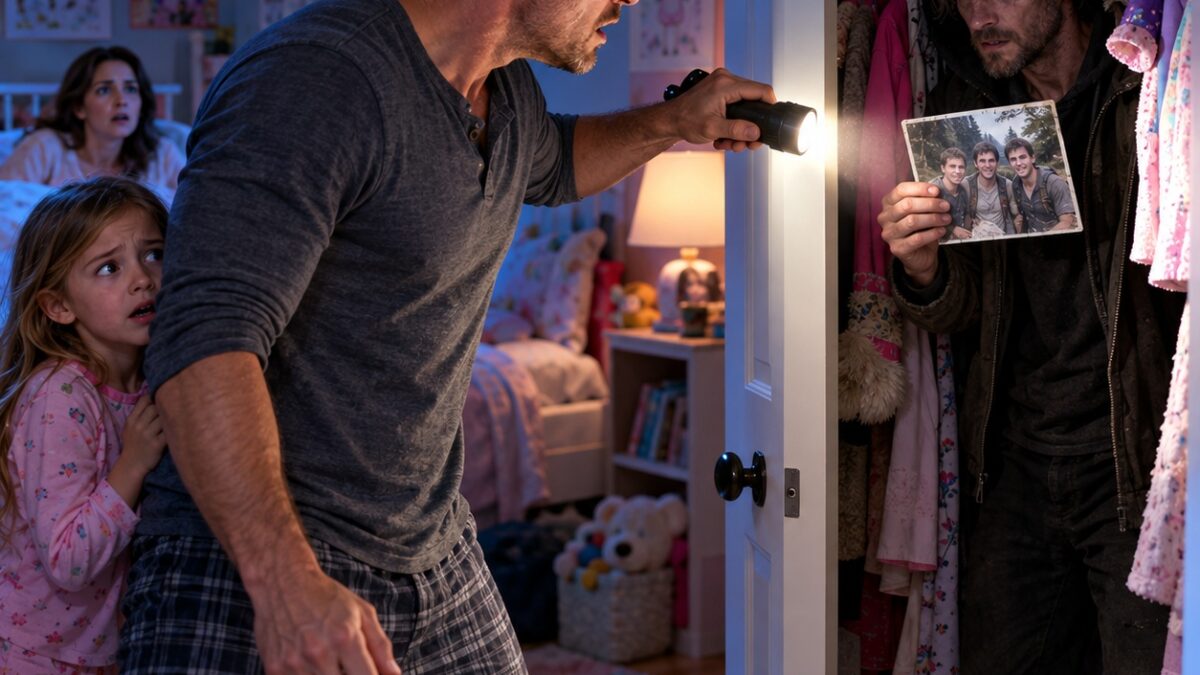
𝗙𝗨𝗟𝗟 𝗦𝗧𝗢𝗥𝗬 


Camille woke while I was settling Gracie into our bed.
She sat up, confused.
“What happened?”
“Nightmare.”
Gracie looked at me.
I saw the question in her eyes.
Why was Daddy lying?
I kissed her forehead.
“Try to sleep.”
Then I walked downstairs.
The kitchen lights were already on.
I had not left them that way.
A sheet of paper sat on the counter.
Cornell’s handwriting had not changed.
Angular.
Hard.
Controlled.
DAY ONE.
I WAS TRAPPED FOR SIX DAYS.
YOU HAVE SIX DAYS TO FEEL WHAT I FELT.
WATCH YOUR FAMILY CLOSELY.
THE DARKNESS IS COMING FOR ALL OF YOU.
My hands shook.
I crushed the note.
Then flattened it again.
Evidence.
That word mattered.
I went to the basement.
Behind boxes of Christmas decorations was an old laptop I had not connected to the internet in years.
It belonged to Micah before Micah Hall existed.
Encrypted folders.
Old photographs.
Maps.
Cave coordinates.
Documents I should have destroyed.
I turned it on.
The screen glowed.
And the past returned.
We had been young.
That is not an excuse.
But it is the beginning.
Cornell, Noah, and I had been obsessed with caves.
Not tourists.
Not guided caverns with railings and gift shops.
Wild systems.
Unmapped passages.
Places where you crawled through limestone cracks barely wider than your shoulders and trusted the person behind you with your life.
At first, it was adventure.
Then Cornell became interested in rumors.
Spanish coins.
Civil War caches.
Native artifacts.
Anything old enough to have value and hidden enough that ownership became complicated.
Noah hated that part.
So did I.
At least, I told myself I did.
But I kept going.
That made me guilty too.
The final cave changed everything.
Cornell had found references suggesting something had been hidden deep inside an Ozark system.
We went in.
Hours later, our lights found metal.
Coins.
Artifacts.
Objects that should have been reported immediately.
Noah said exactly that.
Cornell disagreed.
The argument turned ugly.
Then violent.
I remembered Noah shouting.
Cornell screaming.
A flash.
A collapse.
Rock falling.
Dust filling my mouth.
Noah’s blood.
Then darkness.
I remembered crawling.
Calling for them.
Getting no answer.
And eventually seeing daylight.
I came out alone.
Terrified.
Injured.
Convinced both men were dead.
Then I did the worst thing I had ever done.
I ran.
I told myself I was in shock.
I was.
I told myself the authorities would blame me.
Maybe.
I told myself I could do nothing for dead men.
That was cowardice.
I changed my name.
Moved.
Built another life.
Three years later, I met Camille.
Eight years after that, we had Gracie.
I became a woodworker.
Built cabinets.
Tables.
Custom interiors.
I learned how to create beautiful things with my hands because destruction had haunted me long enough.
Then Cornell walked back into my daughter’s room.
Morning arrived too soon.
I made pancakes.
Gracie barely spoke.
Camille watched me.
She was a child psychologist.
People assume being married to a psychologist means you get free therapy.
Mostly it means lying becomes extremely difficult.
After Gracie left for school, Camille cornered me near the sink.
“What happened last night?”
“She had a nightmare.”
“No.”
“Camille—”
“You were awake until morning.”
“I had work.”
“You have a look.”
“What look?”
“The one you get when you’re carrying something heavy and refusing to put it down.”
She touched my arm.
“Micah.”
“We’ve been married eight years.”
“I know when you’re afraid.”
I wanted to tell her.
Every part.
Instead:
“Big cabinet order.”
She stared.
“Morrison project?”
“Yes.”
She did not believe me.
But she had work.
So did I.
For the moment, she let it go.
I called Isaac Marshall.
Isaac was a former park ranger.
Built like a bear.
Kind eyes.
Gray beginning around his temples.
He knew I had explored caves when I was young.
He did not know the truth.
We met at a diner outside Springfield.
“Cornell Baldwin.”
I said.
Isaac froze.
“That’s a name.”
“You know it?”
“Everybody around the Ozarks knew it twelve years ago.”
My stomach tightened.
“He survived?”
Isaac stared.
“You didn’t know?”
I shook my head.
“He was trapped six days.”
“They found him barely alive.”
“Dehydrated.”
“Delirious.”
“He kept saying somebody tried to kill him.”
My hands went numb around the coffee cup.
“What happened afterward?”
“Hospital.”
“Psychiatric facility.”
“Years of treatment.”
“PTSD.”
“Paranoia.”
“Eventually released.”
Isaac leaned closer.
“Why?”
I looked around the diner.
Then said:
“He was in my daughter’s closet last night.”
Isaac did not move.
“What?”
I told him enough.
Not everything.
He listened.
Then:
“You call the police?”
“No.”
“Call them.”
“I need to understand what he’s doing.”
“Micah, he broke into your house.”
“I know.”
“He stood beside your child.”
“I know.”
“Then stop pretending this is some old personal dispute.”
He was right.
My phone vibrated.
Unknown number.
I opened the message.
A photograph of Camille through her office window.
DAY TWO.
PRETTY WIFE.
PRETTY LIFE.
BUILT ON LIES.
Another message.
Gracie on the school playground.
SHE HAS YOUR EYES.
My vision narrowed.
Isaac saw my face.
“What?”
I showed him.
He cursed.
Then took out his phone.
“I’m making calls.”
Less than an hour later, he had more.
Cornell had spent years in psychiatric treatment.
After release, he drifted.
Then disappeared from regular records.
One connection remained.
Randall Woods.
Cornell’s cousin.
We had known him years ago.
Always on the edge of our group.
Always wanting to be included.
Now he worked as a private investigator in Kansas City.
That explained too much.
How Cornell found me.
How he knew my house.
My routine.
Camille’s office.
Gracie’s school.
I drove home.
A package waited outside my workshop.
Inside was Noah’s old backpack.
Dark stains still marked the fabric.
There was a photograph.
The backpack lying in the cave near scattered coins.
Then a note.
I HAVE PROOF YOU WERE THERE.
PROOF YOU LEFT US.
PROOF YOU TOOK THE TREASURE.
SIX DAYS.
THEN I TAKE EVERYTHING FROM YOU.
I had not taken anything.
Not gold.
Not artifacts.
Nothing.
I had run with blood on my clothes and terror in my head.
But Cornell’s memory had become something else.
Maybe trauma.
Maybe obsession.
Maybe both.
The workshop phone rang.
I answered.
“Hello?”
“Micah.”
Cornell.
Quiet.
Almost friendly.
“I’ve been watching you four months.”
My skin crawled.
“I know your wife drinks Earl Grey every morning.”
“I know Gracie sleeps with a stuffed elephant.”
“I know you kiss Camille goodbye every morning before she leaves.”
“Stop.”
“I’ve been inside your house while you slept.”
“You stay away from them.”
“I want you to feel helpless.”
His voice sharpened.
“I want you to know everything you love can disappear.”
“Like Noah disappeared.”
“Like my sanity disappeared.”
“You caused that cave-in.”
I said.
Silence.
Then:
“Six days.”
His calm cracked.
“You have six days to confess.”
“Tell Camille who you really are.”
“Tell her what you did.”
“Or I’ll tell her after I take your daughter.”
The line went dead.
That was when fear became clarity.
I went to the police on day three.
Detective Cole Walton listened.
He had the tired eyes of someone who had spent thirty years hearing people insist their version of a story was the only possible one.
I brought the notes.
Photos.
Backpack.
Everything.
Then I told him about the cave.
Not every detail.
Enough.
“We were exploring illegally.”
I said.
“We found artifacts.”
“Cornell wanted to sell them.”
“Noah and I wanted to report them.”
“There was a fight.”
“The cave collapsed.”
“Noah died.”
“I escaped.”
“You reported none of this?”
“No.”
Walton looked unimpressed.
“I was twenty-two.”
“That doesn’t answer me.”
“I was terrified.”
“That does.”
He wrote something.
Then:
“Where does Cornell fit?”
“He caused the collapse.”
“You certain?”
“Yes.”
“Can you prove it?”
“No.”
Walton called Cornell in.
That was my first lesson in how thoroughly Randall had prepared him.
Cornell arrived clean.
Khakis.
Button-down shirt.
Lawyer beside him.
Randall behind them.
He looked less like the man from Gracie’s closet and more like a damaged professional trying to rebuild his life.
Cornell spoke calmly.
“I came to Springfield for closure.”
He told Walton that I had led them into the cave.
That I had wanted the treasure.
That I became violent.
That I abandoned him.
He described himself as the survivor.
Me as the aggressor.
Randall confirmed Cornell had been living with him.
The lawyer presented psychiatric records.
PTSD.
Trauma.
Paranoid symptoms.
Then Cornell looked at me with sadness so convincing I almost doubted my own memory.
“Micah.”
He said.
“You need to face what you did.”
I lost control.
“He broke into my house!”
“Threatened my daughter!”
Walton asked for proof.
I reached for my phone.
The messages were gone.
All of them.
My stomach dropped.
Call history too.
Deleted.
Compromised somehow.
Randall watched me quietly.
I understood.
The PI.
The surveillance.
The preparation.
“The notes.”
I said.
“They’re at home.”
Cornell stood.
“If I’m not being charged, I’d like to leave.”
Then his lawyer added:
“We also have a restraining-order hearing scheduled regarding Mr. Hall’s threats against my client.”
Walton looked at me differently after that.
Cornell left.
At the door, he glanced back.
A tiny smile.
Checkmate.
I drove home furious.
My workshop had been searched.
Drawers open.
Files disturbed.
The evidence I had left there was gone.
Then I turned.
Camille stood in the doorway.
Holding Noah’s backpack.
And the notes.
Her face was white.
“What is this?”
“Camille—”
“Who is Noah Sparks?”
I said nothing.
“Who is Cornell?”
“Why is somebody threatening our daughter?”
Her voice broke.
“And why does every piece of this tell me my husband has been lying about who he is?”
“I was trying to protect you.”
“From what?”
“The truth.”
The words sounded pathetic as soon as I said them.
She threw the papers onto my workbench.
“We’ll talk later.”
She wiped tears from her face.
“Right now you need to get Gracie.”
I looked at the clock.
2:47.
School ended at three.
I drove too fast.
Reached Meadowbrook Elementary at 2:55.
The pickup line moved.
Children came out.
3:00.
3:05.
No Gracie.
I got out.
Before I reached the office, my phone rang.
Unknown number.
I answered.
Cornell.
“Day four came early.”
My knees weakened.
“Where is she?”
“She’s safe.”
“For now.”
“If you touch her—”
“I’m not going to hurt her.”
“You are.”
He sent coordinates.
Remote Ozarks.
“Come alone.”
“Three hours.”
“Police and she dies.”
Then:
“Come back to the darkness.”
The call ended.
I should have called Walton.
I know that.
Every rational part of me knew.
Instead, I called Camille.
“Gracie’s with me.”
I lied.
“We’re going for ice cream.”
The silence on her end told me she knew something was wrong.
But I hung up.
Then I drove.
The mountains rose against the late afternoon sky.
Beautiful.
Ancient.
Terrifying.
Cornell’s coordinates led to a cave system I knew from years earlier.
Not the original one.
Worse in some ways.
More narrow passages.
Underground water.
Places even experienced cavers respected.
A black van sat near the trailhead.
Randall’s.
At the cave entrance, a headlamp waited.
A note instructed me to leave my phone.
I disabled what I could.
Then entered.
The smell hit first.
Wet limestone.
Mud.
Decay.
Then memory.
Noah calling my name.
Rock falling.
My own breath becoming too loud.
Cornell’s voice echoed from deeper underground.
“Welcome back.”
I followed glow sticks.
Down.
Then farther down.
Twenty minutes later, the passage opened.
Gracie sat inside a metal enclosure in the center of a large chamber.
Her hands were bound.
She was crying.
“Daddy!”
Every instinct in me surged forward.
Cornell raised a device in his hand.
“Stop.”
I stopped.
Small charges were visible along sections of the chamber walls.
The setup was designed to terrify me more than anything else.
Cornell knew exactly where my mind would go.
“Let her go.”
“No.”
“This is about me.”
“It was always about you.”
His face looked worse underground.
Gaunt.
Sweat at his temples.
Pills rattling in one hand.
“You left me in darkness.”
He said.
“For six days.”
“You tried to kill us.”
“No.”
His voice rose.
“You wanted the gold.”
“You and Noah turned on me.”
“That’s not what happened.”
“That is exactly what happened.”
There was no reaching him.
His pain had fused with memory until they were the same thing.
Then air began hissing somewhere in the chamber.
Cornell smiled.
He explained the choice he wanted me to make.
Stay.
Or force Gracie through a dangerous narrow escape route alone.
He wanted me to abandon my child to save her.
The way he believed I had abandoned him.
That was the point.
Not murder.
Reenactment.
He wanted a father to become the coward he believed I had always been.
Then he disappeared through another passage.
I ran to Gracie.
“I’m getting you out.”
The lock was complicated.
But nothing built by a human is magic.
I found a mechanical weakness.
It took precious minutes.
Finally, the door opened.
Gracie fell into me.
I held her.
For one second.
That was all I allowed.
Because we still had to escape.
The obvious route was too dangerous.
Cornell expected us to take it.
I studied the chamber.
Air movement.
Rock formations.
Old memory.
Caves breathe.
If air moved, somewhere there was another connection.
I found a tight secondary passage.
Not safe.
Nothing there was safe.
But possible.
I gave Gracie my strongest light.
“Listen to me.”
“I have to find another way around.”
“No.”
She grabbed my shirt.
“Daddy, don’t leave.”
Those words nearly broke me.
“I am coming back.”
“Promise?”
“Yes.”
And I meant it in a way I had never meant anything before.
Twelve years earlier, I ran from darkness.
This time I crawled into it.
The passage compressed around me.
Stone scraped my shoulders.
At one point I had to breathe out just to move.
Panic surged.
For a moment, I was twenty-two again.
Trapped.
Blood.
Noah.
Then I saw Gracie’s face.
I kept moving.
Eventually the passage opened above underground water.
I entered.
Cold stole my breath.
I followed the system until I saw light.
Cornell.
Randall.
Waiting near the far side.
They expected Gracie.
Not me.
I surprised them.
The struggle was fast.
Ugly.
Randall went down first.
Cornell came at me.
I fought like a man whose daughter was behind him even when she was hundreds of feet away through stone.
Eventually Cornell lost control of the situation.
What mattered was time.
Gracie was still in the chamber.
I left Randall restrained and forced my way back through the alternate route.
The return nearly killed me.
I was exhausted.
Cold.
Every muscle burning.
When I reached the chamber, Gracie was barely conscious.
I lifted her.
Ran.
The main passage was longer but wider.
Behind us, rock began shifting.
Some part of Cornell’s trap was failing.
Or activating.
I never knew which.
I carried my daughter through darkness until I saw daylight.
Then the hill shook behind us.
The entrance partially collapsed.
I laid Gracie on the ground.
She wasn’t breathing right.
“Come on.”
I started first aid.
“Baby, come on.”
She coughed.
Air rushed into her lungs.
Her eyes opened.
“Daddy?”
I broke.
Completely.
“I’m here.”
Sirens approached.
Somebody had seen the collapse.
Hikers.
Maybe another explorer.
I reached for my phone.
When it powered on, messages flooded the screen.
Camille.
Again and again.
Then one message stopped everything.
A photograph.
Camille.
Bound.
Inside a concrete room.
The message said Cornell’s revenge had never ended in the cave.
The cave was the distraction.
While I was saving Gracie, Randall’s plan had already placed Camille somewhere else.
An old Baldwin family shelter.
Buried.
Sealed.
Limited air.
My world tilted.
“Daddy?”
Gracie whispered.
“Where’s Mommy?”
I looked at my daughter.
Then toward the emergency vehicles.
And knew the nightmare was not finished.
Isaac arrived not long after.
I pulled him aside.
“Take Gracie.”
“Micah—”
“Camille’s missing.”
“What?”
“Cornell has her somewhere.”
“Tell the police.”
“There isn’t time.”
“That’s insane.”
“I know.”
Isaac looked at Gracie.
Then back at me.
Finally:
“Go.”
I drove toward Kansas City.
Randall’s office.
If anybody knew Baldwin family properties, he did.
Breaking into that office was illegal.
I knew that too.
By then, laws and consequences had become blurred under panic.
Inside, I found months of surveillance.
Photographs of us.
Maps.
Schedules.
Camille at the grocery store.
Gracie at school.
Me leaving work.
A wall of obsession.
Then the map.
Three old Baldwin properties.
Two crossed out.
One marked:
SHELTER INTACT.
I photographed the map.
Called Isaac from the road.
He told me Cornell had been recovered alive from the cave after a severe panic episode.
Randall had also been taken into custody and was cooperating.
The police were now treating everything as kidnapping.
I gave Isaac the location.
“If I don’t call within six hours, send everybody.”
Then I drove toward Belleview.
The old Baldwin property was abandoned.
Only a burned foundation remained from the farmhouse.
Behind it:
A hill.
Overgrown brush.
A rusted door set into earth.
Recent marks around the frame.
“Camille!”
I pounded.
Nothing.
Then:
“Micah?”
Faint.
But alive.
I nearly collapsed.
“I’m here!”
The entrance had been sealed.
I used what tools I had.
Then more I bought along the way.
I worked until my hands split.
Hours passed.
Morning began.
Camille’s voice weakened.
“I love you.”
“No.”
I shouted.
“Don’t say goodbye.”
“Tell Gracie—”
“You’re telling her yourself.”
I kept working.
Eventually, Isaac stopped arguing with me and sent help.
By the time sirens reached the property, I had created enough of an opening to force the door.
It gave.
I ran inside.
Camille lay collapsed.
I carried her into daylight.
Paramedics surrounded us.
Police surrounded me.
One officer told me I was under arrest.
“Later.”
I snapped.
“My wife needs oxygen.”
Walton arrived and ordered his people back until she was stable.
Camille grabbed my hand.
Her face was pale.
Her voice barely there.
“The truth.”
I looked at her.
“All of it.”
There was nowhere left to hide.
So beside an ambulance, with police watching and dawn spreading over an abandoned Ozark property, I confessed.
The caves.
The treasure.
Cornell.
Noah.
The fight.
The collapse.
Running.
Changing my name.
Everything.
When I finished, Camille was crying.
So was I.
She squeezed my hand.
“We deal with this.”
Then:
“But no more lies.”
“Never.”
I promised.
Walton approached.
They had searched Randall’s office.
Found surveillance equipment.
Plans.
Records.
Cornell was talking from the hospital.
Randall was talking too.
The story was finally unraveling.
Forensic evidence from the old cave investigation was reopened.
The truth was more complicated than any one person’s memory.
Cornell had played a major role in the violence.
Evidence linked him to the materials used during the original incident.
Noah’s injuries suggested violence before the collapse.
Cornell’s account of me as a treasure thief began breaking apart.
But my actions were not erased.
I had fled.
I had hidden the truth.
I had let families live without answers.
No amount of heroism twelve years later changed that.
Walton told me most possible charges connected to the old exploration had serious evidentiary and limitation problems.
But morally?
There was no limitation period.
I had to live with it.
At the hospital, Gracie ran into my arms.
“You saved Mommy.”
I held her.
“Yes.”
But even then, I knew rescue did not mean everything was fixed.
Camille survived.
Physically.
Emotionally, all three of us were wounded.
Then Cornell called me from the hospital.
His voice was medicated.
Calm.
“You think this is over?”
I almost hung up.
“The police have everything.”
He laughed.
He told me treatment would save him.
That people would call him traumatized.
That someday he would get out.
Then he mentioned Gracie.
My hand tightened around the phone.
“When I come back…”
I ended the call.
That night, I sat beside Camille while she slept.
Every dark part of me woke again.
Fear told me I would never keep them safe.
That Cornell would always return.
That laws could fail.
That hospitals had doors.
That names could be changed but families could still be found.
I thought terrible thoughts.
Thoughts I am not proud of.
For years, I had defined myself by one cowardly decision.
Run.
Now another temptation appeared.
Control everything.
End every threat myself.
That path felt dangerously easy.
And in the original version of my life—the one I sometimes imagined during the worst nights—I might have followed it.
But Camille had asked me for one thing.
No more lies.
So the next morning, I told Walton about the call.
Every word.
I told Camille too.
I expected panic.
Instead, she looked at me for a long time.
Then:
“You don’t get to decide alone anymore.”
That sentence changed my life.
She was right.
I had spent twelve years making decisions alone because I believed secrecy protected people.
It did not.
Secrecy had protected my fear.
Nothing else.
Cornell was transferred under heavy supervision for psychiatric evaluation.
The threat he made became part of the record.
Randall’s cooperation produced more evidence.
The stalking.
The digital intrusion.
The kidnappings.
The shelter.
Months of planning.
Randall eventually pleaded guilty to multiple charges and received a long prison sentence.
Cornell’s case took longer.
Psychiatric evaluations.
Competency hearings.
Experts.
Medication.
Arguments over responsibility.
The process frustrated me.
Sometimes terrified me.
But I stopped trying to control it.
That was harder than crawling through stone.
Eventually, Cornell was committed to a secure state psychiatric facility under court supervision while criminal proceedings and treatment continued.
No dramatic victory.
No revenge.
No cheering.
Just reinforced doors, legal orders, doctors, and years of review ahead.
I hated how uncertain it felt.
But Camille reminded me:
“Uncertainty is not the same as helplessness.”
We changed our security.
Changed routines.
Moved later.
Worked with law enforcement.
Went to therapy.
A lot of therapy.
Cornell remained contained.
And I had to learn that protecting my family did not require becoming something I would have to hide from them.
That was the lesson the caves had refused to teach me when I was twenty-two.
Six months later, our lives looked different.
I sold the woodworking business.
That surprised everyone.
I loved wood.
Still do.
But the workshop had become crowded with memories.
The backpack.
The threatening calls.
Camille standing in the doorway holding proof of my lies.
I could no longer enter without feeling the old panic.
So I sold it.
Then I began volunteering with a trauma-support organization.
At first, I thought it was ridiculous.
Me?
Helping people?
I was the man who had run.
The man who had lied.
But the director told me:
“Sometimes people trust somebody who understands what shame actually feels like.”
That sentence stayed.
Eventually, I worked there more regularly.
Accident survivors.
Victims of violence.
People with PTSD.
Families living beside somebody else’s trauma.
I never told them I had answers.
I did not.
I told them what took me too long to understand.
Fear gets worse in secrecy.
Shame grows when hidden.
And survival is not the same thing as healing.
Camille went through therapy too.
Being trapped underground nearly destroyed her sense of safety.
There were nights she woke unable to breathe.
Days she could not tolerate closed doors.
Sometimes she looked at me and saw the man who saved her.
Other times she saw the husband who had lied for eight years.
Both were true.
Marriage counseling was brutal.
We argued.
Went silent.
Nearly separated twice.
Once Camille packed a suitcase.
She stood beside the bed.
“I don’t know whether I know you.”
I had no defense.
“You know who I am now.”
“That doesn’t give me back eight years.”
“No.”
I said.
“It doesn’t.”
She sat on the suitcase and cried.
So did I.
Then she unpacked.
Not because everything was forgiven.
Because she wanted to see whether trust could be rebuilt honestly.
We did it slowly.
No passwords hidden.
No stories softened.
No past edited for comfort.
Truth even when ugly.
Especially then.
Gracie recovered faster than either of us.
Kids sometimes do.
She had nightmares for weeks.
She hated closets.
Every night, I checked hers.
Then one evening she stopped asking me.
A month later, she left the closet door open herself.
By winter, she was talking more about horses, school, friends, and which cereal counted as “real breakfast” than Cornell.
That was progress.
We moved across Springfield.
Ranch house.
No basement.
Bright rooms.
Security lights.
Camille joked during the showing:
“No underground anything.”
The realtor looked confused.
“We’ll explain never.”
I said.
The house became ours.
Not because it erased what happened.
Because it gave us somewhere new to heal.
Randall wrote to me from prison.
One letter.
He said Cornell had needed help long before he helped him seek revenge.
That instead, Randall had validated the obsession.
Fed it.
Used his skills to make delusions actionable.
He apologized.
Then:
Use your second chance better than I used mine.
I burned the letter.
But remembered that sentence.
The artifacts that started everything remained underground.
I contacted the proper archaeological authorities through my attorney.
Professionals eventually began reviewing the original site.
I wanted nothing.
Not a coin.
Not a photograph.
Not ownership.
Whatever history was buried there deserved better than three reckless young men deciding it belonged to whoever could carry it out.
Noah’s family finally received fuller answers.
That conversation was the hardest one of my life.
His mother was older.
Smaller than I remembered.
I sat across from her.
Told her I was sorry.
Told her I had escaped.
Told her I had been afraid.
Told her I had failed them.
She did not forgive me.
Not then.
Maybe never.
She had that right.
Before I left, she said:
“You should have come home.”
“I know.”
“Noah trusted you.”
“I know.”
“You let us bury him without knowing.”
I could barely speak.
“Yes.”
She cried.
I cried.
There was no resolution.
That mattered too.
Not every wound becomes inspirational.
Some stay painful because they should.
I carried that conversation home.
Camille asked:
“How was it?”
“Awful.”
“Did she forgive you?”
“No.”
Camille took my hand.
“I’m sorry.”
“I’m not.”
She looked at me.
“She didn’t owe me that.”
For the first time in twelve years, guilt felt different.
Still heavy.
But clean.
Not hidden.
One autumn evening, I took Gracie camping.
Just us.
Not caves.
Never caves.
Open sky.
A small campground far from Springfield.
We slept outside our tent for a while, watching stars.
She asked:
“Daddy?”
“Yeah?”
“Are you still afraid of caves?”
I smiled.
“Sometimes.”
“I thought dads weren’t scared.”
“Dads are scared all the time.”
“Really?”
“Absolutely.”
“What do you do?”
I thought.
Then:
“Try not to let fear make all my choices.”
She considered that.
“What did fear make you do before?”
Children ask questions adults spend years avoiding.
I looked at the stars.
“It made me run from something I should have faced.”
“What do you do now?”
“I tell the truth.”
She nodded like that made perfect sense.
Then:
“And protect me and Mommy.”
“Yes.”
“That too.”
She rolled closer in her sleeping bag.
“I’m glad you’re my daddy.”
My throat tightened.
“I’m glad you’re my daughter.”
We lay beneath an enormous sky.
No ceiling.
No stone.
No darkness closing around us.
Just stars.
Twelve years earlier, I had believed darkness was something physical.
A cave.
No light.
Rock overhead.
I understood differently now.
Darkness was shame you refused to name.
Fear you allowed to make decisions.
Truth you buried so deep you convinced yourself nobody could ever dig it up.
Cornell lived inside that darkness until it reshaped every memory he had.
I almost did too.
The difference was not that I was stronger.
It was that eventually I stopped running.
There were consequences.
My marriage changed.
My career changed.
My daughter learned things about her father I wished she never needed to know.
Noah’s family got answers far too late.
But the truth stopped owning me from underground.
Years later, I sometimes wake at two in the morning.
For one heartbeat, I am back on the night Gracie touched my shoulder.
Daddy, there’s a man in my closet.
Then I hear Camille breathing.
The house settling.
Maybe rain.
Maybe the refrigerator.
Ordinary sounds.
I look toward the hall.
No shadow waiting.
No Cornell.
No countdown.
The first few times, I got up and checked every room.
Now I usually stay in bed.
Camille sometimes wakes.
“You okay?”
“Yes.”
And now when I say yes, it is usually true.
Cornell remains part of our history.
Not our center.
That distinction took time.
Gracie grew.
Camille and I stayed married.
Not because love magically defeated trauma.
Because both of us chose the marriage again after finally seeing what it actually contained.
The good.
The damage.
The lies.
The courage.
Everything.
One year after the kidnapping, we drove past my old workshop.
The new owner had repainted the sign.
For a moment, I wanted to stop.
I did not.
Camille touched my hand.
“You miss it?”
“Sometimes.”
“You could build again someday.”
“Maybe.”
“Not because you’re running back.”
She said.
“Because you choose it.”
I smiled.
My wife understood me too well.
Years earlier, that frightened me.
Now it was the safest feeling I knew.
Isaac remained in our lives.
He never let me forget how close secrecy had come to destroying everything.
One evening over coffee, he said:
“You know what I thought when you first told me Cornell came back?”
“What?”
“That you were going to disappear again.”
I looked at him.
“Why?”
“Because running was your old move.”
That hurt.
He shrugged.
“You didn’t.”
“No.”
“You came back.”
“I had Gracie.”
“You had Noah too.”
Silence.
Isaac immediately regretted it.
I stopped him.
“No.”
“You’re right.”
That was another truth I had learned.
Love does not automatically make us brave.
Sometimes responsibility does.
Sometimes age.
Sometimes pain.
Sometimes the simple knowledge that if you run again, you will become the person you fear you already are.
I never became comfortable with caves again.
I did not need to.
Healing is not always returning to the place that broke you and smiling.
Sometimes healing is knowing you never have to prove anything to that place.
The Ozarks remained beautiful.
The caves remained where they had always been.
Stone does not care about guilt.
Mountains do not care about revenge.
They hold whatever we bring into them.
Greed.
Friendship.
Fear.
Secrets.
Then they wait.
Cornell spent twelve years believing the darkness was where I had left him.
I think the darker truth was that he carried it out with him.
So did I.
He fed his.
I hid mine.
Neither worked.
Only when everything was exposed did my life begin becoming honest.
Not easy.
Honest.
And I learned there is a difference.
Sometimes Gracie still asks about Noah.
I tell her the good parts.
That he laughed too loudly.
That he loved cheap gas-station coffee.
That he could identify cave formations faster than any of us.
That he was braver than me.
One day she asked:
“Was he your best friend?”
“Yes.”
“Then why did you leave?”
No soft answer existed.
“Because I was scared.”
She frowned.
“That was bad.”
“Yes.”
“Do you wish you didn’t?”
“Every day.”
She thought.
Then:
“You don’t run now.”
Children can give grace adults cannot request.
I kissed her forehead.
“No.”
“I don’t.”
That became the promise I actually kept.
I could not change the twenty-two-year-old who crawled out of a cave and ran.
I could not bring Noah back.
I could not erase what Cornell suffered underground.
I could not give Camille back the marriage she thought she had before the truth.
I could only choose what happened next.
Stay.
Speak.
Tell the truth.
Ask for help.
Protect without controlling.
Love without hiding.
Those sound simple.
They are not.
They are harder than surviving darkness.
Because darkness gives you excuses.
Light shows everything.
The last time I visited the Ozarks was years later.
Not the cave.
A ridge above it.
Camille came with me.
We stood among trees.
The air smelled like leaves and limestone.
Somewhere below us, miles of passages twisted through the mountain.
“You okay?”
She asked.
“Yes.”
“Really?”
I smiled.
“Really.”
We did not go closer.
I did not need to.
I took an old photograph from my pocket.
Three young men outside a cave.
Me.
Cornell.
Noah.
The same photograph Cornell dropped in Gracie’s room.
For years, I thought about destroying it.
Instead, I folded it back into my wallet.
Camille looked at me.
“Keeping it?”
“Yes.”
“Why?”
“Because forgetting didn’t save me.”
She leaned against my shoulder.
We stood there until the sun lowered.
Then we went home.
Home.
That word mattered more after everything.
Not a place nobody could invade.
Cornell had proved such a place does not exist.
Home became something else.
The place where I no longer needed a second name.
The place where my wife knew who I had been and still expected me to become better.
The place where my daughter could wake me at two in the morning and trust that I would come when she called.
The place where nothing important lived inside a locked folder anymore.
Twelve years earlier, I escaped a cave and thought survival meant getting into daylight.
I was wrong.
Real survival took much longer.
It meant learning how to live there.








