𝗙𝗨𝗟𝗟 𝗦𝗧𝗢𝗥𝗬: The HOA President Smiled as an Excavator Hit My Barn—She Forgot I Was Holding a Judge’s Order in My Hand
PART 2 and FULL ENDING  Thank you

Tessa Whitmore stared at the photograph for almost a full minute before speaking.
She was forty-one, sharp, quiet, and one of those attorneys who never wasted words because she understood silence made other people nervous.
“Caleb.”
She finally said.
“Yes?”
“They just told us exactly what they intend to do.”
I looked at the red paint again.
“You think they’ll actually try?”
“I think people don’t spray demolition instructions on buildings for decoration.”
“What do you want me to do?”
“Nothing dramatic.”
That answer disappointed some angry part of me.
I wanted her to say:
File suit.
Call the sheriff.
March into the HOA meeting.
Instead:
“We build the file.”
She started listing documents.
Deed.
County plat.
Nathan’s survey.
Tax records.
Building permits.
Fire inspection.
Photographs showing the barn existed years before Stonegate Ridge.
Business records.
Certificate of occupancy.
Insurance documents.
Anything establishing what the barn was, where it stood, and who owned the ground beneath it.
Then:
“Start a log.”
“A log?”
“Every visit.”
“Every strange vehicle.”
“Every call.”
“Every email.”
“Every time Marissa comes near the property.”
“Why?”
“Because memory becomes less persuasive after six months of litigation.”
“So paper beats memory.”
“Almost every time.”
She told me to install cameras.
Gate.
Barn.
Driveway.
Interior.
Back everything up to cloud storage.
“Feels paranoid.”
I said.
Tessa looked at the photograph.
“Does that paint look imaginary?”
Point taken.
I installed the cameras that weekend.
I kept my phone charged.
Started saving voicemails.
Made a folder.
Then another.
It felt ridiculous.
My life had always been physical.
Boards.
Nails.
Machines.
Measurements.
If something broke, I fixed it.
Now my best tools were timestamps.
Marissa kept going.
Her next letter was titled:
FINAL ABATEMENT NOTICE.
Ten days to remove my own barn.
I drove straight to Tessa.
She read it.
Then smiled in a way that was not really a smile.
“They are doing excellent work for us.”
“What does that mean?”
“They are documenting intent.”
She sent a cease-and-desist letter to the HOA and its lawyer.
The HOA attorney replied carefully.
The board, he wrote, was “evaluating available remedies.”
No claim that they had the right to demolish.
No statement that my property belonged to them.
No endorsement of Marissa’s ten-day ultimatum.
Tessa tapped the letter.
“This lawyer is protecting himself.”
“From what?”
“From her.”
Two days later, I understood.
Marissa’s SUV was parked outside my fence.
Beside it stood Wade Kesler.
I knew Wade by reputation.
His company demolished commercial buildings, barns, small industrial structures.
He was measuring the gate.
Photographing the roof.
Checking how a loader could turn inside the driveway.
I walked toward them.
“What are you doing?”
Wade looked at Marissa.
Marissa looked at me.
“You had your chance.”
She said.
“Wade.”
I said.
“This is private property.”
He looked uncomfortable immediately.
“I was told—”
“I’m telling you now.”
I pointed toward the public road.
“You don’t have permission to enter.”
Wade stepped back.
“I’m staying out.”
Marissa did not.
She held my eyes.
“Ten days means ten days.”
Then she left.
I called Tessa.
“That’s enough.”
She said.
“For what?”
“Temporary restraining order.”
The next morning, we filed.
The motion explained why money would not be enough after destruction.
The barn was not just walls.
Inside were industrial machines worth nearly two hundred thousand dollars.
Reclaimed timber already committed to customers.
Custom electrical systems.
Ventilation.
Dust collection.
Workspaces I had built over years.
Then there was the building itself.
Old timber-frame construction.
Some structural members older than anyone alive.
Once destroyed, no check could recreate their history.
The HOA opposed us.
Marissa filed an affidavit.
She swore the association had “no immediate plan” to demolish my barn.
Tessa placed three things beside that affidavit.
The spray paint.
The final abatement notice.
A photograph of Marissa standing beside a demolition contractor measuring my gate.
Judge Miles Ardan scheduled an emergency hearing.
He was sixty-one.
Gray hair.
Patient voice.
The kind of judge who made people underestimate how closely he listened.
Marissa testified first.
The barn was dangerous.
Tessa handed the fire inspection to the court.
Marissa changed direction.
The property fell within Stonegate Ridge’s “sphere of influence.”
Tessa handed up my deed.
Then Marissa said the community needed emergency access.
Tessa asked:
“Emergency access approved by which county agency?”
Silence.
She repeated it.
No answer.
Judge Ardan turned toward the HOA lawyer.
“Is there an approved emergency-access plan?”
The attorney looked at his notes.
“No, Your Honor.”
“A permit?”
“No.”
“Pending application?”
“Not that I’m aware of.”
The judge looked at Marissa.
Her confidence finally flickered.
His order was blunt.
The HOA.
Its board.
Its members.
Its agents.
Its contractors.
Anyone acting on its behalf.
No entering my land.
No touching the barn.
No moving materials.
No fence changes.
No demolition.
No interference until the property-right dispute was resolved.
Marissa heard every word.
That afternoon, a process server delivered a certified copy to the HOA office.
She signed for it at 5:42 p.m.
Tessa called.
“You’re protected.”
I let out a breath I felt I had been holding for weeks.
“They can’t touch it?”
“Not without violating a direct court order.”
That night, I slept.
Really slept.
I believed the worst was over.
It lasted about nine hours.
The phone rang before sunrise.
A neighbor.
“Caleb.”
“What?”
“There are trucks coming up Ridge Road.”
I sat up.
“What kind?”
“Dump trucks.”
“An excavator too.”
Then:
“Marissa’s behind them.”
I was dressed in three minutes.
By the time I reached the barn, the sky was still gray.
Wade Kesler’s equipment waited outside.
Excavator.
Loader.
Two dump trucks.
I called Tessa first.
Then the sheriff’s office.
“There is an active injunction.”
I said.
“A demolition crew is at my property.”
The dispatcher told me deputies were on the way.
Tessa called back.
“Do not physically block equipment.”
“I’m not.”
“Do not touch Marissa.”
“I wasn’t planning to.”
“Record.”
“I already am.”
“Everything.”
Marissa arrived around seven.
Business outfit.
Clipboard.
Coffee cup.
Like she was supervising landscaping.
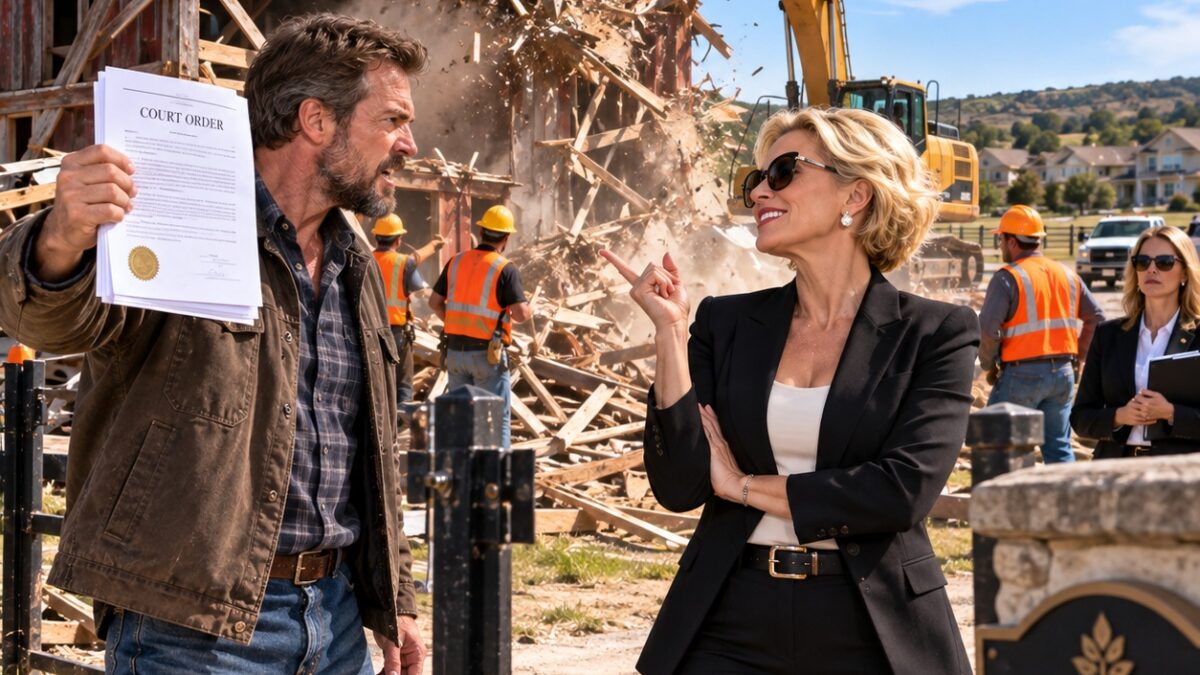
I walked to Wade.
Handed him the injunction.
He read it slowly.
Then looked up.
“Is this real?”
“Yes.”
He turned to Marissa.
She did not look concerned.
“My attorney said the order does not apply to emergency hazard abatement.”
That was the first lie I heard her tell that morning.
I raised my phone.
“Were you served with this injunction yesterday?”
She looked at me.
No answer.
“Marissa.”
“Were you served?”
“I know what the judge signed.”
There it was.
Recorded.
Knowledge.
Wade looked more nervous.
“I need to call my office.”
Marissa pulled out another page.
EMERGENCY DEMOLITION AUTHORIZATION.
Signed:
Marissa Bellamy.
HOA President.
“The association assumes responsibility.”
She told Wade.
He read it.
Then the injunction again.
“Marissa.”
He said.
“This says—”
“I know what it says.”
“Then—”
“Start the job.”
My camera captured it.
Time:
7:54.
The excavator entered.
At 8:03, I filmed the barn.
Whole.
Roof intact.
Machines inside.
Timber stacked.
My sign over the door.
ROR RESTORATION WORKS.
At 8:11, Tessa called.
“I filed an emergency contempt motion.”
“They’re moving equipment.”
“I know.”
“What do I do?”
“Exactly what you’re doing.”
“Record.”
Then came 8:17.
The bucket rose.
For a second, I thought Wade’s operator might stop.
Maybe someone would call.
Maybe a deputy would arrive.
Maybe common sense would enter the property before steel did.
Instead, the bucket swung.
It hit the north wall.
Old wood cracked.
Loud.
Deep.
The sound traveled through my chest.
Boards tore apart.
A section of roof folded.
Dust exploded into the morning air.
I heard myself say:
“There is an active injunction.”
Marissa stood near the road.
“You are destroying property under an active court order.”
She lifted her chin.
“Then sue me.”
I kept recording.
The excavator hit again.
And again.
For forty-six minutes, I watched years of work disappear.
A beam dropped onto one planer.
Metal screamed.
A rack collapsed.
Timber scattered.
The dust-collection system came down with part of the roof.
Hundred-year-old boards cracked under the loader tires.
Some of those pieces had been salvaged from a nineteenth-century mill.
Some had buyers.
Some had histories.
Now they were mixed with insulation, nails, concrete, dirt.
I wanted to run in.
To stop them.
But Tessa’s voice stayed in my head.
Do not fight machinery with your body.
Fight with evidence.
So I filmed.
License plates.
Faces.
Equipment.
Marissa.
Wade.
The time.
Everything.
Then Wade’s phone rang.
He answered.
His face changed immediately.
He started shouting.
“Shut it down!”
The excavator stopped mid-swing.
Marissa stormed toward him.
“What are you doing?”
“My company lawyer says stop.”
“I authorized the job.”
“You didn’t tell us there was an injunction.”
“I told you there was a safety exception.”
“There isn’t.”
She stared.
“Finish it.”
“No.”
“I’ll sue your company.”
Wade looked at her.
“You never told us a judge ordered you to stop.”
Marissa turned away.
Then looked at me across the wreckage.
“You should have taken the offer.”
Still recording.
Always recording.
She got into her SUV.
Left.
When the machinery finally went quiet, I walked inside what remained.
Half the barn was gone.
Sunlight came through places where walls had stood that morning.
One machine was buried.
Another crushed.
Dust covered everything.
I found my wooden shop sign underneath part of a broken wall.
I pulled it out.
Brushed it with my sleeve.
The board was cracked.
The letters survived.
I did not cry.
Not then.
Shock is quieter than grief.
Tessa arrived less than an hour later.
She stopped at the edge of the debris.
Looked around.
Then:
“Did she personally order them to start after Wade saw the injunction?”
I handed her my phone.
She watched.
All of it.
Marissa:
I know what the judge signed.
Marissa:
Start the job.
Marissa:
Then sue me.
Tessa returned the phone.
“She just turned a property dispute into something much bigger.”
By afternoon, the entire neighborhood knew.
Photographs spread.
Residents drove past slowly.
Stonegate Ridge homeowners stood near my fence.
Most looked horrified.
Valerie Knox called me that evening.
She was HOA treasurer.
Fifty-two.
Quiet.
Always present at board meetings.
Rarely confrontational.
“I need to ask you something.”
She said.
“Did the board approve that demolition?”
“I was going to ask you the same question.”
Silence.
Then:
“I’m checking.”
She called back ninety minutes later.
“No vote.”
“What?”
“No resolution.”
“No demolition authorization.”
“No approved budget.”
“Then how did they pay Wade?”
Another pause.
“Marissa used emergency spending authority.”
“How much?”
“Forty-two thousand dollar deposit.”
“For an emergency on land you don’t own.”
“I know.”
Her voice sounded sick.
The HOA’s lawyer called an executive session.
Marissa arrived with a plan.
She wanted the association to issue a statement blaming the contractor.
Wade refused to become her scapegoat.
His lawyer sent everything.
Contract.
Authorization.
Emails.
Texts.
One exchange mattered most.
7:41 a.m.
Wade:
Owner says court blocks demolition. Confirm we are cleared.
7:43.
Marissa:
Proceed. HOA takes responsibility.
Two days later, we were back before Judge Ardan.
Contempt hearing.
The judge looked less patient this time.
Marissa’s attorney argued she believed there was an emergency-hazard exception.
Judge Ardan leaned forward.
“Where?”
Silence.
“Show me where my order contains that exception.”
Her attorney looked down.
Tessa played my video.
My voice:
There is an active injunction.
Marissa:
I know what the judge signed.
Then:
Start the job.
Then:
Then sue me.
Nobody moved.
The judge ordered preservation of every document connected to the demolition.
Emails.
Texts.
Phone records.
HOA financial records.
Minutes.
Contracts.
He issued additional restrictions preventing anyone from entering my land.
But Tessa did not immediately ask for final damages.
“Why not?”
I asked.
“Because right now we know what they destroyed.”
She said.
“I want to know why.”
The financial losses were already staggering.
Equipment:
Roughly $186,000.
Timber inventory:
More than $120,000.
One active restoration contract:
Nearly $310,000.
Then smaller projects.
Lost production.
Rent for temporary space.
Cleanup.
Engineering.
Storage.
Every day the barn remained unusable cost money.
I had employees.
Customers.
Deadlines.
People whose projects could not wait for court.
Marissa seemed to assume insurance would solve everything.
Then the HOA carrier sent a reservation-of-rights letter.
Intentional violation of a court order might not be covered.
Especially as to her personally.
That was when fear finally reached her.
She called Valerie.
“We need the board to ratify the demolition.”
Valerie stared at her.
“You want us to approve it after it happened?”
“We need unity.”
“If we don’t stand together, Caleb will take everyone’s money.”
Valerie shook her head.
“No.”
“You ordered it.”
“Do not ask me to rewrite minutes.”
That email exchange would eventually be subpoenaed too.
Stonegate Ridge turned against Marissa slowly.
Not everyone.
Some residents initially blamed me.
Legal bills.
Insurance exposure.
HOA reserves.
People get scared when somebody says their dues may rise.
One retired teacher named Gerald Pike came to my fence.
“I voted for the beautification budget.”
He said.
“I didn’t know any of this was what she meant.”
I nodded.
“I believe you.”
“I’m sorry.”
“Thank you.”
That was all.
I had no reason to punish people who had been misled.
The person who made the decision was becoming clearer.
Then discovery began.
Tessa demanded every communication involving:
Marissa.
Everett Sloan.
My property.
The barn.
The proposed road.
Marissa fought the request.
Judge Ardan ordered production.
That was where the real motive appeared.
Everett Sloan owned land behind Stonegate Ridge.
Large parcel.
Prime location.
He wanted thirty-one luxury houses.
The problem was access.
The existing route was narrow.
Expensive to improve.
A road across four acres of my land would make the entire project easier.
More valuable.
And my barn sat directly on the best path.
Six months before Marissa first approached me, Everett had emailed a concept map.
The road line ran through the center of my workshop.
Marissa had replied:
The structure is the obstacle. Once it’s gone, the owner will have fewer reasons to resist.
I read that line in Tessa’s office.
My hands went cold.
There it was.
Not safety.
Not appearance.
Not emergency access.
Strategy.
Destroy what made the land useful to me.
Then assume I would become tired enough to sell.
Tessa produced another document.
Draft agreement between Everett and the HOA.
If road access succeeded, Stonegate Ridge would receive money for neighborhood improvements.
The eastern houses would likely rise in value.
That alone was not necessarily illegal.
Maybe some residents would genuinely benefit.
But the full draft had never been given to the board.
Marissa was pushing most of it alone.
Then came the email that changed everything again.
A consulting agreement.
An entity connected with Everett’s project would pay Marissa $175,000 if the road connection was completed.
Marissa called it unrelated private consulting.
Tessa did not need to prove criminal bribery.
This was civil litigation.
Motive mattered.
At deposition, Tessa asked:
“Did you have any financial interest in Mr. Sloan’s development project?”
“No.”
Tessa placed the draft consulting agreement on the table.
Marissa said nothing.
“Would the proposed road shown on this concept plan cross Mr. Ror’s barn?”
“I don’t know.”
Tessa placed the plan in front of her.
Three handwritten words in the margin.
Marissa’s handwriting.
REMOVE STRUCTURE FIRST.
The room changed.
Even her attorney stopped shuffling papers.
What had started as an overreaching HOA dispute now looked like a woman using association power to clear private land in a way that could personally enrich her.
Everett Sloan immediately distanced himself.
He testified he never told Marissa to demolish my barn.
He claimed he assumed she would negotiate legally.
Maybe that was true.
Maybe partly true.
Either way, he had never seen any deed showing Stonegate Ridge owned my land.
His project stalled.
The HOA board suspended Marissa’s spending and contracting authority.
Valerie took control of association finances.
Still, Marissa believed the HOA would absorb everything.
Tessa kept digging.
Then she found the email from the HOA’s own lawyer.
Sent the night before demolition.
9:14 p.m.
Do not undertake physical action against the Ror property while the injunction remains in effect.
Server logs showed Marissa opened it at 9:19.
There was no ambiguity left.
Judge signed injunction:
2:31 p.m.
Lawyers received copies:
3:08.
Marissa signed for certified service:
5:42.
She read her lawyer’s warning:
9:19.
Next morning:
7:41 — Wade asks if cleared.
7:43 — Marissa says proceed.
8:17 — barn falls.
Tessa laid the timeline on her table.
“A contempt finding needs three basic things.”
She told me.
“Clear order.”
“Knowledge.”
“Deliberate disobedience.”
She pointed.
“Order.”
“Service.”
“Proceed.”
She leaned back.
“Most cases fight about what somebody understood.”
“This one is about what she chose.”
Judge Ardan found the violation willful.
Damages would follow.
Outside court, reporters tried asking questions.
I said nothing.
Marissa said nothing.
We walked separate directions.
At my truck, I asked Tessa:
“What if she says she can’t pay?”
Tessa looked at me.
“Then we find out what she owns.”
That answer began another stage.
Marissa owned a large home outside Stonegate Ridge.
Estimated value:
About $1.5 million.
Mortgage.
But substantial equity.
Three weeks after the contempt ruling, Tessa called.
“You’re going to love this.”
“That sounds dangerous.”
“She transferred her house.”
“What?”
“To a new LLC.”
“When?”
“Yesterday.”
“How much?”
“Deed says ten dollars and other consideration.”
I stared.
“Who owns the LLC?”
“Guess.”
“Marissa.”
“Correct.”
“When was it formed?”
“Forty-eight hours before the transfer.”
I actually laughed.
Not joy.
Disbelief.
Marissa still lived there.
Still paid mortgage.
Still paid utilities.
No actual buyer.
No actual money.
Her lawyer called it estate planning.
Tessa asked for one piece of evidence showing estate planning had started before the demolition.
Nothing.
We challenged the conveyance.
Judge ordered records.
Bank statements.
Formation documents.
Title files.
Communications.
No meaningful purchase money existed.
The transfer was set aside.
The house returned to Marissa’s name for judgment enforcement.
Meanwhile, Stonegate Ridge wanted separation from the disaster.
A new majority voted Marissa out as president.
Valerie became acting president.
The HOA negotiated with us.
This was one of the hardest choices for me.
Some people wanted blood.
Residents had allowed Marissa to lead.
Therefore, punish the whole association.
Raise dues.
Empty reserves.
Make everyone pay.
I could not do that.
Most homeowners had never authorized demolition.
Some had not even known my land was outside the HOA.
Tessa and I agreed the association needed accountability, but innocent families did not need unnecessary destruction.
The HOA’s insurer accepted some exposure.
Association reserves contributed.
The contractor’s insurance negotiated separately.
Wade’s company had made its own mistake by beginning work after seeing an injunction, even if Marissa misled them.
We settled portions of the case.
But nothing released Marissa from her personal conduct.
When she found out, she exploded.
“The board is betraying me.”
Valerie answered:
“You betrayed the board when you signed our name to something we never approved.”
That sentence traveled through Stonegate Ridge in a day.
For years, Marissa had entered meetings like the room belonged to her.
Now the same board delivered documents to us.
The final damages hearing lasted several days.
Everett Sloan was deposed for six hours first.
Tessa asked:
“Did you send Marissa the concept map?”
“Yes.”
“Did you see a deed showing Stonegate Ridge owned Caleb’s land?”
“No.”
“Did you ask for demolition?”
“No.”
“What did Marissa tell you?”
“That the land issue would be resolved.”
“Resolved how?”
Everett hesitated.
“She said the structure would not be a problem much longer.”
His own attorney closed his folder.
That answer was enough.
At the damages hearing, Tessa began with the video.
Not numbers.
Not expert testimony.
The video.
8:17.
The barn whole.
Bucket rising.
My voice:
There is an active injunction.
Marissa:
Start the job.
The wall breaking.
Tessa stopped playback.
Silence.
Then she built the timeline.
Order.
Service.
Lawyer warning.
Wade text.
Proceed.
Demolition authorization.
No board vote.
Concept map.
Remove structure first.
Consulting fee.
House transfer.
One fact alone could be explained.
Together, they formed a chain.
Marissa testified she believed the barn was dangerous.
The fire inspector testified.
No demolition order.
No emergency.
County official testified.
No emergency road approval.
Nathan testified.
Barn fully on my land.
Not one day had it stood on HOA property.
Then Wade.
Tessa asked:
“When Mr. Ror handed you the injunction, what did you do?”
“I read it.”
“Did it appear genuine?”
“Yes.”
“Did you ask Marissa Bellamy whether you were cleared?”
“Yes.”
“If she had told you to stop?”
“We would have left.”
“What did she tell you?”
Wade swallowed.
“Proceed.”
Then money.
Tessa never exaggerated.
That mattered.
Rebuild equivalent barn:
Approximately $460,000.
Machines and electrical systems:
About $190,000.
Destroyed or unusable timber:
More than $130,000.
Lost contracts.
Lost operating income.
Warehouse rental.
Professional fees.
Certain legal fees recoverable through contempt.
Enhanced damages tied to willful conduct where permitted.
Marissa’s attorney stood.
“The requested amount will destroy my client financially.”
Judge Ardan answered:
“The function of damages is not to insulate a proven wrongdoer from consequences merely because those consequences are substantial.”
Marissa stared at the table.
For the first time since I met her, she seemed small.
I did not enjoy it.
People think revenge stories end with pleasure.
Mine did not.
I looked at her and thought:
All you had to do was stop.
One word.
Stop.
That was it.
The judge allocated responsibility.
HOA portion.
Contractor settlement credit.
Other recoveries.
Then Marissa’s personal share.
After credits and settlements:
More than $900,000.
She froze.
Whispered to her lawyer.
Appeal.
She could appeal.
But stopping collection during appeal required legal requirements for a stay and bond.
She did not have the necessary cash.
Her request for a stay was denied.
Tessa filed judgment.
Liens.
Asset discovery.
Collection.
The house Marissa had tried to hide became the largest source of equity.
Then Marissa called me.
Directly.
First time in months.
No lawyers.
No title.
Her voice was different.
“Caleb.”
“Yes.”
“I want to resolve this.”
“Talk to Tessa.”
“Can we talk as two people?”
“We are talking.”
“I can pay monthly.”
“How much?”
She named a figure.
It would take decades.
“I can’t agree to that.”
“You’re taking my home.”
I closed my eyes.
“No.”
“I am enforcing a judgment.”
“You know what that means.”
“I know exactly what it means.”
“You could stop it.”
“So could you have.”
Silence.
That was the only harsh thing I said.
I regretted it almost immediately.
Not because it was false.
Because I did not want to become a person who enjoyed twisting the knife.
“Call Tessa.”
I said.
Then hung up.
Tessa gave Marissa one final practical option.
Sell the house voluntarily.
Open market.
Pay mortgage.
Keep protected amount required by law.
Apply remaining equity toward judgment.
Avoid forced sale.
Marissa refused.
She believed appeal would save her.
Deadlines passed.
No bond.
No stay.
Execution proceeded.
The sale notice was posted.
Months earlier, Marissa had stood near my barn and said:
Then sue me.
Now she opened her own front door and saw court enforcement attached to it.
She called it retaliation.
Tessa answered with paperwork.
“This is not Caleb taking your house.”
She told Marissa’s lawyer.
“This is a court judgment following notice, hearings, testimony, findings, and failed voluntary resolution.”
Then bankruptcy.
Marissa filed shortly before sale.
Automatic stay.
Everything paused.
I remember sitting inside the temporary warehouse and asking Tessa:
“Is this going to erase everything?”
“No.”
“Bankruptcy complicates.”
“It does not magically rewrite facts.”
Lawyers argued.
What portions of judgment were dischargeable.
What liens survived.
How homestead protection applied.
How willful conduct affected particular claims.
Months passed.
The barn still was not rebuilt.
That was the part nobody saw.
Court victories make good stories.
Real life happens between hearings.
I was renting a warehouse across the county.
My machines did not fit properly.
Workflow was awful.
Customers left.
One longtime architect called.
“Caleb.”
“I’m sorry.”
She said.
“I can’t wait any longer for the flooring.”
“I understand.”
“My contractor needs material next month.”
“I know.”
“You’ve always done great work.”
“Thank you.”
“I hope you rebuild.”
“Me too.”
After the call, I sat on an overturned crate.
The warehouse felt too quiet.
I wondered whether any of this had been worth it.
Money might come later.
But business does not pause for justice.
Deadlines move.
Customers move.
Employees move.
Life moves.
Tessa arrived that evening carrying Chinese takeout.
She did not say:
Everything happens for a reason.
Thank God.
She sat beside me.
Opened a folder.
“Sale date.”
She pointed.
“Expected distribution.”
“Rebuild contractor.”
“Equipment lead times.”
“Projected opening.”
I stared.
“That’s your comfort speech?”
“Yes.”
“You’re terrible at feelings.”
“I know.”
She handed me noodles.
Then:
“Walls come down fast.”
“Justice is slower.”
“But it shows up.”
I ate.
For the first time in days, I believed her.
The bankruptcy proceedings eventually allowed enforcement against nonprotected equity to continue to the extent ordered.
Sale went forward.
Mortgage paid.
Costs paid.
Statutory protections applied.
Remaining proceeds toward judgment.
Between:
HOA settlement.
Contractor settlement.
Insurance.
House proceeds.
Other collection.
Most of my proven losses were finally covered.
Not all immediately.
Not every emotional cost.
There is no invoice for watching a barn you rebuilt by hand collapse.
There is no expert report for months lost to litigation.
But financially, I could rebuild.
On the morning Marissa’s house sold, people gathered near the courthouse.
Neighbors.
Curious strangers.
A local reporter.
I was not there.
I was in the warehouse sanding a reclaimed oak plank.
Tessa called.
“It’s done.”
I stopped the sander.
“How much?”
She told me.
“The closing?”
“Complete.”
I sat on a workbench.
Then:
“Thank you.”
“That’s it?”
“What else is there?”
“Nothing.”
“Then I need to finish this board.”
I hung up.
Went back to work.
That is how the climax of my supposed revenge story felt.
Dust mask.
Oak.
Phone call.
Back to work.
Marissa lost her house.
Not because of an HOA fine.
Not because I hated her.
Not because I had more power.
She lost it because a judge ordered her to leave my property alone.
She knew.
Her lawyer warned her.
A contractor asked whether to stop.
And she said:
Proceed.
One decision.
Less than a minute.
Everything after grew from it.
About a year after the demolition, I stood outside the rebuilt barn.
I did not build a monument.
I built a shop.
Larger.
Better electrical system.
Modern fire suppression.
Improved storage.
More efficient dust collection.
I salvaged some wood from the wreckage.
Not much.
One beam had excavator teeth carved into the side.
My contractor asked:
“Replace it?”
“No.”
“You sure?”
“Yes.”
We cleaned it.
Stabilized it.
Installed it inside the office wall.
Not a trophy.
A reminder.
The old wooden sign went above the entrance.
The crack remained.
I could have repaired it.
I didn’t.
Stonegate Ridge changed too.
Valerie won election as president.
One of the first changes:
Emergency spending restrictions.
No president could authorize large contracts unilaterally.
Work involving disputed property required board vote and legal review.
Contracts over defined thresholds required two signatures.
Minutes posted promptly.
Boundary issues referred to survey before enforcement.
Then Valerie sent me a letter.
Formal recognition:
My property was outside Stonegate Ridge.
No HOA architectural control.
No HOA land-use authority.
No claim over the barn.
No easement across my property.
The decorative fence encroachment?
Removed and relocated at HOA expense.
Everett Sloan redesigned his road.
More expensive route.
Lawful route.
It never touched my land.
I kept all thirty-eight acres.
The four acres Marissa wanted stayed exactly where they had always been.
Everett’s development eventually moved forward under a different access plan.
I had no objection.
He owned his land.
I owned mine.
That was all I ever wanted.
Marissa left the area.
The consulting agreement never paid out.
I heard different versions about where she went.
Another city.
Family.
Smaller house.
I never checked.
People assumed I must have felt good knowing she lost so much.
One man asked me directly.
“Come on.”
He said.
“Didn’t it feel amazing seeing that sale notice?”
“No.”
He stared.
“You’re kidding.”
“No.”
“Why not?”
“Because I would have preferred she obeyed the injunction.”
He laughed at first.
Then realized I was serious.
“If she stopped, I still have my old barn.”
“The HOA keeps its money.”
“She keeps her house.”
“Wade keeps his company out of litigation.”
“Homeowners don’t pay attorneys.”
“Everybody goes home.”
That was the truth.
Justice was necessary.
It was not better than the harm never happening.
There is a difference.
Months later, Wade Kesler sent me a handwritten letter.
He had left demolition work.
Now managing a lumberyard two counties away.
His note was short.
He said he still remembered standing at my gate reading the injunction.
He knew he should have stopped.
He allowed Marissa’s confidence to override his own judgment.
He wrote:
I let someone else’s certainty do my thinking for me.
He did not ask forgiveness.
Maybe that is why the letter mattered.
I read it twice.
Then placed it inside the original folder.
Violation notices.
Survey.
Fire report.
Red paint photograph.
Injunction.
Wade’s letter.
Some records you keep because you may need them.
Some because you need to remember what they taught you.
Tessa visited the new barn the week we officially reopened.
She walked through the shop.
Checked the new equipment.
Looked at the salvaged beam.
Then my office.
There, in a simple glass frame, hung the certified injunction.
Edges wrinkled.
Dust stains.
Same copy I held at the gate.
Tessa pointed.
“You framed it.”
“I did.”
“Why?”
I looked at it.
“I kept the part she thought didn’t matter.”
Tessa nodded.
“That might be the entire case.”
The first new job after reopening came from one of the architects who had waited through the litigation.
Not the client I lost.
Someone else.
She wanted reclaimed heart pine for a coastal restoration.
Large order.
Good margin.
My employees returned one by one.
Not all.
Some had found permanent jobs elsewhere.
I could not blame them.
I hired new people.
Trained them.
Restarted.
Business recovery was slower than barn construction.
But it happened.
One afternoon, Gerald Pike visited.
The retired teacher from Stonegate Ridge.
He brought coffee.
“Figured you’re probably sick of neighbors.”
“You’re technically across the road.”
“That’s legally different?”
“Very.”
He laughed.
Then looked around.
“This place is beautiful.”
“Thank you.”
“Better than before?”
“In some ways.”
He looked toward the old beam.
“Would you ever have rebuilt if she hadn’t done it?”
“No.”
“Then something good came out of it.”
I shook my head.
“Careful.”
“What?”
“I hate that sentence.”
He looked surprised.
“Why?”
“Because it makes the destruction sound necessary.”
“It wasn’t.”
“The new barn can be good without making the old one’s destruction good.”
He thought.
“You’re right.”
I had learned that through loss.
People love saying everything happens for a reason.
Sometimes things happen because somebody makes a bad decision.
Meaning comes later.
Meaning is what you build after.
Not an excuse for what happened before.
I built a better shop.
That did not make Marissa’s demolition a gift.
It made rebuilding my answer.
Stonegate Ridge homeowners changed too.
For months, I expected hostility.
Special assessments had hurt.
Insurance premiums rose.
Some blamed me privately.
Then documents became public.
Emails.
No vote.
Consulting fee.
Lawyer warning.
Proceed.
Attitudes changed.
A couple who lived near the east entrance came to the barn reopening.
The wife shook my hand.
“We didn’t know.”
“I know.”
“We should have paid more attention.”
“Maybe.”
She looked embarrassed.
“I voted for Marissa twice.”
“That doesn’t make you responsible for everything she did.”
“I still feel stupid.”
“Don’t.”
I meant it.
People vote for confidence all the time.
Marissa was confident.
Organized.
Effective.
She got things done.
That is attractive in leadership.
The danger comes when efficiency becomes entitlement.
When somebody starts believing:
I am the only adult in the room.
Rules are obstacles.
Oversight is weakness.
Questions are disloyal.
I do not think Marissa started as the woman who would ignore a judge.
Power probably changed gradually.
A budget approved without challenge.
A contract nobody questioned.
An emergency expense accepted after the fact.
Residents thanking her for “getting things done.”
Each success confirmed her belief that she knew best.
Then I said no.
Maybe that was why the conflict escalated so fast.
The issue stopped being four acres.
It became whether her authority had limits.
My deed said yes.
The judge said yes.
She could not tolerate it.
That is my interpretation.
I will never know hers.
A journalist once asked:
“Do you think she believed she was above the law?”
I considered.
“No.”
“That surprises me.”
“I think she believed the law would eventually agree with her.”
The journalist paused.
“What’s the difference?”
“A person who thinks they’re above the law knows the rule and rejects it.”
“Marissa kept inventing reasons why the rule secretly supported what she already wanted.”
First:
Aesthetic standards.
Then:
Fire danger.
Then:
Emergency access.
Then:
Hazard exception.
Each explanation changed when the previous one failed.
The destination never changed.
Remove the barn.
Get the road.
Maybe get paid.
That is dangerous.
When the conclusion comes first and facts are recruited afterward.
Tessa taught me the opposite.
Start with paper.
Deed.
Survey.
Inspection.
Order.
Timestamp.
Then see where it leads.
I began using that approach outside court too.
A customer disputed a delivery.
Old Caleb might have argued from memory.
New Caleb checked the signed ticket.
Employee claimed a machine had been serviced.
Maintenance log first.
My accountant joked litigation turned me into a librarian.
Maybe.
Records are boring until somebody needs truth.
Then boring becomes powerful.
The framed injunction stayed in my office.
Occasionally, customers asked about it.
Most knew the broad story.
Local news had covered the case.
Someone would point.
“That the order?”
“Yes.”
“The one she ignored?”
“Yes.”
Then they usually said:
“That’s crazy.”
It was.
But I stopped telling the story with excitement.
The farther I got from the demolition, the less I saw it as some grand battle.
It was a chain of avoidable decisions.
That is what made it tragic.
Marissa could have accepted my first no.
She didn’t.
She could have accepted Nathan’s survey.
She didn’t.
She could have accepted the fire report.
She didn’t.
Her attorney could not stop her.
The judge told her directly.
Still no.
Wade held the injunction.
She still said proceed.
At every stage, there was an exit.
That bothered me more than anything.
People imagine disasters arrive suddenly.
Sometimes they do.
But many are built through repeated refusal to stop.
One choice.
Then another to defend the first.
Then another to hide the second.
By the time consequences arrive, people say:
How did this become so big?
It became big because nobody wanted to reverse the last decision.
I thought about that when I saw the asset transfer.
Ten dollars.
LLC formed two days earlier.
Marissa still in the house.
That was not sophisticated.
It was panic.
Another decision trying to escape consequences of the previous one.
If she had accepted the judgment honestly, she might have preserved more control.
She fought.
Delayed.
Transferred.
Bankruptcy.
Each move cost more.
Emotionally.
Legally.
Financially.
I do not say that with satisfaction.
I say it because I nearly made versions of that mistake myself.
Not in the lawsuit.
In life.
I spent years refusing to let go of parts of the barn that no longer served the business because I had invested too much time restoring them.
Old machine that needed constant repair.
Bad layout.
Storage system I hated.
“This is how we’ve always done it.”
That can become its own trap.
Rebuilding forced changes.
I learned sometimes strength means holding your ground.
Sometimes it means admitting a previous decision no longer works.
Wisdom is knowing which.
A year after reopening, my largest project ever arrived.
Historic hotel renovation.
Massive order.
Reclaimed oak.
Custom milling.
The architect toured the new barn.
She stopped beside the damaged beam.
“What happened there?”
I told her.
Short version.
She touched the marks.
“Can you mill around those?”
“Yes.”
“Don’t.”
“What?”
“For the lobby.”
She smiled.
“I want one beam with the scars.”
I hesitated.
“That’s not for sale.”
She nodded.
“Fair.”
I appreciated that she did not push.
Some things retain value because you refuse to sell them.
My land was one.
That beam was another.
Later that year, Tessa invited me to speak at a continuing-education event for property lawyers.
Absolutely not.
She asked again.
Still no.
Then she told me it was mostly about evidence preservation.
“I’m not a lawyer.”
“That is why I want you.”
“What do I say?”
“Tell them what you did when the excavator arrived.”
I eventually agreed.
Standing in front of sixty attorneys was more frightening than standing behind an excavator.
I told them:
I called my lawyer.
I called the sheriff.
I did not block machinery.
I handed the contractor the order.
I filmed.
I asked clear questions.
I preserved video.
Then I got out of the way.
One attorney asked:
“How did you stay calm?”
“I didn’t.”
The room laughed.
“I was furious.”
“I just understood that my anger would not stop an excavator.”
“Evidence might stop what came after.”
That line ended up quoted in the seminar materials.
Tessa took credit.
Of course.
The case became something lawyers discussed.
I preferred being the guy working in the barn.
Fame, even local fame, is exhausting.
People came by just to see “the HOA barn.”
One man took a selfie outside.
I installed a PRIVATE BUSINESS sign.
Then a second.
Nobody listens to the first sign anymore.
Stonegate Ridge settled into normal life.
Valerie remained president for three years.
She was slower than Marissa.
Residents complained about that.
Board approval took longer.
Legal review cost money.
Emergency spending required extra signatures.
Some people grumbled.
I found that almost funny.
They wanted safeguards.
Then safeguards arrived.
And they discovered safeguards are inconvenient.
That is true.
Good process is slower.
Property rights are inefficient if your goal is moving quickly across somebody else’s land.
Courts are inefficient if your goal is getting what you want tomorrow.
Checks and balances are inefficient.
Until you are the person they protect.
Then suddenly inefficiency looks a lot like civilization.
I never joined the HOA.
Couldn’t.
My property still outside.
But Valerie occasionally called.
“Can I ask your opinion?”
“Is this a trick?”
“No.”
“Then no.”
She laughed.
She asked anyway.
Usually boundaries.
Contractors.
How to handle communication with non-HOA neighbors.
I kept advice simple.
“Ask before entering.”
“Get permission in writing.”
“Check the deed.”
“Don’t demolish anything.”
She told me that last one was unnecessarily specific.
I disagreed.
Everett Sloan eventually completed twenty-six homes instead of thirty-one.
The new access route cost more.
It reduced buildable area.
His profits were probably lower.
He never contacted me personally again.
I saw him once at a county planning hearing.
We nodded.
Nothing else.
That was enough.
A person does not have to become part of your life simply because they became important in one bad chapter.
Marissa was the same.
Years passed.
I heard she had moved several counties away.
Someone said she was working in property management.
Another person said consulting.
I never verified either.
Sometimes people expected me to monitor her.
I did not.
The point of winning was getting my life back.
Not dedicating the rest of it to watching hers.
That distinction mattered.
Otherwise, she would still control my attention after losing every legal claim.
I refused that.
The most difficult day after the case ended came unexpectedly.
Not court.
Not rebuilding.
A quiet Sunday.
I found a small piece of wood in storage.
Heart pine.
About two feet long.
One edge burned dark by friction during demolition.
I recognized it.
It came from the north wall.
The first wall the excavator hit.
I sat with it on my workbench.
And finally cried.
Nearly two years late.
That is how grief works sometimes.
During emergency, you function.
Lawyers.
Insurance.
Employees.
Money.
Contracts.
Then one day, nothing urgent is left.
And your body says:
Now.
I cried for the barn.
For time.
For customers lost.
For nights I drove home too tired to eat.
For the version of myself that believed a court order meant I could relax.
Then I cried because rebuilding had ended and there was nobody left to fight.
Strange, right?
Conflict gives structure.
When it disappears, you have to remember how to simply live.
I kept that board.
Not displayed.
It stays inside a cabinet.
The beam is public reminder enough.
Some memories do not need an audience.
The lawsuit permanently changed how I thought about justice.
Before, I imagined justice as a verdict.
Judge says right.
Judge says wrong.
Money paid.
Done.
Real justice was slower.
Messier.
The injunction was justice.
Ignored.
Contempt ruling.
Justice.
Did not rebuild barn.
Damages judgment.
Justice.
Did not recover lost customers.
House sale.
Justice.
Did not return time.
Nothing made me whole in the literal sense.
You cannot undo.
You can compensate.
Restrict.
Correct.
Deter.
Rebuild.
But law moves forward.
Not backward.
Once I accepted that, I became less angry at what the process could not do.
Tessa never promised magic.
That is why I trusted her.
One afternoon, years later, she came by with no folder.
That scared me more than when she carried one.
“No lawsuit?”
“No.”
“Then why are you here?”
“I wanted coffee.”
“Suspicious.”
We sat outside.
She looked toward the barn.
“Do you ever regret pursuing it?”
“No.”
“Never?”
“I regret that I needed to.”
She nodded.
“That’s different.”
“What about you?”
“What?”
“Cases like this.”
“Do you enjoy winning?”
She thought.
“I enjoy stopping people who believe nobody will challenge them.”
That sounded like Tessa.
Then:
“But good cases are usually evidence of something bad already happening.”
“Victory does not make that good.”
Exactly.
We sat quietly.
The new barn doors were open.
Employees moving timber.
Planer running.
A forklift beeping.
Ordinary work.
That sound was better than any courtroom applause.
I eventually expanded the business.
Not huge.
I never wanted huge.
Four employees became seven.
We added one CNC machine for specialty joinery.
I complained it felt too modern.
My youngest employee told me history could survive computer control.
He was probably right.
We started salvaging wood from more commercial demolitions.
Legal demolitions.
I always asked.
The crew laughed at that.
One day a new worker said:
“Why do you keep copies of property permission?”
Everybody else stared at him.
I said:
“Sit down.”
They groaned.
“Here comes the story.”
I gave him the short version.
He never forgot the paperwork again.
That became workplace culture.
Permit first.
Ownership confirmed.
Written access.
No shortcuts.
Not because paperwork is sacred.
Because somebody’s certainty is not ownership.
Wade’s letter remained in my file.
I thought about contacting him once.
Not to punish.
Not even forgiveness.
Just:
I received your note.
Tessa told me if I wanted closure, I could write.
I didn’t.
Eventually, I realized his letter had already said what needed saying.
He admitted failure.
No excuses.
Sometimes that is enough.
People do not always need responses to grow.
I hoped he did.
Stonegate Ridge installed a second emergency gate on its own land several years later.
County approved.
Fire department approved.
Imagine that.
No need for my barn.
No need for four acres.
No apocalypse.
Just actual planning.
Gerald called.
“They finally got emergency access.”
“Good.”
“Took them long enough.”
“Legal roads are complicated.”
He laughed.
That project became the perfect symbol for me.
Marissa had used “emergency access” as a justification.
Years later, the community built real emergency access lawfully.
Same goal.
Different process.
Process matters.
Not because process is exciting.
Because process protects people from someone deciding that an outcome is too important for consent.
The old injunction stayed framed.
Its paper yellowed slightly.
I replaced the cheap frame after the glass cracked.
Not the document.
The edges remained wrinkled.
One corner had dirt from the morning I stood at the gate.
Visitors occasionally asked why I did not frame a cleaner copy.
“Because that one was there.”
Evidence is not always pretty.
Neither is memory.
I never wanted to become the man whose entire identity was:
HOA demolished my barn.
For a while, that happened.
People introduced me:
“This is Caleb.”
“You know.”
“The barn guy.”
Eventually, I started replying:
“I also make tables.”
That usually confused them.
Good.
Our worst experience is not automatically our most important identity.
I was a craftsman before Marissa.
I remained one after.
Property owner.
Employer.
Neighbor.
Friend.
A person who sometimes overcooks steak.
A man who owns too many clamps.
That last one is impossible, but Tessa disagrees.
I protected my land because it was mine.
Not because I wanted a war.
Marissa interpreted refusal as challenge.
That is another danger of power.
When people become used to agreement, disagreement feels hostile.
No is not aggression.
A boundary is not attack.
A deed line is not disrespect.
A court order is not negotiation.
That seems obvious.
It was not obvious to her.
Maybe it became obvious later.
I hope so.
Not for my sake.
For hers.
Losing your house is a hard way to learn the meaning of a line you could have respected for free.
On the fifth anniversary of the demolition, I arrived early.
Before employees.
Before traffic.
Morning fog over the fields.
I walked around the barn.
Touched the salvaged beam.
Opened the office.
Looked at the injunction.
For once, I did not remember the bucket.
I remembered the barn before.
Pigeons in the rafters.
Leaking roof.
First planer I bought used.
The winter I replaced three posts myself.
My father helping me hang the original sign.
Those memories had been buried beneath litigation for years.
That morning, they came back.
Maybe that was when I knew the case was finally over inside me.
The legal case had ended long before.
Healing took longer.
I made coffee.
Opened the main doors.
Sunlight crossed the floor.
Old oak on racks.
New equipment humming.
Nothing dramatic.
Exactly what I wanted.
Later that week, a young couple came looking for reclaimed beams.
They had bought an old farmhouse.
Wanted character.
The wife pointed toward the excavator-scarred beam.
“Can we get something like that?”
I smiled.
“Probably not exactly.”
“What happened?”
“Long story.”
I showed them other pieces.
Some histories belong to materials.
Some belong to people.
Not every scar needs replication.
The final lesson came from the simplest fact.
Marissa had believed the injunction was paper.
Technically, she was right.
It was paper.
Ink.
Signature.
Court seal.
No wall.
No police officer permanently stationed at my gate.
No force field around the barn.
It did not physically stop the excavator.
That is what people sometimes misunderstand about law.
Rules only become real because systems exist to enforce what happens after someone violates them.
The order did not save my old barn.
But it made Marissa’s choice unmistakable.
Without the injunction, she could argue boundary.
Authority.
Confusion.
Safety.
Contract mistake.
With the injunction:
Stop.
Clear.
Simple.
She knew.
She continued.
That piece of paper did not prevent the wrong.
It made the wrong impossible to hide.
That was its power.
The cameras did the same.
The emails.
Texts.
Survey.
Minutes.
Every boring record closed another escape route.
Marissa kept betting confidence could overcome documentation.
It could not.
That is why I kept the order.
The part she thought did not matter mattered most.
Not because paper is stronger than steel.
Because truth preserved on paper can outlast the person trying to deny it.
When the auction notice eventually appeared on her own door, some people called it poetic justice.
I never did.
Poetry sounds graceful.
None of this was graceful.
A barn fell.
A business nearly failed.
A neighborhood spent money.
A woman lost her home.
A contractor changed careers.
Months of everybody’s lives disappeared into depositions and hearings.
There was nothing elegant about it.
There was only cause and effect.
At 7:41, Wade asked:
Are we cleared?
At 7:43, Marissa answered:
Proceed.
That was the hinge.
She could have typed:
Stop.
Four letters.
Everything changes.
My barn stands.
Her home stays hers.
Stonegate Ridge keeps its reserves.
Nobody knows Judge Ardan’s name.
Tessa probably makes less money.
Everyone wins.
Instead:
Proceed.
I think about that word whenever someone tells me one decision cannot change much.
Sometimes one word is the entire future.
These days, when someone asks what I would tell another property owner fighting an HOA or developer, I do not say:
Fight harder.
I say:
Read your deed.
Get a survey.
Keep records.
Stay calm.
Do not trespass back.
Do not threaten.
Do not destroy anything.
Put important communication in writing.
Hire competent help before anger writes checks evidence cannot cash.
And most importantly:
Do not confuse another person’s confidence with authority.
Marissa sounded certain.
Wade believed her longer than he should have.
Board members followed her longer than they should have.
Residents trusted her because confidence is efficient.
But confidence is not a deed.
It is not a permit.
It is not a court order.
It is not ownership.
Eventually, facts collect.
And when they do, confidence becomes very small.
The afternoon Tessa first visited the rebuilt barn, she stood beneath the old sign.
Crack visible across the back.
She looked around.
“Better.”
She said.
“In some ways.”
“Do you still wish you had the old one?”
“Every day.”
She nodded.
No fake lesson.
No:
Everything turned out for the best.
I appreciated that.
I asked:
“Do you think people will remember the case?”
“Some lawyers will.”
“That sounds terrible.”
She smiled.
“Most people forget.”
“Good.”
I meant it.
I wanted normal.
Normal had become luxury.
No cameras aimed at the gate.
No SUVs outside the fence.
No legal emails at midnight.
No men measuring my barn.
Just work.
At closing time, I locked the main doors.
Light was fading.
The new barn stood exactly where the old one had.
Same land.
My land.
The cracked sign above me.
Inside my office, the injunction waited behind glass.
I looked at it once.
Then turned off the light.
Outside, no HOA truck was waiting.
No red paint marked the door.
No president stood at my gate telling me what to do with ground she did not own.
Just wind moving through the trees.
I locked the gate.
Got into my truck.
And drove home.
Marissa Bellamy believed a court order was only a piece of paper.
In the end, that piece of paper documented the line she knowingly crossed, exposed every decision she made after crossing it, stripped away every excuse, and followed the consequences all the way to the day her own home was sold to satisfy the judgment.
The barn was rebuilt.
My business survived.
My land stayed mine.
But if you ask me what mattered most, it was never seeing Marissa lose her house.
It was standing inside my new workshop and realizing she had failed to take the one thing she had wanted from the beginning.
Not the barn.
Not even the four acres.
My right to decide what happened on my own land.








