𝗙𝗨𝗟𝗟 𝗦𝗧𝗢𝗥𝗬: Our HOA President Tried to Charge a 78-Year-Old Veteran to Fish at the Pond His Family Had Protected for Generations
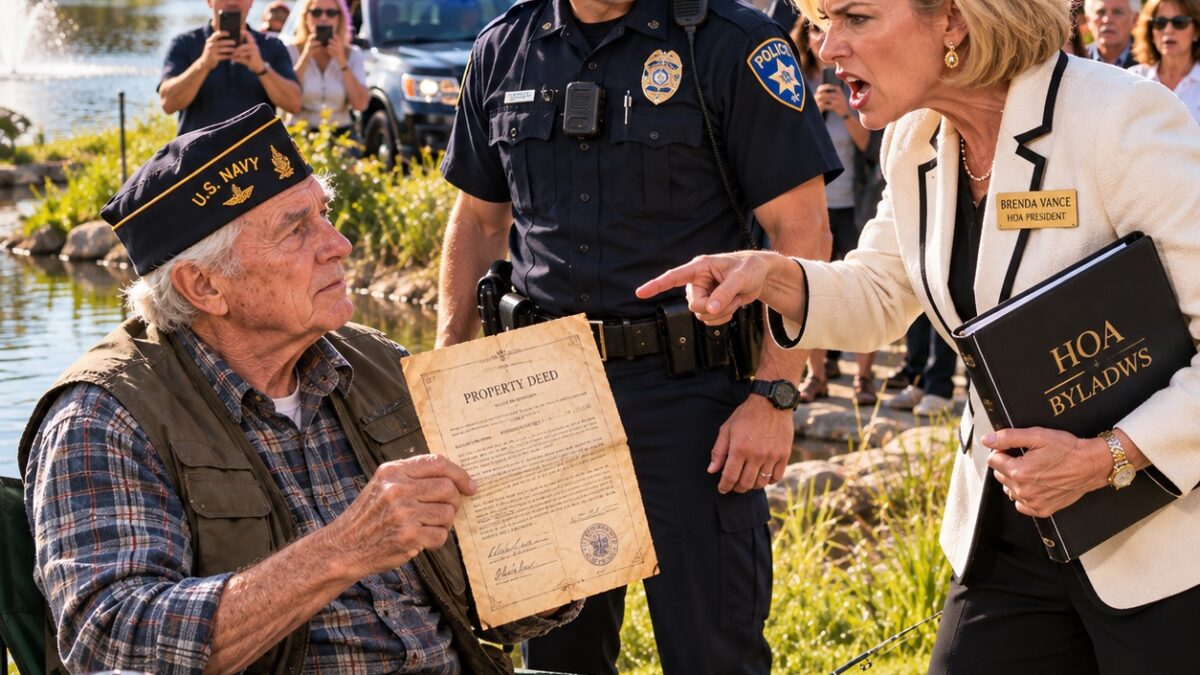
PART 2 and FULL ENDING  Thank you

That silence lasted maybe four seconds.
Then Brenda exploded.
Not physically.
Verbally.
“That’s ridiculous.”
She stepped toward the officer.
“There must be some mistake.”
The officer raised one hand.
“Ma’am—”
“The HOA has maintained that pond for years.”
“That may be true.”
“We insure it.”
“That may also be true.”
“We have landscaping contracts.”
The officer stayed calm.
“I’m only telling you what county records show.”
Brenda pointed toward Arthur.
“He cannot just sit there and use community property for free.”
Arthur glanced at her.
Then at his bobber.
Still floating peacefully on the water.
“Been doing it thirty years.”
He said.
That made several people laugh.
Brenda turned toward the crowd.
“This is not funny.”
Nobody answered.
The officer continued.
“The property records indicate the pond itself and the surrounding easement were never conveyed into the HOA parcel.”
Brenda’s face tightened.
“That makes no sense.”
“Well.”
The officer said.
“Property law doesn’t always care whether something makes sense to us.”
I nearly laughed at that too.
Brenda did not.
She demanded his supervisor.
Then she demanded the county assessor.
Then somebody from records.
Then “a real property attorney.”
At one point, she actually said:
“I am the president of this community.”
As if title offices operated differently once they heard that.
Arthur kept fishing.
I walked closer to him.
“You knew?”
I asked quietly.
He looked at me.
“Knew what?”
“The deed.”
He smiled.
“Course.”
“And you just let her call police?”
Arthur shrugged.
“I told her before.”
That surprised me.
“When?”
“Months ago.”
I looked toward Brenda.
She was still arguing.
Arthur reeled his line in.
Checked the bait.
Cast again.
“She didn’t listen.”
He said.
That sentence would become much more important later.
Around us, neighbors began pulling out phones.
Not only filming Brenda.
Searching.
People opened the HOA website.
Property maps.
Old meeting minutes.
The new pond-permit announcement.
Someone behind me said:
“I paid her a hundred dollars already.”
Another voice:
“I paid for three months.”
A woman near the walking path asked:
“If the HOA doesn’t own it, where did our permit money go?”
Brenda heard.
“We have legal possession.”
She snapped.
The officer turned.
“Ma’am, please stop making statements about ownership until this is confirmed.”
That did not improve her mood.
Twenty minutes later, another police unit arrived.
Not because Arthur posed any threat.
Because Brenda would not stop escalating.
Then, about an hour after the original call, two county officials drove up.
One of them was Eleanor Sterling.
I knew her by reputation.
She worked in county administration.
Late fifties, maybe.
Gray suit.
No-nonsense expression.
She carried a folder, not a clipboard.
That somehow made her look more dangerous than Brenda.
Eleanor greeted the officer.
Then Arthur.
Then Brenda.
“Ms. Vance?”
“Yes.”
“I’ve reviewed the parcel history.”
“Good.”
Brenda said quickly.
“Then you can clear this up.”
“I intend to.”
She opened her folder.
The crowd leaned closer.
Eleanor began with the history.
The pond sat on land that had once belonged to Arthur’s family.
Long before Pinecrest Meadows existed.
Back when this area was mostly farmland.
When developers purchased large portions of the property in the 1980s and early 1990s, not every piece had transferred the way later HOA boards apparently assumed.
The pond had been reserved under a public-trust arrangement.
More importantly for Arthur, his family deed retained permanent fishing access.
There was also a fifty-foot easement around the pond.
Brenda crossed her arms.
“Yet the HOA has maintained it.”
Eleanor nodded.
“Yes.”
“So clearly—”
“Maintenance does not create ownership.”
Brenda stopped.
Eleanor continued.
“I’ve also reviewed preliminary records related to the association’s pond-access fees.”
Someone shouted:
“What about refunds?”
Eleanor looked toward the crowd.
“That will be addressed.”
Then back to Brenda.
“But effective immediately, the association is to cease representing itself as exclusive owner of the pond.”
Brenda’s mouth opened.
“Effective immediately, all pond-permit enforcement stops.”
“You cannot order—”
“I can.”
Eleanor’s voice never rose.
“And I am.”
The crowd went quiet again.
She handed Brenda a paper.
“Cease and desist.”
Brenda stared at it.
I watched the moment she understood this was no longer a neighborhood argument.
A county official had just handed her an order in front of half the community.
Eleanor continued.
“All pond-related fees collected under the disputed ownership claim will be reviewed.”
“The association will refund fees determined to have been improperly collected.”
“And the county is initiating a broader audit of relevant property records.”
Brenda looked like she had swallowed something sharp.
“This is absurd.”
Eleanor folded her hands.
“Ms. Vance.”
“Yes?”
“Had you verified ownership before creating the permit system?”
Brenda hesitated.
“The HOA has always treated the pond as ours.”
“That wasn’t my question.”
That phrase shut her down.
Had you verified ownership?
No.
Obviously not.
The entire confrontation existed because she had not.
Someone near me whispered:
“She’s cooked.”
I didn’t know yet how accurate that was.
Eleanor asked Brenda to address the residents.
Brenda stared at her.
“What?”
“You have collected fees and threatened enforcement based on a claim the county has now found unsupported.”
“I believe a public clarification is appropriate.”
If there was one thing Brenda hated more than being wrong, it was being wrong in public.
Her face flushed.
She took a sheet of paper from Eleanor.
Turned toward us.
Read in the flattest voice I had ever heard.
“There appears to have been a misunderstanding regarding the legal status of the community pond.”
Someone laughed.
Brenda glared.
Then kept reading.
“Until all title matters are clarified, pond restrictions and permit requirements are suspended.”
Another neighbor shouted:
“Suspended or illegal?”
Eleanor stepped in.
“Let her finish.”
Brenda’s hand shook.
“All previously assessed pond-use charges will be reviewed.”
Then, barely audible:
“I apologize for any confusion.”
Arthur cast his line.
That was the image everyone remembered.
Brenda apologizing to the neighborhood.
Arthur sitting twenty feet behind her.
Fishing.
Completely calm.
The crowd erupted after she finished.
Some cheered.
Some clapped.
A few people immediately asked Arthur whether they could fish too.
Arthur looked toward them.
“Ask the county.”
He said.
Not the HOA.
The difference mattered now.
That night, the HOA board called an emergency meeting.
I had attended meetings before.
Usually twenty residents showed up.
Thirty if Brenda proposed something especially irritating.
That night, people were standing against the walls.
Three board members resigned almost immediately.
Not because they had personally created the pond scheme.
Because they wanted distance from Brenda’s leadership before the legal damage became worse.
One man stood and said:
“I repeatedly asked whether we had clear title.”
Brenda turned on him.
“No, you did not.”
“I did.”
“When?”
“March meeting.”
“That was not about title.”
“It absolutely was.”
The meeting nearly became chaos.
The remaining directors voted to retain outside counsel.
Not Brenda’s preferred lawyer.
Independent counsel.
That decision mattered.
Within days, the first legal review came back.
Bad.
The HOA had collected thousands in pond permits.
Those payments would need to be refunded.
Possibly with interest.
The association had also been listing the pond as an HOA-owned asset.
A two-million-dollar waterfront asset.
Except ownership was unsupported.
That meant Pinecrest Meadows’ financial statements were wrong.
Insurance information potentially wrong.
Reserve assumptions wrong.
And perhaps property marketing built around a community asset that did not technically belong to the community.
Brenda kept saying one phrase:
“Clerical error.”
The problem was that the more investigators looked, the less the situation resembled an innocent clerical error.
Because Arthur had warned her.
That fact came out during the legal review.
Months before Brenda launched the permit program, Arthur attended one of her first meetings about pond “improvements.”
He listened while she described the water as underused.
Proposed new landscaping.
Private access controls.
Maybe a small dock.
Arthur waited until after the meeting.
Walked to the front.
Brought the same faded envelope.
The deed.
He told Brenda:
“My family kept access rights here.”
She barely looked at it.
According to Arthur, she said:
“Old-timers like you need to accept that things change.”
I believed him.
Not because Arthur was saintly.
He wasn’t.
He could be stubborn.
Blunt.
Sometimes annoyingly amused by conflict.
But I had seen Brenda.
If an old man approached her with a document contradicting her plans, I could easily imagine her dismissing him.
The deeper history came next.
Arthur Pendleton’s family had once owned far more land than his current three acres.
Much of Pinecrest Meadows had been carved from property held by his father and other farming families.
When developers bought the land, Arthur’s father negotiated conditions.
The pond would remain open under public use arrangements.
And the Pendleton family would retain permanent fishing rights.
Those provisions existed.
Black and white.
Recorded.
Old.
Boring.
Exactly the kind of documents Brenda should have reviewed before declaring a two-million-dollar amenity exclusively controlled by the HOA.
When local news picked up the story, everything accelerated.
A reporter came to the pond one morning.
Arthur hated it.
Not because he disliked attention generally.
Because the reporter wanted him to stop fishing long enough for an interview.
“Can we get you standing beside the water?”
She asked.
“I’m already beside the water.”
“Maybe holding the deed?”
“Why?”
“For the camera.”
Arthur stared.
“The deed doesn’t catch fish.”
I nearly choked laughing.
Eventually, he gave them an interview.
Short.
No drama.
“Yes, I’m a Vietnam veteran.”
“Yes, my family owned the land.”
“Yes, I showed Ms. Vance the deed.”
“No, I don’t want to be HOA president.”
That last answer disappointed several neighbors who had apparently already formed a campaign in their heads.
Arthur wanted to fish.
Not govern.
The local headline was brutal.
HOA PRESIDENT CALLS POLICE ON ELDERLY VETERAN OVER POND THE HOA MAY NOT OWN
By lunchtime, everybody had seen it.
Brenda called the headline defamatory.
The newspaper quietly published a scanned excerpt from the county record.
Brenda stopped talking about defamation.
Then came the insurance audit.
That was where the financial problem went from embarrassing to dangerous.
The HOA had collected more than fifteen thousand dollars in pond permits.
Not an enormous sum compared with the community budget.
But every dollar rested on questionable authority.
Worse, Brenda had convinced the board to take out a loan for pond improvements.
And the pond had been represented as collateral.
Property the HOA did not own.
I remember sitting at the next meeting when the treasurer announced that.
The room became so quiet I could hear the air-conditioning vent.
A man behind me whispered:
“You’ve got to be kidding.”
Nobody was kidding.
Loan documents listed the pond.
Financial statements listed it.
Community promotional materials listed it.
Once those documents reached regulators, Brenda’s problems expanded beyond embarrassment.
The state attorney general’s office began reviewing complaints.
Brenda held a real-estate license.
That license came under scrutiny too.
Had she knowingly misrepresented ownership?
Had she merely assumed?
Had the board relied on her claims?
Which documents had she signed?
Who verified what?
Suddenly, every confident sentence Brenda had spoken over two years became something attorneys wanted to examine.
That was the part I found most interesting.
Power makes people careless with language.
When nobody challenges them, they speak in absolutes.
I have the authority.
This belongs to us.
You will comply.
I can fine you.
I can call the police.
Then lawyers arrive.
And every absolute becomes a question.
Show me.
That one phrase can dismantle an astonishing amount of nonsense.
Show me the deed.
Show me the authority.
Show me the vote.
Show me the policy.
Show me the statutory basis.
Show me the account.
Show me where the money went.
Brenda had spent years assuming confidence could substitute for proof.
Now everybody wanted proof.
Residents began bringing their own stories forward.
Not about the pond.
Everything.
A woman named Denise stood at one meeting and held up a violation notice.
“Five hundred dollars.”
She said.
“For what?”
Someone asked.
“Mailbox.”
People groaned.
“Wrong beige.”
That got laughter.
There were apparently approved beige shades.
I wish I were joking.
Brenda took mailbox colors with the seriousness most governments reserve for infrastructure.
Another homeowner spoke.
Wheelchair ramp.
Her husband was disabled.
Brenda had threatened legal action over a ramp she claimed violated exterior-design standards.
The family eventually obtained proper accommodation.
But not before weeks of stress.
Another resident brought photos of landscaping changes Brenda forced.
Someone else had emails involving holiday lights.
People had tolerated these things individually.
Once the pond issue broke her image of absolute authority, everybody began looking backward.
Not every decision Brenda made was unlawful.
Some HOA regulations were real.
Some residents probably had violated rules.
But that was no longer the central issue.
The issue was how often Brenda stretched authority because nobody wanted the fight.
The special community meeting to remove her was held about a week later.
I arrived thirty minutes early.
Already packed.
Every chair filled.
People standing.
The atmosphere reminded me more of a political rally than an HOA meeting.
Brenda arrived last.
Power suit.
Folder.
Lawyer beside her.
She walked toward the front without looking at anyone.
That was different.
Normally, Brenda entered like she expected the room to part.
That night, people did not move.
She squeezed through.
The treasurer presented numbers first.
Refund exposure.
Legal fees.
Potential insurance consequences.
Then the big one.
Loss of the pond as a claimed HOA-controlled asset reduced the association’s asset position by more than two million dollars.
On top of that, counsel estimated potential legal liability approaching another eight hundred thousand dollars depending on lawsuits, refunds, financing disputes, and regulatory outcomes.
The room erupted.
Brenda stood.
“Those numbers are speculative.”
The treasurer looked at her.
“They came from counsel.”
“Counsel can be wrong.”
“So can presidents.”
Somebody shouted.
Applause.
Brenda’s face tightened.
“I acted in good faith.”
A woman yelled:
“You ignored the deed.”
“I had every reason to believe—”
“Arthur showed you.”
More voices.
“You fined my mother.”
“You threatened my husband.”
“You told us the pond was ours.”
“You borrowed against it.”
The meeting chair banged the gavel.
“Order.”
Nobody cared.
Years of frustration had finally found permission to speak.
I looked toward Arthur.
He was there.
Back row.
No fishing rod.
Hands folded.
He seemed almost uncomfortable.
Not afraid.
Just tired of being turned into a symbol.
I went over.
“You okay?”
“Rather be fishing.”
“Fair.”
“People keep asking me to speak.”
“You going to?”
“No.”
“Also fair.”
He looked at Brenda.
“I told her.”
“I know.”
“That’s all I got to say.”
Eventually, the room settled enough for the vote.
Remove Brenda Vance as HOA president and board member.
Ballots collected.
Counted.
The final number:
212 in favor.
3 against.
For several seconds, Brenda simply stared at the board.
Two hundred twelve to three.
There are defeats you can reinterpret.
Close votes.
Procedural disagreements.
Political factions.
Two hundred twelve to three is difficult to romanticize.
Someone read the result again.
Brenda’s mouth opened.
Closed.
Nothing came out.
The woman who had spent years filling every silence suddenly could not find a sentence.
Then came the second vote.
Whether the association should pursue legal action against Brenda personally for negligence, misrepresentation, and damages connected to decisions she made or directed.
198 in favor.
17 against.
That vote hurt her more.
I could see it.
Removal was humiliation.
Personal liability was fear.
The HOA attorney explained that the association would seek recovery where legally appropriate.
Civil exposure potentially exceeding three hundred thousand dollars.
Then someone shouted from the crowd:
“The state is investigating you for fraud.”
Another:
“They’re reviewing your license.”
Brenda’s composure cracked.
She grabbed her papers.
Not neatly.
Pages slipped.
One hit the floor.
She left it.
Her heels hammered against the linoleum as she hurried toward the exit.
By the time she reached the door, she was crying.
Not quietly.
The door slammed.
Minutes later, somebody near the window said:
“She’s leaving.”
Her Mercedes accelerated out of the parking lot.
For several seconds, nobody spoke.
Then the meeting chair sighed.
“We still have an HOA to run.”
That may have been the smartest thing said all night.
Because getting rid of Brenda did not erase the problems.
Refunds still had to be calculated.
The loan still existed.
Legal counsel still needed to resolve the property issue.
Insurance questions remained.
Financial statements had to be corrected.
A community built around one controlling personality now had to relearn how to govern itself without her.
Revolutions are more exciting than administration.
Administration is what decides whether the revolution was useful.
The interim board did something Brenda rarely did.
They asked questions.
County officials.
Property attorneys.
Insurance people.
Residents.
Arthur.
Not because Arthur wanted authority.
Because he had records.
The county clarified the pond’s status.
The public-access history was preserved.
Arthur’s permanent fishing rights were recognized.
The HOA stopped pretending the water belonged exclusively to Pinecrest Meadows.
Permit money was refunded.
Some people received interest.
The pond-improvement loan became a longer legal and financial headache, but counsel worked through it.
Homeowners were angry about the cost.
Understandably.
Still, the mood in the neighborhood changed almost immediately.
People walked to the pond again.
Without permits.
Parents brought kids.
A few residents fished beside Arthur.
The first Saturday after Brenda’s removal, I walked down around eight.
Arthur sat on his bench.
Beside him were three people.
A teenager.
A middle-aged man.
And Nancy with her dog tied nearby.
I smiled.
“Fishing club?”
Arthur grunted.
“They’re scaring the fish.”
The teenager laughed.
“You invited us.”
“I made a mistake.”
That was Arthur.
I sat on the other end of the bench.
For a while, nobody mentioned Brenda.
That felt healthy.
Water.
Birds.
A line moving gently in the breeze.
Then Nancy said:
“Do you think she knew?”
Arthur did not look up.
“Knew what?”
“That the HOA didn’t own it.”
“Eventually.”
“When?”
Arthur reeled slowly.
“Don’t know.”
Nancy looked at me.
I shrugged.
Arthur continued.
“I showed her the deed.”
“She didn’t read it.”
“That part’s on her.”
“But after the county got involved?”
“She knew then.”
He checked the hook.
“Doesn’t matter much now.”
Nancy seemed unsatisfied.
“It matters whether she lied.”
Arthur finally looked at her.
“To lawyers.”
He pointed toward the water.
“To me, matters that nobody bothers me while I fish.”
Then he cast again.
I thought about that for days.
We tend to believe justice has to feel dramatic to the person who was wronged.
Sometimes the person just wants their morning back.
Arthur did not want Brenda ruined.
He did not want a headline.
Did not want applause.
He wanted coffee.
Tackle box.
Bench.
Water.
Maybe a bass if the fish cooperated.
Everything else had been imposed on him.
Over the next several months, the investigations continued.
Brenda’s real-estate licensing review became serious because of the way she represented the pond in official association documents.
The attorney general’s office reviewed complaints tied to HOA practices.
I heard rumors about possible fines.
Civil penalties.
Potential criminal exposure if investigators concluded she knowingly falsified official asset claims.
Neighbors loved repeating the maximum penalties.
Five years.
Fifty thousand dollars.
Hundreds of thousands civilly.
At first, I listened too.
Then I stopped.
Not because Brenda suddenly had my sympathy.
Because punishment was becoming entertainment.
That bothered me.
I had disliked her leadership for years.
But I did not want to become someone who needed her life destroyed to feel ours had improved.
The neighborhood was already better.
That was the important part.
The new HOA president was a man named Robert Ellis.
Retired engineer.
Gray hair.
Soft voice.
The first meeting he chaired lasted forty minutes longer than Brenda’s meetings because he allowed people to finish sentences.
That was annoying.
And wonderful.
Someone questioned the landscaping budget.
Robert said:
“Let’s pull it up.”
No anger.
No:
How dare you challenge the board.
A woman asked whether a rule regarding exterior lighting had actually been voted on.
He said:
“I don’t know.”
I remember looking around the room.
Brenda would have rather swallowed the microphone than say those three words.
I don’t know.
Robert continued.
“We’ll check.”
Then they did.
Turns out the rule had not been properly adopted.
So they did not enforce it.
Simple.
I began wondering how much conflict in life comes from people being terrified to admit uncertainty.
Brenda had built her identity around being the person who knew.
Rules.
Property.
Authority.
Standards.
She rarely paused.
Rarely checked.
Rarely said maybe.
Eventually reality found the places where certainty exceeded facts.
The pond became a symbol in Pinecrest Meadows.
I don’t think anybody planned that.
People would walk past and say:
“That’s Arthur’s pond.”
Technically wrong.
Arthur did not own the pond outright.
Public trust and easement rights made the legal status more complicated.
Arthur would correct them.
“Not mine.”
“But you can fish there.”
“Yep.”
“So basically yours.”
“Nope.”
He hated imprecise language.
Probably because imprecise language caused the problem.
One morning, I asked him why he kept the original deed in his tackle box.
He shrugged.
“Where else would I keep it?”
“A safe?”
“Then it wouldn’t be by the pond.”
I laughed.
“You always carried it?”
“No.”
“When Brenda started talking nonsense.”
“Ah.”
“So you expected a confrontation.”
“I expected paperwork.”
“Same thing with HOAs.”
He smiled.
That may have been the first time I saw him openly joke about it.
Arthur’s military history came out slowly.
Vietnam.
He rarely discussed it.
Brenda’s defenders later claimed nobody could have known he was a veteran.
That was true.
But irrelevant.
Arthur deserved respect because he was a resident with documented rights.
Not because he had served.
Veteran status made the news story more emotionally powerful.
It did not create his legal rights.
Arthur understood that.
Once, a reporter tried to frame the whole dispute around Brenda “attacking a hero.”
Arthur cut him off.
“I’m not a hero.”
The reporter started to protest.
Arthur continued.
“I went where they sent me.”
“Came home.”
“Worked.”
“Raised my family.”
“This is about a deed.”
The reporter looked disappointed.
Reality often disappoints storytelling.
But I respected Arthur for it.
He refused to let them use his service as decoration.
For the neighborhood, the larger lesson had less to do with heroes and villains.
It had to do with paperwork and assumption.
For years, everybody assumed the pond belonged to the HOA because the HOA behaved as if it did.
Landscapers maintained the shoreline.
Insurance covered activity nearby.
Community maps showed it.
Residents used it.
Nobody asked who held title.
Then Brenda monetized the assumption.
That forced somebody to ask.
Once they did, the whole structure collapsed.
I became almost irritating about property records after that.
A friend mentioned buying a condo.
“Read the declaration.”
I told him.
“I have an agent.”
“Read it anyway.”
Another friend joined an HOA board.
“Pull the deeds.”
“Why?”
“Because I live in Pinecrest Meadows.”
That answer became enough.
My wife eventually asked me to stop telling the pond story at dinner parties.
“You bring it up constantly.”
“I do not.”
“You connected it to a conversation about lasagna.”
“There were property layers.”
She stared at me.
“Stop.”
Fair.
A year after Brenda’s removal, Pinecrest Meadows held a community picnic near the pond.
That would have been unthinkable under Brenda unless there were permits, approved tablecloth colors, and probably a five-page sign-up form.
Robert kept it simple.
Residents brought food.
Children ran around.
Someone played acoustic guitar badly.
Arthur sat under a tree.
Not fishing for once.
I brought him lemonade.
“Where’s the rod?”
“Too many people.”
“You hate this?”
“Mostly.”
“Then why come?”
He looked around.
“Nice seeing folks use the place.”
That surprised me.
Arthur liked solitude.
But he also remembered when the pond was local.
Not controlled.
People came and went.
Fished.
Sat.
Talked.
The picnic looked closer to what he remembered than Brenda’s permit system ever had.
A little boy came over.
“Mr. Pendleton?”
Arthur looked suspicious.
“Yes?”
“My dad said you know where the big fish are.”
Arthur looked toward the boy’s father.
The man grinned.
“Your dad lies.”
The kid laughed.
Arthur eventually took him fishing the next weekend.
That story spread too.
Not online.
Neighborhood stories.
The good kind.
Two years passed.
The pond stabilized legally and financially.
The HOA corrected its asset statements.
Property values did not collapse the way people initially feared.
That had been another panic.
Once residents heard “two million dollar asset lost,” some assumed their homes would suddenly be worth tens of thousands less.
Reality was less dramatic.
The pond remained beside the neighborhood.
People still enjoyed it.
What changed was exclusive control.
Buyers still liked water views.
Nobody bulldozed the shoreline.
Life continued.
That taught another lesson.
Organizations sometimes treat control as identical to value.
It isn’t.
Pinecrest Meadows did not need to own every beautiful thing nearby to benefit from it.
Residents could enjoy the pond without turning it into a revenue stream.
Brenda never understood that.
If something existed near her authority, she wanted it regulated.
Then monetized.
Then branded.
She talked once about installing decorative signage.
PINECREST MEADOWS LAKE
It wasn’t a lake.
Arthur nearly had an aneurysm when he heard.
“Pond.”
He said.
“It’s a pond.”
I laughed.
“You’re passionate about classification.”
“Words matter.”
He was right.
Especially in our neighborhood.
Some time later, I learned Brenda had sold her McMansion.
Nobody organized a farewell.
The moving truck arrived midweek.
She left quietly.
I saw her only once during the move.
I was driving home.
She stood beside the Mercedes talking to a mover.
For a second, our eyes met.
She looked away first.
I expected satisfaction.
Instead, I felt almost nothing.
That surprised me.
Two years earlier, her name could trigger an hour-long conversation.
Now she was simply somebody moving away.
Power evaporates quickly once a community stops feeding it.
Brenda’s house sold to a family from Scottsdale.
The mother introduced herself at an HOA meeting.
She had heard “some weird thing” happened with the former owner.
Half the room laughed.
Robert said:
“You’ll hear multiple versions.”
Arthur, from the back, said:
“Read your deed.”
Everyone laughed harder.
Even Arthur smiled.
The pond remained part of my routine too.
I started walking there after dinner.
Not every night.
A few times a week.
I liked watching the water change color at sunset.
Sometimes Arthur was there.
Sometimes not.
When he was, I learned to sit without talking too much.
Old men who fish have trained generations of people in silence.
One evening, I asked:
“Do you miss how it was before the subdivision?”
He thought.
“Sometimes.”
“Would you rather none of us were here?”
He looked at the houses.
“No.”
That surprised me.
“My father sold land.”
He said.
“Knew houses were coming eventually.”
“Didn’t like everything about it.”
“But people need places to live.”
“So what bothered him?”
Arthur smiled.
“Folks acting like arriving later meant everything before them stopped existing.”
That sentence explained the entire conflict.
Brenda arrived two years before the pond fight.
Within months, she treated local history like administrative clutter.
Arthur’s family.
Old deeds.
Public use.
None of it fit her plan.
So she treated it as obsolete.
But property does not work that way.
Neither does community.
You inherit history whether you enjoy it or not.
Ignoring it does not erase it.
A few years after the incident, Pinecrest Meadows rewrote sections of its governance policies.
Public records review before asserting ownership.
Legal confirmation before using shared property as collateral.
Resident-notice requirements.
Limits on unilateral presidential actions.
Independent review of certain enforcement decisions.
Boring.
Essential.
People complained about the cost of attorneys drafting policies.
Then somebody would say:
“Remember the pond loan?”
Complaints stopped.
We had a phrase for that too.
Brenda tax.
Any unnecessary legal expense caused by fixing old governance mistakes became:
“Another Brenda tax.”
Probably unfair.
Funny anyway.
Arthur refused to use the phrase.
“Name’s had enough use.”
He said.
He was right again.
One winter morning, I found Arthur sitting by the pond without his rod.
That worried me.
“Everything okay?”
He nodded.
“Hands hurt.”
Arthritis.
Cold weather made it harder to handle the reel.
I sat beside him.
“You want me to bring your gear?”
He gave me a look.
“I’m seventy-eight-plus now, not dead.”
“Fair.”
A few weeks later, warmer weather returned.
So did the rod.
I realized how much Arthur himself had become part of the landscape to us.
That made me uneasy.
People are not permanent.
Ponds feel permanent.
Trees.
Houses.
Old men do not.
Arthur had no interest in being sentimental.
But I started wondering what would happen to his access rights after him.
I asked once.
He groaned.
“You becoming Brenda?”
“No.”
“Then quit worrying about my papers.”
Point taken.
He had family.
Children living elsewhere.
Everything arranged.
None of my business.
That was another lesson Brenda could have used.
Not everything nearby belongs to you.
Not every unanswered question requires your intervention.
Sometimes community means respecting edges.
We had become better at that.
Not perfect.
HOAs attract disagreement the way ponds attract mosquitoes.
But better.
New board presidents served limited terms.
Residents demanded records.
Nobody wore a badge.
That last part was unofficial but strongly encouraged.
The old Brenda badge disappeared after her removal.
Nobody knew where.
My theory:
Somebody threw it into a desk drawer.
Arthur claimed the fish had it.
“Bass elected president.”
He said.
“Better temperament.”
I laughed hard enough to scare birds off the water.
Local news revisited the story on the five-year anniversary.
A reporter contacted Arthur.
He declined.
Contacted me.
I reluctantly agreed.
They wanted to know what had changed.
I thought about regulations.
Refunds.
Board structure.
Then said:
“People ask questions now.”
The reporter frowned.
“That’s the biggest change?”
“Yes.”
“Not the pond access?”
“No.”
“Not Brenda leaving?”
“No.”
“Questions.”
I explained.
Before, Brenda announced.
People complied.
Afterward, residents asked:
Where is that written?
Who approved it?
Can we see the record?
What is the appeal process?
Who owns this?
Healthy communities are not places where nobody disagrees.
They are places where disagreement does not automatically become disobedience.
The reporter used part of that.
Not all.
Television prefers shorter sentences.
Arthur later told me I sounded like a school principal.
“Thank you.”
“Wasn’t compliment.”
“I’m taking it.”
One question stayed with me after the interview.
The reporter asked:
“Do you think Brenda was always corrupt?”
I told her I did not know.
I still don’t.
I suspect Brenda did not arrive at Pinecrest Meadows planning to destroy her reputation over a fishing pond.
She liked order.
Liked control.
Liked being useful.
Maybe she started with mailbox colors because people praised her for taking charge.
Then landscaping.
Then enforcement.
Every time residents backed down, her confidence increased.
Every board vote she won confirmed her self-image.
Eventually, questioning Brenda probably felt to her like questioning the community itself.
That is dangerous.
People rarely wake up one morning deciding to become caricatures.
They build habits.
Control becomes competence.
Obedience becomes validation.
Then one day they are calling police on a seventy-eight-year-old man for fishing beside land his family once owned.
The distance between reasonable and absurd can be crossed one little success at a time.
That made me more cautious in my own work.
I manage people.
Not an HOA.
But authority operates similarly everywhere.
If employees stop challenging you, that does not necessarily mean you’re right.
Sometimes it means challenging you became too expensive.
I started asking my team questions differently.
Not:
“Any objections?”
Because people often say no.
I began asking:
“What am I missing?”
“What could make this fail?”
“Who disagrees?”
It annoyed some people at first.
Probably still does.
But Brenda taught me what happens when nobody around authority feels safe saying:
That is wrong.
Again, not intentionally.
The most useful teachers often have no idea what they taught you.
Arthur aged.
Slowly.
Stubbornly.
His mornings at the pond became less regular.
Then his son started joining him when visiting.
One spring morning, I saw Arthur sitting with a younger man who looked enough like him that introduction was unnecessary.
“This your son?”
Arthur nodded.
“Michael.”
We shook hands.
Michael lived in Colorado.
Came back more often now.
He knew the pond story.
Of course he did.
“My dad’s famous.”
He said.
Arthur groaned.
“I caught no fish because of that reporter.”
Michael laughed.
Then told me something I did not know.
Arthur’s father had specifically insisted on permanent family fishing rights because Arthur loved the pond as a boy.
“Grandpa used to say Arthur would sell everything except the fishing hole.”
Arthur looked annoyed.
“Your grandfather talked too much.”
Michael continued.
“When developers made the offer, that was one of the conditions.”
I looked at Arthur.
“So the easement was basically for you.”
“No.”
“Yes.”
“Family.”
“Starting with you.”
Arthur stared at the water.
Maybe embarrassed.
Maybe remembering.
That old deed suddenly felt less like dry property language.
It was a father imagining his son decades into the future.
Still fishing.
A small legal clause carrying love across generations.
Brenda had looked at the same document and seen an obstacle.
Context changes everything.
That evening, I told my wife.
She cried.
“You’re getting sentimental.”
I said.
“Shut up.”
Fair.
Arthur’s health declined gradually.
Nothing dramatic.
Age.
He fished less.
Sat more.
One morning I found him on the bench with coffee but no tackle box.
“Retired?”
“Temporary.”
“Sure.”
He looked at the pond.
“You know what’s funny?”
“What?”
“Brenda thought fifty dollars would stop me.”
I laughed.
“Took county government, lawyers, news cameras, and two million dollars in panic to prove she was wrong.”
Arthur nodded.
“Could’ve saved everybody trouble.”
“How?”
“She could’ve read the paper.”
The simplest summary possible.
Read the paper.
That was Arthur’s whole philosophy.
I thought back to the officer unfolding the deed.
Brenda had bylaws.
Folders.
Titles.
Confidence.
Arthur had one old envelope.
The truth does not always look impressive.
Sometimes it is faded paper in a tackle box.
When Arthur eventually stopped fishing regularly, the pond did not feel the same.
He was still alive.
Still in the ranch house.
But his absence altered the landscape.
Neighbors noticed.
Nancy organized people to check in.
Arthur complained.
“I don’t need a committee.”
“Too bad.”
She said.
“You accidentally became community property.”
He nearly threw her out.
We all laughed.
Nobody crossed his boundaries.
That mattered.
Help offered.
Not imposed.
The irony would have been too much otherwise.
Years after Brenda, Pinecrest Meadows finally felt like a community again.
Not because everyone agreed.
They did not.
Robert once lost an election over pool-opening hours.
People argued about dog stations.
Architectural approvals.
Street parking.
Normal annoyances.
But nobody ruled.
That was progress.
The pond remained open.
Children learned to fish there.
Older residents walked around it.
Runners passed at sunrise.
Nobody paid fifty dollars.
No permit.
No HOA badge.
No police cruiser.
Just water.
I sometimes wonder how many beautiful things become miserable once somebody decides they must be controlled.
Brenda saw an amenity.
Arthur saw a place.
That difference mattered.
An amenity needs management.
Access policies.
Fees.
Branding.
Rules.
A place can simply exist.
Not everything needs optimization.
Some things gain value precisely because nobody has monetized them yet.
Arthur understood that instinctively.
Maybe people who remember farmland usually do.
The community learned slowly.
When developers later proposed improvements near the walking trail, residents asked whether changes were actually necessary.
Not whether they looked expensive.
That was new.
They protected several old trees.
Kept a natural shoreline area.
Did not build the decorative dock Brenda once wanted.
Somebody proposed naming the pond after Arthur.
He refused immediately.
“Absolutely not.”
“Why?”
“It’s had a name longer than me.”
Nobody knew what that name was.
“Pond.”
He said.
That ended the discussion.
A plaque was proposed.
He threatened to throw it in the water.
No plaque.
Again:
Boundaries.
Eventually Arthur’s story became neighborhood folklore.
New residents heard a shorter version.
“Old veteran beat HOA with deed.”
Not entirely accurate.
But close enough for casual conversation.
The real version was less simple.
Arthur did not beat anyone.
County records corrected an ownership assumption.
Residents challenged bad governance.
Regulators reviewed documents.
Board members resigned.
Voters removed a president.
Insurance auditors uncovered more problems.
The system worked because multiple people finally started checking.
I prefer the longer version.
Hero stories make us wait for heroes.
The truth was ordinary.
A cop made a phone call.
A county official read records.
Residents filmed.
A deed existed.
People voted.
Those are things ordinary communities can do.
No cape required.
Brenda had depended on everyone believing she was exceptional.
What defeated that was procedural reality.
I saw Arthur one last memorable morning near the water after a summer storm.
The pond was high.
Clouds still gray.
He sat on the bench.
Fishing.
Of course.
I stood nearby.
“Any luck?”
“No.”
“Water muddy?”
“Fish stupid.”
“Could be fisherman.”
He looked offended.
Then smiled.
After a while he said:
“Remember the police?”
“Yes.”
“Kid looked terrified.”
“He did.”
“Probably thought he’d spend career chasing murderers.”
“Instead he got Brenda.”
“Worse.”
I laughed.
We watched the line.
Arthur said:
“She wasn’t wrong about everything.”
That surprised me.
“What?”
“Pond needed some work.”
I stared.
“You’re kidding.”
“No.”
“Bank erosion.”
“Trash.”
“Could’ve fixed things.”
“If she’d asked?”
“If she’d known what she actually controlled.”
There it was.
Even Arthur could separate the useful goal from the abuse of authority.
Community management was not the enemy.
Rules were not the enemy.
Maintenance was not the enemy.
The problem was certainty without legal foundation.
Authority without humility.
Control without consent.
Brenda’s failure was not that she cared about Pinecrest Meadows.
It was that she started treating care as ownership.
Those are different things.
I carried that sentence with me too.
Years later, I drove past the pond on another ordinary afternoon.
No police.
No crowd.
No cameras.
A grandfather helped a little girl bait a hook.
Two teenagers sat under a tree.
A woman walked her dog.
Water moved gently in the wind.
Arthur was not there that morning.
But his bench was.
I pulled over.
Walked down.
Sat.
The pond looked small.
That amused me.
For something that nearly cost the HOA more than two million dollars in claimed asset value and hundreds of thousands in potential liability, it was just a modest body of water.
Ducks.
Reeds.
Sunlight.
A few fish.
The drama had never really been in the pond.
It had been in what people believed they were entitled to do with it.
Brenda believed holding office meant control.
Residents believed her long enough for that control to feel real.
Arthur believed his deed.
County records agreed.
In the end, the least dramatic man in the entire story had the strongest position.
Not because he shouted louder.
He barely shouted at all.
Not because he had more influence.
He did not.
Not because he understood HOA politics.
He hated HOA politics.
He simply knew what the paper said.
And when somebody powerful told him to surrender something his family had protected for generations, he did not panic.
He did not beg.
He did not argue in circles.
He sat on his bench.
Kept fishing.
And waited for everyone else to finally read the deed.
Brenda’s greatest mistake was never calling 911.
That merely created the audience.
Her greatest mistake happened months earlier when an old man placed the truth in front of her and she decided she was too important to read it.
Everything after that flowed from the same arrogance.
The permits.
Fees.
Loan.
Threats.
Police call.
Asset claims.
Public humiliation.
Audit.
Vote.
Her removal.
All because she treated recorded history like an inconvenience.
Pinecrest Meadows eventually recovered.
Financially.
Administratively.
Socially.
Refunds went out.
Records were corrected.
A new board took over.
The pond stayed open.
Arthur retained the rights his family negotiated decades earlier.
And the rest of us gained something less tangible.
A reflex.
Whenever somebody now says:
“The HOA can do this.”
Someone asks:
“Where does it say that?”
I smile every time.
That question is Arthur’s real monument.
Not a plaque.
Not his name on the pond.
A neighborhood finally willing to ask for proof.
Because authority is healthiest when it can survive being questioned.
And the day Brenda Vance called police on a 78-year-old man holding a fishing rod, she accidentally taught Pinecrest Meadows the difference between looking powerful—
and actually being right.








