𝗙𝗨𝗟𝗟 𝗦𝗧𝗢𝗥𝗬: At My Son’s Funeral, My Daughter-in-Law Whispered Loudly: “I’m Not Taking Care of That Old Witch…”
𝗙𝗨𝗟𝗟 𝗦𝗧𝗢𝗥𝗬 𝗜𝗦 𝗜𝗡 𝗧𝗛𝗘 𝗙𝗜𝗥𝗦𝗧 𝗖𝗢𝗠𝗠𝗘𝗡𝗧

And realized she had already begun planning how to erase me from the only family I had left.
Michael’s father walked out when he was eight.
Thomas Anderson had been my husband for eleven years.
Then one afternoon, he informed me he had fallen in love with his twenty-six-year-old secretary.
He packed.
Left.
That was essentially it.
No long custody battle.
No dramatic return.
No heroic realization that his family mattered.
Thomas chose another life.
Michael spent months believing it was somehow his fault.
Children do that.
They search themselves for explanations adults are too selfish to provide.
One night, I found him sitting on the kitchen floor.
He was holding a photograph of the three of us.
“Mom?”
“Yes?”
“If I’d been better, would Dad have stayed?”
I knelt so quickly my knees hurt.
“No.”
“But maybe if I didn’t bother him when he worked—”
“No.”
I took his face in my hands.
“Your father leaving had nothing to do with how good you are.”
“Then why?”
Because your father was selfish.
Because he valued excitement over responsibility.
Because adults sometimes destroy children while chasing happiness.
I thought all those things.
I did not say them.
Instead:
“Sometimes grown-ups make choices that hurt people who love them.”
Michael stared at me.
“Will you leave too?”
“Never.”
I meant it.
From then on, we were a team.
I worked as a nurse at Memorial Hospital.
Forty-five years eventually.
When Michael was young, I took night shifts because the pay was better.
My mother watched him until I got home.
There were mornings when I arrived after twelve hours on my feet and found him asleep at the kitchen table with pencils everywhere.
Michael drew constantly.
Buildings.
Bridges.
Houses.
Cities.
At eleven, he drew what he called our dream house.
Huge windows.
A fireplace.
A porch.
“Where’s my room?”
I asked.
He pointed.
“This whole side.”
“That seems excessive.”
“You work too hard.”
His seriousness made me laugh.
Then he said:
“When I’m rich, you won’t work at all.”
I kissed his head.
“Become rich after you finish your homework.”
We had little rituals.
Sunday pancakes.
Blueberry.
My mother’s recipe.
Afternoon hikes when the weather was good.
Old movies when money was tight.
Every birthday, Michael gave me one yellow rose.
Only one.
That began when he was nine because one rose was all he could afford.
Even after he became successful enough to send entire arrangements, he still brought one yellow rose himself.
“That one counts.”
He would say.
The expensive flowers are decoration.
The yellow rose is tradition.
At Cornell, he studied architecture.
Partial scholarship.
I had saved what I could.
He worked part-time.
Called twice a week.
Sometimes exhausted.
Sometimes ecstatic.
“Mom, you should see this building.”
Or:
“Mom, my professor destroyed my design today.”
“Did you survive?”
“Barely.”
“Then fix it.”
He did.
After graduation, he joined a prestigious firm.
By thirty, he started Anderson Designs.
Fifteen employees.
Then twenty.
Then major hotel contracts.
Community centers.
Office developments.
Restaurants.
Michael had a particular gift for making buildings beautiful without making them cold.
People trusted him.
Success never changed the part of him that remembered where he came from.
When I retired at sixty-two, he bought me a bungalow ten minutes from his house.
I protested for weeks.
“Michael, I have retirement savings.”
“I know.”
“I can buy my own place.”
“I know.”
“You cannot solve everything with money.”
“I know.”
“Then stop saying you know.”
He laughed.
Then became serious.
“You took care of me my entire life.”
He handed me the keys.
“Let me do something for you.”
I accepted.
Not because I needed rescuing.
Because receiving love is sometimes harder than giving it.
Then Stephanie entered our lives.
Michael met her at a charity gala.
His firm had donated design services for a community center.
Two weeks later, he brought her to Sunday dinner.
That alone told me she mattered.
Michael did not casually bring girlfriends home.
Stephanie was twenty-eight.
Michael was thirty-nine.
Blonde.
Beautiful.
Perfectly styled.
She worked in luxury real estate.
She arrived carrying an expensive bottle of wine and a bouquet from a florist whose prices I knew because I had once walked in, looked around, and walked right back out.
She charmed me.
That first night, I made pot roast and apple pie.
Michael’s favorite meal.
Stephanie complimented everything.
“This house is adorable.”
She said.
Adorable.
I did not think anything of it then.
Michael mentioned he had bought it for me.
Stephanie’s attention sharpened.
“Really?”
“He insisted.”
I said.
She looked at him.
“You are the most generous man.”
Then to me:
“You raised him beautifully.”
I was flattered.
Of course I was.
Yet I noticed something when Michael went to the kitchen.
Stephanie looked around the room.
Not admiring.
Assessing.
Furniture.
Art.
Neighborhood.
Then:
“His company must be doing extremely well.”
“He works hard.”
I answered.
She smiled.
“So I’ve heard.”
Their relationship moved quickly.
Three months later, engaged.
The ring was enormous.
The wedding lavish.
Much more extravagant than Michael’s usual taste.
But he was happy.
I kept my concerns quiet.
There were little things.
Stephanie rearranged flowers I brought.
“More modern this way.”
She commented on my shoes.
“How sensible.”
She interrupted when Michael and I told childhood stories.
“Oh, Michael.”
“You’ve told that one before.”
Nothing overt.
Nothing dramatic.
Just a thousand small signals that our history bored her.
Still, I decided to give her room.
A close mother-son relationship can make a new wife feel excluded.
I knew that.
I refused to become the stereotype of the possessive mother-in-law.
For two years, things were mostly fine.
Michael still came for Sunday dinners.
Stephanie joined less often.
Work.
Friends.
Appointments.
Then they had Tommy.
My grandson.
Perfect baby.
Michael’s eyes.
Quietly observant.
Holding him the first time nearly stopped my heart.
I looked at his tiny face and saw Michael forty years earlier.
For six months, Stephanie seemed to welcome my help.
Then she hired Greta.
Full-time nanny.
Greta was capable.
Efficient.
Kind.
But once she arrived, my role disappeared.
“Let me keep Tommy Saturday.”
I offered.
“Oh, no.”
Stephanie smiled.
“We don’t want to burden you.”
“I would enjoy it.”
“You’ve already raised your child.”
The first time she said that, I laughed awkwardly.
The fifth time, I understood.
Sunday dinners became monthly.
Then less.
Michael was busy.
His firm had won a major hotel project.
When I saw him, he seemed exhausted.
But happy enough.
Or perhaps I wanted him to be.
Then ten months before his death, he called me on a Tuesday.
Not Sunday.
That alone frightened me.
“Mom.”
“What happened?”
“Can you come tomorrow?”
“Of course.”
“Stephanie will be at a spa day.”
“Michael.”
Silence.
“Are you sick?”
Another silence.
“I saw a doctor.”
That drive the next morning lasted twenty minutes.
It felt like years.
Michael met me at the door.
He looked thinner.
We sat in his office.
He closed the door.
“Stage four pancreatic cancer.”
I stared.
“What?”
“It’s in my liver.”
“No.”
“Mom.”
“No.”
“The oncologist says six months.”
He swallowed.
“Maybe a year.”
I remember the room.
Gray rug.
Architectural models on shelves.
Coffee growing cold beside his hand.
A photograph of Tommy.
There are moments your brain records with cruel precision.
I wanted to scream.
Instead, I reached across the desk.
“We fight.”
Michael’s eyes filled.
“I knew you’d say that.”
“Every appointment.”
“Every treatment.”
“Whatever you need.”
He squeezed my hand.
“Stephanie’s taking it hard.”
I believed him.
Why wouldn’t I?
She was thirty-two.
Her husband was dying.
Her son was two.
I told myself grief looked different on different people.
That explanation carried me for months.
At first, Stephanie seemed grateful.
Then access to Michael narrowed.
“He’s sleeping.”
“The nutritionist says no outside food.”
“Tommy’s schedule is strict.”
“The doctor wants fewer visitors.”
I accepted everything.
Because the alternative was accusing the wife of a dying man of keeping his mother away.
I refused to add conflict.
Three months into treatment, I sat beside Michael while he slept in their living room.
From the kitchen, I heard Stephanie on the phone.
“The bills are insane.”
She said.
“Insurance is already maxed out.”
Then:
“Do you know what premium hospice costs?”
Hospice?
Michael was still receiving aggressive treatment.
She continued.
“And his mother is here constantly.”
A pause.
“Watching everything I do.”
Then:
“Of course I care that he’s suffering.”
“But I have to think about the future.”
“Tommy and I need security.”
I sat very still.
Maybe it was practical.
Maybe she was scared.
Maybe I was judging unfairly.
I became skilled at giving Stephanie explanations.
Then Michael asked me to drive him to oncology.
Afterward, we stopped at our old bakery.
He barely touched his coffee.
“How are you holding up?”
He asked.
I almost laughed.
“You have cancer.”
“And?”
“You’re asking about me?”
“You’re my mom.”
That was Michael.
He studied my face.
“I know Stephanie hasn’t been easy.”
I immediately defended her.
“She’s under pressure.”
“Mom.”
His tone stopped me.
He sighed.
“She isn’t who I thought she was.”
I felt something inside me go cold.
“What happened?”
“The spending.”
He said.
“Since the diagnosis.”
“Clothes.”
“Jewelry.”
“She wanted a new car last week.”
“Maybe she’s coping.”
“Maybe.”
He looked out the window.
“But I’m worried about Tommy.”
“And you.”
“Me?”
“She wants to move back to Connecticut eventually.”
“Her parents keep pushing.”
I knew what eventually meant.
After he died.
Michael looked at me.
“I asked her to keep you involved.”
“She promised.”
I swallowed.
“I’m not going anywhere.”
“Whatever Tommy needs.”
“Whatever you need.”
He smiled.
A tired version of that gap-toothed boy.
“I know.”
After that, I stopped pretending I saw nothing.
Stephanie’s behavior became harder to ignore.
She arrived at the hospital late.
Smelling of wine once.
Phone in hand.
Stayed thirty minutes.
Left.
I spent entire days there.
Learned how to help Michael to the bathroom.
How to adjust pillows around his pain pump.
What foods he could tolerate.
Which nurses made him laugh.
One evening, he gripped my wrist.
“Mom.”
“What?”
“She bought a seventy-thousand-dollar SUV.”
I tried not to react.
“Without telling me.”
“Michael—”
“She’s planning.”
His voice broke.
“She’s planning for after I die like it’s a vacation.”
That sentence still hurts.
He told me about Bermuda.
Jewelry.
Designer purchases.
His concern that Tommy’s future was being spent before he could even speak.
Then:
“I need to put things in order.”
A week later, he asked me to take him to Harold Fleming’s office.
Harold had been his attorney since college.
I waited two hours.
Michael came out exhausted.
But peaceful.
“Everything okay?”
“Better.”
“What did you do?”
“Made sure people are protected.”
I did not ask more.
I wish now that I had.
Maybe he would have told me.
Maybe not.
Michael always carried too much quietly.
As his cancer worsened, Stephanie’s parents came from Connecticut.
They were polite.
Cold.
Her mother cornered me in the kitchen.
“Stephanie says you’ve been very present.”
She said.
The word present sounded like intrusive.
“I’m Michael’s mother.”
“Of course.”
She patted my arm.
“But after…”
She paused.
“Stephanie will need a fresh start.”
“And Tommy?”
“Especially Tommy.”
I stared.
“He needs stability.”
“He needs family.”
“All his family.”
She smiled the way people smile when they already think they are being patient with you.
“A clean start may be healthiest.”
There it was.
Connecticut.
Distance.
Erasure.
Michael’s business partner David began noticing problems too.
He pulled me aside at the hospital.
“The firm has excellent insurance.”
He said.
“And an emergency medical fund.”
“Why are you telling me?”
“Because Stephanie keeps saying the bills are overwhelming.”
“She won’t let accounting help.”
He looked uncomfortable.
“I’m not accusing her.”
“But something doesn’t add up.”
Nothing added up anymore.
Then one afternoon, I arrived at Michael’s house unexpectedly.
Stephanie’s friend Jessica was there.
Wine glasses on the patio.
Shopping bags everywhere.
I heard Stephanie before they saw me.
“I cannot keep doing this.”
She said.
“Doctors.”
“Hospitals.”
“The smell.”
“It’s not what I signed up for.”
Jessica murmured something.
Then Stephanie said:
“At least once it’s over, I’m set.”
My hand tightened around the doorway.
“Two million in life insurance.”
“The house.”
“The business.”
“I’m thinking of selling the company to David.”
Jessica asked:
“What about his mother?”
Stephanie laughed.
“Michael never updated his will after we married.”
“Everything comes to me.”
“She’ll get sentimental junk.”
“Maybe some cash.”
“She can go back to her sad little house.”
I backed away before they saw me.
That night, I cried until I had nothing left.
Then morning came.
Nurses learn something after decades in hospitals.
You can fall apart after the emergency.
During it, you function.
Michael was still alive.
Tommy still needed family.
So I would function.
By December, treatment stopped working.
Hospice.
The doctor suggested a facility.
Stephanie insisted Michael die at home.
At first, I thought that was loving.
Then she hired private nurses and continued spending large parts of her days elsewhere.
Hair appointments.
Real estate.
Lunches.
Shopping.
I came every day.
One afternoon, nurse Paula met me at the door.
“He’s asking for you.”
“Stephanie?”
“Leaving in twenty minutes.”
Paula lowered her voice.
“He wants you alone.”
When Stephanie finally drove away for an appointment that apparently could not be rescheduled even though her husband had days left to live, Paula closed Michael’s door.
Michael tried to sit up.
“Help me.”
I raised his pillows.
His skin was yellow.
Face gaunt.
Eyes clear.
“Mom.”
“Yes.”
“I need to say this while I can.”
“You don’t have to—”
“Yes.”
He squeezed my hand.
“Stephanie isn’t who I thought.”
I closed my eyes.
“I know.”
“I was blind.”
“Michael—”
“She’s already planning my death.”
His voice broke.
“I’ve heard things.”
“Seen the spending.”
“She’s keeping Tommy away from you.”
“She wants to move.”
I wiped my face.
“I’m sorry.”
“No.”
He said.
“You don’t apologize.”
“I do.”
“I should have listened.”
Then he reached toward the bedside table.
“Bottom drawer.”
I opened it.
Manila envelope.
Thick.
“Take that.”
“What is it?”
“Don’t open it until I’m gone.”
My hands shook.
“Michael.”
“Promise me.”
“What?”
“Fight for Tommy.”
His eyes filled.
“Don’t let her erase you.”
“He needs you.”
“I promise.”
“Everything I have.”
“And Mom?”
“Yes?”
His eyelids were dropping.
“Forgive yourself for not fixing this.”
I started crying.
“Some things can’t be fixed.”
Then:
“I love you.”
“Always have.”
I stayed until he slept.
Three days later, the nurse called at six in the morning.
“He’s asking for you.”
I drove through darkness.
Michael was awake.
Barely.
I held his hand.
Told him everything.
Pride.
Love.
Gratitude.
I sang the lullaby I used when he was small.
His breathing slowed.
At 7:38 a.m., while the first sunlight entered the room, my son died with his hand in mine.
Stephanie arrived twenty minutes later.
Twenty minutes.
She stood in the doorway.
“Is he…?”
The nurse nodded.
“His mother was with him.”
Something crossed Stephanie’s face.
Not grief.
Something darker.
Then she wailed.
Loudly.
Collapsed over the bed.
I stepped aside.
My pain was too deep for performance.
The funeral became another performance.
Michael had left simple instructions.
Small memorial garden.
Wildflowers.
Close friends.
Stephanie ignored them.
Largest church.
Expensive lilies.
Catered reception.
Photographer.
“Michael was important.”
She told me.
“He deserves something appropriate to his status.”
Status.
That was Stephanie’s religion.
I had no energy to fight.
I spent every possible minute with Tommy.
He was confused.
Clingy.
Too young to understand death.
Old enough to understand absence.
Stephanie did not let me speak at the service.
“It’ll be too emotional.”
She said.
“We don’t want you breaking down.”
So I sat alone in the front pew.
Tommy between Stephanie and her mother.
I watched strangers talk about my son.
David’s eulogy was beautiful.
He spoke about Michael’s generosity.
Creativity.
Quiet leadership.
College friends hugged me.
One said:
“Michael talked about you constantly.”
“He said everything good in him came from you.”
That nearly broke me.
At the reception, I began gathering my coat.
Stephanie and Jessica entered the coatroom.
They did not see me behind a rack.
“What now?”
Jessica asked.
“You staying in Burlington?”
Stephanie laughed.
“God, no.”
“Boston maybe.”
“Or Connecticut.”
“What about the house?”
“Sell it.”
“The business?”
“Sell that too.”
My heart started pounding.
Then Jessica asked:
“What about Michael’s mother?”
“Will she be okay?”
Stephanie laughed.
Cold.
Loud enough for people outside the coatroom to hear.
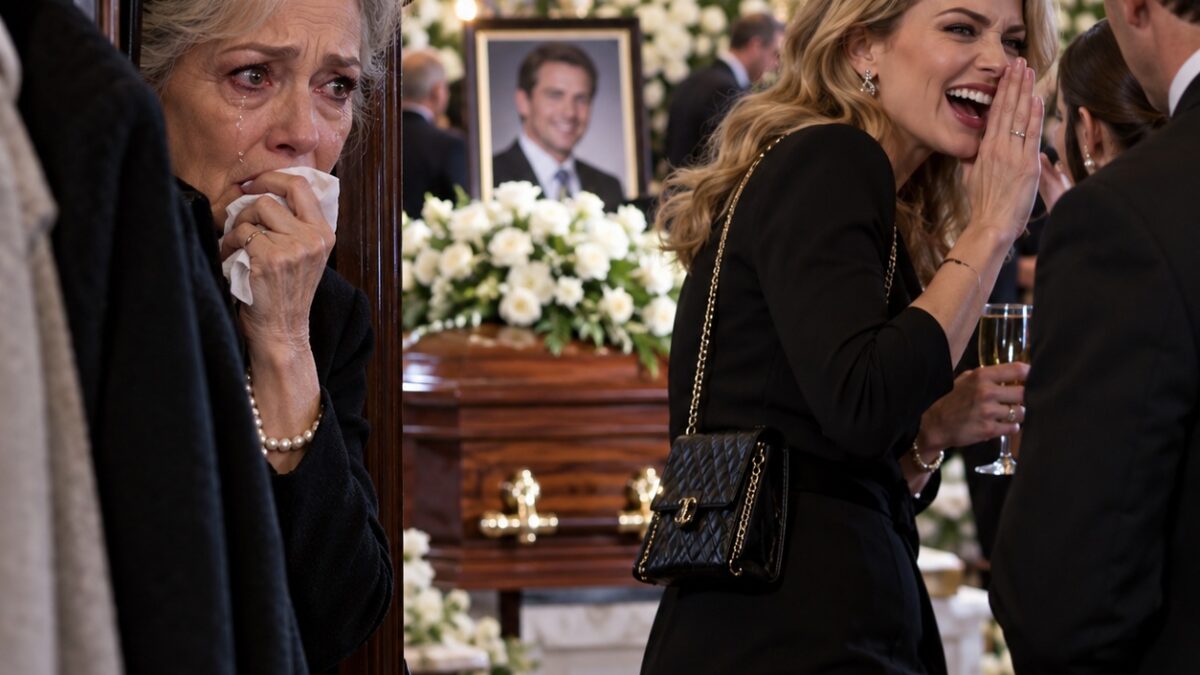
“I’m not taking care of that old witch.”
A pause.
“She can go to a home for all I care.”
The world stopped.
Even Jessica looked horrified.
I stepped out.
Stephanie’s eyes widened.
“Ria.”
She recovered quickly.
“I didn’t see you.”
“Clearly.”
I looked at her.
No screaming.
No insult.
No tears.
Then I walked away.
Not because I had nothing to say.
Because Michael’s envelope was waiting at home.
And suddenly, I understood why he had told me to wait.
I sat at my kitchen table.
Tea untouched.
Opened the envelope.
Inside:
Legal documents.
A USB drive.
A sealed letter addressed:
For Tommy, when he’s older.
And one letter for me.
Mom,
If you’re reading this, then I lost the fight.
I had to stop.
Started again.
Michael wrote that after his diagnosis, he finally saw Stephanie clearly.
The spending.
Coldness.
Distance from me.
Her plans to move Tommy.
He believed she had married him largely for financial security.
Then:
I couldn’t let her remove you from Tommy’s life after I’m gone.
Three months earlier, he had gone to Harold.
He transferred Anderson Designs into the Michael Anderson Family Trust.
The house too.
Investment accounts.
Retirement assets.
Vacation property in Vermont.
Most of what mattered.
Primary trustee:
Me.
Secondary trustee:
David.
Stephanie would receive support.
Not nothing.
Michael was not vindictive.
Eight thousand dollars a month for her and Tommy.
The house available for her and Tommy to live in.
Her car.
Two-million-dollar life-insurance policy payable directly to her.
But she could not sell the company.
Could not sell the house.
Could not liquidate the trust.
Not without trustee approval.
Then I reached the section about Tommy.
I read it twice.
Regular contact with his grandmother.
Every other weekend.
One evening each week.
Shared holidays.
If Stephanie refused or moved Tommy more than fifty miles away without trustee approval, her monthly allowance dropped to three thousand dollars.
The rest went directly into Tommy’s future account.
My hands covered my face.
Michael knew.
He had known exactly what Stephanie might do.
He had prepared for it.
His letter continued.
I know this puts responsibility on you.
I’m sorry.
But I trust you more than anyone to protect Tommy and what I built until he is old enough to choose his own path.
The USB contains videos.
Birthdays.
Graduations.
His wedding someday.
Things I won’t be there for.
Please give them to him when the time comes.
Then:
You gave me a beautiful life.
More love than most people ever receive.
Be strong.
Your son always,
Michael.
I cried until dawn.
Not because I had won something.
My son was dead.
Nothing felt like winning.
But Stephanie’s words stopped having power.
Old witch.
Nursing home.
Erased grandmother.
Michael had seen everything.
And his final act was not revenge.
Protection.
The next morning, Harold called.
“Ria.”
His voice broke slightly.
“I’m sorry.”
“Michael was my friend.”
“I know.”
“He instructed me to meet with you and Stephanie at ten tomorrow.”
“She doesn’t know?”
“Not yet.”
I slept better that night than I had in months.
Not peacefully.
But securely.
At Harold’s office, Stephanie arrived wearing a perfect black suit.
She smiled at him.
Barely acknowledged me.
“I assume there’s a lot to handle.”
She said.
Harold opened a folder.
“There is.”
Then:
“Three months ago, Michael established the Michael Anderson Family Trust.”
Stephanie’s smile disappeared.
“He transferred Anderson Designs into that trust.”
“What?”
“The family home.”
“No.”
“Investment accounts.”
“Retirement funds.”
“The Vermont property.”
She stared.
“I’m his wife.”
Harold adjusted his glasses.
“These were largely Michael’s separate-property assets.”
“He transferred them legally while alive.”
“That’s impossible.”
“It is completed.”
“Who controls this trust?”
Harold glanced at me.
“Ria Anderson is primary trustee.”
Stephanie slowly turned.
I did not smile.
Her face went pale.
“You.”
“Yes.”
“This is some kind of joke.”
“No.”
“You manipulated him.”
Harold interrupted.
“Ria had no involvement.”
“How much does she get?”
“That is not how the trust is structured.”
“What do I get?”
There it was.
Not:
Why did my husband do this?
Not:
What was he afraid of?
“What do I get?”
Harold explained.
Eight thousand monthly.
House occupancy.
Her car.
Two million life insurance.
Stephanie’s anger paused.
Calculation began.
Then:
“What about Tommy?”
“He is extremely well provided for.”
Harold turned to the visitation terms.
Every other weekend.
Wednesday evening.
Holidays.
Fifty-mile restriction.
Stephanie’s jaw dropped.
“That’s blackmail.”
“No.”
Harold said firmly.
“That is a father ensuring his son maintains a meaningful relationship with his grandmother.”
“I’m his mother.”
“And you remain his mother.”
“The trust does not remove your parental role.”
“It protects Michael’s stated wishes.”
“If I move?”
“Without approval?”
Harold explained the reduction.
Eight thousand to three.
The remainder protected for Tommy.
Stephanie looked at me.
Hatred.
“I hope you’re happy.”
I met her gaze.
“This was Michael’s decision.”
“Right.”
“You two planned this.”
Harold again:
“Mrs. Anderson.”
“I personally handled these documents.”
“Ria did not know.”
“Michael made these choices independently.”
Stephanie stormed out.
I remained.
“Will she contest?”
Harold sighed.
“She may.”
“Can she win?”
“Michael documented competence.”
“Doctors evaluated him.”
“The trust was established well before his final decline.”
“And the no-contest clause creates risk.”
“She has substantial benefits to lose.”
Within a week, three attorneys told Stephanie the same thing.
She did not challenge the trust.
At least not directly.
Instead, she attacked Michael.
Pain medication affected him.
He was confused.
I manipulated him.
He had been mentally compromised.
Rumors spread.
That angered me more than anything she had said about me.
Call me old.
Manipulative.
Interfering.
Fine.
But Michael had died with dignity.
He deserved to keep it.
Then Jessica called.
Stephanie’s friend.
The woman in the coatroom.
We met in a coffee shop outside town.
She could barely look at me.
“I need to tell you something.”
“Why?”
“Because what she’s doing now is wrong.”
I waited.
“I’ve known Stephanie since college.”
Jessica twisted her cup.
“She’s always cared too much about money.”
“But during Michael’s illness…”
She stopped.
“What?”
“She was having an affair.”
I felt physically sick.
“With a developer in Boston.”
“How long?”
“Months.”
Jessica showed me messages.
Hotel rooms charged to Michael’s cards.
Shopping trips.
Plans for after his death.
References to moving.
Selling.
Starting fresh.
Worst of all, messages asking Jessica to provide an alibi if Michael questioned certain Boston trips.
“I should’ve said something.”
Jessica whispered.
“Yes.”
I said.
She flinched.
I did not soften it.
Then:
“But you’re saying something now.”
She nodded.
“I can’t let her destroy Michael’s reputation.”
I kept copies.
I did not release them publicly.
Did not send them to friends.
Did not humiliate Stephanie.
My purpose was Tommy.
Not revenge.
Then she forced the issue.
Stephanie filed an emergency motion claiming I was emotionally unstable.
That grief made me dangerous.
That my involvement confused Tommy.
She asked the court to strike the trust’s visitation provisions.
Harold called.
“We have to respond.”
“I know.”
“This may require using Jessica’s evidence.”
I closed my eyes.
“Do it.”
The hearing was painful.
Private grief became public evidence.
Michael’s doctors testified.
Clear mind.
Deliberate estate planning.
Repeated discussions about Tommy.
David testified.
Harold testified.
Jessica’s messages came in.
Affair.
Spending.
Deception.
Planning.
I sat there thinking:
Michael would hate this.
Then I thought:
Michael prepared for this.
The judge reviewed everything.
Then spoke.
No evidence Michael lacked capacity.
Trust intentional.
Grandmother visitation reasonable.
Best interest of Tommy.
Then he looked at Stephanie.
“Continued unfounded attacks on Mr. Anderson’s capacity may implicate the no-contest provisions.”
Stephanie left crying.
Her parents followed.
I did not smile.
Outside, Harold asked:
“How do you feel?”
“Tired.”
“Relieved?”
“Yes.”
“Happy?”
“No.”
That surprised him.
I looked toward the courthouse doors.
“My son is still dead.”
Nothing else needed saying.
A year has passed now.
Tommy is three.
He has Michael’s eyes.
That same thoughtful stare.
He asks:
“Daddy lives in heaven?”
“Yes.”
“Can he see me?”
“I think love sees farther than we understand.”
That answer satisfies him for now.
The court ruling did not end our story.
It changed its direction.
I moved temporarily into Michael’s house because Tommy was struggling with too many changes.
Same bedroom.
Same toys.
Same nanny initially.
Same routines.
Stephanie hated my presence.
I could feel it.
But we were both exhausted.
Eventually something surprising happened.
Without the performance of being Michael’s perfect wife, Stephanie became more honest.
Still materialistic.
Still self-centered in ways that frustrate me.
But she loves Tommy.
That matters.
I stopped needing her to become a good person in every area before I recognized that.
People are rarely that simple.
The two-million-dollar insurance payment gave her choices.
Her parents wanted her in Connecticut.
She could have left.
Instead, she bought a condo near the lake in Burlington.
Returned to real estate.
Our relationship became functional.
Not warm.
Not friendship.
But respectful enough.
Tommy spends weekends with me.
Wednesday evenings.
Extra time when Stephanie travels.
His bedroom in my bungalow has dinosaurs on one wall.
Spaceships on another.
He insisted both themes belonged together.
“Dinosaurs can go to space.”
He explained.
Obviously.
Anderson Designs continues under David’s leadership.
I never expected to become a trustee for an architecture firm at sixty-seven.
The first board meeting made me feel like an imposter.
Then I remembered forty-five years of hospital administration, staffing crises, budgets, insurance battles, and family emergencies.
Different language.
Same principles.
People.
Responsibility.
Integrity.
David teaches me patiently.
We established a scholarship at Cornell.
Michael Anderson Memorial Scholarship.
Architecture students with financial need.
The first recipient was a young man raised by a single mother.
When I read his application, I cried.
Michael would have understood.
The house will belong to Tommy when he is twenty-five.
His education fund grows.
But the most valuable inheritance is not financial.
Videos.
Michael recorded dozens.
Birthday five.
Birthday ten.
First day of high school.
College graduation.
Wedding.
Becoming a father someday.
He sat in front of a camera knowing he would never see those moments.
I have watched only one.
The first.
“Hey, buddy.”
Michael says.
He looks thin.
Smiles.
“If Grandma is showing you this, you’re probably old enough to understand that I wanted to be there.”
I stopped the video.
I could not finish.
Someday Tommy will.
When he is ready.
So will I.
I joined a grief group.
Parents who lost adult children.
There is a specific loneliness in that grief.
People expect children to bury parents.
When the order reverses, language fails.
That is where I met Eleanor.
Her daughter died of breast cancer.
Two teenage grandsons.
Sometimes we talk for hours.
Sometimes we sit silently.
Grief does not always need conversation.
Three days a week, I volunteer at the cancer center.
I sit with chemotherapy patients.
Some want stories.
Some want silence.
One man said:
“You don’t need to stay.”
“I know.”
“Why are you?”
“Because someone stayed with my son.”
That ended the discussion.
The nurses remember Michael.
They tell me things.
How he thanked everyone.
How he asked about their children.
How even while dying, he apologized when he needed help.
“That was him.”
I say.
Time does not heal everything.
I hate that phrase.
Time teaches you how to carry what did not heal.
Different.
I still miss Michael every morning.
But joy returned around the edges.
Tommy’s laughter.
Yellow roses.
Blueberry pancakes.
Architecture scholarship dinners.
Watching one of Michael’s buildings open.
Even moments with Stephanie.
Months after the trial, she came to pick up Tommy.
He was asleep on my couch.
We stood in the kitchen.
She looked exhausted.
Not polished.
Not glamorous.
Just tired.
“Ria.”
“Yes?”
“I know you hate me.”
I considered.
“I don’t.”
She looked surprised.
“You should.”
“Maybe.”
“Why don’t you?”
“Because hate would connect me to you more than I want.”
She stared.
Then laughed once.
Not happily.
“Fair.”
After a moment:
“I did love Michael.”
I said nothing.
“I know you don’t believe me.”
“I believe you loved parts of the life you had with him.”
“That’s not the same.”
She looked down.
“No.”
Then:
“I wasn’t good to him at the end.”
There it was.
Not apology.
Not full accountability.
But truth.
“I know.”
Her eyes filled.
“I was scared.”
“So was he.”
“I thought if I planned enough…”
“You could escape the reality.”
“Yes.”
“Planning is not what hurt him.”
I said.
“Treating his death like your next financial chapter did.”
She flinched.
“I know.”
We never discussed it again.
We did not need to.
I did not forgive because Stephanie deserved it.
Forgiveness was not a gift I handed her.
It was deciding I would not organize my remaining life around anger.
Boundaries remained.
Trust terms remained.
I did not pretend.
But I stopped feeding hatred.
That helped Tommy.
And Michael had made something clear in the trust.
He did not want revenge either.
He could have left Stephanie nothing.
Instead:
Two million.
Housing.
Monthly income.
He protected Tommy while still treating his wife with basic fairness.
Even after recognizing who she was.
That was Michael.
Clear-eyed.
Generous.
Not naive anymore.
I try to live that way now.
Last week was the anniversary of his death.
Tommy and I planted a cherry tree.
He had a tiny plastic shovel.
Mostly useless.
Very enthusiastic.
“This is Daddy’s tree.”
I told him.
“Why?”
“Because every spring it will bloom.”
“And we’ll remember how much he loved us.”
Tommy patted dirt around the trunk.
“Will it get big?”
“Yes.”
“Bigger than me?”
“Eventually.”
He frowned.
“I’m going to get very big.”
“Then the tree has competition.”
He laughed.
Michael’s laugh.
For one second, my chest hurt.
Then warmed.
That is grief now.
Pain and love arriving together.
Later, Stephanie came.
Tommy ran to her.
“Mommy!”
She lifted him.
He told her about the tree.
“Daddy tree.”
Stephanie looked at me.
Our eyes met.
Something passed between us.
Shared loss.
Complicated.
Imperfect.
Real.
“Can we see it?”
She asked.
I nodded.
The three of us walked into the backyard.
Tommy showed her every detail.
The shovel.
The dirt.
The little branches.
Stephanie touched one gently.
Then said:
“Your dad liked cherry blossoms.”
I looked at her.
I had not known that.
“Yes.”
She said quietly.
“When we first dated, we went to Washington in spring.”
“He took about a hundred photographs.”
That story belonged to her.
A Michael I had not known.
I smiled.
“Then it’s the right tree.”
For once, there was no competition over whose version of him mattered more.
He had been my son.
Her husband.
Tommy’s father.
David’s partner.
Many people’s friend.
Love does not need exclusive ownership of memory.
That may be one of the hardest things I learned.
After they left, I sat on the patio.
Sunset turned the sky orange and pink.
I looked at the tiny tree.
“We’re okay.”
I whispered.
“Not perfect.”
“But okay.”
“Tommy knows you.”
“He’ll keep knowing you.”
“Your company is safe.”
“Your designs are still becoming real buildings.”
“Your scholarship is helping someone.”
“I’m still here.”
My voice broke.
“I miss you.”
Silence.
Wind.
Leaves.
That was all.
And somehow enough.
Sometimes I think back to the coatroom.
Stephanie laughing.
“I’m not taking care of that old witch.”
At the time, those words felt like a second funeral.
First I lost Michael.
Then I thought I was losing Tommy.
My family.
My place.
My future.
But Stephanie misunderstood something.
I never wanted her to take care of me.
Michael had bought my home years before.
I had a pension.
Savings.
A life.
What I wanted was not financial support.
I wanted family.
To remain Tommy’s grandmother.
To keep the connection Michael had spent his entire life building.
Stephanie saw closeness as dependence because she measured relationships through usefulness.
Michael understood differently.
That is why his trust did more than protect money.
It protected connection.
He knew exactly what I would value.
Tommy.
Time.
Memories.
Continuity.
His foresight gave us structure when grief might otherwise have scattered us.
But legal documents could not do everything.
A trust could require visitation.
It could not create affection.
That part still had to be built every Wednesday.
Every weekend.
Every pancake breakfast.
Every bedtime story.
Every time Tommy asked:
“Did Daddy like dinosaurs?”
And I answered:
“He liked buildings.”
“That’s boring.”
“Your father would be devastated to hear that.”
Tommy laughs.
Then I tell him another story.
That is how Michael continues.
Not as a frozen photograph.
As stories.
Values.
Habits.
Kindness.
The choice to be generous without becoming foolish.
The choice to see someone clearly without needing to destroy them.
The choice to plan ahead as an act of love.
After everything, I updated my own estate plan.
Immediately.
Harold laughed when I arrived.
“You learned the lesson?”
“Apparently.”
I documented everything.
My bungalow.
Savings.
Personal belongings.
Medical directives.
Who makes decisions if I cannot.
What happens if family relationships change.
No guessing.
No ambiguity.
No one should have to learn what Michael taught us through crisis.
Planning is not morbid.
It is kindness.
I tell everyone my age that now.
Make the documents.
Have the uncomfortable conversation.
Do not assume people know.
Do not assume love will automatically prevent conflict.
Good people can panic.
Grieving people can behave irrationally.
Bad intentions can hide beneath charm.
Clarity protects everyone.
But there is another lesson harder to explain.
Seeing people clearly does not mean we must become hard.
When Michael finally recognized Stephanie’s flaws, he could have punished her financially.
He did not.
He protected what mattered.
Tommy.
The business.
Me.
Then left her enough to live securely.
I try to remember that whenever anger returns.
Because it does return.
Especially when I remember Michael lying in a hospital bed while Stephanie shopped.
Or the affair.
Or the funeral.
I can choose those memories.
Or I can choose the moment Michael handed me the envelope.
“Fight for Tommy.”
Not:
Destroy Stephanie.
Not:
Make her pay.
Fight for Tommy.
That difference became my compass.
When Stephanie filed the emergency motion, I fought.
When she stayed in Burlington and followed the arrangement, I stopped fighting.
When she showed genuine love to her son, I recognized it.
When she crossed boundaries, I enforced them.
Not revenge.
Responsibility.
I had spent forty-five years as a nurse.
Medicine teaches you not every wound can be cured.
Some are managed.
Some scar.
Some require removing what causes damage.
Some heal imperfectly.
Families are similar.
Ours did not return to what it was before Michael became sick.
Impossible.
Instead, we built something new.
Stephanie and I will never be mother and daughter.
We may never be friends.
But we can stand beside one another at Tommy’s preschool recital.
We can coordinate birthdays.
We can share photographs.
We can discuss medical decisions without warfare.
That is not a fairy-tale ending.
It is better.
It is real.
Tommy recently brought home a drawing.
A house.
Huge windows.
A porch.
Stick figures outside.
“Who’s this?”
I asked.
“Me.”
“And this?”
“Mommy.”
“And this?”
“You.”
Then another figure floating above the house.
I swallowed.
“Who is that?”
“Daddy.”
“He lives in the sky.”
I looked at the drawing for a long time.
Michael drew dream houses too.
Maybe talent travels in strange ways.
I framed it.
It hangs in my hallway.
Beside one Michael drew when he was eleven.
Two dream houses.
Father.
Son.
One drawn decades apart.
Sometimes I stand between them and think about what survives us.
Not bank accounts.
Though planning matters.
Not houses.
Though shelter matters.
What survives is what we place inside people.
Michael placed love inside me.
I placed it inside him.
Now both of us place it inside Tommy.
That is the inheritance nobody can litigate.
The first spring after we planted the cherry tree, it produced only a handful of blossoms.
Tommy ran outside shouting.
“Grandma!”
“Daddy’s tree woke up!”
I followed.
Tiny pale flowers covered several branches.
Stephanie arrived later.
We stood beneath it together.
No one spoke for a while.
Then Tommy announced:
“Daddy made flowers.”
Stephanie laughed.
I said:
“He would love you thinking that.”
Tommy looked up.
“Do you miss Daddy?”
“Yes.”
Stephanie answered first.
“So much.”
He turned to me.
“Do you?”
“Every day.”
“Does missing hurt?”
I knelt.
“Sometimes.”
“Why do we do it?”
Children ask questions philosophers spend centuries avoiding.
I thought.
“Because missing is what love feels like when someone isn’t where we can touch them anymore.”
Tommy considered that.
Then hugged both of us.
That was enough philosophy for one afternoon.
Now, when I remember the funeral, the coatroom is no longer the final image.
For a long time, it was.
Stephanie’s laugh.
Old witch.
Nursing home.
Then I began adding what came afterward.
Michael’s handwriting.
Trust documents.
Harold’s office.
Stephanie’s shocked face.
Court.
Tommy running into my arms.
Wednesday dinners.
Scholarship ceremonies.
Cancer-center patients.
The cherry tree.
Healing does not erase the painful scene.
It stops letting that scene own the entire story.
If someone had told me at Michael’s funeral that one year later I would be sitting in his backyard beside a blooming tree while his son laughed, I would not have believed them.
I thought my life had ended with his.
It did not.
A version of it ended.
Mother of a living son.
That identity disappeared.
But another version emerged.
Keeper of his stories.
Trustee of what he built.
Grandmother.
Volunteer.
Friend.
Woman learning to live alongside grief instead of beneath it.
I am sixty-eight now.
Some mornings, my knees hurt.
I forget why I walked into a room.
I own comfortable shoes Stephanie once would have mocked.
And I am happier than the woman she described at the funeral had any right to become.
Not because Michael died.
Never because of that.
Not because conflict made me stronger.
I would trade every lesson to have him back.
But since I cannot, I refuse to let loss waste what remains.
That is different.
Michael’s final arrangements gave me responsibility.
His final words gave me permission.
“Forgive yourself.”
I work on that one.
Forgiving myself for missing signs.
For staying quiet around Stephanie too long.
For assuming Michael was happier than he was.
For not asking more after that lawyer visit.
For every impossible thing mothers believe they should have prevented.
Some things cannot be fixed.
Michael knew.
He was right.
But some things can be protected.
A child’s future.
A grandmother’s place.
A company built with integrity.
A dead man’s reputation.
A family’s memories.
Those things were worth fighting for.
Stephanie once thought taking care of me would be her burden.
She never understood.
I did not need her to carry me.
I needed her not to cut me away from the people I loved.
Michael understood that distinction.
And he built it into the one thing Stephanie respected completely.
The financial structure.
Maybe that sounds cold.
But sometimes boundaries need consequences.
He knew her.
By the end, he knew her better than she realized.
And because of that, Tommy never had to choose between his mother and his father’s family.
He gets both.
Imperfectly.
But he gets both.
That is the victory.
Not that Stephanie receives less money if she violates the trust.
Not that a judge warned her.
Not that Jessica exposed the affair.
The victory is Tommy.
Safe.
Loved.
Growing.
Connected.
Last Sunday, we made blueberry pancakes.
My mother’s recipe.
Tommy poured too much batter.
One pancake came out shaped like Florida.
Another looked like a shoe.
He drowned everything in syrup.
“Daddy ate these?”
“Every Sunday.”
“Did he make good ones?”
“No.”
I said.
“Your father was terrible at pancakes.”
Tommy laughed.
I looked toward the window.
Cherry blossoms moved in the breeze.
For a moment, my kitchen held three generations.
My mother’s recipe.
My son’s memory.
My grandson’s laughter.
That is how love survives.
Not perfectly.
Not without pain.
But stubbornly.
Stephanie said:
“I’m not taking care of that old witch.”
She was right about one thing.
She never had to.
Michael had already made sure I could take care of myself.
What he protected was something much more important.
My place in Tommy’s life.
And as I watched my grandson lick syrup from his fingers beneath a photograph of his father, I finally understood what Michael had built in those final months.
It was never just a trust.
It was a bridge.
Between the son I lost…
and the little boy he refused to let me lose too.







