When My Daughter Pulled a Bloodstained Paper From Beneath Her Hospital Blanket, the Room Suddenly Felt Far More Dangerous
When My Daughter Pulled a Bloodstained Paper From Beneath Her Hospital Blanket, the Room Suddenly Felt Far More Dangerous
My daughter had never begged me to come for her before, so when Hannah whispered, “Mom, please come get me,” I knew whatever had happened was worse than she was willing to say over the phone.
By the time I reached the hospital, one side of her face was swollen, bruises circled both arms, and three members of her husband’s family were already preparing to explain why none of it was their fault.
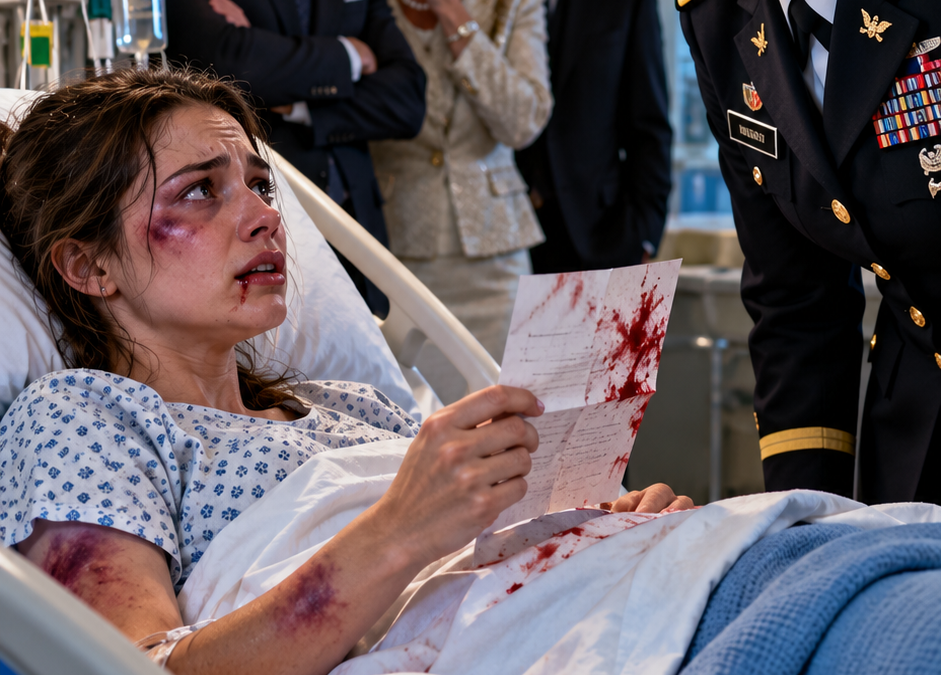
Then Hannah reached beneath her blanket and pulled out a folded sheet of paper stained with blood from her split lip, and I realized the people outside her room were frightened of far more than what they had done to her that night.
My name is Colonel Rebecca Sloan.
For thirty years, the United States Army trained me to operate when everyone else was frightened.
I learned how to listen to incomplete information without inventing what I did not know. I learned how to make decisions while tired, angry, grieving, or afraid. I learned that panic spreads quickly, that authority means little if people do not trust you, and that sometimes the most dangerous person in a room is the one speaking in the calmest voice.
I believed those lessons had prepared me for almost anything.
Then my daughter called me from St. Catherine’s Hospital in Charlotte.
“Mom, please come get me.”
There was something wrong with the way Hannah breathed.
She was trying not to cry.
People think crying is always loud. It isn’t.
Sometimes terror sounds like someone taking tiny breaths because a full one might make everything inside them collapse.
“Hannah?”
“Yes.”
“Where are you?”
“St. Catherine’s. Charlotte.”
“What happened?”
“Please.”
Her voice broke.
“Please just come.”
I was standing outside a military reception near Fayetteville. I had spent the evening shaking hands, discussing personnel issues, smiling for photographs, and making polite conversation with people I respected but barely heard after that phone call.
I was still in my Army dress uniform.
I didn’t change.
I walked directly to my vehicle.
A nurse came onto the phone long enough to tell me Hannah was receiving care and was currently safe.
Currently.
That word followed me all the way to Charlotte.
I called whenever traffic stopped.
Sometimes Hannah answered.
Sometimes the nurse did.
Once no one answered, and my hands tightened around the steering wheel so hard my knuckles hurt.
I had faced moments in uniform when information stopped coming and imagination tried to fill the silence.
I had always told younger officers the same thing.
Do not react to the worst scenario your mind can invent.
Respond to what you know.
That night, I discovered how easy that advice sounded when the person in danger was someone else’s child.
Hannah was twenty-eight.
But she remained every age she had ever been to me.
She was five years old, insisting she could tie her own shoes.
Seven, falling asleep beside the living room window because I had promised I would be home before bedtime.
Twelve, furious because I missed a school event after a training schedule changed.
Seventeen, pretending she wasn’t nervous before taking her driving test.
Twenty-three, calling me after she met a man named Evan Whitmore.
“He’s different, Mom.”
That was what she had said.
I remembered answering, “Different good or different interesting?”
She had laughed.
“Good.”
I wanted desperately for her to have been right.
The Whitmores were wealthy.
Old Charlotte money, according to people who cared about such things.
They knew business owners, politicians, attorneys, judges, charity boards, university administrators.
At Hannah and Evan’s wedding, Celeste Whitmore had spent nearly as much time introducing people by their positions as by their names.
“This is Judge So-and-so.”
“This is the publisher of—”
“This is the chairman of—”
“This family goes back four generations with—”
I had recognized the pattern.
Status as oxygen.
Connections as currency.
I did not particularly care.
I had spent too much of my adult life around generals to be impressed by people who needed to announce that important people returned their calls.
Still, Evan appeared good to Hannah.
Attentive.
Polished.
Protective.
Maybe too protective, I would later understand.
At the time, I told myself I was being overly suspicious.
My daughter loved him.
So I gave him the benefit of the doubt.
Parents sometimes mistake restraint for wisdom.
Sometimes we are simply afraid of becoming the reason our children stop telling us things.
When I entered Hannah’s hospital room that night, every doubt I had ever dismissed came back at once.
She was sitting upright against the pillows, trying to pull a hospital blanket higher over the white dress she had been wearing.
The dress was torn near the shoulder.
Her left eye was swollen.
Her lower lip was split.
Dark bruises were forming around both upper arms.
I stopped at the foot of the bed.
Thirty years of discipline disappeared.
Not visibly.
Inside.
Every part of me wanted to cross the room, demand names, demand explanations, demand consequences.
Instead, I heard my own voice become very quiet.
“Hannah.”
Her face crumpled.
“Mom.”
I moved beside the bed but did not touch her.
“Can I hold you?”
She nodded.
That question mattered more than I understood at the time.
Someone else had been deciding too many things about her body.
Where she could go.
What she could say.
Whether she could have her phone.
Whether she could leave a room.
I would not begin helping her by taking another choice away.
I bent carefully around the monitor wires.
Her fingers closed around the sleeve of my uniform.
She held on like she was afraid I might disappear.
“I’m sorry,” she whispered.
Those were the first full words my injured daughter said to me.
Not help me.
Not he hurt me.
Not I’m scared.
I’m sorry.
Something inside me broke.
“You have nothing to apologize for.”
“I should have called earlier.”
“We’ll talk about everything when you’re ready.”
“You told me—”
“Not now.”
I pulled back enough to look at her.
“You are not responsible for making me feel better about this. Understand?”
Her chin trembled.
Then laughter came from the hallway.
A man’s laughter.
Hannah froze.
Her entire body changed.
The hand holding my sleeve tightened.
I saw it before I even saw him.
Fear.
Evan Whitmore stepped through the doorway.
His tie hung loose around his collar.
Behind him came his mother, Celeste, carrying a pearl-colored handbag.
Grant, Evan’s younger brother, followed with his phone in his hand.
He was still smiling at something on the screen.
Celeste saw me and released an exaggerated breath.
“Rebecca. Thank goodness.”
I straightened.
“Perhaps you can talk some sense into her.”
I looked at Hannah.
Then at Celeste.
“What happened?”
Evan answered.
“She became hysterical.”
The word landed exactly the way he intended.
Not injured.
Not frightened.
Hysterical.
“She was upset,” he continued. “There was an argument. She lost her balance.”
Hannah’s fingers tightened around my sleeve again.
“They took my phone.”
Evan’s expression sharpened.
“Hannah.”
“They locked me in the guesthouse.”
“That is enough.”
He stepped toward the bed.
Hannah pulled back.
Then Evan reached across me toward her arm.
My body moved before anger had time to.
I caught his wrist.
Not violently.
Not theatrically.
Just enough to stop him.
He tried to pull away.
I released him the instant he stepped back.
“Don’t touch her.”
His face flushed.
“She’s my wife.”
“And she’s lying in a hospital bed.”
“This is a family matter.”
Hannah spoke.
Her voice shook.
“And I’m asking you to leave.”
Evan stared at her.
I turned toward her.
She was terrified.
But she had said it.
“I want them out,” she whispered.
I pressed the call button.
A nurse entered within seconds.
She looked at Hannah rather than at the rest of us.
“Who do you want in the room?”
Hannah swallowed.
“Only my mother.”
The nurse nodded.
“Then everyone else needs to step outside.”
Grant gave a short laugh.
“This is unbelievable.”
The nurse did not react.
“Sir, please step outside.”
Grant looked at me.
“Some people just can’t handle marrying into a family like ours.”
There are sentences so revealing that responding to them only reduces their value.
I said nothing.
Celeste walked toward me before leaving.
Her perfume was heavy and floral.
She looked at the ribbons on my uniform.
Then at my face.
“We know judges, Colonel.”
I remained silent.
“Newspaper owners. Attorneys. People who answer when we call.”
Her eyes moved over my uniform again.
“Those ribbons don’t frighten us.”
That told me everything I needed to know about how Celeste saw the world.
Rank.
Influence.
Threat.
Power.
She assumed my uniform was intended to intimidate because intimidation was how she understood authority.
I looked at Evan.
He wasn’t watching me.
He was watching Hannah.
Grant was watching the nurse’s radio.
Celeste was watching my reaction.
She wanted anger.
A threat.
Something she could later describe as an Army colonel abusing her position.
So I gave her nothing.
Grant paused at the doorway.
“If Hannah repeats these accusations, our attorney will be contacting you.”
“You can give his information to hers.”
“You think this is funny?”
“No.”
Security arrived.
Celeste immediately began demanding a supervisor.
The nurse shut the door.
For several seconds, Hannah and I said nothing.
The hallway became muffled.
Only the machines remained.
The nurse looked at Hannah.
“With your permission, I’d like to photograph your injuries and contact law enforcement.”
Hannah glanced at me.
I did not nod.
I did not answer for her.
“Yes,” she said.
The nurse documented the bruises.
Her lip.
Her eye.
Her arms.
I sat where Hannah could see me and kept my hands in my lap.
Afterward, I asked the only question I could think of that did not tell her what to say.
“What do you need me to know?”
Her eyes moved toward the closed door.
“They weren’t just trying to stop me from leaving Evan.”
I waited.
Hannah reached beneath the hospital blanket.
When her hand returned, she was holding a folded sheet of paper.
One corner had a reddish stain.
Blood from her lip.
“They wanted me to sign this.”
She handed it to me.
I unfolded it.
My daughter had grown up around lawyers, officers, contracts, paperwork, and people who understood that words could carry consequences.
I had taught her to read before signing anything.
Maybe that lesson saved her.
The first paragraph was a confession.
It stated that Hannah had diverted money from the Whitmore Family Foundation.
There were dates.
Amounts.
Accounts.
Promises of repayment.
At the bottom was a signature line.
Hannah Sloan Whitmore.
Unsigned.
I read it again.
Then once more.
The language had been designed carefully.
It placed every decision on Hannah.
Nobody else had knowledge.
Nobody else benefited.
Nobody else authorized anything.
She had supposedly acted alone.
I looked up.
“I didn’t do it,” she said immediately.
“I know.”
“Mom, please.”
“Hannah.”
She stopped.
“I believe you.”
Her eyes filled.
“Tell me how this paper got into your hands.”
Hannah breathed slowly.
Then she began.
She volunteered twice a week at the Whitmore Family Foundation.
Most of her work involved organizing scholarship applications, contacting students, reviewing documentation, and helping coordinate tuition payments.
She enjoyed it.
For months, the work had made her feel useful in a marriage that had gradually become smaller around her.
Evan controlled most of their finances.
He preferred that she not work full-time.
At first he said it was because they didn’t need the money.
Then because her schedule made travel inconvenient.
Then because someone in their position should focus on charity work and family commitments.
No single conversation had sounded outrageous.
That was the problem.
Control rarely arrives wearing a sign.
It comes disguised as convenience.
Concern.
Advice.
Why deal with bills? I’ll handle them.
Why drive yourself? Someone can take you.
Why work that job? We don’t need it.
Why keep separate accounts? We’re married.
Why call your mother about everything?
Why are you being difficult?
Piece by piece, freedom becomes something a person has to ask permission to use.
The previous Thursday, a student had called Hannah.
A young woman had been awarded tuition assistance through the foundation.
The money had never reached her college.
Hannah checked.
The paperwork showed the payment as completed.
Then she checked another.
And another.
She discovered invoices connected to scholarship recipients she could not identify.
Some students appeared not to exist.
“When I asked Evan, he said it was a bookkeeping issue.”
“What did you do?”
“I kept looking.”
For the first time that night, I almost smiled.
That was my daughter.
Afraid, perhaps.
Controlled more than she had admitted.
But still herself underneath.
“I downloaded everything I could legally access,” she continued. “Then I called an attorney.”
“Which attorney?”
“One a friend recommended. I had an appointment scheduled.”
“What happened?”
“Evan saw the confirmation.”
“How?”
“Our calendars were shared.”
Of course.
Another convenience.
Another doorway.
“Tonight Celeste said we needed to discuss the foundation after dinner.”
Hannah touched her swollen lip and winced.
“Grant took my phone.”
“Did you give it to him?”
“No.”
Her eyes dropped.
“He took it from the table.”
“And Evan?”
“He brought out the confession.”
The paper felt heavier in my hand.
“They told me if I signed it, they could contain the damage.”
“What damage?”
“They wouldn’t say exactly. Celeste kept saying the foundation had a reputation to protect.”
“What did they threaten?”
“My marriage first.”
She laughed once, bitterly.
“Then my reputation.”
“What else?”
“You.”
I stared at her.
Hannah wiped her cheek.
“Evan said if I caused a public scandal, people would start asking whether you had used military connections to protect me.”
“That’s nonsense.”
“I know that now.”
“You knew it then.”
“I was scared.”
There was no accusation in my voice, but Hannah heard one anyway.
Her shoulders tightened.
I immediately softened.
“Being scared can make nonsense sound possible.”
She looked at me.
“When I wouldn’t sign, I tried to leave.”
Her voice became thin.
“Evan blocked me.”
My stomach tightened.
“Grant stood near the door.”
“Where was Celeste?”
“Watching.”
“What happened next?”
“I told Evan to move.”
Hannah’s fingers trembled.
“He grabbed me.”
She looked at the bruises on her arms.
“I pulled away.”
Then silence.
I wanted desperately not to make her say it.
But this was her story.
Not mine to complete.
“He hit me.”
The room changed.
I had known.
Her face told me.
Her fear told me.
But hearing the sentence was different.
I dug my fingernails into my palms beneath the edge of the chair.
Then forced my hands open.
Hannah noticed.
“Mom.”
“I’m okay.”
“You’re angry.”
“Yes.”
That seemed to surprise her.
Maybe she expected me to deny it.
“I am extremely angry.”
“Please don’t do anything.”
“I won’t do anything that interferes with what you decide or with the investigation.”
She exhaled.
“That is not the same as not being angry.”
“No.”
For the first time that night, something almost resembling relief crossed her face.
She continued.
“After he hit me, I screamed.”
“Did anyone come?”
“Ruth was in the kitchen.”
Ruth Bell.
The Whitmores’ housekeeper.
I remembered her from Hannah’s wedding.
Quiet.
Observant.
Kind.
When Hannah’s dress hem tore thirty minutes before the ceremony, Ruth had appeared with a small sewing kit and safety pins while everyone else panicked.
Later, Celeste scolded her for accidentally appearing in the background of a family photograph.
I had disliked Celeste before that moment.
Afterward, I understood her more clearly.
“Did Ruth see what happened?”
“I didn’t know then.”
Hannah continued.
“Celeste told them to put me in the guesthouse until I was ready to be reasonable.”
I stared at her.
“They confined you there?”
“Yes.”
“Locked?”
“Yes.”
“Phone?”
“Grant had it.”
“Could you leave?”
“No.”
“Then how are you here?”
“Ruth.”
Hannah began crying again.
“She waited until they went back into the main house.”
Ruth used a housekeeping key to unlock a side door.
She drove Hannah to St. Catherine’s in her own car.
Hannah called me using Ruth’s phone.
“Where is Ruth now?”
Hannah’s face changed.
“She went back.”
“What?”
“She lives there.”
“Why would she go back?”
“She had a bag packed but didn’t bring it when she drove me. She thought they would all stay here dealing with me.”
“Hannah.”
“I told her not to.”
Her voice broke.
“She said she would be quick.”
A detective arrived shortly afterward.
Dana Ruiz.
She introduced herself, sat beside the bed, and spoke directly to Hannah.
That mattered.
So many people had spent the evening talking about my daughter as though she wasn’t there.
Ruiz did not.
“Are you comfortable telling me what happened?”
Hannah glanced toward me.
I began to answer automatically.
“She—”
Then I stopped.
Hannah was watching me.
“Sorry,” I said. “Go ahead, sweetheart.”
That moment stayed with me.
I had arrived determined to protect her.
But protection can become control if you are not careful.
Hannah did not need another person taking over her voice.
She needed people willing to make space for it.
So I listened.
She told Detective Ruiz what she had told me.
Ruiz asked practical questions.
Times.
Locations.
Who stood where.
Who touched whom.
Who had the phone.
What doors were locked.
Whether Hannah had signed anything.
Whether there were weapons.
Whether she feared Evan would come after her.
Hannah answered as best she could.
Ruiz photographed the unsigned confession before securing it as evidence.
When she asked about Ruth, Hannah sat forward.
“She could be in danger.”
“We’re going to address that.”
In the hallway, Evan began shouting at security.
Hannah flinched.
Not slightly.
Her entire body jerked.
The nurse noticed.
She walked out and requested that security move Evan farther from the room.
Hannah stared at the doorway after the sound faded.
“He said he’d have me declared unstable.”
Ruiz looked up.
“When?”
“At the house.”
“What exactly did he say?”
“That people already knew I was emotional. That if I told anyone what was happening, he’d say I was having some kind of breakdown.”
“Did he mention treatment, doctors, medication?”
“No. Just that his family would make people believe him.”
Ruiz took notes.
“He also said Mom could lose her career if I caused trouble.”
I nearly interrupted.
Again, I stopped myself.
Detective Ruiz asked whether Hannah had spoken with any attorney before the incident.
“Yes.”
“Can we contact that attorney?”
“Yes.”
Hannah suddenly looked at me.
“There was an email.”
“What email?”
“The attorney sent something yesterday.”
She used my phone to sign into her account.
Her hands shook enough that she mistyped the password twice.
When the message opened, she handed me the phone.
The attorney had already performed preliminary research on one of the supposed scholarship beneficiaries.
The recipient was connected to a company controlled by Grant Whitmore.
Attached to the email were copies of approval records.
At the bottom of several was Hannah’s signature.
I looked at my daughter.
“Did you sign these?”
“No.”
“You’re certain?”
“They’re dated months ago.”
Her voice rose.
“I didn’t even know these invoices existed then.”
She looked at Detective Ruiz.
“They already used my name.”
I felt cold.
The confession in my hand was not a desperate idea created after Hannah discovered financial irregularities.
It was the final piece of something prepared in advance.
Someone had already forged her signature onto transactions.
If an audit exposed the missing money, the Whitmores needed an explanation.
They needed Hannah to confirm the story they had built around her.
The confession did not create guilt.
It was designed to make previously manufactured guilt believable.
Detective Ruiz asked Hannah to forward the attorney’s email through an evidence channel.
Then she stepped outside.
Hannah sank back against the pillows.
“I should have called you.”
“I wish you had felt able to.”
“I knew you’d come.”
“Then why didn’t you call?”
For a moment, I worried the question sounded accusatory.
Hannah stared at my uniform sleeve.
“Because you always seem so certain.”
I frowned.
“What does that mean?”
“You walk into rooms and people listen.”
“That isn’t always true.”
“It felt true to me.”
She looked away.
“I couldn’t tell you I had become someone who was afraid to ask her husband for her own car keys.”
My throat tightened.
“Hannah.”
“I knew what you’d say.”
“What?”
“That this wasn’t normal.”
“It isn’t.”
“I know.”
She started crying.
“But if I said it out loud, then I had to do something.”
That was the part outsiders rarely understand.
They ask why someone stayed as though recognizing danger automatically creates a safe road out.
Sometimes recognizing the truth makes everything more frightening.
Because then the person must face the cost of leaving.
Money.
Housing.
Reputation.
Children, if there are children.
Threats.
Family pressure.
The humiliating question of how something that once looked like love became fear.
“I’ve been afraid plenty of times,” I said.
She looked at me skeptically.
“You?”
“Yes.”
“You never looked afraid.”
“That was probably my mistake.”
She waited.
“I thought being your mother meant showing you I could handle everything.”
My voice became unsteady.
“Maybe I should have shown you that being strong sometimes means admitting you’re scared and asking someone to stand beside you.”
My phone rang in her hands.
The number on the screen was unfamiliar.
Hannah went still.
“That’s Ruth’s number.”
She answered immediately and put it on speaker.
“Ruth?”
A scraping sound.
Then breathing.
“Miss Hannah?”
“Ruth, where are you?”
A whisper.
“Guesthouse.”
Hannah sat upright.
“Did you get your bag?”
“No.”
Then Ruth said, “Grant came back.”
I stood.
Detective Ruiz was not in the room.
I motioned toward the nurse.
She understood my expression and went into the hallway.
“Ruth,” I said, “where exactly are you?”
“Guesthouse bathroom.”
“Is the door locked?”
“Yes.”
Someone shouted in the distance.
A man.
Then Grant’s voice became clearer.
“Open the door, Ruth.”
Hannah covered her mouth.
“Don’t open it,” she whispered.
Grant again.
“Give me the phone.”
Something slammed into wood.
Ruth gasped.
The call disconnected.
I was already moving when Hannah grabbed my hand.
“Mom.”
I turned.
She looked terrified again.
“Don’t leave me.”
That sentence stopped me more effectively than any order I had ever received.
Every instinct told me to drive to the Whitmore property.
To do something.
To become the person solving the danger personally.
But Hannah was asking for something else.
Stay.
Detective Ruiz rushed back in.
I sat beside my daughter and told Ruiz exactly what we had heard.
She immediately radioed officers.
Guesthouse.
Bathroom.
Adult female barricaded inside.
Male attempting forced entry.
Possible witness connected to an active domestic violence investigation.
Then we waited.
I hated waiting.
For most of my professional life, when something happened, people expected me to act.
Give direction.
Authorize.
Coordinate.
Decide.
In that hospital room, my most useful action was holding my daughter’s hand while other people performed their jobs.
It humbled me.
Twenty minutes can become enormous when you are waiting to learn whether someone who helped your child is safe.
Hannah kept asking, “Why isn’t anyone calling?”
I kept answering, “Because they’re working.”
Finally Detective Ruiz returned.
She closed the door behind her.
“They found Ruth.”
Hannah stopped breathing.
“She is safe.”
My daughter folded forward and began sobbing.
I caught her carefully while the nurse checked her monitor.
Ruiz continued.
Officers found Grant outside the bathroom.
The door was damaged.
Ruth had an injured wrist and was being examined.
She agreed to provide a statement.
Grant was no longer free to simply return to the hospital and resume threatening anyone.
There was no dramatic moment where the entire truth suddenly appeared.
Real investigations are not like that.
The case built slowly.
Piece by piece.
Ruth told investigators she had heard the argument after dinner.
From the kitchen, she saw Evan strike Hannah.
She saw Grant block the exit.
She heard Celeste order everyone to stop making a scene and tell Ruth to return to work.
Later, when Hannah was confined in the guesthouse, Ruth used her key to free her.
She drove her to the hospital.
Then she made the mistake of returning for her belongings.
Or perhaps calling it a mistake is unfair.
Ruth had spent years living on the Whitmore property.
Her clothing was there.
Her documents.
Her personal things.
People with secure homes underestimate what it means to leave suddenly carrying nothing.
Grant found her before she reached her car.
He followed her to the guesthouse.
Ruth locked herself inside the bathroom.
Then she called Hannah.
Ruth did not have a perfect secret recording of the dinner.
No dramatic hidden camera.
No miraculous confession.
She had something simpler.
Her eyes.
Her memory.
And the willingness to testify.
For years, the Whitmores had treated Ruth like part of the furniture.
Useful.
Present.
Invisible.
They never considered that an invisible person could become a witness.
Investigators obtained security recordings from the property.
The cameras did not show everything.
But they showed enough.
Hannah entering the guesthouse under circumstances inconsistent with the family’s original story.
Ruth later approaching.
Hannah leaving with her.
The times matched their statements.
Digital evidence filled in other gaps.
One recovered message from Celeste to Evan read:
Get her signature before she speaks to anyone.
I read that sentence only once.
Once was enough.
Hannah’s attorney provided the financial files.
Investigators began following the money.
Funds classified as student assistance had moved to entities connected to Grant.
Some money was later used for personal family expenses.
Grant’s assistant eventually supplied emails directing her to add Hannah’s signature to approvals.
The foundation’s outside accountant still possessed original records that had not been altered.
Those originals became devastating.
The Whitmores’ plan depended on controlling the story before anyone compared documents.
Hannah had accidentally threatened that plan by asking one simple question.
Why had a student not received her tuition money?
That was all.
Not revenge.
Not investigation at first.
A student needed help.
Hannah checked.
A lie cracked.
Behind it sat another lie.
Then another.
And eventually a family willing to injure one of its own members rather than let the truth leave the house.
Hannah stayed with me after the hospital discharged her.
I took leave.
That decision confused some people.
I had spent most of my career treating leave as something to schedule responsibly around obligations.
Suddenly I understood there are moments when the obligation is the person sitting at your kitchen table unable to eat because chewing hurts her injured lip.
Those first weeks were not dramatic.
They were small.
I learned what soup she could tolerate.
I learned not to stand unexpectedly behind her.
I learned that closed doors had changed meaning for her.
The first time she went into my guest room and shut the door, I almost knocked five minutes later.
Then I stopped.
She had spent too long having privacy treated as suspicious.
If she wanted the door closed, the door stayed closed.
I asked before entering.
Every time.
Sometimes she wanted me nearby.
Sometimes she wanted silence.
Sometimes we watched terrible television because serious conversation was too exhausting.
Sometimes she woke at two in the morning and sat in the kitchen.
I’d find her staring through the dark window.
I would ask, “Company or space?”
Some nights she said, “Company.”
Other nights, “Space.”
I learned to accept both.
Celeste called once from an unfamiliar number.
I answered before realizing who it was.
“Rebecca.”
My entire body tensed.
“What do you want?”
“Surely we’re all intelligent enough to settle this.”
“Settle what?”
“This misunderstanding.”
I almost laughed.
She continued.
“Dragging multiple families through court will ruin lives.”
I looked across the kitchen.
Hannah was asleep on the couch.
One bruise was still visible near her wrist.
“Whose lives are you worried about?”
“This affects everyone.”
“It already has.”
“There are ways to resolve these matters privately.”
I wrote down the time of the call.
“You should communicate through Hannah’s attorney.”
“Rebecca, don’t be unreasonable.”
I ended the call.
Then I sent the information to the attorney.
A younger version of me might have argued with Celeste.
I might have told her exactly what I thought of her.
Age had taught me something better.
Evidence is usually more useful than satisfaction.
Hannah struggled with guilt.
Not guilt for the money.
She knew she hadn’t stolen it.
A different kind.
For Ruth.
For calling me.
For the investigation.
For Evan’s future.
For the foundation employees losing jobs while operations were reviewed.
For family members dragged into interviews.
For everyone except herself.
One afternoon, I found her sitting outside with a blanket around her shoulders.
“If I hadn’t looked into those scholarships—”
I interrupted.
“Stop.”
She looked at me.
“The theft existed before you found it.”
“I know.”
“The forged signatures existed before you found them.”
“Yes.”
“Evan hit you because Evan chose to hit you.”
Tears filled her eyes.
“Grant confined you because Grant chose to participate.”
“Yes.”
“Celeste tried to silence you because Celeste made that decision.”
Hannah looked away.
“You discovered what they were already doing.”
Her voice was small.
“It still feels like I detonated everything.”
“No.”
I sat beside her.
“You opened a door in a building that was already burning.”
She began counseling.
At first she hated it.
She told me after the second appointment, “I spent fifty minutes explaining things I already know.”
“Then don’t go back.”
She stared at me.
“What?”
“It’s your choice.”
“You think I should quit?”
“I think you need to stop organizing your life around what you think other people want you to do.”
She frowned.
“That sounds suspiciously like therapy.”
“Don’t tell anyone.”
She went back.
Over time, I saw subtle changes.
The first time Evan’s attorney sent a letter, Hannah shook for an hour.
Months later, when another legal document arrived, she read it, called her attorney, and then asked me whether I wanted Thai food for dinner.
Progress can look remarkably ordinary.
The legal cases took fourteen months.
Fourteen months is a long time when people tell you justice is coming.
There were postponements.
Interviews.
Motions.
Financial analysis.
Meetings.
Days when Hannah felt strong.
Days when she regretted ever speaking.
The Whitmores’ connections made the process exhausting.
People called people.
Reputations were invoked.
Social pressure appeared in subtle ways.
Old acquaintances stopped inviting Hannah to events.
One woman she had considered a friend sent a message saying she hoped “both sides could heal privately.”
Both sides.
As if confinement and forged financial documents were a disagreement over seating arrangements.
But influence had one limitation.
It could not rewrite the original accounting records.
It could not erase Ruth’s testimony.
It could not make the security footage disappear.
It could not transform a forged signature into Hannah’s handwriting.
And it could not explain Celeste’s message telling Evan to get Hannah’s signature before she spoke to anyone.
Eventually Evan pleaded guilty to charges arising from the assault and confinement.
He received a prison sentence.
Grant pleaded guilty in connection with Hannah’s confinement and the assault on Ruth.
Celeste fought longer.
Of the three, she seemed most convinced that consequences were something meant for other families.
Her financial case depended less on dramatic testimony than she expected.
Numbers destroyed her story.
Accounting records.
Messages.
Approvals.
Transfers.
Emails.
The kind of evidence that does not care who your friends are.
She was convicted in connection with the financial scheme.
Hannah was never charged.
I remember the day her attorney said those words clearly.
Not because I had expected her to be charged by then.
The evidence had long since shown she was being positioned as the scapegoat.
But hearing it formally still changed something.
Hannah sat beside me.
Her attorney said, “There is no basis for charges against you.”
My daughter nodded.
Then she went into the courthouse bathroom and cried.
I waited outside.
When she emerged, she looked almost embarrassed.
“I thought I’d feel happy.”
“You might later.”
“I just feel tired.”
“That makes sense.”
“Fourteen months.”
“I know.”
“He took fourteen months.”
I shook my head.
“No.”
She looked at me.
“He took more than he deserved. Don’t give him the rest.”
It was one of those sentences that sounded wiser than I felt.
Because I was still angry too.
I had imagined the convictions would make my anger disappear.
They didn’t.
A court can determine guilt.
It cannot automatically restore the version of your daughter that existed before she learned someone who claimed to love her was willing to hurt her and frame her for a crime.
That rebuilding happened elsewhere.
Slowly.
Hannah’s divorce became final.
She stopped using Whitmore.
She found a job near a community college.
Nothing glamorous.
Nothing connected to old Charlotte families.
She liked it immediately.
The first time she received a paycheck deposited into an account only she controlled, she sent me a screenshot.
Underneath, she wrote:
Mine.
I stared at that one word for a long time.
Then I wrote back:
Yes.
She rented a small apartment.
The first time we toured it, Hannah spent almost ten minutes inspecting the locks.
Then she apologized to the leasing agent.
The woman smiled.
“Take all the time you need.”
Hannah chose the apartment partly because the front door had a deadbolt she liked.
For years, I had thought security meant guards, procedures, plans.
For Hannah, security became the ability to lock a door herself and decide who had the key.
Ruth came with me the first Sunday after Hannah moved in.
We brought groceries.
Too many, according to Hannah.
“Mom, I live three minutes from a grocery store.”
“I know.”
“Then why did you bring enough food for winter?”
“Habit.”
Ruth held up a bag.
“I tried to stop her.”
“Traitor,” I said.
Ruth laughed.
It was good to hear.
Her wrist had healed.
She no longer worked for the Whitmores.
She had found another position with a family who, according to Ruth, understood that employees possessed names, schedules, and human dignity.
Hannah opened the apartment door barefoot.
Her hair was clipped carelessly behind her head.
No makeup.
No carefully chosen dress.
No concern about what Celeste thought was appropriate.
There was a faint smear of dust across her cheek from assembling a bookshelf.
“You finished it?” I asked.
She stepped aside proudly.
“Almost.”
The bookshelf leaned slightly.
I looked at it.
Hannah narrowed her eyes.
“Don’t.”
“I didn’t say anything.”
“You made your colonel face.”
“There is no colonel face.”
Ruth laughed again.
“There absolutely is.”
Hannah grinned.
That grin stopped me at the doorway.
The bruises were gone.
Her lip had healed.
Her eye was clear.
But physical healing was the smallest part of what I saw.
Behind her, a set of keys rested on the table.
Her keys.
Her apartment.
Her phone lay on the counter where she had left it.
No one had taken it.
No one had told her when she could use it.
No one was waiting in another room with a document telling her what truth she was required to sign.
“Mom?”
I realized I had not moved.
“You coming in?”
For one second I saw her again in that hospital bed.
White torn dress.
Swollen eye.
Fingers locked around my uniform sleeve.
Mom, please come get me.
I had spent most of my life believing that rescuing someone meant reaching them, removing the danger, and bringing them somewhere safe.
Hannah taught me that getting someone out is only the beginning.
The harder work is helping them believe their life belongs to them again.
And often, helping means not taking over.
Not deciding for them.
Not turning your fear into another set of instructions.
Standing close enough that they know they are not alone.
Far enough that they can hear their own voice.
I stepped inside.
Hannah closed the door behind us.
Not because anyone ordered her to.
Not because she was afraid of who might enter.
Because it was her door.
And she decided it was time to close it.
We unpacked groceries while Ruth inspected the bookshelf.
“It leans,” she announced.
Hannah looked offended.
“It has character.”
“It has a structural problem.”
I raised my hands.
“I said nothing.”
“You were thinking it.”
“I’ve spent thirty years being blamed for things I never verbalized.”
Hannah laughed.
A real laugh.
Unrestrained.
For several seconds I simply listened.
There are sounds you do not realize you have missed until they return.
Later that afternoon, Ruth left.
Hannah and I sat on the floor eating takeout because her dining table had not arrived yet.
She looked around the small apartment.
The entire place could probably have fit inside one wing of the Whitmore house.
Secondhand sofa.
Half-built bookshelf.
Cheap blinds.
A kitchen barely large enough for two people.
She looked happier there than I had seen her in years.
“Can I ask you something?” she said.
“Of course.”
“Were you disappointed in me?”
I put down my fork.
“For what?”
“For staying.”
“No.”
“Not even a little?”
“Hannah.”
“I stayed after the first time he took my keys.”
I listened.
“I stayed after he changed passwords.”
She stared at the takeout carton.
“I stayed after he started checking where I was.”
Her eyes filled.
“There were so many moments when I could have left.”
I waited until she looked at me.
“I wish you had not gone through any of it.”
“That isn’t an answer.”
“No.”
I thought carefully.
“I was angry that you had been hurt. I was angry at Evan. I was angry at Celeste and Grant.”
I paused.
“And for a while I was angry at myself.”
“Why?”
“Because I kept wondering what I missed.”
“That wasn’t your fault.”
“I know.”
She gave me a look.
I smiled slightly.
“Knowing something doesn’t always prevent you from feeling the opposite.”
“Apparently.”
“But disappointed in you?”
I shook my head.
“No.”
“Why not?”
“Because I saw what leaving cost you.”
She became still.
“People talk about walking away as though it is one step. You were walking away from a marriage, a home, financial security, a social circle, people who had spent years convincing you they controlled the story.”
I reached across the floor and took her hand.
“You still walked.”
A tear slipped down her cheek.
“You called me.”
“I almost didn’t.”
“But you did.”
“I was so embarrassed.”
“I know.”
“I thought you’d hear my voice and know I’d failed.”
My throat tightened.
“Sweetheart, when I heard your voice, I didn’t hear failure.”
“What did you hear?”
“My daughter.”
She cried then.
So did I.
Not because everything was fixed.
It wasn’t.
Some nights she still called because a noise outside frightened her.
Sometimes she checked the lock three times.
Once she left a restaurant because a man at another table wore the same cologne as Evan.
There were dates she could not tolerate.
Places she avoided.
The sound of an angry male voice in a hallway could still make her shoulders stiffen.
Healing did not erase memory.
It changed memory’s authority.
Months passed.
The late-night calls became less frequent.
At first, if three days passed without Hannah calling, I worried.
Then one week passed.
I almost called to check on her.
My hand hovered over the phone.
I remembered what I was trying to learn.
So I waited.
She called on Sunday.
“Hey, Mom.”
“Everything okay?”
“Yes.”
“Good.”
A pause.
“You sound weird.”
“I don’t sound weird.”
“You do.”
“I was trying not to hover.”
She laughed.
“How’d that go?”
“Poorly.”
“I went hiking yesterday.”
I sat up.
“With whom?”
“Mom.”
“Right. Sorry.”
“With some people from work.”
“Did you have fun?”
“Yes.”
There was a lightness in her voice.
Then she told me about a ridiculous argument over trail directions, a sandwich somebody dropped in a creek, and a dog that followed their group for half a mile.
Nothing important.
It was one of the happiest phone calls I ever received.
Because she did not need rescuing.
She was simply telling her mother about Saturday.
One year after moving into her apartment, Hannah invited several friends over for dinner.
Ruth came.
Detective Ruiz came briefly after her shift.
I had not seen Ruiz for months.
Hannah hugged her at the door.
“I’m glad you’re doing well,” Ruiz said.
“So am I.”
There was no grand speech.
No celebration of surviving.
Just food.
Bad music.
Laughter.
At one point I stepped onto Hannah’s balcony.
Charlotte lights spread across the distance.
I heard the apartment door open behind me.
Hannah came outside.
“You okay?”
“Yes.”
She stood beside me.
After a while, she said, “I used to think you were fearless.”
“I’ve never been fearless.”
“I know that now.”
“Disappointing?”
“No.”
She leaned against the railing.
“Actually, it helped.”
“How?”
“When everything happened, I kept thinking there must be something wrong with me because I was afraid all the time.”
I waited.
“Then you told me you were afraid too.”
“I was terrified.”
She smiled faintly.
“You didn’t look like it.”
“Occupational hazard.”
“I realized maybe courage wasn’t the absence of that feeling.”
“No.”
“What is it then?”
I considered every military answer I had ever heard.
Duty.
Action under pressure.
Discipline.
Commitment.
All correct.
None complete.
“Choice,” I said.
She looked at me.
“Being afraid and still making the next choice for yourself.”
Her eyes moved back toward the lights.
“I like that.”
“So do I.”
We stood there quietly.
I thought about the night at St. Catherine’s.
Celeste looking at my uniform and telling me my rank meant nothing.
In one sense, she had been right.
My rank did not save Hannah.
My ribbons did not expose the fraudulent scholarship accounts.
Thirty years in uniform did not open the guesthouse door.
Ruth did.
A housekeeper whom the Whitmores barely saw.
My authority did not produce the accounting evidence.
Careful investigators and honest records did.
My anger did not convict anyone.
Evidence did.
And most importantly, my rank did not give Hannah courage.
She already possessed it.
It had simply been buried beneath years of doubt and fear.
I had arrived at the hospital ready to fight my daughter’s battle.
What Hannah actually needed was something much harder from me.
She needed me to stand beside her while she fought it herself.
That distinction changed me.
Years in command had taught me when to speak.
My daughter taught me when to stop.
When to ask before touching.
When to wait outside a closed door.
When not to answer a detective’s question on someone else’s behalf.
When to let silence belong to the person who had been denied it.
When to understand that protection without respect can become another kind of cage.
Near midnight, I helped Hannah clean the apartment after everyone left.
She handed me a stack of plates.
“Mom.”
“Yes?”
“Do you remember the paper?”
I knew immediately what she meant.
The confession.
“Yes.”
“I think about it sometimes.”
“Why?”
“Because I was so close.”
“To signing?”
She nodded.
My stomach tightened.
“How close?”
“I held the pen.”
She had never told me that.
“Celeste put it in my hand.”
I set the plates down.
“Why didn’t you sign?”
Hannah thought.
“I kept reading the sentence where it said I acted alone.”
She looked at me.
“And I suddenly realized something.”
“What?”
“They weren’t asking me to protect the family.”
She swallowed.
“They were telling me I wasn’t part of it.”
I said nothing.
“If I was family, they wouldn’t need to destroy me to save themselves.”
Her voice remained calm.
“So I put the pen down.”
I felt tears rising.
Hannah smiled sadly.
“Then everything got worse.”
“For a while.”
“For a while.”
She looked around her apartment.
Then back at me.
“But putting down that pen was probably the first decision I’d made entirely for myself in years.”
I nodded.
“Yes.”
She picked up the plates again.
“And calling you was the second.”
I laughed softly.
“I’ll accept second place.”
“You hate second place.”
“Only professionally.”
She smiled.
There she was.
My daughter.
Not restored to who she had been before Evan.
That version of healing is a fantasy.
She had become someone else.
Someone who understood how easily love can be imitated by control.
Someone who knew that wealth does not equal safety.
That powerful families can be frightened by a single honest witness.
That paper can lie.
That records can tell the truth.
That sometimes the bravest word is no.
And that asking for help is not surrender.
Years earlier, when Hannah was seven, she once waited by a window because I had promised I would come home.
Military obligations delayed me.
I arrived hours late.
She had fallen asleep curled against the couch.
The next morning she asked, “Did you forget me?”
I told her never.
That memory returned often after the hospital.
Because somewhere inside her adult fear, I think Hannah had been asking the same question.
Would I believe her?
Would I choose appearances?
Would I care more about embarrassment than her safety?
Would I believe the people with money and connections?
Would I look at my bruised daughter and ask what she had done to cause it?
She called.
I came.
But the truth is, Hannah had already begun saving herself before I arrived.
She noticed money missing from a scholarship.
She checked the records.
She made an appointment with an attorney.
She refused to sign a false confession.
She tried to leave.
She told Ruth the truth.
She called me.
She spoke to Detective Ruiz.
She testified.
She rebuilt.
I was there.
Ruth was there.
Ruiz was there.
Her attorney was there.
Counselors were there.
But Hannah walked through every door herself.
That is what I eventually became proudest of.
Not the convictions.
Not the financial case.
Not seeing people who believed themselves untouchable discover otherwise.
Those outcomes mattered.
But revenge was never the ending.
Hannah was.
A year and a half after the hospital, I visited her on a Sunday morning.
She was wearing an old college sweatshirt and arguing with the same bookshelf.
“It still leans,” I said.
She looked over her shoulder.
“You have been waiting eighteen months to say that.”
“I’ve demonstrated extraordinary restraint.”
“Help me fix it.”
We emptied the shelves.
Turned the unit around.
Found that one of the original screws had been driven poorly.
I held the side steady while Hannah corrected it.
When we stood the shelf upright again, it was straight.
She stepped back.
“Better.”
“Much.”
She began returning books.
I noticed a folder on the bottom shelf.
Legal papers.
Her divorce decree.
Court documents.
For a second, I wondered whether seeing them every day was healthy.
Then I stopped myself.
Her choice.
Hannah noticed where I was looking.
“I keep thinking about throwing those away.”
“You could.”
“Or putting them in storage.”
“You could.”
“What would you do?”
There it was.
The old instinct rose.
Advise.
Decide.
Protect.
I smiled.
“What do you want to do?”
She rolled her eyes.
“Therapy has made you annoying.”
“Command made me annoying. Therapy just refined the technique.”
She laughed.
Then she picked up the folder.
“I think I’ll keep them.”
“Okay.”
“Not because I want to remember Evan.”
I waited.
“I want to remember me.”
She slid the folder back onto the shelf.
“The woman who eventually said no.”
That afternoon, when I left, Hannah walked me to the door.
I stepped into the hallway.
She leaned against the frame.
“Dinner next week?”
“My place?”
“No.”
“Why?”
“Because your cooking is terrible.”
“My cooking kept you alive for months.”
“Soup kept me alive. You heated soup.”
“That is still cooking.”
She grinned.
“I’ll cook.”
“Fine.”
She reached for the door.
Then stopped.
“Mom?”
“Yes?”
“Thank you for coming that night.”
For years, I had wondered whether there was a better answer than the obvious one.
There wasn’t.
“Always.”
She nodded.
Then Hannah closed the door.
I heard the lock turn once.
Only once now.
I stood in the hallway smiling.
My daughter was alone inside.
And for the first time, that thought did not frighten me.
Because alone no longer meant trapped.
The phone was hers.
The keys were hers.
The apartment was hers.
The decisions were hers.
Her name was hers again.
Her future belonged to no husband, no influential family, no false confession, and no person who believed money gave them ownership over another human being.
I walked toward the elevator remembering the piece of paper she had pulled from beneath that hospital blanket.
The Whitmores had believed a signature could turn their lie into her truth.
They were wrong.
Hannah never signed.
And in the end, the most important thing she reclaimed was not her reputation, her money, or even her freedom.
It was the right to decide which words would ever carry her name.
What do you think of this story? Please leave a like and share your thoughts in the comments. Your support means a lot to us and inspires us to keep writing more meaningful and powerful stories. Thank you! 👍
𝗧𝗛𝗘 𝗘𝗡𝗗
When My Daughter Pulled a Bloodstained Paper From Beneath Her Hospital Blanket, the Room Suddenly Felt Far More Dangerous
My daughter had never begged me to come for her before, so when Hannah whispered, “Mom, please come get me,” I knew whatever had happened was worse than she was willing to say over the phone.
By the time I reached the hospital, one side of her face was swollen, bruises circled both arms, and three members of her husband’s family were already preparing to explain why none of it was their fault.
Then Hannah reached beneath her blanket and pulled out a folded sheet of paper stained with blood from her split lip, and I realized the people outside her room were frightened of far more than what they had done to her that night.
My name is Colonel Rebecca Sloan.
For thirty years, the United States Army trained me to operate when everyone else was frightened.
I learned how to listen to incomplete information without inventing what I did not know. I learned how to make decisions while tired, angry, grieving, or afraid. I learned that panic spreads quickly, that authority means little if people do not trust you, and that sometimes the most dangerous person in a room is the one speaking in the calmest voice.
I believed those lessons had prepared me for almost anything.
Then my daughter called me from St. Catherine’s Hospital in Charlotte.
“Mom, please come get me.”
There was something wrong with the way Hannah breathed.
She was trying not to cry.
People think crying is always loud. It isn’t.
Sometimes terror sounds like someone taking tiny breaths because a full one might make everything inside them collapse.
“Hannah?”
“Yes.”
“Where are you?”
“St. Catherine’s. Charlotte.”
“What happened?”
“Please.”
Her voice broke.
“Please just come.”
I was standing outside a military reception near Fayetteville. I had spent the evening shaking hands, discussing personnel issues, smiling for photographs, and making polite conversation with people I respected but barely heard after that phone call.
I was still in my Army dress uniform.
I didn’t change.
I walked directly to my vehicle.
A nurse came onto the phone long enough to tell me Hannah was receiving care and was currently safe.
Currently.
That word followed me all the way to Charlotte.
I called whenever traffic stopped.
Sometimes Hannah answered.
Sometimes the nurse did.
Once no one answered, and my hands tightened around the steering wheel so hard my knuckles hurt.
I had faced moments in uniform when information stopped coming and imagination tried to fill the silence.
I had always told younger officers the same thing.
Do not react to the worst scenario your mind can invent.
Respond to what you know.
That night, I discovered how easy that advice sounded when the person in danger was someone else’s child.
Hannah was twenty-eight.
But she remained every age she had ever been to me.
She was five years old, insisting she could tie her own shoes.
Seven, falling asleep beside the living room window because I had promised I would be home before bedtime.
Twelve, furious because I missed a school event after a training schedule changed.
Seventeen, pretending she wasn’t nervous before taking her driving test.
Twenty-three, calling me after she met a man named Evan Whitmore.
“He’s different, Mom.”
That was what she had said.
I remembered answering, “Different good or different interesting?”
She had laughed.
“Good.”
I wanted desperately for her to have been right.
The Whitmores were wealthy.
Old Charlotte money, according to people who cared about such things.
They knew business owners, politicians, attorneys, judges, charity boards, university administrators.
At Hannah and Evan’s wedding, Celeste Whitmore had spent nearly as much time introducing people by their positions as by their names.
“This is Judge So-and-so.”
“This is the publisher of—”
“This is the chairman of—”
“This family goes back four generations with—”
I had recognized the pattern.
Status as oxygen.
Connections as currency.
I did not particularly care.
I had spent too much of my adult life around generals to be impressed by people who needed to announce that important people returned their calls.
Still, Evan appeared good to Hannah.
Attentive.
Polished.
Protective.
Maybe too protective, I would later understand.
At the time, I told myself I was being overly suspicious.
My daughter loved him.
So I gave him the benefit of the doubt.
Parents sometimes mistake restraint for wisdom.
Sometimes we are simply afraid of becoming the reason our children stop telling us things.
When I entered Hannah’s hospital room that night, every doubt I had ever dismissed came back at once.
She was sitting upright against the pillows, trying to pull a hospital blanket higher over the white dress she had been wearing.
The dress was torn near the shoulder.
Her left eye was swollen.
Her lower lip was split.
Dark bruises were forming around both upper arms.
I stopped at the foot of the bed.
Thirty years of discipline disappeared.
Not visibly.
Inside.
Every part of me wanted to cross the room, demand names, demand explanations, demand consequences.
Instead, I heard my own voice become very quiet.
“Hannah.”
Her face crumpled.
“Mom.”
I moved beside the bed but did not touch her.
“Can I hold you?”
She nodded.
That question mattered more than I understood at the time.
Someone else had been deciding too many things about her body.
Where she could go.
What she could say.
Whether she could have her phone.
Whether she could leave a room.
I would not begin helping her by taking another choice away.
I bent carefully around the monitor wires.
Her fingers closed around the sleeve of my uniform.
She held on like she was afraid I might disappear.
“I’m sorry,” she whispered.
Those were the first full words my injured daughter said to me.
Not help me.
Not he hurt me.
Not I’m scared.
I’m sorry.
Something inside me broke.
“You have nothing to apologize for.”
“I should have called earlier.”
“We’ll talk about everything when you’re ready.”
“You told me—”
“Not now.”
I pulled back enough to look at her.
“You are not responsible for making me feel better about this. Understand?”
Her chin trembled.
Then laughter came from the hallway.
A man’s laughter.
Hannah froze.
Her entire body changed.
The hand holding my sleeve tightened.
I saw it before I even saw him.
Fear.
Evan Whitmore stepped through the doorway.
His tie hung loose around his collar.
Behind him came his mother, Celeste, carrying a pearl-colored handbag.
Grant, Evan’s younger brother, followed with his phone in his hand.
He was still smiling at something on the screen.
Celeste saw me and released an exaggerated breath.
“Rebecca. Thank goodness.”
I straightened.
“Perhaps you can talk some sense into her.”
I looked at Hannah.
Then at Celeste.
“What happened?”
Evan answered.
“She became hysterical.”
The word landed exactly the way he intended.
Not injured.
Not frightened.
Hysterical.
“She was upset,” he continued. “There was an argument. She lost her balance.”
Hannah’s fingers tightened around my sleeve again.
“They took my phone.”
Evan’s expression sharpened.
“Hannah.”
“They locked me in the guesthouse.”
“That is enough.”
He stepped toward the bed.
Hannah pulled back.
Then Evan reached across me toward her arm.
My body moved before anger had time to.
I caught his wrist.
Not violently.
Not theatrically.
Just enough to stop him.
He tried to pull away.
I released him the instant he stepped back.
“Don’t touch her.”
His face flushed.
“She’s my wife.”
“And she’s lying in a hospital bed.”
“This is a family matter.”
Hannah spoke.
Her voice shook.
“And I’m asking you to leave.”
Evan stared at her.
I turned toward her.
She was terrified.
But she had said it.
“I want them out,” she whispered.
I pressed the call button.
A nurse entered within seconds.
She looked at Hannah rather than at the rest of us.
“Who do you want in the room?”
Hannah swallowed.
“Only my mother.”
The nurse nodded.
“Then everyone else needs to step outside.”
Grant gave a short laugh.
“This is unbelievable.”
The nurse did not react.
“Sir, please step outside.”
Grant looked at me.
“Some people just can’t handle marrying into a family like ours.”
There are sentences so revealing that responding to them only reduces their value.
I said nothing.
Celeste walked toward me before leaving.
Her perfume was heavy and floral.
She looked at the ribbons on my uniform.
Then at my face.
“We know judges, Colonel.”
I remained silent.
“Newspaper owners. Attorneys. People who answer when we call.”
Her eyes moved over my uniform again.
“Those ribbons don’t frighten us.”
That told me everything I needed to know about how Celeste saw the world.
Rank.
Influence.
Threat.
Power.
She assumed my uniform was intended to intimidate because intimidation was how she understood authority.
I looked at Evan.
He wasn’t watching me.
He was watching Hannah.
Grant was watching the nurse’s radio.
Celeste was watching my reaction.
She wanted anger.
A threat.
Something she could later describe as an Army colonel abusing her position.
So I gave her nothing.
Grant paused at the doorway.
“If Hannah repeats these accusations, our attorney will be contacting you.”
“You can give his information to hers.”
“You think this is funny?”
“No.”
Security arrived.
Celeste immediately began demanding a supervisor.
The nurse shut the door.
For several seconds, Hannah and I said nothing.
The hallway became muffled.
Only the machines remained.
The nurse looked at Hannah.
“With your permission, I’d like to photograph your injuries and contact law enforcement.”
Hannah glanced at me.
I did not nod.
I did not answer for her.
“Yes,” she said.
The nurse documented the bruises.
Her lip.
Her eye.
Her arms.
I sat where Hannah could see me and kept my hands in my lap.
Afterward, I asked the only question I could think of that did not tell her what to say.
“What do you need me to know?”
Her eyes moved toward the closed door.
“They weren’t just trying to stop me from leaving Evan.”
I waited.
Hannah reached beneath the hospital blanket.
When her hand returned, she was holding a folded sheet of paper.
One corner had a reddish stain.
Blood from her lip.
“They wanted me to sign this.”
She handed it to me.
I unfolded it.
My daughter had grown up around lawyers, officers, contracts, paperwork, and people who understood that words could carry consequences.
I had taught her to read before signing anything.
Maybe that lesson saved her.
The first paragraph was a confession.
It stated that Hannah had diverted money from the Whitmore Family Foundation.
There were dates.
Amounts.
Accounts.
Promises of repayment.
At the bottom was a signature line.
Hannah Sloan Whitmore.
Unsigned.
I read it again.
Then once more.
The language had been designed carefully.
It placed every decision on Hannah.
Nobody else had knowledge.
Nobody else benefited.
Nobody else authorized anything.
She had supposedly acted alone.
I looked up.
“I didn’t do it,” she said immediately.
“I know.”
“Mom, please.”
“Hannah.”
She stopped.
“I believe you.”
Her eyes filled.
“Tell me how this paper got into your hands.”
Hannah breathed slowly.
Then she began.
She volunteered twice a week at the Whitmore Family Foundation.
Most of her work involved organizing scholarship applications, contacting students, reviewing documentation, and helping coordinate tuition payments.
She enjoyed it.
For months, the work had made her feel useful in a marriage that had gradually become smaller around her.
Evan controlled most of their finances.
He preferred that she not work full-time.
At first he said it was because they didn’t need the money.
Then because her schedule made travel inconvenient.
Then because someone in their position should focus on charity work and family commitments.
No single conversation had sounded outrageous.
That was the problem.
Control rarely arrives wearing a sign.
It comes disguised as convenience.
Concern.
Advice.
Why deal with bills? I’ll handle them.
Why drive yourself? Someone can take you.
Why work that job? We don’t need it.
Why keep separate accounts? We’re married.
Why call your mother about everything?
Why are you being difficult?
Piece by piece, freedom becomes something a person has to ask permission to use.
The previous Thursday, a student had called Hannah.
A young woman had been awarded tuition assistance through the foundation.
The money had never reached her college.
Hannah checked.
The paperwork showed the payment as completed.
Then she checked another.
And another.
She discovered invoices connected to scholarship recipients she could not identify.
Some students appeared not to exist.
“When I asked Evan, he said it was a bookkeeping issue.”
“What did you do?”
“I kept looking.”
For the first time that night, I almost smiled.
That was my daughter.
Afraid, perhaps.
Controlled more than she had admitted.
But still herself underneath.
“I downloaded everything I could legally access,” she continued. “Then I called an attorney.”
“Which attorney?”
“One a friend recommended. I had an appointment scheduled.”
“What happened?”
“Evan saw the confirmation.”
“How?”
“Our calendars were shared.”
Of course.
Another convenience.
Another doorway.
“Tonight Celeste said we needed to discuss the foundation after dinner.”
Hannah touched her swollen lip and winced.
“Grant took my phone.”
“Did you give it to him?”
“No.”
Her eyes dropped.
“He took it from the table.”
“And Evan?”
“He brought out the confession.”
The paper felt heavier in my hand.
“They told me if I signed it, they could contain the damage.”
“What damage?”
“They wouldn’t say exactly. Celeste kept saying the foundation had a reputation to protect.”
“What did they threaten?”
“My marriage first.”
She laughed once, bitterly.
“Then my reputation.”
“What else?”
“You.”
I stared at her.
Hannah wiped her cheek.
“Evan said if I caused a public scandal, people would start asking whether you had used military connections to protect me.”
“That’s nonsense.”
“I know that now.”
“You knew it then.”
“I was scared.”
There was no accusation in my voice, but Hannah heard one anyway.
Her shoulders tightened.
I immediately softened.
“Being scared can make nonsense sound possible.”
She looked at me.
“When I wouldn’t sign, I tried to leave.”
Her voice became thin.
“Evan blocked me.”
My stomach tightened.
“Grant stood near the door.”
“Where was Celeste?”
“Watching.”
“What happened next?”
“I told Evan to move.”
Hannah’s fingers trembled.
“He grabbed me.”
She looked at the bruises on her arms.
“I pulled away.”
Then silence.
I wanted desperately not to make her say it.
But this was her story.
Not mine to complete.
“He hit me.”
The room changed.
I had known.
Her face told me.
Her fear told me.
But hearing the sentence was different.
I dug my fingernails into my palms beneath the edge of the chair.
Then forced my hands open.
Hannah noticed.
“Mom.”
“I’m okay.”
“You’re angry.”
“Yes.”
That seemed to surprise her.
Maybe she expected me to deny it.
“I am extremely angry.”
“Please don’t do anything.”
“I won’t do anything that interferes with what you decide or with the investigation.”
She exhaled.
“That is not the same as not being angry.”
“No.”
For the first time that night, something almost resembling relief crossed her face.
She continued.
“After he hit me, I screamed.”
“Did anyone come?”
“Ruth was in the kitchen.”
Ruth Bell.
The Whitmores’ housekeeper.
I remembered her from Hannah’s wedding.
Quiet.
Observant.
Kind.
When Hannah’s dress hem tore thirty minutes before the ceremony, Ruth had appeared with a small sewing kit and safety pins while everyone else panicked.
Later, Celeste scolded her for accidentally appearing in the background of a family photograph.
I had disliked Celeste before that moment.
Afterward, I understood her more clearly.
“Did Ruth see what happened?”
“I didn’t know then.”
Hannah continued.
“Celeste told them to put me in the guesthouse until I was ready to be reasonable.”
I stared at her.
“They confined you there?”
“Yes.”
“Locked?”
“Yes.”
“Phone?”
“Grant had it.”
“Could you leave?”
“No.”
“Then how are you here?”
“Ruth.”
Hannah began crying again.
“She waited until they went back into the main house.”
Ruth used a housekeeping key to unlock a side door.
She drove Hannah to St. Catherine’s in her own car.
Hannah called me using Ruth’s phone.
“Where is Ruth now?”
Hannah’s face changed.
“She went back.”
“What?”
“She lives there.”
“Why would she go back?”
“She had a bag packed but didn’t bring it when she drove me. She thought they would all stay here dealing with me.”
“Hannah.”
“I told her not to.”
Her voice broke.
“She said she would be quick.”
A detective arrived shortly afterward.
Dana Ruiz.
She introduced herself, sat beside the bed, and spoke directly to Hannah.
That mattered.
So many people had spent the evening talking about my daughter as though she wasn’t there.
Ruiz did not.
“Are you comfortable telling me what happened?”
Hannah glanced toward me.
I began to answer automatically.
“She—”
Then I stopped.
Hannah was watching me.
“Sorry,” I said. “Go ahead, sweetheart.”
That moment stayed with me.
I had arrived determined to protect her.
But protection can become control if you are not careful.
Hannah did not need another person taking over her voice.
She needed people willing to make space for it.
So I listened.
She told Detective Ruiz what she had told me.
Ruiz asked practical questions.
Times.
Locations.
Who stood where.
Who touched whom.
Who had the phone.
What doors were locked.
Whether Hannah had signed anything.
Whether there were weapons.
Whether she feared Evan would come after her.
Hannah answered as best she could.
Ruiz photographed the unsigned confession before securing it as evidence.
When she asked about Ruth, Hannah sat forward.
“She could be in danger.”
“We’re going to address that.”
In the hallway, Evan began shouting at security.
Hannah flinched.
Not slightly.
Her entire body jerked.
The nurse noticed.
She walked out and requested that security move Evan farther from the room.
Hannah stared at the doorway after the sound faded.
“He said he’d have me declared unstable.”
Ruiz looked up.
“When?”
“At the house.”
“What exactly did he say?”
“That people already knew I was emotional. That if I told anyone what was happening, he’d say I was having some kind of breakdown.”
“Did he mention treatment, doctors, medication?”
“No. Just that his family would make people believe him.”
Ruiz took notes.
“He also said Mom could lose her career if I caused trouble.”
I nearly interrupted.
Again, I stopped myself.
Detective Ruiz asked whether Hannah had spoken with any attorney before the incident.
“Yes.”
“Can we contact that attorney?”
“Yes.”
Hannah suddenly looked at me.
“There was an email.”
“What email?”
“The attorney sent something yesterday.”
She used my phone to sign into her account.
Her hands shook enough that she mistyped the password twice.
When the message opened, she handed me the phone.
The attorney had already performed preliminary research on one of the supposed scholarship beneficiaries.
The recipient was connected to a company controlled by Grant Whitmore.
Attached to the email were copies of approval records.
At the bottom of several was Hannah’s signature.
I looked at my daughter.
“Did you sign these?”
“No.”
“You’re certain?”
“They’re dated months ago.”
Her voice rose.
“I didn’t even know these invoices existed then.”
She looked at Detective Ruiz.
“They already used my name.”
I felt cold.
The confession in my hand was not a desperate idea created after Hannah discovered financial irregularities.
It was the final piece of something prepared in advance.
Someone had already forged her signature onto transactions.
If an audit exposed the missing money, the Whitmores needed an explanation.
They needed Hannah to confirm the story they had built around her.
The confession did not create guilt.
It was designed to make previously manufactured guilt believable.
Detective Ruiz asked Hannah to forward the attorney’s email through an evidence channel.
Then she stepped outside.
Hannah sank back against the pillows.
“I should have called you.”
“I wish you had felt able to.”
“I knew you’d come.”
“Then why didn’t you call?”
For a moment, I worried the question sounded accusatory.
Hannah stared at my uniform sleeve.
“Because you always seem so certain.”
I frowned.
“What does that mean?”
“You walk into rooms and people listen.”
“That isn’t always true.”
“It felt true to me.”
She looked away.
“I couldn’t tell you I had become someone who was afraid to ask her husband for her own car keys.”
My throat tightened.
“Hannah.”
“I knew what you’d say.”
“What?”
“That this wasn’t normal.”
“It isn’t.”
“I know.”
She started crying.
“But if I said it out loud, then I had to do something.”
That was the part outsiders rarely understand.
They ask why someone stayed as though recognizing danger automatically creates a safe road out.
Sometimes recognizing the truth makes everything more frightening.
Because then the person must face the cost of leaving.
Money.
Housing.
Reputation.
Children, if there are children.
Threats.
Family pressure.
The humiliating question of how something that once looked like love became fear.
“I’ve been afraid plenty of times,” I said.
She looked at me skeptically.
“You?”
“Yes.”
“You never looked afraid.”
“That was probably my mistake.”
She waited.
“I thought being your mother meant showing you I could handle everything.”
My voice became unsteady.
“Maybe I should have shown you that being strong sometimes means admitting you’re scared and asking someone to stand beside you.”
My phone rang in her hands.
The number on the screen was unfamiliar.
Hannah went still.
“That’s Ruth’s number.”
She answered immediately and put it on speaker.
“Ruth?”
A scraping sound.
Then breathing.
“Miss Hannah?”
“Ruth, where are you?”
A whisper.
“Guesthouse.”
Hannah sat upright.
“Did you get your bag?”
“No.”
Then Ruth said, “Grant came back.”
I stood.
Detective Ruiz was not in the room.
I motioned toward the nurse.
She understood my expression and went into the hallway.
“Ruth,” I said, “where exactly are you?”
“Guesthouse bathroom.”
“Is the door locked?”
“Yes.”
Someone shouted in the distance.
A man.
Then Grant’s voice became clearer.
“Open the door, Ruth.”
Hannah covered her mouth.
“Don’t open it,” she whispered.
Grant again.
“Give me the phone.”
Something slammed into wood.
Ruth gasped.
The call disconnected.
I was already moving when Hannah grabbed my hand.
“Mom.”
I turned.
She looked terrified again.
“Don’t leave me.”
That sentence stopped me more effectively than any order I had ever received.
Every instinct told me to drive to the Whitmore property.
To do something.
To become the person solving the danger personally.
But Hannah was asking for something else.
Stay.
Detective Ruiz rushed back in.
I sat beside my daughter and told Ruiz exactly what we had heard.
She immediately radioed officers.
Guesthouse.
Bathroom.
Adult female barricaded inside.
Male attempting forced entry.
Possible witness connected to an active domestic violence investigation.
Then we waited.
I hated waiting.
For most of my professional life, when something happened, people expected me to act.
Give direction.
Authorize.
Coordinate.
Decide.
In that hospital room, my most useful action was holding my daughter’s hand while other people performed their jobs.
It humbled me.
Twenty minutes can become enormous when you are waiting to learn whether someone who helped your child is safe.
Hannah kept asking, “Why isn’t anyone calling?”
I kept answering, “Because they’re working.”
Finally Detective Ruiz returned.
She closed the door behind her.
“They found Ruth.”
Hannah stopped breathing.
“She is safe.”
My daughter folded forward and began sobbing.
I caught her carefully while the nurse checked her monitor.
Ruiz continued.
Officers found Grant outside the bathroom.
The door was damaged.
Ruth had an injured wrist and was being examined.
She agreed to provide a statement.
Grant was no longer free to simply return to the hospital and resume threatening anyone.
There was no dramatic moment where the entire truth suddenly appeared.
Real investigations are not like that.
The case built slowly.
Piece by piece.
Ruth told investigators she had heard the argument after dinner.
From the kitchen, she saw Evan strike Hannah.
She saw Grant block the exit.
She heard Celeste order everyone to stop making a scene and tell Ruth to return to work.
Later, when Hannah was confined in the guesthouse, Ruth used her key to free her.
She drove her to the hospital.
Then she made the mistake of returning for her belongings.
Or perhaps calling it a mistake is unfair.
Ruth had spent years living on the Whitmore property.
Her clothing was there.
Her documents.
Her personal things.
People with secure homes underestimate what it means to leave suddenly carrying nothing.
Grant found her before she reached her car.
He followed her to the guesthouse.
Ruth locked herself inside the bathroom.
Then she called Hannah.
Ruth did not have a perfect secret recording of the dinner.
No dramatic hidden camera.
No miraculous confession.
She had something simpler.
Her eyes.
Her memory.
And the willingness to testify.
For years, the Whitmores had treated Ruth like part of the furniture.
Useful.
Present.
Invisible.
They never considered that an invisible person could become a witness.
Investigators obtained security recordings from the property.
The cameras did not show everything.
But they showed enough.
Hannah entering the guesthouse under circumstances inconsistent with the family’s original story.
Ruth later approaching.
Hannah leaving with her.
The times matched their statements.
Digital evidence filled in other gaps.
One recovered message from Celeste to Evan read:
Get her signature before she speaks to anyone.
I read that sentence only once.
Once was enough.
Hannah’s attorney provided the financial files.
Investigators began following the money.
Funds classified as student assistance had moved to entities connected to Grant.
Some money was later used for personal family expenses.
Grant’s assistant eventually supplied emails directing her to add Hannah’s signature to approvals.
The foundation’s outside accountant still possessed original records that had not been altered.
Those originals became devastating.
The Whitmores’ plan depended on controlling the story before anyone compared documents.
Hannah had accidentally threatened that plan by asking one simple question.
Why had a student not received her tuition money?
That was all.
Not revenge.
Not investigation at first.
A student needed help.
Hannah checked.
A lie cracked.
Behind it sat another lie.
Then another.
And eventually a family willing to injure one of its own members rather than let the truth leave the house.
Hannah stayed with me after the hospital discharged her.
I took leave.
That decision confused some people.
I had spent most of my career treating leave as something to schedule responsibly around obligations.
Suddenly I understood there are moments when the obligation is the person sitting at your kitchen table unable to eat because chewing hurts her injured lip.
Those first weeks were not dramatic.
They were small.
I learned what soup she could tolerate.
I learned not to stand unexpectedly behind her.
I learned that closed doors had changed meaning for her.
The first time she went into my guest room and shut the door, I almost knocked five minutes later.
Then I stopped.
She had spent too long having privacy treated as suspicious.
If she wanted the door closed, the door stayed closed.
I asked before entering.
Every time.
Sometimes she wanted me nearby.
Sometimes she wanted silence.
Sometimes we watched terrible television because serious conversation was too exhausting.
Sometimes she woke at two in the morning and sat in the kitchen.
I’d find her staring through the dark window.
I would ask, “Company or space?”
Some nights she said, “Company.”
Other nights, “Space.”
I learned to accept both.
Celeste called once from an unfamiliar number.
I answered before realizing who it was.
“Rebecca.”
My entire body tensed.
“What do you want?”
“Surely we’re all intelligent enough to settle this.”
“Settle what?”
“This misunderstanding.”
I almost laughed.
She continued.
“Dragging multiple families through court will ruin lives.”
I looked across the kitchen.
Hannah was asleep on the couch.
One bruise was still visible near her wrist.
“Whose lives are you worried about?”
“This affects everyone.”
“It already has.”
“There are ways to resolve these matters privately.”
I wrote down the time of the call.
“You should communicate through Hannah’s attorney.”
“Rebecca, don’t be unreasonable.”
I ended the call.
Then I sent the information to the attorney.
A younger version of me might have argued with Celeste.
I might have told her exactly what I thought of her.
Age had taught me something better.
Evidence is usually more useful than satisfaction.
Hannah struggled with guilt.
Not guilt for the money.
She knew she hadn’t stolen it.
A different kind.
For Ruth.
For calling me.
For the investigation.
For Evan’s future.
For the foundation employees losing jobs while operations were reviewed.
For family members dragged into interviews.
For everyone except herself.
One afternoon, I found her sitting outside with a blanket around her shoulders.
“If I hadn’t looked into those scholarships—”
I interrupted.
“Stop.”
She looked at me.
“The theft existed before you found it.”
“I know.”
“The forged signatures existed before you found them.”
“Yes.”
“Evan hit you because Evan chose to hit you.”
Tears filled her eyes.
“Grant confined you because Grant chose to participate.”
“Yes.”
“Celeste tried to silence you because Celeste made that decision.”
Hannah looked away.
“You discovered what they were already doing.”
Her voice was small.
“It still feels like I detonated everything.”
“No.”
I sat beside her.
“You opened a door in a building that was already burning.”
She began counseling.
At first she hated it.
She told me after the second appointment, “I spent fifty minutes explaining things I already know.”
“Then don’t go back.”
She stared at me.
“What?”
“It’s your choice.”
“You think I should quit?”
“I think you need to stop organizing your life around what you think other people want you to do.”
She frowned.
“That sounds suspiciously like therapy.”
“Don’t tell anyone.”
She went back.
Over time, I saw subtle changes.
The first time Evan’s attorney sent a letter, Hannah shook for an hour.
Months later, when another legal document arrived, she read it, called her attorney, and then asked me whether I wanted Thai food for dinner.
Progress can look remarkably ordinary.
The legal cases took fourteen months.
Fourteen months is a long time when people tell you justice is coming.
There were postponements.
Interviews.
Motions.
Financial analysis.
Meetings.
Days when Hannah felt strong.
Days when she regretted ever speaking.
The Whitmores’ connections made the process exhausting.
People called people.
Reputations were invoked.
Social pressure appeared in subtle ways.
Old acquaintances stopped inviting Hannah to events.
One woman she had considered a friend sent a message saying she hoped “both sides could heal privately.”
Both sides.
As if confinement and forged financial documents were a disagreement over seating arrangements.
But influence had one limitation.
It could not rewrite the original accounting records.
It could not erase Ruth’s testimony.
It could not make the security footage disappear.
It could not transform a forged signature into Hannah’s handwriting.
And it could not explain Celeste’s message telling Evan to get Hannah’s signature before she spoke to anyone.
Eventually Evan pleaded guilty to charges arising from the assault and confinement.
He received a prison sentence.
Grant pleaded guilty in connection with Hannah’s confinement and the assault on Ruth.
Celeste fought longer.
Of the three, she seemed most convinced that consequences were something meant for other families.
Her financial case depended less on dramatic testimony than she expected.
Numbers destroyed her story.
Accounting records.
Messages.
Approvals.
Transfers.
Emails.
The kind of evidence that does not care who your friends are.
She was convicted in connection with the financial scheme.
Hannah was never charged.
I remember the day her attorney said those words clearly.
Not because I had expected her to be charged by then.
The evidence had long since shown she was being positioned as the scapegoat.
But hearing it formally still changed something.
Hannah sat beside me.
Her attorney said, “There is no basis for charges against you.”
My daughter nodded.
Then she went into the courthouse bathroom and cried.
I waited outside.
When she emerged, she looked almost embarrassed.
“I thought I’d feel happy.”
“You might later.”
“I just feel tired.”
“That makes sense.”
“Fourteen months.”
“I know.”
“He took fourteen months.”
I shook my head.
“No.”
She looked at me.
“He took more than he deserved. Don’t give him the rest.”
It was one of those sentences that sounded wiser than I felt.
Because I was still angry too.
I had imagined the convictions would make my anger disappear.
They didn’t.
A court can determine guilt.
It cannot automatically restore the version of your daughter that existed before she learned someone who claimed to love her was willing to hurt her and frame her for a crime.
That rebuilding happened elsewhere.
Slowly.
Hannah’s divorce became final.
She stopped using Whitmore.
She found a job near a community college.
Nothing glamorous.
Nothing connected to old Charlotte families.
She liked it immediately.
The first time she received a paycheck deposited into an account only she controlled, she sent me a screenshot.
Underneath, she wrote:
Mine.
I stared at that one word for a long time.
Then I wrote back:
Yes.
She rented a small apartment.
The first time we toured it, Hannah spent almost ten minutes inspecting the locks.
Then she apologized to the leasing agent.
The woman smiled.
“Take all the time you need.”
Hannah chose the apartment partly because the front door had a deadbolt she liked.
For years, I had thought security meant guards, procedures, plans.
For Hannah, security became the ability to lock a door herself and decide who had the key.
Ruth came with me the first Sunday after Hannah moved in.
We brought groceries.
Too many, according to Hannah.
“Mom, I live three minutes from a grocery store.”
“I know.”
“Then why did you bring enough food for winter?”
“Habit.”
Ruth held up a bag.
“I tried to stop her.”
“Traitor,” I said.
Ruth laughed.
It was good to hear.
Her wrist had healed.
She no longer worked for the Whitmores.
She had found another position with a family who, according to Ruth, understood that employees possessed names, schedules, and human dignity.
Hannah opened the apartment door barefoot.
Her hair was clipped carelessly behind her head.
No makeup.
No carefully chosen dress.
No concern about what Celeste thought was appropriate.
There was a faint smear of dust across her cheek from assembling a bookshelf.
“You finished it?” I asked.
She stepped aside proudly.
“Almost.”
The bookshelf leaned slightly.
I looked at it.
Hannah narrowed her eyes.
“Don’t.”
“I didn’t say anything.”
“You made your colonel face.”
“There is no colonel face.”
Ruth laughed again.
“There absolutely is.”
Hannah grinned.
That grin stopped me at the doorway.
The bruises were gone.
Her lip had healed.
Her eye was clear.
But physical healing was the smallest part of what I saw.
Behind her, a set of keys rested on the table.
Her keys.
Her apartment.
Her phone lay on the counter where she had left it.
No one had taken it.
No one had told her when she could use it.
No one was waiting in another room with a document telling her what truth she was required to sign.
“Mom?”
I realized I had not moved.
“You coming in?”
For one second I saw her again in that hospital bed.
White torn dress.
Swollen eye.
Fingers locked around my uniform sleeve.
Mom, please come get me.
I had spent most of my life believing that rescuing someone meant reaching them, removing the danger, and bringing them somewhere safe.
Hannah taught me that getting someone out is only the beginning.
The harder work is helping them believe their life belongs to them again.
And often, helping means not taking over.
Not deciding for them.
Not turning your fear into another set of instructions.
Standing close enough that they know they are not alone.
Far enough that they can hear their own voice.
I stepped inside.
Hannah closed the door behind us.
Not because anyone ordered her to.
Not because she was afraid of who might enter.
Because it was her door.
And she decided it was time to close it.
We unpacked groceries while Ruth inspected the bookshelf.
“It leans,” she announced.
Hannah looked offended.
“It has character.”
“It has a structural problem.”
I raised my hands.
“I said nothing.”
“You were thinking it.”
“I’ve spent thirty years being blamed for things I never verbalized.”
Hannah laughed.
A real laugh.
Unrestrained.
For several seconds I simply listened.
There are sounds you do not realize you have missed until they return.
Later that afternoon, Ruth left.
Hannah and I sat on the floor eating takeout because her dining table had not arrived yet.
She looked around the small apartment.
The entire place could probably have fit inside one wing of the Whitmore house.
Secondhand sofa.
Half-built bookshelf.
Cheap blinds.
A kitchen barely large enough for two people.
She looked happier there than I had seen her in years.
“Can I ask you something?” she said.
“Of course.”
“Were you disappointed in me?”
I put down my fork.
“For what?”
“For staying.”
“No.”
“Not even a little?”
“Hannah.”
“I stayed after the first time he took my keys.”
I listened.
“I stayed after he changed passwords.”
She stared at the takeout carton.
“I stayed after he started checking where I was.”
Her eyes filled.
“There were so many moments when I could have left.”
I waited until she looked at me.
“I wish you had not gone through any of it.”
“That isn’t an answer.”
“No.”
I thought carefully.
“I was angry that you had been hurt. I was angry at Evan. I was angry at Celeste and Grant.”
I paused.
“And for a while I was angry at myself.”
“Why?”
“Because I kept wondering what I missed.”
“That wasn’t your fault.”
“I know.”
She gave me a look.
I smiled slightly.
“Knowing something doesn’t always prevent you from feeling the opposite.”
“Apparently.”
“But disappointed in you?”
I shook my head.
“No.”
“Why not?”
“Because I saw what leaving cost you.”
She became still.
“People talk about walking away as though it is one step. You were walking away from a marriage, a home, financial security, a social circle, people who had spent years convincing you they controlled the story.”
I reached across the floor and took her hand.
“You still walked.”
A tear slipped down her cheek.
“You called me.”
“I almost didn’t.”
“But you did.”
“I was so embarrassed.”
“I know.”
“I thought you’d hear my voice and know I’d failed.”
My throat tightened.
“Sweetheart, when I heard your voice, I didn’t hear failure.”
“What did you hear?”
“My daughter.”
She cried then.
So did I.
Not because everything was fixed.
It wasn’t.
Some nights she still called because a noise outside frightened her.
Sometimes she checked the lock three times.
Once she left a restaurant because a man at another table wore the same cologne as Evan.
There were dates she could not tolerate.
Places she avoided.
The sound of an angry male voice in a hallway could still make her shoulders stiffen.
Healing did not erase memory.
It changed memory’s authority.
Months passed.
The late-night calls became less frequent.
At first, if three days passed without Hannah calling, I worried.
Then one week passed.
I almost called to check on her.
My hand hovered over the phone.
I remembered what I was trying to learn.
So I waited.
She called on Sunday.
“Hey, Mom.”
“Everything okay?”
“Yes.”
“Good.”
A pause.
“You sound weird.”
“I don’t sound weird.”
“You do.”
“I was trying not to hover.”
She laughed.
“How’d that go?”
“Poorly.”
“I went hiking yesterday.”
I sat up.
“With whom?”
“Mom.”
“Right. Sorry.”
“With some people from work.”
“Did you have fun?”
“Yes.”
There was a lightness in her voice.
Then she told me about a ridiculous argument over trail directions, a sandwich somebody dropped in a creek, and a dog that followed their group for half a mile.
Nothing important.
It was one of the happiest phone calls I ever received.
Because she did not need rescuing.
She was simply telling her mother about Saturday.
One year after moving into her apartment, Hannah invited several friends over for dinner.
Ruth came.
Detective Ruiz came briefly after her shift.
I had not seen Ruiz for months.
Hannah hugged her at the door.
“I’m glad you’re doing well,” Ruiz said.
“So am I.”
There was no grand speech.
No celebration of surviving.
Just food.
Bad music.
Laughter.
At one point I stepped onto Hannah’s balcony.
Charlotte lights spread across the distance.
I heard the apartment door open behind me.
Hannah came outside.
“You okay?”
“Yes.”
She stood beside me.
After a while, she said, “I used to think you were fearless.”
“I’ve never been fearless.”
“I know that now.”
“Disappointing?”
“No.”
She leaned against the railing.
“Actually, it helped.”
“How?”
“When everything happened, I kept thinking there must be something wrong with me because I was afraid all the time.”
I waited.
“Then you told me you were afraid too.”
“I was terrified.”
She smiled faintly.
“You didn’t look like it.”
“Occupational hazard.”
“I realized maybe courage wasn’t the absence of that feeling.”
“No.”
“What is it then?”
I considered every military answer I had ever heard.
Duty.
Action under pressure.
Discipline.
Commitment.
All correct.
None complete.
“Choice,” I said.
She looked at me.
“Being afraid and still making the next choice for yourself.”
Her eyes moved back toward the lights.
“I like that.”
“So do I.”
We stood there quietly.
I thought about the night at St. Catherine’s.
Celeste looking at my uniform and telling me my rank meant nothing.
In one sense, she had been right.
My rank did not save Hannah.
My ribbons did not expose the fraudulent scholarship accounts.
Thirty years in uniform did not open the guesthouse door.
Ruth did.
A housekeeper whom the Whitmores barely saw.
My authority did not produce the accounting evidence.
Careful investigators and honest records did.
My anger did not convict anyone.
Evidence did.
And most importantly, my rank did not give Hannah courage.
She already possessed it.
It had simply been buried beneath years of doubt and fear.
I had arrived at the hospital ready to fight my daughter’s battle.
What Hannah actually needed was something much harder from me.
She needed me to stand beside her while she fought it herself.
That distinction changed me.
Years in command had taught me when to speak.
My daughter taught me when to stop.
When to ask before touching.
When to wait outside a closed door.
When not to answer a detective’s question on someone else’s behalf.
When to let silence belong to the person who had been denied it.
When to understand that protection without respect can become another kind of cage.
Near midnight, I helped Hannah clean the apartment after everyone left.
She handed me a stack of plates.
“Mom.”
“Yes?”
“Do you remember the paper?”
I knew immediately what she meant.
The confession.
“Yes.”
“I think about it sometimes.”
“Why?”
“Because I was so close.”
“To signing?”
She nodded.
My stomach tightened.
“How close?”
“I held the pen.”
She had never told me that.
“Celeste put it in my hand.”
I set the plates down.
“Why didn’t you sign?”
Hannah thought.
“I kept reading the sentence where it said I acted alone.”
She looked at me.
“And I suddenly realized something.”
“What?”
“They weren’t asking me to protect the family.”
She swallowed.
“They were telling me I wasn’t part of it.”
I said nothing.
“If I was family, they wouldn’t need to destroy me to save themselves.”
Her voice remained calm.
“So I put the pen down.”
I felt tears rising.
Hannah smiled sadly.
“Then everything got worse.”
“For a while.”
“For a while.”
She looked around her apartment.
Then back at me.
“But putting down that pen was probably the first decision I’d made entirely for myself in years.”
I nodded.
“Yes.”
She picked up the plates again.
“And calling you was the second.”
I laughed softly.
“I’ll accept second place.”
“You hate second place.”
“Only professionally.”
She smiled.
There she was.
My daughter.
Not restored to who she had been before Evan.
That version of healing is a fantasy.
She had become someone else.
Someone who understood how easily love can be imitated by control.
Someone who knew that wealth does not equal safety.
That powerful families can be frightened by a single honest witness.
That paper can lie.
That records can tell the truth.
That sometimes the bravest word is no.
And that asking for help is not surrender.
Years earlier, when Hannah was seven, she once waited by a window because I had promised I would come home.
Military obligations delayed me.
I arrived hours late.
She had fallen asleep curled against the couch.
The next morning she asked, “Did you forget me?”
I told her never.
That memory returned often after the hospital.
Because somewhere inside her adult fear, I think Hannah had been asking the same question.
Would I believe her?
Would I choose appearances?
Would I care more about embarrassment than her safety?
Would I believe the people with money and connections?
Would I look at my bruised daughter and ask what she had done to cause it?
She called.
I came.
But the truth is, Hannah had already begun saving herself before I arrived.
She noticed money missing from a scholarship.
She checked the records.
She made an appointment with an attorney.
She refused to sign a false confession.
She tried to leave.
She told Ruth the truth.
She called me.
She spoke to Detective Ruiz.
She testified.
She rebuilt.
I was there.
Ruth was there.
Ruiz was there.
Her attorney was there.
Counselors were there.
But Hannah walked through every door herself.
That is what I eventually became proudest of.
Not the convictions.
Not the financial case.
Not seeing people who believed themselves untouchable discover otherwise.
Those outcomes mattered.
But revenge was never the ending.
Hannah was.
A year and a half after the hospital, I visited her on a Sunday morning.
She was wearing an old college sweatshirt and arguing with the same bookshelf.
“It still leans,” I said.
She looked over her shoulder.
“You have been waiting eighteen months to say that.”
“I’ve demonstrated extraordinary restraint.”
“Help me fix it.”
We emptied the shelves.
Turned the unit around.
Found that one of the original screws had been driven poorly.
I held the side steady while Hannah corrected it.
When we stood the shelf upright again, it was straight.
She stepped back.
“Better.”
“Much.”
She began returning books.
I noticed a folder on the bottom shelf.
Legal papers.
Her divorce decree.
Court documents.
For a second, I wondered whether seeing them every day was healthy.
Then I stopped myself.
Her choice.
Hannah noticed where I was looking.
“I keep thinking about throwing those away.”
“You could.”
“Or putting them in storage.”
“You could.”
“What would you do?”
There it was.
The old instinct rose.
Advise.
Decide.
Protect.
I smiled.
“What do you want to do?”
She rolled her eyes.
“Therapy has made you annoying.”
“Command made me annoying. Therapy just refined the technique.”
She laughed.
Then she picked up the folder.
“I think I’ll keep them.”
“Okay.”
“Not because I want to remember Evan.”
I waited.
“I want to remember me.”
She slid the folder back onto the shelf.
“The woman who eventually said no.”
That afternoon, when I left, Hannah walked me to the door.
I stepped into the hallway.
She leaned against the frame.
“Dinner next week?”
“My place?”
“No.”
“Why?”
“Because your cooking is terrible.”
“My cooking kept you alive for months.”
“Soup kept me alive. You heated soup.”
“That is still cooking.”
She grinned.
“I’ll cook.”
“Fine.”
She reached for the door.
Then stopped.
“Mom?”
“Yes?”
“Thank you for coming that night.”
For years, I had wondered whether there was a better answer than the obvious one.
There wasn’t.
“Always.”
She nodded.
Then Hannah closed the door.
I heard the lock turn once.
Only once now.
I stood in the hallway smiling.
My daughter was alone inside.
And for the first time, that thought did not frighten me.
Because alone no longer meant trapped.
The phone was hers.
The keys were hers.
The apartment was hers.
The decisions were hers.
Her name was hers again.
Her future belonged to no husband, no influential family, no false confession, and no person who believed money gave them ownership over another human being.
I walked toward the elevator remembering the piece of paper she had pulled from beneath that hospital blanket.
The Whitmores had believed a signature could turn their lie into her truth.
They were wrong.
Hannah never signed.
And in the end, the most important thing she reclaimed was not her reputation, her money, or even her freedom.
It was the right to decide which words would ever carry her name.

