When I Reached for My Wife’s Knitted Cap, Everyone in the House Went Silent
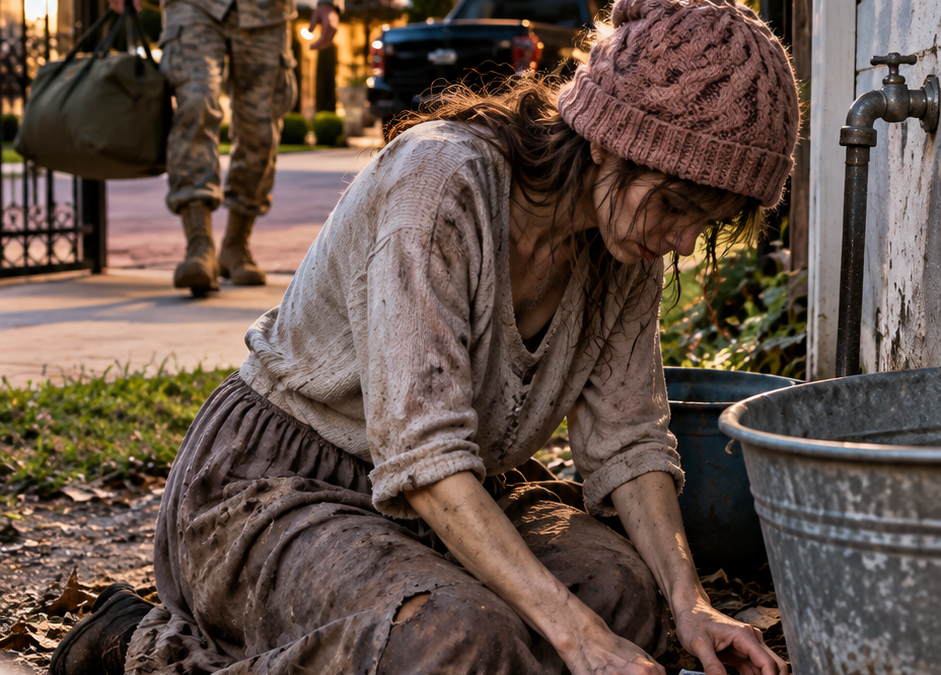
When I Reached for My Wife’s Knitted Cap, Everyone in the House Went Silent
I had spent four years imagining the moment my wife would run into my arms.
Instead, Gwen stepped backward and clutched a knitted cap to her head while my mother told me not to make a scene.
Before that night was over, I understood that the beautiful house surrounding me had been built around a secret far uglier than anything I had seen overseas.
I had served four consecutive years abroad with the U.S. Army.
Four years of sleeping lightly.
Four years of eating meals without tasting them.
Four years of waking to alarms, briefings, bad news, and long stretches of silence when all a man could do was stare at a photograph and remind himself that somewhere beyond the dust and distance, a home was waiting for him.
Mine was Gwen.
I carried her picture inside the breast pocket of my uniform until the edges softened from sweat and handling.
She was standing beneath the maple tree behind the little rental house we had lived in before I deployed. Her chestnut hair fell almost to her waist. She was laughing because I had taken the picture before she was ready.
Whenever the nights overseas became too long, I looked at that photograph.
It reminded me why I wanted to come back.
So when my unit received emergency leave after our final deployment, I told no one.
Not my mother.
Not my younger sister, Paige.
Not even Gwen.
I wanted to surprise her.
I imagined pulling into the driveway and seeing her come through the front door. I imagined dropping my bag and wrapping my arms around her before she could say a word.
Instead, I arrived at a house I barely recognized.
The modest place I remembered had become a two-story showpiece.
A decorative iron gate stood across the driveway. Fresh stone bordered the landscaping. A late-model truck gleamed near the garage. Through the front windows, I could see furniture that looked as though it belonged in a luxury showroom.
For one foolish second, pride filled me.
Maybe all the money I had sent home had done exactly what I intended.
Nearly one hundred thousand dollars over four years.
Housing money.
Savings.
Deployment pay.
Bonuses.
Anything I did not need overseas, I sent home because my father had disappeared when I was young, and I had watched my mother struggle afterward.
I had promised myself that if I could ever give my family security, I would.
Standing outside that beautiful house, I thought I had kept that promise.
Then I heard something break behind the house.
I walked around the side.
And I saw Gwen.
She was kneeling beside an old washbasin, collecting pieces of a shattered plate from the dirt.
At first, I thought I was looking at someone else.
Her clothes hung from her body.
Her wrists looked frighteningly thin.
Her cheeks were hollow.
And despite the warm afternoon, a knitted cap covered her head.
“Gwen?”
She froze.
Slowly, she turned.
I will never forget her face.
Not because she looked sick.
Because she looked afraid of me.
She pushed herself upright, took one step toward me, then stopped.
I dropped my bag.
“Baby.”
She backed away.
Her hands flew to her cap.
From inside the house, Paige shouted, “That bald woman shouldn’t even show her face when we have guests!”
My stomach tightened.
I looked toward the open window.
Then back at my wife.
“Gwen,” I whispered. “What happened?”
Her eyes filled.
“Please.”
That was all she said.
Please.
I stepped closer and touched the edge of the cap.
She grabbed my wrist.
“Don’t.”
My heart started pounding.
“Why?”
She lowered her eyes.
I gently removed her hand.
Then I lifted the cap.
Her scalp had been shaved almost completely bare.
Small cuts marked the skin.
Some were old.
Some had not fully healed.
For several seconds, I could not speak.
The back door opened.
My mother walked outside wearing a cream-colored silk blouse, gold around her neck and wrists.
Paige followed her carrying a designer bag and a phone newer than anything I owned.
My mother looked at Gwen, then at me.
“You don’t need to overreact.”
I stared at her.
“Overreact?”
“Gwen ruined her hair using cheap chemicals. Then she became obsessed with dieting.”
Paige laughed.
“She’s completely dramatic. She wastes your money and still wants everyone feeling sorry for her.”
Gwen pulled the cap back onto her head.
Her sleeve slipped upward.
That was when I saw the hospital bandage near her elbow.
And the fading purple mark left by an IV.
Something hot moved through my chest.
I had spent years being trained to react quickly.
But military service had also taught me something more important.
The first thing you see is not always the whole battlefield.
Anger makes noise.
Planning listens.
So I did something that surprised everyone, including Gwen.
I smiled.
“I guess I came home at a strange time.”
My mother visibly relaxed.
Paige rolled her eyes.
Gwen stared at me.
I turned toward the house.
“Actually, I have some good news.”
My mother stopped.
“What kind of news?”
“The Department of Defense approved a deployment compensation package.”
That was a lie.
I watched both women.
“Between benefits, adjustments, and other payments, it could be close to four hundred thousand dollars.”
Paige’s face changed instantly.
My mother’s did too, though she hid it better.
“The only problem,” I continued, “is that I have to document the assets and investments purchased with my previous income. Properties, vehicles, renovations. Everything.”
My mother smiled.
“Well, that shouldn’t be difficult.”
“No,” I said.
“I don’t think it will be.”
That night, I learned what had happened to my wife.
They had made her sleep in a storage room.
A damp little space at the back of the house with a narrow mattress, cracked ceiling, and one small window.
My mother slept upstairs on imported sheets.
My sister had an entire bedroom filled with clothes.
My wife had a mattress beside stacked boxes.
I sat beside her.
For several minutes, neither of us spoke.
Then Gwen’s hands began shaking.
“I’m sorry.”
Those words almost broke me.
“For what?”
“You came home and found this.”
“This isn’t something you did to me.”
She looked away.
I touched her hand.
“Tell me.”
She unbuttoned the top of her blouse.
A fresh biopsy scar crossed one side of her chest.
My breathing stopped.
“I have breast cancer,” she whispered.
The room seemed to disappear around us.
“When?”
“They found the tumor five months ago.”
“Five months?”
She nodded.
“Why didn’t you tell me?”
“I tried.”
I stared at her.
She swallowed.
“I asked your mother for three hundred dollars to see a specialist.”
“Three hundred?”
“She said no.”
My hands closed into fists.
“She said I was probably inventing it because I wanted attention. When I asked again, she said I was trying to steal your military pay.”
I could barely hear her over the blood pounding in my ears.
“She told me spouses weren’t covered by your military benefits while you were on an extended deployment.”
“That’s a lie.”
“I know.”
“How did you pay for the biopsy?”
She touched her cap.
My eyes moved toward it.
“No.”
Her lips trembled.
“I sold my hair.”
I looked at the woman I loved and suddenly saw that old photograph again.
Gwen beneath the maple tree.
That long chestnut hair.
Her laughter.
She had sold it for one hundred and fifty dollars so she could afford transportation and part of a medical bill.
While my mother wore jewelry bought with my money.
While Paige carried a designer bag.
My wife had sold part of herself just to find out whether she was dying.
I pulled her into my arms.
She was so light that it frightened me.
“You’re leaving this room,” I said.
She stiffened.
“No.”
“Yes.”
“You don’t understand.”
“Then explain it.”
Her voice dropped.
“They watch everything.”
“What does that mean?”
“My calls. My messages. Where I go. What I spend.”
I leaned back.
“Who?”
She gave me a look that made the answer unnecessary.
My mother.
My sister.
I wanted to walk upstairs.
I wanted to throw open every door and demand answers.
Instead, I remembered why I had lied about the four hundred thousand dollars.
“Hold on a little longer,” I whispered.
“For what?”
I looked toward the ceiling.
“For them to believe I’m still stupid.”
The next morning, I walked into the kitchen smiling.
My mother sat at the marble island wearing a silk robe and diamond earrings.
Paige was scrolling through her phone.
Neither asked about Gwen.
“I need your help,” I said.
Both looked up.
“With what?” Paige asked.
“The compensation package.”
Her phone immediately went down.
I explained that I needed statements, titles, receipts, investment records, and documentation for anything purchased while I had been deployed.
My mother’s expression tightened for half a second.
Then she smiled.
“Of course.”
Paige leaned forward.
“Imagine what we could do with four hundred thousand.”
“We?”
She blinked.
Then laughed.
“I mean the family.”
For the next fifteen minutes, they spent money that did not exist.
A pool.
A second property near the coast.
A newer truck.
A European vacation.
Kitchen renovations.
I listened.
Then Gwen entered.
My mother’s face hardened.
“I thought I told you we might have guests.”
Gwen stopped.
I put down my coffee.
“I’m taking Gwen into town.”
Paige snorted.
“For what?”
“Lunch.”
The silence was immediate.
My mother stared at me.
“She has chores.”
“No.”
I said it quietly.
That unsettled her more than shouting would have.
“What did you say?”
“I said Gwen is coming with me.”
Her eyes narrowed.
Then she forced a smile.
“Of course. You just got home.”
Exactly.
Let them think I was sentimental.
Let them think four years away had made me naive.
The moment we were several miles from the house, Gwen’s shoulders collapsed.
“You shouldn’t provoke them.”
“Gwen, they made you sleep in a storage room.”
“They’ll know something is wrong.”
“Something is wrong.”
She stared out the passenger window.
I reached across and took her hand.
“I’m taking you to the military hospital.”
Her head snapped toward me.
“No.”
“Yes.”
“We can’t afford it.”
“You’re my wife.”
She shook her head.
“The benefits—”
“Cover you.”
Her eyes filled again.
“They told me they didn’t.”
“I know what they told you.”
The hospital made everything more serious.
Dr. Elaine Mercer, an oncologist with silver hair and a calm, precise voice, reviewed the documents Gwen had been given.
“You should have been referred months ago,” she said.
Gwen lowered her eyes.
“I didn’t have the money.”
Dr. Mercer looked at me.
“I was overseas,” I said. “I didn’t know.”
She nodded, then turned back to Gwen.
“We need new imaging and an independent pathology review immediately.”
Gwen looked frightened.
“Am I going to die?”
Dr. Mercer leaned forward.
“I’m not going to answer that before I know exactly what we’re dealing with. But you are here now, and from this moment forward, nobody gets between you and appropriate care.”
Gwen began to cry.
Quietly.
Almost apologetically.
That hurt worse than screaming would have.
Afterward, we sat in the truck.
“You’re angry,” she said.
“Yes.”
“At me?”
I turned toward her so quickly she flinched.
That flinch changed something inside me.
“Never at you.”
“I should have found another way to tell you.”
“You tried.”
“They watched me.”
“Tell me everything.”
So she did.
At first, my mother had been kind.
She had offered to help Gwen manage the household while I was away. She persuaded Gwen to add her as an authorized person on one account for emergencies.
Six months later, Paige moved in.
Then the purchases started.
Furniture.
Vehicles.
Vacations.
Renovations.
Whenever Gwen objected, my mother said I wanted my family taken care of.
When I called home, one of them stayed nearby.
If Gwen mentioned finances, they interrupted.
If she asked questions, Paige accused her of distracting a deployed soldier.
Eventually, my mother started taking Gwen’s phone at night.
“She said she was protecting you from unnecessary stress.”
“And when you found the lump?”
“I asked her for help.”
“Three hundred dollars.”
Gwen nodded.
“She laughed.”
I looked through the windshield.
“She said if I called you and something happened to your unit because you were distracted, it would be my fault.”
I turned toward her.
Shame filled her face.
They had trained my wife to believe that asking her husband for help could kill him.
I reached across the console.
“Nothing that happened overseas was caused by you.”
A tear slid down her cheek.
“And whatever they did here, you didn’t deserve it.”
She covered her face.
I held her until her breathing settled.
Then she whispered, “There’s more.”
“What?”
“My hair.”
I looked at her cap.
“I did sell what was left.”
“What do you mean, what was left?”
She stared down at her hands.
“Paige cut it first.”
I went very still.
“Why?”
“Because I refused to sign something.”
“What?”
“I didn’t understand it. Financial paperwork. Your mother said it was authorization for house repairs.”
“You refused?”
“Yes.”
Her voice almost disappeared.
“Paige grabbed my hair and cut a section off with kitchen scissors.”
My fingers tightened around the steering wheel.
“She said if I wanted to act like a prisoner, I might as well look like one.”
I closed my eyes.
“Then I cut the rest myself. It looked terrible. I sold whatever was long enough to use.”
I started the truck.
Gwen grabbed my wrist.
“No.”
“I’m going home.”
“You promised.”
I looked at her.
She was right.
Anger makes noise.
Planning listens.
I shut off the engine.
“What was on the paper?”
“I only remember seeing the words power of attorney.”
That afternoon, I called the bank.
Four years of records turned my trust into numbers.
Luxury department stores.
Hotels.
Restaurants.
Flights.
Spa treatments.
Jewelry.
Cash withdrawals.
Renovation contractors.
Vehicle payments.
Then a transfer caught my attention.
Thirty-five thousand dollars.
“Open that.”
The bank representative checked the account.
“It appears to have gone into a jointly registered brokerage account.”
“With whom?”
He read two names.
Mine.
And Margaret Ellis.
My mother.
“I never opened that account.”
His expression changed.
Then we found the home-equity application.
My identification.
My financial information.
My electronic signature.
A signature I had never made.
After that came a property purchase through a holding company funded partly by my money.
That evening, I contacted Marcus Hale, an attorney recommended through military legal assistance.
He listened to everything.
When I finished, he removed his glasses.
“You have potential financial exploitation, identity fraud, forged signatures, and unauthorized transfers.”
“I know.”
“No, you know enough to be angry. I need you to know enough to be careful.”
He pointed toward me.
“Do not confront them.”
“I won’t.”
“Do not threaten them.”
“I won’t.”
“Do not start moving money around impulsively.”
“I understand.”
“Your wife?”
“Medical care starts now.”
“Good.”
He studied a set of documents I had brought.
Then he frowned.
“Who is Theodore Carver?”
I stared at him.
“I don’t know.”
Marcus turned his laptop toward me.
One property-related record listed Gwen under her full maiden name.
Gwendolyn Elizabeth Carver.
Emergency contact:
Theodore Carver.
“That’s impossible,” I said.
“Why?”
“Gwen told me her father was gone.”
Marcus typed the name into a database.
His eyebrows lifted.
“You might want to ask her what she meant by gone.”
That night, I closed the storage-room door behind me.
“Who is Theodore Carver?”
The blood drained from Gwen’s face.
That reaction answered part of the question.
“He’s alive?”
“Yes.”
“You told me your father was dead.”
“I told you he was gone.”
“Gwen.”
“I know.”
For the first time since I returned, frustration entered my voice.
“Why didn’t you tell me?”
“Because I didn’t want him in our life.”
“Why?”
She wrapped her arms around herself.
“My father controls things.”
“How?”
“With money.”
I waited.
She finally looked at me.
“He built companies. Transportation. Manufacturing. Real estate.”
“How successful?”
“Very.”
“How wealthy?”
Her answer was barely audible.
“Hundreds of millions.”
I stared at her.
“You grew up with that?”
“Yes.”
“And you walked away?”
“Yes.”
“Why?”
“My mother died when I was fourteen. After that, my father decided protecting me meant controlling me. Drivers. Security. Private schools. Background checks on friends. Every boyfriend investigated.”
She looked at me.
“When I met you, he hated it.”
“Because I was a soldier?”
“Because you had no money he could measure you by.”
“What happened?”
“He offered me two million dollars to leave you.”
I almost laughed from disbelief.
“Two million?”
“Yes.”
“And you refused?”
“Of course.”
“You walked away from all that for me?”
Her expression sharpened.
“For myself.”
That answer stopped me.
Then I nodded.
“Fair.”
A tiny smile appeared and vanished.
“But your mother found out.”
I felt my stomach tighten.
“When?”
“About a year after you deployed. She started asking about my maiden name. My childhood. Whether I had inheritance rights.”
“And she wanted you to contact him?”
“At first.”
“Why?”
“She said if I came from money, I should contribute more.”
“And when you refused?”
“She changed.”
Suddenly the pieces fit together.
The resentment.
The isolation.
The pressure.
The financial paperwork.
“What did she ask you to sign?”
“I only saw the first page.”
“Power of attorney?”
Gwen nodded.
I understood then that my military pay might not have been the largest target in that house.
For two days, I performed.
I laughed with Paige.
Complimented my mother’s renovations.
Talked about the nonexistent compensation package.
Greed made them careless.
My mother eventually handed me a folder.
“Everything you asked for.”
Inside were titles, statements, receipts, loan documents, and a photocopy that chilled me.
LIMITED DURABLE POWER OF ATTORNEY.
Principal:
Gwendolyn Elizabeth Carver.
Agent:
Margaret Ellis.
The signature resembled Gwen’s.
But Gwen had never signed it.
I photographed everything.
Marcus later called.
“We found the holding company.”
“Who controls it?”
“A trust your mother controls.”
I closed my eyes.
“There’s more,” he said.
The documents referenced potential future assets belonging to Gwen.
“What does that mean?”
“That forged power of attorney may have been used to make inquiries concerning her inheritance.”
“Can my mother access her father’s money?”
“Not simply because she possesses a piece of paper.”
“Then why do it?”
“To establish authority before something becomes available.”
I looked toward Gwen sleeping on the mattress.
Marcus spoke more carefully.
“Protect her medically and legally. Immediately.”
The next afternoon, my mother approached me near the garage.
“You seem different.”
“Four years will do that.”
“You’re very protective of Gwen.”
“She’s my wife.”
“She isn’t who you think she is.”
I pretended confusion.
“What does that mean?”
“She lied about her family.”
“What family?”
“She comes from money.”
I laughed.
“Gwen?”
“I’m serious.”
“She sold her hair to pay for medical care.”
Something flashed across my mother’s face.
Fear.
Only for a second.
Then it was gone.
“She’s manipulative.”
“What do you want me to do?”
That relaxed her.
“Protect yourself.”
“How?”
“Keep everything in your own name.”
“And the new compensation?”
“Especially that.”
She touched my arm.
“I’m your mother. I’m trying to protect you.”
For one painful moment, I remembered a different woman.
My mother packing my school lunches.
Working two jobs.
Sitting beside me when I was sick.
Counting coins at a kitchen table after my father left.
Maybe that was the cruelest part.
I had loved her.
I had trusted her because once, she had earned that trust.
But somewhere along the way, survival had turned into entitlement.
Need had become greed.
And greed had taught her to look at people as accounts waiting to be opened.
“I appreciate it,” I said.
She smiled.
That night, Gwen packed one suitcase.
Her entire life fit inside it.
“We leave at midnight,” I told her.
“Where?”
“Somewhere safe.”
“What about them?”
“They’ll find out soon.”
“And your accounts?”
“Protected.”
Marcus and the bank fraud team had frozen what they could.
Evidence had been preserved.
The holding company was under review.
My mother and Paige still believed four hundred thousand dollars was coming.
At eleven forty, headlights swept across the wall.
Then more.
Three black sedans stopped outside the gate.
A chauffeur stepped out.
Then two other men.
Finally, an older gentleman emerged from the first car.
Tall.
Silver-haired.
Dark suit.
Perfect posture.
Beside me, Gwen made a broken sound.
“No.”
“You know him.”
She backed away.
“That’s my father.”
Theodore Carver walked toward the door.
My mother appeared at the top of the stairs.
I watched the color disappear from her face.
That was when I understood.
She knew him.
And she was terrified he was there.
The doorbell rang.
My mother hurried downstairs.
“Don’t open that door.”
I turned.
“Why?”
“You don’t understand.”
“What don’t I understand?”
Her eyes moved toward Gwen.
“She brought this on us.”
Gwen came into the foyer.
Theodore saw her through the glass.
His expression collapsed.
The businessman vanished.
He lifted one trembling hand.
“Gwendolyn.”
I unlocked the door.
My mother shouted, “No!”
Theodore entered.
He passed me without looking at me.
He saw Gwen’s thin body.
The oversized clothes.
The knitted cap.
The hospital bandage.
His jaw tightened.
“Who did this?”
“Dad—”
“Who?”
My mother stepped forward.
“She’s sick. She refused help. You know how dramatic she can be.”
Theodore turned toward her.
Silence.
Then he said one word.
“You.”
My mother swallowed.
“Mr. Carver.”
“How do you know my mother?” I asked.
Theodore accepted a leather folder from one of the men behind him.
“My investigators contacted me three months ago.”
Gwen stiffened.
“Investigators?”
“I promised not to interfere in your life.”
“You promised not to watch me.”
“I watched from a distance.”
Her face hardened.
“I knew you would.”
Theodore lowered his eyes.
“And I was wrong to do it.”
That admission surprised her.
Then he looked at my mother.
“But it is the reason I learned this woman contacted my office fourteen months ago.”
My mother said nothing.
“She claimed Gwen wanted reconciliation.”
“I never did,” Gwen said.
“I know.”
Theodore laid papers on the table.
“She requested information concerning inheritance structures.”
I looked at my mother.
“Using the power of attorney?”
“Yes,” Theodore said.
My mother finally spoke.
“That proves nothing.”
He placed another page down.
“She also requested preliminary valuations of assets Gwen might receive upon my death.”
Paige stared at our mother.
“Mom?”
“Be quiet.”
Theodore opened the folder again.
“But that isn’t why I came tonight.”
He slid another document across the table.
“Someone attempted to redirect control of a trust created by Gwen’s mother.”
Gwen frowned.
“My mother?”
“Yes.”
“I thought her estate was settled.”
“Most of it was.”
I looked at the number near the bottom of the page.
Then looked again.
$42,600,000.
“This belongs to Gwen?”
Theodore nodded.
“It becomes fully accessible on her thirtieth birthday.”
Gwen stared at him.
“I didn’t know.”
“Your mother wanted one part of her estate to belong to you without my control.”
Theodore’s voice weakened.
“She knew me well enough to understand why that mattered.”
Gwen’s eyes filled.
“When?”
“Twenty-eight days.”
Suddenly the entire house made sense.
The forged power of attorney.
The surveillance.
The pressure.
The isolation.
My mother had not merely stolen from me.
She had been positioning herself for Gwen’s trust.
Margaret looked around the room.
Then she smiled.
“You think you’ve figured it out.”
Theodore’s security men shifted.
“What have you done?” he asked.
She walked to a kitchen drawer.
I moved.
She pulled out an envelope.
Not a weapon.
A document.
She threw it onto the table.
“Ask Gwen.”
I opened it.
COURT PETITION FOR LEGAL GUARDIANSHIP.
The petition alleged that Gwen was mentally incompetent.
Unable to manage finances.
Unable to understand medical treatment.
Unable to control her assets.
Attached were medical evaluations and physician statements.
Gwen took one look at them.
“I’ve never met these doctors.”
“The hearing is tomorrow,” my mother said.
I stared at her.
“You forged medical records?”
She tilted her head.
“Prove it.”
Then Paige started crying.
“Mom, stop.”
“Go upstairs.”
“No.”
My mother turned sharply.
“I said go upstairs.”
Paige moved behind me.
“I need to tell him.”
My mother’s expression changed.
“Paige.”
“I didn’t know about the trust at first.”
The room went silent.
“I thought we were just taking his money.”
There it was.
A confession.
Paige covered her mouth as though she could pull the words back.
“I’m sorry.”
My mother stared at her.
“Idiot.”
“She made me watch Gwen’s calls,” Paige said.
Gwen closed her eyes.
“She made me sign things. I bought stuff. I went on trips. I knew the money wasn’t mine.”
She looked at Gwen.
“I laughed at you.”
Gwen said nothing.
“I was horrible to you.”
“Yes,” Gwen whispered.
Paige flinched.
It was the first time Gwen had not softened the truth for someone else’s comfort.
“But I didn’t know about the medical records,” Paige said. “I heard Mom talking to someone last week.”
“Who?” I asked.
“A doctor. I don’t know his name.”
My mother moved toward her.
One of Theodore’s men stepped between them.
Paige continued.
“She said once the court declared Gwen incompetent, she could control the trust.”
“That power of attorney is fraudulent,” Theodore said.
My mother laughed.
“Doesn’t matter if a judge believes the rest.”
Then she looked at Gwen.
“You should have signed when I asked nicely.”
Theodore reached into his pocket.
He put a recorder on the table.
“I have recorded everything since I entered.”
For the first time, real fear appeared on my mother’s face.
Then my phone rang.
Marcus.
I answered.
“You need to leave the house,” he said.
“Why?”
“I found the guardianship filing.”
“We have it.”
“There’s more.”
“What?”
“The physician who signed the first competency evaluation died six months ago.”
I looked at the document.
The evaluation was dated three weeks earlier.
“And the second?”
“Doesn’t exist.”
My eyes moved toward my mother.
Marcus continued.
“She didn’t build this alone.”
Headlights suddenly flashed across the windows.
Red.
Blue.
A hard knock hit the front door.
“Open immediately!”
Gwen grabbed my hand.
Another voice came from outside.
“Department of Adult Protective Services. We have an emergency court order regarding Gwendolyn Carver.”
My mother smiled.
“They’re here to take her.”
Gwen’s fingers went cold.
Then my phone buzzed.
A message from Marcus.
DO NOT LET THEM REMOVE GWEN.
THE ORDER NUMBER IS REAL.
THE JUDGE DID NOT AUTHORIZE THIS ORDER.
A second message appeared.
WE IDENTIFIED THE PERSON WHO FILED IT.
There was a photograph attached.
Gwen looked at the screen.
Her knees nearly gave out.
“My doctor.”
I caught her.
“What?”
“Not Dr. Mercer.”
Her voice shook.
“The doctor who did my biopsy.”
Marcus sent another message.
The man had received twelve thousand dollars from one of my mother’s companies three days after Gwen’s procedure.
Then came the sentence that changed everything again.
WE NEED TO VERIFY WHETHER GWEN EVER HAD CANCER.
I felt Gwen trembling against me.
For five months, she had believed she might die.
Now she was being forced to question whether the disease itself had been real.
The knocking continued.
I opened the door but stood in the doorway.
Two Adult Protective Services workers were outside with sheriff’s deputies.
One woman held documents.
“We have authority to take Mrs. Carver for emergency evaluation.”
“My attorney says the judicial authorization is fraudulent.”
“The order is valid in the system.”
“The number is valid,” I said. “The judge’s approval isn’t.”
The deputy nearest her looked at me carefully.
“Do you have your attorney on the phone?”
“Yes.”
I put Marcus on speaker.
He gave his bar information, the case number, and the name of the court clerk he had contacted.
“Call the duty clerk before you execute that order,” he said. “A forged judicial authorization is attached to the file.”
The APS worker frowned.
“Our system shows—”
“Call.”
Theodore stepped forward.
“My counsel is also contacting the court.”
My mother shouted from behind us.
“You can’t stop a court order!”
The deputy looked past me at her.
Then at Paige, who was crying.
Then at Gwen.
Something about the room finally registered with him.
He held up one hand.
“Nobody is leaving until we verify the authorization.”
My mother’s confidence cracked.
She turned toward the stairs.
Theodore’s security man blocked her path without touching her.
“Move.”
“No, ma’am.”
“You have no authority here.”
The deputy stepped inside.
“But I do have authority to tell everyone to remain where they are while we sort out a potentially fraudulent court document.”
Twenty minutes later, his radio crackled.
He listened.
Then looked at the APS workers.
“Stand down.”
My mother’s face went white.
“The judge confirmed he never signed the emergency authorization.”
Gwen sagged against me.
The deputy continued.
“The court is locking the file pending investigation.”
My mother backed toward the wall.
“No.”
Paige looked at her.
For the first time, my sister seemed to understand that money could not talk its way out of everything.
The deputies did not arrest my mother that night.
Not yet.
They did something worse for a woman who had survived by controlling information.
They separated everyone.
They took statements.
They photographed documents.
They preserved the recorder.
They contacted investigators.
And before sunrise, the house no longer belonged to her version of the truth.
Gwen and I left with Theodore.
Not because Gwen wanted to return to her father.
She made that clear before getting into the car.
“I’m not moving into another controlled life.”
Theodore stood beside the open door.
“I know.”
“No security following me without permission.”
He nodded.
“No people reporting on me.”
Another nod.
“And my trust stays mine.”
“Yes.”
She looked at him for a long time.
“You don’t get to save me by owning me again.”
His face tightened.
Then he said something I never expected from a man like Theodore Carver.
“I know.”
He looked older when he said it.
We went to a private guest property he owned near the hospital because it had security, but Gwen chose the rooms, the access list, and who could come inside.
The next morning, Marcus met us at court.
The guardianship hearing lasted less than an hour.
The alleged medical evidence had already begun collapsing.
One physician was dead.
The second identity was fictitious.
The emergency authorization had been inserted into the electronic file without the judge’s approval.
The judge dismissed the guardianship petition and referred the records for investigation.
A protective order prohibited my mother from contacting Gwen directly.
Outside the courtroom, I expected Gwen to look relieved.
Instead, she sat on a bench gripping her hands together.
“What’s wrong?”
She looked at me.
“What if I’m still sick?”
That was the question money could not answer.
The same afternoon, Dr. Mercer admitted Gwen for a full diagnostic workup.
New imaging.
Blood tests.
Independent pathology.
The original biopsy slides were demanded from the first clinic.
The clinic initially claimed they had been misplaced.
That answer lasted until attorneys and investigators became involved.
Then the samples appeared.
For three days, we waited.
Those three days were worse than deployment.
I could prepare for danger I understood.
I could not fight a pathology report.
On the fourth morning, Dr. Mercer entered Gwen’s room holding a file.
I stood immediately.
Gwen did not.
She sat perfectly still.
Dr. Mercer pulled a chair close to the bed.
“I have the independent review.”
Gwen’s voice barely worked.
“Tell me.”
“The tissue removed during your original biopsy was not malignant.”
Silence.
Gwen stared at her.
“What?”
“No breast cancer was identified in the sample.”
Gwen shook her head.
“The other doctor said—”
“I know what you were told.”
“Then what was it?”
“A benign lesion.”
Gwen stopped breathing for a second.
I felt the floor move beneath me.
“You’re sure?” I asked.
“We repeated imaging. We repeated testing. We had the pathology reviewed independently by two specialists.”
Dr. Mercer took Gwen’s hand.
“There is currently no evidence that you have breast cancer.”
Gwen stared at her.
Then something terrible happened.
She started laughing.
Not because it was funny.
Because her body did not know what else to do.
The laughter turned into crying.
She covered her face.
“For five months…”
“I know,” Dr. Mercer said.
“I thought I was dying.”
I sat beside her.
She hit my chest once with the side of her fist.
Then again.
Not hard.
Just grief with nowhere else to go.
“I thought I was dying.”
I held her.
“You’re here.”
“I sold my hair.”
“I know.”
“I begged them.”
“I know.”
“I slept in that room thinking I was dying.”
Her voice broke.
“I know.”
Dr. Mercer waited until Gwen could breathe again.
Then she explained something else.
Gwen was severely underweight.
Anemic.
Dehydrated.
Nutritionally depleted.
But those problems were treatable.
Her body had not been wasting away from cancer.
It had been wasting away because she had been denied care, deprived of adequate food, emotionally terrorized, and convinced that illness was consuming her.
The doctor who performed the biopsy had not merely given her an incorrect diagnosis.
Investigators later discovered he had produced altered medical summaries used to support the guardianship petition.
My mother had found him through a business associate.
Twelve thousand dollars had been the first payment.
There were more.
The cancer story had served several purposes.
It made Gwen easier to frighten.
Easier to isolate.
Easier to portray as mentally unstable.
And if her weight dropped and her appearance changed, everyone would assume the disease was responsible.
I spent weeks asking myself the same question.
How had I missed it?
The answer was painful.
Distance helped them.
But so did trust.
I trusted my mother because she was my mother.
I trusted Paige because she was my sister.
When Gwen sounded tired during calls, I accepted the explanations I was given.
Stress.
Poor connection.
Headaches.
Bad days.
I had been trained to notice danger in unfamiliar places.
I never considered that the most dangerous people in my wife’s life might be waiting inside my own home.
The financial investigation expanded quickly.
The brokerage account.
The forged home-equity documents.
The holding company.
The false power of attorney.
My military pay.
Gwen’s trust inquiries.
The guardianship filing.
The doctor’s payments.
Every thread eventually led back toward my mother.
Paige cooperated.
Not because she became innocent overnight.
She wasn’t.
She had participated.
She had spent stolen money.
She had humiliated Gwen.
She had watched her calls.
She had cut her hair.
One afternoon, while investigators were documenting everything, Paige asked to speak with Gwen.
Gwen almost refused.
Then she agreed to ten minutes.
I stayed nearby but let them talk alone.
Paige entered the room looking smaller than I remembered.
No designer bag.
No new phone in her hand.
No sarcastic smile.
“I’m sorry,” she said.
Gwen stared at her.
Paige began crying.
“I know that doesn’t fix anything.”
“No.”
“I didn’t know Mom was going this far.”
Gwen’s expression did not change.
“You knew enough.”
Paige lowered her head.
“I did.”
“You knew I was hungry.”
“Yes.”
“You knew I was scared.”
“Yes.”
“You knew she took my phone.”
“Yes.”
“You cut my hair.”
Paige started sobbing.
“Yes.”
Gwen was silent for several seconds.
Then she said, “I don’t hate you.”
Paige looked up.
Relief flashed across her face.
Gwen stopped it immediately.
“But I don’t forgive you.”
The relief vanished.
“You don’t get forgiveness because the plan became worse than you expected.”
Paige nodded slowly.
“I understand.”
“I hope someday you become someone who would never do those things again.”
Paige wiped her face.
“But that person will not be part of my life just because she shares my husband’s blood.”
I watched my sister absorb those words.
For once, nobody rescued her from consequences.
She eventually entered a cooperation agreement with prosecutors.
My mother did not.
Even after the evidence became overwhelming, she insisted that everything she had done was for the family.
That was her favorite word.
Family.
She used it in every statement.
Family needed the house.
Family deserved comfort.
Family was protecting me from Gwen.
Family was protecting Gwen from herself.
Family justified the accounts.
The documents.
The control.
The lies.
When I finally saw my mother again months later during a legal proceeding, she looked at me across the room and said, “After everything I sacrificed for you, this is how you repay me?”
I thought that sentence would destroy me.
Instead, I felt tired.
“You were my mother,” I said.
“I am your mother.”
“No.”
Her face tightened.
I continued.
“Being my mother was never supposed to be a loan I spent the rest of my life repaying.”
“You think that woman loves you?”
I looked toward Gwen.
Her hair had begun growing back.
Only a little.
Soft brown strands covered her scalp.
She was still thin, but stronger.
She no longer lowered her eyes when someone raised their voice.
“Yes,” I said.
My mother laughed bitterly.
“She lied about her father.”
“She hid wealth because she was afraid money would control her.”
“And you think that makes her better than me?”
“I think she walked away from forty million dollars to build a life she chose.”
My mother had no answer to that.
The criminal case took time.
Cases like that always do.
Money had to be traced.
Digital signatures analyzed.
Medical files authenticated.
Electronic court access reviewed.
The investigators discovered that the false emergency order had been created using credentials obtained through a compromised legal-services account associated with one of the doctor’s business contacts.
My mother had not controlled the entire system.
She had simply found enough corrupt and careless people to exploit different pieces of it.
The biopsy doctor was charged.
His medical license was suspended while the case proceeded.
The properties purchased with disputed funds were frozen.
The house was placed under a financial restraint.
Eventually, assets were sold or transferred as part of restitution proceedings.
I recovered only part of what I had sent home.
For a while, that bothered me.
Then one night Gwen and I sat on the floor of a small rental house eating takeout from cardboard containers.
No marble island.
No luxury furniture.
No iron gate.
Just two folding chairs, a mattress, and boxes we had not unpacked.
Gwen looked around.
“You lost almost everything.”
I shook my head.
“No.”
She raised an eyebrow.
“I saw the bank statements.”
“So did I.”
“You lost a lot.”
“I lost money.”
“That’s what I said.”
I looked at her.
“I almost lost you.”
The room went quiet.
She set down her fork.
“I don’t want what happened to become the reason you spend the rest of your life afraid to leave me.”
I understood what she meant.
My unit still mattered.
My career mattered.
But so did learning from what had happened without becoming controlled by fear.
“I don’t know how to do that yet,” I admitted.
“Neither do I.”
That was the first honest place we found after everything.
Not promises.
Not speeches.
Just two people admitting they were damaged and still choosing the same direction.
Gwen’s thirtieth birthday arrived twenty-eight days after Theodore appeared at our door.
He asked to see her.
She allowed it.
He came alone.
No chauffeur waiting by the entrance.
No security men walking behind him.
He carried one small box.
Inside was something that had belonged to Gwen’s mother.
A simple silver necklace.
Not diamonds.
Not something worth displaying in a vault.
Just a necklace Gwen remembered touching as a child.
Theodore placed it in her hand.
“Your mother wanted you to have choices.”
Gwen looked down at it.
“Then why didn’t you tell me about the trust?”
“Because I convinced myself I was protecting you.”
“That sounds familiar.”
He accepted the blow.
“Yes.”
She looked at him.
“I left because you made love feel like surveillance.”
His eyes lowered.
“I know.”
“You investigated my husband.”
“Yes.”
“You offered me money to leave him.”
“Yes.”
“You kept watching me.”
“Yes.”
“Do you understand why I don’t trust you?”
“I do.”
Gwen waited.
Theodore did not defend himself.
For perhaps the first time in his relationship with his daughter, he allowed silence without trying to control what came after it.
Finally Gwen asked, “What happens to the trust?”
“It transfers completely to you.”
“No conditions?”
“None.”
“No approval from you?”
“None.”
“No managers I can’t remove?”
“No.”
She studied him.
“Good.”
He almost smiled.
Then she said, “You can visit next month.”
Theodore’s eyes filled.
“Next month?”
“One visit.”
“I’ll take it.”
When he left, Gwen stood at the window holding her mother’s necklace.
“Forty-two million dollars,” I said.
She laughed softly.
“Don’t sound so impressed.”
“I grew up eating cereal for dinner because we couldn’t afford groceries. I’m allowed to be impressed.”
That earned a real laugh.
I had forgotten how much I missed that sound.
Then she became serious.
“I don’t want that money changing us.”
“It already changed everyone around us.”
“Exactly.”
“What do you want to do?”
She looked around our tiny rental.
“Nothing today.”
That might have been the smartest financial decision either of us had ever made.
She left the trust untouched for months while lawyers reorganized everything so that no family member, including me, could access it without her explicit authorization.
I encouraged that.
The money was hers.
Not mine.
Not Theodore’s.
Certainly not my mother’s.
Hers.
Eventually, Gwen used part of the income to create something small compared with the size of the trust but enormous compared with what she had been denied.
A fund for military spouses facing emergency medical expenses while their partners were deployed.
No complicated application.
No family gatekeeper.
No one having to beg someone for three hundred dollars.
The first time she approved an emergency grant, she sat beside me with the confirmation email open on her laptop.
The amount was four hundred dollars.
She stared at the screen for a long time.
“Four hundred dollars,” she whispered.
I knew exactly what she was thinking.
Three hundred dollars had once stood between her and a specialist.
Three hundred dollars had been enough for my mother to make her feel worthless.
Now Gwen could make sure another frightened spouse did not have to sell something precious just to reach a doctor.
She closed the laptop.
“I think my mother would have liked this.”
“I think so too.”
My relationship with Paige never recovered.
Maybe someday it will become something different.
But different is not the same as restored.
She cooperated with investigators, accepted responsibility for what she had done, and eventually began rebuilding her own life without the money she had grown accustomed to.
That mattered.
But consequences mattered too.
Gwen never asked me to forgive her.
And I stopped believing that forgiveness was the price victims had to pay to prove they had healed.
As for my mother, the last letter she sent me arrived almost a year after I came home.
I opened it once.
She wrote about sacrifice.
About betrayal.
About everything she had done after my father left.
She said Gwen had turned me against my own blood.
I read the sentence twice.
Then I folded the letter.
For most of my life, I thought blood was the strongest form of loyalty.
Four years overseas had reinforced that belief in strange ways. Men who shared no blood with me had risked themselves because we wore the same uniform. My mother and sister shared my blood and had used that connection as permission to take what they wanted.
Gwen had shared none of my history.
Yet while starving, frightened, and believing she had cancer, she had still worried about distracting me from my mission.
I knew which loyalty mattered.
I never answered the letter.
A year after I returned, Gwen and I went back to the maple tree behind our old rental house.
The place belonged to someone else now, but the owners had agreed to let us visit.
Gwen stood beneath the branches while I held my phone.
Her hair had grown to her shoulders.
Not as long as it had once been.
She said she might never grow it that long again.
“That person was me before all this,” she told me.
“You don’t want her back?”
She thought about it.
“I don’t think healing means becoming who I was before.”
I lowered the phone.
“Who do you want to be?”
She looked toward me.
“Someone who never has to ask permission to exist.”
I took the picture.
This time, she was ready.
Later that night, I compared it with the photograph I had carried through four years overseas.
In the old picture, Gwen looked younger.
Carefree.
Her hair fell nearly to her waist.
In the new one, there were lines around her eyes that had not been there before.
There were things in her expression I wished she had never been forced to learn.
But she was smiling.
Not because someone told her to.
Not because she needed to reassure me.
Not because my mother was listening from another room.
She was smiling because she wanted to.
For four years, I believed coming home meant returning to the life I had left behind.
I was wrong.
That life was gone before I ever reached the driveway.
The house I had paid for had become a trap.
The people I trusted had become strangers.
My wife had been stripped of her money, her health, her dignity, her hair, and nearly her legal identity while I was thousands of miles away believing she was safe.
I could not undo that.
I could not return the months Gwen spent thinking she was dying.
I could not erase the night Paige cut her hair.
I could not make the storage room disappear from her memory.
I could not turn my mother back into the woman I remembered from childhood.
But I could stand beside Gwen while she rebuilt a life nobody else controlled.
And I could finally understand something I should have understood years earlier.
Home was never the expensive house.
It was never the furniture.
It was never the accounts, the property, the inheritance, or the number printed at the bottom of a trust document.
Home was the woman beneath that maple tree.
And after everything they had tried to take from her, she was finally standing there by her own choice.
𝗧𝗛𝗘 𝗘𝗡𝗗
When I Reached for My Wife’s Knitted Cap, Everyone in the House Went Silent
I had spent four years imagining the moment my wife would run into my arms.
Instead, Gwen stepped backward and clutched a knitted cap to her head while my mother told me not to make a scene.
Before that night was over, I understood that the beautiful house surrounding me had been built around a secret far uglier than anything I had seen overseas.
I had served four consecutive years abroad with the U.S. Army.
Four years of sleeping lightly.
Four years of eating meals without tasting them.
Four years of waking to alarms, briefings, bad news, and long stretches of silence when all a man could do was stare at a photograph and remind himself that somewhere beyond the dust and distance, a home was waiting for him.
Mine was Gwen.
I carried her picture inside the breast pocket of my uniform until the edges softened from sweat and handling.
She was standing beneath the maple tree behind the little rental house we had lived in before I deployed. Her chestnut hair fell almost to her waist. She was laughing because I had taken the picture before she was ready.
Whenever the nights overseas became too long, I looked at that photograph.
It reminded me why I wanted to come back.
So when my unit received emergency leave after our final deployment, I told no one.
Not my mother.
Not my younger sister, Paige.
Not even Gwen.
I wanted to surprise her.
I imagined pulling into the driveway and seeing her come through the front door. I imagined dropping my bag and wrapping my arms around her before she could say a word.
Instead, I arrived at a house I barely recognized.
The modest place I remembered had become a two-story showpiece.
A decorative iron gate stood across the driveway. Fresh stone bordered the landscaping. A late-model truck gleamed near the garage. Through the front windows, I could see furniture that looked as though it belonged in a luxury showroom.
For one foolish second, pride filled me.
Maybe all the money I had sent home had done exactly what I intended.
Nearly one hundred thousand dollars over four years.
Housing money.
Savings.
Deployment pay.
Bonuses.
Anything I did not need overseas, I sent home because my father had disappeared when I was young, and I had watched my mother struggle afterward.
I had promised myself that if I could ever give my family security, I would.
Standing outside that beautiful house, I thought I had kept that promise.
Then I heard something break behind the house.
I walked around the side.
And I saw Gwen.
She was kneeling beside an old washbasin, collecting pieces of a shattered plate from the dirt.
At first, I thought I was looking at someone else.
Her clothes hung from her body.
Her wrists looked frighteningly thin.
Her cheeks were hollow.
And despite the warm afternoon, a knitted cap covered her head.
“Gwen?”
She froze.
Slowly, she turned.
I will never forget her face.
Not because she looked sick.
Because she looked afraid of me.
She pushed herself upright, took one step toward me, then stopped.
I dropped my bag.
“Baby.”
She backed away.
Her hands flew to her cap.
From inside the house, Paige shouted, “That bald woman shouldn’t even show her face when we have guests!”
My stomach tightened.
I looked toward the open window.
Then back at my wife.
“Gwen,” I whispered. “What happened?”
Her eyes filled.
“Please.”
That was all she said.
Please.
I stepped closer and touched the edge of the cap.
She grabbed my wrist.
“Don’t.”
My heart started pounding.
“Why?”
She lowered her eyes.
I gently removed her hand.
Then I lifted the cap.
Her scalp had been shaved almost completely bare.
Small cuts marked the skin.
Some were old.
Some had not fully healed.
For several seconds, I could not speak.
The back door opened.
My mother walked outside wearing a cream-colored silk blouse, gold around her neck and wrists.
Paige followed her carrying a designer bag and a phone newer than anything I owned.
My mother looked at Gwen, then at me.
“You don’t need to overreact.”
I stared at her.
“Overreact?”
“Gwen ruined her hair using cheap chemicals. Then she became obsessed with dieting.”
Paige laughed.
“She’s completely dramatic. She wastes your money and still wants everyone feeling sorry for her.”
Gwen pulled the cap back onto her head.
Her sleeve slipped upward.
That was when I saw the hospital bandage near her elbow.
And the fading purple mark left by an IV.
Something hot moved through my chest.
I had spent years being trained to react quickly.
But military service had also taught me something more important.
The first thing you see is not always the whole battlefield.
Anger makes noise.
Planning listens.
So I did something that surprised everyone, including Gwen.
I smiled.
“I guess I came home at a strange time.”
My mother visibly relaxed.
Paige rolled her eyes.
Gwen stared at me.
I turned toward the house.
“Actually, I have some good news.”
My mother stopped.
“What kind of news?”
“The Department of Defense approved a deployment compensation package.”
That was a lie.
I watched both women.
“Between benefits, adjustments, and other payments, it could be close to four hundred thousand dollars.”
Paige’s face changed instantly.
My mother’s did too, though she hid it better.
“The only problem,” I continued, “is that I have to document the assets and investments purchased with my previous income. Properties, vehicles, renovations. Everything.”
My mother smiled.
“Well, that shouldn’t be difficult.”
“No,” I said.
“I don’t think it will be.”
That night, I learned what had happened to my wife.
They had made her sleep in a storage room.
A damp little space at the back of the house with a narrow mattress, cracked ceiling, and one small window.
My mother slept upstairs on imported sheets.
My sister had an entire bedroom filled with clothes.
My wife had a mattress beside stacked boxes.
I sat beside her.
For several minutes, neither of us spoke.
Then Gwen’s hands began shaking.
“I’m sorry.”
Those words almost broke me.
“For what?”
“You came home and found this.”
“This isn’t something you did to me.”
She looked away.
I touched her hand.
“Tell me.”
She unbuttoned the top of her blouse.
A fresh biopsy scar crossed one side of her chest.
My breathing stopped.
“I have breast cancer,” she whispered.
The room seemed to disappear around us.
“When?”
“They found the tumor five months ago.”
“Five months?”
She nodded.
“Why didn’t you tell me?”
“I tried.”
I stared at her.
She swallowed.
“I asked your mother for three hundred dollars to see a specialist.”
“Three hundred?”
“She said no.”
My hands closed into fists.
“She said I was probably inventing it because I wanted attention. When I asked again, she said I was trying to steal your military pay.”
I could barely hear her over the blood pounding in my ears.
“She told me spouses weren’t covered by your military benefits while you were on an extended deployment.”
“That’s a lie.”
“I know.”
“How did you pay for the biopsy?”
She touched her cap.
My eyes moved toward it.
“No.”
Her lips trembled.
“I sold my hair.”
I looked at the woman I loved and suddenly saw that old photograph again.
Gwen beneath the maple tree.
That long chestnut hair.
Her laughter.
She had sold it for one hundred and fifty dollars so she could afford transportation and part of a medical bill.
While my mother wore jewelry bought with my money.
While Paige carried a designer bag.
My wife had sold part of herself just to find out whether she was dying.
I pulled her into my arms.
She was so light that it frightened me.
“You’re leaving this room,” I said.
She stiffened.
“No.”
“Yes.”
“You don’t understand.”
“Then explain it.”
Her voice dropped.
“They watch everything.”
“What does that mean?”
“My calls. My messages. Where I go. What I spend.”
I leaned back.
“Who?”
She gave me a look that made the answer unnecessary.
My mother.
My sister.
I wanted to walk upstairs.
I wanted to throw open every door and demand answers.
Instead, I remembered why I had lied about the four hundred thousand dollars.
“Hold on a little longer,” I whispered.
“For what?”
I looked toward the ceiling.
“For them to believe I’m still stupid.”
The next morning, I walked into the kitchen smiling.
My mother sat at the marble island wearing a silk robe and diamond earrings.
Paige was scrolling through her phone.
Neither asked about Gwen.
“I need your help,” I said.
Both looked up.
“With what?” Paige asked.
“The compensation package.”
Her phone immediately went down.
I explained that I needed statements, titles, receipts, investment records, and documentation for anything purchased while I had been deployed.
My mother’s expression tightened for half a second.
Then she smiled.
“Of course.”
Paige leaned forward.
“Imagine what we could do with four hundred thousand.”
“We?”
She blinked.
Then laughed.
“I mean the family.”
For the next fifteen minutes, they spent money that did not exist.
A pool.
A second property near the coast.
A newer truck.
A European vacation.
Kitchen renovations.
I listened.
Then Gwen entered.
My mother’s face hardened.
“I thought I told you we might have guests.”
Gwen stopped.
I put down my coffee.
“I’m taking Gwen into town.”
Paige snorted.
“For what?”
“Lunch.”
The silence was immediate.
My mother stared at me.
“She has chores.”
“No.”
I said it quietly.
That unsettled her more than shouting would have.
“What did you say?”
“I said Gwen is coming with me.”
Her eyes narrowed.
Then she forced a smile.
“Of course. You just got home.”
Exactly.
Let them think I was sentimental.
Let them think four years away had made me naive.
The moment we were several miles from the house, Gwen’s shoulders collapsed.
“You shouldn’t provoke them.”
“Gwen, they made you sleep in a storage room.”
“They’ll know something is wrong.”
“Something is wrong.”
She stared out the passenger window.
I reached across and took her hand.
“I’m taking you to the military hospital.”
Her head snapped toward me.
“No.”
“Yes.”
“We can’t afford it.”
“You’re my wife.”
She shook her head.
“The benefits—”
“Cover you.”
Her eyes filled again.
“They told me they didn’t.”
“I know what they told you.”
The hospital made everything more serious.
Dr. Elaine Mercer, an oncologist with silver hair and a calm, precise voice, reviewed the documents Gwen had been given.
“You should have been referred months ago,” she said.
Gwen lowered her eyes.
“I didn’t have the money.”
Dr. Mercer looked at me.
“I was overseas,” I said. “I didn’t know.”
She nodded, then turned back to Gwen.
“We need new imaging and an independent pathology review immediately.”
Gwen looked frightened.
“Am I going to die?”
Dr. Mercer leaned forward.
“I’m not going to answer that before I know exactly what we’re dealing with. But you are here now, and from this moment forward, nobody gets between you and appropriate care.”
Gwen began to cry.
Quietly.
Almost apologetically.
That hurt worse than screaming would have.
Afterward, we sat in the truck.
“You’re angry,” she said.
“Yes.”
“At me?”
I turned toward her so quickly she flinched.
That flinch changed something inside me.
“Never at you.”
“I should have found another way to tell you.”
“You tried.”
“They watched me.”
“Tell me everything.”
So she did.
At first, my mother had been kind.
She had offered to help Gwen manage the household while I was away. She persuaded Gwen to add her as an authorized person on one account for emergencies.
Six months later, Paige moved in.
Then the purchases started.
Furniture.
Vehicles.
Vacations.
Renovations.
Whenever Gwen objected, my mother said I wanted my family taken care of.
When I called home, one of them stayed nearby.
If Gwen mentioned finances, they interrupted.
If she asked questions, Paige accused her of distracting a deployed soldier.
Eventually, my mother started taking Gwen’s phone at night.
“She said she was protecting you from unnecessary stress.”
“And when you found the lump?”
“I asked her for help.”
“Three hundred dollars.”
Gwen nodded.
“She laughed.”
I looked through the windshield.
“She said if I called you and something happened to your unit because you were distracted, it would be my fault.”
I turned toward her.
Shame filled her face.
They had trained my wife to believe that asking her husband for help could kill him.
I reached across the console.
“Nothing that happened overseas was caused by you.”
A tear slid down her cheek.
“And whatever they did here, you didn’t deserve it.”
She covered her face.
I held her until her breathing settled.
Then she whispered, “There’s more.”
“What?”
“My hair.”
I looked at her cap.
“I did sell what was left.”
“What do you mean, what was left?”
She stared down at her hands.
“Paige cut it first.”
I went very still.
“Why?”
“Because I refused to sign something.”
“What?”
“I didn’t understand it. Financial paperwork. Your mother said it was authorization for house repairs.”
“You refused?”
“Yes.”
Her voice almost disappeared.
“Paige grabbed my hair and cut a section off with kitchen scissors.”
My fingers tightened around the steering wheel.
“She said if I wanted to act like a prisoner, I might as well look like one.”
I closed my eyes.
“Then I cut the rest myself. It looked terrible. I sold whatever was long enough to use.”
I started the truck.
Gwen grabbed my wrist.
“No.”
“I’m going home.”
“You promised.”
I looked at her.
She was right.
Anger makes noise.
Planning listens.
I shut off the engine.
“What was on the paper?”
“I only remember seeing the words power of attorney.”
That afternoon, I called the bank.
Four years of records turned my trust into numbers.
Luxury department stores.
Hotels.
Restaurants.
Flights.
Spa treatments.
Jewelry.
Cash withdrawals.
Renovation contractors.
Vehicle payments.
Then a transfer caught my attention.
Thirty-five thousand dollars.
“Open that.”
The bank representative checked the account.
“It appears to have gone into a jointly registered brokerage account.”
“With whom?”
He read two names.
Mine.
And Margaret Ellis.
My mother.
“I never opened that account.”
His expression changed.
Then we found the home-equity application.
My identification.
My financial information.
My electronic signature.
A signature I had never made.
After that came a property purchase through a holding company funded partly by my money.
That evening, I contacted Marcus Hale, an attorney recommended through military legal assistance.
He listened to everything.
When I finished, he removed his glasses.
“You have potential financial exploitation, identity fraud, forged signatures, and unauthorized transfers.”
“I know.”
“No, you know enough to be angry. I need you to know enough to be careful.”
He pointed toward me.
“Do not confront them.”
“I won’t.”
“Do not threaten them.”
“I won’t.”
“Do not start moving money around impulsively.”
“I understand.”
“Your wife?”
“Medical care starts now.”
“Good.”
He studied a set of documents I had brought.
Then he frowned.
“Who is Theodore Carver?”
I stared at him.
“I don’t know.”
Marcus turned his laptop toward me.
One property-related record listed Gwen under her full maiden name.
Gwendolyn Elizabeth Carver.
Emergency contact:
Theodore Carver.
“That’s impossible,” I said.
“Why?”
“Gwen told me her father was gone.”
Marcus typed the name into a database.
His eyebrows lifted.
“You might want to ask her what she meant by gone.”
That night, I closed the storage-room door behind me.
“Who is Theodore Carver?”
The blood drained from Gwen’s face.
That reaction answered part of the question.
“He’s alive?”
“Yes.”
“You told me your father was dead.”
“I told you he was gone.”
“Gwen.”
“I know.”
For the first time since I returned, frustration entered my voice.
“Why didn’t you tell me?”
“Because I didn’t want him in our life.”
“Why?”
She wrapped her arms around herself.
“My father controls things.”
“How?”
“With money.”
I waited.
She finally looked at me.
“He built companies. Transportation. Manufacturing. Real estate.”
“How successful?”
“Very.”
“How wealthy?”
Her answer was barely audible.
“Hundreds of millions.”
I stared at her.
“You grew up with that?”
“Yes.”
“And you walked away?”
“Yes.”
“Why?”
“My mother died when I was fourteen. After that, my father decided protecting me meant controlling me. Drivers. Security. Private schools. Background checks on friends. Every boyfriend investigated.”
She looked at me.
“When I met you, he hated it.”
“Because I was a soldier?”
“Because you had no money he could measure you by.”
“What happened?”
“He offered me two million dollars to leave you.”
I almost laughed from disbelief.
“Two million?”
“Yes.”
“And you refused?”
“Of course.”
“You walked away from all that for me?”
Her expression sharpened.
“For myself.”
That answer stopped me.
Then I nodded.
“Fair.”
A tiny smile appeared and vanished.
“But your mother found out.”
I felt my stomach tighten.
“When?”
“About a year after you deployed. She started asking about my maiden name. My childhood. Whether I had inheritance rights.”
“And she wanted you to contact him?”
“At first.”
“Why?”
“She said if I came from money, I should contribute more.”
“And when you refused?”
“She changed.”
Suddenly the pieces fit together.
The resentment.
The isolation.
The pressure.
The financial paperwork.
“What did she ask you to sign?”
“I only saw the first page.”
“Power of attorney?”
Gwen nodded.
I understood then that my military pay might not have been the largest target in that house.
For two days, I performed.
I laughed with Paige.
Complimented my mother’s renovations.
Talked about the nonexistent compensation package.
Greed made them careless.
My mother eventually handed me a folder.
“Everything you asked for.”
Inside were titles, statements, receipts, loan documents, and a photocopy that chilled me.
LIMITED DURABLE POWER OF ATTORNEY.
Principal:
Gwendolyn Elizabeth Carver.
Agent:
Margaret Ellis.
The signature resembled Gwen’s.
But Gwen had never signed it.
I photographed everything.
Marcus later called.
“We found the holding company.”
“Who controls it?”
“A trust your mother controls.”
I closed my eyes.
“There’s more,” he said.
The documents referenced potential future assets belonging to Gwen.
“What does that mean?”
“That forged power of attorney may have been used to make inquiries concerning her inheritance.”
“Can my mother access her father’s money?”
“Not simply because she possesses a piece of paper.”
“Then why do it?”
“To establish authority before something becomes available.”
I looked toward Gwen sleeping on the mattress.
Marcus spoke more carefully.
“Protect her medically and legally. Immediately.”
The next afternoon, my mother approached me near the garage.
“You seem different.”
“Four years will do that.”
“You’re very protective of Gwen.”
“She’s my wife.”
“She isn’t who you think she is.”
I pretended confusion.
“What does that mean?”
“She lied about her family.”
“What family?”
“She comes from money.”
I laughed.
“Gwen?”
“I’m serious.”
“She sold her hair to pay for medical care.”
Something flashed across my mother’s face.
Fear.
Only for a second.
Then it was gone.
“She’s manipulative.”
“What do you want me to do?”
That relaxed her.
“Protect yourself.”
“How?”
“Keep everything in your own name.”
“And the new compensation?”
“Especially that.”
She touched my arm.
“I’m your mother. I’m trying to protect you.”
For one painful moment, I remembered a different woman.
My mother packing my school lunches.
Working two jobs.
Sitting beside me when I was sick.
Counting coins at a kitchen table after my father left.
Maybe that was the cruelest part.
I had loved her.
I had trusted her because once, she had earned that trust.
But somewhere along the way, survival had turned into entitlement.
Need had become greed.
And greed had taught her to look at people as accounts waiting to be opened.
“I appreciate it,” I said.
She smiled.
That night, Gwen packed one suitcase.
Her entire life fit inside it.
“We leave at midnight,” I told her.
“Where?”
“Somewhere safe.”
“What about them?”
“They’ll find out soon.”
“And your accounts?”
“Protected.”
Marcus and the bank fraud team had frozen what they could.
Evidence had been preserved.
The holding company was under review.
My mother and Paige still believed four hundred thousand dollars was coming.
At eleven forty, headlights swept across the wall.
Then more.
Three black sedans stopped outside the gate.
A chauffeur stepped out.
Then two other men.
Finally, an older gentleman emerged from the first car.
Tall.
Silver-haired.
Dark suit.
Perfect posture.
Beside me, Gwen made a broken sound.
“No.”
“You know him.”
She backed away.
“That’s my father.”
Theodore Carver walked toward the door.
My mother appeared at the top of the stairs.
I watched the color disappear from her face.
That was when I understood.
She knew him.
And she was terrified he was there.
The doorbell rang.
My mother hurried downstairs.
“Don’t open that door.”
I turned.
“Why?”
“You don’t understand.”
“What don’t I understand?”
Her eyes moved toward Gwen.
“She brought this on us.”
Gwen came into the foyer.
Theodore saw her through the glass.
His expression collapsed.
The businessman vanished.
He lifted one trembling hand.
“Gwendolyn.”
I unlocked the door.
My mother shouted, “No!”
Theodore entered.
He passed me without looking at me.
He saw Gwen’s thin body.
The oversized clothes.
The knitted cap.
The hospital bandage.
His jaw tightened.
“Who did this?”
“Dad—”
“Who?”
My mother stepped forward.
“She’s sick. She refused help. You know how dramatic she can be.”
Theodore turned toward her.
Silence.
Then he said one word.
“You.”
My mother swallowed.
“Mr. Carver.”
“How do you know my mother?” I asked.
Theodore accepted a leather folder from one of the men behind him.
“My investigators contacted me three months ago.”
Gwen stiffened.
“Investigators?”
“I promised not to interfere in your life.”
“You promised not to watch me.”
“I watched from a distance.”
Her face hardened.
“I knew you would.”
Theodore lowered his eyes.
“And I was wrong to do it.”
That admission surprised her.
Then he looked at my mother.
“But it is the reason I learned this woman contacted my office fourteen months ago.”
My mother said nothing.
“She claimed Gwen wanted reconciliation.”
“I never did,” Gwen said.
“I know.”
Theodore laid papers on the table.
“She requested information concerning inheritance structures.”
I looked at my mother.
“Using the power of attorney?”
“Yes,” Theodore said.
My mother finally spoke.
“That proves nothing.”
He placed another page down.
“She also requested preliminary valuations of assets Gwen might receive upon my death.”
Paige stared at our mother.
“Mom?”
“Be quiet.”
Theodore opened the folder again.
“But that isn’t why I came tonight.”
He slid another document across the table.
“Someone attempted to redirect control of a trust created by Gwen’s mother.”
Gwen frowned.
“My mother?”
“Yes.”
“I thought her estate was settled.”
“Most of it was.”
I looked at the number near the bottom of the page.
Then looked again.
$42,600,000.
“This belongs to Gwen?”
Theodore nodded.
“It becomes fully accessible on her thirtieth birthday.”
Gwen stared at him.
“I didn’t know.”
“Your mother wanted one part of her estate to belong to you without my control.”
Theodore’s voice weakened.
“She knew me well enough to understand why that mattered.”
Gwen’s eyes filled.
“When?”
“Twenty-eight days.”
Suddenly the entire house made sense.
The forged power of attorney.
The surveillance.
The pressure.
The isolation.
My mother had not merely stolen from me.
She had been positioning herself for Gwen’s trust.
Margaret looked around the room.
Then she smiled.
“You think you’ve figured it out.”
Theodore’s security men shifted.
“What have you done?” he asked.
She walked to a kitchen drawer.
I moved.
She pulled out an envelope.
Not a weapon.
A document.
She threw it onto the table.
“Ask Gwen.”
I opened it.
COURT PETITION FOR LEGAL GUARDIANSHIP.
The petition alleged that Gwen was mentally incompetent.
Unable to manage finances.
Unable to understand medical treatment.
Unable to control her assets.
Attached were medical evaluations and physician statements.
Gwen took one look at them.
“I’ve never met these doctors.”
“The hearing is tomorrow,” my mother said.
I stared at her.
“You forged medical records?”
She tilted her head.
“Prove it.”
Then Paige started crying.
“Mom, stop.”
“Go upstairs.”
“No.”
My mother turned sharply.
“I said go upstairs.”
Paige moved behind me.
“I need to tell him.”
My mother’s expression changed.
“Paige.”
“I didn’t know about the trust at first.”
The room went silent.
“I thought we were just taking his money.”
There it was.
A confession.
Paige covered her mouth as though she could pull the words back.
“I’m sorry.”
My mother stared at her.
“Idiot.”
“She made me watch Gwen’s calls,” Paige said.
Gwen closed her eyes.
“She made me sign things. I bought stuff. I went on trips. I knew the money wasn’t mine.”
She looked at Gwen.
“I laughed at you.”
Gwen said nothing.
“I was horrible to you.”
“Yes,” Gwen whispered.
Paige flinched.
It was the first time Gwen had not softened the truth for someone else’s comfort.
“But I didn’t know about the medical records,” Paige said. “I heard Mom talking to someone last week.”
“Who?” I asked.
“A doctor. I don’t know his name.”
My mother moved toward her.
One of Theodore’s men stepped between them.
Paige continued.
“She said once the court declared Gwen incompetent, she could control the trust.”
“That power of attorney is fraudulent,” Theodore said.
My mother laughed.
“Doesn’t matter if a judge believes the rest.”
Then she looked at Gwen.
“You should have signed when I asked nicely.”
Theodore reached into his pocket.
He put a recorder on the table.
“I have recorded everything since I entered.”
For the first time, real fear appeared on my mother’s face.
Then my phone rang.
Marcus.
I answered.
“You need to leave the house,” he said.
“Why?”
“I found the guardianship filing.”
“We have it.”
“There’s more.”
“What?”
“The physician who signed the first competency evaluation died six months ago.”
I looked at the document.
The evaluation was dated three weeks earlier.
“And the second?”
“Doesn’t exist.”
My eyes moved toward my mother.
Marcus continued.
“She didn’t build this alone.”
Headlights suddenly flashed across the windows.
Red.
Blue.
A hard knock hit the front door.
“Open immediately!”
Gwen grabbed my hand.
Another voice came from outside.
“Department of Adult Protective Services. We have an emergency court order regarding Gwendolyn Carver.”
My mother smiled.
“They’re here to take her.”
Gwen’s fingers went cold.
Then my phone buzzed.
A message from Marcus.
DO NOT LET THEM REMOVE GWEN.
THE ORDER NUMBER IS REAL.
THE JUDGE DID NOT AUTHORIZE THIS ORDER.
A second message appeared.
WE IDENTIFIED THE PERSON WHO FILED IT.
There was a photograph attached.
Gwen looked at the screen.
Her knees nearly gave out.
“My doctor.”
I caught her.
“What?”
“Not Dr. Mercer.”
Her voice shook.
“The doctor who did my biopsy.”
Marcus sent another message.
The man had received twelve thousand dollars from one of my mother’s companies three days after Gwen’s procedure.
Then came the sentence that changed everything again.
WE NEED TO VERIFY WHETHER GWEN EVER HAD CANCER.
I felt Gwen trembling against me.
For five months, she had believed she might die.
Now she was being forced to question whether the disease itself had been real.
The knocking continued.
I opened the door but stood in the doorway.
Two Adult Protective Services workers were outside with sheriff’s deputies.
One woman held documents.
“We have authority to take Mrs. Carver for emergency evaluation.”
“My attorney says the judicial authorization is fraudulent.”
“The order is valid in the system.”
“The number is valid,” I said. “The judge’s approval isn’t.”
The deputy nearest her looked at me carefully.
“Do you have your attorney on the phone?”
“Yes.”
I put Marcus on speaker.
He gave his bar information, the case number, and the name of the court clerk he had contacted.
“Call the duty clerk before you execute that order,” he said. “A forged judicial authorization is attached to the file.”
The APS worker frowned.
“Our system shows—”
“Call.”
Theodore stepped forward.
“My counsel is also contacting the court.”
My mother shouted from behind us.
“You can’t stop a court order!”
The deputy looked past me at her.
Then at Paige, who was crying.
Then at Gwen.
Something about the room finally registered with him.
He held up one hand.
“Nobody is leaving until we verify the authorization.”
My mother’s confidence cracked.
She turned toward the stairs.
Theodore’s security man blocked her path without touching her.
“Move.”
“No, ma’am.”
“You have no authority here.”
The deputy stepped inside.
“But I do have authority to tell everyone to remain where they are while we sort out a potentially fraudulent court document.”
Twenty minutes later, his radio crackled.
He listened.
Then looked at the APS workers.
“Stand down.”
My mother’s face went white.
“The judge confirmed he never signed the emergency authorization.”
Gwen sagged against me.
The deputy continued.
“The court is locking the file pending investigation.”
My mother backed toward the wall.
“No.”
Paige looked at her.
For the first time, my sister seemed to understand that money could not talk its way out of everything.
The deputies did not arrest my mother that night.
Not yet.
They did something worse for a woman who had survived by controlling information.
They separated everyone.
They took statements.
They photographed documents.
They preserved the recorder.
They contacted investigators.
And before sunrise, the house no longer belonged to her version of the truth.
Gwen and I left with Theodore.
Not because Gwen wanted to return to her father.
She made that clear before getting into the car.
“I’m not moving into another controlled life.”
Theodore stood beside the open door.
“I know.”
“No security following me without permission.”
He nodded.
“No people reporting on me.”
Another nod.
“And my trust stays mine.”
“Yes.”
She looked at him for a long time.
“You don’t get to save me by owning me again.”
His face tightened.
Then he said something I never expected from a man like Theodore Carver.
“I know.”
He looked older when he said it.
We went to a private guest property he owned near the hospital because it had security, but Gwen chose the rooms, the access list, and who could come inside.
The next morning, Marcus met us at court.
The guardianship hearing lasted less than an hour.
The alleged medical evidence had already begun collapsing.
One physician was dead.
The second identity was fictitious.
The emergency authorization had been inserted into the electronic file without the judge’s approval.
The judge dismissed the guardianship petition and referred the records for investigation.
A protective order prohibited my mother from contacting Gwen directly.
Outside the courtroom, I expected Gwen to look relieved.
Instead, she sat on a bench gripping her hands together.
“What’s wrong?”
She looked at me.
“What if I’m still sick?”
That was the question money could not answer.
The same afternoon, Dr. Mercer admitted Gwen for a full diagnostic workup.
New imaging.
Blood tests.
Independent pathology.
The original biopsy slides were demanded from the first clinic.
The clinic initially claimed they had been misplaced.
That answer lasted until attorneys and investigators became involved.
Then the samples appeared.
For three days, we waited.
Those three days were worse than deployment.
I could prepare for danger I understood.
I could not fight a pathology report.
On the fourth morning, Dr. Mercer entered Gwen’s room holding a file.
I stood immediately.
Gwen did not.
She sat perfectly still.
Dr. Mercer pulled a chair close to the bed.
“I have the independent review.”
Gwen’s voice barely worked.
“Tell me.”
“The tissue removed during your original biopsy was not malignant.”
Silence.
Gwen stared at her.
“What?”
“No breast cancer was identified in the sample.”
Gwen shook her head.
“The other doctor said—”
“I know what you were told.”
“Then what was it?”
“A benign lesion.”
Gwen stopped breathing for a second.
I felt the floor move beneath me.
“You’re sure?” I asked.
“We repeated imaging. We repeated testing. We had the pathology reviewed independently by two specialists.”
Dr. Mercer took Gwen’s hand.
“There is currently no evidence that you have breast cancer.”
Gwen stared at her.
Then something terrible happened.
She started laughing.
Not because it was funny.
Because her body did not know what else to do.
The laughter turned into crying.
She covered her face.
“For five months…”
“I know,” Dr. Mercer said.
“I thought I was dying.”
I sat beside her.
She hit my chest once with the side of her fist.
Then again.
Not hard.
Just grief with nowhere else to go.
“I thought I was dying.”
I held her.
“You’re here.”
“I sold my hair.”
“I know.”
“I begged them.”
“I know.”
“I slept in that room thinking I was dying.”
Her voice broke.
“I know.”
Dr. Mercer waited until Gwen could breathe again.
Then she explained something else.
Gwen was severely underweight.
Anemic.
Dehydrated.
Nutritionally depleted.
But those problems were treatable.
Her body had not been wasting away from cancer.
It had been wasting away because she had been denied care, deprived of adequate food, emotionally terrorized, and convinced that illness was consuming her.
The doctor who performed the biopsy had not merely given her an incorrect diagnosis.
Investigators later discovered he had produced altered medical summaries used to support the guardianship petition.
My mother had found him through a business associate.
Twelve thousand dollars had been the first payment.
There were more.
The cancer story had served several purposes.
It made Gwen easier to frighten.
Easier to isolate.
Easier to portray as mentally unstable.
And if her weight dropped and her appearance changed, everyone would assume the disease was responsible.
I spent weeks asking myself the same question.
How had I missed it?
The answer was painful.
Distance helped them.
But so did trust.
I trusted my mother because she was my mother.
I trusted Paige because she was my sister.
When Gwen sounded tired during calls, I accepted the explanations I was given.
Stress.
Poor connection.
Headaches.
Bad days.
I had been trained to notice danger in unfamiliar places.
I never considered that the most dangerous people in my wife’s life might be waiting inside my own home.
The financial investigation expanded quickly.
The brokerage account.
The forged home-equity documents.
The holding company.
The false power of attorney.
My military pay.
Gwen’s trust inquiries.
The guardianship filing.
The doctor’s payments.
Every thread eventually led back toward my mother.
Paige cooperated.
Not because she became innocent overnight.
She wasn’t.
She had participated.
She had spent stolen money.
She had humiliated Gwen.
She had watched her calls.
She had cut her hair.
One afternoon, while investigators were documenting everything, Paige asked to speak with Gwen.
Gwen almost refused.
Then she agreed to ten minutes.
I stayed nearby but let them talk alone.
Paige entered the room looking smaller than I remembered.
No designer bag.
No new phone in her hand.
No sarcastic smile.
“I’m sorry,” she said.
Gwen stared at her.
Paige began crying.
“I know that doesn’t fix anything.”
“No.”
“I didn’t know Mom was going this far.”
Gwen’s expression did not change.
“You knew enough.”
Paige lowered her head.
“I did.”
“You knew I was hungry.”
“Yes.”
“You knew I was scared.”
“Yes.”
“You knew she took my phone.”
“Yes.”
“You cut my hair.”
Paige started sobbing.
“Yes.”
Gwen was silent for several seconds.
Then she said, “I don’t hate you.”
Paige looked up.
Relief flashed across her face.
Gwen stopped it immediately.
“But I don’t forgive you.”
The relief vanished.
“You don’t get forgiveness because the plan became worse than you expected.”
Paige nodded slowly.
“I understand.”
“I hope someday you become someone who would never do those things again.”
Paige wiped her face.
“But that person will not be part of my life just because she shares my husband’s blood.”
I watched my sister absorb those words.
For once, nobody rescued her from consequences.
She eventually entered a cooperation agreement with prosecutors.
My mother did not.
Even after the evidence became overwhelming, she insisted that everything she had done was for the family.
That was her favorite word.
Family.
She used it in every statement.
Family needed the house.
Family deserved comfort.
Family was protecting me from Gwen.
Family was protecting Gwen from herself.
Family justified the accounts.
The documents.
The control.
The lies.
When I finally saw my mother again months later during a legal proceeding, she looked at me across the room and said, “After everything I sacrificed for you, this is how you repay me?”
I thought that sentence would destroy me.
Instead, I felt tired.
“You were my mother,” I said.
“I am your mother.”
“No.”
Her face tightened.
I continued.
“Being my mother was never supposed to be a loan I spent the rest of my life repaying.”
“You think that woman loves you?”
I looked toward Gwen.
Her hair had begun growing back.
Only a little.
Soft brown strands covered her scalp.
She was still thin, but stronger.
She no longer lowered her eyes when someone raised their voice.
“Yes,” I said.
My mother laughed bitterly.
“She lied about her father.”
“She hid wealth because she was afraid money would control her.”
“And you think that makes her better than me?”
“I think she walked away from forty million dollars to build a life she chose.”
My mother had no answer to that.
The criminal case took time.
Cases like that always do.
Money had to be traced.
Digital signatures analyzed.
Medical files authenticated.
Electronic court access reviewed.
The investigators discovered that the false emergency order had been created using credentials obtained through a compromised legal-services account associated with one of the doctor’s business contacts.
My mother had not controlled the entire system.
She had simply found enough corrupt and careless people to exploit different pieces of it.
The biopsy doctor was charged.
His medical license was suspended while the case proceeded.
The properties purchased with disputed funds were frozen.
The house was placed under a financial restraint.
Eventually, assets were sold or transferred as part of restitution proceedings.
I recovered only part of what I had sent home.
For a while, that bothered me.
Then one night Gwen and I sat on the floor of a small rental house eating takeout from cardboard containers.
No marble island.
No luxury furniture.
No iron gate.
Just two folding chairs, a mattress, and boxes we had not unpacked.
Gwen looked around.
“You lost almost everything.”
I shook my head.
“No.”
She raised an eyebrow.
“I saw the bank statements.”
“So did I.”
“You lost a lot.”
“I lost money.”
“That’s what I said.”
I looked at her.
“I almost lost you.”
The room went quiet.
She set down her fork.
“I don’t want what happened to become the reason you spend the rest of your life afraid to leave me.”
I understood what she meant.
My unit still mattered.
My career mattered.
But so did learning from what had happened without becoming controlled by fear.
“I don’t know how to do that yet,” I admitted.
“Neither do I.”
That was the first honest place we found after everything.
Not promises.
Not speeches.
Just two people admitting they were damaged and still choosing the same direction.
Gwen’s thirtieth birthday arrived twenty-eight days after Theodore appeared at our door.
He asked to see her.
She allowed it.
He came alone.
No chauffeur waiting by the entrance.
No security men walking behind him.
He carried one small box.
Inside was something that had belonged to Gwen’s mother.
A simple silver necklace.
Not diamonds.
Not something worth displaying in a vault.
Just a necklace Gwen remembered touching as a child.
Theodore placed it in her hand.
“Your mother wanted you to have choices.”
Gwen looked down at it.
“Then why didn’t you tell me about the trust?”
“Because I convinced myself I was protecting you.”
“That sounds familiar.”
He accepted the blow.
“Yes.”
She looked at him.
“I left because you made love feel like surveillance.”
His eyes lowered.
“I know.”
“You investigated my husband.”
“Yes.”
“You offered me money to leave him.”
“Yes.”
“You kept watching me.”
“Yes.”
“Do you understand why I don’t trust you?”
“I do.”
Gwen waited.
Theodore did not defend himself.
For perhaps the first time in his relationship with his daughter, he allowed silence without trying to control what came after it.
Finally Gwen asked, “What happens to the trust?”
“It transfers completely to you.”
“No conditions?”
“None.”
“No approval from you?”
“None.”
“No managers I can’t remove?”
“No.”
She studied him.
“Good.”
He almost smiled.
Then she said, “You can visit next month.”
Theodore’s eyes filled.
“Next month?”
“One visit.”
“I’ll take it.”
When he left, Gwen stood at the window holding her mother’s necklace.
“Forty-two million dollars,” I said.
She laughed softly.
“Don’t sound so impressed.”
“I grew up eating cereal for dinner because we couldn’t afford groceries. I’m allowed to be impressed.”
That earned a real laugh.
I had forgotten how much I missed that sound.
Then she became serious.
“I don’t want that money changing us.”
“It already changed everyone around us.”
“Exactly.”
“What do you want to do?”
She looked around our tiny rental.
“Nothing today.”
That might have been the smartest financial decision either of us had ever made.
She left the trust untouched for months while lawyers reorganized everything so that no family member, including me, could access it without her explicit authorization.
I encouraged that.
The money was hers.
Not mine.
Not Theodore’s.
Certainly not my mother’s.
Hers.
Eventually, Gwen used part of the income to create something small compared with the size of the trust but enormous compared with what she had been denied.
A fund for military spouses facing emergency medical expenses while their partners were deployed.
No complicated application.
No family gatekeeper.
No one having to beg someone for three hundred dollars.
The first time she approved an emergency grant, she sat beside me with the confirmation email open on her laptop.
The amount was four hundred dollars.
She stared at the screen for a long time.
“Four hundred dollars,” she whispered.
I knew exactly what she was thinking.
Three hundred dollars had once stood between her and a specialist.
Three hundred dollars had been enough for my mother to make her feel worthless.
Now Gwen could make sure another frightened spouse did not have to sell something precious just to reach a doctor.
She closed the laptop.
“I think my mother would have liked this.”
“I think so too.”
My relationship with Paige never recovered.
Maybe someday it will become something different.
But different is not the same as restored.
She cooperated with investigators, accepted responsibility for what she had done, and eventually began rebuilding her own life without the money she had grown accustomed to.
That mattered.
But consequences mattered too.
Gwen never asked me to forgive her.
And I stopped believing that forgiveness was the price victims had to pay to prove they had healed.
As for my mother, the last letter she sent me arrived almost a year after I came home.
I opened it once.
She wrote about sacrifice.
About betrayal.
About everything she had done after my father left.
She said Gwen had turned me against my own blood.
I read the sentence twice.
Then I folded the letter.
For most of my life, I thought blood was the strongest form of loyalty.
Four years overseas had reinforced that belief in strange ways. Men who shared no blood with me had risked themselves because we wore the same uniform. My mother and sister shared my blood and had used that connection as permission to take what they wanted.
Gwen had shared none of my history.
Yet while starving, frightened, and believing she had cancer, she had still worried about distracting me from my mission.
I knew which loyalty mattered.
I never answered the letter.
A year after I returned, Gwen and I went back to the maple tree behind our old rental house.
The place belonged to someone else now, but the owners had agreed to let us visit.
Gwen stood beneath the branches while I held my phone.
Her hair had grown to her shoulders.
Not as long as it had once been.
She said she might never grow it that long again.
“That person was me before all this,” she told me.
“You don’t want her back?”
She thought about it.
“I don’t think healing means becoming who I was before.”
I lowered the phone.
“Who do you want to be?”
She looked toward me.
“Someone who never has to ask permission to exist.”
I took the picture.
This time, she was ready.
Later that night, I compared it with the photograph I had carried through four years overseas.
In the old picture, Gwen looked younger.
Carefree.
Her hair fell nearly to her waist.
In the new one, there were lines around her eyes that had not been there before.
There were things in her expression I wished she had never been forced to learn.
But she was smiling.
Not because someone told her to.
Not because she needed to reassure me.
Not because my mother was listening from another room.
She was smiling because she wanted to.
For four years, I believed coming home meant returning to the life I had left behind.
I was wrong.
That life was gone before I ever reached the driveway.
The house I had paid for had become a trap.
The people I trusted had become strangers.
My wife had been stripped of her money, her health, her dignity, her hair, and nearly her legal identity while I was thousands of miles away believing she was safe.
I could not undo that.
I could not return the months Gwen spent thinking she was dying.
I could not erase the night Paige cut her hair.
I could not make the storage room disappear from her memory.
I could not turn my mother back into the woman I remembered from childhood.
But I could stand beside Gwen while she rebuilt a life nobody else controlled.
And I could finally understand something I should have understood years earlier.
Home was never the expensive house.
It was never the furniture.
It was never the accounts, the property, the inheritance, or the number printed at the bottom of a trust document.
Home was the woman beneath that maple tree.
And after everything they had tried to take from her, she was finally standing there by her own choice.

