𝗙𝗨𝗟𝗟 𝗦𝗧𝗢𝗥𝗬 Vanessa Thought the Forty Cows in Her Trailers Were the Leverage She Needed
𝗙𝗨𝗟𝗟 𝗦𝗧𝗢𝗥𝗬
I pushed past the hauler.
“Open the chute.”
Vanessa’s voice sharpened.
“Do not interfere with the contractor.”
I turned.
“You cut a locked gate and entered private property.”
“This action is authorized.”
“By who?”
“County health.”
“Show me the order.”
She extended a paper.
I did not take it.
Behind me, one of the cows kicked the steel wall.
The sound made me turn.
The final animal in the second trailer was moving up the chute.
Black coat.
White ranch tag.
C17.
Juniper.
I had raised her from a calf.
Twelve years old.
One of the last cows descended directly from a breeding line my father had spent three decades building.
Vanessa noticed where I was looking.
“That one valuable?”
“Very.”
Her mouth tightened into something almost like satisfaction.
“By noon, those animals will no longer be your problem.”
I looked at Juniper.
What Vanessa did not know was that C17 had worn a GPS health monitor for eleven months.
The small device on her collar had been installed as part of a Colorado State University livestock-health project.
It recorded movement.
Feeding behavior.
Temperature.
Unusual inactivity.
Pasture location.
Every hour.
Every day.
For almost a year.
The data was stored remotely on a server in Fort Collins.
Vanessa believed she had just loaded one of my most valuable cows for auction.
What she had actually loaded was a witness.
I did not know how important that would become yet.
At that moment, I was simply trying not to do something stupid.
My father had raised cattle on that land before me.
Twenty-four animals in my herd belonged to a bloodline he had developed himself.
He had started with paper records.
Birth weights written in pencil.
Vaccinations on index cards.
Photographs taped into binders.
He kept everything.
When I was sixteen, I once asked him why he spent so much time recording things nobody would ever care about.
He said, “Cattle can’t speak in a courtroom, Cole. Ranchers better keep records that can.”
At sixteen, I thought it was just another one of his sayings.
At forty-nine, watching strangers tag my cattle for auction, I finally understood exactly what he meant.
Whisper Ridge had been built along our eastern boundary years after the ranch was established.
One hundred twelve homes.
Stone clubhouse.
Two tennis courts.
Walking paths.
An artificial lake shaped into a perfect crescent.
Most residents were fine.
Some bought beef from us.
Parents occasionally brought children to watch calves in spring.
One family sent us Christmas cookies every year.
The problem had never been Whisper Ridge as a whole.
The problem was Vanessa Crowe.
She had moved there four years earlier.
Within six months, she joined the HOA board.
Within a year, she was president.
She spoke softly.
That was part of her skill.
Vanessa could threaten somebody without ever sounding angry.
She had a way of making punishment sound like policy and coercion sound like cooperation.
Our properties shared more than a mile of fence.
Whisper Ridge sat higher on the eastern ridge.
My lower pasture lay beneath it.
A seasonal tributary crossed from east to west, entered Barrett Creek near my barn, then curved south before eventually feeding the HOA’s ornamental lake.
That geography became the center of everything.
Three days before the trailers arrived, Vanessa had come to my house.
She brought HOA counsel Martin Kesler and a man carrying a silver sampling case.
Vanessa wore the same red suit.
“Mr. Barrett,” she said from my porch, “we have a serious public health issue.”
She handed me a twelve-page report.
Front Range Environmental Analytics.
The cover showed elevated E. coli levels in Whisper Ridge Lake.
A red arrow marked Barrett Creek as the suspected source.
Martin spoke next.
“Your cattle are contaminating community water.”
I turned several pages.
“The association is exercising emergency abatement authority,” he added.
I looked up.
“Your authority ends at your property line.”
Vanessa did not blink.
“Pollution doesn’t.”
I remember thinking it was a good line.
Too good.
Rehearsed.
She claimed county health officials had identified my herd as an immediate contamination risk.
Unless I moved every animal at least two thousand feet from Barrett Creek within seventy-two hours, Whisper Ridge would hire a licensed livestock contractor to relocate them.
At my expense.
Transport.
Feed.
Veterinary inspection.
Storage.
Estimated cost?
Eighty-four thousand dollars.
If I refused to pay, Martin said the HOA would seek a judgment against the ranch.
I looked at their map.
One sample location was marked near the southern bend of Barrett Creek.
My cattle had not used that pasture in five months.
We were resting it for the season.
“Who collected this sample?”
The man with the silver case stepped forward.
“Randall Pike.”
“You collected it?”
“Yes.”
“What day?”
“Thursday.”
“What time?”
His eyes moved toward Vanessa before he answered.
“Approximately nine.”
I nodded.
“Then you were trespassing.”
His confidence slipped.
Vanessa tapped the report.
“The issue is contamination, not access.”
That sentence stayed with me.
When evidence helped Vanessa, rules were sacred.
When procedure exposed her, procedure suddenly became irrelevant.
“I’m not moving cattle because your private consultant says so.”
Martin opened another folder.
“This is an active county investigation.”
The document carried an official county logo.
One line was highlighted.
Immediate protective measures are recommended until the source is controlled.
I read it twice.
“Recommended.”
Martin said nothing.
“That does not say cattle must be removed.”
Vanessa’s eyes stayed on me.
“Seventy-two hours.”
“I want a county order.”
“If you refuse cooperation, compliance will be handled for you.”
She turned.
That was when I noticed the orange ribbon tied to a juniper post near the driveway.
Fresh survey ribbon.
Eighty feet north of the creek.
It made no sense.
If Vanessa’s problem was contaminated water, why was someone marking ground nowhere near the water?
I called Dr. Lena Ortiz.
Lena had treated my herd for twelve years.
She arrived that afternoon.
We walked the pasture together.
She checked the cattle.
Mineral tubs.
Water troughs.
Manure.
She asked about illness.
“No diarrhea?”
“No.”
“Abortions?”
“No.”
“Fever?”
“Nothing abnormal.”
She studied Vanessa’s map.
Then the terrain.
“This doesn’t make sense.”
“What?”
“The highest reading.”
She pointed.
“They blame your north pasture, but the strongest contamination is upstream from it.”
Near the eastern tributary.
The water entering from Whisper Ridge.
“Could it circulate?”
“Water can pool, spread, back up.”
She looked at me.
“But it usually doesn’t flow uphill to satisfy somebody’s theory.”
She collected independent samples.
Above the herd.
Below the herd.
At the eastern tributary.
At the southern bend.
“Rush results?”
“Forty-eight hours.”
Before leaving, she said, “Call a water attorney.”
I called Rachel Kim.
Rachel did not tell me everything would be fine.
That made me trust her.
She asked for my deed.
The HOA report.
County memo.
Every letter and email from Whisper Ridge.
An hour later, she called.
“The HOA cannot create county authority by attaching a county memo to its own demand.”
“So they can’t remove anything.”
“I didn’t say that.”
I leaned back in my office chair.
“What are you saying?”
“I’m saying they don’t have lawful authority from what I can see.”
“That sounds the same.”
“No. Because people sometimes do unlawful things anyway.”
I was silent.
“We document everything,” Rachel continued. “Do not threaten anyone. Do not block public access. Do not give them a confrontation they can turn into footage.”
That evening, my daughter Sophie drove home from Colorado State.
She was nineteen.
Agricultural business major.
Raised on the ranch.
She could spot an uneven gait from two hundred yards.
She read Vanessa’s notice at the kitchen table.
“They can’t do this.”
“They can try.”
“That’s not comforting.”
“It’s accurate.”
Sophie looked at the framed photograph of my father beside the mudroom.
“He would’ve chased them off.”
“Your grandfather also spent a night in county jail over a bulldozer disagreement.”
She almost smiled.
Then she opened her laptop.
Twenty-four of our cattle had GPS health collars from the university study.
Sophie downloaded the data.
At ten that night, she called me.
“Dad.”
I walked into the office.
Juniper’s movement history covered the screen.
The HOA report claimed cattle had concentrated near the southern bend during the week before Randall’s sample.
Juniper had been nowhere near it.
Northwest pasture.
Almost three thousand feet away.
The other tagged animals showed the same pattern.
“This is good,” Sophie said.
“It’s something.”
“It proves they lied.”
“It proves these twenty-four cows weren’t where Randall says the herd was.”
She frowned.
“That’s not enough?”
“Not for all one hundred eighty-six.”
She knew I was right.
GPS data could not identify the contamination source either.
But it damaged the story Vanessa had told.
The next morning, Miguel and I rode the eastern fence.
Near a stand of chokecherry, he stopped.
“Cole.”
The ground was wet.
We had not seen rain in nine days.
Muddy water seeped from beneath the fence.
The smell reached me when I dismounted.
Detergent.
Stagnant water.
Something chemical.
Not cattle waste.
We followed it uphill.
On the HOA side, decorative river rock covered fresh soil.
Beneath the rock was a black plastic pipe.
About twelve inches wide.
Discharging directly toward the seasonal tributary.
I had never seen it.
It was not on any drainage plan I knew.
Miguel crouched.
“Recent.”
Fresh excavator marks.
Loader tracks.
One tread had a triangular tear along the edge.
I photographed everything.
Distance.
Pipe diameter.
Flow.
Tracks.
Boundary.
Then I installed trail cameras without crossing onto Whisper Ridge property.
At noon, Vanessa called.
“Have you made transportation arrangements?”
“I found a discharge pipe coming from your property.”
A pause.
One second.
Maybe less.
“Whisper Ridge has a permitted storm-water system.”
“Then send me the permit.”
“The board has no obligation to explain community infrastructure.”
“You do when it empties on my land.”
Her voice cooled.
“You have forty-six hours.”
She ended the call.
That afternoon, county health coordinator Aaron Walsh called me.
Her office was investigating bacterial contamination in Whisper Ridge Lake.
“Did you order removal of my cattle?”
“No.”
“Did you authorize the HOA to hire livestock contractors?”
“Absolutely not.”
“Did county health identify Barrett Ranch as the source?”
“We identified several potential sources.”
“Livestock?”
“Yes.”
“What else?”
“Wildlife. Septic failure. Wastewater infrastructure.”
I stared toward the east ridge.
“Vanessa Crow gave me a report saying your office identified my cattle.”
“That report did not come from us.”
I sent her everything.
Twenty minutes later, Aaron called again.
“The first page is our investigation notice.”
“And the rest?”
“Privately prepared.”
“They handed it to me as one packet.”
“That should not have happened.”
“Is that illegal?”
“I can’t answer that, but it is misleading. I’m notifying our director.”
Rachel immediately sent formal notice to Whisper Ridge and every contractor we knew about.
No entry.
No removal.
No sale.
No transport.
No boarding of livestock.
She demanded chain-of-custody records.
Drainage permits.
Board minutes.
Contracts.
Emails related to my ranch.
Vanessa responded with a settlement offer.
The HOA would suspend enforcement.
In return, I had to sign a temporary access agreement.
Eighty-foot corridor along my eastern boundary.
Construction access.
They would pay sixty thousand dollars.
And build a decorative privacy fence.
I stared at the document.
The orange survey ribbon suddenly made sense.
I called Rachel.
“Find out what they want north of the creek.”
By sunset, she had it.
A planning application.
Crow Development Partners.
Whisper Ridge Phase Two.
Forty-eight additional luxury homes on land north of the existing development.
One major problem.
The parcel was landlocked for purposes of the required second emergency entrance.
The proposed road crossed my ranch.
Vanessa Crowe was listed as managing member of the development company.
This was never only about bacteria.
The contamination claim was leverage.
The seventy-two-hour deadline was pressure.
The eighty-foot corridor was the real target.
That night at 1:17, one of my trail cameras triggered.
Headlights.
White compact track loader.
Triangular tear in the left tread.
Same pattern Miguel and I had photographed.
Two men in reflective jackets stopped at the hidden pipe.
Adjusted something behind the river rock.
Took photographs.
Left.
The machine carried a logo.
Summit Grounds and Utility.
At eight the next morning, I called.
A supervisor named Nate Dorsey answered.
When I mentioned Barrett Ranch, his tone changed.
“You need to speak with Whisper Ridge.”
“Your loader was filmed beside a discharge pipe ending on my property.”
“I can’t discuss client infrastructure.”
“The pipe discharges onto my land.”
“I’m sorry.”
He hung up.
Lena’s laboratory results arrived an hour later.
Above my herd?
Clean.
Below the cattle?
Mild bacterial increase.
Consistent with normal agricultural runoff.
Still well below the level measured in Whisper Ridge Lake.
Eastern tributary?
Nine times higher than the water below my cattle.
The strongest contamination was entering from the HOA side.
I sent everything to Rachel.
She started preparing an emergency filing.
Before she submitted it, Vanessa acted.
At 5:40 the next morning.
Eleven hours before her own seventy-two-hour deadline expired.
Three livestock trailers came through the east gate.
Someone cut my chain.
The drivers carried what looked like official paperwork.
HOA work order.
County investigation notice.
And a document titled:
EMERGENCY LIVESTOCK TRANSFER AUTHORIZATION.
At the bottom was what appeared to be Aaron Walsh’s signature.
I did not yet know it was false.
All I knew was that forty of my cows were being taken.
Miguel called the sheriff.
Sophie opened the tracking dashboard.
I called Rachel.
Then I forced myself to step back.
Everything in me wanted to stop those trucks physically.
A pickup across the lane.
Tractor in front of the trailers.
Anything.
But I heard Rachel’s voice.
Do not give them the confrontation they want.
So I raised my phone.
“State your name.”
The first driver looked at me.
“Sir?”
“Name and company.”
He glanced at Vanessa.
“Travis Bell. Front Country Livestock Transport.”
“Who told you these cattle could be removed?”
Vanessa stepped in.
“They’re performing an emergency relocation.”
I kept the camera on Travis.
“Who represented that they controlled these cattle?”
“Mr. Barrett—”
“Why are auction tags being attached?”
Silence.
Travis looked at the paperwork.
Then at Vanessa.
“Ma’am, you told dispatch the association had a court-approved disposal order.”
Martin Kesler stepped backward.
Barely one pace.
But I saw it.
Vanessa’s attorney had just heard something he did not expect.
She pointed at the trailer.
“Complete the transport.”
The first truck was already gone.
Sixteen animals.
Including Juniper.
The second driver started closing his doors.
I handed Travis a copy of Rachel’s no-consent notice.
“You now know the owner disputes every line of that authorization.”
He read it.
“What you do next is your choice.”
He took out his phone.
Called dispatch.
The second trailer stopped.
Then the third.
But Juniper was already moving down County Road 12.
Sophie stood beside me watching a blue dot on her laptop.
“They’re heading south.”
“Where?”
She enlarged the map.
“Mesa Valley Auction.”
Rachel called the auction office immediately.
Sheriff Luke Harmon arrived.
He photographed the cut chain.
Reviewed the paperwork.
Interviewed drivers separately.
Vanessa held up the transfer authorization.
“County health approved this.”
Luke called Aaron Walsh on speaker.
“Ms. Walsh, did you sign an emergency livestock transfer authorization involving Barrett Ranch?”
“No.”
Vanessa went completely still.
Aaron continued.
“I have never authorized removal, transfer, quarantine, sale, or relocation of Mr. Barrett’s cattle.”
Martin Kesler looked down at the signature page.
Then at Vanessa.
“Where did this come from?”
“The environmental consultant handled county paperwork.”
Randall Pike.
She had shifted responsibility in less than three seconds.
Luke ordered the remaining cattle unloaded.
Nobody was arrested.
Not yet.
Luke did not know who created the document.
He did not know what the drivers had been told.
He did not know whether the signature was deliberately forged or copied into something somebody misunderstood.
Real investigations do not move at the speed of anger.
Our immediate problem was sixteen cattle approaching an auction that started in less than three hours.
Mesa Valley manager Tom Bryce agreed to isolate the trailer.
But the HOA documents identified Whisper Ridge as lawful custodian.
They claimed the cattle could be sold to recover “emergency abatement costs.”
Sophie and I drove to the sale barn.
Brand certificate.
Veterinary records.
Herd inventory.
Purchase history.
Photographs.
Rachel headed toward district court.
At Mesa Valley, Juniper’s GPS dot stopped behind the auction barn.
State livestock inspector Marlene Shaw met us near the scale house.
Early sixties.
Dust-covered canvas coat.
Expression of someone who trusted cattle more than lawyers.
“Brand registration.”
I handed it over.
All sixteen cattle carried the Barrett shoulder brand.
Numbered ranch tags matched my inventory.
Juniper’s veterinary file included seven years of photographs.
Vaccinations.
Breeding records.
GPS collar serial number.
Marlene studied the transfer form.
“This does not transfer title.”
I looked at her.
“So?”
“So they’re not entering my sale ring without verified ownership.”
I finally exhaled.
Twenty minutes later, Vanessa arrived with Randall Pike.
She went straight to Tom Bryce.
“If contaminated animals are released, the association will hold this facility responsible for resulting public-health damages.”
Tom folded his arms.
“Bring me a quarantine order.”
Randall opened his silver case.
Another water report.
Marlene barely looked at it.
“I inspect livestock ownership.”
Randall tried to explain.
Marlene interrupted.
“A water sample does not erase a registered brand.”
I remember Sophie looking at me.
Almost smiling.
Vanessa pulled me aside.
“This can end now.”
“How?”
“You sign the corridor agreement.”
I stared at her.
“You want me to sign away construction access while my cattle are sitting in an auction pen?”
“Temporary access.”
“You cut my gate.”
“Because you refused reasonable safeguards.”
“You tagged my animals for sale.”
“Emergency costs must be recovered.”
“And the road?”
Her eyes narrowed.
“What road?”
“The one through the eighty-foot corridor.”
Randall looked from me to Vanessa.
His expression changed.
He did not know about Phase Two.
Sophie walked over holding her laptop.
She opened Juniper’s location history.
“Mr. Pike.”
He looked at her.
“Your report says cattle were concentrated at the southern creek bend.”
“That was my observation.”
“Which cattle?”
“I observed hoof activity.”
“That’s not what I asked.”
She enlarged the map.
“These are eleven months of Juniper’s GPS data.”
Then the other tagged animals.
“During the week you sampled, they were almost three thousand feet away.”
Randall recovered quickly.
“The report refers to herd activity, not individual animals.”
Sophie clicked again.
Electronic gate logs.
Only two openings during the relevant week.
Both Miguel’s feed truck.
Southern pasture gate never opened.
GPS did not account for every cow.
But combined with gate records and our pasture rotation schedule, Randall’s claim looked weaker by the minute.
Then Marlene picked up his laboratory sheet.
“What does LS2 mean?”
Randall reached for the paper.
“Internal sample designation.”
“Meaning?”
“I would need to check.”
He closed the folder too quickly.
Sophie photographed the page.
At 11:17, Rachel called.
A judge had issued a temporary order.
No sale.
No transfer.
No relocation.
The cattle would remain under my ownership while the court examined the dispute.
Juniper and the other fifteen came home that afternoon.
I stood beside the chute when she stepped off.
She paused at the gate.
Sniffed.
Then walked toward her usual group as if she had merely returned from a veterinary visit.
I put one hand on her back.
For the first time since sunrise, I felt how angry I actually was.
Not just because of the money.
Not even because of the trespass.
Those animals trusted routines.
Gates.
Voices.
People.
We had taken something calm and put it through noise, transport, strange pens, and fear because Vanessa wanted leverage.
The next evening, she held an emergency HOA meeting.
Before it began, she emailed residents.
Barrett Ranch, she claimed, had used procedural delay to keep contaminated livestock near family homes.
She proposed a four-thousand-dollar special assessment on every property.
Water remediation.
Litigation.
Nearly half a million dollars.
Suddenly, residents who had ignored the dispute started paying attention.
One was Ellen Park.
The HOA treasurer.
She called from a private number.
“I need to show you something.”
We met at a diner twenty miles away.
Ellen brought three invoices.
All from Summit Grounds and Utility.
Invoice One.
Emergency inspection of Whisper Ridge Lift Station Two.
Failed pump.
Sewage backup.
Risk of overflow.
Invoice Two.
Temporary bypass work.
Invoice Three.
Night installation.
Twelve-inch relief line.
East Slope.
Approved personally by Vanessa under emergency spending authority.
Job code:
LS2.
I looked at Ellen.
“LS2.”
She nodded slowly.
“The same code on Randall’s sample.”
The highest bacterial reading in the report used to blame my cattle did not appear to come from Barrett Creek.
It came from Lift Station Two.
“How much?”
Ellen pushed the invoices toward me.
“One hundred six thousand.”
“What were owners told?”
“Pump repair. Twenty-eight thousand.”
“And the difference?”
“Coded as legal site preparation for Phase Two.”
I looked up.
“She used HOA money?”
“I think so.”
“For the pipe?”
“And maybe survey work along your boundary.”
“You have the contracts?”
“She removed my accounting access yesterday.”
Ellen was not helping me because she suddenly became a ranch-rights activist.
She was helping because the lie had reached her own ledger.
That did not make her evidence less valuable.
Sometimes people become brave when the cost of silence finally becomes personal.
Rachel subpoenaed the HOA vendor records.
We requested county drainage permits.
County engineer Samuel Brooks came to the boundary.
He studied the pipe.
Then the approved plans.
“I cannot find this discharge.”
“Is it legal?”
“A temporary emergency bypass may be permissible inside a development.”
He pointed toward my land.
“Discharging across a private boundary without authorization is not part of any permit I can locate.”
He marked the route.
Lift Station Two.
Behind the clubhouse maintenance area.
Under the decorative stone.
Downhill.
Across the property line.
Into my tributary.
The pipe was not storm drainage.
It was a relief line from a failing wastewater lift station.
Whenever the wet well rose too high, contaminated water could escape toward my ranch.
It entered Barrett Creek.
Followed the southern bend.
Then flowed back toward Whisper Ridge Lake.
Vanessa had accused my cattle of contaminating water that originated inside her own community.
Lena ordered microbial source tracking.
Results came back.
Human-waste markers at the pipe outlet.
Human-waste markers in Whisper Ridge Lake.
Those markers were absent upstream before the eastern tributary entered my ranch.
Now we had independent lab results.
Pipe location.
County mapping.
GPS movement.
Gate logs.
Invoices.
Board records.
But Rachel warned me not to relax.
“Proof is useful. Timing matters too.”
Crow Development Partners had scheduled soil testing for six the next morning.
Along Vanessa’s orange survey line.
She was trying to establish construction activity before the HOA residents fully understood what Phase Two required.
Rachel amended our filing.
Vanessa answered with another legal claim.
Whisper Ridge, her new lawyer said, possessed a recorded utility easement along the eastern edge of Barrett Ranch.
If true, that could grant limited access.
Rachel pulled the easement.
It existed.
Twenty feet wide.
Created in 1998.
Purpose?
Underground electrical maintenance.
It did not authorize a road.
It did not authorize sewage discharge.
It did not authorize cattle removal.
And it ended four hundred sixty feet south of Vanessa’s orange survey ribbons.
Rachel hired a licensed surveyor.
By afternoon, blue flags marked the real easement.
Twenty feet.
South.
Limited.
Vanessa’s orange ribbons ran north.
Through my calving lot.
Across mature cottonwoods.
Toward the Phase Two parcel.
Standing on the county road, anyone could see it.
Two lines.
Blue.
Orange.
One represented a right Vanessa actually had.
The other represented the land she wanted.
That evening, more than ninety Whisper Ridge residents packed the clubhouse.
I attended with Rachel.
Sophie.
Ellen.
Lena.
Samuel Brooks.
The surveyor.
Vanessa sat at the center of the board table in red.
Behind her, the projector showed cattle standing beside muddy water.
The photograph was not from my ranch.
She began with the phrase “ongoing environmental crisis.”
Then “uncooperative neighboring agricultural use.”
She asked the board to approve the four-thousand-dollar assessment and authorize expanded protective access.
Rachel raised her hand.
“Before owners vote, the court has ordered both parties to preserve evidence and refrain from entering Barrett Ranch.”
Vanessa struck the gavel.
“This is a private association meeting.”
Ellen stood.
“I invited them.”
Vanessa stared at her.
“As treasurer.”
Ellen lifted the invoices.
“And before we ask homeowners for four thousand dollars each, I move that we review the emergency expenses I was prevented from auditing.”
The room shifted.
Vanessa said the invoices contained privileged emergency information.
Ellen handed out copies.
Samuel explained the county findings.
No approved discharge point on my ranch.
Utility easement nowhere near the proposed corridor.
No county cattle-removal order.
He did not call Vanessa a liar.
He simply explained documents.
That was more damaging.
The survey overlay went on the screen.
Blue easement.
Orange proposed road.
A resident stood.
“Why did HOA money pay for work along the route of your private development?”
Vanessa answered immediately.
“Phase Two would increase property values for the entire community.”
The room became louder.
She had not denied it.
Another homeowner asked about Lift Station Two.
“Why were we told the pump was repaired if wastewater was still being diverted?”
Vanessa blamed Summit Grounds.
Then the clubhouse doors opened.
Nate Dorsey walked in.
The contractor who had refused to speak to me.
I had not invited him.
Ellen had.
He carried a thick job folder.
He looked like he had not slept.
“I need to clarify the lift station work.”
Vanessa spoke before he reached the table.
“Our attorney should be present for contractor statements.”
Nate stopped.
“You told everyone we caused this.”
“You performed the work.”
“Under your direction.”
People turned.
Nate opened the folder.
“Summit Grounds recommended shutting down Lift Station Two and using temporary pump trucks until permanent repairs could be completed.”
Vanessa said, “That option was operationally impractical.”
“You rejected it because tanker trucks would pass the clubhouse.”
Her expression hardened.
“There was a scheduled community event.”
“Real-estate showcase.”
Silence.
Nate continued.
“You directed us to install the relief line after midnight.”
“That was an emergency measure.”
“You selected the discharge area.”
He produced a change order.
Her signature appeared at the bottom.
ROUTE TEMPORARY DISCHARGE WEST BEYOND COMMUNITY BOUNDARY PENDING PERMANENT REPAIR.
I watched residents read the screen.
Nate turned to Randall Pike’s report.
“LS2 was our lift station code.”
Someone asked, “The sample?”
Nate nodded.
“Mr. Pike collected it from the wet well before we activated the bypass.”
The strongest number in Randall’s report had come directly from the failed sewage station.
Not from my pasture.
Vanessa called Nate a disgruntled contractor trying to avoid liability.
He did not argue.
He left the signed change order on the table.
For days, I had imagined what it would feel like if Vanessa’s story finally collapsed publicly.
I expected satisfaction.
Instead, I was exhausted.
Forty cattle had been frightened and handled by strangers.
Sixteen had been hauled toward auction.
Two later required veterinary treatment for transport stress.
Whisper Ridge residents had been exposed to contaminated water.
Homeowners were being asked to pay for decisions many of them never knew about.
My creek had been used as a waste route.
My ranch had been turned into leverage for a road.
That is the thing people sometimes miss about abuse of power.
The person abusing it rarely pays the first cost.
Workers do.
Neighbors do.
Animals do.
Families do.
The people forced to defend themselves do.
Vanessa tried one last time.
“Even if a temporary bypass contributed to the readings, Barrett Ranch remains incompatible with a modern residential community.”
I stood.
“My ranch was here fifty-eight years before Whisper Ridge.”
The room quieted.
“I did not move cattle beside your houses.”
I looked directly at her.
“Your developer built houses beside my cattle.”
Sophie connected her laptop to the projector.
Juniper’s movement map appeared.
Three thousand feet from the southern bend.
Then the other monitored animals.
Gate logs.
Pasture schedule.
Lena’s laboratory results.
Eastern tributary.
Pipe.
Lift Station Two.
I spoke carefully.
“You said my herd concentrated near the sample site.”
I pointed to the map.
“The monitored animals were nowhere near it.”
Next slide.
“The gate never opened for cattle movement.”
Next.
“The contamination entered through your pipe.”
I looked at Vanessa.
“Then somebody used a county employee’s signature on a document she says she never signed.”
No answer.
“You cut my chain.”
No answer.
“You sent sixteen branded cattle toward auction.”
She looked toward her lawyers.
Neither spoke.
I could have kept going.
I could have demanded resignations.
Threatened every homeowner.
Promised lawsuits until Whisper Ridge no longer existed.
That was not what I wanted.
“I’m not here to take anyone’s home.”
Several residents looked at me.
“I don’t want your clubhouse.”
I pointed toward the eastern boundary on the screen.
“I don’t want to stop families from using their roads.”
Then toward the creek.
“I want the pipe removed.”
The cattle map.
“My losses paid.”
The survey.
“And every claim to an eighty-foot corridor across my ranch withdrawn.”
That was it.
Restoration.
Not revenge.
Ellen moved to suspend Vanessa’s authority over contracts and emergency spending pending an independent audit.
Five board members voted.
Four supported the motion.
One abstained.
Vanessa lost control of HOA contracts that night.
The special assessment failed.
At 6:10 the following morning, Crow Development Partners’ soil-testing crew arrived at my east boundary.
They found survey stakes.
A posted court order.
And a sheriff’s deputy documenting compliance.
The crew never unloaded its equipment.
The next six weeks were less dramatic.
And more important.
County officials ordered Whisper Ridge to stop the unauthorized discharge.
Lift Station Two was repaired under an approved plan.
Vacuum trucks handled wastewater until the new pump went online.
Environmental crews removed contaminated soil near the tributary.
Barrett Creek was monitored.
The HOA insurer negotiated damages.
All sixteen transported cattle received veterinary examinations.
Two required treatment.
None were sold.
We documented everything.
Cut chain.
Damaged chute.
Veterinary bills.
Lost breeding time.
Legal fees.
Creek restoration.
Security upgrades.
The civil settlement totaled $318,000.
Some of it repaired the ranch.
Some paid for two years of independent water monitoring.
The rest covered losses and costs created by the unauthorized cattle removal and contamination.
Whisper Ridge formally acknowledged that Barrett Ranch was outside its covenants.
The HOA withdrew its claim to the eighty-foot corridor.
It recorded notice that the old twenty-foot utility easement could not be enlarged or repurposed without my written consent.
Crow Development Partners withdrew the Phase Two access proposal.
Without a lawful second entrance, the county paused the development application.
Vanessa resigned before the independent audit was finished.
The false transfer authorization and misuse of county materials were referred to investigators.
I never received some dramatic phone call announcing that justice had been completed.
I learned enough in those months not to confuse accountability with theater.
I did not need Vanessa dragged away from the clubhouse in handcuffs to know the situation had changed.
She no longer controlled HOA contracts.
She could no longer direct crews onto my property.
She could no longer use homeowners’ dues as leverage for her development road.
That mattered.
Martin Kesler sent Rachel a letter stating he had never approved the auction plan.
Randall Pike’s consulting contract ended.
Summit Grounds cooperated with the cleanup and contributed toward damages through its insurer.
Ellen became interim HOA president.
She was almost the opposite of Vanessa.
No dramatic speeches.
No red suits.
No polished threats.
She published minutes.
Required two signatures for emergency spending.
Invited residents to inspect the repaired lift station.
Made contracts available for review.
It turned out transparency cost less than intimidation.
The ranch changed too.
Miguel installed tamper alarms on the east gate.
We expanded camera coverage along the tributary.
Lena helped us establish a permanent water-monitoring program.
Every quarter, samples were taken above the herd.
Below the herd.
At the eastern boundary.
Not because Vanessa had been right.
Because my father had been.
Records matter.
Sophie used Juniper’s GPS history and the water-testing timeline for a university research project about agricultural data in land-use disputes.
She never treated what happened like a victory story.
She analyzed it.
Sequence.
Evidence.
Gaps.
Limitations.
I watched her present part of the project online one evening.
She explained that GPS data from twenty-four cows could not prove where all one hundred eighty-six animals had been.
Then she explained why the gate logs, rotation schedule, microbial markers, and water-flow mapping made the complete picture stronger.
My father would have loved that.
Not the conflict.
The discipline.
The following spring, native grass began returning around the restored tributary.
Barrett Creek ran clear.
On a cold March morning, Juniper went into labor.
I found her near the northwest shelter before sunrise.
Sophie was home for the weekend.
We watched from a distance.
Healthy heifer calf.
Strong.
On her feet quickly.
Sophie looked at me.
“I’m naming her Liberty.”
“No.”
“Already did.”
“That is terrible.”
“You’ll survive.”
Juniper turned and cleaned the calf.
I laughed for the first time I can remember laughing about any part of the previous year.
One Saturday, a group of Whisper Ridge residents came to help repair the section of fence damaged during the cattle removal.
Some had believed Vanessa at first.
A few apologized.
Most simply brought gloves.
Posts.
Wire.
Tools.
And worked.
I respected that more.
One man who had accused me of endangering his children spent four hours setting fence posts beside Miguel.
At lunch, he came over.
“I was wrong.”
I nodded.
“My wife showed me the fire—”
“You don’t have to explain.”
“I think I do.”
I looked toward the ridge.
“Then explain by checking the next claim before you repeat it.”
He nodded.
That was enough.
Property disputes often get described as two sides fighting until one wins.
Living through one feels different.
A boundary is not supposed to create enemies.
It tells people where permission begins.
Where one person’s decision stops.
Where another person’s consent becomes necessary.
The fence between Barrett Ranch and Whisper Ridge remained.
I wanted it there.
But I stopped seeing every house beyond it as part of Vanessa’s attack.
Most homeowners had not known.
Some had believed official-looking papers.
Some had stayed quiet too long.
Some had asked hard questions when their own assessment arrived.
Human beings are complicated that way.
Vanessa had treated my cattle as pressure points.
My creek as a disposal route.
Homeowner dues as development money.
The county investigation as a costume she could put around a private demand.
She believed that if she moved quickly enough, official-looking paperwork would become authority before anyone checked it.
She came frighteningly close.
What stopped her was not one miraculous document.
Not a secret deed.
Not a powerful relative.
Not some last-minute confession.
It was ordinary facts agreeing with one another.
Water flowed downhill.
The pipe crossed the boundary.
The sample code matched Lift Station Two.
Human-waste markers appeared where the wastewater entered.
The GPS collars recorded where monitored cattle had been.
The gate logs recorded where the herd had not gone.
The registered brand established ownership.
The invoices showed who paid for the work.
The survey showed the difference between the easement Vanessa possessed and the road she wanted.
And Juniper?
Juniper spent most of it doing what she had always done.
Eating.
Walking.
Ruminating beneath cottonwoods.
Standing in grass.
She never knew that the small monitor on her collar was recording evidence.
She did not know Vanessa had selected her for the first trailer because her bloodline made her valuable.
She did not know Sophie was watching her blue tracking dot move down County Road 12.
She did not know a state inspector would compare her serial number, brand, photographs, and veterinary records in an auction yard.
She certainly did not know that months of quiet location data would help dismantle the story used to take her.
My father had been right.
Cattle cannot speak in court.
But records can.
Sometimes, late in the afternoon, I still drive along the eastern boundary.
The orange survey ribbons are gone.
The blue easement markers remain.
Twenty feet.
Exactly what the recorded document says.
Nothing more.
The hidden pipe is gone too.
Where it once crossed beneath the fence, native grass has taken hold.
Water from the ridge now follows approved drainage.
The east gate has a new chain.
New cameras.
A sensor that sends Miguel and me an alert if it opens outside scheduled hours.
I do not like needing those things.
But I sleep better knowing they are there.
Beyond the fence, Whisper Ridge still exists.
Children ride bicycles.
People walk dogs.
The crescent lake reflects the mountains.
The clubhouse lights come on in the evening.
Life continued.
So did ours.
Most mornings on the ranch begin before sunrise.
Coffee.
Weather.
Calving notes.
Feed.
Fence checks.
The ordinary work Vanessa once tried to turn into evidence against me.
Juniper is older now.
Her pace is slower.
Sophie keeps saying I should retire her from breeding.
She is probably right.
I tell her I am considering it.
That means I will argue for another year.
Sometimes Juniper stands near the lower fence and watches cars moving through Whisper Ridge.
I have wondered whether she remembers the trailer.
The auction pens.
Strange men putting yellow tags through cattle ears.
Probably not in the way people remember.
Maybe that is mercy.
I remember enough for both of us.
But when I think about that morning now, the part that stays with me is not Vanessa’s red suit.
Not the cut chain.
Not even the first trailer leaving.
It is the moment she asked whether Juniper was valuable.
“Very,” I told her.
I thought I meant bloodline.
Genetics.
Breeding history.
My father’s work.
I was wrong.
Juniper’s greatest value that morning had nothing to do with what a buyer would have paid for her.
Her value was that for eleven months she had quietly existed in places Vanessa said she had not.
And the record of that ordinary existence was something no threatening letter, forged authorization, glossy report, or HOA vote could move.
Truth did not arrive loudly.
It came as coordinates.
Timestamps.
Water samples.
Invoices.
Brands.
Survey lines.
Small facts.
Then enough of them stood beside one another that Vanessa could no longer make the story go where she wanted.
That is what I remember whenever I pass the east gate.
The chain is stronger now.
The creek is clean.
The cattle are home.
And the line between my ranch and Whisper Ridge is finally just what it should have been all along.
A boundary.
What do you think of this story? Please leave a like and share your thoughts in the comments. Your support means a lot to us and inspires us to keep writing more meaningful and powerful stories. Thank you! 👍
𝗧𝗛𝗘 𝗘𝗡𝗗
Vanessa Thought the Forty Cows in Her Trailers Were the Leverage She Needed
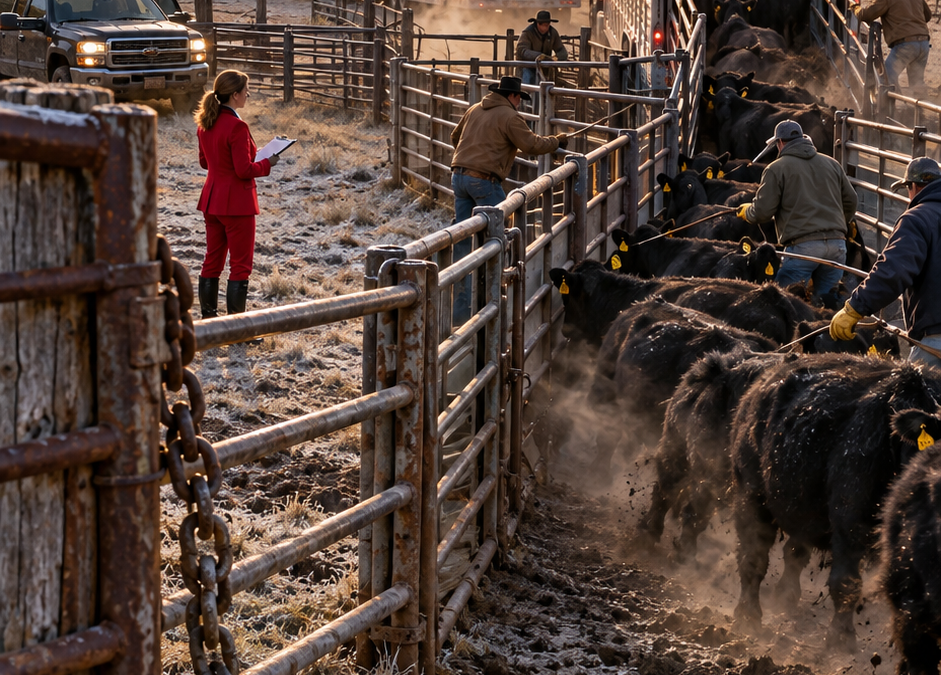
At 5:40 that morning, three livestock trailers came through my east gate without permission.
By the time I reached the lower pasture, men I had never seen had already forced forty of my best Black Angus cows into a steel loading chute.
And standing beside the cut chain in a bright red suit, Vanessa Crowe looked at me as if she had every legal right in the world to be there.
My name is Cole Barrett.
I was forty-nine years old, and I had spent twenty-seven of those years raising cattle on Barrett Ranch outside Bellweather, Colorado.
Seven hundred twenty acres.
High grass.
Cottonwood bottoms.
Rolling pasture beneath the Front Range.
It was not a corporate cattle operation.
It was not a trophy ranch purchased by someone who flew in twice a year and called himself a rancher because his name appeared on a gate.
It was my home.
My business.
My inheritance.
And the one place on earth where I knew almost everything by sound.
I knew which hinge on the north gate squealed when winter temperatures dropped below freezing.
I knew the difference between a calf bawling because it had lost sight of its mother and one calling because something was wrong.
I could tell from my bedroom whether the old well pump beside Barn Two had started correctly.
I knew what two hundred hooves sounded like moving calmly through grass.
And I knew what panic sounded like when cattle were pushed too fast through steel.
That morning, the sound reached me before I saw the trailers.
Metal gates banging.
Engines idling.
Men shouting.
Cattle crowding one another.
I was halfway into my boots when my ranch manager, Miguel Alvarez, called.
“Cole.”
He rarely used my name that way.
Usually it was something practical.
Fence down.
Calf coming backward.
Pump froze.
This was different.
“What?”
“You need to get to the east pasture.”
“What happened?”
“Trailers.”
I stopped.
“What trailers?”
“Livestock haulers.”
For half a second, neither of us spoke.
Then he said, “They’re loading our cattle.”
I was out the door before the call ended.
The sun had barely cleared the ridge.
Frost still held in the shaded grass.
When my truck bounced over the final rise, I saw three large stock trailers positioned beside the lower loading chute.
One was already pulling toward the road.
A second had its rear doors open.
The third engine was running.
Men in work jackets were fastening yellow auction tags to the ears of my cattle.
And Vanessa Crowe stood beside the east gate.
The chain I had locked the night before lay cut in the dirt.
Vanessa held a clipboard.
Red suit.
Black boots.
Perfect hair.
She looked absurd standing there among dust, manure, diesel exhaust, and frightened cattle.
She also looked completely comfortable.
I stopped hard enough to throw gravel.
The nearest hauler stepped toward me.
“Sir—”
“Who are you?”
He glanced toward Vanessa.
She answered for him.
“Mr. Barrett, the association has authorized emergency removal.”
I looked at her.
“The association?”
“Whisper Ridge.”
“My ranch is not in Whisper Ridge.”
“We’ve already discussed the contamination issue.”
“We discussed your accusation.”
She held the clipboard against her chest.
“You refused voluntary compliance.”
I pushed past the hauler.
“Open the chute.”
Vanessa’s voice sharpened.
“Do not interfere with the contractor.”
I turned.
“You cut a locked gate and entered private property.”
“This action is authorized.”
“By who?”
“County health.”
“Show me the order.”
She extended a paper.
I did not take it.
Behind me, one of the cows kicked the steel wall.
The sound made me turn.
The final animal in the second trailer was moving up the chute.
Black coat.
White ranch tag.
C17.
Juniper.
I had raised her from a calf.
Twelve years old.
One of the last cows descended directly from a breeding line my father had spent three decades building.
Vanessa noticed where I was looking.
“That one valuable?”
“Very.”
Her mouth tightened into something almost like satisfaction.
“By noon, those animals will no longer be your problem.”
I looked at Juniper.
What Vanessa did not know was that C17 had worn a GPS health monitor for eleven months.
The small device on her collar had been installed as part of a Colorado State University livestock-health project.
It recorded movement.
Feeding behavior.
Temperature.
Unusual inactivity.
Pasture location.
Every hour.
Every day.
For almost a year.
The data was stored remotely on a server in Fort Collins.
Vanessa believed she had just loaded one of my most valuable cows for auction.
What she had actually loaded was a witness.
I did not know how important that would become yet.
At that moment, I was simply trying not to do something stupid.
My father had raised cattle on that land before me.
Twenty-four animals in my herd belonged to a bloodline he had developed himself.
He had started with paper records.
Birth weights written in pencil.
Vaccinations on index cards.
Photographs taped into binders.
He kept everything.
When I was sixteen, I once asked him why he spent so much time recording things nobody would ever care about.
He said, “Cattle can’t speak in a courtroom, Cole. Ranchers better keep records that can.”
At sixteen, I thought it was just another one of his sayings.
At forty-nine, watching strangers tag my cattle for auction, I finally understood exactly what he meant.
Whisper Ridge had been built along our eastern boundary years after the ranch was established.
One hundred twelve homes.
Stone clubhouse.
Two tennis courts.
Walking paths.
An artificial lake shaped into a perfect crescent.
Most residents were fine.
Some bought beef from us.
Parents occasionally brought children to watch calves in spring.
One family sent us Christmas cookies every year.
The problem had never been Whisper Ridge as a whole.
The problem was Vanessa Crowe.
She had moved there four years earlier.
Within six months, she joined the HOA board.
Within a year, she was president.
She spoke softly.
That was part of her skill.
Vanessa could threaten somebody without ever sounding angry.
She had a way of making punishment sound like policy and coercion sound like cooperation.
Our properties shared more than a mile of fence.
Whisper Ridge sat higher on the eastern ridge.
My lower pasture lay beneath it.
A seasonal tributary crossed from east to west, entered Barrett Creek near my barn, then curved south before eventually feeding the HOA’s ornamental lake.
That geography became the center of everything.
Three days before the trailers arrived, Vanessa had come to my house.
She brought HOA counsel Martin Kesler and a man carrying a silver sampling case.
Vanessa wore the same red suit.
“Mr. Barrett,” she said from my porch, “we have a serious public health issue.”
She handed me a twelve-page report.
Front Range Environmental Analytics.
The cover showed elevated E. coli levels in Whisper Ridge Lake.
A red arrow marked Barrett Creek as the suspected source.
Martin spoke next.
“Your cattle are contaminating community water.”
I turned several pages.
“The association is exercising emergency abatement authority,” he added.
I looked up.
“Your authority ends at your property line.”
Vanessa did not blink.
“Pollution doesn’t.”
I remember thinking it was a good line.
Too good.
Rehearsed.
She claimed county health officials had identified my herd as an immediate contamination risk.
Unless I moved every animal at least two thousand feet from Barrett Creek within seventy-two hours, Whisper Ridge would hire a licensed livestock contractor to relocate them.
At my expense.
Transport.
Feed.
Veterinary inspection.
Storage.
Estimated cost?
Eighty-four thousand dollars.
If I refused to pay, Martin said the HOA would seek a judgment against the ranch.
I looked at their map.
One sample location was marked near the southern bend of Barrett Creek.
My cattle had not used that pasture in five months.
We were resting it for the season.
“Who collected this sample?”
The man with the silver case stepped forward.
“Randall Pike.”
“You collected it?”
“Yes.”
“What day?”
“Thursday.”
“What time?”
His eyes moved toward Vanessa before he answered.
“Approximately nine.”
I nodded.
“Then you were trespassing.”
His confidence slipped.
Vanessa tapped the report.
“The issue is contamination, not access.”
That sentence stayed with me.
When evidence helped Vanessa, rules were sacred.
When procedure exposed her, procedure suddenly became irrelevant.
“I’m not moving cattle because your private consultant says so.”
Martin opened another folder.
“This is an active county investigation.”
The document carried an official county logo.
One line was highlighted.
Immediate protective measures are recommended until the source is controlled.
I read it twice.
“Recommended.”
Martin said nothing.
“That does not say cattle must be removed.”
Vanessa’s eyes stayed on me.
“Seventy-two hours.”
“I want a county order.”
“If you refuse cooperation, compliance will be handled for you.”
She turned.
That was when I noticed the orange ribbon tied to a juniper post near the driveway.
Fresh survey ribbon.
Eighty feet north of the creek.
It made no sense.
If Vanessa’s problem was contaminated water, why was someone marking ground nowhere near the water?
I called Dr. Lena Ortiz.
Lena had treated my herd for twelve years.
She arrived that afternoon.
We walked the pasture together.
She checked the cattle.
Mineral tubs.
Water troughs.
Manure.
She asked about illness.
“No diarrhea?”
“No.”
“Abortions?”
“No.”
“Fever?”
“Nothing abnormal.”
She studied Vanessa’s map.
Then the terrain.
“This doesn’t make sense.”
“What?”
“The highest reading.”
She pointed.
“They blame your north pasture, but the strongest contamination is upstream from it.”
Near the eastern tributary.
The water entering from Whisper Ridge.
“Could it circulate?”
“Water can pool, spread, back up.”
She looked at me.
“But it usually doesn’t flow uphill to satisfy somebody’s theory.”
She collected independent samples.
Above the herd.
Below the herd.
At the eastern tributary.
At the southern bend.
“Rush results?”
“Forty-eight hours.”
Before leaving, she said, “Call a water attorney.”
I called Rachel Kim.
Rachel did not tell me everything would be fine.
That made me trust her.
She asked for my deed.
The HOA report.
County memo.
Every letter and email from Whisper Ridge.
An hour later, she called.
“The HOA cannot create county authority by attaching a county memo to its own demand.”
“So they can’t remove anything.”
“I didn’t say that.”
I leaned back in my office chair.
“What are you saying?”
“I’m saying they don’t have lawful authority from what I can see.”
“That sounds the same.”
“No. Because people sometimes do unlawful things anyway.”
I was silent.
“We document everything,” Rachel continued. “Do not threaten anyone. Do not block public access. Do not give them a confrontation they can turn into footage.”
That evening, my daughter Sophie drove home from Colorado State.
She was nineteen.
Agricultural business major.
Raised on the ranch.
She could spot an uneven gait from two hundred yards.
She read Vanessa’s notice at the kitchen table.
“They can’t do this.”
“They can try.”
“That’s not comforting.”
“It’s accurate.”
Sophie looked at the framed photograph of my father beside the mudroom.
“He would’ve chased them off.”
“Your grandfather also spent a night in county jail over a bulldozer disagreement.”
She almost smiled.
Then she opened her laptop.
Twenty-four of our cattle had GPS health collars from the university study.
Sophie downloaded the data.
At ten that night, she called me.
“Dad.”
I walked into the office.
Juniper’s movement history covered the screen.
The HOA report claimed cattle had concentrated near the southern bend during the week before Randall’s sample.
Juniper had been nowhere near it.
Northwest pasture.
Almost three thousand feet away.
The other tagged animals showed the same pattern.
“This is good,” Sophie said.
“It’s something.”
“It proves they lied.”
“It proves these twenty-four cows weren’t where Randall says the herd was.”
She frowned.
“That’s not enough?”
“Not for all one hundred eighty-six.”
She knew I was right.
GPS data could not identify the contamination source either.
But it damaged the story Vanessa had told.
The next morning, Miguel and I rode the eastern fence.
Near a stand of chokecherry, he stopped.
“Cole.”
The ground was wet.
We had not seen rain in nine days.
Muddy water seeped from beneath the fence.
The smell reached me when I dismounted.
Detergent.
Stagnant water.
Something chemical.
Not cattle waste.
We followed it uphill.
On the HOA side, decorative river rock covered fresh soil.
Beneath the rock was a black plastic pipe.
About twelve inches wide.
Discharging directly toward the seasonal tributary.
I had never seen it.
It was not on any drainage plan I knew.
Miguel crouched.
“Recent.”
Fresh excavator marks.
Loader tracks.
One tread had a triangular tear along the edge.
I photographed everything.
Distance.
Pipe diameter.
Flow.
Tracks.
Boundary.
Then I installed trail cameras without crossing onto Whisper Ridge property.
At noon, Vanessa called.
“Have you made transportation arrangements?”
“I found a discharge pipe coming from your property.”
A pause.
One second.
Maybe less.
“Whisper Ridge has a permitted storm-water system.”
“Then send me the permit.”
“The board has no obligation to explain community infrastructure.”
“You do when it empties on my land.”
Her voice cooled.
“You have forty-six hours.”
She ended the call.
That afternoon, county health coordinator Aaron Walsh called me.
Her office was investigating bacterial contamination in Whisper Ridge Lake.
“Did you order removal of my cattle?”
“No.”
“Did you authorize the HOA to hire livestock contractors?”
“Absolutely not.”
“Did county health identify Barrett Ranch as the source?”
“We identified several potential sources.”
“Livestock?”
“Yes.”
“What else?”
“Wildlife. Septic failure. Wastewater infrastructure.”
I stared toward the east ridge.
“Vanessa Crow gave me a report saying your office identified my cattle.”
“That report did not come from us.”
I sent her everything.
Twenty minutes later, Aaron called again.
“The first page is our investigation notice.”
“And the rest?”
“Privately prepared.”
“They handed it to me as one packet.”
“That should not have happened.”
“Is that illegal?”
“I can’t answer that, but it is misleading. I’m notifying our director.”
Rachel immediately sent formal notice to Whisper Ridge and every contractor we knew about.
No entry.
No removal.
No sale.
No transport.
No boarding of livestock.
She demanded chain-of-custody records.
Drainage permits.
Board minutes.
Contracts.
Emails related to my ranch.
Vanessa responded with a settlement offer.
The HOA would suspend enforcement.
In return, I had to sign a temporary access agreement.
Eighty-foot corridor along my eastern boundary.
Construction access.
They would pay sixty thousand dollars.
And build a decorative privacy fence.
I stared at the document.
The orange survey ribbon suddenly made sense.
I called Rachel.
“Find out what they want north of the creek.”
By sunset, she had it.
A planning application.
Crow Development Partners.
Whisper Ridge Phase Two.
Forty-eight additional luxury homes on land north of the existing development.
One major problem.
The parcel was landlocked for purposes of the required second emergency entrance.
The proposed road crossed my ranch.
Vanessa Crowe was listed as managing member of the development company.
This was never only about bacteria.
The contamination claim was leverage.
The seventy-two-hour deadline was pressure.
The eighty-foot corridor was the real target.
That night at 1:17, one of my trail cameras triggered.
Headlights.
White compact track loader.
Triangular tear in the left tread.
Same pattern Miguel and I had photographed.
Two men in reflective jackets stopped at the hidden pipe.
Adjusted something behind the river rock.
Took photographs.
Left.
The machine carried a logo.
Summit Grounds and Utility.
At eight the next morning, I called.
A supervisor named Nate Dorsey answered.
When I mentioned Barrett Ranch, his tone changed.
“You need to speak with Whisper Ridge.”
“Your loader was filmed beside a discharge pipe ending on my property.”
“I can’t discuss client infrastructure.”
“The pipe discharges onto my land.”
“I’m sorry.”
He hung up.
Lena’s laboratory results arrived an hour later.
Above my herd?
Clean.
Below the cattle?
Mild bacterial increase.
Consistent with normal agricultural runoff.
Still well below the level measured in Whisper Ridge Lake.
Eastern tributary?
Nine times higher than the water below my cattle.
The strongest contamination was entering from the HOA side.
I sent everything to Rachel.
She started preparing an emergency filing.
Before she submitted it, Vanessa acted.
At 5:40 the next morning.
Eleven hours before her own seventy-two-hour deadline expired.
Three livestock trailers came through the east gate.
Someone cut my chain.
The drivers carried what looked like official paperwork.
HOA work order.
County investigation notice.
And a document titled:
EMERGENCY LIVESTOCK TRANSFER AUTHORIZATION.
At the bottom was what appeared to be Aaron Walsh’s signature.
I did not yet know it was false.
All I knew was that forty of my cows were being taken.
Miguel called the sheriff.
Sophie opened the tracking dashboard.
I called Rachel.
Then I forced myself to step back.
Everything in me wanted to stop those trucks physically.
A pickup across the lane.
Tractor in front of the trailers.
Anything.
But I heard Rachel’s voice.
Do not give them the confrontation they want.
So I raised my phone.
“State your name.”
The first driver looked at me.
“Sir?”
“Name and company.”
He glanced at Vanessa.
“Travis Bell. Front Country Livestock Transport.”
“Who told you these cattle could be removed?”
Vanessa stepped in.
“They’re performing an emergency relocation.”
I kept the camera on Travis.
“Who represented that they controlled these cattle?”
“Mr. Barrett—”
“Why are auction tags being attached?”
Silence.
Travis looked at the paperwork.
Then at Vanessa.
“Ma’am, you told dispatch the association had a court-approved disposal order.”
Martin Kesler stepped backward.
Barely one pace.
But I saw it.
Vanessa’s attorney had just heard something he did not expect.
She pointed at the trailer.
“Complete the transport.”
The first truck was already gone.
Sixteen animals.
Including Juniper.
The second driver started closing his doors.
I handed Travis a copy of Rachel’s no-consent notice.
“You now know the owner disputes every line of that authorization.”
He read it.
“What you do next is your choice.”
He took out his phone.
Called dispatch.
The second trailer stopped.
Then the third.
But Juniper was already moving down County Road 12.
Sophie stood beside me watching a blue dot on her laptop.
“They’re heading south.”
“Where?”
She enlarged the map.
“Mesa Valley Auction.”
Rachel called the auction office immediately.
Sheriff Luke Harmon arrived.
He photographed the cut chain.
Reviewed the paperwork.
Interviewed drivers separately.
Vanessa held up the transfer authorization.
“County health approved this.”
Luke called Aaron Walsh on speaker.
“Ms. Walsh, did you sign an emergency livestock transfer authorization involving Barrett Ranch?”
“No.”
Vanessa went completely still.
Aaron continued.
“I have never authorized removal, transfer, quarantine, sale, or relocation of Mr. Barrett’s cattle.”
Martin Kesler looked down at the signature page.
Then at Vanessa.
“Where did this come from?”
“The environmental consultant handled county paperwork.”
Randall Pike.
She had shifted responsibility in less than three seconds.
Luke ordered the remaining cattle unloaded.
Nobody was arrested.
Not yet.
Luke did not know who created the document.
He did not know what the drivers had been told.
He did not know whether the signature was deliberately forged or copied into something somebody misunderstood.
Real investigations do not move at the speed of anger.
Our immediate problem was sixteen cattle approaching an auction that started in less than three hours.
Mesa Valley manager Tom Bryce agreed to isolate the trailer.
But the HOA documents identified Whisper Ridge as lawful custodian.
They claimed the cattle could be sold to recover “emergency abatement costs.”
Sophie and I drove to the sale barn.
Brand certificate.
Veterinary records.
Herd inventory.
Purchase history.
Photographs.
Rachel headed toward district court.
At Mesa Valley, Juniper’s GPS dot stopped behind the auction barn.
State livestock inspector Marlene Shaw met us near the scale house.
Early sixties.
Dust-covered canvas coat.
Expression of someone who trusted cattle more than lawyers.
“Brand registration.”
I handed it over.
All sixteen cattle carried the Barrett shoulder brand.
Numbered ranch tags matched my inventory.
Juniper’s veterinary file included seven years of photographs.
Vaccinations.
Breeding records.
GPS collar serial number.
Marlene studied the transfer form.
“This does not transfer title.”
I looked at her.
“So?”
“So they’re not entering my sale ring without verified ownership.”
I finally exhaled.
Twenty minutes later, Vanessa arrived with Randall Pike.
She went straight to Tom Bryce.
“If contaminated animals are released, the association will hold this facility responsible for resulting public-health damages.”
Tom folded his arms.
“Bring me a quarantine order.”
Randall opened his silver case.
Another water report.
Marlene barely looked at it.
“I inspect livestock ownership.”
Randall tried to explain.
Marlene interrupted.
“A water sample does not erase a registered brand.”
I remember Sophie looking at me.
Almost smiling.
Vanessa pulled me aside.
“This can end now.”
“How?”
“You sign the corridor agreement.”
I stared at her.
“You want me to sign away construction access while my cattle are sitting in an auction pen?”
“Temporary access.”
“You cut my gate.”
“Because you refused reasonable safeguards.”
“You tagged my animals for sale.”
“Emergency costs must be recovered.”
“And the road?”
Her eyes narrowed.
“What road?”
“The one through the eighty-foot corridor.”
Randall looked from me to Vanessa.
His expression changed.
He did not know about Phase Two.
Sophie walked over holding her laptop.
She opened Juniper’s location history.
“Mr. Pike.”
He looked at her.
“Your report says cattle were concentrated at the southern creek bend.”
“That was my observation.”
“Which cattle?”
“I observed hoof activity.”
“That’s not what I asked.”
She enlarged the map.
“These are eleven months of Juniper’s GPS data.”
Then the other tagged animals.
“During the week you sampled, they were almost three thousand feet away.”
Randall recovered quickly.
“The report refers to herd activity, not individual animals.”
Sophie clicked again.
Electronic gate logs.
Only two openings during the relevant week.
Both Miguel’s feed truck.
Southern pasture gate never opened.
GPS did not account for every cow.
But combined with gate records and our pasture rotation schedule, Randall’s claim looked weaker by the minute.
Then Marlene picked up his laboratory sheet.
“What does LS2 mean?”
Randall reached for the paper.
“Internal sample designation.”
“Meaning?”
“I would need to check.”
He closed the folder too quickly.
Sophie photographed the page.
At 11:17, Rachel called.
A judge had issued a temporary order.
No sale.
No transfer.
No relocation.
The cattle would remain under my ownership while the court examined the dispute.
Juniper and the other fifteen came home that afternoon.
I stood beside the chute when she stepped off.
She paused at the gate.
Sniffed.
Then walked toward her usual group as if she had merely returned from a veterinary visit.
I put one hand on her back.
For the first time since sunrise, I felt how angry I actually was.
Not just because of the money.
Not even because of the trespass.
Those animals trusted routines.
Gates.
Voices.
People.
We had taken something calm and put it through noise, transport, strange pens, and fear because Vanessa wanted leverage.
The next evening, she held an emergency HOA meeting.
Before it began, she emailed residents.
Barrett Ranch, she claimed, had used procedural delay to keep contaminated livestock near family homes.
She proposed a four-thousand-dollar special assessment on every property.
Water remediation.
Litigation.
Nearly half a million dollars.
Suddenly, residents who had ignored the dispute started paying attention.
One was Ellen Park.
The HOA treasurer.
She called from a private number.
“I need to show you something.”
We met at a diner twenty miles away.
Ellen brought three invoices.
All from Summit Grounds and Utility.
Invoice One.
Emergency inspection of Whisper Ridge Lift Station Two.
Failed pump.
Sewage backup.
Risk of overflow.
Invoice Two.
Temporary bypass work.
Invoice Three.
Night installation.
Twelve-inch relief line.
East Slope.
Approved personally by Vanessa under emergency spending authority.
Job code:
LS2.
I looked at Ellen.
“LS2.”
She nodded slowly.
“The same code on Randall’s sample.”
The highest bacterial reading in the report used to blame my cattle did not appear to come from Barrett Creek.
It came from Lift Station Two.
“How much?”
Ellen pushed the invoices toward me.
“One hundred six thousand.”
“What were owners told?”
“Pump repair. Twenty-eight thousand.”
“And the difference?”
“Coded as legal site preparation for Phase Two.”
I looked up.
“She used HOA money?”
“I think so.”
“For the pipe?”
“And maybe survey work along your boundary.”
“You have the contracts?”
“She removed my accounting access yesterday.”
Ellen was not helping me because she suddenly became a ranch-rights activist.
She was helping because the lie had reached her own ledger.
That did not make her evidence less valuable.
Sometimes people become brave when the cost of silence finally becomes personal.
Rachel subpoenaed the HOA vendor records.
We requested county drainage permits.
County engineer Samuel Brooks came to the boundary.
He studied the pipe.
Then the approved plans.
“I cannot find this discharge.”
“Is it legal?”
“A temporary emergency bypass may be permissible inside a development.”
He pointed toward my land.
“Discharging across a private boundary without authorization is not part of any permit I can locate.”
He marked the route.
Lift Station Two.
Behind the clubhouse maintenance area.
Under the decorative stone.
Downhill.
Across the property line.
Into my tributary.
The pipe was not storm drainage.
It was a relief line from a failing wastewater lift station.
Whenever the wet well rose too high, contaminated water could escape toward my ranch.
It entered Barrett Creek.
Followed the southern bend.
Then flowed back toward Whisper Ridge Lake.
Vanessa had accused my cattle of contaminating water that originated inside her own community.
Lena ordered microbial source tracking.
Results came back.
Human-waste markers at the pipe outlet.
Human-waste markers in Whisper Ridge Lake.
Those markers were absent upstream before the eastern tributary entered my ranch.
Now we had independent lab results.
Pipe location.
County mapping.
GPS movement.
Gate logs.
Invoices.
Board records.
But Rachel warned me not to relax.
“Proof is useful. Timing matters too.”
Crow Development Partners had scheduled soil testing for six the next morning.
Along Vanessa’s orange survey line.
She was trying to establish construction activity before the HOA residents fully understood what Phase Two required.
Rachel amended our filing.
Vanessa answered with another legal claim.
Whisper Ridge, her new lawyer said, possessed a recorded utility easement along the eastern edge of Barrett Ranch.
If true, that could grant limited access.
Rachel pulled the easement.
It existed.
Twenty feet wide.
Created in 1998.
Purpose?
Underground electrical maintenance.
It did not authorize a road.
It did not authorize sewage discharge.
It did not authorize cattle removal.
And it ended four hundred sixty feet south of Vanessa’s orange survey ribbons.
Rachel hired a licensed surveyor.
By afternoon, blue flags marked the real easement.
Twenty feet.
South.
Limited.
Vanessa’s orange ribbons ran north.
Through my calving lot.
Across mature cottonwoods.
Toward the Phase Two parcel.
Standing on the county road, anyone could see it.
Two lines.
Blue.
Orange.
One represented a right Vanessa actually had.
The other represented the land she wanted.
That evening, more than ninety Whisper Ridge residents packed the clubhouse.
I attended with Rachel.
Sophie.
Ellen.
Lena.
Samuel Brooks.
The surveyor.
Vanessa sat at the center of the board table in red.
Behind her, the projector showed cattle standing beside muddy water.
The photograph was not from my ranch.
She began with the phrase “ongoing environmental crisis.”
Then “uncooperative neighboring agricultural use.”
She asked the board to approve the four-thousand-dollar assessment and authorize expanded protective access.
Rachel raised her hand.
“Before owners vote, the court has ordered both parties to preserve evidence and refrain from entering Barrett Ranch.”
Vanessa struck the gavel.
“This is a private association meeting.”
Ellen stood.
“I invited them.”
Vanessa stared at her.
“As treasurer.”
Ellen lifted the invoices.
“And before we ask homeowners for four thousand dollars each, I move that we review the emergency expenses I was prevented from auditing.”
The room shifted.
Vanessa said the invoices contained privileged emergency information.
Ellen handed out copies.
Samuel explained the county findings.
No approved discharge point on my ranch.
Utility easement nowhere near the proposed corridor.
No county cattle-removal order.
He did not call Vanessa a liar.
He simply explained documents.
That was more damaging.
The survey overlay went on the screen.
Blue easement.
Orange proposed road.
A resident stood.
“Why did HOA money pay for work along the route of your private development?”
Vanessa answered immediately.
“Phase Two would increase property values for the entire community.”
The room became louder.
She had not denied it.
Another homeowner asked about Lift Station Two.
“Why were we told the pump was repaired if wastewater was still being diverted?”
Vanessa blamed Summit Grounds.
Then the clubhouse doors opened.
Nate Dorsey walked in.
The contractor who had refused to speak to me.
I had not invited him.
Ellen had.
He carried a thick job folder.
He looked like he had not slept.
“I need to clarify the lift station work.”
Vanessa spoke before he reached the table.
“Our attorney should be present for contractor statements.”
Nate stopped.
“You told everyone we caused this.”
“You performed the work.”
“Under your direction.”
People turned.
Nate opened the folder.
“Summit Grounds recommended shutting down Lift Station Two and using temporary pump trucks until permanent repairs could be completed.”
Vanessa said, “That option was operationally impractical.”
“You rejected it because tanker trucks would pass the clubhouse.”
Her expression hardened.
“There was a scheduled community event.”
“Real-estate showcase.”
Silence.
Nate continued.
“You directed us to install the relief line after midnight.”
“That was an emergency measure.”
“You selected the discharge area.”
He produced a change order.
Her signature appeared at the bottom.
ROUTE TEMPORARY DISCHARGE WEST BEYOND COMMUNITY BOUNDARY PENDING PERMANENT REPAIR.
I watched residents read the screen.
Nate turned to Randall Pike’s report.
“LS2 was our lift station code.”
Someone asked, “The sample?”
Nate nodded.
“Mr. Pike collected it from the wet well before we activated the bypass.”
The strongest number in Randall’s report had come directly from the failed sewage station.
Not from my pasture.
Vanessa called Nate a disgruntled contractor trying to avoid liability.
He did not argue.
He left the signed change order on the table.
For days, I had imagined what it would feel like if Vanessa’s story finally collapsed publicly.
I expected satisfaction.
Instead, I was exhausted.
Forty cattle had been frightened and handled by strangers.
Sixteen had been hauled toward auction.
Two later required veterinary treatment for transport stress.
Whisper Ridge residents had been exposed to contaminated water.
Homeowners were being asked to pay for decisions many of them never knew about.
My creek had been used as a waste route.
My ranch had been turned into leverage for a road.
That is the thing people sometimes miss about abuse of power.
The person abusing it rarely pays the first cost.
Workers do.
Neighbors do.
Animals do.
Families do.
The people forced to defend themselves do.
Vanessa tried one last time.
“Even if a temporary bypass contributed to the readings, Barrett Ranch remains incompatible with a modern residential community.”
I stood.
“My ranch was here fifty-eight years before Whisper Ridge.”
The room quieted.
“I did not move cattle beside your houses.”
I looked directly at her.
“Your developer built houses beside my cattle.”
Sophie connected her laptop to the projector.
Juniper’s movement map appeared.
Three thousand feet from the southern bend.
Then the other monitored animals.
Gate logs.
Pasture schedule.
Lena’s laboratory results.
Eastern tributary.
Pipe.
Lift Station Two.
I spoke carefully.
“You said my herd concentrated near the sample site.”
I pointed to the map.
“The monitored animals were nowhere near it.”
Next slide.
“The gate never opened for cattle movement.”
Next.
“The contamination entered through your pipe.”
I looked at Vanessa.
“Then somebody used a county employee’s signature on a document she says she never signed.”
No answer.
“You cut my chain.”
No answer.
“You sent sixteen branded cattle toward auction.”
She looked toward her lawyers.
Neither spoke.
I could have kept going.
I could have demanded resignations.
Threatened every homeowner.
Promised lawsuits until Whisper Ridge no longer existed.
That was not what I wanted.
“I’m not here to take anyone’s home.”
Several residents looked at me.
“I don’t want your clubhouse.”
I pointed toward the eastern boundary on the screen.
“I don’t want to stop families from using their roads.”
Then toward the creek.
“I want the pipe removed.”
The cattle map.
“My losses paid.”
The survey.
“And every claim to an eighty-foot corridor across my ranch withdrawn.”
That was it.
Restoration.
Not revenge.
Ellen moved to suspend Vanessa’s authority over contracts and emergency spending pending an independent audit.
Five board members voted.
Four supported the motion.
One abstained.
Vanessa lost control of HOA contracts that night.
The special assessment failed.
At 6:10 the following morning, Crow Development Partners’ soil-testing crew arrived at my east boundary.
They found survey stakes.
A posted court order.
And a sheriff’s deputy documenting compliance.
The crew never unloaded its equipment.
The next six weeks were less dramatic.
And more important.
County officials ordered Whisper Ridge to stop the unauthorized discharge.
Lift Station Two was repaired under an approved plan.
Vacuum trucks handled wastewater until the new pump went online.
Environmental crews removed contaminated soil near the tributary.
Barrett Creek was monitored.
The HOA insurer negotiated damages.
All sixteen transported cattle received veterinary examinations.
Two required treatment.
None were sold.
We documented everything.
Cut chain.
Damaged chute.
Veterinary bills.
Lost breeding time.
Legal fees.
Creek restoration.
Security upgrades.
The civil settlement totaled $318,000.
Some of it repaired the ranch.
Some paid for two years of independent water monitoring.
The rest covered losses and costs created by the unauthorized cattle removal and contamination.
Whisper Ridge formally acknowledged that Barrett Ranch was outside its covenants.
The HOA withdrew its claim to the eighty-foot corridor.
It recorded notice that the old twenty-foot utility easement could not be enlarged or repurposed without my written consent.
Crow Development Partners withdrew the Phase Two access proposal.
Without a lawful second entrance, the county paused the development application.
Vanessa resigned before the independent audit was finished.
The false transfer authorization and misuse of county materials were referred to investigators.
I never received some dramatic phone call announcing that justice had been completed.
I learned enough in those months not to confuse accountability with theater.
I did not need Vanessa dragged away from the clubhouse in handcuffs to know the situation had changed.
She no longer controlled HOA contracts.
She could no longer direct crews onto my property.
She could no longer use homeowners’ dues as leverage for her development road.
That mattered.
Martin Kesler sent Rachel a letter stating he had never approved the auction plan.
Randall Pike’s consulting contract ended.
Summit Grounds cooperated with the cleanup and contributed toward damages through its insurer.
Ellen became interim HOA president.
She was almost the opposite of Vanessa.
No dramatic speeches.
No red suits.
No polished threats.
She published minutes.
Required two signatures for emergency spending.
Invited residents to inspect the repaired lift station.
Made contracts available for review.
It turned out transparency cost less than intimidation.
The ranch changed too.
Miguel installed tamper alarms on the east gate.
We expanded camera coverage along the tributary.
Lena helped us establish a permanent water-monitoring program.
Every quarter, samples were taken above the herd.
Below the herd.
At the eastern boundary.
Not because Vanessa had been right.
Because my father had been.
Records matter.
Sophie used Juniper’s GPS history and the water-testing timeline for a university research project about agricultural data in land-use disputes.
She never treated what happened like a victory story.
She analyzed it.
Sequence.
Evidence.
Gaps.
Limitations.
I watched her present part of the project online one evening.
She explained that GPS data from twenty-four cows could not prove where all one hundred eighty-six animals had been.
Then she explained why the gate logs, rotation schedule, microbial markers, and water-flow mapping made the complete picture stronger.
My father would have loved that.
Not the conflict.
The discipline.
The following spring, native grass began returning around the restored tributary.
Barrett Creek ran clear.
On a cold March morning, Juniper went into labor.
I found her near the northwest shelter before sunrise.
Sophie was home for the weekend.
We watched from a distance.
Healthy heifer calf.
Strong.
On her feet quickly.
Sophie looked at me.
“I’m naming her Liberty.”
“No.”
“Already did.”
“That is terrible.”
“You’ll survive.”
Juniper turned and cleaned the calf.
I laughed for the first time I can remember laughing about any part of the previous year.
One Saturday, a group of Whisper Ridge residents came to help repair the section of fence damaged during the cattle removal.
Some had believed Vanessa at first.
A few apologized.
Most simply brought gloves.
Posts.
Wire.
Tools.
And worked.
I respected that more.
One man who had accused me of endangering his children spent four hours setting fence posts beside Miguel.
At lunch, he came over.
“I was wrong.”
I nodded.
“My wife showed me the fire—”
“You don’t have to explain.”
“I think I do.”
I looked toward the ridge.
“Then explain by checking the next claim before you repeat it.”
He nodded.
That was enough.
Property disputes often get described as two sides fighting until one wins.
Living through one feels different.
A boundary is not supposed to create enemies.
It tells people where permission begins.
Where one person’s decision stops.
Where another person’s consent becomes necessary.
The fence between Barrett Ranch and Whisper Ridge remained.
I wanted it there.
But I stopped seeing every house beyond it as part of Vanessa’s attack.
Most homeowners had not known.
Some had believed official-looking papers.
Some had stayed quiet too long.
Some had asked hard questions when their own assessment arrived.
Human beings are complicated that way.
Vanessa had treated my cattle as pressure points.
My creek as a disposal route.
Homeowner dues as development money.
The county investigation as a costume she could put around a private demand.
She believed that if she moved quickly enough, official-looking paperwork would become authority before anyone checked it.
She came frighteningly close.
What stopped her was not one miraculous document.
Not a secret deed.
Not a powerful relative.
Not some last-minute confession.
It was ordinary facts agreeing with one another.
Water flowed downhill.
The pipe crossed the boundary.
The sample code matched Lift Station Two.
Human-waste markers appeared where the wastewater entered.
The GPS collars recorded where monitored cattle had been.
The gate logs recorded where the herd had not gone.
The registered brand established ownership.
The invoices showed who paid for the work.
The survey showed the difference between the easement Vanessa possessed and the road she wanted.
And Juniper?
Juniper spent most of it doing what she had always done.
Eating.
Walking.
Ruminating beneath cottonwoods.
Standing in grass.
She never knew that the small monitor on her collar was recording evidence.
She did not know Vanessa had selected her for the first trailer because her bloodline made her valuable.
She did not know Sophie was watching her blue tracking dot move down County Road 12.
She did not know a state inspector would compare her serial number, brand, photographs, and veterinary records in an auction yard.
She certainly did not know that months of quiet location data would help dismantle the story used to take her.
My father had been right.
Cattle cannot speak in court.
But records can.
Sometimes, late in the afternoon, I still drive along the eastern boundary.
The orange survey ribbons are gone.
The blue easement markers remain.
Twenty feet.
Exactly what the recorded document says.
Nothing more.
The hidden pipe is gone too.
Where it once crossed beneath the fence, native grass has taken hold.
Water from the ridge now follows approved drainage.
The east gate has a new chain.
New cameras.
A sensor that sends Miguel and me an alert if it opens outside scheduled hours.
I do not like needing those things.
But I sleep better knowing they are there.
Beyond the fence, Whisper Ridge still exists.
Children ride bicycles.
People walk dogs.
The crescent lake reflects the mountains.
The clubhouse lights come on in the evening.
Life continued.
So did ours.
Most mornings on the ranch begin before sunrise.
Coffee.
Weather.
Calving notes.
Feed.
Fence checks.
The ordinary work Vanessa once tried to turn into evidence against me.
Juniper is older now.
Her pace is slower.
Sophie keeps saying I should retire her from breeding.
She is probably right.
I tell her I am considering it.
That means I will argue for another year.
Sometimes Juniper stands near the lower fence and watches cars moving through Whisper Ridge.
I have wondered whether she remembers the trailer.
The auction pens.
Strange men putting yellow tags through cattle ears.
Probably not in the way people remember.
Maybe that is mercy.
I remember enough for both of us.
But when I think about that morning now, the part that stays with me is not Vanessa’s red suit.
Not the cut chain.
Not even the first trailer leaving.
It is the moment she asked whether Juniper was valuable.
“Very,” I told her.
I thought I meant bloodline.
Genetics.
Breeding history.
My father’s work.
I was wrong.
Juniper’s greatest value that morning had nothing to do with what a buyer would have paid for her.
Her value was that for eleven months she had quietly existed in places Vanessa said she had not.
And the record of that ordinary existence was something no threatening letter, forged authorization, glossy report, or HOA vote could move.
Truth did not arrive loudly.
It came as coordinates.
Timestamps.
Water samples.
Invoices.
Brands.
Survey lines.
Small facts.
Then enough of them stood beside one another that Vanessa could no longer make the story go where she wanted.
That is what I remember whenever I pass the east gate.
The chain is stronger now.
The creek is clean.
The cattle are home.
And the line between my ranch and Whisper Ridge is finally just what it should have been all along.
A boundary.

