𝗙𝗨𝗟𝗟 𝗦𝗧𝗢𝗥𝗬 Twenty Stray Dogs Sat Down on the Old Bridge and Refused to Move, and I Knew They Were Waiting for Something No One Else Could See
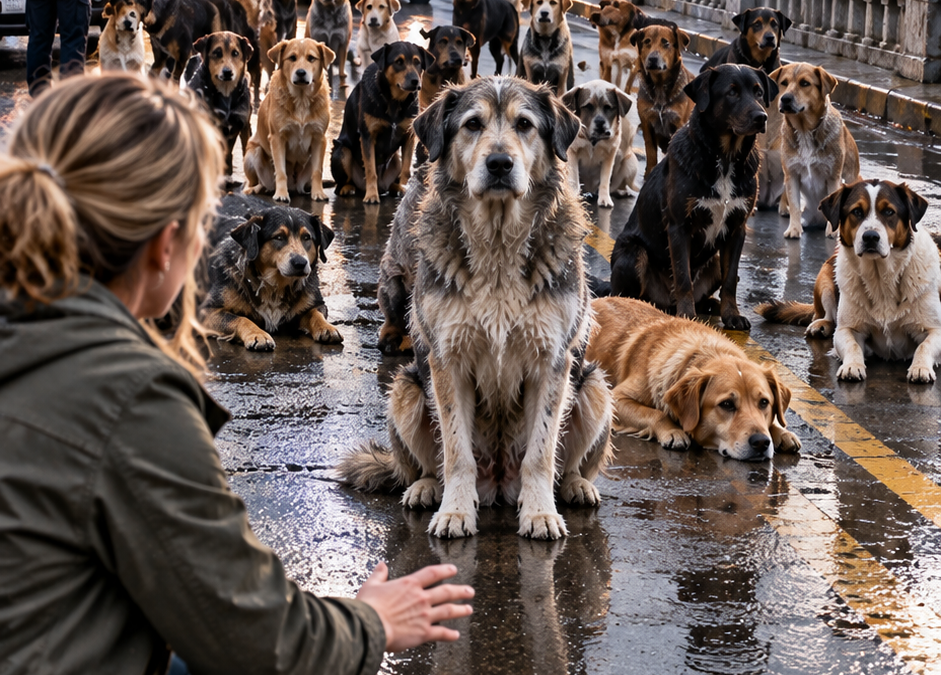
𝗙𝗨𝗟𝗟 𝗦𝗧𝗢𝗥𝗬
A horn sounded behind us.
Then another.
People were getting impatient.
I understood.
A bridge closure creates problems immediately.
People have jobs.
Appointments.
Children waiting to be picked up.
Deliveries.
Medical visits.
Lives do not conveniently stop because twenty homeless animals decide to sit in the road.
But I also knew what would happen if someone rushed them.
One frightened dog running into traffic would become twenty.
“I’m going closer.”
The officer nodded.
“Just be careful.”
I went back to my vehicle and grabbed an old fleece blanket I carried for emergency rescues.
Then I walked slowly onto the bridge.
Sage watched me.
So did Luna.
Spark stayed curled against the pavement.
I stopped about fifteen feet away.
Then I sat down.
The concrete was freezing through my jeans.
I spread the blanket across my knees.
And I waited.
I had learned years earlier that frightened dogs rarely need more noise.
People see an animal in distress and immediately begin calling.
Whistling.
Clapping.
Repeating the animal’s name.
Come here.
It’s okay.
Come on.
Come on.
Come on.
But fear does not understand persuasion.
Fear understands space.
So I gave them space.
For several minutes, I said nothing.
Traffic murmured behind us.
The river moved beneath the bridge.
A light wind pushed damp hair across my face.
Then I began talking.
Not commands.
Just words.
“You’re okay.”
Sage’s ears shifted.
“I see you.”
Luna blinked.
“You don’t have to come closer.”
Spark raised his head.
“That’s fine.”
I kept my voice low.
“You can stay exactly where you are.”
Something moved behind me.
A man shouted.
“What is going on?”
I turned.
He was probably in his early thirties.
Dark jacket.
Office clothes.
Phone in one hand.
Anger on his face.
He walked toward one of the officers.
“I’ve been sitting there for twenty minutes.”
The officer replied calmly.
“I understand, sir.”
“I have an appointment.”
“We’re working on it.”
“You have two police cars. Move them.”
The officer glanced toward the dogs.
“We’ve tried.”
The man looked past him.
“At dogs?”
“Yes.”
“You’re telling me twenty dogs shut down an entire bridge?”
“They’re frightened animals.”
“So call animal control.”
“They’re already coming.”
“I cannot miss this meeting.”
His voice rose.
Some of the dogs stood.
I lifted one hand.
“Please.”
The man looked at me.
“What?”
“Lower your voice.”
He stared.
“I’m sorry?”
“You’re making them nervous.”
“I’m making them nervous?”
He laughed once, sharply.
“I’m the one trapped on a bridge because nobody can move a bunch of dogs.”
He started forward.
One officer moved between us.
“Sir.”
“I’m not going to hurt them.”
“Stay back.”
Then something happened.
The man saw Spark.
Really saw him.
Until that moment, I think the dogs had been an obstacle to him.
A delay.
A problem without individual faces.
Then Spark stood.
His legs trembled.
His fur was wet along his belly.
He took two unsteady steps and stopped.
The man’s expression changed.
Anger disappeared so quickly it almost looked like embarrassment.
“My God.”
He stared at Spark.
“He’s freezing.”
“Yes,” I said.
The man looked around at the others.
For the first time, I think he noticed how thin some of them were.
He noticed the scars.
The ribs.
The wet coats.
The way they leaned against one another for warmth.
A woman’s voice came from behind him.
“Being angry won’t make that little one warmer.”
An elderly woman stood near the sidewalk.
She wore a beige coat and held an umbrella even though the rain had stopped.
The man turned.
“I know.”
His voice was quieter now.
She looked at Spark.
“He’s looking for someone.”
I swallowed.
“His mother disappeared last week.”
The man looked at me.
“You know him?”
“I know most of them.”
He rubbed his jaw.
“My name is Michael.”
“Emily.”
He looked again at Spark.
“I had a dog when I was a kid.”
His voice changed when he said it.
“He got out once. We looked for him all night.”
The older woman watched him carefully.
“Did you find him?”
Michael nodded.
“Six hours later. Three neighborhoods away.”
He looked embarrassed.
“I remember thinking I’d never forgive myself if something happened to him.”
Nobody answered.
He slipped his phone into his pocket.
“My appointment can wait.”
Then he walked back toward his car.
The older woman approached me.
“May I?”
She gestured toward the ground beside me.
“Slowly,” I said.
She smiled.
“At my age, everything is slowly.”
She lowered herself beside me with more difficulty than she wanted anyone to notice.
“My name is Margaret.”
“Emily.”
She studied the dogs.
“You really know them?”
“Most.”
I pointed toward Sage.
“That silver one has been on the street about three months.”
“What happened to him?”
“His owners moved away.”
Margaret’s face tightened.
“They left him?”
“I don’t know the whole story.”
“But he waited?”
“Yes.”
She looked at Sage for a long time.
Then she noticed Spark.
“And the little one?”
“My shelter volunteers call him Spark.”
“That’s a hopeful name.”
“I thought he needed one.”
Margaret smiled.
“Where’s his mother?”
“I wish I knew.”
Her eyes filled immediately.
It surprised me.
She looked away as though embarrassed by her own reaction.
“What can I do?”
“Right now?”
“Yes.”
“Nothing.”
She blinked.
“Nothing?”
“Just sit here.”
“That helps?”
“More than you think.”
She removed her coat.
Underneath, she wore a blue sweater.
Before I could ask what she was doing, she spread the coat across the pavement beside the blanket.
“If that baby decides to come closer, at least he’ll have somewhere warm.”
For several minutes, nothing happened.
Then Spark moved.
One step.
Stop.
Another.
He looked back at Sage.
Sage did not move.
Spark came closer.
Margaret did not reach for him.
That impressed me.
Most people cannot resist.
He sniffed the edge of her coat.
Then placed one paw on it.
Margaret’s mouth trembled.
Spark circled once.
Then curled into the fabric.
The older woman covered her mouth.
Tears appeared in her eyes.
I whispered, “Don’t touch him yet.”
She nodded.
“I won’t.”
We sat there quietly.
Then she said something so softly I almost missed it.
“No one has needed me in ten years.”
I looked at her.
She was staring at Spark.
“My husband died ten years ago.”
I said nothing.
“My daughter lives across the country. She has children and work and a whole life. We talk. She loves me. But nobody needs me.”
Spark shifted closer to her leg.
Margaret laughed through her tears.
“Well.”
She wiped her cheek.
“Apparently somebody does now.”
A man carrying a paper bag approached from behind the police line.
He looked to be in his forties or fifties.
“I brought food.”
I glanced up.
“For the dogs?”
He held up the bag.
“Actually, I bought breakfast biscuits before traffic stopped. I have no idea if dogs should eat them.”
Despite everything, I laughed.
“Probably not those.”
“Good. Because I’m starving.”
Margaret smiled.
He sat several feet away.
“My name is Samuel.”
“Emily.”
“Margaret.”
Samuel opened the bag.
He handed Margaret a biscuit.
Then offered one to me.
I shook my head.
“Later.”
He looked across the bridge.
“So what are they doing?”
“That’s what I’m trying to understand.”
“They don’t look trapped.”
“They aren’t.”
“Then why stay?”
“I don’t know.”
He studied them.
“Waiting for someone?”
“Maybe.”
“Who?”
I looked at Sage.
“I wish I knew.”
Michael returned carrying a blanket from his car.
He placed it near us.
“I found this in the trunk.”
“Perfect.”
He sat down.
Within fifteen minutes, something strange happened.
The bridge became quiet.
Not completely.
Engines still idled.
Radios crackled.
People spoke.
But the anger faded.
Drivers began getting out of their vehicles.
A father lifted his young daughter onto his shoulders so she could see.
A woman brought bottled water.
Someone found an old towel.
Another person called a nearby pet store and asked whether they could bring dog food.
Police officers stopped trying to move the animals.
They began protecting the space around them instead.
What had begun as a traffic problem became something else.
People watched.
Not because the scene was entertaining.
Because twenty abandoned animals had somehow forced everyone to stop long enough to notice them.
Michael pointed toward a brown dog sitting near the railing.
“That one keeps staring at me.”
I followed his finger.
Bennie.
Medium-sized.
Brown coat.
White paws.
One torn ear.
“He’s been homeless about three months.”
“What happened?”
“He lived with a man who moved away.”
Michael frowned.
“Another one?”
“Different situation.”
He watched Bennie.
“Why does he keep looking at me?”
I hesitated.
“His owner looked a little like you.”
Michael gave me a strange look.
“You’re serious?”
“Same build. Dark hair.”
He stood.
“Can I go near him?”
“Don’t walk directly at him.”
“What do I do?”
“Turn sideways. Get low. Let him decide.”
Michael moved slowly.
Bennie watched.
Michael stopped about six feet away and crouched.
“Hey, buddy.”
Bennie’s ears moved.
Michael lowered his hand.
The dog stepped forward.
Once.
Twice.
Then stopped close enough to smell his fingers.
Michael did not move.
Bennie pressed his nose against Michael’s hand.
I saw Michael’s eyes close.
He stroked the dog once.
Bennie leaned into his palm.
Michael swallowed.
“I’m taking him home.”
I almost laughed.
“You met him thirty seconds ago.”
“I know.”
“You should probably think about it.”
“I have been thinking about getting another dog for six years.”
He looked at Bennie.
“I keep telling myself I travel too much. I work too much. My apartment is too small.”
Bennie licked his hand.
Michael smiled.
“I think he just reviewed my excuses.”
Margaret laughed.
Samuel said, “Harsh reviewer.”
For the first time that afternoon, I felt hope.
Then Sage stood.
Every conversation stopped.
He walked toward me.
Slowly.
Deliberately.
I had known that dog for three months.
I had fed him.
Followed him.
Sat in alleys waiting for him.
Watched him retreat whenever affection moved faster than trust.
He had never voluntarily walked directly into my reach.
Now he did.
He stopped in front of me.
I held out my hand.
Sage lowered his head into my palm.
My breath caught.
His fur was cold.
I touched his cheek.
“You’re tired, aren’t you?”
He looked at me.
Then he turned toward the other dogs.
A low sound came from his throat.
Not quite a bark.
Not a growl.
Just a short call.
Luna stood.
Then Bennie.
Then another dog.
Spark lifted his head from Margaret’s coat.
One by one, all twenty dogs rose.
Everyone around us became still.
Sage walked three steps toward the far end of the bridge.
Stopped.
Looked back.
Then walked again.
I stood.
Samuel stared.
“What’s happening?”
“I think they want to move.”
An officer approached.
“Where are they going?”
I looked ahead.
The road beyond the bridge curved toward the industrial district.
Bright Path was less than half a mile that direction.
I felt goose bumps rise across my arms.
“They’re going toward the shelter.”
Samuel looked at me.
“They know where it is?”
“Some of them do.”
Sage had followed our rescue van before.
Luna had eaten behind our building.
Several others had been treated there and later escaped or been released through community programs.
Maybe the explanation was simple.
Maybe they smelled something familiar.
Maybe one dog moved and the others followed.
I did not know.
But the sight of those twenty animals beginning to walk together down the bridge felt bigger than any explanation I could offer.
The police opened a lane.
I walked beside Sage.
Michael stayed with Bennie.
Margaret lifted Spark carefully after I showed her how to support him.
To my surprise, he did not resist.
Samuel carried the blankets.
People followed.
Not everyone.
Some drivers returned to their cars the moment traffic reopened.
That was fine.
They had lives to continue.
But dozens stayed.
They walked behind the dogs in a loose procession.
The sun broke through the clouds as we reached the end of the bridge.
Warm light spread across the wet pavement.
For a few seconds, the entire river turned gold.
At the back of the pack was a small dog with an injured leg.
I knew him too.
We had been trying to catch him near an abandoned grocery store.
He limped badly.
Each time the others moved ahead, they slowed.
Sage stopped twice to look back.
When the little dog finally stepped off the bridge, someone began clapping.
Softly.
Another person joined.
Then another.
Soon the sound moved through the crowd.
It was not loud.
Nobody cheered.
It felt almost like applause in a church.
A thank-you.
A recognition.
Twenty animals who had spent weeks or months being ignored were suddenly being seen.
Officer Daniel, one of the younger policemen, walked beside me.
“I’ve been doing this job six years.”
“Yeah?”
“I’ve seen some strange things.”
“I believe you.”
“This is new.”
I smiled.
“Same.”
“What do you think happened?”
I looked at Sage.
“I think they got tired of waiting separately.”
Daniel laughed.
“You believe that?”
“I don’t know.”
I looked behind us.
Margaret was carrying Spark beneath her coat.
Michael walked with one hand resting on Bennie’s back.
Samuel had somehow recruited three strangers to carry blankets and water.
“I know something happened.”
Bright Path was already crowded before we arrived.
My coworker Jenna stood in the doorway staring.
“What did you do?”
“I brought company.”
She counted.
“Oh, no.”
“Twenty.”
“Emily.”
“I know.”
“We have four empty kennels.”
“I know.”
“We have sixteen dollars in the emergency food fund.”
“I know.”
She looked behind me and saw the crowd.
“What are all those people doing?”
“I think they’re helping.”
We opened everything.
Storage rooms.
Office space.
The laundry room.
A training area.
We brought out every crate.
Every blanket.
Every towel.
A local veterinarian named Dr. Patel arrived within an hour after hearing what happened over police radio.
He examined the dogs one by one.
Dehydration.
Fleas.
Minor infections.
Old injuries.
Hunger.
Nothing we had not seen before.
But six needed significant care.
The limping dog had an untreated fracture.
Luna had a skin infection.
Another dog had severe dental disease.
Spark was underweight and mildly hypothermic.
Sage had arthritis.
Through it all, people kept arriving.
Food.
Blankets.
Bowls.
Money.
Someone brought space heaters.
A hardware store donated temporary fencing.
A restaurant delivered sandwiches.
The local pet store arrived with bags of kibble.
By evening, our little shelter looked like a disaster relief center.
At 9:30, I found Margaret sitting on the floor beside Spark.
“You should go home.”
She shook her head.
“No.”
“You’ve been here all day.”
“So have you.”
“I work here.”
“Well, apparently I do now too.”
Spark was asleep against her thigh.
I smiled.
“You like him.”
Margaret looked almost offended.
“Like him?”
She placed one hand gently against his back.
“I have already informed him that he is not allowed to die.”
“He’s not dying.”
“Good. Then he’s following instructions.”
Across the room, Michael sat beside Bennie.
Samuel was helping Jenna wash bowls.
I realized none of them intended to leave.
“You all know we have chairs?”
Michael looked up.
“Bennie doesn’t.”
“You are not Bennie.”
“He disagrees.”
I went home after midnight.
I slept three hours.
Then I woke up because I could not stop thinking about the dogs.
At 5:30, I gave up.
I drove back to Bright Path.
When I opened the shelter door, I stopped.
The room was almost silent.
Twenty dogs were sleeping on blankets, towels, cushions, and borrowed beds.
And scattered among them were people.
Michael lay against a wall with Bennie curled beside him.
Margaret was asleep in a chair with Spark wrapped against her chest.
Samuel sat crooked in another chair, chin against his chest, while Luna slept across his feet.
Three volunteers had fallen asleep near the kennels.
Jenna was under her desk.
I stood there watching them.
Then I cried.
Not dramatically.
There was no great collapse.
I simply stood with my hand on the door and let tears run down my face.
Shelter work teaches you to survive disappointment.
You tell yourself not to take every cruelty home.
You learn not to think too long about the dogs nobody chooses.
You celebrate adoptions while knowing another animal will arrive before the kennel is cold.
You become practical because being heartbroken every day is unsustainable.
But sometimes hope is just as overwhelming as grief.
That morning, I could not protect myself from it.
At seven, someone knocked on the door.
I opened it.
A young couple stood outside.
Behind them were at least fifteen more people.
The man smiled nervously.
“We heard about yesterday.”
I looked at the line.
Apparently, everyone had.
“We’d like to adopt.”
“Which dog?”
He looked at the woman beside him.
She shrugged.
“Whichever one needs us.”
I almost cried again.
The next week became the busiest Bright Path had experienced in years.
Local television stations called.
Newspapers came.
Someone posted video of the bridge online.
The story spread.
People began calling it the Bridge Twenty.
I hated the nickname at first.
It sounded too polished.
Too much like entertainment.
These were living animals, not characters.
But the attention helped.
Fourteen dogs eventually found permanent homes.
Not immediately.
Not irresponsibly.
We still did applications.
Home checks.
Veterinary evaluations.
Introductions.
The same procedures we always used.
A dramatic story was not a reason to skip the responsibility that came afterward.
Michael surprised me most.
I assumed he would adopt Bennie.
Everyone did.
Instead, three days after the bridge incident, he asked to speak with me privately.
We stood outside beside the loading door.
“What’s wrong?”
“Nothing.”
He looked nervous.
“I want to adopt Sage.”
I stared at him.
“Sage?”
He nodded.
“What about Bennie?”
Michael smiled.
“Bennie likes me.”
“He definitely does.”
“But Sage…”
He looked through the window.
The old silver dog was sleeping near the heater.
“I cannot explain it.”
“Try.”
Michael thought.
“When I arrived at that bridge, I was furious because twenty minutes of my day had been taken from me.”
He looked embarrassed.
“I thought my meeting was the most important thing happening.”
“You were stressed.”
“I was selfish.”
I did not argue.
He continued.
“Then I saw that old dog sitting there.”
“Sage.”
“I know.”
He smiled.
“I watched him wait for everyone else.”
I looked at him.
“What do you mean?”
“When they started walking.”
Michael pointed toward the shelter.
“He didn’t leave first and forget the rest. He kept checking behind him.”
I remembered.
“He did.”
“And I realized I have spent most of my adult life moving as fast as possible.”
He exhaled.
“Work. Promotions. Meetings. Airports. Calls. Everything is urgent. Everything has to happen now.”
Sage lifted his head inside.
Michael watched him.
“That dog waited three months for people who were never coming back.”
His voice broke.
“And somehow he still knows how to trust slowly instead of becoming angry.”
I folded my arms.
“You understand adopting him means dealing with arthritis, possible medical expenses, and an older dog who may never become playful.”
“I know.”
“He may have separation anxiety.”
“I know.”
“He may not like your apartment.”
“I’m moving.”
I blinked.
“What?”
“I already talked to my landlord. There’s a ground-floor unit with a small yard opening next month.”
I stared at him.
Michael smiled.
“I told you. I’ve been making excuses for six years.”
Sage went home with him two weeks later.
The first night, Michael sent me a photograph.
Sage was lying beside his bed.
Not on it.
Beside it.
The next morning, another picture arrived.
Sage had moved closer.
A week later, he was sleeping with his head on Michael’s shoe.
A month after that, Michael told me Sage waited by the door every afternoon at 5:30.
“He knows when I come home.”
“Dogs are good at schedules.”
“No.”
Michael laughed.
“You don’t understand. He waits even when I work from home.”
“That sounds like Sage.”
Margaret’s adoption was more complicated.
She wanted Spark.
That was obvious from the beginning.
But Luna began following her too.
Not closely.
Luna trusted almost nobody.
Yet whenever Margaret moved through the shelter, Luna appeared nearby.
If Margaret sat, Luna sat ten feet away.
Then eight.
Then five.
One afternoon, Margaret called me.
“Emily.”
“Yes?”
“I believe I have developed a problem.”
“What kind?”
“I seem to have two dogs.”
“You have zero dogs.”
“Technically.”
I looked toward the kennel room.
Luna sat outside Spark’s pen.
Margaret pointed.
“She won’t leave him.”
“They’re attached.”
“So I cannot separate them.”
“That is one interpretation.”
“It is the correct interpretation.”
“Margaret, you came here intending to adopt one small puppy.”
“Yes.”
“You’re seventy-two.”
“Thank you for the breaking news.”
I laughed.
“Luna is young. She needs exercise.”
“I walk.”
“You told me last week you had not walked farther than your mailbox in years.”
“That was the old Margaret.”
“The new Margaret has been here for nine days.”
“She’s making excellent progress.”
In the end, I approved both adoptions after her daughter flew in to help arrange fencing and veterinary care.
The day Margaret took them home, she stood beside her car crying.
“What happened?”
“Nothing.”
She hugged me.
“I had forgotten what it felt like to have someone waiting for me.”
Spark barked from the back seat.
Luna stared through the window.
Margaret wiped her face.
“Listen to him.”
“He sounds impatient.”
“He sounds perfect.”
Samuel adopted Bennie.
That surprised everyone except Samuel.
He had never mentioned it.
One afternoon he appeared with a leash, a new collar, and completed paperwork.
Michael looked at him.
“You stole my dog.”
Samuel laughed.
“You abandoned your claim.”
“He chose me first.”
“He has excellent judgment and reconsidered.”
Bennie went home with Samuel that evening.
Samuel renamed him Companion, though everyone kept calling him Bennie for months.
“Why Companion?” I asked.
Samuel shrugged.
“My house has been quiet too long.”
I understood.
Later I learned his wife had died three years earlier.
He had not said anything because grief had become something he carried privately.
Bennie changed that.
Samuel sent photographs of morning walks.
Trips to the hardware store.
Bennie asleep in the passenger seat.
One picture showed the dog sitting beside a fishing pond wearing an expression of profound disappointment.
“He hates fishing,” Samuel wrote.
“Then why take him?”
“He hates being left home more.”
Six dogs remained at Bright Path because they needed longer treatment.
And something else changed.
For years, our shelter had lived month to month.
Sometimes week to week.
We postponed repairs.
Begged for food.
Held fundraisers that barely covered veterinary bills.
After the bridge, donations came from everywhere.
Five dollars.
Ten.
Fifty.
People mailed checks.
Children brought jars of coins.
A retired contractor fixed our roof.
A heating company replaced the furnace.
A veterinarian offered monthly clinic hours.
No single donation saved us.
Hundreds of small ones did.
The bridge had made people notice the dogs.
Then the dogs made people notice the shelter.
Three months later, the city invited me to a ceremony.
I almost refused.
I dislike ceremonies.
But Margaret called.
“You’re going.”
“I have work.”
“You always have work.”
“We have dogs.”
“The dogs will survive two hours.”
“I hate speeches.”
“So don’t give one.”
“You are extremely bossy for someone who once described herself as unnecessary.”
She became quiet.
Then said, “That woman disappeared.”
So I went.
The city had installed a small stone near the old bridge.
Nothing elaborate.
Just a polished marker with paw prints carved into the face.
Below them were the words:
TO THOSE WHO TAUGHT US TO STOP.
Michael came with Sage.
Margaret arrived with Spark in her arms and Luna on a leash.
Samuel brought Bennie—Companion, technically—who immediately tried to steal food from a child.
Several of the other adopted dogs came with their families.
The six still under our care came with volunteers.
People gathered around the stone.
The mayor spoke.
A police officer spoke.
Daniel, the young officer from that afternoon, stood near the back smiling.
I barely heard the speeches.
I watched the dogs.
Spark was almost unrecognizable.
His coat had grown thick and bright.
His legs were stronger.
The frightened puppy who had trembled on Margaret’s coat now pulled impatiently against his leash because he wanted to investigate everything.
At one point Margaret set him down.
Spark trotted onto the bridge.
He moved almost exactly to the place where he had curled up months earlier.
Then stopped.
Everyone noticed.
He lifted his head.
For a second, the crowd became silent.
Then Spark barked once.
A happy, sharp sound.
Margaret covered her mouth.
“He remembers.”
“Maybe,” I said.
She looked at me.
“No. He remembers.”
I smiled.
“All right.”
Sage walked toward him.
The old dog sat nearby.
Michael rested a hand against his back.
When I looked at Sage’s face, something had changed.
It took me a moment to understand what.
He was no longer searching.
For months, every time I had seen him on the street, Sage watched doors.
Cars.
People walking away.
His eyes always seemed to ask the same question.
Is that them?
Are they coming back?
Now he simply watched the river.
Peacefully.
That image stayed with me longer than anything else.
Not the crowd.
Not the television cameras.
Not the stone.
An old abandoned dog sitting beside the man who had chosen him, looking at the world without waiting for somebody else to return.
Later Margaret found me near the railing.
“We did it,” she said.
I shook my head.
“They did.”
She followed my eyes toward the dogs.
“You really believe that, don’t you?”
“I do.”
She smiled.
Spark ran toward us.
Margaret bent and lifted him.
“You know something?”
“What?”
“I spent ten years believing loneliness was what happened when someone left.”
I waited.
She touched Spark’s ear.
“But loneliness is also what happens when you stop believing anyone new can arrive.”
That stayed with me too.
Years passed.
Bright Path changed.
We added a proper medical room.
We replaced the kennel doors.
We created a foster program.
Michael became one of our most reliable volunteers, although he still arrived late sometimes and claimed Sage had taught him that schedules were “a human construct.”
Sage grew older.
His muzzle became almost completely white.
He stopped enjoying stairs.
Eventually, Michael moved again, this time into a small house near the river.
Every morning, they walked across the bridge.
Slowly.
Sage chose the pace.
Michael followed.
Margaret became impossible to keep away from the shelter.
She volunteered every Wednesday.
Then Wednesdays and Saturdays.
Then whenever she believed we looked overwhelmed, which according to Margaret was always.
She specialized in frightened animals.
She had extraordinary patience.
She would sit outside a kennel for an hour without asking anything from the dog inside.
Sometimes I teased her.
“You know, you used to say nobody needed you.”
She would point around the shelter.
“Clearly I was poorly informed.”
Luna became her shadow.
Spark became everyone’s friend.
Samuel and Bennie took long morning walks.
Samuel said the dog was better than an alarm clock because every morning at exactly six, Bennie placed one paw on his chest and stared until he got up.
“What if you want to sleep late?” I asked.
“He considers that a character flaw.”
Not every part of the story stayed perfect.
Some of the dogs struggled.
One adoption failed and the dog came back.
We found another home later.
The dog with the fractured leg needed surgery twice.
Another developed kidney disease.
Sage required medication.
Luna remained afraid of thunderstorms.
Spark destroyed one couch, two pairs of shoes, and apparently an entire bag of flour.
Real rescue is not a miracle followed by perfection.
It is work.
Vet bills.
Training.
Patience.
Bad nights.
Second chances.
Sometimes third ones.
That was why I became uncomfortable whenever reporters called what happened “the miracle on the bridge.”
Miracles sound effortless.
Nothing that came afterward was effortless.
The miracle, if there was one, was smaller.
Twenty animals sat down.
People stopped.
And because they stopped, they finally looked.
Years after that afternoon, I still crossed the old bridge several times a week.
Sometimes I stopped beside the memorial.
The stone weathered.
Leaves collected around it in fall.
Snow covered the bottom in winter.
Children touched the carved paw prints.
Tourists occasionally photographed it without knowing the entire story.
But the people who had been there remembered.
We remembered the gray sky.
The traffic.
The frustration.
The strange silence.
The dogs sitting together as though they had reached some invisible agreement.
One autumn afternoon, clouds gathered over the river again.
I had finished work early.
The shelter was quiet.
I decided to walk.
When I reached the middle of the bridge, I stopped beside the railing.
The water below reflected the dark sky.
For a moment, the place looked almost exactly as it had years earlier.
Then I heard footsteps.
“Emily.”
I turned.
Michael was walking toward me.
Sage was beside him.
Very old now.
Slow.
Thin through the hips.
But still unmistakably Sage.
Michael smiled.
“I thought that was you.”
I crouched carefully.
Sage came forward.
He placed his head beneath my hand.
Just like that first afternoon.
“Hello, old man.”
His tail moved once.
Michael leaned against the railing.
“You know what I still think about?”
“What?”
“That meeting.”
I laughed.
“The one you were screaming about?”
“I was not screaming.”
“You were absolutely screaming.”
“I was expressing urgency.”
“You told a police officer to move twenty dogs.”
He smiled.
“I was an idiot.”
“You were having a bad morning.”
“No.”
He shook his head.
“I was living a bad way.”
I looked at him.
Michael stared across the river.
“I thought everything mattered because everything felt urgent.”
Sage sat beside him.
“And then twenty dogs stopped traffic.”
“Very inconsiderate.”
“Completely.”
He laughed.
Then he grew serious.
“They didn’t bark.”
I knew what he meant.
Most of them barely had.
“They just sat there.”
“Yes.”
“Waiting.”
“Maybe.”
Michael looked at Sage.
“I spent years thinking somebody needed to explain that day to me.”
“And now?”
“I don’t think they do.”
We stood quietly.
After a while, I said, “You know what I think was strange?”
“What?”
“They didn’t really ask us for anything.”
Michael nodded.
“No.”
“They didn’t chase anyone.”
“No.”
“They didn’t beg.”
“No.”
“They were simply there.”
Sage sighed.
I smiled.
“And for once, we paid attention.”
A break appeared in the clouds.
Sunlight crossed the river.
The bridge brightened.
Years earlier, I would have described that kind of moment as symbolic.
Working with animals has made me less dramatic about coincidence.
Sometimes sunlight is just sunlight.
Sometimes dogs gather because one dog moved and another followed.
Sometimes twenty strays end up on a bridge because food, weather, fear, instinct, or chance pushed them there.
I cannot prove Sage led them.
I cannot prove they understood where the shelter was.
I cannot prove Spark remembered the exact place where Margaret first covered him with her coat.
I cannot prove anything supernatural happened.
I do not need to.
I know what happened to us.
Michael had entered that bridge believing a delayed appointment was a crisis.
He left carrying responsibility for a dog who taught him to slow down.
Margaret arrived believing nobody needed her.
She left with Spark in her arms and eventually built a new life around caring for animals nobody else could reach.
Samuel came carrying breakfast.
He left with a companion who filled a house grief had kept silent.
Bright Path entered that afternoon struggling to survive.
It came out of it supported by an entire community.
And twenty animals who had been invisible became impossible to ignore.
Fourteen eventually went home.
Six stayed with us longer until they were healthy enough to begin again.
Every one of them became known by name.
That mattered.
Because being homeless does something cruel to an animal.
People stop seeing an individual.
They see a category.
Stray.
Problem.
Danger.
Nuisance.
Dirty dog.
Unwanted dog.
The bridge changed that.
People saw Sage.
Luna.
Spark.
Bennie.
They saw shaking legs.
Tired eyes.
Old scars.
Wet fur.
They saw personalities.
Fear.
Trust.
Need.
Hope.
And once you have truly seen someone, it becomes harder to pretend they do not exist.
Sage leaned against Michael’s leg.
Michael looked down.
“He gets tired faster now.”
“I know.”
“The vet says we should enjoy the good days.”
“That’s good advice.”
Michael nodded.
For several seconds, neither of us spoke.
Then Sage stepped toward me.
I crouched again.
His eyes were cloudy with age.
I scratched the fur beneath his chin.
“You did all right, didn’t you?”
His tail moved.
Michael laughed softly.
“He certainly thinks so.”
I looked toward the memorial.
TO THOSE WHO TAUGHT US TO STOP.
People sometimes asked me what that sentence meant.
I used to give long explanations.
Now I usually gave a short one.
Most of us spend our lives moving toward whatever we believe cannot wait.
Work.
Money.
Appointments.
Deadlines.
Arguments.
Plans.
We move so quickly that anything slowing us down feels like an enemy.
Then, every once in a while, life puts something directly in the road.
Something that refuses to move.
Something that forces us to stop.
And in that pause, we sometimes notice what speed had allowed us to miss.
That afternoon, it was twenty dogs.
Nothing magical.
Nothing complicated.
Just twenty frightened, tired, homeless animals sitting together on an old bridge beneath a gray sky.
They blocked traffic.
They ruined schedules.
They frustrated strangers.
And for a little while, they made an entire group of people stand still.
Long enough for Michael to see Bennie shivering.
Long enough for Margaret to spread her coat across cold pavement.
Long enough for Samuel to ask what the animals needed.
Long enough for me to realize Sage was finally willing to trust my hand.
Long enough for all of us to listen to creatures who never said a word.
Michael eventually continued his walk.
Sage moved slowly beside him.
I stayed near the railing.
Before they reached the far end, Sage stopped.
He turned back.
For just a second, the old silver dog looked directly at me.
Then Michael called him.
Sage turned and followed.
I watched until they disappeared around the curve.
The bridge became quiet again.
Cars moved across it.
People went home.
The river continued beneath us exactly as it always had.
And I thought about the frightened puppy who once curled against a stranger’s coat.
Spark had grown into a strong young dog.
Every day, Margaret walked him across that same bridge.
She always stopped near the middle.
Sometimes Spark stopped too.
She told me that whenever he did, she remembered the afternoon she first saw him trembling alone among twenty unwanted dogs.
For the rest of her life, Margaret insisted that Spark had saved her.
People usually smiled when she said it.
They assumed she meant emotionally.
She meant it literally.
Before that afternoon, Margaret had been alive, but she had stopped expecting life to contain anything new.
Spark changed that.
He gave her mornings that required getting out of bed.
Walks that required leaving the house.
Veterinary appointments.
Training classes.
Mud on the carpet.
Dog hair on her clothes.
Friends at the shelter.
Phone calls from other volunteers.
Luna sleeping beside her chair.
Spark barking at delivery trucks.
Life became inconvenient again.
Messy.
Noisy.
Necessary.
And Margaret loved every minute of it.
Near the end of her life, many years later, she told me something I never forgot.
We were sitting outside Bright Path while Spark, old himself by then, slept at her feet.
She rested one hand on his back.
“I used to think grief had emptied my life,” she said.
I waited.
She looked down at him.
“It didn’t.”
“What did?”
“I did.”
I frowned.
She explained.
“After my husband died, I closed every door because I was afraid anything else I loved would eventually leave too.”
Her fingers moved gently through Spark’s fur.
“Then this little creature walked onto my coat without asking permission.”
I smiled.
“That sounds like him.”
“He didn’t promise he would stay forever.”
“No dog can.”
“He simply needed me that day.”
Margaret looked toward me.
“And I needed him.”
That was the truth of the bridge.
Nobody there received forever.
Not Michael.
Not Margaret.
Not Samuel.
Not me.
Dogs age faster than the people who love them.
Eventually, there are final walks.
Final meals.
Final nights.
Final goodbyes.
Love does not protect us from that.
But it gives the years between arrival and goodbye meaning.
Sage eventually died at home with Michael beside him.
Michael called me afterward.
For nearly a minute, neither of us could speak.
Then he said, “He waited for me.”
“What do you mean?”
“I had to fly back from Chicago.”
I closed my eyes.
Michael continued.
“The vet thought he might not make it through the night.”
“But he did.”
“He waited until I got home.”
His voice broke.
“I sat beside him. Put my hand on his head. Same way I did on the bridge.”
I remembered Michael touching Bennie that afternoon.
I remembered Sage lowering his head into my palm.
“He knew you were there.”
“I hope so.”
“I think he did.”
Michael was quiet.
Then he laughed through tears.
“You know what’s ridiculous?”
“What?”
“I spent the first thirty years of my life hating waiting.”
I smiled sadly.
“And Sage spent his whole life teaching you how.”
“Apparently.”
Sage was cremated.
Michael scattered part of his ashes on a hiking trail they loved.
He buried the rest beneath a tree in his yard.
He placed no elaborate marker there.
Only a small stone.
On it were three words.
WORTH THE WAIT.
Margaret cried when she saw it.
Samuel pretended not to.
I did not pretend.
Over time, the Bridge Twenty became a local story people told newcomers.
Details changed.
Stories always do.
Some people claimed the dogs arrived at exactly the same moment.
They did not.
Others said Sage barked and all nineteen followed instantly.
Not exactly.
Someone once told me tourists believed all twenty dogs had been adopted that night.
They were not.
Reality was slower.
Messier.
More ordinary.
And to me, more beautiful.
Because change rarely happens all at once.
It happens when a man who was furious about traffic kneels beside a frightened dog.
When an elderly widow puts her coat on wet pavement.
When someone who came carrying food stays to wash bowls.
When police officers decide patience is more useful than force.
When strangers bring blankets.
When one person chooses one animal.
Then another.
Then another.
Years after the bridge incident, I still worked at Bright Path.
We had a better roof by then.
Better heating.
More volunteers.
A larger adoption room.
The front door finally closed without being lifted.
But I kept the original fleece blanket from that afternoon.
It had been washed hundreds of times.
The fabric had become thin.
One corner was torn.
There was no practical reason to keep it.
We had dozens of better blankets.
Still, I folded it carefully and stored it in my office.
Sometimes new volunteers asked why.
I would tell them.
“Twenty dogs once sat on this.”
That was not entirely true.
Most never touched it.
But it had been there.
Sometimes objects become important simply because they witnessed something.
My grandfather might have called that sentimental.
I call it evidence.
Evidence that a terrible day can become a beginning.
Evidence that strangers can change.
Evidence that an animal can ask for help without understanding the word.
Evidence that being needed and being loved are sometimes only one brave step apart.
And evidence that stopping is not always the same thing as being delayed.
Sometimes stopping is exactly how you finally arrive where you were supposed to be.
On cloudy afternoons, I still walk to the bridge.
I stand beside the stone.
I watch traffic pass.
Most drivers never look at the carved paw prints.
They have somewhere to be.
I understand that.
I usually do too.
But every now and then, someone stops.
A child.
An older couple.
A person walking a dog.
They read the words.
TO THOSE WHO TAUGHT US TO STOP.
Then they look around.
At the river.
At the shelter road.
At whatever dog happens to be beside them.
And for a few seconds, they are still.
That is enough.
Because on one gray afternoon, twenty abandoned dogs taught me something I had somehow missed despite nearly a decade of rescue work.
Saving an animal is not always about rushing toward it.
Sometimes the first thing love asks us to do is stop.
Sit down.
Be quiet.
And stay long enough for the frightened one to decide that maybe, just maybe, this time the person in front of them will not disappear.
𝗧𝗛𝗘 𝗘𝗡𝗗
Twenty Stray Dogs Sat Down on the Old Bridge and Refused to Move, and I Knew They Were Waiting for Something No One Else Could See
Twenty stray dogs brought traffic to a complete stop on the old bridge that afternoon, and not one of them would move.
At first, everyone thought they were frightened, confused, or simply trapped.
But the moment I recognized the silver dog sitting at the front of the pack, I understood that something much stranger was happening.
My name is Emily Carter, and for almost nine years, I had worked at a small animal shelter called Bright Path.
It sat on the edge of town in a converted brick warehouse that had once stored farm equipment. The roof leaked in two places when it rained hard, our heating system complained every winter, and the front door had to be lifted slightly before it would close.
It was not beautiful.
It was not modern.
But for hundreds of abandoned animals over the years, it had been the first safe place they had known.
Working at a shelter teaches you strange things about a town.
You learn which neighborhoods leave bowls of water outside in summer.
You learn which restaurants quietly save scraps for people who feed strays.
You learn where frightened dogs hide during thunderstorms.
You learn which abandoned buildings become shelters during winter.
And eventually, you begin recognizing the animals the same way other people recognize neighbors.
That was why I knew something was wrong when I saw the dogs on the bridge.
It was a cold, cloudy afternoon in early spring.
Rain had fallen during the night, leaving the pavement dark and slick, and a heavy gray sky pressed low over the river.
I had been driving back to Bright Path after picking up antibiotics from a veterinary clinic across town when traffic suddenly stopped.
At first, I assumed there had been an accident.
Cars stretched ahead of me in both lanes.
People leaned out their windows.
A delivery driver stood beside his truck with both hands on his hips.
Someone behind me honked.
Then someone else honked.
Nothing moved.
I waited several minutes before getting out.
The old bridge crossed the river just east of downtown.
It was narrow, built long before modern traffic standards, with a pedestrian walkway on one side and stone railings that had been repaired so many times they looked like layers of different centuries pressed together.
From where I stood, I could see two police cruisers ahead.
An officer was waving drivers back.
And beyond him, scattered across the center of the bridge, were dogs.
A lot of dogs.
I started counting.
Five.
Nine.
Fourteen.
Seventeen.
Twenty.
My heartbeat changed.
I knew some of them.
I left my vehicle on the shoulder and hurried forward.
One officer raised his hand.
“Ma’am, stay back.”
“I work at Bright Path.”
That got his attention.
“The shelter?”
“Yes.”
He looked toward the animals.
“Then maybe you can explain this.”
I moved closer.
And that was when I saw him.
The silver dog sat almost exactly in the center of the bridge.
He was large, probably some kind of shepherd mix, though age had softened his face and turned much of the fur around his muzzle white.
I had been feeding him for nearly three months.
Privately, I called him Sage.
Nobody else knew that.
To the city, he was simply another stray.
But I knew part of his history.
His owners had been an elderly couple who lived in a small house near the train tracks.
They had owned Sage for years.
Then the husband became seriously ill.
The couple moved away to live with relatives.
I never learned whether they had deliberately abandoned Sage or whether some arrangement for him had fallen apart.
All I knew was that one winter morning, neighbors found him sitting outside the empty house.
Waiting.
For almost a week, he returned to the porch every night.
Someone eventually called us.
We tried to catch him.
Sage refused.
Not aggressively.
He simply kept his distance.
If you approached, he walked away.
If you chased him, he disappeared.
But if you sat quietly enough, he sometimes came close.
I began leaving food behind the old hardware store where he liked to sleep.
Eventually, he allowed me to stand ten feet away.
Then six.
Then three.
Once, during a snowstorm, he let me touch his shoulder.
After that, he vanished for two weeks.
Sage trusted slowly.
Perhaps because he had learned that people could disappear quickly.
Now he sat on the bridge staring directly at me.
Beside him was Luna.
Thin.
Long-legged.
Black coat with a white patch beneath her throat.
She had been born behind a row of garages and had never lived inside a home.
And near the center of the pack was the smallest dog.
Spark.
He could not have been more than four months old.
His mother had vanished a week earlier.
I had spent days looking for her.
Every time I found Spark, he ran.
Now he was curled against another dog, shaking beneath the cold mist.
I whispered his name.
“Spark.”
His ears moved.
He looked at me.
That was when fear replaced confusion.
These dogs did not normally stay together.
Some traveled in pairs.
Some avoided one another completely.
Their territories stretched across different parts of town.
For all twenty to gather in one place was unusual.
For them to gather on a busy bridge was almost impossible.
One officer approached me.
He looked exhausted.
“We’ve been trying to clear them for almost half an hour.”
“What did you do?”
“Nothing aggressive. Sirens off. Slow approach. Food. We tried directing them toward the sidewalk.”
“And?”
“They sit back down.”
I studied the pack.
Some dogs were standing.
Others were lying against the pavement.
Several looked tired.
But none appeared panicked.
That mattered.
Terrified animals scatter.
These dogs were doing the opposite.
They were staying.
“Don’t push them,” I said.
“We’re trying not to.”
A horn sounded behind us.
Then another.
People were getting impatient.
I understood.
A bridge closure creates problems immediately.
People have jobs.
Appointments.
Children waiting to be picked up.
Deliveries.
Medical visits.
Lives do not conveniently stop because twenty homeless animals decide to sit in the road.
But I also knew what would happen if someone rushed them.
One frightened dog running into traffic would become twenty.
“I’m going closer.”
The officer nodded.
“Just be careful.”
I went back to my vehicle and grabbed an old fleece blanket I carried for emergency rescues.
Then I walked slowly onto the bridge.
Sage watched me.
So did Luna.
Spark stayed curled against the pavement.
I stopped about fifteen feet away.
Then I sat down.
The concrete was freezing through my jeans.
I spread the blanket across my knees.
And I waited.
I had learned years earlier that frightened dogs rarely need more noise.
People see an animal in distress and immediately begin calling.
Whistling.
Clapping.
Repeating the animal’s name.
Come here.
It’s okay.
Come on.
Come on.
Come on.
But fear does not understand persuasion.
Fear understands space.
So I gave them space.
For several minutes, I said nothing.
Traffic murmured behind us.
The river moved beneath the bridge.
A light wind pushed damp hair across my face.
Then I began talking.
Not commands.
Just words.
“You’re okay.”
Sage’s ears shifted.
“I see you.”
Luna blinked.
“You don’t have to come closer.”
Spark raised his head.
“That’s fine.”
I kept my voice low.
“You can stay exactly where you are.”
Something moved behind me.
A man shouted.
“What is going on?”
I turned.
He was probably in his early thirties.
Dark jacket.
Office clothes.
Phone in one hand.
Anger on his face.
He walked toward one of the officers.
“I’ve been sitting there for twenty minutes.”
The officer replied calmly.
“I understand, sir.”
“I have an appointment.”
“We’re working on it.”
“You have two police cars. Move them.”
The officer glanced toward the dogs.
“We’ve tried.”
The man looked past him.
“At dogs?”
“Yes.”
“You’re telling me twenty dogs shut down an entire bridge?”
“They’re frightened animals.”
“So call animal control.”
“They’re already coming.”
“I cannot miss this meeting.”
His voice rose.
Some of the dogs stood.
I lifted one hand.
“Please.”
The man looked at me.
“What?”
“Lower your voice.”
He stared.
“I’m sorry?”
“You’re making them nervous.”
“I’m making them nervous?”
He laughed once, sharply.
“I’m the one trapped on a bridge because nobody can move a bunch of dogs.”
He started forward.
One officer moved between us.
“Sir.”
“I’m not going to hurt them.”
“Stay back.”
Then something happened.
The man saw Spark.
Really saw him.
Until that moment, I think the dogs had been an obstacle to him.
A delay.
A problem without individual faces.
Then Spark stood.
His legs trembled.
His fur was wet along his belly.
He took two unsteady steps and stopped.
The man’s expression changed.
Anger disappeared so quickly it almost looked like embarrassment.
“My God.”
He stared at Spark.
“He’s freezing.”
“Yes,” I said.
The man looked around at the others.
For the first time, I think he noticed how thin some of them were.
He noticed the scars.
The ribs.
The wet coats.
The way they leaned against one another for warmth.
A woman’s voice came from behind him.
“Being angry won’t make that little one warmer.”
An elderly woman stood near the sidewalk.
She wore a beige coat and held an umbrella even though the rain had stopped.
The man turned.
“I know.”
His voice was quieter now.
She looked at Spark.
“He’s looking for someone.”
I swallowed.
“His mother disappeared last week.”
The man looked at me.
“You know him?”
“I know most of them.”
He rubbed his jaw.
“My name is Michael.”
“Emily.”
He looked again at Spark.
“I had a dog when I was a kid.”
His voice changed when he said it.
“He got out once. We looked for him all night.”
The older woman watched him carefully.
“Did you find him?”
Michael nodded.
“Six hours later. Three neighborhoods away.”
He looked embarrassed.
“I remember thinking I’d never forgive myself if something happened to him.”
Nobody answered.
He slipped his phone into his pocket.
“My appointment can wait.”
Then he walked back toward his car.
The older woman approached me.
“May I?”
She gestured toward the ground beside me.
“Slowly,” I said.
She smiled.
“At my age, everything is slowly.”
She lowered herself beside me with more difficulty than she wanted anyone to notice.
“My name is Margaret.”
“Emily.”
She studied the dogs.
“You really know them?”
“Most.”
I pointed toward Sage.
“That silver one has been on the street about three months.”
“What happened to him?”
“His owners moved away.”
Margaret’s face tightened.
“They left him?”
“I don’t know the whole story.”
“But he waited?”
“Yes.”
She looked at Sage for a long time.
Then she noticed Spark.
“And the little one?”
“My shelter volunteers call him Spark.”
“That’s a hopeful name.”
“I thought he needed one.”
Margaret smiled.
“Where’s his mother?”
“I wish I knew.”
Her eyes filled immediately.
It surprised me.
She looked away as though embarrassed by her own reaction.
“What can I do?”
“Right now?”
“Yes.”
“Nothing.”
She blinked.
“Nothing?”
“Just sit here.”
“That helps?”
“More than you think.”
She removed her coat.
Underneath, she wore a blue sweater.
Before I could ask what she was doing, she spread the coat across the pavement beside the blanket.
“If that baby decides to come closer, at least he’ll have somewhere warm.”
For several minutes, nothing happened.
Then Spark moved.
One step.
Stop.
Another.
He looked back at Sage.
Sage did not move.
Spark came closer.
Margaret did not reach for him.
That impressed me.
Most people cannot resist.
He sniffed the edge of her coat.
Then placed one paw on it.
Margaret’s mouth trembled.
Spark circled once.
Then curled into the fabric.
The older woman covered her mouth.
Tears appeared in her eyes.
I whispered, “Don’t touch him yet.”
She nodded.
“I won’t.”
We sat there quietly.
Then she said something so softly I almost missed it.
“No one has needed me in ten years.”
I looked at her.
She was staring at Spark.
“My husband died ten years ago.”
I said nothing.
“My daughter lives across the country. She has children and work and a whole life. We talk. She loves me. But nobody needs me.”
Spark shifted closer to her leg.
Margaret laughed through her tears.
“Well.”
She wiped her cheek.
“Apparently somebody does now.”
A man carrying a paper bag approached from behind the police line.
He looked to be in his forties or fifties.
“I brought food.”
I glanced up.
“For the dogs?”
He held up the bag.
“Actually, I bought breakfast biscuits before traffic stopped. I have no idea if dogs should eat them.”
Despite everything, I laughed.
“Probably not those.”
“Good. Because I’m starving.”
Margaret smiled.
He sat several feet away.
“My name is Samuel.”
“Emily.”
“Margaret.”
Samuel opened the bag.
He handed Margaret a biscuit.
Then offered one to me.
I shook my head.
“Later.”
He looked across the bridge.
“So what are they doing?”
“That’s what I’m trying to understand.”
“They don’t look trapped.”
“They aren’t.”
“Then why stay?”
“I don’t know.”
He studied them.
“Waiting for someone?”
“Maybe.”
“Who?”
I looked at Sage.
“I wish I knew.”
Michael returned carrying a blanket from his car.
He placed it near us.
“I found this in the trunk.”
“Perfect.”
He sat down.
Within fifteen minutes, something strange happened.
The bridge became quiet.
Not completely.
Engines still idled.
Radios crackled.
People spoke.
But the anger faded.
Drivers began getting out of their vehicles.
A father lifted his young daughter onto his shoulders so she could see.
A woman brought bottled water.
Someone found an old towel.
Another person called a nearby pet store and asked whether they could bring dog food.
Police officers stopped trying to move the animals.
They began protecting the space around them instead.
What had begun as a traffic problem became something else.
People watched.
Not because the scene was entertaining.
Because twenty abandoned animals had somehow forced everyone to stop long enough to notice them.
Michael pointed toward a brown dog sitting near the railing.
“That one keeps staring at me.”
I followed his finger.
Bennie.
Medium-sized.
Brown coat.
White paws.
One torn ear.
“He’s been homeless about three months.”
“What happened?”
“He lived with a man who moved away.”
Michael frowned.
“Another one?”
“Different situation.”
He watched Bennie.
“Why does he keep looking at me?”
I hesitated.
“His owner looked a little like you.”
Michael gave me a strange look.
“You’re serious?”
“Same build. Dark hair.”
He stood.
“Can I go near him?”
“Don’t walk directly at him.”
“What do I do?”
“Turn sideways. Get low. Let him decide.”
Michael moved slowly.
Bennie watched.
Michael stopped about six feet away and crouched.
“Hey, buddy.”
Bennie’s ears moved.
Michael lowered his hand.
The dog stepped forward.
Once.
Twice.
Then stopped close enough to smell his fingers.
Michael did not move.
Bennie pressed his nose against Michael’s hand.
I saw Michael’s eyes close.
He stroked the dog once.
Bennie leaned into his palm.
Michael swallowed.
“I’m taking him home.”
I almost laughed.
“You met him thirty seconds ago.”
“I know.”
“You should probably think about it.”
“I have been thinking about getting another dog for six years.”
He looked at Bennie.
“I keep telling myself I travel too much. I work too much. My apartment is too small.”
Bennie licked his hand.
Michael smiled.
“I think he just reviewed my excuses.”
Margaret laughed.
Samuel said, “Harsh reviewer.”
For the first time that afternoon, I felt hope.
Then Sage stood.
Every conversation stopped.
He walked toward me.
Slowly.
Deliberately.
I had known that dog for three months.
I had fed him.
Followed him.
Sat in alleys waiting for him.
Watched him retreat whenever affection moved faster than trust.
He had never voluntarily walked directly into my reach.
Now he did.
He stopped in front of me.
I held out my hand.
Sage lowered his head into my palm.
My breath caught.
His fur was cold.
I touched his cheek.
“You’re tired, aren’t you?”
He looked at me.
Then he turned toward the other dogs.
A low sound came from his throat.
Not quite a bark.
Not a growl.
Just a short call.
Luna stood.
Then Bennie.
Then another dog.
Spark lifted his head from Margaret’s coat.
One by one, all twenty dogs rose.
Everyone around us became still.
Sage walked three steps toward the far end of the bridge.
Stopped.
Looked back.
Then walked again.
I stood.
Samuel stared.
“What’s happening?”
“I think they want to move.”
An officer approached.
“Where are they going?”
I looked ahead.
The road beyond the bridge curved toward the industrial district.
Bright Path was less than half a mile that direction.
I felt goose bumps rise across my arms.
“They’re going toward the shelter.”
Samuel looked at me.
“They know where it is?”
“Some of them do.”
Sage had followed our rescue van before.
Luna had eaten behind our building.
Several others had been treated there and later escaped or been released through community programs.
Maybe the explanation was simple.
Maybe they smelled something familiar.
Maybe one dog moved and the others followed.
I did not know.
But the sight of those twenty animals beginning to walk together down the bridge felt bigger than any explanation I could offer.
The police opened a lane.
I walked beside Sage.
Michael stayed with Bennie.
Margaret lifted Spark carefully after I showed her how to support him.
To my surprise, he did not resist.
Samuel carried the blankets.
People followed.
Not everyone.
Some drivers returned to their cars the moment traffic reopened.
That was fine.
They had lives to continue.
But dozens stayed.
They walked behind the dogs in a loose procession.
The sun broke through the clouds as we reached the end of the bridge.
Warm light spread across the wet pavement.
For a few seconds, the entire river turned gold.
At the back of the pack was a small dog with an injured leg.
I knew him too.
We had been trying to catch him near an abandoned grocery store.
He limped badly.
Each time the others moved ahead, they slowed.
Sage stopped twice to look back.
When the little dog finally stepped off the bridge, someone began clapping.
Softly.
Another person joined.
Then another.
Soon the sound moved through the crowd.
It was not loud.
Nobody cheered.
It felt almost like applause in a church.
A thank-you.
A recognition.
Twenty animals who had spent weeks or months being ignored were suddenly being seen.
Officer Daniel, one of the younger policemen, walked beside me.
“I’ve been doing this job six years.”
“Yeah?”
“I’ve seen some strange things.”
“I believe you.”
“This is new.”
I smiled.
“Same.”
“What do you think happened?”
I looked at Sage.
“I think they got tired of waiting separately.”
Daniel laughed.
“You believe that?”
“I don’t know.”
I looked behind us.
Margaret was carrying Spark beneath her coat.
Michael walked with one hand resting on Bennie’s back.
Samuel had somehow recruited three strangers to carry blankets and water.
“I know something happened.”
Bright Path was already crowded before we arrived.
My coworker Jenna stood in the doorway staring.
“What did you do?”
“I brought company.”
She counted.
“Oh, no.”
“Twenty.”
“Emily.”
“I know.”
“We have four empty kennels.”
“I know.”
“We have sixteen dollars in the emergency food fund.”
“I know.”
She looked behind me and saw the crowd.
“What are all those people doing?”
“I think they’re helping.”
We opened everything.
Storage rooms.
Office space.
The laundry room.
A training area.
We brought out every crate.
Every blanket.
Every towel.
A local veterinarian named Dr. Patel arrived within an hour after hearing what happened over police radio.
He examined the dogs one by one.
Dehydration.
Fleas.
Minor infections.
Old injuries.
Hunger.
Nothing we had not seen before.
But six needed significant care.
The limping dog had an untreated fracture.
Luna had a skin infection.
Another dog had severe dental disease.
Spark was underweight and mildly hypothermic.
Sage had arthritis.
Through it all, people kept arriving.
Food.
Blankets.
Bowls.
Money.
Someone brought space heaters.
A hardware store donated temporary fencing.
A restaurant delivered sandwiches.
The local pet store arrived with bags of kibble.
By evening, our little shelter looked like a disaster relief center.
At 9:30, I found Margaret sitting on the floor beside Spark.
“You should go home.”
She shook her head.
“No.”
“You’ve been here all day.”
“So have you.”
“I work here.”
“Well, apparently I do now too.”
Spark was asleep against her thigh.
I smiled.
“You like him.”
Margaret looked almost offended.
“Like him?”
She placed one hand gently against his back.
“I have already informed him that he is not allowed to die.”
“He’s not dying.”
“Good. Then he’s following instructions.”
Across the room, Michael sat beside Bennie.
Samuel was helping Jenna wash bowls.
I realized none of them intended to leave.
“You all know we have chairs?”
Michael looked up.
“Bennie doesn’t.”
“You are not Bennie.”
“He disagrees.”
I went home after midnight.
I slept three hours.
Then I woke up because I could not stop thinking about the dogs.
At 5:30, I gave up.
I drove back to Bright Path.
When I opened the shelter door, I stopped.
The room was almost silent.
Twenty dogs were sleeping on blankets, towels, cushions, and borrowed beds.
And scattered among them were people.
Michael lay against a wall with Bennie curled beside him.
Margaret was asleep in a chair with Spark wrapped against her chest.
Samuel sat crooked in another chair, chin against his chest, while Luna slept across his feet.
Three volunteers had fallen asleep near the kennels.
Jenna was under her desk.
I stood there watching them.
Then I cried.
Not dramatically.
There was no great collapse.
I simply stood with my hand on the door and let tears run down my face.
Shelter work teaches you to survive disappointment.
You tell yourself not to take every cruelty home.
You learn not to think too long about the dogs nobody chooses.
You celebrate adoptions while knowing another animal will arrive before the kennel is cold.
You become practical because being heartbroken every day is unsustainable.
But sometimes hope is just as overwhelming as grief.
That morning, I could not protect myself from it.
At seven, someone knocked on the door.
I opened it.
A young couple stood outside.
Behind them were at least fifteen more people.
The man smiled nervously.
“We heard about yesterday.”
I looked at the line.
Apparently, everyone had.
“We’d like to adopt.”
“Which dog?”
He looked at the woman beside him.
She shrugged.
“Whichever one needs us.”
I almost cried again.
The next week became the busiest Bright Path had experienced in years.
Local television stations called.
Newspapers came.
Someone posted video of the bridge online.
The story spread.
People began calling it the Bridge Twenty.
I hated the nickname at first.
It sounded too polished.
Too much like entertainment.
These were living animals, not characters.
But the attention helped.
Fourteen dogs eventually found permanent homes.
Not immediately.
Not irresponsibly.
We still did applications.
Home checks.
Veterinary evaluations.
Introductions.
The same procedures we always used.
A dramatic story was not a reason to skip the responsibility that came afterward.
Michael surprised me most.
I assumed he would adopt Bennie.
Everyone did.
Instead, three days after the bridge incident, he asked to speak with me privately.
We stood outside beside the loading door.
“What’s wrong?”
“Nothing.”
He looked nervous.
“I want to adopt Sage.”
I stared at him.
“Sage?”
He nodded.
“What about Bennie?”
Michael smiled.
“Bennie likes me.”
“He definitely does.”
“But Sage…”
He looked through the window.
The old silver dog was sleeping near the heater.
“I cannot explain it.”
“Try.”
Michael thought.
“When I arrived at that bridge, I was furious because twenty minutes of my day had been taken from me.”
He looked embarrassed.
“I thought my meeting was the most important thing happening.”
“You were stressed.”
“I was selfish.”
I did not argue.
He continued.
“Then I saw that old dog sitting there.”
“Sage.”
“I know.”
He smiled.
“I watched him wait for everyone else.”
I looked at him.
“What do you mean?”
“When they started walking.”
Michael pointed toward the shelter.
“He didn’t leave first and forget the rest. He kept checking behind him.”
I remembered.
“He did.”
“And I realized I have spent most of my adult life moving as fast as possible.”
He exhaled.
“Work. Promotions. Meetings. Airports. Calls. Everything is urgent. Everything has to happen now.”
Sage lifted his head inside.
Michael watched him.
“That dog waited three months for people who were never coming back.”
His voice broke.
“And somehow he still knows how to trust slowly instead of becoming angry.”
I folded my arms.
“You understand adopting him means dealing with arthritis, possible medical expenses, and an older dog who may never become playful.”
“I know.”
“He may have separation anxiety.”
“I know.”
“He may not like your apartment.”
“I’m moving.”
I blinked.
“What?”
“I already talked to my landlord. There’s a ground-floor unit with a small yard opening next month.”
I stared at him.
Michael smiled.
“I told you. I’ve been making excuses for six years.”
Sage went home with him two weeks later.
The first night, Michael sent me a photograph.
Sage was lying beside his bed.
Not on it.
Beside it.
The next morning, another picture arrived.
Sage had moved closer.
A week later, he was sleeping with his head on Michael’s shoe.
A month after that, Michael told me Sage waited by the door every afternoon at 5:30.
“He knows when I come home.”
“Dogs are good at schedules.”
“No.”
Michael laughed.
“You don’t understand. He waits even when I work from home.”
“That sounds like Sage.”
Margaret’s adoption was more complicated.
She wanted Spark.
That was obvious from the beginning.
But Luna began following her too.
Not closely.
Luna trusted almost nobody.
Yet whenever Margaret moved through the shelter, Luna appeared nearby.
If Margaret sat, Luna sat ten feet away.
Then eight.
Then five.
One afternoon, Margaret called me.
“Emily.”
“Yes?”
“I believe I have developed a problem.”
“What kind?”
“I seem to have two dogs.”
“You have zero dogs.”
“Technically.”
I looked toward the kennel room.
Luna sat outside Spark’s pen.
Margaret pointed.
“She won’t leave him.”
“They’re attached.”
“So I cannot separate them.”
“That is one interpretation.”
“It is the correct interpretation.”
“Margaret, you came here intending to adopt one small puppy.”
“Yes.”
“You’re seventy-two.”
“Thank you for the breaking news.”
I laughed.
“Luna is young. She needs exercise.”
“I walk.”
“You told me last week you had not walked farther than your mailbox in years.”
“That was the old Margaret.”
“The new Margaret has been here for nine days.”
“She’s making excellent progress.”
In the end, I approved both adoptions after her daughter flew in to help arrange fencing and veterinary care.
The day Margaret took them home, she stood beside her car crying.
“What happened?”
“Nothing.”
She hugged me.
“I had forgotten what it felt like to have someone waiting for me.”
Spark barked from the back seat.
Luna stared through the window.
Margaret wiped her face.
“Listen to him.”
“He sounds impatient.”
“He sounds perfect.”
Samuel adopted Bennie.
That surprised everyone except Samuel.
He had never mentioned it.
One afternoon he appeared with a leash, a new collar, and completed paperwork.
Michael looked at him.
“You stole my dog.”
Samuel laughed.
“You abandoned your claim.”
“He chose me first.”
“He has excellent judgment and reconsidered.”
Bennie went home with Samuel that evening.
Samuel renamed him Companion, though everyone kept calling him Bennie for months.
“Why Companion?” I asked.
Samuel shrugged.
“My house has been quiet too long.”
I understood.
Later I learned his wife had died three years earlier.
He had not said anything because grief had become something he carried privately.
Bennie changed that.
Samuel sent photographs of morning walks.
Trips to the hardware store.
Bennie asleep in the passenger seat.
One picture showed the dog sitting beside a fishing pond wearing an expression of profound disappointment.
“He hates fishing,” Samuel wrote.
“Then why take him?”
“He hates being left home more.”
Six dogs remained at Bright Path because they needed longer treatment.
And something else changed.
For years, our shelter had lived month to month.
Sometimes week to week.
We postponed repairs.
Begged for food.
Held fundraisers that barely covered veterinary bills.
After the bridge, donations came from everywhere.
Five dollars.
Ten.
Fifty.
People mailed checks.
Children brought jars of coins.
A retired contractor fixed our roof.
A heating company replaced the furnace.
A veterinarian offered monthly clinic hours.
No single donation saved us.
Hundreds of small ones did.
The bridge had made people notice the dogs.
Then the dogs made people notice the shelter.
Three months later, the city invited me to a ceremony.
I almost refused.
I dislike ceremonies.
But Margaret called.
“You’re going.”
“I have work.”
“You always have work.”
“We have dogs.”
“The dogs will survive two hours.”
“I hate speeches.”
“So don’t give one.”
“You are extremely bossy for someone who once described herself as unnecessary.”
She became quiet.
Then said, “That woman disappeared.”
So I went.
The city had installed a small stone near the old bridge.
Nothing elaborate.
Just a polished marker with paw prints carved into the face.
Below them were the words:
TO THOSE WHO TAUGHT US TO STOP.
Michael came with Sage.
Margaret arrived with Spark in her arms and Luna on a leash.
Samuel brought Bennie—Companion, technically—who immediately tried to steal food from a child.
Several of the other adopted dogs came with their families.
The six still under our care came with volunteers.
People gathered around the stone.
The mayor spoke.
A police officer spoke.
Daniel, the young officer from that afternoon, stood near the back smiling.
I barely heard the speeches.
I watched the dogs.
Spark was almost unrecognizable.
His coat had grown thick and bright.
His legs were stronger.
The frightened puppy who had trembled on Margaret’s coat now pulled impatiently against his leash because he wanted to investigate everything.
At one point Margaret set him down.
Spark trotted onto the bridge.
He moved almost exactly to the place where he had curled up months earlier.
Then stopped.
Everyone noticed.
He lifted his head.
For a second, the crowd became silent.
Then Spark barked once.
A happy, sharp sound.
Margaret covered her mouth.
“He remembers.”
“Maybe,” I said.
She looked at me.
“No. He remembers.”
I smiled.
“All right.”
Sage walked toward him.
The old dog sat nearby.
Michael rested a hand against his back.
When I looked at Sage’s face, something had changed.
It took me a moment to understand what.
He was no longer searching.
For months, every time I had seen him on the street, Sage watched doors.
Cars.
People walking away.
His eyes always seemed to ask the same question.
Is that them?
Are they coming back?
Now he simply watched the river.
Peacefully.
That image stayed with me longer than anything else.
Not the crowd.
Not the television cameras.
Not the stone.
An old abandoned dog sitting beside the man who had chosen him, looking at the world without waiting for somebody else to return.
Later Margaret found me near the railing.
“We did it,” she said.
I shook my head.
“They did.”
She followed my eyes toward the dogs.
“You really believe that, don’t you?”
“I do.”
She smiled.
Spark ran toward us.
Margaret bent and lifted him.
“You know something?”
“What?”
“I spent ten years believing loneliness was what happened when someone left.”
I waited.
She touched Spark’s ear.
“But loneliness is also what happens when you stop believing anyone new can arrive.”
That stayed with me too.
Years passed.
Bright Path changed.
We added a proper medical room.
We replaced the kennel doors.
We created a foster program.
Michael became one of our most reliable volunteers, although he still arrived late sometimes and claimed Sage had taught him that schedules were “a human construct.”
Sage grew older.
His muzzle became almost completely white.
He stopped enjoying stairs.
Eventually, Michael moved again, this time into a small house near the river.
Every morning, they walked across the bridge.
Slowly.
Sage chose the pace.
Michael followed.
Margaret became impossible to keep away from the shelter.
She volunteered every Wednesday.
Then Wednesdays and Saturdays.
Then whenever she believed we looked overwhelmed, which according to Margaret was always.
She specialized in frightened animals.
She had extraordinary patience.
She would sit outside a kennel for an hour without asking anything from the dog inside.
Sometimes I teased her.
“You know, you used to say nobody needed you.”
She would point around the shelter.
“Clearly I was poorly informed.”
Luna became her shadow.
Spark became everyone’s friend.
Samuel and Bennie took long morning walks.
Samuel said the dog was better than an alarm clock because every morning at exactly six, Bennie placed one paw on his chest and stared until he got up.
“What if you want to sleep late?” I asked.
“He considers that a character flaw.”
Not every part of the story stayed perfect.
Some of the dogs struggled.
One adoption failed and the dog came back.
We found another home later.
The dog with the fractured leg needed surgery twice.
Another developed kidney disease.
Sage required medication.
Luna remained afraid of thunderstorms.
Spark destroyed one couch, two pairs of shoes, and apparently an entire bag of flour.
Real rescue is not a miracle followed by perfection.
It is work.
Vet bills.
Training.
Patience.
Bad nights.
Second chances.
Sometimes third ones.
That was why I became uncomfortable whenever reporters called what happened “the miracle on the bridge.”
Miracles sound effortless.
Nothing that came afterward was effortless.
The miracle, if there was one, was smaller.
Twenty animals sat down.
People stopped.
And because they stopped, they finally looked.
Years after that afternoon, I still crossed the old bridge several times a week.
Sometimes I stopped beside the memorial.
The stone weathered.
Leaves collected around it in fall.
Snow covered the bottom in winter.
Children touched the carved paw prints.
Tourists occasionally photographed it without knowing the entire story.
But the people who had been there remembered.
We remembered the gray sky.
The traffic.
The frustration.
The strange silence.
The dogs sitting together as though they had reached some invisible agreement.
One autumn afternoon, clouds gathered over the river again.
I had finished work early.
The shelter was quiet.
I decided to walk.
When I reached the middle of the bridge, I stopped beside the railing.
The water below reflected the dark sky.
For a moment, the place looked almost exactly as it had years earlier.
Then I heard footsteps.
“Emily.”
I turned.
Michael was walking toward me.
Sage was beside him.
Very old now.
Slow.
Thin through the hips.
But still unmistakably Sage.
Michael smiled.
“I thought that was you.”
I crouched carefully.
Sage came forward.
He placed his head beneath my hand.
Just like that first afternoon.
“Hello, old man.”
His tail moved once.
Michael leaned against the railing.
“You know what I still think about?”
“What?”
“That meeting.”
I laughed.
“The one you were screaming about?”
“I was not screaming.”
“You were absolutely screaming.”
“I was expressing urgency.”
“You told a police officer to move twenty dogs.”
He smiled.
“I was an idiot.”
“You were having a bad morning.”
“No.”
He shook his head.
“I was living a bad way.”
I looked at him.
Michael stared across the river.
“I thought everything mattered because everything felt urgent.”
Sage sat beside him.
“And then twenty dogs stopped traffic.”
“Very inconsiderate.”
“Completely.”
He laughed.
Then he grew serious.
“They didn’t bark.”
I knew what he meant.
Most of them barely had.
“They just sat there.”
“Yes.”
“Waiting.”
“Maybe.”
Michael looked at Sage.
“I spent years thinking somebody needed to explain that day to me.”
“And now?”
“I don’t think they do.”
We stood quietly.
After a while, I said, “You know what I think was strange?”
“What?”
“They didn’t really ask us for anything.”
Michael nodded.
“No.”
“They didn’t chase anyone.”
“No.”
“They didn’t beg.”
“No.”
“They were simply there.”
Sage sighed.
I smiled.
“And for once, we paid attention.”
A break appeared in the clouds.
Sunlight crossed the river.
The bridge brightened.
Years earlier, I would have described that kind of moment as symbolic.
Working with animals has made me less dramatic about coincidence.
Sometimes sunlight is just sunlight.
Sometimes dogs gather because one dog moved and another followed.
Sometimes twenty strays end up on a bridge because food, weather, fear, instinct, or chance pushed them there.
I cannot prove Sage led them.
I cannot prove they understood where the shelter was.
I cannot prove Spark remembered the exact place where Margaret first covered him with her coat.
I cannot prove anything supernatural happened.
I do not need to.
I know what happened to us.
Michael had entered that bridge believing a delayed appointment was a crisis.
He left carrying responsibility for a dog who taught him to slow down.
Margaret arrived believing nobody needed her.
She left with Spark in her arms and eventually built a new life around caring for animals nobody else could reach.
Samuel came carrying breakfast.
He left with a companion who filled a house grief had kept silent.
Bright Path entered that afternoon struggling to survive.
It came out of it supported by an entire community.
And twenty animals who had been invisible became impossible to ignore.
Fourteen eventually went home.
Six stayed with us longer until they were healthy enough to begin again.
Every one of them became known by name.
That mattered.
Because being homeless does something cruel to an animal.
People stop seeing an individual.
They see a category.
Stray.
Problem.
Danger.
Nuisance.
Dirty dog.
Unwanted dog.
The bridge changed that.
People saw Sage.
Luna.
Spark.
Bennie.
They saw shaking legs.
Tired eyes.
Old scars.
Wet fur.
They saw personalities.
Fear.
Trust.
Need.
Hope.
And once you have truly seen someone, it becomes harder to pretend they do not exist.
Sage leaned against Michael’s leg.
Michael looked down.
“He gets tired faster now.”
“I know.”
“The vet says we should enjoy the good days.”
“That’s good advice.”
Michael nodded.
For several seconds, neither of us spoke.
Then Sage stepped toward me.
I crouched again.
His eyes were cloudy with age.
I scratched the fur beneath his chin.
“You did all right, didn’t you?”
His tail moved.
Michael laughed softly.
“He certainly thinks so.”
I looked toward the memorial.
TO THOSE WHO TAUGHT US TO STOP.
People sometimes asked me what that sentence meant.
I used to give long explanations.
Now I usually gave a short one.
Most of us spend our lives moving toward whatever we believe cannot wait.
Work.
Money.
Appointments.
Deadlines.
Arguments.
Plans.
We move so quickly that anything slowing us down feels like an enemy.
Then, every once in a while, life puts something directly in the road.
Something that refuses to move.
Something that forces us to stop.
And in that pause, we sometimes notice what speed had allowed us to miss.
That afternoon, it was twenty dogs.
Nothing magical.
Nothing complicated.
Just twenty frightened, tired, homeless animals sitting together on an old bridge beneath a gray sky.
They blocked traffic.
They ruined schedules.
They frustrated strangers.
And for a little while, they made an entire group of people stand still.
Long enough for Michael to see Bennie shivering.
Long enough for Margaret to spread her coat across cold pavement.
Long enough for Samuel to ask what the animals needed.
Long enough for me to realize Sage was finally willing to trust my hand.
Long enough for all of us to listen to creatures who never said a word.
Michael eventually continued his walk.
Sage moved slowly beside him.
I stayed near the railing.
Before they reached the far end, Sage stopped.
He turned back.
For just a second, the old silver dog looked directly at me.
Then Michael called him.
Sage turned and followed.
I watched until they disappeared around the curve.
The bridge became quiet again.
Cars moved across it.
People went home.
The river continued beneath us exactly as it always had.
And I thought about the frightened puppy who once curled against a stranger’s coat.
Spark had grown into a strong young dog.
Every day, Margaret walked him across that same bridge.
She always stopped near the middle.
Sometimes Spark stopped too.
She told me that whenever he did, she remembered the afternoon she first saw him trembling alone among twenty unwanted dogs.
For the rest of her life, Margaret insisted that Spark had saved her.
People usually smiled when she said it.
They assumed she meant emotionally.
She meant it literally.
Before that afternoon, Margaret had been alive, but she had stopped expecting life to contain anything new.
Spark changed that.
He gave her mornings that required getting out of bed.
Walks that required leaving the house.
Veterinary appointments.
Training classes.
Mud on the carpet.
Dog hair on her clothes.
Friends at the shelter.
Phone calls from other volunteers.
Luna sleeping beside her chair.
Spark barking at delivery trucks.
Life became inconvenient again.
Messy.
Noisy.
Necessary.
And Margaret loved every minute of it.
Near the end of her life, many years later, she told me something I never forgot.
We were sitting outside Bright Path while Spark, old himself by then, slept at her feet.
She rested one hand on his back.
“I used to think grief had emptied my life,” she said.
I waited.
She looked down at him.
“It didn’t.”
“What did?”
“I did.”
I frowned.
She explained.
“After my husband died, I closed every door because I was afraid anything else I loved would eventually leave too.”
Her fingers moved gently through Spark’s fur.
“Then this little creature walked onto my coat without asking permission.”
I smiled.
“That sounds like him.”
“He didn’t promise he would stay forever.”
“No dog can.”
“He simply needed me that day.”
Margaret looked toward me.
“And I needed him.”
That was the truth of the bridge.
Nobody there received forever.
Not Michael.
Not Margaret.
Not Samuel.
Not me.
Dogs age faster than the people who love them.
Eventually, there are final walks.
Final meals.
Final nights.
Final goodbyes.
Love does not protect us from that.
But it gives the years between arrival and goodbye meaning.
Sage eventually died at home with Michael beside him.
Michael called me afterward.
For nearly a minute, neither of us could speak.
Then he said, “He waited for me.”
“What do you mean?”
“I had to fly back from Chicago.”
I closed my eyes.
Michael continued.
“The vet thought he might not make it through the night.”
“But he did.”
“He waited until I got home.”
His voice broke.
“I sat beside him. Put my hand on his head. Same way I did on the bridge.”
I remembered Michael touching Bennie that afternoon.
I remembered Sage lowering his head into my palm.
“He knew you were there.”
“I hope so.”
“I think he did.”
Michael was quiet.
Then he laughed through tears.
“You know what’s ridiculous?”
“What?”
“I spent the first thirty years of my life hating waiting.”
I smiled sadly.
“And Sage spent his whole life teaching you how.”
“Apparently.”
Sage was cremated.
Michael scattered part of his ashes on a hiking trail they loved.
He buried the rest beneath a tree in his yard.
He placed no elaborate marker there.
Only a small stone.
On it were three words.
WORTH THE WAIT.
Margaret cried when she saw it.
Samuel pretended not to.
I did not pretend.
Over time, the Bridge Twenty became a local story people told newcomers.
Details changed.
Stories always do.
Some people claimed the dogs arrived at exactly the same moment.
They did not.
Others said Sage barked and all nineteen followed instantly.
Not exactly.
Someone once told me tourists believed all twenty dogs had been adopted that night.
They were not.
Reality was slower.
Messier.
More ordinary.
And to me, more beautiful.
Because change rarely happens all at once.
It happens when a man who was furious about traffic kneels beside a frightened dog.
When an elderly widow puts her coat on wet pavement.
When someone who came carrying food stays to wash bowls.
When police officers decide patience is more useful than force.
When strangers bring blankets.
When one person chooses one animal.
Then another.
Then another.
Years after the bridge incident, I still worked at Bright Path.
We had a better roof by then.
Better heating.
More volunteers.
A larger adoption room.
The front door finally closed without being lifted.
But I kept the original fleece blanket from that afternoon.
It had been washed hundreds of times.
The fabric had become thin.
One corner was torn.
There was no practical reason to keep it.
We had dozens of better blankets.
Still, I folded it carefully and stored it in my office.
Sometimes new volunteers asked why.
I would tell them.
“Twenty dogs once sat on this.”
That was not entirely true.
Most never touched it.
But it had been there.
Sometimes objects become important simply because they witnessed something.
My grandfather might have called that sentimental.
I call it evidence.
Evidence that a terrible day can become a beginning.
Evidence that strangers can change.
Evidence that an animal can ask for help without understanding the word.
Evidence that being needed and being loved are sometimes only one brave step apart.
And evidence that stopping is not always the same thing as being delayed.
Sometimes stopping is exactly how you finally arrive where you were supposed to be.
On cloudy afternoons, I still walk to the bridge.
I stand beside the stone.
I watch traffic pass.
Most drivers never look at the carved paw prints.
They have somewhere to be.
I understand that.
I usually do too.
But every now and then, someone stops.
A child.
An older couple.
A person walking a dog.
They read the words.
TO THOSE WHO TAUGHT US TO STOP.
Then they look around.
At the river.
At the shelter road.
At whatever dog happens to be beside them.
And for a few seconds, they are still.
That is enough.
Because on one gray afternoon, twenty abandoned dogs taught me something I had somehow missed despite nearly a decade of rescue work.
Saving an animal is not always about rushing toward it.
Sometimes the first thing love asks us to do is stop.
Sit down.
Be quiet.
And stay long enough for the frightened one to decide that maybe, just maybe, this time the person in front of them will not disappear.

