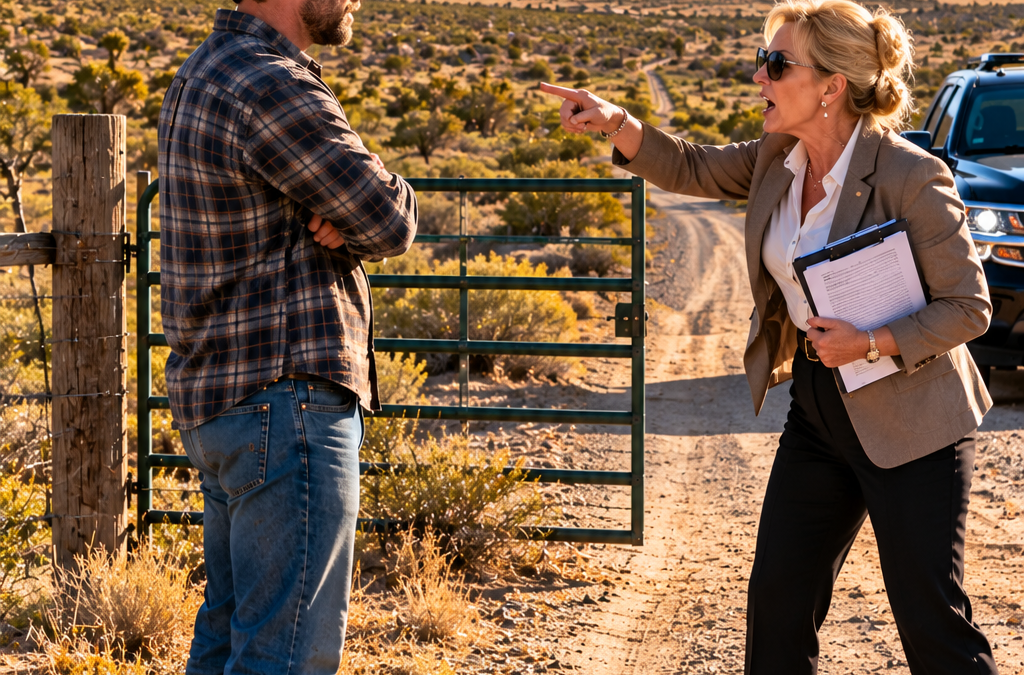
𝗙𝗨𝗟𝗟 𝗦𝗧𝗢𝗥𝗬 Three weeks after I paid cash for six hundred acres of empty desert, a woman from an HOA I had never joined informed me that I owed $2,500 for permission to use land I already owned. When I told her there was no HOA on my deed, she calmly warned me that people who challenged Sundown Ridge usually discovered how expensive noncompliance could become.
𝗙𝗨𝗟𝗟 𝗦𝗧𝗢𝗥𝗬
I stared at my name.
Six hundred acres.
Mine.
No mortgage.
No bank.
No association.
No monthly dues.
I shook their hands, got into my truck, and drove straight out there.
The sun was dropping by the time I arrived.
Wind carried dust across the access road.
I parked near the place I imagined building someday and stepped out.
Silence.
Not suburban quiet.
Actual silence.
No lawn mower.
No air-conditioning units.
No highway.
No dogs barking behind fences.
No basketball bouncing against concrete.
There were small sounds once you stopped moving.
Wind through dry brush.
An insect somewhere in the grass.
My own boots scraping gravel.
But there was enough empty space around me that every sound disappeared almost immediately.
Six hundred acres is difficult to understand until you’re standing on it.
From one boundary to another, the land rolled through dry washes and low ridges.
Scrub brush covered much of it.
There were rocky sections where almost nothing grew.
In one shallow basin, mesquite gathered around an old drainage line.
I climbed onto a ridge and looked west.
Nothing.
I looked east.
Nothing.
That evening, I said something aloud that I would remember later.
“This is mine.”
Nobody answered.
That was the point.
I spent my first night there in a tent.
I could have driven home.
Instead, I set up a small camp near the spot where I wanted my cabin.
After dark, the stars came out.
Not dozens.
Thousands.
The sky looked crowded.
I lay outside the tent for almost two hours.
I started imagining what I could build.
Small off-grid cabin.
Nothing extravagant.
Maybe eight hundred square feet at first.
Covered porch facing west.
A well if drilling worked out.
Solar panels.
A septic system.
Equipment shed.
Later maybe a larger workshop.
I wanted a few animals eventually.
I had no grand plan to become a rancher.
I simply wanted room to experiment.
The important part was that I could make those decisions myself, subject to actual county law.
I wouldn’t need to send a paint sample to somebody.
Nobody would measure my fence and decide six feet was aesthetically offensive.
Nobody would tell me my workshop roof needed to match houses that didn’t exist.
That night felt like freedom in physical form.
I wish I could describe the exact emotion better.
It wasn’t excitement alone.
It was relief.
For the first time in my adult life, I felt like I had purchased distance from other people’s opinions.
Three weeks later, I learned how naive that was.
I had ordered fencing materials and arranged for them to be delivered near my proposed cabin site.
Nothing unusual.
Posts.
Wire.
Tools.
A small amount of lumber.
I drove out one afternoon to inspect the delivery.
From fifty yards away, I noticed something white sitting on top of the stack.
At first I thought it was a shipping invoice.
Then I saw the plastic sleeve.
I pulled up beside the materials, got out, and removed the envelope.
Cream-colored paper.
Embossed logo.
SUNDOWN RIDGE PROPERTY OWNERS ASSOCIATION.
I stood there staring at it.
Sundown Ridge?
I had never heard those words.
There was no Sundown Ridge on my deed.
No Sundown Ridge subdivision on any map I had reviewed.
No entrance sign.
No streets.
No houses.
Nothing.
I opened the envelope.
Dear Property Owner of Lot 14, Section C.
That got my attention.
Lot 14, Section C corresponded to an old marketing designation associated with my tract.
They knew exactly which property they were addressing.
The letter welcomed me to the Sundown Ridge planned community.
I actually looked around.
Planned community?
Six hundred acres of sand and brush surrounded me.
The nearest building was so far away I couldn’t see it.
The letter continued.
It explained that all owners were required to comply with community architectural standards.
Structures required approval.
Fencing was subject to height and material restrictions.
Exterior colors had to come from an approved palette.
Utility placement required review.
Temporary structures were prohibited without written authorization.
Then came the fee.
ARCHITECTURAL REVIEW AND INITIAL COMPLIANCE ASSESSMENT: $2,500.
Due within thirty days.
I read it twice.
Then I laughed.
I couldn’t help it.
There I was, standing alone in the middle of nowhere, holding a letter demanding architectural review for a neighborhood that did not physically exist.
I folded the letter and put it in my truck.
My first assumption was fraud.
Not sophisticated fraud.
Just some ridiculous mailing sent to the wrong parcel.
I drove home, opened my closing file, and started checking.
Title report.
No HOA.
Deed.
No HOA.
County assessor.
Nothing.
Recorded covenants.
None.
I searched Sundown Ridge Property Owners Association online.
Almost nothing appeared.
There was a business registration.
Recent.
An address thirty miles from my land.
A phone number.
That was about it.
I called the next morning.
A woman answered on the fourth ring.
“Sundown Ridge Property Owners Association.”
Her voice was pleasant.
Professional.
“Hi. I received a letter yesterday.”
“Lot number?”
I hesitated.
“Fourteen, Section C.”
I heard keyboard tapping.
“Yes. I have your account.”
“My account?”
“Correct.”
“I don’t have an account with you.”
A pause.
“Are you the new owner?”
“Yes.”
“Then the account transferred with the property.”
“No, it didn’t.”
Her voice cooled almost imperceptibly.
“I’m sorry?”
“My deed has no HOA covenant.”
“County paperwork doesn’t always keep up with community agreements.”
I remember sitting back when she said that.
“Community agreements?”
“Correct.”
“What agreement?”
“The Sundown Ridge governing declaration.”
“When was it recorded?”
“I don’t have that date in front of me.”
“Can you send it?”
“Certainly.”
“And where does it say my parcel is subject to it?”
“It applies to Sundown Ridge properties.”
“My property isn’t listed in any Sundown Ridge subdivision.”
“You are Lot 14, Section C.”
“That’s an old marketing lot designation, not an HOA.”
Her tone became more patronizing.
“Sir, these matters can be complicated.”
“I agree. That’s why I’m asking for the recorded covenant.”
“We can provide association documentation.”
“Good.”
“The $2,500 assessment remains due regardless.”
“No.”
Silence.
“What do you mean, no?”
“I mean I’m not paying an organization I’ve never joined until you show me legally recorded documents proving I owe you money.”
The friendliness disappeared.
“Nonpayment can result in administrative penalties.”
“Based on what authority?”
“Our declaration.”
“Send it.”
“We will.”
“And until then, don’t send anyone onto my property.”
There was another pause.
“Nobody has entered your residence.”
“I don’t have a residence there. Somebody entered my land to put that letter on my materials.”
“Association representatives are authorized to conduct compliance contact.”
“Not on six hundred acres I own if your association has no rights there.”
She spoke slowly.
“You’re becoming unnecessarily adversarial.”
I almost laughed.
“I asked for paperwork.”
“You’ll receive it.”
“Good.”
Then, before she hung up, she said something else.
“Most new owners find cooperation easier.”
I stopped.
“What does that mean?”
“It means these disputes can become expensive.”
The line went dead.
That was my introduction to Elaine Mercer.
I didn’t know her name yet.
I would soon.
Officially she was the board secretary.
In practice, Elaine appeared to run nearly everything.
She handled correspondence.
She answered the phone.
She issued notices.
She controlled the meeting calendar.
And from the first conversation, she spoke as if the existence of Sundown Ridge had already been settled by the simple fact that she said it existed.
Two days later, I received an email containing what she called the governing documents.
The file was ninety-three pages.
Declaration.
Architectural guidelines.
Enforcement procedures.
Fee schedule.
Board rules.
Maps.
It looked legitimate.
At first glance.
That was what bothered me.
There were seals.
Legal descriptions.
Signature pages.
Notary blocks.
The kind of material that makes people stop asking questions because it looks too complicated to challenge.
I read the first twenty pages that evening.
Then another twenty.
I noticed the date.
Eight months earlier.
I checked again.
Eight months.
My parcel had been individually conveyed long before then.
So had surrounding parcels.
I emailed Elaine.
These documents were recorded after multiple parcels were already sold. Please provide the earlier covenant or deed restriction that gave the association authority to bind those parcels.
Her response arrived eleven minutes later.
The declaration speaks for itself.
I wrote back.
No, it doesn’t. Please identify the recorded instrument attached to my deed.
No answer.
I requested a meeting.
This time she replied immediately.
Tuesday, 10 a.m.
The address belonged to a strip mall.
When I arrived, I almost thought I’d made a mistake.
A nail salon occupied one unit.
Insurance office beside it.
A tax-preparation business two doors down.
Sundown Ridge was in a narrow office between a dry cleaner and an empty storefront.
The association’s name was printed on a removable plastic sign beside the door.
Inside were three folding chairs facing a folding table.
A whiteboard hung on one wall.
Someone had erased most of a grocery list but left:
MILK
DOG FOOD
BATTERIES
There were no neighborhood plans displayed.
No photographs.
No residents.
Nothing about the place suggested an organization controlling hundreds or thousands of acres.
Elaine sat at the table.
She wore a dark jacket despite the heat.
Probably early fifties.
Hair cut short.
Silver glasses.
Beside her sat two men.
She stood.
“Lot Fourteen.”
I looked at her.
“My name is Jack.”
“Of course.”
No apology.
“This is Mr. Bell and Mr. Kramer, fellow board members.”
I shook their hands.
Neither said much.
Elaine gestured toward the chair.
“We’ve prepared your packet.”
I sat.
A thick binder rested in front of me.
She pushed it across.
“This should answer most of your concerns.”
I opened it.
Same documents.
“These are dated eight months ago.”
“Yes.”
“I bought land that had already been separately recorded.”
“You purchased within the Sundown Ridge planning area.”
“Planning area isn’t the same thing as an HOA.”
Elaine smiled.
Not pleasantly.
“You seem very focused on terminology.”
“I’m focused on whether you can charge me money.”
“All owners benefit from unified planning.”
“Benefit from what?”
She frowned.
“Road coordination.”
“The county road reaches my property.”
“Future private access.”
“I didn’t buy future private access.”
“Architectural standards.”
“I deliberately bought property without them.”
“Shared property values.”
I looked around the strip mall office.
“There are no houses.”
“Yet.”
“So you’re protecting the values of buildings that don’t exist?”
Mr. Bell shifted uncomfortably.
Elaine’s smile vanished.
“What you’re doing is exactly why communities need governance before development becomes chaotic.”
I leaned forward.
“Then govern property you legally control.”
“We do.”
“Show me the instrument putting my land into this association.”
She tapped the binder.
“It’s all there.”
“No. It’s not.”
“It has been reviewed by counsel.”
“Which counsel?”
“That’s privileged.”
“Where is the declaration that existed before my deed?”
“The current declaration governs.”
“How can an agreement created after owners already received unrestricted deeds bind them without their consent?”
For the first time, one of the men spoke.
Mr. Kramer.
“There were development rights.”
“Whose?”
“The original land company.”
“Which company?”
Elaine interrupted.
“We’re not here to conduct a deposition.”
“I thought we were here to answer my questions.”
“We’re here to resolve your noncompliance before fees accumulate.”
I stared at her.
“I don’t have noncompliance.”
“You have an unpaid initial assessment.”
“Because I don’t owe it.”
“You’ve also begun fencing activity without review.”
“I don’t need your review.”
“That’s your position.”
“It’s also the county’s position.”
Her eyes narrowed.
“The county handles zoning. We handle community standards.”
“You don’t handle anything on my property unless my title gives you authority.”
Elaine folded her hands.
“Mr. Dawson—”
“Jack.”
“Mr. Dawson, I have been doing this for years.”
Something about that sentence caught my attention.
“Doing what?”
“Managing association compliance.”
“Here?”
She paused.
“In multiple communities.”
That was interesting.
I didn’t know why yet.
She continued.
“Owners often become upset when they discover restrictions after closing. That doesn’t invalidate those restrictions.”
“I agree.”
That seemed to surprise her.
“If the restriction exists.”
“It does.”
“Show me where it attached to my parcel.”
“We have.”
“No, you handed me a binder created eight months ago.”
Her patience finally broke.
“Do you honestly believe hundreds of acres can be developed with every owner doing whatever he wants?”
“Yes, if that’s what the recorded property rights allow.”
“You’ll destroy long-term values.”
“I’m not part of your development.”
“You are inside its boundaries.”
“According to which county plat?”
She didn’t answer.
I closed the binder.
“I’m going to have an attorney review this.”
Elaine shrugged.
“You’re free to waste money however you choose.”
There was something so casually contemptuous about the way she said it that I felt my anger rise.
I stood.
“Good meeting.”
As I reached the door, she called after me.
“Your review fee is still due.”
I turned.
“No.”
“Then penalties will begin.”
“Do whatever you think you’re legally allowed to do.”
Elaine smiled again.
“We will.”
I left the binder.
She called after me.
“Take it. You’ll need it.”
I almost kept walking.
Instead, I went back and picked it up.
She was right about one thing.
I would need it.
Not for the reason she expected.
Two weeks later, the second letter arrived.
FORMAL VIOLATION NOTICE.
Unauthorized structure.
At first I had no idea what they meant.
Then I realized they were referring to my tool shed.
Shed was generous.
It was a small prefabricated structure I had installed near the fencing materials.
I used it for tools, water containers, gloves, wire, spare parts, and equipment I didn’t want exposed to weather.
County rules did not require a building permit for a structure that small under the conditions applicable to my land.
I’d confirmed that before placing it.
The HOA didn’t care.
The notice claimed I had constructed an unapproved accessory structure inconsistent with Sundown Ridge architectural requirements.
Fine:
$500 PER DAY.
Until removed or approved.
I called Elaine.
She answered.
“Sundown Ridge.”
“It’s Jack.”
“I assumed you’d call.”
“Five hundred dollars a day?”
“That’s the schedule.”
“For a legal tool shed on agricultural property?”
“For an unauthorized structure.”
“Unauthorized by you.”
“Correct.”
“You have still not established that I require your authorization.”
“The board has already addressed that.”
“No. The board avoided it.”
“That’s your interpretation.”
“What happens if I don’t pay?”
“Fees accrue.”
“And then?”
“Collection.”
“You mean a lawsuit?”
“Potentially.”
“Anything else?”
She waited.
Then said, “Liens are available remedies.”
That got my full attention.
“A lien against my property.”
“If your account becomes delinquent.”
“I don’t have an account.”
“You own Lot 14.”
“My land is paid for.”
“That doesn’t eliminate association obligations.”
“There are no association obligations on the title.”
Elaine sighed.
I could hear irritation now.
“Jack, I understand that you believe repeating that sentence somehow changes the declaration.”
“I believe the public record matters.”
“So do we.”
“Then identify the covenant.”
“We’ve provided all required documentation.”
“No, you haven’t.”
Her voice dropped.
“Let me give you some advice.”
“I didn’t ask for advice.”
“Take it anyway.”
I went quiet.
She continued.
“You own valuable acreage. Do you really want to create title problems over a small review fee?”
There it was.
Not subtle anymore.
“Are you threatening to cloud my title?”
“I’m explaining consequences.”
“Based on authority you still haven’t proven.”
“Pay the fee, submit the shed, and this goes away.”
That sentence made everything clear.
She expected exhaustion to do what evidence could not.
Pay the $2,500.
Ask permission.
Accept the relationship.
Once I did that, I wasn’t just resolving a shed dispute.
I’d be behaving like an HOA member.
And Elaine knew it.
“No.”
Her voice went cold.
“Then the fine continues.”
“Send everything in writing.”
“I already do.”
“Good.”
I hung up.
That afternoon, I called the real estate attorney who had reviewed my purchase.
His name was Martin Cole.
I forwarded the binder, letters, fee demands, and violation notices.
He called me the next morning.
“Where did you get this declaration?”
“Their office.”
“Did you sign anything?”
“No.”
“Ever pay them?”
“No.”
“Did the seller sign anything while he owned the property?”
“Not that I know.”
“I’ll check.”
“Can they lien the land?”
Martin paused.
“Anyone can attempt to file something. Whether it survives is another matter.”
“That’s not comforting.”
“It’s not supposed to be.”
I walked outside my house while we talked.
“What do you think?”
“I think their timeline is strange.”
“Because the declaration is recent?”
“Very.”
“Could they legally create an HOA after the deed and bind me?”
“Not simply by deciding to, no. There are circumstances involving reserved development rights, master declarations, annexation authority, things like that. We need to examine the full chain.”
“That’s what Elaine keeps hiding behind.”
“Then we’ll see whether it’s real.”
For the next two weeks, Martin researched.
I kept going to the property.
I kept working.
I didn’t remove the shed.
I didn’t pay the fee.
I didn’t submit my fence for approval.
And I documented everything.
Every envelope.
Postmark.
Email.
Phone call.
I created a spreadsheet.
Date.
Sender.
Demand.
Amount.
Deadline.
Claimed authority.
I photographed the shed.
I saved county zoning screenshots.
I downloaded certified assessor maps.
Something about Elaine’s confidence had stopped feeling like ordinary arrogance.
It felt practiced.
Like she’d had this argument before.
So I started asking around.
There were several other large parcels scattered through the desert surrounding mine.
Most had sold within the previous year or two.
I found an owner through county records named Rafael Torres.
He owned eighty acres about four miles east.
I called him.
“This is going to sound strange. Have you ever received anything from Sundown Ridge Property Owners Association?”
Silence.
Then:
“Who are you?”
“Jack Dawson. I own the big tract west of you.”
Another pause.
“How much did they ask you for?”
That answered my question.
“Twenty-five hundred to start.”
He laughed without humor.
“Same.”
“Did you pay?”
“Hell no.”
“What happened?”
“Letters. Threats. They said my RV pad violated community design.”
“You’re in the HOA?”
“I don’t think so.”
“Your deed?”
“Nothing.”
My stomach tightened.
“How long have they been contacting you?”
“Six months.”
“Ever threatened a lien?”
“Last month.”
I wrote everything down.
Rafael gave me the number of another owner.
She had received the same fee demand.
Different lot number.
Same amount.
Same thirty-day deadline.
Then I found another.
And another.
Every story had the same shape.
Land bought without an HOA disclosed.
Letter arrives later.
Association claims some development authority.
Initial fee.
Architectural restrictions.
Violation notices.
Threat of lien.
Most people hadn’t paid.
One had.
A retired couple with forty acres.
They were terrified of damaging the title to the property they planned to leave their children.
They had written a check for $2,500 and another $1,800 in “compliance fees.”
When the husband told me, his voice was embarrassed.
“I figured it was cheaper than a lawyer.”
I understood.
That was probably exactly what Sundown Ridge depended on.
The numbers were carefully chosen.
Painful enough to generate money.
Not always painful enough to justify hiring counsel.
A manufactured nuisance.
Pay to make it disappear.
That night I reopened the binder.
I went page by page.
Then I reached the signature section.
I had seen it before without paying much attention.
One name appeared repeatedly beneath development authorization language.
Gerald Voss.
He wasn’t one of the three people at the strip mall.
He wasn’t listed on the association website.
His signature looked older than the rest of the paperwork, as though it had been reproduced from something else.
I searched the name.
The first results were ordinary.
Business registrations.
Land companies.
Registered agents.
Then I found a court case in the neighboring county.
Gerald Voss.
Property owners association.
Declaratory judgment.
I opened the docket.
The language felt familiar immediately.
Remote parcels.
Association formed after individual deeds.
Fees demanded from landowners.
Claimed development authority.
Owners challenged enforceability.
I called Martin.
“You need to search Gerald Voss.”
“I already did.”
His tone told me something had changed.
“And?”
“Come to my office tomorrow.”
I arrived at nine.
Martin had a stack of documents waiting.
“Your instincts were right.”
He slid over a court ruling.
I read.
A company connected to Voss had acquired a large remote tract years earlier.
It sold parcels individually.
After many deeds had already been recorded without mandatory association covenants, an entity later filed documents attempting to create a property owners association and impose assessments.
Owners sued.
The court rejected the attempted retroactive application against parcels lacking the necessary recorded restrictions or valid annexation mechanism.
“Same guy?”
“Same name. Same connected business network.”
“How many cases?”
“At least two significant ones I found.”
He handed me another.
Different county.
Similar facts.
Same result.
I stared at the papers.
“So Sundown Ridge isn’t some weird new board making a mistake.”
Martin leaned back.
“I wouldn’t jump further than the evidence.”
“Come on.”
“I’m your lawyer. My job is to jump exactly as far as the evidence allows.”
I nodded.
“Fine.”
He continued.
“But I will say this: the structure raises serious concerns.”
He showed me business filings.
Sundown Ridge Property Owners Association had been created recently.
A development company tied to Gerald Voss appeared in parts of the paper trail.
There were overlapping mailing addresses.
Management entities.
Registered-agent relationships.
Not illegal by itself.
But suspicious when combined with the timing.
Martin then pulled out my title report.
“I reviewed the complete chain.”
“And?”
“No recorded HOA covenant.”
I exhaled.
“No declaration?”
“No.”
“No annexation?”
“No.”
“No reserved right in the prior deed allowing a developer to add me later?”
“Nothing I found that does what Sundown Ridge claims.”
“Can they collect dues?”
“Not based on the documents I’ve reviewed.”
“Fine me?”
“Same answer.”
“Put a lien on my property?”
“They can threaten. Filing a valid lien is a different matter.”
I sat back.
For weeks, despite how certain I’d sounded with Elaine, there had been a small part of me wondering whether I had missed something.
Some buried paragraph.
Some old master plan.
Some legal mechanism I didn’t understand.
Now that uncertainty disappeared.
My deed was clean.
The title was clean.
Sundown Ridge had been created after the relevant conveyances.
No binding covenant connected me to it.
I felt relief for about thirty seconds.
Then anger replaced it.
Because Elaine knew I had asked these questions.
Repeatedly.
She hadn’t said:
We’re checking.
She hadn’t said:
There may be a title issue.
She had threatened me.
Five hundred dollars a day.
Lien.
Title problems.
And I wasn’t the only one.
“Martin.”
“Yeah?”
“How many people have paid them?”
“I don’t know.”
“I want to find out.”
He studied me.
“What are you thinking?”
“This isn’t an HOA dispute anymore.”
“I agree.”
“What is it?”
“Potentially a consumer-protection problem. Potentially more. We should be careful with labels until we have facts.”
I nodded.
“What do we do?”
“First, I send a cease-and-desist letter.”
“Then?”
“We contact the other owners if they’re willing.”
“I already have several.”
“Good.”
“We report it?”
“If the pattern supports it, yes.”
I smiled slightly.
Elaine had spent weeks telling me to use proper channels.
I was finally ready to do exactly that.
Martin’s letter was four pages.
No emotion.
No insults.
No threats beyond legal remedies.
It identified my parcel.
The deed date.
Relevant title history.
The absence of recorded covenants.
The timing of the Sundown Ridge declaration.
It disputed every fee and fine.
It demanded that all enforcement stop.
It warned against recording any lien or other instrument against title without lawful basis.
And it requested documentary evidence of the association’s claimed jurisdiction within ten business days.
Elaine called me personally the day she received it.
I didn’t answer.
She called again.
Then emailed.
Please contact me directly so we can resolve this without unnecessary attorney involvement.
I forwarded it to Martin.
He replied:
Don’t engage. Let me handle it.
That was harder than I expected.
I wanted to call her.
I wanted to hear the change in her voice now that she knew someone had finally examined the paper.
Instead, I waited.
The HOA’s written response was almost comically vague.
It repeated that Sundown Ridge had development authority.
It asserted that owners had received constructive notice.
It claimed architectural review obligations ran with the land.
What it did not provide was the one thing we’d asked for.
A valid recorded instrument binding my parcel.
Martin called.
“They’re dodging.”
“I noticed.”
“Now we build the record.”
I contacted every owner I had found.
Five agreed to work together immediately.
Rafael.
The retired couple.
A woman named Rebecca who owned one hundred twenty acres.
Two brothers who had purchased adjoining parcels.
One of the brothers was married to a paralegal named Megan.
That changed everything organizationally.
Megan didn’t give legal advice.
She didn’t pretend to be an attorney.
What she did exceptionally well was organize evidence.
She created a shared chronology.
Every owner got a folder.
Deeds.
Title reports.
HOA letters.
Fee schedules.
Emails.
Threats.
Dates.
Certified-mail receipts.
Screenshots.
Corporate filings.
County records.
We built a master table showing when each parcel was conveyed and when Sundown Ridge documents appeared.
The pattern became visually obvious.
Many deeds first.
HOA later.
Then demands.
Megan looked at the timeline one evening and said, “If somebody wanted to design evidence that makes an agency investigator interested, this is pretty close.”
Rafael laughed.
“They did all the work themselves.”
He wasn’t wrong.
Elaine’s letters were aggressive.
Precise.
Consistent.
They didn’t read like casual mistakes.
They read like a system.
My $500-a-day fine reached an absurd theoretical total.
Elaine sent another notice claiming my account balance exceeded $14,000.
I showed Martin.
“Do I frame this?”
“Save it.”
“I’ve saved everything.”
“Then save it twice.”
We filed a complaint with the state attorney general’s consumer protection division.
Not just me.
Multiple landowners.
The complaint focused on fee solicitation, representations of mandatory membership, threats of property liens, and the discrepancy between Sundown Ridge’s claims and recorded deed histories.
We attached evidence.
A lot of evidence.
We also filed a civil action seeking a declaration that the later HOA documents did not apply to our parcels.
The moment that happened, Sundown Ridge’s behavior changed.
Not gradually.
Immediately.
The phone stopped ringing.
No new fine letters.
No emails.
Elaine vanished.
I called the strip mall office once from a blocked number.
Recorded message.
“This office is temporarily unavailable due to renovation.”
Rafael drove by two days later.
The plastic Sundown Ridge sign was gone.
There was brown paper covering the window.
“Renovation,” he said when he called me. “Looks more like evacuation.”
I laughed.
But Martin warned us not to assume anything.
“Silence doesn’t mean surrender.”
“What does it mean?”
“It means they’re talking to lawyers.”
He was probably right.
For weeks, nothing happened publicly.
The Attorney General’s office acknowledged receipt of our materials but didn’t give us a running commentary.
That’s normal.
Investigations aren’t entertainment.
You don’t get daily updates.
You submit evidence.
Answer questions.
Wait.
Waiting was difficult.
I continued building.
Not much.
I wasn’t ready for the full cabin yet.
But I improved the road.
Finished more fencing.
Organized a well assessment.
The tool shed remained exactly where it was.
Every time I opened the door, I thought about the $500-a-day fine that supposedly made it one of the most expensive small buildings in the state.
One afternoon, a pickup I didn’t recognize stopped near my gate.
I walked over.
A woman lowered the window.
“Are you Jack Dawson?”
“Depends.”
She smiled.
“I’m not with the HOA.”
“That’s a good start.”
Her name was Laura.
She owned land several miles south.
She had heard about our complaint through another owner.
Sundown Ridge had billed her too.
She had paid.
Almost six thousand dollars.
Her eyes filled with anger as she told me.
“They said if I didn’t pay, I wouldn’t be able to sell.”
“Did you have a lawyer?”
“No.”
“Title restriction?”
“I didn’t know to check.”
She looked toward my property.
“I was scared.”
That sentence stayed with me.
Not stupid.
Not careless.
Scared.
That was the business model, if our suspicions were right.
Fear.
You buy land.
You’re proud.
Then an official-looking organization tells you that you owe money.
They mention liens.
Legal fees.
Title problems.
Most ordinary people don’t understand property law.
Why would they?
They hear “lien” and imagine losing the land they just spent years buying.
So they pay.
That was when the situation stopped being personal to me.
Until then, I had wanted Sundown Ridge off my property.
After meeting Laura, I wanted answers.
Elaine had spoken to me as if resistance was childish.
She had told me cooperation was easier.
Of course it was easier.
For them.
People like Laura cooperated.
Thousands of dollars changed hands.
No lawyer required.
No judge.
No valid covenant.
Just fear and paperwork.
Megan added Laura’s documents to our chronology.
Then another owner surfaced.
Then another.
The pattern expanded.
Different amounts.
Same language.
One owner had been charged a “road preservation contribution” even though no association road reached his parcel.
Another had paid for mandatory architectural review of a house he had never planned to build.
One received a violation for parking a shipping container on agricultural property.
Every communication cited the Sundown Ridge declaration.
The declaration that appeared after their deeds.
Martin eventually obtained additional company records tied to Gerald Voss.
There wasn’t one simple entity.
That would have been too easy.
There were land companies.
Management companies.
Associations.
Different registered addresses.
Gerald appeared in some records directly and others indirectly.
But the connection was strong enough that we understood why his name had bothered me.
I remembered the first board meeting.
That signature in the back of the binder.
A name none of the board members explained.
At the time, I thought it was paperwork clutter.
Now it looked like a fingerprint.
Months passed.
Then Martin called.
“I found something.”
I had heard him say that enough times that I immediately sat down.
“What?”
“Sundown Ridge filed dissolution documents.”
I didn’t answer.
“Jack?”
“Say that again.”
“The association is dissolved.”
“Voluntarily?”
“That’s how the filing appears.”
“When?”
He gave me the date.
I checked the calendar.
It was right around the time the Attorney General’s inquiry became active.
“Did they announce anything?”
“Not that I found.”
“Did they tell owners?”
“Apparently not.”
I leaned back.
For weeks, we had been preparing for a long fight.
Discovery.
Hearings.
Potential trial.
Instead, the organization that had threatened thousands of dollars in fines and a lien against my six hundred acres had quietly stopped existing.
“What happens to the fines?”
“Against your parcel? We already disputed them. There’s no valid association claim I see.”
“The $2,500 fee?”
“No.”
“$500 a day?”
“No.”
“Lien?”
“None filed.”
“And the declaration?”
“As applied to your property, our position remains what it was: it never bound you.”
I looked through the window.
It was strange.
I thought I would feel triumphant.
Instead I felt tired.
Deeply tired.
“That’s it?”
“Legally, there are still loose ends. Agency review may continue. Owners who paid money may have claims. Dissolution doesn’t magically erase everything that happened.”
“But they’re done.”
“The HOA entity is.”
I thought about Elaine.
The strip mall office.
The folding table.
The binder.
The confidence in her voice.
Most new owners find cooperation easier.
I asked Martin, “Any idea where she went?”
“No.”
“Gerald?”
“Still connected to other entities.”
That bothered me.
But for my property, the central fight was over.
No Sundown Ridge.
No fees.
No architectural committee.
No violation account.
No fictional debt multiplying by $500 every sunrise.
I drove to the land that evening.
Same road.
Same dust.
Same desert.
I parked near the original campsite.
For the first time in months, I didn’t bring legal folders.
No certified letters.
No binder.
Just water and a folding chair.
I sat until dark.
The stars came back exactly as they had the first night.
That was the strange thing about the land.
It had been quiet throughout everything.
While Elaine sent letters, the desert remained quiet.
While lawyers reviewed title chains, quiet.
While fines supposedly accumulated, quiet.
While agencies opened files, quiet.
The land never changed.
Only the story someone tried to attach to it had changed.
Sundown Ridge had looked at six hundred empty acres and tried to redefine them.
Lot 14.
Section C.
Architectural district.
Association account.
Violation property.
Delinquent owner.
Those were their words.
I had my own.
Mine.
Not in the childish sense.
Not because ownership means limitless freedom.
Because I had purchased a specific legal parcel with a specific recorded title.
Rights and restrictions were knowable.
Recorded.
Searchable.
They weren’t whatever Elaine decided to place in a binder eight months later.
Construction on my cabin began the following spring.
I intentionally kept it modest.
People who hear “six hundred acres” imagine I built some enormous ranch house.
I didn’t.
The first cabin was under a thousand square feet.
Simple rectangular footprint.
Metal roof.
Large porch.
Solar array set back from the house.
Water storage while I figured out the well.
Inside, polished concrete floors, basic kitchen, one bedroom, one small loft.
Exactly what I wanted.
I remember the day we finished the exterior siding.
The contractor asked, “You sure about this color?”
I looked at him.
“Why?”
“No reason. Just asking.”
For half a second, all I could hear was Elaine talking about approved exterior colors.
I started laughing.
The contractor stared.
“What?”
“Nothing.”
I looked at the cabin.
“Yeah. I’m sure.”
No architectural review fee.
No palette.
No committee.
The color was legal.
I liked it.
That was enough.
I kept the original tool shed too.
There was no reason not to.
For a while, I considered hanging one of Sundown Ridge’s violation notices inside.
Then I decided I didn’t want that organization occupying wall space in a building it had never controlled.
So the letters stayed in my files.
The other owners continued sorting out claims involving money they had paid.
Some recovered funds through legal channels and settlements.
Others had more complicated situations.
I won’t pretend every person’s problem vanished because the association dissolved.
Property disputes aren’t that clean.
But the shared effort changed something important.
People started checking.
They stopped treating HOA letterhead like a court order.
They requested recorded instruments.
Asked for parcel-specific authority.
Compared dates.
Shared information.
The isolation Sundown Ridge depended on disappeared.
That mattered.
If Elaine contacted six owners separately, she controlled six separate conversations.
Each person thought they were alone.
Each worried they had misunderstood their deed.
Each feared hiring a lawyer would cost more than paying the fee.
The moment we compared letters, the strategy lost much of its power.
Same language.
Same threats.
Same weaknesses.
Fear thrives in isolation.
Evidence improves with company.
About eight months after Sundown Ridge dissolved, Rafael drove out to see the cabin.
He stood on the porch looking across the desert.
“You know, I hated you when you called.”
I laughed.
“Why?”
“Because I was trying not to think about those letters.”
“Sorry.”
“No, seriously. I had shoved them in a drawer.”
He leaned against the porch post.
“I thought maybe if I ignored them, they’d forget me.”
“Worked?”
“Nope.”
We both laughed.
He became serious.
“I almost paid.”
“How close?”
“Check written out.”
“Why didn’t you?”
“My wife stopped me.”
“What’d she say?”
“She asked why the title company never mentioned an HOA.”
I nodded.
“Good question.”
“Best question anyone asked.”
We sat quietly.
Then Rafael said, “Do you know what made me the angriest?”
“The fake authority?”
“No.”
“The money?”
“No.”
“What?”
“The way they made me feel stupid for asking.”
I understood instantly.
Elaine had done the same thing to me.
These matters can be complicated.
You seem very focused on terminology.
Most owners cooperate.
You’re becoming unnecessarily adversarial.
Every phrase carried the same message.
You don’t understand this.
We do.
Stop asking.
Pay.
That was how the pressure worked.
Not just through legal threats.
Through embarrassment.
Make owners feel foolish for questioning documents.
Make them feel difficult.
Make resistance look expensive and obedience look mature.
I told Rafael, “That’s probably why she hated paperwork questions.”
“Because she didn’t have answers?”
“Because questions changed the power balance.”
We watched the sunset from the porch.
I had pictured that exact view years earlier.
Before the purchase.
Before Sundown Ridge.
Before I knew what Lot 14, Section C supposedly meant.
The cabin stood where my tent had been.
Same ridge.
Same stars at night.
The property was still mostly untouched.
I liked that.
I didn’t buy six hundred acres so I could cover them with buildings.
I bought them because emptiness had value.
Elaine never seemed capable of understanding that.
To her, undeveloped land was unfinished.
Something waiting for a planned community.
Roads.
Uniform architecture.
Review fees.
Boards.
Rules.
But I had bought it precisely because it wasn’t those things.
One day, while researching something unrelated, I searched Gerald Voss again.
I don’t know why.
Curiosity.
Bad habit.
Maybe both.
A new business registration appeared.
Different county.
Different association name.
Similar structure.
My chest tightened.
I called Martin.
“You’re going to love this.”
“I doubt that.”
I gave him the name.
He was quiet while typing.
“Yeah.”
“You see it?”
“I see a connection.”
“Three counties away.”
“Looks that way.”
“Same thing?”
“Don’t know yet.”
I stared at the screen.
A fresh association.
Remote land.
Names overlapping with entities we’d seen before.
I remembered that signature in the binder.
Gerald Voss.
The name I’d almost ignored.
It was tempting to believe Sundown Ridge had been one bizarre event.
One bad scheme.
One group of people making one set of terrible decisions.
The new filing suggested the pattern hadn’t necessarily ended.
But that was a different case.
Different landowners.
Different documents.
I wasn’t going to claim facts I couldn’t prove.
What I did know was that we passed along what we’d found to the appropriate people.
If somebody else received a cream-colored envelope in the desert, maybe they wouldn’t have to start from zero the way I did.
Years later, I still have the first Sundown Ridge letter.
It’s in a file cabinet in the cabin.
Sometimes I pull it out.
The paper has curled slightly.
The embossed logo isn’t impressive anymore.
There was a time when that envelope made my stomach tighten.
Now it looks almost ridiculous.
WELCOME TO SUNDOWN RIDGE.
I was never a member.
ARCHITECTURAL REVIEW FEE: $2,500.
Never owed.
COMPLIANCE REQUIRED.
Not by them.
I think about the person who carried that envelope onto my land and placed it on top of the fencing materials.
At the time, that act felt invasive.
Now it feels symbolic.
They arrived uninvited.
Declared authority.
Left instructions.
Expected obedience.
The entire dispute was contained in that one moment.
Someone assumed putting an official-looking document on my property was enough to create a relationship that the title itself did not create.
It wasn’t.
There is a lesson in that, but it isn’t that every HOA is illegitimate.
They’re not.
Plenty of people knowingly buy properties subject to associations.
Those covenants can be valid.
Those obligations can be real.
If they’re in the title, they’re in the title.
My lesson was narrower.
Know what you actually bought.
Don’t rely on the loudest person in the argument to explain your property rights.
Check the record.
If someone says you owe money, ask why.
If someone says your land is bound by restrictions, ask where they were recorded.
If someone threatens your title, take it seriously—but taking a threat seriously does not mean assuming the threat is valid.
For me, that distinction saved thousands of dollars.
Maybe more.
Because I often wonder what would have happened if I had paid the initial $2,500.
Elaine would have entered it into an account.
Then the shed review.
Maybe another fee.
Fencing.
Cabin plans.
Solar placement.
Every new project would become evidence that I accepted Sundown Ridge authority.
Maybe I could have fought later.
But later would have been messier.
Instead, the answer began with one word.
No.
Not an angry no.
Not a reckless one.
A documented one.
Show me the authority.
They couldn’t.
Everything followed from that.
The cabin has grown slightly since then.
I added a larger storage building.
Expanded solar.
Drilled the well.
Built more fencing.
There are animals now.
Not many.
Enough to make mornings interesting.
Sometimes I wake before sunrise and sit on the porch with coffee.
There’s a particular moment just before daylight when the desert is almost completely gray.
Then the first sunlight hits the ridge.
Everything changes color quickly.
Gold.
Red.
Brown.
Six hundred acres open in front of me.
No roofs.
No streetlights.
No entrance monument announcing Sundown Ridge.
No community clubhouse.
No architectural committee.
Just land.
My land.
Not because I fought harder than everyone else.
Not because I had more money.
I definitely didn’t.
Not because I was fearless.
I wasn’t.
When Elaine mentioned a lien, I was afraid.
When fines reached five figures on paper, I wondered whether I had somehow made a terrible mistake.
When Martin started researching the title chain, I worried he might find some buried covenant that proved Elaine right.
That fear was real.
But fear isn’t proof.
That’s another thing I learned.
People can make you feel legally vulnerable without actually possessing legal authority.
The emotional effect arrives before the facts.
That’s why threatening letters work.
Your heart reacts before your brain finishes reading.
Lien.
Fine.
Enforcement.
Collection.
Legal action.
Those words are chosen for a reason.
I learned to slow down.
Read the entire page.
Find the source.
Check the date.
Ask who signed it.
Ask what existed first.
In my case, chronology told almost the whole story.
My deed existed.
The parcels had been conveyed.
Then Sundown Ridge appeared.
Elaine wanted me to treat the later binder as though it had traveled backward through time and inserted itself into earlier ownership.
It hadn’t.
One evening, Megan visited the property with her husband.
She had never seen the cabin.
We sat outside eating grilled burgers while she laughed about the old shared spreadsheet.
“I still have it.”
“Why?”
“Because it’s beautiful.”
“It’s a spreadsheet.”
“Exactly.”
She pulled out her phone.
Apparently she had saved a PDF version.
Rows of dates.
Parcel numbers.
Letters.
Fees.
Recording dates.
“Look at this,” she said.
I stared.
“What am I looking at?”
“The thing that killed their story.”
“Not exactly dramatic.”
“That’s why I love it.”
She zoomed in.
“See this column?”
Deed recording date.
Next:
Association declaration date.
Across parcel after parcel, the order repeated.
Deed first.
Association later.
Megan said, “They relied on complexity. But once you put everything in one table, it wasn’t complex anymore.”
That was true.
Elaine had buried authority inside ninety-three pages.
Megan reduced the problem to two columns.
What existed when the land was sold?
What appeared afterward?
Sometimes the right organization of facts matters as much as the facts themselves.
After dinner, we walked toward the original tool shed.
Her husband laughed.
“This is the famous illegal structure?”
“Five hundred dollars a day.”
He walked around it.
“Fancy.”
“Careful. You’re looking at millions in accumulated violation value.”
Megan opened the door.
Rakes.
Fencing tools.
Buckets.
A spare tire.
She shook her head.
“They threatened a lien over this?”
“Among other things.”
She closed the door.
“People are unbelievable.”
I looked across the land.
“No. People are predictable.”
“What do you mean?”
“If something looks official enough, most of us assume somebody checked whether it’s legitimate.”
She nodded.
“Until somebody does.”
Exactly.
Until somebody does.
That was the entire story.
For months, Sundown Ridge existed because people behaved as though it had authority.
Letters went out.
Some owners paid.
Some argued.
Some ignored them.
But the association continued because enough people treated the claim itself as evidence.
Then we checked.
Not dramatically.
No secret cameras.
No undercover investigation.
No sheriff kicking down doors.
We compared public records.
Asked lawyers.
Read prior court cases.
Followed corporate filings.
Shared letters.
Submitted complaints.
The story Sundown Ridge told couldn’t survive the documentation.
That was enough.
I never saw Elaine again after the strip mall meeting.
I occasionally wondered what happened to her.
Did she believe the association was legitimate?
Maybe.
People can convince themselves of extraordinary things when their paycheck or authority depends on believing them.
Or maybe she understood exactly how weak the documents were.
I don’t know.
I only know what she did.
She demanded money.
Threatened fines.
Mentioned liens.
Dismissed reasonable questions.
And treated property owners as difficult whenever they asked her to prove the authority she claimed.
I don’t need to know what she believed internally to know how that felt on the receiving end.
Years later, I was at a hardware store in a town about an hour away when a man recognized my truck.
He walked over.
“You own the big Dawson parcel?”
“Yeah.”
“Six hundred acres?”
“That’s me.”
He smiled.
“You’re the guy who fought that fake HOA.”
I laughed.
“I don’t know if I’d put it exactly that way.”
“Everybody does.”
“Everybody who?”
“Land people talk.”
Apparently we had become local folklore.
I corrected him.
“It wasn’t just me.”
He shrugged.
“Still.”
Then he said something that made me think.
“I got one of those letters once.”
“From Sundown Ridge?”
“Different association.”
My attention sharpened.
“What happened?”
“Threw it away.”
“Did you check whether it was valid?”
“Nope.”
“Then don’t use my story as a reason to ignore paperwork.”
He looked surprised.
I continued.
“Check first.”
“But yours was bogus.”
“Mine was unenforceable against my parcel based on the title. Yours might not be.”
That matters.
The lesson isn’t that every official notice is fake.
The lesson is that official notices should be verified.
Being skeptical isn’t the same as being careless.
If your deed genuinely contains restrictions, pretending otherwise won’t save you.
Facts work both directions.
That’s what made our position strong.
We weren’t arguing that nobody could ever create an HOA.
We were arguing that this particular entity could not simply impose itself on these particular parcels after the fact without the required legal foundation.
That was a much narrower argument.
And it was supported by the records.
The man at the hardware store nodded.
“Maybe I’ll dig that letter out.”
“Good idea.”
I never found out what happened.
I hope he checked.
My property has changed over the years.
Slowly.
That was intentional.
I built only what I needed.
The desert still dominates the place.
At night, artificial light reaches only a small area around the cabin.
I designed it that way.
I still like seeing stars.
Sometimes I sleep outside on the porch.
It reminds me of that first night.
I remember lying beside the tent believing I’d escaped every complication associated with other people’s rules.
I was wrong about that.
Buying remote land didn’t remove conflict from my life.
In some ways, it created a kind of conflict I had never imagined.
But I was right about one thing.
That first night, I wanted the freedom to make lawful decisions about my own land without surrendering them to a committee that had no legitimate claim.
I have that now.
The freedom means more because I had to understand exactly where it came from.
Not emptiness.
Not distance.
Paper.
A recorded deed.
A title chain.
County law.
The boring things.
The same things most people never read until somebody threatens them.
My cabin porch faces west.
Near sunset, the desert turns almost orange.
I often sit there after work.
The old tool shed is visible from one end of the porch.
Behind it, fencing runs toward a low ridge.
Beyond that, hundreds of acres remain open.
Sometimes I imagine a Sundown Ridge neighborhood exactly as Elaine described it.
Rows of houses.
Approved colors.
Matching fences.
Association roads.
A clubhouse.
Maybe someday development will reach closer.
Land doesn’t remain empty forever simply because one owner likes silence.
That’s fine.
Other people can build on what they own.
The line that matters is the same one that mattered from the beginning.
They build there.
I decide here.
Simple.
One morning, years after the dispute, I found the original cream-colored envelope while cleaning a desk drawer.
I carried it outside.
Sat on the porch.
Read the first paragraph.
Welcome to Sundown Ridge.
I laughed.
The confidence was extraordinary.
They didn’t ask whether I knew about the association.
Didn’t explain when it had been formed.
Didn’t disclose that the declaration was recent.
Didn’t invite me to review whether my deed was bound.
Welcome.
As though my participation had already been decided.
Then the fee.
$2,500.
Then the rules.
Fence heights.
Structure approval.
Exterior colors.
The letter represented an entire future somebody else had drafted for my land.
I folded it again.
For a second, I considered burning it.
Instead, I returned it to the file.
Not because I was still angry.
I wasn’t.
Because memory is useful.
People forget how uncertain they felt after the outcome becomes obvious.
Today it’s easy to look back and say I knew Sundown Ridge was wrong.
I didn’t know.
I suspected.
Big difference.
When Elaine threatened my title, I didn’t know how far she could push.
When Martin reviewed the documents, I waited like someone waiting for medical results.
When we sent the Attorney General complaint, nobody promised us anything.
There was no guaranteed ending.
We simply kept asking for evidence.
Eventually, there wasn’t enough on their side.
That’s what I want to remember.
Certainty came after investigation.
Not before.
And maybe that’s why the desert still means what it meant to me on closing day.
It isn’t freedom because nobody can ever challenge me.
Clearly they can.
It’s freedom because challenges have to survive reality.
Someone can mail me a rulebook.
They can call themselves a board.
They can create a logo.
They can rent an office.
They can buy binders.
They can send certified letters.
They can speak confidently about liens.
But eventually there is a question that all of that has to answer.
Where is your authority?
Sundown Ridge never found a good answer.
The county records did.
So did my deed.
And after months of letters, threats, fines, meetings, lawyers, shared evidence, and an investigation that made the association suddenly disappear from the strip mall where it had once acted so permanent, I ended up back where I started.
On my land.
One evening not long ago, I walked out beyond the cabin after sunset.
No flashlight.
I knew the ground.
I climbed the same ridge I’d stood on immediately after closing.
The cabin lights glowed faintly behind me.
Solar panels were barely visible.
My fences disappeared into darkness.
I stopped at the top.
For a while, I listened.
Silence.
The kind I’d paid for.
The kind I’d almost convinced myself someone could take away with an envelope.
Above me, the stars looked exactly as they had that first night.
I remembered the thought I’d had before Sundown Ridge entered my life.
This is mine, and no one gets a say in it.
I smiled at how simplistic that had been.
Of course other people sometimes get a say.
The county does.
The law does.
Recorded easements do.
Valid restrictions do.
Ownership isn’t the absence of rules.
It’s knowing which rules actually apply.
So I corrected the thought.
Quietly.
“This is mine.”
That was enough.
No committee answered.
No letter arrived.
No woman from a strip mall office told me I owed her $2,500 for the privilege of standing there.
Wind moved across the brush below.
The cabin sat exactly where I’d planned to build it.
The tool shed was still standing.
No lien had ever touched my title.
No $500-a-day fine had ever become real debt.
And the organization that once insisted it had the power to approve the color of a house that didn’t even exist when I bought the land was gone.
Six hundred acres stretched into the darkness.
Open.
Quiet.
And still mine.

