They Thought My Thirty Years of Service Were an Old Woman’s Confused Memory Until Someone at the Door Recognized Me
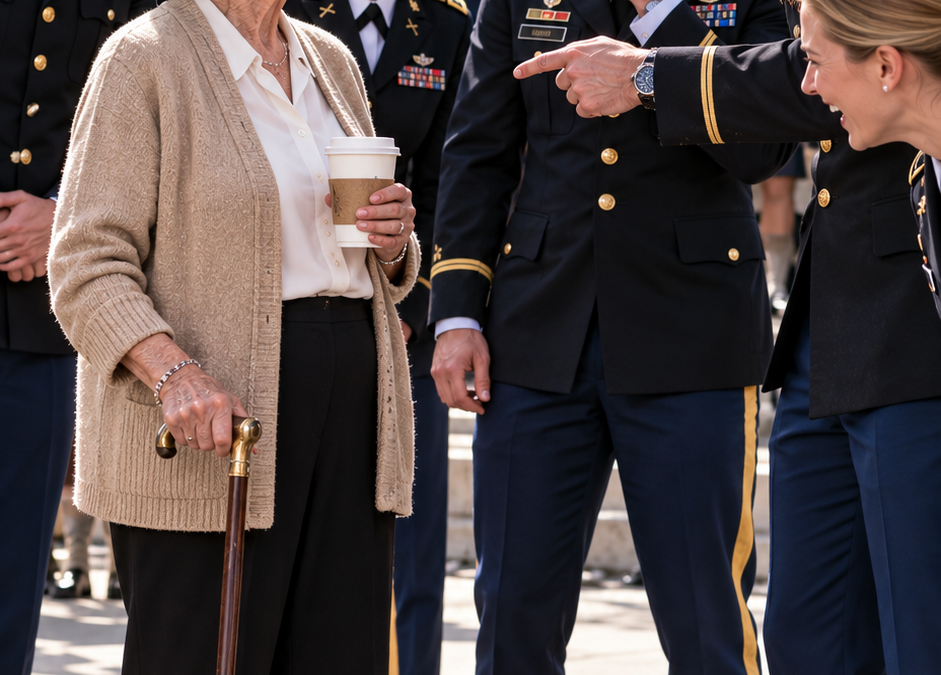
They Thought My Thirty Years of Service Were an Old Woman’s Confused Memory Until Someone at the Door Recognized Me
The laughter started with one lieutenant.
Then another officer joined him.
Within seconds, half the circle around me was smiling as though I had just told the most ridiculous story they had heard all morning.
I stood there holding a paper cup of coffee in one hand and the polished handle of my cane in the other.
My beige cardigan hung loosely over a simple white blouse. I wore black slacks, comfortable shoes, and the small silver bracelet my husband had given me before my final deployment.
My hair was gray.
My shoulders were smaller than they had once been.
My hands had begun to show the blue veins and swollen knuckles of seventy-eight years.
To everyone around me, I looked exactly like what they expected to see.
An elderly woman.
Someone’s grandmother.
Someone who belonged in the back row of a veterans’ appreciation ceremony, smiling politely while younger soldiers told stories about service.
Not someone whose own stories had filled thirty years.
The young officer nearest me covered his mouth, but not quickly enough to hide his grin.
“Thirty years?”
I looked at him.
“Yes.”
A woman beside him laughed.
“Maybe she means her husband served thirty years.”
“No.”
I kept my voice calm.
“I mean I did.”
That made them laugh harder.
Not cruelly at first.
That is important.
Most people are not cruel in the theatrical way stories make them.
They do not wake up planning to humiliate someone.
They simply become comfortable with an assumption.
Then they defend it.
A retired officer standing nearby glanced at my cardigan.
“Were you civilian staff?”
“No.”
“Army family?”
“No.”
“Contractor?”
“No.”
The lieutenant tilted his head.
“When did you join?”
“1968.”
A few people exchanged looks.
He laughed again.
“I’m sorry, ma’am. You’re saying you were active duty for thirty years?”
“Yes.”
“And what rank did you retire at?”
I already knew why he was asking.
It was not curiosity.
It was a test.
I had spent decades learning to recognize the difference.
“Command Sergeant Major.”
Silence came first.
Then laughter.
Louder this time.
One young officer actually shook his head.
“Command Sergeant Major?”
“Yes.”
“Ma’am, that’s a very senior enlisted rank.”
“I remember.”
Someone snorted.
The woman beside him smiled as though she were trying to be kind.
“Maybe the years are blending together.”
I looked at her.
“They aren’t.”
My granddaughter Emily had begged me to attend that event at Fort Hamilton.
I had almost stayed home.
At my age, invitations arrived more often for medical appointments and funerals than military ceremonies, and I had made peace with that.
But Emily would not let it go.
“Grandma, you should go.”
“Why?”
“Because you always complain that nobody remembers the people who served quietly.”
“I do not complain.”
“You absolutely complain.”
“I observe.”
“You observe aggressively.”
I had laughed.
Emily was twenty-one and possessed the dangerous confidence of someone young enough to tell her grandmother the truth without fearing consequences.
The event was supposed to be simple.
Veterans would meet active-duty personnel.
People would exchange stories.
Young soldiers could ask questions about military history.
There would be coffee, flags, framed photographs, and speeches long enough to remind everyone why chairs had been invented.
Nothing official.
Nothing difficult.
I had no intention of becoming part of the program.
I had not brought medals.
I had not worn my uniform.
I had not even brought the box where I kept most of my old insignia.
That was not modesty performed for effect.
It was habit.
My husband, Henry, used to say that if someone asked me what I had done during three decades in the Army, I would probably tell them I answered telephones.
He was not entirely wrong.
I had spent most of my adult life minimizing things.
Not because I was ashamed.
Because military service teaches you quickly that the people who talk the most are rarely the people carrying the heaviest stories.
The mission mattered.
The soldiers mattered.
Getting everyone home mattered.
Whether strangers knew my name did not.
So I walked into Fort Hamilton that morning dressed like a grandmother.
Because I was one.
I had earned that title too.
The trouble began near a display table holding old unit photographs.
A group of younger officers were discussing the changing role of women in the Army.
One noticed the silver bracelet on my wrist.
It carried a small Army emblem.
“Military family?”
I smiled.
“No. I served.”
His expression changed with polite surprise.
“Oh.”
I could have stopped there.
Maybe I should have.
Instead, he asked, “How long?”
“Thirty years.”
And suddenly I was standing in the middle of a room explaining my own life to people who had already decided it did not fit my face.
The lieutenant finally said, “Do you have proof?”
There it was.
I looked at him.
Not angry.
Not yet.
Just tired.
I had been asked for proof many times in my life.
Proof that a woman belonged at a certain briefing.
Proof that I had authority to give an order.
Proof that I understood equipment someone assumed was beyond me.
Proof that I had actually served where the records said I served.
The question itself did not offend me.
Verification mattered in the military.
But tone mattered too.
There is a difference between checking a fact and hoping to catch someone lying.
I reached slowly into my purse.
The room quieted.
I removed an old military identification card.
The lieutenant took it.
His smile weakened.
He looked once.
Then again.
He handed it to the retired officer beside him.
The older man examined it.
For a second, I thought embarrassment might soften the room.
Instead, he said, “These old cards can be confusing.”
I stared at him.
“Yes.”
“Records from that period aren’t always clear.”
“Sometimes.”
“People remember things differently after enough time.”
That sentence hurt more than the laughter.
Not because he doubted me.
Because evidence had just entered the conversation and somehow his assumption still mattered more.
He had already chosen the story.
The old woman must be confused.
The document therefore had to be questionable.
The event coordinator approached us.
Her name was Susan.
She was a civilian employee who had helped organize the morning.
“Everything okay?”
The lieutenant smiled.
“We’re just hearing an interesting story.”
I looked at him.
“Story?”
He shrugged.
“About her military service.”
Susan looked uncomfortable.
“Margaret, you served?”
“Yes.”
“Thirty years?”
“Yes.”
She glanced around the group.
Then back at me.
I did not blame her.
She had walked into a disagreement with no context.
The lieutenant crossed his arms.
“Maybe someone should verify before we let this become part of the ceremony.”
The room around us became quieter.
I repeated the word.
“Verify?”
“Just to protect the integrity of the event.”
Protect the integrity.
Such elegant language.
People often find professional phrases when they want humiliation to sound responsible.
I looked down at my hands.
These hands had once held rifles steady.
They had written casualty reports at two in the morning.
They had carried injured soldiers.
They had signed recommendations for promotion.
They had folded flags.
They had shaken hands with parents whose sons were not coming home.
Now they trembled slightly around a paper coffee cup.
Age does that.
For the first time that morning, I felt something sharper than irritation.
Sadness.
Not for myself.
For the men and women who never became old enough to be doubted.
I had known soldiers who died at nineteen.
Twenty-two.
Twenty-seven.
They never grew gray.
Never needed canes.
Never became grandparents.
Never stood in a bright conference room while younger officers wondered whether the memories in their heads were real.
I was alive.
I had made it all the way here.
And people were laughing because survival had changed the way I looked.
I raised my eyes.
“Fine.”
The lieutenant seemed surprised.
“Fine?”
“Verify it.”
His smile returned.
“Good.”
He turned toward someone near the registration table.
Nobody noticed the far doors opening.
Nobody noticed several senior officers near the entrance suddenly straighten.
Nobody noticed the conversations nearest the doorway die first.
Then the silence moved through the room like a wave.
I looked up.
General William Carter had entered.
Four stars.
Commander of the installation.
More importantly to me, a man I had known for three decades.
We had first met when he was young enough to think rank could solve anything.
I had spent several years teaching him otherwise.
He stopped after two steps.
His eyes found me.
Not the cardigan.
Not the cane.
Not the gray hair.
Me.
His expression changed.
Then he began walking across the room.
The lieutenant beside me straightened.
The retired officers turned.
People stepped aside.
Nobody understood where Carter was going.
I did.
My stomach tightened.
“William,” I whispered.
He stopped directly in front of me.
For a moment, neither of us spoke.
His hair was gray now too.
His face carried the deep lines of command.
But his eyes were exactly the same.
He raised his right hand.
Perfectly.
Deliberately.
And saluted.
The room went completely silent.
I stared at him.
The salute lasted only a few seconds.
But I felt thirty years inside it.
Mud.
Dust.
Helicopter rotors.
Hospital corridors.
Briefing rooms.
Winter mornings.
Long nights.
Names on casualty lists.
Soldiers who became leaders.
Leaders who became memories.
I straightened as much as my back allowed.
Returned the salute.
Carter lowered his hand.
“Command Sergeant Major Ellis.”
Hearing the title aloud after all those years felt like hearing a name that had once belonged to someone else.
I smiled faintly.
“General.”
The lieutenant beside me swallowed.
“Sir…”
Carter turned.
“Yes, Lieutenant?”
“I… I didn’t realize—”
“No.”
His voice was not angry.
That made it worse.
“You didn’t.”
The room became even quieter.
Carter looked around.
“Apparently there is confusion about who Command Sergeant Major Margaret Ellis is.”
Nobody answered.
“Allow me to correct that.”
I wanted to disappear.
That surprises people when I tell this story.
They imagine I had been waiting for vindication.
That seeing everyone embarrassed must have felt wonderful.
It did not.
Public recognition had always made me uncomfortable.
Carter knew that.
Which was exactly why he ignored it.
He faced the room.
“Margaret Ellis served thirty years in the United States Army.”
He paused.
“She served thirty years, four months, and eleven days, if memory serves.”
I muttered, “You always were annoying.”
His mouth twitched.
Several people looked confused.
Carter continued.
“She held leadership positions across three divisions.”
The lieutenant stared at the floor.
“She deployed repeatedly.”
The woman who had laughed lowered her coffee.
“She received the Army Distinguished Service Medal.”
A murmur moved through the room.
“And she trained more soldiers and junior leaders than most people here will ever meet.”
I looked at Carter.
“That’s enough.”
He ignored me.
Of course.
“She did not spend three decades watching other people serve.”
His voice hardened slightly.
“She served where the Army needed her.”
Every person in that room was listening now.
Not because I had demanded it.
Because he had.
That difference bothered me.
I did not become more truthful when a four-star general walked in.
I had been telling the truth ten minutes earlier.
The lieutenant finally spoke.
“Sir, I was only trying to verify her service.”
Carter nodded.
“Good.”
The young man seemed relieved.
“Verification is important.”
Then Carter added, “So is humility.”
The relief vanished.
“Yes, sir.”
Carter looked at me.
“Margaret, do you still have your ID?”
“I just spent ten minutes proving it exists.”
“Humor me.”
I gave it to him.
He held it where the people nearest us could see.
He read my old rank aloud.
Then my years of service.
He did not need the card.
Neither did I.
The point was not the card.
The point was how quickly the room had decided that an old woman’s word required a higher standard of proof.
When Carter finished, he handed it back.
Nobody laughed.
The ceremony continued.
I wished the whole thing would disappear.
Instead, word traveled through the room.
People began approaching me.
Some apologized.
Others explained.
“I didn’t mean anything.”
“I was surprised.”
“I was just being careful.”
“I hope you understand.”
I did understand.
That was almost the problem.
People rarely say, “I judged you.”
They say they were confused.
They say they were curious.
They say the situation looked unusual.
Sometimes all of that is true.
But when you have been on the receiving end enough times, you learn that polite language does not always make disrespect less painful.
The young lieutenant approached last.
His name tag read BROOKS.
He removed his cap.
“Command Sergeant Major.”
I looked at him.
“Yes?”
“My name is Ethan Brooks.”
“I can read.”
A few nerves left his face.
“Yes, ma’am.”
“You don’t have to call me ma’am.”
He took a breath.
“I owe you an apology.”
I waited.
He did not hide behind surprise.
“I assumed things about you because of your age and appearance.”
That was better.
“I treated your answer like something ridiculous before I had any reason to.”
I nodded.
“Yes.”
His face tightened.
“I’m sorry.”
“Thank you.”
He seemed surprised.
“You’re not angry?”
I smiled.
“Lieutenant, I was angry about this before your parents met.”
He laughed awkwardly.
Then became serious.
“How did you handle it?”
“Handle what?”
“Having to prove yourself all the time.”
I looked around the hall.
Memorial photographs lined one wall.
Young faces.
Old uniforms.
Some men I knew.
Some I had buried.
“I stopped trying to convince everyone.”
Brooks frowned.
“Why?”
“Because eventually you learn that spending your whole life arguing with strangers about who you are means the strangers still control the conversation.”
He nodded slowly.
“The people who mattered knew.”
He looked toward General Carter.
“Yes, ma’am.”
“No.”
I shook my head.
“Not generals.”
He waited.
“The soldiers beside me.”
That evening, after everyone else had left, William Carter found me sitting near the memorial garden outside the hall.
The base had gone quiet.
The air was cool.
My knees hurt.
Growing old is a constant negotiation with joints that have developed political opinions.
Carter sat beside me.
“You haven’t changed.”
I looked at him.
“I have gray hair, arthritis, and a cane.”
“That’s not what I mean.”
“I know.”
We sat quietly.
He said, “You still hate talking about yourself.”
“There are better subjects.”
“You made a lieutenant nearly die of shame today.”
“He’ll survive.”
“He asked me if I thought you hated him.”
“I don’t hate children.”
“He’s thirty.”
“Exactly.”
Carter laughed.
Then the laughter faded.
“Do you ever regret leaving?”
I knew what he meant.
The Army.
Not the institution.
The life.
“No.”
“Never?”
“I miss people.”
“That isn’t what I asked.”
I looked toward the memorial wall.
“I don’t miss being young enough to think I could save everyone.”
Carter lowered his eyes.
“You saved more than you know.”
I did not answer.
His tone had changed.
I knew where he was going before he reached into his briefcase.
An old folder appeared.
Edges worn.
Paper yellowing.
My stomach tightened.
“No.”
Carter rested it on his lap.
“Margaret.”
“Put it away.”
“You haven’t even looked.”
“I know what it is.”
Operation Silver Dawn.
My final year of active service.
The report nobody discussed.
The reason one of my highest decorations had arrived with almost no ceremony and even less explanation.
The reason I left the Army carrying a story that followed me into retirement.
“Where did you get that?”
“Archives.”
“Why?”
“Because I asked.”
“You’re a general. People should tell you no more often.”
“They do.”
“Not enough.”
He opened the folder.
I looked away.
“William.”
“For thirty years you protected everyone else’s story.”
“I did my job.”
“But nobody told yours.”
“I don’t need it told.”
“I know.”
He turned the first page.
“That is why I think it should be.”
I closed my eyes.
Operation Silver Dawn.
The name alone pulled me backward.
Thirty years disappeared.
I was no longer seventy-eight.
I was standing in darkness with a radio against my ear and a direct order telling me to leave a young soldier behind.
I opened my eyes.
“You know what happened.”
“Some of it.”
“That should be enough.”
“No.”
Carter tapped the folder.
“There is something here you never saw.”
I looked at him.
“What?”
He turned several pages.
At the bottom of one report was handwriting.
Not typed.
Not official.
A note.
I recognized the name attached to it.
Colonel James Whitaker.
My commanding officer.
Dead twenty years.
My hands began trembling.
“What is that?”
“Read it.”
I hesitated.
Then took the folder.
The handwriting was unmistakable.
Command Sergeant Major Margaret Ellis demonstrated the highest standard of leadership, not by obeying the easiest order, but by remembering the purpose behind the order.
My vision blurred.
I stopped.
Carter said nothing.
I read it again.
And suddenly Silver Dawn was no longer buried.
It was alive.
I had joined the Army in 1968 at twenty years old.
My father thought I had lost my mind.
My mother cried.
“Why would you choose a life where people might not come home?”
I did not know how to answer.
I simply knew I wanted to serve.
That sounds naive now.
Maybe it was.
I was not the strongest recruit.
Not the loudest.
Certainly not the most confident.
But I discovered something about myself early.
I could tolerate being afraid.
That turned out to matter more than never feeling fear.
And I hated leaving people behind.
That became the thread running through my entire career.
If a soldier struggled, I noticed.
If someone fell behind, I stopped.
If a young private was too embarrassed to admit he could not read part of a technical manual, I stayed after training.
If a sergeant started drinking too much after a deployment, I knocked on his door.
Sometimes helping meant carrying someone.
Sometimes it meant refusing to let them lie to themselves.
Silver Dawn happened during my final year.
Our unit received orders to extract civilians and intelligence personnel from a region deteriorating faster than anyone predicted.
Twelve hours.
That was the plan.
We packed for longer.
Experience teaches pessimism.
The twelve-hour mission lasted three days.
Weather closed routes.
Communications failed.
Movement became dangerous.
The final extraction happened after dark.
Our aircraft had limited time on station.
Hostile forces were moving closer.
Everyone received the same order.
Return immediately.
No exceptions.
We were nearly at the extraction point when a voice came through my radio.
Weak.
Broken by static.
“Command… this is Private Daniel Ross.”
I froze.
Daniel was twenty-two.
Youngest soldier in our element.
He had been moving with another team.
“Ross, report.”
Static.
Then:
“Ma’am… I’m still here.”
My commander looked at me.
“Ellis.”
I already knew.
“No.”
His face hardened.
“You heard the order.”
“I heard Ross.”
“We do not have support.”
“I know.”
“Visibility is deteriorating.”
“I know.”
“Hostile movement is less than three kilometers away.”
“I know.”
“Margaret.”
I looked into the valley.
Darkness.
Terrain I could barely see.
A young soldier somewhere inside it.
“The aircraft leaves in nine minutes.”
I looked at him.
“Then we shouldn’t waste them.”
He grabbed my arm.
“That is a direct order.”
“I understand.”
“Probability of recovery is low.”
“Probability becomes zero if nobody goes.”
He stared at me.
I remember that look.
Anger.
Fear.
And something else.
He knew me.
He knew I had already decided.
“Ellis.”
I pulled away.
“He’s still there.”
That was my entire argument.
He is still there.
Sometimes people want courage to sound more sophisticated.
It rarely does in the moment.
There are no speeches when adrenaline is high.
No philosophical explanations.
There is only a decision.
Go.
Stay.
Run.
Return.
I went back.
Alone.
For six hours.
Not because that was smart.
It was not.
Not because I believed I was invincible.
I was terrified.
Every sound became movement.
Every shadow became a person.
Cold air scraped my lungs.
My radio failed twice.
I fell once and tore the skin from my palm.
I remember looking at the blood and thinking how stupid it would be to survive decades of service only to die because I tripped over a rock searching for one stubborn private.
Then I heard him.
Not a shout.
A moan.
I found Daniel behind broken masonry.
His leg was injured.
He had lost blood.
He was barely conscious.
I knelt.
His eyes opened.
For several seconds he stared at me like I was a hallucination.
“Command Sergeant Major?”
“I’ve been called worse.”
He blinked.
Then whispered, “Why did you come back?”
I checked his injury.
“Because you were still here.”
That was all.
He started crying.
Not loudly.
Just tears sliding sideways into the dirt.
“Ma’am…”
“Save your energy.”
“They ordered everyone out.”
“I noticed.”
“You came alone?”
“Daniel.”
“Yes, ma’am?”
“If you keep asking questions, I will leave you.”
He almost smiled.
Good.
Angry soldiers stay awake better than hopeless ones.
I stabilized his leg as best I could.
Then we moved.
Slowly.
Part walking.
Part dragging.
Part carrying.
Daniel was taller than me and had the unreasonable mass of a twenty-two-year-old soldier who had eaten every meal in his life like someone might steal it.
At one point he said, “You can leave me.”
“No.”
“I’m slowing you down.”
“Yes.”
“You could make it without me.”
“Also yes.”
“Then—”
“Daniel.”
He went quiet.
“I am not explaining this again.”
“Yes, ma’am.”
We kept moving.
Hours later, we reached the secondary extraction position.
Everyone there stared.
My commander was furious.
Then he saw Daniel.
The anger changed.
The official report called what happened a coordinated rescue recovery.
It was a lie.
Not maliciously.
Protectively.
The report did not say I went back alone.
It did not emphasize that I disobeyed a direct extraction order.
It did not explain how close the aircraft came to leaving.
My commander stood in the debrief afterward and said something I never forgot.
“If you punish Margaret Ellis for bringing home one of my soldiers, you will have to punish me for raising an Army that taught her not to leave him.”
No disciplinary action followed.
The incident disappeared into sealed files.
A medal came quietly.
I accepted it.
Then moved on.
At least, I believed I did.
Sitting beside Carter all those decades later, I stared at Colonel Whitaker’s note.
“He wrote this?”
“Yes.”
“He never showed me.”
“I don’t think it was meant for you then.”
“Why preserve it?”
Carter smiled faintly.
“He wrote another sentence.”
I looked down.
Below the first note:
The world may misunderstand the decision. The soldier she brought home never will.
I looked away.
“That is sentimental nonsense.”
My voice had gone rough.
Carter knew better than to expose me.
“He kept it because he thought someday people should know.”
“I don’t need the world to know.”
“I know.”
“Then why are you doing this?”
“Because you have spent your retirement acting as if what you gave only mattered when nobody noticed.”
I looked at him.
“And maybe that isn’t completely true.”
That irritated me.
Which usually meant he had found the correct nerve.
The next morning, the video of Carter saluting me began moving around Fort Hamilton.
Then beyond it.
Someone had recorded the moment.
Of course.
There is always a phone now.
Young soldiers began recognizing me.
Veterans contacted the base.
People asked questions.
The same officers who doubted my thirty years now wanted to know what those years contained.
I disliked all of it.
Yet one afternoon, a young soldier approached me outside the memorial hall.
“Command Sergeant Major?”
I turned.
He could not have been older than nineteen.
“Yes?”
“Can I ask you something?”
“Apparently retirement means nobody asks permission anymore, so go ahead.”
He smiled nervously.
“How do you deal with people underestimating you?”
I thought about Lieutenant Brooks.
The laughter.
The ID card.
The way the room changed only after Carter saluted.
Then I said, “Remember who you are before someone else tells you who they think you are.”
The young soldier became serious.
“I’ll remember that.”
“Good.”
Then I added, “But don’t become so proud that you stop listening when someone has evidence you are wrong.”
He nodded.
“Both lessons?”
“Especially both.”
A week later, Carter asked me to return to the ceremony hall.
No crowd.
No decorations.
The chairs had been cleared.
Only one thing remained on the stage.
A framed photograph.
I stopped when I saw it.
My old unit.
Thirty years younger.
Smiling in the careless way soldiers sometimes smile before they know which memories will follow them forever.
I moved closer.
Faces.
Some still alive.
Some gone.
Some I had not thought about in years because thinking about them hurt.
Carter pointed toward the corner.
“Look.”
A young soldier stood half behind the group.
Daniel Ross.
My breath caught.
Under the photograph was a plaque.
Dedicated to the soldiers who were saved by one person who refused to leave them behind.
I looked at Carter.
“Who did this?”
He smiled.
“Daniel.”
I froze.
“What?”
“Daniel Ross.”
“He’s alive?”
Carter stared at me.
“You never checked?”
“I knew he survived the mission.”
“You never followed his career?”
“No.”
“Why?”
I looked at the photograph.
“Because soldiers move on.”
Carter shook his head.
“You are astonishingly bad at understanding how much you matter to people.”
I ignored that.
“Where is he?”
Carter looked toward the door.
An older man stood there.
Gray hair.
Straight posture.
Eyes I knew immediately.
Daniel.
For one second, all the years between us vanished.
I saw the twenty-two-year-old lying in the darkness asking why I had come back.
Then he raised his hand.
Saluted.
“Command Sergeant Major Ellis.”
My eyes filled.
“Daniel.”
He lowered the salute.
I walked toward him as quickly as my cane allowed.
He smiled.
“You’re shorter.”
“I was always this height.”
“You seemed enormous that night.”
“You had lost blood.”
“That explains it.”
I stopped in front of him.
For a moment, neither of us knew what to do.
Then Daniel hugged me.
Carefully.
Like people hug the elderly.
I hated that.
I hugged him harder.
He laughed.
“There she is.”
We separated.
“What are you doing here?”
“I saw the video.”
I groaned.
“Everyone saw the video.”
“That lieutenant looked like he wanted the floor to swallow him.”
“He apologized.”
“Good.”
Daniel looked at the photograph.
“I’ve been trying to find you.”
“Why?”
His expression became serious.
“Because I owed you something.”
“You owe me nothing.”
“I knew you would say that.”
“Then why ask?”
He reached into his jacket.
A small envelope.
My name handwritten across the front.
He handed it over.
“What is this?”
“Something I should have given you years ago.”
I opened it.
A letter.
At the bottom was a name I did not recognize.
Daniel’s mother.
I looked up.
“She died eight years ago.”
“I’m sorry.”
“She had a good life.”
He nodded toward the letter.
“She wrote that after I told her about Silver Dawn.”
I unfolded the paper.
The handwriting was delicate.
Old-fashioned.
Command Sergeant Major Ellis,
You do not know me, but you saved my son.
I stopped.
Daniel looked away.
I continued.
For years, Daniel tried to explain what happened that night. He told me about the soldier who returned when everyone else was ordered to leave.
He told me you could have obeyed and protected yourself. Instead, you protected him.
My vision blurred.
I kept reading.
You gave me years with my son I would otherwise have lost.
Birthdays. Holidays. Arguments. Ordinary dinners. Phone calls I sometimes found annoying because mothers are foolish enough to forget how precious ordinary things are until we almost lose them.
I swallowed.
Soldiers hear thank you at ceremonies. I wanted to tell you something else.
You were not only doing your job.
You were someone’s miracle.
I lowered the letter.
I could not read the rest.
Thirty years of reports.
Evaluations.
Ribbons.
Awards.
Nothing had prepared me for that sentence.
Daniel waited.
Finally I said, “Your mother was dramatic.”
He laughed through tears.
“Yes.”
“I would have liked her.”
“She would have terrified you.”
“Good.”
I folded the letter carefully.
“Why didn’t you send it?”
“I tried.”
“How hard?”
He looked guilty.
“Not hard enough.”
I raised an eyebrow.
He smiled.
“I was building my career. You retired. I transferred. Years happened.”
“They do.”
“My mother kept asking.”
“What did you tell her?”
“That I would find you.”
“And she believed you?”
“Unfortunately.”
I looked down at the paper.
“Thank you.”
Daniel’s voice softened.
“I needed you to know something.”
“What?”
“That the decision mattered.”
“Every soldier matters.”
He nodded.
“Yes.”
Then he said, “But not every soldier gets told that they mattered.”
That sentence stayed with me.
Because maybe my lifelong refusal of recognition had not been entirely noble.
Maybe part of it was fear.
If you never let anyone thank you, you never have to admit that what happened hurt.
If you keep every story small, nobody can ask what it cost.
If you refuse praise, you can pretend you were simply doing your job.
Jobs are manageable.
Memories are not.
The following week, Carter invited me back to Fort Hamilton.
This time I knew there would be a ceremony.
I almost refused.
Then Emily arrived at my house.
She opened my closet.
“Where is it?”
“Where is what?”
“The uniform.”
“No.”
“Grandma.”
“I retired decades ago.”
“That did not answer me.”
“I am not wearing it.”
She crossed her arms.
I had used that posture on hundreds of soldiers.
Apparently it had become hereditary despite skipping my children.
“Why?”
“Because I am seventy-eight.”
“And?”
“I have no interest in dressing like a historical reenactment.”
She looked offended.
“You earned that uniform.”
I looked at her.
She softened.
“You spent your whole life saying recognition wasn’t important.”
“It isn’t.”
“Maybe.”
She sat beside me.
“But remembering is.”
That was unfairly intelligent.
I blamed her mother.
So I wore the uniform.
Not because it fit perfectly.
It did not.
A tailor had to help.
Not because I wanted anyone impressed.
I did not.
I wore it because I finally understood the difference between displaying something for praise and carrying it in remembrance.
When I entered the hall, nobody laughed.
The room was full.
Active-duty soldiers.
Veterans.
Families.
General Carter stood near the stage.
Lieutenant Ethan Brooks was by the entrance.
He saw me.
Immediately straightened.
“Command Sergeant Major Ellis.”
I smiled.
“Lieutenant Brooks.”
He seemed surprised.
“You remember my name.”
“I remembered the names of hundreds of privates who caused me trouble. Yours was easy.”
He smiled nervously.
“Can I say something?”
“You already started.”
He took a breath.
“I was wrong.”
I waited.
“I judged you before I knew anything about you.”
“Yes.”
“I’ve thought about it all week.”
“That sounds exhausting.”
He laughed once.
Then said, “It shouldn’t happen.”
That answer changed how I saw him.
“No,” I said. “It shouldn’t.”
“But it will.”
“Yes.”
“What do I do with that?”
“Catch yourself sooner next time.”
He nodded.
“And if someone junior to you tells you something that doesn’t fit your assumptions?”
“Verify it.”
“Without humiliating them.”
“Yes, Command Sergeant Major.”
“Then perhaps something useful happened.”
The ceremony began.
General Carter took the stage.
He spoke briefly.
A miracle.
Then he looked toward me.
“Today we recognize someone whose service was never measured by how many people knew her name.”
I walked forward.
My cane clicked once against the stage.
I hated that sound.
Then I decided I didn’t.
Age had earned the right to make noise too.
Carter continued.
“Thirty years ago, Command Sergeant Major Margaret Ellis made a decision during Operation Silver Dawn.”
The room was silent.
“That decision violated a direct extraction order.”
A few younger soldiers shifted.
Good.
I wanted them uncomfortable.
“But leadership is not blind obedience.”
He paused.
“Leadership is understanding why orders exist.”
His eyes moved across the room.
“Orders exist to accomplish missions and protect people.”
Then Daniel Ross walked onto the stage.
My throat tightened again.
Carter continued.
“Command Sergeant Major Ellis understood that leaving Private Ross behind would satisfy the literal order while betraying the purpose of everything she had spent her career teaching.”
Daniel stood beside me.
He faced the audience.
“I’m alive because she came back.”
No dramatic speech.
Just that.
The room became absolutely still.
Daniel looked at me.
“The easiest thing she could have done was obey.”
I frowned.
“That is not entirely fair.”
People laughed softly.
He continued.
“She had every reason to leave.”
“That is worse.”
More laughter.
Daniel smiled.
“And she returned anyway.”
He looked toward the audience.
“I had already accepted that nobody was coming.”
His voice changed.
“I was twenty-two years old.”
I looked at him.
His eyes were wet.
“I remember hearing movement and thinking I was about to die.”
He swallowed.
“Then I heard her voice complaining that I had made her walk downhill.”
A few people laughed.
“That sounds accurate,” I said.
Daniel nodded.
“She said, ‘If you die after making me come this far, I will personally drag you back just to kill you myself.’”
I closed my eyes.
“I was tired.”
The room laughed.
Daniel did too.
Then he became serious.
“The thing I remember most is asking why she came back.”
He looked at me.
“She said, ‘Because you were still here.’”
The laughter disappeared.
Daniel faced the room again.
“That sentence built the rest of my life.”
My chest tightened.
“I stayed in the Army.”
He continued.
“I became a sergeant.”
Then a first sergeant.
Then a command sergeant major.
I stared at him.
He smiled.
“You weren’t the only one.”
The room laughed softly.
“I trained soldiers.”
He nodded toward me.
“And every time one struggled, every time someone became inconvenient, every time a young soldier made me wonder whether leaving them behind would make my job easier, I remembered her.”
I looked down.
Daniel’s voice cracked.
“One person came back for me.”
His wife sat in the front row.
Beside her were three grown children.
Behind them sat grandchildren.
Lives.
All connected by time.
Daniel said, “Everything that came after that night exists because she turned around.”
That was when I finally understood why his mother’s letter had affected me so deeply.
I had always measured the decision by Daniel.
One soldier survived.
Mission complete.
But human lives do not stop at survival.
They branch.
A marriage.
Children.
Grandchildren.
Soldiers he later trained.
Lives he influenced.
Ordinary dinners.
Birthdays.
Arguments.
A thousand things nobody could calculate when I heard one frightened voice on a radio.
Carter stepped forward.
“One final thing, Margaret.”
I looked at him.
“If you produce another folder, I’m leaving.”
He smiled.
“No folder.”
He handed me a small box.
Inside was not a medal.
It was a photograph.
The old unit photograph.
But this copy had writing across the back.
Names.
Messages.
Signatures.
Some from people still alive.
Some written years earlier.
One message stopped me.
Colonel Whitaker.
The best leaders are not remembered because they were followed. They are remembered because they cared enough to return.
I closed my eyes.
For thirty years, I thought the story of Silver Dawn was about disobedience.
Maybe that was why I kept it buried.
I had broken an order.
Saved a soldier.
Received a medal.
Moved on.
Simple.
But time had changed the meaning.
Not the facts.
The meaning.
I had thought leadership meant making correct decisions.
It did.
But sometimes the thing people carried longest was not the decision.
It was the knowledge that when they were at their weakest, someone considered them worth returning for.
Months later, I visited Fort Hamilton again.
No ceremony.
No uniform.
Cardigan.
Comfortable shoes.
Cane.
Exactly how the whole story began.
I spoke to a group of recruits.
They were young enough that some of their parents had not been born when I joined the Army.
That thought was deeply offensive.
Afterward, a young woman waited while everyone else left.
She looked nervous.
“Command Sergeant Major?”
“Yes?”
“How do you become someone people respect?”
I smiled.
Of all the questions I had heard over thirty years, that was one worth answering carefully.
“Don’t chase respect.”
She frowned.
“Then what should I chase?”
“Trust.”
She waited.
“Earn it.”
I continued.
“Protect it.”
She nodded.
“And when somebody beside you needs help?”
I looked toward the training field.
Young soldiers running.
Instructors shouting.
The Army moving forward without asking permission from the past.
“Go back.”
She smiled.
“I’ll remember that.”
“Good.”
Then I added, “But if somebody orders you not to go back, understand why before you decide I told you to become insubordinate.”
Her eyes widened.
I laughed.
“Context matters.”
“Yes, Command Sergeant Major.”
“Very much.”
People still ask about the veterans’ event.
The day everyone laughed when an elderly woman said she had served thirty years.
The day a four-star general walked across the room and saluted her.
That is the part people remember.
They ask how it felt when everyone realized who I was.
I never know exactly how to answer.
Because I did not feel victorious.
Victory would suggest there had been an enemy.
Lieutenant Brooks was not my enemy.
The retired officers were not my enemy.
Age was not my enemy.
Even disrespect was not really the enemy.
The danger was assumption.
The comfortable habit of deciding who someone is before learning anything about them.
I had done it too.
Everyone does.
Growing older does not automatically make you wise.
Sometimes it only gives you more years to become confident in your mistakes.
The salute mattered.
But not for the reason people think.
General Carter did not make my service real.
He reminded me of something I had forgotten.
Recognition can be uncomfortable without being meaningless.
For decades I believed the purest kind of service was service nobody noticed.
There was truth in that.
But Daniel taught me something else.
People sometimes need to know their sacrifice mattered.
Not because they are vain.
Because difficult memories ask questions.
Was it worth it?
Did anything good come from that night?
Did the pain mean anything?
You do not always receive answers.
I was fortunate.
Daniel became one.
His family became another.
His mother’s letter became another.
Lieutenant Brooks became one too.
The young officer who laughed at me eventually began volunteering with a veterans’ oral-history project at Fort Hamilton.
He sent me a letter about a year later.
He wrote:
I used to think military history was dates, campaigns, and famous names. Now I understand it also lives in people we walk past without asking questions.
I kept that letter.
Not because it praised me.
Because it showed he had learned.
General Carter retired eventually.
I attended.
He hated that I sat near the back.
“Margaret, there are seats in front.”
“I can see from here.”
“You are impossible.”
“You outranked me for years and never solved that problem.”
At the end of his ceremony, he found me.
No cameras nearby.
No crowd listening.
He hugged me.
“We’re old.”
“You are.”
He laughed.
Then looked toward the memorial wall.
“Do you think we did enough?”
That question followed every good leader I ever knew.
Never, Did I earn enough medals?
Never, Did people respect me?
Always, Did we do enough?
I considered it.
“No.”
He nodded.
Then I added, “But we did what we could.”
He looked at me.
“That’s all?”
“That has always been all.”
He smiled.
“Still giving orders.”
“Someone has to.”
Emily eventually had a daughter.
My great-granddaughter.
They named her Margaret.
I protested.
No one listened.
Family members become remarkably disrespectful when they know age has weakened your ability to chase them.
The first time I held that baby, I thought about Daniel’s mother.
Ordinary days.
That was what she thanked me for.
Not war.
Not medals.
Time.
I looked at this tiny child named after me and realized that most of life is built from moments nobody decorates.
Breakfast.
Arguments over homework.
Phone calls.
Birthdays.
Driving someone to the doctor.
Holding a hand.
Those are the things service is supposed to protect.
Not glory.
Life.
When I finally placed my old uniform into a preservation box, Emily watched.
“You’re really putting it away?”
“It has been away for decades.”
“I mean for good.”
I touched the fabric.
There was a time when putting on that uniform changed how people looked at me.
At Fort Hamilton, the absence of it changed how they looked at me too.
Both reactions taught me something.
Clothing can announce authority.
It cannot create character.
Rank can establish responsibility.
It cannot guarantee wisdom.
Medals can recognize courage.
They cannot manufacture it.
And aging can change everything people see without changing the most important things at all.
The woman in the cardigan and the command sergeant major were never two different people.
The young soldiers at Fort Hamilton simply needed a general’s salute before they could see both at once.
I no longer resent them for that.
I hope they remember.
Especially Brooks.
Especially the young woman who asked about respect.
Especially anyone who one day sees an old veteran sitting quietly in the corner and assumes the quiet means there is nothing worth hearing.
I am seventy-eight.
I served thirty years.
I carried people.
I buried people.
I made good decisions.
I made bad ones.
I followed orders.
Once, when it mattered most, I broke one.
A twenty-two-year-old soldier came home because of it.
He became a leader.
He raised a family.
His mother received years she thought she had lost.
And decades later, when people laughed because they could not imagine that an old woman had once been powerful, Daniel reminded me that power had never been the point.
The point was responsibility.
When somebody trusted you.
When someone needed you.
When leaving would have been easier.
When returning would cost something.
That is when you found out who you were.
The last time Daniel and I spoke, we sat outside Fort Hamilton with two cups of terrible coffee.
Military coffee improves slowly enough that I suspect it is part of a classified endurance program.
Daniel looked toward the memorial garden.
“Do you ever think about that night?”
“Less than I used to.”
“I think about it all the time.”
“That sounds unhealthy.”
He laughed.
Then became serious.
“I’ve never forgotten what I asked you.”
I knew.
“Why did you come back?”
“Yes.”
I stared at the names on the memorial wall.
Some belonged to people I knew.
Some did not.
All represented someone who had once expected another ordinary morning.
Daniel said, “Would you do it again?”
That question was harder.
Age makes courage easier to romanticize because you no longer have to pay the original price.
I remembered the fear.
The direct order.
The darkness.
The possibility of dying and leaving Henry alone.
The commander who had to decide whether to protect me afterward.
The consequences that could have followed.
I did not answer quickly.
Finally I said, “I hope I would.”
Daniel smiled.
“That isn’t what I expected.”
“It’s the honest answer.”
“You don’t know?”
“Nobody knows what they will do until the moment arrives.”
I looked at him.
“But I know why I went back then.”
“Because I was still there.”
“Yes.”
He smiled.
“That answer used to sound simple.”
“It is simple.”
“No.”
He shook his head.
“I spent years learning it isn’t.”
Maybe he was right.
Because “you were still there” meant something larger now.
It meant a soldier had not become expendable because rescue was inconvenient.
It meant an order could be necessary without becoming more sacred than the people it was designed to protect.
It meant leadership sometimes required enough courage to understand the difference between obedience and responsibility.
And decades later, it meant an elderly woman could stand inside a conference room while people laughed and still know exactly who she was.
Not because a general might eventually enter.
Not because an ID card could prove it.
Not because Daniel Ross was still alive.
Because identity built through decades of choices does not disappear when strangers fail to recognize it.
Daniel finished his coffee.
Then stood.
His knees cracked.
I smiled.
“Getting old?”
“Apparently.”
“Terrible, isn’t it?”
“You seem to be handling it.”
“I have thirty years of experience dealing with difficult conditions.”
He saluted.
Not formally.
Almost playfully.
But I returned it.
Then he started walking toward the parking lot.
“Daniel.”
He turned.
“Yes, Command Sergeant Major?”
I smiled.
“Glad you’re still here.”
His expression changed.
Softened.
“Me too.”
He walked away.
I stayed beside the memorial garden a little longer.
People often think stories like mine are about proving doubters wrong.
They are not.
If your life becomes a performance designed to defeat everyone who underestimates you, you will spend your entire life performing.
I had already done the work.
The laughter did not erase it.
The salute did not create it.
The medal did not make it more real.
Thirty years were thirty years whether the room believed me or not.
What mattered was what those years had taught me.
Do the work.
Know who you are.
Verify before you judge.
Let rank make you responsible, not arrogant.
And when someone beside you needs help, never let convenience make you forget why you put on the uniform in the first place.
There is a young soldier somewhere who may remember those words one day.
Maybe in training.
Maybe on deployment.
Maybe in a hospital.
Maybe simply when another person becomes difficult enough to abandon.
I hope that soldier remembers.
Not my name.
Not the four-star general who crossed a room to salute me.
Not the video.
Not the ceremony.
Just the lesson.
Someone is still there.
So go back.
What do you think of this story? Please leave a like and share your thoughts in the comments. Your support means a lot to us and inspires us to keep writing more meaningful and powerful stories. Thank you! 👍
𝗧𝗛𝗘 𝗘𝗡𝗗
They Thought My Thirty Years of Service Were an Old Woman’s Confused Memory Until Someone at the Door Recognized Me
The laughter started with one lieutenant.
Then another officer joined him.
Within seconds, half the circle around me was smiling as though I had just told the most ridiculous story they had heard all morning.
I stood there holding a paper cup of coffee in one hand and the polished handle of my cane in the other.
My beige cardigan hung loosely over a simple white blouse. I wore black slacks, comfortable shoes, and the small silver bracelet my husband had given me before my final deployment.
My hair was gray.
My shoulders were smaller than they had once been.
My hands had begun to show the blue veins and swollen knuckles of seventy-eight years.
To everyone around me, I looked exactly like what they expected to see.
An elderly woman.
Someone’s grandmother.
Someone who belonged in the back row of a veterans’ appreciation ceremony, smiling politely while younger soldiers told stories about service.
Not someone whose own stories had filled thirty years.
The young officer nearest me covered his mouth, but not quickly enough to hide his grin.
“Thirty years?”
I looked at him.
“Yes.”
A woman beside him laughed.
“Maybe she means her husband served thirty years.”
“No.”
I kept my voice calm.
“I mean I did.”
That made them laugh harder.
Not cruelly at first.
That is important.
Most people are not cruel in the theatrical way stories make them.
They do not wake up planning to humiliate someone.
They simply become comfortable with an assumption.
Then they defend it.
A retired officer standing nearby glanced at my cardigan.
“Were you civilian staff?”
“No.”
“Army family?”
“No.”
“Contractor?”
“No.”
The lieutenant tilted his head.
“When did you join?”
“1968.”
A few people exchanged looks.
He laughed again.
“I’m sorry, ma’am. You’re saying you were active duty for thirty years?”
“Yes.”
“And what rank did you retire at?”
I already knew why he was asking.
It was not curiosity.
It was a test.
I had spent decades learning to recognize the difference.
“Command Sergeant Major.”
Silence came first.
Then laughter.
Louder this time.
One young officer actually shook his head.
“Command Sergeant Major?”
“Yes.”
“Ma’am, that’s a very senior enlisted rank.”
“I remember.”
Someone snorted.
The woman beside him smiled as though she were trying to be kind.
“Maybe the years are blending together.”
I looked at her.
“They aren’t.”
My granddaughter Emily had begged me to attend that event at Fort Hamilton.
I had almost stayed home.
At my age, invitations arrived more often for medical appointments and funerals than military ceremonies, and I had made peace with that.
But Emily would not let it go.
“Grandma, you should go.”
“Why?”
“Because you always complain that nobody remembers the people who served quietly.”
“I do not complain.”
“You absolutely complain.”
“I observe.”
“You observe aggressively.”
I had laughed.
Emily was twenty-one and possessed the dangerous confidence of someone young enough to tell her grandmother the truth without fearing consequences.
The event was supposed to be simple.
Veterans would meet active-duty personnel.
People would exchange stories.
Young soldiers could ask questions about military history.
There would be coffee, flags, framed photographs, and speeches long enough to remind everyone why chairs had been invented.
Nothing official.
Nothing difficult.
I had no intention of becoming part of the program.
I had not brought medals.
I had not worn my uniform.
I had not even brought the box where I kept most of my old insignia.
That was not modesty performed for effect.
It was habit.
My husband, Henry, used to say that if someone asked me what I had done during three decades in the Army, I would probably tell them I answered telephones.
He was not entirely wrong.
I had spent most of my adult life minimizing things.
Not because I was ashamed.
Because military service teaches you quickly that the people who talk the most are rarely the people carrying the heaviest stories.
The mission mattered.
The soldiers mattered.
Getting everyone home mattered.
Whether strangers knew my name did not.
So I walked into Fort Hamilton that morning dressed like a grandmother.
Because I was one.
I had earned that title too.
The trouble began near a display table holding old unit photographs.
A group of younger officers were discussing the changing role of women in the Army.
One noticed the silver bracelet on my wrist.
It carried a small Army emblem.
“Military family?”
I smiled.
“No. I served.”
His expression changed with polite surprise.
“Oh.”
I could have stopped there.
Maybe I should have.
Instead, he asked, “How long?”
“Thirty years.”
And suddenly I was standing in the middle of a room explaining my own life to people who had already decided it did not fit my face.
The lieutenant finally said, “Do you have proof?”
There it was.
I looked at him.
Not angry.
Not yet.
Just tired.
I had been asked for proof many times in my life.
Proof that a woman belonged at a certain briefing.
Proof that I had authority to give an order.
Proof that I understood equipment someone assumed was beyond me.
Proof that I had actually served where the records said I served.
The question itself did not offend me.
Verification mattered in the military.
But tone mattered too.
There is a difference between checking a fact and hoping to catch someone lying.
I reached slowly into my purse.
The room quieted.
I removed an old military identification card.
The lieutenant took it.
His smile weakened.
He looked once.
Then again.
He handed it to the retired officer beside him.
The older man examined it.
For a second, I thought embarrassment might soften the room.
Instead, he said, “These old cards can be confusing.”
I stared at him.
“Yes.”
“Records from that period aren’t always clear.”
“Sometimes.”
“People remember things differently after enough time.”
That sentence hurt more than the laughter.
Not because he doubted me.
Because evidence had just entered the conversation and somehow his assumption still mattered more.
He had already chosen the story.
The old woman must be confused.
The document therefore had to be questionable.
The event coordinator approached us.
Her name was Susan.
She was a civilian employee who had helped organize the morning.
“Everything okay?”
The lieutenant smiled.
“We’re just hearing an interesting story.”
I looked at him.
“Story?”
He shrugged.
“About her military service.”
Susan looked uncomfortable.
“Margaret, you served?”
“Yes.”
“Thirty years?”
“Yes.”
She glanced around the group.
Then back at me.
I did not blame her.
She had walked into a disagreement with no context.
The lieutenant crossed his arms.
“Maybe someone should verify before we let this become part of the ceremony.”
The room around us became quieter.
I repeated the word.
“Verify?”
“Just to protect the integrity of the event.”
Protect the integrity.
Such elegant language.
People often find professional phrases when they want humiliation to sound responsible.
I looked down at my hands.
These hands had once held rifles steady.
They had written casualty reports at two in the morning.
They had carried injured soldiers.
They had signed recommendations for promotion.
They had folded flags.
They had shaken hands with parents whose sons were not coming home.
Now they trembled slightly around a paper coffee cup.
Age does that.
For the first time that morning, I felt something sharper than irritation.
Sadness.
Not for myself.
For the men and women who never became old enough to be doubted.
I had known soldiers who died at nineteen.
Twenty-two.
Twenty-seven.
They never grew gray.
Never needed canes.
Never became grandparents.
Never stood in a bright conference room while younger officers wondered whether the memories in their heads were real.
I was alive.
I had made it all the way here.
And people were laughing because survival had changed the way I looked.
I raised my eyes.
“Fine.”
The lieutenant seemed surprised.
“Fine?”
“Verify it.”
His smile returned.
“Good.”
He turned toward someone near the registration table.
Nobody noticed the far doors opening.
Nobody noticed several senior officers near the entrance suddenly straighten.
Nobody noticed the conversations nearest the doorway die first.
Then the silence moved through the room like a wave.
I looked up.
General William Carter had entered.
Four stars.
Commander of the installation.
More importantly to me, a man I had known for three decades.
We had first met when he was young enough to think rank could solve anything.
I had spent several years teaching him otherwise.
He stopped after two steps.
His eyes found me.
Not the cardigan.
Not the cane.
Not the gray hair.
Me.
His expression changed.
Then he began walking across the room.
The lieutenant beside me straightened.
The retired officers turned.
People stepped aside.
Nobody understood where Carter was going.
I did.
My stomach tightened.
“William,” I whispered.
He stopped directly in front of me.
For a moment, neither of us spoke.
His hair was gray now too.
His face carried the deep lines of command.
But his eyes were exactly the same.
He raised his right hand.
Perfectly.
Deliberately.
And saluted.
The room went completely silent.
I stared at him.
The salute lasted only a few seconds.
But I felt thirty years inside it.
Mud.
Dust.
Helicopter rotors.
Hospital corridors.
Briefing rooms.
Winter mornings.
Long nights.
Names on casualty lists.
Soldiers who became leaders.
Leaders who became memories.
I straightened as much as my back allowed.
Returned the salute.
Carter lowered his hand.
“Command Sergeant Major Ellis.”
Hearing the title aloud after all those years felt like hearing a name that had once belonged to someone else.
I smiled faintly.
“General.”
The lieutenant beside me swallowed.
“Sir…”
Carter turned.
“Yes, Lieutenant?”
“I… I didn’t realize—”
“No.”
His voice was not angry.
That made it worse.
“You didn’t.”
The room became even quieter.
Carter looked around.
“Apparently there is confusion about who Command Sergeant Major Margaret Ellis is.”
Nobody answered.
“Allow me to correct that.”
I wanted to disappear.
That surprises people when I tell this story.
They imagine I had been waiting for vindication.
That seeing everyone embarrassed must have felt wonderful.
It did not.
Public recognition had always made me uncomfortable.
Carter knew that.
Which was exactly why he ignored it.
He faced the room.
“Margaret Ellis served thirty years in the United States Army.”
He paused.
“She served thirty years, four months, and eleven days, if memory serves.”
I muttered, “You always were annoying.”
His mouth twitched.
Several people looked confused.
Carter continued.
“She held leadership positions across three divisions.”
The lieutenant stared at the floor.
“She deployed repeatedly.”
The woman who had laughed lowered her coffee.
“She received the Army Distinguished Service Medal.”
A murmur moved through the room.
“And she trained more soldiers and junior leaders than most people here will ever meet.”
I looked at Carter.
“That’s enough.”
He ignored me.
Of course.
“She did not spend three decades watching other people serve.”
His voice hardened slightly.
“She served where the Army needed her.”
Every person in that room was listening now.
Not because I had demanded it.
Because he had.
That difference bothered me.
I did not become more truthful when a four-star general walked in.
I had been telling the truth ten minutes earlier.
The lieutenant finally spoke.
“Sir, I was only trying to verify her service.”
Carter nodded.
“Good.”
The young man seemed relieved.
“Verification is important.”
Then Carter added, “So is humility.”
The relief vanished.
“Yes, sir.”
Carter looked at me.
“Margaret, do you still have your ID?”
“I just spent ten minutes proving it exists.”
“Humor me.”
I gave it to him.
He held it where the people nearest us could see.
He read my old rank aloud.
Then my years of service.
He did not need the card.
Neither did I.
The point was not the card.
The point was how quickly the room had decided that an old woman’s word required a higher standard of proof.
When Carter finished, he handed it back.
Nobody laughed.
The ceremony continued.
I wished the whole thing would disappear.
Instead, word traveled through the room.
People began approaching me.
Some apologized.
Others explained.
“I didn’t mean anything.”
“I was surprised.”
“I was just being careful.”
“I hope you understand.”
I did understand.
That was almost the problem.
People rarely say, “I judged you.”
They say they were confused.
They say they were curious.
They say the situation looked unusual.
Sometimes all of that is true.
But when you have been on the receiving end enough times, you learn that polite language does not always make disrespect less painful.
The young lieutenant approached last.
His name tag read BROOKS.
He removed his cap.
“Command Sergeant Major.”
I looked at him.
“Yes?”
“My name is Ethan Brooks.”
“I can read.”
A few nerves left his face.
“Yes, ma’am.”
“You don’t have to call me ma’am.”
He took a breath.
“I owe you an apology.”
I waited.
He did not hide behind surprise.
“I assumed things about you because of your age and appearance.”
That was better.
“I treated your answer like something ridiculous before I had any reason to.”
I nodded.
“Yes.”
His face tightened.
“I’m sorry.”
“Thank you.”
He seemed surprised.
“You’re not angry?”
I smiled.
“Lieutenant, I was angry about this before your parents met.”
He laughed awkwardly.
Then became serious.
“How did you handle it?”
“Handle what?”
“Having to prove yourself all the time.”
I looked around the hall.
Memorial photographs lined one wall.
Young faces.
Old uniforms.
Some men I knew.
Some I had buried.
“I stopped trying to convince everyone.”
Brooks frowned.
“Why?”
“Because eventually you learn that spending your whole life arguing with strangers about who you are means the strangers still control the conversation.”
He nodded slowly.
“The people who mattered knew.”
He looked toward General Carter.
“Yes, ma’am.”
“No.”
I shook my head.
“Not generals.”
He waited.
“The soldiers beside me.”
That evening, after everyone else had left, William Carter found me sitting near the memorial garden outside the hall.
The base had gone quiet.
The air was cool.
My knees hurt.
Growing old is a constant negotiation with joints that have developed political opinions.
Carter sat beside me.
“You haven’t changed.”
I looked at him.
“I have gray hair, arthritis, and a cane.”
“That’s not what I mean.”
“I know.”
We sat quietly.
He said, “You still hate talking about yourself.”
“There are better subjects.”
“You made a lieutenant nearly die of shame today.”
“He’ll survive.”
“He asked me if I thought you hated him.”
“I don’t hate children.”
“He’s thirty.”
“Exactly.”
Carter laughed.
Then the laughter faded.
“Do you ever regret leaving?”
I knew what he meant.
The Army.
Not the institution.
The life.
“No.”
“Never?”
“I miss people.”
“That isn’t what I asked.”
I looked toward the memorial wall.
“I don’t miss being young enough to think I could save everyone.”
Carter lowered his eyes.
“You saved more than you know.”
I did not answer.
His tone had changed.
I knew where he was going before he reached into his briefcase.
An old folder appeared.
Edges worn.
Paper yellowing.
My stomach tightened.
“No.”
Carter rested it on his lap.
“Margaret.”
“Put it away.”
“You haven’t even looked.”
“I know what it is.”
Operation Silver Dawn.
My final year of active service.
The report nobody discussed.
The reason one of my highest decorations had arrived with almost no ceremony and even less explanation.
The reason I left the Army carrying a story that followed me into retirement.
“Where did you get that?”
“Archives.”
“Why?”
“Because I asked.”
“You’re a general. People should tell you no more often.”
“They do.”
“Not enough.”
He opened the folder.
I looked away.
“William.”
“For thirty years you protected everyone else’s story.”
“I did my job.”
“But nobody told yours.”
“I don’t need it told.”
“I know.”
He turned the first page.
“That is why I think it should be.”
I closed my eyes.
Operation Silver Dawn.
The name alone pulled me backward.
Thirty years disappeared.
I was no longer seventy-eight.
I was standing in darkness with a radio against my ear and a direct order telling me to leave a young soldier behind.
I opened my eyes.
“You know what happened.”
“Some of it.”
“That should be enough.”
“No.”
Carter tapped the folder.
“There is something here you never saw.”
I looked at him.
“What?”
He turned several pages.
At the bottom of one report was handwriting.
Not typed.
Not official.
A note.
I recognized the name attached to it.
Colonel James Whitaker.
My commanding officer.
Dead twenty years.
My hands began trembling.
“What is that?”
“Read it.”
I hesitated.
Then took the folder.
The handwriting was unmistakable.
Command Sergeant Major Margaret Ellis demonstrated the highest standard of leadership, not by obeying the easiest order, but by remembering the purpose behind the order.
My vision blurred.
I stopped.
Carter said nothing.
I read it again.
And suddenly Silver Dawn was no longer buried.
It was alive.
I had joined the Army in 1968 at twenty years old.
My father thought I had lost my mind.
My mother cried.
“Why would you choose a life where people might not come home?”
I did not know how to answer.
I simply knew I wanted to serve.
That sounds naive now.
Maybe it was.
I was not the strongest recruit.
Not the loudest.
Certainly not the most confident.
But I discovered something about myself early.
I could tolerate being afraid.
That turned out to matter more than never feeling fear.
And I hated leaving people behind.
That became the thread running through my entire career.
If a soldier struggled, I noticed.
If someone fell behind, I stopped.
If a young private was too embarrassed to admit he could not read part of a technical manual, I stayed after training.
If a sergeant started drinking too much after a deployment, I knocked on his door.
Sometimes helping meant carrying someone.
Sometimes it meant refusing to let them lie to themselves.
Silver Dawn happened during my final year.
Our unit received orders to extract civilians and intelligence personnel from a region deteriorating faster than anyone predicted.
Twelve hours.
That was the plan.
We packed for longer.
Experience teaches pessimism.
The twelve-hour mission lasted three days.
Weather closed routes.
Communications failed.
Movement became dangerous.
The final extraction happened after dark.
Our aircraft had limited time on station.
Hostile forces were moving closer.
Everyone received the same order.
Return immediately.
No exceptions.
We were nearly at the extraction point when a voice came through my radio.
Weak.
Broken by static.
“Command… this is Private Daniel Ross.”
I froze.
Daniel was twenty-two.
Youngest soldier in our element.
He had been moving with another team.
“Ross, report.”
Static.
Then:
“Ma’am… I’m still here.”
My commander looked at me.
“Ellis.”
I already knew.
“No.”
His face hardened.
“You heard the order.”
“I heard Ross.”
“We do not have support.”
“I know.”
“Visibility is deteriorating.”
“I know.”
“Hostile movement is less than three kilometers away.”
“I know.”
“Margaret.”
I looked into the valley.
Darkness.
Terrain I could barely see.
A young soldier somewhere inside it.
“The aircraft leaves in nine minutes.”
I looked at him.
“Then we shouldn’t waste them.”
He grabbed my arm.
“That is a direct order.”
“I understand.”
“Probability of recovery is low.”
“Probability becomes zero if nobody goes.”
He stared at me.
I remember that look.
Anger.
Fear.
And something else.
He knew me.
He knew I had already decided.
“Ellis.”
I pulled away.
“He’s still there.”
That was my entire argument.
He is still there.
Sometimes people want courage to sound more sophisticated.
It rarely does in the moment.
There are no speeches when adrenaline is high.
No philosophical explanations.
There is only a decision.
Go.
Stay.
Run.
Return.
I went back.
Alone.
For six hours.
Not because that was smart.
It was not.
Not because I believed I was invincible.
I was terrified.
Every sound became movement.
Every shadow became a person.
Cold air scraped my lungs.
My radio failed twice.
I fell once and tore the skin from my palm.
I remember looking at the blood and thinking how stupid it would be to survive decades of service only to die because I tripped over a rock searching for one stubborn private.
Then I heard him.
Not a shout.
A moan.
I found Daniel behind broken masonry.
His leg was injured.
He had lost blood.
He was barely conscious.
I knelt.
His eyes opened.
For several seconds he stared at me like I was a hallucination.
“Command Sergeant Major?”
“I’ve been called worse.”
He blinked.
Then whispered, “Why did you come back?”
I checked his injury.
“Because you were still here.”
That was all.
He started crying.
Not loudly.
Just tears sliding sideways into the dirt.
“Ma’am…”
“Save your energy.”
“They ordered everyone out.”
“I noticed.”
“You came alone?”
“Daniel.”
“Yes, ma’am?”
“If you keep asking questions, I will leave you.”
He almost smiled.
Good.
Angry soldiers stay awake better than hopeless ones.
I stabilized his leg as best I could.
Then we moved.
Slowly.
Part walking.
Part dragging.
Part carrying.
Daniel was taller than me and had the unreasonable mass of a twenty-two-year-old soldier who had eaten every meal in his life like someone might steal it.
At one point he said, “You can leave me.”
“No.”
“I’m slowing you down.”
“Yes.”
“You could make it without me.”
“Also yes.”
“Then—”
“Daniel.”
He went quiet.
“I am not explaining this again.”
“Yes, ma’am.”
We kept moving.
Hours later, we reached the secondary extraction position.
Everyone there stared.
My commander was furious.
Then he saw Daniel.
The anger changed.
The official report called what happened a coordinated rescue recovery.
It was a lie.
Not maliciously.
Protectively.
The report did not say I went back alone.
It did not emphasize that I disobeyed a direct extraction order.
It did not explain how close the aircraft came to leaving.
My commander stood in the debrief afterward and said something I never forgot.
“If you punish Margaret Ellis for bringing home one of my soldiers, you will have to punish me for raising an Army that taught her not to leave him.”
No disciplinary action followed.
The incident disappeared into sealed files.
A medal came quietly.
I accepted it.
Then moved on.
At least, I believed I did.
Sitting beside Carter all those decades later, I stared at Colonel Whitaker’s note.
“He wrote this?”
“Yes.”
“He never showed me.”
“I don’t think it was meant for you then.”
“Why preserve it?”
Carter smiled faintly.
“He wrote another sentence.”
I looked down.
Below the first note:
The world may misunderstand the decision. The soldier she brought home never will.
I looked away.
“That is sentimental nonsense.”
My voice had gone rough.
Carter knew better than to expose me.
“He kept it because he thought someday people should know.”
“I don’t need the world to know.”
“I know.”
“Then why are you doing this?”
“Because you have spent your retirement acting as if what you gave only mattered when nobody noticed.”
I looked at him.
“And maybe that isn’t completely true.”
That irritated me.
Which usually meant he had found the correct nerve.
The next morning, the video of Carter saluting me began moving around Fort Hamilton.
Then beyond it.
Someone had recorded the moment.
Of course.
There is always a phone now.
Young soldiers began recognizing me.
Veterans contacted the base.
People asked questions.
The same officers who doubted my thirty years now wanted to know what those years contained.
I disliked all of it.
Yet one afternoon, a young soldier approached me outside the memorial hall.
“Command Sergeant Major?”
I turned.
He could not have been older than nineteen.
“Yes?”
“Can I ask you something?”
“Apparently retirement means nobody asks permission anymore, so go ahead.”
He smiled nervously.
“How do you deal with people underestimating you?”
I thought about Lieutenant Brooks.
The laughter.
The ID card.
The way the room changed only after Carter saluted.
Then I said, “Remember who you are before someone else tells you who they think you are.”
The young soldier became serious.
“I’ll remember that.”
“Good.”
Then I added, “But don’t become so proud that you stop listening when someone has evidence you are wrong.”
He nodded.
“Both lessons?”
“Especially both.”
A week later, Carter asked me to return to the ceremony hall.
No crowd.
No decorations.
The chairs had been cleared.
Only one thing remained on the stage.
A framed photograph.
I stopped when I saw it.
My old unit.
Thirty years younger.
Smiling in the careless way soldiers sometimes smile before they know which memories will follow them forever.
I moved closer.
Faces.
Some still alive.
Some gone.
Some I had not thought about in years because thinking about them hurt.
Carter pointed toward the corner.
“Look.”
A young soldier stood half behind the group.
Daniel Ross.
My breath caught.
Under the photograph was a plaque.
Dedicated to the soldiers who were saved by one person who refused to leave them behind.
I looked at Carter.
“Who did this?”
He smiled.
“Daniel.”
I froze.
“What?”
“Daniel Ross.”
“He’s alive?”
Carter stared at me.
“You never checked?”
“I knew he survived the mission.”
“You never followed his career?”
“No.”
“Why?”
I looked at the photograph.
“Because soldiers move on.”
Carter shook his head.
“You are astonishingly bad at understanding how much you matter to people.”
I ignored that.
“Where is he?”
Carter looked toward the door.
An older man stood there.
Gray hair.
Straight posture.
Eyes I knew immediately.
Daniel.
For one second, all the years between us vanished.
I saw the twenty-two-year-old lying in the darkness asking why I had come back.
Then he raised his hand.
Saluted.
“Command Sergeant Major Ellis.”
My eyes filled.
“Daniel.”
He lowered the salute.
I walked toward him as quickly as my cane allowed.
He smiled.
“You’re shorter.”
“I was always this height.”
“You seemed enormous that night.”
“You had lost blood.”
“That explains it.”
I stopped in front of him.
For a moment, neither of us knew what to do.
Then Daniel hugged me.
Carefully.
Like people hug the elderly.
I hated that.
I hugged him harder.
He laughed.
“There she is.”
We separated.
“What are you doing here?”
“I saw the video.”
I groaned.
“Everyone saw the video.”
“That lieutenant looked like he wanted the floor to swallow him.”
“He apologized.”
“Good.”
Daniel looked at the photograph.
“I’ve been trying to find you.”
“Why?”
His expression became serious.
“Because I owed you something.”
“You owe me nothing.”
“I knew you would say that.”
“Then why ask?”
He reached into his jacket.
A small envelope.
My name handwritten across the front.
He handed it over.
“What is this?”
“Something I should have given you years ago.”
I opened it.
A letter.
At the bottom was a name I did not recognize.
Daniel’s mother.
I looked up.
“She died eight years ago.”
“I’m sorry.”
“She had a good life.”
He nodded toward the letter.
“She wrote that after I told her about Silver Dawn.”
I unfolded the paper.
The handwriting was delicate.
Old-fashioned.
Command Sergeant Major Ellis,
You do not know me, but you saved my son.
I stopped.
Daniel looked away.
I continued.
For years, Daniel tried to explain what happened that night. He told me about the soldier who returned when everyone else was ordered to leave.
He told me you could have obeyed and protected yourself. Instead, you protected him.
My vision blurred.
I kept reading.
You gave me years with my son I would otherwise have lost.
Birthdays. Holidays. Arguments. Ordinary dinners. Phone calls I sometimes found annoying because mothers are foolish enough to forget how precious ordinary things are until we almost lose them.
I swallowed.
Soldiers hear thank you at ceremonies. I wanted to tell you something else.
You were not only doing your job.
You were someone’s miracle.
I lowered the letter.
I could not read the rest.
Thirty years of reports.
Evaluations.
Ribbons.
Awards.
Nothing had prepared me for that sentence.
Daniel waited.
Finally I said, “Your mother was dramatic.”
He laughed through tears.
“Yes.”
“I would have liked her.”
“She would have terrified you.”
“Good.”
I folded the letter carefully.
“Why didn’t you send it?”
“I tried.”
“How hard?”
He looked guilty.
“Not hard enough.”
I raised an eyebrow.
He smiled.
“I was building my career. You retired. I transferred. Years happened.”
“They do.”
“My mother kept asking.”
“What did you tell her?”
“That I would find you.”
“And she believed you?”
“Unfortunately.”
I looked down at the paper.
“Thank you.”
Daniel’s voice softened.
“I needed you to know something.”
“What?”
“That the decision mattered.”
“Every soldier matters.”
He nodded.
“Yes.”
Then he said, “But not every soldier gets told that they mattered.”
That sentence stayed with me.
Because maybe my lifelong refusal of recognition had not been entirely noble.
Maybe part of it was fear.
If you never let anyone thank you, you never have to admit that what happened hurt.
If you keep every story small, nobody can ask what it cost.
If you refuse praise, you can pretend you were simply doing your job.
Jobs are manageable.
Memories are not.
The following week, Carter invited me back to Fort Hamilton.
This time I knew there would be a ceremony.
I almost refused.
Then Emily arrived at my house.
She opened my closet.
“Where is it?”
“Where is what?”
“The uniform.”
“No.”
“Grandma.”
“I retired decades ago.”
“That did not answer me.”
“I am not wearing it.”
She crossed her arms.
I had used that posture on hundreds of soldiers.
Apparently it had become hereditary despite skipping my children.
“Why?”
“Because I am seventy-eight.”
“And?”
“I have no interest in dressing like a historical reenactment.”
She looked offended.
“You earned that uniform.”
I looked at her.
She softened.
“You spent your whole life saying recognition wasn’t important.”
“It isn’t.”
“Maybe.”
She sat beside me.
“But remembering is.”
That was unfairly intelligent.
I blamed her mother.
So I wore the uniform.
Not because it fit perfectly.
It did not.
A tailor had to help.
Not because I wanted anyone impressed.
I did not.
I wore it because I finally understood the difference between displaying something for praise and carrying it in remembrance.
When I entered the hall, nobody laughed.
The room was full.
Active-duty soldiers.
Veterans.
Families.
General Carter stood near the stage.
Lieutenant Ethan Brooks was by the entrance.
He saw me.
Immediately straightened.
“Command Sergeant Major Ellis.”
I smiled.
“Lieutenant Brooks.”
He seemed surprised.
“You remember my name.”
“I remembered the names of hundreds of privates who caused me trouble. Yours was easy.”
He smiled nervously.
“Can I say something?”
“You already started.”
He took a breath.
“I was wrong.”
I waited.
“I judged you before I knew anything about you.”
“Yes.”
“I’ve thought about it all week.”
“That sounds exhausting.”
He laughed once.
Then said, “It shouldn’t happen.”
That answer changed how I saw him.
“No,” I said. “It shouldn’t.”
“But it will.”
“Yes.”
“What do I do with that?”
“Catch yourself sooner next time.”
He nodded.
“And if someone junior to you tells you something that doesn’t fit your assumptions?”
“Verify it.”
“Without humiliating them.”
“Yes, Command Sergeant Major.”
“Then perhaps something useful happened.”
The ceremony began.
General Carter took the stage.
He spoke briefly.
A miracle.
Then he looked toward me.
“Today we recognize someone whose service was never measured by how many people knew her name.”
I walked forward.
My cane clicked once against the stage.
I hated that sound.
Then I decided I didn’t.
Age had earned the right to make noise too.
Carter continued.
“Thirty years ago, Command Sergeant Major Margaret Ellis made a decision during Operation Silver Dawn.”
The room was silent.
“That decision violated a direct extraction order.”
A few younger soldiers shifted.
Good.
I wanted them uncomfortable.
“But leadership is not blind obedience.”
He paused.
“Leadership is understanding why orders exist.”
His eyes moved across the room.
“Orders exist to accomplish missions and protect people.”
Then Daniel Ross walked onto the stage.
My throat tightened again.
Carter continued.
“Command Sergeant Major Ellis understood that leaving Private Ross behind would satisfy the literal order while betraying the purpose of everything she had spent her career teaching.”
Daniel stood beside me.
He faced the audience.
“I’m alive because she came back.”
No dramatic speech.
Just that.
The room became absolutely still.
Daniel looked at me.
“The easiest thing she could have done was obey.”
I frowned.
“That is not entirely fair.”
People laughed softly.
He continued.
“She had every reason to leave.”
“That is worse.”
More laughter.
Daniel smiled.
“And she returned anyway.”
He looked toward the audience.
“I had already accepted that nobody was coming.”
His voice changed.
“I was twenty-two years old.”
I looked at him.
His eyes were wet.
“I remember hearing movement and thinking I was about to die.”
He swallowed.
“Then I heard her voice complaining that I had made her walk downhill.”
A few people laughed.
“That sounds accurate,” I said.
Daniel nodded.
“She said, ‘If you die after making me come this far, I will personally drag you back just to kill you myself.’”
I closed my eyes.
“I was tired.”
The room laughed.
Daniel did too.
Then he became serious.
“The thing I remember most is asking why she came back.”
He looked at me.
“She said, ‘Because you were still here.’”
The laughter disappeared.
Daniel faced the room again.
“That sentence built the rest of my life.”
My chest tightened.
“I stayed in the Army.”
He continued.
“I became a sergeant.”
Then a first sergeant.
Then a command sergeant major.
I stared at him.
He smiled.
“You weren’t the only one.”
The room laughed softly.
“I trained soldiers.”
He nodded toward me.
“And every time one struggled, every time someone became inconvenient, every time a young soldier made me wonder whether leaving them behind would make my job easier, I remembered her.”
I looked down.
Daniel’s voice cracked.
“One person came back for me.”
His wife sat in the front row.
Beside her were three grown children.
Behind them sat grandchildren.
Lives.
All connected by time.
Daniel said, “Everything that came after that night exists because she turned around.”
That was when I finally understood why his mother’s letter had affected me so deeply.
I had always measured the decision by Daniel.
One soldier survived.
Mission complete.
But human lives do not stop at survival.
They branch.
A marriage.
Children.
Grandchildren.
Soldiers he later trained.
Lives he influenced.
Ordinary dinners.
Birthdays.
Arguments.
A thousand things nobody could calculate when I heard one frightened voice on a radio.
Carter stepped forward.
“One final thing, Margaret.”
I looked at him.
“If you produce another folder, I’m leaving.”
He smiled.
“No folder.”
He handed me a small box.
Inside was not a medal.
It was a photograph.
The old unit photograph.
But this copy had writing across the back.
Names.
Messages.
Signatures.
Some from people still alive.
Some written years earlier.
One message stopped me.
Colonel Whitaker.
The best leaders are not remembered because they were followed. They are remembered because they cared enough to return.
I closed my eyes.
For thirty years, I thought the story of Silver Dawn was about disobedience.
Maybe that was why I kept it buried.
I had broken an order.
Saved a soldier.
Received a medal.
Moved on.
Simple.
But time had changed the meaning.
Not the facts.
The meaning.
I had thought leadership meant making correct decisions.
It did.
But sometimes the thing people carried longest was not the decision.
It was the knowledge that when they were at their weakest, someone considered them worth returning for.
Months later, I visited Fort Hamilton again.
No ceremony.
No uniform.
Cardigan.
Comfortable shoes.
Cane.
Exactly how the whole story began.
I spoke to a group of recruits.
They were young enough that some of their parents had not been born when I joined the Army.
That thought was deeply offensive.
Afterward, a young woman waited while everyone else left.
She looked nervous.
“Command Sergeant Major?”
“Yes?”
“How do you become someone people respect?”
I smiled.
Of all the questions I had heard over thirty years, that was one worth answering carefully.
“Don’t chase respect.”
She frowned.
“Then what should I chase?”
“Trust.”
She waited.
“Earn it.”
I continued.
“Protect it.”
She nodded.
“And when somebody beside you needs help?”
I looked toward the training field.
Young soldiers running.
Instructors shouting.
The Army moving forward without asking permission from the past.
“Go back.”
She smiled.
“I’ll remember that.”
“Good.”
Then I added, “But if somebody orders you not to go back, understand why before you decide I told you to become insubordinate.”
Her eyes widened.
I laughed.
“Context matters.”
“Yes, Command Sergeant Major.”
“Very much.”
People still ask about the veterans’ event.
The day everyone laughed when an elderly woman said she had served thirty years.
The day a four-star general walked across the room and saluted her.
That is the part people remember.
They ask how it felt when everyone realized who I was.
I never know exactly how to answer.
Because I did not feel victorious.
Victory would suggest there had been an enemy.
Lieutenant Brooks was not my enemy.
The retired officers were not my enemy.
Age was not my enemy.
Even disrespect was not really the enemy.
The danger was assumption.
The comfortable habit of deciding who someone is before learning anything about them.
I had done it too.
Everyone does.
Growing older does not automatically make you wise.
Sometimes it only gives you more years to become confident in your mistakes.
The salute mattered.
But not for the reason people think.
General Carter did not make my service real.
He reminded me of something I had forgotten.
Recognition can be uncomfortable without being meaningless.
For decades I believed the purest kind of service was service nobody noticed.
There was truth in that.
But Daniel taught me something else.
People sometimes need to know their sacrifice mattered.
Not because they are vain.
Because difficult memories ask questions.
Was it worth it?
Did anything good come from that night?
Did the pain mean anything?
You do not always receive answers.
I was fortunate.
Daniel became one.
His family became another.
His mother’s letter became another.
Lieutenant Brooks became one too.
The young officer who laughed at me eventually began volunteering with a veterans’ oral-history project at Fort Hamilton.
He sent me a letter about a year later.
He wrote:
I used to think military history was dates, campaigns, and famous names. Now I understand it also lives in people we walk past without asking questions.
I kept that letter.
Not because it praised me.
Because it showed he had learned.
General Carter retired eventually.
I attended.
He hated that I sat near the back.
“Margaret, there are seats in front.”
“I can see from here.”
“You are impossible.”
“You outranked me for years and never solved that problem.”
At the end of his ceremony, he found me.
No cameras nearby.
No crowd listening.
He hugged me.
“We’re old.”
“You are.”
He laughed.
Then looked toward the memorial wall.
“Do you think we did enough?”
That question followed every good leader I ever knew.
Never, Did I earn enough medals?
Never, Did people respect me?
Always, Did we do enough?
I considered it.
“No.”
He nodded.
Then I added, “But we did what we could.”
He looked at me.
“That’s all?”
“That has always been all.”
He smiled.
“Still giving orders.”
“Someone has to.”
Emily eventually had a daughter.
My great-granddaughter.
They named her Margaret.
I protested.
No one listened.
Family members become remarkably disrespectful when they know age has weakened your ability to chase them.
The first time I held that baby, I thought about Daniel’s mother.
Ordinary days.
That was what she thanked me for.
Not war.
Not medals.
Time.
I looked at this tiny child named after me and realized that most of life is built from moments nobody decorates.
Breakfast.
Arguments over homework.
Phone calls.
Birthdays.
Driving someone to the doctor.
Holding a hand.
Those are the things service is supposed to protect.
Not glory.
Life.
When I finally placed my old uniform into a preservation box, Emily watched.
“You’re really putting it away?”
“It has been away for decades.”
“I mean for good.”
I touched the fabric.
There was a time when putting on that uniform changed how people looked at me.
At Fort Hamilton, the absence of it changed how they looked at me too.
Both reactions taught me something.
Clothing can announce authority.
It cannot create character.
Rank can establish responsibility.
It cannot guarantee wisdom.
Medals can recognize courage.
They cannot manufacture it.
And aging can change everything people see without changing the most important things at all.
The woman in the cardigan and the command sergeant major were never two different people.
The young soldiers at Fort Hamilton simply needed a general’s salute before they could see both at once.
I no longer resent them for that.
I hope they remember.
Especially Brooks.
Especially the young woman who asked about respect.
Especially anyone who one day sees an old veteran sitting quietly in the corner and assumes the quiet means there is nothing worth hearing.
I am seventy-eight.
I served thirty years.
I carried people.
I buried people.
I made good decisions.
I made bad ones.
I followed orders.
Once, when it mattered most, I broke one.
A twenty-two-year-old soldier came home because of it.
He became a leader.
He raised a family.
His mother received years she thought she had lost.
And decades later, when people laughed because they could not imagine that an old woman had once been powerful, Daniel reminded me that power had never been the point.
The point was responsibility.
When somebody trusted you.
When someone needed you.
When leaving would have been easier.
When returning would cost something.
That is when you found out who you were.
The last time Daniel and I spoke, we sat outside Fort Hamilton with two cups of terrible coffee.
Military coffee improves slowly enough that I suspect it is part of a classified endurance program.
Daniel looked toward the memorial garden.
“Do you ever think about that night?”
“Less than I used to.”
“I think about it all the time.”
“That sounds unhealthy.”
He laughed.
Then became serious.
“I’ve never forgotten what I asked you.”
I knew.
“Why did you come back?”
“Yes.”
I stared at the names on the memorial wall.
Some belonged to people I knew.
Some did not.
All represented someone who had once expected another ordinary morning.
Daniel said, “Would you do it again?”
That question was harder.
Age makes courage easier to romanticize because you no longer have to pay the original price.
I remembered the fear.
The direct order.
The darkness.
The possibility of dying and leaving Henry alone.
The commander who had to decide whether to protect me afterward.
The consequences that could have followed.
I did not answer quickly.
Finally I said, “I hope I would.”
Daniel smiled.
“That isn’t what I expected.”
“It’s the honest answer.”
“You don’t know?”
“Nobody knows what they will do until the moment arrives.”
I looked at him.
“But I know why I went back then.”
“Because I was still there.”
“Yes.”
He smiled.
“That answer used to sound simple.”
“It is simple.”
“No.”
He shook his head.
“I spent years learning it isn’t.”
Maybe he was right.
Because “you were still there” meant something larger now.
It meant a soldier had not become expendable because rescue was inconvenient.
It meant an order could be necessary without becoming more sacred than the people it was designed to protect.
It meant leadership sometimes required enough courage to understand the difference between obedience and responsibility.
And decades later, it meant an elderly woman could stand inside a conference room while people laughed and still know exactly who she was.
Not because a general might eventually enter.
Not because an ID card could prove it.
Not because Daniel Ross was still alive.
Because identity built through decades of choices does not disappear when strangers fail to recognize it.
Daniel finished his coffee.
Then stood.
His knees cracked.
I smiled.
“Getting old?”
“Apparently.”
“Terrible, isn’t it?”
“You seem to be handling it.”
“I have thirty years of experience dealing with difficult conditions.”
He saluted.
Not formally.
Almost playfully.
But I returned it.
Then he started walking toward the parking lot.
“Daniel.”
He turned.
“Yes, Command Sergeant Major?”
I smiled.
“Glad you’re still here.”
His expression changed.
Softened.
“Me too.”
He walked away.
I stayed beside the memorial garden a little longer.
People often think stories like mine are about proving doubters wrong.
They are not.
If your life becomes a performance designed to defeat everyone who underestimates you, you will spend your entire life performing.
I had already done the work.
The laughter did not erase it.
The salute did not create it.
The medal did not make it more real.
Thirty years were thirty years whether the room believed me or not.
What mattered was what those years had taught me.
Do the work.
Know who you are.
Verify before you judge.
Let rank make you responsible, not arrogant.
And when someone beside you needs help, never let convenience make you forget why you put on the uniform in the first place.
There is a young soldier somewhere who may remember those words one day.
Maybe in training.
Maybe on deployment.
Maybe in a hospital.
Maybe simply when another person becomes difficult enough to abandon.
I hope that soldier remembers.
Not my name.
Not the four-star general who crossed a room to salute me.
Not the video.
Not the ceremony.
Just the lesson.
Someone is still there.
So go back.

