𝗙𝗨𝗟𝗟 𝗦𝗧𝗢𝗥𝗬 They Thought My Cabin Was Empty Until the Cameras Told a Different Story
𝗙𝗨𝗟𝗟 𝗦𝗧𝗢𝗥𝗬
He seemed to believe the entire rural area should eventually look like his property.
People warned me about him before I ever dealt with him directly.
At a road-maintenance meeting, an older landowner named Jim leaned toward me and said quietly, “Keep everything he sends you.”
I remember smiling.
“Why?”
“You’ll understand.”
I thought Jim was exaggerating.
He wasn’t.
The first notice arrived about my solar panels.
Gerald called them “visually disruptive infrastructure.”
That phrase was impressive considering the nearest HOA-maintained road was barely visible from my roof.
The letter said the panels failed to preserve the “traditional rural character” of the area.
I read the covenants.
No solar restriction.
I answered politely.
I cited the relevant section.
Included photographs showing the panels were entirely within my parcel.
Then I filed the letter.
A month later, the HOA complained about my rainwater barrels.
Potential mosquito breeding.
The barrels were sealed tanks with screened inlets.
I replied with photographs.
Manufacturer specifications.
Again, no violation.
Then came the tire swing.
That one almost made me laugh.
I had hung an old tire from a thick oak limb near the cabin.
Gerald’s letter described it as an “unapproved recreational installation.”
I sent the reply to my attorney just to make sure I wasn’t overlooking some bizarre language.
She called me.
“I have read the covenants twice.”
“And?”
“I regret to inform you that the tire swing appears to remain legal.”
“I’ll try to contain my relief.”
But the joke stopped being funny.
Letters kept coming.
Brush piles.
Firewood storage.
Outdoor lighting.
The gravel turnaround near the cabin.
Each one more official than the last.
I answered every one.
In writing.
Certified mail when necessary.
Email copies.
Printed copies.
Digital copies.
Dates.
Photographs.
My attorney reviewed two of the more aggressive responses.
At that point, Gerald had never been on my property.
Not once.
He had seen some things from the road.
Other things, I assumed, came from satellite images or complaints.
I did not care.
He could dislike my solar panels.
He could dislike my tire swing.
Dislike was free.
Authority was not.
Six months before everything changed, someone stole tools from my property.
I arrived one Saturday and noticed the shed door hanging slightly open.
At first I thought I had failed to latch it.
Then I saw the cut hasp.
A cordless saw.
Battery charger.
Socket set.
Two hand tools.
Maybe twelve hundred dollars total.
Not catastrophic.
But the theft bothered me in a way I had not expected.
The whole reason I loved the cabin was that it felt isolated from people.
Suddenly that isolation felt different.
Someone had stood where I stood.
Opened my building.
Touched my things.
Gone through storage.
I kept imagining them looking through the cabin windows.
That week, I installed cameras.
Then I kept installing cameras.
Six outside.
Two inside.
One facing the gate.
One covering the drive.
One watching the front porch.
One covering the rear side of the cabin.
One mounted high enough to see most of the clearing.
Another hidden near the workshop area.
Inside, I placed cameras covering only the common living space and main entrance.
Nothing in the bedroom or private areas.
Everything recorded locally to an NVR.
Everything also backed up to encrypted cloud storage.
Timestamped.
HD.
Audio on the porch camera.
Motion alerts to my phone.
It was probably more security than a four-acre cabin needed.
I remember thinking that when I finished.
Six months later, that system became the most valuable thing on the property.
The Tuesday it happened, I was at my apartment in the city.
Working from home.
Laptop open.
Coffee gone cold beside me.
At 11:14 a.m., my phone buzzed.
Motion detected: Gate.
Then again.
Driveway.
Then three alerts almost together.
Gate.
Driveway.
Front exterior.
I picked up the phone.
Opened the camera app.
Two vehicles sat outside my gate.
A dark pickup I did not recognize.
And a white SUV.
I recognized the SUV.
Gerald’s.
I had seen it in HOA meeting photos.
My gate was closed.
Heavy chain.
Padlock.
For several seconds, nothing happened.
Then Gerald got out.
Another man stepped from the truck.
I recognized him vaguely from an HOA newsletter.
The board’s self-appointed compliance officer.
His name was Martin Cole.
Martin wore a dark jacket and carried a folder.
Gerald looked at the gate.
Then Martin walked back to the truck.
When he returned, he was carrying bolt cutters.
I actually leaned closer to my phone.
There are moments when your brain refuses to interpret something because the obvious explanation is too stupid.
I thought maybe they had called me.
Maybe I had missed something.
I checked my messages.
Nothing.
Then Martin placed the cutters around my chain.
Gerald held the chain steady.
The jaws closed.
Snap.
They cut it.
I remember saying out loud to an empty apartment,
“You have got to be kidding me.”
They opened my gate.
Drove inside.
Then closed it behind them.
Not locked.
Just closed.
As if that somehow made the trespass more professional.
My first instinct was to call 911.
My thumb actually moved toward the dialer.
Then I stopped.
I wanted to know what they were doing.
I was two hundred miles away.
They were not threatening anyone physically.
The property was empty.
The cameras were recording.
So I watched.
Gerald and Martin walked slowly toward the cabin.
They took photographs.
Solar panels.
Rain barrels.
Firewood.
Tire swing.
Shed.
The gravel pad.
Martin pointed at things while Gerald wrote something on a clipboard.
They looked almost relaxed.
That was what disturbed me.
They did not behave like men worried about whether they were allowed to be there.
They behaved like inspectors.
People accustomed to assuming cooperation.
Gerald walked onto my porch.
Tried the front door.
Locked.
He looked through the front window.
Martin walked around the side.
The camera followed him until he disappeared beneath its edge.
A second camera caught him near the rear window.
He tried it.
Locked.
Then Gerald photographed the porch.
The solar-system disconnect.
The rain barrel.
Everything.
They spent twenty-two minutes on my land.
Twenty-two minutes.
When you watch something live, twenty-two minutes is much longer than it sounds afterward.
I could hear my own breathing.
Every time Martin moved toward another window, I felt my shoulders tighten.
At one point, Gerald sat on the porch railing.
He looked at his phone.
Then made a call.
I could not hear the audio clearly through the live stream.
I saw him speaking.
Martin returned.
They talked.
Then Gerald removed a paper from his folder and taped it to my front door.
After that, they walked back to their vehicles.
Drove out.
Left the gate chain cut on the ground.
I did not move for several seconds after the motion alerts stopped.
Then I called my attorney.
Her name was Rebecca Sloan.
She answered on the second ring.
“Ethan?”
“I have a problem.”
“What kind?”
“The HOA president just cut my gate lock and entered the property.”
Silence.
Then:
“Are they still there?”
“No.”
“Did you see this?”
“Live camera.”
“Recorded?”
“Yes.”
“All of it?”
“I think so.”
“Do not contact Gerald.”
That was her first instruction.
“Download everything.”
“I was going to call him.”
“Don’t.”
“He cut my chain.”
“Good. Let him continue believing you don’t know exactly what he did.”
I sat back.
“What now?”
“First, preserve the evidence. Then we decide.”
That evening, I reviewed the footage on a larger screen.
That was when the situation became worse.
Live video had shown the trespass.
The full recordings showed intent.
The hidden camera angle near the rear of the cabin captured Martin standing at the window.
He tried to lift it.
Failed.
Then reached into his jacket.
He pulled out a narrow object.
Metal.
Maybe a small screwdriver.
Maybe a pick.
The exact tool mattered less than what he did with it.
He inserted it near the latch.
Worked at the frame.
Stopped.
Tried again.
For almost forty seconds.
Then gave up.
I replayed that clip four times.
Gerald’s phone call was even clearer.
The porch camera had a directional microphone.
Wind noise.
Birds.
Then Gerald’s voice.
“The place looks abandoned.”
Pause.
“No, I don’t think he’s here full-time.”
Another pause.
“Yes.”
He looked toward the cabin.
“I think we move forward with the next step.”
The next step.
Those words stayed with me.
What next step?
The HOA had no authority to take my cabin.
No right to occupy my land.
No court order.
No lien.
No foreclosure.
Nothing.
My dues were current.
Taxes current.
Permits valid.
The property was actively used.
So why was Gerald telling someone that the cabin looked abandoned?
I made copies.
Cloud archive.
External hard drive.
USB.
Another USB for Rebecca.
One copy to my brother.
I generated file hashes because Rebecca suggested it.
Preserved the original NVR data.
Saved screenshots.
Created a timeline.
11:14 arrival.
11:16 chain cut.
11:19 porch.
11:23 attempted rear-window manipulation.
11:31 phone call.
11:35 notice placed.
11:36 departure.
Then I called the sheriff’s department.
The deputy who took my initial report asked several questions.
Was the gate locked?
Yes.
Did I give permission?
No.
Was the chain damaged?
Yes.
Did they enter a structure?
Not successfully, as far as I could tell from the first review.
Attempted entry?
Yes.
Evidence?
Multiple videos.
He told me to preserve everything and said someone would contact me.
Then I replaced the gate lock the next morning.
I did not email Gerald.
I did not confront Martin.
I did not post anything publicly.
That was harder than it sounds.
Anger creates an almost physical need to let the other person know you caught them.
But Rebecca kept repeating the same thing.
“Let the evidence arrive before your anger.”
Two days later, Gerald sent me an email.
Subject:
EMERGENCY COMPLIANCE HEARING
He ordered me to appear before the HOA board Saturday morning regarding “continued and escalating noncompliance.”
I had seventy-two hours to respond.
I replied four minutes later.
I will attend.
Please ensure all officers are present.
I have materials relevant to all attendees.
That was all.
Saturday morning, I drove the two hours to the community hall.
Rebecca rode with me.
She had the USB drive in her briefcase.
I had my laptop.
Printed timeline.
Copies of Gerald’s prior letters.
My responses.
My parcel documents.
The sheriff incident number.
We arrived ten minutes early.
Gerald was already there.
He stood beside a folding table talking to Martin.
Three other board members sat nearby.
When Gerald saw Rebecca walk in behind me, his expression changed.
Only slightly.
But I saw it.
He had expected me.
He had not expected counsel.
“Mr. Mercer.”
“Gerald.”
He looked at Rebecca.
“And you are?”
“Rebecca Sloan.”
She gave him her card.
“I represent Ethan.”
Martin stopped arranging his papers.
One board member, a woman named Carol Bennett, looked from Rebecca to Gerald.
“You didn’t tell us attorneys were coming.”
Gerald answered quickly.
“This is an internal compliance hearing.”
Rebecca placed her briefcase on the table.
“Then I imagine transparency will be useful.”
Gerald did not like that.
There were seven people in the room.
Gerald.
Martin.
Carol.
Two other board members.
Rebecca.
Me.
Gerald opened the meeting.
He read from prepared notes.
My solar installation.
Rainwater tanks.
Unapproved exterior structures.
Accumulated materials.
Property-maintenance concerns.
He displayed photographs on a portable projector.
Photographs taken from my property.
He did not say that.
He presented them as “inspection documentation.”
I let him finish.
That mattered.
If I interrupted, the hearing could become an argument.
I wanted him on record presenting the photographs.
Martin added that the property showed “signs of intermittent or abandoned use.”
That phrase caught my attention.
Gerald had said the same thing on the phone.
One of the other board members asked,
“Abandoned?”
Martin nodded.
“Minimal occupancy indicators.”
I looked at Rebecca.
She wrote something down.
Gerald continued.
“The association has an obligation to investigate conditions that may affect community safety and covenant compliance.”
He finished by recommending enhanced enforcement.
Then he looked at me.
“Mr. Mercer, you may respond.”
I opened my laptop.
“Before we discuss violations, I’d like to show the board something.”
Gerald frowned.
“If this is about the photographs—”
“It is.”
Rebecca connected my laptop to the projector.
The first video appeared.
Timestamp.
11:14:07.
Gerald’s white SUV.
Martin’s truck.
Gate closed.
I pressed play.
Nobody spoke.
Martin stepped out.
Returned with bolt cutters.
The chain snapped.
Carol leaned forward.
I stopped the video.
“That is my private gate.”
Gerald shifted in his chair.
“The association has inspection authority.”
Rebecca said nothing.
Neither did I.
I played the next clip.
They entered.
Photographed the property.
Tried the front door.
Then the rear camera.
Martin at the window.
Pulling something from his jacket.
Working at the latch.
His face on the screen was clear.
In the room, the real Martin turned pale.
Carol said quietly,
“What did you do?”
Martin looked at Gerald.
Gerald said,
“This is being taken out of context.”
I paused the footage.
“What context makes this appropriate?”
“We believed the property might be abandoned.”
“You knew exactly where to email me two days later.”
Gerald’s jaw tightened.
“The HOA has the right to inspect suspected violations.”
Rebecca reached into her bag.
She placed a printed copy of the state trespass statute on the table.
Then another page.
Property-entry provisions.
She did not say a word.
She did not need to.
I played the phone-call clip.
Gerald’s voice filled the room.
“The place looks abandoned.”
Pause.
“I think we move forward with the next step.”
The room changed.
It was not dramatic.
Nobody shouted.
But the entire atmosphere shifted.
One of the male board members asked,
“What next step?”
Gerald answered too quickly.
“Enforcement escalation.”
“Meaning what?”
“Additional compliance review.”
Carol looked at him.
“Why were you discussing abandonment?”
Gerald stared at the frozen image of himself on the projector.
“The property appeared unused.”
I leaned forward.
“You have my email.”
No response.
“You have my mailing address.”
Nothing.
“You have correspondence from my attorney.”
Gerald looked at Rebecca.
I continued.
“My HOA dues are current.”
Silence.
“My permits are current.”
Silence.
“My utility and tax records exist.”
Carol asked,
“Gerald, did the board authorize entry?”
He hesitated.
That was the moment I knew.
“No.”
Carol’s face hardened.
“Did we authorize cutting a lock?”
Gerald said,
“The compliance committee has operational discretion.”
Martin nodded weakly.
Carol turned toward him.
“Did we authorize you to try to open a window?”
“I wasn’t trying to enter.”
I replayed the clip.
Nobody needed commentary.
Forty seconds.
Tool at latch.
Attempt.
Failure.
Another board member whispered,
“Jesus.”
The hearing collapsed in less than ten minutes.
Gerald attempted to recover.
He argued that the HOA covenants gave officers inspection rights.
Rebecca finally spoke.
“Please identify the section authorizing forced access through a locked gate.”
Gerald flipped through his copy.
“There is a general inspection provision.”
“Read it.”
He found the clause.
It allowed reasonable inspection of visible exterior conditions after notice when necessary to verify compliance.
Rebecca asked,
“Where does it authorize cutting a lock?”
Gerald did not answer.
“Where does it authorize attempted entry through a window?”
Nothing.
“Where is the notice to my client that an inspection would occur?”
No answer.
Then she asked one more question.
“Who was Mr. Pike speaking to when he said they should proceed to the next step?”
Gerald looked at her.
“I don’t recall.”
“You made the call four days ago.”
“I make many calls.”
Rebecca nodded.
“We’ll obtain the records through the appropriate process if necessary.”
That sentence seemed to hit him harder than anything I had said.
Carol pushed her chair back.
“I move that we suspend this hearing.”
Gerald objected.
“We still have unresolved violations.”
Carol looked at him.
“I think we have a more immediate problem.”
The motion passed.
Gerald voted against it.
Of course.
Outside the hall, I stood beside my truck while Rebecca packed the laptop away.
My hands were shaking.
Not from fear.
Adrenaline.
I had held everything in for days.
Watched the footage.
Copied it.
Cataloged it.
Sat across from Gerald while he used photographs from my own property as evidence against me.
Only once we were outside did the anger hit fully.
Rebecca noticed.
“You okay?”
“No.”
“That’s fine.”
“He stood there and acted like I was the problem.”
“I know.”
“He cut my gate.”
“I know.”
“He tried to get into the cabin.”
“Martin tried.”
“Gerald stood there.”
“Yes.”
I looked toward the hall.
“I want to go back in.”
“No.”
“Just five minutes.”
“Absolutely not.”
I laughed despite myself.
“Worth asking.”
“The footage did what it needed to do.”
The sheriff’s department contacted me the following week.
An investigator reviewed the original recordings.
He asked me to provide the lock.
I had saved it.
Cut chain.
Padlock.
Photographs.
Everything.
Gerald and Martin were interviewed.
Neither was arrested.
That disappointed some people later when they heard the story.
They expected handcuffs.
Real life is usually less theatrical.
Both men received criminal trespass citations.
Formal.
Recorded.
With the warning that future behavior could escalate consequences.
For me, that was enough.
I had never wanted revenge.
I wanted them to understand that my gate was not a suggestion.
The HOA board called a special meeting.
I was not required to attend.
I did anyway.
This time, twenty-seven association members showed up.
Gerald sat at the front.
Martin beside him.
Carol presented a motion to remove both men from their officer positions pending further governance review.
Gerald gave a speech.
He said he had acted to protect property values.
He said the cabin’s intermittent use created legitimate concerns.
He said the camera footage was being weaponized to undermine volunteers who had been “trying to perform difficult duties.”
Then Jim, the older landowner who had once told me to save everything Gerald sent, raised his hand.
“I have one question.”
Gerald sighed.
“Go ahead.”
“Did you cut Ethan’s lock?”
Gerald hesitated.
“We entered for compliance purposes.”
Jim repeated it.
“Did you cut his lock?”
“Yes.”
“Then I’m done.”
The vote was four to one.
Gerald voted for himself.
Martin did not have a board vote.
Both were removed.
For the first time in months, I drove home from an HOA meeting feeling lighter instead of angrier.
But the legal part continued.
Rebecca sent a civil demand.
Property damage.
Unauthorized entry.
Attempted forced access.
Legal costs.
Other documented losses.
I will not disclose the settlement amount.
The final number matters less than what it covered.
Every legal bill.
Every security upgrade.
Replacement gate hardware.
And enough money for me to finish the second outbuilding I had been postponing.
The settlement included no admission of some grand conspiracy.
There was no cinematic confession.
Just payment.
Mutual releases.
Written terms.
Most disputes actually end that way.
Paper correcting damage caused by bad paper.
Then the HOA sent me something I never expected.
A formal apology.
Not Gerald.
The association.
Signed by the remaining board.
It acknowledged unauthorized access.
Confirmed that my property remained subject only to the covenants actually recorded against it.
Withdrew the pending violations.
Confirmed no officer would enter private property without lawful authority and required notice.
According to Jim, it was the first formal written apology the association had issued in twenty-two years.
I framed nothing.
I did not hang the citations on the wall.
I did not keep Gerald’s photograph above my desk.
I put every document into a folder.
Then I stored the folder beside the cabin paperwork.
That felt more appropriate.
Six months after the incident, I finished the second outbuilding.
Small structure.
Metal roof.
Workbench.
Tool storage.
I installed it exactly where I had planned.
Gerald would probably have hated it.
The new board approved the notice without comment because the structure complied with the covenants.
My solar panels are still on the roof.
The rainwater tanks are still behind the cabin.
And the tire swing still hangs from the oak.
Nobody has mentioned it since.
I still use the cabin most weekends.
Sometimes more.
The camera system remains.
I upgraded two cameras after the case ended.
Not because I expect Gerald to return.
He moved away the following year.
Martin stopped attending meetings.
I kept the system because I learned something about isolation.
Privacy and invisibility are not the same thing.
I wanted privacy.
Gerald mistook it for invisibility.
That was his mistake.
The strangest part is that I almost never look at the camera app anymore.
Most alerts are deer.
Raccoons.
Wind.
Occasionally a delivery driver.
Sometimes the tire swing moving in a storm.
The property feels peaceful again.
That took longer than I expected.
For weeks after the trespass, I would arrive and check every window before unpacking.
I would notice footprints.
Tire marks.
Small things I had never cared about.
The cabin no longer felt completely separate from the world.
Someone had crossed that boundary.
There is a specific kind of violation in knowing a stranger stood inside a space you built with your own hands.
Gerald never actually got through the locked door that first day.
But later, investigators learned from reviewing all camera angles that during a second unauthorized visit before the formal hearing notice arrived, Martin had returned with Gerald, found an unsecured utility-side window I had temporarily removed for maintenance, and reached inside far enough to release a secondary latch.
That was the footage I had not noticed during the first live review.
It came from one of the interior cameras.
Gerald stepped inside behind him.
Only for a few minutes.
They opened two kitchen drawers.
Looked through a shelf beside the door.
Photographed the battery monitor.
Laughed about the “survivalist setup.”
Gerald said something like,
“If he’s hardly here, I don’t know why he’s fighting this hard.”
That was the moment the entire thing became personal in a way the gate alone had not.
They were inside.
Inside the place I had built because I wanted one space in my life that belonged entirely to me.
I remember watching that clip alone the night I discovered it.
My first reaction was not rage.
It was embarrassment.
Strange, but true.
I felt exposed.
They had seen the coffee cup on the counter.
The old blanket folded on the chair.
The book I had left open.
My boots beside the stove.
Ordinary things.
Private because they were mine.
Then Gerald opened a drawer and laughed.
Something about that laugh stayed with me longer than the bolt cutters.
The sheriff added that footage to the case.
Rebecca added it to the civil demand.
Gerald’s claim that he had only conducted an exterior inspection became impossible to maintain.
When Carol saw that second clip, she called me herself.
Her voice was quiet.
“I owe you an apology.”
“You weren’t there.”
“I voted for him.”
“That isn’t the same thing.”
“I ignored things I should have questioned.”
I did not know what to say.
Eventually, I said,
“You questioned it when you saw the truth.”
She was silent.
Then:
“I should have asked sooner.”
That conversation changed how I thought about the HOA.
For a while, I had treated the entire organization as Gerald.
That was easy.
Too easy.
Gerald had power because other people trusted him, deferred to him, or found it simpler not to challenge him.
Some of those people were careless.
Some were intimidated.
Some had never seen the letters he sent property owners.
Once they did, several changed.
The next board rewrote the inspection policy.
Exterior-only observations from public or common areas unless the owner gave permission.
Written notice required.
Emergency entry limited to immediate threats to life or property and subject to law enforcement or first-responder involvement.
No officer acting alone.
No self-appointed compliance visits.
The language was boring.
Good policies often are.
The entire fight had started because one man believed his title meant more than the actual documents said it did.
That is what stayed with me most.
Gerald never broke into my cabin because of a tire swing.
Not really.
He did not care about mosquitoes.
He did not care about solar-panel aesthetics.
Those were pressure points.
He wanted compliance.
Not compliance with a particular rule.
Compliance with him.
Every time I answered one letter with facts, he needed another issue.
Every time I refused to behave intimidated, he escalated.
Eventually, he crossed a locked gate because he had convinced himself that my refusal to surrender somehow created his permission to act.
That is the danger of small authority mixed with unchecked certainty.
The person starts by enforcing real rules.
Then interprets them broadly.
Then invents procedure.
Then confuses procedure with law.
Then begins treating resistance as proof that stronger action is justified.
By the time Gerald stood inside my cabin, I do not think he believed he was committing some dramatic crime.
I think he believed he was entitled to find the evidence he wanted.
That may be worse.
A thief usually knows the property belongs to someone else.
Gerald had convinced himself that his role allowed him to stop asking that question.
For a long time afterward, people told me the cameras saved me.
They did.
But not in the way people usually mean.
The cameras did not make me right.
I was already right about the boundary.
The cameras did not create my property rights.
They did not create the trespass law.
They did not make Gerald cut the chain.
They simply removed his ability to rewrite what happened.
Without them, the story could have become:
HOA officials inspected a possibly abandoned property after receiving compliance concerns.
Owner became hostile.
Inspection was limited.
No forced entry occurred.
Any damage to the lock was incidental.
Maybe a deputy believes me.
Maybe the board does.
Maybe not.
Gerald had a title.
A witness beside him.
Official letterhead.
I had anger.
The cameras turned anger into timestamps.
That mattered.
The chain broke at 11:16.
Martin worked on the rear latch for forty seconds.
Gerald called someone from the porch.
The words were recorded.
They entered.
The drawers opened.
The photographs were taken.
No one had to remember perfectly.
No one had to decide whose tone sounded more believable.
The facts existed independent of all of us.
That changed everything.
Documentation had already been a habit before the trespass.
Every Gerald letter went into a folder.
Every response was saved.
Certified-mail receipts.
Emails.
Photographs.
My attorney’s notes.
At the time, that felt excessive.
Afterward, it became the timeline.
The earliest letters established escalation.
My responses established that Gerald knew I actively owned and used the property.
That mattered when he later claimed it looked abandoned.
My attorney’s previous communications proved the HOA knew how to reach me.
That mattered when Gerald claimed immediate inspection was necessary.
The permits showed lawful improvements.
The dues records showed I was current.
No one piece won everything.
The strength came from consistency.
Gerald’s story changed.
The records did not.
About a year after the case ended, Jim came by the cabin.
He brought beer.
We sat on the porch.
The tire swing moved slightly in the wind.
He pointed at it.
“Dangerous compliance issue.”
“Extremely.”
“Could destroy property values.”
“Probably already has.”
He laughed.
Then became serious.
“You know what bothered me?”
“What?”
“How close he got.”
I knew what he meant.
“If you hadn’t had the cameras…”
“I know.”
“No. I mean before that. The letters. People were scared of him.”
Jim looked toward the road.
“Two owners almost sold.”
“Because of Gerald?”
“He was making their lives miserable.”
One had an older barn.
Another kept a trailer visible from the road.
Gerald sent repeated enforcement notices.
Neither owner fought as aggressively as I had.
After Gerald was removed, the new board reviewed those cases.
Several alleged violations disappeared.
That was the part of the outcome I appreciated most.
The cameras protected more than my cabin.
They forced the association to examine the person it had empowered.
I still live in the city during the week.
For now.
Eventually I may move to the cabin full-time.
Maybe not.
The difference is that the decision is mine again.
On Friday evenings, I still take the same road out.
Highway first.
Then county route.
Then gravel.
The farther I drive, the quieter everything becomes.
At the gate, I usually stop for a moment before unlocking it.
The chain is heavier now.
Better lock.
There is a camera on the post.
A small sign beneath it says:
PRIVATE PROPERTY
NO ENTRY WITHOUT PERMISSION
Nothing about the HOA.
Nothing angry.
Just a boundary stated clearly.
I sometimes think about putting the cut chain on the wall of the workshop.
Then I decide against it.
I do not want Gerald to become part of the cabin’s identity.
He already occupied too much of it for a few months.
The cabin was built for silence.
That is what I wanted back.
And I got it.
The rainwater still makes a hollow sound inside the tanks after storms.
The batteries hum quietly under load.
The wood stove ticks as it cools.
At night, the trees block almost every artificial light.
Sometimes deer trigger the cameras near the clearing.
Sometimes nothing triggers them for days.
That is the best outcome I could have asked for.
Nothing happening.
No notices.
No surprise vehicles.
No men standing at the gate.
No hearings.
Just the property doing what it did before Gerald decided my independence was somehow his problem.
If I had to choose one image from everything that happened, it would not be the bolt cutters.
Not Gerald’s face at the board meeting.
Not the criminal citation.
Not the settlement letter.
It would be the moment on the projector when Martin appeared at my window with that tool in his hand.
The room was completely silent.
For months, Gerald had controlled the language.
Noncompliance.
Inspection authority.
Community standards.
Potential abandonment.
Safety.
When the video played, none of those words mattered.
Everyone saw the same thing.
A locked window.
A man who did not own the property.
A tool at the latch.
That was it.
No argument needed.
That was when I learned the real value of evidence.
Not that it lets you speak louder.
It lets you stop speaking.
The facts can take the room from there.
Two years have passed since the hearing.
Carol is still on the board.
The association is boring now.
That may be the highest compliment I can give it.
Road maintenance.
Budget updates.
Snow-removal contracts.
Actual HOA business.
Nobody sends me letters about the tire swing.
The current president once came by because a tree had fallen across the shared road.
He stopped at the gate.
Called me.
Asked permission before stepping onto the property.
That small courtesy meant more than the HOA’s written apology.
It told me the lesson had lasted.
I unlocked the gate.
We moved the tree together.
When we finished, he looked toward the cabin.
“Nice place.”
“Thanks.”
Then he noticed one of the cameras.
“Still recording everything?”
“Always.”
He smiled.
“Probably wise.”
Maybe.
But I no longer think of the cameras as paranoia.
Paranoia is fear without evidence.
Preparation is understanding that memory is fragile, power can be misused, and the cleanest defense is sometimes a timestamp.
Gerald believed my cabin was vulnerable because it was remote.
He was partly right.
Remote places depend heavily on trust.
But isolation cuts both ways.
He thought no one was watching.
He thought distance meant absence.
He thought if he moved quickly enough, he could define what happened afterward.
He was wrong about all three.
I was two hundred miles away.
I still saw him cut the chain.
I saw Martin touch the window.
I heard Gerald say the property looked abandoned.
I watched them walk through a space neither man had permission to enter.
And when Gerald later sat at the head of a table and tried to describe those acts as compliance work, I did not have to accuse him of lying.
I pressed play.
That was enough.
I used to think the biggest benefit of off-grid living was independence.
Generating my own power.
Collecting water.
Building things myself.
Needing less from systems I did not control.
Now I think independence means something slightly different.
It means knowing where your responsibility ends and somebody else’s authority begins.
It means being willing to say no without becoming reckless.
It means documenting the no.
And it means understanding that a person who keeps escalating after receiving a lawful answer is no longer trying to solve the original problem.
Gerald was not fighting my solar panels.
He was fighting the fact that I could tell him no.
The cabin reminded him there was something inside the association boundary he could see but could not control.
He could write about it.
Photograph it from lawful areas.
Complain.
Propose changes.
But he could not own the decision.
That frustrated him enough that eventually he crossed the one line even the most generous interpretation of his authority could not erase.
My locked gate.
That line cost him his position.
Not because I was more powerful.
Not because my lawyer was louder.
Because he created the evidence himself.
All I had to do was preserve it.
The final settlement check arrived on a Thursday.
I deposited it.
Paid Rebecca.
Bought lumber.
Finished the second outbuilding.
Then I drove to the cabin alone.
It was late when I arrived.
I unlocked the gate.
Parked beside the porch.
The tire swing moved under the oak.
I carried one bag inside.
Turned on a lamp.
The interior camera indicator blinked once.
For a second, I remembered Gerald and Martin standing there.
Opening my drawer.
Laughing.
The feeling passed.
I made coffee.
Sat on the porch.
No traffic.
No voices.
Stars through the trees.
The property felt like mine again.
That was the part no citation or settlement could give me.
I had to take that back myself.
Not with confrontation.
Not by becoming as controlling as Gerald.
Just by continuing to live there.
To build.
To repair.
To sit quietly on the porch.
To let the cabin become a cabin again instead of a crime scene.
The next morning, sunlight came through the trees and hit the solar panels.
The battery monitor showed full charge.
There had been rain overnight.
Both collection tanks were nearly topped off.
A deer had triggered Camera Four around 4:12.
Nothing else.
I walked to the oak.
Checked the rope.
Sat briefly on the tire swing because I could.
Then I looked toward the gate.
New chain.
New lock.
Same road.
Same trees.
Same four acres.
Gerald had spent months trying to make that land feel conditional.
As though my right to use it depended on whether he approved of the way it looked.
The truth was much simpler.
The cabin was mine before his first letter.
It remained mine during every notice.
It was mine while he stood on the porch.
Mine while Martin tried the window.
Mine when they laughed inside.
Mine when Gerald presented illegal photographs as evidence.
And mine after the whole structure of intimidation collapsed.
Authority does not become real because someone says it confidently.
A locked gate does not become public because an HOA president wants to cross it.
And a private home does not become abandoned because the owner happens to be two hundred miles away.
Sometimes the strongest thing you can do is not shout.
It is record.
Preserve.
Wait.
Then, when the person who thought no one was watching sits across from you and tries to tell everyone what happened, you put the truth on the screen and let every frame speak for itself.
What do you think of this story? Please leave a like and share your thoughts in the comments. Your support means a lot to us and inspires us to keep writing more meaningful and powerful stories. Thank you! 👍
𝗧𝗛𝗘 𝗘𝗡𝗗
They Thought My Cabin Was Empty Until the Cameras Told a Different Story
They walked onto my land like the gate was decorative.
They tried my doors, tested a window, opened drawers once they finally got inside, took photographs, laughed, and talked about my property as if I had already lost it.
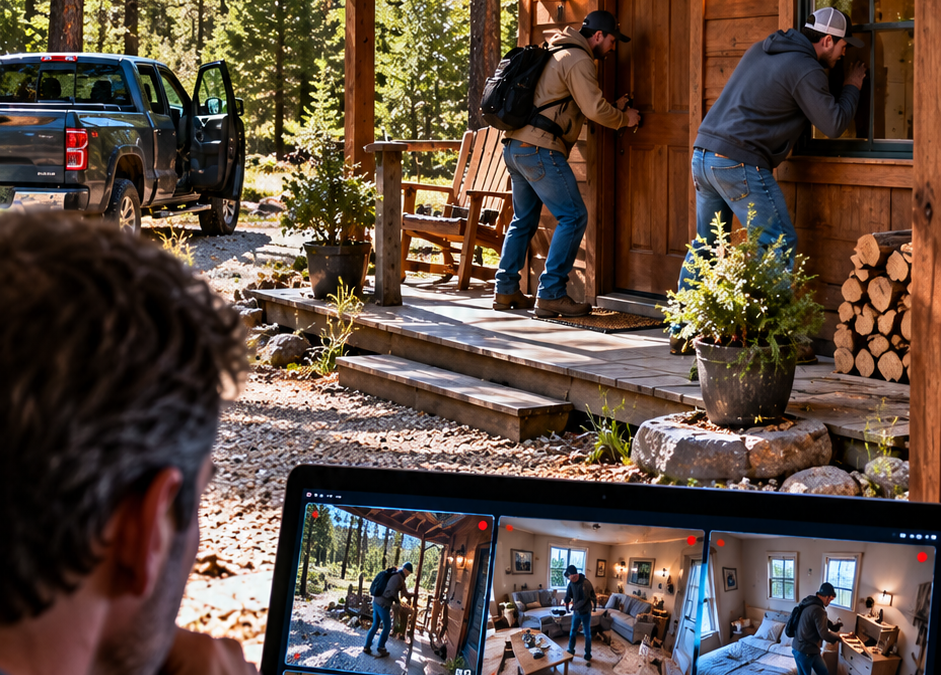
What neither man understood was that I was watching them from two hundred miles away, while six cameras recorded every decision they made.
My name is Ethan Mercer.
Three years earlier, I had bought four acres of forested land a little more than two hours from the city.
There were no neighbors close enough to see my porch lights.
No traffic noise.
No sirens.
No apartment doors slamming at midnight.
Just pine trees, a rough gravel road, dark skies, and enough silence that the first few nights out there almost felt uncomfortable.
I had spent most of my adult life in the city.
Traffic outside the window.
Phones vibrating.
People above me.
People below me.
Somebody always wanting something.
The cabin began as an idea I kept postponing.
Someday I would buy land.
Someday I would build something with my own hands.
Someday I would stop paying rent for the privilege of hearing somebody else’s television through a wall.
Eventually, I got tired of using the word someday.
The property was not impressive.
Four acres.
Mostly trees.
A slight rise near the center.
An old logging track.
A shallow seasonal drainage line near the western edge.
But when I walked it for the first time, I could hear wind moving through the branches and nothing else.
I made an offer that week.
The cabin took me almost a year.
I built most of it myself.
Not because I was some master carpenter.
I wasn’t.
I made mistakes.
Cut boards twice.
Installed one window crooked enough that I had to pull the entire frame and start over.
Spent three hours trying to understand why the solar controller kept showing an error before discovering I had reversed two connectors.
But I learned.
The finished cabin was small.
One bedroom.
Combined kitchen and living space.
Wood stove.
Loft for storage.
Solar panels on the roof.
Battery bank inside a utility closet.
Rainwater collection feeding two tanks behind the cabin.
Composting toilet.
A simple outdoor shower for warm weather.
Nothing luxurious.
Nothing designed for social media.
It worked.
More importantly, it was mine.
I would drive out on Friday evenings carrying groceries, tools, books, sometimes nothing more than coffee and firewood.
I would work on small projects Saturday morning.
Split wood.
Clear brush.
Adjust the rainwater filters.
Then spend hours doing absolutely nothing.
That became the point.
The land gave me something the city never did.
Space between one thought and the next.
Unfortunately, the land also came with an HOA.
Rural HOA.
I know.
The phrase sounds almost contradictory.
When I purchased the parcel, I read the covenants carefully.
Basic road maintenance.
No commercial operations.
No junkyards.
Reasonable restrictions on dumping, abandoned vehicles, and hazardous storage.
Nothing about matching paint colors or approved mailbox designs.
The association existed mostly because a private gravel road served several parcels.
At closing, my attorney reviewed the restrictions and saw nothing unusual.
For almost two years, I barely thought about the HOA.
Then the board changed.
Gerald Pike became president.
I will call him Gerald because that was his name, and because I stopped caring about protecting his ego around the time I watched him cut the lock on my gate.
Gerald owned one of the newer houses closer to the main road.
Large place.
Stone veneer.
Three-car garage.
Decorative entrance lights.
He seemed to believe the entire rural area should eventually look like his property.
People warned me about him before I ever dealt with him directly.
At a road-maintenance meeting, an older landowner named Jim leaned toward me and said quietly, “Keep everything he sends you.”
I remember smiling.
“Why?”
“You’ll understand.”
I thought Jim was exaggerating.
He wasn’t.
The first notice arrived about my solar panels.
Gerald called them “visually disruptive infrastructure.”
That phrase was impressive considering the nearest HOA-maintained road was barely visible from my roof.
The letter said the panels failed to preserve the “traditional rural character” of the area.
I read the covenants.
No solar restriction.
I answered politely.
I cited the relevant section.
Included photographs showing the panels were entirely within my parcel.
Then I filed the letter.
A month later, the HOA complained about my rainwater barrels.
Potential mosquito breeding.
The barrels were sealed tanks with screened inlets.
I replied with photographs.
Manufacturer specifications.
Again, no violation.
Then came the tire swing.
That one almost made me laugh.
I had hung an old tire from a thick oak limb near the cabin.
Gerald’s letter described it as an “unapproved recreational installation.”
I sent the reply to my attorney just to make sure I wasn’t overlooking some bizarre language.
She called me.
“I have read the covenants twice.”
“And?”
“I regret to inform you that the tire swing appears to remain legal.”
“I’ll try to contain my relief.”
But the joke stopped being funny.
Letters kept coming.
Brush piles.
Firewood storage.
Outdoor lighting.
The gravel turnaround near the cabin.
Each one more official than the last.
I answered every one.
In writing.
Certified mail when necessary.
Email copies.
Printed copies.
Digital copies.
Dates.
Photographs.
My attorney reviewed two of the more aggressive responses.
At that point, Gerald had never been on my property.
Not once.
He had seen some things from the road.
Other things, I assumed, came from satellite images or complaints.
I did not care.
He could dislike my solar panels.
He could dislike my tire swing.
Dislike was free.
Authority was not.
Six months before everything changed, someone stole tools from my property.
I arrived one Saturday and noticed the shed door hanging slightly open.
At first I thought I had failed to latch it.
Then I saw the cut hasp.
A cordless saw.
Battery charger.
Socket set.
Two hand tools.
Maybe twelve hundred dollars total.
Not catastrophic.
But the theft bothered me in a way I had not expected.
The whole reason I loved the cabin was that it felt isolated from people.
Suddenly that isolation felt different.
Someone had stood where I stood.
Opened my building.
Touched my things.
Gone through storage.
I kept imagining them looking through the cabin windows.
That week, I installed cameras.
Then I kept installing cameras.
Six outside.
Two inside.
One facing the gate.
One covering the drive.
One watching the front porch.
One covering the rear side of the cabin.
One mounted high enough to see most of the clearing.
Another hidden near the workshop area.
Inside, I placed cameras covering only the common living space and main entrance.
Nothing in the bedroom or private areas.
Everything recorded locally to an NVR.
Everything also backed up to encrypted cloud storage.
Timestamped.
HD.
Audio on the porch camera.
Motion alerts to my phone.
It was probably more security than a four-acre cabin needed.
I remember thinking that when I finished.
Six months later, that system became the most valuable thing on the property.
The Tuesday it happened, I was at my apartment in the city.
Working from home.
Laptop open.
Coffee gone cold beside me.
At 11:14 a.m., my phone buzzed.
Motion detected: Gate.
Then again.
Driveway.
Then three alerts almost together.
Gate.
Driveway.
Front exterior.
I picked up the phone.
Opened the camera app.
Two vehicles sat outside my gate.
A dark pickup I did not recognize.
And a white SUV.
I recognized the SUV.
Gerald’s.
I had seen it in HOA meeting photos.
My gate was closed.
Heavy chain.
Padlock.
For several seconds, nothing happened.
Then Gerald got out.
Another man stepped from the truck.
I recognized him vaguely from an HOA newsletter.
The board’s self-appointed compliance officer.
His name was Martin Cole.
Martin wore a dark jacket and carried a folder.
Gerald looked at the gate.
Then Martin walked back to the truck.
When he returned, he was carrying bolt cutters.
I actually leaned closer to my phone.
There are moments when your brain refuses to interpret something because the obvious explanation is too stupid.
I thought maybe they had called me.
Maybe I had missed something.
I checked my messages.
Nothing.
Then Martin placed the cutters around my chain.
Gerald held the chain steady.
The jaws closed.
Snap.
They cut it.
I remember saying out loud to an empty apartment,
“You have got to be kidding me.”
They opened my gate.
Drove inside.
Then closed it behind them.
Not locked.
Just closed.
As if that somehow made the trespass more professional.
My first instinct was to call 911.
My thumb actually moved toward the dialer.
Then I stopped.
I wanted to know what they were doing.
I was two hundred miles away.
They were not threatening anyone physically.
The property was empty.
The cameras were recording.
So I watched.
Gerald and Martin walked slowly toward the cabin.
They took photographs.
Solar panels.
Rain barrels.
Firewood.
Tire swing.
Shed.
The gravel pad.
Martin pointed at things while Gerald wrote something on a clipboard.
They looked almost relaxed.
That was what disturbed me.
They did not behave like men worried about whether they were allowed to be there.
They behaved like inspectors.
People accustomed to assuming cooperation.
Gerald walked onto my porch.
Tried the front door.
Locked.
He looked through the front window.
Martin walked around the side.
The camera followed him until he disappeared beneath its edge.
A second camera caught him near the rear window.
He tried it.
Locked.
Then Gerald photographed the porch.
The solar-system disconnect.
The rain barrel.
Everything.
They spent twenty-two minutes on my land.
Twenty-two minutes.
When you watch something live, twenty-two minutes is much longer than it sounds afterward.
I could hear my own breathing.
Every time Martin moved toward another window, I felt my shoulders tighten.
At one point, Gerald sat on the porch railing.
He looked at his phone.
Then made a call.
I could not hear the audio clearly through the live stream.
I saw him speaking.
Martin returned.
They talked.
Then Gerald removed a paper from his folder and taped it to my front door.
After that, they walked back to their vehicles.
Drove out.
Left the gate chain cut on the ground.
I did not move for several seconds after the motion alerts stopped.
Then I called my attorney.
Her name was Rebecca Sloan.
She answered on the second ring.
“Ethan?”
“I have a problem.”
“What kind?”
“The HOA president just cut my gate lock and entered the property.”
Silence.
Then:
“Are they still there?”
“No.”
“Did you see this?”
“Live camera.”
“Recorded?”
“Yes.”
“All of it?”
“I think so.”
“Do not contact Gerald.”
That was her first instruction.
“Download everything.”
“I was going to call him.”
“Don’t.”
“He cut my chain.”
“Good. Let him continue believing you don’t know exactly what he did.”
I sat back.
“What now?”
“First, preserve the evidence. Then we decide.”
That evening, I reviewed the footage on a larger screen.
That was when the situation became worse.
Live video had shown the trespass.
The full recordings showed intent.
The hidden camera angle near the rear of the cabin captured Martin standing at the window.
He tried to lift it.
Failed.
Then reached into his jacket.
He pulled out a narrow object.
Metal.
Maybe a small screwdriver.
Maybe a pick.
The exact tool mattered less than what he did with it.
He inserted it near the latch.
Worked at the frame.
Stopped.
Tried again.
For almost forty seconds.
Then gave up.
I replayed that clip four times.
Gerald’s phone call was even clearer.
The porch camera had a directional microphone.
Wind noise.
Birds.
Then Gerald’s voice.
“The place looks abandoned.”
Pause.
“No, I don’t think he’s here full-time.”
Another pause.
“Yes.”
He looked toward the cabin.
“I think we move forward with the next step.”
The next step.
Those words stayed with me.
What next step?
The HOA had no authority to take my cabin.
No right to occupy my land.
No court order.
No lien.
No foreclosure.
Nothing.
My dues were current.
Taxes current.
Permits valid.
The property was actively used.
So why was Gerald telling someone that the cabin looked abandoned?
I made copies.
Cloud archive.
External hard drive.
USB.
Another USB for Rebecca.
One copy to my brother.
I generated file hashes because Rebecca suggested it.
Preserved the original NVR data.
Saved screenshots.
Created a timeline.
11:14 arrival.
11:16 chain cut.
11:19 porch.
11:23 attempted rear-window manipulation.
11:31 phone call.
11:35 notice placed.
11:36 departure.
Then I called the sheriff’s department.
The deputy who took my initial report asked several questions.
Was the gate locked?
Yes.
Did I give permission?
No.
Was the chain damaged?
Yes.
Did they enter a structure?
Not successfully, as far as I could tell from the first review.
Attempted entry?
Yes.
Evidence?
Multiple videos.
He told me to preserve everything and said someone would contact me.
Then I replaced the gate lock the next morning.
I did not email Gerald.
I did not confront Martin.
I did not post anything publicly.
That was harder than it sounds.
Anger creates an almost physical need to let the other person know you caught them.
But Rebecca kept repeating the same thing.
“Let the evidence arrive before your anger.”
Two days later, Gerald sent me an email.
Subject:
EMERGENCY COMPLIANCE HEARING
He ordered me to appear before the HOA board Saturday morning regarding “continued and escalating noncompliance.”
I had seventy-two hours to respond.
I replied four minutes later.
I will attend.
Please ensure all officers are present.
I have materials relevant to all attendees.
That was all.
Saturday morning, I drove the two hours to the community hall.
Rebecca rode with me.
She had the USB drive in her briefcase.
I had my laptop.
Printed timeline.
Copies of Gerald’s prior letters.
My responses.
My parcel documents.
The sheriff incident number.
We arrived ten minutes early.
Gerald was already there.
He stood beside a folding table talking to Martin.
Three other board members sat nearby.
When Gerald saw Rebecca walk in behind me, his expression changed.
Only slightly.
But I saw it.
He had expected me.
He had not expected counsel.
“Mr. Mercer.”
“Gerald.”
He looked at Rebecca.
“And you are?”
“Rebecca Sloan.”
She gave him her card.
“I represent Ethan.”
Martin stopped arranging his papers.
One board member, a woman named Carol Bennett, looked from Rebecca to Gerald.
“You didn’t tell us attorneys were coming.”
Gerald answered quickly.
“This is an internal compliance hearing.”
Rebecca placed her briefcase on the table.
“Then I imagine transparency will be useful.”
Gerald did not like that.
There were seven people in the room.
Gerald.
Martin.
Carol.
Two other board members.
Rebecca.
Me.
Gerald opened the meeting.
He read from prepared notes.
My solar installation.
Rainwater tanks.
Unapproved exterior structures.
Accumulated materials.
Property-maintenance concerns.
He displayed photographs on a portable projector.
Photographs taken from my property.
He did not say that.
He presented them as “inspection documentation.”
I let him finish.
That mattered.
If I interrupted, the hearing could become an argument.
I wanted him on record presenting the photographs.
Martin added that the property showed “signs of intermittent or abandoned use.”
That phrase caught my attention.
Gerald had said the same thing on the phone.
One of the other board members asked,
“Abandoned?”
Martin nodded.
“Minimal occupancy indicators.”
I looked at Rebecca.
She wrote something down.
Gerald continued.
“The association has an obligation to investigate conditions that may affect community safety and covenant compliance.”
He finished by recommending enhanced enforcement.
Then he looked at me.
“Mr. Mercer, you may respond.”
I opened my laptop.
“Before we discuss violations, I’d like to show the board something.”
Gerald frowned.
“If this is about the photographs—”
“It is.”
Rebecca connected my laptop to the projector.
The first video appeared.
Timestamp.
11:14:07.
Gerald’s white SUV.
Martin’s truck.
Gate closed.
I pressed play.
Nobody spoke.
Martin stepped out.
Returned with bolt cutters.
The chain snapped.
Carol leaned forward.
I stopped the video.
“That is my private gate.”
Gerald shifted in his chair.
“The association has inspection authority.”
Rebecca said nothing.
Neither did I.
I played the next clip.
They entered.
Photographed the property.
Tried the front door.
Then the rear camera.
Martin at the window.
Pulling something from his jacket.
Working at the latch.
His face on the screen was clear.
In the room, the real Martin turned pale.
Carol said quietly,
“What did you do?”
Martin looked at Gerald.
Gerald said,
“This is being taken out of context.”
I paused the footage.
“What context makes this appropriate?”
“We believed the property might be abandoned.”
“You knew exactly where to email me two days later.”
Gerald’s jaw tightened.
“The HOA has the right to inspect suspected violations.”
Rebecca reached into her bag.
She placed a printed copy of the state trespass statute on the table.
Then another page.
Property-entry provisions.
She did not say a word.
She did not need to.
I played the phone-call clip.
Gerald’s voice filled the room.
“The place looks abandoned.”
Pause.
“I think we move forward with the next step.”
The room changed.
It was not dramatic.
Nobody shouted.
But the entire atmosphere shifted.
One of the male board members asked,
“What next step?”
Gerald answered too quickly.
“Enforcement escalation.”
“Meaning what?”
“Additional compliance review.”
Carol looked at him.
“Why were you discussing abandonment?”
Gerald stared at the frozen image of himself on the projector.
“The property appeared unused.”
I leaned forward.
“You have my email.”
No response.
“You have my mailing address.”
Nothing.
“You have correspondence from my attorney.”
Gerald looked at Rebecca.
I continued.
“My HOA dues are current.”
Silence.
“My permits are current.”
Silence.
“My utility and tax records exist.”
Carol asked,
“Gerald, did the board authorize entry?”
He hesitated.
That was the moment I knew.
“No.”
Carol’s face hardened.
“Did we authorize cutting a lock?”
Gerald said,
“The compliance committee has operational discretion.”
Martin nodded weakly.
Carol turned toward him.
“Did we authorize you to try to open a window?”
“I wasn’t trying to enter.”
I replayed the clip.
Nobody needed commentary.
Forty seconds.
Tool at latch.
Attempt.
Failure.
Another board member whispered,
“Jesus.”
The hearing collapsed in less than ten minutes.
Gerald attempted to recover.
He argued that the HOA covenants gave officers inspection rights.
Rebecca finally spoke.
“Please identify the section authorizing forced access through a locked gate.”
Gerald flipped through his copy.
“There is a general inspection provision.”
“Read it.”
He found the clause.
It allowed reasonable inspection of visible exterior conditions after notice when necessary to verify compliance.
Rebecca asked,
“Where does it authorize cutting a lock?”
Gerald did not answer.
“Where does it authorize attempted entry through a window?”
Nothing.
“Where is the notice to my client that an inspection would occur?”
No answer.
Then she asked one more question.
“Who was Mr. Pike speaking to when he said they should proceed to the next step?”
Gerald looked at her.
“I don’t recall.”
“You made the call four days ago.”
“I make many calls.”
Rebecca nodded.
“We’ll obtain the records through the appropriate process if necessary.”
That sentence seemed to hit him harder than anything I had said.
Carol pushed her chair back.
“I move that we suspend this hearing.”
Gerald objected.
“We still have unresolved violations.”
Carol looked at him.
“I think we have a more immediate problem.”
The motion passed.
Gerald voted against it.
Of course.
Outside the hall, I stood beside my truck while Rebecca packed the laptop away.
My hands were shaking.
Not from fear.
Adrenaline.
I had held everything in for days.
Watched the footage.
Copied it.
Cataloged it.
Sat across from Gerald while he used photographs from my own property as evidence against me.
Only once we were outside did the anger hit fully.
Rebecca noticed.
“You okay?”
“No.”
“That’s fine.”
“He stood there and acted like I was the problem.”
“I know.”
“He cut my gate.”
“I know.”
“He tried to get into the cabin.”
“Martin tried.”
“Gerald stood there.”
“Yes.”
I looked toward the hall.
“I want to go back in.”
“No.”
“Just five minutes.”
“Absolutely not.”
I laughed despite myself.
“Worth asking.”
“The footage did what it needed to do.”
The sheriff’s department contacted me the following week.
An investigator reviewed the original recordings.
He asked me to provide the lock.
I had saved it.
Cut chain.
Padlock.
Photographs.
Everything.
Gerald and Martin were interviewed.
Neither was arrested.
That disappointed some people later when they heard the story.
They expected handcuffs.
Real life is usually less theatrical.
Both men received criminal trespass citations.
Formal.
Recorded.
With the warning that future behavior could escalate consequences.
For me, that was enough.
I had never wanted revenge.
I wanted them to understand that my gate was not a suggestion.
The HOA board called a special meeting.
I was not required to attend.
I did anyway.
This time, twenty-seven association members showed up.
Gerald sat at the front.
Martin beside him.
Carol presented a motion to remove both men from their officer positions pending further governance review.
Gerald gave a speech.
He said he had acted to protect property values.
He said the cabin’s intermittent use created legitimate concerns.
He said the camera footage was being weaponized to undermine volunteers who had been “trying to perform difficult duties.”
Then Jim, the older landowner who had once told me to save everything Gerald sent, raised his hand.
“I have one question.”
Gerald sighed.
“Go ahead.”
“Did you cut Ethan’s lock?”
Gerald hesitated.
“We entered for compliance purposes.”
Jim repeated it.
“Did you cut his lock?”
“Yes.”
“Then I’m done.”
The vote was four to one.
Gerald voted for himself.
Martin did not have a board vote.
Both were removed.
For the first time in months, I drove home from an HOA meeting feeling lighter instead of angrier.
But the legal part continued.
Rebecca sent a civil demand.
Property damage.
Unauthorized entry.
Attempted forced access.
Legal costs.
Other documented losses.
I will not disclose the settlement amount.
The final number matters less than what it covered.
Every legal bill.
Every security upgrade.
Replacement gate hardware.
And enough money for me to finish the second outbuilding I had been postponing.
The settlement included no admission of some grand conspiracy.
There was no cinematic confession.
Just payment.
Mutual releases.
Written terms.
Most disputes actually end that way.
Paper correcting damage caused by bad paper.
Then the HOA sent me something I never expected.
A formal apology.
Not Gerald.
The association.
Signed by the remaining board.
It acknowledged unauthorized access.
Confirmed that my property remained subject only to the covenants actually recorded against it.
Withdrew the pending violations.
Confirmed no officer would enter private property without lawful authority and required notice.
According to Jim, it was the first formal written apology the association had issued in twenty-two years.
I framed nothing.
I did not hang the citations on the wall.
I did not keep Gerald’s photograph above my desk.
I put every document into a folder.
Then I stored the folder beside the cabin paperwork.
That felt more appropriate.
Six months after the incident, I finished the second outbuilding.
Small structure.
Metal roof.
Workbench.
Tool storage.
I installed it exactly where I had planned.
Gerald would probably have hated it.
The new board approved the notice without comment because the structure complied with the covenants.
My solar panels are still on the roof.
The rainwater tanks are still behind the cabin.
And the tire swing still hangs from the oak.
Nobody has mentioned it since.
I still use the cabin most weekends.
Sometimes more.
The camera system remains.
I upgraded two cameras after the case ended.
Not because I expect Gerald to return.
He moved away the following year.
Martin stopped attending meetings.
I kept the system because I learned something about isolation.
Privacy and invisibility are not the same thing.
I wanted privacy.
Gerald mistook it for invisibility.
That was his mistake.
The strangest part is that I almost never look at the camera app anymore.
Most alerts are deer.
Raccoons.
Wind.
Occasionally a delivery driver.
Sometimes the tire swing moving in a storm.
The property feels peaceful again.
That took longer than I expected.
For weeks after the trespass, I would arrive and check every window before unpacking.
I would notice footprints.
Tire marks.
Small things I had never cared about.
The cabin no longer felt completely separate from the world.
Someone had crossed that boundary.
There is a specific kind of violation in knowing a stranger stood inside a space you built with your own hands.
Gerald never actually got through the locked door that first day.
But later, investigators learned from reviewing all camera angles that during a second unauthorized visit before the formal hearing notice arrived, Martin had returned with Gerald, found an unsecured utility-side window I had temporarily removed for maintenance, and reached inside far enough to release a secondary latch.
That was the footage I had not noticed during the first live review.
It came from one of the interior cameras.
Gerald stepped inside behind him.
Only for a few minutes.
They opened two kitchen drawers.
Looked through a shelf beside the door.
Photographed the battery monitor.
Laughed about the “survivalist setup.”
Gerald said something like,
“If he’s hardly here, I don’t know why he’s fighting this hard.”
That was the moment the entire thing became personal in a way the gate alone had not.
They were inside.
Inside the place I had built because I wanted one space in my life that belonged entirely to me.
I remember watching that clip alone the night I discovered it.
My first reaction was not rage.
It was embarrassment.
Strange, but true.
I felt exposed.
They had seen the coffee cup on the counter.
The old blanket folded on the chair.
The book I had left open.
My boots beside the stove.
Ordinary things.
Private because they were mine.
Then Gerald opened a drawer and laughed.
Something about that laugh stayed with me longer than the bolt cutters.
The sheriff added that footage to the case.
Rebecca added it to the civil demand.
Gerald’s claim that he had only conducted an exterior inspection became impossible to maintain.
When Carol saw that second clip, she called me herself.
Her voice was quiet.
“I owe you an apology.”
“You weren’t there.”
“I voted for him.”
“That isn’t the same thing.”
“I ignored things I should have questioned.”
I did not know what to say.
Eventually, I said,
“You questioned it when you saw the truth.”
She was silent.
Then:
“I should have asked sooner.”
That conversation changed how I thought about the HOA.
For a while, I had treated the entire organization as Gerald.
That was easy.
Too easy.
Gerald had power because other people trusted him, deferred to him, or found it simpler not to challenge him.
Some of those people were careless.
Some were intimidated.
Some had never seen the letters he sent property owners.
Once they did, several changed.
The next board rewrote the inspection policy.
Exterior-only observations from public or common areas unless the owner gave permission.
Written notice required.
Emergency entry limited to immediate threats to life or property and subject to law enforcement or first-responder involvement.
No officer acting alone.
No self-appointed compliance visits.
The language was boring.
Good policies often are.
The entire fight had started because one man believed his title meant more than the actual documents said it did.
That is what stayed with me most.
Gerald never broke into my cabin because of a tire swing.
Not really.
He did not care about mosquitoes.
He did not care about solar-panel aesthetics.
Those were pressure points.
He wanted compliance.
Not compliance with a particular rule.
Compliance with him.
Every time I answered one letter with facts, he needed another issue.
Every time I refused to behave intimidated, he escalated.
Eventually, he crossed a locked gate because he had convinced himself that my refusal to surrender somehow created his permission to act.
That is the danger of small authority mixed with unchecked certainty.
The person starts by enforcing real rules.
Then interprets them broadly.
Then invents procedure.
Then confuses procedure with law.
Then begins treating resistance as proof that stronger action is justified.
By the time Gerald stood inside my cabin, I do not think he believed he was committing some dramatic crime.
I think he believed he was entitled to find the evidence he wanted.
That may be worse.
A thief usually knows the property belongs to someone else.
Gerald had convinced himself that his role allowed him to stop asking that question.
For a long time afterward, people told me the cameras saved me.
They did.
But not in the way people usually mean.
The cameras did not make me right.
I was already right about the boundary.
The cameras did not create my property rights.
They did not create the trespass law.
They did not make Gerald cut the chain.
They simply removed his ability to rewrite what happened.
Without them, the story could have become:
HOA officials inspected a possibly abandoned property after receiving compliance concerns.
Owner became hostile.
Inspection was limited.
No forced entry occurred.
Any damage to the lock was incidental.
Maybe a deputy believes me.
Maybe the board does.
Maybe not.
Gerald had a title.
A witness beside him.
Official letterhead.
I had anger.
The cameras turned anger into timestamps.
That mattered.
The chain broke at 11:16.
Martin worked on the rear latch for forty seconds.
Gerald called someone from the porch.
The words were recorded.
They entered.
The drawers opened.
The photographs were taken.
No one had to remember perfectly.
No one had to decide whose tone sounded more believable.
The facts existed independent of all of us.
That changed everything.
Documentation had already been a habit before the trespass.
Every Gerald letter went into a folder.
Every response was saved.
Certified-mail receipts.
Emails.
Photographs.
My attorney’s notes.
At the time, that felt excessive.
Afterward, it became the timeline.
The earliest letters established escalation.
My responses established that Gerald knew I actively owned and used the property.
That mattered when he later claimed it looked abandoned.
My attorney’s previous communications proved the HOA knew how to reach me.
That mattered when Gerald claimed immediate inspection was necessary.
The permits showed lawful improvements.
The dues records showed I was current.
No one piece won everything.
The strength came from consistency.
Gerald’s story changed.
The records did not.
About a year after the case ended, Jim came by the cabin.
He brought beer.
We sat on the porch.
The tire swing moved slightly in the wind.
He pointed at it.
“Dangerous compliance issue.”
“Extremely.”
“Could destroy property values.”
“Probably already has.”
He laughed.
Then became serious.
“You know what bothered me?”
“What?”
“How close he got.”
I knew what he meant.
“If you hadn’t had the cameras…”
“I know.”
“No. I mean before that. The letters. People were scared of him.”
Jim looked toward the road.
“Two owners almost sold.”
“Because of Gerald?”
“He was making their lives miserable.”
One had an older barn.
Another kept a trailer visible from the road.
Gerald sent repeated enforcement notices.
Neither owner fought as aggressively as I had.
After Gerald was removed, the new board reviewed those cases.
Several alleged violations disappeared.
That was the part of the outcome I appreciated most.
The cameras protected more than my cabin.
They forced the association to examine the person it had empowered.
I still live in the city during the week.
For now.
Eventually I may move to the cabin full-time.
Maybe not.
The difference is that the decision is mine again.
On Friday evenings, I still take the same road out.
Highway first.
Then county route.
Then gravel.
The farther I drive, the quieter everything becomes.
At the gate, I usually stop for a moment before unlocking it.
The chain is heavier now.
Better lock.
There is a camera on the post.
A small sign beneath it says:
PRIVATE PROPERTY
NO ENTRY WITHOUT PERMISSION
Nothing about the HOA.
Nothing angry.
Just a boundary stated clearly.
I sometimes think about putting the cut chain on the wall of the workshop.
Then I decide against it.
I do not want Gerald to become part of the cabin’s identity.
He already occupied too much of it for a few months.
The cabin was built for silence.
That is what I wanted back.
And I got it.
The rainwater still makes a hollow sound inside the tanks after storms.
The batteries hum quietly under load.
The wood stove ticks as it cools.
At night, the trees block almost every artificial light.
Sometimes deer trigger the cameras near the clearing.
Sometimes nothing triggers them for days.
That is the best outcome I could have asked for.
Nothing happening.
No notices.
No surprise vehicles.
No men standing at the gate.
No hearings.
Just the property doing what it did before Gerald decided my independence was somehow his problem.
If I had to choose one image from everything that happened, it would not be the bolt cutters.
Not Gerald’s face at the board meeting.
Not the criminal citation.
Not the settlement letter.
It would be the moment on the projector when Martin appeared at my window with that tool in his hand.
The room was completely silent.
For months, Gerald had controlled the language.
Noncompliance.
Inspection authority.
Community standards.
Potential abandonment.
Safety.
When the video played, none of those words mattered.
Everyone saw the same thing.
A locked window.
A man who did not own the property.
A tool at the latch.
That was it.
No argument needed.
That was when I learned the real value of evidence.
Not that it lets you speak louder.
It lets you stop speaking.
The facts can take the room from there.
Two years have passed since the hearing.
Carol is still on the board.
The association is boring now.
That may be the highest compliment I can give it.
Road maintenance.
Budget updates.
Snow-removal contracts.
Actual HOA business.
Nobody sends me letters about the tire swing.
The current president once came by because a tree had fallen across the shared road.
He stopped at the gate.
Called me.
Asked permission before stepping onto the property.
That small courtesy meant more than the HOA’s written apology.
It told me the lesson had lasted.
I unlocked the gate.
We moved the tree together.
When we finished, he looked toward the cabin.
“Nice place.”
“Thanks.”
Then he noticed one of the cameras.
“Still recording everything?”
“Always.”
He smiled.
“Probably wise.”
Maybe.
But I no longer think of the cameras as paranoia.
Paranoia is fear without evidence.
Preparation is understanding that memory is fragile, power can be misused, and the cleanest defense is sometimes a timestamp.
Gerald believed my cabin was vulnerable because it was remote.
He was partly right.
Remote places depend heavily on trust.
But isolation cuts both ways.
He thought no one was watching.
He thought distance meant absence.
He thought if he moved quickly enough, he could define what happened afterward.
He was wrong about all three.
I was two hundred miles away.
I still saw him cut the chain.
I saw Martin touch the window.
I heard Gerald say the property looked abandoned.
I watched them walk through a space neither man had permission to enter.
And when Gerald later sat at the head of a table and tried to describe those acts as compliance work, I did not have to accuse him of lying.
I pressed play.
That was enough.
I used to think the biggest benefit of off-grid living was independence.
Generating my own power.
Collecting water.
Building things myself.
Needing less from systems I did not control.
Now I think independence means something slightly different.
It means knowing where your responsibility ends and somebody else’s authority begins.
It means being willing to say no without becoming reckless.
It means documenting the no.
And it means understanding that a person who keeps escalating after receiving a lawful answer is no longer trying to solve the original problem.
Gerald was not fighting my solar panels.
He was fighting the fact that I could tell him no.
The cabin reminded him there was something inside the association boundary he could see but could not control.
He could write about it.
Photograph it from lawful areas.
Complain.
Propose changes.
But he could not own the decision.
That frustrated him enough that eventually he crossed the one line even the most generous interpretation of his authority could not erase.
My locked gate.
That line cost him his position.
Not because I was more powerful.
Not because my lawyer was louder.
Because he created the evidence himself.
All I had to do was preserve it.
The final settlement check arrived on a Thursday.
I deposited it.
Paid Rebecca.
Bought lumber.
Finished the second outbuilding.
Then I drove to the cabin alone.
It was late when I arrived.
I unlocked the gate.
Parked beside the porch.
The tire swing moved under the oak.
I carried one bag inside.
Turned on a lamp.
The interior camera indicator blinked once.
For a second, I remembered Gerald and Martin standing there.
Opening my drawer.
Laughing.
The feeling passed.
I made coffee.
Sat on the porch.
No traffic.
No voices.
Stars through the trees.
The property felt like mine again.
That was the part no citation or settlement could give me.
I had to take that back myself.
Not with confrontation.
Not by becoming as controlling as Gerald.
Just by continuing to live there.
To build.
To repair.
To sit quietly on the porch.
To let the cabin become a cabin again instead of a crime scene.
The next morning, sunlight came through the trees and hit the solar panels.
The battery monitor showed full charge.
There had been rain overnight.
Both collection tanks were nearly topped off.
A deer had triggered Camera Four around 4:12.
Nothing else.
I walked to the oak.
Checked the rope.
Sat briefly on the tire swing because I could.
Then I looked toward the gate.
New chain.
New lock.
Same road.
Same trees.
Same four acres.
Gerald had spent months trying to make that land feel conditional.
As though my right to use it depended on whether he approved of the way it looked.
The truth was much simpler.
The cabin was mine before his first letter.
It remained mine during every notice.
It was mine while he stood on the porch.
Mine while Martin tried the window.
Mine when they laughed inside.
Mine when Gerald presented illegal photographs as evidence.
And mine after the whole structure of intimidation collapsed.
Authority does not become real because someone says it confidently.
A locked gate does not become public because an HOA president wants to cross it.
And a private home does not become abandoned because the owner happens to be two hundred miles away.
Sometimes the strongest thing you can do is not shout.
It is record.
Preserve.
Wait.
Then, when the person who thought no one was watching sits across from you and tries to tell everyone what happened, you put the truth on the screen and let every frame speak for itself.

