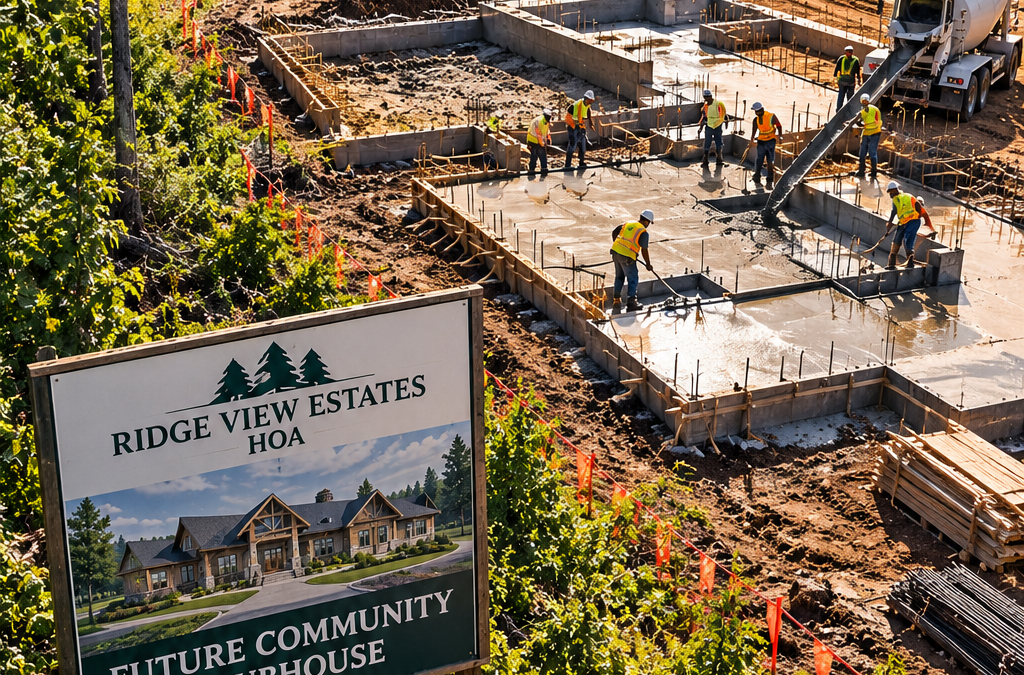
𝗙𝗨𝗟𝗟 𝗦𝗧𝗢𝗥𝗬 They looked at eleven wooded acres that had been in my family for generations, decided the owner probably wouldn’t notice, and started pouring a $340,000 clubhouse foundation across it without ever asking my permission. What they didn’t know was that the county file deciding whether their entire project could continue was about to land on the desk of the same man they had just told to go away.
𝗙𝗨𝗟𝗟 𝗦𝗧𝗢𝗥𝗬
I measure it.
Parcel number says construction belongs on Lot A?
You had better not be building on Lot B.
Most days weren’t dramatic.
People imagine government inspectors spend our lives shutting things down.
We don’t.
Most of the job is helping people get into compliance before mistakes become expensive.
But there are rules you cannot talk your way around.
Property ownership is one of them.
Which is why I still can’t understand how Ridge View Estates believed what it was doing would remain hidden.
The text came from a man named Carl who owned land near mine.
I knew him casually.
We’d talked twice about drainage.
That morning, his message said:
Isn’t this near your property?
Under it was a photograph.
At first I didn’t recognize the location.
There was framing.
Construction equipment.
A crane.
Fresh dirt everywhere.
Then I noticed the tree line.
My tree line.
I zoomed in.
There was a temporary project sign near the road.
I couldn’t read it clearly.
My stomach tightened.
I called Carl.
“Where did you take this?”
“Back road near Ridge View.”
“Which side?”
“The west extension.”
“What are they building?”
“No idea. Thought maybe you sold.”
“I didn’t.”
There was a pause.
“Then you might want to come look.”
I was already grabbing my keys.
Before driving out, I did something I had done dozens of times to check storm damage and tree fall.
I launched my drone.
Technically I could have waited until I reached the property, but I was impatient.
I wanted coordinates.
Images.
Context.
I flew it over the area.
The live feed came up on my screen.
Trees.
Gravel road.
Cleared ground.
Then construction.
I stopped moving the controls.
A rectangular foundation had been poured.
Wood framing had gone up along part of it.
There were concrete trucks.
Stacks of lumber.
A skid steer.
Temporary fencing.
Workers moving around the site.
And near the entrance was a sign large enough for the drone camera to read.
FUTURE HOME OF THE RIDGE VIEW ESTATES COMMUNITY CLUBHOUSE.
I stared at it.
For several seconds, my brain tried to create an explanation that would make the image reasonable.
Maybe it was adjacent.
Maybe the mapping overlay was wrong.
Maybe I had misunderstood where the access road crossed.
Maybe Ridge View had acquired a small parcel that cut into mine.
Then I moved the drone higher.
I knew the landmarks.
The old oak.
The drainage dip.
The broken line of limestone near the eastern edge.
They weren’t near my property.
They were inside it.
Far inside it.
I pulled up the digital survey.
Compared the coordinates.
Then checked again.
I flew the drone directly over two survey monuments I had verified after purchase.
The clubhouse foundation was unquestionably on my land.
Not by a few inches.
Not a fence error.
Not a driveway crossing one corner.
A substantial portion of the project sat inside my acreage.
I lowered the drone.
Then raised it.
Then checked again.
That’s how disbelief works.
You think repetition might make reality change.
It doesn’t.
I eventually sat in my truck with the engine off, looking down at the controller.
Ten minutes passed.
Maybe longer.
I kept zooming in.
Fresh concrete.
Framing.
Workers.
A structure that had probably already consumed an enormous amount of money.
On my property.
People sometimes describe anger as heat.
Mine wasn’t.
Mine felt cold.
Because once I knew what I was seeing, another thought arrived.
This project wasn’t two days old.
Nobody accidentally built that much without paperwork.
There had been planning.
Surveying.
Permits.
Engineering.
Contractors.
Board approvals.
Budgets.
Meetings.
Somebody had looked at a map.
Somebody had selected a location.
Somebody had signed documents.
And through all of that, nobody had contacted the person named on the deed.
Me.
I drove there.
The construction entrance had been widened using what had once been part of an old trail.
I stopped outside the temporary fence.
A worker looked at me but kept walking.
I stepped out.
A foreman came over within thirty seconds.
Reflective vest.
Hard hat.
Clipboard.
He had the expression contractors develop when strangers arrive at active sites and immediately start asking questions.
“Can I help you?”
“Who’s in charge here?”
“That’d be me on site.”
“What are you building?”
He pointed toward the sign.
“Ridge View clubhouse.”
“Who owns this land?”
He glanced toward me.
“The HOA project is permitted.”
“That’s not what I asked.”
He shifted his weight.
“If you have a question about ownership, you’ll need to talk with Ridge View.”
“I own it.”
That got slightly more attention.
“This property?”
“Eleven acres. Including where you’re standing.”
He frowned.
“We’re inside the approved project boundary.”
“According to whom?”
“The plans.”
“Do you have the site plan?”
“I’m not giving you project documents.”
“Then give me the permit number.”
“You’ll have to contact the board.”
I stared at him.
“I have the deed.”
“Okay.”
“I have two surveys.”
“Okay.”
“Your foundation is inside my recorded boundary.”
He gave a short shrug.
Not mocking exactly.
Worse.
Dismissive.
Like I was a man complaining that construction dust had crossed my driveway.
“This is a permitted HOA project,” he repeated. “You’ll need to talk to the board.”
“Stop work.”
His eyebrows went up.
“What?”
“I’m the property owner. I’m telling you that you’re building on land you have no permission to enter.”
“I’m working under a contract.”
“Then call whoever hired you.”
“Sir, I’m not shutting down a permitted job because someone drove up and claims they own the lot.”
I felt my jaw tighten.
“I don’t claim it.”
I pointed toward the ground.
“I own it.”
The foreman turned away.
“Talk to the board.”
Then he walked back into the site.
That was the first time they treated me like I didn’t matter.
It wouldn’t be the last.
I photographed everything from outside the active work zone.
Equipment.
Access.
Foundation.
Signage.
Workers.
Then I drove straight home and pulled my deed.
After that I called Ridge View Estates.
It took four transfers to reach someone willing to discuss the project.
Her name was Denise Harper.
Property manager.
I explained what I’d found.
There was a pause.
Then:
“The clubhouse site was approved through the HOA’s engineering consultant.”
“The site is on my property.”
“According to the approved documents, the project is within the development’s authorized area.”
“Whose parcel number is listed?”
“Sir, I don’t have that information in front of me.”
“You just said it’s authorized.”
“It has been approved.”
“Approved where?”
“Through the appropriate process.”
“Denise, I own the land.”
Another pause.
This one sounded less patient.
“If you believe there’s a boundary discrepancy, you’ll need to submit that through proper legal channels.”
I almost laughed.
“A boundary discrepancy?”
“Yes.”
“There’s a clubhouse foundation fifty yards inside my property.”
“I’m not qualified to adjudicate a boundary dispute over the phone.”
“I’m not asking you to adjudicate anything. I’m telling you to stop construction until you confirm ownership.”
“The board isn’t going to suspend a major capital project because of an unverified claim.”
Unverified claim.
I looked at the deed sitting on my desk.
“Would you like the survey?”
“You can submit documents to the management office.”
“Who performed your survey?”
“I’m sorry?”
“The boundary survey used for the clubhouse. Who performed it?”
“That information would be in the project file.”
“Give me the surveyor’s name.”
“I don’t have authorization to release internal project documents.”
“Survey plans filed for permitting aren’t internal.”
“Then you may obtain them through the appropriate channels.”
“What’s the permit number?”
Another pause.
She finally gave it to me.
I wrote it down.
Then asked:
“Did your board confirm ownership before construction started?”
“I’m not going to continue this conversation if you’re accusing the board of misconduct.”
“I asked a question.”
“And I’ve explained the process.”
“No, you’ve told me to go away.”
“I didn’t say that.”
“You didn’t need to.”
Her tone went flat.
“Is there anything else?”
“Yes.”
“What?”
“Tell your contractor that the person who owns that land has formally objected to continued entry and construction.”
“I’ll note your concern.”
“Not a concern. An objection.”
“Have a good afternoon, sir.”
The line went dead.
I sat there looking at the phone.
That conversation changed my view of the entire situation.
Until then, I had believed the project might be the result of an extraordinary mistake.
Wrong overlay.
Bad map.
Transposed coordinates.
Old developer plan.
Something incompetent but innocent.
But innocent mistakes usually produce alarm when the actual property owner appears.
People say:
Wait, what?
Send us your survey.
We’ll stop until we check.
Denise did none of that.
She defended the project before verifying anything.
She wouldn’t name the surveyor.
Wouldn’t discuss the parcel.
Wouldn’t pause construction.
And she kept using language designed to push the burden onto me.
Boundary discrepancy.
Legal channels.
Unverified claim.
Proper process.
I knew that language.
It’s what organizations use when they want the person complaining to become exhausted before anyone important has to answer a question.
I wasn’t exhausted.
I was curious.
And curiosity, in my profession, can be far more dangerous than anger.
Two days later I walked into the county office just before eight.
I carried coffee in one hand and a stack of routine cases in the other.
Nothing about the morning seemed unusual.
I sat down.
Logged into the assignment system.
Started sorting files.
Then I saw a newly assigned compliance review.
RIDGE VIEW ESTATES HOA CLUBHOUSE—CONSTRUCTION BOUNDARY COMPLIANCE.
I stopped.
I read it twice.
Then clicked the file.
Same permit number Denise had given me.
Same project.
My project.
Well, their project.
My land.
For a full minute, I did nothing.
Our case system distributed certain reviews based on geography, workload, and specialty.
That week several people were out.
My assigned territory included the development corridor.
Under normal circumstances, the file landing on my desk would have been completely unremarkable.
Under these circumstances, it was almost absurd.
I leaned back.
My first emotional reaction was satisfaction.
I’ll admit that.
After being brushed off, there was a part of me that thought:
You wanted proper channels?
Here I am.
But my second reaction was professional.
And that one mattered more.
I owned the land.
I had a direct personal interest in the outcome.
That created an obvious conflict issue.
I wasn’t going to weaponize my government position against them.
No matter how tempting the situation looked.
So before doing anything substantive, I documented my ownership connection with my supervisor and asked how the county wanted the case handled.
That step matters.
Because the truth was already enough.
I didn’t need to cheat.
My supervisor reviewed the circumstances and kept me involved as the field inspector responsible for documenting the site and underlying discrepancy, while final enforcement decisions required independent supervisory sign-off.
That was fine with me.
More than fine.
Because what I needed wasn’t revenge.
It was a complete record.
So I said nothing to Ridge View.
Didn’t call Denise.
Didn’t announce the assignment.
Didn’t threaten anyone.
I simply requested the complete permit file.
Site plan.
Boundary survey.
Engineering submissions.
Ownership certifications.
Meeting records relevant to the application.
Contractor information.
Parcel references.
Everything.
If they were right and I was wrong, the file would show it.
That is one of the beautiful things about land records.
People can argue.
Maps don’t care.
Parcel numbers don’t care.
Recorded deeds do not become embarrassed when someone important made a mistake.
I started with the site plan.
The clubhouse was identified clearly.
Parking area.
Utility connections.
Setbacks.
Drainage.
Landscaping.
The paperwork looked polished.
Professional title blocks.
Engineering stamps.
Revision dates.
Nothing about it immediately screamed fraud.
Then I checked the parcel number.
I froze.
It wasn’t mine.
I typed it into the county GIS database.
The map jumped to a different lot.
Three properties away.
I checked again.
Same result.
The parcel referenced in the permit was not the land where they were building.
It wasn’t even owned by Ridge View Estates.
That parcel was privately owned too.
But unlike mine, it fell within zoning conditions that made clubhouse development much easier to approve.
I printed both parcel records.
Then I overlaid the approved plan against aerial mapping.
The building footprint submitted to the county appeared in one location.
The actual structure was being built in another.
My location.
At that point, the situation moved from boundary dispute to serious compliance problem.
I kept reading.
The permit file included a boundary survey dated fourteen months earlier.
I looked at the surveyor information.
The company name wasn’t familiar.
That meant nothing by itself.
There were plenty of small firms.
I ran the professional license number.
Inactive.
I leaned closer to the screen.
Checked the date.
Inactive for two years.
The survey submitted for the project was dated during a period when the listed license was not active.
I searched the state database again using the name instead of the number.
Same result.
I downloaded the licensing record.
Printed it.
Added it to the file.
Then I compared the survey geometry to my recorded plat.
The inconsistencies multiplied.
Monument references didn’t align.
Distances were suspicious.
The bearing along one boundary resembled an older development concept plan rather than the recorded parcel configuration.
It looked less like someone had surveyed the actual site and more like someone had assembled paperwork around where the HOA wanted the structure to be.
But a bad survey alone doesn’t prove intent.
So I kept going.
Next came ownership certification.
The HOA application represented that it possessed sufficient site control for construction.
That phrase bothered me.
Sufficient site control.
Not ownership.
Not deeded title.
I checked attachments.
No deed transferring my land.
No lease.
No easement authorizing clubhouse construction.
No purchase agreement.
No license from me.
Nothing.
Then I found the board minutes.
Ridge View held monthly meetings.
Their minutes were brief.
Mostly budgets, landscaping, security, homeowner complaints.
The clubhouse appeared repeatedly.
Design approval.
Financing.
Contractor selection.
Amenities.
Projected completion.
Then I found a meeting from several months before construction.
Buried in the notes was a sentence I read several times.
Board approved proceeding with construction ahead of final survey confirmation per developer recommendation to remain on schedule.
I sat back.
There it was.
They knew.
Maybe they didn’t know precisely that the land was mine.
But they knew the boundary had not been confirmed.
And they authorized construction anyway.
I kept searching.
Email correspondence attached to the development review file contained conversations between the HOA president, contractor, and a consultant.
Most were ordinary.
Scheduling.
Material pricing.
Weather delays.
Then I found a thread discussing the western edge of the clubhouse site.
One message asked whether there was exposure if final survey points shifted.
The reply used a phrase I’ll probably remember forever.
Minor boundary flexibility should be manageable. Adjacent area appears vacant. Low risk of dispute.
Vacant.
Low risk.
I read it again.
They had seen the land.
They knew ownership wasn’t settled.
They knew final survey confirmation was outstanding.
And somebody decided an empty-looking property meant they could take the risk.
My land wasn’t empty.
My father was there in every trail I remembered.
My grandfather’s history was there.
Four years of overtime were there.
Every vacation I didn’t take was there.
Every time I’d opened that savings account and watched the balance crawl upward was there.
They saw trees and dirt.
I saw a promise.
Maybe that difference shouldn’t matter legally.
Emotion doesn’t establish title.
But it mattered to me.
I sat alone in the office long after most people had gone home.
The lights in the hallway automatically dimmed.
My monitor was the brightest thing in the room.
I arranged the evidence in chronological order.
Wrong parcel number.
Questionable survey credential.
Construction ahead of final survey confirmation.
Emails acknowledging boundary uncertainty.
Vacant land.
Low risk of dispute.
Actual construction footprint on my parcel.
Direct notice from me after work had begun.
Continued construction.
I should have been furious.
Instead, I smiled.
Not because I enjoyed what had happened.
Because uncertainty was gone.
I finally understood the problem.
They had gambled.
Their assumption was simple.
The property looked unused.
No house.
No resident.
No visible owner.
If the boundary was slightly aggressive and somebody later complained, the HOA could negotiate from a position of strength after hundreds of thousands of dollars were already in the ground.
Most property owners confronted with a nearly completed clubhouse would probably think they had no choice.
The HOA could say:
Look how much we’ve invested.
Look how disruptive demolition would be.
Take this amount.
Sign here.
Let’s be reasonable.
That works only when the other person is intimidated by sunk cost.
I wasn’t.
The $340,000 they’d spent wasn’t leverage against me.
It was evidence of how far they’d proceeded without securing the ground beneath it.
The HOA board had a meeting the following Tuesday.
The agenda called the clubhouse item a routine construction progress update.
I decided to attend.
I arrived ten minutes early.
Denise saw me walk into the room.
For half a second, our eyes met.
Then she looked away.
I chose a seat in the third row.
Board members filed in carrying coffee, laptops, and folders.
Residents talked quietly around me.
From their perspective, the clubhouse was probably exciting.
A pool room.
Meeting space.
Fitness area.
Outdoor patio.
An amenity that would increase property values.
I didn’t blame them.
Most had no idea where it was being built.
The board president, Richard Calloway, started the meeting.
He was a man in his late fifties who spoke in the slow, practiced tone of someone accustomed to being listened to.
The first half hour covered landscaping contracts and gate maintenance.
Then came the clubhouse.
Richard smiled.
“I’m pleased to report we’re currently ahead of schedule.”
That almost made me laugh.
He continued.
“Framing is progressing well. We anticipate the building being weather-tight within approximately six weeks.”
A board member asked about budget.
Denise answered.
“We remain within approved contingency levels.”
Another asked about final inspection.
Denise said they expected no significant compliance concerns.
That was my moment.
I waited until Richard asked:
“Any final questions regarding clubhouse compliance before we move forward?”
I raised my hand.
He looked toward me.
“Yes?”
I stood.
“My name is Evan Mercer.”
Denise turned fully toward me now.
“I have several questions regarding the clubhouse site.”
Richard gave the kind of polite smile people use when they expect a resident complaint they can dispose of in two minutes.
“Please keep it brief.”
“I’ll try.”
I walked toward the front with a folder.
Denise spoke before I reached the table.
“Mr. Mercer has previously raised a private boundary claim with management.”
Private boundary claim.
Still that language.
I placed the folder on the table.
Richard looked at Denise.
Then me.
“Is this regarding your property?”
“Yes.”
“The board has been advised that any ownership dispute should go through counsel.”
“I agree.”
That surprised him.
“Then I’m not sure what—”
“I’m also the county code compliance and land use inspector assigned to the clubhouse boundary review.”
Silence.
Actual silence.
Not the dramatic kind people exaggerate when telling stories.
The real kind.
A chair creaked.
Someone stopped whispering.
Denise’s face changed immediately.
Richard stared at me.
“I’m sorry?”
I placed my county identification beside the folder.
“The project has been assigned for compliance review.”
Denise stood slightly.
“That’s a conflict.”
“I disclosed my property ownership to the county. The case is under supervisory review. I’m responsible for documented field findings and compliance evidence. Final enforcement action is independently approved.”
Richard looked at Denise again.
Then back at me.
“What exactly are you alleging?”
“Nothing.”
I opened the folder.
“I’m presenting records.”
I placed the first document on the table.
“This is the parcel number listed on your approved project site plan.”
Then the county GIS printout.
“This is the parcel associated with that number.”
A board member leaned forward.
I continued.
“It is three properties away.”
Richard frowned.
“That may be a clerical error.”
“Possibly.”
Another document.
“This is the recorded parcel for the physical location where construction is currently taking place.”
I looked directly at him.
“It’s mine.”
Denise spoke quickly.
“Our engineering consultant verified the project boundary.”
I placed the survey licensing record down.
“This is the license number attached to the boundary survey in your permit file.”
I paused.
“The credential was inactive on the date shown on the survey.”
A murmur moved through the room.
Richard’s jaw tightened.
“That doesn’t necessarily invalidate—”
“I haven’t said what it invalidates.”
I placed the board minutes on the table.
“This is your own meeting record approving construction ahead of final survey confirmation.”
Denise stared down at it.
I added printed emails.
“And these are project communications discussing unresolved boundary concerns.”
Richard picked up one page.
His eyes stopped at the line.
Adjacent area appears vacant. Low risk of dispute.
He looked toward Denise.
“Where did this come from?”
“The county permit file.”
He read it again.
One of the board members said quietly:
“Richard, did we know this?”
He ignored her.
I continued.
“Your contractor was notified directly by me that the structure was on privately owned land. Management was notified two days later. Construction continued.”
Denise recovered enough to speak.
“You called us making an unsupported ownership assertion.”
I looked at her.
“I gave you the permit number, told you I had two surveys, offered documentation, and asked you to stop work long enough to confirm the boundary.”
“You were instructed to submit through the correct channels.”
“And I did.”
I let that sit for a second.
“These are the correct channels.”
Nobody laughed.
Richard pushed back in his chair.
“What is the county’s position?”
I answered carefully.
“The documented building location does not match the approved parcel information. There is no recorded ownership, lease, easement, or other site-control instrument in the file authorizing Ridge View Estates to construct this clubhouse on my parcel. The permit record contains material inconsistencies requiring enforcement review.”
“Are you shutting us down?”
“The county is issuing a compliance determination through the normal process.”
“You said you’re the inspector.”
“I am.”
“Then answer the question.”
I looked around the table.
“As of tonight, I cannot verify this project as compliant.”
The room erupted.
Not chaos.
But voices everywhere.
Residents asking what that meant.
A board member asking Denise how a $340,000 project could be on the wrong property.
Someone behind me said:
“Wait. He’s the owner?”
Another voice:
“And the inspector?”
I turned slightly.
“Yes.”
Richard called for order.
Then he leaned toward me.
“You understand this clubhouse is substantially completed.”
“Yes.”
“You understand homeowners have paid assessments for it.”
“Yes.”
“You understand stopping construction creates substantial financial damage.”
I looked directly at him.
“Then confirming that you owned the construction site before pouring the foundation would have been important.”
His face went red.
“There’s no reason to be sarcastic.”
“I’m not being sarcastic.”
That was true.
“There is a building on land you did not purchase. I’m explaining why that matters.”
Denise whispered something to Richard.
He shook his head.
Then looked at me again.
“What do you want?”
That question bothered me.
Not because I didn’t know.
Because he still thought this was a negotiation occurring inside his board meeting.
“What I want personally and what the county requires are separate issues.”
“You’re the property owner.”
“Correct.”
“So what are you asking us to do?”
“First, comply with the county.”
“And second?”
“Stop treating my ownership like an inconvenience.”
The meeting ended badly.
For them.
Within forty-eight hours, the county issued a formal stop-work order.
No additional framing.
No electrical.
No utilities.
No finishing work.
The site had to remain safe, but construction could not proceed.
The county also opened a deeper permit review because the parcel discrepancy affected more than the clubhouse footprint.
Setbacks.
Zoning applicability.
Drainage assumptions.
Access.
Utilities.
The entire project had been evaluated using information tied to land where the building did not sit.
That meant correcting the situation wasn’t as simple as changing one number on a form.
Ridge View hired attorneys.
So did I.
From that moment forward, I kept my county role and property-owner role strictly separated.
At work, I documented facts.
Through my private attorney, I dealt with trespass, property damage, and negotiations.
The distinction protected everybody.
Especially me.
The HOA initially tried to minimize the problem.
Their attorney described it as a surveying discrepancy.
My attorney responded with the recorded deed, verified survey monuments, construction photographs, and their own internal correspondence.
The phrase surveying discrepancy disappeared fairly quickly.
Then they argued substantial completion.
In other words:
We’ve already spent so much money that removal would be unreasonable.
My attorney asked a simple question.
“How much of someone else’s money are you allowed to spend on someone else’s land before trespass becomes acceptable?”
They didn’t answer that one.
Then came the first purchase offer.
It was insulting.
Barely above ordinary undeveloped acreage value.
No compensation for cleared trees.
No restoration.
No consideration for the road they cut.
No professional fees.
No recognition of what they’d done.
Just a number.
I rejected it.
Denise called me personally the next day.
“You’re being unrealistic.”
That was the first thing she said.
I almost admired the consistency.
“You built a clubhouse on my property.”
“We’re trying to resolve that.”
“Then resolve it.”
“The offer reflects market value.”
“No. It reflects vacant acreage value before your organization altered the site.”
“Land values don’t suddenly multiply because construction occurred.”
“I didn’t ask for the value of your building.”
“Then what are you asking for?”
“Compensation for the land, tree removal, site disturbance, access damage, legal costs, surveying costs, and every expense required to restore what you changed if this transaction doesn’t happen.”
She exhaled.
“You’re taking advantage of the situation.”
I went silent.
Of all the things she could have said, that one almost made me lose my temper.
“Denise.”
“What?”
“You knew there was a boundary issue.”
“We relied on professionals.”
“Your own meeting minutes say construction started before final survey confirmation.”
“That was an administrative timing issue.”
“Your emails called adjacent land low risk because it looked vacant.”
She didn’t answer.
I continued.
“You didn’t call me before clearing trees.”
Nothing.
“You didn’t call me before cutting access.”
Nothing.
“You didn’t call me before pouring concrete.”
Still nothing.
“But now that your foundation is trapped on my property, I’m taking advantage?”
Her voice dropped.
“I don’t appreciate your tone.”
“I didn’t appreciate a bulldozer.”
I ended the call.
After that, communication went through attorneys.
The county gave Ridge View a compliance deadline.
They had limited options.
Secure lawful site control and re-permit the project based on the correct parcel.
Relocate the building if technically possible, which it wasn’t realistically.
Or dismantle what they’d built and restore the site.
The clubhouse was nowhere near finished enough to excuse the ownership problem and too permanent to move economically.
Demolition would be expensive.
Restoration would be expensive.
Refunding or explaining the loss to homeowners would be politically disastrous for the board.
So eventually they negotiated seriously.
I didn’t want to sell all eleven acres.
Never did.
That mattered.
Their early proposals assumed that because they had occupied part of the tract, I would simply name a price for the whole thing and disappear.
No.
I hadn’t spent four years buying my family’s land back so an HOA could convert it into an amenity parcel because somebody had been careless.
The area affected by construction sat closer to one edge of my tract.
After weeks of surveying, legal review, and subdivision analysis, we discussed a limited acquisition and restoration package.
Even then, I wasn’t enthusiastic.
Every meeting felt strange.
Attorneys sat around tables talking about square footage and market comparables while I kept picturing my father walking through those woods.
Some things are easy to price.
Others aren’t.
One afternoon my attorney asked me:
“Do you actually want a deal?”
I looked at him.
“What do you mean?”
“You can negotiate forever, but eventually you need to know your objective.”
“My objective is for them to have never done this.”
“That’s unavailable.”
I hated how true that was.
“So what are the available options?”
“Sell them the minimum land necessary under terms that compensate you fully, or force removal and litigate restoration.”
I looked down at the map.
A large patch of woods had already been cleared.
The foundation sat there.
Construction traffic had changed the soil.
The old trail was gone.
Even if they removed everything, that exact piece of ground would never look like it had before.
That made the decision harder, not easier.
My attorney tapped the plan.
“If they buy this portion, what remains of your important area?”
“The ridge.”
“The oak?”
“Yes.”
“The old family trail?”
“Part of it.”
“And you control access?”
“Under the proposed configuration, yes.”
I stared at the drawing.
Then I said:
“They pay for every tree.”
He nodded.
“Okay.”
“Not generic timber value.”
“Understood.”
“They pay for a restoration buffer between the clubhouse and what’s left of my property.”
“Reasonable.”
“Privacy fencing where necessary.”
“Fine.”
“New access for me because they damaged the original entrance.”
“Add it.”
“And reimbursement for all private surveying and legal costs caused by this.”
He wrote.
“Anything else?”
“My time.”
He looked up.
“What?”
“Every hour I had to spend dealing with a project that never should have crossed my boundary.”
“That’s harder.”
“Then make it less hard.”
He smiled.
“I’ll see what I can do.”
The negotiations continued.
Meanwhile the half-built clubhouse sat behind temporary fencing like a monument to impatience.
No workers.
No saws.
No concrete trucks.
Every day it remained idle cost the HOA money.
That wasn’t my goal.
But it did change the tone.
Board members who had initially acted offended by my objections began demanding answers from their own management company.
Residents requested records.
Assessment questions started.
Someone leaked the phrase low risk of dispute to homeowners.
That went over badly.
Because once residents understood what had happened, they weren’t asking why I refused to cooperate.
They were asking why their board had authorized a six-figure project before verifying the land.
Richard stopped attending some meetings.
Then he announced he would resign as president for personal reasons before the next annual election.
I never confronted him again.
There was no point.
Denise lasted two more months with the management company.
I don’t know everything that happened internally.
I know she was no longer assigned to Ridge View.
Then I heard she had left the company entirely.
People later told me she had been terminated.
I never confirmed the details, and frankly I didn’t care enough to investigate.
By then I wanted my land problem resolved.
The final settlement was substantially better than the HOA’s first offer.
It accounted for the limited land acquisition.
Destroyed trees.
Surveying.
Legal expenses.
Site impacts.
Access correction.
Buffer restoration.
And other costs created by the unauthorized construction.
More importantly, the agreement permanently defined the new boundary.
No ambiguity.
No “flexibility.”
No handshake understanding.
Recorded documents.
Survey monuments.
Clear access.
Clear obligations.
Everything that should have existed before they moved the first bulldozer onto the site.
But something unexpected happened before construction could restart.
The HOA’s financing became a problem.
The compliance shutdown had delayed everything.
Costs had increased.
Some original approvals had to be revised.
Residents were furious.
New board leadership wanted to reassess whether finishing the clubhouse made financial sense at all.
Months passed.
The exposed framing deteriorated.
Eventually portions were removed for safety.
The structure itself never became what Ridge View had planned.
For a long time, the most visible remnant was the concrete slab.
A huge gray rectangle in a place where trees used to stand.
I would see it sometimes when driving past.
At first, it made me angry every time.
Then less.
Eventually it became almost abstract.
Concrete.
Nothing more.
The first time I walked the affected part of my remaining property after everything settled, I went alone.
It was late afternoon.
Construction noise was gone.
Birds had returned.
I followed what remained of the old trail.
At the ridge, I sat where my father and I used to stop.
You could see part of the abandoned slab through the trees.
I hated that.
For a moment I imagined him sitting beside me.
Not as some ghostly vision.
Just memory.
I could hear the way he used to clear his throat.
The way his boots scraped dirt when he sat.
I remembered that thing he’d told me when I was young.
Not everybody needs to build something on land to love it.
Ridge View had believed the opposite.
They believed unused land was available land.
If there was no house, no fence, no visible owner, then the property somehow mattered less.
That assumption was at the center of everything.
Vacant.
Low risk.
Two phrases in an email.
That’s how they reduced eleven acres of my family history.
To them, the trees were blank space around a site plan.
To me, they were the last physical connection to men I couldn’t call anymore.
I stayed on that ridge until sunset.
Then I walked back to my truck.
The story should have ended there.
For a while, I believed it had.
I went back to work.
New inspections arrived.
Restaurants.
Storage buildings.
Residential additions.
Drainage complaints.
Fences.
Illegal conversions.
Life became boring again.
I like boring.
Boring means nobody has built a clubhouse on your property.
About six months later, I received another permit-review assignment.
Different neighborhood.
Different project.
Different developer.
Nothing connected to Ridge View.
At least, that’s what I thought.
I opened the file.
There was a survey attachment.
I looked at the title block.
Something in my mind snagged.
The company name was different.
But the signature looked familiar.
I leaned closer.
I had spent enough time staring at the Ridge View file that certain shapes were burned into memory.
The looping first initial.
The strange angle of the last name.
I pulled the archived clubhouse documents.
Put the signatures side by side.
My stomach tightened.
Same name.
Same credential number.
The surveyor whose license had been inactive.
I checked the new project’s license date.
Still inactive during the period when this survey had supposedly been prepared.
Then I found something else.
An email.
Not from the same HOA.
Not from Denise.
Different people entirely.
But the language was almost identical.
Low likelihood of ownership challenge.
I sat back.
For a long time, I didn’t touch the keyboard.
One bad HOA project could be negligence.
One sloppy consultant.
One reckless board.
One contractor willing to push ahead.
But the same inactive survey credential appearing in a second unrelated development file changed the question.
Now I wasn’t wondering how Ridge View had made its mistake.
I was wondering how many times the same method had been used elsewhere.
That second case became a separate investigation.
I disclosed the connection.
Supervisors reviewed the records.
Other departments became involved.
I won’t pretend I personally uncovered some enormous conspiracy overnight.
Real investigations don’t work like that.
Names have to be verified.
Records have to be authenticated.
Signatures must be examined.
Companies reorganize.
Documents get copied.
Old forms are reused.
There are innocent explanations for things that initially look suspicious.
But there was enough to justify scrutiny.
And the deeper the record review went, the less comfortable the pattern became.
For me, though, the most important lesson remained the first clubhouse.
Because everything that followed began with a single assumption.
Nobody is watching.
The land looks empty.
The owner probably won’t object.
The schedule matters more than confirmation.
We’ll sort out the paperwork later.
Those assumptions are dangerous in any construction project.
On private property, they’re catastrophic.
People sometimes ask me whether Ridge View intentionally stole my land.
That’s too simple.
I can’t tell you what every board member knew.
I can’t tell you what every consultant intended.
Some may genuinely have believed the boundary would work out.
Some may have relied on bad information.
Some may never have looked at the survey at all.
But I know what the records showed.
The boundary had not been finally confirmed.
The project moved forward anyway.
My land was described as vacant.
The likelihood of dispute was treated as low.
And after the actual owner appeared and objected, construction did not immediately stop.
Those facts were enough for me.
Years later, I still own the majority of those eleven acres.
I still go to the ridge.
I improved the access road.
Built a small covered structure farther from the HOA boundary.
Nothing elaborate.
A roof.
A table.
A place to sit.
My wife sometimes comes with me.
Friends do too.
But occasionally I go alone.
I leave my phone in the truck.
Walk the trail.
Sit under the trees.
There is something deeply satisfying about using land in the quiet way someone else mistook for nonuse.
I never built the cabin I once imagined.
Maybe someday.
Maybe not.
My father was right.
You don’t have to build something on land to love it.
Sometimes ownership is simply the right to leave something alone.
That’s the part Ridge View never understood.
They saw the absence of construction and assumed the absence of attachment.
They saw no house and assumed no one was home.
They saw woods and thought opportunity.
I saw history.
And when they finally noticed the difference, hundreds of thousands of dollars of concrete and lumber were already sitting where they didn’t belong.
I still have the original drone video.
I’ve watched it only a few times since.
The image that stays with me isn’t the foundation.
It’s the sign.
FUTURE HOME OF THE RIDGE VIEW ESTATES COMMUNITY CLUBHOUSE.
Planted confidently in my dirt.
There was something almost absurd about it.
A declaration of ownership where no ownership existed.
Back then, the sign made my stomach drop.
Now it reminds me how authority often presents itself.
Not always with police.
Not always with threats.
Sometimes authority looks like a professional sign, approved plans, reflective vests, and somebody telling you everything has already been permitted.
That’s what made the foreman’s confidence so effective.
He had paperwork.
He had a crew.
He had equipment.
There was concrete curing behind him.
I had a deed sitting in a file cabinet.
From the road, he looked official.
I looked like some irritated guy in a pickup truck.
But appearances don’t establish property rights.
Confidence doesn’t establish property rights.
Neither does sunk cost.
The most expensive lesson Ridge View learned was one I deal with every day at work.
Before you build, verify.
Before you clear, verify.
Before you pour concrete, verify.
Before you assume nobody will object, find out who owns the ground beneath your feet.
Because concrete is patient.
It will sit wherever you pour it.
The law is less forgiving.
I occasionally run into former Ridge View residents around town.
Most are decent people.
A few apologized even though they personally had nothing to apologize for.
One man stopped me at a hardware store.
“You’re the clubhouse guy, right?”
I laughed.
“Apparently.”
He shook his head.
“You know how much that whole mess cost us?”
“I have a rough idea.”
“I voted for the clubhouse.”
“I don’t blame you.”
He looked surprised.
“Really?”
“You voted for a clubhouse. You didn’t vote to build it on land you didn’t own.”
He nodded.
Then said:
“That board made it sound like you were trying to extort the HOA.”
“I heard.”
“I believed them for a while.”
“I know.”
“What changed your mind?”
“The emails.”
That answer satisfied me more than an apology would have.
Documents changed his mind.
Facts.
Not personalities.
That was how it should be.
I never wanted the story to become homeowner versus neighborhood.
The people living in Ridge View weren’t my enemy.
Most didn’t know any more than I did until construction was already underway.
The failure happened higher up.
A small number of people made increasingly risky decisions because each one seemed easier than stopping the project.
First they proceeded without final boundary confirmation.
Then they relied on questionable documentation.
Then they poured concrete.
Then, after I objected, they treated the ownership issue as something I needed to prove rather than something they needed to verify.
Each decision made the next one harder to reverse.
By the time I appeared at the board meeting with the permit file, they weren’t protecting a boundary decision anymore.
They were protecting months of prior decisions.
That’s how organizations get trapped.
Admitting the first mistake would have been embarrassing.
Admitting it after $100,000 was spent would have been worse.
After $340,000?
By then, people stop asking, “Are we right?”
They start asking, “How do we avoid losing what we’ve already spent?”
Those are not the same question.
And once the second replaces the first, bad judgment becomes very expensive.
I sometimes think back to Denise telling me I was taking advantage of the situation.
At the time, I was furious.
Now I understand why she said it.
From her perspective, the money already invested in the clubhouse had become morally relevant.
Their project mattered because it was expensive.
Their deadlines mattered because people expected results.
Their board’s reputation mattered.
Their assessments mattered.
And somehow my ownership became the obstacle.
That’s a dangerous way to think.
Rights don’t become less important because violating them was costly.
If anything, the cost is evidence of how long someone failed to ask the right question.
The concrete slab remained visible for years.
Weather stained it.
Grass grew around the edges.
Leaves accumulated across the surface each fall.
At one point, weeds pushed through a crack near the corner.
Nature has a sense of humor.
The HOA had spent months rushing because they were afraid of falling behind schedule.
Years later, plants were slowly reclaiming the thing they were once too impatient to verify.
I walked past it one afternoon and thought about the first day.
The crane.
The workers.
The sign.
The foreman’s crossed arms.
Talk to the board.
I had talked to the board.
They told me to use proper channels.
So I did.
That remains my favorite irony in the entire story.
They believed “proper channels” were a maze designed to slow me down.
They had no idea those channels led directly into the permit records they had created themselves.
I didn’t beat them because I shouted louder.
I didn’t need to trespass onto the site.
Didn’t threaten anyone.
Didn’t sabotage equipment.
Didn’t create a scene.
I read.
That’s all.
Page after page.
Parcel records.
Licensing databases.
Minutes.
Emails.
Maps.
Surveys.
The truth was already there.
Nobody had connected it.
Sometimes that’s the difference between power and accountability.
Power assumes no one will read the file.
Accountability begins when someone does.
The first time my father took me onto those acres, I was probably seven.
I remember getting scratched by blackberry vines and complaining the entire walk.
He finally turned around and said:
“You want to go back?”
I said yes.
He pointed toward where we’d parked.
“Truck’s that way.”
I stared at him.
“You’re not coming?”
“Nope.”
I was horrified.
He laughed.
Then he waited until I caught up.
Years later I asked him why he did that.
He said:
“I wanted you to know where you were.”
I thought he meant direction.
Maybe he did.
But that phrase came back to me during the HOA fight.
Know where you are.
Know your boundary.
Know what belongs to you.
Know what the paper says.
Know who has authority.
Know who doesn’t.
Because other people will sometimes speak with enormous confidence about ground they have never truly examined.
The morning I bought the land back, I thought keeping it would be simple.
Pay the taxes.
Maintain the property.
Don’t sell.
I learned otherwise.
Ownership isn’t merely possession.
Sometimes it’s attention.
And attention was exactly what Ridge View assumed my eleven acres would never receive.
They were wrong.
I had been watching that land since I was a boy.
I just never imagined that one day I’d be watching it through a drone camera and discover someone else’s clubhouse rising out of it.
Now, whenever I climb the ridge near sunset, I can still see development lights through the trees.
Ridge View Estates has expanded.
New houses.
New families.
Different board members.
Most people there probably don’t know the full story anymore.
That’s fine.
I don’t need them to.
The boundary monuments remain exactly where the final recorded survey placed them.
That’s enough.
Sometimes I walk past one and touch the top with my boot.
Not because I distrust the survey.
Because it reminds me how much can depend on a few inches of metal in the ground and whether anybody bothered to verify where they were.
Then I keep walking.
Eventually I reach the place where my father and I used to sit.
The land becomes quiet there.
No boardrooms.
No permit files.
No lawyers.
No project schedules.
Just wind in the trees.
I think he’d find the clubhouse story hilarious now that it ended without costing me the land I cared about most.
He would probably listen to the whole thing, shake his head, and ask one question.
“They didn’t check the deed?”
“No.”
“The survey?”
“Apparently not properly.”
“And they poured concrete anyway?”
“Yep.”
Then he would laugh.
Not because it was funny.
Because my father had very little patience for people who complicated simple things.
And underneath all the engineering, attorneys, compliance reviews, board meetings, and negotiations, this had always been simple.
The property belonged to someone.
It wasn’t the HOA.
Everything else came after that.
One evening, years after the dispute, I sat under the covered structure I’d finally built near the ridge.
It wasn’t much.
Four posts.
Metal roof.
Wooden table.
A couple of chairs.
Exactly the kind of simple place I had once imagined sharing with my father.
Rain started moving across the valley.
I stayed.
Drops hit the roof one at a time.
Then faster.
The smell of wet cedar filled the air.
I could barely see Ridge View through the trees.
And for the first time in a long time, I thought about the original project sign.
Future home.
That phrase used to irritate me.
Future home of the Ridge View Estates Community Clubhouse.
They had announced a future for my land without asking the person who owned it.
But sitting there in the rain, I realized they had been wrong about something even bigger than the boundary.
They thought the future of those acres was something they could decide because nothing had been built there yet.
It wasn’t.
The future had always belonged to whoever had the right to say yes or no.
For those eleven acres, that person was me.
I looked out at the woods my father once walked through.
Most were still standing.
The ridge was still mine.
The old oak was still there.
The sky beyond it looked exactly the way I remembered from childhood.
And somewhere beyond the trees was a weathered concrete reminder of what can happen when people mistake silence for permission.
I sat there until the rain stopped.
Then I locked the gate behind me and drove home.

