The Woman Who Spent Sixteen Years Telling Me I Was Nothing Panicked the Moment My Medal Was Pinned On
The Woman Who Spent Sixteen Years Telling Me I Was Nothing Panicked the Moment My Medal Was Pinned On
The chair broke my arm, but the look on my father’s face hurt in a place no surgeon could set.
For sixteen years, Linda had tried to convince me that everything I accomplished was an embarrassment, an exaggeration, or a lie.
It took one medal, one sealed letter, and one photograph of a dead three-star general to finally show me why.
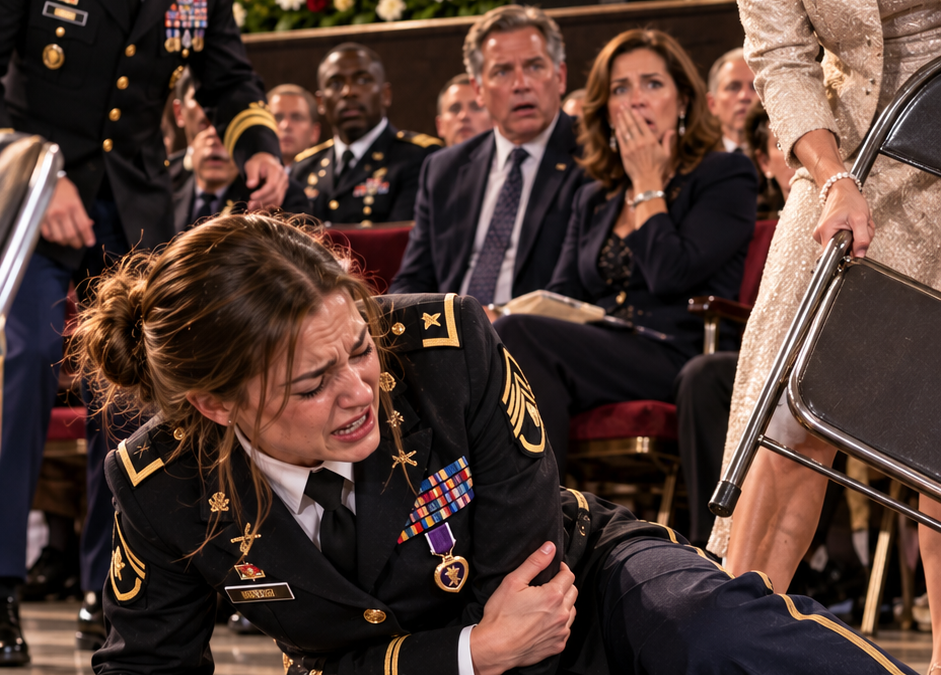
The sound of the bone snapping was louder than the applause.
One second, I was standing beside the stage at my Purple Heart ceremony with General Robert Hayes’s elbow in my hand.
The next, a metal folding chair slammed into my left arm.
CRACK.
Pain exploded from my wrist to my shoulder.
My knees folded.
I hit the floor hard enough to knock the air from my lungs.
The chair bounced once on the polished auditorium floor and landed beside me with a metallic crash.
For two or three seconds, I could not understand what had happened.
My fingers would not move correctly.
My arm felt both numb and violently alive, pain pulsing through it so deeply that nausea climbed into my throat.
Then I heard Linda.
“Who do you think you are?”
My stepmother stood over me, breathing hard.
One hand still gripped the folding chair.
Her face was red.
Her eyes were wild.
“You put on that costume and suddenly think you’re better than us?”
The auditorium had been full of applause moments earlier.
Hundreds of people.
Soldiers.
Officers.
Veterans.
Families.
Now it was silent.
Linda looked down at me and spat the words she had been feeding me in different forms since I was twelve.
“You’re still Porter trash.”
I pulled my broken arm against my chest.
But I was not looking at Linda.
I was looking at my father.
Richard Porter sat in the third row.
He had seen everything.
Every second.
He had watched his wife pick up the chair.
Watched her swing it.
Watched the metal strike my arm.
I waited for him to stand.
That sounds pathetic now.
But some part of me was still the twelve-year-old girl who believed there had to be a line Linda could cross that would finally force my father to choose me.
I had imagined that line for years.
When she mocked my grades.
When she called my military scholarship a charity handout.
When she told relatives I joined the Army because no decent college wanted me.
When I came home from deployment limping and she asked why I was “putting on a wounded-veteran act for the neighbors.”
When I woke from nightmares and heard her tell Dad I was doing it for attention.
Every time, he had excuses.
Linda had a temper.
Linda had a difficult childhood.
Linda was threatened by my mother’s memory.
Linda didn’t mean it the way it sounded.
Linda loved differently.
Dad always had another explanation.
So when she broke my arm in front of an auditorium full of witnesses, part of me thought:
This is it.
This has to be it.
He will stand now.
He didn’t.
My father looked at his shoes.
Beside him, my stepbrother Kyle laughed.
Actually laughed.
It lasted less than a second.
Probably shock.
Probably disbelief.
I did not care.
The sound went straight through me.
Linda’s mouth tightened with satisfaction.
She thought the humiliation was complete.
Then a hand settled on my shoulder.
Firm.
Steady.
General Robert Hayes.
He had been the reason I moved toward the stage in the first place.
He had stepped down from the podium after presenting my Purple Heart, caught his foot awkwardly on the edge of the platform, and stumbled.
I reached for his elbow automatically.
“Easy there, General.”
That was all.
A reflex.
One soldier steadying another.
Linda had seen something else.
A show.
Attention.
Another piece of evidence that I thought I was special.
Now Hayes crouched behind me.
His warm ceremonial expression had disappeared.
I had seen anger in senior officers before.
The loud kind.
The theatrical kind.
Hayes’s was worse.
His face had gone completely still.
He looked at Linda.
Then at the chair.
Then toward the back of the auditorium.
Two Military Police officers entered the aisle.
Linda’s confidence shifted.
Only slightly.
But I saw it.
General Hayes lifted his chin.
“Secure her.”
Linda jerked backward.
“What?”
The MPs moved faster.
One reached for the chair.
Linda pulled it toward herself.
“Don’t touch me!”
“Ma’am, release the chair.”
“I am her mother.”
“No,” I said.
The word barely left my mouth.
But the room was so silent everyone heard it.
Linda looked at me.
For the first time since she swung the chair, she appeared genuinely shocked.
I struggled to my knees.
Pain almost dropped me again.
The medic stationed beside the ceremony rushed forward.
“Captain, don’t move that arm.”
“I know.”
Linda stared at me.
“You ungrateful little—”
“Enough.”
Hayes did not raise his voice.
He did not need to.
Linda stopped.
Something was brought to him from the stage.
A small velvet case.
I had seen it earlier sitting behind the podium, but I assumed it belonged to someone else.
General Hayes opened it.
Silver against dark blue velvet.
For several seconds I forgot my broken arm.
The Silver Star.
My mouth went dry.
“Sir?”
“This presentation was supposed to happen after your Purple Heart.”
I stared at him.
“I wasn’t told.”
“You weren’t supposed to be.”
The medic touched my shoulder.
“General, she needs a hospital.”
“I know.”
Hayes closed the case halfway.
Then reconsidered.
He faced the room.
“Before Captain Porter is taken for treatment, I believe everyone here deserves to understand what they just witnessed.”
Linda pulled against the MP holding her wrist.
“This is ridiculous.”
“Stop resisting, ma’am.”
“I said I’m her mother.”
I looked at her.
“You married my father.”
The words came more calmly than I felt.
“That is not the same thing.”
Something old and poisonous moved behind her eyes.
The same expression I had seen whenever I earned something she could not take credit for.
A scholarship.
A promotion.
A commendation.
A place she had already told everyone I would never reach.
General Hayes stepped between us.
“Captain Emma Porter saved my life.”
The room changed.
My father finally looked up.
Hayes continued.
“She also saved two other soldiers during the same engagement.”
I closed my eyes.
Heat.
Dust.
Black smoke.
Fuel.
Radio static.
A mountain road.
A vehicle on its side.
Blood inside my glove.
I had spent three years learning how not to return to that afternoon.
Hayes brought the room there anyway.
“Our convoy was moving through a mountain corridor when the lead vehicle was hit.”
His voice was level.
Controlled.
But I knew him well enough to hear memory underneath it.
“The blast overturned my vehicle. I sustained significant injuries and lost consciousness.”
Dad’s eyes moved toward me.
I hated myself for noticing.
I hated that after everything, some part of me still wanted to see pride there.
Hayes looked down at me.
“When I regained consciousness, Captain Porter was pulling me away from the wreckage.”
A murmur moved through the auditorium.
“She had already been wounded.”
Linda shook her head.
“No.”
Hayes turned.
“You appear to have difficulty accepting facts that do not suit you.”
Her face flushed.
“She’s always dramatic.”
The medic beside me inhaled sharply.
Hayes’s jaw tightened.
“Captain Porter had taken shrapnel before she reached my vehicle.”
I remembered seeing the blood.
Remembered deciding not to look at it again.
If I inspected the wound, I might stop.
So I didn’t.
“She dragged me almost forty yards to cover.”
Dad swallowed.
Hayes continued.
“Then she heard two soldiers calling from the damaged vehicle behind us.”
Kyle stopped smiling.
“She went back.”
The general paused.
“Twice.”
The silence became heavy.
“The second time, fire had spread through the vehicle.”
I looked toward the back of the auditorium.
A man stood.
Older now.
Scar along his jaw.
Broad through the shoulders.
But I knew him.
Sergeant Daniel Ruiz.
He raised one hand.
“I’m right here, Captain.”
My throat closed.
I had not known he was coming.
Ruiz stepped into the aisle.
“My wife is here too.”
A woman beside him stood, already crying.
“So are my daughters.”
Two girls stood.
One maybe nine.
The other eleven.
Ruiz looked at Linda.
“Your daughter is the reason they still have a father.”
Linda had no response.
“She carried me farther than I could crawl. Broken pelvis. Burns down my right side.”
His voice shook.
“She talked to me the whole time.”
I remembered.
Stay awake.
What’s your wife’s name?
Where did you meet her?
Tell me your daughters’ birthdays.
Tell me anything.
Anything except goodbye.
Ruiz looked at me.
“You kept saying I wasn’t allowed to die because your back already hurt from carrying me.”
A ripple of laughter moved through the room.
I almost smiled.
“That sounds like me.”
He laughed through tears.
“It does.”
Then his expression changed.
“You never told them?”
He meant my family.
I looked at Dad.
“No.”
My father flinched.
Linda found her voice.
“You didn’t tell us because you knew we wouldn’t believe you.”
“No.”
I looked directly at her.
“I didn’t tell you because you never asked.”
My father closed his eyes.
Kyle looked down.
“When I came home from that deployment,” I continued, “you asked why I was limping because you said it made me look pathetic in front of the neighbors.”
A few people gasped.
“You said military medals were participation trophies for adults.”
Linda’s eyes darted toward the officers.
“You told Dad my nightmares were an attention stunt.”
My father whispered, “Emma.”
I turned toward him.
“No.”
He stopped.
“You don’t get to say my name now like you suddenly remember I’m your daughter.”
That hurt him.
I could see it.
Once, that would have satisfied me.
Instead I felt tired.
General Hayes nodded toward the MPs.
“Remove her.”
Linda erupted.
“No!”
She twisted.
“You cannot do this.”
“You are being detained for assault.”
“It was an accident!”
Several people actually reacted aloud.
The chair had been above her head.
She had screamed before swinging.
She had stood over me afterward calling me trash.
But Linda had always believed repetition could make reality tired enough to surrender.
The MP guided her toward the aisle.
She dug her heels into the carpet.
“Richard!”
My father looked up.
“Richard, tell them!”
He stood halfway.
Then stopped.
Halfway.
That had been his entire relationship with me.
Halfway protecting me.
Halfway challenging her.
Halfway being a father.
Linda stared at him.
“You’re letting them take me?”
Dad looked at my arm.
It was swelling badly.
Then he looked at the chair.
Finally, he looked at Linda.
“I saw you swing it.”
She went still.
“What?”
His voice trembled.
“I saw you swing the chair.”
I had imagined him finally saying something like that for years.
I expected relief.
Victory.
Maybe even love.
Instead, it felt like being handed water after twenty years of thirst and discovering the thirst had already died.
Linda’s face hardened.
“You weak bastard.”
Dad said nothing.
The MPs took her out.
She screamed my name twice.
I did not turn.
The medic touched my shoulder.
“Captain, hospital. Now.”
I tried to stand.
“I can walk.”
“I know.”
She smiled without humor.
“That isn’t the same as should.”
Ruiz approached before they moved me.
“Still trying to prove you don’t need help?”
“Bad habit.”
“Terrible habit.”
His wife squeezed my good hand.
“Thank you.”
Those two words nearly broke me more completely than Linda’s chair.
I squeezed back.
“You don’t owe me anything.”
“Yes,” she whispered. “We do.”
The hospital was eight minutes away.
It felt like an hour.
X-rays showed fractures in both the radius and ulna.
The orthopedic surgeon called it serious but clean.
I called it Linda’s newest contribution to Porter family history.
They medicated me.
Reset the arm.
Stabilized it.
Talked about follow-up imaging and whether surgery might be necessary.
Through all of it, General Hayes stayed.
Two hours later, he stood beside the window in my private room, jacket folded over one arm.
“You didn’t have to stay.”
“Yes, I did.”
“General—”
“Robert.”
I blinked.
“What?”
“You dragged me from a burning vehicle. I think we can suspend rank etiquette while you’re drugged.”
I laughed.
It hurt.
“Fine. Robert.”
He nodded toward the cast.
“How bad?”
“Could have been worse.”
“That isn’t an answer.”
“It’s the answer soldiers use.”
“I know. I’ve used it.”
He pulled a chair closer.
Then said, “Your father is outside.”
My stomach tightened.
“Kyle too.”
“I don’t want to see them.”
“I told them.”
“Thank you.”
“They have been sitting there forty minutes.”
“That sounds uncomfortable.”
“It appears to be.”
Despite everything, I smiled.
Then his face changed.
“There is something else.”
Of course there was.
He reached inside his jacket and removed a sealed folder.
Classification stamps.
Operational review.
My name.
Every trace of humor left me.
“What is that?”
“The formal review of the convoy attack.”
“I thought that investigation closed.”
“It did.”
He sat.
“Part of it was reopened.”
“Why?”
“The attack was originally classified as an insurgent ambush based on intercepted communications.”
“Yes.”
“Those communications were manipulated.”
I stared.
“What do you mean?”
“Someone leaked our route.”
“No.”
“Yes.”
The convoy route had been restricted to a very small circle.
“What are you telling me?”
Hayes rested the folder on his knee.
“Your name appeared during the reopened review.”
My stomach dropped.
“As what?”
“Not a suspect.”
I exhaled.
“As a target.”
For a moment I almost laughed.
“That’s ridiculous.”
“I agree.”
“I was a junior officer.”
“I know.”
“Nobody targets an entire convoy because of a junior officer.”
“There is evidence someone specifically wanted you on that route.”
My skin turned cold.
“Who?”
“We don’t know.”
“Are you saying those men died because someone wanted me there?”
“I am saying investigators have evidence the route was altered in a way that increased the probability you would be aboard that convoy.”
My arm stopped mattering.
For three years, I had treated that day as random war.
Brutal.
Senseless.
But random.
“What evidence?”
“Enough to reopen the file.”
“Why tell me now?”
“Because the attack may no longer be disconnected from what happened today.”
I frowned.
“The chair?”
“Maybe not the chair itself.”
He studied me.
“But Linda attacked you at a ceremony that publicly recognized an event someone once tried to make sure you did not survive.”
A knock interrupted us.
Hayes immediately put the folder away.
A nurse entered.
“There is a man asking for Captain Porter.”
“My father?”
“No.”
She checked the name.
“Michael Reeves.”
I stopped breathing.
Hayes noticed.
“You know him?”
“I did.”
Michael Reeves had been my mother’s attorney.
My biological mother died when I was ten.
Two years later Linda entered our lives.
Michael handled Mom’s estate.
Then disappeared.
Or so I had believed.
“Send him in,” I said.
The man who entered looked older than my memory.
Almost white hair.
Gray eyes.
The same uncomfortable sharpness.
He saw my cast.
“I’m sorry.”
“How did you know?”
“The ceremony was livestreamed.”
Of course.
Army public affairs.
“I’ve been trying to contact you.”
“I haven’t heard from you in sixteen years.”
“I know.”
“Why now?”
He set a briefcase down.
“Your mother left instructions.”
“My mother has been dead sixteen years.”
“Yes.”
“She left instructions that waited sixteen years?”
“A sealed legal directive.”
“For what?”
“For a condition.”
“What condition?”
His eyes moved toward my folded uniform.
“When you were officially recognized for valor by the United States military.”
I stared.
“That is absurdly specific.”
“Your mother was a specific woman.”
That much was true.
Lists.
Labels.
Calendars.
Receipts arranged by date.
Details keep people from stealing your future, she used to say.
Michael opened the case.
He removed a thick envelope.
My name was handwritten across it.
I knew the handwriting.
My mother’s.
“No.”
He placed it on the table.
The paper trembled when I touched it.
“Why would she connect this to a military medal?”
“I don’t know everything.”
“That is not good enough.”
“No.”
He sat.
“But I know she believed someone inside your family would try to stop you from learning the truth.”
Hayes stepped closer.
“Does this concern Captain Porter’s service?”
“I don’t know.”
Michael looked at me.
“Your mother did not give me that information.”
I opened the envelope.
A letter.
Legal documents.
Photographs.
The first picture showed Mom outside a military hospital when she was young.
A man stood beside her.
Uniform.
Three stars.
The photograph was creased across part of his face.
But General Hayes recognized him immediately.
“No.”
I looked at him.
“You know him?”
Hayes took the picture.
“General Thomas Avery.”
The name was famous.
One of the most decorated Army officers of his generation.
Strategist.
Commander.
A man whose career ended when a private aircraft crashed eighteen years earlier.
“He died.”
“Yes.”
I turned the photograph over.
Mom’s handwriting.
Robert knows the truth.
I looked at Hayes.
“Robert?”
He shook his head.
“Not me.”
“Your name is Robert.”
“Yes. But that photograph predates me knowing your mother.”
He stared at Avery.
“There was another Robert in Avery’s circle.”
“Who?”
“I don’t know yet.”
I unfolded Mom’s letter.
The first sentence stopped me.
Emma, if you are reading this, then you became exactly what I was afraid you would become.
Afraid.
Not proud.
Afraid.
I kept reading.
You chose service. You chose courage. You chose to protect people who may never know what you sacrificed. If that happened, then I failed to keep you far enough away from the life that came before you.
My hand tightened.
The next paragraph was worse.
There are things your father does not know. Things Linda must never learn.
I looked up.
“Linda?”
Michael leaned forward.
“What?”
I read aloud.
If Linda Mercer ever becomes part of your father’s life, do not trust her.
My pulse accelerated.
Linda’s maiden name was Mercer.
Mom had died two years before Dad claimed he ever met her.
“How did my mother know Linda?”
Nobody answered.
I continued.
Linda is not who she says she is. She knows about Thomas. She knows about you. And if she ever discovers what I hid, she will try to take it.
Legal documents slipped from my lap.
Trust agreements.
Sealed records.
Redactions.
Then another photograph fell onto the blanket.
Mom held a baby.
Me.
Thomas Avery stood behind her.
Not Richard Porter.
Avery.
On the back:
For our daughter, when ready.
The hospital room went silent.
My mouth opened.
No sound came.
Michael closed his eyes.
“My father…”
He spoke carefully.
“Richard Porter may not be your biological father.”
May not.
The photograph was not subtle.
I looked at Avery’s face again.
Then the convoy folder in Hayes’s hand.
Mom’s warning.
Linda.
Target.
Route leak.
My body became cold.
Hayes reached for his phone.
“If Thomas Avery was your biological father, this becomes more than a family issue.”
“Why?”
His expression hardened.
“Because Avery did not die in an accident.”
The door opened.
Dad stood there.
Kyle behind him.
Hayes snapped, “I told you to wait outside.”
Dad did not seem to hear.
He was staring at the photograph.
His face collapsed.
“Oh God.”
I stared at him.
“You knew.”
He shook his head.
“Emma.”
“You knew.”
“No.”
“You recognized him.”
His eyes filled.
“I knew there was another man.”
“Another man?”
“Your mother told me shortly before she died.”
“You let me believe you were my biological father.”
His face twisted.
“I am your father.”
“Biologically?”
Silence.
That was my answer.
“She told you?”
“Yes.”
“And you never told me.”
“She begged me not to.”
“Why?”
Dad looked at Hayes.
Then Michael.
Then me.
“Because she said the people who killed Thomas Avery would come for you if they knew who you were.”
Nobody moved.
Hayes stepped closer.
“What did you say?”
Dad swallowed.
“She believed Avery was murdered.”
“By whom?”
Dad looked toward the hallway.
Then at me.
“Linda knew.”
My skin prickled.
“What?”
“She knew before I married her.”
Michael whispered, “Jesus.”
Dad’s voice shook.
“She came to me after your mother’s funeral. She knew things about Avery. About your mother. About you.”
“You married her?”
“I thought if she believed I was cooperating, she would leave you alone.”
I stared at him.
Every insult.
Every humiliation.
Every time Linda told me I would never succeed.
Every time Dad asked me not to provoke her.
“You let her abuse me for sixteen years.”
“I was trying to keep you alive.”
“You should have tried being my father.”
He lowered his head.
Kyle suddenly spoke.
“Dad.”
We all turned.
He stared at his phone.
“What?”
Kyle looked terrified.
“Mom isn’t in custody anymore.”
Hayes moved.
“What do you mean?”
“She texted me.”
Dad went white.
Kyle turned the screen.
One message.
Tell Emma her mother should have burned the evidence when she had the chance.
Then an image.
Linda stood beside an old military storage building.
Gasoline can in one hand.
A folder bearing Mom’s name in the other.
A faded unit number was painted on the rusted door.
Hayes saw it.
Swore quietly.
“What building?” I asked.
“It belonged to Avery’s special operations group.”
Everything aligned.
The ceremony.
The medal.
Mom’s condition.
Linda attacking me at the exact event that triggered the directive.
“She knew.”
Hayes nodded.
“She knew what recognition for valor would activate.”
“How?”
Nobody answered.
Then Kyle’s phone rang.
Unknown number.
He looked at me.
I nodded.
He answered on speaker.
Breathing.
Then Linda.
Calm.
Almost cheerful.
“Congratulations on your medal, Emma.”
My blood went cold.
“Linda.”
“You always were stubborn.”
Hayes signaled everyone to remain silent.
“You found the photograph, didn’t you?”
I said nothing.
“I’ll take that as a yes.”
“What do you want?”
“Oh, sweetheart.”
Her voice softened.
“It was never about what I wanted.”
A metallic sound came through.
A lock.
“My job was to keep you from finding out what your real father left behind.”
“What did he leave?”
Silence.
Then:
“A list of names.”
Hayes froze.
Linda continued.
“And one of those names belongs to someone standing in that hospital room with you.”
The line disconnected.
Nobody moved.
Dad.
Kyle.
Michael Reeves.
General Hayes.
Four men.
Four faces.
I looked from one to another.
And then a thought cut through the confusion.
“How did she know?”
Hayes looked at me.
“What?”
“How did Linda know I opened the letter?”
Nobody answered.
I turned toward Michael.
He had gone very still.
The room changed.
Michael saw it happen.
“Emma.”
“No.”
I looked at him.
“My mother created a sealed directive.”
“Yes.”
“You held it.”
“Yes.”
“She tied delivery to military recognition.”
“Yes.”
“Who knew that condition?”
He hesitated.
“My staff—”
“What staff?”
“The firm.”
“Names.”
His face tightened.
“That was sixteen years ago.”
Hayes stood.
“Answer her.”
Michael looked at the door.
That was enough.
General Hayes moved between him and the exit.
“Sit down.”
Michael’s composure cracked.
“You don’t understand.”
“Then explain.”
He backed toward the wall.
I stared at the man my mother had trusted with her final legal instructions.
“You told Linda.”
“No.”
“Then how did she know the medal activated the letter?”
“I did not tell her today.”
Today.
The word landed like a gunshot.
Hayes heard it too.
“When did you tell her?”
Michael closed his eyes.
“Years ago.”
My father whispered, “You?”
Michael looked at him.
“You were never supposed to know.”
Dad moved toward him.
Hayes blocked him.
“What did you do?”
Michael’s voice broke.
“I was young.”
“So was my mother.”
“I had debts.”
“So did everyone.”
“You don’t understand what those people were capable of.”
I almost laughed.
“You are standing beside the daughter of a murdered general with a broken arm because a woman you helped spent sixteen years abusing me. Try again.”
Michael sat down.
His shoulders collapsed.
“I was Avery’s legal liaison.”
Hayes’s eyes narrowed.
“For what?”
“Contract structure. Classified procurement channels. Private intermediaries.”
My mother’s lawyer.
Avery’s liaison.
Not coincidence.
Michael continued.
“Thomas discovered money moving through defense contracts into private entities that did not exist on paper the way they appeared to.”
Hayes said, “Black procurement.”
“Yes.”
“Who was involved?”
“A network. Military officers. Civilian contractors. Two intelligence intermediaries. Political donors.”
“And Linda?”
“Her father worked for one of the contractors.”
I looked at him.
“Linda Mercer.”
“She was not Linda Mercer then.”
“What was she?”
“Linda Shaw.”
Hayes stiffened.
Michael noticed.
“You know the name.”
“Colonel Everett Shaw.”
Michael nodded.
Hayes swore quietly.
I had heard the name in old training literature.
Procurement scandal.
Retired early.
No conviction.
“Thomas found evidence Shaw’s company was leaking operational data in exchange for overseas payments.”
Dad looked sick.
Michael said, “Avery started compiling names.”
“The list.”
“Yes.”
“He trusted my mother?”
Michael looked at me.
“He loved your mother.”
That hurt unexpectedly.
Not because I had known Avery.
I hadn’t.
Because suddenly my mother’s life had an entire hidden room I had never been allowed to enter.
“He knew he was being watched,” Michael continued. “So he gave her copies.”
“Why not military investigators?”
“He did.”
Hayes frowned.
“What happened?”
“The report disappeared.”
The room became still.
Michael looked toward him.
“Someone above him was involved.”
Hayes said nothing.
“Avery arranged a second package. Names. Account numbers. contract identifiers. Route manipulations. Personnel transfers.”
“And my mother hid it.”
“Yes.”
“Where?”
“I never knew.”
“Linda thinks it is at that building.”
“She thinks something is.”
I looked at him.
“And you helped her.”
Michael’s eyes filled.
“I gave her the condition in the directive.”
“Why?”
“Because after your mother died, Linda found me.”
“And?”
“She knew I had been Avery’s counsel.”
“You were scared.”
“Yes.”
“So you sacrificed me.”
“No.”
The answer came quickly.
Too quickly.
“I tried to keep the directive intact.”
“You disappeared for sixteen years.”
“I monitored you.”
My stomach turned.
“What?”
“Public records. Military announcements. Promotions.”
Hayes’s face went cold.
“You tracked an Army officer without authorization?”
“Public sources.”
I stared at Michael.
“Was Linda tracking me too?”
He said nothing.
That answered it.
“Did you tell her about my deployments?”
“No.”
“Did you tell her about the medal?”
“No.”
“Then how did she know?”
Michael looked toward Dad.
Dad shook his head.
“I didn’t.”
Kyle said, “Mom watched everything Emma did.”
We looked at him.
He swallowed.
“She had alerts.”
“What alerts?”
“News. Army pages. Anything with Emma’s name.”
I felt sick.
“She would get angry anytime Emma got mentioned.”
Linda had not simply resented me.
She had been monitoring me.
Hayes stepped toward Michael.
“Did you help her leave custody today?”
Michael looked down.
“Michael.”
“I gave her an emergency attorney contact years ago.”
“That isn’t an answer.”
He hesitated.
“I received a message after the ceremony.”
“From her?”
“Yes.”
“What did it say?”
“That the condition had been met.”
“And?”
“She said she needed legal assistance.”
“You arranged it.”
“I called someone.”
“Who?”
Michael whispered a name.
Hayes immediately picked up his phone.
He called security.
Within minutes, the hospital floor was locked down.
Michael Reeves was no longer a visitor.
He was being questioned.
I should have felt vindicated.
Instead I felt exhausted.
Everything in my life had become evidence.
My childhood.
My mother’s death.
Linda’s abuse.
My father’s cowardice.
My military career.
Even the ambush.
Hayes ended the call.
“Linda’s lawyer used forged transfer documents to interfere with her movement from military police custody. Local authorities are responding.”
“So she escaped.”
“Yes.”
“And she is at Avery’s building.”
“Probably.”
“I’m going.”
“No.”
“Robert.”
“No.”
“That woman broke my arm because she thinks whatever is there belongs to me.”
“And you currently have two fractured bones and medication in your system.”
“I can stand.”
“Congratulations.”
“Robert.”
“You are also potentially the central target in an eighteen-year-old conspiracy involving the murder of a general.”
I stared.
“That sounded more dramatic when you said it aloud.”
“It was meant to.”
I looked at the image on Kyle’s phone.
Linda.
Gasoline.
Mom’s folder.
“She has something of my mother’s.”
Hayes leaned closer.
“Then let trained people recover it.”
“I am trained people.”
“Today you are a patient.”
We stared at each other.
Finally, Kyle spoke.
“She’ll destroy it if Emma doesn’t talk to her.”
Hayes turned.
“What makes you say that?”
Kyle swallowed.
“Because Mom doesn’t want evidence.”
He looked at me.
“She wants Emma.”
I felt something cold settle in my stomach.
“What do you mean?”
Kyle sat.
For the first time, he looked less like Linda’s son and more like a frightened man raised by the same woman who raised me.
“She hated you.”
“I noticed.”
“No.”
He shook his head.
“Not normal hate.”
He looked at Dad.
“She was afraid of her.”
Dad went still.
Kyle continued.
“Whenever Emma got promoted, Mom would drink.”
I remembered.
“When Emma deployed, she would ask Dad questions.”
“What questions?”
“Where. With who. What unit.”
Dad looked ashamed.
“I never told her classified information.”
Kyle laughed bitterly.
“You told her enough.”
Dad flinched.
Kyle looked at me.
“She used to say you were becoming harder to control.”
The words landed slowly.
I thought of Linda laughing when I failed.
Mocking when I succeeded.
Punishing every sign of independence.
“She didn’t want to destroy my confidence because she hated me.”
Kyle’s eyes filled.
“She wanted you small.”
Because small people do not ask questions.
Small people do not earn medals.
Small people do not become important enough for sealed letters to open.
General Hayes ordered me to remain at the hospital.
This time, I did not fight him.
Not because I agreed.
Because I finally understood that rushing toward Linda was exactly what she expected.
So we did something she did not expect.
We made her talk.
Kyle called back.
She answered on the fourth ring.
“Sweetheart.”
His hands trembled.
“Mom.”
“Are you safe?”
He looked at me.
“Yes.”
“Did they hurt you?”
“No.”
“Where’s Emma?”
I leaned toward the phone.
“I’m here.”
Silence.
Then Linda laughed.
“There you are.”
“What do you want?”
“Come to the building.”
“No.”
She had not expected that.
“What?”
“You heard me.”
“You want your mother’s evidence?”
“I want the truth.”
“Same thing.”
“No.”
I looked at Hayes.
He nodded.
The call was being recorded.
“The truth does not disappear because you burn paper.”
Linda laughed.
“You always did sound like her.”
“Did you know my mother before you married Dad?”
Silence.
“Yes.”
Dad closed his eyes.
“Did you know Thomas Avery?”
Longer silence.
“Yes.”
“Were you involved in his death?”
Kyle stopped breathing.
Linda’s voice changed.
“No.”
Not angry.
Careful.
That mattered.
“But you know who was.”
“I know enough.”
“Who altered my convoy route?”
No answer.
“Linda.”
“You should never have joined the Army.”
My skin went cold.
There it was.
Not denial.
“Was the ambush meant for me?”
“You were supposed to choose another life.”
“That’s not an answer.”
“You were supposed to stay ordinary.”
Dad covered his mouth.
I kept my voice steady.
“Did you put me on that convoy?”
Her breathing changed.
General Hayes leaned closer to the phone.
Linda knew he was listening.
“I gave someone your schedule.”
Dad made a broken sound.
I did not look at him.
“Who?”
“No.”
“You gave someone my schedule.”
“I was trying to scare you out of the Army.”
The room became completely still.
“People died.”
“I didn’t order anyone to die.”
“You leaked information.”
“I told someone when you were moving.”
“Who?”
Silence.
“Linda.”
“You think that medal makes you important?”
“No.”
I looked at my broken arm.
“But you do.”
She breathed heavily.
“You don’t understand what Avery left.”
“Then explain it.”
“That list can destroy families.”
“It already did.”
“It can destroy careers.”
“Good.”
“It can collapse companies.”
“Better.”
Her voice sharpened.
“You sound just like your mother.”
“Thank you.”
She screamed.
Actually screamed.
“You don’t know what she did!”
For the first time, I heard the thing beneath Linda’s rage.
Fear.
My mother had frightened her.
Not physically.
With evidence.
I lowered my voice.
“What did she do?”
“She kept copies.”
“Of Avery’s list.”
“Yes.”
“Where?”
Linda laughed again.
“I thought this building.”
“You don’t sound certain.”
No answer.
Hayes scribbled something.
KEEP HER TALKING.
I said, “You have Mom’s folder.”
“Some of it.”
“Where did you get it?”
“Richard had things he didn’t know mattered.”
Dad looked horrified.
“From our house?”
Linda ignored him.
I continued.
“Does the building contain the list?”
“I’ll know soon.”
Metal scraped in the background.
A drawer.
Cabinet.
Something heavy.
Linda was searching.
Security teams were already moving toward the site.
Hayes received messages silently.
Eight minutes.
I kept her talking.
“Why did Mom tie the letter to military valor?”
Linda stopped moving.
“You really don’t know?”
“No.”
“She knew exactly what you were.”
“I was ten when she died.”
“She knew Avery.”
That sentence made no sense at first.
Then Linda said, “He believed courage reproduced itself.”
I almost laughed.
“That sounds scientifically weak.”
“He wanted you away from the military.”
“So did Mom.”
“Yes.”
“Then why the medal condition?”
“Because if you ignored every warning and went anyway, she wanted proof you had become strong enough to survive the truth.”
That hurt.
Mom had built a lock only the woman she feared I would become could open.
Avery’s daughter.
Army officer.
Combat survivor.
Recipient of the Purple Heart.
Now Silver Star.
“Why attack me at the ceremony?”
“To stop Reeves.”
“You knew he had the letter.”
“Yes.”
“You knew the condition.”
“Yes.”
“And if I left the ceremony?”
“You might not get it.”
“You broke my arm.”
“You were supposed to leave before the presentation.”
I almost laughed.
“You have an interesting definition of persuasion.”
“You never listened.”
“No. I survived.”
The line went silent.
Then Linda said something quietly.
“You were supposed to die on that road.”
Dad sank into his chair.
Kyle whispered, “Mom…”
Linda seemed to realize what she had said.
But it was too late.
Hayes’s eyes hardened.
“Who gave them the route?” he asked.
Linda laughed nervously.
“Oh, General Hayes. Finally speaking.”
“You know my voice.”
“Of course I do.”
Hayes’s face changed.
“Who are you?”
“You knew my father.”
Colonel Everett Shaw.
Hayes stood completely still.
“I knew of him.”
“He said you helped destroy him.”
“I testified about procurement irregularities.”
“You ruined him.”
“He stole from the government and endangered soldiers.”
Linda’s breath sharpened.
“Thomas Avery ruined him first.”
And there it was.
The old grievance.
A father disgraced.
A daughter raised on revenge.
Avery discovered the network.
Avery died.
My mother preserved evidence.
Linda entered our family.
Then watched me.
A living loose end.
Sirens sounded faintly through Linda’s phone.
She heard them.
“So that’s what this was.”
“What?”
“You kept me talking.”
“Yes.”
Her voice dropped.
“You always were a little bitch.”
“Still better than trash.”
The insult was hers.
I gave it back without believing it.
Linda hung up.
Hayes’s phone immediately vibrated.
Security teams had reached the site.
What happened next came to me through fragments.
Radio calls.
Messages.
Later, body-camera footage.
Linda had poured gasoline through the front archive room but had not yet ignited it.
When officers arrived, she locked herself inside.
For eleven minutes, she threatened to burn everything.
Then she tried to escape through a maintenance exit.
Military police detained her less than fifty yards from the building.
No shots.
No heroic final fight.
No cinematic explosion.
Just a woman in muddy clothes with gasoline on her hands, screaming that the evidence belonged to her family.
The folder survived.
So did the records inside the building.
And Linda had been wrong about something important.
The list was not there.
What they found instead was a map.
Old storage identifiers.
Avery’s notes.
And a reference to a legal archive maintained under a code name.
Michael Reeves recognized the code.
That was when his cooperation began.
Maybe guilt finally became heavier than fear.
Maybe he understood the evidence had outlived everyone’s attempts to bury it.
Maybe he simply wanted a better outcome for himself.
I stopped caring why.
The archive was located three days later.
Inside a secure commercial records facility two states away.
My mother had hidden copies there through a trust controlled by an attorney Reeves never knew she had hired independently.
That was Mom.
Specific.
Suspicious.
Prepared.
The list contained twenty-three names.
Several were dead.
Some retired.
Some had left government years earlier.
Two remained in defense contracting.
One was still working in a federal advisory role.
Michael Reeves’s name was there.
Not as one of Avery’s principal targets.
As a compromised intermediary.
A man who had leaked legal communications after being pressured by Everett Shaw’s network.
That was the name Linda meant when she said someone in my hospital room was on the list.
General Hayes’s name appeared too.
But under a different heading.
TRUSTED CONTACTS.
Robert Hayes had been a young officer Avery believed could eventually be trusted if the primary reporting chain failed.
Mom’s handwriting on the photograph—Robert knows the truth—had not referred to Hayes knowing about my parentage.
It meant Avery had believed Robert Hayes knew enough about the procurement irregularities to recognize the evidence if it surfaced.
Hayes sat beside my hospital bed when investigators explained that part.
He looked stunned.
“I didn’t know.”
“I believe you.”
“Avery spoke to me once.”
“When?”
“Months before he died.”
“About this?”
“Not directly.”
He looked toward the window.
“He asked what I would do if an order was legal on paper but built from corrupted information.”
“What did you say?”
“That I would verify the information.”
I smiled faintly.
“And?”
“He said, ‘Good. Remember that when somebody tells you the paperwork is clean.’”
Hayes rubbed his face.
“I thought it was a leadership lesson.”
“It probably was.”
“It was also a warning.”
“Yes.”
The investigation widened.
Quietly.
There were no headlines naming everyone the next morning.
Real investigations are slower than stories.
Accounts had to be traced.
Old contracting records reconstructed.
Archived communications authenticated.
The evidence concerning Avery’s death was reviewed separately.
Investigators eventually concluded there was sufficient evidence that his plane crash had not been the random mechanical failure originally recorded.
A maintenance component had been deliberately compromised.
Who physically altered it could not be established with certainty after eighteen years.
But financial records connected the contractor responsible for servicing the aircraft to a company controlled through one of Everett Shaw’s former associates.
Linda had not killed Avery herself.
She had been young then.
But she had grown up inside the machinery that protected the people who benefited from his death.
Years later, she accepted the role her father’s circle gave her.
Watch Emma Porter.
Watch Richard.
Find out what Marianne Avery—my mother—had hidden.
Prevent disclosure.
I learned my mother’s full story through those files.
Marianne Porter had met Thomas Avery while working as a civilian logistics analyst attached to a military medical-support project.
They fell in love.
Complicatedly.
Quietly.
Avery was already living much of his life behind classified doors.
Mom became pregnant with me.
Richard knew she had loved someone before him, but not the full truth until after Avery’s death.
Mom chose Richard because he offered something Thomas could not.
Ordinary life.
A home.
A name that did not attract attention.
Richard loved her.
And when she told him before her death that I was Avery’s daughter, he promised to protect me.
That promise should have been noble.
Fear twisted it.
Linda approached after Mom’s death.
She knew enough about Avery to terrify him.
Richard believed keeping Linda close would allow him to monitor her.
Instead, she entered our house.
Then controlled it.
That was the hardest truth for me to accept.
Dad had not ignored Linda’s abuse because he did not care at all.
He ignored it because he convinced himself her cruelty was safer than her enemies.
He thought humiliation would keep me ordinary.
He thought discouraging me from the military might keep me alive.
He thought surrender was protection.
When he came to see me three weeks after the ceremony, my arm was still in a cast.
He looked older.
Not three weeks older.
Twenty years older.
We sat in a hospital rehabilitation room.
He kept his hands in his lap.
“I owe you more apologies than I know how to say.”
“Yes.”
He nodded.
“I loved your mother.”
“I know.”
“I loved you.”
I looked at him.
“I believe you.”
He seemed surprised.
“That doesn’t make what you did acceptable.”
His eyes dropped.
“I know.”
“Do you?”
“Yes.”
“You watched her break me down because you were afraid of what would happen if she thought I was important.”
His mouth trembled.
“Yes.”
“You let me believe my mother was gone and that was the end of the story.”
“Yes.”
“You knew I had another biological father.”
“Yes.”
“You knew Linda was connected to people who frightened Mom.”
“Yes.”
“And instead of calling law enforcement, military investigators, lawyers—anyone—you married her.”
He closed his eyes.
“I thought I could manage her.”
“You couldn’t.”
“No.”
“You thought you could protect me without telling me what danger I was in.”
“Yes.”
“You couldn’t.”
“No.”
I stared at the man who raised me.
He was my father.
Not biologically.
But biology had become one of the least interesting definitions in my life.
Richard taught me to ride a bicycle.
Packed lunches.
Sat beside my bed when I had pneumonia.
Cried at my high school graduation when he thought I was not looking.
He also failed me in ways that changed who I became.
Both were true.
“I don’t know what our relationship is going to be.”
His eyes filled.
“I understand.”
“No. Listen.”
He looked up.
“I am not saying never.”
Hope flashed.
I stopped it.
“I am also not saying soon.”
He nodded.
“You spent sixteen years making decisions for me because you were afraid.”
“I know.”
“I need time where you do not get to make another decision about what is best for me.”
He swallowed.
“Okay.”
“And if Linda ever contacts you—”
“I call the investigators.”
“Immediately.”
“Yes.”
“No protecting me.”
His face broke.
“Yes.”
“No deciding I cannot handle the truth.”
“Yes.”
“No halfway.”
That word hurt him.
Good.
He needed to understand it.
“No halfway,” he repeated.
Kyle’s apology came differently.
No speeches.
He visited with coffee.
Placed it on my table.
“I shouldn’t have laughed.”
“No.”
“I was shocked.”
“I know.”
“That doesn’t make it better.”
“No.”
He stared at my cast.
“She did things to you I pretended were normal.”
“Yes.”
“She did things to me too.”
I looked at him.
That was the first time he had said it.
Linda’s cruelty had different targets.
With Kyle, control came disguised as devotion.
He was her son.
Her favorite.
Her proof that she could raise someone better than me.
But love from a controlling person is still a cage.
Kyle spent years learning that disagreeing with Linda meant betrayal.
“I’m sorry,” he said.
“I know.”
“We’re okay?”
“No.”
He laughed sadly.
“Fair.”
“But maybe someday.”
He nodded.
“Better than I expected.”
Linda eventually faced separate proceedings for the assault at the ceremony and for her role in obstructing the investigation surrounding Avery’s records.
The larger conspiracy took longer.
Years longer.
Some charges were impossible because people had died.
Some evidence was too old.
Some acts fell outside what prosecutors could prove beyond reasonable doubt.
Others did not.
Michael Reeves cooperated extensively.
It reduced some consequences.
It did not erase them.
Several former officials and contractors faced charges related to fraud, obstruction, unlawful disclosure of operational information, and conspiracy.
The attack on my convoy became part of the case.
Linda’s recorded statement that she gave someone my schedule became critical.
So did records showing contact between her and an intermediary connected to the hostile group that received the convoy route.
She insisted she never intended anyone to die.
Maybe that was true.
I stopped trying to decide.
People who hand dangerous information to dangerous people do not get to control what happens next.
Ruiz once asked if knowing the truth made the ambush harder to live with.
I thought about it.
“No.”
“Really?”
“We survived it once.”
He nodded.
“And now?”
“Now I understand why it happened.”
“Does that help?”
“No.”
I looked at his daughters running across his backyard.
“But ignorance wasn’t helping either.”
My Silver Star ceremony was rescheduled four months after the chair attack.
Smaller this time.
By choice.
No livestream.
No massive auditorium.
No family spectacle.
I almost refused the medal.
Not because I believed I did not deserve it.
Because the first ceremony had become connected in my mind with Linda.
General Hayes understood.
He visited my office after I returned to limited duty.
“The medal isn’t hers.”
“I know.”
“She doesn’t get to own that day.”
“I know.”
“Ruiz is coming.”
“That’s cheating.”
“Yes.”
“His daughters too?”
“Probably.”
“That is definitely cheating.”
Hayes smiled.
“Will you be there?”
I looked at the Silver Star case on his desk.
Then at my healed arm.
“Yes.”
The ceremony took place on a cool morning.
Ruiz stood in the front row.
His wife beside him.
His daughters held hands.
Kyle attended.
Dad did not.
That was my decision.
He respected it.
That mattered.
General Hayes called my name.
I stepped forward.
This time no one shouted.
No chair scraped.
No one tried to make me smaller.
Hayes pinned the Silver Star beneath my ribbons.
Then quietly said, “Your mother would have hated how much attention this is getting.”
I almost laughed.
“You didn’t know her.”
“I know enough now.”
“That’s fair.”
He stepped back.
Saluted.
I returned it.
Afterward Ruiz hugged me carefully.
His older daughter looked at my medal.
“Is that the one you got for saving Dad?”
I crouched.
“It’s one of the things they gave me.”
“Are you a hero?”
Children ask terrifying questions.
I looked at Ruiz.
He was trying not to smile.
“No.”
His daughter frowned.
“My dad says you are.”
“Your dad is dramatic.”
Ruiz laughed.
The girl considered me.
“Did you save him?”
“I helped.”
“Then you’re a hero.”
I could have argued.
Instead I smiled.
“Okay.”
She seemed satisfied.
Later that afternoon, I visited my mother’s grave.
I brought no flowers.
Mom hated cut flowers.
She said watching something die slowly in a vase was depressing.
So I brought coffee.
One cup for me.
One sealed cup beside her headstone.
Ridiculous.
She would have approved.
I sat on the grass.
“Thomas Avery.”
The name sounded strange aloud.
“My biological father was a three-star general.”
Wind moved through the trees.
“And you thought the best way to tell me was a letter triggered by a medal.”
Silence.
“That is the most Marianne Porter thing anyone has ever done.”
I laughed.
Then cried.
I told her everything.
The convoy.
Hayes.
Ruiz.
Linda.
Dad.
Kyle.
Michael.
The list.
The investigation.
The Silver Star.
Then I told her something I had been afraid to admit.
“I’m angry with you too.”
The words surprised me even though I had thought them for months.
“You left me with a puzzle instead of the truth.”
I wiped my face.
“I know you were scared.”
The wind continued.
“I know you were trying to protect me.”
I laughed bitterly.
“Apparently that is a family disease.”
I looked at her name carved in stone.
“But secrets are not always protection.”
That was the lesson all of them had missed.
Mom.
Dad.
Michael.
Even Avery.
Everyone thought hiding information would keep someone safe.
Sometimes it did.
Sometimes secrecy saved lives.
I understood that better than most.
But secrecy could also become a prison.
A place where frightened people made decisions for others and called it love.
I had lived sixteen years inside that prison.
I was finished.
DNA testing later confirmed what the photographs already suggested.
Thomas Avery was my biological father.
People expected that revelation to change how I saw myself.
It didn’t.
Not much.
I had his eyes.
Apparently his stubbornness.
Maybe his reflex toward danger.
But a famous biological father did not make my life more valuable.
Neither did a Silver Star.
Neither did a Purple Heart.
That mattered to me because Linda had spent years teaching the opposite lesson.
She taught that value came from controlling what other people believed.
That humiliation could reduce someone.
That praise could be stolen.
That if she called me trash enough times, eventually I would become it.
She was wrong.
Pain can shape you.
It cannot define you without permission.
My father and I slowly built something new.
Not the old relationship.
That was gone.
There was no pretending sixteen years had not happened.
No holiday movie reconciliation.
He went to therapy.
So did I.
We met for coffee occasionally.
At first, conversations were awkward.
Then less so.
One afternoon he said, “I thought keeping Linda close meant I could protect you.”
“I know.”
“I should have called someone.”
“Yes.”
“I should have told you when you were old enough.”
“Yes.”
“I should have stopped her the first time she hurt you.”
I looked at him.
“Yes.”
He nodded.
No excuses.
That was new.
“I don’t expect you to forgive me.”
“I might.”
His eyes lifted.
“But forgiveness isn’t going to mean pretending you made the right choices.”
“I understand.”
“Good.”
We drank coffee.
Nothing dramatic happened.
Sometimes healing is disappointing that way.
No music.
No perfect speech.
Just two people sitting across from each other, learning not to lie.
Kyle moved away from Linda’s old house.
Changed his number.
Started therapy.
He sent me a message six months later.
Mom used to tell me if I defended you, you would leave us both.
I stared at it for a long time.
Then answered:
She told me if I challenged her, Dad would choose her and I’d lose the family.
Kyle replied:
She really loved hostage situations.
I laughed harder than I should have.
Humor had always been easier for me than grief.
General Hayes eventually retired.
At his ceremony, I stood near the back.
He spotted me anyway.
Of course.
Afterward he handed me the old photograph of Avery and Mom outside the military hospital.
“I think this belongs to you.”
I held it carefully.
“You kept it?”
“Evidence copy. Investigators released the original.”
I turned it over.
Mom’s handwriting.
Robert knows the truth.
I smiled.
“For years I thought she meant you.”
“So did I.”
“Disappointed?”
“Deeply.”
I laughed.
Then he became serious.
“Your father—Avery—was a difficult man.”
“So I’ve heard.”
“Brilliant.”
“Also heard.”
“Stubborn.”
“That apparently survived genetically.”
Hayes smiled.
Then said, “But he cared about what happened to soldiers.”
I looked at the photograph.
“That matters.”
“He would have been proud of you.”
I hated sentences like that.
Not because I didn’t want them.
Because there was no way to verify them.
Still, I nodded.
“I hope so.”
Hayes shook my hand.
“Emma.”
“Sir?”
“What Linda did to you was never because you were weak.”
I said nothing.
“She saw something in you that frightened her.”
I looked down.
“I know that now.”
For years, I thought Linda attacked everything I achieved because she believed I was worthless.
The truth was almost the opposite.
She needed me to believe I was worthless.
There is a difference.
Worthless people do not need sixteen-year campaigns.
Worthless people do not require surveillance.
Worthless people do not frighten networks built around dead generals and buried evidence.
Linda spent years trying to make me small because she was terrified of what would happen if I discovered I had every right to stand tall.
But the strangest part was that none of the secret history actually made me stronger.
Not Avery.
Not the list.
Not the medals.
Not Hayes.
I had already survived Linda before I knew any of it.
I had already joined the Army.
Already deployed.
Already dragged wounded men out of burning vehicles.
Already woken from nightmares and put my boots on the next morning.
The truth explained my past.
It did not create my strength.
Years later, people still asked about the chair.
Mostly because the ceremony footage leaked despite everyone’s best efforts.
Someone always asked the same question.
“What did you think when she hit you?”
They expected something dramatic.
Rage.
Shock.
Combat reflex.
My answer was simpler.
I thought about my father.
I waited for him to stand.
That was the wound I remembered.
Not the fractures.
Bones heal predictably.
Families do not.
But even that memory changed over time.
Because eventually I understood something I could not understand while lying on that auditorium floor.
I did not need him to stand for me anymore.
I had spent years waiting for someone else to prove I was worth defending.
Dad.
Commanders.
Family.
Anyone.
The Army taught me differently.
So did Ruiz.
So did my mother’s letter.
So, ironically, did Linda.
Dignity does not become real when someone finally protects it.
It was yours before they noticed.
My arm healed.
The scars from the convoy faded.
The investigation closed piece by piece.
Names became charges.
Charges became convictions, dismissals, or unresolved files depending on the evidence.
Not every villain received perfect punishment.
Not every secret became public.
Not every dead person received justice in the form people imagine justice should take.
Thomas Avery was still dead.
Mom was still dead.
The soldiers lost during the convoy attack did not come home because investigators finally understood why the road had been compromised.
There is no ending that repairs everything.
There is only truth.
Accountability where possible.
And the choice of what you do after.
I stayed in service.
For a time, people expected me to leave.
Too much attention.
Too much history.
Too many files with my name attached.
I considered it.
Then remembered something Linda had said.
You were supposed to choose another life.
No.
That decision belonged to me.
So I stayed.
Not to defy her.
That would have given her too much importance.
I stayed because I still believed in the work.
Years after the Silver Star ceremony, I was mentoring a young lieutenant who had made a difficult call during an emergency.
She kept second-guessing herself.
“What if I was wrong?”
“You weren’t.”
“But what if—”
“You verify afterward. You learn. You adjust.”
She looked at me.
“How do you know when to trust yourself?”
I thought of a mountain road.
A burning vehicle.
A folding chair.
A sealed letter.
A father who stayed seated too long.
A mother who hid the truth too well.
“You don’t always.”
That surprised her.
“You act on the best evidence you have.”
“And if people don’t believe you?”
“Evidence does not become weaker because somebody dislikes it.”
She nodded.
Then I added, “And your worth does not become smaller because somebody benefits from you believing it is.”
She frowned.
“That sounds personal.”
“Extremely.”
She laughed.
So did I.
That evening, I went home.
On my wall were three photographs.
One showed Mom fixing my hair before school.
One showed Richard teaching me to ride a bicycle.
The third showed Thomas Avery beside Mom outside a military hospital.
Three people.
Three different kinds of truth.
I stopped needing one photograph to cancel another.
Richard was not my biological father.
He was still the man who raised me.
He failed me badly.
He also loved me.
Thomas Avery was my biological father.
He never got the chance to raise me.
His courage mattered.
So did his mistakes.
Mom tried to protect me with secrets.
Those secrets caused their own damage.
Love and failure can occupy the same life.
That was one of the hardest lessons adulthood gave me.
Near those photographs sat two medals.
Purple Heart.
Silver Star.
For years, I kept them in a drawer.
Eventually I displayed them.
Not because I wanted visitors to be impressed.
Because Linda once tried to turn one of the proudest days of my life into proof that I was still nothing.
I refused to let her own the memory.
The Purple Heart did not belong to the chair.
The Silver Star did not belong to the conspiracy.
They belonged to a mountain road.
To Hayes.
To Ruiz.
To men who needed help.
To the part of me that kept moving after fear said stop.
Sometimes people ask whether I forgive Linda.
I do not have a satisfying answer.
I stopped needing revenge.
That is not the same thing.
I stopped waking up angry at her.
Also not the same thing.
I hope she eventually understands what she destroyed inside herself.
Maybe that is forgiveness.
Maybe not.
What I do know is that she no longer has access to me.
No calls.
No letters.
No indirect messages through Kyle.
Forgiveness does not require reopening a door somebody repeatedly used to hurt you.
Dad once asked if that lesson applied to him too.
“Yes.”
He swallowed.
Then said, “Thank you for opening it even a little.”
That was the right answer.
A year after Hayes retired, I returned to the auditorium where Linda broke my arm.
The building had been renovated.
New chairs.
New carpet.
Same stage.
I was there to speak to a group of soldiers receiving awards.
Before the ceremony, I stood alone near the place where I had fallen.
Nothing marked it.
Of course.
Buildings do not remember trauma the way people do.
I looked at the floor.
For one moment, I saw everything.
Linda above me.
The chair.
Dad looking down.
Hayes moving forward.
The MPs.
Then it disappeared.
A young sergeant walked onto the stage.
“Ma’am?”
“Yes?”
“We’re ready.”
I looked at him.
Then at the rows of soldiers waiting with their families.
“Coming.”
I stepped onto the stage.
My left arm had full movement again.
The surgeon had been right.
Clean break.
Serious.
Repairable.
I stood behind the podium.
Faces looked back at me.
Some nervous.
Some proud.
Some embarrassed by attention.
I knew the feeling.
I had written a speech.
I did not use most of it.
Instead I said:
“People sometimes think medals create courage.”
The room became still.
“They don’t.”
I looked at the soldiers.
“A medal is evidence that somebody noticed a moment when you chose to act despite fear, pain, confusion, or risk.”
I paused.
“But your value existed before anyone noticed.”
In the front row, a young soldier lowered his eyes.
I continued.
“Do not make the mistake of believing recognition creates worth.”
My voice remained steady.
“And do not let anyone convince you that withholding recognition can take your worth away.”
I had not planned to say that.
But it was the truest thing I knew.
Afterward, I walked outside.
Cold air.
Bright sun.
Normal day.
No chair.
No secrets.
No convoy.
Just my own footsteps.
For sixteen years, Linda had tried to convince me I was nothing.
Then she spent one afternoon proving how terrified she had always been that I might discover otherwise.
I used to think the greatest revelation of my life was learning that Thomas Avery was my biological father.
It wasn’t.
It was learning that I never needed his name to become who I was.
I did not need General Hayes’s praise.
I did not need Dad to finally stand.
I did not need Linda to regret anything.
I did not even need the medals.
The woman lying on that auditorium floor with a broken arm had already survived everything required to stand again.
And when I finally understood that, Linda lost the one thing she had spent sixteen years trying to control.
Not my career.
Not my family history.
Not Avery’s evidence.
Me.
What do you think of this story? Please leave a like and share your thoughts in the comments. Your support means a lot to us and inspires us to keep writing more meaningful and powerful stories. Thank you! 👍

