The Woman Holding My Daughter at Midnight Was Hiding a Past I Was Never Supposed to Discover
The Woman Holding My Daughter at Midnight Was Hiding a Past I Was Never Supposed to Discover
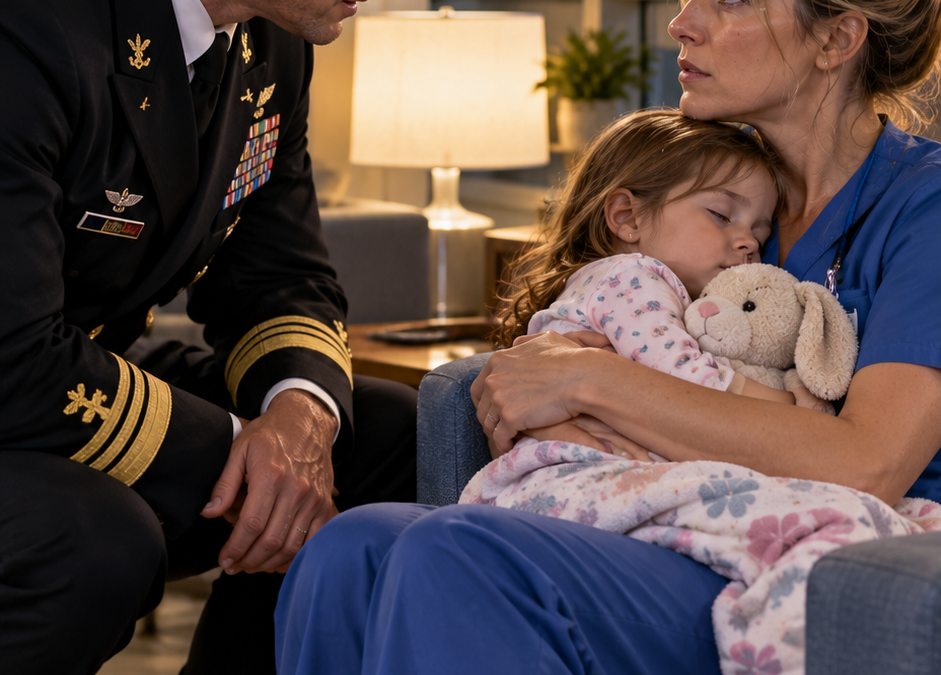
At 11:47 p.m., after nearly three days without real sleep, I walked into a dim hospital lounge in San Diego and saw my four-year-old daughter asleep in the arms of a woman I had never met.
I stopped so hard the security officer behind me almost walked into my back.
Ava’s cheek rested against the stranger’s chest.
One tiny hand had twisted itself into the collar of the woman’s cobalt-blue scrubs.
Her stuffed rabbit was trapped between them.
For a moment, my mind refused to process what I was looking at.
I had kicked open doors with explosives going off behind me.
I had crossed open ground while rounds struck concrete around my boots.
I had watched men bleed out while helicopters were still minutes away.
Twenty years of Naval Special Warfare had taught me what fear did to the body.
But nothing I had ever faced prepared me for seeing my little girl held by someone whose name I did not know.
“Ava?”
The word came out sharper than I intended.
The woman looked up.
Mid-thirties.
Dark-blond hair pulled into a loose knot.
Pale from exhaustion.
Eyes far too alert for midnight.
Her gaze moved over my dress uniform.
Then my face.
Then my hands.
Not the ribbons.
Not the rank.
My hands.
That caught my attention.
It was the kind of scan I had seen operators use when deciding whether the person in front of them was dangerous.
“Captain Reed,” she said quietly.
My pulse kicked.
“How do you know who I am?”
She looked down at Ava.
“She’s said ‘Daddy’s coming’ about forty times tonight.”
I took one step forward.
Ava shifted in her sleep.
The woman immediately adjusted her hold, supporting the back of my daughter’s neck without looking down.
Precise.
Automatic.
Protective.
Not the awkward way a stranger handles somebody else’s child.
Practiced.
“What happened?” I asked.
“My daughter was supposed to be in room 318.”
“She was.”
“Then why is she here?”
The edge in my voice did not bother her.
“Because she woke up crying and wouldn’t stay in the room.”
“Where’s my mother-in-law?”
“Cardiac observation. Fifth floor.”
My stomach tightened.
I already knew that part.
Thirty-six hours earlier, halfway across the Pacific after six weeks of limited communications, I had received three sentences.
AVA HOSPITALIZED. PNEUMONIA.
MARGARET CARDIAC EVENT.
RETURN ASAP.
Three messages.
Three rounds straight through whatever armor I thought I had left.
I had traveled by military transport to Hawaii, caught another flight to California, then ridden from North Island to the hospital without changing clothes.
I had slept maybe two hours in three days.
I expected oxygen tubing.
Doctors.
Bad news.
I expected fear.
I did not expect this.
“Why are you holding her?”
For the first time, the woman looked offended.
“Because she needed someone to.”
The security officer behind me shifted.
The woman’s eyes flicked toward him.
“You can leave us.”
He looked at me.
I nodded.
The door closed.
The woman lowered her voice.
“My shift ended almost three hours ago. Ava woke up after visiting hours. Her grandmother had already been taken upstairs. You were still unreachable. The social worker was dealing with another emergency.”
“You stayed after your shift?”
“Yes.”
“For nearly three hours?”
“Two hours and forty-seven minutes.”
I stared at her.
“Why?”
Something changed in her face.
Only for a second.
But I saw it.
Something old.
Something painful.
“Because a four-year-old shouldn’t have to wonder whether everyone she loves has disappeared.”
The anger left me so fast I almost felt dizzy.
I looked at Ava.
Eighteen months earlier, my wife Laura had collapsed in the parking lot of a grocery store from a ruptured cerebral aneurysm.
I had been overseas.
By the time command reached me, there was nothing left to do but fly home and identify the woman I had kissed goodbye three months earlier.
Ava had been two.
Too young to understand death.
Old enough to remember disappearance.
Since then, she carried one fear she rarely said directly.
People leave.
Sometimes they do not come back.
This woman had somehow understood that.
“What’s your name?”
“Claire Bennett.”
“Nurse Bennett?”
“Claire is fine.”
My eyes dropped to her right wrist.
Her sleeve had slipped back slightly.
Thin white scars crossed the inside of her forearm.
Not surgical.
Not ordinary cuts.
They looked like old rope burns.
I had seen similar marks before.
Claire noticed where I was looking and pulled her sleeve down.
That made me more curious, not less.
Ava shifted again.
Her eyes opened.
For one second she stared sleepily at Claire.
Then she saw me.
Everything in her face changed.
“Daddy?”
My throat closed.
“Hey, Peanut.”
She launched herself out of Claire’s arms so quickly I barely caught her.
“Daddy!”
I dropped to my knees.
Ava buried her face against my neck.
“You came back.”
Three words.
Small.
Muffled.
Devastating.
“I came back.”
“You took forever.”
“I know.”
“I thought you got lost.”
“I know, baby.”
She pulled back and touched my face with both hands as though checking that I was real.
“You promised.”
“I know.”
“You promised you always come back.”
“And I did.”
She looked toward Claire.
“She stayed.”
I turned.
Claire stood near the door, exhausted, suddenly looking like someone who wanted to disappear before gratitude became a conversation.
Ava continued.
“I cried and she stayed. I got scared and she stayed. Grandma got sick and she stayed.”
I rose slowly with Ava still in my arms.
I had received medals in rooms full of officers.
I had watched men risk their lives for people whose names they never knew.
Experience had taught me that courage rarely looked the way movies wanted it to look.
Sometimes it looked like gunfire.
Sometimes it looked like a woman in blue scrubs sitting in a dark hospital lounge almost three hours after her shift ended because a frightened little girl did not want to be alone.
“Claire.”
She stopped.
“Thank you.”
“You’re welcome.”
“No.”
I shook my head.
“I mean it.”
She held my gaze.
“You made it home. That’s all she needed.”
Then she walked past me.
Halfway down the corridor, she stopped at an intersection.
Her eyes moved left.
Right.
Exit door.
Stairwell.
Security mirror.
Then she kept walking.
I went completely still.
I knew that scan.
I had performed it thousands of times.
People did not learn that in nursing school.
I looked down at Ava.
Then toward the empty hallway.
Who the hell was Claire Bennett?
I asked myself that question for the rest of the night.
By morning, I had another one.
Why did she look like someone who was afraid of being recognized?
Claire returned at 6:55 a.m.
I had not slept.
Ava managed about four hours curled beneath a cartoon-print blanket while I sat beside the bed with one hand resting against the rail.
Claire walked in carrying a chart.
Her eyes moved to me.
“You’re still wearing the uniform.”
“I didn’t exactly pack for this.”
“You could sleep.”
“So could you.”
“Fair.”
She checked Ava’s temperature.
Pulse.
Oxygen saturation.
Breathing.
Everything she did was efficient without being rushed.
“You always do that?” I asked.
“Do what?”
“Check every exit when you enter a room.”
Her hand paused.
Then continued writing.
“I work in a hospital.”
“So do hundreds of people here. They don’t map evacuation routes every time they walk through a door.”
She closed the chart.
“Captain—”
“Mason.”
“Captain.”
I almost smiled.
“I stayed with your daughter because she was afraid. Whatever interrogation you’re planning can wait.”
“I’m not interrogating you.”
“You’re terrible at pretending not to.”
I laughed for the first time in days.
Ava opened one eye.
“Daddy?”
“Morning, Peanut.”
She saw Claire.
“You came back too.”
Claire smiled.
“Told you I would.”
Ava accepted that immediately.
Children are often better at recognizing sincerity than adults.
Ten minutes later, a young doctor entered.
Dr. Aaron Whitmore.
Early thirties.
Intelligent face.
Controlled manner.
And immediately uncomfortable when he saw Claire.
He reviewed Ava’s chart.
“Lungs are improving. If her oxygen remains stable, discharge tomorrow is possible.”
Ava raised both hands.
“Yes!”
“Easy.”
“I hate hospital eggs.”
“Everyone hates hospital eggs,” Claire said.
Aaron looked at her.
“Claire, can I speak with you outside?”
Her expression cooled.
“Sure.”
They walked into the hallway.
I could not hear everything.
I did not need to.
I had spent too many years reading body language.
“You stayed off the clock again.”
“A child was alone.”
“We have procedures.”
“She needed a person, Aaron. Not a procedure.”
“Risk management—”
“Can call me.”
“That isn’t the point.”
“Then tell me the point.”
Aaron exhaled.
“You can’t save everybody.”
Claire became completely still.
That sentence hit something.
Hard.
She answered quietly.
“I know.”
Then walked away.
Aaron remained in the hall looking like he wanted the words back.
Twenty minutes later, Claire returned.
I waited until Ava was distracted with crayons.
“That bothered you.”
“What?”
“You can’t save everybody.”
Claire looked at me.
“You really do not know how to stop.”
“No.”
“Occupational hazard?”
“Probably.”
She adjusted Ava’s IV.
“Military?” I asked.
Her fingers stopped.
There it was.
“Why?”
“Situational awareness.”
No answer.
“The scars.”
Still nothing.
“The way you supported Ava’s airway when she was sleeping.”
Claire looked directly at me.
“Eight years Coast Guard.”
I leaned forward.
“What job?”
“I’m a nurse now.”
“That wasn’t my question.”
Ava held up a purple crayon.
“Claire, can rabbits be purple?”
“Absolutely.”
“Daddy says no.”
“Your daddy lacks imagination.”
“Mutiny already,” I muttered.
Claire smiled.
For a few seconds, the tension disappeared.
Then her smile vanished.
Her head tilted.
Listening.
Not to me.
To Ava.
My daughter was sitting upright coloring.
She looked fine.
“What?”
Claire did not answer.
She crossed the room.
“Ava?”
The little girl looked up.
“Yes?”
“Take a breath for me.”
Ava inhaled.
Claire’s expression changed.
“Again.”
A faint whistle came from Ava’s chest.
I stood.
“What’s wrong?”
Claire hit the call button.
“Get respiratory therapy in here.”
A nurse appeared at the door and nodded.
Claire leaned closer.
“Sweetheart, are you feeling tight?”
Ava nodded.
“A little.”
I looked at the monitor.
Oxygen saturation 93.
Then 91.
“What does that mean?”
Claire watched the screen.
Aaron hurried back in.
“What happened?”
“Respiratory distress after pneumonia. She’s tightening fast.”
Aaron listened with his stethoscope.
Ava’s breathing became visibly harder.
The muscles around her neck strained.
The monitor began beeping.
“Start the rescue nebulizer,” Aaron ordered.
Claire already had it connected.
Mist filled the mask.
Ava looked at me.
“Daddy.”
“I’m here.”
“Can’t breathe.”
I had heard grown men say those words after explosions.
I had never imagined hearing them from my daughter.
Aaron listened again.
His face drained.
“Wheezing is decreasing.”
“Not improving,” Claire said.
He looked at her.
Claire listened to Ava’s chest herself.
Then slowly lifted her head.
“Too quiet.”
Something changed in Aaron’s eyes.
“What does that mean?” I demanded.
Claire turned to me.
“Almost no air is moving.”
The monitor screamed.
Ava’s lips were beginning to turn gray.
Claire changed.
The gentle woman who had held my daughter all night disappeared.
Her voice became sharp, controlled, absolute.
“Activate pediatric rapid response. Crash cart now.”
People ran.
The room filled.
Respiratory therapy.
Nurses.
Equipment.
Aaron reviewed the emergency protocol.
“Ava, eyes on me,” Claire said.
“Do not chase the breath. Slow.”
Ava gasped.
Nothing useful entered.
Her chest pulled inward.
Aaron reached for medication.
“Epinephrine dose confirmed.”
His hand hovered.
“Doctor,” Claire said.
“I’m checking her weight.”
“Sixteen-point-eight kilograms. It’s already in the chart.”
He looked at the syringe.
And froze.
One second.
Maybe less.
In medicine and combat, one second can be a long time.
Claire stepped closer.
“Aaron.”
He looked at her.
“She is disappearing in front of you.”
That broke him loose.
He administered the medication under the emergency protocol.
Claire kept Ava positioned while respiratory therapy increased treatment.
“Magnesium protocol. Page anesthesia.”
“On the way.”
“Saturation eighty-two.”
My vision narrowed.
Eighty-two.
A number.
Except the number belonged to my daughter.
I had spent most of my adult life believing helplessness was something weak people accepted.
That morning, I learned otherwise.
Sometimes helplessness is being the strongest man in the room and realizing strength is completely irrelevant to what your child needs.
“Mason.”
Claire looked at me.
My hands were shaking.
“I need you.”
“What?”
“Ava is watching you.”
I looked.
She was.
Terrified eyes fixed on my face.
“If she sees panic, she’ll fight the mask. Give her your calm.”
I moved beside the bed.
“Hey, Peanut.”
Ava gasped.
“I’m right here.”
Another desperate breath.
“You remember birthday candles?”
Tiny nod.
“Good. We’re blowing out four candles. One for every year you’ve been bossing me around.”
For half a second, she almost smiled.
“Slow breath.”
Her fingers closed around mine.
“Good.”
The saturation stopped falling.
Claire reached for a bag-valve mask.
Her sleeve slid back.
A faded leather band appeared around her wrist.
A small metal emblem.
Wings.
A rescue ring.
And four words.
SO OTHERS MAY LIVE.
I stopped breathing.
“No way.”
Claire did not look at me.
“Claire.”
Nothing.
“You were a rescue swimmer?”
Aaron looked up.
Claire remained focused on Ava.
“Not now.”
“Coast Guard AST?”
Her jaw tightened.
I knew those initials.
Aviation Survival Technician.
The people who went out of helicopters into seas everyone else was desperately trying to escape.
“Air movement!” respiratory therapy called.
Claire listened.
A faint wheeze returned.
No sound had ever sounded better.
Aaron listened.
“Left lower lobe.”
“Again.”
He moved the stethoscope.
“Right too.”
Saturation climbed to 85.
Ava squeezed my hand.
“Daddy?”
“I’m here.”
Anesthesiology arrived prepared for emergency airway management.
Claire held up a hand.
“Give her thirty seconds. She’s turning.”
Everyone watched.
The anesthesiologist nodded.
“We stand by unless she reverses.”
Claire finally stepped back.
Her hands were steady.
Mine were not.
Aaron removed his gloves.
“How did you hear it before the monitor changed?”
Claire looked toward Ava.
“Machines confirm things.”
She paused.
“People warn you first.”
I stared at the bracelet.
“AST.”
Claire pulled her sleeve down.
“Retired.”
“What rank?”
“Petty Officer First Class.”
I stared at her.
“You’ve worked here for years and nobody knows?”
“I didn’t come here to be who I was.”
“What were you?”
Her expression tightened.
“A person who couldn’t save someone.”
The room went silent.
Aaron looked down.
I knew that tone.
Survivor’s guilt.
I had heard it in men after missions.
I had heard it in my own head after Laura died even though I had been thousands of miles away.
Claire looked at Ava.
“Continuous monitoring. No discharge discussion today.”
Aaron nodded.
No argument.
When the emergency team cleared, I followed Claire into the hallway.
“Wait.”
She kept walking.
“Claire.”
She stopped.
“What happened?”
“You just watched it.”
“No.”
I touched my wrist where her bracelet had been visible.
“Before.”
She stared at me for a long moment.
Then said, “January. Eight years ago.”
I waited.
“Storm off Northern California.”
Her voice became flat.
Almost emotionless.
That made it heavier.
“Thirty-five-foot seas. Fishing vessel rolled after an engine-room fire. Seven adults. Two children.”
She swallowed.
“I went down five times.”
I said nothing.
“Fifth hoist, I found a girl tied to a floating hatch because her father thought it would keep her above water.”
Claire looked toward Ava’s room.
“She was six.”
For the first time, her hands trembled.
“Her name was Sophie.”
The hallway disappeared around us.
“Water was forty-three degrees. She had been in too long.”
Claire looked at me.
“I held her in the helicopter and performed CPR until the flight surgeon physically pulled my hands away.”
Now I understood.
Why she stayed with frightened children.
Why Aaron’s sentence had wounded her.
Why leaving Ava alone had been impossible.
Claire continued.
“I made a promise that night while I was still wearing my flight gear.”
“What promise?”
Her eyes filled.
“That if I ever had the chance to keep another child from waiting alone for help, I would stay.”
She looked toward room 318.
“No matter how late.”
I found Claire forty minutes later sitting in an empty stairwell.
Third and fourth floors.
Concrete walls.
Fluorescent light.
For the first time since meeting her, she looked exhausted instead of controlled.
I sat two steps below.
“You don’t need to babysit me.”
“I’m not.”
“You’re a terrible liar.”
“So I’ve been told.”
Silence.
Then I asked, “How many people did you save?”
She stared at the wall.
“Eight.”
“Eight?”
“Eight came home.”
“And Sophie didn’t.”
“No.”
I nodded.
“So when people say nine people were in the water, you hear one.”
Claire turned.
I had found the center of it.
“How do you know?”
“Because I’ve done the same math.”
I rested my arms on my knees.
“There was a mission eleven years ago.”
I could not give details.
Did not need to.
“We brought six men home.”
Claire understood immediately.
“And one didn’t.”
“One didn’t.”
“What was his name?”
“Travis Cole.”
I looked at the floor.
“People congratulated us afterward because the objective was completed. All I could think about was Travis’s wife. She was pregnant.”
Claire whispered, “I’m sorry.”
“So am I.”
I looked at her.
“But six families opened their doors and saw somebody they loved.”
Claire said nothing.
“Eight people walked away from that storm because you kept going back into the ocean.”
“Sophie didn’t.”
“No.”
My voice stayed firm.
“She didn’t.”
Claire looked surprised that I did not try to soften it.
“Pretending she survived would dishonor what happened.”
I held her gaze.
“But using her death to erase the eight lives you saved dishonors them too.”
Her eyes filled.
“Did you rehearse that?”
“No.”
“It sounds rehearsed.”
“I give excellent speeches when I haven’t slept.”
She laughed through tears.
I stood.
“Come on.”
“Where?”
“My daughter is asking for you.”
“She has you.”
“She specifically said I’m boring.”
“That sounds accurate.”
When we returned, Ava was exhausted but stable.
Her oxygen had improved.
She raised a hand.
“Claire.”
Claire sat beside her.
“You scared everybody today.”
Ava frowned.
“I didn’t do it.”
“I know.”
“My lungs did it.”
“Your lungs were being dramatic.”
“Daddy’s dramatic too.”
I placed a hand over my heart.
“Betrayed by my own child.”
Ava giggled.
That sound nearly broke me.
Aaron appeared at the door.
“Claire?”
His nervousness had returned.
“Administration wants us downstairs.”
I stood.
“Why?”
“Standard rapid-response review. Medication timing. Staff actions.”
Claire rose.
“I’ll go.”
I started to follow.
“You don’t have to,” she said.
“Yes, I do.”
“No. This is my review.”
There was something in her tone that stopped me.
So I stayed with Ava.
Later, I learned what happened.
The review included the nursing supervisor, risk management, the pediatric chief, and hospital counsel.
They examined everything.
Seconds.
Medications.
Authority.
Protocol.
Claire answered without defensiveness.
Yes, she identified deterioration before the monitor threshold.
Yes, she activated rapid response.
No, she did not independently prescribe medication.
Yes, she pressured Aaron to act under established emergency protocols.
The medical director asked, “Would you do anything differently?”
Claire thought.
“Yes.”
Everyone waited.
“I would have called respiratory therapy thirty seconds earlier.”
Silence.
“That’s it?” the pediatric chief asked.
“A child had almost no air moving. I’m not going to apologize for making the room uncomfortable.”
Aaron spoke.
“She’s right.”
Everyone turned.
“I hesitated.”
Claire looked at him.
He continued.
“She did not exceed authority. She recognized the emergency. She activated protocol. She forced me to look at the patient instead of hiding behind another calculation.”
He took a breath.
“If someone deserves review, review me.”
Two hours later, the result was clear.
No violation.
No discipline.
Instead, the pediatric chief asked Claire to help develop training on recognizing respiratory collapse before monitors reached critical thresholds.
Outside the room, Aaron handed her coffee.
“I owe you two apologies.”
“Stop counting.”
“I was wrong last night.”
“About liability?”
“About you trying to save everyone.”
Claire looked at him.
Aaron said, “You know you can’t.”
“Yes.”
“You just refuse to use that as an excuse to stop trying.”
Claire took the coffee.
“That’s closer.”
By Friday, Ava was almost herself again.
Her oxygen remained normal.
Her appetite returned.
Her hatred of hospital pancakes intensified.
Margaret, my mother-in-law, was also discharged from cardiac observation.
The three of us stood near the nurses’ station surrounded by balloons, discharge papers, and far too many bags for a four-day stay.
Claire approached during lunch.
Ava saw her first.
“Claire!”
She ran.
Claire barely crouched in time before Ava wrapped both arms around her neck.
“You’re squishing me.”
“I’m hugging.”
“There’s a difference?”
“No.”
Claire laughed.
Ava leaned back.
“Are you coming home?”
Claire blinked.
“Home?”
“With us.”
Margaret smiled.
“Ava has been planning your future.”
I folded my arms.
“Apparently I have no authority in my household.”
Ava ignored me.
“You can have pancakes.”
Claire whispered, “That is an aggressive offer.”
“Daddy burns them.”
“I do not burn pancakes.”
Three nurses nearby laughed.
Then Ava became serious.
“Will you forget me?”
Everything around us seemed to quiet.
Claire lowered herself until their eyes were level.
“No.”
“Promise?”
“I promise.”
“How long?”
Claire touched her cheek.
“For as long as I’m lucky enough to remember anything.”
Ava accepted that.
Then ran back toward Margaret.
I stepped closer to Claire.
“I did some checking.”
Her eyebrows rose.
“That sounds ominous.”
“I called a Coast Guard contact.”
Claire stiffened.
“Mason.”
“The storm.”
“You didn’t have to.”
“I wanted to.”
My voice dropped.
“Eight survivors.”
She looked away.
“Don’t.”
“I’m not trying to erase Sophie.”
She looked back.
“I’m trying to make you see the whole picture.”
Several staff members had begun watching.
“Eight people went home because you entered water experienced fishermen could barely survive.”
Her eyes glistened.
“You stayed after your shift because my daughter was frightened.”
I took another breath.
“You heard her breathing change before a machine did.”
“Mason—”
“You saved her life.”
“I was part of a team.”
“Yes.”
I nodded.
“Heroes usually are.”
Then I did something nobody in that pediatric corridor expected.
I stepped backward.
Heels together.
Shoulders square.
Claire froze.
“Mason, don’t.”
I raised my right hand.
Formal salute.
The hallway went silent.
A Navy captain.
Decorated SEAL officer.
Nearly twenty years in uniform.
Standing at attention in front of a civilian nurse wearing blue scrubs.
Claire stared at me.
“Mason.”
My voice carried.
“Petty Officer First Class Claire Bennett, United States Coast Guard, retired.”
People stopped moving.
Aaron stepped from a patient room.
Margaret covered her mouth.
Ava watched with huge eyes.
“For the eight people who came home from that storm.”
Claire’s lip trembled.
“For the children you stayed with when nobody was watching.”
Her eyes filled.
“And for my daughter, who is alive because you refused to wait until a machine told you she was dying.”
I held the salute.
“Thank you for your service.”
Claire had not saluted anyone in years.
For a moment, she seemed unable to move.
Then training returned.
Her back straightened.
Chin lifted.
Her trembling hand rose.
She returned the salute.
Several nurses cried.
Aaron looked down.
The charge nurse covered her mouth.
I lowered my hand.
Claire lowered hers.
Ava immediately ran between us.
“Why were you doing that?”
I crouched.
“It means I respect Claire very much.”
Ava considered this.
Then hugged her.
“I respect her too.”
Laughter broke through the tears.
Ava looked between us.
“Can she be family?”
Claire stopped breathing.
I looked at her.
It was an innocent question.
But it landed in two adults who had each spent years learning how easily family could disappear.
I answered carefully.
“Family isn’t something you order people to become.”
Ava frowned.
“Why?”
“Because Claire gets to choose.”
Ava looked up.
“Do you choose?”
Claire’s eyes filled again.
She looked at Margaret.
Then me.
Then the child who once slept against her because she was afraid everyone she loved had disappeared.
“I think,” Claire whispered, “I’d like to start with Sunday dinner.”
Ava cheered.
“Sunday dinner it is.”
Claire thought that was the end of my surprise.
It wasn’t.
I had discovered one more thing buried in the career she tried so hard to leave behind.
Three months later, it walked through the hospital doors in Coast Guard dress blues.
Claire was halfway through a twelve-hour shift when the hospital operator paged her.
“Claire Bennett, please report to the main lobby.”
She called the desk.
“Why?”
“No idea.”
“Is somebody hurt?”
“No.”
“Then tell them I’m busy.”
“They said they’ll wait.”
“Who?”
A pause.
“United States Coast Guard.”
Five minutes later she walked into the lobby.
I stood near the entrance with Ava and Margaret.
Claire stopped.
“Mason.”
I smiled.
“You’re going to yell at me.”
“Almost certainly.”
Three Coast Guard service members stood beside us.
The oldest stepped forward.
Senior Chief Michael Harlan.
“AST1 Bennett?”
Claire stared.
“I haven’t been called that in a long time.”
“Maybe too long.”
He carried a dark-blue presentation case.
Claire’s face lost color.
“No.”
Harlan smiled faintly.
“Yes.”
She turned toward me.
“Mason.”
“I found a records issue.”
“You investigated my service record?”
“I asked questions.”
“You absolutely investigated my service record.”
“That wording sounds hostile.”
“What did you do?”
Harlan stepped in before Claire could murder me in a hospital lobby.
“What Captain Reed discovered was that a commendation package from your final aviation unit was never completed during a command transition.”
Claire looked at the case.
“Your commanding officer submitted you for recognition after the Northern California rescue.”
She shook her head.
“I don’t want—”
“This isn’t about wanting it.”
Harlan opened the case.
Inside rested a Coast Guard medal and citation.
Claire’s hands began trembling.
“Eight survivors,” he said.
She closed her eyes.
Harlan did not pretend the ninth survived.
He understood enough not to.
“One child was lost.”
Claire swallowed.
“Yes.”
“That loss belongs in the truth.”
His voice softened.
“But so do eight lives.”
Claire opened her eyes.
“Your record describes repeated hoist entries under extreme conditions after normal rescue parameters had deteriorated. You continued until every reachable survivor had been recovered.”
Claire whispered, “Sophie was reachable.”
“And you reached her.”
The words hit her.
Harlan repeated them.
“You reached her.”
Claire’s breathing changed.
“The outcome was not yours to control.”
For years, she had replayed the memory differently.
If she descended faster.
If she pushed the pilot.
If she found Sophie earlier.
If.
If.
If.
Harlan placed the case in her hands.
“You don’t wear this because of the person you couldn’t bring home.”
He nodded toward the medal.
“You wear it because fear and loss did not stop you from going back down.”
Claire cried openly.
Ava hugged her leg.
“Is that because you’re brave?”
Claire looked down.
“No.”
Ava frowned.
Claire knelt.
“It means sometimes you’re scared and you go anyway.”
Ava nodded seriously.
“That’s brave.”
I laughed.
“You’re not winning that argument.”
The commendation changed something in Claire.
Not pride.
Permission.
Permission to remember the rescue without putting herself on trial every time.
Permission to speak about the Coast Guard.
Permission to accept that her life before nursing was not something she needed to bury.
Within six months, she helped establish a pediatric rapid-response training program.
Aaron attended every session.
Eventually, he taught beside her.
He became known among residents for asking one question.
“What is the patient telling you before the monitor starts yelling?”
Claire knew where he learned it.
He never pretended otherwise.
I changed too.
After twenty years of service, I accepted a shore assignment.
It cost me professionally.
Another operational command had been available.
A younger version of me would have accepted before anyone finished asking.
Then one evening, Ava found me packing gear.
She did not cry.
That was worse.
She simply asked, “How many sleeps?”
I sat on the floor beside the bag.
Looked at my daughter.
Then Laura’s photograph.
“Not this time.”
I unpacked.
Several months later, I submitted retirement paperwork.
My final day in uniform came on a clear morning overlooking San Diego Bay.
Claire and Ava sat in the front row.
When the ceremony ended, I removed my cover.
For the first time in two decades, there was nowhere command required me to go.
Ava ran into my arms.
Claire remained a few steps back.
I held out my hand.
“Sunday dinner?”
She smiled.
“It’s Tuesday.”
“We’ve never been good with rules.”
She took my hand.
Not romantically.
Not yet.
Something slower.
Careful.
Built by two people who understood that trust was not a speech.
Trust was showing up.
And staying.
Two years after I first found Ava asleep in Claire’s arms, she started kindergarten.
Her first-month assignment was simple.
Draw your family.
The picture lived on our refrigerator for years.
DADDY.
GRANDMA.
MOMMY IN HEAVEN, floating on a cloud with enormous wings.
AVA.
And beside her, a woman in bright-blue clothes.
CLAIRE.
Her teacher asked, “Is Claire your aunt?”
Ava shook her head.
“Nurse.”
“Your nurse?”
“No.”
Apparently frustrated with adult vocabulary, she said:
“She’s Claire.”
That was the best definition any of us ever found.
Claire became part of our lives gradually.
Sunday dinners became baseball games.
Baseball games became birthdays.
Birthdays became Christmas mornings.
There was no moment when someone announced:
Now we are a family.
We simply kept showing up until the word fit.
Claire and I became close the same way.
Neither of us needed rescue from loneliness.
We needed consistency.
There were difficult days.
On the anniversary of Laura’s death, Claire never tried to replace her.
She brought flowers.
Then gave Ava and me room to remember.
On the anniversary of Sophie’s rescue, I never told Claire she needed to move on.
I took her to the coast.
We stood above the Pacific before sunrise.
For years, Claire imagined Sophie only in freezing water.
That morning, I asked something different.
“What do you think she liked?”
Claire wiped her eyes.
“I don’t know.”
“Guess.”
She thought.
“Maybe horses.”
“Why?”
“She had a horse patch on her jacket.”
I nodded.
“Then let her like horses.”
Claire smiled through tears.
It was the first time she remembered Sophie as a little girl instead of a failure.
At the hospital, Claire still stayed after shifts.
Administration eventually stopped pretending they could prevent it.
Instead, they created a volunteer comfort program around the problem she had been solving alone.
Background-checked nurses.
Retired teachers.
Chaplains.
Trained volunteers.
Overnight rotations for children whose families could not stay.
They called it Night Watch.
Claire hated the name.
I loved it.
“It sounds tactical.”
“That’s exactly why I hate it.”
Within a year, three other hospitals adopted versions of the program.
Aaron became an attending physician.
He kept the coffee cup from the morning he apologized to Claire on a shelf in his office.
Whenever a resident froze during a difficult emergency, he told them about a four-year-old whose lungs became dangerously quiet.
He never made himself the hero.
He told the truth.
He hesitated.
Someone else saw more clearly.
He learned.
Next time, he was better.
That mattered to Claire.
One summer afternoon, Ava—seven by then—came to the hospital with me.
Claire was finishing her shift.
A little boy sat alone near the nurses’ station while his father underwent emergency surgery.
Claire sat beside him.
An hour later, she was still there.
Ava whispered, “She’s staying again.”
“Yeah.”
“Because of Sophie?”
“Partly.”
“Because of me?”
“Partly.”
“Why else?”
I watched Claire move her chair closer to the frightened boy.
“Because that’s who she decided to become.”
Ava thought about that.
Then walked over and sat beside the boy.
“Hi.”
He stared at her.
“My name’s Ava.”
No response.
“That’s Claire.”
Still nothing.
“She stays.”
The little boy looked toward Claire.
Something changed in her face.
I saw it from across the hall.
Ava pulled out a coloring book.
“You can use purple.”
The boy whispered, “Purple dogs aren’t real.”
Ava gasped.
“That’s what my dad used to think.”
I covered my face.
Claire laughed.
The boy smiled.
Years earlier, a six-year-old girl named Sophie died in Claire Bennett’s arms above an unforgiving ocean.
For a long time, Claire believed that moment proved there would always be someone she was not good enough to save.
Eventually, she understood it differently.
Sophie had not become a punishment.
She became a direction.
Because of Sophie, Claire stayed beside frightened children.
Because Claire stayed, Ava did not spend one terrible night alone.
Because Claire listened, Ava survived a medical crisis that could have ended differently.
Because I saw the woman behind the scrubs, Claire eventually learned that the eight lives she saved mattered too.
Because Aaron admitted he froze, hundreds of young doctors learned to trust what patients were telling them before technology confirmed the emergency.
One life touched another.
Then another.
Then another.
Nobody could tell where the chain ended.
Maybe it never did.
On Claire’s forty-first birthday, I took her back to the third-floor family lounge where we first met.
The vinyl chairs had been replaced.
The coffee machine was different.
But she recognized the corner.
“You dragged me to work on my day off?”
“Technically.”
“You are terrible at birthdays.”
“Open the door.”
She did.
Inside were Ava, Margaret, Aaron, several nurses, Senior Chief Harlan, and two people Claire did not recognize.
A man in his fifties stepped forward.
Beside him stood a younger woman.
“Claire Bennett?”
“Yes?”
“My name is Thomas Mercer.”
His voice shook.
“I was on the fishing vessel North Star.”
Claire stopped breathing.
“One of the eight.”
Her hand flew to her mouth.
Thomas nodded.
“This is my daughter, Emily.”
The young woman smiled through tears.
“She was born three years after you pulled my father out of the ocean.”
Claire looked from daughter to father.
Thomas continued.
“I have two grandchildren now.”
Claire started crying.
“You probably spent years thinking about the child who didn’t make it.”
She nodded.
“I wanted you to meet someone who exists because you did.”
Emily crossed the room and hugged her.
Claire could not speak.
I watched from the other side of the room.
For most of my career, I thought rescue ended when the helicopter landed.
When the hostage crossed the line.
When the medevac left.
When the after-action report was signed.
I was wrong.
Sometimes rescue lasts generations.
Later that evening, after everyone left, Claire and I stood beside the hospital window.
San Diego lights stretched toward the bay.
I touched the old leather band at her wrist.
“You still wear it.”
“Always.”
“So others may live.”
She nodded.
For years, those words had sounded like a sentence Claire forced herself to serve.
Now they meant something else.
Gratitude.
Possibility.
Purpose.
A promise worth keeping.
I took her hand.
“Ready to go home?”
Claire looked once more at the lounge.
She remembered Ava at four years old asleep against her chest.
Me frozen in the doorway.
Screaming monitors.
Her rescue-swimmer emblem.
A salute in a hospital corridor.
A medal that arrived years late.
A six-year-old girl named Sophie.
Eight survivors.
And every life that came afterward.
She squeezed my hand.
“Yes.”
We walked toward the elevators together.
Behind us, a Night Watch volunteer entered the lounge.
A frightened child sat alone while his mother remained in surgery.
The volunteer pulled a chair close.
The child whispered, “Are you leaving?”
The woman smiled.
“No.”
And somewhere inside Claire Bennett, a promise made years earlier in freezing darkness finally stopped feeling like grief.
It became something she had built.
Something larger than one storm.
Larger than one child.
Larger than one hospital room.
No child would wait alone if someone could stay.
Not that night.
Not while Claire was there.
Not on our watch.
What do you think of this story? Please leave a like and share your thoughts in the comments. Your support means a lot to us and inspires us to keep writing more meaningful and powerful stories. Thank you! 👍
𝗧𝗛𝗘 𝗘𝗡𝗗
The Woman Holding My Daughter at Midnight Was Hiding a Past I Was Never Supposed to Discover
At 11:47 p.m., after nearly three days without real sleep, I walked into a dim hospital lounge in San Diego and saw my four-year-old daughter asleep in the arms of a woman I had never met.
I stopped so hard the security officer behind me almost walked into my back.
Ava’s cheek rested against the stranger’s chest.
One tiny hand had twisted itself into the collar of the woman’s cobalt-blue scrubs.
Her stuffed rabbit was trapped between them.
For a moment, my mind refused to process what I was looking at.
I had kicked open doors with explosives going off behind me.
I had crossed open ground while rounds struck concrete around my boots.
I had watched men bleed out while helicopters were still minutes away.
Twenty years of Naval Special Warfare had taught me what fear did to the body.
But nothing I had ever faced prepared me for seeing my little girl held by someone whose name I did not know.
“Ava?”
The word came out sharper than I intended.
The woman looked up.
Mid-thirties.
Dark-blond hair pulled into a loose knot.
Pale from exhaustion.
Eyes far too alert for midnight.
Her gaze moved over my dress uniform.
Then my face.
Then my hands.
Not the ribbons.
Not the rank.
My hands.
That caught my attention.
It was the kind of scan I had seen operators use when deciding whether the person in front of them was dangerous.
“Captain Reed,” she said quietly.
My pulse kicked.
“How do you know who I am?”
She looked down at Ava.
“She’s said ‘Daddy’s coming’ about forty times tonight.”
I took one step forward.
Ava shifted in her sleep.
The woman immediately adjusted her hold, supporting the back of my daughter’s neck without looking down.
Precise.
Automatic.
Protective.
Not the awkward way a stranger handles somebody else’s child.
Practiced.
“What happened?” I asked.
“My daughter was supposed to be in room 318.”
“She was.”
“Then why is she here?”
The edge in my voice did not bother her.
“Because she woke up crying and wouldn’t stay in the room.”
“Where’s my mother-in-law?”
“Cardiac observation. Fifth floor.”
My stomach tightened.
I already knew that part.
Thirty-six hours earlier, halfway across the Pacific after six weeks of limited communications, I had received three sentences.
AVA HOSPITALIZED. PNEUMONIA.
MARGARET CARDIAC EVENT.
RETURN ASAP.
Three messages.
Three rounds straight through whatever armor I thought I had left.
I had traveled by military transport to Hawaii, caught another flight to California, then ridden from North Island to the hospital without changing clothes.
I had slept maybe two hours in three days.
I expected oxygen tubing.
Doctors.
Bad news.
I expected fear.
I did not expect this.
“Why are you holding her?”
For the first time, the woman looked offended.
“Because she needed someone to.”
The security officer behind me shifted.
The woman’s eyes flicked toward him.
“You can leave us.”
He looked at me.
I nodded.
The door closed.
The woman lowered her voice.
“My shift ended almost three hours ago. Ava woke up after visiting hours. Her grandmother had already been taken upstairs. You were still unreachable. The social worker was dealing with another emergency.”
“You stayed after your shift?”
“Yes.”
“For nearly three hours?”
“Two hours and forty-seven minutes.”
I stared at her.
“Why?”
Something changed in her face.
Only for a second.
But I saw it.
Something old.
Something painful.
“Because a four-year-old shouldn’t have to wonder whether everyone she loves has disappeared.”
The anger left me so fast I almost felt dizzy.
I looked at Ava.
Eighteen months earlier, my wife Laura had collapsed in the parking lot of a grocery store from a ruptured cerebral aneurysm.
I had been overseas.
By the time command reached me, there was nothing left to do but fly home and identify the woman I had kissed goodbye three months earlier.
Ava had been two.
Too young to understand death.
Old enough to remember disappearance.
Since then, she carried one fear she rarely said directly.
People leave.
Sometimes they do not come back.
This woman had somehow understood that.
“What’s your name?”
“Claire Bennett.”
“Nurse Bennett?”
“Claire is fine.”
My eyes dropped to her right wrist.
Her sleeve had slipped back slightly.
Thin white scars crossed the inside of her forearm.
Not surgical.
Not ordinary cuts.
They looked like old rope burns.
I had seen similar marks before.
Claire noticed where I was looking and pulled her sleeve down.
That made me more curious, not less.
Ava shifted again.
Her eyes opened.
For one second she stared sleepily at Claire.
Then she saw me.
Everything in her face changed.
“Daddy?”
My throat closed.
“Hey, Peanut.”
She launched herself out of Claire’s arms so quickly I barely caught her.
“Daddy!”
I dropped to my knees.
Ava buried her face against my neck.
“You came back.”
Three words.
Small.
Muffled.
Devastating.
“I came back.”
“You took forever.”
“I know.”
“I thought you got lost.”
“I know, baby.”
She pulled back and touched my face with both hands as though checking that I was real.
“You promised.”
“I know.”
“You promised you always come back.”
“And I did.”
She looked toward Claire.
“She stayed.”
I turned.
Claire stood near the door, exhausted, suddenly looking like someone who wanted to disappear before gratitude became a conversation.
Ava continued.
“I cried and she stayed. I got scared and she stayed. Grandma got sick and she stayed.”
I rose slowly with Ava still in my arms.
I had received medals in rooms full of officers.
I had watched men risk their lives for people whose names they never knew.
Experience had taught me that courage rarely looked the way movies wanted it to look.
Sometimes it looked like gunfire.
Sometimes it looked like a woman in blue scrubs sitting in a dark hospital lounge almost three hours after her shift ended because a frightened little girl did not want to be alone.
“Claire.”
She stopped.
“Thank you.”
“You’re welcome.”
“No.”
I shook my head.
“I mean it.”
She held my gaze.
“You made it home. That’s all she needed.”
Then she walked past me.
Halfway down the corridor, she stopped at an intersection.
Her eyes moved left.
Right.
Exit door.
Stairwell.
Security mirror.
Then she kept walking.
I went completely still.
I knew that scan.
I had performed it thousands of times.
People did not learn that in nursing school.
I looked down at Ava.
Then toward the empty hallway.
Who the hell was Claire Bennett?
I asked myself that question for the rest of the night.
By morning, I had another one.
Why did she look like someone who was afraid of being recognized?
Claire returned at 6:55 a.m.
I had not slept.
Ava managed about four hours curled beneath a cartoon-print blanket while I sat beside the bed with one hand resting against the rail.
Claire walked in carrying a chart.
Her eyes moved to me.
“You’re still wearing the uniform.”
“I didn’t exactly pack for this.”
“You could sleep.”
“So could you.”
“Fair.”
She checked Ava’s temperature.
Pulse.
Oxygen saturation.
Breathing.
Everything she did was efficient without being rushed.
“You always do that?” I asked.
“Do what?”
“Check every exit when you enter a room.”
Her hand paused.
Then continued writing.
“I work in a hospital.”
“So do hundreds of people here. They don’t map evacuation routes every time they walk through a door.”
She closed the chart.
“Captain—”
“Mason.”
“Captain.”
I almost smiled.
“I stayed with your daughter because she was afraid. Whatever interrogation you’re planning can wait.”
“I’m not interrogating you.”
“You’re terrible at pretending not to.”
I laughed for the first time in days.
Ava opened one eye.
“Daddy?”
“Morning, Peanut.”
She saw Claire.
“You came back too.”
Claire smiled.
“Told you I would.”
Ava accepted that immediately.
Children are often better at recognizing sincerity than adults.
Ten minutes later, a young doctor entered.
Dr. Aaron Whitmore.
Early thirties.
Intelligent face.
Controlled manner.
And immediately uncomfortable when he saw Claire.
He reviewed Ava’s chart.
“Lungs are improving. If her oxygen remains stable, discharge tomorrow is possible.”
Ava raised both hands.
“Yes!”
“Easy.”
“I hate hospital eggs.”
“Everyone hates hospital eggs,” Claire said.
Aaron looked at her.
“Claire, can I speak with you outside?”
Her expression cooled.
“Sure.”
They walked into the hallway.
I could not hear everything.
I did not need to.
I had spent too many years reading body language.
“You stayed off the clock again.”
“A child was alone.”
“We have procedures.”
“She needed a person, Aaron. Not a procedure.”
“Risk management—”
“Can call me.”
“That isn’t the point.”
“Then tell me the point.”
Aaron exhaled.
“You can’t save everybody.”
Claire became completely still.
That sentence hit something.
Hard.
She answered quietly.
“I know.”
Then walked away.
Aaron remained in the hall looking like he wanted the words back.
Twenty minutes later, Claire returned.
I waited until Ava was distracted with crayons.
“That bothered you.”
“What?”
“You can’t save everybody.”
Claire looked at me.
“You really do not know how to stop.”
“No.”
“Occupational hazard?”
“Probably.”
She adjusted Ava’s IV.
“Military?” I asked.
Her fingers stopped.
There it was.
“Why?”
“Situational awareness.”
No answer.
“The scars.”
Still nothing.
“The way you supported Ava’s airway when she was sleeping.”
Claire looked directly at me.
“Eight years Coast Guard.”
I leaned forward.
“What job?”
“I’m a nurse now.”
“That wasn’t my question.”
Ava held up a purple crayon.
“Claire, can rabbits be purple?”
“Absolutely.”
“Daddy says no.”
“Your daddy lacks imagination.”
“Mutiny already,” I muttered.
Claire smiled.
For a few seconds, the tension disappeared.
Then her smile vanished.
Her head tilted.
Listening.
Not to me.
To Ava.
My daughter was sitting upright coloring.
She looked fine.
“What?”
Claire did not answer.
She crossed the room.
“Ava?”
The little girl looked up.
“Yes?”
“Take a breath for me.”
Ava inhaled.
Claire’s expression changed.
“Again.”
A faint whistle came from Ava’s chest.
I stood.
“What’s wrong?”
Claire hit the call button.
“Get respiratory therapy in here.”
A nurse appeared at the door and nodded.
Claire leaned closer.
“Sweetheart, are you feeling tight?”
Ava nodded.
“A little.”
I looked at the monitor.
Oxygen saturation 93.
Then 91.
“What does that mean?”
Claire watched the screen.
Aaron hurried back in.
“What happened?”
“Respiratory distress after pneumonia. She’s tightening fast.”
Aaron listened with his stethoscope.
Ava’s breathing became visibly harder.
The muscles around her neck strained.
The monitor began beeping.
“Start the rescue nebulizer,” Aaron ordered.
Claire already had it connected.
Mist filled the mask.
Ava looked at me.
“Daddy.”
“I’m here.”
“Can’t breathe.”
I had heard grown men say those words after explosions.
I had never imagined hearing them from my daughter.
Aaron listened again.
His face drained.
“Wheezing is decreasing.”
“Not improving,” Claire said.
He looked at her.
Claire listened to Ava’s chest herself.
Then slowly lifted her head.
“Too quiet.”
Something changed in Aaron’s eyes.
“What does that mean?” I demanded.
Claire turned to me.
“Almost no air is moving.”
The monitor screamed.
Ava’s lips were beginning to turn gray.
Claire changed.
The gentle woman who had held my daughter all night disappeared.
Her voice became sharp, controlled, absolute.
“Activate pediatric rapid response. Crash cart now.”
People ran.
The room filled.
Respiratory therapy.
Nurses.
Equipment.
Aaron reviewed the emergency protocol.
“Ava, eyes on me,” Claire said.
“Do not chase the breath. Slow.”
Ava gasped.
Nothing useful entered.
Her chest pulled inward.
Aaron reached for medication.
“Epinephrine dose confirmed.”
His hand hovered.
“Doctor,” Claire said.
“I’m checking her weight.”
“Sixteen-point-eight kilograms. It’s already in the chart.”
He looked at the syringe.
And froze.
One second.
Maybe less.
In medicine and combat, one second can be a long time.
Claire stepped closer.
“Aaron.”
He looked at her.
“She is disappearing in front of you.”
That broke him loose.
He administered the medication under the emergency protocol.
Claire kept Ava positioned while respiratory therapy increased treatment.
“Magnesium protocol. Page anesthesia.”
“On the way.”
“Saturation eighty-two.”
My vision narrowed.
Eighty-two.
A number.
Except the number belonged to my daughter.
I had spent most of my adult life believing helplessness was something weak people accepted.
That morning, I learned otherwise.
Sometimes helplessness is being the strongest man in the room and realizing strength is completely irrelevant to what your child needs.
“Mason.”
Claire looked at me.
My hands were shaking.
“I need you.”
“What?”
“Ava is watching you.”
I looked.
She was.
Terrified eyes fixed on my face.
“If she sees panic, she’ll fight the mask. Give her your calm.”
I moved beside the bed.
“Hey, Peanut.”
Ava gasped.
“I’m right here.”
Another desperate breath.
“You remember birthday candles?”
Tiny nod.
“Good. We’re blowing out four candles. One for every year you’ve been bossing me around.”
For half a second, she almost smiled.
“Slow breath.”
Her fingers closed around mine.
“Good.”
The saturation stopped falling.
Claire reached for a bag-valve mask.
Her sleeve slid back.
A faded leather band appeared around her wrist.
A small metal emblem.
Wings.
A rescue ring.
And four words.
SO OTHERS MAY LIVE.
I stopped breathing.
“No way.”
Claire did not look at me.
“Claire.”
Nothing.
“You were a rescue swimmer?”
Aaron looked up.
Claire remained focused on Ava.
“Not now.”
“Coast Guard AST?”
Her jaw tightened.
I knew those initials.
Aviation Survival Technician.
The people who went out of helicopters into seas everyone else was desperately trying to escape.
“Air movement!” respiratory therapy called.
Claire listened.
A faint wheeze returned.
No sound had ever sounded better.
Aaron listened.
“Left lower lobe.”
“Again.”
He moved the stethoscope.
“Right too.”
Saturation climbed to 85.
Ava squeezed my hand.
“Daddy?”
“I’m here.”
Anesthesiology arrived prepared for emergency airway management.
Claire held up a hand.
“Give her thirty seconds. She’s turning.”
Everyone watched.
The anesthesiologist nodded.
“We stand by unless she reverses.”
Claire finally stepped back.
Her hands were steady.
Mine were not.
Aaron removed his gloves.
“How did you hear it before the monitor changed?”
Claire looked toward Ava.
“Machines confirm things.”
She paused.
“People warn you first.”
I stared at the bracelet.
“AST.”
Claire pulled her sleeve down.
“Retired.”
“What rank?”
“Petty Officer First Class.”
I stared at her.
“You’ve worked here for years and nobody knows?”
“I didn’t come here to be who I was.”
“What were you?”
Her expression tightened.
“A person who couldn’t save someone.”
The room went silent.
Aaron looked down.
I knew that tone.
Survivor’s guilt.
I had heard it in men after missions.
I had heard it in my own head after Laura died even though I had been thousands of miles away.
Claire looked at Ava.
“Continuous monitoring. No discharge discussion today.”
Aaron nodded.
No argument.
When the emergency team cleared, I followed Claire into the hallway.
“Wait.”
She kept walking.
“Claire.”
She stopped.
“What happened?”
“You just watched it.”
“No.”
I touched my wrist where her bracelet had been visible.
“Before.”
She stared at me for a long moment.
Then said, “January. Eight years ago.”
I waited.
“Storm off Northern California.”
Her voice became flat.
Almost emotionless.
That made it heavier.
“Thirty-five-foot seas. Fishing vessel rolled after an engine-room fire. Seven adults. Two children.”
She swallowed.
“I went down five times.”
I said nothing.
“Fifth hoist, I found a girl tied to a floating hatch because her father thought it would keep her above water.”
Claire looked toward Ava’s room.
“She was six.”
For the first time, her hands trembled.
“Her name was Sophie.”
The hallway disappeared around us.
“Water was forty-three degrees. She had been in too long.”
Claire looked at me.
“I held her in the helicopter and performed CPR until the flight surgeon physically pulled my hands away.”
Now I understood.
Why she stayed with frightened children.
Why Aaron’s sentence had wounded her.
Why leaving Ava alone had been impossible.
Claire continued.
“I made a promise that night while I was still wearing my flight gear.”
“What promise?”
Her eyes filled.
“That if I ever had the chance to keep another child from waiting alone for help, I would stay.”
She looked toward room 318.
“No matter how late.”
I found Claire forty minutes later sitting in an empty stairwell.
Third and fourth floors.
Concrete walls.
Fluorescent light.
For the first time since meeting her, she looked exhausted instead of controlled.
I sat two steps below.
“You don’t need to babysit me.”
“I’m not.”
“You’re a terrible liar.”
“So I’ve been told.”
Silence.
Then I asked, “How many people did you save?”
She stared at the wall.
“Eight.”
“Eight?”
“Eight came home.”
“And Sophie didn’t.”
“No.”
I nodded.
“So when people say nine people were in the water, you hear one.”
Claire turned.
I had found the center of it.
“How do you know?”
“Because I’ve done the same math.”
I rested my arms on my knees.
“There was a mission eleven years ago.”
I could not give details.
Did not need to.
“We brought six men home.”
Claire understood immediately.
“And one didn’t.”
“One didn’t.”
“What was his name?”
“Travis Cole.”
I looked at the floor.
“People congratulated us afterward because the objective was completed. All I could think about was Travis’s wife. She was pregnant.”
Claire whispered, “I’m sorry.”
“So am I.”
I looked at her.
“But six families opened their doors and saw somebody they loved.”
Claire said nothing.
“Eight people walked away from that storm because you kept going back into the ocean.”
“Sophie didn’t.”
“No.”
My voice stayed firm.
“She didn’t.”
Claire looked surprised that I did not try to soften it.
“Pretending she survived would dishonor what happened.”
I held her gaze.
“But using her death to erase the eight lives you saved dishonors them too.”
Her eyes filled.
“Did you rehearse that?”
“No.”
“It sounds rehearsed.”
“I give excellent speeches when I haven’t slept.”
She laughed through tears.
I stood.
“Come on.”
“Where?”
“My daughter is asking for you.”
“She has you.”
“She specifically said I’m boring.”
“That sounds accurate.”
When we returned, Ava was exhausted but stable.
Her oxygen had improved.
She raised a hand.
“Claire.”
Claire sat beside her.
“You scared everybody today.”
Ava frowned.
“I didn’t do it.”
“I know.”
“My lungs did it.”
“Your lungs were being dramatic.”
“Daddy’s dramatic too.”
I placed a hand over my heart.
“Betrayed by my own child.”
Ava giggled.
That sound nearly broke me.
Aaron appeared at the door.
“Claire?”
His nervousness had returned.
“Administration wants us downstairs.”
I stood.
“Why?”
“Standard rapid-response review. Medication timing. Staff actions.”
Claire rose.
“I’ll go.”
I started to follow.
“You don’t have to,” she said.
“Yes, I do.”
“No. This is my review.”
There was something in her tone that stopped me.
So I stayed with Ava.
Later, I learned what happened.
The review included the nursing supervisor, risk management, the pediatric chief, and hospital counsel.
They examined everything.
Seconds.
Medications.
Authority.
Protocol.
Claire answered without defensiveness.
Yes, she identified deterioration before the monitor threshold.
Yes, she activated rapid response.
No, she did not independently prescribe medication.
Yes, she pressured Aaron to act under established emergency protocols.
The medical director asked, “Would you do anything differently?”
Claire thought.
“Yes.”
Everyone waited.
“I would have called respiratory therapy thirty seconds earlier.”
Silence.
“That’s it?” the pediatric chief asked.
“A child had almost no air moving. I’m not going to apologize for making the room uncomfortable.”
Aaron spoke.
“She’s right.”
Everyone turned.
“I hesitated.”
Claire looked at him.
He continued.
“She did not exceed authority. She recognized the emergency. She activated protocol. She forced me to look at the patient instead of hiding behind another calculation.”
He took a breath.
“If someone deserves review, review me.”
Two hours later, the result was clear.
No violation.
No discipline.
Instead, the pediatric chief asked Claire to help develop training on recognizing respiratory collapse before monitors reached critical thresholds.
Outside the room, Aaron handed her coffee.
“I owe you two apologies.”
“Stop counting.”
“I was wrong last night.”
“About liability?”
“About you trying to save everyone.”
Claire looked at him.
Aaron said, “You know you can’t.”
“Yes.”
“You just refuse to use that as an excuse to stop trying.”
Claire took the coffee.
“That’s closer.”
By Friday, Ava was almost herself again.
Her oxygen remained normal.
Her appetite returned.
Her hatred of hospital pancakes intensified.
Margaret, my mother-in-law, was also discharged from cardiac observation.
The three of us stood near the nurses’ station surrounded by balloons, discharge papers, and far too many bags for a four-day stay.
Claire approached during lunch.
Ava saw her first.
“Claire!”
She ran.
Claire barely crouched in time before Ava wrapped both arms around her neck.
“You’re squishing me.”
“I’m hugging.”
“There’s a difference?”
“No.”
Claire laughed.
Ava leaned back.
“Are you coming home?”
Claire blinked.
“Home?”
“With us.”
Margaret smiled.
“Ava has been planning your future.”
I folded my arms.
“Apparently I have no authority in my household.”
Ava ignored me.
“You can have pancakes.”
Claire whispered, “That is an aggressive offer.”
“Daddy burns them.”
“I do not burn pancakes.”
Three nurses nearby laughed.
Then Ava became serious.
“Will you forget me?”
Everything around us seemed to quiet.
Claire lowered herself until their eyes were level.
“No.”
“Promise?”
“I promise.”
“How long?”
Claire touched her cheek.
“For as long as I’m lucky enough to remember anything.”
Ava accepted that.
Then ran back toward Margaret.
I stepped closer to Claire.
“I did some checking.”
Her eyebrows rose.
“That sounds ominous.”
“I called a Coast Guard contact.”
Claire stiffened.
“Mason.”
“The storm.”
“You didn’t have to.”
“I wanted to.”
My voice dropped.
“Eight survivors.”
She looked away.
“Don’t.”
“I’m not trying to erase Sophie.”
She looked back.
“I’m trying to make you see the whole picture.”
Several staff members had begun watching.
“Eight people went home because you entered water experienced fishermen could barely survive.”
Her eyes glistened.
“You stayed after your shift because my daughter was frightened.”
I took another breath.
“You heard her breathing change before a machine did.”
“Mason—”
“You saved her life.”
“I was part of a team.”
“Yes.”
I nodded.
“Heroes usually are.”
Then I did something nobody in that pediatric corridor expected.
I stepped backward.
Heels together.
Shoulders square.
Claire froze.
“Mason, don’t.”
I raised my right hand.
Formal salute.
The hallway went silent.
A Navy captain.
Decorated SEAL officer.
Nearly twenty years in uniform.
Standing at attention in front of a civilian nurse wearing blue scrubs.
Claire stared at me.
“Mason.”
My voice carried.
“Petty Officer First Class Claire Bennett, United States Coast Guard, retired.”
People stopped moving.
Aaron stepped from a patient room.
Margaret covered her mouth.
Ava watched with huge eyes.
“For the eight people who came home from that storm.”
Claire’s lip trembled.
“For the children you stayed with when nobody was watching.”
Her eyes filled.
“And for my daughter, who is alive because you refused to wait until a machine told you she was dying.”
I held the salute.
“Thank you for your service.”
Claire had not saluted anyone in years.
For a moment, she seemed unable to move.
Then training returned.
Her back straightened.
Chin lifted.
Her trembling hand rose.
She returned the salute.
Several nurses cried.
Aaron looked down.
The charge nurse covered her mouth.
I lowered my hand.
Claire lowered hers.
Ava immediately ran between us.
“Why were you doing that?”
I crouched.
“It means I respect Claire very much.”
Ava considered this.
Then hugged her.
“I respect her too.”
Laughter broke through the tears.
Ava looked between us.
“Can she be family?”
Claire stopped breathing.
I looked at her.
It was an innocent question.
But it landed in two adults who had each spent years learning how easily family could disappear.
I answered carefully.
“Family isn’t something you order people to become.”
Ava frowned.
“Why?”
“Because Claire gets to choose.”
Ava looked up.
“Do you choose?”
Claire’s eyes filled again.
She looked at Margaret.
Then me.
Then the child who once slept against her because she was afraid everyone she loved had disappeared.
“I think,” Claire whispered, “I’d like to start with Sunday dinner.”
Ava cheered.
“Sunday dinner it is.”
Claire thought that was the end of my surprise.
It wasn’t.
I had discovered one more thing buried in the career she tried so hard to leave behind.
Three months later, it walked through the hospital doors in Coast Guard dress blues.
Claire was halfway through a twelve-hour shift when the hospital operator paged her.
“Claire Bennett, please report to the main lobby.”
She called the desk.
“Why?”
“No idea.”
“Is somebody hurt?”
“No.”
“Then tell them I’m busy.”
“They said they’ll wait.”
“Who?”
A pause.
“United States Coast Guard.”
Five minutes later she walked into the lobby.
I stood near the entrance with Ava and Margaret.
Claire stopped.
“Mason.”
I smiled.
“You’re going to yell at me.”
“Almost certainly.”
Three Coast Guard service members stood beside us.
The oldest stepped forward.
Senior Chief Michael Harlan.
“AST1 Bennett?”
Claire stared.
“I haven’t been called that in a long time.”
“Maybe too long.”
He carried a dark-blue presentation case.
Claire’s face lost color.
“No.”
Harlan smiled faintly.
“Yes.”
She turned toward me.
“Mason.”
“I found a records issue.”
“You investigated my service record?”
“I asked questions.”
“You absolutely investigated my service record.”
“That wording sounds hostile.”
“What did you do?”
Harlan stepped in before Claire could murder me in a hospital lobby.
“What Captain Reed discovered was that a commendation package from your final aviation unit was never completed during a command transition.”
Claire looked at the case.
“Your commanding officer submitted you for recognition after the Northern California rescue.”
She shook her head.
“I don’t want—”
“This isn’t about wanting it.”
Harlan opened the case.
Inside rested a Coast Guard medal and citation.
Claire’s hands began trembling.
“Eight survivors,” he said.
She closed her eyes.
Harlan did not pretend the ninth survived.
He understood enough not to.
“One child was lost.”
Claire swallowed.
“Yes.”
“That loss belongs in the truth.”
His voice softened.
“But so do eight lives.”
Claire opened her eyes.
“Your record describes repeated hoist entries under extreme conditions after normal rescue parameters had deteriorated. You continued until every reachable survivor had been recovered.”
Claire whispered, “Sophie was reachable.”
“And you reached her.”
The words hit her.
Harlan repeated them.
“You reached her.”
Claire’s breathing changed.
“The outcome was not yours to control.”
For years, she had replayed the memory differently.
If she descended faster.
If she pushed the pilot.
If she found Sophie earlier.
If.
If.
If.
Harlan placed the case in her hands.
“You don’t wear this because of the person you couldn’t bring home.”
He nodded toward the medal.
“You wear it because fear and loss did not stop you from going back down.”
Claire cried openly.
Ava hugged her leg.
“Is that because you’re brave?”
Claire looked down.
“No.”
Ava frowned.
Claire knelt.
“It means sometimes you’re scared and you go anyway.”
Ava nodded seriously.
“That’s brave.”
I laughed.
“You’re not winning that argument.”
The commendation changed something in Claire.
Not pride.
Permission.
Permission to remember the rescue without putting herself on trial every time.
Permission to speak about the Coast Guard.
Permission to accept that her life before nursing was not something she needed to bury.
Within six months, she helped establish a pediatric rapid-response training program.
Aaron attended every session.
Eventually, he taught beside her.
He became known among residents for asking one question.
“What is the patient telling you before the monitor starts yelling?”
Claire knew where he learned it.
He never pretended otherwise.
I changed too.
After twenty years of service, I accepted a shore assignment.
It cost me professionally.
Another operational command had been available.
A younger version of me would have accepted before anyone finished asking.
Then one evening, Ava found me packing gear.
She did not cry.
That was worse.
She simply asked, “How many sleeps?”
I sat on the floor beside the bag.
Looked at my daughter.
Then Laura’s photograph.
“Not this time.”
I unpacked.
Several months later, I submitted retirement paperwork.
My final day in uniform came on a clear morning overlooking San Diego Bay.
Claire and Ava sat in the front row.
When the ceremony ended, I removed my cover.
For the first time in two decades, there was nowhere command required me to go.
Ava ran into my arms.
Claire remained a few steps back.
I held out my hand.
“Sunday dinner?”
She smiled.
“It’s Tuesday.”
“We’ve never been good with rules.”
She took my hand.
Not romantically.
Not yet.
Something slower.
Careful.
Built by two people who understood that trust was not a speech.
Trust was showing up.
And staying.
Two years after I first found Ava asleep in Claire’s arms, she started kindergarten.
Her first-month assignment was simple.
Draw your family.
The picture lived on our refrigerator for years.
DADDY.
GRANDMA.
MOMMY IN HEAVEN, floating on a cloud with enormous wings.
AVA.
And beside her, a woman in bright-blue clothes.
CLAIRE.
Her teacher asked, “Is Claire your aunt?”
Ava shook her head.
“Nurse.”
“Your nurse?”
“No.”
Apparently frustrated with adult vocabulary, she said:
“She’s Claire.”
That was the best definition any of us ever found.
Claire became part of our lives gradually.
Sunday dinners became baseball games.
Baseball games became birthdays.
Birthdays became Christmas mornings.
There was no moment when someone announced:
Now we are a family.
We simply kept showing up until the word fit.
Claire and I became close the same way.
Neither of us needed rescue from loneliness.
We needed consistency.
There were difficult days.
On the anniversary of Laura’s death, Claire never tried to replace her.
She brought flowers.
Then gave Ava and me room to remember.
On the anniversary of Sophie’s rescue, I never told Claire she needed to move on.
I took her to the coast.
We stood above the Pacific before sunrise.
For years, Claire imagined Sophie only in freezing water.
That morning, I asked something different.
“What do you think she liked?”
Claire wiped her eyes.
“I don’t know.”
“Guess.”
She thought.
“Maybe horses.”
“Why?”
“She had a horse patch on her jacket.”
I nodded.
“Then let her like horses.”
Claire smiled through tears.
It was the first time she remembered Sophie as a little girl instead of a failure.
At the hospital, Claire still stayed after shifts.
Administration eventually stopped pretending they could prevent it.
Instead, they created a volunteer comfort program around the problem she had been solving alone.
Background-checked nurses.
Retired teachers.
Chaplains.
Trained volunteers.
Overnight rotations for children whose families could not stay.
They called it Night Watch.
Claire hated the name.
I loved it.
“It sounds tactical.”
“That’s exactly why I hate it.”
Within a year, three other hospitals adopted versions of the program.
Aaron became an attending physician.
He kept the coffee cup from the morning he apologized to Claire on a shelf in his office.
Whenever a resident froze during a difficult emergency, he told them about a four-year-old whose lungs became dangerously quiet.
He never made himself the hero.
He told the truth.
He hesitated.
Someone else saw more clearly.
He learned.
Next time, he was better.
That mattered to Claire.
One summer afternoon, Ava—seven by then—came to the hospital with me.
Claire was finishing her shift.
A little boy sat alone near the nurses’ station while his father underwent emergency surgery.
Claire sat beside him.
An hour later, she was still there.
Ava whispered, “She’s staying again.”
“Yeah.”
“Because of Sophie?”
“Partly.”
“Because of me?”
“Partly.”
“Why else?”
I watched Claire move her chair closer to the frightened boy.
“Because that’s who she decided to become.”
Ava thought about that.
Then walked over and sat beside the boy.
“Hi.”
He stared at her.
“My name’s Ava.”
No response.
“That’s Claire.”
Still nothing.
“She stays.”
The little boy looked toward Claire.
Something changed in her face.
I saw it from across the hall.
Ava pulled out a coloring book.
“You can use purple.”
The boy whispered, “Purple dogs aren’t real.”
Ava gasped.
“That’s what my dad used to think.”
I covered my face.
Claire laughed.
The boy smiled.
Years earlier, a six-year-old girl named Sophie died in Claire Bennett’s arms above an unforgiving ocean.
For a long time, Claire believed that moment proved there would always be someone she was not good enough to save.
Eventually, she understood it differently.
Sophie had not become a punishment.
She became a direction.
Because of Sophie, Claire stayed beside frightened children.
Because Claire stayed, Ava did not spend one terrible night alone.
Because Claire listened, Ava survived a medical crisis that could have ended differently.
Because I saw the woman behind the scrubs, Claire eventually learned that the eight lives she saved mattered too.
Because Aaron admitted he froze, hundreds of young doctors learned to trust what patients were telling them before technology confirmed the emergency.
One life touched another.
Then another.
Then another.
Nobody could tell where the chain ended.
Maybe it never did.
On Claire’s forty-first birthday, I took her back to the third-floor family lounge where we first met.
The vinyl chairs had been replaced.
The coffee machine was different.
But she recognized the corner.
“You dragged me to work on my day off?”
“Technically.”
“You are terrible at birthdays.”
“Open the door.”
She did.
Inside were Ava, Margaret, Aaron, several nurses, Senior Chief Harlan, and two people Claire did not recognize.
A man in his fifties stepped forward.
Beside him stood a younger woman.
“Claire Bennett?”
“Yes?”
“My name is Thomas Mercer.”
His voice shook.
“I was on the fishing vessel North Star.”
Claire stopped breathing.
“One of the eight.”
Her hand flew to her mouth.
Thomas nodded.
“This is my daughter, Emily.”
The young woman smiled through tears.
“She was born three years after you pulled my father out of the ocean.”
Claire looked from daughter to father.
Thomas continued.
“I have two grandchildren now.”
Claire started crying.
“You probably spent years thinking about the child who didn’t make it.”
She nodded.
“I wanted you to meet someone who exists because you did.”
Emily crossed the room and hugged her.
Claire could not speak.
I watched from the other side of the room.
For most of my career, I thought rescue ended when the helicopter landed.
When the hostage crossed the line.
When the medevac left.
When the after-action report was signed.
I was wrong.
Sometimes rescue lasts generations.
Later that evening, after everyone left, Claire and I stood beside the hospital window.
San Diego lights stretched toward the bay.
I touched the old leather band at her wrist.
“You still wear it.”
“Always.”
“So others may live.”
She nodded.
For years, those words had sounded like a sentence Claire forced herself to serve.
Now they meant something else.
Gratitude.
Possibility.
Purpose.
A promise worth keeping.
I took her hand.
“Ready to go home?”
Claire looked once more at the lounge.
She remembered Ava at four years old asleep against her chest.
Me frozen in the doorway.
Screaming monitors.
Her rescue-swimmer emblem.
A salute in a hospital corridor.
A medal that arrived years late.
A six-year-old girl named Sophie.
Eight survivors.
And every life that came afterward.
She squeezed my hand.
“Yes.”
We walked toward the elevators together.
Behind us, a Night Watch volunteer entered the lounge.
A frightened child sat alone while his mother remained in surgery.
The volunteer pulled a chair close.
The child whispered, “Are you leaving?”
The woman smiled.
“No.”
And somewhere inside Claire Bennett, a promise made years earlier in freezing darkness finally stopped feeling like grief.
It became something she had built.
Something larger than one storm.
Larger than one child.
Larger than one hospital room.
No child would wait alone if someone could stay.
Not that night.
Not while Claire was there.
Not on our watch.

