𝗙𝗨𝗟𝗟 𝗦𝗧𝗢𝗥𝗬 The Water Kept Falling Until Something Beneath My Dock Finally Came Into View
𝗙𝗨𝗟𝗟 𝗦𝗧𝗢𝗥𝗬
Then Vanessa Caldwell became president.
Vanessa was the type of person who could make a suggestion sound like a regulation before anyone remembered to ask whether she actually had authority.
Within months, the neighborhood newsletter stopped referring to the water behind my property as “the pond near the western boundary.”
It became “the community lake.”
The first time I noticed, I assumed it was lazy language.
Then a small sign appeared near my shoreline.
RESIDENTS ONLY.
The sign had been planted several feet inside my property.
I pulled it out.
The next board newsletter referred to “enhancing access and appearance around the community water amenity.”
I emailed the management office.
The lake is privately owned and lies within my recorded parcel. Please correct future references.
No answer.
A month later, I received a notice telling me to remove fishing gear visible from the walking path because it created an “inconsistent recreational appearance.”
I read the phrase twice.
Inconsistent recreational appearance.
There are moments when bureaucratic language becomes almost artistic.
I replied with a copy of my recorded survey.
The dock was inside my boundary.
The shoreline was inside my boundary.
The lake itself was inside my boundary.
The HOA had authority over common land.
My water was not common land.
The sign disappeared.
The attitude did not.
Vanessa continued using the phrase “community lake” at meetings.
She began talking about improving shoreline access.
She did not need to legally own the property in her mind.
She only needed enough people to start behaving as if she did.
At first, I thought the whole thing was irritating.
Not dangerous.
That was my mistake.
The first formal violation notice arrived on a Tuesday.
It claimed that my fishing equipment, small boat, and use of the shoreline created an unsafe recreational condition.
It ordered me to remove visible items and stop using the water in any manner inconsistent with neighborhood appearance standards.
I went straight to my closing documents.
Nothing had changed.
The survey was the same one I had received when I bought the house.
The lake was inside my parcel.
The intake channel feeding it was inside my parcel.
I sent a certified response.
I attached the survey.
Then I asked one simple question.
What recorded covenant gives the HOA authority over this shoreline?
They never answered.
Three days later, I looked out the rear window and saw a landscaping crew behind my house.
At first, I assumed they were working along the subdivision path.
Then I saw branches falling.
I ran outside.
“Stop!”
One of the men killed a chainsaw.
Another worker stood beside a stack of freshly cut shrubs.
Those shrubs had screened my lake from the walking path for years.
“What are you doing?”
The crew supervisor looked confused.
“HOA maintenance.”
“You’re on private property.”
He pointed toward the path.
“We were told this entire area belongs to the association.”
“It doesn’t.”
I showed him the survey on my phone.
His expression changed.
He called someone.
The crew left twenty minutes later.
By then, several mature shrubs were gone.
A strip of vegetation had been cleared toward the rear corner of my parcel.
I photographed everything.
Truck.
License plate.
Equipment.
Stumps.
Tracks.
Survey pins.
That evening, Vanessa emailed me a map.
The lake was shaded blue.
A walking path curved around it.
The entire area was labeled ASSOCIATION CONTROLLED WATER AMENITY.
At first glance, it looked convincing.
Clean colors.
Professional labels.
Subdivision logo.
Then I compared it with the recorded plat.
It was not a legal survey.
It was a marketing illustration.
The type of conceptual drawing developers use to show trees, walking trails, parks, and future houses.
It did not contain accurate boundary monuments.
It did not show my recorded parcel correctly.
It simply colored the lake blue because blue looked nice on a subdivision brochure.
Vanessa was using a marketing image as if it could override a deed.
That was when I stopped thinking we had a misunderstanding.
A misunderstanding ends when somebody sees the correct information.
I had given her the survey.
She preferred the document that gave her more control.
I sent another certified letter.
No HOA employee, contractor, officer, or agent had permission to enter my parcel without written consent.
I specifically included the shoreline and creek intake area.
For almost two weeks, nothing happened.
Then survey flags appeared near the rear edge of the lake.
Small orange markers followed a curve along the shore before continuing toward undeveloped property beyond Cedar View.
I photographed them.
A neighbor named Paul mentioned that the developer had been discussing another residential phase beyond the subdivision.
“You hear anything about a trail?” I asked.
“Something about pedestrian connectivity.”
“What does that mean?”
He shrugged.
“Probably developer language for spending money.”
I laughed.
But the phrase stayed with me.
The cleanest route from the current subdivision to the future tract ran near my lake.
At normal water level, very little dry shoreline existed on that side.
I did not yet understand what that meant.
Then, before sunrise one morning, diesel engines woke me.
I sat up in bed and listened.
Heavy equipment.
Behind the house.
I pulled on jeans and boots and went outside.
Lights moved through the trees.
A compact excavator and skid steer had entered through the rear strip.
Fresh tire tracks crossed my grass.
A pile of riprap stone had been dumped beside the creek.
Two workers were already digging around the channel feeding my lake.
When I reached them, they had placed a steel panel into the intake area and were packing stone and soil against it.
“Stop!”
The excavator bucket paused.
One worker looked toward the bank.
That was when I saw Vanessa.
Bright red suit.
Heels completely inappropriate for wet ground.
Folder under one arm.
She stood there as calmly as if she were supervising the installation of flower beds.
“What are you doing?”
She did not answer the question.
Instead, she removed a paper from her folder.
“You are in violation of HOA policy.”
I stared at her.
“Your excavator is on my property.”
“This is emergency shoreline remediation.”
“You’re blocking the water.”
“We are correcting an unauthorized condition.”
“My lake is the condition?”
“Your lake is not recognized as a permitted private recreational amenity under current association standards.”
For several seconds, I genuinely could not process the sentence.
“Vanessa.”
“Yes?”
“The lake is on my deed.”
“Your deed does not override association infrastructure.”
“The culvert is on my property.”
“The board’s counsel has reviewed our position.”
“Show me the county permit.”
“This isn’t a county matter.”
“You are excavating a creek.”
She held out the violation notice.
“Touch that barrier and the HOA will fine you.”
I took the paper.
Behind her, the excavator dropped another load of stone.
I looked at the worker.
“You have my written notice that this is private land.”
He avoided my eyes.
Vanessa stepped closer.
“You’ve resisted every reasonable effort to integrate this water feature into the community plan.”
“Integrate?”
“Yes.”
“You mean take.”
“That is not productive.”
“No. What’s not productive is blocking the water supply to my lake.”
She turned away.
By that afternoon, the water level had already fallen.
The next morning, mud appeared beneath a section of dock that had been underwater for years.
Small coves became isolated pools.
The jon boat leaned toward the shallower side.
I marked the waterline against one dock post.
Photographed it.
Measured again that evening.
Then the next morning.
And the next.
Every day, the level dropped.
By the third day, the smell changed.
Open water had always smelled clean.
Cool mud.
Aquatic plants.
Now the exposed shore smelled warm and stagnant.
Fish crowded into the deepest remaining area.
Near the reeds, I found a dead bluegill.
Then another.
A bass floated near the edge.
I took photographs because by then I had learned that grief and anger were not evidence.
I contacted the excavation contractor directly.
Sent the survey.
Sent my earlier certified notice.
Informed them that their equipment had entered private property and that I disputed the HOA’s authority.
No meaningful response came that day.
The HOA invoice arrived instead.
They billed me for the excavation.
I stood in my kitchen holding the letter.
EMERGENCY REMEDIATION ASSOCIATED WITH PRIVATE PROPERTY CONDITION.
There were labor charges.
Equipment charges.
Materials.
Administrative fee.
Another page warned that refusal to pay might result in collection costs and additional assessments.
I read it three times.
They had entered my land without permission.
Blocked water feeding my lake.
Started killing fish.
Then sent me the bill.
That invoice changed my understanding of Vanessa.
People who think they made an honest mistake usually stop when someone shows them the mistake.
They do not charge the victim for it.
The survey flags near the shoreline suddenly mattered more.
I searched old planning documents.
Buried in one board presentation was a vague phrase.
Future pedestrian connectivity with adjacent development.
I pulled up the conceptual expansion plan.
There it was.
A possible walking connection.
The shortest route ran near the rear of my lake.
At normal water level, the shoreline narrowed the available ground.
But if the water dropped several feet, the exposed bank became wider.
Dry enough to walk.
Measure.
Photograph.
Potentially represent on a future plan as a usable corridor.
The HOA had not legally gained any land.
But lowering the lake changed how the area looked.
That might be enough for planning conversations.
Maybe even enough to pressure me later.
I walked the entire property line that evening.
Photographed every disturbance.
Cut vegetation.
Tire tracks.
Blocked intake.
Dead fish.
Water marks.
HOA notice.
Survey stakes.
Invoice.
My rear camera had recorded the equipment entering before sunrise.
I copied the footage to another hard drive.
Then to cloud storage.
At that point, I did not know which piece would eventually matter.
I just knew I was done relying on memory.
The next afternoon, a local fire district pickup drove past my property.
It slowed.
Then stopped.
Reversed.
Two firefighters got out.
I assumed someone had complained about the exposed mud.
They walked directly toward the dock.
One of them crouched beside something that had become visible as the lake receded.
A thick red steel pipe.
I had seen a small piece of it before.
Never thought much about it.
I assumed it was old irrigation equipment.
The firefighter brushed dirt from a faded marker beside the pipe.
His expression changed.
He looked toward the water.
Then toward the blocked creek.
“Who did this?”
I pointed up the bank.
Vanessa happened to be there speaking with a landscaping supervisor.
She walked toward us.
“The HOA.”
The firefighter stared at her.
“You blocked that intake?”
“We’re conducting shoreline remediation.”
He reached for his radio.
“Do you know what this is?”
Vanessa glanced at the red pipe.
“Probably abandoned equipment.”
The firefighter looked at his partner.
Then back at Vanessa.
“No.”
His voice changed.
“This is a dry hydrant.”
Vanessa stopped smiling.
I had heard the term before.
I just never knew one was on my property.
The firefighter asked me whether I had closing documents relating to fire access.
“I have a box full of recorded documents.”
“Find them.”
That was the morning I stopped treating the dispute as an HOA argument.
Until then, I had been reacting.
They sent a notice.
I answered.
They entered.
I photographed.
Vanessa claimed authority.
I resent the survey.
That cycle was pointless.
The board did not need another explanation.
It needed outside review.
I created a dedicated evidence folder.
Every notice.
Invoice.
Email.
Certified mail receipt.
Photograph.
Screenshot.
Marketing map.
Camera recording.
I exported everything before the security system could overwrite older footage.
The rear camera clearly showed equipment entering my parcel.
It showed the excavator moving toward the intake.
It showed the time.
Nothing about that video depended on Vanessa’s description of events.
Then I opened my closing box.
Deed.
Survey.
Title documents.
Historic plats.
Old inspection reports.
Most of it had been untouched for years.
The deed chain showed that my parcel predated the subdivision.
The subdivision had been platted around older property boundaries.
Nothing transferred my lake to the HOA.
Then I found a reference buried near the end of an older deed.
FIRE PROTECTION WATER ACCESS AGREEMENT.
There was a recording number.
I drove to the county office.
The clerk located it.
The agreement predated most surrounding homes.
A previous owner had entered into a recorded arrangement with the local fire district.
It provided access for drafting water during emergencies.
Equipment placement.
Maintenance access.
Continued availability of the water source.
Attached to the agreement was a simple diagram.
A line ran from the shoreline directly to the location where the red pipe now sat exposed.
I called the fire district.
They confirmed it.
The dry hydrant allowed engines to draw water from my lake.
It was not connected to a pressurized municipal system like a regular hydrant.
A suction line extended into the water.
For the system to operate reliably, the intake had to remain submerged.
If the water level dropped too low, the pump could pull air.
Reduced flow.
Lost prime.
Failure at exactly the moment a fire crew needed sustained water.
“Is it still active?” I asked.
There was a pause while the district employee checked records.
“Yes.”
That changed everything.
Not ownership.
The lake was still mine.
The agreement did not turn it into public land.
But the fire district still carried my lake in its emergency water planning.
The HOA had altered a condition relied on by emergency services.
I requested copies.
Then I searched county records for permits associated with the excavation.
Water diversion.
Grading.
Channel obstruction.
Shoreline stabilization.
Nothing matching the work appeared.
I did not claim that automatically made every inch of the work illegal.
Permit systems can be complicated.
Records can be misindexed.
But I documented what I could truthfully prove.
I had been unable to identify any matching county approval.
I contacted a retired county engineer named Marcus Bell who had experience with rural fire-water systems.
He agreed to review the recorded diagram.
We stood beside the dock.
The dry hydrant pipe was now clearly visible above the water.
Marcus pointed toward the intake elevation.
“See that?”
“Yes.”
“That suction line needs proper submergence.”
“How low is too low?”
“Depends on the installation, pump, intake configuration. But this?”
He pointed at the exposed section.
“This needs immediate review.”
“Could it fail?”
“It could lose reliability if it starts pulling air.”
He looked toward the blocked channel.
“You don’t want to discover that during a house fire.”
I photographed the waterline against the marker.
Measured the exposed pipe.
Photographed the creek obstruction upstream and downstream.
Then I created a timeline.
Vanessa starts calling the lake a community amenity.
HOA installs residents-only sign.
Violation notice.
I provide survey.
Landscaping crew crosses boundary.
I provide explicit no-entry notice.
Survey flags appear.
Heavy equipment arrives.
Intake is obstructed.
Water level drops.
Fish die.
HOA invoices me.
Fire system becomes exposed.
The order mattered.
It made one defense much harder.
The HOA could not say it had no idea I disputed ownership.
I had warned them before the excavation.
My attorney, David Wells, sent a formal demand.
It identified the boundary.
Trespass.
Physical damage.
Water alteration.
Fire protection agreement.
Possible permit issues.
And a requirement to preserve records related to the work.
We did not accuse Vanessa of every theory I had considered.
David explained why.
“If you list ten conclusions before discovery, you give them ten arguments.”
“So what do we do?”
“We identify facts.”
“And the trail?”
“Preserve the communications.”
“And wait?”
“We make agencies with actual authority answer the questions.”
That was not emotionally satisfying.
But it was smart.
Vanessa responded through the HOA account.
The board’s legal position has been reviewed.
That sentence helped us.
If the HOA continued acting after receiving the survey, then the later argument that nobody understood the boundary became weaker.
Meanwhile, the lake kept falling.
The end of the dock Laura and I rebuilt together stood over mud.
I wanted to remove the barrier myself.
I owned enough equipment to do it.
An hour.
Maybe less.
But David told me not to.
“If you change the site, they can argue about causation.”
“So I just watch my lake die?”
“You document the condition until the inspector sees it.”
It felt wrong.
Passive.
Cowardly, almost.
Every morning I watched more shoreline appear.
More fish crowd into shrinking water.
But preserving the scene allowed independent people to see exactly what the HOA had created.
The fire marshal arrived shortly after eight the next morning.
He carried the recorded water agreement.
Clipboard.
Camera.
He began with the red pipe.
Measured the exposed fitting.
Checked the reference elevation.
Photographed the intake.
Then walked upstream.
No speeches.
No shouting.
No arguments about community aesthetics.
Just measurements.
He finally looked at me.
“The level is lower than I want to see for reliable drafting.”
He wrote something down.
“Can you order them to restore it?”
“I can document the emergency system concern. County permitting and property authority are separate questions.”
That answer was careful.
I appreciated it.
The report later concluded that the lake level had fallen enough to raise concern about the dry hydrant’s reliable operation.
That changed the dispute immediately.
Vanessa could still call the project maintenance.
She could call my lake ugly.
Private.
Unauthorized.
A drainage feature.
Whatever phrase suited her.
The fire district now had its own record.
The lake remained listed as a supplemental emergency water source.
The broader area had municipal hydrants.
But under high-demand fire conditions, supplemental drafting locations still had operational value.
My lake was one of them.
The irony was hard to ignore.
The HOA claimed it was acting to protect the neighborhood while lowering water relied on by firefighters protecting those same homes.
I did not treat that like a victory.
My shoreline was still damaged.
Fish were still dead.
The water system was still compromised.
But for the first time, somebody outside Vanessa’s authority had a reason to intervene.
The county inspector arrived later that day.
He examined the disturbed channel.
Steel panel.
Riprap.
Tracks.
Boundary information.
He asked the contractor for the approved plan.
The site supervisor did not have one.
The inspector ordered all additional disturbance stopped pending county review.
That moment was almost quiet.
No sirens.
No dramatic confrontation.
But something had changed.
For weeks, the HOA had been issuing orders.
Now it was receiving one.
Vanessa immediately changed her language.
Emergency shoreline remediation became maintenance misunderstanding.
Her authority over the intake became a disputed maintenance right.
The problem for her was that documents did not change simply because her explanation did.
My certified notice still existed.
The survey still existed.
The camera footage still showed the excavation after notice.
The HOA invoice still connected the association to the work.
The fire marshal’s report documented the water-level consequence.
David expanded the preservation demand.
Emails.
Texts.
Invoices.
Work orders.
Board communications.
Contractor instructions.
Developer communications.
That last category mattered most.
If the future trail had influenced the work, someone would have written about it.
For several days, nothing surfaced.
Then the contractor’s attorney contacted ours.
The company had a problem.
It had performed work on land whose ownership was now disputed.
It wanted to establish exactly what the HOA had told them.
Their internal planning documents referred to reducing the lake level before additional shoreline work.
No emergency.
No imminent erosion failure.
Reducing water level.
Preparation for shoreline access.
Potential trail connection.
I read the work order twice.
The contractor had not invented the lake-lowering plan.
They had been hired to execute it.
Then came an email from Vanessa.
She instructed the contractor to complete the work before the next full board discussion because additional homeowner objections could delay the schedule.
Another communication represented the intake area as HOA-controlled property.
By the date of that email, Vanessa already had my survey.
That mattered.
Some board members had apparently believed they were approving ordinary landscaping.
Others had never seen the complete instructions.
The contractor reacted first.
Its representatives supplied copies of everything they had been given.
Not because they suddenly loved me.
Liability destroys loyalty quickly.
If the contractor had relied on false representations, the company needed that documented.
Then the HOA insurer entered the dispute.
Insurance adjusters do not care how confidently someone speaks at a board meeting.
They care about notice.
Authorization.
Ownership.
Damage.
Policy exclusions.
Who knew what.
When.
Whether the HOA sent a contractor across a recorded boundary after receiving written warning.
Whether water damage followed.
Whether the board followed its own approval process.
An emergency board meeting was scheduled.
I attended with David.
For weeks, Vanessa had controlled the discussion with language.
Community lake.
Emergency remediation.
Association infrastructure.
Maintenance authority.
At that meeting, each phrase had to sit beside a document.
The survey showed ownership.
The deed confirmed the lake remained part of my parcel.
The historic agreement showed the fire protection arrangement.
The fire marshal documented the compromised water depth.
The contractor’s work order referred to future shoreline access.
My certified letter proved notice before the excavation.
The security video showed the contractor entering afterward.
The HOA invoice showed who ordered the work.
Board member Ellen Price looked at Vanessa.
“Were you given Mr. Walker’s survey before the excavation?”
Vanessa folded her hands.
“The board was provided multiple conflicting documents.”
David leaned toward me but said nothing.
Ellen asked again.
“Did you receive his survey?”
“Yes.”
“Did counsel verify that the intake was common property?”
“The legal status was under review.”
“Then why did we excavate before the review was finished?”
Vanessa glanced toward the HOA attorney.
He did not answer for her.
Another director spoke.
“I thought we approved erosion maintenance.”
“That was the purpose.”
David slid a copy of the contractor’s work order across the table.
“Then perhaps the board should read this.”
Future shoreline access.
Potential trail connection.
Reduce water level.
Silence.
The attorney read it.
Then looked at Vanessa.
“Who authorized this wording?”
“It was operational language.”
“Did the board discuss lowering the lake?”
“The board discussed shoreline access.”
Ellen shook her head.
“No. We discussed maintaining common landscaping.”
“It is all part of the same corridor.”
“No.”
The director’s voice hardened.
“It clearly isn’t.”
For the first time since the dispute began, board members were questioning Vanessa instead of questioning me.
The HOA attorney stopped defending the marketing map.
The conversation shifted from whether Vanessa was right to how much damage had already been done.
Restore flow.
Stop work.
Preserve documents.
Notify the carrier.
No additional entry.
That was the practical end of Vanessa’s control.
The county required the obstruction removed under supervision.
A restoration plan was prepared so reopening the channel would not create additional erosion.
The same contractor returned.
This time, they arrived in daylight.
The property line was marked.
County inspector present.
Fire district notified.
Work documented.
No one called my lake a community amenity.
The excavator removed the stone packed around the intake.
Workers exposed the steel panel.
Chains were attached.
The panel lifted free.
For a moment, nothing happened.
Then a thin stream of water moved through the opening.
It spread over the muddy channel.
Strengthened.
Within minutes, water began running steadily toward the lake.
I stood on the dock.
The first current reached a shallow pool containing several stranded bluegill.
The fish moved with it.
I do not know why that affected me as much as it did.
Maybe because I had spent days watching the lake disappear while refusing to alter evidence.
Maybe because Laura and I had rebuilt that dock together.
Maybe because something finally moved in the right direction.
There was no cheering.
Nobody needed to.
Vanessa stood farther up the bank with several directors.
The contractor she had hired was undoing the project she had ordered.
A county official watched.
The insurer had notice.
The fire district had its record.
The developer was reviewing communications related to the future trail.
The trail plan collapsed quickly after that.
Once the developer understood that the supposed shoreline corridor depended on private property, that the access theory was contradicted by recorded boundaries, and that the lake supported an active fire-water arrangement, the route stopped looking cheap.
Developers do not love complicated land.
They love predictable land.
My shoreline had become the opposite.
The proposed trail disappeared from the next planning materials.
The expansion itself was not canceled.
It simply had to connect another way.
Across land the developer actually controlled.
That did not restore my lake immediately.
Water recovery took time.
Mud remained exposed for days.
Some fish were lost permanently.
Sections of bank needed stabilization.
The dry hydrant could not be considered fully restored until proper water depth returned.
My attorney filed the property claim.
The HOA insurer investigated.
The contractor faced its own county issues.
By then, the company was openly documenting every instruction it had received from Vanessa.
The HOA fines against me were withdrawn.
So was the “emergency remediation” invoice.
Weeks earlier, Vanessa had warned me about collections.
Now the charge disappeared without ceremony.
The lake slowly climbed.
One inch.
Then another.
The mud line moved backward.
Shallow coves reconnected.
The jon boat floated level again.
When the water reached the proper range, the fire district returned.
They inspected the dry hydrant.
Tested access.
Verified operating conditions.
The red pipe disappeared mostly beneath the surface again.
This time, the district installed a clearer marker.
Nobody would mistake it for abandoned junk.
The insurance settlement eventually covered shoreline restoration.
Water-quality testing.
Replacement stocking for fish lost during the drawdown.
And a significant portion of the legal expenses caused by the dispute.
The contractor’s liability remained a separate matter.
The company had crossed into private land.
But its records showed why.
Vanessa had represented the intake area as under HOA control.
The board meeting that ended her presidency happened after most of the physical restoration was complete.
She did not resign.
She came prepared to defend herself.
Red suit.
Organized folder.
Same posture.
Same controlled voice.
She argued that everything she had done was for the neighborhood.
“The lake has functioned as a community feature for years.”
One resident interrupted.
“It’s visible from the trail. That doesn’t make it ours.”
Vanessa ignored him.
“No one disclosed the fire agreement to me.”
I almost responded.
David stopped me.
She continued.
“The developer has long viewed the shoreline as integral to neighborhood connectivity.”
Another director asked, “Were you given Grant’s survey?”
“Yes.”
“Before excavation?”
“Yes, but—”
“That is enough.”
Vanessa looked toward him.
“No, it isn’t.”
The director leaned forward.
“It is for me.”
She tried to reframe the project as maintenance.
The work order prevented that.
She argued the contractor misunderstood.
Her emails prevented that.
She said the trail was only conceptual.
The planning correspondence showed why timing mattered.
She said she believed the HOA controlled the intake.
My certified warning proved she knew ownership was disputed.
The issue was no longer whether Vanessa knew about one obscure fire-district document.
It was whether she had enough information to stop before sending machinery onto private land.
She had.
The board voted to remove her as president.
There was no applause.
I did not want any.
What happened next mattered more.
The HOA adopted new rules.
Any project touching a private parcel required verification against recorded property lines.
No contractor could be sent onto disputed land based solely on conceptual community maps.
Board approval had to be documented in writing.
Material scope changes required another vote.
Property ownership could not be inferred from marketing plans.
It was basic stuff.
It should have been basic from the beginning.
The county never “gave” me the lake.
Neither did the HOA.
Neither did a judge.
That was the part I appreciated most.
I had never lost legal ownership.
The documents said the same thing on the worst day of the dispute that they said at the end.
Everyone else simply had to stop pretending those documents did not matter.
A few weeks later, I repaired the final damaged section of dock.
One board had warped while the water was low.
Several supports needed adjustment.
My daughter came home that weekend.
She stood at the end of the dock looking at the new dry hydrant marker.
“That was always there?”
“Apparently.”
“How did we never notice it?”
“Most of it was underwater.”
She sat down.
“Mom would’ve known.”
I laughed softly.
“Your mother would’ve claimed she knew.”
“She probably would’ve found it the first summer.”
“She probably would’ve painted it.”
“Red?”
“She hated red.”
My daughter smiled.
For a moment, I could hear Laura laughing again.
We brought two rods.
My daughter cast first.
Then immediately reeled in.
“Wait.”
“For what?”
She looked at me.
I realized what I had said.
She smiled.
“For the fish?”
I nodded.
“For the fish.”
We sat there.
The water had returned to the old mark.
Almost perfectly.
The oak reflections stretched across the surface.
The red emergency marker stood near the bank.
Nothing about the scene looked dramatic.
That was exactly what I wanted.
For weeks, Vanessa had tried to make ordinary ownership look unreasonable.
She treated my survey like an inconvenience.
My lake like an HOA asset.
My boundary like a suggestion.
My refusal like obstruction.
And her title like authority over anything visible from the walking path.
But titles are limited by records.
So are boards.
So are developers.
So are contractors.
The strongest part of the case was never one document.
It was the way ordinary facts reinforced one another.
The deed showed ownership.
The survey showed location.
The camera showed entry.
The certified letters showed notice.
The work order showed purpose.
The fire records showed consequence.
The invoice showed association responsibility.
The emails showed timing.
No dramatic revelation stood alone.
Together, they became difficult to explain away.
I thought about that the first evening my daughter and I fished after the lake recovered.
The sun went down slowly.
The water became still.
My line rested near the surface.
The dry hydrant marker reflected beside it.
When the lake first started falling, I thought the worst thing Vanessa could do was damage a place Laura had loved.
For several days, that was all I could see.
The mud.
Dead fish.
Crooked boat.
Exposed dock supports.
It felt personal because it was personal.
But when the red pipe emerged, the dispute became larger than memory.
Vanessa had lowered water that served an emergency purpose she had never bothered to investigate.
She had done it after receiving a survey.
After receiving notice.
Not because the lake was failing.
Not because homes were threatened.
Because a wider shoreline made a future connection easier to plan.
That was what stayed with me.
Not her red suit.
Not the fines.
Not the board vote.
The assumption underneath everything.
That if she acted with enough confidence, ownership would become negotiable.
It did not.
One evening, months after the dispute ended, I walked to the dock alone.
My daughter had returned to college.
The repairs were complete.
The shoreline had settled.
New fish had been stocked.
The fire district’s marker looked almost too bright beside the old wood.
I sat where Laura used to sit with her coffee.
For a long time, nothing moved.
Then a fish broke the surface.
One small circle spread outward.
Then another.
I thought about how close I had come to treating the first violation letter as nothing more than HOA nonsense.
I could have thrown it away.
Ignored the landscaping crew.
Assumed the survey was enough by itself.
Removed the barrier in anger.
Deleted old camera footage.
Never searched the closing documents.
Any one of those choices would have made the truth harder to prove.
Instead, I kept things.
Dates.
Photos.
Letters.
Records.
It sounds boring.
Most useful evidence is.
People like Vanessa depend on exhaustion.
They count on the owner getting angry.
Or intimidated.
Or tired.
They hope you will either surrender or overreact.
Because both outcomes let them control the story.
Documentation does something different.
It slows the argument down.
It forces titles, maps, invoices, and claims to stand beside facts.
That was all I ever needed.
I did not need the HOA to agree that the lake mattered.
I did not need Vanessa to apologize.
I did not need the developer to admit why the trail had seemed so attractive.
I needed the water restored.
The boundary respected.
The fire system protected.
And the lake left alone.
That was what happened.
The last time I saw Vanessa near my property, she was walking the subdivision trail.
She stopped when she reached the point where the HOA sign once stood.
For a second, she looked toward the lake.
I was repairing a rod at the end of the dock.
Neither of us spoke.
She kept walking.
I preferred that.
There are arguments worth winning.
And there are arguments worth ending.
The lake was quiet again.
That was enough.
𝗧𝗛𝗘 𝗘𝗡𝗗
The Water Kept Falling Until Something Beneath My Dock Finally Came Into View
By the time I reached the lake behind my house, six feet of shoreline had already turned to mud.
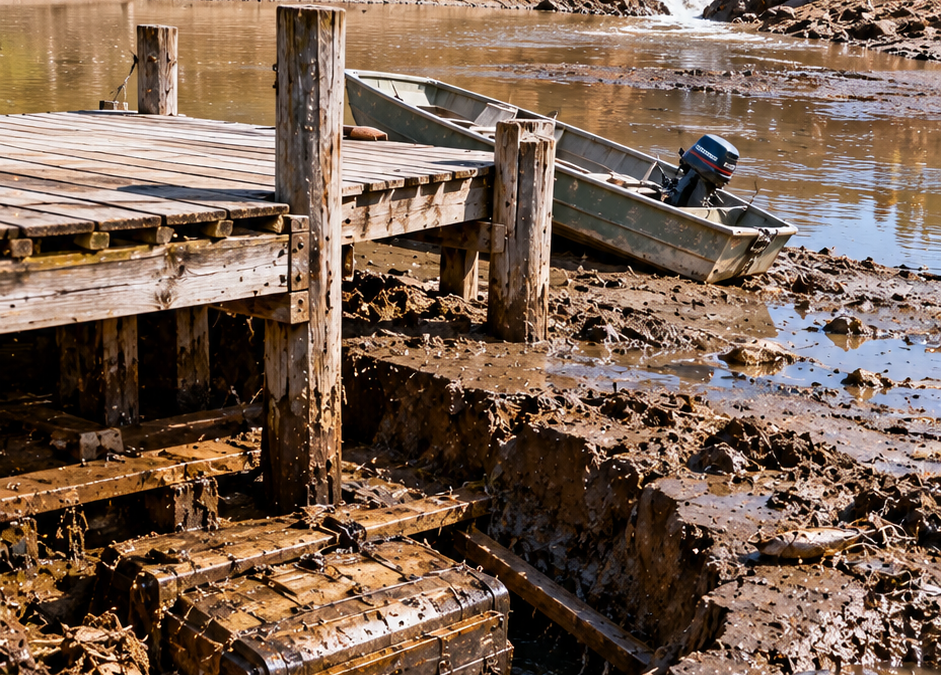
My boat sat sideways against its mooring, fish were thrashing in shrinking pools, and the water was still dropping because an HOA excavator had blocked the creek feeding the lake.
Then the falling water exposed something beneath the old dock that had been hidden for years—and the moment a passing fire crew saw it, Vanessa Caldwell stopped smiling.
My name is Grant Walker.
I had owned the house for eleven years.
Long before the subdivision wrapped itself around my property, before the decorative stone entrance signs, manicured walking paths, matching mailboxes, and newsletters about “community aesthetics,” my parcel had existed on its own.
Two acres.
Uneven ground.
Old oak trees.
A house that leaned slightly into its age instead of trying to hide it.
And behind the house, a small private lake.
Calling it a lake probably made it sound grander than it was.
It was large enough for a narrow dock, a small jon boat, bass, bluegill, reeds along the shallow end, and quiet evenings when the surface became so still you could see the trees reflected upside down.
That was enough for us.
More than enough, actually.
My wife, Laura, loved the lake before I did.
She was the reason we bought the place.
When we first walked the property, I saw an old house that needed work, a sagging dock, brush choking half the shoreline, and another list of repairs I would have to spend weekends completing.
Laura looked at the same place and saw home.
She stepped onto the dock even though one board bent under her shoe.
“Imagine this cleaned up.”
I looked around.
“I’m imagining several thousand dollars.”
She smiled.
“I’m imagining coffee out here in the morning.”
“That’s cheaper.”
“And fishing.”
“You don’t fish.”
“I could.”
“You hate worms.”
“I’ll become sophisticated.”
She never did.
But our daughter did.
During our first summer, Laura and I replaced rotten boards.
We cleared brush by hand.
Rebuilt the little bench at the end of the dock.
Learned where the water stayed deepest in August.
Our daughter was still small enough then that Laura had to hold her life jacket while she leaned over the edge trying to see fish.
Years later, Laura taught her how to cast.
Or tried to.
“Stop yanking the line every five seconds,” she told her.
“How do I know if there’s a fish?”
“You wait.”
“For what?”
“For the fish.”
“That sounds inefficient.”
Laura laughed so hard she nearly dropped her rod.
After Laura died, the lake changed.
I wish I had a better way to explain that.
It was still water.
Still trees.
Still the same dock.
But it became the one part of the property where the house felt complete.
Inside, there were empty spaces everywhere.
Her mug disappeared from the kitchen.
Her shoes from the hallway.
Her reading glasses from the side table.
Her coat from the hook near the garage.
But the lake still looked almost exactly the way it had when she was alive.
The same reeds.
The same shallow cove.
The same oak leaning over the western bank.
I kept the dock repaired.
Kept the shoreline clean.
Watched the water level in dry weather.
Fished there when my daughter came home from college.
I was not preserving a monument.
I was simply protecting one piece of my life that grief had not rearranged.
For years, the HOA barely cared.
Then Vanessa Caldwell became president.
Vanessa was the type of person who could make a suggestion sound like a regulation before anyone remembered to ask whether she actually had authority.
Within months, the neighborhood newsletter stopped referring to the water behind my property as “the pond near the western boundary.”
It became “the community lake.”
The first time I noticed, I assumed it was lazy language.
Then a small sign appeared near my shoreline.
RESIDENTS ONLY.
The sign had been planted several feet inside my property.
I pulled it out.
The next board newsletter referred to “enhancing access and appearance around the community water amenity.”
I emailed the management office.
The lake is privately owned and lies within my recorded parcel. Please correct future references.
No answer.
A month later, I received a notice telling me to remove fishing gear visible from the walking path because it created an “inconsistent recreational appearance.”
I read the phrase twice.
Inconsistent recreational appearance.
There are moments when bureaucratic language becomes almost artistic.
I replied with a copy of my recorded survey.
The dock was inside my boundary.
The shoreline was inside my boundary.
The lake itself was inside my boundary.
The HOA had authority over common land.
My water was not common land.
The sign disappeared.
The attitude did not.
Vanessa continued using the phrase “community lake” at meetings.
She began talking about improving shoreline access.
She did not need to legally own the property in her mind.
She only needed enough people to start behaving as if she did.
At first, I thought the whole thing was irritating.
Not dangerous.
That was my mistake.
The first formal violation notice arrived on a Tuesday.
It claimed that my fishing equipment, small boat, and use of the shoreline created an unsafe recreational condition.
It ordered me to remove visible items and stop using the water in any manner inconsistent with neighborhood appearance standards.
I went straight to my closing documents.
Nothing had changed.
The survey was the same one I had received when I bought the house.
The lake was inside my parcel.
The intake channel feeding it was inside my parcel.
I sent a certified response.
I attached the survey.
Then I asked one simple question.
What recorded covenant gives the HOA authority over this shoreline?
They never answered.
Three days later, I looked out the rear window and saw a landscaping crew behind my house.
At first, I assumed they were working along the subdivision path.
Then I saw branches falling.
I ran outside.
“Stop!”
One of the men killed a chainsaw.
Another worker stood beside a stack of freshly cut shrubs.
Those shrubs had screened my lake from the walking path for years.
“What are you doing?”
The crew supervisor looked confused.
“HOA maintenance.”
“You’re on private property.”
He pointed toward the path.
“We were told this entire area belongs to the association.”
“It doesn’t.”
I showed him the survey on my phone.
His expression changed.
He called someone.
The crew left twenty minutes later.
By then, several mature shrubs were gone.
A strip of vegetation had been cleared toward the rear corner of my parcel.
I photographed everything.
Truck.
License plate.
Equipment.
Stumps.
Tracks.
Survey pins.
That evening, Vanessa emailed me a map.
The lake was shaded blue.
A walking path curved around it.
The entire area was labeled ASSOCIATION CONTROLLED WATER AMENITY.
At first glance, it looked convincing.
Clean colors.
Professional labels.
Subdivision logo.
Then I compared it with the recorded plat.
It was not a legal survey.
It was a marketing illustration.
The type of conceptual drawing developers use to show trees, walking trails, parks, and future houses.
It did not contain accurate boundary monuments.
It did not show my recorded parcel correctly.
It simply colored the lake blue because blue looked nice on a subdivision brochure.
Vanessa was using a marketing image as if it could override a deed.
That was when I stopped thinking we had a misunderstanding.
A misunderstanding ends when somebody sees the correct information.
I had given her the survey.
She preferred the document that gave her more control.
I sent another certified letter.
No HOA employee, contractor, officer, or agent had permission to enter my parcel without written consent.
I specifically included the shoreline and creek intake area.
For almost two weeks, nothing happened.
Then survey flags appeared near the rear edge of the lake.
Small orange markers followed a curve along the shore before continuing toward undeveloped property beyond Cedar View.
I photographed them.
A neighbor named Paul mentioned that the developer had been discussing another residential phase beyond the subdivision.
“You hear anything about a trail?” I asked.
“Something about pedestrian connectivity.”
“What does that mean?”
He shrugged.
“Probably developer language for spending money.”
I laughed.
But the phrase stayed with me.
The cleanest route from the current subdivision to the future tract ran near my lake.
At normal water level, very little dry shoreline existed on that side.
I did not yet understand what that meant.
Then, before sunrise one morning, diesel engines woke me.
I sat up in bed and listened.
Heavy equipment.
Behind the house.
I pulled on jeans and boots and went outside.
Lights moved through the trees.
A compact excavator and skid steer had entered through the rear strip.
Fresh tire tracks crossed my grass.
A pile of riprap stone had been dumped beside the creek.
Two workers were already digging around the channel feeding my lake.
When I reached them, they had placed a steel panel into the intake area and were packing stone and soil against it.
“Stop!”
The excavator bucket paused.
One worker looked toward the bank.
That was when I saw Vanessa.
Bright red suit.
Heels completely inappropriate for wet ground.
Folder under one arm.
She stood there as calmly as if she were supervising the installation of flower beds.
“What are you doing?”
She did not answer the question.
Instead, she removed a paper from her folder.
“You are in violation of HOA policy.”
I stared at her.
“Your excavator is on my property.”
“This is emergency shoreline remediation.”
“You’re blocking the water.”
“We are correcting an unauthorized condition.”
“My lake is the condition?”
“Your lake is not recognized as a permitted private recreational amenity under current association standards.”
For several seconds, I genuinely could not process the sentence.
“Vanessa.”
“Yes?”
“The lake is on my deed.”
“Your deed does not override association infrastructure.”
“The culvert is on my property.”
“The board’s counsel has reviewed our position.”
“Show me the county permit.”
“This isn’t a county matter.”
“You are excavating a creek.”
She held out the violation notice.
“Touch that barrier and the HOA will fine you.”
I took the paper.
Behind her, the excavator dropped another load of stone.
I looked at the worker.
“You have my written notice that this is private land.”
He avoided my eyes.
Vanessa stepped closer.
“You’ve resisted every reasonable effort to integrate this water feature into the community plan.”
“Integrate?”
“Yes.”
“You mean take.”
“That is not productive.”
“No. What’s not productive is blocking the water supply to my lake.”
She turned away.
By that afternoon, the water level had already fallen.
The next morning, mud appeared beneath a section of dock that had been underwater for years.
Small coves became isolated pools.
The jon boat leaned toward the shallower side.
I marked the waterline against one dock post.
Photographed it.
Measured again that evening.
Then the next morning.
And the next.
Every day, the level dropped.
By the third day, the smell changed.
Open water had always smelled clean.
Cool mud.
Aquatic plants.
Now the exposed shore smelled warm and stagnant.
Fish crowded into the deepest remaining area.
Near the reeds, I found a dead bluegill.
Then another.
A bass floated near the edge.
I took photographs because by then I had learned that grief and anger were not evidence.
I contacted the excavation contractor directly.
Sent the survey.
Sent my earlier certified notice.
Informed them that their equipment had entered private property and that I disputed the HOA’s authority.
No meaningful response came that day.
The HOA invoice arrived instead.
They billed me for the excavation.
I stood in my kitchen holding the letter.
EMERGENCY REMEDIATION ASSOCIATED WITH PRIVATE PROPERTY CONDITION.
There were labor charges.
Equipment charges.
Materials.
Administrative fee.
Another page warned that refusal to pay might result in collection costs and additional assessments.
I read it three times.
They had entered my land without permission.
Blocked water feeding my lake.
Started killing fish.
Then sent me the bill.
That invoice changed my understanding of Vanessa.
People who think they made an honest mistake usually stop when someone shows them the mistake.
They do not charge the victim for it.
The survey flags near the shoreline suddenly mattered more.
I searched old planning documents.
Buried in one board presentation was a vague phrase.
Future pedestrian connectivity with adjacent development.
I pulled up the conceptual expansion plan.
There it was.
A possible walking connection.
The shortest route ran near the rear of my lake.
At normal water level, the shoreline narrowed the available ground.
But if the water dropped several feet, the exposed bank became wider.
Dry enough to walk.
Measure.
Photograph.
Potentially represent on a future plan as a usable corridor.
The HOA had not legally gained any land.
But lowering the lake changed how the area looked.
That might be enough for planning conversations.
Maybe even enough to pressure me later.
I walked the entire property line that evening.
Photographed every disturbance.
Cut vegetation.
Tire tracks.
Blocked intake.
Dead fish.
Water marks.
HOA notice.
Survey stakes.
Invoice.
My rear camera had recorded the equipment entering before sunrise.
I copied the footage to another hard drive.
Then to cloud storage.
At that point, I did not know which piece would eventually matter.
I just knew I was done relying on memory.
The next afternoon, a local fire district pickup drove past my property.
It slowed.
Then stopped.
Reversed.
Two firefighters got out.
I assumed someone had complained about the exposed mud.
They walked directly toward the dock.
One of them crouched beside something that had become visible as the lake receded.
A thick red steel pipe.
I had seen a small piece of it before.
Never thought much about it.
I assumed it was old irrigation equipment.
The firefighter brushed dirt from a faded marker beside the pipe.
His expression changed.
He looked toward the water.
Then toward the blocked creek.
“Who did this?”
I pointed up the bank.
Vanessa happened to be there speaking with a landscaping supervisor.
She walked toward us.
“The HOA.”
The firefighter stared at her.
“You blocked that intake?”
“We’re conducting shoreline remediation.”
He reached for his radio.
“Do you know what this is?”
Vanessa glanced at the red pipe.
“Probably abandoned equipment.”
The firefighter looked at his partner.
Then back at Vanessa.
“No.”
His voice changed.
“This is a dry hydrant.”
Vanessa stopped smiling.
I had heard the term before.
I just never knew one was on my property.
The firefighter asked me whether I had closing documents relating to fire access.
“I have a box full of recorded documents.”
“Find them.”
That was the morning I stopped treating the dispute as an HOA argument.
Until then, I had been reacting.
They sent a notice.
I answered.
They entered.
I photographed.
Vanessa claimed authority.
I resent the survey.
That cycle was pointless.
The board did not need another explanation.
It needed outside review.
I created a dedicated evidence folder.
Every notice.
Invoice.
Email.
Certified mail receipt.
Photograph.
Screenshot.
Marketing map.
Camera recording.
I exported everything before the security system could overwrite older footage.
The rear camera clearly showed equipment entering my parcel.
It showed the excavator moving toward the intake.
It showed the time.
Nothing about that video depended on Vanessa’s description of events.
Then I opened my closing box.
Deed.
Survey.
Title documents.
Historic plats.
Old inspection reports.
Most of it had been untouched for years.
The deed chain showed that my parcel predated the subdivision.
The subdivision had been platted around older property boundaries.
Nothing transferred my lake to the HOA.
Then I found a reference buried near the end of an older deed.
FIRE PROTECTION WATER ACCESS AGREEMENT.
There was a recording number.
I drove to the county office.
The clerk located it.
The agreement predated most surrounding homes.
A previous owner had entered into a recorded arrangement with the local fire district.
It provided access for drafting water during emergencies.
Equipment placement.
Maintenance access.
Continued availability of the water source.
Attached to the agreement was a simple diagram.
A line ran from the shoreline directly to the location where the red pipe now sat exposed.
I called the fire district.
They confirmed it.
The dry hydrant allowed engines to draw water from my lake.
It was not connected to a pressurized municipal system like a regular hydrant.
A suction line extended into the water.
For the system to operate reliably, the intake had to remain submerged.
If the water level dropped too low, the pump could pull air.
Reduced flow.
Lost prime.
Failure at exactly the moment a fire crew needed sustained water.
“Is it still active?” I asked.
There was a pause while the district employee checked records.
“Yes.”
That changed everything.
Not ownership.
The lake was still mine.
The agreement did not turn it into public land.
But the fire district still carried my lake in its emergency water planning.
The HOA had altered a condition relied on by emergency services.
I requested copies.
Then I searched county records for permits associated with the excavation.
Water diversion.
Grading.
Channel obstruction.
Shoreline stabilization.
Nothing matching the work appeared.
I did not claim that automatically made every inch of the work illegal.
Permit systems can be complicated.
Records can be misindexed.
But I documented what I could truthfully prove.
I had been unable to identify any matching county approval.
I contacted a retired county engineer named Marcus Bell who had experience with rural fire-water systems.
He agreed to review the recorded diagram.
We stood beside the dock.
The dry hydrant pipe was now clearly visible above the water.
Marcus pointed toward the intake elevation.
“See that?”
“Yes.”
“That suction line needs proper submergence.”
“How low is too low?”
“Depends on the installation, pump, intake configuration. But this?”
He pointed at the exposed section.
“This needs immediate review.”
“Could it fail?”
“It could lose reliability if it starts pulling air.”
He looked toward the blocked channel.
“You don’t want to discover that during a house fire.”
I photographed the waterline against the marker.
Measured the exposed pipe.
Photographed the creek obstruction upstream and downstream.
Then I created a timeline.
Vanessa starts calling the lake a community amenity.
HOA installs residents-only sign.
Violation notice.
I provide survey.
Landscaping crew crosses boundary.
I provide explicit no-entry notice.
Survey flags appear.
Heavy equipment arrives.
Intake is obstructed.
Water level drops.
Fish die.
HOA invoices me.
Fire system becomes exposed.
The order mattered.
It made one defense much harder.
The HOA could not say it had no idea I disputed ownership.
I had warned them before the excavation.
My attorney, David Wells, sent a formal demand.
It identified the boundary.
Trespass.
Physical damage.
Water alteration.
Fire protection agreement.
Possible permit issues.
And a requirement to preserve records related to the work.
We did not accuse Vanessa of every theory I had considered.
David explained why.
“If you list ten conclusions before discovery, you give them ten arguments.”
“So what do we do?”
“We identify facts.”
“And the trail?”
“Preserve the communications.”
“And wait?”
“We make agencies with actual authority answer the questions.”
That was not emotionally satisfying.
But it was smart.
Vanessa responded through the HOA account.
The board’s legal position has been reviewed.
That sentence helped us.
If the HOA continued acting after receiving the survey, then the later argument that nobody understood the boundary became weaker.
Meanwhile, the lake kept falling.
The end of the dock Laura and I rebuilt together stood over mud.
I wanted to remove the barrier myself.
I owned enough equipment to do it.
An hour.
Maybe less.
But David told me not to.
“If you change the site, they can argue about causation.”
“So I just watch my lake die?”
“You document the condition until the inspector sees it.”
It felt wrong.
Passive.
Cowardly, almost.
Every morning I watched more shoreline appear.
More fish crowd into shrinking water.
But preserving the scene allowed independent people to see exactly what the HOA had created.
The fire marshal arrived shortly after eight the next morning.
He carried the recorded water agreement.
Clipboard.
Camera.
He began with the red pipe.
Measured the exposed fitting.
Checked the reference elevation.
Photographed the intake.
Then walked upstream.
No speeches.
No shouting.
No arguments about community aesthetics.
Just measurements.
He finally looked at me.
“The level is lower than I want to see for reliable drafting.”
He wrote something down.
“Can you order them to restore it?”
“I can document the emergency system concern. County permitting and property authority are separate questions.”
That answer was careful.
I appreciated it.
The report later concluded that the lake level had fallen enough to raise concern about the dry hydrant’s reliable operation.
That changed the dispute immediately.
Vanessa could still call the project maintenance.
She could call my lake ugly.
Private.
Unauthorized.
A drainage feature.
Whatever phrase suited her.
The fire district now had its own record.
The lake remained listed as a supplemental emergency water source.
The broader area had municipal hydrants.
But under high-demand fire conditions, supplemental drafting locations still had operational value.
My lake was one of them.
The irony was hard to ignore.
The HOA claimed it was acting to protect the neighborhood while lowering water relied on by firefighters protecting those same homes.
I did not treat that like a victory.
My shoreline was still damaged.
Fish were still dead.
The water system was still compromised.
But for the first time, somebody outside Vanessa’s authority had a reason to intervene.
The county inspector arrived later that day.
He examined the disturbed channel.
Steel panel.
Riprap.
Tracks.
Boundary information.
He asked the contractor for the approved plan.
The site supervisor did not have one.
The inspector ordered all additional disturbance stopped pending county review.
That moment was almost quiet.
No sirens.
No dramatic confrontation.
But something had changed.
For weeks, the HOA had been issuing orders.
Now it was receiving one.
Vanessa immediately changed her language.
Emergency shoreline remediation became maintenance misunderstanding.
Her authority over the intake became a disputed maintenance right.
The problem for her was that documents did not change simply because her explanation did.
My certified notice still existed.
The survey still existed.
The camera footage still showed the excavation after notice.
The HOA invoice still connected the association to the work.
The fire marshal’s report documented the water-level consequence.
David expanded the preservation demand.
Emails.
Texts.
Invoices.
Work orders.
Board communications.
Contractor instructions.
Developer communications.
That last category mattered most.
If the future trail had influenced the work, someone would have written about it.
For several days, nothing surfaced.
Then the contractor’s attorney contacted ours.
The company had a problem.
It had performed work on land whose ownership was now disputed.
It wanted to establish exactly what the HOA had told them.
Their internal planning documents referred to reducing the lake level before additional shoreline work.
No emergency.
No imminent erosion failure.
Reducing water level.
Preparation for shoreline access.
Potential trail connection.
I read the work order twice.
The contractor had not invented the lake-lowering plan.
They had been hired to execute it.
Then came an email from Vanessa.
She instructed the contractor to complete the work before the next full board discussion because additional homeowner objections could delay the schedule.
Another communication represented the intake area as HOA-controlled property.
By the date of that email, Vanessa already had my survey.
That mattered.
Some board members had apparently believed they were approving ordinary landscaping.
Others had never seen the complete instructions.
The contractor reacted first.
Its representatives supplied copies of everything they had been given.
Not because they suddenly loved me.
Liability destroys loyalty quickly.
If the contractor had relied on false representations, the company needed that documented.
Then the HOA insurer entered the dispute.
Insurance adjusters do not care how confidently someone speaks at a board meeting.
They care about notice.
Authorization.
Ownership.
Damage.
Policy exclusions.
Who knew what.
When.
Whether the HOA sent a contractor across a recorded boundary after receiving written warning.
Whether water damage followed.
Whether the board followed its own approval process.
An emergency board meeting was scheduled.
I attended with David.
For weeks, Vanessa had controlled the discussion with language.
Community lake.
Emergency remediation.
Association infrastructure.
Maintenance authority.
At that meeting, each phrase had to sit beside a document.
The survey showed ownership.
The deed confirmed the lake remained part of my parcel.
The historic agreement showed the fire protection arrangement.
The fire marshal documented the compromised water depth.
The contractor’s work order referred to future shoreline access.
My certified letter proved notice before the excavation.
The security video showed the contractor entering afterward.
The HOA invoice showed who ordered the work.
Board member Ellen Price looked at Vanessa.
“Were you given Mr. Walker’s survey before the excavation?”
Vanessa folded her hands.
“The board was provided multiple conflicting documents.”
David leaned toward me but said nothing.
Ellen asked again.
“Did you receive his survey?”
“Yes.”
“Did counsel verify that the intake was common property?”
“The legal status was under review.”
“Then why did we excavate before the review was finished?”
Vanessa glanced toward the HOA attorney.
He did not answer for her.
Another director spoke.
“I thought we approved erosion maintenance.”
“That was the purpose.”
David slid a copy of the contractor’s work order across the table.
“Then perhaps the board should read this.”
Future shoreline access.
Potential trail connection.
Reduce water level.
Silence.
The attorney read it.
Then looked at Vanessa.
“Who authorized this wording?”
“It was operational language.”
“Did the board discuss lowering the lake?”
“The board discussed shoreline access.”
Ellen shook her head.
“No. We discussed maintaining common landscaping.”
“It is all part of the same corridor.”
“No.”
The director’s voice hardened.
“It clearly isn’t.”
For the first time since the dispute began, board members were questioning Vanessa instead of questioning me.
The HOA attorney stopped defending the marketing map.
The conversation shifted from whether Vanessa was right to how much damage had already been done.
Restore flow.
Stop work.
Preserve documents.
Notify the carrier.
No additional entry.
That was the practical end of Vanessa’s control.
The county required the obstruction removed under supervision.
A restoration plan was prepared so reopening the channel would not create additional erosion.
The same contractor returned.
This time, they arrived in daylight.
The property line was marked.
County inspector present.
Fire district notified.
Work documented.
No one called my lake a community amenity.
The excavator removed the stone packed around the intake.
Workers exposed the steel panel.
Chains were attached.
The panel lifted free.
For a moment, nothing happened.
Then a thin stream of water moved through the opening.
It spread over the muddy channel.
Strengthened.
Within minutes, water began running steadily toward the lake.
I stood on the dock.
The first current reached a shallow pool containing several stranded bluegill.
The fish moved with it.
I do not know why that affected me as much as it did.
Maybe because I had spent days watching the lake disappear while refusing to alter evidence.
Maybe because Laura and I had rebuilt that dock together.
Maybe because something finally moved in the right direction.
There was no cheering.
Nobody needed to.
Vanessa stood farther up the bank with several directors.
The contractor she had hired was undoing the project she had ordered.
A county official watched.
The insurer had notice.
The fire district had its record.
The developer was reviewing communications related to the future trail.
The trail plan collapsed quickly after that.
Once the developer understood that the supposed shoreline corridor depended on private property, that the access theory was contradicted by recorded boundaries, and that the lake supported an active fire-water arrangement, the route stopped looking cheap.
Developers do not love complicated land.
They love predictable land.
My shoreline had become the opposite.
The proposed trail disappeared from the next planning materials.
The expansion itself was not canceled.
It simply had to connect another way.
Across land the developer actually controlled.
That did not restore my lake immediately.
Water recovery took time.
Mud remained exposed for days.
Some fish were lost permanently.
Sections of bank needed stabilization.
The dry hydrant could not be considered fully restored until proper water depth returned.
My attorney filed the property claim.
The HOA insurer investigated.
The contractor faced its own county issues.
By then, the company was openly documenting every instruction it had received from Vanessa.
The HOA fines against me were withdrawn.
So was the “emergency remediation” invoice.
Weeks earlier, Vanessa had warned me about collections.
Now the charge disappeared without ceremony.
The lake slowly climbed.
One inch.
Then another.
The mud line moved backward.
Shallow coves reconnected.
The jon boat floated level again.
When the water reached the proper range, the fire district returned.
They inspected the dry hydrant.
Tested access.
Verified operating conditions.
The red pipe disappeared mostly beneath the surface again.
This time, the district installed a clearer marker.
Nobody would mistake it for abandoned junk.
The insurance settlement eventually covered shoreline restoration.
Water-quality testing.
Replacement stocking for fish lost during the drawdown.
And a significant portion of the legal expenses caused by the dispute.
The contractor’s liability remained a separate matter.
The company had crossed into private land.
But its records showed why.
Vanessa had represented the intake area as under HOA control.
The board meeting that ended her presidency happened after most of the physical restoration was complete.
She did not resign.
She came prepared to defend herself.
Red suit.
Organized folder.
Same posture.
Same controlled voice.
She argued that everything she had done was for the neighborhood.
“The lake has functioned as a community feature for years.”
One resident interrupted.
“It’s visible from the trail. That doesn’t make it ours.”
Vanessa ignored him.
“No one disclosed the fire agreement to me.”
I almost responded.
David stopped me.
She continued.
“The developer has long viewed the shoreline as integral to neighborhood connectivity.”
Another director asked, “Were you given Grant’s survey?”
“Yes.”
“Before excavation?”
“Yes, but—”
“That is enough.”
Vanessa looked toward him.
“No, it isn’t.”
The director leaned forward.
“It is for me.”
She tried to reframe the project as maintenance.
The work order prevented that.
She argued the contractor misunderstood.
Her emails prevented that.
She said the trail was only conceptual.
The planning correspondence showed why timing mattered.
She said she believed the HOA controlled the intake.
My certified warning proved she knew ownership was disputed.
The issue was no longer whether Vanessa knew about one obscure fire-district document.
It was whether she had enough information to stop before sending machinery onto private land.
She had.
The board voted to remove her as president.
There was no applause.
I did not want any.
What happened next mattered more.
The HOA adopted new rules.
Any project touching a private parcel required verification against recorded property lines.
No contractor could be sent onto disputed land based solely on conceptual community maps.
Board approval had to be documented in writing.
Material scope changes required another vote.
Property ownership could not be inferred from marketing plans.
It was basic stuff.
It should have been basic from the beginning.
The county never “gave” me the lake.
Neither did the HOA.
Neither did a judge.
That was the part I appreciated most.
I had never lost legal ownership.
The documents said the same thing on the worst day of the dispute that they said at the end.
Everyone else simply had to stop pretending those documents did not matter.
A few weeks later, I repaired the final damaged section of dock.
One board had warped while the water was low.
Several supports needed adjustment.
My daughter came home that weekend.
She stood at the end of the dock looking at the new dry hydrant marker.
“That was always there?”
“Apparently.”
“How did we never notice it?”
“Most of it was underwater.”
She sat down.
“Mom would’ve known.”
I laughed softly.
“Your mother would’ve claimed she knew.”
“She probably would’ve found it the first summer.”
“She probably would’ve painted it.”
“Red?”
“She hated red.”
My daughter smiled.
For a moment, I could hear Laura laughing again.
We brought two rods.
My daughter cast first.
Then immediately reeled in.
“Wait.”
“For what?”
She looked at me.
I realized what I had said.
She smiled.
“For the fish?”
I nodded.
“For the fish.”
We sat there.
The water had returned to the old mark.
Almost perfectly.
The oak reflections stretched across the surface.
The red emergency marker stood near the bank.
Nothing about the scene looked dramatic.
That was exactly what I wanted.
For weeks, Vanessa had tried to make ordinary ownership look unreasonable.
She treated my survey like an inconvenience.
My lake like an HOA asset.
My boundary like a suggestion.
My refusal like obstruction.
And her title like authority over anything visible from the walking path.
But titles are limited by records.
So are boards.
So are developers.
So are contractors.
The strongest part of the case was never one document.
It was the way ordinary facts reinforced one another.
The deed showed ownership.
The survey showed location.
The camera showed entry.
The certified letters showed notice.
The work order showed purpose.
The fire records showed consequence.
The invoice showed association responsibility.
The emails showed timing.
No dramatic revelation stood alone.
Together, they became difficult to explain away.
I thought about that the first evening my daughter and I fished after the lake recovered.
The sun went down slowly.
The water became still.
My line rested near the surface.
The dry hydrant marker reflected beside it.
When the lake first started falling, I thought the worst thing Vanessa could do was damage a place Laura had loved.
For several days, that was all I could see.
The mud.
Dead fish.
Crooked boat.
Exposed dock supports.
It felt personal because it was personal.
But when the red pipe emerged, the dispute became larger than memory.
Vanessa had lowered water that served an emergency purpose she had never bothered to investigate.
She had done it after receiving a survey.
After receiving notice.
Not because the lake was failing.
Not because homes were threatened.
Because a wider shoreline made a future connection easier to plan.
That was what stayed with me.
Not her red suit.
Not the fines.
Not the board vote.
The assumption underneath everything.
That if she acted with enough confidence, ownership would become negotiable.
It did not.
One evening, months after the dispute ended, I walked to the dock alone.
My daughter had returned to college.
The repairs were complete.
The shoreline had settled.
New fish had been stocked.
The fire district’s marker looked almost too bright beside the old wood.
I sat where Laura used to sit with her coffee.
For a long time, nothing moved.
Then a fish broke the surface.
One small circle spread outward.
Then another.
I thought about how close I had come to treating the first violation letter as nothing more than HOA nonsense.
I could have thrown it away.
Ignored the landscaping crew.
Assumed the survey was enough by itself.
Removed the barrier in anger.
Deleted old camera footage.
Never searched the closing documents.
Any one of those choices would have made the truth harder to prove.
Instead, I kept things.
Dates.
Photos.
Letters.
Records.
It sounds boring.
Most useful evidence is.
People like Vanessa depend on exhaustion.
They count on the owner getting angry.
Or intimidated.
Or tired.
They hope you will either surrender or overreact.
Because both outcomes let them control the story.
Documentation does something different.
It slows the argument down.
It forces titles, maps, invoices, and claims to stand beside facts.
That was all I ever needed.
I did not need the HOA to agree that the lake mattered.
I did not need Vanessa to apologize.
I did not need the developer to admit why the trail had seemed so attractive.
I needed the water restored.
The boundary respected.
The fire system protected.
And the lake left alone.
That was what happened.
The last time I saw Vanessa near my property, she was walking the subdivision trail.
She stopped when she reached the point where the HOA sign once stood.
For a second, she looked toward the lake.
I was repairing a rod at the end of the dock.
Neither of us spoke.
She kept walking.
I preferred that.
There are arguments worth winning.
And there are arguments worth ending.
The lake was quiet again.
That was enough.

