𝗙𝗨𝗟𝗟 𝗦𝗧𝗢𝗥𝗬 The Ten-Day Notice in Vanessa Pike’s Red Folder Made Me Look Down at the Road Beneath Her Feet
𝗙𝗨𝗟𝗟 𝗦𝗧𝗢𝗥𝗬
We marked specialized road-base orders when contractors requested specific gradation documentation.
The mark was not proof that the stone belonged to us.
Once aggregate leaves a quarry, it can travel almost anywhere.
But it was enough to make me look twice.
Vanessa opened the door of her white crossover.
“Ten days, Mr. Holt.”
I looked at the road again.
“I’ll use them carefully.”
That evening, Elena walked into my office carrying three binders.
She shut the door with her foot.
“Remember Arrow Site Work?”
I did.
Arrow was a small contractor that had purchased road base from us during Silver Mesa’s second phase.
Their account had gone from thirty days late to sixty.
Then ninety.
We had suspended credit two weeks earlier.
Elena opened the first binder.
“Sixty-eight loads.”
“How much?”
“One hundred fifty-four tons.”
She tapped the delivery sheet.
“Canyon Spur. Stations four-plus-twenty through eleven-plus-eighty.”
Those were engineering stations along a centerline.
Not addresses.
“How much do they owe?”
“Thirty-six thousand four hundred twelve dollars with fuel adjustment.”
I leaned back.
“That explains why you look annoyed.”
“That’s not the interesting part.”
She opened another section.
Every delivery had been digitally accepted by a superintendent named Cole Vardis.
Arrow Site Work appeared as purchaser.
But the compaction requirements carried Redstone Residential’s project code.
Redstone was the developer building Silver Mesa.
Then Elena showed me an email.
Arrow had specifically instructed our drivers to enter Canyon Spur from the quarry side instead of driving through the subdivision.
The attached route diagram crossed a strip labeled:
HOLT BUFFER.
I stared at it.
“Did anyone ask us for permission to cross that?”
“No.”
“Did dispatch approve access?”
“No. They assumed the contractor already had permission.”
“Why?”
“Because Arrow’s flagman directed the trucks.”
I studied the diagram again.
Something cold settled in my stomach.
The HOA threatening to shut down my quarry was driving over stone purchased from my quarry.
Stone they had not paid for.
And our own trucks may have been directed across our land to deliver it.
The next morning, I called my attorney.
Clare Donnelly had spent years representing construction companies before opening a real estate practice.
She understood deeds.
She also understood how jobsites actually worked.
I explained the road.
The invoices.
Vanessa’s notice.
Clare did not interrupt.
When I finished, she said, “Do not block Canyon Spur.”
“I hadn’t planned to.”
“Good. Don’t move a rock. Don’t park equipment across it. Don’t give them photographs of frightened families standing behind a gate you installed.”
“I understand.”
“First we establish the boundary.”
“And the quarry notice?”
“Send it to me.”
She paused.
“If their board wants an emergency injunction against an operating quarry, they’ll need evidence of an emergency.”
“Our seismographs are clean.”
“Then they’re about to become very popular.”
Clare hired a licensed surveyor named Nathan Bell.
Nathan was sixty-three, brown from years in the Texas sun, and aggressively uninterested in everybody’s opinion.
The first morning he arrived, I pointed toward an old cattle fence running along the eastern saddle.
Nathan looked at it.
“Fence looks old.”
“It is.”
“Is it the boundary?”
“I don’t know.”
He nodded approvingly.
“Good answer.”
Then he said something I later repeated more times than I could count.
“Fences tell me where cows stopped. Deeds tell me where ownership stops.”
Nathan began at a brass county monument half a mile south of Canyon Spur.
His crew recovered the first corner pin beneath eight inches of dirt.
It matched our old boundary survey.
The second monument had been cut off below grade.
By noon, Nathan was standing forty-one feet east of the old cattle fence.
“That fence is wrong.”
“How wrong?”
“At this point? Forty-one feet.”
We followed the line north.
The geometry became worse for Silver Mesa.
Canyon Spur entered my parcel near the dry creek.
It curved around a limestone outcrop.
Then remained on my property for seven hundred thirty-six feet.
At the widest section, pavement, drainage swale, and graded shoulder occupied almost an acre and a half.
Nathan placed temporary orange stakes.
The stakes crossed Canyon Spur diagonally.
Then continued through a landscaped stone monument.
SILVER MESA – PHASE 3.
At two that afternoon, Vanessa arrived.
She brought Redstone’s project director.
Grant Mercer.
Grant walked past me without introducing himself.
He went straight to Nathan.
“You’re staking from an obsolete call.”
Nathan kept writing in his field book.
“Which call?”
“The western boundary.”
“Which recorded instrument superseded it?”
“The development plat shows—”
Nathan finally looked up.
“The development plat can show a purple elephant. I still have to reconcile controlling monuments and deed calls.”
Grant turned toward me.
“You authorized construction access.”
“Show me where.”
“Your trucks delivered road base.”
“My company sold aggregate to Arrow Site Work.”
“You knew it was for Canyon Spur.”
“Selling stone doesn’t sell land.”
Vanessa stepped between us.
“This road is critical life-safety infrastructure.”
“That may be true.”
“Blocking it would put more than a hundred families at risk.”
“Then the people who built it should have been extremely careful where they put it.”
She pointed toward Nathan’s orange stakes.
“Remove those before residents see them.”
Nathan closed his field book.
“They are survey control.”
“They’re creating unnecessary alarm.”
“Move one and I’ll document who moved it.”
Vanessa looked at me.
“Is this retaliation because of the quarry violation?”
“No.”
I gestured toward Nathan.
“This is measurement.”
Then I looked at the stakes cutting across her entrance monument.
“It only feels like retaliation because you were depending on nobody measuring.”
Grant walked the line twice.
On his second pass, he photographed every stake.
That told me more than any argument.
He believed Nathan.
Three days later, Nathan delivered the certified survey.
Canyon Spur was on my land.
The decorative Silver Mesa entrance sign was on my land.
A stormwater culvert discharged onto my property.
The road had been constructed less than three years earlier.
That date mattered.
Redstone could not plausibly claim generations of long-established use.
Clare was cautious.
“The record is very good for us,” she said.
“Then they’re finished.”
“No.”
I looked at her.
“No?”
“Good facts are not magic.”
She tapped the survey.
“The deed favors you. The monuments favor you. Construction date favors you. Lack of a recorded easement favors you. But they may argue implied permission, estoppel, reliance, course of conduct.”
“I never permitted them.”
“They may claim your conduct did.”
“They built on my land.”
“And courts still examine facts.”
She leaned back.
“Confidence is useful, Mason. Certainty is expensive.”
Clare sent preservation letters to Redstone and the HOA.
Emails.
Plats.
Surveys.
Contracts.
Payment records.
Fire-access communications.
Everything related to Canyon Spur.
She demanded proof of any easement, license, right-of-way, written permission, or recorded interest covering my parcel.
She also sent notice of the unpaid aggregate account.
Redstone responded within forty-eight hours.
Their attorney, Lowell Brand, claimed Canyon Spur had been constructed in good-faith reliance on an approved county plat and on my conduct.
My conduct included allowing deliveries.
Lowell proposed a standstill.
I would allow unrestricted use of Canyon Spur.
I would waive claims while negotiations continued.
In exchange, Silver Mesa would postpone its quarry-enforcement action.
I read the proposal twice.
“They’re offering to stop doing something they have no authority to do,” I told Clare.
“In exchange for you temporarily allowing something they never acquired authority to do.”
“That’s a remarkable trade.”
“I’ve seen worse.”
“At least at an equipment auction, somebody gives you a tractor.”
Clare’s answer was direct.
I would not obstruct emergency access while title was disputed.
That accommodation was not permission.
Not an easement.
Not a waiver.
The HOA had to withdraw its unsupported quarry notice.
Redstone had to identify the legal basis for Canyon Spur.
And $36,412 in unpaid aggregate charges had to be placed into escrow.
Vanessa did not withdraw the notice.
She escalated.
On day seven of the ten-day deadline, Silver Mesa residents received a “Community Safety Bulletin.”
It said industrial blasting had increased.
It claimed heavy trucks threatened subdivision roads.
It announced that the HOA was pursuing all available remedies to protect families and property values.
The bulletin left out several things.
Our blast readings remained inside permitted limits.
Our trucks used a state farm-to-market route, not Silver Mesa streets.
No regulatory agency had found the quarry unsafe.
And the HOA’s second emergency exit was sitting on the land of the very business it was accusing of being a threat.
By noon, two customers called me.
One asked whether Holt Ridge was closing.
Another said he had heard the county was investigating our permits.
That crossed a line.
Vanessa was no longer simply arguing over property.
She was putting my company’s reputation at risk.
Twenty-three families depended on Holt Ridge payroll.
I would not let an HOA board use rumors about government action to scare customers away.
Clare requested a temporary restraining order.
We attached the permit records.
Seismograph logs.
HOA declaration map.
Vanessa’s bulletin.
Nathan’s survey.
Two days later, the judge granted narrow relief.
Silver Mesa could not represent that it had regulatory authority over Holt Ridge.
It could not imply that a government agency had found our quarry unsafe when none had.
Neither side could alter the disputed road strip before the next hearing.
The order did not award me Canyon Spur.
It did not decide the entire case.
It simply stopped Vanessa from turning assertion into fact through repetition.
That Friday night, Vanessa called a special HOA board meeting.
I did not attend.
I was not a member.
Forty minutes after it started, Rachel Kim drove into the quarry office.
She was an emergency-room nurse.
Mother of two boys.
She looked exhausted.
Not angry.
“Mason Holt?”
“That’s me.”
“I live in Silver Mesa.”
“I figured.”
“I need to ask you something.”
“Go ahead.”
“Are you planning to put a gate across Canyon Spur?”
“No.”
She studied my face.
“No?”
“Not while this is being resolved. And never in a way that traps residents during an emergency.”
Her shoulders dropped.
“Vanessa told us you were using the road to keep the HOA from stopping your blasting.”
“The quarry doesn’t need Canyon Spur to keep operating.”
“But the lawsuit—”
“Separate issues.”
I showed her Nathan’s survey and the temporary court order.
Nothing confidential.
Rachel traced the boundary with one finger.
“Redstone sold us these houses with two permanent exits.”
“Then Redstone owes you two permanent exits.”
She looked up.
That was the moment the conflict changed for me.
Until Rachel walked into my office, Silver Mesa had been an entity in my mind.
Developer.
HOA.
Board.
Lawyers.
Plat.
Rachel reminded me there were families inside those lines.
People had bought houses based on promises they did not draft.
If I treated all of them as the enemy, I would be doing a cleaner version of what Vanessa had done to me.
Property rights are not permission to stop thinking about people.
They tell us who must ask.
Who may say no.
And who should bear the cost when someone decides asking is inconvenient.
Rachel opened her purse.
“I brought something.”
She handed me the HOA board packet.
Inside was a proposed special assessment.
$2,400 per household.
One hundred twelve homes.
$268,800.
The stated purpose was road defense and quarry mitigation.
Residents were about to be charged more than a quarter-million dollars to defend a road the developer might have built on somebody else’s land.
And most of them had not been told that.
The following Monday, we held a documented inspection of Canyon Spur.
Both sides attended.
We photographed pavement.
Measured shoulders.
Located the culvert.
Took shallow core samples with Redstone’s written consent.
A civil engineer opened the original compaction report.
Elena saw the production code first.
“NC17.”
I leaned over.
Our North Cut batch sheets were attached.
Six of them.
Holt Ridge listed as material source.
Arrow Site Work as purchaser.
Redstone Residential as owner.
The quantities matched our unpaid scale tickets within fourteen tons.
Grant reached for the report.
Clare put one hand on the copy.
“This was included in your inspection packet.”
He stopped.
“This copy remains part of the inspection record.”
Vanessa looked at Grant.
“You told us the road was fully conveyed.”
“It was approved.”
“That is not what I asked.”
For the first time, Vanessa and Redstone were not standing on the same side.
We now had two things.
Survey evidence showing the road on my parcel.
Construction records tracing unpaid Holt Ridge aggregate directly into the road.
Two days later, Clare found the county condition that explained the pressure campaign.
Silver Mesa Phase 3 could not receive final occupancy approval for its last twenty-seven homes without two things.
A compliant secondary fire-access route.
And a recorded right-of-way benefiting the subdivision.
The county had approved Canyon Spur’s engineering.
But the approval letter explicitly stated that Redstone remained responsible for acquiring all private property interests.
The county approved a road design.
It did not donate my land to the project.
Redstone was six weeks from scheduled closings on nine finished homes.
Without the right-of-way, closings could be delayed.
Without closings, Redstone’s lender could freeze the next construction draw.
Suddenly I understood Vanessa’s earlier sentence.
You may find the county more receptive than you expect.
Somebody had explained that pressuring the quarry might force me to sign before the county examined Phase 3 access.
The next piece came from a twenty-dollar corporate filing.
Elena was checking Arrow Site Work’s billing address.
Its registered agent shared an office suite with another entity called Redstone Land Services.
Clare pulled Texas formation records.
Arrow had been created nineteen days before the first Canyon Spur purchase order.
Its manager was Grant Mercer’s brother-in-law.
Its mailing addresses eventually led back to Redstone-controlled offices.
Arrow might have been legally separate.
Project entities are common in development.
But Grant could no longer credibly claim Redstone knew nothing about the unpaid stone.
Clare amended our complaint.
We requested a declaration confirming my boundary.
Confirmation that no recorded permanent easement existed.
Recovery of unpaid materials.
Trespass damages.
And an order requiring Redstone either to lawfully relocate its improvements or obtain a proper limited agreement after a safe transition.
We did not ask a judge to strand homeowners.
We asked the party that created the problem to correct it.
Silver Mesa counterclaimed.
They argued estoppel.
Detrimental reliance.
Redstone claimed I had seen construction.
Allowed deliveries.
Remained silent.
Then objected only after the road was complete.
That argument worried me.
Because parts of it were true.
I had seen graders across the ridge.
I had watched construction from a distance.
My company had sold the aggregate.
I had not walked out and stopped the first machine.
One evening, I told Clare exactly that.
“They’re going to say I let them do it.”
“Yes.”
“You don’t sound worried.”
“I’m worried about facts, not emotions.”
She pushed a legal pad toward me.
“What did you actually know?”
“I knew construction was happening.”
“Did you know the road crossed your deed line?”
“No.”
“Why?”
“I assumed they were beyond the old cattle fence.”
“Did Holt Ridge sell material directly to Redstone?”
“No. Arrow.”
“Were your drivers told they were entering Holt property?”
“No.”
“Then we document that.”
Elena pulled dispatch recordings.
Driver notes.
Route sheets.
Credit applications.
Every customer document identified Arrow.
Every delivery map showed the work inside a shaded area labeled:
SILVER MESA CONSTRUCTION LIMITS.
One driver had questioned the old fence.
The dispatcher note said Arrow’s flagman confirmed all work was on Redstone property.
Then Nathan overlaid Redstone’s construction-limit drawing onto the certified deed boundary.
The entire shaded block had been shifted west.
Forty-six feet.
It followed the cattle fence.
Not the actual line.
That could have been a survey mistake.
Then discovery produced the email.
Redstone gave us more than thirty thousand pages.
Invoices.
Duplicates.
Daily reports.
Emails.
Schedules.
Clare’s staff indexed everything.
For four nights, Elena and I sat in a conference room searching terms.
Holt.
Arrow.
Canyon Spur.
Western line.
Fire access.
Easement.
At 11:18 on the fourth night, Elena stopped scrolling.
“Mason.”
I looked over.
“What?”
“Read this.”
The email came from Grant Mercer.
It had been sent eleven days before grading began.
Subject:
WESTERN ACCESS GAP.
Grant wrote that the title company had not located an easement across the Holt parcel.
He warned that approaching me before construction could delay Phase 3.
Then came his recommendation.
Align Canyon Spur with the existing fence.
Complete the base.
Address ownership during final dedication.
And one final sentence:
Once homeowners depend on the route, Holt will have no practical choice but to sign.
I read it again.
Then again.
My hands went cold.
There had been no mistaken plat.
No innocent assumption that the fence matched the boundary.
Redstone knew access was missing before the first grader moved.
Elena scrolled farther.
The land-acquisition director had replied:
Proceed only if civil confirms county will accept.
Grant responded:
County reviews engineering, not private title. Board pressure can handle Holt.
Board pressure.
Clare found another email months later.
Grant to Vanessa.
Attached was a draft quarry complaint.
Talking points about dust.
Blasting.
Property values.
A suggestion that HOA pressure could improve negotiations over Canyon Spur.
Redstone also agreed to reimburse outside counsel costs related to securing access.
Vanessa had edited the complaint.
Grant’s draft requested voluntary operating limits.
Vanessa changed it to demand immediate compliance.
She added the ten-day deadline.
I sat in silence.
For weeks, I had wondered whether Redstone had used Vanessa or whether she was consciously working with them.
The answer was both.
Grant had not initially told her the full history.
But once Vanessa learned the easement was missing, she chose pressure rather than disclosure because she feared losing the second exit and hurting property values.
Redstone used that fear.
Vanessa used the authority homeowners had given her.
And the residents sat between them without the information required to judge either one.
Clare moved for expedited relief.
She filed the email chain under seal.
She notified Redstone’s lender through formal litigation channels.
We did not call television stations.
We did not post excerpts online.
I wanted a court to see evidence.
Not a crowd to see revenge.
Within twenty-four hours, Redstone requested mediation.
Before mediation, Vanessa sat for a deposition.
She arrived with her own lawyer.
Not Redstone’s.
That told Clare the alliance had broken.
I was not in the room.
I read the transcript afterward.
At first, Vanessa defended the quarry bulletin as a normal HOA safety action.
Clare showed her the declaration map.
My property was outside Silver Mesa.
Then the permit records.
Then the Phase 3 county condition.
Then Grant’s draft complaint.
Clare asked:
“Who prepared the first version of the notice sent to Mr. Holt?”
The transcript noted a pause.
Vanessa finally answered.
“Mr. Mercer provided language.”
“Did he explain why Redstone wanted Holt Ridge operations restricted?”
“He said cooperation on operations might lead to cooperation on access.”
“What did that mean to you?”
“That if the quarry dispute were resolved, Mr. Holt might sign the road documents.”
“Did you tell homeowners the road documents had never been signed?”
“No.”
“Did you tell residents that Redstone had constructed Canyon Spur despite the missing easement?”
“I did not know that when construction started.”
“You knew before proposing the special assessment?”
Long pause.
“Yes.”
One word.
Yes.
The HOA counterclaim did not formally disappear that afternoon.
But practically, it was finished.
Clare kept going.
She showed Vanessa the Redstone reimbursement email.
“Was Redstone paying the HOA’s outside legal expenses?”
“They agreed to reimburse costs related to access.”
“Then why were homeowners asked for $268,800?”
“The board believed costs could exceed Redstone’s contribution.”
“Where in the board packet did you disclose Redstone’s reimbursement agreement?”
Vanessa answered:
“It was not disclosed.”
I stopped reading.
I did not feel triumphant.
Vanessa had not stolen the assessment.
The vote had been cancelled before money was collected.
But she had asked neighbors to finance litigation without telling them why the road was disputed or that the developer had agreed to reimburse costs.
Once leadership hides one important fact, every earlier statement becomes questionable.
Rachel Kim and twenty-six other homeowners demanded access to HOA legal and financial records.
Two directors resigned.
The special-assessment vote was cancelled.
Meanwhile, Redstone still had nine houses waiting to close.
County inspection was nineteen days away.
At mediation, Redstone arrived prepared to buy speed.
Clare and I sat in one room.
Redstone in another.
Silver Mesa in a third with independent counsel.
A retired judge carried proposals between us along with terrible coffee.
Redstone’s first offer was $100,000.
Permanent sixty-foot easement.
Dismissal of all claims.
Confidentiality.
And permission for the HOA to enforce quarry operating restrictions.
“No.”
Their second offer:
$185,000.
Payment of the outstanding aggregate invoices.
No HOA jurisdiction over Holt Ridge.
Permanent road rights remained.
“No.”
The mediator looked tired.
“What number do you want?”
“It isn’t only a number.”
“Everything becomes a number eventually.”
“Not this.”
I spread Nathan’s survey across the table.
“Canyon Spur passes through our quarry safety buffer.”
“So?”
“If that road becomes permanent, ordinary residential traffic operates within roughly four hundred feet of an active cut.”
“You can adjust blasting.”
“That’s the point.”
I looked at him.
“They didn’t take one strip of ground. A road changes the land around it.”
Traffic.
Drainage.
Liability.
Setbacks.
Future expectations.
Future claims.
Every blast plan becomes harder.
Every expansion pushes west.
Every year the road remains, someone has another argument for why it should stay.
Redstone had thought in pavement width.
I had to think in decades.
Clare proposed two choices.
First:
A narrow emergency-only easement at an independently appraised value.
No normal residential traffic.
Fire-department-controlled gates.
Restored drainage.
Payment of the stone account.
Legal and survey costs.
Second:
Remove Canyon Spur from my property.
Build the permanent second exit entirely on land Redstone owned.
Restore my buffer.
Pay the same accounts and costs.
Redstone rejected both.
Grant told the mediator there was not enough time before the county deadline.
I answered:
“That deadline existed before they poured the road.”
We left without a settlement.
The next morning, somebody disturbed three of Nathan’s reference stakes.
Broken concrete had been dumped over one corner monument.
That was a serious mistake.
Nathan had photographed everything.
He had coordinates.
He had installed discreet reference nails outside the construction area.
And because we had been dealing with illegal dumping elsewhere on the property, one motion-activated camera happened to cover part of the disputed strip.
At 6:42 that morning, it recorded a Redstone subcontractor’s skid steer entering the area.
I did not confront the operator.
I did not accuse Vanessa.
Clare filed an emergency motion.
The judge ordered Redstone to preserve the site.
Restore the survey monuments under Nathan’s supervision.
And stop all work inside the disputed strip.
Grant claimed the operator had simply been cleaning construction debris.
Then the subcontractor produced a text message.
Clean all Holt markings before inspection.
Sent from Grant’s project phone.
By then, the pattern mattered more than any one revelation.
Whenever Redstone found a document it could not change, somebody tried to change the ground around it.
The county postponed the Phase 3 inspection.
Redstone’s lender froze the next construction draw.
Subcontractors started asking about payment.
For the first time, the cost of the missing easement landed directly on the company that had chosen to build without one.
The homeowners still needed emergency access.
That part had not changed.
I signed a ninety-day revocable emergency license.
Fire.
Ambulance.
Evacuation.
No construction traffic.
No ordinary Phase 3 sales traffic.
The fire marshal reviewed the temporary gate arrangement.
Redstone paid for controls.
Rachel asked me about it.
“Why let them keep using it after everything?”
“Because an ambulance isn’t a developer.”
She smiled faintly.
“That simple?”
“Yes.”
And I meant it.
Holding a boundary does not require confusing innocent people with the corporation that crossed it.
The case lasted months.
No dramatic twenty-minute trial.
Motions.
Affidavits.
Objections.
Weeks when nothing visible happened.
Four months after Vanessa first brought the red folder to my gate, Clare requested partial summary judgment.
Three narrow questions.
Who owned the strip?
Was there a recorded permanent easement?
Was the material account unpaid?
Redstone continued arguing implied consent and equitable reliance.
Clare answered with the records.
Delivery maps showing work inside Redstone’s represented construction limits.
Arrow’s flagman telling our dispatcher the work remained on Redstone property.
The road’s recent construction date.
Nathan’s survey.
And Grant’s email explaining that Redstone wanted homeowners to become dependent before asking me to sign.
January brought the hearing.
District Judge Helen Ward presided.
No jury.
No packed courtroom.
Two legal teams.
Several witnesses.
Three HOA directors.
A few homeowners, including Rachel.
Lowell Brand argued that Holt Ridge knowingly profited from building Canyon Spur.
He said fairness should prevent me from denying access once the community relied on it.
Judge Ward interrupted.
“Counsel, where is the representation by Mr. Holt that Redstone could use his parcel?”
“His course of conduct, Your Honor.”
“Be specific.”
“He observed construction and supplied aggregate through an entity performing Redstone work.”
Judge Ward looked at him.
“That does not answer my question.”
The courtroom became very quiet.
Lowell pointed to the cattle fence.
He argued Redstone reasonably believed it marked the boundary.
Clare stood.
She projected Grant’s email beside the title correspondence.
“A party cannot reasonably rely on a fence after its own title team identifies an access gap.”
Then the shifted construction map appeared.
“And it cannot create reliance deliberately, then ask equity to protect the dependency it created.”
Clare did not accuse Grant of being evil.
She did not need to.
The dates were enough.
First, Redstone learned no easement existed.
Then it mapped the construction area to the fence rather than the deed line.
Then Arrow Site Work appeared.
Then Canyon Spur was constructed.
Then Holt Ridge’s material went unpaid.
Then the HOA was recruited to pressure me.
That sequence became the strongest evidence in the case.
There was no secret federal document.
No mysterious powerful relative.
No last-minute heroic witness.
Just ordinary records.
Each small.
Together, devastating.
Judge Ward confirmed my title to the disputed strip.
She found no recorded permanent easement benefiting Silver Mesa.
She entered judgment on the unpaid material account against Arrow and allowed related debt claims to proceed.
She denied Redstone’s demand for permanent access.
She did not award final trespass damages that morning.
She did not order bulldozers to tear Canyon Spur apart before sunset.
Instead, she gave both sides thirty days to propose a safe transition.
That mattered.
Courts are not revenge machines.
They separate what has been proved from what remains unresolved.
Outside the courtroom, Grant approached me.
For the first time, no attorney stood between us.
“You know moving that road is going to cost almost a million dollars.”
“I know.”
“That helps nobody.”
“Asking first would’ve cost less.”
His face tightened.
“The homeowners will blame you.”
Rachel was standing six feet behind him.
“No,” she said.
Grant turned.
Rachel held up a folder.
“We read the emails.”
Other homeowners were gathering near the elevators.
Grant looked at them.
For the first time, the dependency Redstone had intentionally created was working against him.
The company had assumed residents would defend Canyon Spur at any cost.
It had never considered that residents might instead turn on the people who put their emergency road in the wrong place.
Settlement came twenty-three days later.
Redstone agreed to construct a new permanent secondary exit along the southern edge of Phase 3.
Completely inside surveyed Redstone property.
The new route was three hundred twenty feet longer.
It reached the same public road.
Redstone’s lender reserve and performance bond covered most of the construction.
During the transition, Canyon Spur remained available for emergency use only.
Once the new road passed fire inspection, Redstone had sixty days to remove Canyon Spur from my land.
Pavement.
Base.
Culvert.
Silver Mesa monument sign.
Everything.
Restoration had to follow a soil-engineer plan reviewed by Nathan.
Redstone and Arrow paid the full $36,412 aggregate balance plus contractual interest.
Redstone covered my survey expenses.
A negotiated portion of legal costs.
The trespass claim settled for an amount reflecting temporary occupation and restoration risk.
No fantasy fortune.
No giant punitive check.
I did not want to become rich because somebody built a road badly.
I wanted my land back.
The settlement also required three things to be recorded publicly.
The confirmed boundary.
The absence of a permanent Silver Mesa right-of-way over my parcel.
And the expiration date of the temporary emergency license.
No handshake.
No “everybody understands.”
No conversation some future HOA president could reinterpret.
Recorded documents.
Vanessa resigned before the settlement became public.
She wrote a four-page letter to residents.
She said she had acted to protect emergency access.
True.
She said she had relied on information from Redstone.
Also partly true.
What she did not explain well was why she continued the pressure campaign after learning the easement was missing.
Or why the Redstone reimbursement agreement had not been disclosed before asking homeowners for $268,800.
I never asked for her resignation.
The residents did that.
Rachel joined a temporary board.
She refused the presidency.
She helped hire independent counsel.
The HOA dissolved its quarry-mitigation committee.
A new rule required all outside reimbursements or funding agreements to appear in any packet supporting a special assessment.
That outcome interested me more than seeing Vanessa publicly humiliated.
Arrests make dramatic stories.
Better procedures make better neighborhoods.
In March, Silver Mesa’s new southern exit opened.
The fire marshal drove the road in an engine.
Checked turning radius.
Tested access.
Signed the inspection.
The nine delayed home closings eventually went forward.
Buyers received corrected disclosures.
Nobody lost emergency access.
The following Monday, crews began removing Canyon Spur from my property.
I stood with Elena near the North Cut.
The excavator bucket broke through asphalt.
Beneath it was pale compacted limestone.
Our limestone.
The same material that had started the entire discovery.
The operator loaded it into trucks.
Redstone planned to reuse suitable aggregate on the new road.
Elena watched the first truck pull away.
“Think they’ll pay for it this time?”
“They already did.”
She smiled.
“Then I finally like that road.”
The entrance monument came down last.
When workers removed one concrete footing, Nathan found something underneath.
An old orange survey stake.
Crushed.
Encased in concrete.
He photographed it.
One more quiet witness.
By early summer, the pavement was gone.
The roadbed had been ripped.
Soil was regraded.
Native grass seeded.
The drainage swale returned to its original channel.
We installed a proper wildlife fence along the deed line.
Set far enough back that survey monuments remained visible.
The acre and a half did not suddenly become glamorous.
It became usable again.
That was enough.
My daughter Sophie came home during restoration.
She was twenty-nine.
A civil engineer in Austin.
For years, she had been uncertain whether she wanted any involvement with Holt Ridge after I retired.
She loved the ranch.
She liked engineering.
She did not love the idea of inheriting every property dispute, permit review, equipment breakdown, and customer complaint that came with a quarry.
One evening, we walked the restored buffer.
Blue flags marked new grass seed.
The North Cut turned pale gold under the setting sun.
Sophie looked at the new fence.
“Granddad would’ve blocked the road on day one.”
“Your granddad also thought every carburetor could be repaired with a hammer.”
She laughed.
Then she asked something more serious.
“Why didn’t you take the hundred eighty-five thousand?”
I knew what she meant.
Redstone’s second settlement offer.
“It was real money.”
“Yes.”
“You could’ve invested it.”
“Yes.”
“Why say no?”
I stopped.
Looked across the open ground toward Silver Mesa’s new exit.
“Because they weren’t buying a strip of pavement.”
“What were they buying?”
“Influence over everything beside it.”
She waited.
I pointed toward the quarry.
“Put permanent residential traffic here and everything changes.”
Blast plans.
Insurance.
Drainage.
Safety buffers.
Noise complaints.
Future quarry expansion.
“Traffic becomes expectation,” I told her.
“Expectation becomes pressure.”
I kicked a loose stone.
“Ten years later, somebody points at the road and says it has always been there.”
Sophie looked toward the new road in the distance.
Entirely on the other side of the fence.
“So what happens when you’re done here?”
“That’s a dangerous question to ask a man who owns filing cabinets.”
She laughed again.
The following month, Sophie started spending Fridays at Holt Ridge.
At first, she said she was only helping digitize old parcel records.
Then she started reviewing reclamation plans.
Then stormwater files.
I will not pretend one road dispute decided her future.
Life is rarely that neat.
But I think she saw something in the way the quarry survived the conflict.
Our defense had not been anger.
It had not been power.
It had not even been money.
It was engineering.
Load tickets.
Surveys.
Recorded deeds.
Permit files.
Dispatch notes.
People willing to preserve facts until the facts finally lined up.
Vanessa’s original ten-day notice now sits in a file.
So does Nathan’s survey.
Elena’s unpaid tickets.
The county Phase 3 condition.
The emergency license.
Grant’s email.
Vanessa’s deposition.
Judge Ward’s order.
The settlement.
The restoration report.
The red folder meant to frighten me became the first page in a record proving almost the opposite of what Vanessa intended.
I still think about Grant’s sentence.
Once homeowners depend on the route, Holt will have no practical choice but to sign.
He misunderstood two things.
The first was legal.
Dependency deliberately created through misconduct is not the same as consent.
The second was human.
Protecting my property did not require hurting the families Redstone had deliberately placed in the middle.
We kept Canyon Spur open to emergency vehicles.
We gave residents time.
Then we made the company responsible for the mistake build a lawful solution.
That is the ending I trust.
Not revenge.
Restoration.
Today the crusher starts at seven every morning.
The first loaded truck usually crosses Elena’s scale around 7:15.
Her system records weight.
Customer.
Destination.
Material type.
Production batch.
Payment terms.
Everything gets a ticket.
My father would approve.
The North Cut still supplies stone for farms, public roads, schools, commercial sites, and subdivisions.
Occasionally even Silver Mesa.
Their accounts are prepaid now.
Elena insisted on that.
I did not argue.
Sometimes I drive along the restored eastern buffer.
The fence runs straight across the saddle where Canyon Spur once curved through our property.
Nothing about it looks dramatic.
Four strands of wire.
Steel posts.
Survey monuments.
Grass.
That is what most boundaries look like.
Quiet.
Unimpressive.
Easy to ignore until someone crosses them.
Vanessa came to my quarry believing ten days would force me to choose between surrender and a legal fight I could not afford.
Ten days did change everything.
But not in the way she expected.
They gave Elena time to recognize our stone.
They gave Nathan time to locate the true boundary.
They gave Clare time to ask why a road approved by the county had no recorded private right-of-way.
Then the records did the rest.
The answer had never really been hidden.
Redstone knew.
Grant knew.
Later, Vanessa knew.
The problem was that asking permission threatened their schedule.
So they built first.
Created dependence.
Then assumed inconvenience would become authority.
That assumption nearly cost Silver Mesa its emergency exit.
It damaged trust inside the HOA.
It froze home closings.
It cost Redstone close to a million dollars to correct.
And it could have been avoided with one conversation before the first grader entered my land.
My father used to say people get themselves into trouble when they confuse a fence with a deed.
I think the problem is bigger than that.
People confuse plans with rights.
Permits with ownership.
Need with authority.
Urgency with permission.
Canyon Spur was necessary.
Silver Mesa genuinely needed a second emergency exit.
Vanessa was right about that.
Where she failed was believing necessity erased the obligation to ask.
It does not.
The more important the project becomes, the more precise the authority behind it should be.
Not louder.
A board letter is not a permit.
A county permit is not a deed.
A paved road is not an easement.
A hundred families depending on something does not automatically transfer ownership of the land beneath it.
And a mistake does not become lawful simply because fixing it becomes expensive.
I learned something else too.
For years, I thought property rights were mainly about saying no.
Now I think they are equally about assigning responsibility.
If Redstone had asked me before building Canyon Spur, maybe we could have negotiated.
Maybe not.
But the risk would have belonged to the person making the decision.
Instead, Redstone tried to transfer that risk.
First to me.
Then to the HOA.
Then to homeowners.
Then to the county.
Every time the problem grew, somebody else was supposed to absorb the cost.
The court eventually forced that cost back toward the people who created it.
That mattered more than winning an argument.
One evening, months after the road was gone, Rachel stopped by the quarry office.
She had one of her sons with her.
He was maybe ten.
He wanted to see the crusher.
Elena found him a hard hat that was much too big.
I walked them to the overlook.
The boy stared at the equipment.
“That thing crushes rocks?”
“All day.”
“Can it crush anything?”
“No.”
“What can’t it crush?”
I looked toward the restored buffer.
“Property law.”
Rachel laughed.
The boy did not understand why.
I showed them the new Silver Mesa exit in the distance.
Rachel leaned against the railing.
“You know what still bothers me?”
“What?”
“I believed Vanessa.”
“So did a lot of people.”
“I defended her.”
“You were defending what you thought was your emergency road.”
“That’s not the same thing?”
“No.”
She looked at me.
“You really think that?”
“Yes.”
Because I did.
People deserve to be judged by the information they had when they made a decision.
That principle had protected me too.
I had seen construction but did not know the road crossed my deed line.
Once the truth became clear, my responsibility changed.
The same was true for Rachel.
For residents.
Even for some HOA directors.
Vanessa’s responsibility changed the moment she learned the easement was missing.
Grant’s had changed even earlier.
That is where I draw the line now.
Not between people who were right and people who were wrong from the beginning.
Between those who corrected themselves when the facts changed and those who tried to force the facts to fit what they had already decided.
The sun was dropping behind the North Cut.
Rachel’s son watched another truck roll over the scale.
Elena’s printer produced a load ticket inside the office.
A tiny piece of paper.
Weight.
Batch.
Time.
Customer.
Destination.
Nothing dramatic.
But seventy such pieces of paper had once helped expose a road.
I thought about my father.
Every load gets a ticket.
Every acre gets a deed.
He had understood something I did not appreciate when I was young.
Records are not bureaucracy when they protect reality.
Sometimes they are the only reason reality survives somebody else’s confidence.
That is why the restored strip of grass means more to me now than Canyon Spur ever could.
It does not announce anything.
It does not threaten anybody.
It does not need a red folder.
The fence follows the deed.
The road follows Redstone’s land.
The quarry follows its permits.
Silver Mesa has its emergency exit.
My twenty-three employees still have their jobs.
Families were never trapped behind a boundary dispute.
And the ground beneath my boots belongs to the same family it belonged to before anyone decided inconvenience was a substitute for permission.
The line did not have to shout.
It only had to be measured.
𝗧𝗛𝗘 𝗘𝗡𝗗
The Ten-Day Notice in Vanessa Pike’s Red Folder Made Me Look Down at the Road Beneath Her Feet
Vanessa Pike gave me ten days to shut down the quarry my family had operated for almost half a century.
She stood there talking about laws, safety, and emergency court orders while trucks rolled over a road I had never agreed to give her.
Then I looked at the gravel beneath her shoes and realized the argument she had brought to my gate was much bigger than either of us knew.
My name is Mason Holt.
I was fifty-eight years old that spring, and Holt Ridge Aggregates had been part of my life for as long as I could remember.
My father, Owen, opened the first limestone cut in 1974.
He started with two hundred eighty acres, a used crusher he rebuilt inside our barn, and enough stubbornness to make a bad business plan survive long enough to become a good one.
By the time I took over, Holt Ridge covered eight hundred sixty acres west of Bellweather, Texas.
We employed twenty-three people.
We supplied road base, washed stone, drainage material, and construction aggregate across four counties.
Our permits were current.
Our environmental reports were current.
Our blast logs were current.
Our seismograph records were so boring that I considered them beautiful.
A quarry should be boring on paper.
Boring means nobody was improvising with explosives.
Boring means the scale tickets matched the invoices.
Boring means the county inspector could open a file and find exactly what he expected.
My father believed boring records were what kept complicated operations alive.
“Every load gets a ticket,” he used to tell me.
“And every acre gets a deed.”
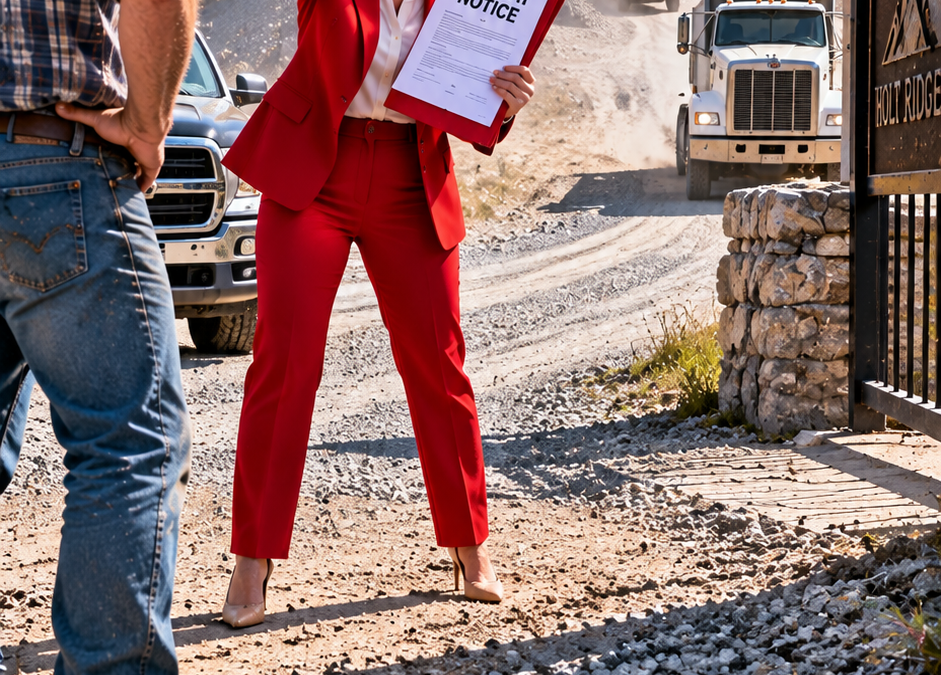
I heard those words in my head the morning Vanessa Pike walked past the sign telling office visitors to check in and came directly toward the crusher carrying a red folder.
She was forty-seven, president of the Silver Mesa Estates Homeowners Association, and professionally employed in commercial property management.
She had moved into Silver Mesa during the first phase of construction and become HOA president within six months.
Vanessa was organized.
Articulate.
Confident.
She had an ability I had seen in many people who managed property for a living.
She could make a preference sound like a regulation before you had time to ask where it had been recorded.
She wore a red blazer despite the Texas heat.
The folder under her arm had colored tabs sticking from the side.
Our scale manager, Elena Ruiz, called me from the office.
“You have company.”
“What kind?”
“The kind that arrives with tabs.”
Elena had worked at Holt Ridge for fourteen years.
She managed load tickets, customer credit, truck weights, and enough spreadsheets to frighten most accountants.
She could identify a duplicated ticket number from across the room.
I met Vanessa on the access apron.
Behind me, the crusher was processing roughly one hundred tons of limestone an hour.
Dust hung pale in the sunlight.
Vanessa did not waste time.
“Mr. Holt, we have exhausted informal remedies.”
I looked around.
“This is the first time you’ve been here.”
“Our correspondence constituted the informal remedy.”
She opened the red folder and handed me a notice.
The HOA demanded that I suspend blasting and restrict truck operations to between ten in the morning and three in the afternoon.
If I refused, Silver Mesa intended to seek county intervention and an emergency injunction.
I read the first page.
Then the second.
“Which authority gives Silver Mesa the right to set my quarry hours?”
“Your operation materially affects our residents.”
“That isn’t what I asked.”
Her expression shifted slightly.
“You should take this seriously.”
“I take every written threat seriously.”
I handed the notice back.
“That’s why I usually look for the paragraph where the person making the threat explains why she has legal authority to make it.”
She glanced toward the crusher.
“You may find the county more receptive than you expect.”
That sentence stayed with me.
Not because it frightened me.
Because it sounded borrowed.
Vanessa had spoken with somebody who believed the county could be used as leverage.
Before she left, a dump truck approached from the east on Canyon Spur Road.
Canyon Spur was a new private road built to serve Silver Mesa’s unfinished third phase.
The truck rolled slowly past us.
Vanessa stepped aside.
I looked down.
The road beneath her shoes was pale limestone base.
Nothing unusual about that.
We sold thousands of tons of similar material.
Then I noticed a blue paint mark along the curb.
NC17.
North Cut, production batch seventeen.
We marked specialized road-base orders when contractors requested specific gradation documentation.
The mark was not proof that the stone belonged to us.
Once aggregate leaves a quarry, it can travel almost anywhere.
But it was enough to make me look twice.
Vanessa opened the door of her white crossover.
“Ten days, Mr. Holt.”
I looked at the road again.
“I’ll use them carefully.”
That evening, Elena walked into my office carrying three binders.
She shut the door with her foot.
“Remember Arrow Site Work?”
I did.
Arrow was a small contractor that had purchased road base from us during Silver Mesa’s second phase.
Their account had gone from thirty days late to sixty.
Then ninety.
We had suspended credit two weeks earlier.
Elena opened the first binder.
“Sixty-eight loads.”
“How much?”
“One hundred fifty-four tons.”
She tapped the delivery sheet.
“Canyon Spur. Stations four-plus-twenty through eleven-plus-eighty.”
Those were engineering stations along a centerline.
Not addresses.
“How much do they owe?”
“Thirty-six thousand four hundred twelve dollars with fuel adjustment.”
I leaned back.
“That explains why you look annoyed.”
“That’s not the interesting part.”
She opened another section.
Every delivery had been digitally accepted by a superintendent named Cole Vardis.
Arrow Site Work appeared as purchaser.
But the compaction requirements carried Redstone Residential’s project code.
Redstone was the developer building Silver Mesa.
Then Elena showed me an email.
Arrow had specifically instructed our drivers to enter Canyon Spur from the quarry side instead of driving through the subdivision.
The attached route diagram crossed a strip labeled:
HOLT BUFFER.
I stared at it.
“Did anyone ask us for permission to cross that?”
“No.”
“Did dispatch approve access?”
“No. They assumed the contractor already had permission.”
“Why?”
“Because Arrow’s flagman directed the trucks.”
I studied the diagram again.
Something cold settled in my stomach.
The HOA threatening to shut down my quarry was driving over stone purchased from my quarry.
Stone they had not paid for.
And our own trucks may have been directed across our land to deliver it.
The next morning, I called my attorney.
Clare Donnelly had spent years representing construction companies before opening a real estate practice.
She understood deeds.
She also understood how jobsites actually worked.
I explained the road.
The invoices.
Vanessa’s notice.
Clare did not interrupt.
When I finished, she said, “Do not block Canyon Spur.”
“I hadn’t planned to.”
“Good. Don’t move a rock. Don’t park equipment across it. Don’t give them photographs of frightened families standing behind a gate you installed.”
“I understand.”
“First we establish the boundary.”
“And the quarry notice?”
“Send it to me.”
She paused.
“If their board wants an emergency injunction against an operating quarry, they’ll need evidence of an emergency.”
“Our seismographs are clean.”
“Then they’re about to become very popular.”
Clare hired a licensed surveyor named Nathan Bell.
Nathan was sixty-three, brown from years in the Texas sun, and aggressively uninterested in everybody’s opinion.
The first morning he arrived, I pointed toward an old cattle fence running along the eastern saddle.
Nathan looked at it.
“Fence looks old.”
“It is.”
“Is it the boundary?”
“I don’t know.”
He nodded approvingly.
“Good answer.”
Then he said something I later repeated more times than I could count.
“Fences tell me where cows stopped. Deeds tell me where ownership stops.”
Nathan began at a brass county monument half a mile south of Canyon Spur.
His crew recovered the first corner pin beneath eight inches of dirt.
It matched our old boundary survey.
The second monument had been cut off below grade.
By noon, Nathan was standing forty-one feet east of the old cattle fence.
“That fence is wrong.”
“How wrong?”
“At this point? Forty-one feet.”
We followed the line north.
The geometry became worse for Silver Mesa.
Canyon Spur entered my parcel near the dry creek.
It curved around a limestone outcrop.
Then remained on my property for seven hundred thirty-six feet.
At the widest section, pavement, drainage swale, and graded shoulder occupied almost an acre and a half.
Nathan placed temporary orange stakes.
The stakes crossed Canyon Spur diagonally.
Then continued through a landscaped stone monument.
SILVER MESA – PHASE 3.
At two that afternoon, Vanessa arrived.
She brought Redstone’s project director.
Grant Mercer.
Grant walked past me without introducing himself.
He went straight to Nathan.
“You’re staking from an obsolete call.”
Nathan kept writing in his field book.
“Which call?”
“The western boundary.”
“Which recorded instrument superseded it?”
“The development plat shows—”
Nathan finally looked up.
“The development plat can show a purple elephant. I still have to reconcile controlling monuments and deed calls.”
Grant turned toward me.
“You authorized construction access.”
“Show me where.”
“Your trucks delivered road base.”
“My company sold aggregate to Arrow Site Work.”
“You knew it was for Canyon Spur.”
“Selling stone doesn’t sell land.”
Vanessa stepped between us.
“This road is critical life-safety infrastructure.”
“That may be true.”
“Blocking it would put more than a hundred families at risk.”
“Then the people who built it should have been extremely careful where they put it.”
She pointed toward Nathan’s orange stakes.
“Remove those before residents see them.”
Nathan closed his field book.
“They are survey control.”
“They’re creating unnecessary alarm.”
“Move one and I’ll document who moved it.”
Vanessa looked at me.
“Is this retaliation because of the quarry violation?”
“No.”
I gestured toward Nathan.
“This is measurement.”
Then I looked at the stakes cutting across her entrance monument.
“It only feels like retaliation because you were depending on nobody measuring.”
Grant walked the line twice.
On his second pass, he photographed every stake.
That told me more than any argument.
He believed Nathan.
Three days later, Nathan delivered the certified survey.
Canyon Spur was on my land.
The decorative Silver Mesa entrance sign was on my land.
A stormwater culvert discharged onto my property.
The road had been constructed less than three years earlier.
That date mattered.
Redstone could not plausibly claim generations of long-established use.
Clare was cautious.
“The record is very good for us,” she said.
“Then they’re finished.”
“No.”
I looked at her.
“No?”
“Good facts are not magic.”
She tapped the survey.
“The deed favors you. The monuments favor you. Construction date favors you. Lack of a recorded easement favors you. But they may argue implied permission, estoppel, reliance, course of conduct.”
“I never permitted them.”
“They may claim your conduct did.”
“They built on my land.”
“And courts still examine facts.”
She leaned back.
“Confidence is useful, Mason. Certainty is expensive.”
Clare sent preservation letters to Redstone and the HOA.
Emails.
Plats.
Surveys.
Contracts.
Payment records.
Fire-access communications.
Everything related to Canyon Spur.
She demanded proof of any easement, license, right-of-way, written permission, or recorded interest covering my parcel.
She also sent notice of the unpaid aggregate account.
Redstone responded within forty-eight hours.
Their attorney, Lowell Brand, claimed Canyon Spur had been constructed in good-faith reliance on an approved county plat and on my conduct.
My conduct included allowing deliveries.
Lowell proposed a standstill.
I would allow unrestricted use of Canyon Spur.
I would waive claims while negotiations continued.
In exchange, Silver Mesa would postpone its quarry-enforcement action.
I read the proposal twice.
“They’re offering to stop doing something they have no authority to do,” I told Clare.
“In exchange for you temporarily allowing something they never acquired authority to do.”
“That’s a remarkable trade.”
“I’ve seen worse.”
“At least at an equipment auction, somebody gives you a tractor.”
Clare’s answer was direct.
I would not obstruct emergency access while title was disputed.
That accommodation was not permission.
Not an easement.
Not a waiver.
The HOA had to withdraw its unsupported quarry notice.
Redstone had to identify the legal basis for Canyon Spur.
And $36,412 in unpaid aggregate charges had to be placed into escrow.
Vanessa did not withdraw the notice.
She escalated.
On day seven of the ten-day deadline, Silver Mesa residents received a “Community Safety Bulletin.”
It said industrial blasting had increased.
It claimed heavy trucks threatened subdivision roads.
It announced that the HOA was pursuing all available remedies to protect families and property values.
The bulletin left out several things.
Our blast readings remained inside permitted limits.
Our trucks used a state farm-to-market route, not Silver Mesa streets.
No regulatory agency had found the quarry unsafe.
And the HOA’s second emergency exit was sitting on the land of the very business it was accusing of being a threat.
By noon, two customers called me.
One asked whether Holt Ridge was closing.
Another said he had heard the county was investigating our permits.
That crossed a line.
Vanessa was no longer simply arguing over property.
She was putting my company’s reputation at risk.
Twenty-three families depended on Holt Ridge payroll.
I would not let an HOA board use rumors about government action to scare customers away.
Clare requested a temporary restraining order.
We attached the permit records.
Seismograph logs.
HOA declaration map.
Vanessa’s bulletin.
Nathan’s survey.
Two days later, the judge granted narrow relief.
Silver Mesa could not represent that it had regulatory authority over Holt Ridge.
It could not imply that a government agency had found our quarry unsafe when none had.
Neither side could alter the disputed road strip before the next hearing.
The order did not award me Canyon Spur.
It did not decide the entire case.
It simply stopped Vanessa from turning assertion into fact through repetition.
That Friday night, Vanessa called a special HOA board meeting.
I did not attend.
I was not a member.
Forty minutes after it started, Rachel Kim drove into the quarry office.
She was an emergency-room nurse.
Mother of two boys.
She looked exhausted.
Not angry.
“Mason Holt?”
“That’s me.”
“I live in Silver Mesa.”
“I figured.”
“I need to ask you something.”
“Go ahead.”
“Are you planning to put a gate across Canyon Spur?”
“No.”
She studied my face.
“No?”
“Not while this is being resolved. And never in a way that traps residents during an emergency.”
Her shoulders dropped.
“Vanessa told us you were using the road to keep the HOA from stopping your blasting.”
“The quarry doesn’t need Canyon Spur to keep operating.”
“But the lawsuit—”
“Separate issues.”
I showed her Nathan’s survey and the temporary court order.
Nothing confidential.
Rachel traced the boundary with one finger.
“Redstone sold us these houses with two permanent exits.”
“Then Redstone owes you two permanent exits.”
She looked up.
That was the moment the conflict changed for me.
Until Rachel walked into my office, Silver Mesa had been an entity in my mind.
Developer.
HOA.
Board.
Lawyers.
Plat.
Rachel reminded me there were families inside those lines.
People had bought houses based on promises they did not draft.
If I treated all of them as the enemy, I would be doing a cleaner version of what Vanessa had done to me.
Property rights are not permission to stop thinking about people.
They tell us who must ask.
Who may say no.
And who should bear the cost when someone decides asking is inconvenient.
Rachel opened her purse.
“I brought something.”
She handed me the HOA board packet.
Inside was a proposed special assessment.
$2,400 per household.
One hundred twelve homes.
$268,800.
The stated purpose was road defense and quarry mitigation.
Residents were about to be charged more than a quarter-million dollars to defend a road the developer might have built on somebody else’s land.
And most of them had not been told that.
The following Monday, we held a documented inspection of Canyon Spur.
Both sides attended.
We photographed pavement.
Measured shoulders.
Located the culvert.
Took shallow core samples with Redstone’s written consent.
A civil engineer opened the original compaction report.
Elena saw the production code first.
“NC17.”
I leaned over.
Our North Cut batch sheets were attached.
Six of them.
Holt Ridge listed as material source.
Arrow Site Work as purchaser.
Redstone Residential as owner.
The quantities matched our unpaid scale tickets within fourteen tons.
Grant reached for the report.
Clare put one hand on the copy.
“This was included in your inspection packet.”
He stopped.
“This copy remains part of the inspection record.”
Vanessa looked at Grant.
“You told us the road was fully conveyed.”
“It was approved.”
“That is not what I asked.”
For the first time, Vanessa and Redstone were not standing on the same side.
We now had two things.
Survey evidence showing the road on my parcel.
Construction records tracing unpaid Holt Ridge aggregate directly into the road.
Two days later, Clare found the county condition that explained the pressure campaign.
Silver Mesa Phase 3 could not receive final occupancy approval for its last twenty-seven homes without two things.
A compliant secondary fire-access route.
And a recorded right-of-way benefiting the subdivision.
The county had approved Canyon Spur’s engineering.
But the approval letter explicitly stated that Redstone remained responsible for acquiring all private property interests.
The county approved a road design.
It did not donate my land to the project.
Redstone was six weeks from scheduled closings on nine finished homes.
Without the right-of-way, closings could be delayed.
Without closings, Redstone’s lender could freeze the next construction draw.
Suddenly I understood Vanessa’s earlier sentence.
You may find the county more receptive than you expect.
Somebody had explained that pressuring the quarry might force me to sign before the county examined Phase 3 access.
The next piece came from a twenty-dollar corporate filing.
Elena was checking Arrow Site Work’s billing address.
Its registered agent shared an office suite with another entity called Redstone Land Services.
Clare pulled Texas formation records.
Arrow had been created nineteen days before the first Canyon Spur purchase order.
Its manager was Grant Mercer’s brother-in-law.
Its mailing addresses eventually led back to Redstone-controlled offices.
Arrow might have been legally separate.
Project entities are common in development.
But Grant could no longer credibly claim Redstone knew nothing about the unpaid stone.
Clare amended our complaint.
We requested a declaration confirming my boundary.
Confirmation that no recorded permanent easement existed.
Recovery of unpaid materials.
Trespass damages.
And an order requiring Redstone either to lawfully relocate its improvements or obtain a proper limited agreement after a safe transition.
We did not ask a judge to strand homeowners.
We asked the party that created the problem to correct it.
Silver Mesa counterclaimed.
They argued estoppel.
Detrimental reliance.
Redstone claimed I had seen construction.
Allowed deliveries.
Remained silent.
Then objected only after the road was complete.
That argument worried me.
Because parts of it were true.
I had seen graders across the ridge.
I had watched construction from a distance.
My company had sold the aggregate.
I had not walked out and stopped the first machine.
One evening, I told Clare exactly that.
“They’re going to say I let them do it.”
“Yes.”
“You don’t sound worried.”
“I’m worried about facts, not emotions.”
She pushed a legal pad toward me.
“What did you actually know?”
“I knew construction was happening.”
“Did you know the road crossed your deed line?”
“No.”
“Why?”
“I assumed they were beyond the old cattle fence.”
“Did Holt Ridge sell material directly to Redstone?”
“No. Arrow.”
“Were your drivers told they were entering Holt property?”
“No.”
“Then we document that.”
Elena pulled dispatch recordings.
Driver notes.
Route sheets.
Credit applications.
Every customer document identified Arrow.
Every delivery map showed the work inside a shaded area labeled:
SILVER MESA CONSTRUCTION LIMITS.
One driver had questioned the old fence.
The dispatcher note said Arrow’s flagman confirmed all work was on Redstone property.
Then Nathan overlaid Redstone’s construction-limit drawing onto the certified deed boundary.
The entire shaded block had been shifted west.
Forty-six feet.
It followed the cattle fence.
Not the actual line.
That could have been a survey mistake.
Then discovery produced the email.
Redstone gave us more than thirty thousand pages.
Invoices.
Duplicates.
Daily reports.
Emails.
Schedules.
Clare’s staff indexed everything.
For four nights, Elena and I sat in a conference room searching terms.
Holt.
Arrow.
Canyon Spur.
Western line.
Fire access.
Easement.
At 11:18 on the fourth night, Elena stopped scrolling.
“Mason.”
I looked over.
“What?”
“Read this.”
The email came from Grant Mercer.
It had been sent eleven days before grading began.
Subject:
WESTERN ACCESS GAP.
Grant wrote that the title company had not located an easement across the Holt parcel.
He warned that approaching me before construction could delay Phase 3.
Then came his recommendation.
Align Canyon Spur with the existing fence.
Complete the base.
Address ownership during final dedication.
And one final sentence:
Once homeowners depend on the route, Holt will have no practical choice but to sign.
I read it again.
Then again.
My hands went cold.
There had been no mistaken plat.
No innocent assumption that the fence matched the boundary.
Redstone knew access was missing before the first grader moved.
Elena scrolled farther.
The land-acquisition director had replied:
Proceed only if civil confirms county will accept.
Grant responded:
County reviews engineering, not private title. Board pressure can handle Holt.
Board pressure.
Clare found another email months later.
Grant to Vanessa.
Attached was a draft quarry complaint.
Talking points about dust.
Blasting.
Property values.
A suggestion that HOA pressure could improve negotiations over Canyon Spur.
Redstone also agreed to reimburse outside counsel costs related to securing access.
Vanessa had edited the complaint.
Grant’s draft requested voluntary operating limits.
Vanessa changed it to demand immediate compliance.
She added the ten-day deadline.
I sat in silence.
For weeks, I had wondered whether Redstone had used Vanessa or whether she was consciously working with them.
The answer was both.
Grant had not initially told her the full history.
But once Vanessa learned the easement was missing, she chose pressure rather than disclosure because she feared losing the second exit and hurting property values.
Redstone used that fear.
Vanessa used the authority homeowners had given her.
And the residents sat between them without the information required to judge either one.
Clare moved for expedited relief.
She filed the email chain under seal.
She notified Redstone’s lender through formal litigation channels.
We did not call television stations.
We did not post excerpts online.
I wanted a court to see evidence.
Not a crowd to see revenge.
Within twenty-four hours, Redstone requested mediation.
Before mediation, Vanessa sat for a deposition.
She arrived with her own lawyer.
Not Redstone’s.
That told Clare the alliance had broken.
I was not in the room.
I read the transcript afterward.
At first, Vanessa defended the quarry bulletin as a normal HOA safety action.
Clare showed her the declaration map.
My property was outside Silver Mesa.
Then the permit records.
Then the Phase 3 county condition.
Then Grant’s draft complaint.
Clare asked:
“Who prepared the first version of the notice sent to Mr. Holt?”
The transcript noted a pause.
Vanessa finally answered.
“Mr. Mercer provided language.”
“Did he explain why Redstone wanted Holt Ridge operations restricted?”
“He said cooperation on operations might lead to cooperation on access.”
“What did that mean to you?”
“That if the quarry dispute were resolved, Mr. Holt might sign the road documents.”
“Did you tell homeowners the road documents had never been signed?”
“No.”
“Did you tell residents that Redstone had constructed Canyon Spur despite the missing easement?”
“I did not know that when construction started.”
“You knew before proposing the special assessment?”
Long pause.
“Yes.”
One word.
Yes.
The HOA counterclaim did not formally disappear that afternoon.
But practically, it was finished.
Clare kept going.
She showed Vanessa the Redstone reimbursement email.
“Was Redstone paying the HOA’s outside legal expenses?”
“They agreed to reimburse costs related to access.”
“Then why were homeowners asked for $268,800?”
“The board believed costs could exceed Redstone’s contribution.”
“Where in the board packet did you disclose Redstone’s reimbursement agreement?”
Vanessa answered:
“It was not disclosed.”
I stopped reading.
I did not feel triumphant.
Vanessa had not stolen the assessment.
The vote had been cancelled before money was collected.
But she had asked neighbors to finance litigation without telling them why the road was disputed or that the developer had agreed to reimburse costs.
Once leadership hides one important fact, every earlier statement becomes questionable.
Rachel Kim and twenty-six other homeowners demanded access to HOA legal and financial records.
Two directors resigned.
The special-assessment vote was cancelled.
Meanwhile, Redstone still had nine houses waiting to close.
County inspection was nineteen days away.
At mediation, Redstone arrived prepared to buy speed.
Clare and I sat in one room.
Redstone in another.
Silver Mesa in a third with independent counsel.
A retired judge carried proposals between us along with terrible coffee.
Redstone’s first offer was $100,000.
Permanent sixty-foot easement.
Dismissal of all claims.
Confidentiality.
And permission for the HOA to enforce quarry operating restrictions.
“No.”
Their second offer:
$185,000.
Payment of the outstanding aggregate invoices.
No HOA jurisdiction over Holt Ridge.
Permanent road rights remained.
“No.”
The mediator looked tired.
“What number do you want?”
“It isn’t only a number.”
“Everything becomes a number eventually.”
“Not this.”
I spread Nathan’s survey across the table.
“Canyon Spur passes through our quarry safety buffer.”
“So?”
“If that road becomes permanent, ordinary residential traffic operates within roughly four hundred feet of an active cut.”
“You can adjust blasting.”
“That’s the point.”
I looked at him.
“They didn’t take one strip of ground. A road changes the land around it.”
Traffic.
Drainage.
Liability.
Setbacks.
Future expectations.
Future claims.
Every blast plan becomes harder.
Every expansion pushes west.
Every year the road remains, someone has another argument for why it should stay.
Redstone had thought in pavement width.
I had to think in decades.
Clare proposed two choices.
First:
A narrow emergency-only easement at an independently appraised value.
No normal residential traffic.
Fire-department-controlled gates.
Restored drainage.
Payment of the stone account.
Legal and survey costs.
Second:
Remove Canyon Spur from my property.
Build the permanent second exit entirely on land Redstone owned.
Restore my buffer.
Pay the same accounts and costs.
Redstone rejected both.
Grant told the mediator there was not enough time before the county deadline.
I answered:
“That deadline existed before they poured the road.”
We left without a settlement.
The next morning, somebody disturbed three of Nathan’s reference stakes.
Broken concrete had been dumped over one corner monument.
That was a serious mistake.
Nathan had photographed everything.
He had coordinates.
He had installed discreet reference nails outside the construction area.
And because we had been dealing with illegal dumping elsewhere on the property, one motion-activated camera happened to cover part of the disputed strip.
At 6:42 that morning, it recorded a Redstone subcontractor’s skid steer entering the area.
I did not confront the operator.
I did not accuse Vanessa.
Clare filed an emergency motion.
The judge ordered Redstone to preserve the site.
Restore the survey monuments under Nathan’s supervision.
And stop all work inside the disputed strip.
Grant claimed the operator had simply been cleaning construction debris.
Then the subcontractor produced a text message.
Clean all Holt markings before inspection.
Sent from Grant’s project phone.
By then, the pattern mattered more than any one revelation.
Whenever Redstone found a document it could not change, somebody tried to change the ground around it.
The county postponed the Phase 3 inspection.
Redstone’s lender froze the next construction draw.
Subcontractors started asking about payment.
For the first time, the cost of the missing easement landed directly on the company that had chosen to build without one.
The homeowners still needed emergency access.
That part had not changed.
I signed a ninety-day revocable emergency license.
Fire.
Ambulance.
Evacuation.
No construction traffic.
No ordinary Phase 3 sales traffic.
The fire marshal reviewed the temporary gate arrangement.
Redstone paid for controls.
Rachel asked me about it.
“Why let them keep using it after everything?”
“Because an ambulance isn’t a developer.”
She smiled faintly.
“That simple?”
“Yes.”
And I meant it.
Holding a boundary does not require confusing innocent people with the corporation that crossed it.
The case lasted months.
No dramatic twenty-minute trial.
Motions.
Affidavits.
Objections.
Weeks when nothing visible happened.
Four months after Vanessa first brought the red folder to my gate, Clare requested partial summary judgment.
Three narrow questions.
Who owned the strip?
Was there a recorded permanent easement?
Was the material account unpaid?
Redstone continued arguing implied consent and equitable reliance.
Clare answered with the records.
Delivery maps showing work inside Redstone’s represented construction limits.
Arrow’s flagman telling our dispatcher the work remained on Redstone property.
The road’s recent construction date.
Nathan’s survey.
And Grant’s email explaining that Redstone wanted homeowners to become dependent before asking me to sign.
January brought the hearing.
District Judge Helen Ward presided.
No jury.
No packed courtroom.
Two legal teams.
Several witnesses.
Three HOA directors.
A few homeowners, including Rachel.
Lowell Brand argued that Holt Ridge knowingly profited from building Canyon Spur.
He said fairness should prevent me from denying access once the community relied on it.
Judge Ward interrupted.
“Counsel, where is the representation by Mr. Holt that Redstone could use his parcel?”
“His course of conduct, Your Honor.”
“Be specific.”
“He observed construction and supplied aggregate through an entity performing Redstone work.”
Judge Ward looked at him.
“That does not answer my question.”
The courtroom became very quiet.
Lowell pointed to the cattle fence.
He argued Redstone reasonably believed it marked the boundary.
Clare stood.
She projected Grant’s email beside the title correspondence.
“A party cannot reasonably rely on a fence after its own title team identifies an access gap.”
Then the shifted construction map appeared.
“And it cannot create reliance deliberately, then ask equity to protect the dependency it created.”
Clare did not accuse Grant of being evil.
She did not need to.
The dates were enough.
First, Redstone learned no easement existed.
Then it mapped the construction area to the fence rather than the deed line.
Then Arrow Site Work appeared.
Then Canyon Spur was constructed.
Then Holt Ridge’s material went unpaid.
Then the HOA was recruited to pressure me.
That sequence became the strongest evidence in the case.
There was no secret federal document.
No mysterious powerful relative.
No last-minute heroic witness.
Just ordinary records.
Each small.
Together, devastating.
Judge Ward confirmed my title to the disputed strip.
She found no recorded permanent easement benefiting Silver Mesa.
She entered judgment on the unpaid material account against Arrow and allowed related debt claims to proceed.
She denied Redstone’s demand for permanent access.
She did not award final trespass damages that morning.
She did not order bulldozers to tear Canyon Spur apart before sunset.
Instead, she gave both sides thirty days to propose a safe transition.
That mattered.
Courts are not revenge machines.
They separate what has been proved from what remains unresolved.
Outside the courtroom, Grant approached me.
For the first time, no attorney stood between us.
“You know moving that road is going to cost almost a million dollars.”
“I know.”
“That helps nobody.”
“Asking first would’ve cost less.”
His face tightened.
“The homeowners will blame you.”
Rachel was standing six feet behind him.
“No,” she said.
Grant turned.
Rachel held up a folder.
“We read the emails.”
Other homeowners were gathering near the elevators.
Grant looked at them.
For the first time, the dependency Redstone had intentionally created was working against him.
The company had assumed residents would defend Canyon Spur at any cost.
It had never considered that residents might instead turn on the people who put their emergency road in the wrong place.
Settlement came twenty-three days later.
Redstone agreed to construct a new permanent secondary exit along the southern edge of Phase 3.
Completely inside surveyed Redstone property.
The new route was three hundred twenty feet longer.
It reached the same public road.
Redstone’s lender reserve and performance bond covered most of the construction.
During the transition, Canyon Spur remained available for emergency use only.
Once the new road passed fire inspection, Redstone had sixty days to remove Canyon Spur from my land.
Pavement.
Base.
Culvert.
Silver Mesa monument sign.
Everything.
Restoration had to follow a soil-engineer plan reviewed by Nathan.
Redstone and Arrow paid the full $36,412 aggregate balance plus contractual interest.
Redstone covered my survey expenses.
A negotiated portion of legal costs.
The trespass claim settled for an amount reflecting temporary occupation and restoration risk.
No fantasy fortune.
No giant punitive check.
I did not want to become rich because somebody built a road badly.
I wanted my land back.
The settlement also required three things to be recorded publicly.
The confirmed boundary.
The absence of a permanent Silver Mesa right-of-way over my parcel.
And the expiration date of the temporary emergency license.
No handshake.
No “everybody understands.”
No conversation some future HOA president could reinterpret.
Recorded documents.
Vanessa resigned before the settlement became public.
She wrote a four-page letter to residents.
She said she had acted to protect emergency access.
True.
She said she had relied on information from Redstone.
Also partly true.
What she did not explain well was why she continued the pressure campaign after learning the easement was missing.
Or why the Redstone reimbursement agreement had not been disclosed before asking homeowners for $268,800.
I never asked for her resignation.
The residents did that.
Rachel joined a temporary board.
She refused the presidency.
She helped hire independent counsel.
The HOA dissolved its quarry-mitigation committee.
A new rule required all outside reimbursements or funding agreements to appear in any packet supporting a special assessment.
That outcome interested me more than seeing Vanessa publicly humiliated.
Arrests make dramatic stories.
Better procedures make better neighborhoods.
In March, Silver Mesa’s new southern exit opened.
The fire marshal drove the road in an engine.
Checked turning radius.
Tested access.
Signed the inspection.
The nine delayed home closings eventually went forward.
Buyers received corrected disclosures.
Nobody lost emergency access.
The following Monday, crews began removing Canyon Spur from my property.
I stood with Elena near the North Cut.
The excavator bucket broke through asphalt.
Beneath it was pale compacted limestone.
Our limestone.
The same material that had started the entire discovery.
The operator loaded it into trucks.
Redstone planned to reuse suitable aggregate on the new road.
Elena watched the first truck pull away.
“Think they’ll pay for it this time?”
“They already did.”
She smiled.
“Then I finally like that road.”
The entrance monument came down last.
When workers removed one concrete footing, Nathan found something underneath.
An old orange survey stake.
Crushed.
Encased in concrete.
He photographed it.
One more quiet witness.
By early summer, the pavement was gone.
The roadbed had been ripped.
Soil was regraded.
Native grass seeded.
The drainage swale returned to its original channel.
We installed a proper wildlife fence along the deed line.
Set far enough back that survey monuments remained visible.
The acre and a half did not suddenly become glamorous.
It became usable again.
That was enough.
My daughter Sophie came home during restoration.
She was twenty-nine.
A civil engineer in Austin.
For years, she had been uncertain whether she wanted any involvement with Holt Ridge after I retired.
She loved the ranch.
She liked engineering.
She did not love the idea of inheriting every property dispute, permit review, equipment breakdown, and customer complaint that came with a quarry.
One evening, we walked the restored buffer.
Blue flags marked new grass seed.
The North Cut turned pale gold under the setting sun.
Sophie looked at the new fence.
“Granddad would’ve blocked the road on day one.”
“Your granddad also thought every carburetor could be repaired with a hammer.”
She laughed.
Then she asked something more serious.
“Why didn’t you take the hundred eighty-five thousand?”
I knew what she meant.
Redstone’s second settlement offer.
“It was real money.”
“Yes.”
“You could’ve invested it.”
“Yes.”
“Why say no?”
I stopped.
Looked across the open ground toward Silver Mesa’s new exit.
“Because they weren’t buying a strip of pavement.”
“What were they buying?”
“Influence over everything beside it.”
She waited.
I pointed toward the quarry.
“Put permanent residential traffic here and everything changes.”
Blast plans.
Insurance.
Drainage.
Safety buffers.
Noise complaints.
Future quarry expansion.
“Traffic becomes expectation,” I told her.
“Expectation becomes pressure.”
I kicked a loose stone.
“Ten years later, somebody points at the road and says it has always been there.”
Sophie looked toward the new road in the distance.
Entirely on the other side of the fence.
“So what happens when you’re done here?”
“That’s a dangerous question to ask a man who owns filing cabinets.”
She laughed again.
The following month, Sophie started spending Fridays at Holt Ridge.
At first, she said she was only helping digitize old parcel records.
Then she started reviewing reclamation plans.
Then stormwater files.
I will not pretend one road dispute decided her future.
Life is rarely that neat.
But I think she saw something in the way the quarry survived the conflict.
Our defense had not been anger.
It had not been power.
It had not even been money.
It was engineering.
Load tickets.
Surveys.
Recorded deeds.
Permit files.
Dispatch notes.
People willing to preserve facts until the facts finally lined up.
Vanessa’s original ten-day notice now sits in a file.
So does Nathan’s survey.
Elena’s unpaid tickets.
The county Phase 3 condition.
The emergency license.
Grant’s email.
Vanessa’s deposition.
Judge Ward’s order.
The settlement.
The restoration report.
The red folder meant to frighten me became the first page in a record proving almost the opposite of what Vanessa intended.
I still think about Grant’s sentence.
Once homeowners depend on the route, Holt will have no practical choice but to sign.
He misunderstood two things.
The first was legal.
Dependency deliberately created through misconduct is not the same as consent.
The second was human.
Protecting my property did not require hurting the families Redstone had deliberately placed in the middle.
We kept Canyon Spur open to emergency vehicles.
We gave residents time.
Then we made the company responsible for the mistake build a lawful solution.
That is the ending I trust.
Not revenge.
Restoration.
Today the crusher starts at seven every morning.
The first loaded truck usually crosses Elena’s scale around 7:15.
Her system records weight.
Customer.
Destination.
Material type.
Production batch.
Payment terms.
Everything gets a ticket.
My father would approve.
The North Cut still supplies stone for farms, public roads, schools, commercial sites, and subdivisions.
Occasionally even Silver Mesa.
Their accounts are prepaid now.
Elena insisted on that.
I did not argue.
Sometimes I drive along the restored eastern buffer.
The fence runs straight across the saddle where Canyon Spur once curved through our property.
Nothing about it looks dramatic.
Four strands of wire.
Steel posts.
Survey monuments.
Grass.
That is what most boundaries look like.
Quiet.
Unimpressive.
Easy to ignore until someone crosses them.
Vanessa came to my quarry believing ten days would force me to choose between surrender and a legal fight I could not afford.
Ten days did change everything.
But not in the way she expected.
They gave Elena time to recognize our stone.
They gave Nathan time to locate the true boundary.
They gave Clare time to ask why a road approved by the county had no recorded private right-of-way.
Then the records did the rest.
The answer had never really been hidden.
Redstone knew.
Grant knew.
Later, Vanessa knew.
The problem was that asking permission threatened their schedule.
So they built first.
Created dependence.
Then assumed inconvenience would become authority.
That assumption nearly cost Silver Mesa its emergency exit.
It damaged trust inside the HOA.
It froze home closings.
It cost Redstone close to a million dollars to correct.
And it could have been avoided with one conversation before the first grader entered my land.
My father used to say people get themselves into trouble when they confuse a fence with a deed.
I think the problem is bigger than that.
People confuse plans with rights.
Permits with ownership.
Need with authority.
Urgency with permission.
Canyon Spur was necessary.
Silver Mesa genuinely needed a second emergency exit.
Vanessa was right about that.
Where she failed was believing necessity erased the obligation to ask.
It does not.
The more important the project becomes, the more precise the authority behind it should be.
Not louder.
A board letter is not a permit.
A county permit is not a deed.
A paved road is not an easement.
A hundred families depending on something does not automatically transfer ownership of the land beneath it.
And a mistake does not become lawful simply because fixing it becomes expensive.
I learned something else too.
For years, I thought property rights were mainly about saying no.
Now I think they are equally about assigning responsibility.
If Redstone had asked me before building Canyon Spur, maybe we could have negotiated.
Maybe not.
But the risk would have belonged to the person making the decision.
Instead, Redstone tried to transfer that risk.
First to me.
Then to the HOA.
Then to homeowners.
Then to the county.
Every time the problem grew, somebody else was supposed to absorb the cost.
The court eventually forced that cost back toward the people who created it.
That mattered more than winning an argument.
One evening, months after the road was gone, Rachel stopped by the quarry office.
She had one of her sons with her.
He was maybe ten.
He wanted to see the crusher.
Elena found him a hard hat that was much too big.
I walked them to the overlook.
The boy stared at the equipment.
“That thing crushes rocks?”
“All day.”
“Can it crush anything?”
“No.”
“What can’t it crush?”
I looked toward the restored buffer.
“Property law.”
Rachel laughed.
The boy did not understand why.
I showed them the new Silver Mesa exit in the distance.
Rachel leaned against the railing.
“You know what still bothers me?”
“What?”
“I believed Vanessa.”
“So did a lot of people.”
“I defended her.”
“You were defending what you thought was your emergency road.”
“That’s not the same thing?”
“No.”
She looked at me.
“You really think that?”
“Yes.”
Because I did.
People deserve to be judged by the information they had when they made a decision.
That principle had protected me too.
I had seen construction but did not know the road crossed my deed line.
Once the truth became clear, my responsibility changed.
The same was true for Rachel.
For residents.
Even for some HOA directors.
Vanessa’s responsibility changed the moment she learned the easement was missing.
Grant’s had changed even earlier.
That is where I draw the line now.
Not between people who were right and people who were wrong from the beginning.
Between those who corrected themselves when the facts changed and those who tried to force the facts to fit what they had already decided.
The sun was dropping behind the North Cut.
Rachel’s son watched another truck roll over the scale.
Elena’s printer produced a load ticket inside the office.
A tiny piece of paper.
Weight.
Batch.
Time.
Customer.
Destination.
Nothing dramatic.
But seventy such pieces of paper had once helped expose a road.
I thought about my father.
Every load gets a ticket.
Every acre gets a deed.
He had understood something I did not appreciate when I was young.
Records are not bureaucracy when they protect reality.
Sometimes they are the only reason reality survives somebody else’s confidence.
That is why the restored strip of grass means more to me now than Canyon Spur ever could.
It does not announce anything.
It does not threaten anybody.
It does not need a red folder.
The fence follows the deed.
The road follows Redstone’s land.
The quarry follows its permits.
Silver Mesa has its emergency exit.
My twenty-three employees still have their jobs.
Families were never trapped behind a boundary dispute.
And the ground beneath my boots belongs to the same family it belonged to before anyone decided inconvenience was a substitute for permission.
The line did not have to shout.
It only had to be measured.

