𝗙𝗨𝗟𝗟 𝗦𝗧𝗢𝗥𝗬 The Stray Dog Wouldn’t Let Go of My Bag, and Something in His Eyes Made Me Follow Him
𝗙𝗨𝗟𝗟 𝗦𝗧𝗢𝗥𝗬
One of his ears twitched.
That was his only response.
I tore off a small piece of turkey and placed it on the ground several feet away.
“There.”
He sniffed in its direction but didn’t move.
That made me look at him more carefully.
A hungry stray refusing food?
“Okay,” I whispered. “You’re strange.”
I finished what little I wanted, wrapped the rest, put it in my bag, and stood.
The dog immediately moved.
He followed me.
At first I ignored him.
I crossed the square.
So did he.
I turned onto another street.
He stayed twenty feet behind me.
I slowed.
He slowed.
I stopped.
He stopped.
I looked back.
“Go home.”
The dog stared at me.
“Seriously.”
Nothing.
I started walking again.
A few seconds later, I heard his paws on the pavement behind me.
Despite myself, I almost smiled.
“Fine. Be mysterious.”
That was the closest thing to amusement I had felt in days.
Then he suddenly came up beside me.
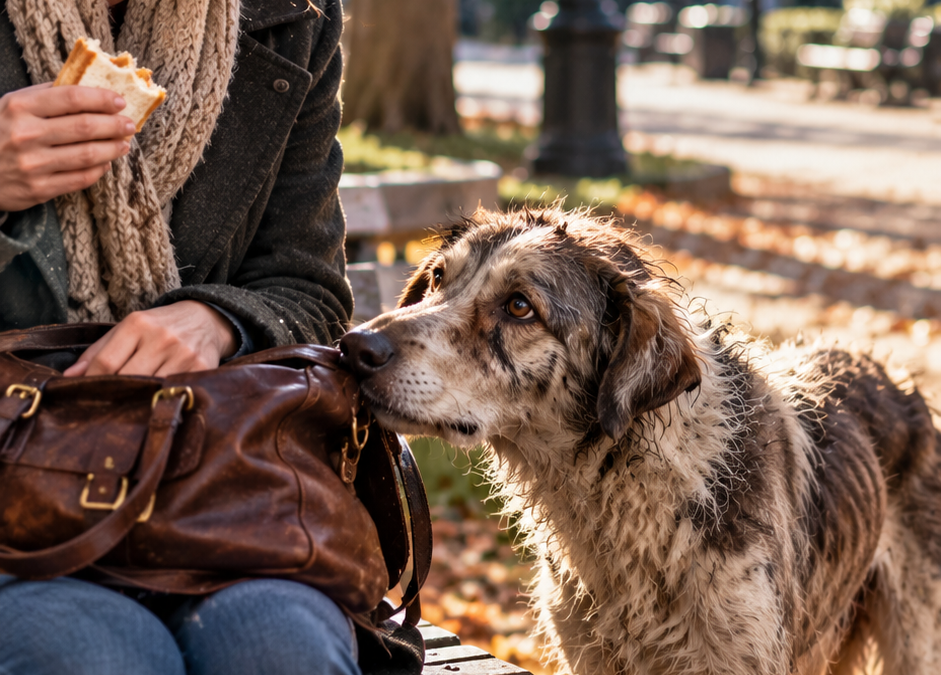
Before I understood what he was doing, he grabbed one of the leather handles of my mother’s bag in his mouth.
I froze.
“Hey!”
He didn’t growl.
He didn’t shake it.
He simply backed away.
My arm extended with the bag.
“Let go.”
He pulled harder.
“That’s my mother’s bag.”
Still pulling.
I tightened my grip.
For several seconds, we stood in the middle of the sidewalk engaged in the strangest tug-of-war of my life.
The dog could have ripped the leather if he’d wanted to.
He didn’t.
His bite remained carefully positioned around the handle.
“Are you trying to rob me?”
His tail didn’t wag.
He pulled again.
Not randomly.
Toward the street behind us.
I took a step in that direction.
He immediately relaxed.
I stepped toward him again.
He backed up.
That was when I realized what he was doing.
He wasn’t trying to take the bag.
He was trying to make me follow him.
The realization should have made me laugh.
Instead, a strange chill moved across my arms.
“What do you want?”
The dog released the handle.
He took several steps away, stopped, and looked back at me.
Then he let out one low bark.
Not aggressive.
Impatient.
He walked a few more steps.
Looked back again.
I don’t know why I followed him.
I’ve asked myself that question many times since.
Maybe it was because I had nowhere else to be.
Maybe because his behavior was too deliberate to ignore.
Or maybe after six months of waking up every morning with no direction at all, I was willing to accept one from a stray dog.
“Okay,” I said quietly.
He watched me.
“Show me.”
Something changed in him immediately.
He turned and started moving.
Fast.
I followed.
He led me away from the busy streets and into an older section of town.
Every few minutes, he looked over his shoulder.
If I fell behind, he slowed.
If I stopped, he stopped.
There was no doubt anymore.
He knew exactly where he was going.
We crossed two streets, passed an abandoned gas station, and entered a narrow lane where the pavement had broken into patches of gravel and weeds.
“Where are you taking me?”
His ears flicked backward at the sound of my voice.
Then he kept going.
The neighborhood became quieter.
The houses grew older.
Some had sagging porches and boarded windows. Others had yards swallowed by weeds.
Eventually, the road climbed a small hill.
My breathing grew heavier.
The dog kept moving.
At the top, he disappeared through a gap in an overgrown hedge.
I hesitated.
Every sensible instinct I possessed told me this had gone far enough.
I was a woman alone, following an unknown dog into an isolated part of town.
I should have turned around.
Then the dog came back through the hedge.
He stood there looking at me.
Waiting.
There was something almost desperate in his expression now.
That decided it.
I followed him through.
On the other side stood a small house.
If I had driven past it, I probably wouldn’t have noticed it at all.
The roof sagged slightly in the middle. Weeds had grown almost waist-high around the foundation. One window was boarded over, while another had been covered from inside with old fabric.
The front steps were cracked.
The dog ran straight to the door.
He dropped down and began scratching at the bottom.
Hard.
“Is this where you live?”
Scratch.
Scratch.
Scratch.
Then he stopped and looked at me.
I approached carefully.
The door wasn’t locked.
In fact, it wasn’t even properly closed.
A heavy piece of timber had fallen—or perhaps been placed—against it at an angle.
Then I heard something.
I stopped breathing.
A sound came from inside.
At first I thought it was the house settling.
Then it came again.
A voice.
Weak.
Barely louder than a breath.
“Hello?”
I stepped closer.
The dog began whining.
My heart started pounding.
“Is somebody in there?”
For a few seconds, nothing happened.
Then I heard it.
“Please…”
One word.
That was enough.
I dropped my bag.
The dog hadn’t wanted my sandwich.
He hadn’t wanted my bag.
He had needed hands.
Human hands.
I grabbed the piece of wood blocking the door.
It was heavier than I expected. I dragged one end across the porch until there was enough room to move it aside.
The dog squeezed through immediately.
I pushed the door open.
“Hello?”
The smell hit me first.
Dust.
Damp wood.
Stale air.
The interior was almost completely dark because fabric covered most of the windows.
I pulled out my phone and turned on the flashlight.
“Where are you?”
“Here.”
The voice came from my right.
I followed it into what had once been a living room.
And there, on the floor near an old couch, was an elderly woman.
She was painfully thin.
Gray hair hung loose around her face. A blanket had been wrapped around her shoulders, and one leg rested at an unnatural angle beneath her.
She was holding a small photograph against her chest.
The dog rushed to her.
He didn’t jump.
He didn’t bark.
He simply pressed himself against her side.
The woman’s shaking hand settled on his head.
“Oh, sweetheart,” she whispered.
Something inside me broke open.
I knelt beside her.
“My name is Emily. I’m going to help you.”
Her eyes found mine.
They were exhausted, but remarkably calm.
“I’m Margaret.”
“Are you hurt?”
“I fell.”
“When?”
She swallowed.
“Three days ago.”
My stomach tightened.
“Three days?”
“I couldn’t stand.”
“Have you had any water?”
She shook her head.
I immediately reached for my bag.
That stupid old leather bag.
The one the dog had grabbed because he needed a way to make me understand.
I took out my water bottle.
“Small sips,” I said. “Okay?”
Margaret nodded.
I held the bottle while she drank.
The dog remained pressed against her.
“Is he yours?” I asked.
Her mouth lifted into the faintest smile.
“More than that.”
I called 911.
While we waited, I gave Margaret a few bites of the sandwich. She struggled to eat, so I didn’t push her.
Instead, I sat on the floor beside her.
For the first time in six months, I wasn’t thinking about Daniel.
I wasn’t wondering what I had done wrong.
I wasn’t replaying our last months together or imagining where he might be now.
Every part of me was focused on another human being.
“Do you live here alone?” I asked.
Margaret nodded.
“No family nearby?”
“My son died years ago. My husband before him.”
“I’m sorry.”
She looked toward the dog.
“I wasn’t completely alone.”
He lifted his head at the sound of her voice.
“What is his name?”
She hesitated.
“He never really had one.”
I frowned.
“He’s been with you all this time without a name?”
“He wasn’t supposed to stay.”
There was affection in her voice now.
“I found him beside the highway almost two years ago. Someone had abandoned him. He was starving and had a wound on his back leg.”
She stroked his ear.
“I brought him here. Fed him. Cleaned the wound. Told myself I’d find him a home.”
The dog placed one paw across her blanket.
Margaret smiled.
“He had other ideas.”
I looked at him differently after that.
“So you saved him.”
“I suppose I did.”
She turned toward me.
“And today he returned the favor.”
My throat tightened.
The dog must have left the house after Margaret fell.
How many people had he approached?
How long had he searched?
Why had he chosen me?
I looked at the old leather bag lying near the doorway.
Maybe it wasn’t mystical.
Maybe he had smelled the sandwich.
Maybe he’d learned that grabbing objects got people’s attention.
Maybe there was a perfectly logical explanation for everything.
At that moment, I didn’t care.
He had found me.
And I had followed.
The paramedics arrived shortly afterward.
They examined Margaret and determined that she was dehydrated and likely had a fractured hip.
As they prepared the stretcher, one of them looked at me.
“You found her?”
I pointed toward the dog.
“He did.”
The paramedic looked down at him.
“Smart boy.”
“Smarter than me,” I said.
The words came out before I could stop them.
And then I laughed.
It wasn’t much.
Just a short, surprised sound.
But it startled me.
I couldn’t remember the last time I’d laughed without forcing it.
They carried Margaret toward the door.
Before they reached it, she suddenly raised one hand.
“Wait.”
The paramedics stopped.
Margaret looked at me.
“Emily.”
I stepped closer.
“What is it?”
Her eyes moved toward the dog.
He was standing beside me now.
“Take him.”
I stared at her.
“What?”
“Take him with you.”
“No, Margaret. He’s yours.”
“He was.”
Her voice was weak, but there was no uncertainty in it.
“He saved me because once I saved him.”
She looked down at him.
“But I don’t think this morning was only about me.”
I didn’t know what she meant.
Apparently, my face showed it.
Margaret smiled.
“I saw you when you came through that door.”
She paused to breathe.
“You looked almost as lost as he did the day I found him.”
I couldn’t answer.
“He chose you, Emily.”
I looked down.
The dog looked back at me.
Those strange brown eyes hadn’t changed.
But suddenly I understood what had unsettled me about them.
He hadn’t looked at me like a stranger.
He had looked at me as though he had already decided I mattered.
And I had spent six months believing the opposite.
“I don’t know anything about dogs,” I whispered.
Margaret’s smile deepened.
“Neither did I.”
One of the paramedics gently touched her shoulder.
“We need to go.”
Margaret nodded.
Before they carried her out, she looked at the dog one last time.
“Go on.”
He watched her disappear through the doorway.
Then he sat beside my leg.
I stood there with my mother’s old bag in one hand, staring down at the animal who had dragged me halfway across town.
He looked exhausted now.
His fur was dirty.
His ribs showed.
There was mud dried around his paws.
And for the first time, I wondered how long he had been searching for someone.
I crouched.
“Was I really your best option?”
His tail moved once against the floor.
I smiled.
“That’s not exactly reassuring.”
The tail moved again.
I put my hand against the side of his face.
He leaned into my palm.
And that simple gesture nearly destroyed me.
For six months, I had been waiting for someone to make my life feel whole again.
Waiting for Daniel to call.
Waiting for an apology.
Waiting for some explanation powerful enough to make rejection hurt less.
But kneeling in that ruined house beside a dog who had refused to give up on an old woman, I understood something.
Maybe life wasn’t going to bring back what I had lost.
Maybe it was asking me to notice what was standing in front of me.
“All right,” I whispered.
The dog’s ears lifted.
“Let’s go home.”
He followed me outside.
We walked back down the hill together.
This time, he didn’t need to pull my bag.
He stayed at my side.
At a small grocery store, I bought dog food, two bowls, a cheap leash, and a collar.
The cashier looked at the dog waiting beside me.
“New?”
“Very.”
“What’s his name?”
I opened my mouth.
Then stopped.
I hadn’t thought about it.
The dog looked up at me.
I thought about Margaret lying alone for three days.
I thought about him leaving the only home he knew to search for help.
I thought about myself sitting on that park bench believing nothing in the world needed me anymore.
And somehow, against all reason, this animal had connected those two lonely places.
“Hope,” I said.
The cashier smiled.
“That’s a good name.”
I looked down at him.
“Yeah.”
For once, I didn’t second-guess myself.
“It is.”
That evening, I called the hospital.
Margaret had a fractured hip and severe dehydration, but the doctors expected her to recover.
I visited her two days later.
Hope came with me as far as the hospital entrance, where a friend stayed with him while I went upstairs.
Margaret looked stronger.
When I showed her a photograph of Hope sleeping on my couch with his legs pointed in four different directions, she laughed.
“He has always believed furniture belongs to him.”
“I discovered that.”
“He stealing your food yet?”
“He attempted negotiations over bacon this morning.”
“Did he win?”
I thought about it.
“Partially.”
Margaret nodded.
“He’s training you well.”
I laughed again.
This time, the sound didn’t surprise me.
During Margaret’s recovery, I visited often.
I learned about her husband, Thomas, who had been a carpenter. Her son, Michael, who had died young. The little house had once been filled with birthdays, Christmas dinners, arguments, music, and muddy shoes.
Time had slowly taken almost everything from her.
But somehow it hadn’t made her bitter.
One afternoon, I finally asked the question that had stayed in my mind.
“Why did you tell me Hope had chosen me?”
Margaret studied me.
“Because he had.”
“But why?”
She shrugged.
“Maybe animals don’t ask the questions people do.”
“What questions?”
“Whether you’re successful enough. Interesting enough. Easy enough to love.”
Her words landed somewhere deep.
She continued.
“Maybe he just saw someone who would stop.”
I looked away toward the hospital window.
Daniel had spent our final months making me feel as though something fundamental about me was missing.
Not exciting enough.
Not happy enough.
Not enough.
Yet on the worst morning of Margaret’s life, Hope had searched an entire neighborhood and somehow decided I was exactly enough for what he needed.
That mattered more than I knew how to say.
Margaret eventually moved into a small assisted-living apartment closer to the hospital.
Pets were allowed, but by then there was no real discussion about where Hope would live.
He had made that decision himself.
I brought him to visit her every week.
He loved her.
That never changed.
But when it was time to leave, he always came back to me.
Over the following months, my life changed in ways that would have seemed insignificant to anyone watching from outside.
I woke up earlier because Hope wanted breakfast.
I walked every morning because Hope wanted outside.
I learned which parks he liked.
I discovered he hated thunderstorms, loved cheese, distrusted vacuum cleaners, and believed every delivery driver was involved in organized crime.
My house stopped feeling silent.
There were paws on the floor.
A collar jingling in the hallway.
A nose pushing open the bathroom door because apparently privacy was an unreasonable human concept.
I started cooking again.
Then sleeping.
Then calling friends before they called me.
One morning, I realized three entire days had passed without me wondering whether Daniel regretted leaving.
That realization frightened me at first.
Then it freed me.
I hadn’t forgotten him.
I hadn’t decided that nine years meant nothing.
I had simply started living somewhere other than inside the wound he left behind.
Months after the day Hope grabbed my bag, I returned to that same little square.
The trees were green again.
People sat on the benches.
Children chased pigeons across the path.
I sat in the same place where Hope had first watched me.
He settled beside my feet.
My mother’s leather bag rested on the bench.
One of its handles still carried several tiny marks from his teeth.
I had considered having it repaired.
I never did.
Those marks had become my favorite part of it.
I ran my thumb across them.
“You nearly ruined this, you know.”
Hope looked up.
“You could have just barked.”
His tail thumped once.
“I suppose that would’ve been too easy.”
I reached down and scratched beneath his chin.
There are moments in life that seem meaningless while they’re happening.
A missed train.
A phone call answered at the wrong time.
A decision to turn left instead of right.
A hungry dog standing twenty feet away while you eat a mediocre sandwich.
We rarely recognize the doors that matter until we’ve already walked through them.
I used to believe Hope led me to that broken little house because Margaret needed to be saved.
And she did.
But after everything that followed, I began to understand that wasn’t the whole story.
There had been two people trapped that morning.
Margaret was trapped inside a house with a broken hip.
I was trapped inside six months of grief, rejection, and silence.
Hope found a way to reach both of us.
That night, as I got into bed, he settled onto the rug beside me.
I turned off the lamp.
A moment later, I felt his head rest against my hand.
I smiled in the darkness.
For a long time after Daniel left, mornings had been the hardest part.
Every sunrise felt like another obligation.
Another day I had to survive without knowing why.
Now I knew that when morning came, there would be paws clicking across the floor.
A cold nose against my hand.
A leash waiting by the door.
Something alive expecting me to get up.
Something that trusted I would.
I rested my hand on Hope’s head.
He sighed and closed his eyes.
And for the first time in a very long while, I didn’t think about what had left my life.
I thought about what had found me
𝗧𝗛𝗘 𝗘𝗡𝗗
The Stray Dog Wouldn’t Let Go of My Bag, and Something in His Eyes Made Me Follow Him
I was thirty-five years old when my life stopped moving forward.
There was no accident. No diagnosis. No dramatic phone call in the middle of the night.
Just an ordinary morning six months earlier, when my husband, Daniel, packed a suitcase, carried it to the front door, and left.
He didn’t yell.
He didn’t blame me.
He didn’t even have the courage to say goodbye to my face.
When I finally came downstairs, the house was quiet, his side of the closet was empty, and there was a folded note on the kitchen table.
I’m sorry. I can’t do this anymore.
That was all.
Eight words to close a marriage that had lasted nearly nine years.
For the first few weeks, people surrounded me.
My friends brought food I didn’t eat. My sister called every evening. Coworkers carefully avoided asking how I was doing because they knew I would lie.
I even saw a therapist.
She was kind, patient, and probably very good at her job.
But kindness couldn’t fill the empty chair across from me at breakfast.
It couldn’t make the house sound less hollow at night.
And it couldn’t answer the question I had begun asking myself every morning.
What exactly am I getting up for?
By the time fall arrived, I had become very good at functioning without really living.
I worked.
I bought groceries.
I answered messages.
I slept badly.
Then I repeated the process.
That was the woman I was on the morning I met the dog.
I hadn’t planned to go anywhere in particular. I simply needed to get out of the house, so I drove downtown and started walking through one of the oldest neighborhoods in the city.
The air had that first sharp bite of autumn.
Dry leaves skittered across the sidewalks. A cold breeze moved through the narrow streets between brick buildings, carrying the smell of coffee, damp pavement, and wood smoke from somewhere I couldn’t see.
I carried an old brown leather bag that had belonged to my mother.
The leather was cracked near the handles, and the brass clasp didn’t always close correctly, but I refused to replace it.
Inside were my wallet, a bottle of water, a photograph of my mother, the newspaper I’d bought at a pharmacy, and a few other things I probably didn’t need.
I think I carried that bag because it made me feel connected to someone.
My mother had been gone for four years.
Daniel had been gone for six months.
I wasn’t ready to lose anything else.
After walking for almost an hour, I stopped in a small square and sat on a wooden bench beneath a row of nearly bare trees.
I had bought a sandwich earlier, mostly because I knew I should eat.
I took two bites.
That’s when I noticed him.
A dog stood on the other side of the path.
Medium-sized.
Gray and white.
No collar that I could see.
His fur was dirty and uneven, and he was much too thin. His ribs weren’t completely visible, but close enough that I knew he hadn’t been eating regularly.
He didn’t approach me.
He simply stared.
Normally, I would have assumed he wanted my sandwich.
But he wasn’t watching the food.
He was watching me.
There was something unsettling about his eyes.
Not threatening.
Just intense.
Deep brown, almost amber where the sunlight touched them.
I took another bite.
His gaze never moved.
“You’re wasting your time,” I told him. “This isn’t even a good sandwich.”
One of his ears twitched.
That was his only response.
I tore off a small piece of turkey and placed it on the ground several feet away.
“There.”
He sniffed in its direction but didn’t move.
That made me look at him more carefully.
A hungry stray refusing food?
“Okay,” I whispered. “You’re strange.”
I finished what little I wanted, wrapped the rest, put it in my bag, and stood.
The dog immediately moved.
He followed me.
At first I ignored him.
I crossed the square.
So did he.
I turned onto another street.
He stayed twenty feet behind me.
I slowed.
He slowed.
I stopped.
He stopped.
I looked back.
“Go home.”
The dog stared at me.
“Seriously.”
Nothing.
I started walking again.
A few seconds later, I heard his paws on the pavement behind me.
Despite myself, I almost smiled.
“Fine. Be mysterious.”
That was the closest thing to amusement I had felt in days.
Then he suddenly came up beside me.
Before I understood what he was doing, he grabbed one of the leather handles of my mother’s bag in his mouth.
I froze.
“Hey!”
He didn’t growl.
He didn’t shake it.
He simply backed away.
My arm extended with the bag.
“Let go.”
He pulled harder.
“That’s my mother’s bag.”
Still pulling.
I tightened my grip.
For several seconds, we stood in the middle of the sidewalk engaged in the strangest tug-of-war of my life.
The dog could have ripped the leather if he’d wanted to.
He didn’t.
His bite remained carefully positioned around the handle.
“Are you trying to rob me?”
His tail didn’t wag.
He pulled again.
Not randomly.
Toward the street behind us.
I took a step in that direction.
He immediately relaxed.
I stepped toward him again.
He backed up.
That was when I realized what he was doing.
He wasn’t trying to take the bag.
He was trying to make me follow him.
The realization should have made me laugh.
Instead, a strange chill moved across my arms.
“What do you want?”
The dog released the handle.
He took several steps away, stopped, and looked back at me.
Then he let out one low bark.
Not aggressive.
Impatient.
He walked a few more steps.
Looked back again.
I don’t know why I followed him.
I’ve asked myself that question many times since.
Maybe it was because I had nowhere else to be.
Maybe because his behavior was too deliberate to ignore.
Or maybe after six months of waking up every morning with no direction at all, I was willing to accept one from a stray dog.
“Okay,” I said quietly.
He watched me.
“Show me.”
Something changed in him immediately.
He turned and started moving.
Fast.
I followed.
He led me away from the busy streets and into an older section of town.
Every few minutes, he looked over his shoulder.
If I fell behind, he slowed.
If I stopped, he stopped.
There was no doubt anymore.
He knew exactly where he was going.
We crossed two streets, passed an abandoned gas station, and entered a narrow lane where the pavement had broken into patches of gravel and weeds.
“Where are you taking me?”
His ears flicked backward at the sound of my voice.
Then he kept going.
The neighborhood became quieter.
The houses grew older.
Some had sagging porches and boarded windows. Others had yards swallowed by weeds.
Eventually, the road climbed a small hill.
My breathing grew heavier.
The dog kept moving.
At the top, he disappeared through a gap in an overgrown hedge.
I hesitated.
Every sensible instinct I possessed told me this had gone far enough.
I was a woman alone, following an unknown dog into an isolated part of town.
I should have turned around.
Then the dog came back through the hedge.
He stood there looking at me.
Waiting.
There was something almost desperate in his expression now.
That decided it.
I followed him through.
On the other side stood a small house.
If I had driven past it, I probably wouldn’t have noticed it at all.
The roof sagged slightly in the middle. Weeds had grown almost waist-high around the foundation. One window was boarded over, while another had been covered from inside with old fabric.
The front steps were cracked.
The dog ran straight to the door.
He dropped down and began scratching at the bottom.
Hard.
“Is this where you live?”
Scratch.
Scratch.
Scratch.
Then he stopped and looked at me.
I approached carefully.
The door wasn’t locked.
In fact, it wasn’t even properly closed.
A heavy piece of timber had fallen—or perhaps been placed—against it at an angle.
Then I heard something.
I stopped breathing.
A sound came from inside.
At first I thought it was the house settling.
Then it came again.
A voice.
Weak.
Barely louder than a breath.
“Hello?”
I stepped closer.
The dog began whining.
My heart started pounding.
“Is somebody in there?”
For a few seconds, nothing happened.
Then I heard it.
“Please…”
One word.
That was enough.
I dropped my bag.
The dog hadn’t wanted my sandwich.
He hadn’t wanted my bag.
He had needed hands.
Human hands.
I grabbed the piece of wood blocking the door.
It was heavier than I expected. I dragged one end across the porch until there was enough room to move it aside.
The dog squeezed through immediately.
I pushed the door open.
“Hello?”
The smell hit me first.
Dust.
Damp wood.
Stale air.
The interior was almost completely dark because fabric covered most of the windows.
I pulled out my phone and turned on the flashlight.
“Where are you?”
“Here.”
The voice came from my right.
I followed it into what had once been a living room.
And there, on the floor near an old couch, was an elderly woman.
She was painfully thin.
Gray hair hung loose around her face. A blanket had been wrapped around her shoulders, and one leg rested at an unnatural angle beneath her.
She was holding a small photograph against her chest.
The dog rushed to her.
He didn’t jump.
He didn’t bark.
He simply pressed himself against her side.
The woman’s shaking hand settled on his head.
“Oh, sweetheart,” she whispered.
Something inside me broke open.
I knelt beside her.
“My name is Emily. I’m going to help you.”
Her eyes found mine.
They were exhausted, but remarkably calm.
“I’m Margaret.”
“Are you hurt?”
“I fell.”
“When?”
She swallowed.
“Three days ago.”
My stomach tightened.
“Three days?”
“I couldn’t stand.”
“Have you had any water?”
She shook her head.
I immediately reached for my bag.
That stupid old leather bag.
The one the dog had grabbed because he needed a way to make me understand.
I took out my water bottle.
“Small sips,” I said. “Okay?”
Margaret nodded.
I held the bottle while she drank.
The dog remained pressed against her.
“Is he yours?” I asked.
Her mouth lifted into the faintest smile.
“More than that.”
I called 911.
While we waited, I gave Margaret a few bites of the sandwich. She struggled to eat, so I didn’t push her.
Instead, I sat on the floor beside her.
For the first time in six months, I wasn’t thinking about Daniel.
I wasn’t wondering what I had done wrong.
I wasn’t replaying our last months together or imagining where he might be now.
Every part of me was focused on another human being.
“Do you live here alone?” I asked.
Margaret nodded.
“No family nearby?”
“My son died years ago. My husband before him.”
“I’m sorry.”
She looked toward the dog.
“I wasn’t completely alone.”
He lifted his head at the sound of her voice.
“What is his name?”
She hesitated.
“He never really had one.”
I frowned.
“He’s been with you all this time without a name?”
“He wasn’t supposed to stay.”
There was affection in her voice now.
“I found him beside the highway almost two years ago. Someone had abandoned him. He was starving and had a wound on his back leg.”
She stroked his ear.
“I brought him here. Fed him. Cleaned the wound. Told myself I’d find him a home.”
The dog placed one paw across her blanket.
Margaret smiled.
“He had other ideas.”
I looked at him differently after that.
“So you saved him.”
“I suppose I did.”
She turned toward me.
“And today he returned the favor.”
My throat tightened.
The dog must have left the house after Margaret fell.
How many people had he approached?
How long had he searched?
Why had he chosen me?
I looked at the old leather bag lying near the doorway.
Maybe it wasn’t mystical.
Maybe he had smelled the sandwich.
Maybe he’d learned that grabbing objects got people’s attention.
Maybe there was a perfectly logical explanation for everything.
At that moment, I didn’t care.
He had found me.
And I had followed.
The paramedics arrived shortly afterward.
They examined Margaret and determined that she was dehydrated and likely had a fractured hip.
As they prepared the stretcher, one of them looked at me.
“You found her?”
I pointed toward the dog.
“He did.”
The paramedic looked down at him.
“Smart boy.”
“Smarter than me,” I said.
The words came out before I could stop them.
And then I laughed.
It wasn’t much.
Just a short, surprised sound.
But it startled me.
I couldn’t remember the last time I’d laughed without forcing it.
They carried Margaret toward the door.
Before they reached it, she suddenly raised one hand.
“Wait.”
The paramedics stopped.
Margaret looked at me.
“Emily.”
I stepped closer.
“What is it?”
Her eyes moved toward the dog.
He was standing beside me now.
“Take him.”
I stared at her.
“What?”
“Take him with you.”
“No, Margaret. He’s yours.”
“He was.”
Her voice was weak, but there was no uncertainty in it.
“He saved me because once I saved him.”
She looked down at him.
“But I don’t think this morning was only about me.”
I didn’t know what she meant.
Apparently, my face showed it.
Margaret smiled.
“I saw you when you came through that door.”
She paused to breathe.
“You looked almost as lost as he did the day I found him.”
I couldn’t answer.
“He chose you, Emily.”
I looked down.
The dog looked back at me.
Those strange brown eyes hadn’t changed.
But suddenly I understood what had unsettled me about them.
He hadn’t looked at me like a stranger.
He had looked at me as though he had already decided I mattered.
And I had spent six months believing the opposite.
“I don’t know anything about dogs,” I whispered.
Margaret’s smile deepened.
“Neither did I.”
One of the paramedics gently touched her shoulder.
“We need to go.”
Margaret nodded.
Before they carried her out, she looked at the dog one last time.
“Go on.”
He watched her disappear through the doorway.
Then he sat beside my leg.
I stood there with my mother’s old bag in one hand, staring down at the animal who had dragged me halfway across town.
He looked exhausted now.
His fur was dirty.
His ribs showed.
There was mud dried around his paws.
And for the first time, I wondered how long he had been searching for someone.
I crouched.
“Was I really your best option?”
His tail moved once against the floor.
I smiled.
“That’s not exactly reassuring.”
The tail moved again.
I put my hand against the side of his face.
He leaned into my palm.
And that simple gesture nearly destroyed me.
For six months, I had been waiting for someone to make my life feel whole again.
Waiting for Daniel to call.
Waiting for an apology.
Waiting for some explanation powerful enough to make rejection hurt less.
But kneeling in that ruined house beside a dog who had refused to give up on an old woman, I understood something.
Maybe life wasn’t going to bring back what I had lost.
Maybe it was asking me to notice what was standing in front of me.
“All right,” I whispered.
The dog’s ears lifted.
“Let’s go home.”
He followed me outside.
We walked back down the hill together.
This time, he didn’t need to pull my bag.
He stayed at my side.
At a small grocery store, I bought dog food, two bowls, a cheap leash, and a collar.
The cashier looked at the dog waiting beside me.
“New?”
“Very.”
“What’s his name?”
I opened my mouth.
Then stopped.
I hadn’t thought about it.
The dog looked up at me.
I thought about Margaret lying alone for three days.
I thought about him leaving the only home he knew to search for help.
I thought about myself sitting on that park bench believing nothing in the world needed me anymore.
And somehow, against all reason, this animal had connected those two lonely places.
“Hope,” I said.
The cashier smiled.
“That’s a good name.”
I looked down at him.
“Yeah.”
For once, I didn’t second-guess myself.
“It is.”
That evening, I called the hospital.
Margaret had a fractured hip and severe dehydration, but the doctors expected her to recover.
I visited her two days later.
Hope came with me as far as the hospital entrance, where a friend stayed with him while I went upstairs.
Margaret looked stronger.
When I showed her a photograph of Hope sleeping on my couch with his legs pointed in four different directions, she laughed.
“He has always believed furniture belongs to him.”
“I discovered that.”
“He stealing your food yet?”
“He attempted negotiations over bacon this morning.”
“Did he win?”
I thought about it.
“Partially.”
Margaret nodded.
“He’s training you well.”
I laughed again.
This time, the sound didn’t surprise me.
During Margaret’s recovery, I visited often.
I learned about her husband, Thomas, who had been a carpenter. Her son, Michael, who had died young. The little house had once been filled with birthdays, Christmas dinners, arguments, music, and muddy shoes.
Time had slowly taken almost everything from her.
But somehow it hadn’t made her bitter.
One afternoon, I finally asked the question that had stayed in my mind.
“Why did you tell me Hope had chosen me?”
Margaret studied me.
“Because he had.”
“But why?”
She shrugged.
“Maybe animals don’t ask the questions people do.”
“What questions?”
“Whether you’re successful enough. Interesting enough. Easy enough to love.”
Her words landed somewhere deep.
She continued.
“Maybe he just saw someone who would stop.”
I looked away toward the hospital window.
Daniel had spent our final months making me feel as though something fundamental about me was missing.
Not exciting enough.
Not happy enough.
Not enough.
Yet on the worst morning of Margaret’s life, Hope had searched an entire neighborhood and somehow decided I was exactly enough for what he needed.
That mattered more than I knew how to say.
Margaret eventually moved into a small assisted-living apartment closer to the hospital.
Pets were allowed, but by then there was no real discussion about where Hope would live.
He had made that decision himself.
I brought him to visit her every week.
He loved her.
That never changed.
But when it was time to leave, he always came back to me.
Over the following months, my life changed in ways that would have seemed insignificant to anyone watching from outside.
I woke up earlier because Hope wanted breakfast.
I walked every morning because Hope wanted outside.
I learned which parks he liked.
I discovered he hated thunderstorms, loved cheese, distrusted vacuum cleaners, and believed every delivery driver was involved in organized crime.
My house stopped feeling silent.
There were paws on the floor.
A collar jingling in the hallway.
A nose pushing open the bathroom door because apparently privacy was an unreasonable human concept.
I started cooking again.
Then sleeping.
Then calling friends before they called me.
One morning, I realized three entire days had passed without me wondering whether Daniel regretted leaving.
That realization frightened me at first.
Then it freed me.
I hadn’t forgotten him.
I hadn’t decided that nine years meant nothing.
I had simply started living somewhere other than inside the wound he left behind.
Months after the day Hope grabbed my bag, I returned to that same little square.
The trees were green again.
People sat on the benches.
Children chased pigeons across the path.
I sat in the same place where Hope had first watched me.
He settled beside my feet.
My mother’s leather bag rested on the bench.
One of its handles still carried several tiny marks from his teeth.
I had considered having it repaired.
I never did.
Those marks had become my favorite part of it.
I ran my thumb across them.
“You nearly ruined this, you know.”
Hope looked up.
“You could have just barked.”
His tail thumped once.
“I suppose that would’ve been too easy.”
I reached down and scratched beneath his chin.
There are moments in life that seem meaningless while they’re happening.
A missed train.
A phone call answered at the wrong time.
A decision to turn left instead of right.
A hungry dog standing twenty feet away while you eat a mediocre sandwich.
We rarely recognize the doors that matter until we’ve already walked through them.
I used to believe Hope led me to that broken little house because Margaret needed to be saved.
And she did.
But after everything that followed, I began to understand that wasn’t the whole story.
There had been two people trapped that morning.
Margaret was trapped inside a house with a broken hip.
I was trapped inside six months of grief, rejection, and silence.
Hope found a way to reach both of us.
That night, as I got into bed, he settled onto the rug beside me.
I turned off the lamp.
A moment later, I felt his head rest against my hand.
I smiled in the darkness.
For a long time after Daniel left, mornings had been the hardest part.
Every sunrise felt like another obligation.
Another day I had to survive without knowing why.
Now I knew that when morning came, there would be paws clicking across the floor.
A cold nose against my hand.
A leash waiting by the door.
Something alive expecting me to get up.
Something that trusted I would.
I rested my hand on Hope’s head.
He sighed and closed his eyes.
And for the first time in a very long while, I didn’t think about what had left my life.
I thought about what had found me.

