𝗙𝗨𝗟𝗟 𝗦𝗧𝗢𝗥𝗬 The Stray Dog Who Followed Me for Six Days Was Watching Something I Hadn’t Seen Yet
𝗙𝗨𝗟𝗟 𝗦𝗧𝗢𝗥𝗬
The rain had stopped.
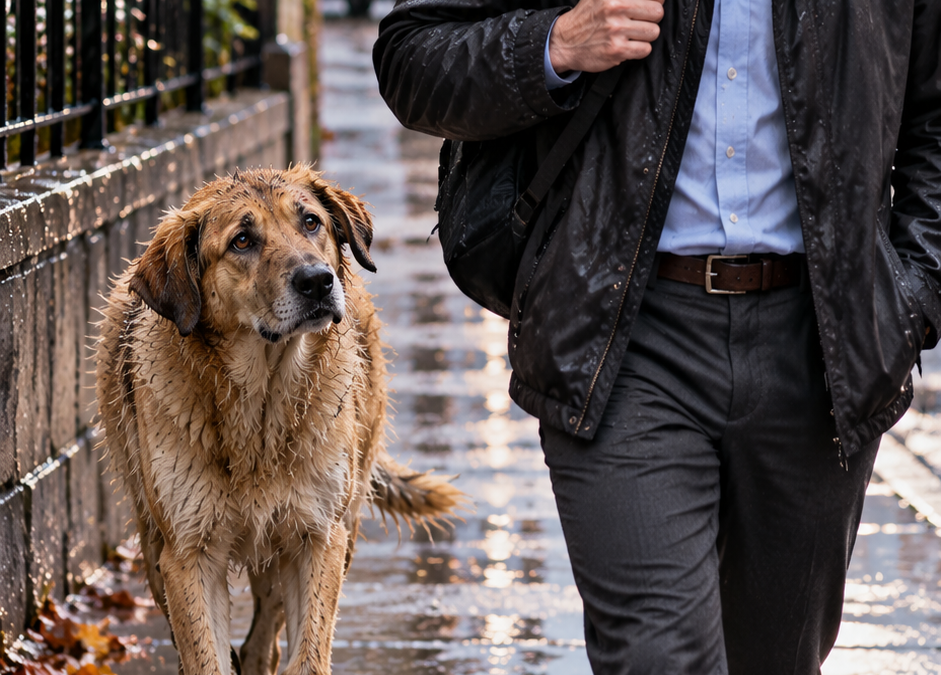
The dog rose before I reached the sidewalk.
“Seriously?”
His tail moved once.
Not a wag exactly.
Acknowledgment.
I began walking home.
Five or six paces behind me came the familiar sound of paws.
That evening I looked out my apartment window at eleven.
The dog was lying beneath the streetlight across from the building.
His head rested between his paws.
His face pointed toward my window.
I closed the curtain.
The next morning, he was sitting beside the steps again.
“You have got to be kidding me.”
He stood.
“No.”
I walked toward the opposite end of the block.
My office was east.
I went west.
The dog followed.
I turned north.
He followed.
I cut through a small parking lot.
He followed.
Finally I stopped beside a convenience store.
“All right.”
He stopped.
“What do you want?”
He tilted his head.
“Food?”
No reaction.
I went inside and bought a small package of cooked chicken.
When I came outside, the dog was sitting where I left him.
I opened the package.
Immediately his nose moved.
“Okay. Now we’re getting somewhere.”
I tossed a piece toward a grassy area in the opposite direction.
He ran after it.
“Good.”
I walked quickly away.
Thirty seconds later, his paws were behind me again.
“You cannot be serious.”
He had eaten the chicken and returned.
I threw another piece farther.
Same result.
Food.
Return.
Food.
Return.
Eventually I gave him the rest of the package.
He ate.
Then followed me to work.
The pattern repeated on Wednesday.
Then Thursday.
Every morning, he appeared outside my building.
Every day, he followed me to work.
Every evening, he followed me home.
He never entered the building.
Never tried to force his way inside.
Never barked unnecessarily.
He simply stayed near me.
At first, I tried everything.
Different routes.
Different departure times.
On Thursday I left forty-five minutes earlier than usual.
He was there.
Friday, I waited until nearly nine.
He was there.
I took a bus one morning.
He chased it for three blocks before disappearing.
I felt strangely guilty.
Then when I got off near work, I found him waiting on the corner.
I still have no idea how he managed it.
My neighbor, Martha, found the entire situation hilarious.
She was seventy-two and considered other people’s privacy an inefficient social convention.
On Friday evening she was watering flowers outside when I returned.
The dog followed behind me.
Martha looked at him.
Then at me.
“You should name him.”
“He’s not mine.”
“He disagrees.”
“He is a stray.”
“So were three of my husbands.”
I stared at her.
She smiled.
“Eventually somebody lets them inside.”
“I’m not letting him inside.”
The dog sat beside the curb.
Martha leaned toward him.
“Don’t worry. He’s emotionally constipated.”
“Martha.”
“What?”
“Have you seen this dog before?”
Her humor faded.
“No.”
“Anywhere?”
“No.”
“Does he belong to somebody nearby?”
“Not that I know.”
I looked at him.
“Then why me?”
Martha shrugged.
“Maybe you look lonely.”
“I’m not lonely.”
She raised an eyebrow.
“Daniel, you talk to your microwave.”
“It beeps at me first.”
Martha laughed.
Then she became serious.
“He doesn’t look hungry.”
“No.”
“He looks like he’s waiting.”
“For what?”
“That’s the interesting question.”
That night, I looked out the window again.
Streetlight.
Sidewalk.
Dog.
Same position.
Watching.
I began feeling something I did not want to admit.
Safe.
That was ridiculous.
I had lived alone for years.
Never had a problem.
Never needed protection.
Yet when I turned off the lights that night, I knew there was a large dog outside.
For reasons I did not understand, that knowledge comforted me.
By Saturday, I had stopped trying to chase him away.
I went grocery shopping.
He followed.
I stopped at a coffee shop.
He waited outside.
I went to the park.
He followed me through every path.
At one point, I sat on a bench and finally allowed him to approach.
“Come here.”
He remained standing twenty feet away.
I tapped the bench.
“After following me for six days, now you’re shy?”
He took one step.
Then another.
Slowly.
Cautiously.
Finally he reached me.
I extended my hand.
He sniffed.
Warm breath against my fingers.
Then he allowed me to touch the top of his head.
His fur was rough.
“You’ve been through something.”
He looked up.
There was an intelligence in his expression that made me uncomfortable.
Not human intelligence.
Something simpler.
More immediate.
He watched movement.
Smell.
Tone.
Tension.
Things people ignore because we are too busy explaining everything.
“You have a name?”
His ears moved.
“Of course not.”
I examined him for a collar mark.
Nothing.
No obvious wounds.
No tags.
“You understand I cannot keep you.”
His tail moved.
“That wasn’t approval.”
He leaned his shoulder against my leg.
I sighed.
“You’re manipulative.”
The next morning was Sunday.
Day seven.
And that was when everything changed.
I had gone into the office for a few hours because month-end reports were due.
The dog followed me as usual.
By then, even the security guard recognized him.
“Your bodyguard’s back.”
“Not mine.”
“That dog has spent more time outside this building than some employees spend inside.”
At around four thirty, I packed my laptop and left.
The dog rose from his usual spot.
The afternoon was cooler than the previous days.
The streets were relatively quiet.
I took my usual route.
Two blocks from home, I felt something strange.
Not fear.
Awareness.
The sense that someone was watching.
I looked behind me.
The dog was there.
Beyond him, parked about three buildings away, was a black sedan.
Unmarked.
Dark windows.
Engine running.
Nothing unusual by itself.
I turned around and continued.
At the next intersection, I crossed.
The sedan pulled out.
Slowly.
I looked back again.
The dog had stopped.
His attention was fixed entirely on the car.
His body had changed.
Head lower.
Ears forward.
Tail still.
I took another ten steps.
The sedan moved.
I stopped.
It stopped.
A cold sensation moved down my spine.
The dog looked at me.
Then at the sedan.
Then back at me.
For six days, I had never seen him behave that way.
I started walking faster.
The sedan followed.
Not close.
Careful.
That made it worse.
Maybe I was imagining things.
Maybe it belonged to somebody who lived nearby.
Maybe—
The dog suddenly passed me.
For the first time all week, he moved ahead.
He reached a narrow alley between two brick buildings and stopped.
Looked back.
Then ran into it.
I stared.
“This is insane.”
The black sedan moved closer.
I followed the dog.
Halfway into the alley, he waited.
“Where are you going?”
He ran again.
I followed.
We turned left behind a row of garages.
Then right.
Then through another narrow passage.
My heart pounded.
I was running after a stray dog because I believed a black car was following me.
If anybody had described that situation to me a week earlier, I would have recommended professional help.
The dog stopped near a high brick wall at the end of another alley.
I bent forward, hands on my knees, trying to breathe.
“Great.”
He stood facing the direction we had come from.
Then I heard it.
A low growl.
I had never heard him growl before.
Not at pedestrians.
Not at bicycles.
Not at other dogs.
This was different.
Deep.
Controlled.
Warning.
The dog moved closer to me without turning around.
His body placed itself slightly between me and the alley entrance.
“What do you see?”
His growl deepened.
Then I heard an engine.
The black sedan appeared.
Slowly.
It stopped at the entrance.
My stomach dropped.
The driver’s door opened.
Then the passenger door.
Two men stepped out.
Both wore plain clothes.
One older.
Late forties, maybe early fifties.
The other younger.
Both moved with the unmistakable confidence of people accustomed to approaching strangers who did not want to be approached.
The older man held up a badge.
“Daniel Carter?”
I stared.
“Yes.”
“Detective Michael Reynolds. City Police.”
My fear changed shape.
It did not disappear.
“You’ve been following me?”
“We need to speak with you.”
The dog growled.
Reynolds stopped.
“Is that your dog?”
“No.”
He glanced toward his partner.
Then back at me.
“He appears to disagree.”
“He’s been following me all week.”
The younger officer took one step forward.
The dog moved immediately.
Not lunging.
Not barking.
He simply stepped between us.
Broad chest.
Head low.
“Easy,” I said.
The dog stayed.
Reynolds raised one hand.
“We’re not here to hurt you.”
“What are you here for?”
The detective studied me.
“There was a theft last Monday at the Riverside Shopping Center.”
I waited.
“A high-value shipment was stolen from a jewelry retailer before opening hours.”
“What does that have to do with me?”
“A case containing luxury watches disappeared.”
“I don’t know anything about watches.”
“We have security footage.”
“So?”
Reynolds’s expression hardened.
“The person in the footage matches your approximate height and build.”
I laughed.
Not because it was funny.
Because the accusation was so absurd that my brain did not know what else to do.
“You followed me because I’m the same size as somebody?”
“There’s more.”
“What?”
“You were identified as a possible suspect.”
“By who?”
“I’m not going to discuss the entire investigation in an alley.”
My mouth went dry.
“I’m an accountant.”
“We know.”
“I was at work Monday.”
“We’re verifying that.”
“Why didn’t you just ask me?”
“We wanted to observe your routine first.”
“So you followed me for three days?”
“Yes.”
The dog turned his head toward me.
Three days.
I looked down at him.
He had been following me six.
“You noticed the car,” I whispered.
Reynolds frowned.
“What?”
I shook my head.
“Nothing.”
“We’d like you to come with us to answer some questions.”
“Am I under arrest?”
“No.”
“Then why should I?”
“You don’t have to.”
The younger detective shifted.
The dog immediately moved again.
Reynolds looked at him.
“Interesting.”
“What?”
“That dog.”
“He’s a stray.”
“You said that.”
“He’s not evidence.”
“I didn’t say he was.”
Reynolds crouched slightly.
The dog did not retreat.
“I’ve worked around police dogs for twenty years,” he said.
“And?”
“Animals notice tension before people do.”
I looked at him.
The original story I would later tell people often got simplified into something foolish: that Reynolds believed dogs somehow knew who was innocent.
He never actually said that.
What he said was more measured.
“Whatever this dog thinks is happening,” Reynolds continued, “he clearly thinks you need protecting.”
The dog stood firm.
I looked down at him.
Six days.
Rain.
Work.
Home.
Streetlight.
Every night.
I swallowed.
“I’ll come to the station.”
Reynolds nodded.
“We can drive you.”
“I’ll walk.”
“It’s several blocks.”
“I know.”
The dog turned toward me.
“If I get in your car, he may follow and get hit.”
Reynolds almost smiled.
“Fair point.”
So I walked to the police station with two detectives and a stray dog.
It was one of the strangest walks of my life.
The dog remained directly beside me now.
No longer five paces behind.
At the station entrance, an officer tried to stop him.
“No dogs.”
“He’s not mine.”
“That doesn’t improve the situation.”
Reynolds looked at the dog.
Then at me.
“Leave him outside.”
I crouched.
“Stay.”
The dog stared.
“I’ll come back.”
His eyes remained fixed on mine.
“Promise.”
I entered.
Through the glass doors, I looked back.
He sat.
Exactly where I had left him.
The interview lasted nearly two hours.
Detective Reynolds sat across from me.
His partner, Detective Alvarez, handled most of the questions.
“Where were you Monday between six and eight in the morning?”
“At work.”
“You start that early?”
“Month-end closing.”
“What time did you arrive?”
“Six fifteen. Maybe six twenty.”
“Who saw you?”
“Security guard. Melissa Grant. My supervisor arrived around seven.”
“Did you leave?”
“No.”
“Parking records?”
“I walked.”
“Computer login?”
“Yes.”
“Security cameras?”
“Yes.”
Reynolds made a note.
“What were you wearing?”
I frowned.
“Monday?”
“Yes.”
“Blue shirt. Gray pants. Probably my black coat.”
“Hat?”
“No.”
“You own a black knit cap?”
“I own three.”
Alvarez leaned forward.
“Black jacket?”
“Yes.”
“Dark jeans?”
“Yes.”
“So do approximately half the men in the state.”
Reynolds glanced at his partner.
I appreciated that.
“What exactly does the footage show?” I asked.
“A man leaving the rear service corridor carrying a case.”
“Face?”
“Partial.”
“Is it me?”
Reynolds paused.
“We’re trying to determine that.”
“That means no.”
“It means the image quality is limited.”
I leaned back.
“Who gave you my name?”
Reynolds did not answer.
“Detective.”
“A person familiar with the area said the figure resembled you.”
“Who?”
“We’re not there yet.”
I laughed bitterly.
“You’re following me in an unmarked car, pulling me into alleys, but we’re not there yet?”
“No one pulled you anywhere.”
“Fine. Followed.”
Reynolds folded his hands.
“Mr. Carter, I understand you’re upset.”
“No, you don’t.”
My voice rose.
“I’ve never been arrested. Never stolen anything. I don’t even have a parking ticket.”
“That doesn’t eliminate you.”
“And my entire life doesn’t matter because somebody looks like me on bad video?”
“It matters.”
“Doesn’t feel like it.”
Reynolds remained calm.
“Then help us eliminate you.”
I took a breath.
“Check my office.”
“We will.”
“Check the cameras.”
“We will.”
“Check my computer.”
“We will.”
“Ask everyone.”
“We will.”
“Then why am I here?”
“Because sometimes innocent people still have to answer questions.”
That sentence stayed with me.
Not because it was comforting.
Because it was true.
And because truth can still feel deeply unfair.
When I finally left the station, it was dark.
The dog was still there.
The second the doors opened, he stood.
His entire body changed.
Tail moving.
Head up.
He circled me once.
Then twice.
Sniffed my legs.
My hands.
My coat.
As if checking for damage.
I crouched.
“You stayed.”
He pressed his head against my chest.
For the first time, I wrapped both arms around him.
“I’m okay.”
His body relaxed.
“You knew something was wrong, didn’t you?”
His tail moved.
I laughed quietly.
“All right. You win.”
That night, I let him inside.
Martha saw us from her doorway.
“Well.”
“Don’t.”
“I said nothing.”
“You’re smiling.”
“Because I’m gracious in victory.”
“He’s staying one night.”
“Of course.”
“One.”
“What are you calling him?”
“I’m not.”
The dog walked past me into my apartment.
Martha nodded.
“Seems he has plans.”
I closed the door.
The dog explored carefully.
Kitchen.
Living room.
Bedroom.
He sniffed every corner.
Then returned to the front door and lay down directly against it.
“You’re guarding it?”
He rested his head on his paws.
“I have locks.”
Nothing.
“Very expensive locks.”
His eyes closed.
I sighed.
“Fine.”
The next morning, I bought dog food.
One night became two.
Two became a week.
I still told myself he was temporary.
But now I had more urgent problems.
Detective Reynolds called Tuesday afternoon.
“We confirmed your office entry at 6:18 Monday morning.”
I closed my eyes.
“Good.”
“Your computer was active continuously.”
“Yes.”
“Security footage shows you inside the building.”
“So I’m done?”
“Not yet.”
My stomach dropped.
“Why?”
“The theft window may be slightly earlier than initially reported.”
“How much earlier?”
“We’re reviewing it.”
I stood beside my desk, unable to sit.
“Detective, how long is this going to continue?”
“I don’t know.”
That was the hardest answer.
Not guilty.
Not innocent.
Not cleared.
Just uncertainty.
My employer heard about the investigation.
Of course they did.
Police asking questions in an accounting office is not subtle.
My supervisor, Robert, called me into his office.
“I believe you,” he said.
I stared at him.
“Then why do you look terrified?”
“Because the company has to protect itself.”
“From what?”
“If there’s an ongoing theft investigation—”
“I didn’t steal anything.”
“I know.”
“Do you?”
Robert removed his glasses.
“Daniel.”
I hated the way he said my name.
Softly.
Carefully.
The way people speak before disappointing you.
“We’re putting you on paid administrative leave until this is resolved.”
I felt as though the floor moved.
“You’re suspending me.”
“No.”
“Paid leave is suspension with nicer furniture.”
“It’s temporary.”
I stood.
“Right.”
When I returned home at two in the afternoon, the dog was waiting by the door.
I sat on the floor without removing my coat.
He approached.
Placed his head on my shoulder.
For nearly an hour, we stayed there.
I had spent years insisting I was not lonely.
That afternoon, I understood the difference between being alone and having nobody beside you when your life suddenly becomes uncertain.
The dog was beside me.
That mattered.
The next morning, I called an attorney.
Jennifer Collins.
A friend of a friend had recommended her.
She was sharp, direct, and allergic to wasted words.
The first thing she asked was, “Have you spoken to police without counsel?”
“Yes.”
“How much?”
“Two hours.”
She stared at me.
“That was unwise.”
“I’m innocent.”
“That has never been a substitute for legal representation.”
I liked her immediately.
I told her everything.
The theft.
The surveillance.
The unidentified witness.
The black sedan.
Even the dog.
When I mentioned him, she stopped writing.
“A stray followed you for six days?”
“Yes.”
“And was present when detectives approached?”
“Yes.”
Jennifer looked toward the living room.
The dog was lying near the doorway.
“He’s still here.”
“Apparently.”
“What’s his name?”
“He doesn’t have one.”
She looked at me as though this was the most irresponsible fact I had shared.
“You are under police scrutiny and living with an unidentified animal.”
“He’s less stressful than the police.”
“Low bar.”
She walked over.
The dog raised his head.
Jennifer held out her hand.
He sniffed.
Allowed one touch.
Then went back to sleep.
“He trusts you.”
“I think so.”
Jennifer returned to the table.
“Good. Now let’s deal with the humans.”
She worked relentlessly.
My office footage was obtained.
Time logs.
Computer access records.
Emails.
Security badge records.
Phone location data.
Receipts.
Anything that could establish where I was.
The original theft had occurred at approximately 6:50 in the morning.
I had entered my office at 6:18.
The office was nearly a mile and a half away.
That should have been enough.
It wasn’t.
Police discovered the retailer’s alarm had been disabled earlier.
Maybe the thief entered before six.
Maybe he left and returned.
The timeline shifted.
Every time one fact helped me, another question appeared.
That was when fear truly began.
Not because the evidence was strong.
Because uncertainty itself had power.
People think innocence feels solid.
It doesn’t when everyone around you is still deciding whether they believe it.
Wednesday, another interview.
Jennifer sat beside me.
Reynolds asked questions.
“Did you know anyone employed at Riverside Jewelers?”
“No.”
“Ever service their accounting?”
“No.”
“Know their delivery schedule?”
“No.”
“Gamble?”
“No.”
“Financial trouble?”
“Normal financial trouble.”
“What does that mean?”
“Mortgage. Car repair. Life.”
Jennifer interrupted.
“His finances are documented.”
Reynolds nodded.
“I’ve seen them.”
“Then stop suggesting motive where none exists.”
“I’m asking questions.”
“And he’s answering.”
The dog was not allowed inside the interview room.
He waited at the station entrance again.
When we left, he rose immediately.
Jennifer watched him circle me.
“You were right.”
“About what?”
“He checks you.”
“I know.”
“He’s not just excited.”
“No.”
She crouched.
The dog sniffed her hand.
“He expects something bad to happen.”
I looked at him.
“Maybe something did.”
Jennifer glanced at me.
“To him?”
“Before me.”
We did not yet know.
The investigation lasted nearly two weeks.
Those fourteen days changed the way I looked at ordinary life.
My phone ringing made my stomach tighten.
Cars slowing near the building made me look out the window.
I began noticing strangers.
License plates.
Cameras.
People standing too long at corners.
Once suspicion enters your life, it contaminates everything.
The dog noticed my anxiety.
If I paced, he followed.
If I woke during the night, he lifted his head.
If someone knocked unexpectedly, he stood between me and the door.
Martha eventually said, “You named him yet?”
“No.”
“You feed him.”
“Yes.”
“He sleeps inside.”
“Yes.”
“You bought him a bed.”
“He wasn’t comfortable on the floor.”
“You took him to a veterinarian.”
“He needed shots.”
“You paid four hundred dollars.”
“He had an ear infection.”
Martha smiled.
“Definitely not your dog.”
“Exactly.”
She shook her head.
“You are exhausting.”
Then Jennifer called.
“Come to my office.”
Her tone was different.
I arrived thirty minutes later.
The dog came with me.
Jennifer had several still images spread across her desk.
“Sit.”
I did.
“What happened?”
“We got additional footage.”
My heart raced.
“From where?”
“A delivery entrance across the service road.”
She slid one image toward me.
A man in a black knit cap.
Dark jacket.
Same general height as me.
Same build.
From behind, he could have been my brother.
Maybe even me.
“That’s why they suspected you.”
“Yes.”
Jennifer placed another photograph beside it.
Different angle.
The man’s face partially visible.
My breath stopped.
“That’s not me.”
“No.”
I leaned closer.
Different nose.
Different jaw.
A scar near the mouth.
“Jesus.”
Jennifer smiled for the first time in days.
“It gets better.”
Another image.
The thief stepping into a vehicle.
License plate partially visible.
“Police traced the car.”
“To who?”
“They’re working on it.”
“So I’m cleared?”
“Almost.”
I hated that word.
“Almost.”
“Daniel, this is good.”
“I’ve had two weeks of good evidence that apparently isn’t good enough.”
Jennifer sat across from me.
“I know.”
“No, you don’t.”
She did not argue.
I rubbed my face.
“I lost work.”
“Temporarily.”
“Neighbors know.”
“People gossip.”
“My mother thinks I’m hiding something because I haven’t told her everything.”
“You should probably call your mother.”
“I know.”
“And you need patience.”
I laughed bitterly.
“I’m out.”
The dog stood.
Walked over.
Rested his chin on my knee.
Jennifer watched.
“He does that every time you’re upset?”
“Pretty much.”
She smiled.
“You really need to name him.”
“I’ll name him when this is over.”
“Why?”
I looked down.
“Because I don’t want to attach something permanent to a life that feels temporary.”
Jennifer’s expression changed.
“Your life is not temporary.”
“It doesn’t feel like mine.”
She became quiet.
Then said, “Maybe that’s exactly why you should name him.”
Three days later, Detective Reynolds called.
“We found the man.”
I stood so quickly my chair fell backward.
“What?”
“His name is Eric Nolan.”
“Who is he?”
“Prior theft conviction. Similar height and build.”
“The person who identified me?”
“Was mistaken.”
“Who was it?”
“A security contractor who had seen you in the area before.”
I closed my eyes.
My office route passed Riverside.
That was all.
A man had seen me walking nearby.
Then watched poor-quality video.
Then connected two unrelated facts.
My life had nearly been rewritten because someone thought I looked familiar.
“Is Nolan charged?”
“Investigation is ongoing, but we recovered evidence linking him to the theft.”
“What kind?”
“I can’t discuss everything.”
I laughed.
“Of course.”
“Daniel.”
“Yes?”
“You should hear from the prosecutor soon.”
“About what?”
“Closing your involvement.”
I sat down slowly.
The dog approached.
“What does that mean?”
“It means you’re being cleared.”
I covered my eyes.
For several seconds, I said nothing.
Then Reynolds added, “For what it’s worth, I’m sorry.”
I lowered my hand.
“You were doing your job.”
“Yes.”
“That doesn’t mean I enjoyed being part of it.”
“I understand.”
I looked at the dog.
“He still hates your car.”
Reynolds laughed.
“That makes two of us.”
The final court hearing was brief.
Technically, the process was less dramatic than people later imagined.
There was no jury.
No sweeping speech.
No last-minute witness.
The prosecutor formally acknowledged the exculpatory evidence and confirmed that I was no longer considered a suspect.
My attorney presented my documented alibi.
The newer surveillance images.
The distinction between me and the actual offender.
The judge reviewed everything.
I sat beside Jennifer.
The dog rested near my feet.
He had been allowed inside after Jennifer made several calls and convinced someone he was effectively an emotional support presence, though not formally certified as anything.
“He is remarkably calm,” the bailiff whispered.
“He has more courtroom discipline than some attorneys,” Jennifer replied.
I almost laughed.
The judge looked down from the bench.
“Mr. Carter.”
I stood.
My legs felt weak.
“The updated evidence substantially undermines the original suspicion directed toward you.”
I listened.
Every word felt slower than normal.
“The record reflects corroborated evidence that you were at your place of employment during the relevant period, as well as newly obtained surveillance footage inconsistent with your identification as the individual involved.”
Jennifer touched my arm.
The judge continued.
“The state has represented that it does not intend to pursue any charge against you related to this matter.”
I exhaled.
Not a dramatic gasp.
Just air leaving a body that had apparently been holding it for two weeks.
“Accordingly, this matter is concluded as to Mr. Carter.”
The dog lifted his head.
Then barked once.
One sharp bark.
The courtroom went silent.
The judge looked at him.
Jennifer pressed her lips together.
I stared down.
“Seriously?”
The judge smiled.
“Well.”
A few people laughed.
Even Reynolds, sitting near the back, lowered his head with a grin.
The judge looked at the dog.
“I’ll consider that concurrence.”
The room laughed harder.
I crouched.
The dog pressed his face against mine.
“We’re done,” I whispered.
His tail struck the floor.
“We’re done.”
Outside the courthouse, reporters waited.
Not many.
My case had attracted some local attention because of the mistaken identification.
One reporter asked, “Mr. Carter, what do you think caused the police to focus on you?”
“Bad video. Mistaken identification.”
“Are you angry?”
I looked at Reynolds standing farther away.
“I’m relieved.”
“Will you sue?”
Jennifer’s head turned immediately toward me.
“Not discussing that.”
Good lawyer.
Then someone pointed toward the dog.
“What’s his name?”
I froze.
Jennifer looked at me.
Martha’s voice seemed to appear inside my head.
Name him.
The dog stared up at me.
Six days of following.
Three nights of police surveillance he noticed before I did.
Hours outside a station.
Two weeks sleeping beside my door.
I placed my hand on his head.
“Hope.”
The reporter frowned.
“Hope?”
“Yes.”
Jennifer smiled.
It was the first time I had said the name.
It fit immediately.
Hope.
Not because he magically proved I was innocent.
He didn’t.
Not because he understood criminal investigations.
He didn’t.
But because every time I walked outside during the worst two weeks of my life, he was there.
And sometimes hope is nothing more complicated than discovering you do not have to face the next block alone.
When we returned home, Martha was waiting.
She saw the reporters’ car leave.
Then saw the dog.
“Everything finished?”
“Yes.”
“You’re cleared?”
“Yes.”
She hugged me before I could stop her.
Then stepped back.
“What’s the dog’s name?”
“Hope.”
Her eyes softened.
“Oh.”
“Don’t.”
“I didn’t say anything.”
“You’re about to.”
“No.”
She wiped one eye.
“You’re crying.”
“Allergies.”
“In October?”
“Very aggressive pollen.”
Hope approached her.
For the first time, he allowed Martha to touch his head without backing away.
She smiled.
“Welcome home, Hope.”
The words landed unexpectedly hard.
Home.
That evening, I removed the temporary blanket from the floor beside my bedroom and replaced it with the dog bed I had already secretly purchased.
Hope sniffed it.
Then jumped onto my bed.
“No.”
He turned in a circle.
“Absolutely not.”
He lay down.
“Hope.”
Eyes closed.
“You have a bed.”
Nothing.
“I paid seventy dollars.”
Snoring.
I laughed.
For the first time in weeks, I laughed without immediately remembering that something terrible was happening.
Because it wasn’t.
The investigation was over.
My employer called the next morning.
Robert apologized.
“You understand why we had to be cautious.”
“Yes.”
“You can return Monday.”
I looked at Hope.
“Tuesday.”
Robert paused.
“Why Tuesday?”
“I have something to do Monday.”
That something was finding out who Hope had belonged to.
The veterinarian had scanned him during our earlier visit.
No microchip.
No collar.
No obvious identifying information.
I printed photographs.
Called shelters.
Posted notices.
Asked neighbors.
For almost three weeks, nothing.
Then an older woman named Elaine contacted me.
“I think I know that dog.”
We met at a small coffee shop.
Hope came.
The moment he saw Elaine, he stood.
His tail moved cautiously.
She began crying.
“Oh, sweetheart.”
Hope approached.
Not with the wild excitement he showed me.
Something gentler.
Recognition.
Elaine knelt.
“You remember me.”
She stroked his face.
I waited.
“Who is he?”
Elaine looked at me.
“His name used to be Buddy.”
Hope’s ears lifted.
Buddy.
I tried it.
“Buddy?”
He looked at Elaine.
Then at me.
Interesting.
“Who owned him?”
“My neighbor.”
She sat.
“Walter Greene.”
“Where is Walter?”
Her expression answered before her words did.
“He died.”
I looked at Hope.
“When?”
“About three months ago.”
That explained the wandering.
Maybe even the following.
“Was there family?”
“A nephew in another state.”
“Why didn’t he take the dog?”
“He tried to arrange something, but Buddy ran away before they could.”
Elaine wiped her eyes.
“Walter adored that dog.”
“How long did they have each other?”
“Eight years.”
I looked at Hope.
He lay at my feet now.
“Do you know how Walter died?”
“At home.”
“Was Hope there?”
“Yes.”
Another loss.
Another person gone.
Hope had lost his entire world.
Then wandered.
Neighborhood to neighborhood.
Until one Monday morning he sat outside my building.
“Why do you think he followed me?”
Elaine studied me.
“I don’t know.”
“I thought maybe I looked like Walter.”
“No.”
“Smelled familiar?”
“Maybe.”
She smiled sadly.
“But Walter used to say Buddy chose people.”
“What does that mean?”
“If someone was upset, he knew.”
I looked down.
“When Walter’s wife died, Buddy slept beside the front door for weeks.”
Elaine continued.
“When Walter became sick, that dog barely left him.”
My throat tightened.
“He watches people.”
“Yes.”
“Especially if something is wrong.”
“Yes.”
I thought about the black sedan.
Hope’s growl.
The way he led me into the alley.
He probably did not understand police.
He did not understand suspicion.
Maybe he simply sensed my anxiety before I consciously did.
Maybe he saw the same car repeatedly.
Maybe the detectives’ attention felt threatening.
Dogs build worlds from patterns humans ignore.
The truth did not need to be supernatural.
It was remarkable enough.
Elaine reached across the table.
“Are you keeping him?”
I looked at Hope.
“Unless somebody has a stronger claim.”
“The nephew?”
“He should decide.”
Elaine contacted him.
His name was Andrew.
We spoke by phone.
He told me about Walter.
Retired mechanic.
Widower.
Quiet man.
Loved baseball.
Loved terrible coffee.
Loved Hope—Buddy—more than almost anything.
“I wanted him,” Andrew said.
“Why didn’t you take him immediately?”
“I live twelve hours away. Apartment had restrictions. I was trying to arrange transportation.”
His voice tightened.
“Then he disappeared.”
“I’m sorry.”
“Did you find him in bad shape?”
“No.”
“Is he okay?”
“Yes.”
“Happy?”
I looked at Hope asleep beside my chair.
“Yes.”
Long silence.
Then Andrew said, “Keep him.”
“You’re sure?”
“My uncle would want that.”
“What about the name?”
“What did you call him?”
“Hope.”
Andrew laughed softly.
“That sounds like something Walter would hate.”
I smiled.
“Why?”
“He thought emotional names were ridiculous.”
“What did he call him?”
“Buddy.”
“Not exactly imaginative.”
“Exactly.”
We both laughed.
Then Andrew’s voice changed.
“But maybe Hope is better.”
“I can keep Buddy too.”
“No.”
Pause.
“He already had that life.”
I understood.
“Let him have the new name.”
So Hope stayed.
Not because he had saved me from prison.
That became the version people liked.
The dramatic version.
A stray dog senses innocent man is in danger and exposes police mistake.
It made a better story.
Reality was more complicated.
Hope did not prove anything.
Jennifer did.
Security footage did.
Badge records did.
Phone records did.
Careful police work eventually did.
The detectives corrected their theory when better evidence appeared.
That mattered too.
What Hope gave me was different.
He noticed I was being watched before I did.
He responded to danger before I understood its source.
And when my life became frightening and unstable, he stayed.
That was not evidence.
It was companionship.
Sometimes companionship saves a person in quieter ways.
I returned to work.
The first morning, Hope followed me.
Of course.
At the entrance, I stopped.
“You cannot sit here all day anymore.”
He stared.
Melissa came outside.
“Hope!”
She crouched.
This time he allowed her to pet him.
“Traitor,” I said.
Melissa looked at me.
“You could bring him to the office.”
“No.”
Twenty minutes later, Robert approved a temporary arrangement.
By noon, Hope was asleep under my desk.
By Friday, he had become more popular than I was.
People brought treats.
Security guards greeted him.
Employees from departments I had never spoken to stopped by.
Hope had spent months wandering because his person died.
Then he walked into an office full of strangers and somehow belonged.
Maybe dogs understand something humans complicate.
Belonging does not always require history.
Sometimes presence is enough.
Months passed.
Hope stopped sleeping against the front door.
At first, he guarded it every night.
Then gradually he moved closer to the bedroom.
Eventually he chose the space beside my bed.
Some nights he dreamed.
His paws moved.
Quiet sounds came from his throat.
I wondered whether he dreamed of Walter.
Maybe.
I hoped so.
Memory is painful, but forgetting is not always kindness.
One Saturday morning, I took Hope to visit Walter’s grave.
Elaine came.
I felt slightly foolish.
Hope was a dog.
A cemetery meant nothing to him.
Or so I thought.
We walked between the rows.
Elaine stopped.
“There.”
A simple stone.
Walter Greene.
Hope stopped too.
He sniffed.
Not the stone.
The ground.
The grass.
The flowers Elaine had placed.
He walked a slow circle.
Then sat.
I stood beside him.
Elaine began crying.
“He used to sit exactly like that next to Walter’s chair.”
I placed my hand on Hope’s head.
For several minutes, none of us spoke.
Eventually Hope stood.
Walked back toward me.
Pressed his shoulder against my leg.
I looked at Walter’s name.
“Thank you,” I whispered.
Elaine heard.
“For what?”
“For him.”
She smiled.
“He probably thinks he found you himself.”
“Maybe he did.”
On the drive home, Hope sat in the passenger seat.
No restraint could keep him in the back anymore.
At a red light, he looked at me.
“What?”
His tail moved.
“You picked me?”
Another movement.
“I had no say?”
He leaned over and licked my cheek.
“Disgusting.”
He did it again.
“Fine.”
I scratched his neck.
“You picked me.”
The false accusation faded from public interest quickly.
That is how these things work.
For two weeks, everyone wanted details.
Then another story came along.
Eric Nolan was eventually charged.
The stolen watches were recovered through a fence who cooperated with police.
His clothing matched the footage.
The vehicle matched.
Evidence linked him to the service corridor.
My involvement disappeared into a corrected case file.
But the experience remained in me.
Sometimes when a black sedan slowed near my building, my pulse still jumped.
Sometimes a police car behind me made my shoulders tighten.
Not because I hated police.
I didn’t.
Because being innocent had not protected me from being afraid.
Hope noticed every time.
He would look up.
Move closer.
Wait.
Never dramatic.
Just present.
Detective Reynolds visited once.
Not officially.
He stopped by my office carrying coffee.
Hope saw him through the glass and stood.
Reynolds laughed.
“He remembers me.”
“Yes.”
“Still hates me?”
“He has standards.”
Reynolds crouched.
Hope approached.
Sniffed.
Then allowed him to scratch one ear.
“Progress.”
I sat on the edge of my desk.
“Why did you come?”
Reynolds stood.
“To say something I probably should have said better.”
I waited.
“We got tunnel vision.”
That surprised me.
“You corrected it.”
“Yes.”
“But later than we should have.”
He looked through the office window.
“The original footage was bad. The witness gave us your name. You fit enough details that everything else started looking like confirmation.”
I understood exactly what he meant.
Once people believe a story, new facts often become servants to it.
“You followed me.”
“We did.”
“Hope noticed.”
“Yes.”
Reynolds looked at him.
“Maybe before you did.”
“I think so.”
He smiled.
“Good dog.”
Hope’s tail moved.
I laughed.
“You’ve been forgiven.”
“By him?”
“Don’t get ambitious.”
Reynolds left.
Hope watched through the window until he disappeared.
Then returned to his bed.
I thought about what Reynolds had said.
Tunnel vision.
How easily people can mistake resemblance for identity.
Suspicion for knowledge.
Coincidence for proof.
And how difficult it becomes to reverse direction once a theory feels complete.
I did not become bitter.
I did become less certain.
That may have been healthier.
Before Hope, I liked simple explanations.
Numbers.
Columns.
Balance sheets.
Things either matched or did not.
Afterward, I understood that human lives resist neat accounting.
A person can look guilty and be innocent.
A police officer can suspect you and still be decent.
A stray dog can follow you for reasons no one can ever fully prove.
Someone can lose one home and still choose another.
And loneliness can exist inside a life that looks perfectly organized.
That final truth was the one I resisted longest.
Martha had been right.
I had been lonely.
My apartment was clean.
My job stable.
My finances orderly.
My routine efficient.
And nobody waited for me.
Then Hope did.
First outside the building.
Then outside the office.
Then outside the police station.
Eventually, inside my home.
The first year anniversary of the day he appeared, I woke early.
Hope was already sitting beside the bed.
“Do you know what today is?”
He yawned.
“One year.”
Nothing.
“You ruined my life.”
Tail wag.
“I used to sleep late.”
Tail wag.
“I had clean furniture.”
More wagging.
“I did not spend money on premium dog food.”
He placed one paw on the mattress.
“No.”
Other paw.
“Absolutely not.”
He climbed up.
I sighed.
“One year ago I tried to get rid of you.”
Hope lay across my legs.
“Six days.”
His head settled on my stomach.
“You just kept coming back.”
I scratched his chest.
“Why?”
Hope closed his eyes.
I would never know.
Maybe he smelled food on my clothes.
Maybe I reminded him of Walter in some small way.
Maybe he was simply exhausted from wandering and chose the first person who did not frighten him.
Maybe he noticed the unmarked sedan and responded to my growing tension.
Maybe all of those things happened.
Maybe none.
People love reasons.
Dogs seem satisfied with relationships.
Over time, I became satisfied with that too.
He chose to stay.
So did I.
Years later, people still occasionally recognized us from the local article.
“You’re the man with the dog who proved you were innocent.”
I always corrected them.
“No.”
They looked disappointed.
“The dog didn’t prove anything.”
“But he protected you.”
“Yes.”
“He knew you were innocent.”
“I don’t know what he knew.”
This mattered to me.
Hope did not need magical powers for his loyalty to mean something.
He did not need to understand guilt.
He only needed to know I was frightened.
He only needed to decide not to leave.
That was enough.
More than enough.
One evening, long after the case ended, I sat on the same apartment steps where I had first seen him.
Hope lay beside me.
His muzzle had begun turning gray.
Martha came outside carrying trash.
She stopped.
“Look at you two.”
“What?”
“You finally admit he’s yours?”
I looked at Hope.
“He was never mine.”
Martha rolled her eyes.
“Here we go.”
I smiled.
“I think I’m his.”
She stared.
“That is disgusting.”
“You’re emotional.”
“I’m nauseous.”
Hope’s tail tapped the step.
Martha scratched his head.
“Good boy.”
Then she looked at me.
“He really did save you.”
I thought for a moment.
“Not from the police.”
“No?”
“No.”
Jennifer saved me from making legal mistakes.
My coworkers gave me an alibi.
The cameras showed the truth.
Police eventually found the right man.
Martha waited.
“Then from what?”
I looked through the open doorway of my apartment.
Dog bed.
Food bowl.
Leash hanging on the wall.
A life that had changed shape so gradually I had almost missed it.
“From thinking I didn’t need anyone.”
Martha became quiet.
Then nodded.
“That sounds more accurate.”
Hope stood and pressed against my knee.
The sun was disappearing behind the buildings.
A year earlier, he had slept under that streetlight.
Head between his paws.
Facing my apartment.
Waiting.
I had thought he was stubborn.
Then annoying.
Then strange.
Then frightening.
Then loyal.
Now I understood something else.
He had been lost too.
Walter had died.
Hope had no home.
No routine.
No person.
He wandered through neighborhoods carrying an instinct to stay close to someone, but no one belonged to him anymore.
Then he found me.
A man who had convinced himself that solitude was independence.
A man about to become the focus of an investigation he knew nothing about.
A man who would soon need someone waiting outside the door.
Neither of us understood that first morning.
Maybe that is why the best relationships sometimes begin without permission.
No plan.
No explanation.
Just presence repeated until it becomes trust.
The next morning, Hope followed me to work.
Not five paces behind.
Beside me.
He had done that ever since the day the detectives approached.
We reached the corner where I had first noticed the black sedan.
Hope slowed.
He still did that.
Every time.
He glanced toward the curb.
Then toward me.
I touched his head.
“All good.”
He moved again.
At the office entrance, he waited for me to open the door.
“You know,” I said, “the first week, I wouldn’t let you inside.”
He looked at me.
“Now they have your picture in the lobby.”
That was true.
Someone had printed a photograph of Hope beneath a handwritten sign:
EMPLOYEE OF THE MONTH.
He had never been employed.
He had nevertheless won twice.
We entered.
Melissa crouched immediately.
“Hope!”
He ran toward her.
“Again with the betrayal.”
She handed him a biscuit.
“Maybe if you were nicer.”
“I pay for his food.”
“Love cannot be purchased.”
“Apparently biscuits can.”
Hope ate.
Then came back to me.
Always.
He might greet everyone.
Accept treats.
Sleep beneath different desks.
But when I moved, he noticed.
When I left a room, he followed.
Not because he feared I would disappear anymore.
At least I hoped not.
It had become habit.
Companionship.
The ordinary kind.
The best kind.
Eventually, Hope grew old.
That happens too quickly.
One year his muzzle was sandy.
The next, white spread around his eyes.
He became slower on stairs.
Slept longer.
Needed medication for his joints.
I adjusted.
Shorter walks.
More rugs.
A ramp beside the bed that he ignored because he still preferred to be lifted.
“You weigh seventy pounds.”
Hope stared.
“You know this.”
Tail movement.
“You have no respect for my spine.”
He waited.
I lifted him.
Every time.
On difficult nights, I thought about Walter.
How he must have watched the same dog grow older.
How he must have wondered who would care for Hope after he was gone.
Maybe that question frightened him.
It would have frightened me.
One evening, I found the old photograph Elaine had given me.
Walter sitting in a chair.
Hope—Buddy then—beside him.
I placed it on the floor.
Hope sniffed it.
Then lay down.
His paw rested near the photograph.
I sat beside him.
“That was your first person.”
Hope sighed.
“He did a good job.”
I touched the edge of the photograph.
“I hope I did too.”
Hope shifted until his head rested across my leg.
I smiled.
“Still checking on me?”
His eyes closed.
Years earlier, I thought the most extraordinary thing about Hope was that he followed me for six days.
It wasn’t.
The extraordinary thing was that after everything he had already lost, he decided to trust another person.
Walter died.
Hope wandered.
People passed.
Then he sat outside my building and began again.
That required more courage than anything I did.
People praise humans for rescuing dogs.
Sometimes correctly.
We give them food.
Medical care.
Warmth.
Homes.
But we rarely give enough credit to what an abandoned or grieving dog risks when it attaches to someone new.
It risks loss again.
Hope knew loss.
He chose me anyway.
And when my own world became uncertain, he stayed close enough to remind me that suspicion was not identity.
Fear was not destiny.
And being watched was not the same as being alone.
I named him Hope because I needed a word for what he had given me.
Later I realized the name belonged to him even more.
Hope is not certainty that everything will work out.
I had confused those things before.
Hope is what remains when certainty disappears.
It is sitting outside an office all day because your person is inside.
It is waiting outside a police station because you do not know why he went in.
It is following him home after he tells you to leave.
It is sleeping beside his door until he finally lets you stay.
It is trying again after the person you loved before is gone.
On that first Monday morning, I thought I was looking at a stray dog.
I was wrong.
I was looking at an animal who had already lost one home and was deciding whether to build another.
On the seventh day, when that black sedan followed me and Hope stepped ahead for the first time, I believed he was leading me away from danger.
Maybe he was.
But the most important direction he ever led me was much quieter.
He led me out of a life where no one waited for me.
And I followed.
For six days, I tried to send him away.
For the rest of his life, I never did again.

