𝗙𝗨𝗟𝗟 𝗦𝗧𝗢𝗥𝗬 The Stranger Wearing My Aunt’s Apron Knew Exactly How Many Days She Had Left
𝗙𝗨𝗟𝗟 𝗦𝗧𝗢𝗥𝗬
She said absence as though four months spent working wildfire assignments had erased four generations of title.
Seven minutes later, Deputy Ben Alvarez pulled into the drive.
Ben was in his early fifties, compact, gray at the temples, and carried the exhausted caution of a deputy who had probably spent half his career arriving at houses where everyone insisted the law was obvious.
Dana met him before I reached the bottom porch step.
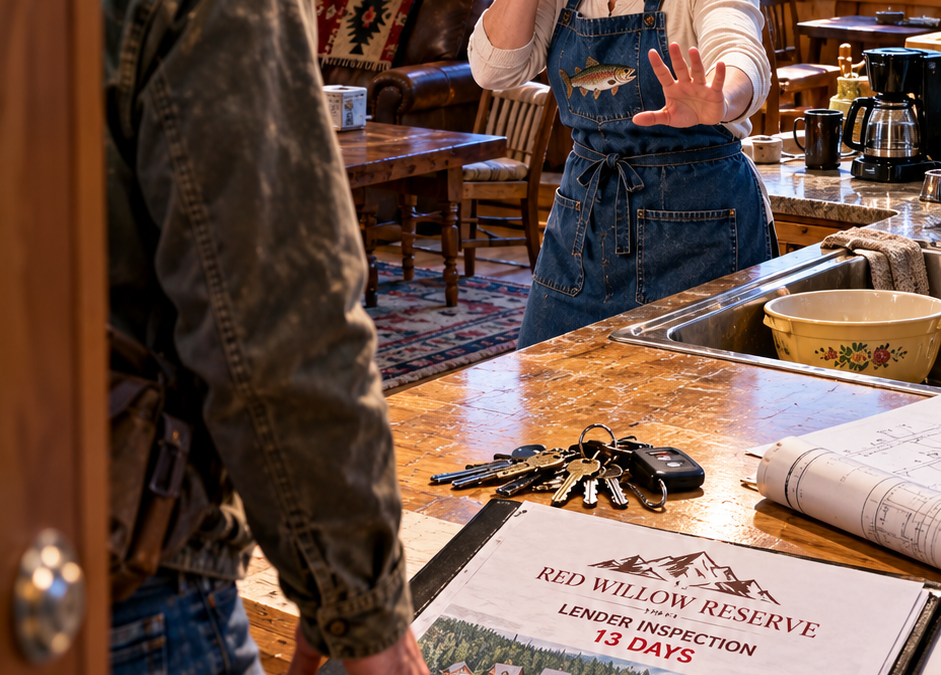
She had removed Ruth’s apron.
In its place, she wore a scarlet blazer over a white blouse.
The speed of that costume change told me something.
This part had been rehearsed.
“Deputy, thank you,” she said. “I was conducting an authorized property inspection when this man forced entry.”
“I used my key.”
Ben looked at the new deadbolt.
“You have a key to that?”
“No. Somebody changed it.”
Dana gestured toward the door.
“He entered anyway.”
“I unlocked the side entrance.”
Ben looked at me.
“Identification.”
I gave him my driver’s license.
Then I pulled up the county parcel record on my phone.
Dana opened the black binder.
She removed a notarized document.
TEMPORARY PROPERTY CARE AUTHORIZATION.
It supposedly gave Red Willow Shores HOA permission to enter, secure, inspect, and maintain the lodge during my seasonal absence.
Ben read it.
Then looked at me.
I took the paper.
The signature at the bottom was mine.
Not vaguely similar.
Not an imitation.
Mine.
The angle of the K.
The spacing.
The slight break where my electronic signature always looked uneven.
Ben compared the document to my license.
“Did you electronically sign this on April twenty-second?”
“No.”
Dana folded her arms.
“The association received the authorization through the county wildfire-compliance portal.”
That detail made me look at her differently.
In April, before leaving for New Mexico, I had submitted a defensible-space acknowledgment to the county.
It carried my electronic signature.
Somebody had not invented a fake version of my name.
Somebody had taken my real signature from a legitimate government filing.
Ben called dispatch.
County records confirmed the deed immediately.
Ownership was not in dispute.
The supposed authorization was harder.
Dana claimed it gave her current access rights.
I said it was forged.
A deputy standing on a porch could not determine digital document fraud in ten minutes.
Ben handled the situation correctly.
He did not arrest me because Dana called first.
He did not hand Dana my lodge because she carried a binder.
He separated us.
Photographed the documents.
Took statements.
Then turned to Dana.
“You’re leaving.”
Her composure finally shifted.
“The association has contractors scheduled.”
“Cancel them.”
“You don’t understand the safety deadline.”
Ben pointed toward her Lexus.
“You can explain the deadline through counsel.”
Dana gathered the binder.
As she passed me, she lowered her voice.
“Thirteen days, Mr. Kincaid.”
I looked at her.
“Thirteen days until what?”
Her expression did not move.
“After that, this becomes much more expensive for everyone.”
Then she drove away.
Inside the lodge, I began noticing things I had missed when I first walked through the door.
Fresh towels hung in the downstairs bathroom.
A compact printer sat on Ruth’s rolltop desk.
Extension cords had been run behind the dining room furniture.
A stack of Red Willow Shores stationery rested beside the phone.
My family photographs were gone from the mantel.
I found them in a cardboard box.
Face down.
Nothing had been damaged.
That mattered.
Dana had not come inside to vandalize the house.
She had come to replace its identity.
The glossy resort plan had disappeared with her binder.
One page remained under the dining table.
I picked it up.
It showed the lodge.
The shoreline.
The HOA common area to the north.
A red line wrapped around all of it.
RED WILLOW RESERVE — PHASE ONE.
At the bottom was the developer’s name.
SLOAN MOUNTAIN DEVELOPMENT.
I knew Graham Sloan by reputation.
He had built luxury communities near Jackson.
Another in Montana.
One resort project near Bozeman had collapsed after financing trouble.
For the past year, rumors had put him around Red Willow Lake.
Ruth had refused two meetings with him before she died.
I walked to the cabinet where she kept property records.
Deed.
Tax receipts.
Old surveys.
Forestry plans.
All there.
One folder was missing.
Dark green.
NORTH MEADOW LEASE.
That worried me more than the fake authorization.
The next morning, I drove forty miles to see Elena Park.
Elena had represented Ruth during the last years of her life.
She was a land-use attorney who believed patience was more effective than volume.
I put the temporary-care document in front of her.
Then my April wildfire filing.
She compared the signatures.
“Same image.”
“You’re sure?”
She enlarged them.
“See the break above the K?”
“Yes.”
“Identical.”
She pointed again.
“Same dimensions. Same artifact along the bottom edge.”
“They copied it.”
“They copied the image. We still need records showing who did what.”
I gave her the resort plan.
Elena studied it.
Her eyes stopped at the North Meadow.
“When does the HOA lease expire?”
“Ruth said sometime this fall.”
She opened her computer.
“Seventeen days.”
I stared at her.
Dana’s thirteen-day deadline suddenly felt much more significant.
Elena pulled a scanned copy of the 1996 lease from her archive.
My grandfather and Ruth had leased thirty-four acres to the newly formed Red Willow Shores Association.
The purpose was limited.
Community clubhouse.
Resident boat launch.
Tennis courts.
Walking trails.
Seasonal emergency access.
Rent had been intentionally modest.
Ruth believed the lake should not become a private fortress.
But the lease was precise about what could not happen.
No hotel.
No public marina.
No transfer of land rights to a commercial developer.
No mortgage or security interest against the land without the owner’s written consent.
When the lease expired, permanent improvements remained on the land unless a new agreement said otherwise.
The Red Willow Shores houses themselves were never on Kincaid property.
Neither were their residential streets.
That distinction was important.
I did not own a neighborhood.
I owned the ground beneath several amenities the neighborhood used.
People misunderstand property disputes because they imagine ownership as something enormous and absolute.
Usually the real leverage is narrower.
One parcel.
One access lane.
One expiration date.
One signature.
Narrow does not mean unimportant.
Sometimes thirty-four acres can support millions of dollars in promises made by somebody who does not own them.
Elena turned another page.
“The HOA has an option to purchase the leased parcel.”
My stomach tightened.
“I remember Ruth mentioning it.”
“It isn’t automatic.”
The option required the HOA to satisfy four conditions throughout the lease.
Maintain the shoreline vegetation buffer.
Keep the seasonal fire lane unobstructed.
Maintain the dry hydrant and pump system.
Provide annual maintenance records to the Kincaid family.
Elena looked at me.
“Have they sent the annual reports?”
“Not since Ruth died.”
“Did you request them?”
“Twice.”
“What did they say?”
“Dana told me they were internal association material.”
Elena leaned back.
“Then we verify performance before deciding whether the option survives.”
“You think they could still buy the land?”
“I think we do not assume the option is dead because you’re angry.”
I looked at her.
“If they met the conditions, they may have rights.”
“And if they didn’t?”
“Then the lease expires without that option.”
That was why I trusted Elena.
She did not convert my anger into a legal promise.
A good attorney separates what happened from what can actually be proved.
She sent preservation notices that afternoon.
Red Willow Shores.
Dana.
Sloan Mountain Development.
The county portal administrator.
She formally disputed the property-care authorization.
Nobody had permission to return to my lodge.
At noon, a courier delivered a thick violation packet from Red Willow Shores.
They had moved quickly.
My property supposedly created a wildfire hazard.
Deadfall.
Improper fuel storage.
Obsolete septic system.
An emergency compliance hearing had been scheduled for the next evening.
The HOA threatened to charge inspection and mitigation costs against any future ground-lease negotiations.
It was clever.
They could not fine my lodge under neighborhood covenants because my ninety-six acres were outside the HOA.
But they could weaponize renewal negotiations.
They could also tell residents I was endangering them.
I spent the afternoon walking my land with a camera.
The supposed deadfall was three habitat logs marked under a forestry plan.
The fuel tank had passed inspection in April.
The septic service tag was current.
Near the North Meadow, I found something that was not.
Orange stakes.
They began near the clubhouse.
Crossed a walking trail.
Curved through cottonwoods.
Continued toward my shoreline.
White utility flags marked power.
Water.
Fiber.
The line stopped fifteen feet from the lodge porch.
Somebody had surveyed infrastructure for a project before acquiring rights to build it.
I called Luis Ortega.
Luis was a licensed surveyor I had worked with on access planning years earlier.
By late afternoon, he recovered two original monuments and overlaid the 1996 lease boundary against current coordinates.
The orange stakes were not marking an existing utility easement.
They traced the service corridor for Graham Sloan’s twenty-four-cabin resort.
“How far outside the lease?”
Luis studied his tablet.
“Here at the lodge? Eight hundred twelve feet.”
“And shoreline?”
“One hundred forty-six at the bend.”
He looked at me.
“This is not survey noise.”
Then he found something else.
A brass monument beside the seasonal fire lane had been buried beneath decorative gravel.
Three years earlier, the HOA installed stone planters and an ornamental gate across the route.
The lease required twenty feet of clear emergency width.
Luis measured.
Eleven feet four inches.
I looked at the opening.
“A Type 3 engine won’t fit.”
Luis glanced toward the dry hills west of the lake.
“Has anyone tested it?”
I called the fire district.
No annual access test had been recorded.
Yet the HOA had certified the lane as open.
The following evening, Red Willow Shores held its emergency meeting.
Elena sat beside me in the last row.
Sixty or seventy residents filled the clubhouse.
Dana stood at the front wearing the red blazer.
Beside her was Graham Sloan.
Silver hair.
Tailored jacket.
Relaxed smile.
He looked like the kind of man who preferred entering negotiations after somebody else had made the unpleasant parts feel inevitable.
Dana displayed photographs of my fuel tank.
My habitat logs.
“Red Willow Shores has a responsibility to address unmanaged hazards adjacent to our homes.”
She paused.
“Mr. Kincaid’s prolonged absence has forced emergency intervention.”
When public comment opened, I raised my hand.
Dana recognized me.
I stood.
“Why was your property director inside my kitchen wearing my aunt’s apron?”
The room went silent.
Dana did not blink.
“I was conducting a documented inspection under authorization supplied by the owner.”
“The authorization contains a signature copied from my county wildfire filing.”
Graham leaned toward his microphone.
“That allegation should be addressed between counsel. Tonight’s subject is community safety.”
“Good.”
I looked toward the residents.
“When was the clubhouse fire pump last inspected?”
Dana glanced at her notes.
“The system is professionally maintained.”
“What date?”
“This is not an interrogation.”
An older man near the aisle raised his hand.
“I’m on the safety committee.”
Dana looked at him.
“I would also like the date.”
Six minutes later, Dana ended public comment early.
Afterward, Graham found me near the boat launch.
Clubhouse lights reflected across Red Willow Lake.
“Your aunt understood what this community needed.”
“She understood contracts.”
“Contracts evolve.”
“Yes.”
“The resort would bring employment, infrastructure upgrades, shoreline investment, and a significant payment to you.”
“Then why did your concept plan already label my lodge an amenity center?”
His smile tightened.
“Concept drawings are not commitments.”
“Neither is land you don’t own.”
He studied me.
“You work wildfire.”
“I do.”
“So you understand how expensive delay becomes.”
“Sometimes.”
“Thirteen days from now, our lender performs site verification.”
There it was.
“If title and control remain unresolved, the financing window closes.”
I nodded.
“So that’s Dana’s thirteen days.”
“Everybody loses if the project collapses.”
“Not everybody.”
I left.
The next morning, Luis delivered his signed survey.
The proposed utility corridor crossed sixty-three acres outside the HOA lease.
He documented the blocked emergency lane.
He also found three shoreline areas where native willows had already been cleared to improve preliminary dock views.
Now we had independent measurement.
Graham could call his rendering conceptual.
Dana could call her access temporary.
A surveyor could call a coordinate a coordinate.
Elena filed the survey with our request for temporary injunctive relief.
She did not ask the court to throw residents out of the clubhouse.
She did not ask for the boat launch closed.
She requested a narrow order.
No new construction entry onto my ninety-six acres.
No destruction of relevant records.
No public representation that the HOA owned the common parcel.
That restraint was strategic.
It was also personal.
Sixty-eight families had not forged my signature.
They had not drawn twenty-four cabins on my shoreline.
Most of them were probably trying to raise children, pay mortgages, and enjoy the lake.
Collective guilt is not justice.
It is laziness pretending to be principle.
That afternoon, the county portal produced its logs.
Elena and I met with Priya Shah, the systems analyst responsible for electronic land and wildfire filings.
She projected a timeline.
July 7.
10:56 p.m.
An account registered to the Red Willow Shores management office requested a copy of my April Defensible Space Acknowledgment.
11:08 p.m.
The file was downloaded.
11:42 p.m.
The temporary property-care authorization was uploaded from the same network address as a miscellaneous property exhibit.
Elena asked, “Does the county create that authorization form?”
“No.”
“Did the county approve it?”
“No.”
Priya looked at us.
“The portal accepted the file because the uploader classified it as supporting material. Storage is not approval.”
There was the trick.
Somebody had placed a private document inside a government system.
Then used the government receipt to make the document appear official.
“Can you identify who created it?” I asked.
“Not from these logs.”
“Whose credentials?”
“The HOA management account.”
“Dana’s?”
“Her credentials were used. Multiple staff may have had access.”
Priya enlarged the signatures.
“The image was copied.”
“You can say that definitively?”
“Identical pixel dimensions. Identical compression artifact. Identical background noise.”
She pointed to one small flaw in the K.
“It was not separately signed.”
That was strong evidence.
It still did not prove which person had sat at the keyboard.
I respected Priya for stopping there.
Careful truth sounds less exciting than accusation.
It also holds up better when somebody tries to destroy it.
Now we had two trails.
Luis gave us physical geography.
Priya gave us digital activity.
Someone had crossed a boundary on my land.
Someone had crossed another boundary through my identity.
Neither explained the entire resort plan.
Then Marjorie Bell called.
Until six weeks earlier, Marjorie had been HOA treasurer.
She was sixty-three and had spent most of her career managing a credit union branch.
She asked us to meet at a diner twenty miles away.
She arrived with a grocery bag full of board packets.
Before we ordered coffee, she said, “Dana told residents you refused every renewal offer.”
“I never received one.”
“I know.”
She removed two certified-mail envelopes.
Both had been returned.
The mailing address on the letters was not my post office box.
It was the Red Willow Shores management office.
Marjorie said, “Your contact address in the HOA file changed fourteen months ago.”
“Who changed it?”
“The management office.”
“Why?”
She opened another folder.
“Because there’s more.”
Three years earlier, homeowners had approved a $680,000 safety assessment.
Replace the dry-hydrant pump.
Widen the seasonal fire lane.
Clear hazardous fuel around the clubhouse.
“How much was spent?”
“Ninety-two thousand.”
I looked at Elena.
Marjorie continued.
“Four hundred thousand was transferred into an account called Strategic Lake Enhancement.”
“For what?”
“Resort planning.”
“And the rest?”
“One hundred fifty thousand to Sloan Mountain Development for design and exclusivity.”
I stared at her.
“The residents paid Graham for the exclusive right to negotiate a resort on land they didn’t own?”
“That was one of the reasons I started asking questions.”
“What happened?”
“I was removed from executive session the next week.”
She handed Elena a document.
It was an ownership certification signed by Dana.
It said Red Willow Shores owned the common parcel in fee simple and controlled adjacent shoreline required for the resort.
The date was two months earlier.
The fake authorization carrying my signature had been created three weeks after that.
The sequence mattered.
Dana had not manufactured access merely because she wanted to inspect my lodge.
She had already certified to somebody else that the HOA controlled land it only leased.
Then she needed paperwork that made her claim look real.
Marjorie took out one more document.
Mountain Frontier Bank.
Term sheet.
The first $4.8 million construction draw would be released only after a lender inspection confirmed three things.
Possession of the lodge.
Control of the common parcel beyond lease expiration.
A continuous utility corridor to the western shoreline.
Inspection day was thirteen days after I came home.
I finally understood why Dana had been making coffee in Ruth’s kitchen.
She was not trying to live there.
She was trying to create evidence of possession.
A lender representative could walk through the lodge.
See association staff.
See keys.
See office equipment.
See a person in the kitchen.
See a government portal receipt.
Then write one sentence in an inspection report.
Association appears in possession of amenity center.
Sometimes millions of dollars depend on one ordinary sentence written by someone who believes the scene arranged in front of him.
Elena had Marjorie’s records copied and preserved.
“Do not post any of this online,” she warned us.
Marjorie looked almost offended.
“I wasn’t planning to.”
“Good. Evidence handled for applause usually loses value.”
Driving home, I thought about the homeowners.
They had voted for fire protection.
A working pump.
A wider emergency lane.
Fuel reduction.
Instead, most of the money had financed pictures of cabins.
That night, Dana changed tactics.
Her attorney emailed a settlement offer.
Sloan Mountain Development would pay me $1.2 million for the lodge and twenty-two shoreline acres.
The HOA would renew its common-land lease for another thirty years at the old rent.
I would withdraw the forgery allegation.
And I would sign a statement saying Dana entered the lodge under a good-faith misunderstanding.
The offer expired at noon the following day.
Elena read it.
Then looked at me.
“They’re buying your silence cheaper than they’re buying the property.”
I read the offer again.
“I want one change.”
“Which?”
“A title report.”
“For what?”
“Every acre Graham claims the HOA controls.”
Elena smiled slightly.
“That isn’t a revision. That’s an autopsy.”
She sent the request.
Twenty minutes later, Sloan Mountain withdrew the offer.
The following morning, I found the padlock cut on my equipment shed.
Nothing expensive was missing.
Instead, two gasoline cans had been moved outside.
They were placed beside a pile of dry slash visible from the county road.
Gasoline.
Deadwood.
Careless landowner.
A clean photograph.
I checked the trail camera.
At 4:38 a.m., a white Red Willow Shores maintenance pickup entered.
The driver wore an association facilities jacket.
He moved both cans.
Positioned them.
Took six photographs.
Then left.
I knew him from the clubhouse.
Eric Danner.
HOA maintenance contractor.
Deputy Ben Alvarez returned.
He watched the footage.
“This tells us he moved the cans.”
“Enough for you?”
“Enough to ask better questions.”
He obtained the original camera files through proper process after Elena documented the evidence chain.
Eric eventually answered through his lawyer.
Dana had ordered him to photograph unsafe storage before the emergency hearing.
He claimed he moved the containers only because their original location did not show the hazard clearly.
I read that sentence twice.
The bureaucratic version of admitting you created the evidence you intended to photograph.
Eric provided additional work orders.
One was for the clubhouse fire pump.
The pump had failed a pressure test eleven months earlier.
Replacement estimate:
$84,000.
Dana had marked it:
DEFERRED — PENDING REDEVELOPMENT.
The dry hydrant at the center of the HOA’s safety campaign could not reliably supply a fire engine.
Elena added everything to our filing.
The county fire marshal scheduled an inspection.
Until then, the system was posted out of service.
The district ordered the seasonal fire lane kept open.
Dana emailed residents.
She blamed me.
She said my refusal to cooperate had jeopardized the HOA’s comprehensive safety modernization and threatened insurance coverage.
This time, people did not accept the message automatically.
Marjorie’s lawyer distributed the actual pump estimate and reserve ledger to association members.
The safety committee demanded an independent audit.
Twenty-one owners signed a petition for a special meeting.
Graham had seven days left before the lender inspection.
He used them.
On Tuesday morning, a drilling contractor arrived on my North Meadow with a compact boring rig.
Luis was already there.
The crew produced a county utility-exploration permit.
Luis checked the coordinates.
The permit covered a parcel two miles east.
Owned by Sloan Mountain Development.
Not mine.
The superintendent stopped work.
Graham arrived forty minutes later.
“The county authorized exploration.”
Luis answered.
“On your parcel.”
Graham looked at me.
“Every day you delay this costs residents money.”
“Then stop sending equipment to the wrong land.”
“You think this ends because a lease expires?”
“No.”
“The association has invested here for thirty years. Reliance matters. Improvements matter. Equity matters.”
For once, Graham raised a real argument instead of a sales pitch.
Courts do consider reliance.
Course of dealing.
Improvements.
Notice.
Elena stepped forward.
“Then preserve your evidence and present that argument.”
She pointed at the drill rig.
“You do not manufacture additional reliance after receiving notice of disputed title.”
The crew packed up.
That evening, Dana left me a voicemail.
“Nolan, we need to stop treating each other like enemies.”
I listened twice.
“If the lease expires without a transition agreement, residents could lose the clubhouse, boat launch, and much of the value they built their lives around. Is that what you want Ruth’s legacy to become?”
That question hurt because part of it was true.
Ruth cared about the residents.
She kept the rent low for almost thirty years.
She wanted people at the lake.
She did not believe every nice place should belong only to whoever could pay the highest price.
But generosity written into a lease is not permission to forge the owner’s signature three decades later.
I called Dana back.
Elena sat beside me with the speakerphone on.
“Open the books.”
Silence.
I continued.
“Cancel Graham’s resort option. Restore the fire reserve. Then we can discuss a new community agreement.”
“The development contract cannot simply be cancelled.”
“Then you’re not protecting the residents.”
“You have no idea what happens if financing collapses.”
“Tell me.”
Another silence.
Then:
“The association could owe Sloan Mountain approximately $1.4 million in design, option, and termination fees.”
Elena leaned toward the phone.
“Did the membership vote on that obligation?”
Dana ended the call.
Two days later, the development agreement appeared in document production.
No membership vote.
Meeting minutes referred only to preliminary planning at no net cost to owners.
The $1.4 million termination provision sat inside a schedule approved during closed executive session.
Residents’ dues had been placed behind a project requiring land the HOA did not own.
Mountain Frontier Bank postponed its inspection when Elena delivered a title notice and Luis’s survey.
Financing was not cancelled.
Graham received five business days to clear the exceptions.
Then Friday arrived.
Red-flag warning.
Twenty-eight-mile-per-hour southwest winds.
Single-digit humidity.
Three days of dry lightning.
The fire district positioned an engine near Red Willow Shores because two other incidents were already consuming regional resources.
At 2:16 p.m., I saw smoke west of the lodge.
A thin gray column.
Bent hard toward the northeast.
My phone alerted seconds later.
Power-line fault near the county road.
Grass fire.
I stood on the porch looking at the smoke.
For weeks, Dana had built her argument around fire safety.
Now nobody needed an argument.
The failed pump existed before the ignition.
The narrowed emergency lane existed before the ignition.
The diverted reserve existed before the ignition.
Fire did not create the weakness.
It simply arrived on the day the weakness mattered.
I pulled on my yellow field shirt.
Grabbed two radios.
Drove toward the North Meadow.
I was not part of the local incident-command team.
I did not pretend otherwise.
I checked in with Battalion Chief Rosa Delgado.
Gave her my qualifications.
Offered local access information.
The fire had already crossed six acres and entered scattered timber.
Embers were spotting into dry grass.
Red Willow Shores began voluntary evacuation through the eastern entrance.
Rosa looked toward the clubhouse.
“I need an engine on the west flank.”
“The seasonal lane isn’t passable for your Type 3.”
“Why?”
“Ornamental gate. Eleven feet four.”
Her expression hardened.
“Alternative?”
I opened a map.
“Ruth’s maintenance track.”
“Width?”
“Enough for one unit.”
“Surface?”
“Native with gravel reinforcement.”
“Bridge?”
“Timber drainage deck rated twelve tons. Type 6 and water tender. Not Type 3.”
Rosa assigned a lighter engine.
Sent the larger unit around the eastern road.
I unlocked the meadow gate.
Positioned myself at the drainage.
Guided vehicles through one at a time.
At the clubhouse, firefighters connected to the dry hydrant.
The pump started.
Coughed.
Pressure fell.
Dana stood in the parking lot wearing her red blazer.
Ash was beginning to settle on the shoulders.
“Why isn’t it working?”
The engine operator looked at the pressure gauge.
“Ask whoever deferred replacement.”
Residents standing near the evacuation area heard him.
The district switched to a tanker shuttle.
I remembered Ruth’s gravity-fed irrigation cistern above the lodge.
Eighteen thousand gallons.
Normally used for meadow irrigation and structure protection.
I opened the locked valve.
The system had enough water to wet the West Meadow and refill two smaller engines while tenders cycled to the municipal hydrant eight miles away.
Graham arrived in a black SUV.
He ordered a contractor to bring a skid steer and tear out the ornamental gate.
Rosa stopped him.
“The machine stays out.”
“We can have that gate gone in five minutes.”
“You had three years.”
Graham stared at her.
Rosa pointed toward the road.
“Get out of my traffic path.”
Residents heard that too.
For the next four hours, the lawsuit disappeared.
Nobody cared whose lawyer had written what.
We moved hose.
Checked decks.
Cleared spot fires.
Helped older residents load medication.
Helped people find cats hiding under furniture.
Marjorie stood beside the clubhouse recording names.
Eric used his maintenance truck to pull a disabled SUV out of the evacuation lane.
Even Dana eventually stopped giving instructions and began directing families toward the eastern exit as deputies told her.
At 4:07, flames reached the edge of the common meadow.
Crews held the fire along Ruth’s mowed break and a wet line supplied partly from the cistern.
Two sheds on a vacant parcel burned.
No houses did.
One firefighter twisted an ankle.
By midnight, the fire was contained at 131 acres.
After the last engine left the lodge, I sat on the front steps.
Ash drifted across the porch.
Nine days earlier, Dana had stood inside the doorway and told a dispatcher I might be armed.
Now her community had used my private maintenance road and Ruth’s water to help keep fire away from its homes.
I could have kept the gate locked.
I could have told Red Willow Shores to depend on the system their own leadership had neglected.
Perhaps I could have defended that decision legally.
I could not have defended it to Ruth.
Property rights matter most when exercising them responsibly costs you something.
Otherwise they are easy.
The next morning, Chief Delgado issued a preliminary incident note.
The Kincaid maintenance track materially supported west-flank access.
The ornamental gate delayed use of the recorded seasonal fire lane.
The HOA dry hydrant failed to provide usable pressure.
Those findings did not settle the land case.
They destroyed Dana’s public-safety narrative.
Residents called a special meeting for Sunday.
Dana did not control the agenda.
Marjorie projected the reserve ledger.
Eric authenticated the pump estimate.
Chief Delgado explained the access failures without offering any legal opinion on ownership.
Elena displayed the 1996 lease.
Then she drew three boxes.
One:
Privately owned Red Willow Shores homes.
Two:
Association-owned streets.
Three:
Thirty-four-acre common parcel leased from the Kincaid family.
“No one is losing a house because this lease expires,” Elena said.
The room visibly relaxed.
Then she showed the Sloan Mountain development agreement.
Residents saw the $1.4 million potential termination exposure.
The proposed $4.8 million lender financing.
Dana’s certification falsely describing the HOA as owner of the common parcel.
A father named Sam Whitaker stood.
“Were our fire-safety funds used to pay this developer?”
Dana took the microphone.
“The redevelopment would have delivered a complete modernized safety system.”
Sam looked at her.
“That wasn’t my question.”
Marjorie read the transfers aloud.
Graham tried to talk about long-term property value.
A woman asked why a resort lender needed proof that the HOA possessed my lodge.
Another asked why Dana’s supposed authorization contained my copied signature.
Dana’s attorney advised her not to answer.
The membership voted to remove her from operational authority pending an independent audit.
Two board members resigned.
Independent counsel was appointed.
The association insurer was notified.
Dana did not scream.
She did not throw the binder.
She closed it.
Then looked at Graham.
I saw the moment she understood he would let every ounce of blame remain on her if doing so protected Sloan Mountain.
Outside, Graham approached me.
“You think they’re going to thank you when the lease expires?”
“I don’t need thanks.”
“The clubhouse could close.”
“Not if they negotiate.”
“You could take everything next week.”
“The fact I can refuse a new agreement doesn’t make refusal intelligent.”
He looked across the lake.
“Ruth left money on the table for thirty years.”
I looked at him.
“She left neighbors at the lake.”
“You see sentiment. I see underutilized shoreline.”
“That’s exactly the difference.”
For the first time, Graham stopped smiling.
Before I reached my truck, another resident stopped me.
Ava Monroe.
She lived in Red Willow Shores with her husband and two daughters.
I remembered her from the evacuation center carrying cases of water between elderly residents.
“Are you really taking the clubhouse?”
“The ground lease is expiring.”
“So yes.”
“The building stays with the land under the old agreement.”
“That sounds like yes.”
“It means the old agreement ends.”
She folded her arms.
Not angry.
Scared.
“We bought because of the lake access.”
“I understand.”
“Our closing documents call it a permanent community amenity.”
“Do they mention the ground lease?”
Her expression changed.
“No. I checked last night.”
“Then your closing documents left something important out.”
Ava looked toward the clubhouse.
“What are we supposed to trust now?”
I took one page from my folder.
Elena had prepared a transition outline.
Residents could continue using existing amenities during negotiation.
No commercial resort development.
No public marina.
No transfer of land rights to Graham.
No debt secured by the property.
I handed it to her.
“Trust the recorded deed.”
I pointed to the second paragraph.
“The existing lease.”
Then the final section.
“And whatever new agreement everyone signs openly.”
She looked at me.
“Not you?”
“Don’t trust me because I helped during the fire.”
I paused.
“And don’t distrust me because Dana sent an email.”
I tapped the paper.
“Read the terms.”
“You could charge anything you want.”
“I could refuse a new agreement completely.”
“That’s worse.”
“It would also be stupid if I want a stable community next door.”
Ava raised an eyebrow.
“Leverage and wisdom are different things?”
“Yes.”
“Will you put that in writing?”
I looked at the sheet in her hand.
“That’s why you’re holding paper.”
For the first time, she almost smiled.
That conversation stayed with me.
The lawsuit had created two different audiences.
One wanted to know who would win.
The other wanted to know what would still exist when the winning stopped.
A courtroom answers the first question.
A responsible landowner has to think about the second.
Monday’s hearing concerned temporary relief.
Judge Evelyn Shaw reviewed everything.
The deed.
Luis’s survey.
The signature comparison.
County portal logs.
Reserve ledger.
Development agreement.
Fire-system records.
Incident report.
Graham’s lawyer argued the HOA had spent millions improving the common parcel and had relied on a longstanding relationship with my family.
He emphasized that Ruth had accepted decades of stable community use.
Elena did not deny any of it.
“That reliance,” she said, “is exactly why Mr. Kincaid has offered continued recreational use during transition.”
Then she pointed to the resort plan.
“But reliance does not permit a developer to certify ownership that does not exist.”
She pointed to Luis’s survey.
“It does not authorize entry onto sixty-three acres outside the lease.”
Then to my copied signature.
“And it certainly does not manufacture consent after a financing term sheet has already been signed.”
Judge Shaw asked Dana’s attorney who uploaded the temporary property-care authorization.
The portal logs showed Dana’s account credentials.
The HOA office network.
11:42 p.m.
Dana’s lawyer said multiple employees had access.
The judge did not declare her guilty of forgery.
She did not order handcuffs.
She preserved the question for investigation.
Then she addressed what could be resolved immediately.
Preliminary injunction.
Sloan Mountain Development and former HOA leadership could not enter my ninety-six acres.
No new surveys.
No shoreline alteration.
No lodge access.
No representation that they controlled disputed land.
Residents could continue normal use of the clubhouse, courts, walking trails, and boat launch during a sixty-day transition.
Financial records had to be preserved.
Electronic records had to be preserved.
The claimed $1.4 million termination fee could not be assessed against residents until authority for the agreement was reviewed.
The ornamental gate had to be removed.
The fire lane restored under district supervision.
The order was narrow.
For the resort, it was devastating.
Mountain Frontier Bank cancelled the lender inspection.
Financing was suspended.
The title insurer added exceptions for the expiring lease.
Lack of owner consent.
Disputed utility corridor.
Graham could not erase those with another rendering.
The independent audit took six weeks.
It confirmed $550,000 of the original fire reserve had been diverted without the membership approval required by HOA governing documents.
Then another payment appeared.
$60,000.
Consulting company.
Owned by Dana’s brother.
The state licensing board opened a review into Dana’s community-management credential.
The county prosecutor investigated the copied signature, the shed incident, the ownership certification, and the property authorization.
Those investigations did not produce instant television-style endings.
Real investigations rarely do.
They moved slowly.
Interviews.
Digital records.
Authentication.
Intent.
Authority.
Graham sued the HOA over the termination fee.
The association’s new attorney argued the agreement had been approved without required membership authority and induced by false representations about control of the land.
Eventually, the parties settled for a fraction of Graham’s demand.
The settlement came through management-liability coverage and recoveries from responsible vendors.
Residents were not handed a surprise million-dollar assessment.
But the hardest question remained.
The common parcel.
The 1996 lease expired.
The clubhouse stood on my land.
So did the courts.
Boat launch.
Trails.
I could have closed them.
There were moments when part of me wanted to.
Dana had worn Ruth’s apron.
Copied my signature.
Called me an intruder in my own lodge.
Graham had drawn cabins along a shoreline he did not control.
Residents had attended meetings where I was described as a wildfire threat.
Closing the gate would have produced a clean ending.
It would also have punished people who approved money for a fire pump and got a resort brochure instead.
I proposed a fifteen-year community recreation license.
Red Willow Shores could continue using the existing facilities.
The contract expressly prohibited commercial resort operations.
Public marina use.
Transfer to a developer.
Mortgaging the land.
Rent increased.
Not enough to punish them.
Enough to reflect fair value.
Half of every payment went into an independently controlled fire-and-shoreline reserve.
Maintenance reports had to go both to me and directly to HOA members.
The fire lane became subject to annual district inspection.
Any future purchase option required three things.
A supermajority resident vote.
Independent appraisal.
My recorded consent.
Residents approved the agreement.
Seventy-nine percent in favor.
Twenty-one percent opposed.
I did not need everyone to like me.
A good property agreement should survive long after the people signing it stop liking one another.
Marjorie became interim treasurer.
Sam Whitaker chaired the new safety committee.
Eric Danner kept the maintenance contract after reimbursing costs connected to the staged fuel photographs and cooperating with investigators.
Some people thought he should have been permanently banned.
I disagreed.
He had done something wrong.
He admitted it.
He helped reveal larger failures.
Consequences should fit conduct.
Theater does not create accountability.
Before the next fire season, Red Willow Shores installed a new pump.
The emergency lane was widened to twenty-two feet.
The dry hydrant was tested under full load.
Ruth’s cistern became a documented secondary water source under an emergency-use agreement.
Every activation would be logged.
The lodge stayed private.
I replaced the deadbolt Dana had installed.
Then I brought the family photographs out of the box.
One by one, I returned them to the mantel.
My grandparents beside the lake.
Ruth holding a trout almost as long as her forearm.
My parents before the accident.
Me at eleven standing beside Ruth with a chainsaw I had no business touching.
Then I carried her apron to the sink.
It still smelled faintly of citrus cleaner.
Dana’s cleaner.
I washed it once.
The smell remained.
So I washed it again.
Then hung it on the wooden peg beside the stove.
For weeks, I had thought the deepest insult was seeing that stranger wear it.
Eventually, I understood why the image bothered me so much.
Dana had treated symbols of care as evidence of control.
She believed possession could be performed.
Wear the apron.
Make the coffee.
Put office equipment on Ruth’s desk.
Carry new keys.
Upload a paper into a government portal.
Stand inside long enough.
Speak confidently enough.
And perhaps ownership would begin to look like whatever the audience expected.
But belonging does not come from performance.
Ruth belonged there because she spent a lifetime maintaining the land.
Keeping agreements.
Helping neighbors.
Repairing fences.
Clearing fire lanes.
Opening the lake while still making boundaries clear.
She shared without pretending that sharing erased ownership.
That judgment was the inheritance I almost missed.
The biggest revelation was never that I could have ended up owning a clubhouse worth millions.
It was that ownership gave me more choices than Graham imagined.
I could protect the land without selling it.
Preserve resident access without surrendering title.
Reject commercial development without punishing children who wanted to swim.
Hold a boundary without turning it into a weapon.
One year after I found Dana in my kitchen, I attended the annual fire-lane test.
A Type 3 engine approached the restored entrance.
No ornamental gate.
No planters.
Twenty-two clear feet.
The engine passed with room to spare.
At the clubhouse, the replacement pump started.
Held pressure.
Firefighters flowed water through the dry hydrant.
Children watched from the lawn.
Sam Whitaker handed me the inspection sheet.
“Want a copy?”
“Send it to everyone.”
He laughed.
“Everyone?”
“Everyone who paid for the pump.”
That was the difference.
No hidden report.
No internal file residents were supposedly too unsophisticated to read.
No signature borrowed from another purpose.
A test.
A result.
The people who paid for it standing there watching it work.
That afternoon, I walked back to the lodge.
The lake was calm.
Graham’s twenty-four luxury cabins had never moved beyond paper.
Native willows were returning along the corridor where orange utility stakes once stood.
The HOA still had its clubhouse.
I still had my shoreline.
The residents still had their boat launch.
The fire district had a lane it could actually use.
The bank had its answer.
And the records finally described reality instead of trying to replace it.
Dana had entered my home believing possession could be staged long enough to become authority.
Graham believed a financing deadline could turn an unsigned plan into ownership.
They were wrong for the same reason.
Paper matters.
A deed can transfer a right.
A lease can limit one.
An easement can preserve one.
A court order can protect one.
But paper created through deception does not become legitimate because a board votes around it.
It does not become ownership because a lender wants it.
It does not become consent because a stranger carries it into your kitchen.
The truth in Red Willow was narrower than Graham’s promises.
That was exactly why it was stronger.
The lodge was mine.
The common parcel was mine.
The community’s right to use part of it continued because we wrote an honest agreement.
Not because thirty years of habit magically became ownership.
Not because I surrendered.
Because everyone finally understood which rights existed and which ones had to be negotiated.
A few months later, Ava Monroe brought her daughters to the boat launch while I was checking shoreline vegetation.
The younger girl recognized me from the fire-lane test.
“You own the clubhouse,” she said.
Her mother looked embarrassed.
I smiled.
“I own the ground.”
“That’s the same thing.”
“Not exactly.”
She frowned.
I pointed toward the families around the launch.
“Your neighborhood gets to use it.”
“But you could make them leave?”
Ava started to intervene.
I shook my head.
“It’s okay.”
I crouched slightly so I was closer to the girl’s height.
“The agreement says they can stay.”
“For fifteen years?”
I looked at Ava.
“You’ve been teaching contract law?”
“She asks questions.”
The girl said, “What happens after fifteen years?”
“We make another decision.”
“What if everyone is mad?”
“That’s why we wrote it down.”
She considered that.
Then ran toward the dock.
Ava watched her.
“I still hate that we never knew.”
“About the lease?”
“About any of it.”
She looked toward the clubhouse.
“We thought we owned this.”
“You owned what your deed said you owned.”
“That sounds like something Elena would say.”
“It probably is.”
Ava smiled.
“Are you sorry you renewed?”
“No.”
“Even after Dana?”
“Dana isn’t sixty-eight families.”
That answer surprised even me with how easily it came.
The conflict had spent months trying to make people into categories.
HOA.
Owner.
Developer.
Residents.
Intruder.
Threat.
Each label made the next aggressive step easier.
The fire stripped those labels away for a few hours.
There were people who needed to get out.
People who knew where water was.
People who could open gates.
People who could move cars.
People who could help.
That did not erase ownership.
It clarified why ownership mattered.
The right to control land includes the responsibility to decide how that control affects people around you.
Ruth had understood that much earlier.
One evening near the end of summer, I opened the old North Meadow file.
The original lease was inside a new archival sleeve.
Elena had sent it back after the new agreement recorded.
Ruth’s handwriting filled the margins.
Beside the fire-lane clause:
KEEP CLEAR — NO PRETTY GATES.
I laughed aloud.
Thirty years later, somebody had installed a pretty gate.
Beside the purchase-option section:
ONLY IF THEY MAINTAIN THEIR END.
Farther down:
NEIGHBORS, NOT CUSTOMERS.
I sat there for a long time.
Graham would have hated that sentence.
He saw the shoreline as inventory.
Cabins.
Amenity fees.
Lender collateral.
Reservation revenue.
Ruth saw neighbors.
That did not make her naive.
She wrote restrictions precisely because generosity without boundaries eventually becomes confusion.
And confusion is where people like Dana can begin telling themselves that stewardship and ownership are basically the same thing.
They are not.
I kept the forged authorization too.
It sits in the same property file now.
Not because I expect to need it again.
Because I want whoever handles the land after me to understand how quickly a simple arrangement can become vulnerable when records stop being shared.
The county changed its portal procedures after the case.
Private supporting documents now carry a clearer disclaimer that submission does not equal government approval.
The HOA adopted its own reforms.
Major development agreements require membership disclosure.
Outside payments to directors or related parties require independent review.
Special assessments must identify third-party reimbursements.
Fire-reserve funds cannot be moved into non-safety projects without a separate vote.
The rules sound boring.
That is a compliment.
Good governance is supposed to be boring most of the time.
If every meeting feels dramatic, something is wrong.
Dana eventually lost her management credential after the licensing review.
The criminal investigation over the copied authorization and related records continued longer than residents expected.
I rarely asked for updates.
I had spent enough of my life waiting for paperwork to declare what the documents already showed.
Graham moved on to another project.
Sloan Mountain abandoned Red Willow Reserve.
The twenty-four-cabin rendering disappeared from their website.
One afternoon, months later, Graham called me.
I almost let it go to voicemail.
Then answered.
“Nolan.”
“Graham.”
“I hear the new agreement recorded.”
“It did.”
“You gave them fifteen years.”
“Yes.”
“You know what the land is worth commercially.”
“Yes.”
“You could have sold the shoreline alone for more than that lease will produce.”
“Probably.”
He was quiet.
“I never understood Ruth either.”
“No.”
“I thought she was bad at maximizing assets.”
I looked through the lodge window at the lake.
“She was maximizing something else.”
“What?”
“A place people could still live beside.”
Graham laughed quietly.
“That doesn’t fit in a spreadsheet.”
“That was your problem.”
He did not argue.
We never spoke again.
Years of wildfire work taught me that every landscape contains invisible agreements.
A drainage channel agrees to carry water until somebody fills it.
A road agrees to provide escape until somebody narrows it.
A pump agrees to provide water only if someone maintains it.
A forest buffer agrees to slow fire only if it remains a buffer.
Property works the same way.
The map is physical.
The obligations are not.
People ignore invisible things until they fail.
Red Willow nearly failed because too many people treated recorded limits as obstacles and visual appearances as facts.
Dana appeared to control the lodge.
The HOA appeared to own the clubhouse land.
Graham’s drawings appeared to show a resort.
The county portal appeared to validate Dana’s authorization.
The dry hydrant appeared to be a fire-protection system.
The emergency lane appeared to exist on a safety plan.
Appearance carried everyone almost to the lender inspection.
Then reality arrived.
A deed.
A survey.
A portal log.
A failed pressure test.
A fire engine too wide for a decorative gate.
That is what I think about now when I hear someone describe paperwork as a technicality.
Sometimes paperwork is a technicality.
Sometimes it is the only reason one person’s confidence does not become another person’s loss.
I returned to New Mexico the following fire season.
Only for six weeks.
Before I left, I gave Elena a copy of my travel schedule.
Sent the HOA one as well.
Not because they were entitled to know when I was home.
Because clear communication is cheaper than another war.
The new board sent back a simple acknowledgment.
Safe travels. Annual maintenance report attached.
I opened the report.
Pump test.
Pass.
Fire-lane width.
Twenty-two feet.
Shoreline buffer.
Compliant.
Boat-launch inspection.
Complete.
Reserve balance.
Listed.
Everything on one page.
No red folder.
No threats.
No performance.
I printed it and placed it in Ruth’s old North Meadow file.
The next morning, before driving south, I made coffee.
Ruth’s blue apron hung beside the stove.
I did not wear it.
That had always been hers.
But I touched the faded trout once before leaving.
The lodge was quiet.
Outside, sunlight moved across the lake.
Children from Red Willow Shores were already carrying towels toward the boat launch.
Nobody asked permission to cross the recreation parcel.
They did not need to.
The new agreement gave them the right.
That difference was everything.
Rights written honestly do not need to be performed.
They simply work.
And for the first time since I came home and found a stranger standing in my kitchen, Red Willow was working again.

