𝗙𝗨𝗟𝗟 𝗦𝗧𝗢𝗥𝗬 The Strange Dog Walked Straight to My Grandmother With an Envelope in His Mouth, and One Word on the Back Made Her Hands Begin to Shake
𝗙𝗨𝗟𝗟 𝗦𝗧𝗢𝗥𝗬
There were moments when I loved him fiercely.
There were others when I wanted to grab him by the shoulders and scream until he finally understood what he was doing to us.
But Grandma always looked at him as though she could still see the eight-year-old boy abandoned by his parents.
“It’s just a lost boy trying to find his way home,” she once told me.
“He isn’t a boy anymore.”
“He is to me.”
That was Grandma.
She could forgive almost anything from the people she loved.
I sometimes thought it was her greatest strength.
Sometimes I thought it was her greatest weakness.
After James disappeared, she refused to believe he was dead.
The police were more cautious.
They never said he was dead either.
But after a year, their voices changed.
After two years, calls stopped coming unless we made them.
After three, his case existed mostly in a file.
Grandma still left the porch light on.
Every night.
No matter the weather.
“Grandma,” I told her once, “if James comes back, he’ll know how to knock.”
She adjusted the lamp beside the front door.
“The light isn’t so he knows where the door is.”
“Then what is it for?”
“So he knows we were waiting.”
I couldn’t argue with that.
So on that cold afternoon beneath the apple tree, when the gate creaked, my first thought wasn’t James.
It was the neighbor’s cat.
The animal had a habit of squeezing through the gap beside the gate and digging in Grandma’s flowerbeds.
I turned around, ready to chase it away.
Instead, a dog stepped into the yard.
He was medium-sized, golden, maybe part retriever and part something else. His fur was dusty and tangled around his legs. One ear stood slightly higher than the other.
But what I noticed first were his eyes.
They were alert.
Focused.
Almost unsettlingly intelligent.
He wasn’t wandering.
He had come somewhere.
There was a difference.
“Whose dog is that?” I asked.
Grandma turned.
The dog stood just inside the gate.
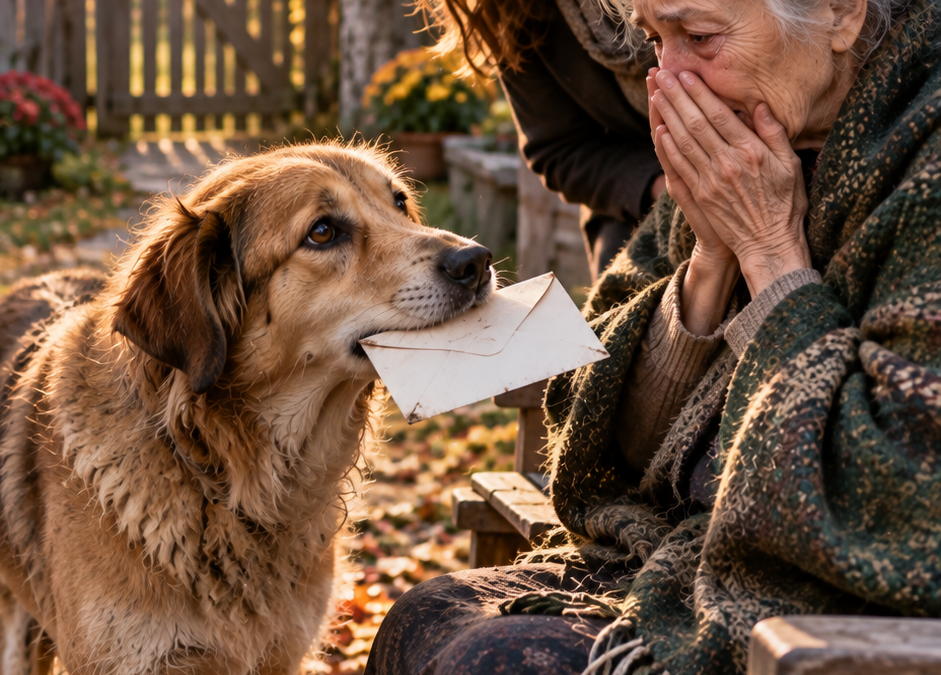
Something white was clamped gently between his teeth.
I leaned forward.
“Is that paper?”
The dog looked at us.
Then began walking.
Straight toward Grandma.
“Easy,” I said, standing.
Grandma didn’t move.
The dog approached slowly.
His tail wasn’t wagging.
He wasn’t afraid either.
He seemed serious.
Intentional.
When he reached Grandma, he sat.
Then he lowered his head and placed an envelope directly on her lap.
I remember the sound Grandma made.
Not a word.
More like a breath caught halfway out.
The dog remained sitting in front of her.
I stared at the envelope.
It was dirty from travel.
One corner was bent.
There were faint marks from the dog’s teeth along one edge.
But it had been folded and sealed carefully.
“That’s impossible,” I whispered.
Grandma didn’t answer.
She lifted the envelope.
Her fingers shook.
“Do you know what this is?” I asked.
She turned it over.
On the back, written in blue ink, was a single word.
Margaret.
Grandma went completely still.
I saw all the color leave her face.
“Grandma?”
Her thumb moved over the letters.
“Émilie.”
Something in her voice frightened me.
“What?”
“Émilie.”
She looked at me.
There were already tears in her eyes.
“This is James’s handwriting.”
My stomach dropped.
“No.”
“It is.”
“No, Grandma.”
“I know my grandson’s writing.”
I stepped closer.
She held out the envelope.
I stared at the name.
Margaret.
The M leaned farther right than the other letters.
The final t had a crossbar extending too long on one side.
My heart began pounding.
I’d seen that handwriting on birthday cards.
Grocery lists.
Notes left on the refrigerator.
Apology letters after fights.
The same handwriting had written Happy Birthday, Little Monster on nearly every birthday card James had given me since I was nine.
“Oh, my God.”
Grandma pressed the envelope against her chest.
“It’s him.”
“We don’t know that.”
“It’s him.”
“Someone could have copied it.”
She looked sharply at me.
“Why would anyone do that?”
“I don’t know.”
“Exactly.”
The dog shifted closer and rested his chin on Grandma’s knee.
She looked down at him.
“Where did you come from?”
His tail moved once.
My hands were trembling now too.
“Open it.”
Grandma hesitated.
“Grandma.”
“What if—”
Her voice broke.
For three years, she had been the strongest person in our house.
Suddenly she looked frightened.
“What if it isn’t what we think?”
I knelt in front of her.
“Then we’ll deal with that.”
“And what if it is?”
I swallowed.
“Then we’ll deal with that too.”
She opened the envelope carefully.
Inside was one sheet of paper.
No letter.
No explanation.
Only an address.
A street.
A town.
And beneath that, the name of a country thousands of miles from ours.
I read it twice.
“That’s it?”
Grandma turned the page over.
Blank.
“There has to be more.”
There wasn’t.
Then I saw the tiny mark at the bottom.
A small hand-drawn heart.
My breath stopped.
When James and I were kids, he drew that heart on everything he gave me.
Birthday cards.
Christmas tags.
Notes slipped beneath my bedroom door after we’d fought.
It wasn’t a normal heart.
The right half was always slightly larger than the left.
And through the middle he drew one short horizontal line.
Once, when I was ten, I’d asked why.
“So you know it’s mine,” he’d said.
I touched the drawing.
Grandma whispered, “You remember.”
“Yes.”
Neither of us spoke for a long time.
The dog put one paw against Grandma’s shoe.
She looked at me.
“We’re going.”
I almost laughed because the idea was so absurd.
“Going where?”
She pointed at the paper.
“There.”
“Grandma, that address is across the world.”
“I can read.”
“We don’t know what’s waiting there.”
“James is waiting there.”
“We don’t know that.”
Her expression hardened.
For a seventy-eight-year-old woman who barely reached my shoulder, Grandma could become terrifyingly stubborn.
“I’ve waited three years for something from him.”
“I know.”
“Three years, Émilie.”
“I know.”
“I prayed for a letter.”
Her fingers closed around the paper.
“I prayed for one sentence. One word. Anything.”
She looked down at the name on the envelope.
“Now something has come.”
I glanced at the dog.
“This could be dangerous.”
“So could doing nothing.”
“What if it’s a trap?”
“Then someone went to an extraordinary amount of trouble to imitate your brother’s handwriting and train a dog to deliver an envelope to my garden.”
She had a point.
I hated that.
“At least let me check the address first.”
“You can check it while I pack.”
“Grandma.”
She stood.
The dog stood too.
“We’re going.”
There are moments when you recognize that an argument has ended despite the fact that you haven’t agreed.
That was one of them.
I spent the next hour trying to prove this was madness.
Instead, almost everything I found made it stranger.
The town existed.
Small.
Mountainous.
Remote.
The address appeared to correspond to a residential street.
There was no obvious connection to James.
No record under his full name that I could find.
No social media.
Nothing.
But nothing proved the message was false either.
I called the detective who had originally handled James’s disappearance.
He sounded surprised to hear from me.
“An envelope?”
“Delivered by a dog.”
Silence.
“Excuse me?”
“I know how it sounds.”
“What exactly was inside?”
“An address.”
“Any message?”
“No.”
“Postmark?”
“There wasn’t one.”
“Then technically we can’t verify where it came from.”
“It’s his handwriting.”
“You believe it’s his handwriting.”
“We know it.”
He sighed.
“Émilie, I understand why this feels significant.”
I hated the careful professionalism in his voice.
“Don’t.”
“Don’t what?”
“Talk to me like I’m imagining things because I’m desperate.”
“I’m not.”
“You are.”
He paused.
“All right. What are you planning to do?”
“Grandma wants to go.”
“Overseas?”
“Yes.”
“Immediately?”
“Apparently.”
Another pause.
“I’d strongly recommend contacting local authorities before going to the address.”
“We will.”
“And send me photographs of the envelope and note.”
“I already took them.”
“Good.”
“Do you think it’s possible?”
“What?”
“That James is there.”
He didn’t answer quickly enough.
“I don’t know.”
At least that was honest.
“I hope so.”
When I entered the house, Grandma’s suitcase was open on her bed.
She had already packed three dresses, socks, medicine, toiletries, and the green scarf.
On top of everything sat a photograph.
I picked it up.
It had been taken at the beach four months before James disappeared.
Grandma sat between us on a faded blanket.
My hair was blowing across my face.
James had one arm around Grandma and the other around me.
He was laughing.
Actually laughing.
Not the half-smile he used when cameras made him uncomfortable.
A real laugh.
For years I had kept another copy in a drawer because looking at it hurt too much.
Grandma noticed me staring.
“I’m taking that.”
“I figured.”
“If he is there, I want him to see what I’ve been looking at every day.”
My throat tightened.
The dog was lying outside her bedroom door.
“He still hasn’t left.”
Grandma looked at him.
“He knows.”
“Knows what?”
“That we’re coming.”
“You’ve decided he knows everything now?”
“I’ve decided he knows more than you.”
I almost smiled.
“What are we supposed to do with him?”
“Take him.”
“Grandma.”
“He brought the letter.”
“We can’t just take an unknown dog internationally.”
“Then find out how.”
I stared at her.
She folded another sweater.
“Why are you standing there?”
“I’m wondering when I lost control of my own life.”
“Probably years ago.”
That night, I barely slept.
Grandma didn’t sleep at all.
I found her in the kitchen at 3:15 a.m., sitting at the table with the envelope beneath her hands.
The dog lay beside her chair.
I poured myself water.
“You need rest.”
“So do you.”
“I tried.”
“So did I.”
I sat across from her.
For several minutes we listened to the refrigerator hum.
Then Grandma said, “Do you think he’s angry with us?”
The question shocked me.
“What?”
“James.”
“Why would he be angry with us?”
“I don’t know.”
She looked down.
“People leave for reasons.”
I leaned forward.
“Grandma, whatever happened, this wasn’t because you didn’t love him enough.”
“I didn’t say that.”
“You didn’t have to.”
She rubbed the edge of the envelope.
“When your parents left, I promised myself I would give you both enough love for four people.”
“You did.”
“Maybe that isn’t possible.”
I reached across the table.
“You kept us together.”
“I tried.”
“You raised us.”
“I tried.”
“You saved us.”
She shook her head.
“James never believed he deserved saving.”
That sentence hurt because it was true.
“He always carried shame like it was a debt,” Grandma continued. “Every mistake became proof that he was exactly what he feared he was.”
“Which was?”
“Like his father.”
I had never heard her say that.
“Grandma—”
“Your father loved you.”
I waited.
“But he was frightened of responsibility. When fear became unbearable, he ran.”
She looked toward the dark window.
“James always feared the running was inside him too.”
I thought about the morning he disappeared.
I’m going for a walk.
“Maybe it was.”
Grandma looked at me.
There was no anger in her expression.
Only sadness.
“Or maybe he finally ran because he thought he was protecting us.”
“From what?”
“That is what we’re going to find out.”
The dog lifted his head.
Grandma reached down.
“You need a name.”
“We don’t know if he’s staying.”
“He crossed God knows how far to bring us a letter.”
She scratched behind his ear.
“He’s staying.”
“What name?”
Grandma looked at the envelope.
Then at the dog.
“Hope.”
I groaned.
“That’s extremely sentimental.”
“I’m old. I’m allowed.”
The dog’s tail moved.
Grandma smiled.
“See? He likes it.”
“He’s a dog.”
“Exactly. Better judgment than most people.”
By dawn, Hope had a name.
By evening, after more frantic arrangements than I want to remember, we were on our way.
The journey felt impossible even while it was happening.
Flights.
Documents.
Phone calls.
Airport terminals.
Forms.
Security lines.
Grandma gripping the photo every time turbulence shook the plane.
Hope traveling with us under arrangements that still felt miraculous.
When I questioned the absurdity of any of it, Grandma simply said, “We didn’t come this far to stop in an airport.”
We changed planes twice.
Then took a train.
Then a bus.
By the final leg, I had stopped thinking in hours.
Grandma barely slept.
She sat beside the window, watching landscapes change.
Cities disappeared.
Fields widened.
Mountains rose.
“He’s not going to be standing beside the railroad tracks,” I said gently after I caught her scanning another platform.
“I know.”
“Then what are you looking for?”
She didn’t turn.
“I don’t know.”
I understood.
For three years, she’d searched every crowd.
Why would another country change that?
Hope became increasingly restless as we moved closer to the town written on the paper.
On the bus, he stood whenever we stopped.
At the final station, the moment his paws touched the ground, he changed.
Tail up.
Head raised.
Alert.
He knew this place.
Grandma saw it too.
“Émilie.”
“I know.”
Hope walked several yards, turned, then looked at us.
“He wants us to follow.”
Grandma adjusted her scarf.
“Then stop standing there.”
The town looked as though it had been placed between the mountains and forgotten.
Narrow streets.
Old houses.
Small balconies.
Stone walls.
Smoke curling from chimneys.
The air was cool and so clean it almost hurt my lungs.
We crossed a wooden bridge.
Hope trotted ahead.
Every so often he turned to check whether we were still there.
Grandma moved more slowly.
I kept one hand beneath her elbow.
“I’m fine.”
“I know.”
“Then stop holding me like I’m ninety.”
“You’re seventy-eight.”
“Exactly. Practically young.”
Hope barked once ahead of us.
“He’s impatient,” Grandma said.
“He takes after you.”
After another ten minutes, Hope turned onto a narrow street.
My heartbeat changed.
I checked the address.
“We’re close.”
Grandma stopped walking.
“Grandma?”
She looked suddenly terrified.
The certainty she’d carried from the moment the envelope arrived disappeared.
“What if he doesn’t want us here?”
I stared at her.
“You’re the one who dragged me across the planet.”
“I know.”
“What happened to ‘we’re going’?”
“I’m allowed to be brave and frightened at the same time.”
I took her hand.
“Then we’ll be frightened together.”
Hope reached a house with a blue door.
He stopped.
Sat.
His tail began moving so hard his entire back end shifted.
I looked at the number.
It matched.
“This is it.”
Grandma’s hand tightened around mine.
We stood there for several seconds.
Three years had led to one blue door.
I suddenly felt twenty-five again.
Standing in a police station.
Answering questions.
Trying not to cry.
Then twenty-six.
Folding one of James’s sweaters and placing it back in his room because Grandma wouldn’t let me pack his things away.
Then twenty-seven.
Watching another birthday pass.
Then twenty-eight.
Standing here.
“What if he’s not here?” I whispered.
Grandma looked at the door.
“Then we’ll know we came.”
She climbed the steps.
I followed.
Hope sat beside her.
Grandma raised her hand.
Knocked.
Nothing.
She waited.
Knocked again.
“James?”
Silence.
I looked through a nearby window.
Curtains.
No movement.
“Maybe we should—”
Hope stood.
He pressed his nose against the door.
It opened slightly.
Grandma and I froze.
“Unlocked,” I whispered.
Hope pushed it farther.
“James?”
No answer.
I entered first.
The room beyond the door was small.
And filled with paintings.
They covered almost every wall.
Mountains.
Rivers.
A storm over the ocean.
A woman standing at a train station.
An old man repairing a bicycle.
Flowers.
Trees.
Faces.
I stepped farther inside.
“Hello?”
Grandma came behind me.
Then I saw the painting on the far wall.
I stopped.
“No.”
Grandma followed my gaze.
Her hand covered her mouth.
It was us.
The beach photograph.
Grandma in the center.
Me beside her.
James with one arm around each of us.
But the painting wasn’t an exact copy.
The colors were softer.
The sky brighter.
Our faces slightly younger.
As though painted not from a photograph but from memory.
Grandma whispered, “He painted this.”
There was another.
The apple tree.
Our backyard.
James and me as children.
I wore the yellow dress Grandma had sewn for my eighth birthday.
I hadn’t remembered that dress in years.
Another painting showed Grandma standing over the stove while James stole something from a plate.
Another showed me asleep on the couch while James placed a blanket over me.
My knees weakened.
“He remembered.”
A floorboard creaked behind us.
I turned.
A man stood beside an armchair in the corner.
For half a second, I didn’t know him.
He was thinner.
Much thinner.
His hair reached his shoulders.
There was stubble across his jaw.
His cheeks were sharper.
He looked older than thirty-one.
Tired.
But his eyes—
I knew those eyes.
Green.
The same eyes that had looked across the hallway when thunderstorms frightened me as a child.
The same eyes that had rolled whenever I borrowed his things.
The same eyes that had watched me leave for my first date and told the boy, very calmly, that he knew where he lived.
“James.”
Grandma said his name before I could.
His face broke.
Not metaphorically.
Actually broke.
The careful expression he’d been holding collapsed.
“Grandma.”
Her cane slipped from her hand.
He moved toward us.
Then stopped halfway.
He looked frightened.
My brother.
The boy who used to fight anyone.
The teenager who pretended he needed no one.
The man who disappeared without explanation.
He looked frightened of his grandmother.
“I’m sorry.”
Grandma stared at him.
James swallowed.
“I’m sorry.”
His knees hit the floor.
“Grandma, please.”
She stepped toward him.
“I couldn’t tell you.”
Her hands trembled.
“I couldn’t—”
“What did you do?”
The question wasn’t angry.
That made it worse.
James looked down.
“I got involved with people I shouldn’t have.”
“What people?”
“People I owed money to. People who used me for things.”
My stomach tightened.
“What things?”
He looked at me.
“Émilie—”
“No.”
Three years of anger suddenly surged through me.
“You don’t get to say my name like that.”
His face changed.
“Tell us.”
“I carried packages.”
“What packages?”
“I didn’t always ask.”
“That’s convenient.”
“Émilie.”
Grandma’s voice was soft.
“No, Grandma.”
I turned on James.
“You disappeared.”
“I know.”
“You let us think you were dead.”
His eyes filled.
“I know.”
“The police searched rivers.”
He flinched.
“I know.”
“They searched abandoned buildings.”
“I know.”
“Grandma stopped sleeping.”
“I know.”
“No, you don’t.”
My voice cracked.
“You don’t know.”
Hope came between us.
I hadn’t realized I was shouting until the dog pressed against my leg.
James stayed on his knees.
“I deserve that.”
“Don’t say that.”
“What?”
“Don’t make this easy by agreeing with me.”
He looked confused.
“I want to hate you.”
My chest hurt.
“For three years, I wanted to hate you because being angry was easier than being afraid.”
James closed his eyes.
“And now you’re standing here.”
I wiped my face.
“You were alive.”
“Yes.”
“You were alive every birthday.”
“Yes.”
“Every Christmas.”
His voice barely came.
“Yes.”
“And you said nothing.”
“I thought silence was protecting you.”
“From what?”
He stared at the floor.
“From me.”
Grandma stepped forward.
She bent slowly and placed both hands on his face.
James opened his eyes.
“You foolish boy.”
He started crying.
Not quietly.
Not politely.
The sound came from somewhere deep and wounded.
“I’m sorry.”
Grandma knelt as far as her body allowed.
I moved to help her.
She waved me away.
“Look at me.”
James tried.
“Look at me.”
He did.
Grandma’s thumbs wiped tears from his cheeks the way she had done when he was eight.
“Whatever you did,” she said, “whatever mistakes you made, whatever fear brought you here—you are my grandson.”
James shook his head.
“You don’t know everything.”
“Then tell me everything.”
“You might hate me.”
“No.”
“You can’t know that.”
“James.”
Her voice became firm.
“I have loved you angry.”
His shoulders trembled.
“I have loved you dishonest.”
He looked away.
“I have loved you when you broke my heart.”
She lifted his chin again.
“I loved you every one of the thousand nights you were gone.”
James covered her hands with his.
“You don’t get to decide for me when that love ends.”
Something inside me gave way.
I knelt beside them.
James looked at me.
I hit him.
Not hard.
Just one open-handed slap against his shoulder.
He stared.
“That’s for disappearing.”
Then I threw my arms around him.
“And this is because you’re alive.”
He wrapped his arms around me.
I hadn’t remembered his smell.
That’s strange, the things grief steals.
But somewhere beneath paint, soap, and the cold mountain air, he still smelled like my brother.
I buried my face against his shoulder.
“You idiot.”
“I know.”
“I hate you.”
“I know.”
“I missed you.”
His arms tightened.
“I missed you too.”
Grandma wrapped herself around both of us.
For several minutes, we became a pile on the floor.
Three people crying.
Laughing.
Trying to talk.
Failing.
Hope pushed his head between us and whined.
James laughed through his tears.
“You did it.”
Grandma pulled back.
“What?”
James reached for the dog.
“Hope.”
His hands moved through the golden fur.
“I didn’t know if he’d find you.”
I stared at him.
“He’s yours?”
James nodded.
“I found him two years ago.”
Hope licked his face.
“He was injured near a road. Someone had hit him, I think. He wouldn’t let anyone near him.”
James smiled faintly.
“It took three days before he let me touch him.”
Grandma looked at the dog.
“And you sent him to us?”
“Yes.”
“Across thousands of miles?”
James gave a small embarrassed smile.
“That part of the story is complicated.”
“So explain it.”
He helped Grandma sit in a chair.
We sat around him.
Hope immediately lay beside James’s feet.
For the first time, it became real that this dog belonged here.
“Hope wasn’t alone for the whole journey,” James explained. “I arranged help along the route. People I knew. A transport worker. Someone traveling toward the border. Another family moving in your direction. I trained him to carry envelopes, but I wasn’t stupid enough to simply point him toward home from another continent.”
I exhaled.
“Thank God.”
James almost smiled.
“You thought he actually walked the entire way?”
“The last three years have lowered my standards for what I consider impossible.”
Grandma ignored us.
“Why didn’t you come yourself?”
James’s smile disappeared.
“Because I was afraid.”
“Of what?”
“You.”
Grandma blinked.
“Me?”
“All of you.”
He rubbed his hands together.
“I spent years telling myself I left because I was protecting you.”
“Wasn’t that true?”
“Partly.”
He looked at me.
“But after the danger passed, I still stayed away.”
“When did it pass?”
“About eight months ago.”
My anger returned.
“Eight months?”
He nodded.
“You could have called eight months ago?”
“Yes.”
“Then why didn’t you?”
“Because by then the danger wasn’t the reason anymore.”
He looked ashamed.
“I was.”
I didn’t speak.
James stared toward the paintings.
“The first year, I moved constantly.”
He told us about cheap rooms.
Temporary jobs.
Warehouses.
Construction sites.
Restaurants where he washed dishes until dawn.
He never used our family address.
Rarely used his full name.
He cut contact with almost everyone.
Some of the people he’d owed money to were involved in criminal activity. He had carried things for them and witnessed things he shouldn’t have.
He eventually cooperated with people who helped him leave the situation.
He didn’t give every detail.
I didn’t ask for every detail.
Some things belonged to police reports and lawyers, not reunions.
“What matters,” he said, “is that it’s over.”
“Legally?” I asked.
“Yes.”
“Completely?”
“As completely as anything can be.”
Grandma studied him.
“And then?”
James looked toward the paintings.
“I started painting.”
“You never painted before.”
“I did.”
I frowned.
“When?”
“When you weren’t looking.”
For the first time, his smile resembled the James I remembered.
“I used to draw all the time.”
Grandma nodded.
“You drew on my grocery receipts.”
“I was six.”
“You drew on the wall.”
“I was seven.”
“You blamed Émilie.”
I stared at him.
“That was you?”
James actually laughed.
The sound hit me harder than the tears.
“Sorry.”
“You let me lose television for a week.”
“You were five. You didn’t even watch television.”
“That’s not the point.”
For a moment, we were children again.
Then the laughter faded.
James looked at the painting of us at the beach.
“Painting was the only time my head became quiet.”
He stood.
“Come here.”
He showed us the room.
Each painting was a piece of home.
The apple tree in summer.
Grandma’s kitchen.
My old bicycle.
The hallway outside our bedrooms.
A winter morning seen from the living-room window.
Our childhood beach.
“Why paint all this if you were trying to forget us?” I asked.
“I wasn’t trying to forget.”
His voice softened.
“I was trying to survive remembering.”
I couldn’t answer.
He pointed toward one painting.
Grandma was asleep in her chair.
A blanket covered her knees.
A cup of tea sat beside her.
“When did that happen?”
“Christmas before I left.”
Grandma touched the canvas.
“I remember that blanket.”
“So do I.”
James’s eyes filled again.
“I remembered everything.”
Grandma looked at him.
“Then why didn’t you believe we remembered you?”
He turned away.
“I thought eventually you’d be better without me.”
“Better?”
My anger flared again.
“You seriously thought Grandma was better?”
“No.”
“You thought I was?”
“No.”
“Then who exactly benefited?”
He said nothing.
“That’s what I thought.”
Grandma touched my arm.
“Let him answer.”
James sat down.
“No one benefited.”
He looked exhausted.
“I know that now.”
He rubbed his face.
“At first I thought leaving was sacrifice.”
His voice became bitter.
“It sounded noble in my head. Stay away. Keep them safe. Don’t drag them into your mess.”
He looked at us.
“But after a while, sacrifice became cowardice.”
The room went quiet.
“I was ashamed.”
He continued.
“Every month made the next month harder.”
I understood that more than I wanted to.
“If I called after one week, I had to explain one week.”
He looked at me.
“After six months, I had to explain six months.”
His eyes moved to Grandma.
“After a year, I had to explain a year.”
He swallowed.
“After three years, I couldn’t imagine saying hello.”
Grandma’s face softened.
“So you sent a dog.”
James laughed weakly.
“I sent a dog.”
“That may be the most James solution you’ve ever invented,” I said.
“I know.”
“Why just the address?”
“I wrote thirteen letters.”
“Where are they?”
He pointed toward a desk.
A drawer held them.
Thick envelopes.
Some unopened.
Some crossed out.
Some torn in half.
“I couldn’t decide what explanation would be enough.”
He looked toward Hope.
“Then I realized there wasn’t one.”
“So you wrote an address.”
“Yes.”
“And a heart.”
He looked at me.
“I hoped you’d remember.”
My throat tightened.
“Of course I remembered.”
“I didn’t know.”
“How could you not know?”
James looked away.
Because fear is irrational.
Because shame rewrites memory.
Because when people believe they are unworthy of love, they often become convinced everyone else has finally noticed too.
I didn’t say any of that.
I simply said, “I remembered.”
We talked until night.
There wasn’t one dramatic explanation that fixed everything.
No single confession erased three years.
That’s not how families work.
James apologized.
Then apologized again.
I got angry.
Then cried.
Then laughed at something stupid.
Grandma made tea in his kitchen because apparently she could not process a family crisis without boiling water.
At some point, I asked the question I’d been avoiding.
“Are you happy here?”
James looked around.
“I’m safe here.”
“That’s not what I asked.”
He smiled sadly.
“No.”
Grandma put down her cup.
“Why?”
“Because being safe isn’t the same as being home.”
The next morning, James showed us the town.
Hope walked ahead.
For three weeks, we stayed.
Three weeks was longer than planned.
None of us cared.
James took us along mountain trails.
He showed us a lake so clear we could see stones at the bottom.
He introduced us to a bakery owner who called him “the painter boy” despite James being thirty-one.
Grandma immediately adopted the baker as though he’d been missing from the family too.
“He needs feeding,” she whispered after meeting him.
“He owns a bakery.”
“That’s not the same thing.”
James laughed.
That became my favorite sound during those weeks.
Not because it happened constantly.
Because at first it didn’t.
James was careful around us.
He watched our reactions.
Apologized too often.
Asked permission for things that required none.
“Can I sit here?”
“It’s your house.”
“Right.”
“Can I make coffee?”
“Still your house.”
“Right.”
He was behaving like a guest in his own life.
Slowly, that changed.
One afternoon, we visited his studio.
It was a small cabin above the town.
James had repaired it himself.
Paint stained the floorboards.
Brushes stood in jars.
Canvases leaned against walls.
There were more paintings of home than I could count.
One stopped me cold.
James and I were lying in grass beneath the apple tree.
I couldn’t have been older than seven.
He was ten.
Our hands pointed toward the sky.
“What is this?”
He came beside me.
“The night we tried to count stars.”
I laughed softly.
“I forgot that.”
“I didn’t.”
“You told me stars disappeared when people stopped looking at them.”
“I was ten.”
“I believed you.”
“You believed everything I said.”
“That was my first mistake.”
He smiled.
Then his expression changed.
“I’m sorry I wasn’t a better brother.”
“James.”
“No, let me say it.”
He looked at the painting.
“You deserved someone stable.”
“You were my brother, not my father.”
“I acted like neither.”
“Sometimes.”
He accepted that.
I appreciated it.
“You also walked me to school for three months because some girl was bullying me.”
“You remember that?”
“Of course.”
“You never told Grandma.”
“You said you’d be embarrassed.”
He smiled.
“You made soup when I had the flu.”
“I burned it.”
“You did.”
“Badly.”
“Grandma had to throw out the pot.”
“Why are you bringing this up?”
“Because you’re doing it again.”
“Doing what?”
“Reducing your whole life to your worst decisions.”
He became quiet.
“You’re not innocent.”
“I know.”
“You hurt us.”
“I know.”
“I may be angry for a long time.”
“I know.”
“But you’re not only the worst thing you’ve ever done.”
James looked at me.
“Grandma told you that?”
“No.”
“Sounds like her.”
“It probably rubbed off.”
His eyes filled.
I nudged his shoulder.
“Don’t cry. You’ll make me uncomfortable.”
“Still terrible with feelings?”
“Absolutely.”
He laughed.
By the end of the second week, Grandma had begun asking when James was coming home.
Not whether.
When.
He avoided answering.
Finally, one evening we sat outside his house as the sun sank behind the mountains.
Hope slept near his feet.
Grandma had been quiet for almost ten minutes.
That should have warned us.
“James.”
“Yes?”
“Are you coming home?”
He stared toward the valley.
“I don’t know.”
“Wrong answer.”
“Grandma.”
“I am almost eighty.”
“You’re seventy-eight.”
“At my age, rounding up is efficient.”
He smiled.
She didn’t.
“I did not cross half the world to find my grandson so he could continue hiding in a mountain.”
“I’m not hiding.”
“Then come home.”
James looked at me.
“Don’t involve me.”
“Coward.”
“Runs in the family.”
That joke landed differently than intended.
He looked away.
“Sorry.”
Grandma reached for his hand.
“What are you afraid of now?”
He was silent for a long time.
“That home won’t feel like home anymore.”
The honesty softened all of us.
“Of course it won’t,” Grandma said.
James looked surprised.
She continued.
“Three years passed.”
Her thumb rubbed the back of his hand.
“You changed.”
She looked at me.
“Émilie changed.”
Then at herself.
“I changed.”
She smiled.
“The apple tree probably changed.”
“It lost a branch last winter,” I said.
“There. Even the tree has suffered.”
James smiled faintly.
Grandma leaned closer.
“Home isn’t preserved in glass, James.”
He looked at her.
“You don’t return to the exact place you left.”
She squeezed his hand.
“You return to people willing to meet you where you are now.”
His eyes dropped.
“What if I mess up again?”
“You will.”
“Grandma.”
“So will Émilie.”
“Thanks.”
“So will I.”
She shrugged.
“People are inconvenient that way.”
James laughed.
Then started crying.
Again.
He had apparently decided three lost years needed to be repaid in tears.
Grandma pulled him toward her.
“I want my garden,” he whispered.
“What?”
“The real one.”
His voice cracked.
“The apple tree.”
He looked at us.
“Your cinnamon pie.”
Grandma nodded as though discussing grocery plans.
“I can make that.”
“The old swing.”
“It’s barely standing.”
“I want it anyway.”
He wiped his eyes.
“I want to hear you making tea in the morning.”
Grandma smiled.
“You always complained about the kettle.”
“I know.”
He looked at me.
“I want my sister stealing things from my room.”
“I haven’t done that since I was fifteen.”
“You stole my headphones when you were twenty-three.”
“They suited me better.”
He laughed.
Then his face became serious.
“I want to go home.”
Grandma closed her eyes.
Tears rolled down her cheeks.
“Then come home.”
We returned three weeks after arriving.
James packed his paintings.
Brushes.
Clothes.
Hope’s things.
The small wooden table where he painted.
He gave away furniture.
Said goodbye to the bakery owner.
To neighbors.
To people who had known him only as the quiet painter from somewhere else.
I watched him say goodbye and realized this place had saved part of him.
Home wasn’t the only place that had loved him.
That mattered too.
At the airport, James became tense.
His foot bounced constantly.
“You okay?”
“Fine.”
“You’re lying.”
“Yes.”
“Want to leave?”
He looked at me.
“No.”
“Good.”
“Terrified.”
“Also good.”
“How is that good?”
“Means you’re actually thinking.”
He rolled his eyes.
There he was.
My brother.
During the flight, Grandma slept with her head against his shoulder.
James barely moved for three hours because he didn’t want to wake her.
I watched them from across the aisle.
At one point he noticed me.
“What?”
“Nothing.”
“You’re staring.”
“I’m documenting this.”
“For what?”
“Future blackmail.”
He smiled.
When we landed, James stood outside the terminal and breathed deeply.
His eyes closed.
For a long moment, he said nothing.
Then he laughed softly.
“What?”
He inhaled again.
“It smells the same.”
“What does?”
“Home.”
I smelled exhaust.
Rain.
Concrete.
Coffee from somewhere inside the terminal.
“What exactly are you smelling?”
“The wet ground.”
He smiled.
“The trees.”
“We’re at an airport.”
“You’ve always lacked imagination.”
Grandma took his arm.
“You’ll smell the apple tree soon.”
The drive home was quiet.
As we approached our neighborhood, James leaned forward.
He recognized everything.
The gas station.
The corner store.
The old school.
The street where we learned to ride bicycles.
“That pharmacy is new.”
“Opened last year.”
“The Wilsons painted their house.”
“They moved.”
His face fell slightly.
“Right.”
Three years.
The town had moved on too.
Then we turned onto our street.
Grandma reached for his hand.
The porch light was on.
It was still daylight.
I’d forgotten to turn it off that morning before our trip weeks earlier.
Or maybe Grandma had intentionally left it.
James stared at it.
“You kept it on?”
“Every night.”
His jaw tightened.
“Grandma.”
“In case you came back.”
He looked away quickly.
I parked.
Hope jumped out first.
James stayed in the car.
I opened his door.
“Coming?”
He stared at the house.
“I don’t know if I can.”
I leaned against the door.
“After all this?”
“What if I walk in and it feels wrong?”
“Then it feels wrong.”
“What if—”
“James.”
He looked at me.
“You spent three years imagining this moment.”
“Yes.”
“Stop imagining.”
I held out my hand.
“Come inside.”
He took it.
Grandma walked ahead.
The front door opened.
James stepped through.
He froze.
Almost nothing had changed.
Grandma had refused to redecorate much.
The same clock ticked above the hallway table.
The same framed photographs stood on the shelf.
The same scratch from when James dragged a bicycle through the hallway remained near the baseboard.
He touched it.
“You never fixed this?”
Grandma sniffed.
“I was waiting for the person who made it.”
“That’s manipulative.”
“I’m your grandmother.”
He laughed.
Then he walked toward the kitchen.
His chair was still there.
Not ceremonially preserved.
Just there.
Grandma moved toward the counter.
“Sit.”
“What are you doing?”
“Pie.”
“Now?”
“You’ve waited three years.”
She tied on an apron.
“Another hour won’t kill you.”
“Cinnamon and walnuts?”
She looked offended.
“What else?”
The smell filled the house that evening.
Warm cinnamon.
Butter.
Roasted walnuts.
James sat at the kitchen table watching Grandma move around the room.
Sometimes she touched his shoulder when passing.
Sometimes he reached out and touched her arm.
Small checks.
You’re real.
You’re here.
After dinner, we went outside.
The apple tree stood above us.
Yellow leaves moved in the cool air.
Hope collapsed in the grass as though he had always lived there.
James walked toward the trunk.
He found the initials carved years before.
J + E.
His finger traced them.
“Still here.”
“So are we,” I said.
He looked at me.
“Yeah.”
Grandma brought blankets.
We sat beneath the tree.
The sky cleared as darkness settled.
Stars appeared.
James leaned back.
“When we were kids, I thought the stars were different here.”
“Different how?”
“Brighter.”
“They probably seemed brighter because we were children.”
He shook his head.
“No.”
He looked upward.
“They’re brighter.”
Grandma rested her hand over his.
“For three years,” James said, “I thought I’d never see this sky again.”
“Why?”
“Because I thought returning meant becoming the person I used to be.”
He looked at us.
“I didn’t want to be him anymore.”
I understood.
“So don’t.”
He looked at me.
“Come home as someone else.”
Grandma nodded.
“Exactly.”
James stared upward.
“The stars didn’t wait for you,” Grandma said.
He smiled.
“No?”
“No.”
“They moved?”
“They always move.”
She leaned against his shoulder.
“You just came back in time to see them again.”
The next morning, James took out his paints.
He set an easel beneath the apple tree.
Grandma sat in her chair wearing the green scarf.
Hope slept nearby.
I brought coffee.
“What are you painting?”
“Nothing.”
“You’re clearly painting something.”
“Go away.”
“You’re in my yard.”
“Our yard.”
I smiled.
“Better.”
For hours, he worked.
I watched the canvas change.
The apple tree.
Grandma’s scarf hanging over the chair.
Hope stretched beneath the sun.
The old swing.
The house behind us.
Then three figures sitting side by side.
When he finished, he signed his name.
At the bottom, he wrote a sentence.
Every journey can lead home when someone there still keeps a place for you.
Grandma read it.
“Too sentimental,” she said.
James stared at her.
“You named the dog Hope.”
“That’s different.”
“How?”
“I’m old.”
Apparently age remained her universal defense.
I hung the painting in my bedroom.
Not because it was his best work.
It wasn’t.
Some of the mountain paintings were technically better.
But that one contained something none of the others did.
A future.
The paintings abroad had all been memories.
This one was painted after he came back.
Life did not become perfect.
I need to say that.
Because reunions in stories often happen as though love erases consequences.
It doesn’t.
James came home.
But three missing years remained missing.
I remained angry sometimes.
There were mornings when I’d look at him drinking coffee and suddenly remember police officers asking whether my brother had ever discussed suicide.
I’d become furious.
Once I shouted at him because he didn’t answer his phone for forty minutes.
“I was in the shower!”
“I don’t care!”
“What was I supposed to do?”
“Answer!”
“From the shower?”
“Yes!”
He stared at me.
Then understood.
His face softened.
“I’m sorry.”
“I don’t want your apology.”
“What do you want?”
“I want those three years back.”
He couldn’t give them.
We both knew it.
So I cried.
And he stayed.
That mattered.
Grandma had her own fear.
If James left the house without saying where he was going, she became quiet.
The first time it happened, he went to the hardware store.
When he returned, she was sitting beside the window.
His face changed immediately.
“Grandma.”
She smiled too quickly.
“Did you get what you needed?”
He put the bag down.
Then knelt beside her.
“I should have told you.”
“You are thirty-one.”
“I should have told you.”
She touched his cheek.
The next morning, he placed a small chalkboard beside the kitchen door.
James — studio until 4.
When he went somewhere else, he wrote it down.
Not because Grandma controlled him.
Because trust sometimes needs practical help while it heals.
Hope became ours almost immediately.
Although technically James’s dog, he followed Grandma more than anyone.
She fed him scraps despite repeated warnings.
“You’ll make him fat.”
“He was traveling.”
“Six months ago.”
“Travel is exhausting.”
Hope slept beneath her chair while she knitted.
If James worked late in the studio, Hope divided his time between them as though responsible for keeping the family intact.
James eventually rented a small storefront downtown.
He turned the front room into a gallery and used the back as a studio.
At first, few people came.
Then one painting sold.
Then another.
A local café asked to display several.
A newspaper wrote a short profile about the artist who had returned to his hometown after years away.
They didn’t know the full story.
James didn’t want them to.
Some stories belong to the people who survived them.
Grandma went to the gallery almost every day.
She sat in one corner knitting scarves.
Customers began recognizing her.
One afternoon I arrived to find three people buying scarves that Grandma insisted she wasn’t selling.
“You’ve started a business?”
“No.”
“Those people are giving you money.”
“They insisted.”
“That is generally how businesses work.”
James laughed from behind an easel.
Grandma threw yarn at him.
I stood in the doorway and watched them.
There were moments when happiness arrived so quietly I almost missed it.
That was one.
Not the dog entering the yard.
Not the plane landing.
Not the first embrace after three years.
Just Grandma throwing yarn at James while he laughed.
Ordinary.
That was what we had lost when James disappeared.
Not dramatic moments.
Ordinary ones.
Breakfasts.
Arguments.
Tea.
Birthdays.
The sound of someone walking upstairs.
The frustration of finding an empty milk carton returned to the refrigerator.
The things people complain about until those things disappear.
One evening, almost a year after James returned, the three of us sat beneath the apple tree again.
Hope lay near the gate.
The air smelled like damp soil.
Grandma had fallen asleep in her chair.
James and I spoke quietly.
“Do you ever regret coming back?” I asked.
He took a long time to answer.
“No.”
“Ever?”
“I regret waiting.”
“So do I.”
“You didn’t wait.”
“I waited for you.”
He nodded.
“I’m sorry.”
“I know.”
He said that less often now.
That was progress.
I looked toward Hope.
“Do you really think he understood what he was doing?”
“Delivering the envelope?”
“Yes.”
James smiled.
“I trained him to take something to a person.”
“That’s not the same as understanding.”
“No.”
He watched Hope.
“But sometimes I think dogs understand the important part without understanding the details.”
“Which important part?”
“Who belongs to whom.”
Hope lifted his head as though hearing his name inside the conversation.
James smiled.
“He knew you belonged to me.”
My eyes stung.
“Don’t get sentimental.”
“You’re crying.”
“Allergies.”
“To what?”
“You.”
He laughed.
Grandma woke.
“What did I miss?”
“Émilie crying.”
“I am not.”
Grandma looked at me.
“She is.”
“Traitor.”
Grandma smiled.
Hope stood and walked toward us.
He rested his head on Grandma’s knee exactly as he had the day he arrived with the envelope.
Her hand automatically moved over his fur.
“You brought my boy back,” she whispered.
James looked down.
Hope closed his eyes.
For a moment, I could see the whole path that had brought us there.
My parents leaving.
Grandma raising two frightened children.
James becoming angry.
Mistakes becoming larger.
Fear becoming dangerous.
One morning.
One walk.
One disappearance.
Three years.
A dog.
An envelope.
A blue door.
None of it felt like a miracle when we were living through it.
It felt messy.
Painful.
Confusing.
Miracles are usually described neatly afterward.
Real life rarely provides neatness while you’re inside it.
There was one thing I finally understood, though.
Grandma had been right about James.
He had been lost.
That didn’t excuse what he did.
Being wounded doesn’t give you permission to wound everyone around you.
But understanding why someone got lost can matter when they are trying to find their way back.
James never asked us to pretend the past hadn’t happened.
He learned to live beside it.
So did we.
On the anniversary of his return, James gave Grandma a painting.
He had worked on it secretly.
It showed our backyard at dusk.
The apple tree filled most of the canvas.
The porch light glowed.
A woman sat beneath the tree.
A younger woman stood beside her.
At the open gate was a man.
Not entering yet.
Just standing there.
And beside him was a golden dog holding an envelope.
Grandma stared at the painting for several minutes.
Then she said, “You made me look too old.”
James groaned.
“That’s what you noticed?”
“My hair is completely white.”
“It is completely white.”
“Artistic license exists for a reason.”
I laughed so hard I nearly spilled my coffee.
Grandma eventually hung the painting above the fireplace.
Sometimes I stand in front of it.
I look at the man at the gate.
James painted his face partly in shadow.
You can’t quite tell whether he’s afraid to come inside.
But the porch light is on.
That’s the part that matters.
It had always been on.
Years later, I asked James what he would have done if Hope had returned without finding us.
He went quiet.
“I don’t know.”
“Would you have come?”
“Eventually.”
“Honestly.”
He smiled sadly.
“I want to say yes.”
“But?”
“But fear had already taken three years from me.”
He looked toward Grandma’s chair.
“I don’t know how much more I would have given it.”
That answer still frightens me.
Because our reunion felt inevitable after it happened.
It wasn’t.
There were dozens of places where the story could have ended differently.
James could have stayed silent.
Hope could have failed.
Grandma could have listened to me when I said traveling was dangerous.
I could have convinced myself the handwriting wasn’t real.
We could have arrived too late.
Nothing about love guarantees reunion.
Sometimes people disappear and never come home.
I know that.
Our family was lucky.
But I don’t think luck was the only thing involved.
James had to send the envelope.
Grandma had to open it.
We had to go.
He had to let us through the door.
Coming home required action from both directions.
That may be what I remember most.
Hope didn’t bring James home by himself.
He carried the first step.
The rest belonged to us.
Grandma grew older.
James painted.
I built my own life without moving far away.
Hope stayed in the garden whenever the weather was good.
The old apple tree continued dropping more fruit than any three people could eat.
James repaired the swing.
Eventually he repaired the fence board too.
“Only took you fifteen years,” I told him.
“I was busy.”
“Clearly.”
Every autumn, we sat beneath the tree.
Sometimes Grandma told the story of Hope arriving as though none of us had been there.
“He walked straight toward me.”
“We know, Grandma.”
“Envelope in his mouth.”
“We were literally sitting beside you.”
“And then—”
“Grandma.”
“Don’t interrupt.”
So we’d listen.
Every time.
Because I eventually learned something else.
Stories change as people age.
Not because facts necessarily change.
Because what matters inside those facts changes.
At first, Grandma told the story as proof that James was alive.
Later, she told it as proof that hope had been justified.
Years after that, she told it as proof that families can survive things they never wanted to endure.
James told it differently.
To him, Hope represented courage he hadn’t possessed himself.
“I sent the bravest member of the household,” he once joked.
I told it as the story of the day grief changed shape.
For three years, grief had been uncertainty.
After that envelope, it became movement.
Fear.
Anger.
Then finally forgiveness.
Not perfect forgiveness.
Real forgiveness.
The kind that still remembers.
The kind that has boundaries.
The kind that sometimes becomes angry again.
But stays.
That’s what we learned to do.
Stay.
When things became uncomfortable, James stayed.
When I became angry, I stayed.
When Grandma became frightened that he’d disappear again, she said so instead of pretending.
And James listened.
Staying became our family’s quiet rebellion against everything that had happened before.
Our parents had left.
James had left.
But now we stayed.
One late autumn evening, many years after that first envelope, I found James painting beneath the apple tree.
Hope was older then.
His golden coat had faded around his muzzle.
He slept beside the easel.
Grandma sat under a blanket.
I carried three mugs outside.
“What are you painting?”
James angled the canvas away.
“None of your business.”
“Still saying that after all these years?”
“Tradition.”
I handed him coffee.
Grandma opened one eye.
“Is mine tea?”
“Of course.”
“Good.”
Hope lifted his head.
“No coffee for you.”
His tail moved once.
James turned the canvas.
He had painted the house at night.
The porch light glowed.
No people.
No dog.
Just the house.
I stared.
“Why is it empty?”
“It isn’t.”
“No one’s there.”
James shook his head.
“The light is on.”
I understood.
Grandma did too.
She reached for his hand.
“Someone’s waiting.”
James nodded.
That painting may be my favorite now.
Not because it’s dramatic.
Because it says everything without showing anyone.
A light.
A house.
A place waiting to become home again.
When I think about the day Hope entered our garden, I no longer remember first how frightened I was.
I remember Grandma’s hands around the envelope.
I remember recognizing James’s crooked heart.
I remember the dog resting his head against her knee.
I remember her saying, “We’re going.”
No debate.
No hesitation.
She had spent three years waiting.
The moment hope required movement, she moved.
Maybe that’s the difference between wishing and hoping.
Wishing stays in the chair.
Hope eventually gets up.
It packs a suitcase.
It boards the plane.
It crosses the bridge.
It knocks on the blue door even when no one answers.
It pushes the door open.
It steps inside.
And sometimes, if you’re fortunate, the person you’ve missed is waiting on the other side.
James once told me he thought home was a place you earned.
That was why he stayed away so long.
He believed he’d done too much wrong to deserve it.
Grandma corrected him.
“Home isn’t a reward,” she said.
“It’s a responsibility.”
“What does that mean?” he asked.
“It means you don’t deserve home by being perfect.”
She pointed at him.
“You deserve to be loved because you’re ours. But being part of a family means you have to show up for it.”
James smiled.
“That sounds less comforting.”
“It is.”
She looked pleased.
“Love is not the same thing as letting you behave however you want.”
That became another family rule.
Love didn’t erase accountability.
Accountability didn’t erase love.
Both could exist.
James learned that.
So did I.
On the wall above my bed still hangs the first painting he made after returning.
The apple tree.
Grandma’s green scarf.
Hope in the sun.
The three of us together.
At the bottom is his sentence about journeys returning home.
I see it every morning.
I don’t always stop to read it anymore.
That’s another gift.
Some things become part of the room instead of wounds you have to examine.
But occasionally I wake before sunrise and the first light catches the paint.
Then I remember the afternoon the gate opened.
The golden dog.
The envelope.
One word written on the back.
Margaret.
I remember Grandma’s hands shaking.
And I understand just how much a life can change between one breath and the next.
Before that gate opened, James was missing.
After it opened, there was an address.
That wasn’t certainty.
It wasn’t forgiveness.
It wasn’t reunion.
It was simply a direction.
Sometimes that’s all hope gives you.
Not an answer.
A direction.
We followed it.
Thousands of miles.
Through fear.
Through anger.
Through questions none of us wanted to ask.
Until we reached a blue door and found my brother behind it surrounded by paintings of the home he had been too afraid to return to.
Three years cannot be recovered.
We never got them back.
Grandma grew older during them.
I learned to live without my brother during them.
James carried loneliness and shame through them.
There is no beautiful sentence that makes lost time less lost.
But the years afterward taught me that a life cannot be measured only by what disappeared.
Sometimes what returns matters too.
James returned.
Not unchanged.
Not innocent.
Not magically healed.
But willing.
Willing to apologize.
Willing to explain.
Willing to stay.
That was enough to begin.
Hope remained with us for the rest of his life.
Even in old age, he liked sleeping beside the gate.
The first few times, Grandma became worried.
“Why is he there?”
James smiled.
“Probably making sure no one else has a letter.”
Whenever the gate creaked, Hope lifted his head.
So did we.
Usually it was wind.
Sometimes the neighbor’s cat.
Sometimes a delivery.
Nothing ever arrived that changed our lives quite like that envelope.
But we kept looking anyway.
Once life teaches you that an ordinary gate can open onto something extraordinary, you never hear its hinges the same way again.
And when people ask me whether I believe in miracles, I still hesitate.
I believe in choices.
I believe in second chances that require work.
I believe people can run so far from themselves that returning feels impossible.
I believe shame can keep someone away longer than danger ever could.
I believe forgiveness is harder and more complicated than stories usually admit.
And yes, I believe sometimes a golden dog can walk through an old garden carrying an envelope in his mouth and give a broken family the one thing it had almost stopped expecting.
A direction home.
James was thirty-one when he came back.
Grandma told him three years was far too long to take a walk.
He laughed.
Then cried.
Then promised that next time he’d be back before dinner.
There was never a next time.
He stayed.
And every night after that, whenever I passed the front door, I still saw the porch light glowing.
One evening I asked Grandma why she continued leaving it on.
“James is home now.”
She looked toward the kitchen.
My brother was inside arguing with Hope over a piece of chicken.
“I know.”
“Then who are we waiting for?”
Grandma smiled.
“Maybe no one.”
She adjusted the lamp.
“But after everything we’ve learned, why would we ever turn it off?”
I looked through the window.
James laughed.
Hope barked.
The smell of cinnamon drifted from the kitchen.
The apple tree moved gently in the night wind.
Grandma took my hand.
And finally I understood.
The porch light wasn’t only for the missing anymore.
It was for all of us.
A reminder that no matter how dark the road became, no matter how far one of us wandered, no matter how long fear convinced us we had lost the way—
there would always be a light at the door.
Not promising there would be no anger.
Not promising there would be no consequences.
Not pretending the years apart hadn’t happened.
Simply saying:
This is where we begin again.
I squeezed Grandma’s hand.
Inside, James called my name.
“What?”
“Hope stole the chicken.”
“I warned you.”
“Can you help?”
“No.”
“Émilie!”
Grandma laughed.
I opened the door.
Warm light spilled across the porch.
Hope ran past me with James following.
For a second, everything became noise and laughter and ridiculous confusion.
And standing there, watching my brother chase a golden dog through the kitchen while my grandmother laughed until tears came to her eyes, I realized that this was what I had wanted during every one of those thousand silent days.
Not an explanation.
Not a perfect apology.
Not some grand redemption.
This.
My brother alive.
My grandmother laughing.
A dog underfoot.
Home noisy again.
I had thought happiness would feel extraordinary if James ever came back.
Instead, it felt ordinary.
And that was far better.
Because extraordinary moments pass.
Ordinary life is what you get to keep.
Years earlier, James walked out saying he was going for a walk.
For three years, we didn’t know whether he would ever return.
Then one autumn afternoon, a strange dog entered our yard with an envelope bearing my grandmother’s name.
That envelope carried no explanation.
Only an address.
But an address was enough.
We followed it.
And on the other side of the world, behind a blue door, we found the person we had never stopped missing.
He had been afraid that too much time had passed.
Afraid his mistakes had become larger than our love.
Afraid coming home required him to be worthy first.
He was wrong.
Coming home didn’t erase what he had done.
It gave him somewhere to begin repairing it.
Grandma had understood that from the start.
Maybe that was why she never stopped leaving the porch light on.
She wasn’t denying reality.
She wasn’t pretending James hadn’t failed us.
She was simply refusing to let failure have the final word.
Today, whenever I look at the painting above my bed, I notice Hope first.
James painted him lying beneath the apple tree, watching all three of us.
His golden head is lifted.
His ears are alert.
Almost as though he’s still making sure everyone is where they belong.
Sometimes I smile at him.
“Good job,” I whisper.
Because without Hope, maybe James eventually would have found the courage himself.
Maybe he would have called.
Maybe he would have returned.
Maybe.
But I don’t build my life on maybes anymore.
I know what happened.
A dog carried the first step.
Grandma took the second.
I took another.
James opened the door.
And then all of us kept walking.
That was how we found one another again.
Not through one miracle.
Through a chain of small acts of courage.
A letter written.
An envelope carried.
A journey taken.
A door opened.
An apology spoken.
An embrace accepted.
A decision to stay.
And in the end, maybe that is what home really is.
Not a house.
Not an apple tree.
Not a porch light.
Home is the place where people keep choosing one another after they finally understand how easily they could have been lost.
James had been gone for three years.
For a thousand nights, Grandma left the light on.
When he finally came back, she never said, “I told you so.”
She simply put cinnamon pie on the table, pulled out his chair, and said the simplest words in the world.
“Sit down, sweetheart. You’re home.”
And this time, he stayed.

