𝗙𝗨𝗟𝗟 𝗦𝗧𝗢𝗥𝗬 The Storm Was Eleven Minutes Away When She Ordered Me to Leave the Gate Closed
𝗙𝗨𝗟𝗟 𝗦𝗧𝗢𝗥𝗬
I looked at the missing debris rack.
“Did your counsel tell you to cut out flood-control equipment?”
“That structure was abandoned.”
“It was operational.”
“It conflicts with our channel modernization project.”
I looked at the raw torch marks.
“Modernization usually involves installing something.”
There was a pause.
Then she said, “Aesthetic restoration is part of the project.”
That sentence stayed with me.
She had not said flood improvement.
She had not said capacity.
She had not said safety.
She had said aesthetic restoration.
“Send me the engineered plan.”
“You are not a member of Coyote Ridge.”
“You’re working on my property.”
“We will provide whatever disclosures are legally required.”
“Until then, nobody comes through my fence.”
Her voice became colder.
“Interfering with easement maintenance may expose you to liability.”
“Cutting my fence already exposed somebody to it.”
I ended the call.
An hour later, a black SUV came down my driveway.
Celeste stepped out wearing a red pantsuit and cream-colored boots that probably cost more than my saddle.
She was in her early fifties and carried herself with the controlled precision of someone accustomed to meetings ending the way she wanted.
Beside her was Martin Vale, the HOA’s property manager.
Martin carried a leather folder.
He never once looked directly at the damaged fence.
Celeste handed me a notice.
“Coyote Ridge will resume easement maintenance Friday at seven a.m.”
I read the first paragraph.
It referred to a thirty-foot drainage and access easement recorded in 2011.
Then I saw language I had never seen before.
Exclusive operational control.
I looked up.
“Where did those words come from?”
“The recorded grant.”
“No. The recorded grant says inspection, maintenance, and repair.”
Martin opened his folder.
“Our attorney reviewed the language.”
“Did your attorney visit this property?”
Celeste answered.
“That isn’t necessary to interpret a document.”
“It is if you’re confusing an easement corridor with equipment that isn’t inside it.”
Her eyes moved toward the old floodgate.
“The rusted gate and grate are visual nuisances at the entrance to a premium community.”
“They collect debris.”
“Our new underground drainage system will manage runoff more efficiently.”
“Show me the calculations.”
“The association is not seeking your approval.”
I folded the notice and held it back toward her.
“Then the association can stay off my land.”
She did not take it.
“Mr. Mercer, your property benefits from our roads, our security presence, and the increased property values created by this community even though you pay no assessments.”
I almost laughed.
Instead, I waited.
She continued.
“We have been patient with your fencing, your barn, and the agricultural equipment visible from our entrance. This project improves the appearance of the entire area.”
There it was.
Not safety.
Not drainage.
Appearance.
“My barn was here before your entrance.”
“Communities evolve.”
“Water doesn’t care.”
A faint smile touched her mouth.
“Friday at seven.”
She turned and walked back to the SUV.
That afternoon, I drove to the county recorder’s office.
The original easement was exactly where it should have been.
Filed May 18, 2011.
It granted Coyote Ridge a nonexclusive right to enter a thirty-foot corridor for inspection, maintenance, and repair of a designated drainage facility.
It required forty-eight hours’ notice except during an emergency.
Then came the language Celeste had left out.
The association could not enlarge, relocate, or remove the facility without written approval from both the landowner and the county flood-control district.
More important, the legal description of the easement ended six feet north of the splitter box.
The floodgate itself was outside Coyote Ridge’s easement.
I ordered certified copies.
Then I requested every public filing connected to the new clubhouse.
The clerk returned with nearly two inches of documents.
Building permit.
Electrical.
Pool.
Structural.
Landscaping.
But no final drainage approval.
Instead, I found a conditional site letter issued eighteen months earlier.
The county had approved the clubhouse only if the emergency overflow swale remained open across its full sixty-foot width.
No permanent foundation.
No parking surface.
No landscape berm.
No structure.
Nothing could obstruct the corridor.
I opened the county aerial image.
Then I measured.
The western fitness wing covered twenty-two feet of the required swale.
The raised pool terrace covered another eighteen.
Decorative planters and stonework reduced what remained.
Sixty feet of emergency flow path had become less than twenty.
They had turned a flood corridor into a funnel.
At four that afternoon, I called Priya Nanduri at the county flood-control office.
Priya had been a junior engineer when the original Coyote Ridge plans were reviewed.
She was now deputy director.
“Daniel Mercer,” she said. “I haven’t heard that name in years.”
“I’ve enjoyed the quiet.”
“Quiet is why people move next to dry washes.”
“Somebody chained the Mercer gate and removed the rack.”
The line went silent.
“Who?”
“Coyote Ridge.”
“Why?”
“They say they’re modernizing drainage.”
“There is no approved modernization.”
“I noticed.”
I told her about the clubhouse footprint.
About the missing approval.
About the cut steel.
“Send me photographs,” she said. “Everything.”
“They’re coming back Friday.”
“I can open a field review. I can’t promise an inspector before Monday.”
“There’s weather in the forecast.”
“I saw it.”
Two summers earlier, wildfire had stripped nearly nine square miles of vegetation from the juniper country northwest of us.
Healthy ground can absorb part of a hard storm.
Burned soil often cannot.
Water hits it, runs, gathers ash, branches, rock, and whatever else gravity offers.
A storm that once produced muddy runoff can become a debris flow.
Priya knew exactly what I was thinking.
“Are the original operating marks still visible on the gate?”
“Yes.”
“Is it functional?”
“It was before somebody chained it.”
“Do not operate it unless there is an emergency order. Document everything. Keep people away from the corridor.”
“Understood.”
Before hanging up, she asked, “Does the HOA know who designed the bypass?”
“No.”
“Are you going to tell them?”
I stared at the fresh cuts where the rack had stood.
“Only if facts stop working without a résumé.”
Friday morning, Celeste returned with an excavator, a concrete truck, and two sheriff’s deputies.
I parked my pickup across the opening in my fence.
My certified easement documents sat on the hood.
Celeste stepped out of her SUV.
“You were advised not to obstruct maintenance.”
“And you were advised not to enter my parcel.”
One deputy raised his hand.
His name was Ruiz.
“Let’s slow this down. Ms. Harrow says the HOA has recorded access.”
“It does,” I said. “Six feet north of the equipment they intend to remove. And the easement allows maintenance or repair.”
I pointed toward the concrete truck.
“They brought concrete.”
Ruiz looked toward the contractor.
“What’s the concrete for?”
Celeste answered immediately.
“Stabilization.”
I unfolded a sketch attached to the HOA notice.
A gray rectangle labeled VIEW TERRACE stretched across the wash.
“It’s for bridge footings.”
Celeste’s jaw tightened.
“The bridge is part of the association’s easement rights.”
“Your easement ends over there.”
I pointed toward two blue survey stakes.
“The north footing is twenty-three feet inside my parcel and outside the recorded corridor.”
Ruiz studied the stakes.
Then he looked at Celeste.
“Do you have a court order?”
“We have a recorded property right.”
“That wasn’t my question.”
She said nothing.
Ruiz nodded toward the construction crew.
“This is a civil dispute. Nobody crosses his fence today.”
The contractor let out a breath.
His name was Luis Ortega.
Celeste turned sharply toward him.
“Unload the forms on the HOA side.”
Luis stayed where he was.
“Ms. Harrow, I need the stamped drainage sheet before I pour concrete near that channel.”
“You have the project plans.”
“The set doesn’t contain a drainage approval.”
“Our architect issued a clarification.”
Luis looked toward the floodgate.
“Is that bypass active?”
Celeste answered.
“It is obsolete infrastructure scheduled for removal.”
Luis stared at the fresh torch marks.
“Your office told me the county abandoned it.”
I looked at him.
That was different.
Not misunderstood.
Not outdated.
Abandoned.
Somebody had supplied the contractor with a factual claim that could be checked.
And it was false.
Celeste dismissed the crew.
By noon, the HOA emailed me a demand for $12,800 in contractor delay costs.
An hour later, a second notice arrived.
My barn.
My tractor shed.
My stock trailer.
All declared visual nuisances visible from the Coyote Ridge entrance.
I had ten days to screen or remove them.
I was not a member of Coyote Ridge.
My deed carried no HOA covenant.
The demand had no legitimate enforcement power.
But it did something more valuable.
It documented motive.
I called Rebecca Sloan, a property attorney I had known for several years.
She read both notices.
“This is nonsense.”
“I know.”
“Then why do you sound happy?”
“The first letter called this flood maintenance. The second one complains about how my barn looks from their entrance.”
Rebecca went quiet.
“You think this is about the clubhouse opening?”
“I think drainage was the excuse.”
She tapped the demand letter.
“We can ask for a temporary restraining order.”
“How fast?”
“Monday filing. Maybe Tuesday if the judge sees immediate risk.”
“Storm chance moves in Wednesday.”
“Then we need the county moving too.”
That evening, Luis returned alone.
He stopped outside my gate.
“I’m not here to work.”
“Good start.”
He held up a tablet.
“I think you should see something.”
The photograph was three months old.
It showed the clubhouse before the western wing had been enclosed.
Yellow paint on the ground marked the original sixty-foot overflow corridor.
Concrete footings sat directly across it.
“Who took this?”
“I did.”
Luis explained that he had been hired for landscaping, not the building.
When his crew laid out irrigation, he noticed the channel markings and sent a request for information to the architect.
He opened the email.
The architect’s response was short.
WEST WING CONFLICTS WITH CONDITIONAL DRAINAGE LETTER. REVISED COUNTY APPROVAL REQUIRED BEFORE CONTINUING.
Under it was a response from Celeste.
THIS IS A FIELD CONDITION, NOT A DESIGN CHANGE. PROCEED UNDER EXISTING PERMITS. DO NOT COPY COUNTY UNTIL AS-BUILT REVIEW.
I read it twice.
“Why didn’t you stop?”
“I stopped my scope. They replaced us for three weeks.”
“And then?”
“They brought us back to remove the debris rack and pour bridge footings. We were told the county had vacated the channel.”
“Did they give you proof?”
“A memo from the HOA attorney. No county stamp.”
“Will you give this to the inspector?”
Luis rubbed a hand over his face.
“If I do, they may sue me.”
“If you don’t and someone gets hurt, you’ll remember this conversation.”
He stared at the screen.
Then he nodded.
“Send me the inspector’s name.”
That was the first independent evidence created before our dispute began.
A photograph.
A written warning.
An instruction to continue.
The following day, Coyote Ridge held a resident meeting.
I was not invited.
Five residents called me anyway.
The first was a retired teacher named Ellen Park.
“Ms. Harrow says you’re threatening to divert floodwater into our homes.”
“Did she show you the drainage map?”
“She showed us a photograph of your gate.”
“That wasn’t my question.”
A pause.
“No.”
“The emergency channel runs through HOA common property between the tennis courts and the entrance. It was designed to keep extreme flow away from the houses.”
“She said you built it yourself.”
“The developer built it under county conditions.”
“Then why is it called Mercer Wash?”
“Because water crossed my family’s land before your subdivision existed.”
Another pause.
Then Ellen said quietly, “Celeste says opening the gate would destroy the clubhouse.”
I closed my eyes.
There it was.
The first public admission.
The clubhouse was occupying land the emergency system needed.
“Ask her something for me.”
“What?”
“Ask why a county-approved clubhouse would be destroyed by a county-required drainage system.”
Twenty minutes later, Martin called.
“Mr. Mercer, residents are becoming alarmed by misinformation.”
“Which information?”
“Claims that the clubhouse occupies a flood corridor.”
“It does.”
“That is your interpretation.”
“It’s written in the county site letter.”
Silence.
Then he asked, “Where did you get that?”
“Public records.”
“Those plans were superseded.”
“Send me the superseding approval.”
“I’m not authorized to distribute internal documents.”
“County approvals aren’t internal.”
His voice dropped.
“Daniel, this has gone farther than anyone intended.”
“Then stop.”
“Celeste is prepared to waive the delay charges and withdraw the nuisance notice if you grant a permanent landscaping easement along your south fence.”
“How wide?”
“Forty feet.”
“That includes my cottonwoods.”
“The association would maintain them.”
“And the floodgate?”
“Removed.”
My hand tightened around the phone.
“And the emergency channel?”
“Converted into a landscaped infiltration garden. Our consultants consider the existing bypass excessive.”
“Name the consultant.”
Martin said nothing.
“You want forty feet of my land so residents won’t see my barn from a clubhouse built inside a flood corridor.”
“I’m trying to prevent expensive litigation.”
“Then tell Celeste to stop creating evidence.”
I hung up.
Then I wrote down every word.
That offer explained more than the letters did.
They did not merely want the gate gone.
They needed additional land.
If I granted them a wider easement, they could redraw the emergency route north through my pasture.
The clubhouse could remain where it was.
Their violation would appear to disappear on paper.
They were not trying to move the building away from the water.
They were trying to move the water around the building.
Monday morning, Rebecca filed for the restraining order.
At ten, Priya arrived with a county inspector, survey crew, and two plan sets.
Celeste waited on the HOA side with Martin, the association attorney, and Colin Beck, the civil engineer whose seal appeared on the clubhouse grading plan.
Priya began upstream.
She photographed the missing debris rack.
Measured the chained floodgate.
Then followed the original channel south.
Surveyors placed flags every twenty feet.
Blue marked the main culvert route.
Orange marked the emergency overflow.
I stood silent as the orange line crossed the common land.
Then continued.
Straight beneath the western fitness wing.
One flag.
Another.
Another.
Celeste watched the line materialize.
“Those coordinates are from an outdated concept plan.”
Priya never looked up.
“They are from the recorded final drainage exhibit.”
Colin stepped forward.
“The building footprint changed through field revisions.”
“Show me the approved revision,” Priya said.
“It should be in the county portal.”
“It isn’t.”
“There may be an indexing issue.”
Priya handed him the conditional site letter.
“Your seal is on the acknowledgment.”
Colin studied it.
“I signed the early civil package. The architect controlled final placement.”
Celeste looked at him sharply.
“You certified this project.”
“I certified the grading shown on my sheets. My sheets did not put a fitness wing in the overflow corridor.”
Martin looked from Celeste to Colin.
For the first time, the people who had arrived together stopped facing me.
They faced one another.
The inspector measured the remaining opening beside the decorative planters.
“Eighteen feet, ten inches.”
Priya wrote the number down.
“Required clear width?”
“Sixty feet.”
The association attorney cleared his throat.
“We should distinguish a mapped planning corridor from an active drainage facility.”
Priya finally looked at him.
“The county required the corridor because the main culvert cannot convey the full design flow.”
She pointed northwest.
“The burn scar increases the current runoff risk. It does not erase the original requirement.”
Celeste crossed her arms.
“We were told the Mercer gate is privately operated and therefore unreliable.”
Priya asked the same question I had.
“Who told you?”
Celeste glanced toward Colin.
He shook his head.
“Not me.”
Priya looked at me.
“Daniel, do you still have the operating plan?”
“The signed copy is in my truck.”
I returned with a weathered blue binder.
Inspection logs.
Maintenance photographs.
Annual test notes.
Hydraulic tables.
Priya opened it on the hood of her vehicle.
Celeste laughed quietly.
“You expect the county to rely on a rancher’s personal binder?”
Priya studied the title page.
“This is not a personal binder.”
She turned it toward Celeste.
At the bottom of the page were the words:
DANIEL MERCER, P.E.
HYDRAULIC DESIGNER
Nobody spoke.
Celeste stared at me.
“You’re an engineer.”
“I was.”
“You never disclosed that.”
“You never asked before cutting the equipment.”
The truth was less dramatic than her expression suggested.
I had spent fourteen years in flood-control design, first with a private engineering firm and later as a county consultant.
I had no special authority anymore.
No government badge.
No power to approve my own argument.
What I had was history.
And history was why that gate existed.
In 2008, my younger brother Eli had been driving six miles north of our ranch when a flash flood crossed a low-water road.
His truck was found more than a mile downstream.
He was twenty-six.
People called the storm unpredictable.
That word stayed with me.
Unpredictable.
It sounded cleaner than preventable.
After Eli died, I spent years studying the failures people dismissed as acts of nature when the truth was usually more complicated.
Bad assumptions.
Poor maintenance.
Buildings placed where water needed to travel.
Warnings softened until nobody felt responsible for ignoring them.
When the original Coyote Ridge developer submitted plans, the main culvert was not large enough to safely carry the entire extreme flow.
I designed the backup system.
A debris rack.
A splitter gate.
A broad emergency overflow route.
The developer hated the cost.
The county supported the requirement.
My father granted the narrow maintenance easement on one condition:
The emergency system could not be removed or relocated unless both the county and the landowner agreed in writing.
After my father suffered a stroke, I left engineering and returned to the ranch.
But every spring, I tested that gate.
Because safety systems do not remain safe merely because the person who designed them leaves.
Celeste stared at my name in the binder.
“You have a financial interest in defending your own design.”
Priya closed the binder.
“His ownership does not change the hydraulic model.”
“Models can be wrong.”
“Yes,” Priya said. “Which is why we compare them with field conditions.”
She looked at the clubhouse.
“Your field condition is worse.”
The inspector issued an immediate stop-work order covering the bridge, landscaping, and all work inside the drainage corridor.
The HOA was ordered to restore access to the floodgate and produce all project revisions within forty-eight hours.
That should have ended the immediate fight.
Instead, Celeste escalated it.
That afternoon, Coyote Ridge residents received a seven-page emergency bulletin.
It described me as a former consultant with an undisclosed conflict who was using obsolete plans to threaten the community’s central amenity.
It warned that the county shutdown could trigger a two-million-dollar construction loss and a special assessment of up to eleven thousand dollars per household.
My name appeared fourteen times.
Then I reached the paragraph about Eli.
Celeste described my brother’s death as the source of my “personal fixation on exaggerated flood scenarios.”
I stopped reading.
For several minutes, I sat alone at my kitchen table.
There are insults you can answer.
There are lies you can correct.
Then there are things people take from your life because they believe everything becomes usable once it enters a dispute.
I had spent eighteen years learning how to say Eli’s name without returning to the morning a deputy knocked on our door.
Celeste had turned him into a paragraph.
Ellen forwarded me the bulletin with one sentence.
She should not have written that.
She was right.
But anger was what Celeste needed from me.
If I screamed at a board meeting, threatened anyone, or operated that gate without authority, she could make the issue about me.
A grieving brother.
An angry neighbor.
An engineer obsessed with an old design.
So I gave the residents three documents.
The recorded drainage exhibit.
The county’s conditional site letter.
The stop-work order.
My message contained eleven words.
The orange corridor crosses the building. Please read the dates yourself.
By Tuesday morning, twenty-seven residents had demanded a special board meeting.
Celeste scheduled it for Thursday night.
After the clubhouse grand opening.
That timing was not accidental.
Rebecca found the reason in a board packet obtained through a resident records request.
The HOA’s construction loan required a certificate of substantial completion by midnight Wednesday.
Miss the deadline and the lender could withhold the final $800,000.
The grand opening was not merely a celebration.
It was a financing deadline.
The same packet contained another number.
$312,000.
Drainage aesthetic mitigation.
There was no hydraulic study attached.
No flood-control fee.
No approved capacity analysis.
The money had purchased stone walls, mature landscaping, bridge foundations, and the raised terrace that constricted the overflow path.
Coyote Ridge had spent more than three hundred thousand dollars making a flood-control system less visible.
And less capable of doing its job.
Tuesday afternoon, the judge granted our temporary restraining order.
The HOA could inspect and maintain its recorded easement.
It could not remove, relocate, cover, chain, obstruct, or disable the flood-control structures.
It had to repair my fence.
It had to preserve its project records.
Deputy Ruiz served the order at 5:20.
At six, I walked to the gate.
The orange chain was gone.
For one moment, I thought Celeste had finally backed down.
Then I saw the steel.
Someone had welded a stop directly across the guide rail.
The gate could rise about three inches.
No more.
Fresh grinding dust lay on the concrete.
I stared at it.
Technically, the chain had been removed.
Functionally, the gate had been disabled.
I called Ruiz.
Priya.
Rebecca.
Then I installed two trail cameras.
At 2:13 Wednesday morning, one camera recorded Martin Vale walking down from the clubhouse.
He carried a cordless work light.
He knelt beside the welded stop.
Photographed it.
Made a phone call.
At 2:21, the camera microphone captured eight words.
“It’s fixed in place. She said leave it.”
Martin had not welded the stop.
But he had found it.
He knew the restraining order required the gate to remain operable.
And he chose silence.
At seven Wednesday morning, the National Weather Service upgraded the forecast.
Slow-moving thunderstorms were expected over the juniper burn scar after four p.m.
Rainfall intensity could exceed two inches per hour.
Priya immediately convened a call with the sheriff’s office, fire district, public works, and HOA management.
Celeste joined from the clubhouse.
“We have one hundred ninety confirmed guests tonight,” she said. “Cancelling because of a forecast would create unnecessary panic and jeopardize contractual obligations.”
Fire Chief Marcus Hale answered.
“This is not a cancellation discussion. It is an access and evacuation discussion.”
“The clubhouse meets occupancy code.”
“Your entrance crosses a drainage path.”
“The road is elevated.”
“And the culvert is missing its debris rack.”
Celeste looked toward my image on the call.
“Mr. Mercer claims that rack is essential. Our maintenance consultant says it contributes to blockage.”
Priya asked, “Name the consultant.”
Silence.
Again.
I shared the original operating chart from the blue binder.
“At twenty-four inches on the upstream gauge, the gate opens one-quarter.”
I moved down the table.
“At thirty-two, halfway.”
Then the final threshold.
“At forty inches, fully open. Excess water moves south through the emergency corridor.”
Celeste leaned toward her camera.
“Directly through our fitness wing.”
“Now it does.”
“If that gate opens, the association’s building will be deliberately damaged.”
Chief Hale cut in.
“If the threshold is reached, incident command decides what opens. The building is not the priority.”
Celeste’s face tightened.
“There are no homes at risk.”
I brought up the inundation map.
“If the main culvert blocks and the bypass remains closed, water backs across the entrance and moves east toward Juniper Court.”
I highlighted the lowest contour.
“Forty-one homes sit below that elevation.”
“That is a theoretical model.”
“So is every evacuation map until the water arrives.”
Chief Hale ordered Coyote Ridge to keep the lower parking lot empty and maintain clear access to both exits.
Priya arranged for a county crew to remove the welded stop that afternoon.
At eleven, the crew arrived.
The HOA access gate was padlocked.
Behind it, a landscaping truck had been parked sideways.
Martin claimed he could not find the keys.
By the time Ruiz arrived and ordered the truck moved, lightning had entered the area.
County rules prohibited outdoor metal work during an active electrical storm.
The steel stop remained.
That was when I understood Celeste no longer needed to prove she was right.
She only needed time.
If the clubhouse could survive until the lender’s inspection and grand opening were complete, the project would become harder to undo.
At 3:45, guests began arriving.
The sky over the ridge was dark blue, almost black.
The clubhouse glowed gold through the storm light.
Valets filled the upper parking area.
A string quartet played beneath the covered terrace.
Through binoculars from my property, I saw Celeste greeting residents in her scarlet suit.
Beside her stood the lender’s representative.
At 4:12, my phone issued a flash-flood warning.
At 4:17, the first hard rain struck the barn roof.
At 4:23, Chief Hale called.
“We’re activating the wash plan. Meet us at the gate.”
I pulled on my rain gear and drove south.
By the time I reached the lower pasture, the hills had disappeared behind sheets of rain.
Water crossed the ground in braided streams.
The upstream gauge read eighteen inches.
Priya arrived in a county truck.
Ruiz followed.
Two firefighters carried a hydraulic cutter toward the welded stop.
On the HOA side, the access gate was finally open.
Celeste stood there wearing a red rain shell over the same scarlet suit from the party.
“You are disrupting a private event,” she shouted.
Hale walked past her.
“The event is over. Begin evacuation.”
“The warning is for the burn scar, not Coyote Ridge.”
“This wash drains the burn scar.”
Priya looked at her tablet.
“Miller Canyon just recorded 1.8 inches in twenty-two minutes.”
Celeste glanced toward the clubhouse.
“We have elderly residents inside. Sending them into heavy rain is more dangerous.”
“Move them through the upper exit.”
Martin appeared at the clubhouse door.
“The upper exit is blocked.”
Everyone turned.
Hale stared at him.
“Blocked by what?”
“Valet parking.”
“How many vehicles?”
“Two rows.”
“Move them.”
“Some drivers have the keys.”
Celeste closed her eyes.
Just for one second.
The grand opening intended to certify the building as complete had turned the emergency exit into a parking aisle.
Hale requested additional units.
The gauge climbed to twenty-two inches.
Firefighters positioned the hydraulic cutter against the welded stop.
The tool bit into the steel.
Slipped.
Sparks scattered into the rain.
Then a branch came down the wash.
It hit the place where the debris rack should have been and entered the main culvert sideways.
Three more branches followed.
The water rose six inches in less than two minutes.
“Twenty-eight!” Priya shouted.
Hale pointed toward the gate.
“As soon as that steel is removed, open it one-quarter.”
Celeste grabbed his arm.
“You cannot send water into an occupied building.”
He pulled free.
“Your building is occupying a flood channel.”
The cutter screamed again.
The stop bent.
But it did not break.
One firefighter crouched closer.
“They welded it into the guide. We need the spreader.”
“Where is it?”
“On the engine.”
The engine was trapped behind vehicles still trying to leave the entrance road.
I looked at the rising gauge.
Then I ran toward my truck.
Inside the toolbox was my father’s old portable oxyacetylene torch.
Heavy.
Ugly.
Maintained because ranch equipment usually fails after the hardware store closes.
Ruiz helped me carry it through the water.
Celeste stepped between us and the gate.
“If he cuts that, I want it recorded that he is acting against the association’s explicit objection.”
Ruiz pointed to the body camera on his chest.
“It’s recorded.”
“I will have him arrested for criminal damage.”
Lightning flashed.
For a white second, the entire clubhouse reflected in the floodwater.
Hundreds of eyes watched us through glass.
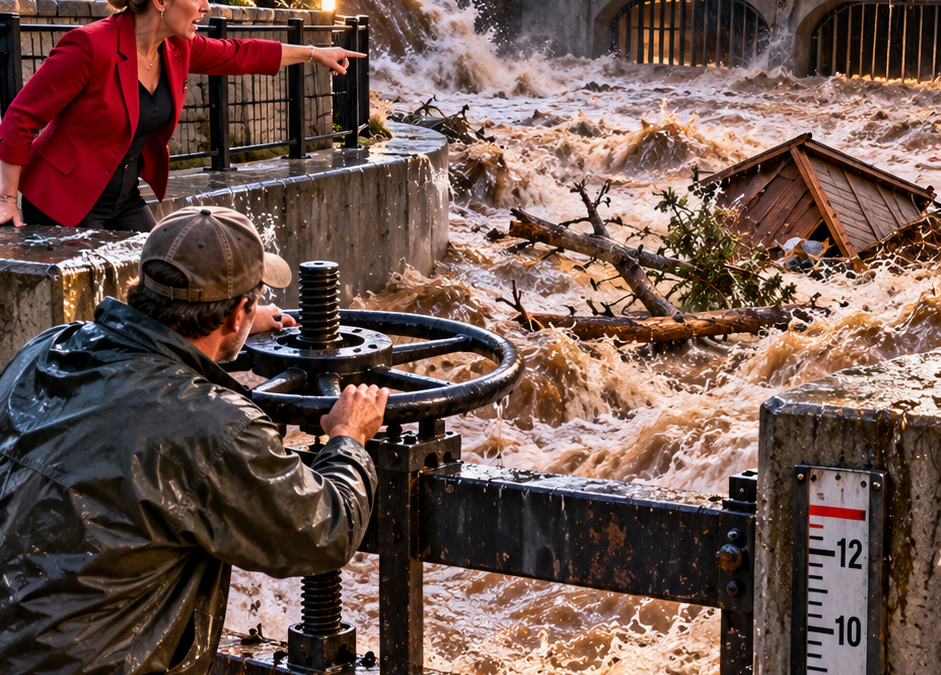
My hand went to the floodgate wheel.
That was the moment the story had been moving toward since I found my fence cut nine days earlier.
Celeste pointed at the gate.
“That channel belongs to the association. Step away.”
I looked upstream.
The water carried fence posts.
Branches.
Pieces of somebody’s shed.
The gauge had climbed fourteen inches in six minutes.
I checked my watch.
“You have eleven minutes.”
“Until what?”
“Until the water finds the route you buried under your clubhouse.”
Celeste stared at me.
Then Priya stepped forward.
“The association does not own this gate.”
Her voice carried over the storm.
“It never did.”
Chief Hale raised one hand.
He did not look at Celeste.
He looked at me.
“Emergency order. Cut it.”
I opened the torch.
The flame caught.
Rain turned to steam around the tip.
I cut into the upper weld while a firefighter attacked the lower section.
The gauge passed thirty-two inches.
Water pressed against the floodgate with a vibration I could feel through my boots.
The steel stop finally broke.
It fell into the mud.
I grabbed the wheel.
It would not turn.
The guide had twisted under the weld.
Ruiz stepped beside me.
“Again.”
We both pushed.
The wheel moved a quarter-turn.
Then another.
The gate rose six inches.
Brown water exploded through the opening.
It hit the emergency channel and raced south.
Exactly where the old maps said it would.
Exactly where the orange survey flags had been placed.
Straight toward the clubhouse.
Inside, guests pulled back from the western windows.
Celeste stared at the water.
“Close it!”
Priya watched the upstream gauge.
“It’s still rising.”
“You’re flooding the building!”
Chief Hale answered.
“We’re lowering the road crossing.”
The distinction mattered.
We were not sending water toward the clubhouse.
The clubhouse had been placed where the water needed to go.
At thirty-eight inches, Hale ordered the gate opened halfway.
The bypass widened.
Water tore ornamental grass from the landscaping.
It struck the raised pool terrace.
For several seconds, the stone wall held.
Then the current found the narrowed opening beneath the fitness wing.
A decorative planter turned sideways.
Broke loose.
Jammed against a support column.
Water backed around it.
Then burst through a glass door.
The clubhouse alarms began flashing.
Firefighters moved guests upstairs and toward the upper drive as tow trucks cleared trapped cars.
Nobody stampeded.
Nobody was abandoned.
The main culvert blocked completely.
The upstream gauge reached forty-one inches.
Later, Priya calculated what would have happened if the bypass had remained closed.
Water would have crossed the entrance road at nearly three feet deep.
Fourteen minutes later, it would have begun reaching the lowest houses on Juniper Court.
Forty-one families.
Instead, the road stayed above water.
The homes remained dry.
The clubhouse did not.
Thirty-one inches of muddy water entered the western wing.
The pool filled with silt.
The fitness floor lifted.
A grand-opening banner tore free, wrapped itself around one of my mother’s old cottonwoods, and stayed there until morning.
But every guest and employee was accounted for.
One hundred ninety-three people.
No deaths.
No missing residents.
No rescue from flooded homes.
The storm eased after seven.
Under portable lights, residents gathered on the upper drive.
They watched water follow the orange flags through darkness.
Ellen Park came to stand beside me.
Her hair was soaked.
Mud covered the bottom of her pants.
“She told us you were going to flood our houses.”
“I know.”
Ellen looked toward the dry entrance road.
Then toward the damaged clubhouse.
“The channel saved them.”
“The channel gave the water somewhere else to go.”
“Isn’t that the same thing?”
I watched the runoff slowly dropping.
“Only if people remember to leave it open.”
The next morning, county investigators entered the clubhouse.
Mud covered the first floor.
The red grand-opening ribbon floated beside a rowing machine.
Water had peeled the Coyote Ridge logo from the reception desk.
Four clean bolt holes remained in the stone behind it.
Celeste arrived with the HOA attorney.
Her hair was pulled back.
She looked exhausted.
But her voice was still controlled.
“The association has suffered an unforeseeable natural disaster caused in part by an unauthorized diversion.”
Priya did not argue.
She gave her numbers.
“The storm was below the design event.”
Celeste said nothing.
“The gate operated under incident command.”
Still nothing.
“The forty-one homes in the modeled risk area remained dry.”
Celeste turned toward her attorney.
“We should not discuss causation in the field.”
For once, he agreed with her for a reason she probably did not appreciate.
The county did not seize records.
It did not need to.
The restraining order already required preservation.
And while the storm was flooding the clubhouse, the board secretary had been making copies.
Her name was Rachel Kim.
She was an accountant.
Quiet.
Careful.
The type of person people overlook because she does not raise her voice.
At 10:30 that morning, Rachel handed Rebecca a flash drive.
“I believed the project had been approved,” she said.
Then she looked toward the mud line inside the clubhouse.
“Last night I watched the water follow the exact route Daniel showed us.”
The drive contained emails.
Invoices.
Meeting minutes.
Engineering reports.
And one missing page.
Six months before construction crossed the swale, Colin Beck had issued a formal design exception report.
Appendix D contained a warning inside a red box.
WESTERN WING SHALL NOT BE OCCUPIED UNTIL THE EMERGENCY FLOW PATH IS RELOCATED BY APPROVED HYDRAULIC REVISION OR THE BUILDING FOOTPRINT IS REDUCED.
The complete report had been emailed to Celeste.
Martin.
And the HOA treasurer.
Then we looked at the version later presented to the board.
Appendix D was gone.
Page 46.
Then page 48.
The warning had not been misunderstood.
It had been removed.
A second email explained why.
Reducing the western wing would lower the clubhouse’s finished square footage enough to jeopardize the valuation promised to the lender.
The HOA would have needed to contribute another $650,000 before closing.
So someone had made a decision.
Finish the building.
Meet the valuation.
Reach the financing deadline.
Deal with the flood corridor later.
The storm arrived first.
Thursday night, residents held the special board meeting in a nearby middle-school gymnasium because the clubhouse had lost its temporary occupancy approval.
Every folding chair was full.
Celeste sat at the center table.
She wore a dark gray suit.
For the first time since I had met her, there was no red.
She opened with a prepared statement.
“This board made difficult decisions based on professional representations. We categorically reject any suggestion that a director knowingly endangered Coyote Ridge residents.”
Rachel walked to the microphone.
She carried Appendix D.
“Why was this page removed from the packet we voted on?”
Celeste looked at the association attorney.
He did not answer.
“The report was preliminary,” Celeste said.
From the back of the gym, Colin Beck stood.
“My warning was final.”
The room went silent.
Celeste turned.
Colin did not sit down.
“The building footprint required revision or the emergency flow path required county approval before occupancy. That was my written position.”
Martin sat several seats away.
His shoulders dropped.
Then he asked to speak.
He admitted Celeste had instructed him to delay access to the welded gate until after the lender’s inspection.
He resigned before the meeting ended.
The board voted four to one to remove Celeste as president and refer the relevant project records to the association’s insurer, construction counsel, and county authorities.
Removing her from office did not establish criminal guilt.
That would be for investigators, attorneys, regulators, and courts to decide if necessary.
But her control over Coyote Ridge ended that night.
The repairs took months.
The county revoked the clubhouse’s temporary occupancy approval.
Independent engineers concluded the western fitness wing and raised terrace had to be removed.
Not repaired.
Removed.
The original sixty-foot emergency corridor had to be restored.
Coyote Ridge could not solve its problem by shifting the channel into my pasture.
The water route stayed where it had been designed.
The contractor’s performance bond, construction coverage, and negotiated claims against several project parties covered most of the correction cost.
Residents still paid a modest assessment for expenses insurance did not cover.
Nobody enjoyed that.
But it was nowhere near the eleven-thousand-dollar figure Celeste had used in her warning letter.
My fence was rebuilt.
A new debris rack was fabricated from updated engineering plans.
The floodgate received new guides.
The county installed a locked emergency-access box.
A remote depth sensor began sending alerts directly to the fire district and HOA.
The settlement reimbursed my repair costs and attorney fees.
But the most important part was not money.
It was one paragraph recorded against the properties involved.
Coyote Ridge had a limited right and duty to inspect and maintain the drainage easement.
It did not own my land.
It did not own the floodgate.
It did not possess the right to relocate the wash simply because a clubhouse had been constructed in its path.
Luis gave investigators his original photographs and emails.
He later recovered the unpaid balance for work he had properly refused to perform.
Colin surrendered the full revision history.
Rachel became interim board president.
One of her first actions was creating a resident-accessible archive for every drainage document connected to the subdivision.
Three months later, Ellen invited me to a safety meeting beside the restored channel.
I nearly refused.
For years, I had kept the story of Eli inside my family.
I never wanted my brother reduced to an engineering lesson.
He had been more than the way he died.
He laughed too loudly.
He hated tomatoes.
He once drove three hours because I told him one of my horses was sick and I needed help through the night.
He was twenty-six.
That should have been enough to describe him.
But forty-one families now lived below the floodgate.
So I brought the old blue binder.
Parents stood beside the new depth sensor.
Children watched the empty wash.
I explained the gate marks.
The debris rack.
The culvert.
The reason emergency channels need space even when they are dry.
Then I told them something my father had taught me before I ever studied engineering.
“A full river looks dangerous.”
I pointed toward the sand.
“A dry wash invites you to believe danger has gone.”
After the meeting, Ellen helped me attach a small metal plaque to the county access post.
It did not carry my name.
It did not list my engineering license.
It did not mention Eli.
It contained six words.
LEAVE THE WATER A WAY THROUGH.
The next monsoon storm came six weeks later.
I woke before sunrise to the sensor alert.
For one second, my body remembered the clubhouse flood before my mind caught up.
I pulled on my boots and drove to the wash.
Rain fell hard over the ridge.
The new debris rack caught two branches.
County dispatch received the same reading I did.
The water climbed.
Then stopped below the first gate mark.
The culvert carried it.
The road stayed dry.
The emergency bypass never needed to open.
No residents gathered.
No deputies arrived.
No angry board president stood beside the gate.
No glass broke.
No homes flooded.
By morning, the channel was almost empty again.
To anyone driving past Coyote Ridge, nothing had happened.
That was the best outcome possible.
Because good flood-control design is rarely remembered for what people see.
It is remembered for the disaster that never arrives.
I stood there for a while after the rain stopped.
Water dripped from the cottonwoods.
The ranch smelled like wet dust and juniper.
For the first time in years, I thought about Eli without imagining his truck.
I thought about the nights we slept in the barn as kids.
About him stealing my boots because his were wet.
About the time he fell into the cattle trough and blamed me even though I had been twenty feet away.
About the things a person is before tragedy reduces them to one final story.
Then I looked downhill.
The western wing of the clubhouse was gone.
Where the fitness center had once stood, the restored overflow corridor crossed the property in a wide, unimpressive strip of stone and native grass.
It was not beautiful in the way Celeste had wanted the entrance to be beautiful.
No brochure photographer would have chosen it.
No lender would have increased a valuation because of it.
But there was room.
Room for water.
Room for mistakes.
Room for the kind of storm people always swear they never expected.
Celeste had believed the most valuable thing at Coyote Ridge was a $4.2 million clubhouse with sunset glass, landscaped terraces, and enough finished square footage to satisfy a financing deadline.
She was wrong.
The most valuable thing had been there before any house was built.
An ugly steel gate.
A clear strip of ground.
And a route the water already knew.
What do you think of this story? Please leave a like and share your thoughts in the comments. Your support means a lot to us and inspires us to keep writing more meaningful and powerful stories. Thank you! 👍
𝗧𝗛𝗘 𝗘𝗡𝗗
The Storm Was Eleven Minutes Away When She Ordered Me to Leave the Gate Closed
“If you open that gate, I’ll have you arrested for destroying HOA property.”
Celeste Harrow shouted the words over the rain as brown water climbed around my boots.
Lightning flashed behind the glass walls of the Coyote Ridge clubhouse, turning the building white for half a second. Through those windows, I could see nearly two hundred people crowded together, watching us from inside a structure that had cost more than four million dollars.
My hand rested on the steel wheel of a floodgate that had been there long before the clubhouse.
Long before Coyote Ridge.
Long before Celeste had ever learned my name.
Upstream, a wall of muddy water was carrying branches, fence posts, and half of somebody’s shed toward us.
The depth gauge had risen fourteen inches in six minutes.
The main culvert beneath the subdivision entrance was already choking.
Celeste pointed at the gate.
“That channel belongs to the association. Step away.”
I looked at the water.
Then at my watch.
“You have eleven minutes.”
Her face hardened.
“Until what?”
“Until the water finds the route you buried under your clubhouse.”
Nine days earlier, that sentence would have sounded like a threat.
By that night, forty-one families would understand it was a measurement.
My name is Daniel Mercer.
I was forty-eight years old when the Coyote Ridge Homeowners Association decided that a drainage easement across my property gave them the right to redesign land my family had owned for generations.
I lived on thirty-eight acres north of Prescott, Arizona, where the pine country breaks into granite shelves, dry grass, juniper, and shallow washes that can remain empty for eleven months and become violent rivers in less than an hour.
My house was nothing special.
The horse barn leaned slightly east because my father and I framed it during a windy spring and were too stubborn to start over.
The western ridge was where he had taught me to read storm clouds.
The east pasture held a row of cottonwoods my mother planted when I was a boy.
And through the center of the property ran a shallow channel everyone called Mercer Wash.
Most of the year, it looked harmless.
Sand.
Rabbitbrush.
Smooth gray stone.
People who move to Arizona often make the same mistake about dry washes.
They see no water and assume there is no danger.
But water remembers.
It remembers elevation.
It remembers channels.
It remembers every low place people tried to fill because a blueprint looked better without it.
Coyote Ridge had been built downhill from my property in three phases.
The first homes appeared in 2012.
By 2026, there were 186 houses, a guarded entrance, two tennis courts, walking paths, stone walls, and a new glass-and-cedar clubhouse built beside the entrance road.
The sales brochure showed an infinity pool glowing at sunset.
A fitness studio.
A terrace overlooking the mountains.
Perfect landscaping.
What it did not show was the overflow swale beneath the western side of the property.
I noticed the first sign of trouble on a Tuesday morning because my horse June refused to cross the lower pasture.
She stopped twenty yards from the wash, lifted her head, and stared toward the cottonwoods.
Horses notice changes before people admit they made them.
I followed her gaze.
Fresh tire tracks crossed my fence line.
Three steel posts had been pulled out.
Twelve feet of wire fencing lay flat in the dust.
Beyond it, somebody had driven a compact excavator onto my land.
I walked toward the wash.
Then I stopped.
The old debris rack was gone.
It had never been pretty.
Five heavy vertical bars stood ahead of a concrete splitter box. During hard storms, the rack caught branches and larger debris before they could jam the main culvert.
Beside it was a waist-high steel floodgate controlled by a hand wheel.
Under normal runoff, the gate stayed closed and water continued toward the main culvert.
When the channel rose above specific thresholds, the gate could be opened in stages, sending excess flow into a broad emergency corridor that curved south through what later became HOA common land.
The rack had been cut off at the base.
Bright metal showed where a torch had passed through the steel.
The floodgate wheel had been wrapped in orange chain.
Bolted to the chain was a white sign.
COYOTE RIDGE HOA PROPERTY
TAMPERING PROHIBITED
I stood there for a long moment.
Then I took out my phone.
I photographed the tire tracks.
The cut bars.
The flattened fence.
The chain.
The sign.
Then I called the number printed at the bottom.
A woman answered on the fourth ring.
“Coyote Ridge Administration.”
“This is Daniel Mercer.”
A short pause.
Then her voice changed.
“Mr. Mercer. Yes. We expected you might call.”
That was my first introduction to Celeste Harrow.
“Your contractor entered my south pasture.”
“We hold a drainage easement.”
“You expected my call, which means you knew the fence was mine.”
“The association has legal access for drainage maintenance.”
“A drainage easement isn’t ownership.”
“Our counsel interprets the documents differently.”
I looked at the missing debris rack.
“Did your counsel tell you to cut out flood-control equipment?”
“That structure was abandoned.”
“It was operational.”
“It conflicts with our channel modernization project.”
I looked at the raw torch marks.
“Modernization usually involves installing something.”
There was a pause.
Then she said, “Aesthetic restoration is part of the project.”
That sentence stayed with me.
She had not said flood improvement.
She had not said capacity.
She had not said safety.
She had said aesthetic restoration.
“Send me the engineered plan.”
“You are not a member of Coyote Ridge.”
“You’re working on my property.”
“We will provide whatever disclosures are legally required.”
“Until then, nobody comes through my fence.”
Her voice became colder.
“Interfering with easement maintenance may expose you to liability.”
“Cutting my fence already exposed somebody to it.”
I ended the call.
An hour later, a black SUV came down my driveway.
Celeste stepped out wearing a red pantsuit and cream-colored boots that probably cost more than my saddle.
She was in her early fifties and carried herself with the controlled precision of someone accustomed to meetings ending the way she wanted.
Beside her was Martin Vale, the HOA’s property manager.
Martin carried a leather folder.
He never once looked directly at the damaged fence.
Celeste handed me a notice.
“Coyote Ridge will resume easement maintenance Friday at seven a.m.”
I read the first paragraph.
It referred to a thirty-foot drainage and access easement recorded in 2011.
Then I saw language I had never seen before.
Exclusive operational control.
I looked up.
“Where did those words come from?”
“The recorded grant.”
“No. The recorded grant says inspection, maintenance, and repair.”
Martin opened his folder.
“Our attorney reviewed the language.”
“Did your attorney visit this property?”
Celeste answered.
“That isn’t necessary to interpret a document.”
“It is if you’re confusing an easement corridor with equipment that isn’t inside it.”
Her eyes moved toward the old floodgate.
“The rusted gate and grate are visual nuisances at the entrance to a premium community.”
“They collect debris.”
“Our new underground drainage system will manage runoff more efficiently.”
“Show me the calculations.”
“The association is not seeking your approval.”
I folded the notice and held it back toward her.
“Then the association can stay off my land.”
She did not take it.
“Mr. Mercer, your property benefits from our roads, our security presence, and the increased property values created by this community even though you pay no assessments.”
I almost laughed.
Instead, I waited.
She continued.
“We have been patient with your fencing, your barn, and the agricultural equipment visible from our entrance. This project improves the appearance of the entire area.”
There it was.
Not safety.
Not drainage.
Appearance.
“My barn was here before your entrance.”
“Communities evolve.”
“Water doesn’t care.”
A faint smile touched her mouth.
“Friday at seven.”
She turned and walked back to the SUV.
That afternoon, I drove to the county recorder’s office.
The original easement was exactly where it should have been.
Filed May 18, 2011.
It granted Coyote Ridge a nonexclusive right to enter a thirty-foot corridor for inspection, maintenance, and repair of a designated drainage facility.
It required forty-eight hours’ notice except during an emergency.
Then came the language Celeste had left out.
The association could not enlarge, relocate, or remove the facility without written approval from both the landowner and the county flood-control district.
More important, the legal description of the easement ended six feet north of the splitter box.
The floodgate itself was outside Coyote Ridge’s easement.
I ordered certified copies.
Then I requested every public filing connected to the new clubhouse.
The clerk returned with nearly two inches of documents.
Building permit.
Electrical.
Pool.
Structural.
Landscaping.
But no final drainage approval.
Instead, I found a conditional site letter issued eighteen months earlier.
The county had approved the clubhouse only if the emergency overflow swale remained open across its full sixty-foot width.
No permanent foundation.
No parking surface.
No landscape berm.
No structure.
Nothing could obstruct the corridor.
I opened the county aerial image.
Then I measured.
The western fitness wing covered twenty-two feet of the required swale.
The raised pool terrace covered another eighteen.
Decorative planters and stonework reduced what remained.
Sixty feet of emergency flow path had become less than twenty.
They had turned a flood corridor into a funnel.
At four that afternoon, I called Priya Nanduri at the county flood-control office.
Priya had been a junior engineer when the original Coyote Ridge plans were reviewed.
She was now deputy director.
“Daniel Mercer,” she said. “I haven’t heard that name in years.”
“I’ve enjoyed the quiet.”
“Quiet is why people move next to dry washes.”
“Somebody chained the Mercer gate and removed the rack.”
The line went silent.
“Who?”
“Coyote Ridge.”
“Why?”
“They say they’re modernizing drainage.”
“There is no approved modernization.”
“I noticed.”
I told her about the clubhouse footprint.
About the missing approval.
About the cut steel.
“Send me photographs,” she said. “Everything.”
“They’re coming back Friday.”
“I can open a field review. I can’t promise an inspector before Monday.”
“There’s weather in the forecast.”
“I saw it.”
Two summers earlier, wildfire had stripped nearly nine square miles of vegetation from the juniper country northwest of us.
Healthy ground can absorb part of a hard storm.
Burned soil often cannot.
Water hits it, runs, gathers ash, branches, rock, and whatever else gravity offers.
A storm that once produced muddy runoff can become a debris flow.
Priya knew exactly what I was thinking.
“Are the original operating marks still visible on the gate?”
“Yes.”
“Is it functional?”
“It was before somebody chained it.”
“Do not operate it unless there is an emergency order. Document everything. Keep people away from the corridor.”
“Understood.”
Before hanging up, she asked, “Does the HOA know who designed the bypass?”
“No.”
“Are you going to tell them?”
I stared at the fresh cuts where the rack had stood.
“Only if facts stop working without a résumé.”
Friday morning, Celeste returned with an excavator, a concrete truck, and two sheriff’s deputies.
I parked my pickup across the opening in my fence.
My certified easement documents sat on the hood.
Celeste stepped out of her SUV.
“You were advised not to obstruct maintenance.”
“And you were advised not to enter my parcel.”
One deputy raised his hand.
His name was Ruiz.
“Let’s slow this down. Ms. Harrow says the HOA has recorded access.”
“It does,” I said. “Six feet north of the equipment they intend to remove. And the easement allows maintenance or repair.”
I pointed toward the concrete truck.
“They brought concrete.”
Ruiz looked toward the contractor.
“What’s the concrete for?”
Celeste answered immediately.
“Stabilization.”
I unfolded a sketch attached to the HOA notice.
A gray rectangle labeled VIEW TERRACE stretched across the wash.
“It’s for bridge footings.”
Celeste’s jaw tightened.
“The bridge is part of the association’s easement rights.”
“Your easement ends over there.”
I pointed toward two blue survey stakes.
“The north footing is twenty-three feet inside my parcel and outside the recorded corridor.”
Ruiz studied the stakes.
Then he looked at Celeste.
“Do you have a court order?”
“We have a recorded property right.”
“That wasn’t my question.”
She said nothing.
Ruiz nodded toward the construction crew.
“This is a civil dispute. Nobody crosses his fence today.”
The contractor let out a breath.
His name was Luis Ortega.
Celeste turned sharply toward him.
“Unload the forms on the HOA side.”
Luis stayed where he was.
“Ms. Harrow, I need the stamped drainage sheet before I pour concrete near that channel.”
“You have the project plans.”
“The set doesn’t contain a drainage approval.”
“Our architect issued a clarification.”
Luis looked toward the floodgate.
“Is that bypass active?”
Celeste answered.
“It is obsolete infrastructure scheduled for removal.”
Luis stared at the fresh torch marks.
“Your office told me the county abandoned it.”
I looked at him.
That was different.
Not misunderstood.
Not outdated.
Abandoned.
Somebody had supplied the contractor with a factual claim that could be checked.
And it was false.
Celeste dismissed the crew.
By noon, the HOA emailed me a demand for $12,800 in contractor delay costs.
An hour later, a second notice arrived.
My barn.
My tractor shed.
My stock trailer.
All declared visual nuisances visible from the Coyote Ridge entrance.
I had ten days to screen or remove them.
I was not a member of Coyote Ridge.
My deed carried no HOA covenant.
The demand had no legitimate enforcement power.
But it did something more valuable.
It documented motive.
I called Rebecca Sloan, a property attorney I had known for several years.
She read both notices.
“This is nonsense.”
“I know.”
“Then why do you sound happy?”
“The first letter called this flood maintenance. The second one complains about how my barn looks from their entrance.”
Rebecca went quiet.
“You think this is about the clubhouse opening?”
“I think drainage was the excuse.”
She tapped the demand letter.
“We can ask for a temporary restraining order.”
“How fast?”
“Monday filing. Maybe Tuesday if the judge sees immediate risk.”
“Storm chance moves in Wednesday.”
“Then we need the county moving too.”
That evening, Luis returned alone.
He stopped outside my gate.
“I’m not here to work.”
“Good start.”
He held up a tablet.
“I think you should see something.”
The photograph was three months old.
It showed the clubhouse before the western wing had been enclosed.
Yellow paint on the ground marked the original sixty-foot overflow corridor.
Concrete footings sat directly across it.
“Who took this?”
“I did.”
Luis explained that he had been hired for landscaping, not the building.
When his crew laid out irrigation, he noticed the channel markings and sent a request for information to the architect.
He opened the email.
The architect’s response was short.
WEST WING CONFLICTS WITH CONDITIONAL DRAINAGE LETTER. REVISED COUNTY APPROVAL REQUIRED BEFORE CONTINUING.
Under it was a response from Celeste.
THIS IS A FIELD CONDITION, NOT A DESIGN CHANGE. PROCEED UNDER EXISTING PERMITS. DO NOT COPY COUNTY UNTIL AS-BUILT REVIEW.
I read it twice.
“Why didn’t you stop?”
“I stopped my scope. They replaced us for three weeks.”
“And then?”
“They brought us back to remove the debris rack and pour bridge footings. We were told the county had vacated the channel.”
“Did they give you proof?”
“A memo from the HOA attorney. No county stamp.”
“Will you give this to the inspector?”
Luis rubbed a hand over his face.
“If I do, they may sue me.”
“If you don’t and someone gets hurt, you’ll remember this conversation.”
He stared at the screen.
Then he nodded.
“Send me the inspector’s name.”
That was the first independent evidence created before our dispute began.
A photograph.
A written warning.
An instruction to continue.
The following day, Coyote Ridge held a resident meeting.
I was not invited.
Five residents called me anyway.
The first was a retired teacher named Ellen Park.
“Ms. Harrow says you’re threatening to divert floodwater into our homes.”
“Did she show you the drainage map?”
“She showed us a photograph of your gate.”
“That wasn’t my question.”
A pause.
“No.”
“The emergency channel runs through HOA common property between the tennis courts and the entrance. It was designed to keep extreme flow away from the houses.”
“She said you built it yourself.”
“The developer built it under county conditions.”
“Then why is it called Mercer Wash?”
“Because water crossed my family’s land before your subdivision existed.”
Another pause.
Then Ellen said quietly, “Celeste says opening the gate would destroy the clubhouse.”
I closed my eyes.
There it was.
The first public admission.
The clubhouse was occupying land the emergency system needed.
“Ask her something for me.”
“What?”
“Ask why a county-approved clubhouse would be destroyed by a county-required drainage system.”
Twenty minutes later, Martin called.
“Mr. Mercer, residents are becoming alarmed by misinformation.”
“Which information?”
“Claims that the clubhouse occupies a flood corridor.”
“It does.”
“That is your interpretation.”
“It’s written in the county site letter.”
Silence.
Then he asked, “Where did you get that?”
“Public records.”
“Those plans were superseded.”
“Send me the superseding approval.”
“I’m not authorized to distribute internal documents.”
“County approvals aren’t internal.”
His voice dropped.
“Daniel, this has gone farther than anyone intended.”
“Then stop.”
“Celeste is prepared to waive the delay charges and withdraw the nuisance notice if you grant a permanent landscaping easement along your south fence.”
“How wide?”
“Forty feet.”
“That includes my cottonwoods.”
“The association would maintain them.”
“And the floodgate?”
“Removed.”
My hand tightened around the phone.
“And the emergency channel?”
“Converted into a landscaped infiltration garden. Our consultants consider the existing bypass excessive.”
“Name the consultant.”
Martin said nothing.
“You want forty feet of my land so residents won’t see my barn from a clubhouse built inside a flood corridor.”
“I’m trying to prevent expensive litigation.”
“Then tell Celeste to stop creating evidence.”
I hung up.
Then I wrote down every word.
That offer explained more than the letters did.
They did not merely want the gate gone.
They needed additional land.
If I granted them a wider easement, they could redraw the emergency route north through my pasture.
The clubhouse could remain where it was.
Their violation would appear to disappear on paper.
They were not trying to move the building away from the water.
They were trying to move the water around the building.
Monday morning, Rebecca filed for the restraining order.
At ten, Priya arrived with a county inspector, survey crew, and two plan sets.
Celeste waited on the HOA side with Martin, the association attorney, and Colin Beck, the civil engineer whose seal appeared on the clubhouse grading plan.
Priya began upstream.
She photographed the missing debris rack.
Measured the chained floodgate.
Then followed the original channel south.
Surveyors placed flags every twenty feet.
Blue marked the main culvert route.
Orange marked the emergency overflow.
I stood silent as the orange line crossed the common land.
Then continued.
Straight beneath the western fitness wing.
One flag.
Another.
Another.
Celeste watched the line materialize.
“Those coordinates are from an outdated concept plan.”
Priya never looked up.
“They are from the recorded final drainage exhibit.”
Colin stepped forward.
“The building footprint changed through field revisions.”
“Show me the approved revision,” Priya said.
“It should be in the county portal.”
“It isn’t.”
“There may be an indexing issue.”
Priya handed him the conditional site letter.
“Your seal is on the acknowledgment.”
Colin studied it.
“I signed the early civil package. The architect controlled final placement.”
Celeste looked at him sharply.
“You certified this project.”
“I certified the grading shown on my sheets. My sheets did not put a fitness wing in the overflow corridor.”
Martin looked from Celeste to Colin.
For the first time, the people who had arrived together stopped facing me.
They faced one another.
The inspector measured the remaining opening beside the decorative planters.
“Eighteen feet, ten inches.”
Priya wrote the number down.
“Required clear width?”
“Sixty feet.”
The association attorney cleared his throat.
“We should distinguish a mapped planning corridor from an active drainage facility.”
Priya finally looked at him.
“The county required the corridor because the main culvert cannot convey the full design flow.”
She pointed northwest.
“The burn scar increases the current runoff risk. It does not erase the original requirement.”
Celeste crossed her arms.
“We were told the Mercer gate is privately operated and therefore unreliable.”
Priya asked the same question I had.
“Who told you?”
Celeste glanced toward Colin.
He shook his head.
“Not me.”
Priya looked at me.
“Daniel, do you still have the operating plan?”
“The signed copy is in my truck.”
I returned with a weathered blue binder.
Inspection logs.
Maintenance photographs.
Annual test notes.
Hydraulic tables.
Priya opened it on the hood of her vehicle.
Celeste laughed quietly.
“You expect the county to rely on a rancher’s personal binder?”
Priya studied the title page.
“This is not a personal binder.”
She turned it toward Celeste.
At the bottom of the page were the words:
DANIEL MERCER, P.E.
HYDRAULIC DESIGNER
Nobody spoke.
Celeste stared at me.
“You’re an engineer.”
“I was.”
“You never disclosed that.”
“You never asked before cutting the equipment.”
The truth was less dramatic than her expression suggested.
I had spent fourteen years in flood-control design, first with a private engineering firm and later as a county consultant.
I had no special authority anymore.
No government badge.
No power to approve my own argument.
What I had was history.
And history was why that gate existed.
In 2008, my younger brother Eli had been driving six miles north of our ranch when a flash flood crossed a low-water road.
His truck was found more than a mile downstream.
He was twenty-six.
People called the storm unpredictable.
That word stayed with me.
Unpredictable.
It sounded cleaner than preventable.
After Eli died, I spent years studying the failures people dismissed as acts of nature when the truth was usually more complicated.
Bad assumptions.
Poor maintenance.
Buildings placed where water needed to travel.
Warnings softened until nobody felt responsible for ignoring them.
When the original Coyote Ridge developer submitted plans, the main culvert was not large enough to safely carry the entire extreme flow.
I designed the backup system.
A debris rack.
A splitter gate.
A broad emergency overflow route.
The developer hated the cost.
The county supported the requirement.
My father granted the narrow maintenance easement on one condition:
The emergency system could not be removed or relocated unless both the county and the landowner agreed in writing.
After my father suffered a stroke, I left engineering and returned to the ranch.
But every spring, I tested that gate.
Because safety systems do not remain safe merely because the person who designed them leaves.
Celeste stared at my name in the binder.
“You have a financial interest in defending your own design.”
Priya closed the binder.
“His ownership does not change the hydraulic model.”
“Models can be wrong.”
“Yes,” Priya said. “Which is why we compare them with field conditions.”
She looked at the clubhouse.
“Your field condition is worse.”
The inspector issued an immediate stop-work order covering the bridge, landscaping, and all work inside the drainage corridor.
The HOA was ordered to restore access to the floodgate and produce all project revisions within forty-eight hours.
That should have ended the immediate fight.
Instead, Celeste escalated it.
That afternoon, Coyote Ridge residents received a seven-page emergency bulletin.
It described me as a former consultant with an undisclosed conflict who was using obsolete plans to threaten the community’s central amenity.
It warned that the county shutdown could trigger a two-million-dollar construction loss and a special assessment of up to eleven thousand dollars per household.
My name appeared fourteen times.
Then I reached the paragraph about Eli.
Celeste described my brother’s death as the source of my “personal fixation on exaggerated flood scenarios.”
I stopped reading.
For several minutes, I sat alone at my kitchen table.
There are insults you can answer.
There are lies you can correct.
Then there are things people take from your life because they believe everything becomes usable once it enters a dispute.
I had spent eighteen years learning how to say Eli’s name without returning to the morning a deputy knocked on our door.
Celeste had turned him into a paragraph.
Ellen forwarded me the bulletin with one sentence.
She should not have written that.
She was right.
But anger was what Celeste needed from me.
If I screamed at a board meeting, threatened anyone, or operated that gate without authority, she could make the issue about me.
A grieving brother.
An angry neighbor.
An engineer obsessed with an old design.
So I gave the residents three documents.
The recorded drainage exhibit.
The county’s conditional site letter.
The stop-work order.
My message contained eleven words.
The orange corridor crosses the building. Please read the dates yourself.
By Tuesday morning, twenty-seven residents had demanded a special board meeting.
Celeste scheduled it for Thursday night.
After the clubhouse grand opening.
That timing was not accidental.
Rebecca found the reason in a board packet obtained through a resident records request.
The HOA’s construction loan required a certificate of substantial completion by midnight Wednesday.
Miss the deadline and the lender could withhold the final $800,000.
The grand opening was not merely a celebration.
It was a financing deadline.
The same packet contained another number.
$312,000.
Drainage aesthetic mitigation.
There was no hydraulic study attached.
No flood-control fee.
No approved capacity analysis.
The money had purchased stone walls, mature landscaping, bridge foundations, and the raised terrace that constricted the overflow path.
Coyote Ridge had spent more than three hundred thousand dollars making a flood-control system less visible.
And less capable of doing its job.
Tuesday afternoon, the judge granted our temporary restraining order.
The HOA could inspect and maintain its recorded easement.
It could not remove, relocate, cover, chain, obstruct, or disable the flood-control structures.
It had to repair my fence.
It had to preserve its project records.
Deputy Ruiz served the order at 5:20.
At six, I walked to the gate.
The orange chain was gone.
For one moment, I thought Celeste had finally backed down.
Then I saw the steel.
Someone had welded a stop directly across the guide rail.
The gate could rise about three inches.
No more.
Fresh grinding dust lay on the concrete.
I stared at it.
Technically, the chain had been removed.
Functionally, the gate had been disabled.
I called Ruiz.
Priya.
Rebecca.
Then I installed two trail cameras.
At 2:13 Wednesday morning, one camera recorded Martin Vale walking down from the clubhouse.
He carried a cordless work light.
He knelt beside the welded stop.
Photographed it.
Made a phone call.
At 2:21, the camera microphone captured eight words.
“It’s fixed in place. She said leave it.”
Martin had not welded the stop.
But he had found it.
He knew the restraining order required the gate to remain operable.
And he chose silence.
At seven Wednesday morning, the National Weather Service upgraded the forecast.
Slow-moving thunderstorms were expected over the juniper burn scar after four p.m.
Rainfall intensity could exceed two inches per hour.
Priya immediately convened a call with the sheriff’s office, fire district, public works, and HOA management.
Celeste joined from the clubhouse.
“We have one hundred ninety confirmed guests tonight,” she said. “Cancelling because of a forecast would create unnecessary panic and jeopardize contractual obligations.”
Fire Chief Marcus Hale answered.
“This is not a cancellation discussion. It is an access and evacuation discussion.”
“The clubhouse meets occupancy code.”
“Your entrance crosses a drainage path.”
“The road is elevated.”
“And the culvert is missing its debris rack.”
Celeste looked toward my image on the call.
“Mr. Mercer claims that rack is essential. Our maintenance consultant says it contributes to blockage.”
Priya asked, “Name the consultant.”
Silence.
Again.
I shared the original operating chart from the blue binder.
“At twenty-four inches on the upstream gauge, the gate opens one-quarter.”
I moved down the table.
“At thirty-two, halfway.”
Then the final threshold.
“At forty inches, fully open. Excess water moves south through the emergency corridor.”
Celeste leaned toward her camera.
“Directly through our fitness wing.”
“Now it does.”
“If that gate opens, the association’s building will be deliberately damaged.”
Chief Hale cut in.
“If the threshold is reached, incident command decides what opens. The building is not the priority.”
Celeste’s face tightened.
“There are no homes at risk.”
I brought up the inundation map.
“If the main culvert blocks and the bypass remains closed, water backs across the entrance and moves east toward Juniper Court.”
I highlighted the lowest contour.
“Forty-one homes sit below that elevation.”
“That is a theoretical model.”
“So is every evacuation map until the water arrives.”
Chief Hale ordered Coyote Ridge to keep the lower parking lot empty and maintain clear access to both exits.
Priya arranged for a county crew to remove the welded stop that afternoon.
At eleven, the crew arrived.
The HOA access gate was padlocked.
Behind it, a landscaping truck had been parked sideways.
Martin claimed he could not find the keys.
By the time Ruiz arrived and ordered the truck moved, lightning had entered the area.
County rules prohibited outdoor metal work during an active electrical storm.
The steel stop remained.
That was when I understood Celeste no longer needed to prove she was right.
She only needed time.
If the clubhouse could survive until the lender’s inspection and grand opening were complete, the project would become harder to undo.
At 3:45, guests began arriving.
The sky over the ridge was dark blue, almost black.
The clubhouse glowed gold through the storm light.
Valets filled the upper parking area.
A string quartet played beneath the covered terrace.
Through binoculars from my property, I saw Celeste greeting residents in her scarlet suit.
Beside her stood the lender’s representative.
At 4:12, my phone issued a flash-flood warning.
At 4:17, the first hard rain struck the barn roof.
At 4:23, Chief Hale called.
“We’re activating the wash plan. Meet us at the gate.”
I pulled on my rain gear and drove south.
By the time I reached the lower pasture, the hills had disappeared behind sheets of rain.
Water crossed the ground in braided streams.
The upstream gauge read eighteen inches.
Priya arrived in a county truck.
Ruiz followed.
Two firefighters carried a hydraulic cutter toward the welded stop.
On the HOA side, the access gate was finally open.
Celeste stood there wearing a red rain shell over the same scarlet suit from the party.
“You are disrupting a private event,” she shouted.
Hale walked past her.
“The event is over. Begin evacuation.”
“The warning is for the burn scar, not Coyote Ridge.”
“This wash drains the burn scar.”
Priya looked at her tablet.
“Miller Canyon just recorded 1.8 inches in twenty-two minutes.”
Celeste glanced toward the clubhouse.
“We have elderly residents inside. Sending them into heavy rain is more dangerous.”
“Move them through the upper exit.”
Martin appeared at the clubhouse door.
“The upper exit is blocked.”
Everyone turned.
Hale stared at him.
“Blocked by what?”
“Valet parking.”
“How many vehicles?”
“Two rows.”
“Move them.”
“Some drivers have the keys.”
Celeste closed her eyes.
Just for one second.
The grand opening intended to certify the building as complete had turned the emergency exit into a parking aisle.
Hale requested additional units.
The gauge climbed to twenty-two inches.
Firefighters positioned the hydraulic cutter against the welded stop.
The tool bit into the steel.
Slipped.
Sparks scattered into the rain.
Then a branch came down the wash.
It hit the place where the debris rack should have been and entered the main culvert sideways.
Three more branches followed.
The water rose six inches in less than two minutes.
“Twenty-eight!” Priya shouted.
Hale pointed toward the gate.
“As soon as that steel is removed, open it one-quarter.”
Celeste grabbed his arm.
“You cannot send water into an occupied building.”
He pulled free.
“Your building is occupying a flood channel.”
The cutter screamed again.
The stop bent.
But it did not break.
One firefighter crouched closer.
“They welded it into the guide. We need the spreader.”
“Where is it?”
“On the engine.”
The engine was trapped behind vehicles still trying to leave the entrance road.
I looked at the rising gauge.
Then I ran toward my truck.
Inside the toolbox was my father’s old portable oxyacetylene torch.
Heavy.
Ugly.
Maintained because ranch equipment usually fails after the hardware store closes.
Ruiz helped me carry it through the water.
Celeste stepped between us and the gate.
“If he cuts that, I want it recorded that he is acting against the association’s explicit objection.”
Ruiz pointed to the body camera on his chest.
“It’s recorded.”
“I will have him arrested for criminal damage.”
Lightning flashed.
For a white second, the entire clubhouse reflected in the floodwater.
Hundreds of eyes watched us through glass.
My hand went to the floodgate wheel.
That was the moment the story had been moving toward since I found my fence cut nine days earlier.
Celeste pointed at the gate.
“That channel belongs to the association. Step away.”
I looked upstream.
The water carried fence posts.
Branches.
Pieces of somebody’s shed.
The gauge had climbed fourteen inches in six minutes.
I checked my watch.
“You have eleven minutes.”
“Until what?”
“Until the water finds the route you buried under your clubhouse.”
Celeste stared at me.
Then Priya stepped forward.
“The association does not own this gate.”
Her voice carried over the storm.
“It never did.”
Chief Hale raised one hand.
He did not look at Celeste.
He looked at me.
“Emergency order. Cut it.”
I opened the torch.
The flame caught.
Rain turned to steam around the tip.
I cut into the upper weld while a firefighter attacked the lower section.
The gauge passed thirty-two inches.
Water pressed against the floodgate with a vibration I could feel through my boots.
The steel stop finally broke.
It fell into the mud.
I grabbed the wheel.
It would not turn.
The guide had twisted under the weld.
Ruiz stepped beside me.
“Again.”
We both pushed.
The wheel moved a quarter-turn.
Then another.
The gate rose six inches.
Brown water exploded through the opening.
It hit the emergency channel and raced south.
Exactly where the old maps said it would.
Exactly where the orange survey flags had been placed.
Straight toward the clubhouse.
Inside, guests pulled back from the western windows.
Celeste stared at the water.
“Close it!”
Priya watched the upstream gauge.
“It’s still rising.”
“You’re flooding the building!”
Chief Hale answered.
“We’re lowering the road crossing.”
The distinction mattered.
We were not sending water toward the clubhouse.
The clubhouse had been placed where the water needed to go.
At thirty-eight inches, Hale ordered the gate opened halfway.
The bypass widened.
Water tore ornamental grass from the landscaping.
It struck the raised pool terrace.
For several seconds, the stone wall held.
Then the current found the narrowed opening beneath the fitness wing.
A decorative planter turned sideways.
Broke loose.
Jammed against a support column.
Water backed around it.
Then burst through a glass door.
The clubhouse alarms began flashing.
Firefighters moved guests upstairs and toward the upper drive as tow trucks cleared trapped cars.
Nobody stampeded.
Nobody was abandoned.
The main culvert blocked completely.
The upstream gauge reached forty-one inches.
Later, Priya calculated what would have happened if the bypass had remained closed.
Water would have crossed the entrance road at nearly three feet deep.
Fourteen minutes later, it would have begun reaching the lowest houses on Juniper Court.
Forty-one families.
Instead, the road stayed above water.
The homes remained dry.
The clubhouse did not.
Thirty-one inches of muddy water entered the western wing.
The pool filled with silt.
The fitness floor lifted.
A grand-opening banner tore free, wrapped itself around one of my mother’s old cottonwoods, and stayed there until morning.
But every guest and employee was accounted for.
One hundred ninety-three people.
No deaths.
No missing residents.
No rescue from flooded homes.
The storm eased after seven.
Under portable lights, residents gathered on the upper drive.
They watched water follow the orange flags through darkness.
Ellen Park came to stand beside me.
Her hair was soaked.
Mud covered the bottom of her pants.
“She told us you were going to flood our houses.”
“I know.”
Ellen looked toward the dry entrance road.
Then toward the damaged clubhouse.
“The channel saved them.”
“The channel gave the water somewhere else to go.”
“Isn’t that the same thing?”
I watched the runoff slowly dropping.
“Only if people remember to leave it open.”
The next morning, county investigators entered the clubhouse.
Mud covered the first floor.
The red grand-opening ribbon floated beside a rowing machine.
Water had peeled the Coyote Ridge logo from the reception desk.
Four clean bolt holes remained in the stone behind it.
Celeste arrived with the HOA attorney.
Her hair was pulled back.
She looked exhausted.
But her voice was still controlled.
“The association has suffered an unforeseeable natural disaster caused in part by an unauthorized diversion.”
Priya did not argue.
She gave her numbers.
“The storm was below the design event.”
Celeste said nothing.
“The gate operated under incident command.”
Still nothing.
“The forty-one homes in the modeled risk area remained dry.”
Celeste turned toward her attorney.
“We should not discuss causation in the field.”
For once, he agreed with her for a reason she probably did not appreciate.
The county did not seize records.
It did not need to.
The restraining order already required preservation.
And while the storm was flooding the clubhouse, the board secretary had been making copies.
Her name was Rachel Kim.
She was an accountant.
Quiet.
Careful.
The type of person people overlook because she does not raise her voice.
At 10:30 that morning, Rachel handed Rebecca a flash drive.
“I believed the project had been approved,” she said.
Then she looked toward the mud line inside the clubhouse.
“Last night I watched the water follow the exact route Daniel showed us.”
The drive contained emails.
Invoices.
Meeting minutes.
Engineering reports.
And one missing page.
Six months before construction crossed the swale, Colin Beck had issued a formal design exception report.
Appendix D contained a warning inside a red box.
WESTERN WING SHALL NOT BE OCCUPIED UNTIL THE EMERGENCY FLOW PATH IS RELOCATED BY APPROVED HYDRAULIC REVISION OR THE BUILDING FOOTPRINT IS REDUCED.
The complete report had been emailed to Celeste.
Martin.
And the HOA treasurer.
Then we looked at the version later presented to the board.
Appendix D was gone.
Page 46.
Then page 48.
The warning had not been misunderstood.
It had been removed.
A second email explained why.
Reducing the western wing would lower the clubhouse’s finished square footage enough to jeopardize the valuation promised to the lender.
The HOA would have needed to contribute another $650,000 before closing.
So someone had made a decision.
Finish the building.
Meet the valuation.
Reach the financing deadline.
Deal with the flood corridor later.
The storm arrived first.
Thursday night, residents held the special board meeting in a nearby middle-school gymnasium because the clubhouse had lost its temporary occupancy approval.
Every folding chair was full.
Celeste sat at the center table.
She wore a dark gray suit.
For the first time since I had met her, there was no red.
She opened with a prepared statement.
“This board made difficult decisions based on professional representations. We categorically reject any suggestion that a director knowingly endangered Coyote Ridge residents.”
Rachel walked to the microphone.
She carried Appendix D.
“Why was this page removed from the packet we voted on?”
Celeste looked at the association attorney.
He did not answer.
“The report was preliminary,” Celeste said.
From the back of the gym, Colin Beck stood.
“My warning was final.”
The room went silent.
Celeste turned.
Colin did not sit down.
“The building footprint required revision or the emergency flow path required county approval before occupancy. That was my written position.”
Martin sat several seats away.
His shoulders dropped.
Then he asked to speak.
He admitted Celeste had instructed him to delay access to the welded gate until after the lender’s inspection.
He resigned before the meeting ended.
The board voted four to one to remove Celeste as president and refer the relevant project records to the association’s insurer, construction counsel, and county authorities.
Removing her from office did not establish criminal guilt.
That would be for investigators, attorneys, regulators, and courts to decide if necessary.
But her control over Coyote Ridge ended that night.
The repairs took months.
The county revoked the clubhouse’s temporary occupancy approval.
Independent engineers concluded the western fitness wing and raised terrace had to be removed.
Not repaired.
Removed.
The original sixty-foot emergency corridor had to be restored.
Coyote Ridge could not solve its problem by shifting the channel into my pasture.
The water route stayed where it had been designed.
The contractor’s performance bond, construction coverage, and negotiated claims against several project parties covered most of the correction cost.
Residents still paid a modest assessment for expenses insurance did not cover.
Nobody enjoyed that.
But it was nowhere near the eleven-thousand-dollar figure Celeste had used in her warning letter.
My fence was rebuilt.
A new debris rack was fabricated from updated engineering plans.
The floodgate received new guides.
The county installed a locked emergency-access box.
A remote depth sensor began sending alerts directly to the fire district and HOA.
The settlement reimbursed my repair costs and attorney fees.
But the most important part was not money.
It was one paragraph recorded against the properties involved.
Coyote Ridge had a limited right and duty to inspect and maintain the drainage easement.
It did not own my land.
It did not own the floodgate.
It did not possess the right to relocate the wash simply because a clubhouse had been constructed in its path.
Luis gave investigators his original photographs and emails.
He later recovered the unpaid balance for work he had properly refused to perform.
Colin surrendered the full revision history.
Rachel became interim board president.
One of her first actions was creating a resident-accessible archive for every drainage document connected to the subdivision.
Three months later, Ellen invited me to a safety meeting beside the restored channel.
I nearly refused.
For years, I had kept the story of Eli inside my family.
I never wanted my brother reduced to an engineering lesson.
He had been more than the way he died.
He laughed too loudly.
He hated tomatoes.
He once drove three hours because I told him one of my horses was sick and I needed help through the night.
He was twenty-six.
That should have been enough to describe him.
But forty-one families now lived below the floodgate.
So I brought the old blue binder.
Parents stood beside the new depth sensor.
Children watched the empty wash.
I explained the gate marks.
The debris rack.
The culvert.
The reason emergency channels need space even when they are dry.
Then I told them something my father had taught me before I ever studied engineering.
“A full river looks dangerous.”
I pointed toward the sand.
“A dry wash invites you to believe danger has gone.”
After the meeting, Ellen helped me attach a small metal plaque to the county access post.
It did not carry my name.
It did not list my engineering license.
It did not mention Eli.
It contained six words.
LEAVE THE WATER A WAY THROUGH.
The next monsoon storm came six weeks later.
I woke before sunrise to the sensor alert.
For one second, my body remembered the clubhouse flood before my mind caught up.
I pulled on my boots and drove to the wash.
Rain fell hard over the ridge.
The new debris rack caught two branches.
County dispatch received the same reading I did.
The water climbed.
Then stopped below the first gate mark.
The culvert carried it.
The road stayed dry.
The emergency bypass never needed to open.
No residents gathered.
No deputies arrived.
No angry board president stood beside the gate.
No glass broke.
No homes flooded.
By morning, the channel was almost empty again.
To anyone driving past Coyote Ridge, nothing had happened.
That was the best outcome possible.
Because good flood-control design is rarely remembered for what people see.
It is remembered for the disaster that never arrives.
I stood there for a while after the rain stopped.
Water dripped from the cottonwoods.
The ranch smelled like wet dust and juniper.
For the first time in years, I thought about Eli without imagining his truck.
I thought about the nights we slept in the barn as kids.
About him stealing my boots because his were wet.
About the time he fell into the cattle trough and blamed me even though I had been twenty feet away.
About the things a person is before tragedy reduces them to one final story.
Then I looked downhill.
The western wing of the clubhouse was gone.
Where the fitness center had once stood, the restored overflow corridor crossed the property in a wide, unimpressive strip of stone and native grass.
It was not beautiful in the way Celeste had wanted the entrance to be beautiful.
No brochure photographer would have chosen it.
No lender would have increased a valuation because of it.
But there was room.
Room for water.
Room for mistakes.
Room for the kind of storm people always swear they never expected.
Celeste had believed the most valuable thing at Coyote Ridge was a $4.2 million clubhouse with sunset glass, landscaped terraces, and enough finished square footage to satisfy a financing deadline.
She was wrong.
The most valuable thing had been there before any house was built.
An ugly steel gate.
A clear strip of ground.
And a route the water already knew.

