𝗙𝗨𝗟𝗟 𝗦𝗧𝗢𝗥𝗬 The Silent Hive at the Edge of My Meadow Was the One They Never Expected Me to Notice
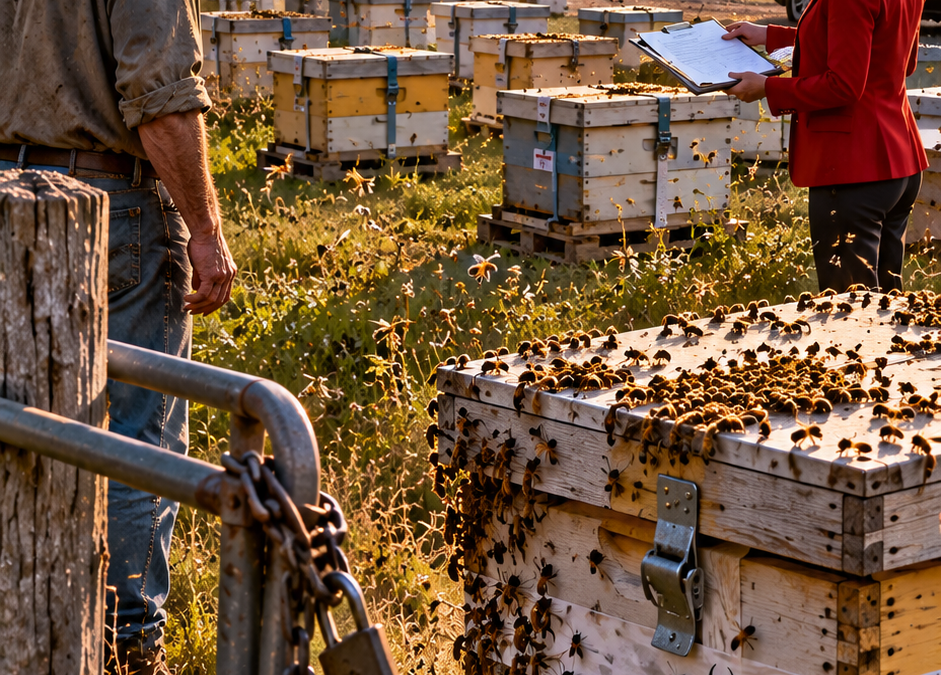
𝗙𝗨𝗟𝗟 𝗦𝗧𝗢𝗥𝗬
She opened her SUV, removed a folder, and held it toward me.
I did not take it immediately.
“Who cut my lock?”
Her expression barely changed.
“Mr. Mercer, there was a time-sensitive environmental issue.”
“You cut my lock?”
“The contractor needed access.”
“That wasn’t my question.”
She extended the folder farther.
“You should review the paperwork.”
I took it.
The first sheet was an invoice.
$7,200.
Below the amount were the words:
EMERGENCY POLLINATOR CONTAINMENT AND RECEIVING SITE PREPARATION.
I looked over my shoulder at the broken hive lying crooked in dead grass.
“What preparation?”
Celeste said nothing.
“You cut a chain at four in the morning and dumped sixty-three colonies in a dry meadow.”
“Your property is listed as a registered apiary.”
“It hasn’t operated in eight years.”
“That isn’t what our consultant found.”
She tapped the bottom of the next page.
There was a signature.
My name.
Wade Mercer.
The shape was close enough that somebody who had seen my signature could imitate it.
But it was not mine.
According to the document, I had agreed three months earlier to receive all sixty-three colonies.
I looked up.
“I never signed this.”
Celeste sighed as if I were making an administrative task unnecessarily difficult.
“You have seventy-two hours to execute the permanent care agreement.”
“And if I don’t?”
“Sunrest Ridge will notify the county that your property is operating an unmanaged biological hazard.”
She glanced at the bees.
“We will also seek recovery of association expenses.”
“You’re billing me for hives you put on my land without permission?”
“You accepted the relocation.”
“I just told you I didn’t.”
Her eyes moved toward the sky.
The first pale shimmer of heat already hung above the eastern ridge.
“I suggest you decide quickly.”
She turned toward the SUV.
I called after her.
“Celeste.”
She stopped.
“Who owns these colonies?”
For the first time, she hesitated.
Then she opened the driver’s door.
“They’re your responsibility now.”
She drove away.
I should have called my attorney immediately.
I should have called the sheriff and stood beside the cut chain until a deputy arrived.
Instead, I walked toward the broken hive.
Old habits took over before anger could.
The workers near the entrance were moving badly.
Some spun in tight circles.
Others dragged their legs across the landing board.
Dead bees formed a scattered gray-black layer beneath the pallet.
I crouched.
A faint residue clung to several bodies.
This was not ordinary transport stress.
Something had happened to them before they reached my farm.
I waited for the cluster near the crack to shift.
For half a second, I saw the queen.
A blue dot marked her thorax.
Beside it was a tiny identification code.
HDH.
My stomach tightened.
I had seen that marking seventeen years earlier.
Celeste thought she had dumped sixty-three ordinary beehives on an old farmer’s property.
She had no idea what that blue mark meant.
I decided not to educate her.
Not yet.
My name is Wade Mercer.
I was sixty-two that summer, and I owned ninety-four acres outside the northern edge of Sunrest Ridge, Idaho.
The development had 412 homes, a golf course, two artificial ponds, landscaped walking paths, and a stone entrance large enough to make visitors believe the mountains belonged to the HOA.
My side of the fence looked different.
A weathered farmhouse.
A hay barn.
Old irrigation pipe.
Cottonwoods.
And almost thirty acres of wildflowers my wife, Ellie, had planted around the teaching apiary we once operated together.
Eight years earlier, after Ellie died, I sold most of our colonies.
I locked the teaching shed.
I allowed the apiary registration to lapse.
I could not bring myself to plow her meadow under.
But I could not bring myself to work it either.
So I left it alone.
Celeste interpreted silence as weakness.
Over the years, Sunrest Ridge had sent me landscaping notices, noise complaints, and demands that I maintain parts of my property according to association standards.
My farm was not inside the association.
I answered every letter the same way.
Parcel number.
Recorded boundary.
No HOA jurisdiction.
Usually that ended the conversation.
But the bees were different.
They were alive.
They were already suffering.
And the heat was coming.
I called county dispatch and reported the cut chain, trespass, and unauthorized delivery.
Then I called Dr. Lena Ortiz with the Idaho Department of Agriculture.
Lena had known me for years.
She was now the regional apiary coordinator.
She answered on the second ring.
“Wade?”
“I have sixty-three colonies sitting in my east meadow.”
Silence.
“How many?”
“Sixty-three.”
“Say that again.”
“Sixty-three. At least one queen is marked HDH.”
The silence lasted longer this time.
“Do not open another hive.”
“I haven’t opened any.”
“Do not move anything off-site. Photograph every entrance, pallet, seal, vehicle track, and document they left.”
“Lena, we’re about seventy-two hours from a hundred and eight degrees.”
“You can provide emergency water and external shade without taking ownership or breaking quarantine.”
I looked at the rows.
“You’re coming?”
“I’m leaving now.”
Then her voice changed.
“Wade?”
“Yeah?”
“Who knew your old apiary registration number?”
I looked at Celeste’s forged document.
“Someone at Sunrest Ridge.”
While I waited, I checked my trail cameras.
I kept three along the east fence because deer regularly pushed through that corner.
The first camera showed the flatbed arriving at 3:42 a.m.
The second showed a man at my gate.
He tried the padlock.
When it did not open, he took bolt cutters from the truck and cut the secondary chain.
The third camera showed Celeste’s black SUV parked on the county road twelve minutes before the first hive crossed my boundary.
There had been no emergency discovery.
No confusion.
No contractor improvisation.
There had been a schedule.
The truck made four trips.
On the final trip, one worker held a clipboard while another photographed the rows.
Celeste stood behind them directing where pallets should go.
At 5:06, she photographed my old apiary sign.
At 5:11, she sent a worker back to straighten it.
I replayed that clip.
The sign had hung crooked for years.
Nobody cared.
Except somebody who needed photographs showing sixty-three colonies delivered to what appeared to be an operating apiary.
That disturbed me more than the invoice.
Lena arrived shortly after seven with an animal-health technician and sealed sampling equipment.
She did not walk directly into the rows.
She stopped at the gate and watched.
After less than a minute, she said, “You were right.”
“About exposure?”
She nodded.
Three entrances showed trembling workers.
Several bees extended their proboscises against bare wood as if desperately searching for moisture.
Others stumbled in ways inconsistent with ordinary relocation stress.
We established a clean path along the north side.
Lena collected dead workers, wax scrapings, pollen, and residue from pallet straps.
Every sample went into a labeled container.
Every container went onto a chain-of-custody sheet.
Then we reached the queen I had seen.
Lena inspected through the damaged observation gap.
Her expression changed.
“That’s an HDH queen.”
“I know.”
“This line was supposed to remain under the High Desert Pollinator Cooperative.”
“The commercial cooperative closed.”
“The commercial company closed,” Lena said. “The genetic registry didn’t.”
That distinction changed everything.
The breeding line had not become abandoned property when the operator shut down.
Custody had passed to a successor agricultural trust.
Those colonies could not simply be sold, divided, transferred, or abandoned without authorization.
Lena checked the remaining rows.
Fourteen hives carried the same blue queen identification.
Nine carried orange seals associated with a university trial.
The other forty appeared to be conventional commercial pollination colonies.
Several showed symptoms similar to the broken hive.
“Where were these kept?” I asked.
“I don’t know yet.”
I handed her Celeste’s folder.
She read the supposed transfer document twice.
“This isn’t an apiary transfer certificate.”
“She called it one.”
“It’s a receiving-site acknowledgement prepared by a private environmental consultant.”
“So it doesn’t authorize movement.”
“Not under the state program.”
I looked toward the rooftops of Sunrest Ridge visible beyond the cottonwoods.
“Then why use my expired registration?”
Lena followed my eyes.
“Because somebody needed these bees to arrive somewhere that looked legitimate.”
By noon, the temperature hit ninety-six.
I stretched shade cloth above the most exposed rows.
I connected a solar pump to an old irrigation line and placed shallow water trays around the meadow.
Each tray had floating stones so bees could land and drink without drowning.
Lena approved every step in writing.
To an outsider, the paperwork might have looked ridiculous.
It was not.
When an organization wants to rewrite what happened, memories are fragile.
Timestamps are stronger.
At two that afternoon, Celeste returned.
This time, Sunrest Ridge property manager Trent Barlo came with her.
Trent carried a camera.
His boots looked as though they had been purchased that morning.
Celeste stopped when she saw the shade cloth.
“You altered the site.”
“I kept the bees alive.”
“You were instructed not to interfere with HOA property.”
I stared at her.
“This morning they were my responsibility.”
Trent lowered his camera.
Celeste caught herself.
“The association retains a management interest until transfer is completed.”
A voice came from behind the rows.
“There is no completed transfer.”
Lena stepped into view.
Celeste recognized the state emblem on her shirt.
Something shifted in her face.
“Who called you?”
“The receiving landowner.”
“This is a private civil matter.”
“Controlled colonies crossed inspection areas without required documentation.”
Celeste glanced at Trent.
Trent looked at the ground.
Then Celeste asked a question that told me more than she intended.
“Have you photographed the queen markings?”
Lena tilted her head.
“Why would that concern you?”
Celeste closed her folder.
“It doesn’t.”
She left.
She never asked whether the bees were alive.
She never asked about the broken hive.
She never asked whether the extreme heat might kill them.
She wanted to know whether Lena had seen the blue dots.
That evening, a courier came to my front door.
Sunrest Ridge had sent a cease-and-desist notice.
According to the letter, I was obstructing an environmental relocation, interfering with association assets, and creating a public nuisance by allowing bees near the county trail.
The letter demanded that I remove my shade structures and give the HOA unrestricted access from six in the morning until eight at night.
Attached to it was a site map.
My east meadow was shaded green.
MERCER RECEIVING APIARY.
A dashed route ran from the Sunrest Ridge golf course across the county road, through my gate, and directly to the rows of hives.
The map was dated eleven weeks earlier.
I stared at the date.
I had been in Oregon that week.
My sister had died.
I had spent those days at her funeral.
The following morning, attorney Mara Park sat at my kitchen table.
I had known Mara’s father for years, but I had never needed her professionally.
She read the cease-and-desist letter.
Reviewed my deed.
Then watched every trail-camera clip without interrupting.
Finally, she closed her laptop.
“Do you want the bees?”
“That isn’t the issue.”
“It is the first question a judge or hearing officer may ask.”
I looked through the kitchen window.
The white hive boxes sat beneath the shade cloth.
“I want them alive. I am not claiming ownership. I want whoever actually owns them identified. And I want Sunrest Ridge off my property.”
Mara nodded.
“Good. That keeps the case clean.”
She laid three fingers on the table.
“We need three things first. Proof of unauthorized entry. Proof you never accepted the transfer. And an official determination of lawful custody.”
“The cameras prove entry.”
“Your Oregon records can help with consent.”
“And ownership?”
“State regulators and the agricultural trust.”
Then Mara returned to the green site map.
She studied the corner.
“This wasn’t made just to relocate bees.”
“What do you mean?”
She pointed to a revision number.
“Environmental consultants don’t usually create eleven revisions of a simple receiving-site diagram.”
She opened the county planning portal.
Within minutes, we found the project.
SOLARA WELLNESS CENTER.
An $18.4 million private fitness, spa, restaurant, and event complex planned beside the Sunrest Ridge golf course.
The public summary described tennis courts.
A heated pool.
Additional parking.
A glass event hall.
Private dining.
It did not mention bees.
The detailed environmental attachments were still under staff review.
Mara requested them.
That afternoon, the heat passed one hundred degrees.
Bees gathered outside the hive entrances in thick living beards as they tried to cool the brood inside.
I checked water trays every hour.
Then the solar pump lost pressure.
Somewhere underground, the old irrigation line had cracked.
I was digging along the line when a pickup stopped at my gate.
A young woman climbed out carrying two cases of bottled water and a coil of hose.
“Mr. Mercer?”
“Yes?”
“I’m Maya Chen.”
The name meant nothing at first.
Then she smiled.
“I came here when I was nine.”
I looked at her again.
“Teaching apiary?”
She nodded.
“Mrs. Mercer let me hold a frame.”
Something tightened behind my ribs.
Maya had been a child then.
Ellie remembered nearly every kid who came through our apiary.
I did not.
“She told me the bees could feel when I was scared,” Maya continued. “And then she told me that didn’t mean I had to stop being scared.”
“That sounds like Ellie.”
Maya placed the hose beside the trench.
“I live in Sunrest Ridge now. With my parents.”
Her expression changed.
“You need to see something.”
She opened her phone.
At 5:20 Tuesday morning, nine minutes after Celeste ordered my old apiary sign straightened for photographs, she had posted a message to the HOA resident portal.
Residents were warned that an irresponsible neighboring landowner had accepted a large bee shipment but failed to secure it properly.
I read the timestamp twice.
Celeste had publicly blamed me before she ever walked up to my fence and pretended the transfer was complete.
Maya had saved screenshots.
More importantly, she had saved the original version of the announcement.
Celeste edited it two hours later.
The revised message omitted one sentence.
The first version said the relocation represented the final environmental condition required before construction approval.
Mara had been right.
This was never merely about bees.
The bees were standing between Sunrest Ridge and an $18.4 million project.
Maya spent the afternoon helping me repair the irrigation line.
Her father arrived with livestock troughs.
By evening, six Sunrest Ridge residents were in my meadow carrying water.
Then twelve.
They brought reflective covers.
Extension cords.
Hose fittings.
Frozen bottles.
Celeste had told them the bees were a threat.
They came anyway.
The next morning, Lena called with preliminary laboratory results.
“We found pyrethroid residue.”
I stopped walking.
“At what concentration?”
“High enough that ordinary household drift is unlikely.”
“Can you identify where exposure occurred?”
“Not from the residue alone. But we have pollen.”
The pollen profile contained ornamental sage.
Golf-course clover.
And a hybrid lavender cultivar planted heavily around the Sunrest Ridge clubhouse.
The colonies had been foraging inside the development before they were moved.
That afternoon, Mara received the county permit attachments.
Page forty-three contained the same green map labeling my land as Mercer Receiving Apiary.
Page forty-four contained a pollinator mitigation certificate.
It claimed all affected colonies had already been transferred to an active, state-inspected apiary.
My expired apiary number was printed across the top.
My electronic signature appeared at the bottom.
The submission timestamp was May 9 at 2:13 p.m.
I remembered May 9.
I had bought fuel outside Bend, Oregon, that afternoon.
My hotel receipt was there.
My card transaction was there.
My phone records were there.
More than four hundred miles separated me from Blackpine County.
But there was a larger problem.
The permit document described the relocation as already completed.
Six weeks before the bees actually arrived.
I leaned back from Mara’s laptop.
“They didn’t move these colonies because of an emergency.”
“No,” she said.
“They moved them because the county might discover the paperwork was false.”
The sixty-three hives were not a surprise problem.
They were a box Celeste needed checked.
We still did not know the full reason the bees were sick.
Then the weather forecast worsened.
The high was revised upward.
One hundred eight degrees.
The peak would arrive Friday afternoon and last through Saturday night.
Lena authorized inspection of exterior ventilation without breaking quarantine seals.
Twelve hives had transport screens partly covered by shipping labels.
Four had no effective upper ventilation.
Whoever moved them had rushed.
We adjusted shade.
Increased water.
Placed battery-powered fans outside the weakest entrances.
Every intervention was photographed.
Every time was recorded.
At 8:12 that night, the sound from hive HDH-14 changed.
To most people, bees sound like bees.
To someone who has spent years listening, a colony has a rhythm.
That rhythm had broken.
Thousands of workers were fanning at the entrance, but very few entered the box.
Then I noticed honey seeping from a lower seam.
The wax inside was softening.
I called Lena.
“I’ve got honey showing at the base of fourteen.”
“How much?”
“Thin line. Increasing.”
“Do not open it yet.”
“If the comb drops, we could lose the brood.”
“I know.”
I heard typing.
“Move the fan closer. Do not move the hive. Lower the shade. I’m filing emergency authorization.”
Maya held a flashlight while I placed a second fan near the entrance.
The honey stopped spreading.
The colony remained unstable.
Then I walked to the silent hive at the end of the southern row.
The one with its entrance nailed shut.
I placed my hand against its wall.
Cool.
Every living colony around it radiated heat.
That box did not.
No workers clustered at the entrance.
No vibration came through the wood.
Whatever was inside, it was not a live colony.
I photographed it again.
At 11:48 p.m., my motion alarm sounded.
Two vehicles had stopped near the east gate.
Their headlights were off.
I called county dispatch.
Then I watched my security feed from the kitchen.
Three figures in bee veils crossed through the section of fence damaged during the original delivery.
They carried empty white hive boxes.
They ignored the ordinary commercial colonies.
They went directly to the row containing the fourteen blue-marked queens.
That told me everything I needed to know about their instructions.
I switched on the field lights.
The meadow exploded into brightness.
All three froze.
One ran back toward the road.
The other two grabbed HDH-14.
They tried to lift it.
Thousands of bees were clustered outside the entrance because of the heat.
The box tilted.
The upper body shifted several inches.
They dropped it.
I turned on the outdoor loudspeaker.
“Put it down.”
One man looked toward the house.
“We’re authorized contractors.”
“Authorized contractors use the gate.”
Silence.
“And they don’t arrive at midnight with the headlights off.”
Deputy Aaron Bell reached the county road before they could leave.
Nobody was arrested that night.
Custody of the colonies was still being sorted out, and the men claimed they had been given authority to retrieve association property.
But Aaron documented everything.
Names.
Vehicles.
Equipment.
Photographs.
And most importantly, the work order.
The order came through Trent Barlo’s property-management office.
Its instruction was simple.
REMOVE 14 MARKED COLONIES.
SUBSTITUTE 14 STANDARD BOXES BEFORE FRIDAY STATE INSPECTION.
I read it under the porch light.
Until that moment, Sunrest Ridge could still claim that an incompetent contractor had mishandled an otherwise legitimate relocation.
A forged signature might be blamed on a consultant.
A broken chain might be called a misunderstanding.
Bad ventilation could be called negligence.
The midnight order was different.
Somebody was actively trying to replace evidence.
Trent called me shortly after seven the next morning.
His voice shook.
“I didn’t issue that order.”
“It came from your office.”
“Celeste used my digital approval account.”
“Why did she have access?”
Silence.
“Trent?”
“She said the project couldn’t miss the county deadline.”
Mara arranged a meeting at the county administration building.
She told Trent to bring his own attorney.
She also told him to bring every version of the pollinator relocation file.
We met in a public conference room covered by county security cameras.
Trent brought a flash drive.
The earliest documents began five weeks before the bees appeared in my meadow.
Sunrest Ridge’s golf-course superintendent had reported abnormal bee deaths near the future Solara construction site.
A landscaping company had applied chemicals to ornamental shrubs during active bloom.
Photographs showed piles of dead workers beneath several hive entrances.
An environmental consultant warned that a mass colony-loss event could trigger testing.
Testing could delay the Solara permit.
Celeste’s reply contained six words.
MOVE THEM BEFORE THE COUNTY VISIT.
The consultant refused to certify my farm as a receiving site without my consent.
Two days later, Celeste sent him the acknowledgement containing my forged signature.
I looked across the table at Trent.
“You knew I wasn’t at a relocation meeting.”
He rubbed both hands over his face.
“Yes.”
“Did you call me?”
“No.”
“Did you verify whether my state registration was active?”
“No.”
“Did you tell the transport contractor about the heat forecast?”
His eyes dropped.
“No.”
I wanted to keep going.
Mara touched my arm.
The documents mattered more than his excuses.
Then she opened another file from the drive.
A financing schedule.
Sunrest Ridge needed final county approval by Monday to preserve the interest rate on the construction loan.
A delay longer than thirty days allowed the lender to reprice the loan.
A delay beyond ninety days allowed withdrawal.
The heat dome had not created Celeste’s desperation.
The loan clock had.
Friday afternoon came like an oven door opening.
The temperature passed 104.
Wind blew across the meadow hot and dry.
The bees covered the fronts of their boxes and fanned in unison.
One weakened colony began removing damaged brood from the hive.
Lena returned with two inspectors.
This time, she carried emergency authorization allowing us to open any colony in immediate danger.
We began with HDH-14.
When the cover came free, the heat struck my face.
Wax near the upper frames had softened.
Honey ran down one side.
Thousands of workers were dead.
But the queen was alive.
We moved the sealed colony into the old teaching shed, isolating it from the others.
I had not worked inside that room in eight years.
The moment I stepped through the door, memory hit harder than the heat.
Beeswax.
Wood smoke.
Warm honey.
For years I had avoided that smell because it belonged to Ellie.
Her gloves had once hung beside the sink.
Her handwriting was still visible on faded labels inside one cabinet.
And on the workbench lay her old hive tool.
Red paint had worn from the handle exactly where her thumb used to rest.
I stopped.
Maya noticed.
“You okay?”
“Yeah.”
I wasn’t.
I picked up the tool.
It fit my hand badly.
It had always been Ellie’s.
For eight years, I had told myself closing the apiary was a way of preserving what we had built together.
I had kept the equipment.
Kept the meadow.
Kept her notes.
Kept the teaching shed almost exactly as she left it.
But standing there with living bees in danger, I finally understood the difference between preserving something and refusing to touch it.
I had preserved the objects.
I had abandoned the work.
Maya stood behind the observation window while I showed her how to position the fan without chilling the brood.
She listened the same way Ellie used to describe her listening as a child—completely still except for her eyes.
“You remember being here?” I asked.
“Everything.”
“You were nine.”
“I remember Mrs. Mercer putting a frame in my hands.”
I smiled despite myself.
“That sounds dangerous.”
“She told me I was stronger than I thought.”
“That definitely sounds like her.”
By sunset, no additional colony had collapsed.
Four remained critical.
Eleven needed supplemental ventilation.
Water use nearly doubled.
More residents came from Sunrest Ridge.
A local electrician loaned us two backup generators.
The fire district inspected our setup because the surrounding grass had become tinder.
People brought sandwiches.
Ice.
Extension cords.
Shade panels.
We had turned what began as a trespass scene into an emergency field hospital.
Celeste responded with another resident notice.
She accused me of operating an unauthorized commercial apiary beside family homes.
She accused state officials of helping me exploit a community emergency.
This time, the residents did not accept the statement quietly.
Someone posted the trail-camera timestamp.
Someone else posted the forged certificate date.
Residents asked why the supposed transfer had been certified six weeks before the bees were moved.
They asked why contractors returned at midnight.
They asked why Celeste’s first resident announcement had been written before she spoke to me.
Celeste disabled comments.
Saturday morning, Samuel Price arrived from the High Desert Agricultural Trust.
Sam was seventy-one, broad-shouldered, and deliberate.
He spoke slowly enough that impatient people often mistook him for uncertain.
They were usually wrong.
He inspected the queen markings with Lena.
Then he reviewed the registry.
“These fourteen colonies contain the last active maternal lines from the original HDH breeding program.”
Maya was standing nearby.
“How much does that make them worth?”
Sam looked at her.
“That is the wrong first question.”
She nodded.
He explained.
The queens themselves had monetary value.
But the true value was in verified breeding history.
Disease resistance.
Temperament.
Winter survival.
Heat tolerance.
Generational records.
Without lawful custody and accurate documentation, a large number written beside a queen meant very little.
“Can the trust take them?” I asked.
“Not safely in this heat. And not until we know what the chemical exposure did.”
“So they remain here.”
“For now.”
He walked my old teaching apiary.
He examined the shed.
The water system.
The meadow.
The distance to the road.
The cottonwood shade.
Finally he said, “You could bring this place back.”
“I’m not asking to keep your bees.”
“I know.”
He looked toward the teaching shed.
“That’s why I said it.”
Before leaving, he discovered something else.
The transport manifest listed sixty-two colonies.
We had sixty-three boxes.
I took him to the silent hive.
The unnumbered box still bore the Sunrest Ridge inventory tag.
It did not appear anywhere on the official manifest.
Lena opened it using quarantine protocol.
There were no bees.
Between two empty frames sat a weatherproof pouch.
Inside was a handwritten inspection checklist.
And a memory card.
The card contained photographs of dead bees around the Sunrest Ridge golf course.
It also contained copies of pesticide-application logs.
The initials on the checklist belonged to Caleb Morris, an assistant groundskeeper who had resigned the previous week.
Mara contacted him.
Before we told him what we found, Caleb identified the pallet number.
Then he explained why he had hidden the card.
He had heard Celeste order every hive-shaped box removed before the county environmental visit.
He believed files on the shared system might be deleted.
So he copied photographs and treatment records to a memory card.
He sealed the card in an unused swarm box.
Then the contractor loaded the empty box with everything else.
The sixty-third hive was not a colony.
It was evidence.
Caleb filled in the remaining timeline.
Grounds workers had warned Celeste not to approve chemical treatment while lavender beds were in full bloom.
The landscaping contractor said postponing the application would interfere with a private investor tour.
Celeste authorized treatment.
Within twenty-four hours, bees began dying.
Caleb photographed the entrances and filed an internal report.
He was instructed to remove his photographs from the shared drive.
When he refused, Trent suspended him for insubordination.
Then Celeste ordered the hives removed before county inspectors arrived.
Mara refused to treat the memory card like a miracle.
“Caleb has to authenticate it,” she warned me. “The digital logs have to match. The laboratory has to connect the chemical residue to the product records. One hidden card is not proof of everything.”
That was why I trusted her.
Real evidence is rarely one perfect object.
It is a chain.
And every link has to hold.
By Sunday, the worst heat began to ease.
We lost one weakened colony.
The other sixty-two survived.
All fourteen blue-marked queens were alive.
The agricultural trust agreed to fund additional health screening and temporary care.
Then Sunrest Ridge’s attorney offered a settlement.
The HOA would withdraw the $7,200 invoice.
Repair my damaged fence.
And arrange removal of every hive after the heat emergency.
In return, I would surrender copies of the documents.
Delete my recordings.
Sign the original receiving certificate.
And agree not to oppose the Solara Wellness Center.
The offer expired in four hours.
Mara read it at my kitchen table.
Then she pushed it toward me.
“They are offering to undo the smallest part of the damage if you help legitimize the largest part.”
I looked at my forged signature.
For days, Celeste had insisted the issue was safety.
Then ownership.
Then public nuisance.
Now she wanted one thing.
My name.
I wrote my answer.
One sentence.
My signature is not for sale.
Monday’s county permit hearing was moved to the largest meeting room in the administration building.
More than one hundred Sunrest Ridge residents attended.
Others watched online.
Celeste sat beside the HOA attorney.
She wore a red pantsuit.
Behind her stood a display board showing the proposed Solara Wellness Center.
Glass walls.
Stone terraces.
Blue swimming pool.
Landscaped courtyards.
Smiling families.
No poisoned bees.
The HOA attorney described the relocation as an imperfect response to an unexpected pollinator emergency.
Then he suggested I had initially accepted the bees and objected only after learning that some might be commercially valuable.
Mara did not answer with outrage.
She did not call Celeste a liar.
She placed the first exhibit on the screen.
The receiving certificate.
My supposed signature.
Beside it were my Oregon fuel receipt, hotel record, and phone-location data.
The certificate said I accepted the transfer in Idaho.
The records placed me more than four hundred miles away.
Then Mara displayed the trail-camera sequence.
3:42 a.m.
The truck arrived.
A worker cut my chain.
The first load crossed my boundary.
Celeste’s SUV waited on the road.
The truck returned.
Again.
Again.
And again.
At 5:11, a worker straightened my expired apiary sign for the photographs.
Then Mara displayed the midnight work order.
REMOVE 14 MARKED COLONIES.
SUBSTITUTE 14 STANDARD BOXES BEFORE FRIDAY STATE INSPECTION.
Celeste leaned toward her microphone.
“Mr. Mercer changed his story when he discovered their potential value. He is a retired hay farmer, not an environmental specialist.”
Lena stood.
She carried an old field manual to the microphone.
“Mr. Mercer did not merely keep bees.”
The room quieted.
“For seventeen years, he inspected commercial apiaries and investigated colony-disease and exposure events for this state.”
Celeste looked at me.
Lena continued.
“He also helped write the original emergency relocation protocol Sunrest Ridge claims to have followed.”
I had not told the residents about that part of my career.
I had not needed to.
An old job title did not make me correct.
The evidence did.
I took the microphone.
“Don’t trust my old job.”
Several heads turned.
“Trust the timestamps.”
I pointed toward the screen.
“Trust the laboratory samples. Trust the map filed eleven weeks before anyone claims there was an emergency. Trust the transport manifest. Trust the work order that told contractors to replace fourteen marked colonies.”
I looked toward Celeste.
“Evidence doesn’t become true because I used to work for the state. And it doesn’t become false because someone calls me an old farmer.”
Lena summarized the laboratory findings.
The agricultural trust submitted written confirmation that it had never authorized transfer of the HDH breeding stock.
Caleb authenticated his files.
Digital records matched the copies on his memory card.
Product logs connected the pesticide treatment to the contractor working at Sunrest Ridge.
Celeste denied approving the midnight substitution order.
Then the county technology officer displayed one final timeline.
At 10:36 Thursday night, Trent’s digital approval account had been opened from Celeste’s board-issued tablet.
Eleven minutes later, the contractor order left the clubhouse network.
Celeste’s attorney requested a recess.
The planning chair refused.
“This is not a criminal proceeding,” he said. “This is a permit review. Our question is whether the county can rely on environmental representations submitted by the applicant.”
He looked down at the documents.
Then he suspended review of the Solara Wellness Center.
Sunrest Ridge would have to submit corrected environmental materials.
A lawful pollinator mitigation plan.
An independent account of the chemical application.
The county referred the signature issue and attempted removal of marked colonies to the appropriate investigative agencies without making a criminal finding during the hearing.
No one cheered.
Not at first.
Then a man in a dark suit sitting near the back stood.
I had never seen him before.
He collected his papers.
Walked out.
Mara leaned toward me.
“Lender.”
I watched Celeste watch him leave.
That quiet departure carried more weight than any courtroom shouting could have.
The project did not disappear.
But the assumption beneath its financing had just changed.
That evening, the HOA called an emergency board meeting.
Residents filled the clubhouse.
They demanded contracts.
Legal invoices.
Consultant reports.
Relocation documents.
Board minutes.
Three directors said they had been told the colonies were being moved to a licensed commercial operator.
None had seen my supposed consent.
Celeste insisted she had acted because delay would have endangered the development.
Maya’s father stood near the back.
“A delay to what?”
Celeste stopped.
“The project?”
He waited.
“Or the truth?”
Nobody answered.
The board voted to remove Celeste as president pending an audit.
Trent’s management company placed him on administrative leave.
The landscaping contractor’s insurer opened a claim involving the dead colony, emergency care, damaged fencing, testing, and remediation.
The $7,200 invoice disappeared.
I did not throw my copy away.
I framed it.
Then I hung it in the old teaching shed.
Not as a trophy.
As a reminder.
Official-looking paper is not the same thing as authority.
Over the next six weeks, the drama faded.
The important work began.
The colonies completed quarantine.
All fourteen HDH queens remained alive.
Two were removed from active breeding for at least another season while health data was collected.
Thirty-eight commercial colonies recovered enough to return to service.
Nine weaker colonies were combined with stronger ones.
One had died during the heat emergency.
Another had arrived queenless.
The registered breeding stock remained property of the agricultural trust.
That never changed.
One afternoon, Sam Price returned.
He placed a three-year operating proposal on my workbench.
The trust would provide breeding records.
Veterinary oversight.
Startup equipment.
Genetic-management guidance.
I would restore the old apiary.
Manage the colonies.
Train two apprentices.
And receive a share of legitimate queen and nucleus-colony sales.
I did not sign.
Not that day.
For anyone else, reopening an apiary might have looked like a business decision.
For me, it meant opening a door I had spent eight years keeping closed.
That evening, I sat outside the teaching shed with Ellie’s hive tool in my hand.
Maya found me there.
“Are you going to do it?”
“I don’t know.”
She sat on the step.
“Mrs. Mercer would.”
“You barely knew Ellie.”
“I was nine.”
“Exactly.”
Maya smiled.
“I knew she gave a terrified kid a frame covered in bees and somehow made it feel safe.”
I looked down at the worn red handle.
“That was Ellie.”
Maya nodded.
“Exactly.”
The next morning, I signed.
We reopened the apiary under a new name.
Ellie’s Meadow Apiary.
The first year was not some sudden miracle.
We spent money before we made it.
The old water lines needed replacement.
The teaching shed needed washable work surfaces.
We installed monitored ventilation.
Repaired fencing.
Restored shade.
Planted new forage farther from the road.
State inspectors came regularly.
Every queen transfer was documented.
Every treatment was documented.
Every colony loss was recorded.
Maya became our first paid apprentice.
Caleb Morris joined us after completing additional pesticide-handling training.
The first week he worked there, he stood beside the hive rows at sunset and said, “I wanted to work somewhere people don’t get punished for reporting a problem.”
I understood.
Our first revenue did not come from some priceless queen sale.
It came from ordinary pollination contracts and small nucleus colonies.
At the end of our first full season, the apiary had generated about ninety-four thousand dollars in gross revenue.
Most of it went back into equipment.
Labor.
Testing.
Habitat restoration.
Insurance.
Training.
Three years later, an independent agricultural appraisal valued the breeding program, equipment, contracts, and verified stock at a little over four hundred thousand dollars.
Newspapers liked that number.
People always like numbers.
But it was never the number that mattered most to me.
The most valuable thing happened on Saturday mornings.
Children came back to the meadow.
New beekeepers stood behind the observation glass.
Sunrest Ridge families crossed the county trail to buy honey.
They learned why pollinators required more than decorative flowers printed on a development brochure.
They learned what pesticide timing meant.
Why water mattered.
Why queen records mattered.
Why a dead worker at the entrance could tell you something long before an entire colony collapsed.
The land sounded alive again.
For eight years, silence had been the way I remembered Ellie.
Now the buzzing did it better.
Sunrest Ridge eventually built the Solara Wellness Center.
But it was smaller.
The footprint was revised.
A broad pollinator corridor remained untouched.
Independent environmental monitoring became part of the approval.
Construction opened almost two years later than Celeste had promised.
The corrected disclosures cost the HOA money.
The financing changed.
The design changed.
But the community did not collapse.
That mattered to me.
Four hundred twelve homeowners had not forged my signature.
They had not poisoned bees.
They had not cut my chain.
They had not sent people into my meadow at midnight.
Making every family suffer would not have been accountability.
The audit eventually found that Celeste had exceeded her approval authority, withheld the chemical incident from portions of the board, and supplied my signature without verified consent.
The remaining consequences unfolded through civil claims, regulatory findings, insurance disputes, and a separate investigation.
There were no television cameras waiting outside a courthouse.
No dramatic handcuffs.
No judge pounding a gavel while everybody gasped.
Real accountability was quieter.
Celeste lost control of the project she had tried so hard to protect.
She lost the board position she had treated like personal authority.
The contractor’s insurer paid toward the damage.
The county received corrected records.
The agricultural trust kept its breeding stock.
My land remained mine.
And sixty-two colonies survived.
Months after the revised wellness center finally opened, Celeste came to my farm.
She stopped outside the repaired east gate.
She did not enter.
She waited until I walked over.
This time she wore a gray coat.
No red blazer.
No folder.
No invoice.
For several seconds, neither of us spoke.
Behind me, bees moved between the wildflowers.
Finally, Celeste said, “You got your business.”
I looked across the meadow.
Maya was helping two students near the observation shed.
Caleb was inspecting a row of nucleus colonies.
The cottonwoods moved slowly in the afternoon wind.
Then I looked back at Celeste.
“No.”
Her expression tightened.
“I got my meadow back.”
She glanced toward the shed.
Through the window, she could see the framed $7,200 invoice hanging on the wall.
“You could take that down.”
I almost smiled.
“You could have asked permission.”
She stared at me.
Then she turned toward her car.
That was the last conversation we ever had.
The invoice stayed.
So did Ellie’s hive tool.
So did the repaired gate.
And every summer, when the meadow flowers opened, the sound returned.
Millions of wings.
Not the frightened roar that woke me before dawn.
Something steadier.
Healthier.
Alive.
For years, I thought grief meant protecting the last version of a life I had known.
I kept Ellie’s equipment exactly where she left it.
I kept her meadow untouched.
I convinced myself that if nothing changed, nothing else could be lost.
But silence is not preservation.
Sometimes it is only silence.
Those sixty-three boxes arrived because someone saw my empty apiary, an expired registration, and a widower who mostly kept to himself.
They saw a convenient address.
A signature they thought nobody would challenge.
A meadow where a problem could disappear before an $18.4 million project missed its financing deadline.
They were almost right.
If the colonies had been ordinary.
If the blue queen marking had meant nothing to me.
If the cameras had been pointed somewhere else.
If Maya had not saved the original resident message.
If Caleb had not hidden his records.
If Lena had not protected the chain of custody.
If Mara had chased accusations instead of evidence.
If Trent had decided his own job mattered more than the truth.
Any one of those missing pieces might have allowed Celeste’s version of events to survive longer.
But that is not what happened.
She treated land as an empty square on a permit map.
She treated a forged signature as administrative convenience.
She treated living colonies as obstacles that could be relocated before anyone asked why they were dying.
She treated a financing deadline as more real than everything standing in its way.
And she thought the old man on the other side of the fence would be too tired, too isolated, or too afraid of trouble to challenge her.
What she never understood was that I had spent seventeen years learning to follow evidence through sick colonies.
And I had spent thirty-four years married to a woman who believed that caring for living things meant paying attention before the damage became impossible to ignore.
The bees did not bring Ellie back.
Nothing could.
But they forced me through the door I had kept locked since she died.
They filled her teaching shed with wax and warm honey again.
They put students back in the meadow.
They gave Maya a profession she had first imagined as a nine-year-old child holding one of Ellie’s frames.
They gave Caleb somewhere his warnings were treated as useful instead of inconvenient.
And they reminded me that carrying something forward is different from refusing to let it change.
Sometimes I still walk to the east gate before sunrise.
The chain is heavier now.
The posts are new.
A small camera faces the county road.
Beyond the fence, Sunrest Ridge looks almost peaceful in the early light.
The roofs catch the sunrise.
Golf-course sprinklers turn slowly.
The new wellness center sits lower against the ridge than the original drawings showed.
From my side, I can hear bees beginning to move inside their boxes.
I stop beside the meadow and listen.
On quiet mornings, I can almost hear Ellie correcting me.
Not with words.
With the life around me.
I used to think the most important evidence from that summer was the forged certificate.
Then I thought it was Celeste’s midnight work order.
For a while, I thought it was the silent sixty-third box with Caleb’s memory card hidden between empty frames.
Those things mattered.
They exposed what happened.
But the thing I remember most is smaller.
A worn red hive tool lying on the workbench.
For eight years, I could not pick it up.
Then one Friday afternoon, with a poisoned breeding colony overheating inside Ellie’s old teaching shed, I reached for it without thinking.
And my hand remembered what to do.
That was when the meadow truly began coming back.
Not when Celeste lost the board vote.
Not when the county suspended the permit.
Not when the appraisal later put a number on the breeding program.
It happened the moment I stopped treating the life Ellie and I had built as something that had ended with her.
Celeste had delivered sixty-three unwanted boxes to my farm because she believed they were liabilities she could hide.
One of them held evidence.
Fourteen carried breeding lines she had no right to move.
Sixty-two survived the heat.
But every one of them forced me to confront the same truth.
My meadow had never been empty.
I had simply stopped listening.
Now, every summer morning, it reminds me.
The bees are still here.
The work is still here.
And so am I.
What do you think of this story? Please leave a like and share your thoughts in the comments. Your support means a lot to us and inspires us to keep writing more meaningful and powerful stories. Thank you! 👍
𝗧𝗛𝗘 𝗘𝗡𝗗
The Silent Hive at the Edge of My Meadow Was the One They Never Expected Me to Notice
At four o’clock on a Tuesday morning, I woke to a sound I had not heard in eight years.
It was not thunder, and it was not farm equipment moving before sunrise.
It was the low, living roar of millions of wings coming from a meadow that was supposed to be empty.
I sat upright in bed before I was fully awake.
For several seconds, I listened.
The sound came through the open bedroom window in waves—deep, uneven, almost like wind trapped inside a wall.
Except there was no wind.
I pulled on jeans, shoved my feet into old work boots, and stepped onto the porch.
Beyond the cottonwoods, headlights moved across my east meadow.
A white flatbed truck was backing away from the service gate.
My locked service gate.
Its tires cut two dark tracks through the dry grass, and before I could reach the fence, the truck turned onto the county road and disappeared.
I stopped.
Sixty-three beehives stood on my property.
They had been arranged in six crooked rows, as if someone had unloaded them in a hurry and wanted to be gone before daylight.
Some were strapped to pallets.
Others had been dropped directly into the grass.
One hive near the first row had split along a corner.
Bees poured through the crack like smoke.
Thousands more covered the fence posts, my gate chain, weeds along the ditch, and the hood of my old pickup.
Their sound pressed against my chest.
I had lived with honeybees for much of my adult life.
I knew the difference between a healthy colony waking with the morning and bees that had been frightened, overheated, poisoned, or thrown out of rhythm.
These bees were not right.
Then I noticed the hive at the far end of the southern row.
It made no sound at all.
Its entrance had been nailed shut.
There was no painted identification number on the box.
The pallet beneath it carried only a Sunrest Ridge inventory tag.
I walked toward it.
Then I stopped.
Fresh quarantine seals ran across several boxes nearby.
Whatever had happened before those colonies reached my land, the seals meant I could not simply open them because they were sitting on my property.
Not yet.
My phone buzzed in my pocket.
A weather alert filled the screen.
EXTREME HEAT WATCH.
Temperatures across Blackpine County were expected to climb as high as 108 degrees within seventy-two hours.
I looked across the rows again.
No shade.
No water.
Almost no windbreak.
Several transport screens were poorly positioned.
Whoever had left those colonies in my meadow had not prepared a receiving site.
They had dumped living animals in dry grass beneath a heat dome and driven away.
A black SUV stopped on the county road behind me.
I knew the vehicle.
Celeste Varden stepped out.
Celeste was president of the Sunrest Ridge Homeowners Association, a development that began beyond my eastern fence and stretched toward the mountains.
She wore a red blazer over a white blouse.
Her blond hair was pinned into the same tight knot she wore to county meetings.
Nothing about her appearance suggested she had climbed out of bed before sunrise.
More important, nothing about her expression suggested surprise.
She looked relieved.
“Good,” she said. “They made it before sunrise.”
I stared at her.
“You put these here?”
“The association authorized an emergency relocation.”
She opened her SUV, removed a folder, and held it toward me.
I did not take it immediately.
“Who cut my lock?”
Her expression barely changed.
“Mr. Mercer, there was a time-sensitive environmental issue.”
“You cut my lock?”
“The contractor needed access.”
“That wasn’t my question.”
She extended the folder farther.
“You should review the paperwork.”
I took it.
The first sheet was an invoice.
$7,200.
Below the amount were the words:
EMERGENCY POLLINATOR CONTAINMENT AND RECEIVING SITE PREPARATION.
I looked over my shoulder at the broken hive lying crooked in dead grass.
“What preparation?”
Celeste said nothing.
“You cut a chain at four in the morning and dumped sixty-three colonies in a dry meadow.”
“Your property is listed as a registered apiary.”
“It hasn’t operated in eight years.”
“That isn’t what our consultant found.”
She tapped the bottom of the next page.
There was a signature.
My name.
Wade Mercer.
The shape was close enough that somebody who had seen my signature could imitate it.
But it was not mine.
According to the document, I had agreed three months earlier to receive all sixty-three colonies.
I looked up.
“I never signed this.”
Celeste sighed as if I were making an administrative task unnecessarily difficult.
“You have seventy-two hours to execute the permanent care agreement.”
“And if I don’t?”
“Sunrest Ridge will notify the county that your property is operating an unmanaged biological hazard.”
She glanced at the bees.
“We will also seek recovery of association expenses.”
“You’re billing me for hives you put on my land without permission?”
“You accepted the relocation.”
“I just told you I didn’t.”
Her eyes moved toward the sky.
The first pale shimmer of heat already hung above the eastern ridge.
“I suggest you decide quickly.”
She turned toward the SUV.
I called after her.
“Celeste.”
She stopped.
“Who owns these colonies?”
For the first time, she hesitated.
Then she opened the driver’s door.
“They’re your responsibility now.”
She drove away.
I should have called my attorney immediately.
I should have called the sheriff and stood beside the cut chain until a deputy arrived.
Instead, I walked toward the broken hive.
Old habits took over before anger could.
The workers near the entrance were moving badly.
Some spun in tight circles.
Others dragged their legs across the landing board.
Dead bees formed a scattered gray-black layer beneath the pallet.
I crouched.
A faint residue clung to several bodies.
This was not ordinary transport stress.
Something had happened to them before they reached my farm.
I waited for the cluster near the crack to shift.
For half a second, I saw the queen.
A blue dot marked her thorax.
Beside it was a tiny identification code.
HDH.
My stomach tightened.
I had seen that marking seventeen years earlier.
Celeste thought she had dumped sixty-three ordinary beehives on an old farmer’s property.
She had no idea what that blue mark meant.
I decided not to educate her.
Not yet.
My name is Wade Mercer.
I was sixty-two that summer, and I owned ninety-four acres outside the northern edge of Sunrest Ridge, Idaho.
The development had 412 homes, a golf course, two artificial ponds, landscaped walking paths, and a stone entrance large enough to make visitors believe the mountains belonged to the HOA.
My side of the fence looked different.
A weathered farmhouse.
A hay barn.
Old irrigation pipe.
Cottonwoods.
And almost thirty acres of wildflowers my wife, Ellie, had planted around the teaching apiary we once operated together.
Eight years earlier, after Ellie died, I sold most of our colonies.
I locked the teaching shed.
I allowed the apiary registration to lapse.
I could not bring myself to plow her meadow under.
But I could not bring myself to work it either.
So I left it alone.
Celeste interpreted silence as weakness.
Over the years, Sunrest Ridge had sent me landscaping notices, noise complaints, and demands that I maintain parts of my property according to association standards.
My farm was not inside the association.
I answered every letter the same way.
Parcel number.
Recorded boundary.
No HOA jurisdiction.
Usually that ended the conversation.
But the bees were different.
They were alive.
They were already suffering.
And the heat was coming.
I called county dispatch and reported the cut chain, trespass, and unauthorized delivery.
Then I called Dr. Lena Ortiz with the Idaho Department of Agriculture.
Lena had known me for years.
She was now the regional apiary coordinator.
She answered on the second ring.
“Wade?”
“I have sixty-three colonies sitting in my east meadow.”
Silence.
“How many?”
“Sixty-three.”
“Say that again.”
“Sixty-three. At least one queen is marked HDH.”
The silence lasted longer this time.
“Do not open another hive.”
“I haven’t opened any.”
“Do not move anything off-site. Photograph every entrance, pallet, seal, vehicle track, and document they left.”
“Lena, we’re about seventy-two hours from a hundred and eight degrees.”
“You can provide emergency water and external shade without taking ownership or breaking quarantine.”
I looked at the rows.
“You’re coming?”
“I’m leaving now.”
Then her voice changed.
“Wade?”
“Yeah?”
“Who knew your old apiary registration number?”
I looked at Celeste’s forged document.
“Someone at Sunrest Ridge.”
While I waited, I checked my trail cameras.
I kept three along the east fence because deer regularly pushed through that corner.
The first camera showed the flatbed arriving at 3:42 a.m.
The second showed a man at my gate.
He tried the padlock.
When it did not open, he took bolt cutters from the truck and cut the secondary chain.
The third camera showed Celeste’s black SUV parked on the county road twelve minutes before the first hive crossed my boundary.
There had been no emergency discovery.
No confusion.
No contractor improvisation.
There had been a schedule.
The truck made four trips.
On the final trip, one worker held a clipboard while another photographed the rows.
Celeste stood behind them directing where pallets should go.
At 5:06, she photographed my old apiary sign.
At 5:11, she sent a worker back to straighten it.
I replayed that clip.
The sign had hung crooked for years.
Nobody cared.
Except somebody who needed photographs showing sixty-three colonies delivered to what appeared to be an operating apiary.
That disturbed me more than the invoice.
Lena arrived shortly after seven with an animal-health technician and sealed sampling equipment.
She did not walk directly into the rows.
She stopped at the gate and watched.
After less than a minute, she said, “You were right.”
“About exposure?”
She nodded.
Three entrances showed trembling workers.
Several bees extended their proboscises against bare wood as if desperately searching for moisture.
Others stumbled in ways inconsistent with ordinary relocation stress.
We established a clean path along the north side.
Lena collected dead workers, wax scrapings, pollen, and residue from pallet straps.
Every sample went into a labeled container.
Every container went onto a chain-of-custody sheet.
Then we reached the queen I had seen.
Lena inspected through the damaged observation gap.
Her expression changed.
“That’s an HDH queen.”
“I know.”
“This line was supposed to remain under the High Desert Pollinator Cooperative.”
“The commercial cooperative closed.”
“The commercial company closed,” Lena said. “The genetic registry didn’t.”
That distinction changed everything.
The breeding line had not become abandoned property when the operator shut down.
Custody had passed to a successor agricultural trust.
Those colonies could not simply be sold, divided, transferred, or abandoned without authorization.
Lena checked the remaining rows.
Fourteen hives carried the same blue queen identification.
Nine carried orange seals associated with a university trial.
The other forty appeared to be conventional commercial pollination colonies.
Several showed symptoms similar to the broken hive.
“Where were these kept?” I asked.
“I don’t know yet.”
I handed her Celeste’s folder.
She read the supposed transfer document twice.
“This isn’t an apiary transfer certificate.”
“She called it one.”
“It’s a receiving-site acknowledgement prepared by a private environmental consultant.”
“So it doesn’t authorize movement.”
“Not under the state program.”
I looked toward the rooftops of Sunrest Ridge visible beyond the cottonwoods.
“Then why use my expired registration?”
Lena followed my eyes.
“Because somebody needed these bees to arrive somewhere that looked legitimate.”
By noon, the temperature hit ninety-six.
I stretched shade cloth above the most exposed rows.
I connected a solar pump to an old irrigation line and placed shallow water trays around the meadow.
Each tray had floating stones so bees could land and drink without drowning.
Lena approved every step in writing.
To an outsider, the paperwork might have looked ridiculous.
It was not.
When an organization wants to rewrite what happened, memories are fragile.
Timestamps are stronger.
At two that afternoon, Celeste returned.
This time, Sunrest Ridge property manager Trent Barlo came with her.
Trent carried a camera.
His boots looked as though they had been purchased that morning.
Celeste stopped when she saw the shade cloth.
“You altered the site.”
“I kept the bees alive.”
“You were instructed not to interfere with HOA property.”
I stared at her.
“This morning they were my responsibility.”
Trent lowered his camera.
Celeste caught herself.
“The association retains a management interest until transfer is completed.”
A voice came from behind the rows.
“There is no completed transfer.”
Lena stepped into view.
Celeste recognized the state emblem on her shirt.
Something shifted in her face.
“Who called you?”
“The receiving landowner.”
“This is a private civil matter.”
“Controlled colonies crossed inspection areas without required documentation.”
Celeste glanced at Trent.
Trent looked at the ground.
Then Celeste asked a question that told me more than she intended.
“Have you photographed the queen markings?”
Lena tilted her head.
“Why would that concern you?”
Celeste closed her folder.
“It doesn’t.”
She left.
She never asked whether the bees were alive.
She never asked about the broken hive.
She never asked whether the extreme heat might kill them.
She wanted to know whether Lena had seen the blue dots.
That evening, a courier came to my front door.
Sunrest Ridge had sent a cease-and-desist notice.
According to the letter, I was obstructing an environmental relocation, interfering with association assets, and creating a public nuisance by allowing bees near the county trail.
The letter demanded that I remove my shade structures and give the HOA unrestricted access from six in the morning until eight at night.
Attached to it was a site map.
My east meadow was shaded green.
MERCER RECEIVING APIARY.
A dashed route ran from the Sunrest Ridge golf course across the county road, through my gate, and directly to the rows of hives.
The map was dated eleven weeks earlier.
I stared at the date.
I had been in Oregon that week.
My sister had died.
I had spent those days at her funeral.
The following morning, attorney Mara Park sat at my kitchen table.
I had known Mara’s father for years, but I had never needed her professionally.
She read the cease-and-desist letter.
Reviewed my deed.
Then watched every trail-camera clip without interrupting.
Finally, she closed her laptop.
“Do you want the bees?”
“That isn’t the issue.”
“It is the first question a judge or hearing officer may ask.”
I looked through the kitchen window.
The white hive boxes sat beneath the shade cloth.
“I want them alive. I am not claiming ownership. I want whoever actually owns them identified. And I want Sunrest Ridge off my property.”
Mara nodded.
“Good. That keeps the case clean.”
She laid three fingers on the table.
“We need three things first. Proof of unauthorized entry. Proof you never accepted the transfer. And an official determination of lawful custody.”
“The cameras prove entry.”
“Your Oregon records can help with consent.”
“And ownership?”
“State regulators and the agricultural trust.”
Then Mara returned to the green site map.
She studied the corner.
“This wasn’t made just to relocate bees.”
“What do you mean?”
She pointed to a revision number.
“Environmental consultants don’t usually create eleven revisions of a simple receiving-site diagram.”
She opened the county planning portal.
Within minutes, we found the project.
SOLARA WELLNESS CENTER.
An $18.4 million private fitness, spa, restaurant, and event complex planned beside the Sunrest Ridge golf course.
The public summary described tennis courts.
A heated pool.
Additional parking.
A glass event hall.
Private dining.
It did not mention bees.
The detailed environmental attachments were still under staff review.
Mara requested them.
That afternoon, the heat passed one hundred degrees.
Bees gathered outside the hive entrances in thick living beards as they tried to cool the brood inside.
I checked water trays every hour.
Then the solar pump lost pressure.
Somewhere underground, the old irrigation line had cracked.
I was digging along the line when a pickup stopped at my gate.
A young woman climbed out carrying two cases of bottled water and a coil of hose.
“Mr. Mercer?”
“Yes?”
“I’m Maya Chen.”
The name meant nothing at first.
Then she smiled.
“I came here when I was nine.”
I looked at her again.
“Teaching apiary?”
She nodded.
“Mrs. Mercer let me hold a frame.”
Something tightened behind my ribs.
Maya had been a child then.
Ellie remembered nearly every kid who came through our apiary.
I did not.
“She told me the bees could feel when I was scared,” Maya continued. “And then she told me that didn’t mean I had to stop being scared.”
“That sounds like Ellie.”
Maya placed the hose beside the trench.
“I live in Sunrest Ridge now. With my parents.”
Her expression changed.
“You need to see something.”
She opened her phone.
At 5:20 Tuesday morning, nine minutes after Celeste ordered my old apiary sign straightened for photographs, she had posted a message to the HOA resident portal.
Residents were warned that an irresponsible neighboring landowner had accepted a large bee shipment but failed to secure it properly.
I read the timestamp twice.
Celeste had publicly blamed me before she ever walked up to my fence and pretended the transfer was complete.
Maya had saved screenshots.
More importantly, she had saved the original version of the announcement.
Celeste edited it two hours later.
The revised message omitted one sentence.
The first version said the relocation represented the final environmental condition required before construction approval.
Mara had been right.
This was never merely about bees.
The bees were standing between Sunrest Ridge and an $18.4 million project.
Maya spent the afternoon helping me repair the irrigation line.
Her father arrived with livestock troughs.
By evening, six Sunrest Ridge residents were in my meadow carrying water.
Then twelve.
They brought reflective covers.
Extension cords.
Hose fittings.
Frozen bottles.
Celeste had told them the bees were a threat.
They came anyway.
The next morning, Lena called with preliminary laboratory results.
“We found pyrethroid residue.”
I stopped walking.
“At what concentration?”
“High enough that ordinary household drift is unlikely.”
“Can you identify where exposure occurred?”
“Not from the residue alone. But we have pollen.”
The pollen profile contained ornamental sage.
Golf-course clover.
And a hybrid lavender cultivar planted heavily around the Sunrest Ridge clubhouse.
The colonies had been foraging inside the development before they were moved.
That afternoon, Mara received the county permit attachments.
Page forty-three contained the same green map labeling my land as Mercer Receiving Apiary.
Page forty-four contained a pollinator mitigation certificate.
It claimed all affected colonies had already been transferred to an active, state-inspected apiary.
My expired apiary number was printed across the top.
My electronic signature appeared at the bottom.
The submission timestamp was May 9 at 2:13 p.m.
I remembered May 9.
I had bought fuel outside Bend, Oregon, that afternoon.
My hotel receipt was there.
My card transaction was there.
My phone records were there.
More than four hundred miles separated me from Blackpine County.
But there was a larger problem.
The permit document described the relocation as already completed.
Six weeks before the bees actually arrived.
I leaned back from Mara’s laptop.
“They didn’t move these colonies because of an emergency.”
“No,” she said.
“They moved them because the county might discover the paperwork was false.”
The sixty-three hives were not a surprise problem.
They were a box Celeste needed checked.
We still did not know the full reason the bees were sick.
Then the weather forecast worsened.
The high was revised upward.
One hundred eight degrees.
The peak would arrive Friday afternoon and last through Saturday night.
Lena authorized inspection of exterior ventilation without breaking quarantine seals.
Twelve hives had transport screens partly covered by shipping labels.
Four had no effective upper ventilation.
Whoever moved them had rushed.
We adjusted shade.
Increased water.
Placed battery-powered fans outside the weakest entrances.
Every intervention was photographed.
Every time was recorded.
At 8:12 that night, the sound from hive HDH-14 changed.
To most people, bees sound like bees.
To someone who has spent years listening, a colony has a rhythm.
That rhythm had broken.
Thousands of workers were fanning at the entrance, but very few entered the box.
Then I noticed honey seeping from a lower seam.
The wax inside was softening.
I called Lena.
“I’ve got honey showing at the base of fourteen.”
“How much?”
“Thin line. Increasing.”
“Do not open it yet.”
“If the comb drops, we could lose the brood.”
“I know.”
I heard typing.
“Move the fan closer. Do not move the hive. Lower the shade. I’m filing emergency authorization.”
Maya held a flashlight while I placed a second fan near the entrance.
The honey stopped spreading.
The colony remained unstable.
Then I walked to the silent hive at the end of the southern row.
The one with its entrance nailed shut.
I placed my hand against its wall.
Cool.
Every living colony around it radiated heat.
That box did not.
No workers clustered at the entrance.
No vibration came through the wood.
Whatever was inside, it was not a live colony.
I photographed it again.
At 11:48 p.m., my motion alarm sounded.
Two vehicles had stopped near the east gate.
Their headlights were off.
I called county dispatch.
Then I watched my security feed from the kitchen.
Three figures in bee veils crossed through the section of fence damaged during the original delivery.
They carried empty white hive boxes.
They ignored the ordinary commercial colonies.
They went directly to the row containing the fourteen blue-marked queens.
That told me everything I needed to know about their instructions.
I switched on the field lights.
The meadow exploded into brightness.
All three froze.
One ran back toward the road.
The other two grabbed HDH-14.
They tried to lift it.
Thousands of bees were clustered outside the entrance because of the heat.
The box tilted.
The upper body shifted several inches.
They dropped it.
I turned on the outdoor loudspeaker.
“Put it down.”
One man looked toward the house.
“We’re authorized contractors.”
“Authorized contractors use the gate.”
Silence.
“And they don’t arrive at midnight with the headlights off.”
Deputy Aaron Bell reached the county road before they could leave.
Nobody was arrested that night.
Custody of the colonies was still being sorted out, and the men claimed they had been given authority to retrieve association property.
But Aaron documented everything.
Names.
Vehicles.
Equipment.
Photographs.
And most importantly, the work order.
The order came through Trent Barlo’s property-management office.
Its instruction was simple.
REMOVE 14 MARKED COLONIES.
SUBSTITUTE 14 STANDARD BOXES BEFORE FRIDAY STATE INSPECTION.
I read it under the porch light.
Until that moment, Sunrest Ridge could still claim that an incompetent contractor had mishandled an otherwise legitimate relocation.
A forged signature might be blamed on a consultant.
A broken chain might be called a misunderstanding.
Bad ventilation could be called negligence.
The midnight order was different.
Somebody was actively trying to replace evidence.
Trent called me shortly after seven the next morning.
His voice shook.
“I didn’t issue that order.”
“It came from your office.”
“Celeste used my digital approval account.”
“Why did she have access?”
Silence.
“Trent?”
“She said the project couldn’t miss the county deadline.”
Mara arranged a meeting at the county administration building.
She told Trent to bring his own attorney.
She also told him to bring every version of the pollinator relocation file.
We met in a public conference room covered by county security cameras.
Trent brought a flash drive.
The earliest documents began five weeks before the bees appeared in my meadow.
Sunrest Ridge’s golf-course superintendent had reported abnormal bee deaths near the future Solara construction site.
A landscaping company had applied chemicals to ornamental shrubs during active bloom.
Photographs showed piles of dead workers beneath several hive entrances.
An environmental consultant warned that a mass colony-loss event could trigger testing.
Testing could delay the Solara permit.
Celeste’s reply contained six words.
MOVE THEM BEFORE THE COUNTY VISIT.
The consultant refused to certify my farm as a receiving site without my consent.
Two days later, Celeste sent him the acknowledgement containing my forged signature.
I looked across the table at Trent.
“You knew I wasn’t at a relocation meeting.”
He rubbed both hands over his face.
“Yes.”
“Did you call me?”
“No.”
“Did you verify whether my state registration was active?”
“No.”
“Did you tell the transport contractor about the heat forecast?”
His eyes dropped.
“No.”
I wanted to keep going.
Mara touched my arm.
The documents mattered more than his excuses.
Then she opened another file from the drive.
A financing schedule.
Sunrest Ridge needed final county approval by Monday to preserve the interest rate on the construction loan.
A delay longer than thirty days allowed the lender to reprice the loan.
A delay beyond ninety days allowed withdrawal.
The heat dome had not created Celeste’s desperation.
The loan clock had.
Friday afternoon came like an oven door opening.
The temperature passed 104.
Wind blew across the meadow hot and dry.
The bees covered the fronts of their boxes and fanned in unison.
One weakened colony began removing damaged brood from the hive.
Lena returned with two inspectors.
This time, she carried emergency authorization allowing us to open any colony in immediate danger.
We began with HDH-14.
When the cover came free, the heat struck my face.
Wax near the upper frames had softened.
Honey ran down one side.
Thousands of workers were dead.
But the queen was alive.
We moved the sealed colony into the old teaching shed, isolating it from the others.
I had not worked inside that room in eight years.
The moment I stepped through the door, memory hit harder than the heat.
Beeswax.
Wood smoke.
Warm honey.
For years I had avoided that smell because it belonged to Ellie.
Her gloves had once hung beside the sink.
Her handwriting was still visible on faded labels inside one cabinet.
And on the workbench lay her old hive tool.
Red paint had worn from the handle exactly where her thumb used to rest.
I stopped.
Maya noticed.
“You okay?”
“Yeah.”
I wasn’t.
I picked up the tool.
It fit my hand badly.
It had always been Ellie’s.
For eight years, I had told myself closing the apiary was a way of preserving what we had built together.
I had kept the equipment.
Kept the meadow.
Kept her notes.
Kept the teaching shed almost exactly as she left it.
But standing there with living bees in danger, I finally understood the difference between preserving something and refusing to touch it.
I had preserved the objects.
I had abandoned the work.
Maya stood behind the observation window while I showed her how to position the fan without chilling the brood.
She listened the same way Ellie used to describe her listening as a child—completely still except for her eyes.
“You remember being here?” I asked.
“Everything.”
“You were nine.”
“I remember Mrs. Mercer putting a frame in my hands.”
I smiled despite myself.
“That sounds dangerous.”
“She told me I was stronger than I thought.”
“That definitely sounds like her.”
By sunset, no additional colony had collapsed.
Four remained critical.
Eleven needed supplemental ventilation.
Water use nearly doubled.
More residents came from Sunrest Ridge.
A local electrician loaned us two backup generators.
The fire district inspected our setup because the surrounding grass had become tinder.
People brought sandwiches.
Ice.
Extension cords.
Shade panels.
We had turned what began as a trespass scene into an emergency field hospital.
Celeste responded with another resident notice.
She accused me of operating an unauthorized commercial apiary beside family homes.
She accused state officials of helping me exploit a community emergency.
This time, the residents did not accept the statement quietly.
Someone posted the trail-camera timestamp.
Someone else posted the forged certificate date.
Residents asked why the supposed transfer had been certified six weeks before the bees were moved.
They asked why contractors returned at midnight.
They asked why Celeste’s first resident announcement had been written before she spoke to me.
Celeste disabled comments.
Saturday morning, Samuel Price arrived from the High Desert Agricultural Trust.
Sam was seventy-one, broad-shouldered, and deliberate.
He spoke slowly enough that impatient people often mistook him for uncertain.
They were usually wrong.
He inspected the queen markings with Lena.
Then he reviewed the registry.
“These fourteen colonies contain the last active maternal lines from the original HDH breeding program.”
Maya was standing nearby.
“How much does that make them worth?”
Sam looked at her.
“That is the wrong first question.”
She nodded.
He explained.
The queens themselves had monetary value.
But the true value was in verified breeding history.
Disease resistance.
Temperament.
Winter survival.
Heat tolerance.
Generational records.
Without lawful custody and accurate documentation, a large number written beside a queen meant very little.
“Can the trust take them?” I asked.
“Not safely in this heat. And not until we know what the chemical exposure did.”
“So they remain here.”
“For now.”
He walked my old teaching apiary.
He examined the shed.
The water system.
The meadow.
The distance to the road.
The cottonwood shade.
Finally he said, “You could bring this place back.”
“I’m not asking to keep your bees.”
“I know.”
He looked toward the teaching shed.
“That’s why I said it.”
Before leaving, he discovered something else.
The transport manifest listed sixty-two colonies.
We had sixty-three boxes.
I took him to the silent hive.
The unnumbered box still bore the Sunrest Ridge inventory tag.
It did not appear anywhere on the official manifest.
Lena opened it using quarantine protocol.
There were no bees.
Between two empty frames sat a weatherproof pouch.
Inside was a handwritten inspection checklist.
And a memory card.
The card contained photographs of dead bees around the Sunrest Ridge golf course.
It also contained copies of pesticide-application logs.
The initials on the checklist belonged to Caleb Morris, an assistant groundskeeper who had resigned the previous week.
Mara contacted him.
Before we told him what we found, Caleb identified the pallet number.
Then he explained why he had hidden the card.
He had heard Celeste order every hive-shaped box removed before the county environmental visit.
He believed files on the shared system might be deleted.
So he copied photographs and treatment records to a memory card.
He sealed the card in an unused swarm box.
Then the contractor loaded the empty box with everything else.
The sixty-third hive was not a colony.
It was evidence.
Caleb filled in the remaining timeline.
Grounds workers had warned Celeste not to approve chemical treatment while lavender beds were in full bloom.
The landscaping contractor said postponing the application would interfere with a private investor tour.
Celeste authorized treatment.
Within twenty-four hours, bees began dying.
Caleb photographed the entrances and filed an internal report.
He was instructed to remove his photographs from the shared drive.
When he refused, Trent suspended him for insubordination.
Then Celeste ordered the hives removed before county inspectors arrived.
Mara refused to treat the memory card like a miracle.
“Caleb has to authenticate it,” she warned me. “The digital logs have to match. The laboratory has to connect the chemical residue to the product records. One hidden card is not proof of everything.”
That was why I trusted her.
Real evidence is rarely one perfect object.
It is a chain.
And every link has to hold.
By Sunday, the worst heat began to ease.
We lost one weakened colony.
The other sixty-two survived.
All fourteen blue-marked queens were alive.
The agricultural trust agreed to fund additional health screening and temporary care.
Then Sunrest Ridge’s attorney offered a settlement.
The HOA would withdraw the $7,200 invoice.
Repair my damaged fence.
And arrange removal of every hive after the heat emergency.
In return, I would surrender copies of the documents.
Delete my recordings.
Sign the original receiving certificate.
And agree not to oppose the Solara Wellness Center.
The offer expired in four hours.
Mara read it at my kitchen table.
Then she pushed it toward me.
“They are offering to undo the smallest part of the damage if you help legitimize the largest part.”
I looked at my forged signature.
For days, Celeste had insisted the issue was safety.
Then ownership.
Then public nuisance.
Now she wanted one thing.
My name.
I wrote my answer.
One sentence.
My signature is not for sale.
Monday’s county permit hearing was moved to the largest meeting room in the administration building.
More than one hundred Sunrest Ridge residents attended.
Others watched online.
Celeste sat beside the HOA attorney.
She wore a red pantsuit.
Behind her stood a display board showing the proposed Solara Wellness Center.
Glass walls.
Stone terraces.
Blue swimming pool.
Landscaped courtyards.
Smiling families.
No poisoned bees.
The HOA attorney described the relocation as an imperfect response to an unexpected pollinator emergency.
Then he suggested I had initially accepted the bees and objected only after learning that some might be commercially valuable.
Mara did not answer with outrage.
She did not call Celeste a liar.
She placed the first exhibit on the screen.
The receiving certificate.
My supposed signature.
Beside it were my Oregon fuel receipt, hotel record, and phone-location data.
The certificate said I accepted the transfer in Idaho.
The records placed me more than four hundred miles away.
Then Mara displayed the trail-camera sequence.
3:42 a.m.
The truck arrived.
A worker cut my chain.
The first load crossed my boundary.
Celeste’s SUV waited on the road.
The truck returned.
Again.
Again.
And again.
At 5:11, a worker straightened my expired apiary sign for the photographs.
Then Mara displayed the midnight work order.
REMOVE 14 MARKED COLONIES.
SUBSTITUTE 14 STANDARD BOXES BEFORE FRIDAY STATE INSPECTION.
Celeste leaned toward her microphone.
“Mr. Mercer changed his story when he discovered their potential value. He is a retired hay farmer, not an environmental specialist.”
Lena stood.
She carried an old field manual to the microphone.
“Mr. Mercer did not merely keep bees.”
The room quieted.
“For seventeen years, he inspected commercial apiaries and investigated colony-disease and exposure events for this state.”
Celeste looked at me.
Lena continued.
“He also helped write the original emergency relocation protocol Sunrest Ridge claims to have followed.”
I had not told the residents about that part of my career.
I had not needed to.
An old job title did not make me correct.
The evidence did.
I took the microphone.
“Don’t trust my old job.”
Several heads turned.
“Trust the timestamps.”
I pointed toward the screen.
“Trust the laboratory samples. Trust the map filed eleven weeks before anyone claims there was an emergency. Trust the transport manifest. Trust the work order that told contractors to replace fourteen marked colonies.”
I looked toward Celeste.
“Evidence doesn’t become true because I used to work for the state. And it doesn’t become false because someone calls me an old farmer.”
Lena summarized the laboratory findings.
The agricultural trust submitted written confirmation that it had never authorized transfer of the HDH breeding stock.
Caleb authenticated his files.
Digital records matched the copies on his memory card.
Product logs connected the pesticide treatment to the contractor working at Sunrest Ridge.
Celeste denied approving the midnight substitution order.
Then the county technology officer displayed one final timeline.
At 10:36 Thursday night, Trent’s digital approval account had been opened from Celeste’s board-issued tablet.
Eleven minutes later, the contractor order left the clubhouse network.
Celeste’s attorney requested a recess.
The planning chair refused.
“This is not a criminal proceeding,” he said. “This is a permit review. Our question is whether the county can rely on environmental representations submitted by the applicant.”
He looked down at the documents.
Then he suspended review of the Solara Wellness Center.
Sunrest Ridge would have to submit corrected environmental materials.
A lawful pollinator mitigation plan.
An independent account of the chemical application.
The county referred the signature issue and attempted removal of marked colonies to the appropriate investigative agencies without making a criminal finding during the hearing.
No one cheered.
Not at first.
Then a man in a dark suit sitting near the back stood.
I had never seen him before.
He collected his papers.
Walked out.
Mara leaned toward me.
“Lender.”
I watched Celeste watch him leave.
That quiet departure carried more weight than any courtroom shouting could have.
The project did not disappear.
But the assumption beneath its financing had just changed.
That evening, the HOA called an emergency board meeting.
Residents filled the clubhouse.
They demanded contracts.
Legal invoices.
Consultant reports.
Relocation documents.
Board minutes.
Three directors said they had been told the colonies were being moved to a licensed commercial operator.
None had seen my supposed consent.
Celeste insisted she had acted because delay would have endangered the development.
Maya’s father stood near the back.
“A delay to what?”
Celeste stopped.
“The project?”
He waited.
“Or the truth?”
Nobody answered.
The board voted to remove Celeste as president pending an audit.
Trent’s management company placed him on administrative leave.
The landscaping contractor’s insurer opened a claim involving the dead colony, emergency care, damaged fencing, testing, and remediation.
The $7,200 invoice disappeared.
I did not throw my copy away.
I framed it.
Then I hung it in the old teaching shed.
Not as a trophy.
As a reminder.
Official-looking paper is not the same thing as authority.
Over the next six weeks, the drama faded.
The important work began.
The colonies completed quarantine.
All fourteen HDH queens remained alive.
Two were removed from active breeding for at least another season while health data was collected.
Thirty-eight commercial colonies recovered enough to return to service.
Nine weaker colonies were combined with stronger ones.
One had died during the heat emergency.
Another had arrived queenless.
The registered breeding stock remained property of the agricultural trust.
That never changed.
One afternoon, Sam Price returned.
He placed a three-year operating proposal on my workbench.
The trust would provide breeding records.
Veterinary oversight.
Startup equipment.
Genetic-management guidance.
I would restore the old apiary.
Manage the colonies.
Train two apprentices.
And receive a share of legitimate queen and nucleus-colony sales.
I did not sign.
Not that day.
For anyone else, reopening an apiary might have looked like a business decision.
For me, it meant opening a door I had spent eight years keeping closed.
That evening, I sat outside the teaching shed with Ellie’s hive tool in my hand.
Maya found me there.
“Are you going to do it?”
“I don’t know.”
She sat on the step.
“Mrs. Mercer would.”
“You barely knew Ellie.”
“I was nine.”
“Exactly.”
Maya smiled.
“I knew she gave a terrified kid a frame covered in bees and somehow made it feel safe.”
I looked down at the worn red handle.
“That was Ellie.”
Maya nodded.
“Exactly.”
The next morning, I signed.
We reopened the apiary under a new name.
Ellie’s Meadow Apiary.
The first year was not some sudden miracle.
We spent money before we made it.
The old water lines needed replacement.
The teaching shed needed washable work surfaces.
We installed monitored ventilation.
Repaired fencing.
Restored shade.
Planted new forage farther from the road.
State inspectors came regularly.
Every queen transfer was documented.
Every treatment was documented.
Every colony loss was recorded.
Maya became our first paid apprentice.
Caleb Morris joined us after completing additional pesticide-handling training.
The first week he worked there, he stood beside the hive rows at sunset and said, “I wanted to work somewhere people don’t get punished for reporting a problem.”
I understood.
Our first revenue did not come from some priceless queen sale.
It came from ordinary pollination contracts and small nucleus colonies.
At the end of our first full season, the apiary had generated about ninety-four thousand dollars in gross revenue.
Most of it went back into equipment.
Labor.
Testing.
Habitat restoration.
Insurance.
Training.
Three years later, an independent agricultural appraisal valued the breeding program, equipment, contracts, and verified stock at a little over four hundred thousand dollars.
Newspapers liked that number.
People always like numbers.
But it was never the number that mattered most to me.
The most valuable thing happened on Saturday mornings.
Children came back to the meadow.
New beekeepers stood behind the observation glass.
Sunrest Ridge families crossed the county trail to buy honey.
They learned why pollinators required more than decorative flowers printed on a development brochure.
They learned what pesticide timing meant.
Why water mattered.
Why queen records mattered.
Why a dead worker at the entrance could tell you something long before an entire colony collapsed.
The land sounded alive again.
For eight years, silence had been the way I remembered Ellie.
Now the buzzing did it better.
Sunrest Ridge eventually built the Solara Wellness Center.
But it was smaller.
The footprint was revised.
A broad pollinator corridor remained untouched.
Independent environmental monitoring became part of the approval.
Construction opened almost two years later than Celeste had promised.
The corrected disclosures cost the HOA money.
The financing changed.
The design changed.
But the community did not collapse.
That mattered to me.
Four hundred twelve homeowners had not forged my signature.
They had not poisoned bees.
They had not cut my chain.
They had not sent people into my meadow at midnight.
Making every family suffer would not have been accountability.
The audit eventually found that Celeste had exceeded her approval authority, withheld the chemical incident from portions of the board, and supplied my signature without verified consent.
The remaining consequences unfolded through civil claims, regulatory findings, insurance disputes, and a separate investigation.
There were no television cameras waiting outside a courthouse.
No dramatic handcuffs.
No judge pounding a gavel while everybody gasped.
Real accountability was quieter.
Celeste lost control of the project she had tried so hard to protect.
She lost the board position she had treated like personal authority.
The contractor’s insurer paid toward the damage.
The county received corrected records.
The agricultural trust kept its breeding stock.
My land remained mine.
And sixty-two colonies survived.
Months after the revised wellness center finally opened, Celeste came to my farm.
She stopped outside the repaired east gate.
She did not enter.
She waited until I walked over.
This time she wore a gray coat.
No red blazer.
No folder.
No invoice.
For several seconds, neither of us spoke.
Behind me, bees moved between the wildflowers.
Finally, Celeste said, “You got your business.”
I looked across the meadow.
Maya was helping two students near the observation shed.
Caleb was inspecting a row of nucleus colonies.
The cottonwoods moved slowly in the afternoon wind.
Then I looked back at Celeste.
“No.”
Her expression tightened.
“I got my meadow back.”
She glanced toward the shed.
Through the window, she could see the framed $7,200 invoice hanging on the wall.
“You could take that down.”
I almost smiled.
“You could have asked permission.”
She stared at me.
Then she turned toward her car.
That was the last conversation we ever had.
The invoice stayed.
So did Ellie’s hive tool.
So did the repaired gate.
And every summer, when the meadow flowers opened, the sound returned.
Millions of wings.
Not the frightened roar that woke me before dawn.
Something steadier.
Healthier.
Alive.
For years, I thought grief meant protecting the last version of a life I had known.
I kept Ellie’s equipment exactly where she left it.
I kept her meadow untouched.
I convinced myself that if nothing changed, nothing else could be lost.
But silence is not preservation.
Sometimes it is only silence.
Those sixty-three boxes arrived because someone saw my empty apiary, an expired registration, and a widower who mostly kept to himself.
They saw a convenient address.
A signature they thought nobody would challenge.
A meadow where a problem could disappear before an $18.4 million project missed its financing deadline.
They were almost right.
If the colonies had been ordinary.
If the blue queen marking had meant nothing to me.
If the cameras had been pointed somewhere else.
If Maya had not saved the original resident message.
If Caleb had not hidden his records.
If Lena had not protected the chain of custody.
If Mara had chased accusations instead of evidence.
If Trent had decided his own job mattered more than the truth.
Any one of those missing pieces might have allowed Celeste’s version of events to survive longer.
But that is not what happened.
She treated land as an empty square on a permit map.
She treated a forged signature as administrative convenience.
She treated living colonies as obstacles that could be relocated before anyone asked why they were dying.
She treated a financing deadline as more real than everything standing in its way.
And she thought the old man on the other side of the fence would be too tired, too isolated, or too afraid of trouble to challenge her.
What she never understood was that I had spent seventeen years learning to follow evidence through sick colonies.
And I had spent thirty-four years married to a woman who believed that caring for living things meant paying attention before the damage became impossible to ignore.
The bees did not bring Ellie back.
Nothing could.
But they forced me through the door I had kept locked since she died.
They filled her teaching shed with wax and warm honey again.
They put students back in the meadow.
They gave Maya a profession she had first imagined as a nine-year-old child holding one of Ellie’s frames.
They gave Caleb somewhere his warnings were treated as useful instead of inconvenient.
And they reminded me that carrying something forward is different from refusing to let it change.
Sometimes I still walk to the east gate before sunrise.
The chain is heavier now.
The posts are new.
A small camera faces the county road.
Beyond the fence, Sunrest Ridge looks almost peaceful in the early light.
The roofs catch the sunrise.
Golf-course sprinklers turn slowly.
The new wellness center sits lower against the ridge than the original drawings showed.
From my side, I can hear bees beginning to move inside their boxes.
I stop beside the meadow and listen.
On quiet mornings, I can almost hear Ellie correcting me.
Not with words.
With the life around me.
I used to think the most important evidence from that summer was the forged certificate.
Then I thought it was Celeste’s midnight work order.
For a while, I thought it was the silent sixty-third box with Caleb’s memory card hidden between empty frames.
Those things mattered.
They exposed what happened.
But the thing I remember most is smaller.
A worn red hive tool lying on the workbench.
For eight years, I could not pick it up.
Then one Friday afternoon, with a poisoned breeding colony overheating inside Ellie’s old teaching shed, I reached for it without thinking.
And my hand remembered what to do.
That was when the meadow truly began coming back.
Not when Celeste lost the board vote.
Not when the county suspended the permit.
Not when the appraisal later put a number on the breeding program.
It happened the moment I stopped treating the life Ellie and I had built as something that had ended with her.
Celeste had delivered sixty-three unwanted boxes to my farm because she believed they were liabilities she could hide.
One of them held evidence.
Fourteen carried breeding lines she had no right to move.
Sixty-two survived the heat.
But every one of them forced me to confront the same truth.
My meadow had never been empty.
I had simply stopped listening.
Now, every summer morning, it reminds me.
The bees are still here.
The work is still here.
And so am I.

