𝗙𝗨𝗟𝗟 𝗦𝗧𝗢𝗥𝗬 The Signature on Their Map Looked Like Mine Until One Tiny Flaw Refused to Match
𝗙𝗨𝗟𝗟 𝗦𝗧𝗢𝗥𝗬
And twenty-seven-point-four acres.
The recorded declaration establishing Brier Ridge specifically excluded our parcel.
In a separate document, Dad granted the future association a narrow access easement across the northeast corner of our property.
Eighteen feet wide.
Two hundred forty feet long.
It allowed maintenance vehicles to reach a drainage swale.
It allowed emergency vehicles to use a locked fire gate if the subdivision’s main entrance was blocked.
Nothing in it authorized daily resident traffic.
Nothing authorized construction access.
Nothing authorized utility trenches.
Nothing authorized parking.
Nothing authorized widening.
The HOA had to maintain the gravel surface and repair any damage caused by its use.
Dad kept the original documents in a gray metal box inside the workshop safe.
For more than two decades, the arrangement worked because everyone treated it as what it was.
A narrow privilege across someone else’s land.
After Dad died, I kept the orchard.
I also turned his workshop into a small restoration business.
Church pews.
Farm tables.
Old doors.
Cabinets from houses where the owners wanted to save the wood even when most of the original finish had disappeared.
The orchard supplied two grocery stores and a cider mill about forty miles north.
It was not a massive farm.
Four seasonal workers came in during harvest.
A good year covered expenses, the mortgage, repairs, and enough profit to make the next year possible.
My wife, Leah, used to handle the invoices.
She had been gone three years.
Cancer is not dramatic most days.
People remember hospital rooms and final conversations because those are easier to describe.
What I remembered were pill bottles lined up beside the sink.
Calendar appointments written in her handwriting.
The chair she sat in when the treatments made standing too difficult.
The way our kitchen became quieter one ordinary morning and never quite became noisy again.
After Leah died, the orchard gave me somewhere to be before sunrise.
Pruning had a season.
Fertilizing had a schedule.
Irrigation had numbers.
Trees did not ask whether I was healing.
They needed what they needed.
That helped.
It is easy for someone who has never depended on a particular piece of land to call it just property.
Land can be money.
But it can also be routine.
Memory.
Work.
The last place where a voice you miss still seems close enough to hear.
Vanessa Crow became president of Brier Ridge in January.
She was forty-seven, a real estate broker, and too competent to dismiss as merely bossy.
She read every agenda.
Remembered every deadline.
Spoke in a calm, finished tone that made disagreement sound like a clerical mistake waiting to be corrected.
Her red suits became a joke among residents.
If someone saw red crossing the clubhouse parking lot, they said, somebody was about to receive a violation letter.
At first, Vanessa’s biggest project sounded reasonable.
The clubhouse was too small.
The pool needed major work.
The west side of the community did not have a direct secondary exit.
She proposed a $4.2 million expansion.
Larger meeting hall.
Two pickleball courts.
Additional parking.
A redesigned pool area.
And a second entrance connecting the community directly to Milstone Road.
Residents were told it would improve emergency access and increase property values without increasing regular dues.
Six weeks later, a glossy packet appeared in my mailbox.
My name was printed on the cover.
WELCOME TO BRIER RIDGE.
I carried it inside.
At my kitchen table, I found a welcome letter, architectural standards, copies of association rules, and an account statement claiming I owed $31,800 in unpaid assessments, late charges, and fines.
I laughed once.
Then stopped.
One fine was for my metal barn roof.
One was for operating a commercial business in a residential area.
Another said my orchard fence failed to comply with Brier Ridge’s approved black aluminum fencing standard.
The final page gave me seven days to sign an acknowledgment of membership.
Attached to it was another document.
ACCESS CLARIFICATION.
I read that one more slowly.
It described a twenty-eight-foot private road running six hundred twelve feet along my eastern boundary.
It added underground utility rights.
Drainage rights.
And another ten feet of temporary construction space on either side.
That was not a clarification.
It was a new road.
A utility corridor.
A drainage corridor.
And construction authority over nearly four times the area covered by Dad’s original easement.
At the bottom was a signature line.
Caleb Ward.
I stared at it.
In my experience, the most dangerous sentence in a property dispute is not, “We own this.”
It is, “This is only a formality.”
A formality is what someone calls your signature when they need it badly and do not want you asking why.
I did not sign.
The next afternoon, Vanessa came to my gate.
Her black SUV stopped partly across the gravel lane.
She stepped out wearing a red jacket and carrying a leather folder.
Her eyes went first to the orchard.
Then my barn.
Then my old Ford pickup.
Only after that did she look at me.
“I hoped we could handle this professionally.”
“So did I.”
She gave me a practiced smile.
“Good.”
“Then explain why Brier Ridge needs my signature if I already belong to Brier Ridge.”
The smile changed.
She opened the folder.
Inside was a color map.
My twenty-seven acres were shaded blue.
Exactly like every other lot in the subdivision.
A thick red line labeled SECONDARY COMMUNITY ACCESS ran beside my fence.
It crossed my irrigation main.
Then cut through the east side of Dad’s barn.
“The county’s updated records resolved the boundary issue,” she said.
“My parcel is not part of your declaration.”
“It is designated Parcel 7A. A supplemental joinder was recorded last fall.”
“Who signed it?”
“That is a title question.”
“I am the title question.”
For the first time, her expression tightened.
“The project has been approved by the community. County planning accepted the preliminary design. Delays will cost homeowners substantial money.”
“Who signed the joinder?”
She closed the folder.
“One holdout cannot be allowed to endanger one hundred twenty-six families.”
I remember that sentence because it sounded noble.
That kind of sentence usually does.
But I had spent my life watching people use collective language when they wanted one individual to surrender something the collective did not own.
“Send me the recorded document.”
“You have until Friday to reconsider.”
I attended the next Brier Ridge board meeting.
Vanessa placed my issue last.
I sat through landscaping complaints.
Pool repairs.
Budget updates.
Three arguments about overnight parking.
Then she finally looked toward me.
“Mr. Ward, the noncompliant owner of Parcel 7A.”
The map appeared on a projection screen.
My property was blue.
The future road was red.
My barn had become a small gray rectangle directly in its path.
I brought twenty-two years of separate property tax bills.
Dad’s retained parcel deed.
The recorded declaration reference that excluded our land from Brier Ridge.
Vanessa did not say they were fake.
She called them historical materials.
“The later joinder controls.”
“Put it on the screen.”
She looked toward the association’s attorney.
His name was Miles Danner.
“Mr. Ward,” he said, “the recorded instrument speaks for itself.”
“Then show it.”
Nobody moved.
At the far end of the table, treasurer Elaine Porter looked down at the paperwork in front of her.
Elaine was in her sixties, a retired accountant, and the only board member who had looked uncomfortable before I started speaking.
Vanessa offered a compromise.
The HOA would waive half of the back assessments.
Nearly sixteen thousand dollars.
Architectural fines would be suspended for a year.
I would receive ninety days to bring the barn and fencing into compliance.
All I had to do was sign the membership acknowledgment and access clarification.
I looked down the table.
Then I asked one question.
“If the recorded joinder already made me a member, why are you offering to erase sixteen thousand dollars for a second signature?”
The room became very quiet.
Miles leaned toward Vanessa.
Whispered something.
Vanessa ended public comment before my allotted time expired.
As I walked toward the clubhouse door, Elaine touched my sleeve.
“Mr. Ward.”
I turned.
She looked back toward the board.
“Check the date.”
“What?”
“On the joinder.”
Her voice dropped.
“Check every date.”
Then she returned to the meeting.
The next Monday morning, I was waiting when the Larksburg County Register of Deeds opened.
The clerk searched Parcel 7A.
There it was.
A supplemental joinder recorded electronically eight months earlier.
Page one declared that my parcel had voluntarily joined the Brier Ridge declaration.
Page two expanded the old eighteen-foot easement to twenty-eight feet.
It also extended the corridor from two hundred forty feet to six hundred twelve.
I turned to the signature page.
My name was there.
Not typed.
Signed.
The handwriting looked exactly like mine.
That was worse than a bad forgery.
There was a particular break in my capital W caused by an old fountain pen I used for formal documents.
The copied signature contained it.
I knew I had not signed the joinder.
Then I saw the date.
October 14.
On October 14, I had been in Asheville sitting beside my sister while she underwent knee surgery.
I still had the hospital parking receipt.
Her check-in records carried the date.
Beneath my signature was a notary acknowledgment.
Judith Bell.
According to the paper, I had personally appeared before Judith on October 14 and voluntarily executed the joinder.
The clerk printed a certified copy.
Then she showed me the electronic filing history.
The document had been submitted through an account belonging to Danner Property Law.
Miles Danner’s firm.
That did not prove Miles created the document.
It did prove the paper did not appear in county records by accident.
I drove directly to Hannah Reese’s office.
Hannah was a property attorney whose name I knew from a local church boundary case.
She read the original deed reference.
Dad’s easement.
The joinder.
Then she asked for a blank sheet of paper.
“Draw your property.”
I drew Milstone Road along the south.
The orchard rows climbing west.
House in the middle.
Barn east.
Brier Ridge against my eastern fence.
I marked the old two-hundred-forty-foot access lane.
Then the proposed six-hundred-twelve-foot road.
Hannah turned the drawing around.
“What is north of you?”
“Sixty-three acres of timber.”
“Who owns it?”
“The original Brier Ridge developer.”
“Approved for anything?”
“Not that I know of.”
“Find out.”
Before talking about lawsuits, Hannah verified every recording number herself.
Then she ordered certified copies of the original declaration.
Every amendment.
The easement.
The supplemental joinder.
She also sent litigation-hold letters to Brier Ridge and Danner Property Law ordering preservation of emails, board minutes, mapping files, drafts, and every version of the disputed joinder.
Then she gave me instructions.
I hated most of them.
“Do not block the old emergency lane.”
“I wasn’t planning to.”
“Do not threaten contractors.”
“I don’t threaten contractors.”
“Do not accuse anyone online.”
“They forged my signature.”
“Maybe.”
I stared at her.
“Maybe?”
“We believe the signature was copied. That is not the same as proving who did it.”
“Fair enough.”
“Photograph everything.”
“I can do that.”
“Save every envelope. Every voicemail. Every email.”
I nodded.
“And let them be unreasonable.”
That annoyed me.
“They have my name on a document I never signed.”
“Caleb, fair and useful are different words.”
She tapped the joinder.
“For now, be useful.”
That afternoon, I went to the county planning office.
The sixty-three timbered acres north of me had a new name.
BRIER RIDGE PHASE 3.
Thirty-eight proposed homes.
Stormwater basin.
Road connections.
A second entrance leading to Milstone Road.
The preliminary plan showed that road crossing my land exactly where Vanessa’s red line ran.
A twenty-four-inch drainage pipe passed beneath the road and discharged into the swale beside my youngest apple rows.
Then I found the lender condition.
The bank financing the clubhouse work and Phase 3 would not close the $4.2 million loan unless the developer demonstrated permanent unrestricted secondary access and approved stormwater rights.
Dad’s eighteen-foot easement gave them neither.
That was the first time the situation made economic sense.
Vanessa did not need my HOA dues.
The $31,800 was noise.
She needed my signature.
No permanent access meant no lender approval.
No lender approval meant no expansion loan.
The dates became even more important.
Brier Ridge commissioned a title review in March.
The bank issued its access condition in April.
The supplemental joinder bearing my false signature was recorded in October.
Then Vanessa delivered the membership packet the following May.
They had not suddenly discovered I belonged to Brier Ridge.
Someone had created a document that solved their financing problem, allowed it to sit in the public record long enough to appear established, and then asked me for a second signature that would make the whole thing much harder to challenge.
That was what I believed.
Hannah reminded me that believing something and proving it were different jobs.
The next evidence appeared on my land three days later.
Orange survey stakes ran beside the east fence.
Some stood within the old lane.
Others continued south past the point where the recorded easement ended.
They crossed my irrigation main.
Then stopped beside the barn.
I photographed every stake beside a numbered card and tape measure.
Then I hired Owen Price.
Owen was a licensed surveyor with no relationship to Brier Ridge.
He found Dad’s original iron pins.
Checked county control points.
Retraced the recorded boundary.
The old easement measured exactly as the document said.
Eighteen feet.
Two hundred forty feet.
Then he measured the new orange corridor.
Twenty-eight feet.
Six hundred twelve feet.
Exactly as described in the disputed joinder.
At the widest construction point, the new work area extended eleven feet, two inches beyond the original easement.
One row of stakes passed directly over the four-inch irrigation main.
Owen painted the legitimate line in blue.
Then he placed capped witness stakes beyond the proposed work zone.
“People move wood,” he said.
He tapped the survey equipment.
“They have a harder time moving coordinates.”
The next morning, every blue stake visible from the clubhouse was gone.
The orange stakes remained.
My trail camera showed a Brier Ridge maintenance cart arriving at 11:48 p.m.
A man in a gray hoodie pulled the blue stakes.
Loaded them into the cart.
Drove back through the fire gate.
The camera did not capture his face.
It did capture the cart number.
Hannah sent the footage to Miles and demanded that no construction begin until the dispute was resolved.
Miles replied that Brier Ridge possessed a recorded easement and county-approved preliminary plan.
He claimed any removed markers were probably mistaken for abandoned construction debris.
He did not explain why the orange stakes survived.
Vanessa attacked the problem differently.
Saturday morning, every Brier Ridge resident received an HOA newsletter.
COMMUNITY SAFETY AT RISK.
It claimed an adjoining property owner was threatening to block fire access and delay drainage improvements necessary to protect homes.
My name did not appear.
It did not have to.
Before noon, two residents stopped at my gate.
One was a woman I had known for fifteen years.
“Caleb, would you really keep a fire truck out over a strip of gravel?”
“The fire gate is still available.”
She frowned.
“Vanessa said you’re blocking the route.”
I walked her to the old lane.
Showed her the locked gate.
Then the emergency key box.
Then Dad’s easement.
“That stays.”
I pulled out the Phase 3 map.
“This is what they want.”
Her expression changed.
A daily road.
Utilities.
Drainage.
Construction access.
“These aren’t the same thing,” I said.
She looked embarrassed.
But fear travels faster than correction.
By Sunday, an online petition demanded the county force me to restore emergency access I had never removed.
That was when I understood something I had underestimated.
A false map can be corrected with another map.
A false legal description can be challenged with a deed.
But a false story enters a neighborhood through every open window.
By the time truth knocks, the lie has already been offered coffee.
Hannah filed suit Monday.
We asked the court to declare the supplemental joinder invalid.
Confirm the limits of Dad’s original easement.
Prevent construction outside it.
Our filing included Owen’s survey.
My Asheville parking receipt.
Hospital documentation.
Certified filing history.
Trail-camera footage.
Brier Ridge counterclaimed.
It asked the court to declare me a member.
Enforce the expanded road.
Authorize collection of the assessments and fines.
The first hearing was scheduled for the following week.
Vanessa did not wait.
At 6:17 Thursday morning, the excavator arrived.
The operator showed me a grading permit.
Then a copy of the recorded joinder.
He said his company had been hired to expose drainage utilities and prepare the road corridor before a loan inspection Monday.
I called the sheriff.
A deputy arrived.
Read my documents.
Read theirs.
Then gave the answer I already expected.
The ownership dispute was civil.
Vanessa arrived ten minutes later.
Red suit.
Black boots.
Leather plans.
Hannah was in another county courtroom.
I sent photographs to her assistant.
Called her cell.
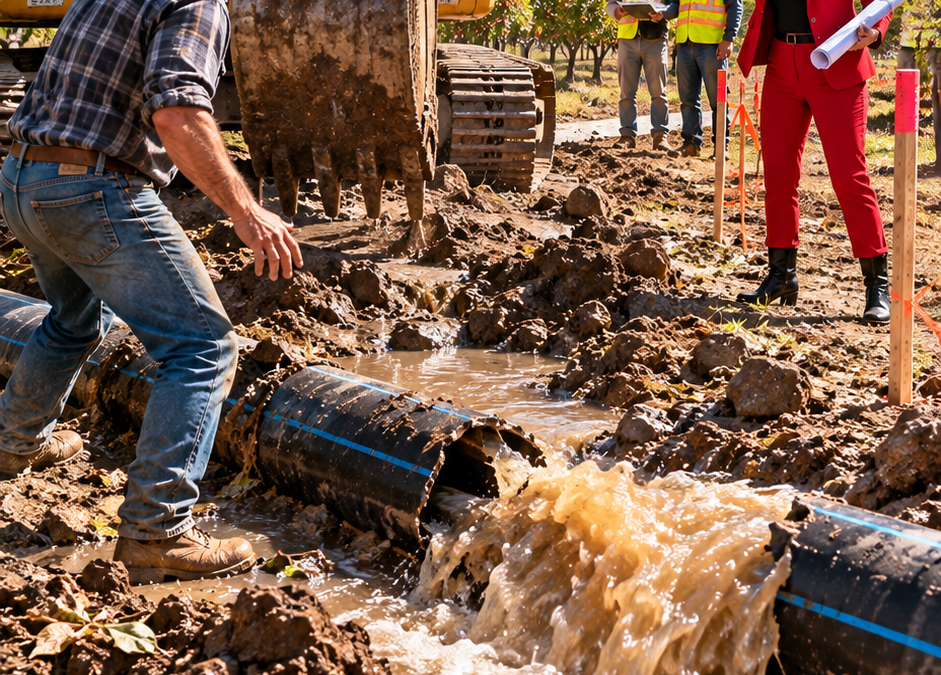
While we waited for her to reach a judge, the excavator began working.
At first, the bucket stayed near the old gravel lane.
Then it followed the orange stakes south.
I stood beside one of Owen’s witness markers.
“You’re leaving the recorded easement!”
The operator looked toward Vanessa.
She pointed ahead.
The bucket dropped.
The irrigation main broke.
Water erupted.
My pump alarm started screaming.
And suddenly the dispute was no longer abstract.
That pipe fed six hundred forty apple trees.
The upper storage tank held enough for one short irrigation cycle.
A repair contractor could reach me that afternoon.
But not while an excavator sat over the break.
The heat warning was already in effect.
The youngest trees had the shallowest roots.
I looked toward Vanessa.
“You knew the pipe was there.”
“The project drawings identify utilities.”
“Then why did you tell him to dig?”
“The line interferes with the road.”
“It was here first.”
She unrolled her plans.
“Move everything out of the barn by noon.”
At 9:12, Hannah called.
“Judge signed the TRO.”
I closed my eyes.
“What does it say?”
“No construction. No grading. No marker removal. No interference with your irrigation system before the hearing.”
The deputy read the emailed order.
A court runner was already bringing the certified copy.
The excavator operator shut down.
Vanessa asked whether emergency maintenance inside the original easement could continue.
The deputy looked at the water pouring into the trench.
“Ma’am, whatever this is, it doesn’t look like maintenance.”
For once, Vanessa had nothing polished to say.
The irrigation crew arrived after lunch.
They clamped the line by two.
We waited until after sunset to irrigate.
Lower temperature.
Less evaporation.
But damage had already started.
Twenty-three young trees curled hard at the leaves.
Nine eventually died.
Nine trees did not destroy my orchard.
I knew that.
But each of those trees represented six years.
Six winters of pruning.
Six springs of thinning.
Six summers of watching.
Years before a young tree produces enough quality fruit to pay back what went into it.
A spreadsheet can price a replacement tree.
It cannot easily price lost time.
Until the irrigation line broke, I had mainly wanted Brier Ridge to leave me alone.
Afterward, I wanted the entire record.
At the preliminary hearing, the judge kept the construction freeze in place while the validity of the joinder was investigated.
That injunction gave us time.
It did not give us answers.
Hannah subpoenaed the HOA’s title review.
Board minutes.
Communications with the map contractor.
Files used to prepare the joinder.
Miles objected to almost everything.
Privilege.
Confidential business information.
Irrelevance.
The judge ordered production of non-privileged records and specifically required Brier Ridge to identify who supplied my signature to the notary.
That was when Vanessa changed tactics.
She proposed private mediation at the clubhouse.
Miles sat beside her.
Elaine Porter sat at the far end of the table with a yellow legal pad.
Vanessa offered to erase every assessment.
Withdraw the lien claim.
Reimburse the irrigation repair.
And pay me $90,000.
In exchange, I would sign the expanded joinder.
Grant permanent road access.
Utility rights.
Stormwater rights.
Release every claim.
Keep the settlement confidential.
Vanessa called it generous.
I read every page.
The easement would allow unrestricted daily access forever.
Construction vehicles.
Utilities.
Drainage.
And the right to assign those privileges to the Phase 3 developer.
I looked up.
“You say the October joinder already gives you this.”
“It does.”
“Then what is ninety thousand dollars buying?”
Miles removed his glasses.
“Avoidance of further litigation.”
Vanessa said, “Peace.”
“Peace doesn’t require a notarized easement.”
Elaine stopped writing.
Hannah pushed the agreement back.
“We’ll discuss a settlement recognizing Mr. Ward’s parcel as independent, compensating documented damage, and preserving the original emergency access.”
Vanessa interrupted.
“No.”
Hannah had not finished.
“No expanded road?”
“No settlement.”
The mediation lasted twenty-seven minutes.
In the parking lot, Elaine hurried after us.
She looked over her shoulder toward the clubhouse.
“I need to speak with my own attorney.”
Hannah waited.
Elaine swallowed.
“After that, I may have records the association has not produced.”
Three days later, her attorney delivered a sealed envelope to Hannah’s office.
Inside was a board packet dated March of the previous year.
Fourteen months before Vanessa first came to my gate.
The first document was Brier Ridge’s full title report.
Its conclusion was plain.
Parcel 7A was excluded from the Brier Ridge declaration.
The existing eighteen-foot easement permitted only maintenance and genuine emergency access.
The proposed road required new written, notarized consent from Caleb Ward.
Vanessa’s initials appeared at the bottom of every page.
I sat staring at them.
She had known.
Before the joinder.
Before the fines.
Before the membership packet.
Before she told residents the road crossed association-controlled land.
The next document was an appraisal.
Permanent road and drainage rights across my property were valued between $380,000 and $460,000, depending on the final construction footprint and runoff obligations.
I looked at Hannah.
“Ninety thousand.”
She nodded.
“They weren’t offering you a generous settlement.”
“They were trying to buy four hundred thousand dollars of rights for ninety.”
“From someone they hoped didn’t know the appraisal existed.”
Then we opened the third document.
A brokerage agreement.
The Phase 3 developer had signed Crow Residential—Vanessa’s company—as exclusive listing broker for the thirty-eight proposed homes.
If the development received final approval, projected commissions exceeded $240,000.
I read the figure twice.
There was nothing illegal about making money.
I made money from apples.
From restored furniture.
From people who paid me because I had something or could do something they valued.
The problem was not Vanessa earning a commission.
The problem was that she had stood in front of one hundred twenty-six homeowners talking about emergency access and community safety without telling them her private company stood to earn nearly a quarter million dollars if the road across my land went through.
Elaine also provided the March executive-session minutes.
Miles had warned the board that the HOA could not expand Dad’s easement without my consent.
Elaine moved to negotiate with me at the appraised value.
Vanessa opposed the motion.
It failed three votes to two.
The public minutes later posted online said only:
BOARD CONFIRMED ACCESS STRATEGY.
Nothing about the title problem.
Nothing about the appraisal.
Nothing about the divided vote.
Nothing about counsel’s warning.
Hannah asked Elaine why she had waited.
Elaine looked down at her hands.
“Because I told myself losing a vote wasn’t the same as witnessing a crime.”
She paused.
“Then I watched the excavator cut his water.”
It was not a heroic answer.
It was better.
It was honest.
We had motive.
We had knowledge.
But we still needed to prove how the false joinder had been created.
The notary, Judith Bell, lived about eighty miles east.
Hannah arranged a recorded deposition.
Judith was seventy-one.
She had stopped notarizing documents the previous year because surgery had damaged her eyesight.
She recognized the seal on the joinder.
But she had never met with me on October 14.
Her notary journal contained no entry for Caleb Ward that day.
Then she gave us something even more important.
Her commission had expired thirty-seven days before the date printed on the joinder.
“That seal could not have been lawfully applied in October?” Hannah asked.
“No.”
“Have you ever notarized anything for Mr. Ward?”
Judith thought.
“Yes.”
“What?”
“A road maintenance acknowledgment.”
Two years earlier, Brier Ridge had repaired potholes in Dad’s original lane.
I signed a short document confirming the work was complete.
Judith notarized it.
Vanessa had personally brought the form to Judith’s house.
Hannah obtained the old acknowledgment.
My real signature was there.
The same W.
The same ink skip.
Judith’s valid seal sat beneath it.
Then someone enlarged both documents on a screen.
The notary seal contained a tiny crescent-shaped white gap.
Barely visible.
It came from a fold in the original maintenance paper that crossed the black circle of the seal.
The same crescent appeared in the disputed joinder.
Same position.
Same shape.
Same imperfect curve.
My signature also matched the earlier document down to the tiny pen drag in the W.
There are moments in a dispute when suspicion becomes something harder.
For me, it was not the money.
Not the missing stakes.
Not Vanessa’s brokerage agreement.
It was that white crescent.
A flaw smaller than my fingernail.
Someone had copied my real signature and Judith’s real seal from a harmless two-year-old maintenance acknowledgment and placed them on a document granting permanent access I had never approved.
Something created to record cooperation had been recycled as consent.
The mapping contractor produced its project files the following week.
Draft one showed my property in white.
Outside Brier Ridge.
Draft two shaded it blue.
The access route expanded.
Attached was an email from Vanessa.
Remove the exclusion boundary from the presentation map. Residents do not need to be confused by an outdated technical distinction. Show the approved access corridor as continuous.
The contractor had replied that the county parcel layer still showed separate ownership.
Vanessa answered:
Use the association layer, not the county layer.
That sentence tied the documents together.
The title report proved Vanessa knew the legal boundary.
The email proved she ordered residents shown something different.
Judith’s expired commission and journal undermined the joinder.
The copied crescent tied the new paper to the old maintenance acknowledgment.
Owen’s survey proved the excavation crossed eleven feet, two inches beyond Dad’s easement.
My camera showed HOA personnel removing the stakes that made that fact visible.
No single item proved the whole story.
Together, they left less and less room for innocent explanation.
Miles Danner withdrew as Brier Ridge’s attorney two days after Judith’s deposition.
His filing stated that his firm’s electronic recording account had been used to submit a client-supplied instrument whose authenticity was now disputed.
He preserved his files.
Obtained separate counsel.
Brier Ridge hired a new law firm.
Vanessa sent residents another newsletter.
She said technical defects were being used to stop a safety project supported by an overwhelming majority of homeowners.
She warned that litigation could cause a special assessment.
She accused an unnamed former board member of releasing confidential material.
She did not mention Judith’s expired commission.
The copied seal.
The appraisal.
The title report.
Her brokerage agreement.
Elaine did.
At the next open board meeting, she stood during homeowner comments.
Her hands shook slightly.
Then she read the title report aloud.
Parcel 7A excluded.
Original eighteen-foot emergency and maintenance easement only.
New notarized consent required from Caleb Ward.
The room shifted.
Elaine disclosed her failed motion to negotiate.
The appraisal.
The projected value of the rights.
Then Vanessa’s brokerage agreement.
Residents who had signed the petition against me started asking questions.
If I had blocked emergency access, why was the fire gate still available?
Who authorized the excavator before the court hearing?
Why had the title report not been shared?
Had HOA money ever been paid to Crow Residential?
Vanessa remained calm.
But calm and control are not the same thing.
“The brokerage agreement was preliminary and fully disclosed where required.”
Elaine looked directly at her.
“Which board meeting?”
Vanessa paused.
Elaine repeated the question.
“Which meeting disclosed it to the board?”
Vanessa could not identify one.
Then a resident named Diane Hall stood near the front.
She raised her phone.
“I recorded the contractor presentation six months ago.”
The video played on the clubhouse screen.
There was Vanessa.
Red jacket.
Pointer in hand.
“The second entrance crosses association-controlled land. No private acquisition is required.”
Residents had voted for the project after hearing that.
The board voted four to one that night to suspend Phase 3 spending until an independent audit could be completed.
Vanessa cast the only opposing vote.
The following morning, the lender froze the expansion loan.
That was when the timetable reversed.
For months, Vanessa had used urgency against me.
Loan deadlines.
Construction schedules.
Safety claims.
One holdout delaying one hundred twenty-six families.
Now the developer’s option on the Phase 3 land would expire in sixty days.
Without permanent access, the financing could not close.
Without financing, the developer could not proceed.
Without the development, Crow Residential’s listing agreement was worth nothing.
Every unanswered question now cost Vanessa another day.
Our court hearing began in September.
Judge Rebecca Sloan presided.
She read faster than anyone I had ever met.
Brier Ridge’s new attorney went first.
He argued that the association had relied on a recorded instrument.
Spent money in good faith.
Believed expanded access served community safety.
He avoided directly defending my signature.
Instead, he argued that my years of cooperation with Brier Ridge maintenance traffic demonstrated implied acceptance of the association’s authority over the corridor.
Judge Sloan looked up.
“Mr. Ward cooperated with an eighteen-foot emergency and maintenance easement?”
“Yes, Your Honor.”
“And you argue that this establishes consent to a twenty-eight-foot daily road extending hundreds of feet farther?”
“The uses are related.”
The judge leaned back.
“A garden hose and fire hose are related. They are not interchangeable.”
Nobody laughed.
Not quite.
Hannah called Owen first.
He explained the boundary slowly.
No speeches.
No emotion.
Measurements.
Coordinates.
Recorded monuments.
The original easement ended three hundred seventy-two feet before the proposed road reached Milstone Road.
The broken irrigation line sat eleven feet, two inches outside the legitimate corridor.
His witness stakes allowed the original line to be reconstructed after the blue markers disappeared.
Then the excavator operator testified.
He confirmed Vanessa instructed him to follow the orange construction line after I warned that the irrigation pipe was outside the easement.
He confirmed the digging was preparation for the new road.
Not emergency maintenance.
Judith testified by video.
Hannah placed the old maintenance acknowledgment beside the disputed joinder.
My signature image matched.
The ink skip matched.
Judith’s seal matched.
The crescent-shaped fold defect matched.
Judith’s journal contained one document.
Not the other.
Her commission had expired.
Then Elaine testified.
She authenticated the title packet.
The appraisal.
The executive-session minutes.
She described her motion to negotiate with me before the project started.
She described Vanessa’s opposition.
Then Diane’s video showed residents being told no private land acquisition was required.
Finally, Hannah called Vanessa.
Vanessa entered the witness box wearing the same red jacket she had worn at my gate.
Hannah waited until she was settled.
“Ms. Crow, did you read the complete title report?”
“Yes.”
“Did that report state Parcel 7A was excluded from Brier Ridge?”
“It raised an issue requiring clarification.”
Hannah displayed the page.
“Did it say Mr. Ward’s land was excluded?”
Vanessa looked toward her attorney.
“Yes.”
“Did it state that new notarized consent from Mr. Ward was required for the proposed road?”
“That was one consultant’s opinion.”
“Your initials appear on the page.”
“Yes.”
“Did you obtain new notarized consent from Mr. Ward?”
“The association recorded a joinder.”
“That was not my question.”
Vanessa’s fingers tightened once around the witness rail.
“I relied on staff and counsel.”
Hannah displayed an email dated the day the joinder was filed.
It came from Vanessa’s HOA account.
Recipient: a paralegal at Danner Property Law.
Attachment: supplemental joinder.
Message:
Please record the final owner-approved version today. Loan schedule cannot slip again.
Hannah looked at Vanessa.
“Who gave you the attachment?”
“I don’t remember.”
“Did Caleb Ward send it?”
“I don’t remember.”
“Did Judith Bell send it?”
“I don’t remember.”
“Did any person tell you Mr. Ward appeared before Judith Bell on October 14?”
The courtroom grew quiet enough that I could hear the ventilation.
Vanessa stared ahead.
Then said, “I relied on the document.”
People imagine lies collapse with shouting.
Most do not.
Most get smaller one answer at a time.
Until everyone can see them trying to hide behind paperwork.
Hannah’s last exhibit was the $90,000 settlement proposal.
“Why offer Mr. Ward money for rights Brier Ridge says it already possessed?”
“Settlement is often cheaper than litigation.”
Hannah placed the appraisal beside it.
The rights had been valued between $380,000 and $460,000.
Then she placed Vanessa’s brokerage agreement beside both.
“Your company projected more than two hundred forty thousand dollars in commissions if Phase 3 closed?”
“It was an estimate.”
“You opposed negotiating with Mr. Ward at appraised value?”
“I believed the community already had access.”
“You then offered him ninety thousand dollars?”
“To resolve the dispute.”
“And if he accepted, Phase 3 financing could proceed?”
Vanessa’s attorney objected.
The judge allowed Hannah to rephrase.
“Was permanent secondary access a lender condition?”
“Yes.”
“Would your brokerage agreement have value if Phase 3 did not receive approval?”
Vanessa paused.
“Not in the same form.”
Hannah sat down.
Judge Sloan issued her ruling two days later.
She was careful.
She did not declare homeowners associations inherently abusive.
She did not declare developers dishonest.
She decided the documents and property in front of her.
The supplemental joinder was invalid.
Brier Ridge had not proved that I signed it.
Had not proved I acknowledged it before Judith Bell.
Had not proved I authorized anyone to record it.
My property had never joined the association.
Dad’s original eighteen-foot easement remained valid exactly as written.
Maintenance.
Emergency access.
Nothing more.
No daily through road.
No new utility corridor.
No expanded drainage rights.
No construction traffic.
Brier Ridge was permanently prohibited from applying its declaration to my property.
The assessment account had to be removed.
The lien claim withdrawn.
The damaged ground restored.
The irrigation repair reimbursed.
The nine lost trees replaced.
The association was also responsible for reasonable legal costs under the provisions governing the failed lien enforcement and easement dispute.
Then Judge Sloan addressed the false joinder.
She ordered the disputed instrument, Judith’s testimony, and the electronic recording history forwarded to the county district attorney and state notary oversight agency.
She made no criminal finding.
That would require a separate investigation.
Separate evidence.
Separate defenses.
I was glad she said that.
I had spent months demanding that people respect documents.
I could not suddenly decide process no longer mattered because the person under investigation was someone I disliked.
The lender canceled the Phase 3 closing the following week.
Later, the developer returned with a smaller plan.
The new entrance stayed entirely on land it owned.
The project contained fewer homes.
The road cost more.
Which probably explained why nobody had chosen that design first.
Brier Ridge’s independent audit confirmed that Vanessa had never disclosed the Crow Residential agreement to the full board.
The directors removed her as president.
The association referred the altered public minutes and financial issues to counsel and its insurer.
Months later, Vanessa entered a civil settlement covering part of the HOA’s losses and surrendered her brokerage role in the expansion.
The investigation into the joinder continued separately.
I did not need to see her arrested.
I did not need a dramatic sentencing.
I had never started the fight because I wanted Vanessa destroyed.
I wanted my land left where my father had left it.
Elaine Porter became interim president.
Her first visit to my property felt very different from Vanessa’s.
No red suit.
No membership packet.
Elaine arrived with a road contractor, the fire chief, and a written proposal.
“The original lane stays eighteen feet,” she said.
“Yes.”
“Two hundred forty feet.”
“Yes.”
“Emergency and maintenance only.”
“Yes.”
“Brier Ridge grades it twice a year. We inspect the gate with you every spring. We add runoff controls. Any damage from our use is our responsibility.”
I read the paper.
One sentence was in bold.
EMERGENCY OR MAINTENANCE USE OF THIS LANE CREATES NO MEMBERSHIP, OWNERSHIP, EXPANSION, OR ADDITIONAL ACCESS RIGHT.
I looked at Elaine.
“You wrote this?”
“With counsel.”
I signed.
Some people were surprised.
After everything that happened, they expected me to lock the gate permanently.
I never seriously considered it.
The people who lived inside Brier Ridge had not copied my signature.
A family needing a fire truck should not pay for Vanessa’s ambition.
Restraint is not surrender.
Sometimes restraint is the clearest evidence that a boundary was never about revenge.
The replacement apple trees arrived in November.
Nine thin three-year-old whips.
They looked pitiful beside mature trees.
Bamboo stakes.
Small root balls.
Bare branches.
It would be several seasons before they produced enough fruit to fill a crate.
Elaine came to help plant them.
So did Owen.
Two Brier Ridge residents arrived with shovels.
Both had signed the petition accusing me of endangering emergency access.
One of them was the woman who had stopped at my gate months earlier.
We worked most of the morning.
Near the seventh tree, she said, “I owe you an apology.”
I pushed soil around the roots.
“You believed what you were told.”
“I should have checked.”
I looked toward the blue witness stakes along the east fence.
“That’s the real lesson.”
“What is?”
“A map on a projector is still only a claim until somebody checks what it is built on.”
The orange construction stakes disappeared after the judgment.
I kept the blue witness markers.
The irrigation main was repaired permanently.
My barn still stood.
The youngest orchard rows survived the following summer without losing another tree.
The disputed joinder went into Dad’s gray metal document box.
I placed it beside the real easement.
Not as a trophy.
The two documents belonged together because they taught opposite lessons.
Dad’s paper showed what people can build when they describe a boundary honestly.
For twenty-two years, Brier Ridge used that narrow lane without trouble.
Maintenance crews passed through.
The fire gate remained available.
Nobody needed threats.
Nobody needed lawsuits.
One document.
One defined purpose.
Mutual respect.
The false joinder showed how easily cooperation can be rewritten as consent when enough money waits on the other side of a line.
Every spring now, I meet the Brier Ridge fire chief at the gate.
We unlock it.
Walk the full two hundred forty feet.
Inspect drainage.
Check the surface.
Test the lock.
Then close it again.
The lane still serves the exact purpose my father allowed.
Nothing more.
Nothing less.
Sometimes, afterward, I walk into the orchard.
The replacement trees are still easy to identify.
Smaller trunks.
Different branch structure.
They remind me of that morning the pipe broke.
I can still hear the pump alarm.
Still see water spreading through the dirt.
Still see Vanessa standing beside that orange stake telling me the corridor belonged to Brier Ridge.
For a long time, that memory made me angry.
Now it mostly makes me think about Leah.
She had a way of reducing every problem to the question underneath it.
When bills were bad, she did not ask whether I was worried.
She asked which one had to be paid first.
When the harvest looked weak, she did not ask whether it was unfair.
She asked how many bins we realistically expected.
If she had been alive when Vanessa brought that first packet, I know exactly what she would have done.
She would have read every page.
Then she would have pointed to the signature line and said, “If they already own it, why do they need you to sign?”
That was the question hidden inside the entire case.
If Brier Ridge already owned the rights it claimed, why did it need a new document?
Why offer concessions?
Why offer ninety thousand dollars?
Why remove survey stakes?
Why redraw maps?
Why hide the title report?
Why tell residents the land was association-controlled?
Why use an old signature?
Why copy an expired notary seal?
The truth was never hiding behind something complicated.
It was hiding behind repetition.
Say the parcel is part of the HOA enough times.
Shade it blue enough times.
Call the old lane a community road enough times.
Describe a private expansion as public safety enough times.
Eventually, people stop asking where the claim started.
That was what Vanessa counted on.
She once told me one holdout could not stand in the way of one hundred twenty-six families.
She was right about one thing.
I was standing in the way.
I was standing in the way of a private road supported by a copied signature.
A drainage trench disguised inside a safety project.
A property line changed for a lender presentation.
A brokerage interest residents had not been told about.
And a permanent transfer of land rights hidden beneath the word clarification.
That is exactly where an owner should stand.
Not because ownership makes one person more important than everyone else.
Because a boundary means nothing if the number of people on one side can erase the rights of the person on the other.
Dad understood that.
The developers who first built Brier Ridge understood it too.
That was why they asked for an eighteen-foot easement instead of simply taking one.
For twenty-two years, that agreement worked.
It worked because nobody pretended permission was ownership.
Nobody called emergency access a daily road.
Nobody called maintenance authority membership.
Nobody told me cooperation meant I had surrendered the right to say no later.
The orchard is quieter now than it was when Leah was alive.
Some mornings, I still walk out before sunrise with two cups of coffee out of habit.
I catch myself halfway through pouring the second one.
Then I put the pot down.
Grief does not disappear just because a lawsuit ends.
Neither does memory.
The metal document box in the workshop still smells faintly of machine oil.
Dad’s handwriting is on the inside of the lid.
Leah’s old invoice folders still occupy a shelf near my desk.
And every season the apple trees do what they have always done.
Bud.
Bloom.
Set fruit.
Carry too much if I do not thin them.
Drop leaves when the weather turns.
Rest.
Start again.
The nine replacement trees will eventually stop looking new.
Their trunks will thicken.
The bamboo supports will come out.
One autumn, probably without me noticing the exact day, they will produce enough apples that I will stop thinking of them as replacements.
Maybe that is what restoration actually looks like.
Not erasing what happened.
Growing until the scar becomes only one visible line among many.
I never joined Brier Ridge.
My barn never received black aluminum siding.
Nobody collected the thirty-one thousand dollars in invented assessments.
The fire gate still opens when it needs to.
The original lane still serves the residents.
And the boundary still runs where my father put it.
Twenty-two years before someone colored a different version blue on a projector.
I keep one photograph from the case on my desk.
It is not Vanessa in court.
Not the torn irrigation pipe.
Not the fake joinder.
It is a photograph Owen took after resetting the true line.
One blue witness stake stands in the foreground.
Behind it, apple trees run uphill in straight rows.
My father’s barn sits to the left.
Brier Ridge’s roofs are visible beyond the fence.
Everything is in the same frame.
My land.
Their homes.
The shared lane.
The boundary.
Nothing about the picture looks dramatic.
That is why I kept it.
A good boundary is not supposed to create a story.
It is supposed to prevent one.
For twenty-two years, ours did.
Then someone decided a loan deadline mattered more than the line.
All the court eventually did was put the line back where it had always been.
What do you think of this story? Please leave a like and share your thoughts in the comments. Your support means a lot to us and inspires us to keep writing more meaningful and powerful stories. Thank you! 👍

