The Shot He Claimed as His Own Was Still Watching Him
The Shot He Claimed as His Own Was Still Watching Him
Lieutenant Commander Victor Kincaid fired after I told him not to.
Twenty minutes later, he was telling everyone at the forward base that his bullet had ended the mission and mine had nearly destroyed it.
By sunrise, I understood he was not trying to steal a shot—he was trying to erase the only version of events that could destroy him.
“Do not fire,” I whispered.
Kincaid fired anyway.
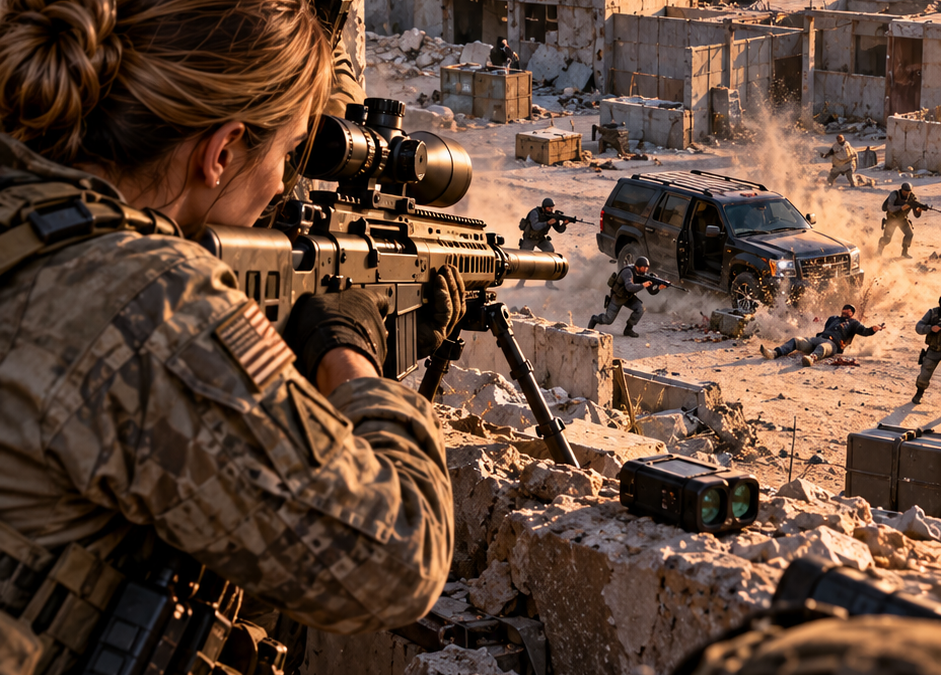
The crack of his rifle inside the ruined radio tower broke eighteen hours of silence.
Dust jumped from the wall beneath my cheek.
Through my optic, I watched the round hit stone almost six feet from Farid Nassar.
Not him.
Not even close.
Stone.
For one fraction of a second, nobody moved.
Then Nassar turned.
My stomach dropped.
Farid Nassar was not a soldier.
He was worse in a quieter way.
A weapons broker.
Money mover.
Logistics coordinator.
A man who had spent years standing far enough from violence to claim his hands were clean while arranging for other people to die.
We had crossed half of Syria to reach him.
Hours in vehicles.
Hours on foot.
Long stretches waiting in dead buildings and dry ravines while surveillance teams tracked his convoy.
The mission was built around one thing.
Patience.
We had a narrow window.
One controlled shot.
Then extraction.
Instead, Kincaid had just announced our presence to every armed man within hearing distance.
“Nassar’s moving,” my spotter, Evan Brooks, said beside me.
His voice remained steady.
That was why I trusted him.
Even when the world broke apart, Evan spoke like a man reading coordinates from a kitchen table.
“Wind shifted right to left,” he added. “Four point two.”
Below us, Nassar sprinted toward an armored SUV.
Two guards spun toward the tower.
Another raised a rifle.
“Take him!” Kincaid barked.
“I need three seconds.”
“You have one.”
I ignored him.
The first burst of return fire struck the outer wall.
Concrete fragments sprayed across my sleeve.
The tower trembled.
I settled behind my .338.
Breathing slowed.
Shoulder loose.
Cheek weld.
Reticle centered.
Everything else disappeared.
People imagine long-range shooting as some kind of miracle.
It is not.
It is mathematics performed under pressure.
Distance.
Wind.
Temperature.
Angle.
Air density.
Movement.
Human error.
At fourteen hundred yards, the smallest bad decision does not remain small.
That was the problem with Kincaid.
He believed aggression could compensate for uncertainty.
It could not.
Evan called another adjustment.
Nassar reached for the SUV door.
A gust moved across the broken industrial yard.
I waited.
One second.
Two.
Then the gust passed.
I squeezed the trigger.
The rifle struck my shoulder.
Through the scope, I watched Nassar collapse beside the vehicle.
His guards dragged him behind cover.
He did not move again.
“Confirmed,” Evan said.
Only then did I breathe.
Kincaid stared at me.
On the floor beside his boot, the empty casing from his rifle was still spinning slowly in the dust.
“You hesitated,” he said.
I looked at the stone scar where his round had landed.
“No.”
His jaw tightened.
“I corrected your mistake.”
His expression changed.
Not much.
But enough.
“Watch your tone, Chief.”
My name is Chief Petty Officer Morgan Hale.
I was thirty-eight years old and had spent most of my adult life in the United States Navy.
I was also the first woman to graduate from my command’s advanced maritime sniper program.
Some people treated that fact like the most interesting thing about me.
It never was.
The work mattered.
Not the novelty.
Accuracy did not care about gender.
Neither did fatigue.
Neither did fear.
The teams called me Frost.
People outside the community assumed the nickname meant I was cold.
It did not.
It meant I stayed controlled when other people became emotional.
Control had saved my life more times than strength ever had.
It had saved other people too.
That morning, it had saved Kincaid.
Because part of me wanted to turn on him immediately.
He had violated fire discipline.
Compromised the mission.
Forced an engagement under worse conditions.
And now he was looking at me like I was the problem.
But there was no time.
Our position had been exposed.
The extraction helicopter came twelve minutes later.
Those twelve minutes felt longer than the previous eighteen hours.
Rounds struck the lower tower.
Someone launched smoke near Nassar’s convoy.
Evan and I packed the rifle system while Kincaid shouted into the radio.
By the time the helicopter dropped into the extraction zone, dust had turned the air brown.
We ran.
I climbed aboard behind Evan.
Kincaid came last.
For the first several minutes, nobody spoke.
Rotor wash hammered through the open compartment.
The crew chief checked us.
Evan sat across from me, helmet resting against the wall.
His eyes met mine once.
Then shifted toward Kincaid.
Kincaid was staring at my rifle.
Not me.
The rifle.
Then Evan.
Then back to the rifle.
I noticed.
At the time, I thought he was angry.
Later, I understood.
He was planning.
Forward Base Resolute appeared below us just after dawn.
By the time we landed, the story had already begun changing.
Captain Owen Maddox met us inside the operations tent.
Maddox was a competent officer.
That mattered later because competent people can still make cowardly mistakes when rank enters the room.
Kincaid removed his helmet before anyone else.
“Target stopped by my first round at fourteen hundred yards,” he announced.
I looked at him.
For a second, I honestly thought I had misheard.
Kincaid continued.
“Chief Hale fired late after losing situational awareness and nearly compromised the extraction team.”
Evan’s face went pale.
Captain Maddox looked between us.
“What?”
“That is false,” I said.
Kincaid removed his gloves with deliberate calm.
“My first shot stopped Nassar.”
“Your first shot hit a wall.”
His eyes shifted toward me.
“Were you watching my optic?”
“I watched your impact.”
“You watched what stress allowed you to see.”
I laughed once.
Not because it was funny.
Because the lie was so clean.
So immediate.
He had prepared it during the helicopter ride.
Maybe earlier.
Captain Maddox turned toward Evan.
“Petty Officer Brooks?”
Evan looked at the floor.
“Sir, I—”
Kincaid stepped beside him.
Then placed one hand against the back of Evan’s neck.
A casual gesture.
Friendly from ten feet away.
Evan flinched.
“Take your time,” Kincaid said softly.
Something cold moved through me.
Maddox saw the movement.
But he did not understand it.
Or chose not to.
Kincaid turned back to me.
“You froze on the trigger.”
“No.”
“You hesitated.”
“I waited for the correction.”
“You panicked.”
The tent seemed to shrink around us.
“You fired without a clean solution,” I said. “Your round missed. Mine stopped the target.”
Kincaid grabbed the sling of my rifle.
He pulled me toward him.
“Do not rewrite the mission because you’re embarrassed.”
I knocked his hand away.
The entire tent went silent.
Maddox stepped between us.
“Enough.”
I stared over his shoulder at Kincaid.
“Chief Hale,” Maddox said, “surrender your weapon pending review.”
I turned toward him.
“You are confiscating the evidence.”
“I am preserving it.”
“No. You are giving it to the chain of command Kincaid controls.”
Maddox’s expression hardened.
“Chief.”
Two security specialists moved closer.
I could have fought the order.
I could have argued.
I could have made a scene that would be quoted in every report afterward.
So I did the harder thing.
I released the rifle.
One specialist took it.
The other documented the handoff.
Kincaid leaned close enough that only I could hear him.
“By sunrise,” he whispered, “you’ll be remembered as the woman who panicked.”
I looked at him.
That was when I knew this was bigger than credit.
He was not defending himself.
He was building me into the explanation.
Maddox later told me I was relieved of operational duty pending review.
Potential dereliction.
False official statement.
Possible Article 32 preliminary hearing.
The words came at me like objects.
Heavy.
Formal.
Deliberate.
Kincaid walked outside.
Within minutes, people were congratulating him.
Men who had not been in the tower.
Men who had not heard me say do not fire.
Men who had not seen his round hit stone.
I stood inside the tent while my rifle disappeared toward evidence storage.
For the first time in my career, I understood how quickly a fact could become lonely.
But Kincaid had overlooked something.
Mounted behind my optic was a classified prototype.
ARGUS-7.
He thought it was simply an enhanced environmental and target-data module.
It was more than that.
The system recorded the target feed.
Thermal imagery.
Environmental telemetry.
Audio markers.
Recoil events.
It was designed for evaluation.
After-action reconstruction.
Accuracy analysis.
What Kincaid did not know was that ARGUS-7 had been watching the entire tower.
Including him.
That knowledge should have reassured me.
It did not.
Because military evidence only matters if evidence survives.
The rifle was no longer in my possession.
Kincaid had rank.
Access.
Influence.
And by the time we left Syria, he already controlled the official narrative.
Three weeks later, we were back at Naval Amphibious Base Coronado.
By then, the lie had hardened.
Kincaid had recommended himself for a valor award.
He recommended I lose my sniper qualification.
His formal report claimed he had fired after confirming the target.
It said I became unresponsive.
It said my later shot was unauthorized.
It said I endangered friendly forces.
And Evan signed it.
That hurt more than I expected.
I read his name three times.
Evan Brooks.
My spotter.
The man whose wind call made the shot possible.
The man who had been lying beside me when Kincaid missed.
The man who had said “confirmed” immediately after my round.
His signature sat beneath Kincaid’s statement.
My detailed military defense counsel was Lieutenant Commander Rachel Kim.
Rachel did not waste words.
The first time we met, she closed the office door, placed Kincaid’s report on the table, and said, “I don’t care what I think happened.”
I looked at her.
“I care what we can prove.”
“Good.”
“That answer usually offends clients.”
“I’m not paying you to believe me.”
That made one corner of her mouth move.
“Good.”
We began with the rifle.
Or we tried.
The primary memory cartridge from ARGUS-7 was missing.
Rachel told me in the hallway outside the legal office.
I stopped walking.
“What?”
“The armorer logged an empty compartment.”
“No.”
“It’s in the chain.”
“It was installed when I surrendered the rifle.”
“I know.”
“I watched them take the weapon.”
“I know.”
“Then somebody removed it.”
Rachel lowered her voice.
“That is what we need to prove.”
My hands went cold.
Only a handful of people had touched the system.
Kincaid.
Maddox.
Security personnel.
The armorer.
All of them existed within a chain Kincaid understood better than I did.
That evening, I was leaving the equipment building when Kincaid stepped into the passage.
There was nobody else visible.
Of course there wasn’t.
He leaned against a metal locker.
“You should accept reassignment.”
I stopped.
“You removed the cartridge.”
He smiled.
“Still telling yourself stories?”
“The compartment was logged empty.”
“Maybe your miracle machine failed.”
“You knew it recorded the mission.”
“I knew enough.”
The answer came too easily.
He realized it a second later.
I saw it in his face.
“You took it.”
He stepped closer.
“You should think about your career.”
“I am.”
“No. You’re thinking about pride.”
“You falsified a combat report.”
His eyes narrowed.
“I corrected a confused account before it damaged a command.”
“You fired early.”
“You hesitated.”
“You missed.”
He grabbed my wrist.
Hard.
Then drove my shoulder into the locker.
Pain flashed down my arm.
The metal rang behind me.
His face moved close.
“Evidence disappears in war,” he said quietly.
His fingers tightened.
“Careers disappear at home.”
There are moments when violence feels easy.
That was one.
I had trained for years.
He was within inches.
I knew exactly how to break the grip.
Exactly how to damage the wrist.
Exactly how to put him on the floor.
And I also knew he wanted me to.
One assault allegation.
One hallway camera without audio.
One story about an unstable sniper already facing review.
So I did not strike him.
I turned my wrist into the weak point of his grip.
Rotated.
Stepped inside.
Freed my hand.
Then moved back.
“Touch me again,” I said, “and that becomes part of the hearing.”
He smiled.
“Only if someone believes you.”
Then he walked away.
For several seconds, I stood motionless.
My shoulder hurt.
My pulse did not.
That frightened me more than anger would have.
Then a door opened beside the communications room.
Chief Signals Technician Noah Reed stepped into the hallway.
Noah was forty-five, broad through the chest, with a burn scar running from the right side of his jaw down into his collar.
Years earlier, in Kandahar, I had pulled him out of a burning vehicle after an attack.
We almost never spoke about it.
People assume saving someone creates lifelong emotional speeches.
Usually it creates awkward jokes and an understanding that does not require discussion.
He looked down the hallway where Kincaid had disappeared.
“Heard enough of that.”
I rubbed my wrist.
“Forget you heard it.”
“No.”
“Noah.”
He looked at me.
“I helped test ARGUS-7.”
That stopped me.
“The cartridge isn’t the only record.”
I stared at him.
“What?”
“The system creates an audit packet every time it synchronizes with an authorized mission network.”
I said nothing.
He continued.
“Not the full feed. Compressed. Timestamped thermal frames. Audio markers. Environmental telemetry. Recoil events.”
“Where?”
“Naval Special Warfare systems lab.”
My heart started beating harder.
“Automatic?”
He nodded.
“Kincaid probably never knew.”
“Can it be altered?”
“Not without breaking the signature.”
For the first time since Syria, I felt something other than controlled anger.
Hope.
I hated it.
Hope makes people careless.
“Can you prove it exists?”
“Not from here.”
“Who can?”
“Rear Admiral Evelyn Price.”
I knew the name.
Admiral Price oversaw the prototype program.
Rachel filed a protected disclosure immediately.
Secure channels.
Formal preservation request.
No hallway conversations.
No ordinary email.
No loose language.
We requested that the lab freeze every ARGUS-7 server record connected to Operation Iron Mirage.
Noah warned us retrieval could take time.
The Article 32 hearing started the next morning.
We did not have the packet yet.
That was the problem.
Commander Elise Warren served as the preliminary hearing officer.
The room was small.
Windowless.
Cold enough to keep everyone uncomfortable.
Kincaid arrived in dress blues.
Perfectly pressed.
Every ribbon aligned.
He looked like a man attending a ceremony held in his honor.
Maybe he believed that was what it was.
I sat beside Rachel.
Evan sat several chairs away.
He never looked at me.
Kincaid testified first.
He spoke calmly.
That was what made him dangerous.
Bad liars overperform.
Kincaid understood that confidence works best when it appears bored.
“I identified Farid Nassar near the armored vehicle,” he said. “Environmental conditions were deteriorating. Chief Hale had primary engagement responsibility but became nonresponsive.”
Rachel wrote something.
Kincaid continued.
“I assessed the threat and fired.”
“Did your round strike Nassar?” Commander Warren asked.
“Yes.”
My jaw tightened.
“He went down?”
“Correct.”
Rachel looked at me.
Do nothing.
I did nothing.
Kincaid continued.
“Chief Hale then fired a second shot without authorization during a confused phase of the engagement.”
“When did you become concerned about her condition?”
“Immediately before my shot.”
Rachel stood for questioning.
“Lieutenant Commander, you testified your first round stopped the target.”
“Yes.”
“If Nassar was already stopped, why did Chief Hale need to fire?”
Kincaid barely paused.
“Confusion.”
“Whose?”
“Hers.”
“Did you see where her round struck?”
“I was focused on command and extraction.”
“You submitted an exact assessment of her shot in your report.”
“I reconstructed events later.”
“Using what?”
“Team reporting.”
“From whom?”
“Personnel present.”
“Petty Officer Brooks?”
“Among others.”
“There were three people in the tower, correct?”
“Yes.”
“You, Chief Hale, and Petty Officer Brooks.”
“Yes.”
“So when you say ‘team reporting,’ you mean yourself and Brooks.”
Kincaid looked irritated.
“Primarily.”
“Did you touch Chief Hale’s rifle after the mission?”
“No.”
The lie was smooth.
Too smooth.
Rachel nodded.
“No further questions at this time.”
Then Evan was called.
I had seen men face enemy fire with less fear than Evan carried into that chair.
His hands were steady.
His face was not.
“State your role during Operation Iron Mirage.”
“Spotter for Chief Hale.”
“Were you present during the engagement?”
“Yes.”
“Kincaid fired once?”
“Yes.”
“What happened next?”
Evan swallowed.
“Chief Hale appeared overwhelmed.”
The words entered me like a physical object.
Not because I believed them.
Because he had chosen them.
Rachel stood.
“Petty Officer Brooks, did Chief Hale fire a round?”
“Yes.”
“Did her round stop Nassar?”
His eyes remained fixed on the table.
“I could not confirm.”
“You reported ‘confirmed’ immediately after the shot.”
Evan’s jaw tightened.
“I don’t recall the exact wording.”
Rachel let the silence stretch.
He finally looked at her.
Not me.
Never me.
During the recess, I found him beside a vending machine.
He had not touched the coffee in his hand.
I stood several feet away.
“You don’t recall?”
His face tightened.
“Morgan.”
“He threatened your promotion.”
Silence.
“Or your assignment.”
Nothing.
Then his eyes filled.
“My wife’s medical transfer.”
That I had not expected.
Evan looked at the floor.
“She’s been waiting eleven months for placement near the specialty program.”
I felt something in my chest collapse.
“I have two kids,” he said.
“What did he say?”
“That the transfer could disappear.”
His voice dropped.
“That my next evaluation could end everything.”
“And you believed him.”
“Yes.”
I wanted to hate him.
It would have been simpler.
Instead, I saw a man caught between truth and the people he loved.
That did not excuse him.
But it explained the fear.
“You let him own your truth.”
His face tightened.
“What would you have done?”
“I don’t know.”
He looked at me sharply.
That answer surprised him.
“I know what I want to believe I would do.”
I stepped closer.
“But fear gets ugly when it knows your family’s names.”
His eyes dropped.
“Then forgive me.”
“No.”
He looked up.
“Not yet.”
The recess ended.
We returned.
The government representative announced that no usable digital evidence had been recovered from my optic.
The primary cartridge was absent.
Kincaid looked at me.
And smiled.
Commander Warren folded her hands.
“Chief Hale, do you have independent evidence supporting your account?”
Rachel stood.
“Ma’am, we have made a preservation request regarding additional system telemetry.”
“Do you currently possess it?”
“No, ma’am.”
Kincaid sat back.
Then the secure conference phone rang.
The communications specialist answered.
Listened.
Then stood straighter.
“Ma’am.”
Commander Warren looked over.
“Rear Admiral Price for the hearing officer.”
Nobody moved.
A classified video link opened on the wall monitor.
Rear Admiral Evelyn Price appeared beside two civilian engineers inside a secure laboratory.
She wore no expression at all.
“Commander Warren.”
“Admiral.”
“This proceeding will pause while authenticated ARGUS-7 audit data is entered into evidence.”
Kincaid moved before anyone else did.
He shot out of his chair.
Straight toward the console.
A security officer intercepted him across the chest.
The movement told the room more than any testimony had.
“Sit down, sir.”
Kincaid twisted.
“What is this?”
Commander Warren’s voice became sharp.
“Lieutenant Commander, take your seat.”
The monitor went black.
Then a thermal image appeared.
The ruined radio tower.
Timestamp.
Environmental data.
Two synchronized event lines.
One for Kincaid’s rifle system.
One for mine.
My mouth went dry.
The audio started.
My own voice filled the room.
“Do not fire.”
Then the first shot.
Kincaid’s.
On the event line connected to my rifle, the recoil counter remained at zero.
Zero.
The thermal image showed the impact.
Stone exploded six feet from Nassar.
The target turned.
Ran.
Evan’s recorded voice came next.
“Wind shifted. He’s moving.”
Kincaid’s voice.
“Take him!”
Mine.
“I need three seconds.”
“You have one.”
The room disappeared around me.
I was back in Syria.
Dust.
Stone.
Heat.
Wind.
Nassar running.
My cheek against the stock.
On the monitor, my reticle stabilized.
Evan called the correction.
One second.
Two.
Three.
The recoil counter advanced.
Zero to one.
My shot sounded.
Nassar collapsed.
Then Evan’s voice.
“Confirmed.”
Nobody moved.
Commander Warren paused the video.
She looked at Kincaid.
“Your report states your first round stopped the target.”
Kincaid’s face had gone gray.
“The data has been manipulated.”
Admiral Price answered from the screen.
“No.”
He turned toward her image.
“This system was experimental.”
“It was.”
“Then it cannot be treated as reliable combat evidence.”
One engineer leaned toward the microphone.
Admiral Price raised one hand.
She answered herself.
“The audit packet was encrypted at capture, transmitted automatically through an authorized mission network, and stored on a laboratory server inaccessible to your command.”
Kincaid said nothing.
“The cryptographic signature matches the original capture,” she continued. “Any alteration would invalidate that signature.”
His face tightened.
“The primary cartridge is missing.”
“Yes,” Admiral Price said.
“That is now a separate concern.”
For the first time, I saw fear in him.
Real fear.
Not anger.
Not wounded ego.
Fear.
Noah was called to explain the system.
Carefully.
Nothing beyond what the hearing required.
Automatic sync.
Audit packet.
Independent storage.
Recoil event capture.
Authenticated timestamps.
The engineers confirmed chain of custody.
The missing cartridge had become irrelevant to the mission record.
Rachel requested one final audio segment.
Commander Warren approved.
Kincaid’s voice filled the room again.
“You hesitated.”
Then mine.
“I corrected your mistake.”
Evan covered his face.
Commander Warren stopped the audio.
Then turned toward him.
“Petty Officer Brooks.”
He lowered his hands.
“You remain under oath.”
His face looked devastated.
“Yes, ma’am.”
“Do you wish to amend your testimony?”
Silence.
Everyone watched him.
I did not.
I looked at the table.
Because I knew what fear looked like when it had to choose between survival and shame.
His chair moved.
Evan stood.
His hands trembled.
“Yes, ma’am.”
Commander Warren waited.
“Chief Hale fired the shot that stopped Nassar.”
His voice almost broke.
“Lieutenant Commander Kincaid’s round missed.”
Kincaid turned.
“Brooks.”
Commander Warren snapped toward him.
“Do not speak.”
Evan continued.
“Kincaid told me if I contradicted his report, my wife’s medical transfer would disappear.”
Rachel asked nothing.
She did not need to.
The truth was finally speaking without help.
Evan swallowed.
“He told me my evaluation would be destroyed.”
Kincaid stood again.
This time he lunged toward the evidence drive on the table.
A second security specialist intercepted him.
He fought harder than I expected.
“Get your hands off me!”
The officer forced his arms behind him.
“I led that mission!”
Kincaid shouted.
“I led that team!”
I stood.
Rachel touched my arm.
Probably to stop me.
I did not move toward him.
I just looked at him.
“No.”
His eyes found mine.
“You endangered it.”
The room had gone completely silent.
“And then you tried to own everyone who survived your decision.”
Commander Warren ordered me to sit.
I did.
She terminated the hearing.
Not continued.
Terminated.
She recommended dismissal of every allegation against me.
She referred Kincaid’s false statements.
The missing cartridge.
His pressure on Evan.
His physical conduct.
And the evidence surrounding the report.
For separate investigation.
When I walked outside, I expected relief.
Instead I felt tired.
More tired than I had after the mission.
Captain Maddox was waiting.
He looked older.
“I should have secured the optic personally.”
I looked at him.
“You should have separated rank from evidence.”
He nodded.
“I know.”
“No.”
I stepped closer.
“You know now.”
His face tightened.
“I believed the officer in command.”
“That is exactly the problem.”
“I made a mistake.”
“Yes.”
He waited.
Maybe for forgiveness.
I did not give it to him.
Not because I hated him.
Because some failures need to remain uncomfortable.
My operational status was restored that afternoon.
The correction went to every command that had received Kincaid’s report.
His valor recommendation was withdrawn before it reached the award board.
People began calling.
Some apologized.
Some congratulated me.
I hated both.
One officer said, “Must feel good.”
It did not.
Being falsely accused and later cleared is not the same as never being accused.
Something remains.
A stain in memory.
A question you know existed in other people’s minds.
For weeks, I caught myself watching people watch me.
Did they believe the correction?
Had they believed him first?
Did it matter?
Rachel finally told me to stop.
“You have been cleared.”
“I know.”
“Then act like it.”
I looked at her.
“That sounds dangerously like therapy.”
“I bill more.”
I laughed.
It was the first real laugh I had managed in weeks.
The investigation into Kincaid widened.
The cartridge had not vanished by accident.
Access logs.
Witness interviews.
Security footage.
Equipment records.
His hallway contact with me.
Noah’s statement.
Evan’s testimony.
Each piece by itself looked manageable.
Together, they formed a pattern.
Kincaid had relied on something that works frighteningly often.
People protect hierarchy before truth.
A junior person questions a senior officer?
Maybe she misunderstood.
A respected commander gives a confident report?
Probably accurate.
A witness changes his statement?
Maybe stress.
Evidence disappears?
War is messy.
Each explanation was plausible.
Until ARGUS-7 removed plausibility.
Months later, Kincaid faced a general court-martial.
I testified.
So did Evan.
So did Noah.
So did the engineers.
The process was not cinematic.
Most justice is not.
There were motions.
Arguments.
Technical questions.
Objections.
Long waits.
Experts explaining systems to people who wished engineers spoke English.
Kincaid’s defense attacked the prototype.
Then the chain of custody.
Then Evan’s credibility.
Then my motivation.
They suggested resentment.
Competition.
Professional rivalry.
They asked whether being the first woman to graduate from the advanced program created pressure to prove myself.
I almost smiled.
There it was.
The oldest trick.
Turn competence into insecurity.
Turn achievement into motive.
Turn a woman defending her work into ambition gone wrong.
I answered every question.
Slowly.
No anger.
No speeches.
When asked whether I disliked Kincaid, I said yes.
His attorney looked surprised.
“Why?”
“Because he fired against my recommendation, missed, lied about it, assaulted me, interfered with evidence, threatened my spotter, and tried to end my career.”
A pause.
“No further explanation required.”
The panel eventually found him responsible for false official statements, obstruction, assault, and conduct unbecoming an officer.
He was dismissed from the Navy.
There was confinement.
There were other consequences.
People expected me to feel satisfaction.
Mostly, I felt exhausted.
Evan received administrative consequences for his false statement.
His cooperation mattered.
So did the documented coercion.
Before I returned fully to training duty, he asked to see me.
We met outside near the water.
Coronado was gray that morning.
The Pacific looked flat.
Evan stood with both hands in his pockets.
“I chose my family over the truth.”
I looked at him.
“No.”
His brow tightened.
“You chose fear.”
He swallowed.
“There’s a difference?”
“Yes.”
“What?”
“If you had chosen your family, you would have asked for help before lying became the thing that endangered them.”
He looked away.
“I thought I had no choice.”
“Kincaid needed you to believe that.”
“My wife could have lost treatment.”
“I know.”
“My kids—”
“I know.”
He finally looked at me.
“I’m sorry.”
This time, I believed him.
That did not erase what he did.
Forgiveness is not deletion.
People confuse those.
I nodded.
“Next time, choose help before someone else pays the price.”
He closed his eyes briefly.
Then nodded.
My own award recommendation was reviewed.
The language changed.
It was no longer about a remarkable shot.
Thank God.
Fourteen hundred yards makes people stupid.
They start talking about distance instead of judgment.
The recommendation focused on control after Kincaid compromised the engagement.
Maintaining discipline under fire.
Completing the mission.
Protecting the team.
A Navy Cross recommendation advanced to higher review.
People assumed that mattered deeply to me.
It mattered less than I expected.
Once, I would have thought a medal restored something.
It does not.
Metal cannot return time.
It cannot erase humiliation.
It cannot remove the memory of men congratulating Kincaid while I stood inside a tent being treated like a liability.
What mattered was simpler.
My name was corrected.
My record was corrected.
The official history no longer belonged to him.
A year later, I became a senior instructor at the maritime sniper program in Coronado.
The first class I taught had twenty-two students.
All experienced.
All confident.
Some too confident.
I knew the type.
On the first morning, I walked into the classroom carrying an empty ARGUS-7 memory cartridge.
Not the original.
The original never came back to me.
The prototype itself returned to the laboratory.
Engineers upgraded the audit system after the investigation.
Evidence integrity became part of the design conversation.
Good.
I placed the empty cartridge on the desk.
Nobody spoke.
Some of them knew the public version of Operation Iron Mirage.
None knew everything.
They never would.
Classified missions do not become campfire stories just because the people involved grow older.
I looked around the room.
“Anybody know what this is?”
One student raised his hand.
“Data cartridge.”
“Excellent. The Navy has officially justified your training budget.”
A few people laughed.
I picked it up.
“Technology can record what happened.”
I turned it between my fingers.
“Sometimes perfectly.”
Then I set it back down.
“But technology does not create character.”
The room became quiet.
“It cannot stop you from firing before you should.”
I looked toward the back row.
“It cannot make you admit a mistake.”
Another student shifted.
“It cannot force you to refuse an unlawful shortcut.”
Silence.
“It cannot make you tell the truth before somebody presses play.”
That was the lesson.
Not the shot.
Not the distance.
Not Kincaid.
Truth matters most before evidence arrives.
Because sometimes evidence does not.
ARGUS-7 saved my career.
I know that.
If the audit packet had failed to transmit, my case would have been harder.
Maybe much harder.
Kincaid controlled the report.
He controlled my weapon after surrender.
He pressured the witness.
He understood the system.
He had rank.
Reputation.
History.
I had my word.
People like to say truth always wins.
That is comforting.
It is also false.
Truth loses every day when nobody protects it.
Records disappear.
Witnesses become frightened.
People with authority speak first.
Organizations choose convenience.
That was what stayed with me.
So I changed how I taught.
Every sniper student expected lessons about patience.
Wind.
Breathing.
Trigger control.
Position.
Observation.
I taught those.
Then I taught the thing nobody puts on the range card.
Responsibility.
One afternoon, a young petty officer asked me whether I regretted not confronting Kincaid harder in the tower.
“No.”
“You knew he messed up.”
“Yes.”
“Why not challenge him immediately?”
“I did.”
“I mean really challenge him.”
I understood what he meant.
Make him pay.
Humiliate him.
Assert control.
“Because we were still in a mission.”
He frowned.
“What if he had taken another shot?”
“Then the situation changes.”
“But he was wrong.”
“Yes.”
“That doesn’t make you angry?”
I looked at him.
“Anger is not authority.”
He went quiet.
“Being right doesn’t excuse losing control.”
That was the irony Kincaid never understood.
He thought leadership meant decisive action.
Sometimes it does.
Sometimes leadership is the discipline to wait three seconds while everyone around you demands one.
Sometimes courage is refusing to fire.
Sometimes courage is signing your own name beneath an unpopular truth.
Sometimes courage is asking for help before fear owns you.
Years later, people still asked me about the shot.
Fourteen hundred yards.
Wind shift.
Moving target.
They wanted the technical answer.
I gave them one.
Then I changed the subject.
The hardest moment in that story did not happen behind a rifle.
It happened in a windowless room when Evan Brooks had to decide whether he would keep carrying a lie that protected his family temporarily but poisoned everything around him.
It happened when Captain Maddox had to admit he treated rank like evidence.
It happened when I had to surrender my rifle knowing the man accusing me had access to it.
It happened in a hallway when Kincaid drove me into a locker and I understood that hitting him back would give him exactly what he wanted.
People imagine strength as force because force is visible.
Control rarely is.
The older I became, the more I respected invisible things.
The shot itself became less important every year.
Farid Nassar was one target in one mission.
Important.
Dangerous.
Necessary.
But still one mission.
The lesson that survived him mattered more.
Kincaid believed the most powerful person in the room was the one who controlled the report.
For a while, he was right.
He walked into Forward Base Resolute and spoke first.
People listened.
He had rank.
Confidence.
A clean uniform.
I had dust on my face and anger in my voice.
He understood something ugly about institutions.
People often prefer a confident lie to a complicated truth.
But he misunderstood the limit.
Control is not ownership.
Not of evidence.
Not of witnesses.
Not of history.
Not forever.
The ARGUS-7 system returned to the laboratory.
The first scope I used was eventually dismantled.
Upgraded.
Rebuilt into something else.
I never saw it again.
But I kept that empty cartridge on the desk in my classroom.
Students asked why.
I usually told them the same thing.
“Because empty space can still remind you what belongs there.”
Some understood.
Some did not.
They would eventually.
The Navy moved on.
It always does.
New deployments.
New officers.
New technology.
New mistakes.
My career moved too.
I trained younger operators.
Wrote doctrine recommendations.
Argued with engineers.
Mentored women who no longer had to be the first in the program because I had already carried that burden.
That mattered to me.
More than the medal.
More than the distance.
One evening, years after the hearing, I stayed late after class.
The building was almost empty.
Outside, the light over Coronado had turned orange.
A student had left a notebook behind.
I picked it up.
Inside the cover, he had written one sentence from the first lecture.
Character decides what you do before anyone presses play.
I stood there for a long time.
Then I put the notebook on his desk.
For years, I thought the most important thing ARGUS-7 preserved was proof that I made the shot.
I was wrong.
The system preserved the three seconds before it.
My warning.
Kincaid’s decision.
Evan’s correction.
My wait.
That was where the truth lived.
Not in the result.
In the choices that created it.
People later called Kincaid corrupt.
That word was accurate.
But corruption rarely begins with something dramatic.
It begins with the belief that position should protect you from consequence.
A missed shot becomes an embarrassing problem.
Then a report becomes a convenient correction.
Then a witness becomes something to manage.
Then evidence becomes something to remove.
Then anyone resisting becomes an enemy.
By the time the behavior looks monstrous, the person has already justified ten smaller steps.
That was why I kept teaching the beginning.
Not the ending.
Do not fire.
Three words.
Kincaid heard them.
He fired anyway.
Everything after that came from his refusal to accept that a subordinate might be right.
The lie.
The missing cartridge.
The threat.
The assault.
Evan’s fear.
The hearing.
His dismissal.
All of it.
One bad decision does not always destroy a career.
Refusing to admit it can.
That was the story I carried forward.
Not the story newspapers would have wanted.
Not the impossible shot.
Not the woman sniper.
Not the corrupt officer dragged from a hearing.
The quieter story.
A professional makes a mistake.
Then chooses pride.
Another professional becomes afraid.
Then chooses silence.
A third watches both and must decide whether truth is worth the cost.
That is where most disasters begin.
In choices small enough to excuse.
I never saw Kincaid after his sentence.
I never wanted to.
Hatred is another form of attention.
He had already taken enough.
Years later, someone asked whether I had forgiven him.
I thought about it.
“No.”
The person looked surprised.
“Doesn’t that bother you?”
“No.”
Forgiveness is personal.
Accountability is public.
I did not spend my life wishing him harm.
I did not wake thinking about him.
That was enough for me.
He became a lesson.
Nothing more.
Evan eventually transferred.
His wife received the medical placement.
Not because Kincaid allowed it.
Because legitimate channels existed once Evan stopped believing one officer controlled everything.
We exchanged occasional messages.
Birthdays.
Promotions.
Nothing emotional.
We never became close again.
Trust rarely returns to its original shape.
But respect can grow around the scar.
Captain Maddox stayed in service.
The last time I saw him, he was speaking to a group of junior officers about evidence preservation after operations.
I stood at the back for five minutes.
He never saw me.
He told them, “Rank cannot substitute for verification.”
I left before the talk ended.
That was enough.
Some lessons should cost something.
His had.
Mine had too.
The official correction to my record remains filed somewhere in a system I will probably never see again.
The award recommendation eventually moved beyond my control.
The details stopped mattering.
What mattered was that no future evaluation would carry Kincaid’s version.
No promotion board would read that I panicked.
No instructor would quietly question whether Frost froze when it mattered.
He had tried to give me a new identity.
The woman who hesitated.
The sniper who lost control.
The operator who endangered her team.
Instead, the record showed what happened.
I waited.
I corrected.
I fired once.
And when the mission ended, I fought harder for the truth than I ever had for the shot.
Sometimes, on cold mornings at the range, I still remembered Syria.
Not visually.
First as sound.
“Do not fire.”
Crack.
Then dust.
Then Evan.
“Wind shifted.”
Then Kincaid.
“Take him.”
Then the pause.
Three seconds.
That was all.
Three seconds.
People underestimate what can happen in three seconds.
A bad leader can expose a team.
A frightened witness can decide to stay silent.
A trained operator can choose not to let someone else’s panic become her own.
I used to think the shot defined that mission.
Now I know the pause did.
Because that pause was the difference between discipline and ego.
Between correction and chaos.
Between the truth and the story Kincaid wanted everyone to remember.
He thought history belonged to whoever filed the report first.
He was wrong.
History belongs to evidence only when people are brave enough to preserve it.
It belongs to witnesses only when they choose truth before fear seals their mouths.
And sometimes, when every person in the room fails, it survives inside a machine nobody thought to silence.
The prototype behind my scope recorded everything.
But the machine was never the hero.
It only did what it was designed to do.
The real question was what the rest of us did once the truth became inconvenient.
That is the question I still ask every student.
Every officer.
Every operator.
Every person who thinks skill alone makes them trustworthy.
What will you do when telling the truth costs you something?
Kincaid answered that question.
Evan answered it too.
So did Maddox.
Eventually, so did I.
That is why the empty cartridge stays on my desk.
Not as a trophy.
Not as revenge.
As a warning.
A rifle can miss.
A memory can fail.
A witness can become afraid.
A commander can lie.
Evidence can disappear.
But character is built before the moment anyone discovers whether you were telling the truth.
And when the room goes silent, when rank and fear and ambition have finished making their arguments, that is the only thing you are guaranteed to have left.
Your name.
Your choices.
And the truth you were willing to stand beside when nobody else wanted it.
What do you think of this story? Please leave a like and share your thoughts in the comments. Your support means a lot to us and inspires us to keep writing more meaningful and powerful stories. Thank you! 👍
𝗧𝗛𝗘 𝗘𝗡𝗗
The Shot He Claimed as His Own Was Still Watching Him
Lieutenant Commander Victor Kincaid fired after I told him not to.
Twenty minutes later, he was telling everyone at the forward base that his bullet had ended the mission and mine had nearly destroyed it.
By sunrise, I understood he was not trying to steal a shot—he was trying to erase the only version of events that could destroy him.
“Do not fire,” I whispered.
Kincaid fired anyway.
The crack of his rifle inside the ruined radio tower broke eighteen hours of silence.
Dust jumped from the wall beneath my cheek.
Through my optic, I watched the round hit stone almost six feet from Farid Nassar.
Not him.
Not even close.
Stone.
For one fraction of a second, nobody moved.
Then Nassar turned.
My stomach dropped.
Farid Nassar was not a soldier.
He was worse in a quieter way.
A weapons broker.
Money mover.
Logistics coordinator.
A man who had spent years standing far enough from violence to claim his hands were clean while arranging for other people to die.
We had crossed half of Syria to reach him.
Hours in vehicles.
Hours on foot.
Long stretches waiting in dead buildings and dry ravines while surveillance teams tracked his convoy.
The mission was built around one thing.
Patience.
We had a narrow window.
One controlled shot.
Then extraction.
Instead, Kincaid had just announced our presence to every armed man within hearing distance.
“Nassar’s moving,” my spotter, Evan Brooks, said beside me.
His voice remained steady.
That was why I trusted him.
Even when the world broke apart, Evan spoke like a man reading coordinates from a kitchen table.
“Wind shifted right to left,” he added. “Four point two.”
Below us, Nassar sprinted toward an armored SUV.
Two guards spun toward the tower.
Another raised a rifle.
“Take him!” Kincaid barked.
“I need three seconds.”
“You have one.”
I ignored him.
The first burst of return fire struck the outer wall.
Concrete fragments sprayed across my sleeve.
The tower trembled.
I settled behind my .338.
Breathing slowed.
Shoulder loose.
Cheek weld.
Reticle centered.
Everything else disappeared.
People imagine long-range shooting as some kind of miracle.
It is not.
It is mathematics performed under pressure.
Distance.
Wind.
Temperature.
Angle.
Air density.
Movement.
Human error.
At fourteen hundred yards, the smallest bad decision does not remain small.
That was the problem with Kincaid.
He believed aggression could compensate for uncertainty.
It could not.
Evan called another adjustment.
Nassar reached for the SUV door.
A gust moved across the broken industrial yard.
I waited.
One second.
Two.
Then the gust passed.
I squeezed the trigger.
The rifle struck my shoulder.
Through the scope, I watched Nassar collapse beside the vehicle.
His guards dragged him behind cover.
He did not move again.
“Confirmed,” Evan said.
Only then did I breathe.
Kincaid stared at me.
On the floor beside his boot, the empty casing from his rifle was still spinning slowly in the dust.
“You hesitated,” he said.
I looked at the stone scar where his round had landed.
“No.”
His jaw tightened.
“I corrected your mistake.”
His expression changed.
Not much.
But enough.
“Watch your tone, Chief.”
My name is Chief Petty Officer Morgan Hale.
I was thirty-eight years old and had spent most of my adult life in the United States Navy.
I was also the first woman to graduate from my command’s advanced maritime sniper program.
Some people treated that fact like the most interesting thing about me.
It never was.
The work mattered.
Not the novelty.
Accuracy did not care about gender.
Neither did fatigue.
Neither did fear.
The teams called me Frost.
People outside the community assumed the nickname meant I was cold.
It did not.
It meant I stayed controlled when other people became emotional.
Control had saved my life more times than strength ever had.
It had saved other people too.
That morning, it had saved Kincaid.
Because part of me wanted to turn on him immediately.
He had violated fire discipline.
Compromised the mission.
Forced an engagement under worse conditions.
And now he was looking at me like I was the problem.
But there was no time.
Our position had been exposed.
The extraction helicopter came twelve minutes later.
Those twelve minutes felt longer than the previous eighteen hours.
Rounds struck the lower tower.
Someone launched smoke near Nassar’s convoy.
Evan and I packed the rifle system while Kincaid shouted into the radio.
By the time the helicopter dropped into the extraction zone, dust had turned the air brown.
We ran.
I climbed aboard behind Evan.
Kincaid came last.
For the first several minutes, nobody spoke.
Rotor wash hammered through the open compartment.
The crew chief checked us.
Evan sat across from me, helmet resting against the wall.
His eyes met mine once.
Then shifted toward Kincaid.
Kincaid was staring at my rifle.
Not me.
The rifle.
Then Evan.
Then back to the rifle.
I noticed.
At the time, I thought he was angry.
Later, I understood.
He was planning.
Forward Base Resolute appeared below us just after dawn.
By the time we landed, the story had already begun changing.
Captain Owen Maddox met us inside the operations tent.
Maddox was a competent officer.
That mattered later because competent people can still make cowardly mistakes when rank enters the room.
Kincaid removed his helmet before anyone else.
“Target stopped by my first round at fourteen hundred yards,” he announced.
I looked at him.
For a second, I honestly thought I had misheard.
Kincaid continued.
“Chief Hale fired late after losing situational awareness and nearly compromised the extraction team.”
Evan’s face went pale.
Captain Maddox looked between us.
“What?”
“That is false,” I said.
Kincaid removed his gloves with deliberate calm.
“My first shot stopped Nassar.”
“Your first shot hit a wall.”
His eyes shifted toward me.
“Were you watching my optic?”
“I watched your impact.”
“You watched what stress allowed you to see.”
I laughed once.
Not because it was funny.
Because the lie was so clean.
So immediate.
He had prepared it during the helicopter ride.
Maybe earlier.
Captain Maddox turned toward Evan.
“Petty Officer Brooks?”
Evan looked at the floor.
“Sir, I—”
Kincaid stepped beside him.
Then placed one hand against the back of Evan’s neck.
A casual gesture.
Friendly from ten feet away.
Evan flinched.
“Take your time,” Kincaid said softly.
Something cold moved through me.
Maddox saw the movement.
But he did not understand it.
Or chose not to.
Kincaid turned back to me.
“You froze on the trigger.”
“No.”
“You hesitated.”
“I waited for the correction.”
“You panicked.”
The tent seemed to shrink around us.
“You fired without a clean solution,” I said. “Your round missed. Mine stopped the target.”
Kincaid grabbed the sling of my rifle.
He pulled me toward him.
“Do not rewrite the mission because you’re embarrassed.”
I knocked his hand away.
The entire tent went silent.
Maddox stepped between us.
“Enough.”
I stared over his shoulder at Kincaid.
“Chief Hale,” Maddox said, “surrender your weapon pending review.”
I turned toward him.
“You are confiscating the evidence.”
“I am preserving it.”
“No. You are giving it to the chain of command Kincaid controls.”
Maddox’s expression hardened.
“Chief.”
Two security specialists moved closer.
I could have fought the order.
I could have argued.
I could have made a scene that would be quoted in every report afterward.
So I did the harder thing.
I released the rifle.
One specialist took it.
The other documented the handoff.
Kincaid leaned close enough that only I could hear him.
“By sunrise,” he whispered, “you’ll be remembered as the woman who panicked.”
I looked at him.
That was when I knew this was bigger than credit.
He was not defending himself.
He was building me into the explanation.
Maddox later told me I was relieved of operational duty pending review.
Potential dereliction.
False official statement.
Possible Article 32 preliminary hearing.
The words came at me like objects.
Heavy.
Formal.
Deliberate.
Kincaid walked outside.
Within minutes, people were congratulating him.
Men who had not been in the tower.
Men who had not heard me say do not fire.
Men who had not seen his round hit stone.
I stood inside the tent while my rifle disappeared toward evidence storage.
For the first time in my career, I understood how quickly a fact could become lonely.
But Kincaid had overlooked something.
Mounted behind my optic was a classified prototype.
ARGUS-7.
He thought it was simply an enhanced environmental and target-data module.
It was more than that.
The system recorded the target feed.
Thermal imagery.
Environmental telemetry.
Audio markers.
Recoil events.
It was designed for evaluation.
After-action reconstruction.
Accuracy analysis.
What Kincaid did not know was that ARGUS-7 had been watching the entire tower.
Including him.
That knowledge should have reassured me.
It did not.
Because military evidence only matters if evidence survives.
The rifle was no longer in my possession.
Kincaid had rank.
Access.
Influence.
And by the time we left Syria, he already controlled the official narrative.
Three weeks later, we were back at Naval Amphibious Base Coronado.
By then, the lie had hardened.
Kincaid had recommended himself for a valor award.
He recommended I lose my sniper qualification.
His formal report claimed he had fired after confirming the target.
It said I became unresponsive.
It said my later shot was unauthorized.
It said I endangered friendly forces.
And Evan signed it.
That hurt more than I expected.
I read his name three times.
Evan Brooks.
My spotter.
The man whose wind call made the shot possible.
The man who had been lying beside me when Kincaid missed.
The man who had said “confirmed” immediately after my round.
His signature sat beneath Kincaid’s statement.
My detailed military defense counsel was Lieutenant Commander Rachel Kim.
Rachel did not waste words.
The first time we met, she closed the office door, placed Kincaid’s report on the table, and said, “I don’t care what I think happened.”
I looked at her.
“I care what we can prove.”
“Good.”
“That answer usually offends clients.”
“I’m not paying you to believe me.”
That made one corner of her mouth move.
“Good.”
We began with the rifle.
Or we tried.
The primary memory cartridge from ARGUS-7 was missing.
Rachel told me in the hallway outside the legal office.
I stopped walking.
“What?”
“The armorer logged an empty compartment.”
“No.”
“It’s in the chain.”
“It was installed when I surrendered the rifle.”
“I know.”
“I watched them take the weapon.”
“I know.”
“Then somebody removed it.”
Rachel lowered her voice.
“That is what we need to prove.”
My hands went cold.
Only a handful of people had touched the system.
Kincaid.
Maddox.
Security personnel.
The armorer.
All of them existed within a chain Kincaid understood better than I did.
That evening, I was leaving the equipment building when Kincaid stepped into the passage.
There was nobody else visible.
Of course there wasn’t.
He leaned against a metal locker.
“You should accept reassignment.”
I stopped.
“You removed the cartridge.”
He smiled.
“Still telling yourself stories?”
“The compartment was logged empty.”
“Maybe your miracle machine failed.”
“You knew it recorded the mission.”
“I knew enough.”
The answer came too easily.
He realized it a second later.
I saw it in his face.
“You took it.”
He stepped closer.
“You should think about your career.”
“I am.”
“No. You’re thinking about pride.”
“You falsified a combat report.”
His eyes narrowed.
“I corrected a confused account before it damaged a command.”
“You fired early.”
“You hesitated.”
“You missed.”
He grabbed my wrist.
Hard.
Then drove my shoulder into the locker.
Pain flashed down my arm.
The metal rang behind me.
His face moved close.
“Evidence disappears in war,” he said quietly.
His fingers tightened.
“Careers disappear at home.”
There are moments when violence feels easy.
That was one.
I had trained for years.
He was within inches.
I knew exactly how to break the grip.
Exactly how to damage the wrist.
Exactly how to put him on the floor.
And I also knew he wanted me to.
One assault allegation.
One hallway camera without audio.
One story about an unstable sniper already facing review.
So I did not strike him.
I turned my wrist into the weak point of his grip.
Rotated.
Stepped inside.
Freed my hand.
Then moved back.
“Touch me again,” I said, “and that becomes part of the hearing.”
He smiled.
“Only if someone believes you.”
Then he walked away.
For several seconds, I stood motionless.
My shoulder hurt.
My pulse did not.
That frightened me more than anger would have.
Then a door opened beside the communications room.
Chief Signals Technician Noah Reed stepped into the hallway.
Noah was forty-five, broad through the chest, with a burn scar running from the right side of his jaw down into his collar.
Years earlier, in Kandahar, I had pulled him out of a burning vehicle after an attack.
We almost never spoke about it.
People assume saving someone creates lifelong emotional speeches.
Usually it creates awkward jokes and an understanding that does not require discussion.
He looked down the hallway where Kincaid had disappeared.
“Heard enough of that.”
I rubbed my wrist.
“Forget you heard it.”
“No.”
“Noah.”
He looked at me.
“I helped test ARGUS-7.”
That stopped me.
“The cartridge isn’t the only record.”
I stared at him.
“What?”
“The system creates an audit packet every time it synchronizes with an authorized mission network.”
I said nothing.
He continued.
“Not the full feed. Compressed. Timestamped thermal frames. Audio markers. Environmental telemetry. Recoil events.”
“Where?”
“Naval Special Warfare systems lab.”
My heart started beating harder.
“Automatic?”
He nodded.
“Kincaid probably never knew.”
“Can it be altered?”
“Not without breaking the signature.”
For the first time since Syria, I felt something other than controlled anger.
Hope.
I hated it.
Hope makes people careless.
“Can you prove it exists?”
“Not from here.”
“Who can?”
“Rear Admiral Evelyn Price.”
I knew the name.
Admiral Price oversaw the prototype program.
Rachel filed a protected disclosure immediately.
Secure channels.
Formal preservation request.
No hallway conversations.
No ordinary email.
No loose language.
We requested that the lab freeze every ARGUS-7 server record connected to Operation Iron Mirage.
Noah warned us retrieval could take time.
The Article 32 hearing started the next morning.
We did not have the packet yet.
That was the problem.
Commander Elise Warren served as the preliminary hearing officer.
The room was small.
Windowless.
Cold enough to keep everyone uncomfortable.
Kincaid arrived in dress blues.
Perfectly pressed.
Every ribbon aligned.
He looked like a man attending a ceremony held in his honor.
Maybe he believed that was what it was.
I sat beside Rachel.
Evan sat several chairs away.
He never looked at me.
Kincaid testified first.
He spoke calmly.
That was what made him dangerous.
Bad liars overperform.
Kincaid understood that confidence works best when it appears bored.
“I identified Farid Nassar near the armored vehicle,” he said. “Environmental conditions were deteriorating. Chief Hale had primary engagement responsibility but became nonresponsive.”
Rachel wrote something.
Kincaid continued.
“I assessed the threat and fired.”
“Did your round strike Nassar?” Commander Warren asked.
“Yes.”
My jaw tightened.
“He went down?”
“Correct.”
Rachel looked at me.
Do nothing.
I did nothing.
Kincaid continued.
“Chief Hale then fired a second shot without authorization during a confused phase of the engagement.”
“When did you become concerned about her condition?”
“Immediately before my shot.”
Rachel stood for questioning.
“Lieutenant Commander, you testified your first round stopped the target.”
“Yes.”
“If Nassar was already stopped, why did Chief Hale need to fire?”
Kincaid barely paused.
“Confusion.”
“Whose?”
“Hers.”
“Did you see where her round struck?”
“I was focused on command and extraction.”
“You submitted an exact assessment of her shot in your report.”
“I reconstructed events later.”
“Using what?”
“Team reporting.”
“From whom?”
“Personnel present.”
“Petty Officer Brooks?”
“Among others.”
“There were three people in the tower, correct?”
“Yes.”
“You, Chief Hale, and Petty Officer Brooks.”
“Yes.”
“So when you say ‘team reporting,’ you mean yourself and Brooks.”
Kincaid looked irritated.
“Primarily.”
“Did you touch Chief Hale’s rifle after the mission?”
“No.”
The lie was smooth.
Too smooth.
Rachel nodded.
“No further questions at this time.”
Then Evan was called.
I had seen men face enemy fire with less fear than Evan carried into that chair.
His hands were steady.
His face was not.
“State your role during Operation Iron Mirage.”
“Spotter for Chief Hale.”
“Were you present during the engagement?”
“Yes.”
“Kincaid fired once?”
“Yes.”
“What happened next?”
Evan swallowed.
“Chief Hale appeared overwhelmed.”
The words entered me like a physical object.
Not because I believed them.
Because he had chosen them.
Rachel stood.
“Petty Officer Brooks, did Chief Hale fire a round?”
“Yes.”
“Did her round stop Nassar?”
His eyes remained fixed on the table.
“I could not confirm.”
“You reported ‘confirmed’ immediately after the shot.”
Evan’s jaw tightened.
“I don’t recall the exact wording.”
Rachel let the silence stretch.
He finally looked at her.
Not me.
Never me.
During the recess, I found him beside a vending machine.
He had not touched the coffee in his hand.
I stood several feet away.
“You don’t recall?”
His face tightened.
“Morgan.”
“He threatened your promotion.”
Silence.
“Or your assignment.”
Nothing.
Then his eyes filled.
“My wife’s medical transfer.”
That I had not expected.
Evan looked at the floor.
“She’s been waiting eleven months for placement near the specialty program.”
I felt something in my chest collapse.
“I have two kids,” he said.
“What did he say?”
“That the transfer could disappear.”
His voice dropped.
“That my next evaluation could end everything.”
“And you believed him.”
“Yes.”
I wanted to hate him.
It would have been simpler.
Instead, I saw a man caught between truth and the people he loved.
That did not excuse him.
But it explained the fear.
“You let him own your truth.”
His face tightened.
“What would you have done?”
“I don’t know.”
He looked at me sharply.
That answer surprised him.
“I know what I want to believe I would do.”
I stepped closer.
“But fear gets ugly when it knows your family’s names.”
His eyes dropped.
“Then forgive me.”
“No.”
He looked up.
“Not yet.”
The recess ended.
We returned.
The government representative announced that no usable digital evidence had been recovered from my optic.
The primary cartridge was absent.
Kincaid looked at me.
And smiled.
Commander Warren folded her hands.
“Chief Hale, do you have independent evidence supporting your account?”
Rachel stood.
“Ma’am, we have made a preservation request regarding additional system telemetry.”
“Do you currently possess it?”
“No, ma’am.”
Kincaid sat back.
Then the secure conference phone rang.
The communications specialist answered.
Listened.
Then stood straighter.
“Ma’am.”
Commander Warren looked over.
“Rear Admiral Price for the hearing officer.”
Nobody moved.
A classified video link opened on the wall monitor.
Rear Admiral Evelyn Price appeared beside two civilian engineers inside a secure laboratory.
She wore no expression at all.
“Commander Warren.”
“Admiral.”
“This proceeding will pause while authenticated ARGUS-7 audit data is entered into evidence.”
Kincaid moved before anyone else did.
He shot out of his chair.
Straight toward the console.
A security officer intercepted him across the chest.
The movement told the room more than any testimony had.
“Sit down, sir.”
Kincaid twisted.
“What is this?”
Commander Warren’s voice became sharp.
“Lieutenant Commander, take your seat.”
The monitor went black.
Then a thermal image appeared.
The ruined radio tower.
Timestamp.
Environmental data.
Two synchronized event lines.
One for Kincaid’s rifle system.
One for mine.
My mouth went dry.
The audio started.
My own voice filled the room.
“Do not fire.”
Then the first shot.
Kincaid’s.
On the event line connected to my rifle, the recoil counter remained at zero.
Zero.
The thermal image showed the impact.
Stone exploded six feet from Nassar.
The target turned.
Ran.
Evan’s recorded voice came next.
“Wind shifted. He’s moving.”
Kincaid’s voice.
“Take him!”
Mine.
“I need three seconds.”
“You have one.”
The room disappeared around me.
I was back in Syria.
Dust.
Stone.
Heat.
Wind.
Nassar running.
My cheek against the stock.
On the monitor, my reticle stabilized.
Evan called the correction.
One second.
Two.
Three.
The recoil counter advanced.
Zero to one.
My shot sounded.
Nassar collapsed.
Then Evan’s voice.
“Confirmed.”
Nobody moved.
Commander Warren paused the video.
She looked at Kincaid.
“Your report states your first round stopped the target.”
Kincaid’s face had gone gray.
“The data has been manipulated.”
Admiral Price answered from the screen.
“No.”
He turned toward her image.
“This system was experimental.”
“It was.”
“Then it cannot be treated as reliable combat evidence.”
One engineer leaned toward the microphone.
Admiral Price raised one hand.
She answered herself.
“The audit packet was encrypted at capture, transmitted automatically through an authorized mission network, and stored on a laboratory server inaccessible to your command.”
Kincaid said nothing.
“The cryptographic signature matches the original capture,” she continued. “Any alteration would invalidate that signature.”
His face tightened.
“The primary cartridge is missing.”
“Yes,” Admiral Price said.
“That is now a separate concern.”
For the first time, I saw fear in him.
Real fear.
Not anger.
Not wounded ego.
Fear.
Noah was called to explain the system.
Carefully.
Nothing beyond what the hearing required.
Automatic sync.
Audit packet.
Independent storage.
Recoil event capture.
Authenticated timestamps.
The engineers confirmed chain of custody.
The missing cartridge had become irrelevant to the mission record.
Rachel requested one final audio segment.
Commander Warren approved.
Kincaid’s voice filled the room again.
“You hesitated.”
Then mine.
“I corrected your mistake.”
Evan covered his face.
Commander Warren stopped the audio.
Then turned toward him.
“Petty Officer Brooks.”
He lowered his hands.
“You remain under oath.”
His face looked devastated.
“Yes, ma’am.”
“Do you wish to amend your testimony?”
Silence.
Everyone watched him.
I did not.
I looked at the table.
Because I knew what fear looked like when it had to choose between survival and shame.
His chair moved.
Evan stood.
His hands trembled.
“Yes, ma’am.”
Commander Warren waited.
“Chief Hale fired the shot that stopped Nassar.”
His voice almost broke.
“Lieutenant Commander Kincaid’s round missed.”
Kincaid turned.
“Brooks.”
Commander Warren snapped toward him.
“Do not speak.”
Evan continued.
“Kincaid told me if I contradicted his report, my wife’s medical transfer would disappear.”
Rachel asked nothing.
She did not need to.
The truth was finally speaking without help.
Evan swallowed.
“He told me my evaluation would be destroyed.”
Kincaid stood again.
This time he lunged toward the evidence drive on the table.
A second security specialist intercepted him.
He fought harder than I expected.
“Get your hands off me!”
The officer forced his arms behind him.
“I led that mission!”
Kincaid shouted.
“I led that team!”
I stood.
Rachel touched my arm.
Probably to stop me.
I did not move toward him.
I just looked at him.
“No.”
His eyes found mine.
“You endangered it.”
The room had gone completely silent.
“And then you tried to own everyone who survived your decision.”
Commander Warren ordered me to sit.
I did.
She terminated the hearing.
Not continued.
Terminated.
She recommended dismissal of every allegation against me.
She referred Kincaid’s false statements.
The missing cartridge.
His pressure on Evan.
His physical conduct.
And the evidence surrounding the report.
For separate investigation.
When I walked outside, I expected relief.
Instead I felt tired.
More tired than I had after the mission.
Captain Maddox was waiting.
He looked older.
“I should have secured the optic personally.”
I looked at him.
“You should have separated rank from evidence.”
He nodded.
“I know.”
“No.”
I stepped closer.
“You know now.”
His face tightened.
“I believed the officer in command.”
“That is exactly the problem.”
“I made a mistake.”
“Yes.”
He waited.
Maybe for forgiveness.
I did not give it to him.
Not because I hated him.
Because some failures need to remain uncomfortable.
My operational status was restored that afternoon.
The correction went to every command that had received Kincaid’s report.
His valor recommendation was withdrawn before it reached the award board.
People began calling.
Some apologized.
Some congratulated me.
I hated both.
One officer said, “Must feel good.”
It did not.
Being falsely accused and later cleared is not the same as never being accused.
Something remains.
A stain in memory.
A question you know existed in other people’s minds.
For weeks, I caught myself watching people watch me.
Did they believe the correction?
Had they believed him first?
Did it matter?
Rachel finally told me to stop.
“You have been cleared.”
“I know.”
“Then act like it.”
I looked at her.
“That sounds dangerously like therapy.”
“I bill more.”
I laughed.
It was the first real laugh I had managed in weeks.
The investigation into Kincaid widened.
The cartridge had not vanished by accident.
Access logs.
Witness interviews.
Security footage.
Equipment records.
His hallway contact with me.
Noah’s statement.
Evan’s testimony.
Each piece by itself looked manageable.
Together, they formed a pattern.
Kincaid had relied on something that works frighteningly often.
People protect hierarchy before truth.
A junior person questions a senior officer?
Maybe she misunderstood.
A respected commander gives a confident report?
Probably accurate.
A witness changes his statement?
Maybe stress.
Evidence disappears?
War is messy.
Each explanation was plausible.
Until ARGUS-7 removed plausibility.
Months later, Kincaid faced a general court-martial.
I testified.
So did Evan.
So did Noah.
So did the engineers.
The process was not cinematic.
Most justice is not.
There were motions.
Arguments.
Technical questions.
Objections.
Long waits.
Experts explaining systems to people who wished engineers spoke English.
Kincaid’s defense attacked the prototype.
Then the chain of custody.
Then Evan’s credibility.
Then my motivation.
They suggested resentment.
Competition.
Professional rivalry.
They asked whether being the first woman to graduate from the advanced program created pressure to prove myself.
I almost smiled.
There it was.
The oldest trick.
Turn competence into insecurity.
Turn achievement into motive.
Turn a woman defending her work into ambition gone wrong.
I answered every question.
Slowly.
No anger.
No speeches.
When asked whether I disliked Kincaid, I said yes.
His attorney looked surprised.
“Why?”
“Because he fired against my recommendation, missed, lied about it, assaulted me, interfered with evidence, threatened my spotter, and tried to end my career.”
A pause.
“No further explanation required.”
The panel eventually found him responsible for false official statements, obstruction, assault, and conduct unbecoming an officer.
He was dismissed from the Navy.
There was confinement.
There were other consequences.
People expected me to feel satisfaction.
Mostly, I felt exhausted.
Evan received administrative consequences for his false statement.
His cooperation mattered.
So did the documented coercion.
Before I returned fully to training duty, he asked to see me.
We met outside near the water.
Coronado was gray that morning.
The Pacific looked flat.
Evan stood with both hands in his pockets.
“I chose my family over the truth.”
I looked at him.
“No.”
His brow tightened.
“You chose fear.”
He swallowed.
“There’s a difference?”
“Yes.”
“What?”
“If you had chosen your family, you would have asked for help before lying became the thing that endangered them.”
He looked away.
“I thought I had no choice.”
“Kincaid needed you to believe that.”
“My wife could have lost treatment.”
“I know.”
“My kids—”
“I know.”
He finally looked at me.
“I’m sorry.”
This time, I believed him.
That did not erase what he did.
Forgiveness is not deletion.
People confuse those.
I nodded.
“Next time, choose help before someone else pays the price.”
He closed his eyes briefly.
Then nodded.
My own award recommendation was reviewed.
The language changed.
It was no longer about a remarkable shot.
Thank God.
Fourteen hundred yards makes people stupid.
They start talking about distance instead of judgment.
The recommendation focused on control after Kincaid compromised the engagement.
Maintaining discipline under fire.
Completing the mission.
Protecting the team.
A Navy Cross recommendation advanced to higher review.
People assumed that mattered deeply to me.
It mattered less than I expected.
Once, I would have thought a medal restored something.
It does not.
Metal cannot return time.
It cannot erase humiliation.
It cannot remove the memory of men congratulating Kincaid while I stood inside a tent being treated like a liability.
What mattered was simpler.
My name was corrected.
My record was corrected.
The official history no longer belonged to him.
A year later, I became a senior instructor at the maritime sniper program in Coronado.
The first class I taught had twenty-two students.
All experienced.
All confident.
Some too confident.
I knew the type.
On the first morning, I walked into the classroom carrying an empty ARGUS-7 memory cartridge.
Not the original.
The original never came back to me.
The prototype itself returned to the laboratory.
Engineers upgraded the audit system after the investigation.
Evidence integrity became part of the design conversation.
Good.
I placed the empty cartridge on the desk.
Nobody spoke.
Some of them knew the public version of Operation Iron Mirage.
None knew everything.
They never would.
Classified missions do not become campfire stories just because the people involved grow older.
I looked around the room.
“Anybody know what this is?”
One student raised his hand.
“Data cartridge.”
“Excellent. The Navy has officially justified your training budget.”
A few people laughed.
I picked it up.
“Technology can record what happened.”
I turned it between my fingers.
“Sometimes perfectly.”
Then I set it back down.
“But technology does not create character.”
The room became quiet.
“It cannot stop you from firing before you should.”
I looked toward the back row.
“It cannot make you admit a mistake.”
Another student shifted.
“It cannot force you to refuse an unlawful shortcut.”
Silence.
“It cannot make you tell the truth before somebody presses play.”
That was the lesson.
Not the shot.
Not the distance.
Not Kincaid.
Truth matters most before evidence arrives.
Because sometimes evidence does not.
ARGUS-7 saved my career.
I know that.
If the audit packet had failed to transmit, my case would have been harder.
Maybe much harder.
Kincaid controlled the report.
He controlled my weapon after surrender.
He pressured the witness.
He understood the system.
He had rank.
Reputation.
History.
I had my word.
People like to say truth always wins.
That is comforting.
It is also false.
Truth loses every day when nobody protects it.
Records disappear.
Witnesses become frightened.
People with authority speak first.
Organizations choose convenience.
That was what stayed with me.
So I changed how I taught.
Every sniper student expected lessons about patience.
Wind.
Breathing.
Trigger control.
Position.
Observation.
I taught those.
Then I taught the thing nobody puts on the range card.
Responsibility.
One afternoon, a young petty officer asked me whether I regretted not confronting Kincaid harder in the tower.
“No.”
“You knew he messed up.”
“Yes.”
“Why not challenge him immediately?”
“I did.”
“I mean really challenge him.”
I understood what he meant.
Make him pay.
Humiliate him.
Assert control.
“Because we were still in a mission.”
He frowned.
“What if he had taken another shot?”
“Then the situation changes.”
“But he was wrong.”
“Yes.”
“That doesn’t make you angry?”
I looked at him.
“Anger is not authority.”
He went quiet.
“Being right doesn’t excuse losing control.”
That was the irony Kincaid never understood.
He thought leadership meant decisive action.
Sometimes it does.
Sometimes leadership is the discipline to wait three seconds while everyone around you demands one.
Sometimes courage is refusing to fire.
Sometimes courage is signing your own name beneath an unpopular truth.
Sometimes courage is asking for help before fear owns you.
Years later, people still asked me about the shot.
Fourteen hundred yards.
Wind shift.
Moving target.
They wanted the technical answer.
I gave them one.
Then I changed the subject.
The hardest moment in that story did not happen behind a rifle.
It happened in a windowless room when Evan Brooks had to decide whether he would keep carrying a lie that protected his family temporarily but poisoned everything around him.
It happened when Captain Maddox had to admit he treated rank like evidence.
It happened when I had to surrender my rifle knowing the man accusing me had access to it.
It happened in a hallway when Kincaid drove me into a locker and I understood that hitting him back would give him exactly what he wanted.
People imagine strength as force because force is visible.
Control rarely is.
The older I became, the more I respected invisible things.
The shot itself became less important every year.
Farid Nassar was one target in one mission.
Important.
Dangerous.
Necessary.
But still one mission.
The lesson that survived him mattered more.
Kincaid believed the most powerful person in the room was the one who controlled the report.
For a while, he was right.
He walked into Forward Base Resolute and spoke first.
People listened.
He had rank.
Confidence.
A clean uniform.
I had dust on my face and anger in my voice.
He understood something ugly about institutions.
People often prefer a confident lie to a complicated truth.
But he misunderstood the limit.
Control is not ownership.
Not of evidence.
Not of witnesses.
Not of history.
Not forever.
The ARGUS-7 system returned to the laboratory.
The first scope I used was eventually dismantled.
Upgraded.
Rebuilt into something else.
I never saw it again.
But I kept that empty cartridge on the desk in my classroom.
Students asked why.
I usually told them the same thing.
“Because empty space can still remind you what belongs there.”
Some understood.
Some did not.
They would eventually.
The Navy moved on.
It always does.
New deployments.
New officers.
New technology.
New mistakes.
My career moved too.
I trained younger operators.
Wrote doctrine recommendations.
Argued with engineers.
Mentored women who no longer had to be the first in the program because I had already carried that burden.
That mattered to me.
More than the medal.
More than the distance.
One evening, years after the hearing, I stayed late after class.
The building was almost empty.
Outside, the light over Coronado had turned orange.
A student had left a notebook behind.
I picked it up.
Inside the cover, he had written one sentence from the first lecture.
Character decides what you do before anyone presses play.
I stood there for a long time.
Then I put the notebook on his desk.
For years, I thought the most important thing ARGUS-7 preserved was proof that I made the shot.
I was wrong.
The system preserved the three seconds before it.
My warning.
Kincaid’s decision.
Evan’s correction.
My wait.
That was where the truth lived.
Not in the result.
In the choices that created it.
People later called Kincaid corrupt.
That word was accurate.
But corruption rarely begins with something dramatic.
It begins with the belief that position should protect you from consequence.
A missed shot becomes an embarrassing problem.
Then a report becomes a convenient correction.
Then a witness becomes something to manage.
Then evidence becomes something to remove.
Then anyone resisting becomes an enemy.
By the time the behavior looks monstrous, the person has already justified ten smaller steps.
That was why I kept teaching the beginning.
Not the ending.
Do not fire.
Three words.
Kincaid heard them.
He fired anyway.
Everything after that came from his refusal to accept that a subordinate might be right.
The lie.
The missing cartridge.
The threat.
The assault.
Evan’s fear.
The hearing.
His dismissal.
All of it.
One bad decision does not always destroy a career.
Refusing to admit it can.
That was the story I carried forward.
Not the story newspapers would have wanted.
Not the impossible shot.
Not the woman sniper.
Not the corrupt officer dragged from a hearing.
The quieter story.
A professional makes a mistake.
Then chooses pride.
Another professional becomes afraid.
Then chooses silence.
A third watches both and must decide whether truth is worth the cost.
That is where most disasters begin.
In choices small enough to excuse.
I never saw Kincaid after his sentence.
I never wanted to.
Hatred is another form of attention.
He had already taken enough.
Years later, someone asked whether I had forgiven him.
I thought about it.
“No.”
The person looked surprised.
“Doesn’t that bother you?”
“No.”
Forgiveness is personal.
Accountability is public.
I did not spend my life wishing him harm.
I did not wake thinking about him.
That was enough for me.
He became a lesson.
Nothing more.
Evan eventually transferred.
His wife received the medical placement.
Not because Kincaid allowed it.
Because legitimate channels existed once Evan stopped believing one officer controlled everything.
We exchanged occasional messages.
Birthdays.
Promotions.
Nothing emotional.
We never became close again.
Trust rarely returns to its original shape.
But respect can grow around the scar.
Captain Maddox stayed in service.
The last time I saw him, he was speaking to a group of junior officers about evidence preservation after operations.
I stood at the back for five minutes.
He never saw me.
He told them, “Rank cannot substitute for verification.”
I left before the talk ended.
That was enough.
Some lessons should cost something.
His had.
Mine had too.
The official correction to my record remains filed somewhere in a system I will probably never see again.
The award recommendation eventually moved beyond my control.
The details stopped mattering.
What mattered was that no future evaluation would carry Kincaid’s version.
No promotion board would read that I panicked.
No instructor would quietly question whether Frost froze when it mattered.
He had tried to give me a new identity.
The woman who hesitated.
The sniper who lost control.
The operator who endangered her team.
Instead, the record showed what happened.
I waited.
I corrected.
I fired once.
And when the mission ended, I fought harder for the truth than I ever had for the shot.
Sometimes, on cold mornings at the range, I still remembered Syria.
Not visually.
First as sound.
“Do not fire.”
Crack.
Then dust.
Then Evan.
“Wind shifted.”
Then Kincaid.
“Take him.”
Then the pause.
Three seconds.
That was all.
Three seconds.
People underestimate what can happen in three seconds.
A bad leader can expose a team.
A frightened witness can decide to stay silent.
A trained operator can choose not to let someone else’s panic become her own.
I used to think the shot defined that mission.
Now I know the pause did.
Because that pause was the difference between discipline and ego.
Between correction and chaos.
Between the truth and the story Kincaid wanted everyone to remember.
He thought history belonged to whoever filed the report first.
He was wrong.
History belongs to evidence only when people are brave enough to preserve it.
It belongs to witnesses only when they choose truth before fear seals their mouths.
And sometimes, when every person in the room fails, it survives inside a machine nobody thought to silence.
The prototype behind my scope recorded everything.
But the machine was never the hero.
It only did what it was designed to do.
The real question was what the rest of us did once the truth became inconvenient.
That is the question I still ask every student.
Every officer.
Every operator.
Every person who thinks skill alone makes them trustworthy.
What will you do when telling the truth costs you something?
Kincaid answered that question.
Evan answered it too.
So did Maddox.
Eventually, so did I.
That is why the empty cartridge stays on my desk.
Not as a trophy.
Not as revenge.
As a warning.
A rifle can miss.
A memory can fail.
A witness can become afraid.
A commander can lie.
Evidence can disappear.
But character is built before the moment anyone discovers whether you were telling the truth.
And when the room goes silent, when rank and fear and ambition have finished making their arguments, that is the only thing you are guaranteed to have left.
Your name.
Your choices.
And the truth you were willing to stand beside when nobody else wanted it.

