𝗙𝗨𝗟𝗟 𝗦𝗧𝗢𝗥𝗬 The Seventeen Rusted Anchors on My Ridge Were the One Thing Summit Crest Couldn’t Afford to Ignore
𝗙𝗨𝗟𝗟 𝗦𝗧𝗢𝗥𝗬
The southern boundary of my parcel had been shifted uphill, placing the anchor line inside HOA land.
I had spent enough of my life reading survey plats, boring logs, grading plans, cross sections, failure maps, and property descriptions to recognize what I was looking at.
Real boundary documents carried bearings.
Dates.
Monuments.
Recording references.
Surveyor stamps.
Marissa’s map had a glossy logo in one corner and the words FUTURE VISION across the top.
“That is a marketing drawing.”
“It is the map approved by our board.”
“Your board cannot move a property line.”
She gave me a thin smile.
“And one retired carpenter cannot stop a community project.”
That was how she saw me.
A carpenter.
A difficult old man.
A widower with tools and too much time.
The security guard shifted beside me.
I stepped around him and headed toward monitoring well M3.
At least, I walked toward where M3 was supposed to be.
Instead of an orange cap, I found a square of fresh concrete.
I knelt.
The surface was still warm.
My stomach tightened.
“Who ordered this?”
The site superintendent, Cal Warren, looked down at the tablet in his hand.
Cal was fifty-two, broad-shouldered, with gray beginning at his temples.
Unlike Marissa, he looked uncomfortable.
“Access revision came through yesterday.”
“From who?”
Marissa answered.
“The property owner.”
I stood slowly.
“I am the property owner.”
The first rain started.
Not the storm yet.
Just scattered drops tapping against the fresh slab.
The main rainband was still forecast more than a day away, but the clouds had already lowered enough to erase most of the valley.
I photographed everything.
The cut anchors.
The damaged ones.
The concrete over M3.
The machinery.
The tire tracks.
The boundary monuments I could still see.
The slope monitor.
Then I called the county engineering office and reported active movement associated with unauthorized disturbance of a known stabilization corridor.
Marissa heard me.
She laughed softly.
“Call whoever you want, Owen. By the time they return your messages, our lounge will be open.”
She was almost right.
The first response I received from the county was an automated email.
By noon, Marissa had called an emergency HOA meeting.
Not because she intended to stop construction.
Because she intended to define the story before I could.
The Summit Crest clubhouse had been designed to make even mundane meetings feel important.
Heavy timber beams crossed a vaulted ceiling.
A stone fireplace occupied one wall.
Floor-to-ceiling windows looked across the lower terraces toward the valley.
Near those windows sat a scale model of the development.
Tiny homes.
Tiny landscaping.
Tiny cars.
And a miniature version of the future Sky Lounge.
My house was not on the model.
Nearly sixty residents attended that night.
Marissa stood at the front wearing a red pantsuit and holding the same marketing map.
I stayed near the back with my yellow field notebook tucked beneath one arm.
She started with photographs of the lounge at sunset.
“For months,” she said, “your board has worked to create an amenity that will increase the long-term value of every property in Summit Crest.”
People nodded.
A few had probably already calculated what that meant for resale prices.
“Unfortunately, one adjacent landowner has attempted to delay that investment by claiming ownership of a maintenance area this community has used for decades.”
Heads turned.
I felt them before I saw them.
Marissa never mentioned that the HOA had not maintained the tiebacks once in twenty-seven years.
She never mentioned that six had already been severed.
She never mentioned the concrete poured over M3.
Instead, she displayed a photograph of one rusted anchor plate.
“Abandoned industrial debris,” she called it.
A man named Daniel Cho raised his hand.
I knew Daniel by sight.
He lived on the upper occupied terrace with his wife and eight-year-old daughter.
He volunteered with a local fire district.
“Is there an engineering risk?”
Marissa answered instantly.
“Our project team has determined that the old material is obsolete.”
I spoke from the back.
“Which engineer signed that determination?”
The room went silent.
Marissa looked toward me.
“This is a board meeting, Mr. Hail. You will have an opportunity during public comment.”
“Put the signed engineering report on the screen.”
Her expression tightened.
“Project correspondence is privileged.”
“Engineering facts do not become safer because you hide them.”
A few people murmured.
Marissa lifted one hand until the room settled.
“Mr. Hail has a long history of resisting improvements near his property.”
I almost laughed.
My “long history” consisted mostly of asking contractors not to park equipment across my driveway.
She continued.
“Our contractor is working from a board-approved plan. The launch will proceed Friday. There is currently no evidence of danger.”
Then she put another document on the screen.
Beginning at midnight, the HOA intended to fine me one thousand dollars per day for obstructing the contractor.
If investor commitments failed, the board reserved the right to pursue delay costs against my property.
That was when the schedule finally made sense.
The eighteen lot commitments expired at ten Thursday morning.
Marissa was not fighting me because she cared about Friday’s celebration.
She was racing a financial clock.
She did not need to prove the steel was harmless.
She needed to keep everyone convinced I was unreasonable until the investors signed.
During public comment, I stood.
No speech.
No accusations.
I gave them measurements.
Eleven millimeters of movement.
Six severed anchors.
Four damaged.
A monitoring well covered by concrete.
A recorded monument inconsistent with the HOA map.
Someone asked, “If this system is so important, why does it look abandoned?”
That question hurt more than it should have.
Because I understood it.
The steel did look abandoned.
Rust.
Weeds.
Moss.
No shiny warning signs.
No fences.
Nothing about it looked like the sort of thing protecting expensive homes.
I closed my notebook.
“Because a slope stabilization system is successful when nothing happens.”
The room stayed quiet.
“For twenty-seven years, you have been looking at nothing happening and treating that as proof that nothing could.”
Marissa ended the meeting five minutes early.
As people filed out, Cal caught me near the fireplace.
His voice was barely above a whisper.
“Ask them for Revision 4B.”
“Revision of what?”
“The demolition classification.”
“What’s in it?”
Cal looked toward the entrance.
Marissa was speaking with two board members.
“Something she does not want on that screen.”
Then he walked away before I could ask more.
I returned to my ridge before dark.
Rain had blackened the soil.
Fresh saw cuts shone silver against rusted steel.
I found the brass monument beneath pine needles and ran a line to the western marker.
My boundary had not moved.
Marissa’s map had.
What she had done was clever.
The drawing borrowed the edge of an old temporary construction access zone and represented it as the property boundary.
To a homeowner unfamiliar with original plats, the line looked legitimate.
The error reached thirty-one feet at its deepest point.
Thirty-one feet was enough to capture the maintenance track.
The monitoring wells.
Every anchor head.
I set my instrument above Monument 5.
Seven millimeters.
Seven millimeters since the previous autumn.
That alone did not prove disaster.
Ground expands.
Settles.
Breathes with moisture.
But seven millimeters at the monument and eleven at the slope monitor immediately after active components were cut?
I was not ignoring that.
Headlights climbed behind me.
The crew had returned.
Portable work lights.
A skid steer.
Crushed rock.
The security guard stepped from the lead truck holding a printed notice accusing me of interfering with contracted maintenance.
Cal was not there.
“You’re trespassing,” I said.
The new foreman raised Marissa’s map.
“We’ve been told this is HOA property.”
“You were told wrong.”
I pointed to the brass monument.
For one second, I saw doubt in his face.
Then someone behind him began pulling out the orange warning stakes surrounding the monitoring corridor.
Another worker reached for my trail camera mounted to a fir tree.
“Leave that alone.”
He tore it down.
It fell beneath the tire of a truck.
The plastic housing cracked.
I stared at it.
Something hot moved through me.
Twenty years earlier, I probably would have grabbed the man.
Instead, I took out my phone.
The security guard called Marissa and put her on speaker.
“Clear the corridor,” she said. “We’ll address Mr. Hail’s complaint through counsel.”
The foreman looked at me.
“We have a written change order.”
“Then preserve it.”
He frowned.
“You may need it.”
The skid steer started forward.
Its first pass pushed gravel over two monitoring caps.
The second buried the shallow drainage throat above the lounge.
I ran toward the machine.
The guard stepped in front of me.
“That channel carries hillside water.”
The foreman shouted over the engine.
“It carries mud onto our construction site.”
“Because you built below it.”
By the time a sheriff’s deputy arrived, the warning stakes had been pulled.
My camera was broken.
Several monitoring points were buried.
Tons of crushed rock covered the drainage throat.
The deputy would not decide a property-line dispute at night.
I did not expect him to.
But he stopped the crew long enough for me to hand everyone copies of my deed and recorded plat.
They left at 9:40.
The ground did not stop moving when they did.
At ten that night, I stood alone in my workshop while rain tapped the metal roof.
The place smelled of cedar dust.
Machine oil.
And faintly, impossibly, lemon oil.
Ruth had used it on finished cabinets.
Three years after her death, I had learned something about grief.
It does not leave a room.
It settles into it.
Into the empty chair.
The untouched coffee mug.
The coat hook no one uses.
The habit of turning to say something before remembering there is no one there.
On the highest shelf sat a gray field box with a dented lid and brass latch.
I had not opened it since her funeral.
Twenty-seven years earlier, Summit Crest had been a raw scar across the ridge.
I was a junior field geologist on the stabilization project.
During grading, crews discovered an old slide plane.
The final repair used deep tiebacks, drainage galleries, retaining structures, wells, and survey monuments.
The anchors were not magic.
They did not hold an entire mountain by themselves.
They reinforced one historically unstable zone while the drainage system relieved internal water pressure.
For eight months, I measured loads and movement.
Logged soil.
Checked drill depths.
Recorded water levels.
Ruth brought coffee to the field trailer.
Once, during a week when I had been working twelve-hour days, she stood over my desk and said, “You know why those numbers matter, right?”
“Because the county inspector likes numbers.”
She slapped my shoulder.
“Because people are going to sleep below them.”
I remembered laughing.
I remembered telling her I knew.
I opened the field box.
Rolled plans.
Photographs.
Boring logs.
Load sheets.
My younger handwriting.
Then I saw a yellow note clipped to a folder.
Ruth’s handwriting.
Quick.
Slanted forward.
If they ever build below this line, make them read page 14.
I had forgotten the note.
I had never forgotten page 14.
I unfolded it across the workbench.
Anchor Group C.
Seventeen tiebacks.
Depths.
Angles.
Drainage relationship.
Reinforced zone.
Six of those anchors were now lying in cut pieces beneath blue tarps.
Four more had saw scars.
At the bottom of the sheet were names.
Project engineer.
Structural consultant.
County reviewer.
Field geologist.
Owen Hail.
My name.
I did not feel vindicated.
I felt sick.
Because page 14 also showed the eastern footing of the new lounge sitting directly above the damaged anchor fan.
And because one thing was missing.
Appendix C.
The load-test table.
Page 14 proved where the anchors went.
Appendix C proved what they had carried when the system was accepted.
I emptied the box twice.
Nothing.
Without that appendix, I could explain the system.
I could not prove the original anchor loads.
At 7:30 Wednesday morning, I walked into the county engineering office carrying the field box.
Elena Ruiz met me in a windowless conference room.
She was thirty-nine, an engineer, with dark curls tied low and the patient expression of somebody who had heard the phrase “this is an emergency” too many times.
She put my deed next to the recorded slope-maintenance easement.
The lines matched my monuments.
Not Marissa’s drawing.
The easement gave the HOA limited authority to inspect and maintain stabilization components.
Not alter them.
Not remove them.
Not redefine my boundary.
Marissa had converted a duty to protect the system into an imaginary right to destroy it.
Elena opened the county archive.
Page 14 appeared.
Appendix C did not.
A scanning error from 1999 had skipped the load tables there too.
She looked through my field copies.
“These are useful.”
“Useful enough to stop work?”
“Not by themselves.”
I clenched my jaw.
She looked straight at me.
“I cannot evacuate forty-one homes because a twenty-seven-year-old field file says these anchors once mattered.”
“I’m not asking you to.”
Her expression changed slightly.
“Then what are you asking?”
“Come see what the slope is doing now.”
I showed her the photographs.
The eleven-millimeter reading.
Monument 5.
The concrete over M3.
The timestamps.
She checked the calibration record for my equipment.
Then she compared my readings against fourteen years of baseline measurements.
She did not compliment me.
I liked that.
“The old plan tells me where to look,” she said. “It does not tell me what these anchors are carrying today.”
“Then test one.”
She nodded.
“That I can do.”
Her phone chimed.
Weather update.
The storm had accelerated.
Heavy rain was expected before midnight.
Several inches could fall on the steep terrain by Thursday morning.
We had less time than I thought.
Elena arrived at my property shortly after ten.
Marissa appeared nine minutes later with the HOA attorney and security guard.
“This inspection is unauthorized,” the attorney said.
Elena pointed toward the recorded easement.
“The county retained inspection authority over the stabilization corridor.”
Marissa folded her arms.
“There is no stabilization corridor. There is abandoned steel on HOA property.”
Elena looked at the brass monument.
Then at Marissa’s glossy map.
“That drawing is not a recorded property document.”
I watched Marissa’s face.
That was the first visible crack in the version of reality she had spent two days selling.
Elena established a stable reference point on bedrock.
We exposed two survey marks.
Both had shifted in the same direction.
Then we uncovered one untouched anchor and connected a test gauge.
For three seconds, almost nothing happened.
Marissa smiled.
Then the needle climbed.
And held.
The tieback was loaded.
Still active.
Marissa stared at the gauge.
“That does not prove the removed components were active.”
Elena photographed the stamped installation number on the plate.
Then compared it to page 14.
“This proves the components were part of a functioning stabilization system. It also proves they should not have been classified as abandoned debris without investigation.”
Near the eastern lounge footing, Elena stopped.
A hairline crack crossed the corner.
Thin.
Easy to dismiss.
But it had not been visible in Monday’s contractor photographs.
She issued a temporary field suspension.
No excavation.
No cutting.
No pouring.
No occupancy of the unfinished lounge.
Marissa accepted the notice without raising her voice.
“You’re making a serious mistake.”
Elena handed her the paperwork.
“Then the measurements will correct me.”
For the first time, the dispute was no longer my word against Marissa’s.
A county engineer had verified that the steel was carrying load.
The ground was moving.
I thought that would buy us time.
It bought us three hours.
At 2:15 that afternoon, Daniel Cho called.
“There’s another crew at the lounge.”
“What are they doing?”
“Glass. Electrical. I thought work was stopped.”
When I reached the terrace, workers were installing panels and running wiring.
Marissa had separated “finish work” from “ground disturbance” and claimed Elena’s field suspension did not apply to interior completion.
She had also moved the investor preview to 8:30 that night.
The financial commitments expired at ten Thursday morning.
If the investors did not sign, the next construction draw froze.
The HOA would be left holding the unpaid balance.
That was when I finally understood the real pressure behind everything.
Marissa was not simply trying to save her project.
She was trying to transfer risk before the deadline exposed it.
Elena issued a broader written notice.
The HOA attorney objected.
Emails multiplied.
Lawyers argued language while workers continued physically building beneath us.
Cal Warren stood outside the temporary fence without his hard hat.
He looked exhausted.
“Northline pulled our crew.”
“Then who are those people?”
“Not mine.”
I stepped closer.
“You told me to ask about Revision 4B.”
He looked at the construction camera on the pole.
Then toward his truck.
“Come here.”
Inside the cab, Cal opened a document on his tablet.
REVISION 4B.
Version One had called the anchors “unidentified steel elements.”
Version Two used similar language.
Version Three recommended removal pending visual confirmation.
Revision 4B called them “landscaping debris.”
Attached beneath it was an email.
Subject:
EXISTING STEEL ELEMENTS — VERIFICATION REQUIRED.
The consulting engineer had reviewed an early site photograph.
His warning was explicit.
The exposed components could be active tiebacks associated with a legacy stabilization system.
No cutting.
No removal.
No burial.
No interruption of the load chain.
Not until subsurface verification and county review were completed.
My mouth went dry.
Then Cal opened another attachment.
Appendix C.
The missing load table.
All seventeen original values.
The record I had searched for all night had been inside the project file the entire time.
Cal had forwarded the warning to Marissa three weeks earlier.
He opened her reply.
Twelve words.
The launch cannot absorb another delay. Classify them as landscaping debris and proceed.
I read it twice.
Then looked at Cal.
“Why did you do it?”
He did not hide behind excuses.
Not really.
“She put it in writing. My company had a six-figure final payment outstanding. I told myself the engineer was being cautious.”
“You asked the right question.”
He looked down.
“And accepted the wrong answer.”
He gave me copies of everything.
Timestamped work logs.
Photographs.
The change order.
The warning.
Appendix C.
Marissa’s reply.
I sent them to Elena before I left the truck.
But one page frightened me more than the email.
The construction grading plan.
The eastern lounge footing sat directly above Anchor Group C.
And a temporary vehicle path had been built for that night’s investors.
To create the path, crews had filled part of the drainage channel.
The anchors were only half of the stabilization system.
Water was the other half.
Saturated slopes do not need drama.
They need pressure.
Enough water inside soil can reduce the margin between stable and moving.
The storm would not create the weakness.
But it could load the damaged system faster than the remaining reinforcement could redistribute stress.
Cal and I climbed back toward the drainage throat.
Three truckloads of crushed rock covered it.
The surface looked almost dry.
I pushed a shovel in.
Water rose around the blade.
Cal stared.
“How much fill?”
“Three loads.”
We started digging by hand.
No machinery.
Not on a moving slope.
The shovel finally struck concrete.
Water pulsed through the opening.
Brown.
Pressurized.
It carried pine needles and mud.
The channel was not simply covered.
It was backing up.
Cal held a tape measure while I called Elena on video.
He read the construction log.
First truckload dumped at 8:52 the previous night.
The slope monitor had accelerated again less than an hour later.
A security vehicle appeared above us.
The same guard stepped out.
He pointed at Cal.
“You’re no longer authorized on this site.”
Cal held up his tablet.
“This is Owen’s parcel.”
“You no longer work here.”
“That is why I can finally tell you to read the survey.”
The guard moved toward the shovel.
Before he reached it, trapped water broke through the gravel.
A brown stream rushed across his boots.
He jumped backward.
For several seconds, water surged hard enough to carry small stones.
Then it settled into a steady discharge.
Elena watched through my phone.
“Do not enlarge the opening any further.”
I nodded.
“Mark the outlet and move below the upper track. I’m upgrading the review.”
We backed away.
The water kept running.
Cal stared at it.
For the first time, the fear on his face had nothing to do with contracts or payments.
He understood what his crew had helped build over.
I called Daniel.
“Go outside.”
“What happened?”
“I need you to look at the uphill side of your house. Don’t crawl under anything. Don’t go into any confined space. Just look at the foundation and soil.”
He called back eleven minutes later.
His voice was different.
“There’s a crack below my daughter’s window.”
I drove down.
Daniel was kneeling beside a narrow opening in the ground.
It ran from the flower bed toward the foundation.
His wife had already taken their daughter to a neighbor’s house.
His hands were shaking enough that the tape measure kept slipping.
“Was that there yesterday?”
“No.”
“Any doors sticking?”
He looked up.
“Her bedroom door.”
Inside, the door rubbed the frame.
A ceramic pencil cup had fallen from a shelf.
None of those things alone meant a major slope failure.
Houses settle.
Wood swells.
Objects fall.
But those signs, in that location, after the measured movement?
They mattered.
Daniel looked at me.
“At the meeting, I thought you were trying to kill the project.”
“I know.”
“Now you’re standing in my daughter’s room telling me the ground might be moving.”
“I’m trying to keep your family out of the wrong place.”
He looked toward her bed.
Then at me.
“If you knew this ridge could move, why didn’t you ever tell us?”
I had been shouted at for two days.
Threatened with fines.
Blocked on my own property.
Called unreasonable.
None of it landed as hard as that question.
Because Daniel deserved an answer.
For fourteen years, I had checked the markers alone.
I reported unusual readings.
I maintained my notes.
But I never invited Summit Crest residents to understand what the instruments meant.
After Ruth died, I stopped going to community meetings altogether.
I told myself the ridge was not their responsibility.
That the county had records.
That the HOA had an easement.
That engineers somewhere understood.
The truth was less comfortable.
Keeping the ridge private let me keep part of my life with Ruth private.
The old field box.
Page 14.
The monitoring route we had once walked together.
I had protected my grief so carefully that I helped create the very ignorance Marissa later exploited.
“I should have shown you,” I said.
Daniel said nothing.
“The HOA had no right to touch those anchors. But I helped make it possible for people to forget why they were there.”
He looked at me for several seconds.
Then held out the tape measure.
“Then show me now.”
We packed medication.
Documents.
Clothing.
I marked the safer western route away from the active slope.
Then I told Daniel to contact the volunteer fire coordinator.
“You think we’re evacuating?”
“I think guessing is no longer enough.”
Word moved quickly.
Residents started sending photographs.
A Sunday birthday picture showed a garden wall behind a family.
Straight joint.
By Wednesday, that same joint was open wide enough to catch a key.
Daniel found doorbell footage from Tuesday morning.
At 8:19.
Two minutes after the first anchor was cut.
The image trembled.
A wind chime moved on a still porch.
None of those details proved everything.
Together, they established something nearly as important.
Sequence.
The HOA had already begun describing the signs as old settlement that residents only noticed because I had made them anxious.
The photographs said otherwise.
The changes were new.
They appeared after work began on the ridge.
They spread outward from the upper area.
I plotted them on a map.
No labels saying SAFE.
No labels saying UNSAFE.
That was not my authority.
I marked only what residents observed and when.
For the first time since Ruth died, my workshop filled with neighbors.
Wet boots lined the wall.
Phones charged on my workbench.
Coffee cups sat beside clamps and wood planes.
People who had waved to me from passing cars for years were now comparing foundation photographs under the same lights where I built cabinets.
Fear brought them there.
Evidence gave them something to do.
Every few minutes, another message came in.
Another crack.
Another sticking door.
Another photograph.
I answered all of them.
At six that evening, Elena and I checked the instruments again.
Twenty-four millimeters.
Water was flowing from an old drainage outlet near the lounge.
It should not have been running at that internal level.
The discharge carried sediment.
Elena stared at it for several seconds.
Then called County Emergency Management.
“We’re approaching evacuation threshold.”
Behind us, construction lights switched on inside the Sky Lounge.
Marissa was still preparing for the investor event.
At 8:30, the rain came hard.
The unfinished pavilion glowed above Summit Crest like a glass box suspended in darkness.
Black SUVs climbed the access road.
Caterers carried trays through a side entrance.
White flowers had been arranged along a wall where sealant was already separating from the frame.
Elena arrived with an expanded stop-work order.
I carried the latest measurements and Cal’s documents inside a waterproof case.
The security guard blocked us.
“Private event.”
Elena showed her county identification.
“Unsafe structure inspection.”
Inside, pendant lights glowed above polished concrete.
Investors stood near the windows with drinks.
Rain streamed down the glass.
Marissa stood among them in the same red pantsuit she had worn at the board meeting.
She saw us.
And kept smiling.
“As you can see,” she told the group, “the rumors surrounding our hillside have not interrupted progress.”
Elena ignored the speech.
She crossed to the eastern joint.
Placed a crack gauge.
The opening had widened since morning.
She stood.
“Everyone needs to leave the structure.”
Conversation stopped.
Marissa stepped forward.
“Our counsel is reviewing your notice.”
“You can review it outside.”
I handed Marissa the consulting engineer’s warning.
For the first time since this started, her face changed completely.
Not irritation.
Not controlled anger.
Recognition.
“This is confidential project material.”
“It was also correct.”
She looked toward the investors.
And made the decision that finally destroyed whatever credibility she had left.
She blamed the storm.
“This is normal settlement during an unusual weather event. Mr. Hail has spent years attempting to block development near his property, and he is using this storm to—”
A sharp sound cracked through the room.
One glass panel shifted.
It did not explode.
The lower corner simply dropped.
The gasket pulled free.
Then a fracture shot across the polished floor.
Eastern wall toward center.
Fast.
Straight.
Visible.
The investors did not wait for another explanation.
They moved.
Chairs scraped.
Someone dropped a glass.
The pendant lights began swaying.
Elena radioed the county emergency coordinator.
Verified ground movement.
Structural distress.
Active drainage discharge.
Forecast heavy rainfall.
Forty-one occupied homes on the two lower terraces were ordered evacuated.
Marissa stared at the crack.
“You cannot evacuate an entire neighborhood because of a line in concrete.”
Elena’s voice stayed level.
“I’m not.”
She pointed toward the instruments outside.
“I’m evacuating it because every independent measurement says the line is moving.”
The next four hours became rain, headlights, doors, and names on a list.
Daniel put on his yellow volunteer fire jacket.
Fire crews went house to house.
Families carried dogs.
Cats.
Medication.
Photo albums.
Laptop bags.
Passports.
Blankets.
Children half asleep in coats.
The things people grab when somebody tells them they may not get a second trip.
I moved between the monitoring corridor and evacuation checkpoint.
Every fifteen minutes, I gave Elena another reading.
Twenty-seven.
Thirty-one.
Thirty-four.
At Marissa’s house, a crack opened across the pool deck.
Water disappeared into it.
Her property sat about 160 feet below the lounge.
Firefighters marked it red.
Marissa drove toward the checkpoint.
Daniel stopped her.
“The road is closed.”
“I need investor agreements from my office.”
“No.”
She looked at me.
“My house is not part of your property dispute.”
“This stopped being a property dispute when the ground started moving.”
“Those documents are worth millions.”
“Then they are worth less than your life.”
Her hands tightened around the steering wheel.
For a second, I thought she might drive around us.
Then a retaining block broke loose from the wall uphill.
It fell into the road.
Marissa stared at it.
Then reversed.
At 1:06 Thursday morning, the last family left the lower terrace.
Two elderly residents needed help.
One man refused to go until firefighters found his dog under a bed.
People cried.
People argued.
People forgot medications and went back for them until firefighters stopped allowing reentry.
But eventually the list was complete.
No one missing.
The slope monitor read thirty-eight millimeters over thirty-one hours.
I sent the number to Elena.
Then moved behind the safety line.
The upper retaining face dropped.
At first, only inches.
The eastern side of the lounge settled.
The steel frame twisted.
Glass broke outward in a glittering chain.
Then saturated soil beneath the footing moved.
Slow for maybe two seconds.
Fast for the next five.
The pavilion pulled away from its western supports.
Metal folded.
Glass shattered.
Concrete cracked.
The lounge collapsed into the terrace.
Mud and debris traveled downslope.
It hit Marissa’s pool deck.
The wall failed.
A sheet of blue water poured out, turned brown almost immediately, and crossed the road below.
The sound rolled across the valley.
Then it stopped.
The mountain did not disappear.
Summit Crest did not vanish.
The entire hillside did not collapse.
The historical slide zone partially failed in the same area where reinforcement had been cut and drainage obstructed.
The houses had been evacuated.
No one died.
Standing there in the rain, I realized that was the only outcome I truly cared about.
At dawn, the storm weakened.
Fog lifted enough to reveal twisted framing above a fan of mud.
Marissa sat at the evacuation shelter wearing borrowed clothes.
She watched footage on somebody’s phone without speaking.
Daniel found me beside the coffee table.
“My daughter asked if our house is gone.”
“I don’t know.”
He rubbed both hands over his face.
“What did you tell people when you worked these failures?”
I thought about Ruth.
About the line she had written twenty-seven years earlier.
About people sleeping below numbers they never knew existed.
“Being alive to ask about the house is the first good measurement.”
Daniel nodded.
Neither of us smiled.
County engineers entered the site after daylight.
Controlled access.
One section at a time.
They exposed the corridor.
Six tieback heads fully severed.
Four deeply damaged.
Seven intact.
Fresh fill over cut components.
M3 sealed beneath concrete.
The temporary investor access path partly blocking the surface drainage route.
Marissa’s attorney released a statement calling the event an unprecedented storm-related slope failure.
The instruments told a more complicated story.
Elena compared the movement record with the contractor logs.
The first acceleration began after anchor cutting.
Before the heaviest rain.
Movement increased after M3 was sealed and the drainage path was buried.
Then the storm arrived and added water to a system whose safety margin had already been damaged.
Rain was the visible trigger.
The work had weakened what the rain acted upon.
The strongest evidence was not my old field plan.
Not my profession.
Not even Marissa’s email.
It was the way independent evidence agreed.
Construction times.
Instrument records.
Physical damage.
Drainage response.
Anchor load data.
Failure location.
Sequence.
For weeks, Marissa had reduced the argument to her word against mine.
The ground had removed that option.
The insurer received Revision 4B.
The engineer’s warning.
Marissa’s instruction.
Cal’s work log.
It reserved coverage while investigating whether known conditions had been concealed.
The eighteen premium-lot commitments froze.
The county revoked the lounge permit.
Reserve funds began paying for inspections, temporary housing, drainage work, road repair, and slope stabilization.
At the first open board meeting after the evacuation, Daniel asked the treasurer to display the cost of the geotechnical review Marissa had previously declined.
The number appeared on the screen.
Less than one-tenth of one percent of the lounge budget.
Nobody spoke.
Residents were furious.
Some wanted criminal charges immediately.
Some wanted lawsuits filed before sunrise.
Real consequences moved slower.
Engineering orders.
Insurance disputes.
Depositions.
Invoices.
Recorded correspondence.
Board procedure.
A recall petition.
Marissa resigned three days before the recall vote.
The new board canceled the Sky Lounge.
Released project correspondence.
Removed the false boundary map.
Entered a restitution agreement covering damage to my monitoring corridor and equipment.
Emergency funds went toward displaced families and slope repair instead of amenities.
Daniel’s house survived.
The foundation below his daughter’s room needed significant repair.
Marissa’s house also survived.
Her pool deck did not.
Neither did the office where she had stored the investor agreements.
I did not celebrate that.
People like to call things poetic justice when they watch from far enough away.
Up close, there is nothing poetic about soaked drywall, displaced families, insurance adjusters, frightened children, or the smell of mud inside a home.
What mattered to me was smaller.
The drainage system was restored.
The damaged ridge was stabilized.
New monitoring points were installed where residents could see them.
Monthly measurements became public.
No more hidden notebook.
No more one old man walking the ridge alone.
The new board asked me to chair a safety committee.
I said no.
I had no interest in a title.
But I agreed to teach.
On the first clear Saturday after residents returned, Daniel and eight volunteers climbed the maintenance track with me.
His daughter carried my yellow field notebook.
I showed them the brass monuments.
The drainage outlets.
The new instruments.
How to record a reading.
How to compare it with baseline.
How one number asks a question.
How a pattern demands attention.
Daniel’s daughter looked toward the repaired ridge.
“Is the mountain safe now?”
I considered the answer.
Twenty-seven years earlier, I might have said yes.
Engineers like certainty until experience teaches them what certainty costs.
“Safer,” I said.
She waited.
“And watched.”
That seemed to satisfy her.
Months later, Summit Crest opened a small timber overlook on verified stable ground.
Nothing spectacular.
No glass palace.
No private investor stage.
Before construction began, the board displayed the recorded plat, easement, geotechnical report, drainage plan, and inspection requirements at an open meeting.
People asked questions.
Engineers answered them.
The documents stayed on the screen.
That evening, I went back to my workshop.
The gray field box sat where I had left it.
I opened it.
Ruth’s yellow note was still clipped to page 14.
If they ever build below this line, make them read page 14.
For years, I had treated that box as something private between us.
A piece of a life that ended when she did.
But forty-one families had slept below those anchors without understanding what was above them.
My silence had not caused Marissa’s decisions.
Her choices were hers.
Still, I understood something I should have understood earlier.
Secrecy had not protected the system.
It had protected my grief.
And in doing so, it made forgetting easier.
I placed Ruth’s note in a protective sleeve.
Made a certified copy of page 14.
Then put copies inside a weatherproof field box at the monitoring station.
The county held the official archive.
The HOA kept a duplicate.
I kept the originals in my workshop.
No single person would ever again be the only one who understood what those seventeen anchors meant.
The following spring, moss began growing over the repaired ground.
Water moved freely through the restored drains.
Families walked to the new overlook.
Children leaned against the railing and looked across the valley.
Nobody stood above buried monitoring wells.
Nobody walked across somebody else’s land because a colorful map said they could.
And nobody called the old steel meaningless simply because it was ugly.
Sometimes I still think about Marissa standing on my ridge that Tuesday morning.
Cream raincoat.
Security guard.
Crew waiting.
The monitor already showing eleven millimeters.
She saw rusted metal and decided appearance explained purpose.
She saw an old man living alone and decided privacy meant ignorance.
She saw a financial deadline and decided urgency could replace verification.
But the thing I remember most is not the first anchor being cut.
It is her email after the engineer warned her.
Because mistakes happen.
A contractor can misidentify steel.
A board can rely on the wrong drawing.
A superintendent can accept an explanation that sounds reasonable.
Those mistakes can still be stopped.
Someone can ask another question.
Call an engineer.
Check a survey.
Pause a machine.
Wait one day.
Marissa’s irreversible choice came after uncertainty had been removed.
She received the warning.
She knew the steel might be active.
She knew verification had been recommended.
And instead of stopping, she changed the description.
“Landscaping debris.”
Two words.
That was all it took to turn a warning into something convenient.
For years, I had believed the most important things holding Summit Crest together were hidden underground.
The tiebacks.
The drains.
The reinforced soil.
I was only partly right.
What ultimately protected those families was less impressive than any engineering structure.
A brass survey monument.
A calibrated instrument.
A contractor who finally handed over his records.
A county engineer willing to measure instead of assume.
A neighbor who stopped defending a project long enough to look at the crack beneath his daughter’s window.
And forty-one families who left their homes before anyone could promise them with certainty that they needed to.
The mountain did not punish Marissa.
Mountains do not care about pride.
They do not understand deadlines.
They do not recognize property values, investor commitments, HOA authority, or polished presentations.
They respond to force.
Water.
Pressure.
Load.
Resistance.
Take away enough resistance while adding enough pressure, and the result does not care who approved the meeting minutes.
That is why I still walk the ridge.
Not every day anymore.
I do not need to.
Other people know how to read the instruments now.
Sometimes I see Daniel and his daughter checking a marker before I get there.
Sometimes a homeowner sends me a photograph of a drain after heavy rain without being asked.
The knowledge belongs to more than one person now.
Ruth would have liked that.
I still keep her original note inside the workshop.
Some things can remain private without becoming secret.
On clear mornings, the seventeen anchor locations are easy to find.
Six are new replacements.
Several others were repaired.
The intact originals were tested and incorporated into the redesigned system.
None of them are beautiful.
Nobody has tried to hide them.
Small identification plates now sit beside the monitoring points.
Not decorative signs.
Not marketing language.
Just facts.
Installation number.
Inspection date.
Reading.
Next review.
Twenty-seven years earlier, we buried most of the important work because that was where the engineering required it.
Now I understand that the knowledge should never have been buried with it.
And whenever I stand above Summit Crest and look down toward the homes below, I still hear Ruth’s voice as clearly as if she were standing beside the old field trailer with two coffees in her hands.
The numbers matter because people sleep below them.
This time, everyone on the mountain knows why.
What do you think of this story? Please leave a like and share your thoughts in the comments. Your support means a lot to us and inspires us to keep writing more meaningful and powerful stories. Thank you! 👍
𝗧𝗛𝗘 𝗘𝗡𝗗
The Seventeen Rusted Anchors on My Ridge Were the One Thing Summit Crest Couldn’t Afford to Ignore
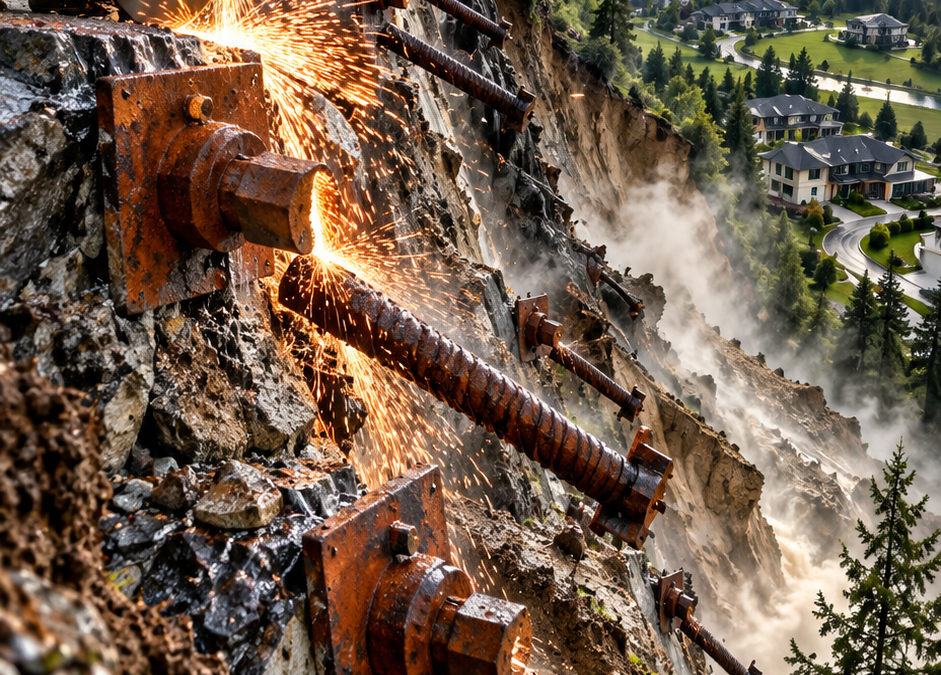
The first steel anchor screamed when the saw reached it at 8:17 on a Tuesday morning.
Thirty feet away, an HOA security guard had one hand pressed against my chest while sparks scattered across land I had owned for more than two decades.
Behind him, Marissa Klene pointed toward the next anchor and told the operator not to stop.
Then something deep beneath the mountain moved.
I felt it before I heard it.
The vibration came through the soles of my boots, low and heavy, more like a pressure passing through the ground than a sound. It rolled beneath us for maybe two seconds.
The security guard felt it too.
His hand fell away from my chest.
Every worker on the ridge froze.
The saw operator lifted his head.
Even the diesel engine seemed suddenly too loud.
Marissa was the only person who did not move.
She stood beside the construction track in a cream raincoat, her dark hair pinned neatly behind her head, and looked at the crew as if the mountain itself had interrupted her schedule.
“Keep going,” she said.
The operator stared at her.
I raised the portable slope monitor in my hand.
“Shut it down.”
He looked at Marissa instead of me.
That told me everything I needed to know about who was signing his checks.
My name is Owen Hail.
I was sixty-four years old, widowed, and living alone in a cedar-sided house on 8.4 acres above Summit Crest Reserve in Oregon’s Coast Range.
Most of my neighbors knew me as the old carpenter on the ridge.
The man who built cabinets in his workshop.
The man who declined invitations to neighborhood Christmas dinners.
The man who came down for groceries twice a week and otherwise seemed content to disappear into the trees.
That was fine with me.
What most of them did not know was that before arthritis stiffened my hands and grief made quieter work attractive, I had spent years working around unstable ground.
Twenty-seven years earlier, I had been a junior field geologist on the stabilization project beneath that ridge.
And the seventeen rusted steel heads Marissa wanted removed because they spoiled the view were not abandoned construction trash.
They were tiebacks.
Deep steel anchors driven into competent ground to reinforce an old slide zone.
They had been there so long that Summit Crest had grown around them.
Houses appeared.
Roads were paved.
Retaining walls were landscaped.
A clubhouse was built.
Families arrived who had never seen the ridge before grass covered the raw cuts left by construction.
The steel stayed.
For twenty-seven years, almost nothing happened.
That was the problem.
People assume a safety system is useless when it works quietly enough for them to forget why it was installed.
Marissa saw rust.
I saw load paths.
She saw ugly steel above the valley.
I saw seventeen reasons the hill had spent almost three decades behaving itself.
And that morning, six of those reasons had already been cut through.
Four others showed fresh saw damage.
Only seven remained untouched.
I looked down at the portable monitor again.
Eleven millimeters.
The reading had shifted eleven millimeters since sunrise.
For most people, eleven millimeters sounds like nothing.
Less than half an inch.
You could lose eleven millimeters in the thickness of a jacket sleeve.
But I had monitored that ridge for fourteen years.
Season after season.
Rain.
Heat.
Freeze.
Dry summers.
Wet winters.
The instruments moved a little. Ground always does.
But I had never recorded a shift like that there.
Not until the morning Marissa’s crew started cutting steel.
She watched me photograph the reading.
“By Friday,” she said, “every piece of that rusted junk will be gone.”
Behind her, beyond the ridge, steel columns and glass framing rose from a newly excavated terrace.
Summit Crest called it the Sky Lounge.
Marissa called it the centerpiece of the community’s future.
The project had a $3.7 million budget and had been designed to serve eighteen premium lots overlooking the valley.
The architectural renderings showed people drinking wine against walls of glass while sunset turned the mountains gold.
There were no old tiebacks in the renderings.
No orange monitoring caps.
No drainage channels.
No cracked concrete.
Just expensive furniture and an uninterrupted view.
Marissa understood views.
She was forty-eight, president of the HOA, and a commercial property branding consultant.
She could take ordinary language and make it sound like luxury.
A road became a “private approach.”
A clubhouse became a “residential lifestyle center.”
A small deck became an “elevated social experience.”
And seventeen corroded anchor heads became “visual contamination.”
Thursday morning, investor commitments on the eighteen premium lots were due to lock.
Friday, the completed illusion was supposed to be unveiled to homeowners and prospective buyers.
She had a deadline.
I had eleven millimeters of movement.
“You’re thirty-one feet inside my property,” I told her.
She adjusted the belt of her raincoat.
“This is a recorded HOA maintenance corridor.”
“Then give me the recording number.”
She lifted a laminated map.
A blue line followed the ridge.
The drawing was clean.
Color-coded.
Professional-looking.
And wrong.
The southern boundary of my parcel had been shifted uphill, placing the anchor line inside HOA land.
I had spent enough of my life reading survey plats, boring logs, grading plans, cross sections, failure maps, and property descriptions to recognize what I was looking at.
Real boundary documents carried bearings.
Dates.
Monuments.
Recording references.
Surveyor stamps.
Marissa’s map had a glossy logo in one corner and the words FUTURE VISION across the top.
“That is a marketing drawing.”
“It is the map approved by our board.”
“Your board cannot move a property line.”
She gave me a thin smile.
“And one retired carpenter cannot stop a community project.”
That was how she saw me.
A carpenter.
A difficult old man.
A widower with tools and too much time.
The security guard shifted beside me.
I stepped around him and headed toward monitoring well M3.
At least, I walked toward where M3 was supposed to be.
Instead of an orange cap, I found a square of fresh concrete.
I knelt.
The surface was still warm.
My stomach tightened.
“Who ordered this?”
The site superintendent, Cal Warren, looked down at the tablet in his hand.
Cal was fifty-two, broad-shouldered, with gray beginning at his temples.
Unlike Marissa, he looked uncomfortable.
“Access revision came through yesterday.”
“From who?”
Marissa answered.
“The property owner.”
I stood slowly.
“I am the property owner.”
The first rain started.
Not the storm yet.
Just scattered drops tapping against the fresh slab.
The main rainband was still forecast more than a day away, but the clouds had already lowered enough to erase most of the valley.
I photographed everything.
The cut anchors.
The damaged ones.
The concrete over M3.
The machinery.
The tire tracks.
The boundary monuments I could still see.
The slope monitor.
Then I called the county engineering office and reported active movement associated with unauthorized disturbance of a known stabilization corridor.
Marissa heard me.
She laughed softly.
“Call whoever you want, Owen. By the time they return your messages, our lounge will be open.”
She was almost right.
The first response I received from the county was an automated email.
By noon, Marissa had called an emergency HOA meeting.
Not because she intended to stop construction.
Because she intended to define the story before I could.
The Summit Crest clubhouse had been designed to make even mundane meetings feel important.
Heavy timber beams crossed a vaulted ceiling.
A stone fireplace occupied one wall.
Floor-to-ceiling windows looked across the lower terraces toward the valley.
Near those windows sat a scale model of the development.
Tiny homes.
Tiny landscaping.
Tiny cars.
And a miniature version of the future Sky Lounge.
My house was not on the model.
Nearly sixty residents attended that night.
Marissa stood at the front wearing a red pantsuit and holding the same marketing map.
I stayed near the back with my yellow field notebook tucked beneath one arm.
She started with photographs of the lounge at sunset.
“For months,” she said, “your board has worked to create an amenity that will increase the long-term value of every property in Summit Crest.”
People nodded.
A few had probably already calculated what that meant for resale prices.
“Unfortunately, one adjacent landowner has attempted to delay that investment by claiming ownership of a maintenance area this community has used for decades.”
Heads turned.
I felt them before I saw them.
Marissa never mentioned that the HOA had not maintained the tiebacks once in twenty-seven years.
She never mentioned that six had already been severed.
She never mentioned the concrete poured over M3.
Instead, she displayed a photograph of one rusted anchor plate.
“Abandoned industrial debris,” she called it.
A man named Daniel Cho raised his hand.
I knew Daniel by sight.
He lived on the upper occupied terrace with his wife and eight-year-old daughter.
He volunteered with a local fire district.
“Is there an engineering risk?”
Marissa answered instantly.
“Our project team has determined that the old material is obsolete.”
I spoke from the back.
“Which engineer signed that determination?”
The room went silent.
Marissa looked toward me.
“This is a board meeting, Mr. Hail. You will have an opportunity during public comment.”
“Put the signed engineering report on the screen.”
Her expression tightened.
“Project correspondence is privileged.”
“Engineering facts do not become safer because you hide them.”
A few people murmured.
Marissa lifted one hand until the room settled.
“Mr. Hail has a long history of resisting improvements near his property.”
I almost laughed.
My “long history” consisted mostly of asking contractors not to park equipment across my driveway.
She continued.
“Our contractor is working from a board-approved plan. The launch will proceed Friday. There is currently no evidence of danger.”
Then she put another document on the screen.
Beginning at midnight, the HOA intended to fine me one thousand dollars per day for obstructing the contractor.
If investor commitments failed, the board reserved the right to pursue delay costs against my property.
That was when the schedule finally made sense.
The eighteen lot commitments expired at ten Thursday morning.
Marissa was not fighting me because she cared about Friday’s celebration.
She was racing a financial clock.
She did not need to prove the steel was harmless.
She needed to keep everyone convinced I was unreasonable until the investors signed.
During public comment, I stood.
No speech.
No accusations.
I gave them measurements.
Eleven millimeters of movement.
Six severed anchors.
Four damaged.
A monitoring well covered by concrete.
A recorded monument inconsistent with the HOA map.
Someone asked, “If this system is so important, why does it look abandoned?”
That question hurt more than it should have.
Because I understood it.
The steel did look abandoned.
Rust.
Weeds.
Moss.
No shiny warning signs.
No fences.
Nothing about it looked like the sort of thing protecting expensive homes.
I closed my notebook.
“Because a slope stabilization system is successful when nothing happens.”
The room stayed quiet.
“For twenty-seven years, you have been looking at nothing happening and treating that as proof that nothing could.”
Marissa ended the meeting five minutes early.
As people filed out, Cal caught me near the fireplace.
His voice was barely above a whisper.
“Ask them for Revision 4B.”
“Revision of what?”
“The demolition classification.”
“What’s in it?”
Cal looked toward the entrance.
Marissa was speaking with two board members.
“Something she does not want on that screen.”
Then he walked away before I could ask more.
I returned to my ridge before dark.
Rain had blackened the soil.
Fresh saw cuts shone silver against rusted steel.
I found the brass monument beneath pine needles and ran a line to the western marker.
My boundary had not moved.
Marissa’s map had.
What she had done was clever.
The drawing borrowed the edge of an old temporary construction access zone and represented it as the property boundary.
To a homeowner unfamiliar with original plats, the line looked legitimate.
The error reached thirty-one feet at its deepest point.
Thirty-one feet was enough to capture the maintenance track.
The monitoring wells.
Every anchor head.
I set my instrument above Monument 5.
Seven millimeters.
Seven millimeters since the previous autumn.
That alone did not prove disaster.
Ground expands.
Settles.
Breathes with moisture.
But seven millimeters at the monument and eleven at the slope monitor immediately after active components were cut?
I was not ignoring that.
Headlights climbed behind me.
The crew had returned.
Portable work lights.
A skid steer.
Crushed rock.
The security guard stepped from the lead truck holding a printed notice accusing me of interfering with contracted maintenance.
Cal was not there.
“You’re trespassing,” I said.
The new foreman raised Marissa’s map.
“We’ve been told this is HOA property.”
“You were told wrong.”
I pointed to the brass monument.
For one second, I saw doubt in his face.
Then someone behind him began pulling out the orange warning stakes surrounding the monitoring corridor.
Another worker reached for my trail camera mounted to a fir tree.
“Leave that alone.”
He tore it down.
It fell beneath the tire of a truck.
The plastic housing cracked.
I stared at it.
Something hot moved through me.
Twenty years earlier, I probably would have grabbed the man.
Instead, I took out my phone.
The security guard called Marissa and put her on speaker.
“Clear the corridor,” she said. “We’ll address Mr. Hail’s complaint through counsel.”
The foreman looked at me.
“We have a written change order.”
“Then preserve it.”
He frowned.
“You may need it.”
The skid steer started forward.
Its first pass pushed gravel over two monitoring caps.
The second buried the shallow drainage throat above the lounge.
I ran toward the machine.
The guard stepped in front of me.
“That channel carries hillside water.”
The foreman shouted over the engine.
“It carries mud onto our construction site.”
“Because you built below it.”
By the time a sheriff’s deputy arrived, the warning stakes had been pulled.
My camera was broken.
Several monitoring points were buried.
Tons of crushed rock covered the drainage throat.
The deputy would not decide a property-line dispute at night.
I did not expect him to.
But he stopped the crew long enough for me to hand everyone copies of my deed and recorded plat.
They left at 9:40.
The ground did not stop moving when they did.
At ten that night, I stood alone in my workshop while rain tapped the metal roof.
The place smelled of cedar dust.
Machine oil.
And faintly, impossibly, lemon oil.
Ruth had used it on finished cabinets.
Three years after her death, I had learned something about grief.
It does not leave a room.
It settles into it.
Into the empty chair.
The untouched coffee mug.
The coat hook no one uses.
The habit of turning to say something before remembering there is no one there.
On the highest shelf sat a gray field box with a dented lid and brass latch.
I had not opened it since her funeral.
Twenty-seven years earlier, Summit Crest had been a raw scar across the ridge.
I was a junior field geologist on the stabilization project.
During grading, crews discovered an old slide plane.
The final repair used deep tiebacks, drainage galleries, retaining structures, wells, and survey monuments.
The anchors were not magic.
They did not hold an entire mountain by themselves.
They reinforced one historically unstable zone while the drainage system relieved internal water pressure.
For eight months, I measured loads and movement.
Logged soil.
Checked drill depths.
Recorded water levels.
Ruth brought coffee to the field trailer.
Once, during a week when I had been working twelve-hour days, she stood over my desk and said, “You know why those numbers matter, right?”
“Because the county inspector likes numbers.”
She slapped my shoulder.
“Because people are going to sleep below them.”
I remembered laughing.
I remembered telling her I knew.
I opened the field box.
Rolled plans.
Photographs.
Boring logs.
Load sheets.
My younger handwriting.
Then I saw a yellow note clipped to a folder.
Ruth’s handwriting.
Quick.
Slanted forward.
If they ever build below this line, make them read page 14.
I had forgotten the note.
I had never forgotten page 14.
I unfolded it across the workbench.
Anchor Group C.
Seventeen tiebacks.
Depths.
Angles.
Drainage relationship.
Reinforced zone.
Six of those anchors were now lying in cut pieces beneath blue tarps.
Four more had saw scars.
At the bottom of the sheet were names.
Project engineer.
Structural consultant.
County reviewer.
Field geologist.
Owen Hail.
My name.
I did not feel vindicated.
I felt sick.
Because page 14 also showed the eastern footing of the new lounge sitting directly above the damaged anchor fan.
And because one thing was missing.
Appendix C.
The load-test table.
Page 14 proved where the anchors went.
Appendix C proved what they had carried when the system was accepted.
I emptied the box twice.
Nothing.
Without that appendix, I could explain the system.
I could not prove the original anchor loads.
At 7:30 Wednesday morning, I walked into the county engineering office carrying the field box.
Elena Ruiz met me in a windowless conference room.
She was thirty-nine, an engineer, with dark curls tied low and the patient expression of somebody who had heard the phrase “this is an emergency” too many times.
She put my deed next to the recorded slope-maintenance easement.
The lines matched my monuments.
Not Marissa’s drawing.
The easement gave the HOA limited authority to inspect and maintain stabilization components.
Not alter them.
Not remove them.
Not redefine my boundary.
Marissa had converted a duty to protect the system into an imaginary right to destroy it.
Elena opened the county archive.
Page 14 appeared.
Appendix C did not.
A scanning error from 1999 had skipped the load tables there too.
She looked through my field copies.
“These are useful.”
“Useful enough to stop work?”
“Not by themselves.”
I clenched my jaw.
She looked straight at me.
“I cannot evacuate forty-one homes because a twenty-seven-year-old field file says these anchors once mattered.”
“I’m not asking you to.”
Her expression changed slightly.
“Then what are you asking?”
“Come see what the slope is doing now.”
I showed her the photographs.
The eleven-millimeter reading.
Monument 5.
The concrete over M3.
The timestamps.
She checked the calibration record for my equipment.
Then she compared my readings against fourteen years of baseline measurements.
She did not compliment me.
I liked that.
“The old plan tells me where to look,” she said. “It does not tell me what these anchors are carrying today.”
“Then test one.”
She nodded.
“That I can do.”
Her phone chimed.
Weather update.
The storm had accelerated.
Heavy rain was expected before midnight.
Several inches could fall on the steep terrain by Thursday morning.
We had less time than I thought.
Elena arrived at my property shortly after ten.
Marissa appeared nine minutes later with the HOA attorney and security guard.
“This inspection is unauthorized,” the attorney said.
Elena pointed toward the recorded easement.
“The county retained inspection authority over the stabilization corridor.”
Marissa folded her arms.
“There is no stabilization corridor. There is abandoned steel on HOA property.”
Elena looked at the brass monument.
Then at Marissa’s glossy map.
“That drawing is not a recorded property document.”
I watched Marissa’s face.
That was the first visible crack in the version of reality she had spent two days selling.
Elena established a stable reference point on bedrock.
We exposed two survey marks.
Both had shifted in the same direction.
Then we uncovered one untouched anchor and connected a test gauge.
For three seconds, almost nothing happened.
Marissa smiled.
Then the needle climbed.
And held.
The tieback was loaded.
Still active.
Marissa stared at the gauge.
“That does not prove the removed components were active.”
Elena photographed the stamped installation number on the plate.
Then compared it to page 14.
“This proves the components were part of a functioning stabilization system. It also proves they should not have been classified as abandoned debris without investigation.”
Near the eastern lounge footing, Elena stopped.
A hairline crack crossed the corner.
Thin.
Easy to dismiss.
But it had not been visible in Monday’s contractor photographs.
She issued a temporary field suspension.
No excavation.
No cutting.
No pouring.
No occupancy of the unfinished lounge.
Marissa accepted the notice without raising her voice.
“You’re making a serious mistake.”
Elena handed her the paperwork.
“Then the measurements will correct me.”
For the first time, the dispute was no longer my word against Marissa’s.
A county engineer had verified that the steel was carrying load.
The ground was moving.
I thought that would buy us time.
It bought us three hours.
At 2:15 that afternoon, Daniel Cho called.
“There’s another crew at the lounge.”
“What are they doing?”
“Glass. Electrical. I thought work was stopped.”
When I reached the terrace, workers were installing panels and running wiring.
Marissa had separated “finish work” from “ground disturbance” and claimed Elena’s field suspension did not apply to interior completion.
She had also moved the investor preview to 8:30 that night.
The financial commitments expired at ten Thursday morning.
If the investors did not sign, the next construction draw froze.
The HOA would be left holding the unpaid balance.
That was when I finally understood the real pressure behind everything.
Marissa was not simply trying to save her project.
She was trying to transfer risk before the deadline exposed it.
Elena issued a broader written notice.
The HOA attorney objected.
Emails multiplied.
Lawyers argued language while workers continued physically building beneath us.
Cal Warren stood outside the temporary fence without his hard hat.
He looked exhausted.
“Northline pulled our crew.”
“Then who are those people?”
“Not mine.”
I stepped closer.
“You told me to ask about Revision 4B.”
He looked at the construction camera on the pole.
Then toward his truck.
“Come here.”
Inside the cab, Cal opened a document on his tablet.
REVISION 4B.
Version One had called the anchors “unidentified steel elements.”
Version Two used similar language.
Version Three recommended removal pending visual confirmation.
Revision 4B called them “landscaping debris.”
Attached beneath it was an email.
Subject:
EXISTING STEEL ELEMENTS — VERIFICATION REQUIRED.
The consulting engineer had reviewed an early site photograph.
His warning was explicit.
The exposed components could be active tiebacks associated with a legacy stabilization system.
No cutting.
No removal.
No burial.
No interruption of the load chain.
Not until subsurface verification and county review were completed.
My mouth went dry.
Then Cal opened another attachment.
Appendix C.
The missing load table.
All seventeen original values.
The record I had searched for all night had been inside the project file the entire time.
Cal had forwarded the warning to Marissa three weeks earlier.
He opened her reply.
Twelve words.
The launch cannot absorb another delay. Classify them as landscaping debris and proceed.
I read it twice.
Then looked at Cal.
“Why did you do it?”
He did not hide behind excuses.
Not really.
“She put it in writing. My company had a six-figure final payment outstanding. I told myself the engineer was being cautious.”
“You asked the right question.”
He looked down.
“And accepted the wrong answer.”
He gave me copies of everything.
Timestamped work logs.
Photographs.
The change order.
The warning.
Appendix C.
Marissa’s reply.
I sent them to Elena before I left the truck.
But one page frightened me more than the email.
The construction grading plan.
The eastern lounge footing sat directly above Anchor Group C.
And a temporary vehicle path had been built for that night’s investors.
To create the path, crews had filled part of the drainage channel.
The anchors were only half of the stabilization system.
Water was the other half.
Saturated slopes do not need drama.
They need pressure.
Enough water inside soil can reduce the margin between stable and moving.
The storm would not create the weakness.
But it could load the damaged system faster than the remaining reinforcement could redistribute stress.
Cal and I climbed back toward the drainage throat.
Three truckloads of crushed rock covered it.
The surface looked almost dry.
I pushed a shovel in.
Water rose around the blade.
Cal stared.
“How much fill?”
“Three loads.”
We started digging by hand.
No machinery.
Not on a moving slope.
The shovel finally struck concrete.
Water pulsed through the opening.
Brown.
Pressurized.
It carried pine needles and mud.
The channel was not simply covered.
It was backing up.
Cal held a tape measure while I called Elena on video.
He read the construction log.
First truckload dumped at 8:52 the previous night.
The slope monitor had accelerated again less than an hour later.
A security vehicle appeared above us.
The same guard stepped out.
He pointed at Cal.
“You’re no longer authorized on this site.”
Cal held up his tablet.
“This is Owen’s parcel.”
“You no longer work here.”
“That is why I can finally tell you to read the survey.”
The guard moved toward the shovel.
Before he reached it, trapped water broke through the gravel.
A brown stream rushed across his boots.
He jumped backward.
For several seconds, water surged hard enough to carry small stones.
Then it settled into a steady discharge.
Elena watched through my phone.
“Do not enlarge the opening any further.”
I nodded.
“Mark the outlet and move below the upper track. I’m upgrading the review.”
We backed away.
The water kept running.
Cal stared at it.
For the first time, the fear on his face had nothing to do with contracts or payments.
He understood what his crew had helped build over.
I called Daniel.
“Go outside.”
“What happened?”
“I need you to look at the uphill side of your house. Don’t crawl under anything. Don’t go into any confined space. Just look at the foundation and soil.”
He called back eleven minutes later.
His voice was different.
“There’s a crack below my daughter’s window.”
I drove down.
Daniel was kneeling beside a narrow opening in the ground.
It ran from the flower bed toward the foundation.
His wife had already taken their daughter to a neighbor’s house.
His hands were shaking enough that the tape measure kept slipping.
“Was that there yesterday?”
“No.”
“Any doors sticking?”
He looked up.
“Her bedroom door.”
Inside, the door rubbed the frame.
A ceramic pencil cup had fallen from a shelf.
None of those things alone meant a major slope failure.
Houses settle.
Wood swells.
Objects fall.
But those signs, in that location, after the measured movement?
They mattered.
Daniel looked at me.
“At the meeting, I thought you were trying to kill the project.”
“I know.”
“Now you’re standing in my daughter’s room telling me the ground might be moving.”
“I’m trying to keep your family out of the wrong place.”
He looked toward her bed.
Then at me.
“If you knew this ridge could move, why didn’t you ever tell us?”
I had been shouted at for two days.
Threatened with fines.
Blocked on my own property.
Called unreasonable.
None of it landed as hard as that question.
Because Daniel deserved an answer.
For fourteen years, I had checked the markers alone.
I reported unusual readings.
I maintained my notes.
But I never invited Summit Crest residents to understand what the instruments meant.
After Ruth died, I stopped going to community meetings altogether.
I told myself the ridge was not their responsibility.
That the county had records.
That the HOA had an easement.
That engineers somewhere understood.
The truth was less comfortable.
Keeping the ridge private let me keep part of my life with Ruth private.
The old field box.
Page 14.
The monitoring route we had once walked together.
I had protected my grief so carefully that I helped create the very ignorance Marissa later exploited.
“I should have shown you,” I said.
Daniel said nothing.
“The HOA had no right to touch those anchors. But I helped make it possible for people to forget why they were there.”
He looked at me for several seconds.
Then held out the tape measure.
“Then show me now.”
We packed medication.
Documents.
Clothing.
I marked the safer western route away from the active slope.
Then I told Daniel to contact the volunteer fire coordinator.
“You think we’re evacuating?”
“I think guessing is no longer enough.”
Word moved quickly.
Residents started sending photographs.
A Sunday birthday picture showed a garden wall behind a family.
Straight joint.
By Wednesday, that same joint was open wide enough to catch a key.
Daniel found doorbell footage from Tuesday morning.
At 8:19.
Two minutes after the first anchor was cut.
The image trembled.
A wind chime moved on a still porch.
None of those details proved everything.
Together, they established something nearly as important.
Sequence.
The HOA had already begun describing the signs as old settlement that residents only noticed because I had made them anxious.
The photographs said otherwise.
The changes were new.
They appeared after work began on the ridge.
They spread outward from the upper area.
I plotted them on a map.
No labels saying SAFE.
No labels saying UNSAFE.
That was not my authority.
I marked only what residents observed and when.
For the first time since Ruth died, my workshop filled with neighbors.
Wet boots lined the wall.
Phones charged on my workbench.
Coffee cups sat beside clamps and wood planes.
People who had waved to me from passing cars for years were now comparing foundation photographs under the same lights where I built cabinets.
Fear brought them there.
Evidence gave them something to do.
Every few minutes, another message came in.
Another crack.
Another sticking door.
Another photograph.
I answered all of them.
At six that evening, Elena and I checked the instruments again.
Twenty-four millimeters.
Water was flowing from an old drainage outlet near the lounge.
It should not have been running at that internal level.
The discharge carried sediment.
Elena stared at it for several seconds.
Then called County Emergency Management.
“We’re approaching evacuation threshold.”
Behind us, construction lights switched on inside the Sky Lounge.
Marissa was still preparing for the investor event.
At 8:30, the rain came hard.
The unfinished pavilion glowed above Summit Crest like a glass box suspended in darkness.
Black SUVs climbed the access road.
Caterers carried trays through a side entrance.
White flowers had been arranged along a wall where sealant was already separating from the frame.
Elena arrived with an expanded stop-work order.
I carried the latest measurements and Cal’s documents inside a waterproof case.
The security guard blocked us.
“Private event.”
Elena showed her county identification.
“Unsafe structure inspection.”
Inside, pendant lights glowed above polished concrete.
Investors stood near the windows with drinks.
Rain streamed down the glass.
Marissa stood among them in the same red pantsuit she had worn at the board meeting.
She saw us.
And kept smiling.
“As you can see,” she told the group, “the rumors surrounding our hillside have not interrupted progress.”
Elena ignored the speech.
She crossed to the eastern joint.
Placed a crack gauge.
The opening had widened since morning.
She stood.
“Everyone needs to leave the structure.”
Conversation stopped.
Marissa stepped forward.
“Our counsel is reviewing your notice.”
“You can review it outside.”
I handed Marissa the consulting engineer’s warning.
For the first time since this started, her face changed completely.
Not irritation.
Not controlled anger.
Recognition.
“This is confidential project material.”
“It was also correct.”
She looked toward the investors.
And made the decision that finally destroyed whatever credibility she had left.
She blamed the storm.
“This is normal settlement during an unusual weather event. Mr. Hail has spent years attempting to block development near his property, and he is using this storm to—”
A sharp sound cracked through the room.
One glass panel shifted.
It did not explode.
The lower corner simply dropped.
The gasket pulled free.
Then a fracture shot across the polished floor.
Eastern wall toward center.
Fast.
Straight.
Visible.
The investors did not wait for another explanation.
They moved.
Chairs scraped.
Someone dropped a glass.
The pendant lights began swaying.
Elena radioed the county emergency coordinator.
Verified ground movement.
Structural distress.
Active drainage discharge.
Forecast heavy rainfall.
Forty-one occupied homes on the two lower terraces were ordered evacuated.
Marissa stared at the crack.
“You cannot evacuate an entire neighborhood because of a line in concrete.”
Elena’s voice stayed level.
“I’m not.”
She pointed toward the instruments outside.
“I’m evacuating it because every independent measurement says the line is moving.”
The next four hours became rain, headlights, doors, and names on a list.
Daniel put on his yellow volunteer fire jacket.
Fire crews went house to house.
Families carried dogs.
Cats.
Medication.
Photo albums.
Laptop bags.
Passports.
Blankets.
Children half asleep in coats.
The things people grab when somebody tells them they may not get a second trip.
I moved between the monitoring corridor and evacuation checkpoint.
Every fifteen minutes, I gave Elena another reading.
Twenty-seven.
Thirty-one.
Thirty-four.
At Marissa’s house, a crack opened across the pool deck.
Water disappeared into it.
Her property sat about 160 feet below the lounge.
Firefighters marked it red.
Marissa drove toward the checkpoint.
Daniel stopped her.
“The road is closed.”
“I need investor agreements from my office.”
“No.”
She looked at me.
“My house is not part of your property dispute.”
“This stopped being a property dispute when the ground started moving.”
“Those documents are worth millions.”
“Then they are worth less than your life.”
Her hands tightened around the steering wheel.
For a second, I thought she might drive around us.
Then a retaining block broke loose from the wall uphill.
It fell into the road.
Marissa stared at it.
Then reversed.
At 1:06 Thursday morning, the last family left the lower terrace.
Two elderly residents needed help.
One man refused to go until firefighters found his dog under a bed.
People cried.
People argued.
People forgot medications and went back for them until firefighters stopped allowing reentry.
But eventually the list was complete.
No one missing.
The slope monitor read thirty-eight millimeters over thirty-one hours.
I sent the number to Elena.
Then moved behind the safety line.
The upper retaining face dropped.
At first, only inches.
The eastern side of the lounge settled.
The steel frame twisted.
Glass broke outward in a glittering chain.
Then saturated soil beneath the footing moved.
Slow for maybe two seconds.
Fast for the next five.
The pavilion pulled away from its western supports.
Metal folded.
Glass shattered.
Concrete cracked.
The lounge collapsed into the terrace.
Mud and debris traveled downslope.
It hit Marissa’s pool deck.
The wall failed.
A sheet of blue water poured out, turned brown almost immediately, and crossed the road below.
The sound rolled across the valley.
Then it stopped.
The mountain did not disappear.
Summit Crest did not vanish.
The entire hillside did not collapse.
The historical slide zone partially failed in the same area where reinforcement had been cut and drainage obstructed.
The houses had been evacuated.
No one died.
Standing there in the rain, I realized that was the only outcome I truly cared about.
At dawn, the storm weakened.
Fog lifted enough to reveal twisted framing above a fan of mud.
Marissa sat at the evacuation shelter wearing borrowed clothes.
She watched footage on somebody’s phone without speaking.
Daniel found me beside the coffee table.
“My daughter asked if our house is gone.”
“I don’t know.”
He rubbed both hands over his face.
“What did you tell people when you worked these failures?”
I thought about Ruth.
About the line she had written twenty-seven years earlier.
About people sleeping below numbers they never knew existed.
“Being alive to ask about the house is the first good measurement.”
Daniel nodded.
Neither of us smiled.
County engineers entered the site after daylight.
Controlled access.
One section at a time.
They exposed the corridor.
Six tieback heads fully severed.
Four deeply damaged.
Seven intact.
Fresh fill over cut components.
M3 sealed beneath concrete.
The temporary investor access path partly blocking the surface drainage route.
Marissa’s attorney released a statement calling the event an unprecedented storm-related slope failure.
The instruments told a more complicated story.
Elena compared the movement record with the contractor logs.
The first acceleration began after anchor cutting.
Before the heaviest rain.
Movement increased after M3 was sealed and the drainage path was buried.
Then the storm arrived and added water to a system whose safety margin had already been damaged.
Rain was the visible trigger.
The work had weakened what the rain acted upon.
The strongest evidence was not my old field plan.
Not my profession.
Not even Marissa’s email.
It was the way independent evidence agreed.
Construction times.
Instrument records.
Physical damage.
Drainage response.
Anchor load data.
Failure location.
Sequence.
For weeks, Marissa had reduced the argument to her word against mine.
The ground had removed that option.
The insurer received Revision 4B.
The engineer’s warning.
Marissa’s instruction.
Cal’s work log.
It reserved coverage while investigating whether known conditions had been concealed.
The eighteen premium-lot commitments froze.
The county revoked the lounge permit.
Reserve funds began paying for inspections, temporary housing, drainage work, road repair, and slope stabilization.
At the first open board meeting after the evacuation, Daniel asked the treasurer to display the cost of the geotechnical review Marissa had previously declined.
The number appeared on the screen.
Less than one-tenth of one percent of the lounge budget.
Nobody spoke.
Residents were furious.
Some wanted criminal charges immediately.
Some wanted lawsuits filed before sunrise.
Real consequences moved slower.
Engineering orders.
Insurance disputes.
Depositions.
Invoices.
Recorded correspondence.
Board procedure.
A recall petition.
Marissa resigned three days before the recall vote.
The new board canceled the Sky Lounge.
Released project correspondence.
Removed the false boundary map.
Entered a restitution agreement covering damage to my monitoring corridor and equipment.
Emergency funds went toward displaced families and slope repair instead of amenities.
Daniel’s house survived.
The foundation below his daughter’s room needed significant repair.
Marissa’s house also survived.
Her pool deck did not.
Neither did the office where she had stored the investor agreements.
I did not celebrate that.
People like to call things poetic justice when they watch from far enough away.
Up close, there is nothing poetic about soaked drywall, displaced families, insurance adjusters, frightened children, or the smell of mud inside a home.
What mattered to me was smaller.
The drainage system was restored.
The damaged ridge was stabilized.
New monitoring points were installed where residents could see them.
Monthly measurements became public.
No more hidden notebook.
No more one old man walking the ridge alone.
The new board asked me to chair a safety committee.
I said no.
I had no interest in a title.
But I agreed to teach.
On the first clear Saturday after residents returned, Daniel and eight volunteers climbed the maintenance track with me.
His daughter carried my yellow field notebook.
I showed them the brass monuments.
The drainage outlets.
The new instruments.
How to record a reading.
How to compare it with baseline.
How one number asks a question.
How a pattern demands attention.
Daniel’s daughter looked toward the repaired ridge.
“Is the mountain safe now?”
I considered the answer.
Twenty-seven years earlier, I might have said yes.
Engineers like certainty until experience teaches them what certainty costs.
“Safer,” I said.
She waited.
“And watched.”
That seemed to satisfy her.
Months later, Summit Crest opened a small timber overlook on verified stable ground.
Nothing spectacular.
No glass palace.
No private investor stage.
Before construction began, the board displayed the recorded plat, easement, geotechnical report, drainage plan, and inspection requirements at an open meeting.
People asked questions.
Engineers answered them.
The documents stayed on the screen.
That evening, I went back to my workshop.
The gray field box sat where I had left it.
I opened it.
Ruth’s yellow note was still clipped to page 14.
If they ever build below this line, make them read page 14.
For years, I had treated that box as something private between us.
A piece of a life that ended when she did.
But forty-one families had slept below those anchors without understanding what was above them.
My silence had not caused Marissa’s decisions.
Her choices were hers.
Still, I understood something I should have understood earlier.
Secrecy had not protected the system.
It had protected my grief.
And in doing so, it made forgetting easier.
I placed Ruth’s note in a protective sleeve.
Made a certified copy of page 14.
Then put copies inside a weatherproof field box at the monitoring station.
The county held the official archive.
The HOA kept a duplicate.
I kept the originals in my workshop.
No single person would ever again be the only one who understood what those seventeen anchors meant.
The following spring, moss began growing over the repaired ground.
Water moved freely through the restored drains.
Families walked to the new overlook.
Children leaned against the railing and looked across the valley.
Nobody stood above buried monitoring wells.
Nobody walked across somebody else’s land because a colorful map said they could.
And nobody called the old steel meaningless simply because it was ugly.
Sometimes I still think about Marissa standing on my ridge that Tuesday morning.
Cream raincoat.
Security guard.
Crew waiting.
The monitor already showing eleven millimeters.
She saw rusted metal and decided appearance explained purpose.
She saw an old man living alone and decided privacy meant ignorance.
She saw a financial deadline and decided urgency could replace verification.
But the thing I remember most is not the first anchor being cut.
It is her email after the engineer warned her.
Because mistakes happen.
A contractor can misidentify steel.
A board can rely on the wrong drawing.
A superintendent can accept an explanation that sounds reasonable.
Those mistakes can still be stopped.
Someone can ask another question.
Call an engineer.
Check a survey.
Pause a machine.
Wait one day.
Marissa’s irreversible choice came after uncertainty had been removed.
She received the warning.
She knew the steel might be active.
She knew verification had been recommended.
And instead of stopping, she changed the description.
“Landscaping debris.”
Two words.
That was all it took to turn a warning into something convenient.
For years, I had believed the most important things holding Summit Crest together were hidden underground.
The tiebacks.
The drains.
The reinforced soil.
I was only partly right.
What ultimately protected those families was less impressive than any engineering structure.
A brass survey monument.
A calibrated instrument.
A contractor who finally handed over his records.
A county engineer willing to measure instead of assume.
A neighbor who stopped defending a project long enough to look at the crack beneath his daughter’s window.
And forty-one families who left their homes before anyone could promise them with certainty that they needed to.
The mountain did not punish Marissa.
Mountains do not care about pride.
They do not understand deadlines.
They do not recognize property values, investor commitments, HOA authority, or polished presentations.
They respond to force.
Water.
Pressure.
Load.
Resistance.
Take away enough resistance while adding enough pressure, and the result does not care who approved the meeting minutes.
That is why I still walk the ridge.
Not every day anymore.
I do not need to.
Other people know how to read the instruments now.
Sometimes I see Daniel and his daughter checking a marker before I get there.
Sometimes a homeowner sends me a photograph of a drain after heavy rain without being asked.
The knowledge belongs to more than one person now.
Ruth would have liked that.
I still keep her original note inside the workshop.
Some things can remain private without becoming secret.
On clear mornings, the seventeen anchor locations are easy to find.
Six are new replacements.
Several others were repaired.
The intact originals were tested and incorporated into the redesigned system.
None of them are beautiful.
Nobody has tried to hide them.
Small identification plates now sit beside the monitoring points.
Not decorative signs.
Not marketing language.
Just facts.
Installation number.
Inspection date.
Reading.
Next review.
Twenty-seven years earlier, we buried most of the important work because that was where the engineering required it.
Now I understand that the knowledge should never have been buried with it.
And whenever I stand above Summit Crest and look down toward the homes below, I still hear Ruth’s voice as clearly as if she were standing beside the old field trailer with two coffees in her hands.
The numbers matter because people sleep below them.
This time, everyone on the mountain knows why.

