𝗙𝗨𝗟𝗟 𝗦𝗧𝗢𝗥𝗬 The Road to My Father’s Lake Was Full of Strangers, and Someone Had Made Them Believe It Belonged to Them
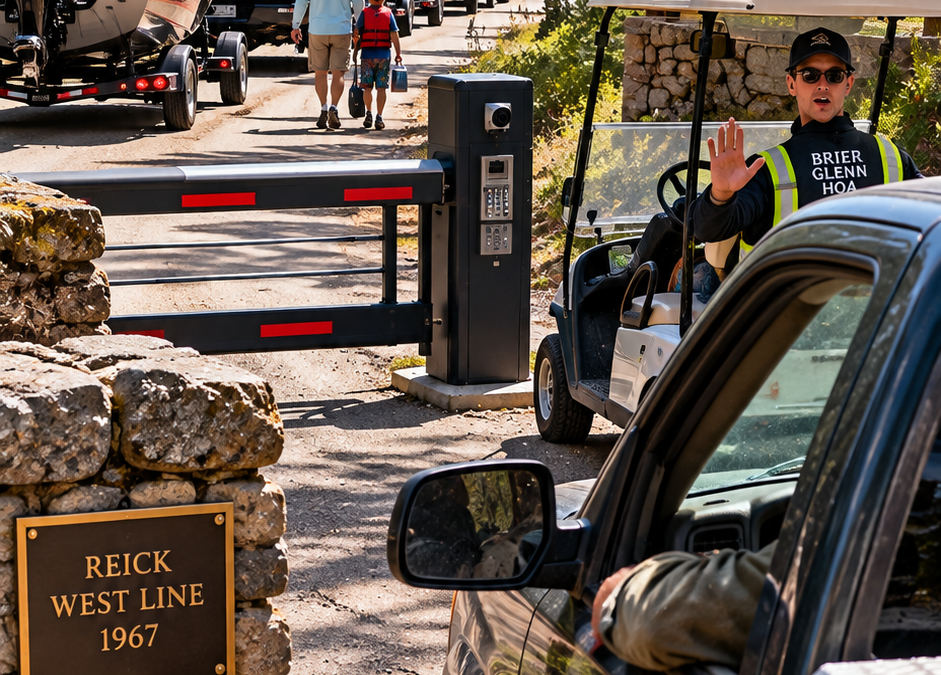
𝗙𝗨𝗟𝗟 𝗦𝗧𝗢𝗥𝗬 .
I had not thought much about it at the time.
Dana turned slightly, positioning herself so the families behind her could see that the situation was under control.
“Today is our spring launch day,” she said. “If you back down to the county road, Tyler can open the service lane on the north side and let you reach the property from there.”
“The north lane reaches the barn.”
“That should be sufficient for today.”
“I need this road to reach my house.”
Her expression barely changed.
“This has been the association’s lake-access corridor for years.”
“How many years?”
She paused.
“Long enough that ownership is not the issue you seem to think it is.”
That sentence told me more than ten minutes of arguing would have.
I looked at the trailers.
Then at the gate.
Then at Dana.
“Move the trailers and open the gate.”
“I’m afraid that isn’t possible during launch operations.”
“It’s my road.”
“Our counsel has a different understanding.”
“Then give me the recording information for the easement.”
Her eyes narrowed slightly.
“We’re not conducting a legal hearing beside the roadway.”
“No. We’re standing on my father’s property while you stop me from reaching his house.”
She turned to Tyler.
“Please give Mr. Reick a visitor pass.”
Tyler held out a blue card.
I did not take it.
Dana sighed.
“Mr. Reick, there is no reason for this to become confrontational.”
“I agree.”
I shifted the truck into reverse.
For a moment she looked satisfied.
Then I backed into the grass, turned around the stone post, and drove through an old timber path my father and I had used decades earlier when we were cutting firewood.
Branches scraped both sides of the truck.
A low limb dragged across the roof.
The path was barely wide enough to pass.
Twenty minutes later, I reached the house from behind the barn.
My father had built it in 1969.
Nothing grand.
Two stories.
Cedar siding.
A porch facing west across Lake Bellweather.
The property covered eleven acres on a narrow point of land.
The eastern boundary touched Brier Glenn.
The western edge followed the gravel road from the county pavement down to our private ramp.
At the bottom, the road widened into a dirt turning circle beside a two-slip boathouse.
Brier Glenn’s cul-de-sac had always ended forty-two feet east of our boundary.
At least it had when my father was alive.
From the porch, I could see what had happened.
Fresh gravel connected the subdivision cul-de-sac directly to our road.
The electronic gate stood well inside our tree line.
A new wooden sign read:
BRIER GLENN LAKE ACCESS
Beyond it, workers were fastening aluminum railings to a floating dock almost twice the size of the old one.
My father’s green fishing boat had been dragged onto the bank and covered with a blue tarp.
I stood on the porch for several minutes without moving.
The funeral had been twelve days earlier.
My father had died at eighty-six after a short decline that somehow still felt long when I remembered the last month.
For most of his life, he had been difficult to slow down.
Even at eighty, he would disappear for three hours because a neighbor had called about a broken pump.
Then, during the last winter, his world became smaller.
The barn.
The kitchen.
The porch.
Eventually the bedroom.
I had spent more time helping him sit up than thinking about his land records.
While I was changing sheets, adjusting medications, and trying to persuade him to eat soup, somebody had been building a marina at the bottom of his road.
I walked downhill.
The lock on the boathouse had been cut.
A keypad had been screwed into the cedar siding.
Inside, orange association life jackets hung where Dad kept fishing nets.
Plastic paddles had been stacked beside his workbench.
A laminated emergency-evacuation plan was taped directly over the pencil marks where he recorded the lake level every October.
The marks were still underneath.
I could see them through the paper.
That was the first thing that truly angered me.
Not the gate.
Not the trailers.
Not even Dana.
That piece of laminated plastic covering my father’s handwriting.
I peeled one corner back.
Then stopped.
Evidence first.
Emotion later.
I photographed everything.
The keypad.
The cut lock.
The life jackets.
The floating dock.
The turning circle.
The new gravel connection.
The electronic gate.
Then I found the old survey pin.
It was buried under about four inches of new stone near the gate footing.
Only the red plastic cap was visible.
Someone had driven a steel fence post about two feet east of it and tied an orange ribbon around the post.
As though ribbon could relocate ownership.
I brushed the gravel away with both hands until the stamped survey number appeared.
The monument was exactly where it had always been.
The gate was not.
Monday morning, I found an envelope wedged into the front door.
NOTICE OF INTERFERENCE WITH COMMUNITY AMENITY
The letter demanded that I stop obstructing what it called the established lake-access corridor.
It ordered me to remove my truck from the turning circle.
Then it requested that I provide the association with keys to the boathouse.
I read that sentence twice.
Keys.
To my father’s boathouse.
The letter also warned that Brier Glenn would seek damages if I interfered with the Memorial Day opening of its new marina pavilion.
Attached was a glossy brochure.
The cover showed a computer rendering of smiling families standing beneath string lights beside a new dock.
Across the top were the words:
YOUR LAKE. YOUR SUMMER. YOUR BRIER GLENN.
Near the bottom was a number that changed the situation completely.
Sixty-three lake-access memberships.
Six hundred dollars per household per year.
The pavilion project had cost roughly $280,000.
A financing sheet said part of the construction had been funded by a special assessment.
Another portion came from a loan secured by future amenity revenue.
The final $85,000 draw depended on the marina receiving operational certification by May 31.
If certification failed, the board could impose another assessment to cover the shortfall.
I sat at my father’s kitchen table and read the papers again.
Dana had not simply let neighbors use a road.
She had sold access.
She had built a dock.
She had signed contracts.
She had borrowed money.
She had collected fees.
And she had connected all of it to a deadline.
Sixty-three families now believed they had purchased something my father had never sold.
That afternoon, I drove to the Brier Glenn clubhouse.
Dana had called what she described as an informational meeting.
My name was already printed on the agenda.
About seventy residents sat in folding chairs facing a projection screen.
Several people recognized me from the road.
Their conversations dropped when I walked in.
I took an empty chair against the back wall.
Dana stood beside an enlarged map.
She wore another scarlet jacket.
Maybe the same one.
Maybe she owned six of them.
“Mr. Reick has recently inherited the property adjoining our established access corridor,” she told the room.
Recently inherited.
That was technically true.
It also made me sound like a stranger who had arrived after everyone else.
“Understandably, he has questions. Unfortunately, he has also indicated an intention to close the road before Memorial Day.”
A man in the second row turned around.
“We paid for that access.”
I answered from the back.
“You paid the HOA. I didn’t sell it.”
The room shifted.
Not dramatically.
One chair scraped the floor.
Someone folded a brochure.
A woman whispered to the person beside her.
Dana lifted a silver pointer.
The map on the screen showed Brier Glenn’s cul-de-sac connecting directly to the lake road.
No gap.
No parcel line.
No forty-two-foot strip.
I stood long enough to read the date in the lower corner.
1998 SHORELINE ACCESS CONTROL SURVEY.
My stomach tightened.
I knew that map.
Years earlier, a copy had appeared in a shoreline dispute.
I had seen the complete survey.
It had not looked like Dana’s version.
I did not tell her that.
Not yet.
Instead, I asked, “What is the instrument number of the recorded easement?”
Dana lowered the pointer.
“Our counsel will communicate any legal documentation through appropriate channels.”
“So you don’t have the number?”
“This is not a courtroom, Mr. Reick.”
“No. It’s a room full of people who paid six hundred dollars for access across my land.”
A few heads turned toward Dana.
Her mouth tightened.
I continued.
“Who authorized the electronic gate?”
“The exact boundary is disputed.”
“Who cut the lock on the boathouse?”
That question slowed her.
Only for a second.
“Our contractor opened an amenity maintained by the association.”
“With whose permission?”
Someone near the front laughed quietly.
Dana glanced at my work jacket.
“Mr. Reick, repairing tractors does not make you a surveyor.”
A few people laughed louder.
She waited.
“Nor does owning a toolbox make someone an attorney. The association has professional counsel. Mr. Reick has opinions.”
A man beside the projector whispered loudly enough for several rows to hear.
“Maybe he can weld himself an easement.”
More laughter.
I sat down.
There are times when correcting someone only teaches them to hide the next mistake better.
The following morning, I called Laura Chen.
She was a licensed surveyor from two counties away.
I deliberately chose someone who had never worked for me, my father, or anyone connected to my professional life.
She arrived Thursday morning with a robotic total station, a data collector, and two technicians.
Dana arrived nine minutes later.
Blue binder.
Scarlet blazer.
Tyler following in the golf cart.
“You do not have permission to survey association property,” Dana announced.
Laura continued setting up her tripod.
“My client hired me to survey his parcel.”
“That is the disputed question.”
Laura looked at her.
“No. The line is the question. My authority to survey my client’s land is not.”
Dana filmed us for almost an hour.
Laura worked for two days.
She recovered three original monuments.
The brass cap near the county road.
The buried pin beside the new gate.
An iron pipe above the old ramp.
When she finished the preliminary calculations, she called me over to her tablet.
The property line appeared as a clean geometric boundary.
The new electronic gate stood eleven feet inside my land.
The fresh gravel connection crossed forty-two feet of my parcel.
Sixteen feet of the marina turnaround occupied our property.
One corner of the pavilion roof extended eighteen inches across the boundary.
Laura zoomed in.
“Unless they have an easement recorded somewhere outside the ordinary index, I don’t see anything giving them this corridor.”
“Neither do I.”
She looked at me.
“You read plats pretty comfortably for a tractor mechanic.”
“I’ve had to read a few.”
She smiled.
Then returned to work.
Dana did not wait for the signed survey.
That evening, she emailed all sixty-three lake-access households.
She described Laura as an outside contractor placing unverified markers across a community roadway.
She announced an emergency board vote to remove any obstruction before Memorial Day.
The following morning, I found two orange construction barricades blocking the old timber path I had been using to reach the house.
A sign said:
CONSTRUCTION ZONE
NO ENTRY
I stood there staring at it.
Until then, Dana had been trying to use my property.
Now she was trying to isolate me on it.
I photographed the barricades.
Moved them carefully to the shoulder.
Then drove through.
That evening, a couple waited beside my mailbox.
Their names were Eric and Marlene Shaw.
Their twelve-year-old son stood between them.
Behind their SUV was a new fishing boat.
Dealer tag still in the window.
Bright trailer tires.
Unused life jackets.
Eric spoke first.
“We bought this after the marina announcement.”
I looked at the boat.
“It’s nice.”
“Twenty-seven thousand dollars.”
I nodded.
Marlene looked toward the lake.
“Dana says you’re closing the only ramp we’re allowed to use.”
Her voice was not hostile.
That made the conversation harder.
Their son stared at the gravel.
I said, “I never sold Brier Glenn a road, a ramp, a boathouse, or lake access.”
Eric clenched his jaw.
“That may be true.”
He looked at his son.
“But we’re the ones who lose.”
I could have argued.
I could have told him exactly who was responsible.
Instead, I said, “I know.”
And I did.
Dana had created a remarkably effective conflict.
Every time I defended my boundary, it looked as if I were taking something away from a family.
Every document I produced could be reframed as another obstacle between a child and the lake.
Eric and Marlene drove away slowly.
Their new boat followed behind them.
I watched until the trailer disappeared around the curve.
That was when I understood that a survey alone would not solve the problem.
The residents needed to know who had made the promise.
And they needed to understand who had never made it.
The next day, a contractor named Rick Alvarez came to my house.
He owned the grading company that had installed the gravel connection and poured the gate footings.
He looked uncomfortable before I even opened the door.
“Mrs. Whitmore says you’re stopping final paving.”
“That’s right.”
“She says your survey is wrong.”
“Did she give you one?”
Rick did not answer immediately.
Instead, he unrolled a set of construction plans across my father’s kitchen table.
The drawing showed the road crossing a parcel labeled:
HOA ACCESS RESERVE
I leaned closer.
The parcel-identification number in the title block belonged to Brier Glenn’s cul-de-sac.
Not my father’s land.
“Who gave you this?”
“The association project manager.”
“Did anyone give you a deed?”
“No.”
“Recorded easement?”
He rubbed his jaw.
“I asked.”
“What did they say?”
“That counsel had it.”
Rick had already poured nearly twelve thousand dollars of concrete based on those plans.
His paving crew was scheduled for Monday.
If the HOA did not control the land, he was exposed too.
I printed a copy of Laura’s preliminary overlay.
Rick studied it.
Then rolled up his plans.
“I’m canceling Monday.”
Dana lost her first deadline that afternoon.
I gained my first independent witness.
My father saved everything.
Unfortunately, he had no consistent idea where anything belonged.
His filing system consisted of places he expected his future self to remember.
Coffee cans.
Desk drawers.
Tackle boxes.
Old envelopes.
A metal cabinet in the barn.
A toolbox that had not contained tools since 1987.
I spent most of Saturday searching.
By sunset, I found a bundle of maintenance invoices held together with a dried rubber band.
Every November from 1999 through 2023, my father had paid the same local company to chain the lake road and winterize the ramp.
Three invoices contained handwritten notes.
TURNED BACK BRIER GLENN VEHICLE.
LOCK REPLACED AFTER UNAUTHORIZED ENTRY.
ROAD CLOSED FOR WINTER—NO ASSOCIATION ACCESS.
I sat on the barn floor holding the papers.
At the clubhouse, Dana had said the association’s use was open and continuous.
Twenty-four years of seasonal closures told a different story.
On Monday, the county archive gave me another piece.
Aerial photographs taken four years apart showed the old tree line intact until the previous fall.
The gravel connection was new.
Not historic.
Then the clerk found a correspondence file attached to Brier Glenn’s 2019 marina-pavilion application.
Inside was a letter from Dana to my father.
The HOA had offered him eighteen thousand dollars for a permanent lake-access easement.
His reply was six sentences.
The road crosses family land and serves our private boathouse.
I am not interested in selling permanent access.
Thank you for the offer.
Please pursue another location.
That was Dad.
No threat.
No insult.
No speech.
Just no.
The board minutes from two weeks later recorded the vote.
MOTION TO INCREASE EASEMENT OFFER FAILS 4–3.
Then:
PRESIDENT WHITMORE RECOMMENDS ALTERNATIVE ACCESS STRATEGY.
I read that sentence three times.
Dana had not misunderstood the boundary.
She had tried to buy the right.
My father had refused.
Her board had failed to approve a larger offer.
Then she had built the marina anyway.
The realization left me colder than anger.
A mistake can sometimes be repaired by showing someone the right line.
This was different.
She knew there was a line.
The project depended on pretending it would eventually stop mattering.
Residents began calling me.
The first was Nolan Price, a retired high-school teacher who lived near the cul-de-sac.
“I paid the six hundred,” he said.
“So did my daughter.”
“I understand.”
“Dana told us your father donated the corridor after the 2019 negotiations.”
“He didn’t.”
There was a long pause.
“Did he sign anything?”
“No.”
“Did we get any recorded document?”
“That’s something you should ask the board.”
Nolan sighed.
“We got windshield stickers.”
He sounded embarrassed.
Then he told me something I had not fully considered.
Brier Glenn’s original boat ramp had silted in badly.
The nearest public launch was fourteen miles away.
On summer weekends, it often filled before sunrise.
Families had purchased boats after the marina announcement.
Some paid the special assessment in monthly installments.
One couple had chosen a house in Brier Glenn because a sales agent emphasized lake access.
Dana had built more than a dock.
She had built expectations.
Loans.
Family plans.
Resale assumptions.
Saturday mornings children had already imagined.
Those residents were beginning to become angry with her.
But they were also afraid of me.
Because even if Dana had lied, my boundary was still the thing standing between them and what they had paid for.
The next morning, Nolan forwarded an internal board email.
Dana had marked it confidential.
The lender would not release the final construction draw unless the marina had legal access and an operating certificate by May 31.
If Brier Glenn missed the deadline, the association could face an emergency assessment of roughly $1,350 per household.
Suddenly, everything made sense.
The rush.
The banners.
The emergency votes.
The insistence that decades of legal ambiguity somehow had to be settled before Memorial Day.
Dana was racing a financing deadline.
If she could get the marina opened, get families using the road, and receive the final loan draw, the unauthorized connection would begin to look permanent.
Not legally.
Socially.
Practically.
Physically.
Sometimes people create facts on the ground because they hope everyone will become too exhausted to challenge them later.
On Monday, Laura delivered her signed survey.
I sent copies to Dana.
The HOA attorney.
The county permitting office.
And the Bellweather Reservoir Authority.
I included the 2019 correspondence.
The board minutes.
The contractor’s site plan.
The winter road-closure invoices.
The aerial photographs.
I requested a compliance review.
Nothing more.
No emergency order.
No police.
No call to anyone I knew professionally.
The reservoir authority acknowledged the packet and scheduled an inspection.
Memorial Day morning.
The exact morning Dana planned to open the marina.
She could have postponed.
She did the opposite.
Three days before Memorial Day, banners appeared at the entrance to Brier Glenn.
A local caterer was hired.
The newsletter promised a ribbon cutting at ten.
Live music at noon.
The first annual Brier Glenn boat parade at one.
The more uncertain the legal access became, the bigger the celebration grew.
Three days before the ceremony, Dana came to my porch alone.
No golf cart.
No binder.
Just the scarlet blazer and a two-page document.
“We can solve this privately.”
I took the paper.
The agreement granted Brier Glenn permanent use of the road, ramp, turning circle, and boathouse.
In return, the association would maintain the gravel.
It would also waive any claims against me for construction delays.
I read it again.
No payment.
No liability terms.
No limit on users.
No operating hours.
No restrictions on events.
No insurance requirement.
At the bottom was a signature line.
ADJOINING OWNER CONSENT.
I looked at her.
“You’re asking me to give you what the board refused to buy.”
“I’m giving you a way to avoid a very ugly dispute.”
“Your board offered my father eighteen thousand dollars for an easement.”
“That was years ago.”
“He said no.”
“Circumstances have changed.”
“His ownership didn’t.”
Her voice hardened.
“You have sixty-three families depending on this access.”
“No. You have sixty-three families depending on a promise you made.”
“You know what I mean.”
“I do.”
She stepped closer.
“You have an opportunity not to become the man who ruined summer for sixty-three families.”
For the first time, I understood the strategy completely.
She wanted me angry.
Angry enough to say something cruel.
Something about keeping everyone out.
Something she could repeat in the clubhouse.
I folded the agreement.
“You sold them something my father refused to sell you.”
Her eyes narrowed.
“Your father is not here.”
That sentence landed exactly where she intended it to.
For several seconds, I saw him in the hospital bed.
His hands thinner than I remembered.
His wedding ring sliding loosely against his knuckle.
I remembered helping him sign the last tax form he would ever sign.
I remembered him apologizing because I had taken time off work.
I remembered saying, “Dad, there is nowhere else I need to be.”
He had looked toward the window.
Toward the lake.
Dana waited.
I handed the paper back.
“The inspection is Monday.”
“I know.”
“Our maps have been approved.”
“Which maps?”
She gave me that same patient smile.
“The ones professionals understand.”
Memorial Day morning arrived bright and almost windless.
By nine, folding chairs covered the marina lawn.
Blue balloons had been tied to the railings.
A white ribbon stretched across the dock entrance.
Boat trailers filled the Brier Glenn cul-de-sac.
This time none were on my road.
Dana had placed two private security guards beside the electronic gate.
I walked down from the house carrying a slim document case.
Nolan stood near the back with his daughter.
Rick Alvarez leaned against his truck.
Laura had set her total station near the shoulder where anyone could see it.
Dana stood beside the podium.
Scarlet blazer.
Perfect posture.
At 9:45, three state vehicles turned into the subdivision.
Conversation faded.
Dana stepped forward before the doors opened.
The first man out was tall, gray-haired, and wearing a Bellweather Reservoir Authority badge.
Behind him came a permit officer and a two-person survey crew.
The gray-haired man looked at Laura’s tripod.
Then the brass boundary cap.
Then me.
He stopped.
“Mason Reick?”
Dana glanced between us.
“Morning, Calvin.”
He crossed the gravel and shook my hand.
“Judge Reick. I didn’t realize this was your family’s property.”
The conversations behind us disappeared.
Not lowered.
Stopped.
Dana’s smile remained on her face for perhaps two seconds too long.
“You two know each other?”
Calvin looked at her.
“Judge Reick has served on the Central Circuit Superior Court for eleven years. I’ve testified in his courtroom on two reservoir-condemnation cases.”
He pointed toward the enlarged 1998 map displayed beside Dana’s podium.
“The complete shoreline-control survey was evidence in one of them.”
I heard Nolan say something under his breath.
Dana recovered quickly.
Faster than most people would have.
“Then there is an obvious conflict.”
Her voice carried across the lawn.
“Judge Reick is using his office to pressure a state agency in a private property dispute.”
I had expected that argument from the moment I filed the complaint.
It was why I had done everything through ordinary channels.
No judicial letterhead.
No phone call to the sheriff.
No request to another judge.
No contact with Calvin.
My submission identified me as the record owner and disclosed my position in the cover letter.
I had entered it through the same public portal available to anyone.
Calvin looked at me.
“Why didn’t you contact my office directly?”
“Because your public counter was good enough.”
The permit officer raised his tablet.
“The request entered the standard portal Monday at 8:14 a.m. No priority designation. No internal referral. No judicial correspondence.”
Nolan spoke from behind the chairs.
“So he could have called people.”
Nobody answered.
He continued.
“But he didn’t.”
Dana’s accusation collapsed before she could build anything on it.
I opened my case.
“I didn’t prepare the current survey.”
Laura stepped forward.
“I did.”
She handed over her sealed plat.
“My firm had never worked for Mr. Reick before this matter. We recovered three original monuments consistent with the recorded deed calls.”
Calvin studied the survey.
“The connection?”
“Forty-two feet across the Reick parcel.”
“The gate?”
“Eleven feet inside.”
“Turnaround?”
“Sixteen feet.”
“Pavilion?”
“Approximately eighteen inches of roof overhang across the line.”
Dana opened her blue binder.
“Our approved historic-access map differs.”
She handed Calvin the enlarged 1998 survey.
I watched his face.
He knew immediately.
The map had been enlarged until the title block and western margin disappeared.
A heavy route line appeared to meet my father’s lake road.
But the property boundary beneath it was missing.
So was a hatched strip.
I handed Calvin a certified copy from the authority archive.
The full survey.
Uncropped.
Complete.
He placed the two maps beside each other.
On the complete copy, the hatched strip between Brier Glenn’s cul-de-sac and our family property was clearly visible.
Across it, in plain block letters, were four words.
NO PUBLIC ACCESS ACQUIRED.
Calvin ran one finger beneath the note.
The permit officer leaned closer.
Behind them, residents began whispering.
Dana’s face changed.
Not much.
But enough.
I said, “That line was recorded years before I became a judge.”
Calvin nodded.
“The office you hold has nothing to do with the boundary.”
“Exactly.”
I looked at Dana.
“My job does not make my deed stronger. It also doesn’t make hers weaker.”
The permit officer compared the construction plan to the county parcel database on his tablet.
His brow tightened.
“This plan identifies the access reserve as HOA-owned.”
Rick stepped away from his truck.
“That is the plan my company received.”
Dana turned toward him.
“Your contract required you to verify site conditions.”
Rick stared at her.
“Site conditions?”
“Yes.”
“I verify grades. Drainage. Utility conflicts. Soil. I don’t verify whether my client invented a parcel.”
The sentence moved through the crowd.
Nolan raised his voice.
“What about 2019?”
Dana did not answer.
I handed Nolan a copy of the board minutes.
He read aloud.
“Motion to increase permanent easement offer fails four to three.”
He looked at Dana.
Then continued.
“President Whitmore recommends alternative access strategy.”
People began asking questions.
At first one at a time.
Then all at once.
“You knew his father said no?”
“Why did we pay six hundred dollars?”
“What did the special assessment buy?”
“Why did the permit show this as association property?”
“Where did the eighty-five thousand dollars go?”
“What happens to our boats?”
Dana raised both hands.
“The association has acquired rights through years of continuous use.”
Laura answered before I could.
“The aerial record shows this connection did not exist until last fall.”
Dana looked at her.
“That does not address historical pedestrian use.”
“No. But the maintenance invoices show the road itself was chained seasonally for twenty-four years.”
The permit officer closed Dana’s binder.
“Whatever access theory the association’s counsel wishes to assert later, this permit packet does not establish lawful control over the route shown.”
Dana stepped closer.
“People have relied on this project.”
“I understand.”
“We have a ribbon cutting in fifteen minutes.”
The permit officer looked at the dock.
Then at the road.
Then back at Dana.
“The marina cannot open under the current approval.”
For the first time that morning, Dana stopped speaking.
The officer continued.
“No association vehicles or members may cross the disputed segment until lawful access is documented and a corrected site plan is approved.”
He walked to the electronic gate.
Removed a red notice from his case.
And attached it beside the keypad.
OPERATIONS SUSPENDED.
There was no dramatic crash.
No police.
No handcuffs.
Nobody escorted Dana away.
The caterer continued arranging sandwiches because he had already been paid.
Blue balloons moved gently above a dock nobody was allowed to use.
Across the lake, an unrelated fishing boat passed without slowing.
That ordinary movement made the scene feel even stranger.
Sixty-three families stood on a lawn beside a $280,000 project and learned that the final forty-two feet had never belonged to the people who sold them access.
I looked at the children.
Some were still wearing life jackets.
One little boy asked his mother if they could fish from somewhere else.
She crouched to answer him.
I felt no satisfaction.
Relief, yes.
Vindication, maybe.
But not pleasure.
Most of those families had done nothing wrong.
They had believed the people handling their money.
Dana stood near the podium.
For the first time, the red blazer looked less like a uniform and more like clothing she had chosen that morning because she thought the day would end differently.
The board met without her three days later.
Before the vote, every director received copies of my portal submission.
Its timestamp.
My disclosure letter.
Laura’s engagement agreement.
The reservoir authority’s response.
The full 1998 survey.
The 2019 minutes.
And the lender email Nolan had forwarded.
Dana had spent days telling residents I had used courthouse influence.
The documents showed the opposite.
I had taken the slow public route while she rushed an unresolved property problem toward a financing deadline.
Nolan called me after the meeting.
“They removed her.”
“What was the vote?”
“Six to one.”
I sat quietly.
“Two directors changed their votes after they saw the financing email and the full map.”
“What happens now?”
“Outside accounting review. New counsel. Permit review.”
He paused.
“They refunded the lake-access stickers.”
“That’s probably wise.”
“Mason?”
“Yes?”
“I’m sorry.”
“You didn’t sell the road.”
“No.”
“But I believed her.”
“So did sixty-two other families.”
The accounting review took several weeks.
It found no hidden offshore account.
No suitcase of stolen cash.
No secret personal transfer.
The money had gone where Dana said the project money had gone.
Dock construction.
Pavilion work.
Paving.
Landscaping.
Loan payments.
Professional fees.
She had not created the marina to steal the money.
In some ways, that made what happened easier to understand.
She believed the project was good.
She believed people wanted it.
She believed enough money, construction, and public reliance could eventually turn my father’s refusal into an inconvenience everyone would pressure me to erase.
That did not make her conduct less serious.
It made the lesson clearer.
You do not gain permission merely because your plan becomes expensive.
Brier Glenn refunded the current year’s access fees from its reserve.
Rick’s company removed the electronic gate.
Workers broke out the concrete footings.
The gravel around the survey monument was restored.
The pavilion roof was cut back eighteen inches.
The association’s insurer required the road to remain closed while negotiations continued.
For six weeks, the only boat that used the ramp was my father’s fourteen-foot green aluminum fishing boat.
I repaired the fuel line.
Replaced the dry trailer tires.
Cleaned the carburetor.
One Tuesday morning, I launched it.
The motor coughed twice.
Then caught.
I took the boat toward the center of Lake Bellweather.
The water was flat enough to reflect the clouds.
I shut off the engine.
Silence came back gradually.
First the ticking of hot metal.
Then insects along the shore.
Then a distant hammer from somewhere across the reservoir.
I thought about my father.
People who did not know him sometimes mistook his stubbornness for hostility.
He had refused the easement because he worried the road would become a highway through the last private place he owned.
But this was the same man who spent forty years towing stranded boaters off shallow bars.
He loaned tools and forgot who borrowed them.
He repaired neighbors’ chainsaws for the price of coffee.
Once, when a family from Brier Glenn lost power during an ice storm, he ran an extension from our generator through the trees to keep their freezer running.
He did not hate neighbors.
He hated being told that kindness and surrender were the same thing.
That difference mattered.
I sat in the boat for almost an hour.
I finally understood what I wanted.
Not revenge.
Not a permanently locked gate.
A choice.
My father had fought to preserve the right to decide when he shared his road.
Dana had tried to erase that choice.
Those were not the same thing.
In July, Brier Glenn approached me again.
This time Dana was not at the table.
Calvin Price was board president.
The association had new counsel.
Nolan attended as a resident representative.
Their first proposal was twelve pages long.
I read it twice.
Then sent it back with changes.
We negotiated for three weeks.
The final agreement granted a seasonal license.
Not an easement.
Not permanent access.
Forty household permits.
Daylight hours only.
No electronic association gate inside my boundary.
No association storage in the boathouse.
Five-mile-per-hour speed limit on the gravel road.
No commercial events.
No trailers left overnight.
The HOA would maintain the road to a specified standard.
Carry liability insurance.
Repair shoreline damage.
And pay an annual license fee into a separate account that association members could inspect.
The license could be suspended for safety violations.
Every three years, it would be reviewed.
Most importantly, the first paragraph said what every document should have said from the beginning.
The road, ramp, turning circle, shoreline, and boathouse remained the private property of Mason Reick.
I signed.
Some people told me later that I should have kept the gate closed permanently.
I understood why.
For weeks, every drive down that road had reminded me of Dana.
The cut boathouse lock.
The blue stickers.
The survey pin buried beneath gravel.
The laughter at the clubhouse.
The agreement she put in front of me days before Memorial Day.
Your father is not here.
But my father had not spent eighty-six years protecting his choices so I could turn his land into a monument to anger.
I had not fought to prove nobody else could touch the lake.
I had fought to prove that sixty-three payments, a construction loan, and one confident president could not turn his no into yes.
The marina reopened in August.
No balloons.
No ribbon.
No speeches.
Nolan was the first resident down the road.
He stopped beside the old brass cap.
Got out of his truck.
Bent down.
And brushed a little dust from the word REICK with his thumb.
I stood beside the wooden gate.
“Five miles an hour.”
He nodded.
“Five.”
“And Nolan?”
He looked back.
“Tell your daughter the west side of the ramp drops faster than it looks.”
A smile crossed his face.
“I will.”
He drove downhill slowly enough that the gravel settled behind his tires instead of spraying into the ditch.
One truck followed.
Then another.
Families launched boats.
Children carried fishing poles.
People waved.
Some looked embarrassed the first few times they passed me.
I never made them apologize.
They had bought something in good faith from someone who had no right to sell it.
There was enough humiliation in that already.
That fall, I saw Dana once.
Grocery store.
Produce aisle.
She saw me near the apples.
For several seconds, neither of us spoke.
She looked at my work jacket.
Then my hands.
There was still grease beneath one thumbnail from repairing the boat lift.
“You could have told me,” she said.
“Told you what?”
“That you were Judge Reick.”
I studied her face.
There was something almost wounded in the question.
As though the greatest unfairness in the entire dispute was that I had allowed her to underestimate me.
“You knew who I was.”
Her brow tightened.
“No, I didn’t.”
“You knew my name.”
“That isn’t what I meant.”
“I owned the road.”
She looked away.
I continued.
“That was the only identity that should have mattered.”
She said nothing.
Neither did I.
We walked away in opposite directions.
The electronic gate is gone now.
In its place stands a plain wooden gate on my side of the survey monument.
It stays open during licensed hours.
I close it when the road becomes too wet.
I close it when the lake is low enough that trailers can damage the shoreline.
I close it every winter.
The key hangs in my kitchen beside my father’s brass carpenter’s level.
I left the pencil lake marks inside the boathouse exactly where they were.
I removed the laminated evacuation plan.
The association has its own copy now.
Every spring, I polish the brass boundary cap beside the county road.
The first year after Dad died, I almost skipped it.
Then one morning I carried an old rag and a tin of polish down the hill.
I knelt beside the stone post.
The letters slowly emerged from under a winter of oxidation.
REICK WEST LINE.
My father had been thirty years old when that marker was placed.
Younger than I had ever known him.
I tried to picture him then.
Before the gray hair.
Before the bad knees.
Before he became the old man sitting on the porch counting fishing boats.
Maybe he had polished the brass all those years because he knew boundaries are easy to take for granted when nobody is challenging them.
I used to think a property line was simply a place where one person’s rights stopped and another person’s began.
Now I think it is more complicated.
A boundary can protect the word no.
But it can also make yes meaningful.
When Brier Glenn residents use the road now, they use it because an agreement exists.
They know the hours.
They know the limits.
They know who maintains what.
They know who owns the road.
Nobody needs to pretend.
That matters more than I expected.
Because sharing something by choice feels entirely different from watching someone sell it as though your permission never mattered.
Sometimes on summer evenings, I sit on the porch and hear trailers moving slowly down the hill.
Children laugh near the ramp.
Doors close.
Engines start.
Then, after sunset, the road becomes quiet again.
The lake is still there.
The marina is still there.
My father’s boathouse is still there.
And so is the line Dana once believed she could make disappear by drawing over it.
She was wrong about one thing from the beginning.
Ownership was exactly the issue I thought it was.
Not because owning land made me important.
Not because I happened to wear a robe five days a week.
Not because somebody from the reservoir authority recognized me in front of sixty-three families.
The deed would have meant the same thing if I had spent my whole life repairing tractors.
The survey pins would have sat in the same ground.
My father’s refusal would have carried the same weight.
That was the point Dana never understood until it was too late.
Authority does not come from looking important while holding a binder.
Consent does not appear because enough people rely on your promise.
And another person’s property does not become yours simply because admitting the truth has become expensive.
My father understood that long before I did.
He shared almost everything he could.
Tools.
Time.
Advice.
A tow across the lake.
A generator during an ice storm.
But when someone tried to turn his generosity into entitlement, he knew how to close a gate.
I finally understand why.
What do you think of this story? Please leave a like and share your thoughts in the comments. Your support means a lot to us and inspires us to keep writing more meaningful and powerful stories. Thank you! 👍
𝗧𝗛𝗘 𝗘𝗡𝗗
The Road to My Father’s Lake Was Full of Strangers, and Someone Had Made Them Believe It Belonged to Them
The first thing I saw when I came around the last bend was twenty-three boat trailers lined up on my father’s private road.
The second was a new electronic gate standing where his old cedar chain had been.
The third was a stranger telling me I needed permission to reach my own house.
My name is Mason Reick.
I was fifty-nine years old that spring, and I had driven six hours to settle the last pieces of my father’s life.
I expected paperwork.
A leaking hydraulic line on his tractor.
Maybe a week of sleeping badly in the room where I had grown up.
I did not expect to find a homeowners association running traffic down the road my father had spent half a century protecting.
The trailers stretched from the old stone post near the county road all the way down the west slope toward Lake Bellweather.
Chrome hitches flashed between the pine trees.
Men in fishing shirts stood beside coolers.
Children walked past carrying orange life jackets almost as big as they were.
A white golf cart moved slowly between the vehicles while a young man scanned blue stickers stuck to windshields.
For one strange moment, I wondered whether I had taken the wrong road.
Then I saw the brass boundary cap set into the stone post.
REICK WEST LINE
1967
My father had polished that cap every spring.
Not because brass needed polishing.
Because he said people respected a boundary more when they could see that somebody was paying attention to it.
I slowed my pickup.
The young man driving the golf cart raised one hand.
“Sir, you can’t stop there.”
I looked at him through the open window.
“I’m not stopping. I’m trying to get home.”
He pointed toward the trailers.
“Lake-access traffic has to keep moving.”
“I can see that.”
“You’ll need to turn around.”
I looked behind him at the road disappearing between the trees.
“No.”
He blinked.
“No?”
“That road ends at my house.”
He glanced at my truck.
It was seventeen years old, faded dark green, with a steel toolbox bolted behind the cab.
Grease darkened two fingers on my left hand.
There were welding burns on the sleeves of my work jacket.
I had spent most of the previous week repairing my father’s tractor and the hydraulic boat lift beside the barn.
Apparently that was all the young man needed to decide who I was.
“This road belongs to Brier Glenn,” he said.
“Residents only.”
I looked again at the brass cap.
Then at him.
Then farther down the road.
About fifty yards beyond the stone post stood something that had not existed the previous Christmas.
A black electronic gate had been mounted on two concrete footings.
A keypad stood beside it.
Beyond the gate, I could see a newly graded shoulder and another line of boat trailers.
“That gate is on my father’s property.”
The young man smiled.
It was not a rude smile.
That almost made it worse.
It was the patient smile people use when they believe confidence and knowledge are the same thing.
“No, sir. It’s the entrance to the Brier Glenn community marina.”
I stared at him.
“The community what?”
He touched the radio clipped to his belt.
Ten minutes later, Dana Whitmore arrived.
Her black SUV came down the road from the subdivision side and stopped nose-to-nose with my pickup.
She stepped out wearing white pants, polished shoes, and a scarlet blazer bright enough to be seen from across the lake.
She was in her early fifties, with carefully styled dark hair and the composed expression of someone who had spent years presiding over rooms where nobody interrupted her.
A blue binder was pressed against her chest.
“Mr. Reick?”
“That’s right.”
She gave me a solemn smile.
“I’m Dana Whitmore, president of the Brier Glenn Property Owners Association. I’m sorry about your father. We sent flowers.”
“I received them.”
The arrangement had arrived at the funeral home with a printed card.
No handwritten message.
No signature beyond the association’s name.
I had not thought much about it at the time.
Dana turned slightly, positioning herself so the families behind her could see that the situation was under control.
“Today is our spring launch day,” she said. “If you back down to the county road, Tyler can open the service lane on the north side and let you reach the property from there.”
“The north lane reaches the barn.”
“That should be sufficient for today.”
“I need this road to reach my house.”
Her expression barely changed.
“This has been the association’s lake-access corridor for years.”
“How many years?”
She paused.
“Long enough that ownership is not the issue you seem to think it is.”
That sentence told me more than ten minutes of arguing would have.
I looked at the trailers.
Then at the gate.
Then at Dana.
“Move the trailers and open the gate.”
“I’m afraid that isn’t possible during launch operations.”
“It’s my road.”
“Our counsel has a different understanding.”
“Then give me the recording information for the easement.”
Her eyes narrowed slightly.
“We’re not conducting a legal hearing beside the roadway.”
“No. We’re standing on my father’s property while you stop me from reaching his house.”
She turned to Tyler.
“Please give Mr. Reick a visitor pass.”
Tyler held out a blue card.
I did not take it.
Dana sighed.
“Mr. Reick, there is no reason for this to become confrontational.”
“I agree.”
I shifted the truck into reverse.
For a moment she looked satisfied.
Then I backed into the grass, turned around the stone post, and drove through an old timber path my father and I had used decades earlier when we were cutting firewood.
Branches scraped both sides of the truck.
A low limb dragged across the roof.
The path was barely wide enough to pass.
Twenty minutes later, I reached the house from behind the barn.
My father had built it in 1969.
Nothing grand.
Two stories.
Cedar siding.
A porch facing west across Lake Bellweather.
The property covered eleven acres on a narrow point of land.
The eastern boundary touched Brier Glenn.
The western edge followed the gravel road from the county pavement down to our private ramp.
At the bottom, the road widened into a dirt turning circle beside a two-slip boathouse.
Brier Glenn’s cul-de-sac had always ended forty-two feet east of our boundary.
At least it had when my father was alive.
From the porch, I could see what had happened.
Fresh gravel connected the subdivision cul-de-sac directly to our road.
The electronic gate stood well inside our tree line.
A new wooden sign read:
BRIER GLENN LAKE ACCESS
Beyond it, workers were fastening aluminum railings to a floating dock almost twice the size of the old one.
My father’s green fishing boat had been dragged onto the bank and covered with a blue tarp.
I stood on the porch for several minutes without moving.
The funeral had been twelve days earlier.
My father had died at eighty-six after a short decline that somehow still felt long when I remembered the last month.
For most of his life, he had been difficult to slow down.
Even at eighty, he would disappear for three hours because a neighbor had called about a broken pump.
Then, during the last winter, his world became smaller.
The barn.
The kitchen.
The porch.
Eventually the bedroom.
I had spent more time helping him sit up than thinking about his land records.
While I was changing sheets, adjusting medications, and trying to persuade him to eat soup, somebody had been building a marina at the bottom of his road.
I walked downhill.
The lock on the boathouse had been cut.
A keypad had been screwed into the cedar siding.
Inside, orange association life jackets hung where Dad kept fishing nets.
Plastic paddles had been stacked beside his workbench.
A laminated emergency-evacuation plan was taped directly over the pencil marks where he recorded the lake level every October.
The marks were still underneath.
I could see them through the paper.
That was the first thing that truly angered me.
Not the gate.
Not the trailers.
Not even Dana.
That piece of laminated plastic covering my father’s handwriting.
I peeled one corner back.
Then stopped.
Evidence first.
Emotion later.
I photographed everything.
The keypad.
The cut lock.
The life jackets.
The floating dock.
The turning circle.
The new gravel connection.
The electronic gate.
Then I found the old survey pin.
It was buried under about four inches of new stone near the gate footing.
Only the red plastic cap was visible.
Someone had driven a steel fence post about two feet east of it and tied an orange ribbon around the post.
As though ribbon could relocate ownership.
I brushed the gravel away with both hands until the stamped survey number appeared.
The monument was exactly where it had always been.
The gate was not.
Monday morning, I found an envelope wedged into the front door.
NOTICE OF INTERFERENCE WITH COMMUNITY AMENITY
The letter demanded that I stop obstructing what it called the established lake-access corridor.
It ordered me to remove my truck from the turning circle.
Then it requested that I provide the association with keys to the boathouse.
I read that sentence twice.
Keys.
To my father’s boathouse.
The letter also warned that Brier Glenn would seek damages if I interfered with the Memorial Day opening of its new marina pavilion.
Attached was a glossy brochure.
The cover showed a computer rendering of smiling families standing beneath string lights beside a new dock.
Across the top were the words:
YOUR LAKE. YOUR SUMMER. YOUR BRIER GLENN.
Near the bottom was a number that changed the situation completely.
Sixty-three lake-access memberships.
Six hundred dollars per household per year.
The pavilion project had cost roughly $280,000.
A financing sheet said part of the construction had been funded by a special assessment.
Another portion came from a loan secured by future amenity revenue.
The final $85,000 draw depended on the marina receiving operational certification by May 31.
If certification failed, the board could impose another assessment to cover the shortfall.
I sat at my father’s kitchen table and read the papers again.
Dana had not simply let neighbors use a road.
She had sold access.
She had built a dock.
She had signed contracts.
She had borrowed money.
She had collected fees.
And she had connected all of it to a deadline.
Sixty-three families now believed they had purchased something my father had never sold.
That afternoon, I drove to the Brier Glenn clubhouse.
Dana had called what she described as an informational meeting.
My name was already printed on the agenda.
About seventy residents sat in folding chairs facing a projection screen.
Several people recognized me from the road.
Their conversations dropped when I walked in.
I took an empty chair against the back wall.
Dana stood beside an enlarged map.
She wore another scarlet jacket.
Maybe the same one.
Maybe she owned six of them.
“Mr. Reick has recently inherited the property adjoining our established access corridor,” she told the room.
Recently inherited.
That was technically true.
It also made me sound like a stranger who had arrived after everyone else.
“Understandably, he has questions. Unfortunately, he has also indicated an intention to close the road before Memorial Day.”
A man in the second row turned around.
“We paid for that access.”
I answered from the back.
“You paid the HOA. I didn’t sell it.”
The room shifted.
Not dramatically.
One chair scraped the floor.
Someone folded a brochure.
A woman whispered to the person beside her.
Dana lifted a silver pointer.
The map on the screen showed Brier Glenn’s cul-de-sac connecting directly to the lake road.
No gap.
No parcel line.
No forty-two-foot strip.
I stood long enough to read the date in the lower corner.
1998 SHORELINE ACCESS CONTROL SURVEY.
My stomach tightened.
I knew that map.
Years earlier, a copy had appeared in a shoreline dispute.
I had seen the complete survey.
It had not looked like Dana’s version.
I did not tell her that.
Not yet.
Instead, I asked, “What is the instrument number of the recorded easement?”
Dana lowered the pointer.
“Our counsel will communicate any legal documentation through appropriate channels.”
“So you don’t have the number?”
“This is not a courtroom, Mr. Reick.”
“No. It’s a room full of people who paid six hundred dollars for access across my land.”
A few heads turned toward Dana.
Her mouth tightened.
I continued.
“Who authorized the electronic gate?”
“The exact boundary is disputed.”
“Who cut the lock on the boathouse?”
That question slowed her.
Only for a second.
“Our contractor opened an amenity maintained by the association.”
“With whose permission?”
Someone near the front laughed quietly.
Dana glanced at my work jacket.
“Mr. Reick, repairing tractors does not make you a surveyor.”
A few people laughed louder.
She waited.
“Nor does owning a toolbox make someone an attorney. The association has professional counsel. Mr. Reick has opinions.”
A man beside the projector whispered loudly enough for several rows to hear.
“Maybe he can weld himself an easement.”
More laughter.
I sat down.
There are times when correcting someone only teaches them to hide the next mistake better.
The following morning, I called Laura Chen.
She was a licensed surveyor from two counties away.
I deliberately chose someone who had never worked for me, my father, or anyone connected to my professional life.
She arrived Thursday morning with a robotic total station, a data collector, and two technicians.
Dana arrived nine minutes later.
Blue binder.
Scarlet blazer.
Tyler following in the golf cart.
“You do not have permission to survey association property,” Dana announced.
Laura continued setting up her tripod.
“My client hired me to survey his parcel.”
“That is the disputed question.”
Laura looked at her.
“No. The line is the question. My authority to survey my client’s land is not.”
Dana filmed us for almost an hour.
Laura worked for two days.
She recovered three original monuments.
The brass cap near the county road.
The buried pin beside the new gate.
An iron pipe above the old ramp.
When she finished the preliminary calculations, she called me over to her tablet.
The property line appeared as a clean geometric boundary.
The new electronic gate stood eleven feet inside my land.
The fresh gravel connection crossed forty-two feet of my parcel.
Sixteen feet of the marina turnaround occupied our property.
One corner of the pavilion roof extended eighteen inches across the boundary.
Laura zoomed in.
“Unless they have an easement recorded somewhere outside the ordinary index, I don’t see anything giving them this corridor.”
“Neither do I.”
She looked at me.
“You read plats pretty comfortably for a tractor mechanic.”
“I’ve had to read a few.”
She smiled.
Then returned to work.
Dana did not wait for the signed survey.
That evening, she emailed all sixty-three lake-access households.
She described Laura as an outside contractor placing unverified markers across a community roadway.
She announced an emergency board vote to remove any obstruction before Memorial Day.
The following morning, I found two orange construction barricades blocking the old timber path I had been using to reach the house.
A sign said:
CONSTRUCTION ZONE
NO ENTRY
I stood there staring at it.
Until then, Dana had been trying to use my property.
Now she was trying to isolate me on it.
I photographed the barricades.
Moved them carefully to the shoulder.
Then drove through.
That evening, a couple waited beside my mailbox.
Their names were Eric and Marlene Shaw.
Their twelve-year-old son stood between them.
Behind their SUV was a new fishing boat.
Dealer tag still in the window.
Bright trailer tires.
Unused life jackets.
Eric spoke first.
“We bought this after the marina announcement.”
I looked at the boat.
“It’s nice.”
“Twenty-seven thousand dollars.”
I nodded.
Marlene looked toward the lake.
“Dana says you’re closing the only ramp we’re allowed to use.”
Her voice was not hostile.
That made the conversation harder.
Their son stared at the gravel.
I said, “I never sold Brier Glenn a road, a ramp, a boathouse, or lake access.”
Eric clenched his jaw.
“That may be true.”
He looked at his son.
“But we’re the ones who lose.”
I could have argued.
I could have told him exactly who was responsible.
Instead, I said, “I know.”
And I did.
Dana had created a remarkably effective conflict.
Every time I defended my boundary, it looked as if I were taking something away from a family.
Every document I produced could be reframed as another obstacle between a child and the lake.
Eric and Marlene drove away slowly.
Their new boat followed behind them.
I watched until the trailer disappeared around the curve.
That was when I understood that a survey alone would not solve the problem.
The residents needed to know who had made the promise.
And they needed to understand who had never made it.
The next day, a contractor named Rick Alvarez came to my house.
He owned the grading company that had installed the gravel connection and poured the gate footings.
He looked uncomfortable before I even opened the door.
“Mrs. Whitmore says you’re stopping final paving.”
“That’s right.”
“She says your survey is wrong.”
“Did she give you one?”
Rick did not answer immediately.
Instead, he unrolled a set of construction plans across my father’s kitchen table.
The drawing showed the road crossing a parcel labeled:
HOA ACCESS RESERVE
I leaned closer.
The parcel-identification number in the title block belonged to Brier Glenn’s cul-de-sac.
Not my father’s land.
“Who gave you this?”
“The association project manager.”
“Did anyone give you a deed?”
“No.”
“Recorded easement?”
He rubbed his jaw.
“I asked.”
“What did they say?”
“That counsel had it.”
Rick had already poured nearly twelve thousand dollars of concrete based on those plans.
His paving crew was scheduled for Monday.
If the HOA did not control the land, he was exposed too.
I printed a copy of Laura’s preliminary overlay.
Rick studied it.
Then rolled up his plans.
“I’m canceling Monday.”
Dana lost her first deadline that afternoon.
I gained my first independent witness.
My father saved everything.
Unfortunately, he had no consistent idea where anything belonged.
His filing system consisted of places he expected his future self to remember.
Coffee cans.
Desk drawers.
Tackle boxes.
Old envelopes.
A metal cabinet in the barn.
A toolbox that had not contained tools since 1987.
I spent most of Saturday searching.
By sunset, I found a bundle of maintenance invoices held together with a dried rubber band.
Every November from 1999 through 2023, my father had paid the same local company to chain the lake road and winterize the ramp.
Three invoices contained handwritten notes.
TURNED BACK BRIER GLENN VEHICLE.
LOCK REPLACED AFTER UNAUTHORIZED ENTRY.
ROAD CLOSED FOR WINTER—NO ASSOCIATION ACCESS.
I sat on the barn floor holding the papers.
At the clubhouse, Dana had said the association’s use was open and continuous.
Twenty-four years of seasonal closures told a different story.
On Monday, the county archive gave me another piece.
Aerial photographs taken four years apart showed the old tree line intact until the previous fall.
The gravel connection was new.
Not historic.
Then the clerk found a correspondence file attached to Brier Glenn’s 2019 marina-pavilion application.
Inside was a letter from Dana to my father.
The HOA had offered him eighteen thousand dollars for a permanent lake-access easement.
His reply was six sentences.
The road crosses family land and serves our private boathouse.
I am not interested in selling permanent access.
Thank you for the offer.
Please pursue another location.
That was Dad.
No threat.
No insult.
No speech.
Just no.
The board minutes from two weeks later recorded the vote.
MOTION TO INCREASE EASEMENT OFFER FAILS 4–3.
Then:
PRESIDENT WHITMORE RECOMMENDS ALTERNATIVE ACCESS STRATEGY.
I read that sentence three times.
Dana had not misunderstood the boundary.
She had tried to buy the right.
My father had refused.
Her board had failed to approve a larger offer.
Then she had built the marina anyway.
The realization left me colder than anger.
A mistake can sometimes be repaired by showing someone the right line.
This was different.
She knew there was a line.
The project depended on pretending it would eventually stop mattering.
Residents began calling me.
The first was Nolan Price, a retired high-school teacher who lived near the cul-de-sac.
“I paid the six hundred,” he said.
“So did my daughter.”
“I understand.”
“Dana told us your father donated the corridor after the 2019 negotiations.”
“He didn’t.”
There was a long pause.
“Did he sign anything?”
“No.”
“Did we get any recorded document?”
“That’s something you should ask the board.”
Nolan sighed.
“We got windshield stickers.”
He sounded embarrassed.
Then he told me something I had not fully considered.
Brier Glenn’s original boat ramp had silted in badly.
The nearest public launch was fourteen miles away.
On summer weekends, it often filled before sunrise.
Families had purchased boats after the marina announcement.
Some paid the special assessment in monthly installments.
One couple had chosen a house in Brier Glenn because a sales agent emphasized lake access.
Dana had built more than a dock.
She had built expectations.
Loans.
Family plans.
Resale assumptions.
Saturday mornings children had already imagined.
Those residents were beginning to become angry with her.
But they were also afraid of me.
Because even if Dana had lied, my boundary was still the thing standing between them and what they had paid for.
The next morning, Nolan forwarded an internal board email.
Dana had marked it confidential.
The lender would not release the final construction draw unless the marina had legal access and an operating certificate by May 31.
If Brier Glenn missed the deadline, the association could face an emergency assessment of roughly $1,350 per household.
Suddenly, everything made sense.
The rush.
The banners.
The emergency votes.
The insistence that decades of legal ambiguity somehow had to be settled before Memorial Day.
Dana was racing a financing deadline.
If she could get the marina opened, get families using the road, and receive the final loan draw, the unauthorized connection would begin to look permanent.
Not legally.
Socially.
Practically.
Physically.
Sometimes people create facts on the ground because they hope everyone will become too exhausted to challenge them later.
On Monday, Laura delivered her signed survey.
I sent copies to Dana.
The HOA attorney.
The county permitting office.
And the Bellweather Reservoir Authority.
I included the 2019 correspondence.
The board minutes.
The contractor’s site plan.
The winter road-closure invoices.
The aerial photographs.
I requested a compliance review.
Nothing more.
No emergency order.
No police.
No call to anyone I knew professionally.
The reservoir authority acknowledged the packet and scheduled an inspection.
Memorial Day morning.
The exact morning Dana planned to open the marina.
She could have postponed.
She did the opposite.
Three days before Memorial Day, banners appeared at the entrance to Brier Glenn.
A local caterer was hired.
The newsletter promised a ribbon cutting at ten.
Live music at noon.
The first annual Brier Glenn boat parade at one.
The more uncertain the legal access became, the bigger the celebration grew.
Three days before the ceremony, Dana came to my porch alone.
No golf cart.
No binder.
Just the scarlet blazer and a two-page document.
“We can solve this privately.”
I took the paper.
The agreement granted Brier Glenn permanent use of the road, ramp, turning circle, and boathouse.
In return, the association would maintain the gravel.
It would also waive any claims against me for construction delays.
I read it again.
No payment.
No liability terms.
No limit on users.
No operating hours.
No restrictions on events.
No insurance requirement.
At the bottom was a signature line.
ADJOINING OWNER CONSENT.
I looked at her.
“You’re asking me to give you what the board refused to buy.”
“I’m giving you a way to avoid a very ugly dispute.”
“Your board offered my father eighteen thousand dollars for an easement.”
“That was years ago.”
“He said no.”
“Circumstances have changed.”
“His ownership didn’t.”
Her voice hardened.
“You have sixty-three families depending on this access.”
“No. You have sixty-three families depending on a promise you made.”
“You know what I mean.”
“I do.”
She stepped closer.
“You have an opportunity not to become the man who ruined summer for sixty-three families.”
For the first time, I understood the strategy completely.
She wanted me angry.
Angry enough to say something cruel.
Something about keeping everyone out.
Something she could repeat in the clubhouse.
I folded the agreement.
“You sold them something my father refused to sell you.”
Her eyes narrowed.
“Your father is not here.”
That sentence landed exactly where she intended it to.
For several seconds, I saw him in the hospital bed.
His hands thinner than I remembered.
His wedding ring sliding loosely against his knuckle.
I remembered helping him sign the last tax form he would ever sign.
I remembered him apologizing because I had taken time off work.
I remembered saying, “Dad, there is nowhere else I need to be.”
He had looked toward the window.
Toward the lake.
Dana waited.
I handed the paper back.
“The inspection is Monday.”
“I know.”
“Our maps have been approved.”
“Which maps?”
She gave me that same patient smile.
“The ones professionals understand.”
Memorial Day morning arrived bright and almost windless.
By nine, folding chairs covered the marina lawn.
Blue balloons had been tied to the railings.
A white ribbon stretched across the dock entrance.
Boat trailers filled the Brier Glenn cul-de-sac.
This time none were on my road.
Dana had placed two private security guards beside the electronic gate.
I walked down from the house carrying a slim document case.
Nolan stood near the back with his daughter.
Rick Alvarez leaned against his truck.
Laura had set her total station near the shoulder where anyone could see it.
Dana stood beside the podium.
Scarlet blazer.
Perfect posture.
At 9:45, three state vehicles turned into the subdivision.
Conversation faded.
Dana stepped forward before the doors opened.
The first man out was tall, gray-haired, and wearing a Bellweather Reservoir Authority badge.
Behind him came a permit officer and a two-person survey crew.
The gray-haired man looked at Laura’s tripod.
Then the brass boundary cap.
Then me.
He stopped.
“Mason Reick?”
Dana glanced between us.
“Morning, Calvin.”
He crossed the gravel and shook my hand.
“Judge Reick. I didn’t realize this was your family’s property.”
The conversations behind us disappeared.
Not lowered.
Stopped.
Dana’s smile remained on her face for perhaps two seconds too long.
“You two know each other?”
Calvin looked at her.
“Judge Reick has served on the Central Circuit Superior Court for eleven years. I’ve testified in his courtroom on two reservoir-condemnation cases.”
He pointed toward the enlarged 1998 map displayed beside Dana’s podium.
“The complete shoreline-control survey was evidence in one of them.”
I heard Nolan say something under his breath.
Dana recovered quickly.
Faster than most people would have.
“Then there is an obvious conflict.”
Her voice carried across the lawn.
“Judge Reick is using his office to pressure a state agency in a private property dispute.”
I had expected that argument from the moment I filed the complaint.
It was why I had done everything through ordinary channels.
No judicial letterhead.
No phone call to the sheriff.
No request to another judge.
No contact with Calvin.
My submission identified me as the record owner and disclosed my position in the cover letter.
I had entered it through the same public portal available to anyone.
Calvin looked at me.
“Why didn’t you contact my office directly?”
“Because your public counter was good enough.”
The permit officer raised his tablet.
“The request entered the standard portal Monday at 8:14 a.m. No priority designation. No internal referral. No judicial correspondence.”
Nolan spoke from behind the chairs.
“So he could have called people.”
Nobody answered.
He continued.
“But he didn’t.”
Dana’s accusation collapsed before she could build anything on it.
I opened my case.
“I didn’t prepare the current survey.”
Laura stepped forward.
“I did.”
She handed over her sealed plat.
“My firm had never worked for Mr. Reick before this matter. We recovered three original monuments consistent with the recorded deed calls.”
Calvin studied the survey.
“The connection?”
“Forty-two feet across the Reick parcel.”
“The gate?”
“Eleven feet inside.”
“Turnaround?”
“Sixteen feet.”
“Pavilion?”
“Approximately eighteen inches of roof overhang across the line.”
Dana opened her blue binder.
“Our approved historic-access map differs.”
She handed Calvin the enlarged 1998 survey.
I watched his face.
He knew immediately.
The map had been enlarged until the title block and western margin disappeared.
A heavy route line appeared to meet my father’s lake road.
But the property boundary beneath it was missing.
So was a hatched strip.
I handed Calvin a certified copy from the authority archive.
The full survey.
Uncropped.
Complete.
He placed the two maps beside each other.
On the complete copy, the hatched strip between Brier Glenn’s cul-de-sac and our family property was clearly visible.
Across it, in plain block letters, were four words.
NO PUBLIC ACCESS ACQUIRED.
Calvin ran one finger beneath the note.
The permit officer leaned closer.
Behind them, residents began whispering.
Dana’s face changed.
Not much.
But enough.
I said, “That line was recorded years before I became a judge.”
Calvin nodded.
“The office you hold has nothing to do with the boundary.”
“Exactly.”
I looked at Dana.
“My job does not make my deed stronger. It also doesn’t make hers weaker.”
The permit officer compared the construction plan to the county parcel database on his tablet.
His brow tightened.
“This plan identifies the access reserve as HOA-owned.”
Rick stepped away from his truck.
“That is the plan my company received.”
Dana turned toward him.
“Your contract required you to verify site conditions.”
Rick stared at her.
“Site conditions?”
“Yes.”
“I verify grades. Drainage. Utility conflicts. Soil. I don’t verify whether my client invented a parcel.”
The sentence moved through the crowd.
Nolan raised his voice.
“What about 2019?”
Dana did not answer.
I handed Nolan a copy of the board minutes.
He read aloud.
“Motion to increase permanent easement offer fails four to three.”
He looked at Dana.
Then continued.
“President Whitmore recommends alternative access strategy.”
People began asking questions.
At first one at a time.
Then all at once.
“You knew his father said no?”
“Why did we pay six hundred dollars?”
“What did the special assessment buy?”
“Why did the permit show this as association property?”
“Where did the eighty-five thousand dollars go?”
“What happens to our boats?”
Dana raised both hands.
“The association has acquired rights through years of continuous use.”
Laura answered before I could.
“The aerial record shows this connection did not exist until last fall.”
Dana looked at her.
“That does not address historical pedestrian use.”
“No. But the maintenance invoices show the road itself was chained seasonally for twenty-four years.”
The permit officer closed Dana’s binder.
“Whatever access theory the association’s counsel wishes to assert later, this permit packet does not establish lawful control over the route shown.”
Dana stepped closer.
“People have relied on this project.”
“I understand.”
“We have a ribbon cutting in fifteen minutes.”
The permit officer looked at the dock.
Then at the road.
Then back at Dana.
“The marina cannot open under the current approval.”
For the first time that morning, Dana stopped speaking.
The officer continued.
“No association vehicles or members may cross the disputed segment until lawful access is documented and a corrected site plan is approved.”
He walked to the electronic gate.
Removed a red notice from his case.
And attached it beside the keypad.
OPERATIONS SUSPENDED.
There was no dramatic crash.
No police.
No handcuffs.
Nobody escorted Dana away.
The caterer continued arranging sandwiches because he had already been paid.
Blue balloons moved gently above a dock nobody was allowed to use.
Across the lake, an unrelated fishing boat passed without slowing.
That ordinary movement made the scene feel even stranger.
Sixty-three families stood on a lawn beside a $280,000 project and learned that the final forty-two feet had never belonged to the people who sold them access.
I looked at the children.
Some were still wearing life jackets.
One little boy asked his mother if they could fish from somewhere else.
She crouched to answer him.
I felt no satisfaction.
Relief, yes.
Vindication, maybe.
But not pleasure.
Most of those families had done nothing wrong.
They had believed the people handling their money.
Dana stood near the podium.
For the first time, the red blazer looked less like a uniform and more like clothing she had chosen that morning because she thought the day would end differently.
The board met without her three days later.
Before the vote, every director received copies of my portal submission.
Its timestamp.
My disclosure letter.
Laura’s engagement agreement.
The reservoir authority’s response.
The full 1998 survey.
The 2019 minutes.
And the lender email Nolan had forwarded.
Dana had spent days telling residents I had used courthouse influence.
The documents showed the opposite.
I had taken the slow public route while she rushed an unresolved property problem toward a financing deadline.
Nolan called me after the meeting.
“They removed her.”
“What was the vote?”
“Six to one.”
I sat quietly.
“Two directors changed their votes after they saw the financing email and the full map.”
“What happens now?”
“Outside accounting review. New counsel. Permit review.”
He paused.
“They refunded the lake-access stickers.”
“That’s probably wise.”
“Mason?”
“Yes?”
“I’m sorry.”
“You didn’t sell the road.”
“No.”
“But I believed her.”
“So did sixty-two other families.”
The accounting review took several weeks.
It found no hidden offshore account.
No suitcase of stolen cash.
No secret personal transfer.
The money had gone where Dana said the project money had gone.
Dock construction.
Pavilion work.
Paving.
Landscaping.
Loan payments.
Professional fees.
She had not created the marina to steal the money.
In some ways, that made what happened easier to understand.
She believed the project was good.
She believed people wanted it.
She believed enough money, construction, and public reliance could eventually turn my father’s refusal into an inconvenience everyone would pressure me to erase.
That did not make her conduct less serious.
It made the lesson clearer.
You do not gain permission merely because your plan becomes expensive.
Brier Glenn refunded the current year’s access fees from its reserve.
Rick’s company removed the electronic gate.
Workers broke out the concrete footings.
The gravel around the survey monument was restored.
The pavilion roof was cut back eighteen inches.
The association’s insurer required the road to remain closed while negotiations continued.
For six weeks, the only boat that used the ramp was my father’s fourteen-foot green aluminum fishing boat.
I repaired the fuel line.
Replaced the dry trailer tires.
Cleaned the carburetor.
One Tuesday morning, I launched it.
The motor coughed twice.
Then caught.
I took the boat toward the center of Lake Bellweather.
The water was flat enough to reflect the clouds.
I shut off the engine.
Silence came back gradually.
First the ticking of hot metal.
Then insects along the shore.
Then a distant hammer from somewhere across the reservoir.
I thought about my father.
People who did not know him sometimes mistook his stubbornness for hostility.
He had refused the easement because he worried the road would become a highway through the last private place he owned.
But this was the same man who spent forty years towing stranded boaters off shallow bars.
He loaned tools and forgot who borrowed them.
He repaired neighbors’ chainsaws for the price of coffee.
Once, when a family from Brier Glenn lost power during an ice storm, he ran an extension from our generator through the trees to keep their freezer running.
He did not hate neighbors.
He hated being told that kindness and surrender were the same thing.
That difference mattered.
I sat in the boat for almost an hour.
I finally understood what I wanted.
Not revenge.
Not a permanently locked gate.
A choice.
My father had fought to preserve the right to decide when he shared his road.
Dana had tried to erase that choice.
Those were not the same thing.
In July, Brier Glenn approached me again.
This time Dana was not at the table.
Calvin Price was board president.
The association had new counsel.
Nolan attended as a resident representative.
Their first proposal was twelve pages long.
I read it twice.
Then sent it back with changes.
We negotiated for three weeks.
The final agreement granted a seasonal license.
Not an easement.
Not permanent access.
Forty household permits.
Daylight hours only.
No electronic association gate inside my boundary.
No association storage in the boathouse.
Five-mile-per-hour speed limit on the gravel road.
No commercial events.
No trailers left overnight.
The HOA would maintain the road to a specified standard.
Carry liability insurance.
Repair shoreline damage.
And pay an annual license fee into a separate account that association members could inspect.
The license could be suspended for safety violations.
Every three years, it would be reviewed.
Most importantly, the first paragraph said what every document should have said from the beginning.
The road, ramp, turning circle, shoreline, and boathouse remained the private property of Mason Reick.
I signed.
Some people told me later that I should have kept the gate closed permanently.
I understood why.
For weeks, every drive down that road had reminded me of Dana.
The cut boathouse lock.
The blue stickers.
The survey pin buried beneath gravel.
The laughter at the clubhouse.
The agreement she put in front of me days before Memorial Day.
Your father is not here.
But my father had not spent eighty-six years protecting his choices so I could turn his land into a monument to anger.
I had not fought to prove nobody else could touch the lake.
I had fought to prove that sixty-three payments, a construction loan, and one confident president could not turn his no into yes.
The marina reopened in August.
No balloons.
No ribbon.
No speeches.
Nolan was the first resident down the road.
He stopped beside the old brass cap.
Got out of his truck.
Bent down.
And brushed a little dust from the word REICK with his thumb.
I stood beside the wooden gate.
“Five miles an hour.”
He nodded.
“Five.”
“And Nolan?”
He looked back.
“Tell your daughter the west side of the ramp drops faster than it looks.”
A smile crossed his face.
“I will.”
He drove downhill slowly enough that the gravel settled behind his tires instead of spraying into the ditch.
One truck followed.
Then another.
Families launched boats.
Children carried fishing poles.
People waved.
Some looked embarrassed the first few times they passed me.
I never made them apologize.
They had bought something in good faith from someone who had no right to sell it.
There was enough humiliation in that already.
That fall, I saw Dana once.
Grocery store.
Produce aisle.
She saw me near the apples.
For several seconds, neither of us spoke.
She looked at my work jacket.
Then my hands.
There was still grease beneath one thumbnail from repairing the boat lift.
“You could have told me,” she said.
“Told you what?”
“That you were Judge Reick.”
I studied her face.
There was something almost wounded in the question.
As though the greatest unfairness in the entire dispute was that I had allowed her to underestimate me.
“You knew who I was.”
Her brow tightened.
“No, I didn’t.”
“You knew my name.”
“That isn’t what I meant.”
“I owned the road.”
She looked away.
I continued.
“That was the only identity that should have mattered.”
She said nothing.
Neither did I.
We walked away in opposite directions.
The electronic gate is gone now.
In its place stands a plain wooden gate on my side of the survey monument.
It stays open during licensed hours.
I close it when the road becomes too wet.
I close it when the lake is low enough that trailers can damage the shoreline.
I close it every winter.
The key hangs in my kitchen beside my father’s brass carpenter’s level.
I left the pencil lake marks inside the boathouse exactly where they were.
I removed the laminated evacuation plan.
The association has its own copy now.
Every spring, I polish the brass boundary cap beside the county road.
The first year after Dad died, I almost skipped it.
Then one morning I carried an old rag and a tin of polish down the hill.
I knelt beside the stone post.
The letters slowly emerged from under a winter of oxidation.
REICK WEST LINE.
My father had been thirty years old when that marker was placed.
Younger than I had ever known him.
I tried to picture him then.
Before the gray hair.
Before the bad knees.
Before he became the old man sitting on the porch counting fishing boats.
Maybe he had polished the brass all those years because he knew boundaries are easy to take for granted when nobody is challenging them.
I used to think a property line was simply a place where one person’s rights stopped and another person’s began.
Now I think it is more complicated.
A boundary can protect the word no.
But it can also make yes meaningful.
When Brier Glenn residents use the road now, they use it because an agreement exists.
They know the hours.
They know the limits.
They know who maintains what.
They know who owns the road.
Nobody needs to pretend.
That matters more than I expected.
Because sharing something by choice feels entirely different from watching someone sell it as though your permission never mattered.
Sometimes on summer evenings, I sit on the porch and hear trailers moving slowly down the hill.
Children laugh near the ramp.
Doors close.
Engines start.
Then, after sunset, the road becomes quiet again.
The lake is still there.
The marina is still there.
My father’s boathouse is still there.
And so is the line Dana once believed she could make disappear by drawing over it.
She was wrong about one thing from the beginning.
Ownership was exactly the issue I thought it was.
Not because owning land made me important.
Not because I happened to wear a robe five days a week.
Not because somebody from the reservoir authority recognized me in front of sixty-three families.
The deed would have meant the same thing if I had spent my whole life repairing tractors.
The survey pins would have sat in the same ground.
My father’s refusal would have carried the same weight.
That was the point Dana never understood until it was too late.
Authority does not come from looking important while holding a binder.
Consent does not appear because enough people rely on your promise.
And another person’s property does not become yours simply because admitting the truth has become expensive.
My father understood that long before I did.
He shared almost everything he could.
Tools.
Time.
Advice.
A tow across the lake.
A generator during an ice storm.
But when someone tried to turn his generosity into entitlement, he knew how to close a gate.
I finally understand why.

