𝗙𝗨𝗟𝗟 𝗦𝗧𝗢𝗥𝗬 The Road Behind Their Gates Was Built on Land They Never Owned
𝗙𝗨𝗟𝗟 𝗦𝗧𝗢𝗥𝗬
Then, on weekends, I imagined bringing students there to record oral histories from retired miners, railroad workers, ranch families, and people whose parents had remembered Copper Creek before the highways came through.
It was the first plan I had made after my grandfather’s death that felt connected to him instead of built around missing him.
For three weekends, I worked alone.
I pulled rotten boards from the platform.
Covered broken windows.
Removed trash.
Cataloged old pieces of rail hardware before deciding what could be saved.
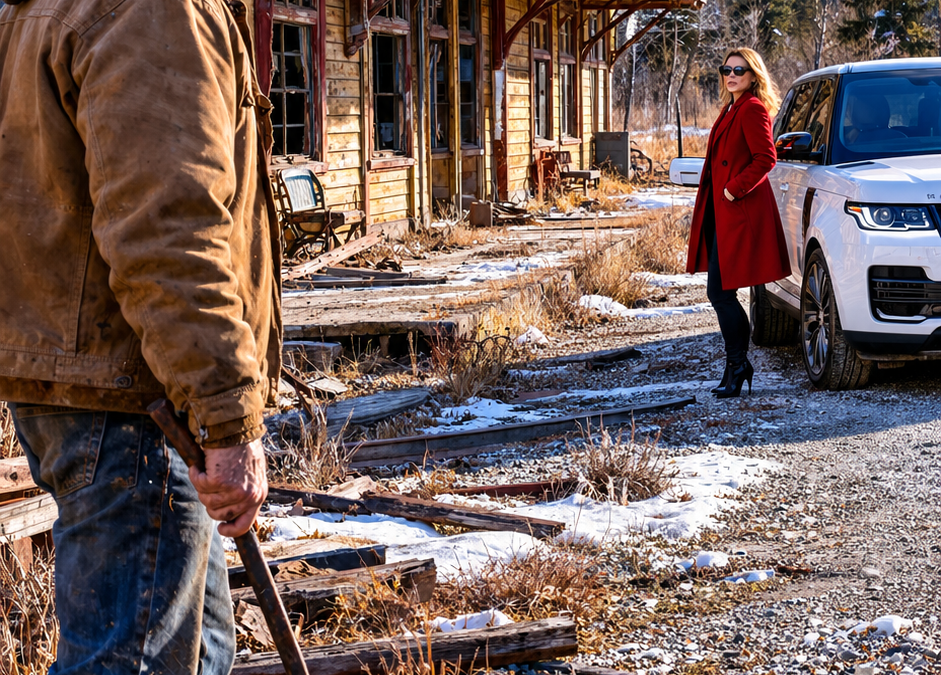
Then, late one Saturday morning, a pearl-white Range Rover came across my gravel entrance.
A woman in a crimson wool coat stepped out.
She looked across the collapsed roof and rusted rail fragments with the expression of someone discovering garbage on the floor of a hotel lobby.
She did not introduce herself.
“Where is the owner?”
I set down my pry bar.
“You found him.”
Her eyes moved over my work gloves, dirty jeans, and mud-covered boots.
“I’m Brandy Parker. President of the Whispering Pines Homeowners Association.”
I had heard of Whispering Pines.
Everyone in the valley had.
Forty custom homes stood on a pine-covered ridge about a mile above the depot. Most were worth several million dollars.
The public entrance crossed a timber bridge designed to resemble an old mountain trestle.
At night, the houses looked like glass lanterns floating above the valley.
Brandy pointed toward my building.
“This property is visible from our southern ridge.”
“I imagine so.”
“You have unapproved debris, exposed masonry, deteriorated roof material, and no architectural screening.”
For a second, I thought she was joking.
Then she opened a leather folder.
“This parcel isn’t part of Whispering Pines.”
She handed me a document titled NOTICE OF VISUAL COMPLIANCE.
It ordered me to remove all exterior railroad materials.
Paint the original brick an approved neutral color.
Screen the building from the ridge.
Submit restoration plans to the Whispering Pines architectural board.
The deadline was fourteen days.
The proposed fine was $500 per day.
At the bottom was the HOA’s gold tree logo.
No county seal.
No permit number.
No public official’s signature.
I looked at Brandy.
“This station was here almost seventy years before your subdivision.”
“History is not an excuse for blight.”
That sentence told me more about her than she probably intended.
She did not see an old station.
She did not see my grandfather.
She did not see a future classroom.
She saw scenery belonging to whoever could afford the most expensive window.
I handed the notice back.
She refused to take it.
“Fourteen days, Mr. Russell.”
“I don’t belong to your HOA.”
“Our attorney will address that.”
She turned toward her Range Rover.
I looked down at the paper.
“Address what?”
She opened the driver’s door.
“The consequences of refusing to cooperate.”
Then she drove away.
I wish I could say I laughed.
I did not.
Five hundred dollars a day was more than I earned teaching.
A person does not need lawful authority to damage your life.
Sometimes all they need is enough money to force you to prove they have no authority.
On Monday, I carried the notice to the county planning office.
A planner named Elena Ruiz pulled up my parcel.
She confirmed what I already believed.
Copper Creek Depot was outside the Whispering Pines subdivision plat.
There was a scenic-corridor overlay, but it was a county zoning rule.
The HOA could comment on certain permits.
It could not fine me.
It could not approve my architecture.
It definitely could not order me to repaint historic brick.
Elena studied Brandy’s notice.
“This is designed to look official.”
“It worked for about thirty seconds.”
She tapped the HOA logo.
“But it isn’t ours.”
That should have ended the problem.
Instead, it taught Brandy that I was willing to check.
Four days later, a county inspector arrived while I was covering the broken roof with temporary sheeting.
Someone had reported that I was removing load-bearing masonry without a stabilization plan.
The complaint included photographs.
Taken from inside my property.
The inspector was professional.
He found no demolition.
But because the roof damage was significant, he said I needed an engineer’s letter before continuing structural repairs.
He issued a limited stop-work order.
My contractor lost his scheduled weekend.
The engineer cost me $2,700.
Two days later, the state environmental office called.
Anonymous complaint.
Petroleum product entering Copper Creek.
Their investigator found rainwater, rust, and one sealed five-gallon container of new roofing compound.
No spill.
No violation.
Then my principal asked me to come to his office.
Someone had contacted the school district claiming I was using students as unpaid labor on a hazardous construction site.
No student had ever worked there.
Still, I sat in an internal review meeting explaining my private property project to the superintendent.
That was when I stopped thinking Brandy was simply an aggressive HOA president.
She was testing every wall around my life.
Property.
Money.
Reputation.
Employment.
My grandfather used to say that bullies depend on speed.
“They hit you with three problems at once,” he told me once, “so you spend all your time swinging and never ask who opened the door.”
The answer was not to hit harder.
It was to slow everything down until facts could catch up.
So I started with the deed.
The legal description attached to my tax certificate was unusually long.
It did not describe a normal rectangular parcel.
Instead, it followed the old Copper Creek railroad corridor north for nearly two miles.
In places, the corridor narrowed to sixty feet.
Around the depot and old maintenance yard, it widened significantly.
On the county’s digital map, parts disappeared beneath forest.
Then I noticed something.
A paved road labeled WHISPERING PINES SERVICE ACCESS entered my parcel near the depot.
It followed the old rail alignment up the ravine.
Then it climbed toward a steel security gate at the back of the subdivision.
I stared at the screen.
Then at the legal description.
Then back at the road.
I took everything to Martha Cole.
Martha had spent thirty-two years working around county land records and now operated a private title research business.
She did not make dramatic declarations.
Competent people rarely do.
She read the deed carefully.
Then she pulled original railroad conveyances.
Historical plats.
Developer agreements.
Recorded licenses.
For three hours, we followed paper from 1921 to the present.
The old railway company had not merely held permission to cross the land.
It had purchased the corridor in fee.
Actual ownership.
When the railroad later dissolved, the corridor and depot had transferred together.
Years later, the developer of Whispering Pines negotiated a temporary construction license allowing bulldozers, concrete trucks, and utility equipment to use part of the former rail bed while the subdivision was built.
The license lasted thirty-six months.
Then Martha found the sentence that changed the problem.
Any permanent use after construction requires a separate recorded easement approved by the corridor owner.
I leaned toward the document.
“Where’s the permanent easement?”
“That,” Martha said, “is the question.”
She searched the grantor and grantee indexes.
Then again.
Nothing.
“No recorded permanent easement?”
“None that I can find.”
I felt something dangerous rise in me.
Relief.
Certainty.
Martha noticed.
She closed the file.
“That does not mean you lock the road tomorrow.”
I looked at her.
“They’ve used my property for twenty years.”
“They may have another legal theory.”
“Like what?”
“Prescription. Estoppel. Implied rights. Depending on facts, maybe something else.”
“So I own the road.”
“You appear to own the land beneath most of it.”
“And they don’t have an easement.”
“We have not found one.”
“That sounds like the same thing.”
“It isn’t.”
Martha leaned back.
“Property law is where confident people discover that one old sentence can have five newer arguments attached to it.”
She told me to get a boundary survey.
A complete title opinion.
A lawyer.
I hired all three things I could not afford.
David Higgins was a licensed surveyor with a gray beard and the patience of a stone wall.
Laura Chen was a local attorney who specialized in land-use disputes.
Paying them consumed almost everything remaining from my grandfather’s inheritance.
That hurt more than I expected.
The money had felt like his last act of care.
Now I was spending it because someone who had no legal relationship to me had decided my property looked inconvenient.
Laura must have seen that on my face.
“You’re not spending this to win an argument,” she said.
“What am I spending it for?”
“To find out what is actually true before someone with more resources defines the truth for you.”
David’s crew worked four days.
They found three iron pins.
Two concrete markers.
The remains of an old milepost buried beneath pine needles.
Their measurements showed that almost the entire lower service road sat inside my rail corridor.
Near the rear subdivision gate, the pavement curved about six feet outside the boundary before returning.
That small imperfection made me trust the survey more.
Real boundaries are rarely kind enough to fit the story perfectly.
Laura ordered the full title report.
Then she studied years of HOA maintenance invoices.
Whispering Pines had paid to plow the road.
Patch it.
Resurface sections.
Clear vegetation.
“They’ll use this,” she said.
“To claim they own it?”
“To claim they acquired the right to use it.”
“But they started under written permission.”
“That helps us. We can argue the use began as permissive and never clearly became adverse.”
“Will we win?”
Laura looked directly at me.
“No honest lawyer should promise that.”
I sat back.
“So I own a road I might not control.”
“You own the land beneath most of the road. The scope of their right to keep using it is the disputed issue.”
It was less satisfying than the version I had imagined.
It was also the truth.
David placed orange stakes along the corridor.
By sunset, the road looked like someone had drawn a bright line through the grass.
The next morning, half the stakes were gone.
One lay broken beside a tire track.
Another had been thrown into the creek.
David photographed every location.
Reset each marker.
I installed trail cameras.
That afternoon, Gary Mills, the Whispering Pines security supervisor, arrived in a utility cart.
He told David his crew was trespassing on HOA land.
David handed him a business card.
“If your board has a competing survey, send it here.”
Gary kicked gravel across a paint mark.
I raised my phone and began recording.
“Gary, the survey crew has my permission. Please leave.”
His eyes moved from my phone to the stakes.
Then he backed away.
Ten minutes later, Brandy’s Range Rover appeared.
Same crimson coat.
Same expression.
She marched toward David.
“Remove these stakes.”
David shook his head.
“I can’t.”
“Then I will.”
I stepped between her and the closest marker.
“Before you do, you should know that removing survey monuments can create problems much larger than an HOA fine.”
She turned toward me.
“You bought a derelict tax parcel and now you think you own our infrastructure.”
“I bought the parcel described in the deed.”
“This is extortion.”
“I haven’t asked you for money.”
“Not yet.”
The accusation sounded prepared.
As though she had already imagined a negotiation I had never proposed.
Laura sent the HOA a formal letter the next morning.
It was intentionally calm.
The letter stated that our title research showed no permanent recorded access agreement.
It invited the HOA to produce any contrary documents.
Most important, it offered a thirty-day temporary license.
Traffic could continue exactly as before.
Emergency vehicles unrestricted.
Commercial traffic unchanged.
Neither side would surrender legal claims.
The license required insurance and prohibited physical alteration of the road during the investigation.
Brandy rejected it in less than an hour.
Her attorney, Nolan Price, responded that Whispering Pines possessed permanent access rights and would not sign any agreement implying otherwise.
Then he demanded that I remove the survey stakes.
And authorize an HOA inspection of my depot for slope hazards.
Two days later, Whispering Pines sued me.
The complaint did not contain ridiculous claims.
That made it dangerous.
It alleged that my depot restoration had destabilized the hillside.
It accused me of interfering with an established community access route.
It sought an injunction stopping construction and preventing me from blocking the service road.
If they won even temporarily, my roof work could stop through winter.
The county lifted its earlier stop-work order after receiving my engineering report.
But by then, my contractor had accepted another job.
A storm tore loose another section of temporary roof covering.
Rainwater ran down the interior brick.
At school, I taught the Homestead Act while calculating legal invoices in my head.
At night, I moved into a rented trailer beside the depot.
I told myself I was protecting the property.
The truth was that I no longer trusted anyone to leave it alone.
There is a particular helplessness in watching paperwork damage something physical.
A roof does not care that your legal position is strong.
It keeps leaking while lawyers exchange letters.
Then, at 1:17 one morning, my phone vibrated.
Camera alert.
A Whispering Pines security truck had stopped beside the depot.
Gary stepped out with another man.
They walked to the road.
Removed two of David’s survey stakes.
Then photographed the roadway without them.
They drove away.
The following afternoon, Nolan Price filed a declaration with the court.
Attached were new photographs.
His filing claimed the alleged property boundary had no visible field markers and appeared to be a recent invention.
Laura read the declaration.
Then smiled.
It was the first time I had seen her smile in two weeks.
“What?”
“They just turned a boundary dispute into an evidence problem.”
We preserved the original video files.
David signed an affidavit documenting where the markers had been placed.
Laura issued a litigation hold requiring the HOA to preserve security logs, emails, photographs, board communications, and relevant digital records.
We did not post the footage online.
We did not send it to residents.
Laura wanted the judge to see it before Brandy had time to create a story around it.
That camera video was the first independent proof that we were dealing with more than a good-faith misunderstanding.
While Laura prepared for the hearing, I studied the road itself.
The public entrance to Whispering Pines crossed a beautiful timber bridge.
It looked like an old railroad trestle.
That was the idea.
But county engineering documents showed the bridge was limited for heavy commercial loads.
The rear service road was different.
It was wide.
Straight enough for trucks.
Beneath the asphalt lay compacted railroad ballast built decades earlier to carry locomotives.
Garbage trucks used it twice a week.
Snowplows used it.
Construction equipment used it.
Propane tankers used it.
The subdivision emergency plan listed it as the preferred route for large fire apparatus when conditions allowed.
It was not some forgotten shortcut.
It was the community’s hidden spine.
That discovery gave me leverage.
It also gave me responsibility.
I called Laura.
“I can’t shut this road.”
“You may eventually have the legal right to control access.”
“That isn’t what I said.”
I looked uphill toward the ridge.
“Forty families use this. Fire trucks use it. Fuel trucks use it.”
Laura was quiet.
Then she said, “Good. Remember that.”
“Why?”
“Because restraint matters when a judge is deciding who can be trusted with leverage.”
We sent a second offer.
Temporary access for one dollar.
Emergency traffic always permitted.
Commercial operators could provide insurance certificates.
Neither side waived ownership claims.
Brandy rejected that too.
Then Evelyn Grant called my school.
She asked to meet somewhere private.
We chose a diner halfway between town and the ridge.
Evelyn had served as Whispering Pines treasurer eight years earlier.
She arrived carrying a canvas grocery bag filled with binders.
“Brandy told everyone you bought useless scrubland below us and invented a road claim after she cited the depot.”
“I wish I were that creative.”
Evelyn did not smile.
“It didn’t sound right.”
She opened a binder marked 2018.
Inside was an infrastructure audit commissioned after a wildfire evacuation.
The report identified the rear road as critical heavy access.
Then I saw the paragraph.
The HOA file contained only an expired construction license.
No permanent recorded easement.
The consultant recommended negotiating with the corridor owner before the parcel changed hands.
Board minutes showed that Whispering Pines had voted to obtain an appraisal.
Later, the matter was tabled.
“At whose request?” I asked.
Evelyn turned one page.
Brandy Parker.
Then she removed another document.
A broker’s proposal.
The HOA had considered quietly acquiring the entire depot property before the county auction.
Brandy supported the purchase.
The board rejected it as unnecessary.
Two months later, I bought the depot.
I stared at the paper.
Everything rearranged itself.
The fake architectural notice.
The complaints.
The lawsuit.
The pressure on my job.
Brandy was not merely protecting a view.
She was trying to correct an eight-year-old mistake without admitting it had ever existed.
If she could make the depot expensive enough to own, I might sell.
Then the HOA could acquire the corridor before residents learned that essential community infrastructure ran across land the association had failed to secure.
“Why would she hide this?” I asked.
Evelyn wrapped both hands around her coffee cup.
“Because she spent years telling people the road belonged to Whispering Pines.”
That was the problem with certain decisions.
The first one can be small.
Embarrassing.
Repairable.
Then every later choice is made to protect the first.
A missed negotiation becomes a secret.
The secret becomes a legal position.
The legal position becomes a lawsuit.
Eventually, defending the mistake costs more than correcting it ever would have.
Evelyn allowed Laura to copy the records.
She asked us not to use her name unless necessary.
She was afraid of retaliation.
Laura verified signatures, meeting dates, invoices, and consultant identities.
Then she subpoenaed Whispering Pines’ official files.
The HOA produced the 2018 audit.
Except one page was missing.
The exact page discussing the expired road license.
The broker proposal was missing too.
The minutes jumped from page forty-six to page forty-eight.
Page forty-seven was sitting in Laura’s office.
Laura emailed Nolan Price a simple question.
Had responsive records been removed before production?
Six hours later, Nolan called instead of responding in writing.
The next morning, he withdrew as counsel for Whispering Pines, citing a professional conflict.
Brandy told residents he had a family emergency.
By then, the thirty-day informal access period we had proposed was ending.
Laura notified commercial operators that ownership and access were legally disputed.
We did not tell anyone to stop using the road.
We sent each operator the survey.
The title report.
A temporary license they could sign directly with me at no charge while the case proceeded.
The garbage company signed.
The snow contractor signed.
The county fire district acknowledged permanent unrestricted emergency access.
High Alpine Propane did not sign immediately.
Its insurer had a problem.
A loaded propane tanker on private property required authorization from the party legally responsible for the road.
I was willing to sign.
The HOA refused to acknowledge my ownership claim.
Without a signed agreement from either side, High Alpine suspended heavy deliveries over the disputed segment.
Then the forecast changed.
Major winter storm.
Six days away.
Three homes in Whispering Pines had propane below twenty percent.
Brandy had received every notice.
She told the residents nothing.
Four days before the storm, High Alpine’s operations manager came to the depot.
He showed me the delivery schedule.
“A loaded tanker cannot use the front bridge.”
“I know.”
“If this road remains legally disputed, my drivers won’t proceed.”
“How many homes?”
“Forty rely on our scheduled route. Three are urgent.”
I called Laura.
“Prepare an emergency license.”
“How long?”
“Seventy-two hours.”
“Fee?”
“Zero.”
She paused.
“Archer, continuing permission can affect how they characterize historical use.”
“Preserve the claim however you need to.”
I watched snow clouds gathering over the mountains.
“I’m not letting families freeze to improve my lawsuit.”
The next morning, I opened the chain across the service entrance.
We had installed it only to stop unauthorized construction equipment after the survey stakes were removed.
A temporary sign read:
AUTHORIZED DELIVERIES AND EMERGENCY ACCESS ONLY.
The first propane tanker arrived just after eight.
The driver gave me the signed emergency license.
I opened the gate.
Three more trucks followed.
Residents began coming down from Whispering Pines.
Some thanked me.
Others blamed me.
One man shouted that I had no right to interfere with a road his family had used for fifteen years.
I handed him a copy of the one-dollar access offer Brandy had rejected.
Then the thirty-day offer.
Then the emergency license.
He read them quietly.
By noon, a small crowd had gathered near the depot.
For the first time, Whispering Pines homeowners were seeing the same documents I had been seeing.
Then Brandy arrived.
She pushed through the group.
“Remove this chain permanently.”
“The road is open for the propane trucks.”
“You do not grant permission to use our road.”
“Then sign a neutral temporary agreement and let the judge decide.”
“I will never sign your extortion document.”
Evelyn stepped out from the crowd.
“Did you know about the 2018 infrastructure audit?”
Brandy’s expression changed.
Only for half a second.
But everyone close enough saw it.
“The audit was outdated.”
“It said we didn’t have a permanent easement.”
“It raised speculative legal questions.”
“Why didn’t residents see it?”
Brandy turned toward her Range Rover.
Before getting inside, she looked directly at the chain.
Then she made a phone call.
At 4:36 that afternoon, my camera detected movement.
A yellow compact excavator came downhill from Whispering Pines.
Gary walked beside it.
Brandy followed in her Range Rover.
I ran from the depot with my phone already recording.
The operator positioned the excavator bucket beneath one of the steel posts supporting my chain.
“Stop the machine!”
The operator looked toward Brandy.
“You’re on private property.”
She pointed toward the road.
“We are removing an illegal obstruction from HOA access.”
“You have a court hearing tomorrow.”
“Exactly.”
The operator hesitated.
Brandy stepped closer to the cab.
“Proceed.”
The bucket pulled.
The steel post bent.
But the concrete held.
The operator looked uncertain.
Brandy motioned again.
The bucket pulled a second time.
Concrete cracked beneath the shoulder.
Then muddy water began pouring across the pavement.
A drainage pipe had broken.
Gary saw my camera.
He backed away.
The operator shut off the machine.
Brandy walked to the damaged post.
She grabbed the loose chain.
Dragged it aside.
“There. Your little performance is over.”
She thought the chain mattered.
It never did.
Our strongest evidence was not a steel post.
It was Brandy ordering heavy equipment onto disputed land, destroying drainage infrastructure, on camera, after refusing two temporary agreements and less than twenty-four hours before a court hearing.
Snow arrived that night.
Wet and heavy.
Water from the broken drainage line spread beneath the edge of the road.
Then froze.
By morning, a six-foot section of pavement had settled several inches.
High Alpine postponed the final delivery pending an engineering inspection.
Brandy sent an emergency message to residents.
She blamed me.
Evelyn replied to the entire community.
She attached the camera footage.
That video changed the atmosphere before we ever walked into court.
By the emergency hearing, every seat behind Brandy was occupied.
Her new attorney argued first.
“Your Honor, Mr. Russell’s sudden assertion of control over a critical access road has created a humanitarian risk for forty families during severe winter weather.”
Laura stood.
“No.”
One word.
Then she placed a timeline on the projector.
“Thirty-day continued access. Offered by Mr. Russell. Rejected by Whispering Pines.”
Next document.
“One-dollar temporary agreement. Rejected.”
Next.
“Permanent unrestricted emergency access. Confirmed in writing to the fire district.”
Next.
“Seventy-two-hour propane license. No charge. Four deliveries completed.”
Then she displayed the video frame.
“And after those deliveries, Ms. Parker ordered an excavator onto the disputed property and damaged the road drainage on the eve of this hearing.”
Brandy sat rigidly at the table.
Laura presented the title report.
David’s survey.
The old construction license.
The clause requiring a separate permanent easement.
Then the 2018 audit.
Including the missing page.
Brandy stood.
“That document was stolen from a private board archive.”
Judge Miriam Hale looked over her glasses.
“Sit down, Ms. Parker.”
Brandy did not move immediately.
For two seconds, the entire courtroom saw something I had experienced repeatedly.
She was accustomed to deciding when conversations ended.
The judge repeated herself.
“Sit down.”
This time Brandy did.
Judge Hale did not declare me the final legal winner.
She said the title and survey established a credible ownership claim.
She said the HOA could still pursue arguments about historical access.
She noted that the original use began under written permission, which complicated Whispering Pines’ claim that its use had always been hostile or independent.
Then she issued a temporary order.
Emergency traffic could continue.
Essential commercial service could continue.
The HOA had to post a bond for road restoration.
Neither party could alter the road.
Neither could remove survey markers.
Cameras could not be disturbed.
Commercial access would continue under court-supervised temporary terms until mediation or trial.
Then Judge Hale turned toward Brandy.
“The court is deeply concerned by the missing records and the destruction shown in the video.”
Brandy’s expression did not move.
“All electronic communications concerning this corridor are to be preserved immediately.”
That was the moment everything changed.
The road had begun the dispute.
The records were about to finish it.
Whispering Pines hired independent counsel.
The board also retained a forensic email specialist.
Within a week, deleted messages were recovered from Brandy’s HOA account.
One was sent six days after I purchased the depot.
The teacher does not understand the corridor value. If we keep pressure on the structure, he will sell before counsel explains it to him.
I read it alone in Laura’s office.
The word teacher bothered me more than I expected.
Not Mr. Russell.
Not property owner.
Teacher.
It was how she had categorized me.
Someone with a public salary.
Limited resources.
Easy to outspend.
Another email instructed Nolan Price to use a version of the 2018 audit without what Brandy called “speculative access language.”
A third told Gary to “clear unauthorized markers” before the HOA photographed the road.
That explained the missing stakes.
And the photographs filed with the court.
Nolan’s withdrawal suddenly made sense.
Independent counsel later confirmed that he had discovered the document production he received from his client had been altered.
He withdrew rather than defend it.
That might have ended Brandy’s control of the board by itself.
But the forensic review uncovered another attachment.
Three years earlier, Whispering Pines had hired a civil engineer named Samuel Ortega to investigate cracking near the lower service-road curve.
His pavement report concluded that the road remained suitable for heavy service vehicles if the HOA repaired the drainage ditch and buried culvert before another major freeze cycle.
Estimated cost:
$24,000.
Brandy had rejected the repair as unnecessary.
That same year, the HOA spent nearly twice as much resurfacing the decorative traffic circle outside its clubhouse.
The road continued deteriorating invisibly beneath the pavement.
When Brandy’s excavator damaged the drainage pipe, it struck the exact area Ortega had warned about.
For weeks, she had accused my unstable depot parcel of threatening the road.
Her own engineer had already identified deferred HOA drainage maintenance as the real problem.
Laura contacted Ortega.
He still had his original field notes.
Dated photographs.
And the email confirming Brandy and the full board had received his report.
Under the court order, Ortega returned to inspect the new failure.
I met him there with David.
He drilled test holes through the asphalt.
Measured the settlement.
Mapped the water path.
Beneath the center of the lane, the old railroad ballast was still solid.
Ortega pointed toward the broken culvert.
“The rail bed isn’t failing.”
“What is?”
“Drainage.”
He walked uphill.
Meltwater from nearly three acres of Whispering Pines pavement entered a ditch constructed by the subdivision.
That ditch narrowed as it approached my rail corridor.
The HOA had added pavement over the years.
More roofs.
More runoff.
But had never upgraded the outlet.
That mattered.
If I simply owned the land beneath the road, Brandy could eventually argue that every maintenance obligation belonged to me.
But Whispering Pines generated much of the runoff.
It had maintained the paved surface for years.
It had been warned about the culvert.
Ownership and responsibility were not the same question.
Any permanent solution would have to answer both.
Then Laura found the developer’s original project files.
They had been stored in a warehouse outside Denver.
Most were ordinary construction records.
Invoices.
Utility plans.
Old contracts.
But one box contained correspondence with the prior owner of the railway corridor.
In 2002, the Whispering Pines developer had attempted to buy a permanent easement.
The corridor owner offered one.
Price:
$35,000.
Plus annual maintenance.
The developer declined.
Its managers expected to complete the deal after selling the final homes.
Then the development company collapsed during a financing dispute.
Assets transferred through bankruptcy.
Employees disappeared.
No one returned to finish the easement.
For years, Whispering Pines treated the absence of an objection as proof of ownership.
But there had barely been an attentive owner to object.
The corridor passed through inactive companies.
Eventually, tax foreclosure.
My purchase had not created the problem.
It had given an old problem a living owner.
Laura tracked down the retired project manager.
Harold Vance was seventy-six and living in Grand Junction.
He remembered the road immediately.
“We called it the construction haul route,” he said during his deposition.
“Was the license temporary?”
“Everyone knew it was temporary.”
“Was a permanent agreement supposed to be completed?”
“Yes.”
“What happened?”
“Money disappeared before the paperwork got finished.”
Laura asked about the front bridge.
“Was it designed for loaded propane trucks?”
Harold gave one short laugh.
“Not if you wanted the truck to reach the other side.”
Even Laura smiled.
Then Harold became serious.
“The rear road was supposed to become a jointly maintained access corridor before homeowners took over the association.”
“So the failure to record the easement—”
“Developer mistake.”
Brandy’s new attorney tried another direction.
“Did the corridor owner ever physically prevent the HOA from using the road?”
Harold looked puzzled.
“Which owner?”
The attorney named one of the companies that had held title before tax foreclosure.
Harold shook his head.
“That company had no employees after 2007.”
He leaned toward the camera.
“You cannot turn silence from an empty office into a handshake.”
That sentence spread through Whispering Pines before the deposition transcript was even finalized.
Residents were finally understanding the timeline.
Their access crisis did not begin when I raised a survey stake.
It began twenty years earlier when a developer failed to finish an agreement everyone assumed somebody else had completed.
My purchase merely exposed it.
Meanwhile, the county required immediate stabilization of the damaged road.
The HOA deposited repair funds into escrow under the judge’s order.
I granted the contractors access.
Ortega designed the drainage repair.
David documented every excavation so neither side could later claim the work had shifted a boundary.
That repair uncovered something beneath the broken pipe.
A cast-iron drainage box.
The metal was dark with age.
On one side, workers cleaned away dirt and found stamped letters.
COPPER CREEK LINE
1924
The subdivision’s newer drainage culvert had been connected directly into old railroad infrastructure.
There was no recorded construction agreement.
I stood in the snow looking at that rusted box.
It was not stronger evidence than a deed.
Laura reminded me of that immediately.
But it made the geography difficult to deny.
The modern gated community had literally connected its drainage into infrastructure built for the old station.
Then spent years treating the station as if it were the intrusion.
A week later, the Whispering Pines board called a special meeting.
I attended with Laura and David.
Nearly every homeowner came.
Brandy sat beneath the stone fireplace at the front of the clubhouse.
She wore red again.
But the certainty was gone.
For nearly two hours, residents asked questions.
Why reject thirty days of free temporary access?
Why reject a one-dollar agreement?
Why hide the 2018 audit?
Why spend more than sixty thousand dollars on litigation before telling homeowners the HOA might not own permanent access?
Why order equipment onto disputed property after a hearing had already been scheduled?
Why had the board been warned about the road drainage three years earlier?
Why had propane risk not been disclosed?
Brandy blamed the original developer.
Then the county.
Then Nolan.
Then the title company.
Eventually, she blamed homeowners.
“You did not understand the seriousness of the depot’s condition.”
Evelyn stood.
“We understood what you told us.”
Nobody applauded.
That made the sentence stronger.
Brandy never answered the central question.
Why had she chosen pressure over negotiation when the HOA’s own records warned that the corridor rights were unresolved?
The board voted that night.
Six to one.
Brandy Parker was removed as president.
The directors authorized an independent review of HOA legal spending.
Then they approved mediation with me.
I expected the new board to come into mediation angry.
Instead, acting president Thomas Abernathy opened with an apology.
“We were told you intended to close the road during winter.”
“I intended to stop permanent use of my land without an agreement.”
Thomas nodded.
“We understand that now.”
“Those are not the same thing.”
“No.”
We negotiated for two days.
The final settlement did not make me rich.
It did something better.
It created an agreement that could survive after everyone stopped being angry.
Whispering Pines received a recorded permanent easement for defined commercial and emergency use.
The HOA accepted responsibility for snow removal.
Drainage.
Pavement maintenance.
Liability insurance.
Annual compensation was set at $38,000, adjusted over time.
Spread across forty homes, it was less than one thousand dollars per household.
The HOA reimbursed my verified survey costs.
Engineering expenses.
Environmental review.
Legal fees.
It also paid for the damage caused by the excavator.
In exchange, I guaranteed uninterrupted access for essential services.
Fire apparatus.
Snowplows.
Garbage trucks.
Propane.
Other authorized commercial traffic.
I agreed to coordinate any future construction near the road so the easement would remain functional.
Nobody froze.
Nobody lost access.
Nobody took land without documentation.
Then Thomas proposed one final provision.
The HOA would contribute $185,000 toward preserving the depot.
Not a private luxury renovation.
A restricted historic-preservation project supervised through the county historical society.
I would contribute labor.
Apply for grants.
And open the depot to the public four educational days each year.
I looked at Laura.
She smiled.
That provision mattered to me more than the annual road payment.
Brandy had tried to make the depot disappear because it interfered with a view.
The settlement ensured the building would remain after the dispute was forgotten.
The independent HOA review later found that Brandy had exceeded portions of her spending authority and concealed material information from other board members.
The association pursued its own insurance and civil remedies.
I did not participate.
I did not need to.
Brandy sold her house the following summer.
There was no crowd.
No police escort.
No dramatic confrontation.
A moving truck simply crossed the same timber bridge she once believed made Whispering Pines untouchable.
That ending felt right.
Quiet consequences are still consequences.
By the following autumn, Copper Creek Depot had a repaired slate roof.
The original brick arches had been restored.
New windows matched photographs from 1931.
The old ticket office became my home.
The waiting room became a small exhibit space.
Railroad maps covered one wall.
Old mining tools and donated photographs filled cases.
Families from across the valley contributed letters, tickets, uniforms, company badges, and stories their grandparents had told them.
My students helped catalog photographs for school credit under a supervised history program.
No one touched construction equipment.
I admit I enjoyed that detail.
The service road still runs beside the platform.
Garbage trucks use it.
Snowplows use it.
Propane tankers use it.
Fire engines use it.
A new sign at the entrance reads:
COPPER CREEK HISTORIC ACCESS ROAD
Every vehicle travels under the recorded agreement.
Every year, Whispering Pines sends updated insurance documentation before winter without anyone asking.
Thomas occasionally stops for coffee.
Evelyn joined the county historical society.
Even Gary came down one afternoon.
He stood outside the ticket office for several minutes before finally speaking.
“I owe you an apology.”
“For which part?”
He almost smiled.
“The stakes.”
“I figured.”
“Brandy told me my job depended on following instructions.”
I looked at him.
“Were you afraid of losing it?”
“Yes.”
I believed him.
“Fear explains a decision.”
He waited.
“It doesn’t erase it.”
“I know.”
“But an honest apology is still somewhere to start.”
He nodded.
Then he helped me carry two boxes of donated photographs inside.
Sometimes, late in the afternoon, I sit on the restored platform and watch snow collect along the old rail bed.
The tracks are mostly gone now.
Only short pieces remain near the station.
My grandfather never saw Copper Creek Depot.
Sometimes that still hurts.
His tools hang above my workbench.
One worn hammer.
A hand plane.
A folding rule with his initials carved badly into the wood.
When I first bought the building, I thought restoring it would make me feel closer to him.
I was wrong about the mechanism.
The bricks did not bring him back.
Neither did the old timber.
What connected me to him was having to decide what kind of owner I wanted to be once the property became difficult.
He had spent his life building things for people who would never know his name.
He believed ownership did not mean doing whatever you wanted.
It meant becoming responsible for whatever had been placed in your hands.
For months, Brandy kept accusing me of using property rights as a weapon against forty families.
That accusation bothered me.
Because I never wanted the road merely to control it.
I never wanted propane trucks stopped.
I never wanted fire engines delayed.
I never wanted anyone to choose between respecting my deed and heating their home.
What I wanted was simple.
If someone else needed permanent use of my land, that use needed to exist honestly.
On paper.
With responsibility.
With insurance.
With maintenance.
With everyone understanding where one person’s property ended and another community’s need began.
A deed is not revenge.
A survey is not revenge.
An easement is not surrender.
Property rights matter because money, influence, and social pressure are never distributed equally.
Documents force people with very different power to eventually stand on the same ground.
Brandy thought ownership belonged to whoever could create the most pressure.
The strongest letter.
The most complaints.
The most expensive lawyer.
The most frightened residents.
For a while, it almost worked.
But the road never cared who had the nicer clubhouse.
The county records never cared who drove the more expensive car.
The old construction license did not care who had been HOA president for eight years.
Neither did the camera footage.
Neither did the missing page.
In the end, ownership came from records.
Leverage came from restraint.
And the only outcome worth keeping was one where the road stayed open without the land being taken from the person who actually owned it.
What do you think of this story? Please leave a like and share your thoughts in the comments. Your support means a lot to us and inspires us to keep writing more meaningful and powerful stories. Thank you! 👍
𝗧𝗛𝗘 𝗘𝗡𝗗
The Road Behind Their Gates Was Built on Land They Never Owned
“Open the gate.”
Brandy Parker’s voice carried across the courtroom with the same cold certainty she had used the first day she stepped onto my property.
“Forty homes need that road.”
Behind her sat a row of Whispering Pines homeowners in winter coats, some still wearing snow on their shoulders from the walk inside. A propane tanker waited six miles away at the bottom of the mountain. The public entrance bridge could not safely carry it. Snow was already covering the one service road strong enough for the truck.
The road Brandy insisted belonged to her HOA.
The road my deed said belonged to me.
She pointed across the courtroom.
“This man is holding an entire community hostage.”
I could have argued.
I could have told the judge how many times I had offered free temporary access.
I could have described the anonymous complaints, the missing survey stakes, the excavator that had damaged the road, or the photographs Brandy’s security supervisor had helped manufacture.
Instead, I opened a thin folder.
Then I placed one page on the judge’s desk.
A page from Whispering Pines’ own records.
A page Brandy had known about for eight years.
A page the rest of the homeowners had never seen.
It said the HOA did not own a permanent access right over the road.
But even that was not the worst document waiting in our evidence file.
Six days after I bought the property, Brandy had sent an email explaining exactly what she wanted.
The teacher does not understand the corridor value. If we keep pressure on the structure, he will sell before counsel explains it to him.
My name is Archer Russell.
I teach American history at a public high school in western Colorado.
Until that autumn, the most hostile room I had ever faced was a classroom full of juniors on the Friday before winter break.
Then I bought Copper Creek Depot.
I found it at a county tax auction on a wet Tuesday morning in October.
The listing described twenty-one acres of vacant mixed terrain with a historic commercial structure.
That was bureaucratic language for a collapsed railroad station, a strip of forest, and a long narrow piece of land climbing toward the mountains.
The depot had been built in 1923, back when silver, timber, coal, and people still moved through Copper Creek by rail.
The last passenger train stopped there in 1968.
The railroad pulled most of the track a few years later.
After that, the building spent half a century losing arguments with weather.
Part of the slate roof had collapsed into the old waiting room.
Cottonwood roots had pushed bricks upward along the platform.
Most of the windows were gone.
A family of raccoons had occupied the ticket office and appeared much more certain of their property rights than I was.
I loved the place immediately.
My grandfather had been a carpenter.
When I was a boy, he took me through abandoned mining towns and old railway settlements whenever my parents allowed it.
Other people saw broken boards.
He saw joinery.
They saw cracked masonry.
He saw the hands that had placed the bricks.
Whenever we passed an abandoned station, he would run his palm across the wall and say, “Buildings remember who passed through them.”
I never completely understood what he meant until he died.
He left me enough money to do something responsible.
Pay down my mortgage.
Invest.
Build retirement savings.
Instead, he also left me enough stubbornness to buy a ruined railroad depot.
The bidding stalled at thirty-eight thousand dollars.
I raised my paddle.
Another bidder went to forty.
I went to forty-two.
Four minutes later, I owned Copper Creek Depot for $42,000, subject to county restrictions, historic review, and whatever legal problems had been hiding beneath seventy years of weeds.
I was not trying to build a resort.
I wanted to stabilize the roof.
Restore the ticket office.
Convert a small part of the building into a modest home.
Then, on weekends, I imagined bringing students there to record oral histories from retired miners, railroad workers, ranch families, and people whose parents had remembered Copper Creek before the highways came through.
It was the first plan I had made after my grandfather’s death that felt connected to him instead of built around missing him.
For three weekends, I worked alone.
I pulled rotten boards from the platform.
Covered broken windows.
Removed trash.
Cataloged old pieces of rail hardware before deciding what could be saved.
Then, late one Saturday morning, a pearl-white Range Rover came across my gravel entrance.
A woman in a crimson wool coat stepped out.
She looked across the collapsed roof and rusted rail fragments with the expression of someone discovering garbage on the floor of a hotel lobby.
She did not introduce herself.
“Where is the owner?”
I set down my pry bar.
“You found him.”
Her eyes moved over my work gloves, dirty jeans, and mud-covered boots.
“I’m Brandy Parker. President of the Whispering Pines Homeowners Association.”
I had heard of Whispering Pines.
Everyone in the valley had.
Forty custom homes stood on a pine-covered ridge about a mile above the depot. Most were worth several million dollars.
The public entrance crossed a timber bridge designed to resemble an old mountain trestle.
At night, the houses looked like glass lanterns floating above the valley.
Brandy pointed toward my building.
“This property is visible from our southern ridge.”
“I imagine so.”
“You have unapproved debris, exposed masonry, deteriorated roof material, and no architectural screening.”
For a second, I thought she was joking.
Then she opened a leather folder.
“This parcel isn’t part of Whispering Pines.”
She handed me a document titled NOTICE OF VISUAL COMPLIANCE.
It ordered me to remove all exterior railroad materials.
Paint the original brick an approved neutral color.
Screen the building from the ridge.
Submit restoration plans to the Whispering Pines architectural board.
The deadline was fourteen days.
The proposed fine was $500 per day.
At the bottom was the HOA’s gold tree logo.
No county seal.
No permit number.
No public official’s signature.
I looked at Brandy.
“This station was here almost seventy years before your subdivision.”
“History is not an excuse for blight.”
That sentence told me more about her than she probably intended.
She did not see an old station.
She did not see my grandfather.
She did not see a future classroom.
She saw scenery belonging to whoever could afford the most expensive window.
I handed the notice back.
She refused to take it.
“Fourteen days, Mr. Russell.”
“I don’t belong to your HOA.”
“Our attorney will address that.”
She turned toward her Range Rover.
I looked down at the paper.
“Address what?”
She opened the driver’s door.
“The consequences of refusing to cooperate.”
Then she drove away.
I wish I could say I laughed.
I did not.
Five hundred dollars a day was more than I earned teaching.
A person does not need lawful authority to damage your life.
Sometimes all they need is enough money to force you to prove they have no authority.
On Monday, I carried the notice to the county planning office.
A planner named Elena Ruiz pulled up my parcel.
She confirmed what I already believed.
Copper Creek Depot was outside the Whispering Pines subdivision plat.
There was a scenic-corridor overlay, but it was a county zoning rule.
The HOA could comment on certain permits.
It could not fine me.
It could not approve my architecture.
It definitely could not order me to repaint historic brick.
Elena studied Brandy’s notice.
“This is designed to look official.”
“It worked for about thirty seconds.”
She tapped the HOA logo.
“But it isn’t ours.”
That should have ended the problem.
Instead, it taught Brandy that I was willing to check.
Four days later, a county inspector arrived while I was covering the broken roof with temporary sheeting.
Someone had reported that I was removing load-bearing masonry without a stabilization plan.
The complaint included photographs.
Taken from inside my property.
The inspector was professional.
He found no demolition.
But because the roof damage was significant, he said I needed an engineer’s letter before continuing structural repairs.
He issued a limited stop-work order.
My contractor lost his scheduled weekend.
The engineer cost me $2,700.
Two days later, the state environmental office called.
Anonymous complaint.
Petroleum product entering Copper Creek.
Their investigator found rainwater, rust, and one sealed five-gallon container of new roofing compound.
No spill.
No violation.
Then my principal asked me to come to his office.
Someone had contacted the school district claiming I was using students as unpaid labor on a hazardous construction site.
No student had ever worked there.
Still, I sat in an internal review meeting explaining my private property project to the superintendent.
That was when I stopped thinking Brandy was simply an aggressive HOA president.
She was testing every wall around my life.
Property.
Money.
Reputation.
Employment.
My grandfather used to say that bullies depend on speed.
“They hit you with three problems at once,” he told me once, “so you spend all your time swinging and never ask who opened the door.”
The answer was not to hit harder.
It was to slow everything down until facts could catch up.
So I started with the deed.
The legal description attached to my tax certificate was unusually long.
It did not describe a normal rectangular parcel.
Instead, it followed the old Copper Creek railroad corridor north for nearly two miles.
In places, the corridor narrowed to sixty feet.
Around the depot and old maintenance yard, it widened significantly.
On the county’s digital map, parts disappeared beneath forest.
Then I noticed something.
A paved road labeled WHISPERING PINES SERVICE ACCESS entered my parcel near the depot.
It followed the old rail alignment up the ravine.
Then it climbed toward a steel security gate at the back of the subdivision.
I stared at the screen.
Then at the legal description.
Then back at the road.
I took everything to Martha Cole.
Martha had spent thirty-two years working around county land records and now operated a private title research business.
She did not make dramatic declarations.
Competent people rarely do.
She read the deed carefully.
Then she pulled original railroad conveyances.
Historical plats.
Developer agreements.
Recorded licenses.
For three hours, we followed paper from 1921 to the present.
The old railway company had not merely held permission to cross the land.
It had purchased the corridor in fee.
Actual ownership.
When the railroad later dissolved, the corridor and depot had transferred together.
Years later, the developer of Whispering Pines negotiated a temporary construction license allowing bulldozers, concrete trucks, and utility equipment to use part of the former rail bed while the subdivision was built.
The license lasted thirty-six months.
Then Martha found the sentence that changed the problem.
Any permanent use after construction requires a separate recorded easement approved by the corridor owner.
I leaned toward the document.
“Where’s the permanent easement?”
“That,” Martha said, “is the question.”
She searched the grantor and grantee indexes.
Then again.
Nothing.
“No recorded permanent easement?”
“None that I can find.”
I felt something dangerous rise in me.
Relief.
Certainty.
Martha noticed.
She closed the file.
“That does not mean you lock the road tomorrow.”
I looked at her.
“They’ve used my property for twenty years.”
“They may have another legal theory.”
“Like what?”
“Prescription. Estoppel. Implied rights. Depending on facts, maybe something else.”
“So I own the road.”
“You appear to own the land beneath most of it.”
“And they don’t have an easement.”
“We have not found one.”
“That sounds like the same thing.”
“It isn’t.”
Martha leaned back.
“Property law is where confident people discover that one old sentence can have five newer arguments attached to it.”
She told me to get a boundary survey.
A complete title opinion.
A lawyer.
I hired all three things I could not afford.
David Higgins was a licensed surveyor with a gray beard and the patience of a stone wall.
Laura Chen was a local attorney who specialized in land-use disputes.
Paying them consumed almost everything remaining from my grandfather’s inheritance.
That hurt more than I expected.
The money had felt like his last act of care.
Now I was spending it because someone who had no legal relationship to me had decided my property looked inconvenient.
Laura must have seen that on my face.
“You’re not spending this to win an argument,” she said.
“What am I spending it for?”
“To find out what is actually true before someone with more resources defines the truth for you.”
David’s crew worked four days.
They found three iron pins.
Two concrete markers.
The remains of an old milepost buried beneath pine needles.
Their measurements showed that almost the entire lower service road sat inside my rail corridor.
Near the rear subdivision gate, the pavement curved about six feet outside the boundary before returning.
That small imperfection made me trust the survey more.
Real boundaries are rarely kind enough to fit the story perfectly.
Laura ordered the full title report.
Then she studied years of HOA maintenance invoices.
Whispering Pines had paid to plow the road.
Patch it.
Resurface sections.
Clear vegetation.
“They’ll use this,” she said.
“To claim they own it?”
“To claim they acquired the right to use it.”
“But they started under written permission.”
“That helps us. We can argue the use began as permissive and never clearly became adverse.”
“Will we win?”
Laura looked directly at me.
“No honest lawyer should promise that.”
I sat back.
“So I own a road I might not control.”
“You own the land beneath most of the road. The scope of their right to keep using it is the disputed issue.”
It was less satisfying than the version I had imagined.
It was also the truth.
David placed orange stakes along the corridor.
By sunset, the road looked like someone had drawn a bright line through the grass.
The next morning, half the stakes were gone.
One lay broken beside a tire track.
Another had been thrown into the creek.
David photographed every location.
Reset each marker.
I installed trail cameras.
That afternoon, Gary Mills, the Whispering Pines security supervisor, arrived in a utility cart.
He told David his crew was trespassing on HOA land.
David handed him a business card.
“If your board has a competing survey, send it here.”
Gary kicked gravel across a paint mark.
I raised my phone and began recording.
“Gary, the survey crew has my permission. Please leave.”
His eyes moved from my phone to the stakes.
Then he backed away.
Ten minutes later, Brandy’s Range Rover appeared.
Same crimson coat.
Same expression.
She marched toward David.
“Remove these stakes.”
David shook his head.
“I can’t.”
“Then I will.”
I stepped between her and the closest marker.
“Before you do, you should know that removing survey monuments can create problems much larger than an HOA fine.”
She turned toward me.
“You bought a derelict tax parcel and now you think you own our infrastructure.”
“I bought the parcel described in the deed.”
“This is extortion.”
“I haven’t asked you for money.”
“Not yet.”
The accusation sounded prepared.
As though she had already imagined a negotiation I had never proposed.
Laura sent the HOA a formal letter the next morning.
It was intentionally calm.
The letter stated that our title research showed no permanent recorded access agreement.
It invited the HOA to produce any contrary documents.
Most important, it offered a thirty-day temporary license.
Traffic could continue exactly as before.
Emergency vehicles unrestricted.
Commercial traffic unchanged.
Neither side would surrender legal claims.
The license required insurance and prohibited physical alteration of the road during the investigation.
Brandy rejected it in less than an hour.
Her attorney, Nolan Price, responded that Whispering Pines possessed permanent access rights and would not sign any agreement implying otherwise.
Then he demanded that I remove the survey stakes.
And authorize an HOA inspection of my depot for slope hazards.
Two days later, Whispering Pines sued me.
The complaint did not contain ridiculous claims.
That made it dangerous.
It alleged that my depot restoration had destabilized the hillside.
It accused me of interfering with an established community access route.
It sought an injunction stopping construction and preventing me from blocking the service road.
If they won even temporarily, my roof work could stop through winter.
The county lifted its earlier stop-work order after receiving my engineering report.
But by then, my contractor had accepted another job.
A storm tore loose another section of temporary roof covering.
Rainwater ran down the interior brick.
At school, I taught the Homestead Act while calculating legal invoices in my head.
At night, I moved into a rented trailer beside the depot.
I told myself I was protecting the property.
The truth was that I no longer trusted anyone to leave it alone.
There is a particular helplessness in watching paperwork damage something physical.
A roof does not care that your legal position is strong.
It keeps leaking while lawyers exchange letters.
Then, at 1:17 one morning, my phone vibrated.
Camera alert.
A Whispering Pines security truck had stopped beside the depot.
Gary stepped out with another man.
They walked to the road.
Removed two of David’s survey stakes.
Then photographed the roadway without them.
They drove away.
The following afternoon, Nolan Price filed a declaration with the court.
Attached were new photographs.
His filing claimed the alleged property boundary had no visible field markers and appeared to be a recent invention.
Laura read the declaration.
Then smiled.
It was the first time I had seen her smile in two weeks.
“What?”
“They just turned a boundary dispute into an evidence problem.”
We preserved the original video files.
David signed an affidavit documenting where the markers had been placed.
Laura issued a litigation hold requiring the HOA to preserve security logs, emails, photographs, board communications, and relevant digital records.
We did not post the footage online.
We did not send it to residents.
Laura wanted the judge to see it before Brandy had time to create a story around it.
That camera video was the first independent proof that we were dealing with more than a good-faith misunderstanding.
While Laura prepared for the hearing, I studied the road itself.
The public entrance to Whispering Pines crossed a beautiful timber bridge.
It looked like an old railroad trestle.
That was the idea.
But county engineering documents showed the bridge was limited for heavy commercial loads.
The rear service road was different.
It was wide.
Straight enough for trucks.
Beneath the asphalt lay compacted railroad ballast built decades earlier to carry locomotives.
Garbage trucks used it twice a week.
Snowplows used it.
Construction equipment used it.
Propane tankers used it.
The subdivision emergency plan listed it as the preferred route for large fire apparatus when conditions allowed.
It was not some forgotten shortcut.
It was the community’s hidden spine.
That discovery gave me leverage.
It also gave me responsibility.
I called Laura.
“I can’t shut this road.”
“You may eventually have the legal right to control access.”
“That isn’t what I said.”
I looked uphill toward the ridge.
“Forty families use this. Fire trucks use it. Fuel trucks use it.”
Laura was quiet.
Then she said, “Good. Remember that.”
“Why?”
“Because restraint matters when a judge is deciding who can be trusted with leverage.”
We sent a second offer.
Temporary access for one dollar.
Emergency traffic always permitted.
Commercial operators could provide insurance certificates.
Neither side waived ownership claims.
Brandy rejected that too.
Then Evelyn Grant called my school.
She asked to meet somewhere private.
We chose a diner halfway between town and the ridge.
Evelyn had served as Whispering Pines treasurer eight years earlier.
She arrived carrying a canvas grocery bag filled with binders.
“Brandy told everyone you bought useless scrubland below us and invented a road claim after she cited the depot.”
“I wish I were that creative.”
Evelyn did not smile.
“It didn’t sound right.”
She opened a binder marked 2018.
Inside was an infrastructure audit commissioned after a wildfire evacuation.
The report identified the rear road as critical heavy access.
Then I saw the paragraph.
The HOA file contained only an expired construction license.
No permanent recorded easement.
The consultant recommended negotiating with the corridor owner before the parcel changed hands.
Board minutes showed that Whispering Pines had voted to obtain an appraisal.
Later, the matter was tabled.
“At whose request?” I asked.
Evelyn turned one page.
Brandy Parker.
Then she removed another document.
A broker’s proposal.
The HOA had considered quietly acquiring the entire depot property before the county auction.
Brandy supported the purchase.
The board rejected it as unnecessary.
Two months later, I bought the depot.
I stared at the paper.
Everything rearranged itself.
The fake architectural notice.
The complaints.
The lawsuit.
The pressure on my job.
Brandy was not merely protecting a view.
She was trying to correct an eight-year-old mistake without admitting it had ever existed.
If she could make the depot expensive enough to own, I might sell.
Then the HOA could acquire the corridor before residents learned that essential community infrastructure ran across land the association had failed to secure.
“Why would she hide this?” I asked.
Evelyn wrapped both hands around her coffee cup.
“Because she spent years telling people the road belonged to Whispering Pines.”
That was the problem with certain decisions.
The first one can be small.
Embarrassing.
Repairable.
Then every later choice is made to protect the first.
A missed negotiation becomes a secret.
The secret becomes a legal position.
The legal position becomes a lawsuit.
Eventually, defending the mistake costs more than correcting it ever would have.
Evelyn allowed Laura to copy the records.
She asked us not to use her name unless necessary.
She was afraid of retaliation.
Laura verified signatures, meeting dates, invoices, and consultant identities.
Then she subpoenaed Whispering Pines’ official files.
The HOA produced the 2018 audit.
Except one page was missing.
The exact page discussing the expired road license.
The broker proposal was missing too.
The minutes jumped from page forty-six to page forty-eight.
Page forty-seven was sitting in Laura’s office.
Laura emailed Nolan Price a simple question.
Had responsive records been removed before production?
Six hours later, Nolan called instead of responding in writing.
The next morning, he withdrew as counsel for Whispering Pines, citing a professional conflict.
Brandy told residents he had a family emergency.
By then, the thirty-day informal access period we had proposed was ending.
Laura notified commercial operators that ownership and access were legally disputed.
We did not tell anyone to stop using the road.
We sent each operator the survey.
The title report.
A temporary license they could sign directly with me at no charge while the case proceeded.
The garbage company signed.
The snow contractor signed.
The county fire district acknowledged permanent unrestricted emergency access.
High Alpine Propane did not sign immediately.
Its insurer had a problem.
A loaded propane tanker on private property required authorization from the party legally responsible for the road.
I was willing to sign.
The HOA refused to acknowledge my ownership claim.
Without a signed agreement from either side, High Alpine suspended heavy deliveries over the disputed segment.
Then the forecast changed.
Major winter storm.
Six days away.
Three homes in Whispering Pines had propane below twenty percent.
Brandy had received every notice.
She told the residents nothing.
Four days before the storm, High Alpine’s operations manager came to the depot.
He showed me the delivery schedule.
“A loaded tanker cannot use the front bridge.”
“I know.”
“If this road remains legally disputed, my drivers won’t proceed.”
“How many homes?”
“Forty rely on our scheduled route. Three are urgent.”
I called Laura.
“Prepare an emergency license.”
“How long?”
“Seventy-two hours.”
“Fee?”
“Zero.”
She paused.
“Archer, continuing permission can affect how they characterize historical use.”
“Preserve the claim however you need to.”
I watched snow clouds gathering over the mountains.
“I’m not letting families freeze to improve my lawsuit.”
The next morning, I opened the chain across the service entrance.
We had installed it only to stop unauthorized construction equipment after the survey stakes were removed.
A temporary sign read:
AUTHORIZED DELIVERIES AND EMERGENCY ACCESS ONLY.
The first propane tanker arrived just after eight.
The driver gave me the signed emergency license.
I opened the gate.
Three more trucks followed.
Residents began coming down from Whispering Pines.
Some thanked me.
Others blamed me.
One man shouted that I had no right to interfere with a road his family had used for fifteen years.
I handed him a copy of the one-dollar access offer Brandy had rejected.
Then the thirty-day offer.
Then the emergency license.
He read them quietly.
By noon, a small crowd had gathered near the depot.
For the first time, Whispering Pines homeowners were seeing the same documents I had been seeing.
Then Brandy arrived.
She pushed through the group.
“Remove this chain permanently.”
“The road is open for the propane trucks.”
“You do not grant permission to use our road.”
“Then sign a neutral temporary agreement and let the judge decide.”
“I will never sign your extortion document.”
Evelyn stepped out from the crowd.
“Did you know about the 2018 infrastructure audit?”
Brandy’s expression changed.
Only for half a second.
But everyone close enough saw it.
“The audit was outdated.”
“It said we didn’t have a permanent easement.”
“It raised speculative legal questions.”
“Why didn’t residents see it?”
Brandy turned toward her Range Rover.
Before getting inside, she looked directly at the chain.
Then she made a phone call.
At 4:36 that afternoon, my camera detected movement.
A yellow compact excavator came downhill from Whispering Pines.
Gary walked beside it.
Brandy followed in her Range Rover.
I ran from the depot with my phone already recording.
The operator positioned the excavator bucket beneath one of the steel posts supporting my chain.
“Stop the machine!”
The operator looked toward Brandy.
“You’re on private property.”
She pointed toward the road.
“We are removing an illegal obstruction from HOA access.”
“You have a court hearing tomorrow.”
“Exactly.”
The operator hesitated.
Brandy stepped closer to the cab.
“Proceed.”
The bucket pulled.
The steel post bent.
But the concrete held.
The operator looked uncertain.
Brandy motioned again.
The bucket pulled a second time.
Concrete cracked beneath the shoulder.
Then muddy water began pouring across the pavement.
A drainage pipe had broken.
Gary saw my camera.
He backed away.
The operator shut off the machine.
Brandy walked to the damaged post.
She grabbed the loose chain.
Dragged it aside.
“There. Your little performance is over.”
She thought the chain mattered.
It never did.
Our strongest evidence was not a steel post.
It was Brandy ordering heavy equipment onto disputed land, destroying drainage infrastructure, on camera, after refusing two temporary agreements and less than twenty-four hours before a court hearing.
Snow arrived that night.
Wet and heavy.
Water from the broken drainage line spread beneath the edge of the road.
Then froze.
By morning, a six-foot section of pavement had settled several inches.
High Alpine postponed the final delivery pending an engineering inspection.
Brandy sent an emergency message to residents.
She blamed me.
Evelyn replied to the entire community.
She attached the camera footage.
That video changed the atmosphere before we ever walked into court.
By the emergency hearing, every seat behind Brandy was occupied.
Her new attorney argued first.
“Your Honor, Mr. Russell’s sudden assertion of control over a critical access road has created a humanitarian risk for forty families during severe winter weather.”
Laura stood.
“No.”
One word.
Then she placed a timeline on the projector.
“Thirty-day continued access. Offered by Mr. Russell. Rejected by Whispering Pines.”
Next document.
“One-dollar temporary agreement. Rejected.”
Next.
“Permanent unrestricted emergency access. Confirmed in writing to the fire district.”
Next.
“Seventy-two-hour propane license. No charge. Four deliveries completed.”
Then she displayed the video frame.
“And after those deliveries, Ms. Parker ordered an excavator onto the disputed property and damaged the road drainage on the eve of this hearing.”
Brandy sat rigidly at the table.
Laura presented the title report.
David’s survey.
The old construction license.
The clause requiring a separate permanent easement.
Then the 2018 audit.
Including the missing page.
Brandy stood.
“That document was stolen from a private board archive.”
Judge Miriam Hale looked over her glasses.
“Sit down, Ms. Parker.”
Brandy did not move immediately.
For two seconds, the entire courtroom saw something I had experienced repeatedly.
She was accustomed to deciding when conversations ended.
The judge repeated herself.
“Sit down.”
This time Brandy did.
Judge Hale did not declare me the final legal winner.
She said the title and survey established a credible ownership claim.
She said the HOA could still pursue arguments about historical access.
She noted that the original use began under written permission, which complicated Whispering Pines’ claim that its use had always been hostile or independent.
Then she issued a temporary order.
Emergency traffic could continue.
Essential commercial service could continue.
The HOA had to post a bond for road restoration.
Neither party could alter the road.
Neither could remove survey markers.
Cameras could not be disturbed.
Commercial access would continue under court-supervised temporary terms until mediation or trial.
Then Judge Hale turned toward Brandy.
“The court is deeply concerned by the missing records and the destruction shown in the video.”
Brandy’s expression did not move.
“All electronic communications concerning this corridor are to be preserved immediately.”
That was the moment everything changed.
The road had begun the dispute.
The records were about to finish it.
Whispering Pines hired independent counsel.
The board also retained a forensic email specialist.
Within a week, deleted messages were recovered from Brandy’s HOA account.
One was sent six days after I purchased the depot.
The teacher does not understand the corridor value. If we keep pressure on the structure, he will sell before counsel explains it to him.
I read it alone in Laura’s office.
The word teacher bothered me more than I expected.
Not Mr. Russell.
Not property owner.
Teacher.
It was how she had categorized me.
Someone with a public salary.
Limited resources.
Easy to outspend.
Another email instructed Nolan Price to use a version of the 2018 audit without what Brandy called “speculative access language.”
A third told Gary to “clear unauthorized markers” before the HOA photographed the road.
That explained the missing stakes.
And the photographs filed with the court.
Nolan’s withdrawal suddenly made sense.
Independent counsel later confirmed that he had discovered the document production he received from his client had been altered.
He withdrew rather than defend it.
That might have ended Brandy’s control of the board by itself.
But the forensic review uncovered another attachment.
Three years earlier, Whispering Pines had hired a civil engineer named Samuel Ortega to investigate cracking near the lower service-road curve.
His pavement report concluded that the road remained suitable for heavy service vehicles if the HOA repaired the drainage ditch and buried culvert before another major freeze cycle.
Estimated cost:
$24,000.
Brandy had rejected the repair as unnecessary.
That same year, the HOA spent nearly twice as much resurfacing the decorative traffic circle outside its clubhouse.
The road continued deteriorating invisibly beneath the pavement.
When Brandy’s excavator damaged the drainage pipe, it struck the exact area Ortega had warned about.
For weeks, she had accused my unstable depot parcel of threatening the road.
Her own engineer had already identified deferred HOA drainage maintenance as the real problem.
Laura contacted Ortega.
He still had his original field notes.
Dated photographs.
And the email confirming Brandy and the full board had received his report.
Under the court order, Ortega returned to inspect the new failure.
I met him there with David.
He drilled test holes through the asphalt.
Measured the settlement.
Mapped the water path.
Beneath the center of the lane, the old railroad ballast was still solid.
Ortega pointed toward the broken culvert.
“The rail bed isn’t failing.”
“What is?”
“Drainage.”
He walked uphill.
Meltwater from nearly three acres of Whispering Pines pavement entered a ditch constructed by the subdivision.
That ditch narrowed as it approached my rail corridor.
The HOA had added pavement over the years.
More roofs.
More runoff.
But had never upgraded the outlet.
That mattered.
If I simply owned the land beneath the road, Brandy could eventually argue that every maintenance obligation belonged to me.
But Whispering Pines generated much of the runoff.
It had maintained the paved surface for years.
It had been warned about the culvert.
Ownership and responsibility were not the same question.
Any permanent solution would have to answer both.
Then Laura found the developer’s original project files.
They had been stored in a warehouse outside Denver.
Most were ordinary construction records.
Invoices.
Utility plans.
Old contracts.
But one box contained correspondence with the prior owner of the railway corridor.
In 2002, the Whispering Pines developer had attempted to buy a permanent easement.
The corridor owner offered one.
Price:
$35,000.
Plus annual maintenance.
The developer declined.
Its managers expected to complete the deal after selling the final homes.
Then the development company collapsed during a financing dispute.
Assets transferred through bankruptcy.
Employees disappeared.
No one returned to finish the easement.
For years, Whispering Pines treated the absence of an objection as proof of ownership.
But there had barely been an attentive owner to object.
The corridor passed through inactive companies.
Eventually, tax foreclosure.
My purchase had not created the problem.
It had given an old problem a living owner.
Laura tracked down the retired project manager.
Harold Vance was seventy-six and living in Grand Junction.
He remembered the road immediately.
“We called it the construction haul route,” he said during his deposition.
“Was the license temporary?”
“Everyone knew it was temporary.”
“Was a permanent agreement supposed to be completed?”
“Yes.”
“What happened?”
“Money disappeared before the paperwork got finished.”
Laura asked about the front bridge.
“Was it designed for loaded propane trucks?”
Harold gave one short laugh.
“Not if you wanted the truck to reach the other side.”
Even Laura smiled.
Then Harold became serious.
“The rear road was supposed to become a jointly maintained access corridor before homeowners took over the association.”
“So the failure to record the easement—”
“Developer mistake.”
Brandy’s new attorney tried another direction.
“Did the corridor owner ever physically prevent the HOA from using the road?”
Harold looked puzzled.
“Which owner?”
The attorney named one of the companies that had held title before tax foreclosure.
Harold shook his head.
“That company had no employees after 2007.”
He leaned toward the camera.
“You cannot turn silence from an empty office into a handshake.”
That sentence spread through Whispering Pines before the deposition transcript was even finalized.
Residents were finally understanding the timeline.
Their access crisis did not begin when I raised a survey stake.
It began twenty years earlier when a developer failed to finish an agreement everyone assumed somebody else had completed.
My purchase merely exposed it.
Meanwhile, the county required immediate stabilization of the damaged road.
The HOA deposited repair funds into escrow under the judge’s order.
I granted the contractors access.
Ortega designed the drainage repair.
David documented every excavation so neither side could later claim the work had shifted a boundary.
That repair uncovered something beneath the broken pipe.
A cast-iron drainage box.
The metal was dark with age.
On one side, workers cleaned away dirt and found stamped letters.
COPPER CREEK LINE
1924
The subdivision’s newer drainage culvert had been connected directly into old railroad infrastructure.
There was no recorded construction agreement.
I stood in the snow looking at that rusted box.
It was not stronger evidence than a deed.
Laura reminded me of that immediately.
But it made the geography difficult to deny.
The modern gated community had literally connected its drainage into infrastructure built for the old station.
Then spent years treating the station as if it were the intrusion.
A week later, the Whispering Pines board called a special meeting.
I attended with Laura and David.
Nearly every homeowner came.
Brandy sat beneath the stone fireplace at the front of the clubhouse.
She wore red again.
But the certainty was gone.
For nearly two hours, residents asked questions.
Why reject thirty days of free temporary access?
Why reject a one-dollar agreement?
Why hide the 2018 audit?
Why spend more than sixty thousand dollars on litigation before telling homeowners the HOA might not own permanent access?
Why order equipment onto disputed property after a hearing had already been scheduled?
Why had the board been warned about the road drainage three years earlier?
Why had propane risk not been disclosed?
Brandy blamed the original developer.
Then the county.
Then Nolan.
Then the title company.
Eventually, she blamed homeowners.
“You did not understand the seriousness of the depot’s condition.”
Evelyn stood.
“We understood what you told us.”
Nobody applauded.
That made the sentence stronger.
Brandy never answered the central question.
Why had she chosen pressure over negotiation when the HOA’s own records warned that the corridor rights were unresolved?
The board voted that night.
Six to one.
Brandy Parker was removed as president.
The directors authorized an independent review of HOA legal spending.
Then they approved mediation with me.
I expected the new board to come into mediation angry.
Instead, acting president Thomas Abernathy opened with an apology.
“We were told you intended to close the road during winter.”
“I intended to stop permanent use of my land without an agreement.”
Thomas nodded.
“We understand that now.”
“Those are not the same thing.”
“No.”
We negotiated for two days.
The final settlement did not make me rich.
It did something better.
It created an agreement that could survive after everyone stopped being angry.
Whispering Pines received a recorded permanent easement for defined commercial and emergency use.
The HOA accepted responsibility for snow removal.
Drainage.
Pavement maintenance.
Liability insurance.
Annual compensation was set at $38,000, adjusted over time.
Spread across forty homes, it was less than one thousand dollars per household.
The HOA reimbursed my verified survey costs.
Engineering expenses.
Environmental review.
Legal fees.
It also paid for the damage caused by the excavator.
In exchange, I guaranteed uninterrupted access for essential services.
Fire apparatus.
Snowplows.
Garbage trucks.
Propane.
Other authorized commercial traffic.
I agreed to coordinate any future construction near the road so the easement would remain functional.
Nobody froze.
Nobody lost access.
Nobody took land without documentation.
Then Thomas proposed one final provision.
The HOA would contribute $185,000 toward preserving the depot.
Not a private luxury renovation.
A restricted historic-preservation project supervised through the county historical society.
I would contribute labor.
Apply for grants.
And open the depot to the public four educational days each year.
I looked at Laura.
She smiled.
That provision mattered to me more than the annual road payment.
Brandy had tried to make the depot disappear because it interfered with a view.
The settlement ensured the building would remain after the dispute was forgotten.
The independent HOA review later found that Brandy had exceeded portions of her spending authority and concealed material information from other board members.
The association pursued its own insurance and civil remedies.
I did not participate.
I did not need to.
Brandy sold her house the following summer.
There was no crowd.
No police escort.
No dramatic confrontation.
A moving truck simply crossed the same timber bridge she once believed made Whispering Pines untouchable.
That ending felt right.
Quiet consequences are still consequences.
By the following autumn, Copper Creek Depot had a repaired slate roof.
The original brick arches had been restored.
New windows matched photographs from 1931.
The old ticket office became my home.
The waiting room became a small exhibit space.
Railroad maps covered one wall.
Old mining tools and donated photographs filled cases.
Families from across the valley contributed letters, tickets, uniforms, company badges, and stories their grandparents had told them.
My students helped catalog photographs for school credit under a supervised history program.
No one touched construction equipment.
I admit I enjoyed that detail.
The service road still runs beside the platform.
Garbage trucks use it.
Snowplows use it.
Propane tankers use it.
Fire engines use it.
A new sign at the entrance reads:
COPPER CREEK HISTORIC ACCESS ROAD
Every vehicle travels under the recorded agreement.
Every year, Whispering Pines sends updated insurance documentation before winter without anyone asking.
Thomas occasionally stops for coffee.
Evelyn joined the county historical society.
Even Gary came down one afternoon.
He stood outside the ticket office for several minutes before finally speaking.
“I owe you an apology.”
“For which part?”
He almost smiled.
“The stakes.”
“I figured.”
“Brandy told me my job depended on following instructions.”
I looked at him.
“Were you afraid of losing it?”
“Yes.”
I believed him.
“Fear explains a decision.”
He waited.
“It doesn’t erase it.”
“I know.”
“But an honest apology is still somewhere to start.”
He nodded.
Then he helped me carry two boxes of donated photographs inside.
Sometimes, late in the afternoon, I sit on the restored platform and watch snow collect along the old rail bed.
The tracks are mostly gone now.
Only short pieces remain near the station.
My grandfather never saw Copper Creek Depot.
Sometimes that still hurts.
His tools hang above my workbench.
One worn hammer.
A hand plane.
A folding rule with his initials carved badly into the wood.
When I first bought the building, I thought restoring it would make me feel closer to him.
I was wrong about the mechanism.
The bricks did not bring him back.
Neither did the old timber.
What connected me to him was having to decide what kind of owner I wanted to be once the property became difficult.
He had spent his life building things for people who would never know his name.
He believed ownership did not mean doing whatever you wanted.
It meant becoming responsible for whatever had been placed in your hands.
For months, Brandy kept accusing me of using property rights as a weapon against forty families.
That accusation bothered me.
Because I never wanted the road merely to control it.
I never wanted propane trucks stopped.
I never wanted fire engines delayed.
I never wanted anyone to choose between respecting my deed and heating their home.
What I wanted was simple.
If someone else needed permanent use of my land, that use needed to exist honestly.
On paper.
With responsibility.
With insurance.
With maintenance.
With everyone understanding where one person’s property ended and another community’s need began.
A deed is not revenge.
A survey is not revenge.
An easement is not surrender.
Property rights matter because money, influence, and social pressure are never distributed equally.
Documents force people with very different power to eventually stand on the same ground.
Brandy thought ownership belonged to whoever could create the most pressure.
The strongest letter.
The most complaints.
The most expensive lawyer.
The most frightened residents.
For a while, it almost worked.
But the road never cared who had the nicer clubhouse.
The county records never cared who drove the more expensive car.
The old construction license did not care who had been HOA president for eight years.
Neither did the camera footage.
Neither did the missing page.
In the end, ownership came from records.
Leverage came from restraint.
And the only outcome worth keeping was one where the road stayed open without the land being taken from the person who actually owned it.

