The Rifle Victor Recognized Was the One Thing He Had Spent Eighteen Years Hoping I Would Never Bring Back
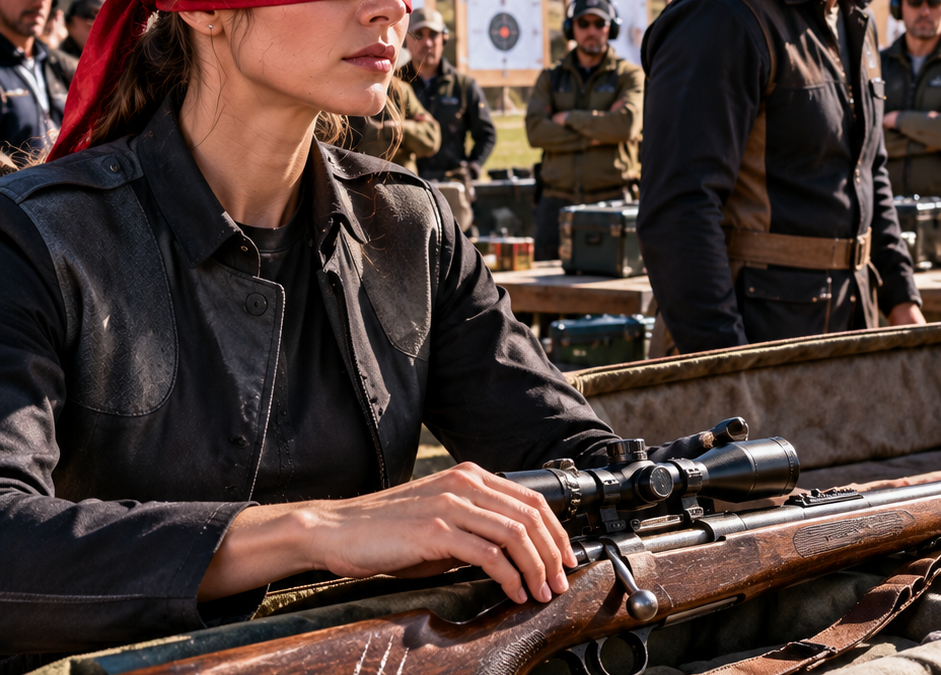
The Rifle Victor Recognized Was the One Thing He Had Spent Eighteen Years Hoping I Would Never Bring Back
Everyone at Ironwood Ridge expected the blind woman to fail, but Victor Hale was the only man who looked afraid before I fired a single shot.
He stopped smiling the moment I opened my father’s old rifle case and touched the three scratches carved beneath the receiver.
By the time I tied a red bandana over eyes that could no longer see, I knew I had not come to that mountain merely to compete.
My name is Mara Ellison.
I was thirty-one years old when I returned to Ironwood Ridge, eighteen years after the night that took my sight and, as far as I had been told, my father.
The morning of the competition was cold enough to make the metal bench bite through my palm.
I could not see the valley anymore.
Not the dark ridges.
Not the pale shooting lanes cut into the hills.
Not the sponsor flags snapping in the wind.
Not the rows of rifles laid out under the bright blue morning sky.
But I heard all of it.
Boots grinding gravel.
Magazine springs clicking.
Ammunition boxes opening.
Range officers speaking into radios.
Coffee lids snapping onto paper cups.
Men laughing too loudly because they wanted other men to know they were relaxed.
And somewhere across the registration area, the one laugh I had traveled four hundred miles to hear.
Victor Hale.
He had won Ironwood Ridge three years in a row.
His name was painted on boards inside the clubhouse.
His photographs hung beside trophies.
His sponsors paid for the navy shooting jacket he wore, the custom rifle he carried, and probably the truck he had parked close enough to the entrance for everyone to notice.
I had learned all of that before arriving.
What I wanted to know could not be found online.
I wanted to know what would happen when Victor Hale heard my name.
More than that, I wanted to know what would happen when he saw the rifle.
I placed the battered canvas case on the concrete bench.
Its brass latches were tarnished.
The edge of the canvas had frayed almost white.
The competitors around me carried rifles built from carbon fiber, aerospace aluminum, custom chassis systems, expensive glass.
Mine looked like something dragged from an attic.
Scarred walnut.
Faded steel.
No polished stock.
No enormous precision optic.
Three diagonal scratches beneath the receiver.
And one narrow silver plate fixed near the buttstock.
I opened the case.
Silence did not fall across the range.
That would have been too dramatic.
But one voice stopped.
Victor’s.
The pause lasted perhaps two seconds.
For me, it might as well have been a confession.
His teammate Grant Mercer spoke first.
“You know that rifle?”
Victor answered too fast.
“No.”
Grant waited.
“You sure?”
Victor forced a laugh.
“Look at it. Half the rifles in Appalachia probably looked like that thirty years ago.”
But I could hear where his voice pointed.
Not toward the whole rifle.
Toward one detail.
The scratches.
I ran my fingertips across them.
Three diagonal marks.
My father, Owen Ellison, had cut them into the wood with a pocketknife after his first major search-and-rescue mission.
When I was little, he used to tell me each one meant something.
Listen.
Wait.
Then act.
I did not understand why a rifle needed a philosophy.
Not when I was nine.
I did now.
“Mara Ellison?”
The registration official stood in front of me.
His name badge said Daniel Price, though I had already memorized his voice from a recording posted on the competition website.
“Yes.”
Paper rustled.
Then stopped.
“This says you’re legally blind.”
“I know what it says.”
His tone softened.
People always did that.
They heard blind and immediately began speaking like I might also be fragile.
“You understand this is a live competitive rifle range.”
“I understand.”
“There will be moving personnel, changing wind, timed commands—”
“Do you ask every competitor whether they understand where they are?”
He stopped.
“No.”
“Then don’t start with me.”
Somebody nearby laughed.
Not cruelly.
Victor did.
Loud enough to make sure I heard.
“The blind woman won’t survive a single round.”
Phones came out.
I heard the subtle electronic tones as cameras began recording.
Someone whispered, “This is going viral.”
Another voice answered, “Probably for the wrong reasons.”
I closed the rifle case halfway.
Then stopped.
“Mr. Hale?”
His laugh died.
“You know who I am?”
I turned my face toward his voice.
“I know who talks too loudly when he wants everyone to believe he isn’t nervous.”
The people nearest us reacted.
Victor did not.
Then he laughed again.
“You’re funny.”
“No.”
I rested one hand on the old case.
“I’m listening.”
Daniel stepped between us.
“Competitors, positions.”
The first stage was simple.
Known distance.
Five shots.
Optics allowed.
No tricks.
No reduced visibility.
Just fundamentals.
I sat behind the rifle and ran my hand across the bench.
Daniel approached.
“Do you need assistance getting set?”
“No.”
“You’re certain?”
“Yes.”
I heard Victor speak quietly somewhere to my left.
“She’s going to hurt somebody.”
I ignored him.
I lifted the rifle.
My father had built my foundation long before I went blind.
At seven, he taught me how to sit still.
Not shoot.
Sit still.
“Most people are bad marksmen before they ever touch a trigger,” he once told me.
“Why?”
“Because they don’t know how to stop moving.”
He taught me breathing.
Body alignment.
Shoulder pressure.
Trigger break.
The sound of wind against pine trees.
The difference between the air before rain and the air after it.
Then, during one strange summer when I was eight, he began making me practice with my eyes covered.
My mother hated it.
“Elise says this is ridiculous,” Dad once whispered while tying a red bandana behind my head.
“She can hear you.”
“I know.”
My mother shouted from the porch, “Then stop saying ridiculous things!”
Dad laughed.
Then leaned beside my ear.
“Sight makes people lazy.”
I remember frowning.
“But shooting uses your eyes.”
“Partly.”
“What else?”
“Everything.”
I never knew why he had trained me that way.
After I lost my sight, I hated him for it.
Because every lesson became a reminder of the man who was gone.
Then, eventually, those lessons became the reason I could keep shooting.
My fingers moved over the old stock.
I checked position.
Settled.
Listened.
The range officer called ready.
Wind crossed the valley.
I heard it strike the sponsor tents before it reached the firing line.
Fabric snapped once.
Then again.
Branches moved somewhere far to the right.
I breathed in.
Out.
Paused.
The first shot broke.
Steel answered.
Not center.
Close.
Murmurs.
Second shot.
Closer.
Third.
Closer still.
By the fifth, the laughter was gone.
I lowered the rifle.
A man behind me whispered, “How the hell is she doing that?”
I turned my head slightly.
“Practice.”
He said nothing else.
Victor shot next.
His five rounds were almost perfect.
Each impact brought applause.
When he finished, people congratulated him.
He accepted it like somebody had already engraved his name on the trophy.
I packed my rifle.
As I walked behind him, his voice dropped.
“Not bad.”
I stopped.
“For what?”
“For someone with your limitations.”
“You mean blindness?”
He shrugged.
“If that’s what you want to call it.”
I smiled.
“What do you call it?”
“A disadvantage.”
“So is arrogance.”
Grant coughed to cover a laugh.
Victor’s voice hardened.
“You came a long way to prove something.”
“Yes.”
“To who?”
I turned toward him.
“You.”
He said nothing.
That silence told me more than his mockery ever could.
The competition continued.
I did not dominate.
I was not some miracle shooter whose blindness suddenly made every round perfect.
That would have been a lie.
I missed.
Adjusted.
Learned the lane.
Used sound.
Felt the rifle.
Tracked wind through pressure changes and timing.
I relied heavily on the range spotters for target confirmation, exactly as my adapted competition approval required.
What changed was not my disability.
It was everyone else’s attitude toward it.
By noon, I had climbed into sixth place.
People started calling my name.
Not many.
Enough.
Victor hated that.
I could hear it in the way he slammed magazines onto his table.
Then Daniel announced the specialty event.
“No optics. Reduced visibility. Three shots. Greatest precision wins.”
Complaints erupted.
Competitors relied on visual environmental references.
Blackout shields would limit peripheral information.
For me, the rule changed almost nothing.
People realized it.
Somebody called out, “Let Mara show them.”
Laughter.
Friendly this time.
I opened my rifle case.
My hand found the red cotton bandana.
Victor stopped moving.
I knew because Grant immediately said, “What?”
Victor did not answer.
I unfolded the cloth.
Someone laughed.
“She brought her own blindfold!”
I tied it around my eyes.
The knot settled low behind my head.
Victor inhaled sharply.
Grant heard him.
“That knot.”
Victor snapped, “What about it?”
“You went pale.”
“Drop it.”
I sat.
The rifle settled into my shoulder.
My father’s voice came back to me.
Listen.
Wait.
Then act.
The firing line went quiet.
Daniel called, “Shooter ready?”
“Ready.”
I listened to the wind.
The command came.
I fired.
The spotter leaned into his scope.
Silence.
Daniel asked, “Well?”
The spotter raised his head.
“Bullseye.”
Somebody laughed from disbelief.
Another person said, “No way.”
I worked the bolt.
Second round.
I listened.
Adjusted.
Fired.
The spotter checked.
Then said, louder, “Bullseye.”
People stood.
Phones lifted again.
Victor stopped breathing for one beat.
I could hear the difference between his chest and Grant’s.
I chambered the third round.
Then stopped.
My trigger finger came outside the guard.
There.
A tiny mechanical click.
Not a rifle.
Not the timer.
A relay or switch.
Then a whisper.
Male.
About eleven feet behind Victor.
Slightly right.
“Move her scoring feed to lane four.”
Victor answered under his breath.
“Do it before she fires.”
My blood went cold.
For several seconds, I stayed behind the rifle.
Then I raised my head.
“You should tell your man to keep his voice down, Victor.”
Nobody spoke.
Victor’s voice came out flat.
“What?”
I turned my blindfolded face toward him.
“And while you’re doing that, you might want to explain why you recognized my father’s rifle.”
Now the silence became real.
Daniel moved away from the firing line.
“What does that mean?”
Victor laughed.
Too late.
Too forced.
“I have no idea what she’s talking about.”
I opened the bolt and cleared the rifle.
Only then did I untie the bandana.
My eyes could not focus on him.
They had not focused on anything since I was nine.
But I faced his voice.
“You said the rifle should be gone.”
Victor did not answer.
Grant said, “You said that?”
“No.”
“Yes,” I said. “You did.”
Victor pointed toward me.
I heard the fabric of his sleeve move.
“She’s bluffing.”
“Then why are you afraid?”
“I’m not.”
Daniel stepped closer.
“What exactly are you accusing him of?”
I rested both hands against the bench.
“My father was Owen Ellison.”
The reaction among the older people told me the name still mattered.
Someone whispered.
Grant said, “The ranger?”
“Yes.”
My father had been a firearms instructor, wilderness guide, and volunteer search-and-rescue coordinator in Ironwood County.
He was known for finding lost people.
Then, eighteen years earlier, he became one.
“His truck was found near Black Pine Gorge,” I said.
Daniel’s voice softened.
“They said he fell into the river.”
“That’s what I was told.”
Victor crossed his arms.
I could hear his jacket shift.
“Tragic story.”
I turned toward him.
“This rifle was recovered last winter.”
Victor answered immediately.
“Where?”
The question came too fast.
Grant noticed.
So did Daniel.
I smiled.
“You just told everyone you didn’t recognize it.”
Victor said nothing.
“I’m curious.”
“No. You’re worried.”
The atmosphere changed.
Nobody cared about the competition anymore.
I touched the three scratches.
“My father carved these after his first rescue mission.”
Then I held up the bandana.
“He tied this same knot when he taught me to shoot without sight.”
Grant whispered, “That’s why you recognized it.”
Victor snapped, “Recognized what?”
“The knot.”
Victor said nothing.
I faced him.
“You recognized both.”
He laughed.
“You expect anyone to believe a blind woman remembers how somebody tied a rag eighteen years ago?”
“I wasn’t blind then.”
That silenced him.
“I lost my sight the same night my father disappeared.”
Daniel’s voice came closer.
“How?”
“A car accident.”
My fingers tightened.
“I was nine. Dad was driving me on Ridgeway Road.”
Memories never return in order.
Not traumatic ones.
Mine lived as sounds.
Tires screaming.
Glass.
My father shouting.
My mother screaming.
Then nothing.
“I woke up three days later.”
“And your father?”
“Gone.”
Victor said, “This is insane.”
I turned toward him.
“You were there.”
His shoes shifted.
“Careful.”
“My father kept records.”
Victor answered before he could stop himself.
“What records?”
Grant swore softly.
Daniel said nothing.
I lifted the rifle enough to touch the silver plate.
“This isn’t decoration.”
I pressed a recessed catch.
The plate opened.
Someone gasped.
Inside the stock was a narrow compartment.
I removed a piece of waxed paper.
Inside was a small brass key.
Victor stepped backward.
Gravel moved beneath his heel.
“Recognize that too?”
No answer.
Daniel asked, “What does it open?”
“My father’s locker.”
“Where?”
“Under the old Ironwood Ridge clubhouse.”
Victor said immediately, “There is no locker.”
I tilted my head.
“You know a lot about a locker you say doesn’t exist.”
Murmurs moved through the crowd.
The original clubhouse had burned seventeen years earlier.
The current building stood on the same foundation.
Victor changed tactics.
“All right.”
His voice became smoother.
“Let’s say your father had some old locker. What does that prove?”
“Nothing.”
He relaxed.
I continued.
“The recording proves more.”
His breathing stopped.
Daniel said, “Recording?”
I pointed toward the rifle case.
Beneath the foam lining was a small audio recorder.
“I’ve been recording since registration.”
Victor’s voice hardened.
“You can’t—”
“Your man just tried to alter my score.”
The scoring official near the table said, “That wasn’t me.”
“I know.”
I turned my head.
The voice had come from the temporary control tent.
“Male. Mid-forties. Heavy breathing. Metal key ring. Left shoe dragging.”
People turned.
Then footsteps.
Fast.
Someone was walking away.
Daniel shouted, “Sir!”
The footsteps became running.
Security tackled the man before he reached the parking lot.
Victor remained silent.
Too silent.
Then the man screamed.
“Victor!”
The entire range reacted.
Victor swore.
The detained man struggled.
“You said she wouldn’t know!”
Victor shouted, “Shut up!”
Phones recorded everything.
Daniel suspended the competition.
Security separated us.
The crowd pulled back.
Grant came beside me.
“You planned this?”
“No.”
“You knew Victor would react.”
“I hoped.”
“What was Owen investigating?”
I hesitated.
Because this was the part I knew.
Or thought I knew.
“Missing rifles.”
“Stolen?”
“Not exactly.”
Years earlier, my father discovered that firearms held in county evidence storage were disappearing.
Some were supposedly destroyed.
Others had serial numbers altered.
Some reappeared in private sales.
Several were eventually linked to violent crimes.
Deputies.
Range officials.
Private brokers.
My father began collecting evidence.
Then he disappeared.
“And Victor?” Grant asked.
“I believed he was involved.”
Across the range, Victor shouted.
“You’re wrong!”
I stood.
Security stopped him several yards away.
“You have no idea what happened that night!”
I walked toward his voice.
Daniel caught my arm.
“Mara.”
“I’m fine.”
I stopped ten feet from Victor.
“Then tell me.”
Victor laughed bitterly.
“You think your father was some hero?”
My stomach tightened.
“He was investigating you.”
“Your father recruited me.”
“No.”
“He started the system.”
“No.”
“He knew which evidence rooms were vulnerable. He knew which serial numbers could disappear. He knew every deputy and collector.”
“You’re lying.”
“Ask the key.”
My fingers closed around the brass.
“That locker wasn’t an evidence cache.”
“What was it?”
“His payment box.”
The words hit harder than I expected.
Grant said, “Victor, enough.”
Victor laughed.
“No. She came for the truth.”
“My father was trying to stop you.”
“Your father recruited me.”
I heard something in Victor’s voice now.
Not arrogance.
Pain.
“You want to know why I recognized that rifle?”
“Yes.”
“Because Owen gave it to me.”
My breath stopped.
“When?”
“The night he disappeared.”
“Why?”
“Because somebody was coming.”
“Who?”
Victor hesitated.
Then said the one word I had never prepared myself to hear.
“Elise.”
My mother.
She had died when I was twelve.
Cancer.
Three years after my father vanished.
For those three years, she raised me alone.
She sat beside my hospital bed.
Held me through panic attacks.
Learned how to guide me through rooms without making me feel helpless.
She never insulted my father.
Never told me he abandoned us.
She said only that whatever had happened, he loved me.
“My mother was home,” I said.
Victor answered quietly.
“No.”
“Yes.”
“She followed him.”
“You’re lying.”
“She knew about the money.”
“No.”
“She knew about the weapons.”
I gripped the key.
Victor continued.
“She threatened to turn Owen in.”
“No.”
“That’s why he took you in the truck.”
The world shifted.
“He was driving me home.”
“No, Mara.”
His voice had become almost gentle.
“He was leaving.”
My chest tightened.
“He planned to disappear with you.”
“No.”
“Elise followed.”
I stepped backward.
Grant touched my elbow.
I pulled away.
“Who forced us off Ridgeway?”
Victor breathed in.
“I wasn’t driving the other car.”
“Who was?”
“Elise.”
My knees weakened.
Then a sound returned from memory.
My mother screaming.
Close.
Not imagined.
Not distant.
Close enough to be on the road.
Victor continued.
“Owen survived the crash.”
My head snapped toward him.
“What?”
“He survived.”
“Where is he?”
Victor turned toward the clubhouse.
“Open the locker.”
Twenty minutes later, county deputies had arrived.
The competition was finished.
Hundreds of people refused to leave.
Daniel led us toward the rebuilt clubhouse.
Victor walked between deputies.
Grant stayed beside me.
A maintenance hatch behind the rear stairs opened into the original foundation.
Cold air rose from below.
Concrete smelled damp.
I put one hand on Grant’s shoulder as we descended.
The corridor narrowed.
At the end stood a rusted metal door.
The brass key fit.
I turned it.
Click.
The room beyond contained no cash.
No rifles.
No payment box.
Shelves lined the walls.
Dozens of cassette tapes sat on them.
Daniel picked one up.
“They’re dated.”
Grant lifted another.
“The newest is two months old.”
Victor whispered, “Impossible.”
I faced him.
“You knew about this room.”
“The locker. Not tapes.”
Grant handed me one.
I traced the label.
Fresh ink had pressed deeply enough to leave ridges in the paper.
“Play it.”
An old recorder sat on the lowest shelf.
Daniel inserted the cassette.
Static.
Then a man’s voice.
Older.
Rougher.
Changed by time.
But a daughter knows some sounds before she knows language.
“Hello, Mara.”
My knees gave.
Grant caught me.
I covered my mouth.
Dad.
The voice continued.
“If you’re hearing this, you finally came to Ironwood Ridge.”
I cried silently.
“I’m sorry.”
A pause.
“I’m sorry for the lies you grew up believing.”
“Dad…”
“I did steal weapons.”
Victor closed his eyes.
My chest broke.
Then Dad continued.
“But not for money.”
Everybody listened.
“I moved them because the county evidence system had been compromised. Rifles connected to crimes were being altered, sold, or destroyed. I removed them before they disappeared.”
Victor looked up.
“Victor Hale helped me.”
I turned toward him.
He sounded stunned.
“I was twenty.”
The tape continued.
“Elise believed I had become part of the trafficking network. I could not convince her otherwise.”
“Mom…”
“That night, she followed me. She thought I was taking Mara away.”
Dad’s voice weakened.
“The crash was an accident.”
I closed my eyes.
“Elise’s vehicle clipped ours. I lost control.”
Static.
Then:
“I pulled Mara from the wreck.”
I whispered, “You did?”
Victor stared at the floor.
“I arrived minutes later.”
The recording continued.
“Mara was unconscious. Elise was injured. Then we heard another vehicle.”
Victor whispered, “The brokers.”
“They had found us.”
Dad described what happened.
He gave Victor the rifle.
Sent Elise and me toward the road.
Stayed behind.
“He saved us,” I whispered.
Victor nodded.
“Yes.”
Then my father’s voice said:
“I survived.”
My entire body went cold.
“Why didn’t you come home?”
The tape answered.
“Because the man running the network was someone Mara would trust.”
Grant said, “Who?”
The tape hissed.
Then my father said:
“Daniel Price.”
Nobody moved.
The registration official was standing beside the doorway.
Daniel’s breathing changed.
Grant reacted first.
Daniel pulled a pistol from beneath his range vest.
“Back!”
He grabbed me.
The barrel pressed against my ribs.
Victor lunged.
A deputy shouted.
Daniel fired into the ceiling.
Concrete dust fell.
“Everybody back!”
He dragged me toward the corridor.
Victor shouted, “You killed Owen?”
Daniel laughed.
“No.”
I heard the truth in that single word.
“You didn’t kill him.”
“Quiet.”
“Where is my father?”
“Dead now.”
I listened.
Breathing.
Foot placement.
Weapon angle.
His grip.
Victor took one step.
Daniel swung the pistol toward him.
“Don’t.”
I whispered, “You’re lying again.”
“About what?”
“My father.”
Then I drove my heel backward into Daniel’s shin.
His grip loosened.
Victor hit him.
The pistol discharged.
Grant pulled me away.
Deputies piled onto Daniel.
Within seconds, he was face down and cuffed.
Victor leaned against the wall, breathing hard.
I turned toward him.
“You saved me.”
He laughed weakly.
“Apparently I’m developing a habit.”
A deputy searched Daniel.
Something came from his pocket.
A photograph.
Grant looked at it.
His breathing changed.
“What?”
“It’s a man.”
“What man?”
“Older. Gray beard. Outside a cabin.”
My hands began shaking.
“Who?”
Grant turned the photograph over.
Then read.
“Owen Ellison. August fourteenth. This year.”
Three weeks earlier.
I dropped to my knees beside Daniel.
“Where is he?”
Daniel smiled through blood on his lip.
“You still don’t understand.”
“What?”
“Your father didn’t send you here.”
I frowned.
“He sent me.”
Victor swore.
Daniel continued.
“The tapes. The rifle. The competition. All of it.”
“Arranged by who?”
“Owen.”
“No.”
“He needed Victor exposed.”
Victor said, “For what?”
“Because Owen still thinks you betrayed him.”
“I saved his daughter.”
“And then you built a career on his techniques, contacts, reputation.”
Victor fell silent.
Daniel smiled.
“Owen wanted everyone in one place.”
“Why?” I whispered.
“To finish it.”
Beep.
Everybody froze.
Beep.
Grant said, “What is that?”
Victor ran toward the shelves.
Behind the cassette recorder was a digital timer.
One minute forty-two.
“Evacuate!”
Daniel started laughing.
Deputies dragged him up.
Grant grabbed me.
“Move.”
I resisted.
“My father wouldn’t do this.”
“Mara!”
The timer fell.
Then the recorder clicked.
A second tape started automatically.
My father’s voice filled the room.
“If the timer has started, Daniel failed.”
Everybody stopped.
“Do not run.”
Victor shouted, “Are you insane?”
“There is no bomb.”
The timer kept dropping.
“Then what is it?” I whispered.
Dad answered from the recording.
“It is a broadcast trigger.”
Victor said, “Broadcast?”
“At zero, all files collected over eighteen years will be released simultaneously to federal investigators, journalists, courts, and every family affected by the stolen evidence network.”
Daniel stopped laughing.
His breathing became panicked.
“The system cannot be stopped.”
Daniel screamed.
“No!”
He fought the deputies.
“You don’t understand what’s in those files!”
I turned.
“What?”
Daniel looked at me.
Then Victor.
Then me again.
“Your mother.”
I froze.
“Elise?”
Daniel nodded.
“She wasn’t just following Owen.”
My voice almost disappeared.
“What did she do?”
Daniel smiled desperately.
“She ran the network.”
“No.”
Victor said, “You told me Price was the head.”
Daniel laughed.
“I was her replacement.”
The tape continued.
“Elise created the first pipeline.”
I could not breathe.
The woman who sat beside me in the hospital.
The mother who taught me how to walk blind through our farmhouse.
The woman whose hand I held while cancer hollowed out her body.
Dad’s voice continued.
“She began moving seized firearms to fund what she believed was an undercover operation.”
Victor whispered, “Believed?”
“The federal contact she trusted did not exist.”
I understood.
At first, she had been manipulated.
But by the time she learned the truth, dozens of firearms had moved.
“She tried to stop,” I whispered.
“Yes,” Dad said on the tape.
Tears ran down my face.
“The crash happened because she believed I was leaving with evidence. She learned the truth before the brokers arrived.”
“And then?”
“She saved you.”
I covered my mouth.
“Elise stayed behind with me.”
Victor said, “Impossible.”
“Why?”
“Because I drove Elise away from the crash.”
The tape answered.
“No, Victor.”
Everyone stared at the recorder.
“The woman you drove away was not Elise.”
My heart stopped.
“What?”
“Elise Ellison had an identical twin.”
Nobody spoke.
“Her sister’s name was Evelyn.”
Daniel knew.
Victor did not.
“Evelyn raised Mara after the crash.”
The room disappeared beneath me.
The woman I had called Mom for the last three years before cancer took her—
had been my aunt.
“Then where was Elise?”
“With me.”
I began sobbing.
The timer reached ten seconds.
Dad spoke again.
“And Mara… if you’re hearing this, your mother is still alive.”
Zero.
Every phone began vibrating.
Computers upstairs chimed.
Messages.
Uploads.
Notifications.
Eighteen years of evidence left Ironwood Ridge at once.
I stood motionless.
Then I heard footsteps in the corridor.
Slow.
Uneven.
A woman.
I turned before anyone else.
She stopped in the doorway.
I could not see her face.
But Victor stopped breathing.
Grant whispered something under his breath.
The woman said my name.
“Mara?”
Every part of me broke.
Not because I recognized the voice exactly.
Eighteen years changes voices.
But something deeper knew.
Something older than memory.
“Mom?”
She crossed the room.
I fell into her arms.
She smelled like cold air, soap, and something painfully familiar.
For several seconds, I could not speak.
Then I pulled back.
“Dad?”
She was crying.
“He’s outside.”
I broke again.
Footsteps.
A cane.
Slow.
A man entered.
Older.
His body carried damage I could hear in the uneven way he walked.
Then he spoke.
“Hello, Mara.”
I ran toward the voice.
Blindly.
Perfectly.
“Dad.”
He caught me.
We collapsed into each other.
His hands were different.
Older.
One incomplete.
But his arms remembered me.
I cried against his chest like I was nine again.
Around us, phones continued vibrating while eighteen years of secrets spread beyond the mountain.
Eventually I pulled away.
“You did this?”
Dad nodded.
“Yes.”
“You planned everything?”
“Yes.”
“You used me.”
His voice broke.
“Yes.”
I stepped back.
“You let me believe you were dead.”
“I know.”
“You let me bury you.”
“Yes.”
“You let me spend eighteen years wondering whether you chose to disappear.”
“I know.”
I slapped him.
Hard.
Nobody moved.
He accepted it.
I was crying too much to control my voice.
“Don’t call this a reunion.”
“I won’t.”
“You don’t get forgiveness because you finally decided I could handle the truth.”
“I know.”
“You don’t get eighteen years back.”
“No.”
My voice cracked.
“But you’re alive.”
He nodded.
I hit his chest twice with both fists.
Then I hugged him again.
Weeks later, federal agents arrested twenty-three people across four states.
Daniel Price was charged in connection with conspiracy, weapons trafficking, evidence tampering, and obstruction.
The files released from my father’s archive led investigators to hundreds of missing evidence items.
Cold cases reopened.
Families received phone calls they had waited years for.
The Ironwood Ridge competition shut down while investigators went through records, staff histories, and financial accounts.
My mother entered protective custody.
Her story was more complicated than I wanted it to be.
She had helped start the pipeline.
That was true.
She had believed it was part of a legitimate undercover effort.
That was also true.
When she discovered the deception, she tried to stop it.
She made terrible choices after that.
Some out of fear.
Some out of guilt.
Some because by then she believed protecting me required disappearing.
None of that erased what she had done.
It also did not erase what she later tried to repair.
For years, I had wanted a clean villain.
Life gave me people.
Flawed.
Afraid.
Cowardly in one moment.
Courageous in another.
Victor was questioned for thirty-six hours.
Then released.
He had lied.
He had cheated.
He had built a career partly on knowledge and techniques my father had taught him.
He had tried to alter my score.
He had done many things I could not respect.
But he had not murdered my father.
At twenty, he had been a frightened young man pulled into a system much bigger than he understood.
And on the night of my crash, he had tried to help.
That truth was harder for me to accept than hatred would have been.
Hatred is simple.
Nuance is exhausting.
My father apologized many times.
I never told him everything was forgiven.
Because it wasn’t.
There were birthdays.
Graduations.
Hospital nights.
Years when I learned how to move through darkness without him.
Years when I needed the person whose voice had taught me not to fear uncertainty.
He chose the investigation.
The network.
The evidence.
Maybe he had reasons.
Maybe some were good.
But I still grew up without him.
Love does not erase consequence.
Neither does truth.
My mother and I had even more to untangle.
She had watched me be raised by Evelyn.
Her own twin.
The woman I buried believing she was my mother.
Elise had survived in hiding while I mourned both parents in different ways.
There was no conversation powerful enough to repair that.
So we did something less dramatic.
We started talking.
Slowly.
Sometimes badly.
Sometimes with long silences.
Sometimes with anger.
That had to be enough.
Months passed.
Ironwood Ridge reopened under new management.
When I heard, I registered again.
Not to investigate.
Not to expose anyone.
Not to prove a theory.
To shoot.
I returned to the same bench.
Victor was there.
No sponsor jacket.
No entourage.
Just an old navy shirt and a range badge.
He heard me open the rifle case.
“You still using that museum piece?”
I touched the scarred walnut.
“My father says it has another thirty years.”
Victor laughed.
“That sounds like Owen.”
I removed the red bandana.
Then tied it around my eyes.
Victor did not go quiet this time.
He smiled.
I could hear it in his breath.
He finally understood the knot.
Trust your hands.
Trust your breath.
Trust what you hear when everyone else is too busy watching.
A new range officer called the line.
My parents stood together somewhere beyond the firing area.
Not healed.
Not fully forgiven.
But there.
Presence mattered more to me than perfection now.
“Shooter ready?”
I rested my cheek against the stock.
“Ready.”
Wind crossed Ironwood Ridge.
The rifle fired.
Steel answered.
The spotter checked.
Then laughed.
Victor called, “What?”
“Bullseye.”
I worked the bolt.
Victor shook his head.
“One day you’re going to miss.”
“Maybe.”
Second shot.
Steel.
“Bullseye.”
I chambered the final round.
Then stopped.
“Victor?”
“Yeah?”
“You were wrong about one thing.”
“What?”
“You said blindness was my disadvantage.”
He laughed softly.
“And?”
I listened to the wind move through the trees.
For eighteen years, I had believed darkness was the thing that separated me from the truth.
It wasn’t.
Sight had failed everyone around me long before it failed me.
People saw reputations instead of motives.
Uniforms instead of guilt.
Success instead of fear.
They looked at my father and saw a criminal.
They looked at Victor and saw a champion.
They looked at Daniel and saw an official.
They looked at my mother and saw a widow.
I had spent most of my life learning that seeing something was not the same as understanding it.
Blindness forced me to listen.
To pauses.
Breathing.
Footsteps.
The hesitation before a lie.
The tremor before someone admitted what they feared.
The sound gravel made when a guilty man stepped backward.
The silence that came when somebody recognized a rifle he claimed never to have seen.
Victor asked again.
“What did blindness teach you?”
I settled the stock against my shoulder.
“That people reveal more when they think you can’t see them.”
I pulled the trigger.
The rifle cracked across the valley.
Half a second later, steel rang.
The spotter laughed again.
“Bullseye.”
I lowered the barrel.
For the first time in eighteen years, Ironwood Ridge did not feel like the place where my family disappeared.
It was simply a mountain.
A firing line.
Wind crossing pine trees.
My father somewhere behind me.
My mother beside him.
Victor standing close enough to hear.
And me.
Still blind.
Still angry in places.
Still healing in others.
But no longer searching for ghosts.
I had come to Ironwood Ridge believing the truth would give me back my past.
It did not.
Nothing could.
My father could not become the man who raised me.
My mother could not undo the years she spent hidden.
Evelyn could never return and explain why she accepted the impossible job of becoming her sister so I would have someone beside my hospital bed.
Victor could not erase the choices he made.
And I could not become the nine-year-old girl who still believed adults told children the whole truth.
What the truth gave me was smaller.
And better.
It gave me the freedom to stop inventing answers.
My father was alive.
My mother was alive.
Victor had failed me in some ways and protected me in others.
Daniel had hidden behind respectability.
Evelyn had loved me enough to become someone else.
And the rifle in my hands had never been evidence that my father abandoned me.
It had been the trail he hoped I would one day follow home.
I ran my thumb across the three scratches beneath the receiver.
Listen.
Wait.
Then act.
At nine years old, I thought he was teaching me how to shoot.
At thirty-one, I finally understood.
He was teaching me how to survive uncertainty without letting fear choose for me.
I closed the bolt.
The new range officer called for the next shooter.
People moved around us.
Rifles clicked.
Voices rose.
Life continued.
Victor came closer.
“Mara?”
“Yes?”
“I’m sorry.”
“For which part?”
He exhaled.
“Fair question.”
I smiled slightly.
“I’m not ready to answer for you.”
“I know.”
Then he walked away.
My father approached next.
I recognized his cane.
Tap.
Step.
Tap.
Step.
He stopped beside the bench.
“You’re still pulling slightly left when you get emotional.”
I laughed.
Eighteen years disappeared for one second.
“You vanish for nearly two decades and the first coaching note you give me is trigger control?”
“I’ve had a lot of time to think about it.”
“You’re impossible.”
“So I’ve been told.”
My mother came closer.
She said nothing.
She placed one hand on my shoulder.
I covered it with mine.
Not forgiveness.
Not yet.
But contact.
That mattered.
My father touched the rifle stock.
“You kept it.”
“I only got it last winter.”
“I know.”
“Did you really believe this whole plan would work?”
He hesitated.
“No.”
I turned toward him.
That answer surprised me.
“What?”
“I hoped.”
“That’s worse.”
“I know.”
“Did you know Victor would react?”
“I suspected.”
“Did you know Daniel would be there?”
“Yes.”
“Did you know he’d pull a gun?”
“No.”
“Good. I was starting to wonder whether insanity was hereditary.”
Dad laughed.
Mom did too.
The sound stopped me.
Their laughter together.
I had not heard it since childhood.
Maybe never.
Memory changes.
Sometimes it fills blank spaces with things we wish were real.
But that laugh felt familiar.
I sat there and listened.
No dramatic forgiveness.
No speeches.
Just two people I had spent eighteen years believing were gone standing behind me on a mountain.
That was enough for one day.
The final scores were posted that evening.
I did not win Ironwood Ridge.
I came third.
A reporter asked whether I was disappointed.
I laughed.
“About what?”
“You were close.”
“I came here once believing I had to win for anyone to take me seriously.”
“And now?”
“I know better.”
“Will you compete again?”
“Yes.”
“Why?”
I turned my face toward the valley.
“Because I like shooting.”
That was the truth.
Simple.
Finally simple.
Months later, federal investigators returned my father’s rifle after the evidence process ended.
I kept the silver compartment empty.
The brass key went into a small wooden box.
The tapes were copied and preserved.
The originals became evidence.
My parents lived under restrictions while investigations continued.
Our family remained complicated.
Some days I loved them.
Some days I could barely speak to them.
Healing became less romantic the closer I got to it.
It was not one decision.
It was repetition.
A phone call.
A meal.
A question answered honestly.
A boundary respected.
A day when nobody lied.
Then another.
Then another.
Victor eventually stopped competing professionally.
He volunteered at the reopened range.
The sponsor patches disappeared.
The arrogance softened.
Not entirely.
Some things survive character development.
Once, after I missed a difficult crosswind target, he said, “Guess blindness finally became a disadvantage.”
I turned toward him.
“You shot two points lower than me.”
He went quiet.
Grant laughed for almost a full minute.
That felt good.
My father sometimes watched me practice.
He never tried to take over.
That mattered.
He gave advice only when I asked.
Mostly.
My mother learned that silence was not always protection.
I learned that anger did not make me disloyal.
Eighteen years of secrets had taught all of us the cost of treating truth like something fragile people should be spared.
It wasn’t.
Truth could hurt.
So could lies.
At least truth gave pain somewhere to go.
One year after I returned to Ironwood Ridge, I stood on the same firing line at dawn.
No crowd yet.
No competition.
Just my father beside me.
He tapped the rifle.
“You remember the three marks?”
“Listen. Wait. Act.”
“Close.”
I frowned.
“You told me that.”
“I simplified it.”
“Of course you did.”
He laughed.
“What did they actually mean?”
He touched the first scratch.
“Listen before you decide what you know.”
Second.
“Wait long enough to discover what fear is trying to make you do.”
Third.
“Then act without lying to yourself about why.”
I stood very still.
“That would’ve been useful eighteen years ago.”
“Yes.”
“Why didn’t you follow it?”
He was quiet for a long time.
Then said, “Because fathers are very good at teaching lessons they still need to learn.”
I smiled.
“That may be the first intelligent thing you’ve said since coming back.”
“I’ve missed your kindness.”
“You missed my teenage years. This is the improved version.”
We stood there until the sun rose.
I could feel the warmth reach my face.
I could not see it.
I no longer hated that fact.
Blindness took colors from me.
Faces.
Written words unless adapted.
The easy independence sighted people rarely think about.
It took things I still grieved.
But it also forced me to build another way of understanding the world.
Not a better way.
Not a magical one.
Just mine.
Victor had once called that a disadvantage.
Maybe it was.
But disadvantages are not verdicts.
Neither are mistakes.
Neither are family histories.
My father’s secrets did not have to become mine.
My mother’s guilt did not have to become my identity.
Victor’s fear did not have to decide what I believed.
And Ironwood Ridge did not have to remain the place where everything disappeared.
I lifted the rifle.
Settled into position.
My father stepped back.
Wind crossed the valley.
I heard pine needles.
A bird somewhere high on the left ridge.
A truck on the distant road.
Then nothing but my breathing.
Dad said quietly, “Shooter ready?”
I smiled.
“Ready.”
And this time, when I pulled the trigger, I was not firing toward the past.
I was simply shooting forward.
What do you think of this story? Please leave a like and share your thoughts in the comments. Your support means a lot to us and inspires us to keep writing more meaningful and powerful stories. Thank you! 👍
𝗧𝗛𝗘 𝗘𝗡𝗗
The Rifle Victor Recognized Was the One Thing He Had Spent Eighteen Years Hoping I Would Never Bring Back
Everyone at Ironwood Ridge expected the blind woman to fail, but Victor Hale was the only man who looked afraid before I fired a single shot.
He stopped smiling the moment I opened my father’s old rifle case and touched the three scratches carved beneath the receiver.
By the time I tied a red bandana over eyes that could no longer see, I knew I had not come to that mountain merely to compete.
My name is Mara Ellison.
I was thirty-one years old when I returned to Ironwood Ridge, eighteen years after the night that took my sight and, as far as I had been told, my father.
The morning of the competition was cold enough to make the metal bench bite through my palm.
I could not see the valley anymore.
Not the dark ridges.
Not the pale shooting lanes cut into the hills.
Not the sponsor flags snapping in the wind.
Not the rows of rifles laid out under the bright blue morning sky.
But I heard all of it.
Boots grinding gravel.
Magazine springs clicking.
Ammunition boxes opening.
Range officers speaking into radios.
Coffee lids snapping onto paper cups.
Men laughing too loudly because they wanted other men to know they were relaxed.
And somewhere across the registration area, the one laugh I had traveled four hundred miles to hear.
Victor Hale.
He had won Ironwood Ridge three years in a row.
His name was painted on boards inside the clubhouse.
His photographs hung beside trophies.
His sponsors paid for the navy shooting jacket he wore, the custom rifle he carried, and probably the truck he had parked close enough to the entrance for everyone to notice.
I had learned all of that before arriving.
What I wanted to know could not be found online.
I wanted to know what would happen when Victor Hale heard my name.
More than that, I wanted to know what would happen when he saw the rifle.
I placed the battered canvas case on the concrete bench.
Its brass latches were tarnished.
The edge of the canvas had frayed almost white.
The competitors around me carried rifles built from carbon fiber, aerospace aluminum, custom chassis systems, expensive glass.
Mine looked like something dragged from an attic.
Scarred walnut.
Faded steel.
No polished stock.
No enormous precision optic.
Three diagonal scratches beneath the receiver.
And one narrow silver plate fixed near the buttstock.
I opened the case.
Silence did not fall across the range.
That would have been too dramatic.
But one voice stopped.
Victor’s.
The pause lasted perhaps two seconds.
For me, it might as well have been a confession.
His teammate Grant Mercer spoke first.
“You know that rifle?”
Victor answered too fast.
“No.”
Grant waited.
“You sure?”
Victor forced a laugh.
“Look at it. Half the rifles in Appalachia probably looked like that thirty years ago.”
But I could hear where his voice pointed.
Not toward the whole rifle.
Toward one detail.
The scratches.
I ran my fingertips across them.
Three diagonal marks.
My father, Owen Ellison, had cut them into the wood with a pocketknife after his first major search-and-rescue mission.
When I was little, he used to tell me each one meant something.
Listen.
Wait.
Then act.
I did not understand why a rifle needed a philosophy.
Not when I was nine.
I did now.
“Mara Ellison?”
The registration official stood in front of me.
His name badge said Daniel Price, though I had already memorized his voice from a recording posted on the competition website.
“Yes.”
Paper rustled.
Then stopped.
“This says you’re legally blind.”
“I know what it says.”
His tone softened.
People always did that.
They heard blind and immediately began speaking like I might also be fragile.
“You understand this is a live competitive rifle range.”
“I understand.”
“There will be moving personnel, changing wind, timed commands—”
“Do you ask every competitor whether they understand where they are?”
He stopped.
“No.”
“Then don’t start with me.”
Somebody nearby laughed.
Not cruelly.
Victor did.
Loud enough to make sure I heard.
“The blind woman won’t survive a single round.”
Phones came out.
I heard the subtle electronic tones as cameras began recording.
Someone whispered, “This is going viral.”
Another voice answered, “Probably for the wrong reasons.”
I closed the rifle case halfway.
Then stopped.
“Mr. Hale?”
His laugh died.
“You know who I am?”
I turned my face toward his voice.
“I know who talks too loudly when he wants everyone to believe he isn’t nervous.”
The people nearest us reacted.
Victor did not.
Then he laughed again.
“You’re funny.”
“No.”
I rested one hand on the old case.
“I’m listening.”
Daniel stepped between us.
“Competitors, positions.”
The first stage was simple.
Known distance.
Five shots.
Optics allowed.
No tricks.
No reduced visibility.
Just fundamentals.
I sat behind the rifle and ran my hand across the bench.
Daniel approached.
“Do you need assistance getting set?”
“No.”
“You’re certain?”
“Yes.”
I heard Victor speak quietly somewhere to my left.
“She’s going to hurt somebody.”
I ignored him.
I lifted the rifle.
My father had built my foundation long before I went blind.
At seven, he taught me how to sit still.
Not shoot.
Sit still.
“Most people are bad marksmen before they ever touch a trigger,” he once told me.
“Why?”
“Because they don’t know how to stop moving.”
He taught me breathing.
Body alignment.
Shoulder pressure.
Trigger break.
The sound of wind against pine trees.
The difference between the air before rain and the air after it.
Then, during one strange summer when I was eight, he began making me practice with my eyes covered.
My mother hated it.
“Elise says this is ridiculous,” Dad once whispered while tying a red bandana behind my head.
“She can hear you.”
“I know.”
My mother shouted from the porch, “Then stop saying ridiculous things!”
Dad laughed.
Then leaned beside my ear.
“Sight makes people lazy.”
I remember frowning.
“But shooting uses your eyes.”
“Partly.”
“What else?”
“Everything.”
I never knew why he had trained me that way.
After I lost my sight, I hated him for it.
Because every lesson became a reminder of the man who was gone.
Then, eventually, those lessons became the reason I could keep shooting.
My fingers moved over the old stock.
I checked position.
Settled.
Listened.
The range officer called ready.
Wind crossed the valley.
I heard it strike the sponsor tents before it reached the firing line.
Fabric snapped once.
Then again.
Branches moved somewhere far to the right.
I breathed in.
Out.
Paused.
The first shot broke.
Steel answered.
Not center.
Close.
Murmurs.
Second shot.
Closer.
Third.
Closer still.
By the fifth, the laughter was gone.
I lowered the rifle.
A man behind me whispered, “How the hell is she doing that?”
I turned my head slightly.
“Practice.”
He said nothing else.
Victor shot next.
His five rounds were almost perfect.
Each impact brought applause.
When he finished, people congratulated him.
He accepted it like somebody had already engraved his name on the trophy.
I packed my rifle.
As I walked behind him, his voice dropped.
“Not bad.”
I stopped.
“For what?”
“For someone with your limitations.”
“You mean blindness?”
He shrugged.
“If that’s what you want to call it.”
I smiled.
“What do you call it?”
“A disadvantage.”
“So is arrogance.”
Grant coughed to cover a laugh.
Victor’s voice hardened.
“You came a long way to prove something.”
“Yes.”
“To who?”
I turned toward him.
“You.”
He said nothing.
That silence told me more than his mockery ever could.
The competition continued.
I did not dominate.
I was not some miracle shooter whose blindness suddenly made every round perfect.
That would have been a lie.
I missed.
Adjusted.
Learned the lane.
Used sound.
Felt the rifle.
Tracked wind through pressure changes and timing.
I relied heavily on the range spotters for target confirmation, exactly as my adapted competition approval required.
What changed was not my disability.
It was everyone else’s attitude toward it.
By noon, I had climbed into sixth place.
People started calling my name.
Not many.
Enough.
Victor hated that.
I could hear it in the way he slammed magazines onto his table.
Then Daniel announced the specialty event.
“No optics. Reduced visibility. Three shots. Greatest precision wins.”
Complaints erupted.
Competitors relied on visual environmental references.
Blackout shields would limit peripheral information.
For me, the rule changed almost nothing.
People realized it.
Somebody called out, “Let Mara show them.”
Laughter.
Friendly this time.
I opened my rifle case.
My hand found the red cotton bandana.
Victor stopped moving.
I knew because Grant immediately said, “What?”
Victor did not answer.
I unfolded the cloth.
Someone laughed.
“She brought her own blindfold!”
I tied it around my eyes.
The knot settled low behind my head.
Victor inhaled sharply.
Grant heard him.
“That knot.”
Victor snapped, “What about it?”
“You went pale.”
“Drop it.”
I sat.
The rifle settled into my shoulder.
My father’s voice came back to me.
Listen.
Wait.
Then act.
The firing line went quiet.
Daniel called, “Shooter ready?”
“Ready.”
I listened to the wind.
The command came.
I fired.
The spotter leaned into his scope.
Silence.
Daniel asked, “Well?”
The spotter raised his head.
“Bullseye.”
Somebody laughed from disbelief.
Another person said, “No way.”
I worked the bolt.
Second round.
I listened.
Adjusted.
Fired.
The spotter checked.
Then said, louder, “Bullseye.”
People stood.
Phones lifted again.
Victor stopped breathing for one beat.
I could hear the difference between his chest and Grant’s.
I chambered the third round.
Then stopped.
My trigger finger came outside the guard.
There.
A tiny mechanical click.
Not a rifle.
Not the timer.
A relay or switch.
Then a whisper.
Male.
About eleven feet behind Victor.
Slightly right.
“Move her scoring feed to lane four.”
Victor answered under his breath.
“Do it before she fires.”
My blood went cold.
For several seconds, I stayed behind the rifle.
Then I raised my head.
“You should tell your man to keep his voice down, Victor.”
Nobody spoke.
Victor’s voice came out flat.
“What?”
I turned my blindfolded face toward him.
“And while you’re doing that, you might want to explain why you recognized my father’s rifle.”
Now the silence became real.
Daniel moved away from the firing line.
“What does that mean?”
Victor laughed.
Too late.
Too forced.
“I have no idea what she’s talking about.”
I opened the bolt and cleared the rifle.
Only then did I untie the bandana.
My eyes could not focus on him.
They had not focused on anything since I was nine.
But I faced his voice.
“You said the rifle should be gone.”
Victor did not answer.
Grant said, “You said that?”
“No.”
“Yes,” I said. “You did.”
Victor pointed toward me.
I heard the fabric of his sleeve move.
“She’s bluffing.”
“Then why are you afraid?”
“I’m not.”
Daniel stepped closer.
“What exactly are you accusing him of?”
I rested both hands against the bench.
“My father was Owen Ellison.”
The reaction among the older people told me the name still mattered.
Someone whispered.
Grant said, “The ranger?”
“Yes.”
My father had been a firearms instructor, wilderness guide, and volunteer search-and-rescue coordinator in Ironwood County.
He was known for finding lost people.
Then, eighteen years earlier, he became one.
“His truck was found near Black Pine Gorge,” I said.
Daniel’s voice softened.
“They said he fell into the river.”
“That’s what I was told.”
Victor crossed his arms.
I could hear his jacket shift.
“Tragic story.”
I turned toward him.
“This rifle was recovered last winter.”
Victor answered immediately.
“Where?”
The question came too fast.
Grant noticed.
So did Daniel.
I smiled.
“You just told everyone you didn’t recognize it.”
Victor said nothing.
“I’m curious.”
“No. You’re worried.”
The atmosphere changed.
Nobody cared about the competition anymore.
I touched the three scratches.
“My father carved these after his first rescue mission.”
Then I held up the bandana.
“He tied this same knot when he taught me to shoot without sight.”
Grant whispered, “That’s why you recognized it.”
Victor snapped, “Recognized what?”
“The knot.”
Victor said nothing.
I faced him.
“You recognized both.”
He laughed.
“You expect anyone to believe a blind woman remembers how somebody tied a rag eighteen years ago?”
“I wasn’t blind then.”
That silenced him.
“I lost my sight the same night my father disappeared.”
Daniel’s voice came closer.
“How?”
“A car accident.”
My fingers tightened.
“I was nine. Dad was driving me on Ridgeway Road.”
Memories never return in order.
Not traumatic ones.
Mine lived as sounds.
Tires screaming.
Glass.
My father shouting.
My mother screaming.
Then nothing.
“I woke up three days later.”
“And your father?”
“Gone.”
Victor said, “This is insane.”
I turned toward him.
“You were there.”
His shoes shifted.
“Careful.”
“My father kept records.”
Victor answered before he could stop himself.
“What records?”
Grant swore softly.
Daniel said nothing.
I lifted the rifle enough to touch the silver plate.
“This isn’t decoration.”
I pressed a recessed catch.
The plate opened.
Someone gasped.
Inside the stock was a narrow compartment.
I removed a piece of waxed paper.
Inside was a small brass key.
Victor stepped backward.
Gravel moved beneath his heel.
“Recognize that too?”
No answer.
Daniel asked, “What does it open?”
“My father’s locker.”
“Where?”
“Under the old Ironwood Ridge clubhouse.”
Victor said immediately, “There is no locker.”
I tilted my head.
“You know a lot about a locker you say doesn’t exist.”
Murmurs moved through the crowd.
The original clubhouse had burned seventeen years earlier.
The current building stood on the same foundation.
Victor changed tactics.
“All right.”
His voice became smoother.
“Let’s say your father had some old locker. What does that prove?”
“Nothing.”
He relaxed.
I continued.
“The recording proves more.”
His breathing stopped.
Daniel said, “Recording?”
I pointed toward the rifle case.
Beneath the foam lining was a small audio recorder.
“I’ve been recording since registration.”
Victor’s voice hardened.
“You can’t—”
“Your man just tried to alter my score.”
The scoring official near the table said, “That wasn’t me.”
“I know.”
I turned my head.
The voice had come from the temporary control tent.
“Male. Mid-forties. Heavy breathing. Metal key ring. Left shoe dragging.”
People turned.
Then footsteps.
Fast.
Someone was walking away.
Daniel shouted, “Sir!”
The footsteps became running.
Security tackled the man before he reached the parking lot.
Victor remained silent.
Too silent.
Then the man screamed.
“Victor!”
The entire range reacted.
Victor swore.
The detained man struggled.
“You said she wouldn’t know!”
Victor shouted, “Shut up!”
Phones recorded everything.
Daniel suspended the competition.
Security separated us.
The crowd pulled back.
Grant came beside me.
“You planned this?”
“No.”
“You knew Victor would react.”
“I hoped.”
“What was Owen investigating?”
I hesitated.
Because this was the part I knew.
Or thought I knew.
“Missing rifles.”
“Stolen?”
“Not exactly.”
Years earlier, my father discovered that firearms held in county evidence storage were disappearing.
Some were supposedly destroyed.
Others had serial numbers altered.
Some reappeared in private sales.
Several were eventually linked to violent crimes.
Deputies.
Range officials.
Private brokers.
My father began collecting evidence.
Then he disappeared.
“And Victor?” Grant asked.
“I believed he was involved.”
Across the range, Victor shouted.
“You’re wrong!”
I stood.
Security stopped him several yards away.
“You have no idea what happened that night!”
I walked toward his voice.
Daniel caught my arm.
“Mara.”
“I’m fine.”
I stopped ten feet from Victor.
“Then tell me.”
Victor laughed bitterly.
“You think your father was some hero?”
My stomach tightened.
“He was investigating you.”
“Your father recruited me.”
“No.”
“He started the system.”
“No.”
“He knew which evidence rooms were vulnerable. He knew which serial numbers could disappear. He knew every deputy and collector.”
“You’re lying.”
“Ask the key.”
My fingers closed around the brass.
“That locker wasn’t an evidence cache.”
“What was it?”
“His payment box.”
The words hit harder than I expected.
Grant said, “Victor, enough.”
Victor laughed.
“No. She came for the truth.”
“My father was trying to stop you.”
“Your father recruited me.”
I heard something in Victor’s voice now.
Not arrogance.
Pain.
“You want to know why I recognized that rifle?”
“Yes.”
“Because Owen gave it to me.”
My breath stopped.
“When?”
“The night he disappeared.”
“Why?”
“Because somebody was coming.”
“Who?”
Victor hesitated.
Then said the one word I had never prepared myself to hear.
“Elise.”
My mother.
She had died when I was twelve.
Cancer.
Three years after my father vanished.
For those three years, she raised me alone.
She sat beside my hospital bed.
Held me through panic attacks.
Learned how to guide me through rooms without making me feel helpless.
She never insulted my father.
Never told me he abandoned us.
She said only that whatever had happened, he loved me.
“My mother was home,” I said.
Victor answered quietly.
“No.”
“Yes.”
“She followed him.”
“You’re lying.”
“She knew about the money.”
“No.”
“She knew about the weapons.”
I gripped the key.
Victor continued.
“She threatened to turn Owen in.”
“No.”
“That’s why he took you in the truck.”
The world shifted.
“He was driving me home.”
“No, Mara.”
His voice had become almost gentle.
“He was leaving.”
My chest tightened.
“He planned to disappear with you.”
“No.”
“Elise followed.”
I stepped backward.
Grant touched my elbow.
I pulled away.
“Who forced us off Ridgeway?”
Victor breathed in.
“I wasn’t driving the other car.”
“Who was?”
“Elise.”
My knees weakened.
Then a sound returned from memory.
My mother screaming.
Close.
Not imagined.
Not distant.
Close enough to be on the road.
Victor continued.
“Owen survived the crash.”
My head snapped toward him.
“What?”
“He survived.”
“Where is he?”
Victor turned toward the clubhouse.
“Open the locker.”
Twenty minutes later, county deputies had arrived.
The competition was finished.
Hundreds of people refused to leave.
Daniel led us toward the rebuilt clubhouse.
Victor walked between deputies.
Grant stayed beside me.
A maintenance hatch behind the rear stairs opened into the original foundation.
Cold air rose from below.
Concrete smelled damp.
I put one hand on Grant’s shoulder as we descended.
The corridor narrowed.
At the end stood a rusted metal door.
The brass key fit.
I turned it.
Click.
The room beyond contained no cash.
No rifles.
No payment box.
Shelves lined the walls.
Dozens of cassette tapes sat on them.
Daniel picked one up.
“They’re dated.”
Grant lifted another.
“The newest is two months old.”
Victor whispered, “Impossible.”
I faced him.
“You knew about this room.”
“The locker. Not tapes.”
Grant handed me one.
I traced the label.
Fresh ink had pressed deeply enough to leave ridges in the paper.
“Play it.”
An old recorder sat on the lowest shelf.
Daniel inserted the cassette.
Static.
Then a man’s voice.
Older.
Rougher.
Changed by time.
But a daughter knows some sounds before she knows language.
“Hello, Mara.”
My knees gave.
Grant caught me.
I covered my mouth.
Dad.
The voice continued.
“If you’re hearing this, you finally came to Ironwood Ridge.”
I cried silently.
“I’m sorry.”
A pause.
“I’m sorry for the lies you grew up believing.”
“Dad…”
“I did steal weapons.”
Victor closed his eyes.
My chest broke.
Then Dad continued.
“But not for money.”
Everybody listened.
“I moved them because the county evidence system had been compromised. Rifles connected to crimes were being altered, sold, or destroyed. I removed them before they disappeared.”
Victor looked up.
“Victor Hale helped me.”
I turned toward him.
He sounded stunned.
“I was twenty.”
The tape continued.
“Elise believed I had become part of the trafficking network. I could not convince her otherwise.”
“Mom…”
“That night, she followed me. She thought I was taking Mara away.”
Dad’s voice weakened.
“The crash was an accident.”
I closed my eyes.
“Elise’s vehicle clipped ours. I lost control.”
Static.
Then:
“I pulled Mara from the wreck.”
I whispered, “You did?”
Victor stared at the floor.
“I arrived minutes later.”
The recording continued.
“Mara was unconscious. Elise was injured. Then we heard another vehicle.”
Victor whispered, “The brokers.”
“They had found us.”
Dad described what happened.
He gave Victor the rifle.
Sent Elise and me toward the road.
Stayed behind.
“He saved us,” I whispered.
Victor nodded.
“Yes.”
Then my father’s voice said:
“I survived.”
My entire body went cold.
“Why didn’t you come home?”
The tape answered.
“Because the man running the network was someone Mara would trust.”
Grant said, “Who?”
The tape hissed.
Then my father said:
“Daniel Price.”
Nobody moved.
The registration official was standing beside the doorway.
Daniel’s breathing changed.
Grant reacted first.
Daniel pulled a pistol from beneath his range vest.
“Back!”
He grabbed me.
The barrel pressed against my ribs.
Victor lunged.
A deputy shouted.
Daniel fired into the ceiling.
Concrete dust fell.
“Everybody back!”
He dragged me toward the corridor.
Victor shouted, “You killed Owen?”
Daniel laughed.
“No.”
I heard the truth in that single word.
“You didn’t kill him.”
“Quiet.”
“Where is my father?”
“Dead now.”
I listened.
Breathing.
Foot placement.
Weapon angle.
His grip.
Victor took one step.
Daniel swung the pistol toward him.
“Don’t.”
I whispered, “You’re lying again.”
“About what?”
“My father.”
Then I drove my heel backward into Daniel’s shin.
His grip loosened.
Victor hit him.
The pistol discharged.
Grant pulled me away.
Deputies piled onto Daniel.
Within seconds, he was face down and cuffed.
Victor leaned against the wall, breathing hard.
I turned toward him.
“You saved me.”
He laughed weakly.
“Apparently I’m developing a habit.”
A deputy searched Daniel.
Something came from his pocket.
A photograph.
Grant looked at it.
His breathing changed.
“What?”
“It’s a man.”
“What man?”
“Older. Gray beard. Outside a cabin.”
My hands began shaking.
“Who?”
Grant turned the photograph over.
Then read.
“Owen Ellison. August fourteenth. This year.”
Three weeks earlier.
I dropped to my knees beside Daniel.
“Where is he?”
Daniel smiled through blood on his lip.
“You still don’t understand.”
“What?”
“Your father didn’t send you here.”
I frowned.
“He sent me.”
Victor swore.
Daniel continued.
“The tapes. The rifle. The competition. All of it.”
“Arranged by who?”
“Owen.”
“No.”
“He needed Victor exposed.”
Victor said, “For what?”
“Because Owen still thinks you betrayed him.”
“I saved his daughter.”
“And then you built a career on his techniques, contacts, reputation.”
Victor fell silent.
Daniel smiled.
“Owen wanted everyone in one place.”
“Why?” I whispered.
“To finish it.”
Beep.
Everybody froze.
Beep.
Grant said, “What is that?”
Victor ran toward the shelves.
Behind the cassette recorder was a digital timer.
One minute forty-two.
“Evacuate!”
Daniel started laughing.
Deputies dragged him up.
Grant grabbed me.
“Move.”
I resisted.
“My father wouldn’t do this.”
“Mara!”
The timer fell.
Then the recorder clicked.
A second tape started automatically.
My father’s voice filled the room.
“If the timer has started, Daniel failed.”
Everybody stopped.
“Do not run.”
Victor shouted, “Are you insane?”
“There is no bomb.”
The timer kept dropping.
“Then what is it?” I whispered.
Dad answered from the recording.
“It is a broadcast trigger.”
Victor said, “Broadcast?”
“At zero, all files collected over eighteen years will be released simultaneously to federal investigators, journalists, courts, and every family affected by the stolen evidence network.”
Daniel stopped laughing.
His breathing became panicked.
“The system cannot be stopped.”
Daniel screamed.
“No!”
He fought the deputies.
“You don’t understand what’s in those files!”
I turned.
“What?”
Daniel looked at me.
Then Victor.
Then me again.
“Your mother.”
I froze.
“Elise?”
Daniel nodded.
“She wasn’t just following Owen.”
My voice almost disappeared.
“What did she do?”
Daniel smiled desperately.
“She ran the network.”
“No.”
Victor said, “You told me Price was the head.”
Daniel laughed.
“I was her replacement.”
The tape continued.
“Elise created the first pipeline.”
I could not breathe.
The woman who sat beside me in the hospital.
The mother who taught me how to walk blind through our farmhouse.
The woman whose hand I held while cancer hollowed out her body.
Dad’s voice continued.
“She began moving seized firearms to fund what she believed was an undercover operation.”
Victor whispered, “Believed?”
“The federal contact she trusted did not exist.”
I understood.
At first, she had been manipulated.
But by the time she learned the truth, dozens of firearms had moved.
“She tried to stop,” I whispered.
“Yes,” Dad said on the tape.
Tears ran down my face.
“The crash happened because she believed I was leaving with evidence. She learned the truth before the brokers arrived.”
“And then?”
“She saved you.”
I covered my mouth.
“Elise stayed behind with me.”
Victor said, “Impossible.”
“Why?”
“Because I drove Elise away from the crash.”
The tape answered.
“No, Victor.”
Everyone stared at the recorder.
“The woman you drove away was not Elise.”
My heart stopped.
“What?”
“Elise Ellison had an identical twin.”
Nobody spoke.
“Her sister’s name was Evelyn.”
Daniel knew.
Victor did not.
“Evelyn raised Mara after the crash.”
The room disappeared beneath me.
The woman I had called Mom for the last three years before cancer took her—
had been my aunt.
“Then where was Elise?”
“With me.”
I began sobbing.
The timer reached ten seconds.
Dad spoke again.
“And Mara… if you’re hearing this, your mother is still alive.”
Zero.
Every phone began vibrating.
Computers upstairs chimed.
Messages.
Uploads.
Notifications.
Eighteen years of evidence left Ironwood Ridge at once.
I stood motionless.
Then I heard footsteps in the corridor.
Slow.
Uneven.
A woman.
I turned before anyone else.
She stopped in the doorway.
I could not see her face.
But Victor stopped breathing.
Grant whispered something under his breath.
The woman said my name.
“Mara?”
Every part of me broke.
Not because I recognized the voice exactly.
Eighteen years changes voices.
But something deeper knew.
Something older than memory.
“Mom?”
She crossed the room.
I fell into her arms.
She smelled like cold air, soap, and something painfully familiar.
For several seconds, I could not speak.
Then I pulled back.
“Dad?”
She was crying.
“He’s outside.”
I broke again.
Footsteps.
A cane.
Slow.
A man entered.
Older.
His body carried damage I could hear in the uneven way he walked.
Then he spoke.
“Hello, Mara.”
I ran toward the voice.
Blindly.
Perfectly.
“Dad.”
He caught me.
We collapsed into each other.
His hands were different.
Older.
One incomplete.
But his arms remembered me.
I cried against his chest like I was nine again.
Around us, phones continued vibrating while eighteen years of secrets spread beyond the mountain.
Eventually I pulled away.
“You did this?”
Dad nodded.
“Yes.”
“You planned everything?”
“Yes.”
“You used me.”
His voice broke.
“Yes.”
I stepped back.
“You let me believe you were dead.”
“I know.”
“You let me bury you.”
“Yes.”
“You let me spend eighteen years wondering whether you chose to disappear.”
“I know.”
I slapped him.
Hard.
Nobody moved.
He accepted it.
I was crying too much to control my voice.
“Don’t call this a reunion.”
“I won’t.”
“You don’t get forgiveness because you finally decided I could handle the truth.”
“I know.”
“You don’t get eighteen years back.”
“No.”
My voice cracked.
“But you’re alive.”
He nodded.
I hit his chest twice with both fists.
Then I hugged him again.
Weeks later, federal agents arrested twenty-three people across four states.
Daniel Price was charged in connection with conspiracy, weapons trafficking, evidence tampering, and obstruction.
The files released from my father’s archive led investigators to hundreds of missing evidence items.
Cold cases reopened.
Families received phone calls they had waited years for.
The Ironwood Ridge competition shut down while investigators went through records, staff histories, and financial accounts.
My mother entered protective custody.
Her story was more complicated than I wanted it to be.
She had helped start the pipeline.
That was true.
She had believed it was part of a legitimate undercover effort.
That was also true.
When she discovered the deception, she tried to stop it.
She made terrible choices after that.
Some out of fear.
Some out of guilt.
Some because by then she believed protecting me required disappearing.
None of that erased what she had done.
It also did not erase what she later tried to repair.
For years, I had wanted a clean villain.
Life gave me people.
Flawed.
Afraid.
Cowardly in one moment.
Courageous in another.
Victor was questioned for thirty-six hours.
Then released.
He had lied.
He had cheated.
He had built a career partly on knowledge and techniques my father had taught him.
He had tried to alter my score.
He had done many things I could not respect.
But he had not murdered my father.
At twenty, he had been a frightened young man pulled into a system much bigger than he understood.
And on the night of my crash, he had tried to help.
That truth was harder for me to accept than hatred would have been.
Hatred is simple.
Nuance is exhausting.
My father apologized many times.
I never told him everything was forgiven.
Because it wasn’t.
There were birthdays.
Graduations.
Hospital nights.
Years when I learned how to move through darkness without him.
Years when I needed the person whose voice had taught me not to fear uncertainty.
He chose the investigation.
The network.
The evidence.
Maybe he had reasons.
Maybe some were good.
But I still grew up without him.
Love does not erase consequence.
Neither does truth.
My mother and I had even more to untangle.
She had watched me be raised by Evelyn.
Her own twin.
The woman I buried believing she was my mother.
Elise had survived in hiding while I mourned both parents in different ways.
There was no conversation powerful enough to repair that.
So we did something less dramatic.
We started talking.
Slowly.
Sometimes badly.
Sometimes with long silences.
Sometimes with anger.
That had to be enough.
Months passed.
Ironwood Ridge reopened under new management.
When I heard, I registered again.
Not to investigate.
Not to expose anyone.
Not to prove a theory.
To shoot.
I returned to the same bench.
Victor was there.
No sponsor jacket.
No entourage.
Just an old navy shirt and a range badge.
He heard me open the rifle case.
“You still using that museum piece?”
I touched the scarred walnut.
“My father says it has another thirty years.”
Victor laughed.
“That sounds like Owen.”
I removed the red bandana.
Then tied it around my eyes.
Victor did not go quiet this time.
He smiled.
I could hear it in his breath.
He finally understood the knot.
Trust your hands.
Trust your breath.
Trust what you hear when everyone else is too busy watching.
A new range officer called the line.
My parents stood together somewhere beyond the firing area.
Not healed.
Not fully forgiven.
But there.
Presence mattered more to me than perfection now.
“Shooter ready?”
I rested my cheek against the stock.
“Ready.”
Wind crossed Ironwood Ridge.
The rifle fired.
Steel answered.
The spotter checked.
Then laughed.
Victor called, “What?”
“Bullseye.”
I worked the bolt.
Victor shook his head.
“One day you’re going to miss.”
“Maybe.”
Second shot.
Steel.
“Bullseye.”
I chambered the final round.
Then stopped.
“Victor?”
“Yeah?”
“You were wrong about one thing.”
“What?”
“You said blindness was my disadvantage.”
He laughed softly.
“And?”
I listened to the wind move through the trees.
For eighteen years, I had believed darkness was the thing that separated me from the truth.
It wasn’t.
Sight had failed everyone around me long before it failed me.
People saw reputations instead of motives.
Uniforms instead of guilt.
Success instead of fear.
They looked at my father and saw a criminal.
They looked at Victor and saw a champion.
They looked at Daniel and saw an official.
They looked at my mother and saw a widow.
I had spent most of my life learning that seeing something was not the same as understanding it.
Blindness forced me to listen.
To pauses.
Breathing.
Footsteps.
The hesitation before a lie.
The tremor before someone admitted what they feared.
The sound gravel made when a guilty man stepped backward.
The silence that came when somebody recognized a rifle he claimed never to have seen.
Victor asked again.
“What did blindness teach you?”
I settled the stock against my shoulder.
“That people reveal more when they think you can’t see them.”
I pulled the trigger.
The rifle cracked across the valley.
Half a second later, steel rang.
The spotter laughed again.
“Bullseye.”
I lowered the barrel.
For the first time in eighteen years, Ironwood Ridge did not feel like the place where my family disappeared.
It was simply a mountain.
A firing line.
Wind crossing pine trees.
My father somewhere behind me.
My mother beside him.
Victor standing close enough to hear.
And me.
Still blind.
Still angry in places.
Still healing in others.
But no longer searching for ghosts.
I had come to Ironwood Ridge believing the truth would give me back my past.
It did not.
Nothing could.
My father could not become the man who raised me.
My mother could not undo the years she spent hidden.
Evelyn could never return and explain why she accepted the impossible job of becoming her sister so I would have someone beside my hospital bed.
Victor could not erase the choices he made.
And I could not become the nine-year-old girl who still believed adults told children the whole truth.
What the truth gave me was smaller.
And better.
It gave me the freedom to stop inventing answers.
My father was alive.
My mother was alive.
Victor had failed me in some ways and protected me in others.
Daniel had hidden behind respectability.
Evelyn had loved me enough to become someone else.
And the rifle in my hands had never been evidence that my father abandoned me.
It had been the trail he hoped I would one day follow home.
I ran my thumb across the three scratches beneath the receiver.
Listen.
Wait.
Then act.
At nine years old, I thought he was teaching me how to shoot.
At thirty-one, I finally understood.
He was teaching me how to survive uncertainty without letting fear choose for me.
I closed the bolt.
The new range officer called for the next shooter.
People moved around us.
Rifles clicked.
Voices rose.
Life continued.
Victor came closer.
“Mara?”
“Yes?”
“I’m sorry.”
“For which part?”
He exhaled.
“Fair question.”
I smiled slightly.
“I’m not ready to answer for you.”
“I know.”
Then he walked away.
My father approached next.
I recognized his cane.
Tap.
Step.
Tap.
Step.
He stopped beside the bench.
“You’re still pulling slightly left when you get emotional.”
I laughed.
Eighteen years disappeared for one second.
“You vanish for nearly two decades and the first coaching note you give me is trigger control?”
“I’ve had a lot of time to think about it.”
“You’re impossible.”
“So I’ve been told.”
My mother came closer.
She said nothing.
She placed one hand on my shoulder.
I covered it with mine.
Not forgiveness.
Not yet.
But contact.
That mattered.
My father touched the rifle stock.
“You kept it.”
“I only got it last winter.”
“I know.”
“Did you really believe this whole plan would work?”
He hesitated.
“No.”
I turned toward him.
That answer surprised me.
“What?”
“I hoped.”
“That’s worse.”
“I know.”
“Did you know Victor would react?”
“I suspected.”
“Did you know Daniel would be there?”
“Yes.”
“Did you know he’d pull a gun?”
“No.”
“Good. I was starting to wonder whether insanity was hereditary.”
Dad laughed.
Mom did too.
The sound stopped me.
Their laughter together.
I had not heard it since childhood.
Maybe never.
Memory changes.
Sometimes it fills blank spaces with things we wish were real.
But that laugh felt familiar.
I sat there and listened.
No dramatic forgiveness.
No speeches.
Just two people I had spent eighteen years believing were gone standing behind me on a mountain.
That was enough for one day.
The final scores were posted that evening.
I did not win Ironwood Ridge.
I came third.
A reporter asked whether I was disappointed.
I laughed.
“About what?”
“You were close.”
“I came here once believing I had to win for anyone to take me seriously.”
“And now?”
“I know better.”
“Will you compete again?”
“Yes.”
“Why?”
I turned my face toward the valley.
“Because I like shooting.”
That was the truth.
Simple.
Finally simple.
Months later, federal investigators returned my father’s rifle after the evidence process ended.
I kept the silver compartment empty.
The brass key went into a small wooden box.
The tapes were copied and preserved.
The originals became evidence.
My parents lived under restrictions while investigations continued.
Our family remained complicated.
Some days I loved them.
Some days I could barely speak to them.
Healing became less romantic the closer I got to it.
It was not one decision.
It was repetition.
A phone call.
A meal.
A question answered honestly.
A boundary respected.
A day when nobody lied.
Then another.
Then another.
Victor eventually stopped competing professionally.
He volunteered at the reopened range.
The sponsor patches disappeared.
The arrogance softened.
Not entirely.
Some things survive character development.
Once, after I missed a difficult crosswind target, he said, “Guess blindness finally became a disadvantage.”
I turned toward him.
“You shot two points lower than me.”
He went quiet.
Grant laughed for almost a full minute.
That felt good.
My father sometimes watched me practice.
He never tried to take over.
That mattered.
He gave advice only when I asked.
Mostly.
My mother learned that silence was not always protection.
I learned that anger did not make me disloyal.
Eighteen years of secrets had taught all of us the cost of treating truth like something fragile people should be spared.
It wasn’t.
Truth could hurt.
So could lies.
At least truth gave pain somewhere to go.
One year after I returned to Ironwood Ridge, I stood on the same firing line at dawn.
No crowd yet.
No competition.
Just my father beside me.
He tapped the rifle.
“You remember the three marks?”
“Listen. Wait. Act.”
“Close.”
I frowned.
“You told me that.”
“I simplified it.”
“Of course you did.”
He laughed.
“What did they actually mean?”
He touched the first scratch.
“Listen before you decide what you know.”
Second.
“Wait long enough to discover what fear is trying to make you do.”
Third.
“Then act without lying to yourself about why.”
I stood very still.
“That would’ve been useful eighteen years ago.”
“Yes.”
“Why didn’t you follow it?”
He was quiet for a long time.
Then said, “Because fathers are very good at teaching lessons they still need to learn.”
I smiled.
“That may be the first intelligent thing you’ve said since coming back.”
“I’ve missed your kindness.”
“You missed my teenage years. This is the improved version.”
We stood there until the sun rose.
I could feel the warmth reach my face.
I could not see it.
I no longer hated that fact.
Blindness took colors from me.
Faces.
Written words unless adapted.
The easy independence sighted people rarely think about.
It took things I still grieved.
But it also forced me to build another way of understanding the world.
Not a better way.
Not a magical one.
Just mine.
Victor had once called that a disadvantage.
Maybe it was.
But disadvantages are not verdicts.
Neither are mistakes.
Neither are family histories.
My father’s secrets did not have to become mine.
My mother’s guilt did not have to become my identity.
Victor’s fear did not have to decide what I believed.
And Ironwood Ridge did not have to remain the place where everything disappeared.
I lifted the rifle.
Settled into position.
My father stepped back.
Wind crossed the valley.
I heard pine needles.
A bird somewhere high on the left ridge.
A truck on the distant road.
Then nothing but my breathing.
Dad said quietly, “Shooter ready?”
I smiled.
“Ready.”
And this time, when I pulled the trigger, I was not firing toward the past.
I was simply shooting forward.

