𝗙𝗨𝗟𝗟 𝗦𝗧𝗢𝗥𝗬 The Quarantine Order Looked Official Until I Asked Where My Cattle Were Really Going
𝗙𝗨𝗟𝗟 𝗦𝗧𝗢𝗥𝗬
My attorney, Rachel Kim, responded with county agricultural-use records showing Harland Ranch had been operating long before the subdivision existed.
After that, Dana went quiet.
Silence from a reasonable person sometimes means an argument has ended.
Silence from someone like Dana often means the argument has moved somewhere you cannot see.
The morning the trailers came, my ranch hand Luis Vega called while I was pulling on my boots.
“Wade.”
Something in his voice made me stop.
“What?”
“There are trucks at the east chute.”
“What kind?”
“Livestock.”
I was already moving toward the door.
“How many?”
“Three.”
“Who called them?”
“I don’t know.”
Then he said, “One already left.”
I stopped with one hand on the truck door.
“What do you mean left?”
“They have cattle, Wade.”
I was in the feed truck before he finished.
The east loading chute sat below a low ridge and could not be seen from the house.
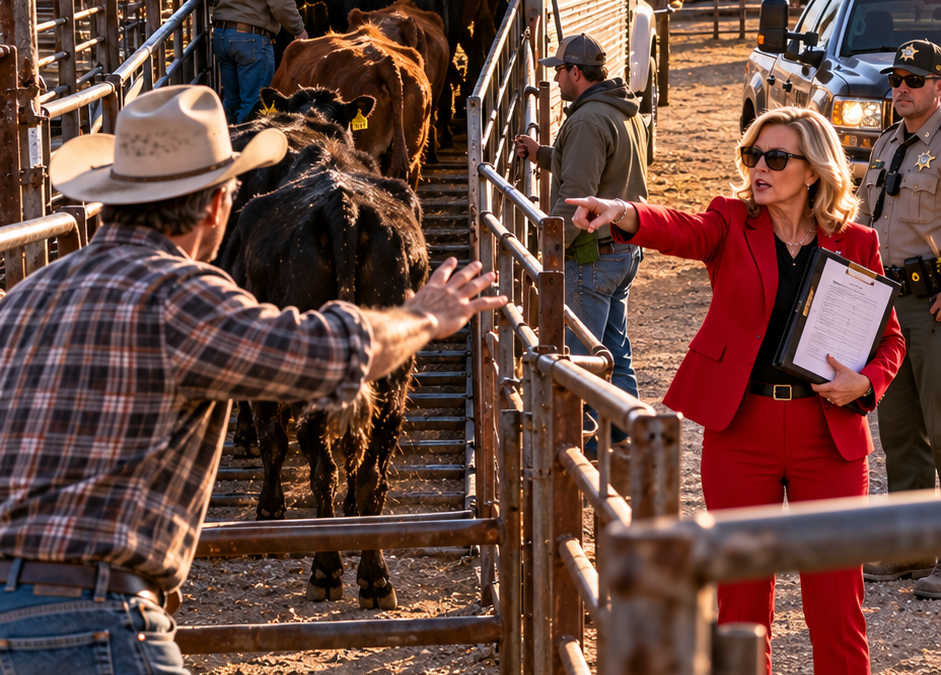
When I came over that rise, I saw portable panels tied into my permanent corral.
Two men were moving Black Angus cattle toward a trailer.
Another man held paperwork beside the gate.
And Dana Whitmore stood in the middle of it wearing a red blazer.
I stopped the truck across the gravel exit but left enough room for an ambulance or emergency vehicle.
Then I got out with my phone recording.
“Stop loading.”
One of the transport men stepped toward me.
“Sir, we have a livestock movement order.”
“Who are you?”
“Coulter Range Transport.”
“Who hired you?”
He looked at Dana.
That glance told me more than his answer would have.
Dana raised the folder.
“Your east breeding group has been placed under emergency quarantine.”
I stared at her.
“By who?”
“The state livestock agency.”
“Show me.”
She handed me a document.
Across the top was the name of the Wyoming livestock authority.
There was a case number.
A red warning box.
Official-looking language.
The paper claimed that a laboratory sample associated with Harland Ranch had returned presumptively positive for a reportable bovine respiratory disease.
All sixty-four animals in my east breeding group were ordered transported to something called the Copper Mesa Biosecurity Facility.
Dana pointed toward my truck.
“Move your vehicle, Mr. Harland.”
“No.”
“Interfering with a state livestock order is a crime.”
“Then the state can tell me that.”
“Your refusal is being documented.”
“Good.”
I raised my phone.
“Document this too. Where is the brand inspection release?”
The transport foreman looked down.
Dana answered.
“Emergency quarantine supersedes routine paperwork.”
“Did the state tell you that?”
She did not answer directly.
I looked closer at the order.
From five feet away, it looked convincing.
At eighteen inches, problems appeared.
My address was correct.
Herd count was exact.
But the description said “mixed commercial cattle.”
Every animal in that pasture was registered or recorded Black Angus.
The listed veterinarian was someone I had never used.
The emergency telephone number had an area code from another state.
Most importantly, there was no animal inventory.
No ear-tag list.
No brand-release record.
No individual identification sheet.
People who do not work livestock sometimes think a herd is one object.
It is not.
Every cow has a history.
Age.
Tag.
Brand.
Vaccinations.
Breeding record.
Calving record.
Ownership record.
Sometimes decades of genetics behind her.
You do not lawfully move sixty-four branded animals by writing “mixed cattle” on a page and counting heads.
I called the Laramie County Sheriff’s Office.
Then I called Mara Quinn, our district brand inspector.
Her number had been in my phone eleven years.
Dana raised her voice.
“He is obstructing a lawful disease-control action. We need law enforcement immediately.”
“We finally agree on something.”
She looked at me.
The transport foreman introduced himself as Roy Tiller.
Broad shoulders.
Gray beard.
Work jacket with his company logo.
He looked at his crew.
“Stop loading.”
Dana turned.
“The order requires immediate movement.”
Roy shook his head.
“Nobody moves until the deputy sorts out ownership and authority.”
That was the first sensible sentence spoken at my chute that morning.
I walked the length of the trailers filming the cattle through the side openings.
One cow pressed her muzzle toward the ventilation slot.
Yellow RFID tag.
4H217.
June.
My father and I had worked that maternal line for thirty-two years.
Her grandmother had been bred on our place.
Her mother had survived a winter birth that nearly killed both her calves.
That had been the final winter my father was alive.
He had stood in the calving shed at two in the morning with his coat open while I held a weak calf against my chest.
He looked at me and said, “If this animal lives, you’ll remember her longer than you remember most people you meet this year.”
He was right.
June was heavy with a calf due in eighteen days.
I turned to Roy.
“That trailer does not move.”
His eyes dropped.
“One already did.”
My chest tightened.
“How long?”
“Maybe twelve minutes.”
“How many?”
“Twenty-two.”
“Destination?”
“Copper Mesa. That’s what I was told.”
He turned his clipboard toward me.
Three truck numbers.
Two visible destination boxes.
Before I could read more, Dana reached for the papers.
Roy pulled them back.
“My paperwork.”
Dana’s face changed for half a second.
Deputy Aaron Bell arrived at 6:06.
He separated everyone.
Checked names.
Photographed Dana’s order.
She spoke first.
“This ranch has a potentially infected herd, and Mr. Harland is obstructing state-directed removal.”
Deputy Bell looked at me.
Dana continued.
“He also attempted to reclaim livestock already placed under state custody.”
I laughed once.
“You mean my cattle standing in my corral?”
Bell raised one hand.
“No one is reclaiming or removing anything until I know who issued this.”
He looked at me.
“You receive prior notification?”
“No.”
“Veterinary concerns?”
“My veterinarian examined this group nine days ago.”
Dana interrupted.
“The test result was confidential until enforcement.”
That sounded official.
It also made no practical sense.
A legitimate disease response does not depend on surprising a rancher before sunrise with an HOA president and a commercial hauling company.
Deputy Bell called the emergency number printed on the order.
We all listened.
A recorded voice said the office was closed.
Then the menu offered appliance-warranty support in Spanish.
Roy slowly turned toward Dana.
“That isn’t the number dispatch gave us.”
“It may be a routing service.”
Bell wrote that down.
“Emergency operations sometimes use third-party systems,” Dana added.
Bell kept writing.
At 6:18, Mara Quinn pulled into the yard in a dust-covered state pickup.
Brown canvas jacket.
Boots already dirty.
RFID reader in one hand.
Seal kit in the other.
She looked like someone who deeply resented being invited into nonsense before breakfast.
Dana walked toward her.
“Thank God. You can confirm the emergency order.”
Mara took the paper.
Read it.
Then read it again.
“Who gave this to the hauler?”
Dana gestured toward the document.
“It was delivered through the community health liaison.”
“Name?”
“I’d have to check.”
“Check.”
Dana opened her phone.
Did not type.
Mara walked to the first trailer.
She scanned six RFID tags through the panel.
Each appeared under my registered premises identification.
Then she asked Roy for the livestock movement certificate.
He gave her everything.
Commercial transport agreement.
Animal count.
Invoice.
No owner release.
No verified state case packet.
No biosecurity facility acceptance form.
Mara tapped one empty section.
“These animals do not leave this district under this paperwork.”
Dana folded her arms.
“The emergency order provides authorization.”
Mara looked at the logo above Dana’s hand.
“This paper claims there is an emergency.”
“Yes.”
“It does not prove one until the issuing agency verifies it.”
“You cannot override the state livestock authority.”
Mara stared at her.
“I work for the agency named on the letterhead.”
There are moments when an argument changes shape without anyone announcing it.
Dana had expected the story to be simple.
Angry rancher.
Dangerous herd.
Responsible HOA president helping authorities protect families.
Mara’s arrival changed the question.
Now Dana had to explain why the state agency supposedly directing the quarantine had not notified its own local brand inspector.
Bell asked Roy about the missing truck.
Roy called dispatch.
Speakerphone.
“Unit Twelve left Harland Ranch at 5:48.”
“Current route?”
Keyboard.
Pause.
“Eastbound County 31.”
“Toward Copper Mesa?”
Another pause.
“No.”
Roy’s head came up.
“What?”
“Programmed destination is Cottonwood Livestock Auction.”
Nobody spoke.
Copper Mesa was north.
Cottonwood was ninety miles east.
Across two county lines.
Weekly cattle sale.
No quarantine facility.
Mara looked at Dana.
“Cottonwood is an auction yard.”
Dana recovered quickly.
“It could be a transfer location.”
“It is not a quarantine facility.”
“Then the transporter entered the wrong address.”
Roy’s jaw tightened.
“That address came in your contract packet.”
“My office did not route the truck.”
“Your signature is on the service order.”
Dana stopped answering Roy.
Mara called the state duty veterinarian.
Bell contacted Cottonwood County.
Roy called his driver.
No answer.
Again.
Voicemail.
“Who’s driving?”
“Evan Tiller.”
“Related?”
“My nephew.”
“Would he ignore you?”
“Never.”
Dana said, “Maybe the disease-control team instructed him not to interrupt transport.”
Bell turned.
“Which disease-control team?”
“The one coordinating this.”
“Name?”
She went silent.
At 6:37, Dr. Lena Park arrived.
My veterinarian.
Eight years treating the ranch.
Tablet.
Health records.
Sampling cooler.
She examined the cattle still inside the trailers.
Respiration.
Temperature.
Nasal discharge.
General condition.
“They’re stressed.”
“Any outbreak symptoms?”
“Nothing obvious.”
Dana stepped closer.
“So you admit clinical examination cannot rule out infection.”
Lena did not look at her.
“I was about to say that.”
She opened the alleged quarantine document.
“I didn’t collect this sample.”
“You recognize the lab?”
“Prairie Veterinary Diagnostics.”
“Can you verify the accession number?”
“I already sent it to the state duty veterinarian.”
Dana crossed her arms.
“You are the owner’s private veterinarian. You have a conflict.”
Lena continued typing.
“That is why I asked the state to verify it.”
Competent people rarely perform confidence.
They identify the claim.
Preserve the evidence.
Send it to someone independent.
While we waited, Luis showed me the fence behind the chute.
Three staples removed.
Wire loosened.
Portable panels tied in.
The work had been done carefully enough that no cattle escaped overnight.
A fresh bootprint remained in the sage.
Then Luis pointed uphill.
“Camera.”
I had installed a small trail camera near the mineral feeder because coyotes had been working the calving pasture.
We pulled the card.
2:13 a.m.
White utility pickup entered with headlights off.
2:19.
Two men started setting portable panels.
2:44.
Dana walked into frame.
Same folder.
Same red blazer.
3:02.
She photographed the corral.
Used her phone.
4:51.
Livestock trucks arrived.
Deputy Bell copied the files.
Dana watched.
“I was asked to observe biosecurity preparation.”
“By who?”
“The liaison.”
Bell waited.
Still no name.
Lena’s tablet chimed.
She read.
For a brief second, Dana relaxed.
“The accession number is real.”
Then Lena kept reading.
I watched the relief leave Dana’s face.
“The sample did not come from Harland Ranch.”
“Where?”
“Red Basin Feedlot.”
I knew the name.
Almost everyone in the region did.
“Red Basin closed.”
“Fourteen months ago.”
She turned the tablet toward Bell.
“Sample collected sixteen months ago. Six-month-old steer.”
The order had not invented a laboratory result.
It had stolen one.
A real accession code.
A real disease finding.
A real laboratory.
Then attached my ranch to it.
That kind of lie can survive longer than pure fiction because the first person who checks one detail finds something real.
At 7:05, Cottonwood County deputies located Unit Twelve at a fuel station thirty-eight miles from the auction.
The driver was safe.
His phone had been silenced under written instructions included in the transport packet.
NO CONTACT WITH OWNER DURING BIOSECURITY TRANSFER.
The deputies held the truck.
Mara transmitted tag numbers and my brand registration.
The first emergency had stopped moving.
The second was only beginning.
Roy opened the full contract on his laptop.
His company had not been hired by Brier Ridge HOA.
It had been hired by an entity called Brier Land Holdings.
Service description:
PRIVATE HERD RELOCATION AND SALE DELIVERY.
Dana Whitmore had signed as authorized property representative.
Roy looked sick.
“She told us the state couldn’t contract directly because it was an emergency.”
Dana said nothing.
“She said Brier Land Holdings was acting as fiscal agent.”
Mara asked for the insurance certificate.
Roy opened it.
An exclusion appeared in plain language.
No involuntary seizure, impoundment, or livestock movement without independently verified governmental authority.
Roy closed his eyes for a second.
“If the order is fake, she put my drivers in the middle of a theft.”
Dana answered immediately.
“You performed contracted services in good faith.”
Roy stared at her.
“Good faith ends when the client lies about who owns the cattle.”
Dana told Deputy Bell she wanted a lawyer.
That was her right.
Bell stopped questioning her.
But the documents had already started speaking.
Mara scanned the forty-two cattle remaining at the ranch.
I exported my East Group inventory.
Sixty-four animals total.
Fifty-eight bred cows.
Four replacement heifers.
Two registered bulls.
Twenty-two RFID numbers missing.
Every one linked to Harland Ranch.
Every brand matched my registered quarter-H mark.
June’s 4H217 appeared on the detained truck.
Ownership was no longer a debate.
It was a chain of independent records.
At 8:10, the two trailers at the ranch were unloaded.
Lena supervised.
Fresh hay.
Clean water.
Holding pasture.
Then she drew blood and nasal samples.
Not because Dana’s paperwork had earned credibility.
Because forty-two animals had been packed into trailers before sunrise and actual biosecurity meant caring about their condition.
The twenty-two cattle on Unit Twelve could not be unloaded at a random fuel stop.
Mara arranged for the truck to continue under deputy escort to Cottonwood’s secure receiving pens.
I followed.
Luis came with me.
Lena drove behind us.
Dana stayed at Harland Ranch with her attorney and Deputy Bell.
Somewhere during that drive, Roy called.
“Wade.”
“What?”
“Dispatch found something.”
I put him on speaker.
“A consignment number.”
“Meaning?”
“It was buried in the invoice notes.”
He read it.
When we reached Cottonwood Auction at 9:34, manager Seth Givens already had the record open.
The consignment had been created four days earlier.
Sixty-four Black Angus cattle.
Seller:
Brier Land Holdings.
Contact email:
Dana Whitmore.
Sale instructions:
SELL AS THREE COMMERCIAL LOTS.
DO NOT ANNOUNCE RANCH BRAND.
PROCEEDS TO ESCROW.
There was no quarantine.
No temporary holding.
No planned return.
All sixty-four cattle were supposed to enter the sale ring at noon.
Luis stood beside me staring at the screen.
“Could they have sold them?”
“Not now.”
“I mean before.”
I looked through the office window at the receiving pens.
“If we’d slept another hour?”
I took a breath.
“They could have tried.”
That mattered.
Dana’s plan did not depend on sophistication.
It depended on speed.
Official language.
Fragmented responsibility.
One person sees an order.
Another sees a haul contract.
Another sees a sale listing.
Another sees cattle already standing in the receiving pen.
Each assumes the previous person checked authority.
Many damaging operations succeed not because everyone involved is dishonest, but because honest people each see only one piece.
The hauler saw paperwork.
The driver saw a route.
The auction saw a consignment.
The HOA residents saw a disease warning.
Only when we placed the pieces together did the shape become obvious.
June stood inside a separate pen with the other twenty-one cattle.
She was breathing faster than normal but steady.
Lena checked her first.
She listened along June’s side.
“Calf’s moving.”
“Labor?”
“No.”
I put one hand against June’s neck.
She leaned slightly into it.
People outside agriculture sometimes assume ranchers either love animals or treat them as business assets.
The truth is both.
You know what a cow is worth.
You know what she costs to feed.
You know what her calf might bring.
You also remember the night her mother almost died.
You remember your father arguing over which bull should breed that line.
You remember the first time a heifer lets you touch her newborn calf.
Numbers and memory coexist.
Dana had treated twenty-two animals as paperwork she needed moved before a deadline.
Seth took us into his office.
He opened the scanned seller packet.
Dana’s signature again.
Then another attached letter.
It claimed Harland Ranch had voluntarily ceased livestock operations adjacent to Brier Ridge.
Dated the previous Friday.
My cattle had still been grazing beside the subdivision when Dana signed it.
Mara leaned toward the screen.
“Why does an auction house need this?”
Seth scrolled.
“It normally wouldn’t.”
Then he found a delivery instruction.
After settlement, proof of disposition was to be sent to an outside party.
Northstar Residential Development.
The company building Brier Ridge Phase Two.
Everything suddenly connected.
The scenic-buffer offer.
Dana’s demand for a cattle-free strip.
The nuisance notice.
The false quarantine.
The auction.
She did not want cattle gone because they were sick.
She needed documentation saying the ranch had stopped operating along that boundary.
I called Rachel.
“Pull everything you can on Northstar and Phase Two.”
“Why?”
I explained.
She listened.
Then said, “Do not accuse anyone in writing yet.”
“I’m past being polite.”
“This is not about politeness. Preserve first. Interpret second.”
Anger wants an audience.
Evidence benefits from arriving first.
At 10:26, Rachel called back.
Northstar’s amended development agreement contained a livestock compatibility requirement.
Before Phase Two model homes could open, Northstar had to construct a buffer on its own property.
Sixty feet of landscaped setback.
Fencing.
Drainage controls.
Buyer disclosures stating that an active cattle operation existed next door.
Estimated cost:
$680,000.
Two months earlier, Dana had submitted an alternative.
She called it a “community transition solution.”
Instead of building the buffer, she claimed she could secure voluntary cessation of visible livestock operations along the Brier Ridge boundary.
Northstar agreed to pay consulting compensation if she succeeded.
Sixty thousand dollars initial fee.
Two hundred forty thousand dollar completion bonus.
Deadline:
4:00 that afternoon.
I sat down.
“Three hundred thousand?”
“Yes.”
“To who?”
“Brier Community Strategies LLC.”
“Who owns it?”
Pause.
“Dana Whitmore.”
There it was.
Not public health.
Not quarantine.
Not resident safety.
Dana had placed herself between a developer and a $680,000 requirement.
If my cattle disappeared and an auction document showed my livestock operation had “ceased,” Northstar could argue the expensive buffer was no longer necessary.
Dana could receive $300,000.
Northstar saved more than twice that.
I would spend months trying to recover cattle scattered through commercial buyers.
Rachel continued.
“There’s a board certification in the county file.”
“From Brier Ridge?”
“Signed by Dana.”
“What does it say?”
“That the HOA approved the transition strategy.”
“Did they?”
“I don’t know yet.”
At 11:15, Mara cleared the twenty-two cattle for return transport after Lena completed health checks.
Roy offered a replacement driver.
“No charge.”
Mara stopped him.
“Your company is part of the evidence.”
Roy nodded.
“I know.”
“Preserve dispatch logs. GPS. Messages. Original work packet. Do not correct anything.”
“I locked the account.”
He looked at me.
“I’m sorry.”
I believed him.
That did not erase his company’s failure to verify a government seizure.
But intent matters.
Roy accepted false paperwork.
Dana created it.
“Help me get them home safely.”
“I will.”
“And when somebody asks what happened?”
“I’ll tell them.”
The cattle returned at 1:07 p.m.
June came off last.
She stopped at the bottom of the ramp.
Looked toward the holding pasture.
Then walked home.
Luis closed the gate.
Only after all sixty-four were back did I feel how frightened I had been since dawn.
Not angry.
Afraid.
That somebody could arrive with logos, case numbers, and paid contractors and take decades of work before the truth caught up.
If we had treated the returned cattle as the end of the story, Dana’s method would have remained usable.
At 1:30, Clare Donnelly, Brier Ridge’s board secretary, called.
Her voice shook.
“Dana emailed the community at six this morning.”
“What did she say?”
“That your herd was infected and the state ordered removal.”
“It didn’t.”
“I know that now.”
She paused.
“Did the HOA board approve an agreement with Northstar?”
“That’s what I was going to ask you.”
“We authorized Dana to discuss landscaping.”
“Any vote about my cattle?”
“No.”
“Voluntary cessation?”
“I’ve never heard those words.”
Clare forwarded agendas.
Minutes.
Dana’s email.
No vote authorized Brier Community Strategies.
No vote approved livestock removal.
No vote allowed Dana to represent Harland Ranch.
The certification Dana filed with Northstar said otherwise.
At 2:12, Northstar’s attorney called Rachel.
The developer claimed it believed Dana had negotiated a legitimate voluntary agreement.
Rachel asked one question.
“Show us Wade Harland’s signature.”
There was none.
Northstar denied instructing Dana to remove cattle.
Denied knowledge of a quarantine order.
Denied authorizing the auction.
Rachel instructed them to preserve every communication with Dana and her LLC.
At 2:47, Northstar suspended the bonus.
At 3:18, Dana emailed the Brier Ridge board an emergency resolution.
It asked directors to retroactively approve her “livestock risk mitigation action.”
The board refused even to vote.
At 4:00, the model-home deadline passed.
Dana received nothing.
I wish that had ended it.
The following morning, her attorney sent a letter.
Dana, it said, had acted on information from an anonymous agricultural whistleblower.
Cottonwood Auction had supposedly been selected because it could provide temporary containment.
The sale listing was described as a clerical template that was never intended to be used.
Three problems destroyed that explanation.
First, the lab result used in the quarantine paperwork was sixteen months old.
Second, Dana created the auction consignment four days before the alleged emergency.
Third, Roy found a dispatch message Dana had sent at 5:31 that morning.
He located it when exporting his account for his insurance company.
The message read:
“Once the first load crosses the county line, Harland will have to buy them back like any other bidder. Keep the rest moving. I need the sale confirmation today.”
No disease language.
No quarantine.
No concern about sick animals.
Sale confirmation.
Deadline.
That message stripped away almost every remaining excuse.
Rachel gave it to the county attorney.
The state livestock investigator.
Deputy Bell.
Roy signed a statement describing how the dispatch system stored the message.
The state livestock office eventually issued a written finding.
No quarantine had been ordered for Harland Ranch.
No authorized agency employee approved livestock movement.
The document Dana presented was not an agency record.
Prairie Veterinary Diagnostics confirmed the accession number belonged to Red Basin Feedlot.
Cottonwood preserved the sale consignment.
Coulter Range preserved GPS and dispatch records.
The trail camera placed Dana at my chute hours before sunrise.
One piece of evidence after another.
Nothing theatrical.
Just facts that matched.
Five days after the trailers came, Brier Ridge held a special meeting.
Rachel advised me to attend.
“Do not turn it into your courtroom.”
“I don’t plan to.”
“The association attorney has invited only people whose records matter.”
Mara.
Roy.
Clare.
Northstar representative.
Lena.
The clubhouse was full.
Some residents looked angry when I entered.
They had spent nearly a week believing my cattle carried a dangerous disease.
Others had already read the state correction.
Dana sat at the center table.
Navy suit this time.
No red blazer.
The association attorney opened with one narrow question.
“Was Ms. Whitmore authorized by the Brier Ridge board to enter the Northstar certification or contract for livestock removal?”
Clare read the minutes.
“No.”
The treasurer confirmed no HOA payment had gone to Coulter Range.
Dana had used Brier Land Holdings and her private company.
Northstar’s representative confirmed the $300,000 compensation agreement.
He confirmed the 4:00 deadline.
Then something else.
Northstar had never spoken with me.
Never received my signature.
Never received a direct agreement from Harland Ranch.
Roy showed the hauling agreement.
Then the 5:31 dispatch message.
Mara explained the missing brand release.
False quarantine.
RFID scans.
Lena submitted the lab verification.
She also had the new herd test results.
Every fresh sample from my cattle was negative for the disease described in Dana’s paper.
Then Dana spoke.
For the first time, I heard what she actually believed.
“Brier Ridge has been trapped beside an incompatible commercial operation for years.”
A few people nodded.
She continued.
“Residents have complained about flies, odor, dust, trucks, early-morning machinery, visual obstruction, and depressed property values.”
One man murmured agreement.
“The Northstar buffer consumes land originally intended for a walking trail. I attempted to find a solution that protected residents while avoiding unnecessary infrastructure.”
Someone actually applauded.
Then a woman raised her hand.
June Calhoun.
Retired schoolteacher.
Her house sat closest to my eastern pasture.
She stood.
“I complained about the flies.”
Dana looked at her as if expecting support.
June continued.
“I complained about the tractor at six-thirty too.”
A few nervous laughs.
Then she said, “I did not ask you to steal his cows.”
The room went silent.
It was a distinction that should never have needed saying.
Neighbors can dislike noise.
They can request fencing.
Landscaping.
Disclosure.
Odor controls.
Better drainage.
They can care about property values.
None of those things transfer ownership of land next door.
Dana looked at me.
“You refused every compromise.”
“I refused to stop ranching so you could collect a bonus.”
“That fee was intended to support community improvements.”
Rachel placed a corporate filing on the table.
“Brier Community Strategies LLC is solely owned by Dana Whitmore.”
Dana’s attorney objected to discussion of an ongoing investigation.
The board chair agreed.
They did not need to determine criminal intent that night.
The governance question was simpler.
Did Dana have authority?
No.
The board voted six to zero to remove her as president.
She remained a homeowner.
Same rights as everyone else.
No authority over mine.
The board rescinded every certification she had issued to Northstar.
It formally notified county planning that Harland Ranch had never agreed to cease livestock operations.
That vote mattered.
But it was not revenge.
Revenge would have meant trying to punish every Brier Ridge resident for what Dana had done.
Trying to make her family lose its home.
Turning one person’s misconduct into collective guilt.
That would have repeated the same logic behind her scheme.
Accountability had to be narrower.
Useful.
Over the next seven weeks, the practical damage was repaired.
Coulter Range’s insurer covered veterinary examinations and monitoring related to transport stress.
Roy’s company paid for the cut fence and damaged chute latch.
It adopted a written policy requiring direct agency verification before accepting any involuntary livestock movement.
Northstar abandoned the voluntary-cessation idea.
It built the livestock compatibility buffer on its own land.
Sixty feet.
Landscape screening.
Solid lower fencing.
Drainage controls.
Buyer disclosures stating clearly that an active cattle ranch operated next door.
Exactly what its original agreement required.
The new Brier Ridge board created a formal complaint process.
Broken fence?
Report it.
Escaped livestock?
Call.
Unusual odor?
Document the time and location.
Unsafe vehicle activity?
Photograph it.
But no complaint could be converted into control over neighboring property.
I gave the board one emergency number for genuine fence or animal issues.
I also moved one mineral feeder eighty yards west.
That reduced cattle bunching near the boundary.
It cost almost nothing.
That was compromise.
Compromise is not one person surrendering something the other never owned.
It is two people adjusting what they actually control.
The HOA insurer reimbursed my documented losses.
Labor.
Veterinary follow-up.
Missed breeding examinations.
Security repairs.
The association also funded an independent governance review.
New rule:
No officer could sign a land-use certification, outside consulting agreement, or contractor commitment without a recorded board vote and conflict disclosure.
Dana’s private company received nothing from Northstar.
The county attorney later confirmed an investigation remained open involving the false state document and attempted unauthorized livestock transfer.
I did not build my life around waiting for a dramatic sentencing headline.
The final legal outcome belonged to the courts.
The story already had an ending I understood.
The cattle remained mine.
The false quarantine was publicly corrected.
Northstar built the buffer it had promised.
Brier Ridge residents learned what their president had and had not been authorized to do.
Every business caught in the chain changed how it verified involuntary livestock moves.
And the maternal line my father had spent three decades building stayed on Harland Ranch.
Eighteen days after the trailers came, June went into labor.
Just before midnight.
Cold front.
Temperature below freezing.
Sleet hit the calving-shed roof hard enough to sound like handfuls of gravel.
Luis and I moved June into a clean pen.
Lena was on standby.
June did not need her.
At 12:41 a.m., a black heifer calf landed in the straw.
For several seconds, she lay still except for breathing.
Then June turned.
Started licking her face.
I stood outside the pen.
Watched.
The calf tried to rise.
Front legs folded.
Tried again.
My father used to say ranching teaches you the difference between control and responsibility.
You cannot control the weather.
Markets.
Disease somewhere three states away.
Whether a calf decides to come during a snowstorm instead of at noon.
You can control the fence.
The records.
The water.
Whether you show up.
Dana had confused control with authority.
She believed that if she could create enough urgency, involve enough people, and move my cattle far enough from the ranch, ownership would become an inconvenience everyone dealt with later.
But every shortcut she used created another witness.
Every cow had an RFID number.
Every truck had GPS.
Every contractor had dispatch records.
Every laboratory result had an accession history.
Every LLC had ownership filings.
Every board had minutes.
Every auction consignment had a creation date.
Every trail camera had a timestamp.
The very system she used to make her scheme look official was what made it traceable.
The calf finally stood.
Unsteady.
Wide-legged.
June nudged her toward the udder.
Luis smiled.
“What number?”
I looked at June’s tag.
4H217.
“4H218.”
Luis nodded.
The next morning, I registered her.
Another record.
Another number.
Another small piece of memory made durable.
Harland Ranch stayed beside Brier Ridge.
The subdivision did not disappear.
Neither did the cattle.
On clear evenings, people walk the trail behind the new buffer.
Children stop at the fence.
The cows graze beyond it.
The mountains turn purple near sunset.
It looks almost exactly like the lifestyle advertisement Northstar sold.
Except now the disclosure is honest.
ACTIVE AGRICULTURAL OPERATION ADJACENT.
Livestock.
Dust.
Noise.
Odor.
Equipment.
Seasonal activity.
Funny how many conflicts can be prevented when reality appears in writing before somebody buys the fantasy.
I still check the east chute every morning.
There is a new gate chain.
Camera.
Tamper sensor.
The portable panels Dana’s contractors installed are gone.
Sometimes, when I walk past the place where that first trailer stood, I remember June’s nose pressed against the ventilation slot.
I remember knowing she was eighteen days from calving.
Knowing the truck was already leaving.
Knowing somebody had put a red government stamp on a lie and was betting nobody would check before noon.
People sometimes think protecting property means being the loudest person at the gate.
Sometimes it does.
But more often it looks boring.
Register the brand.
Save the invoice.
Keep the health records.
Check the tag number.
Download the GPS log.
Read the line beneath the red warning box.
Call the agency whose name is being used.
Ask the professional whether she actually signed the document.
Keep records long before anyone threatens you.
That is not paranoia.
It is memory organized well enough to defend itself.
My father understood that before I did.
Cattle cannot speak in court.
But records can.
And Dana’s biggest mistake was believing that once a trailer started moving, the story belonged to whoever held the paperwork.
It did not.
The story belonged to the facts.
The cattle were ours.
The state had never quarantined them.
The lab result came from another ranch.
The auction listing existed before the alleged emergency.
The developer had a deadline.
Dana had a bonus.
And twenty-two black cows on an eastbound trailer were never headed toward quarantine.
They were headed toward a sale ring.
Everything that mattered had already happened before sunrise.
The rest was simply the long process of making every record say it out loud.
𝗧𝗛𝗘 𝗘𝗡𝗗
The Quarantine Order Looked Official Until I Asked Where My Cattle Were Really Going
At 5:56 on a Tuesday morning, I found two livestock trailers backed against my loading chute and learned that a third had already left with twenty-two of my cattle.
The woman supervising the operation wore a red blazer, spotless boots, and the calm expression of someone who believed an official-looking folder could turn theft into procedure.
Then she called 911 and told the dispatcher I was trying to steal quarantined livestock from state custody.
They were my cattle.
The state had never taken custody of anything.
My name is Wade Harland.
I was fifty-five years old, and Harland Ranch covered 1,860 acres of high grass, sage, and broken limestone in central Wyoming.
My great-grandfather had started there with forty cows, a wood-frame house, and a windmill that froze every January.
By the time the ranch reached me, there were better trucks, hydraulic chutes, digital records, insulated waterers, and a cellular repeater on the grain bin because apparently even cattle ranching now required decent internet.
The weather was still bad.
The work was still hard.
And the basic obligation had never changed.
You did not waste what the people before you had built.
My closest neighbor used to live six miles away.
Then Brier Ridge appeared along our southeast boundary.
One hundred fourteen expensive homes.
Stone clubhouse.
Walking paths.
Landscaped entrance.
Advertising that promised buyers “authentic ranch-country living.”
They liked the ranch-country view.
They were less enthusiastic about ranch-country work.
The first complaints were almost funny.
Cattle visible from patios.
Dust during haying.
A tractor starting before seven in the morning.
One woman emailed asking whether I could rotate the herd away from the eastern pasture on weekends because her guests preferred an unobstructed sunset.
I told her the sunset was free.
The grazing plan was not.
Most residents laughed when they heard that story.
Dana Whitmore did not.
Dana had been elected HOA president six months before everything happened.
She was polished.
Organized.
Always prepared.
She spoke with the confidence of someone who had already decided what the meeting would conclude before anyone else entered the room.
Every request came on letterhead.
Every complaint cited a committee.
Every demand contained a reference number.
Whenever I asked which rule gave Brier Ridge authority over land outside its covenants, her replies became longer and less specific.
Three weeks before the trailers arrived, Dana came to my ranch.
She parked at the house instead of the barn.
That told me immediately she wanted a conversation that looked formal.
I met her on the porch.
She carried a slim black folder.
“Mr. Harland.”
“Dana.”
“I’d like to discuss a practical solution to the eastern boundary.”
“What problem does the boundary have?”
She smiled slightly.
“The developer is concerned about compatibility.”
“That’s a developer problem.”
“Only one hundred feet.”
I waited.
She opened the folder.
A strip of my east pasture had been shaded blue.
“Brier Ridge would like to lease this area as a scenic buffer.”
“No.”
She had not finished.
“No structures. No livestock. The developer would landscape the property at its expense.”
“It’s winter pasture.”
“The developer is prepared to be generous.”
“Then the developer can be generous on his side of the fence.”
Her smile disappeared.
“You haven’t heard the offer.”
“I heard what you want.”
“Sometimes property owners benefit by adapting to surrounding development.”
I leaned against the porch rail.
“The ranch was here almost seventy years before Brier Ridge.”
“That doesn’t mean the area never changes.”
“No. It means people who build next to a cattle ranch should expect cattle.”
That should have ended it.
Instead, four days later, I received a nuisance notice.
Noise.
Odor.
Dust.
Livestock activity.
Potential property-value effects.
My attorney, Rachel Kim, responded with county agricultural-use records showing Harland Ranch had been operating long before the subdivision existed.
After that, Dana went quiet.
Silence from a reasonable person sometimes means an argument has ended.
Silence from someone like Dana often means the argument has moved somewhere you cannot see.
The morning the trailers came, my ranch hand Luis Vega called while I was pulling on my boots.
“Wade.”
Something in his voice made me stop.
“What?”
“There are trucks at the east chute.”
“What kind?”
“Livestock.”
I was already moving toward the door.
“How many?”
“Three.”
“Who called them?”
“I don’t know.”
Then he said, “One already left.”
I stopped with one hand on the truck door.
“What do you mean left?”
“They have cattle, Wade.”
I was in the feed truck before he finished.
The east loading chute sat below a low ridge and could not be seen from the house.
When I came over that rise, I saw portable panels tied into my permanent corral.
Two men were moving Black Angus cattle toward a trailer.
Another man held paperwork beside the gate.
And Dana Whitmore stood in the middle of it wearing a red blazer.
I stopped the truck across the gravel exit but left enough room for an ambulance or emergency vehicle.
Then I got out with my phone recording.
“Stop loading.”
One of the transport men stepped toward me.
“Sir, we have a livestock movement order.”
“Who are you?”
“Coulter Range Transport.”
“Who hired you?”
He looked at Dana.
That glance told me more than his answer would have.
Dana raised the folder.
“Your east breeding group has been placed under emergency quarantine.”
I stared at her.
“By who?”
“The state livestock agency.”
“Show me.”
She handed me a document.
Across the top was the name of the Wyoming livestock authority.
There was a case number.
A red warning box.
Official-looking language.
The paper claimed that a laboratory sample associated with Harland Ranch had returned presumptively positive for a reportable bovine respiratory disease.
All sixty-four animals in my east breeding group were ordered transported to something called the Copper Mesa Biosecurity Facility.
Dana pointed toward my truck.
“Move your vehicle, Mr. Harland.”
“No.”
“Interfering with a state livestock order is a crime.”
“Then the state can tell me that.”
“Your refusal is being documented.”
“Good.”
I raised my phone.
“Document this too. Where is the brand inspection release?”
The transport foreman looked down.
Dana answered.
“Emergency quarantine supersedes routine paperwork.”
“Did the state tell you that?”
She did not answer directly.
I looked closer at the order.
From five feet away, it looked convincing.
At eighteen inches, problems appeared.
My address was correct.
Herd count was exact.
But the description said “mixed commercial cattle.”
Every animal in that pasture was registered or recorded Black Angus.
The listed veterinarian was someone I had never used.
The emergency telephone number had an area code from another state.
Most importantly, there was no animal inventory.
No ear-tag list.
No brand-release record.
No individual identification sheet.
People who do not work livestock sometimes think a herd is one object.
It is not.
Every cow has a history.
Age.
Tag.
Brand.
Vaccinations.
Breeding record.
Calving record.
Ownership record.
Sometimes decades of genetics behind her.
You do not lawfully move sixty-four branded animals by writing “mixed cattle” on a page and counting heads.
I called the Laramie County Sheriff’s Office.
Then I called Mara Quinn, our district brand inspector.
Her number had been in my phone eleven years.
Dana raised her voice.
“He is obstructing a lawful disease-control action. We need law enforcement immediately.”
“We finally agree on something.”
She looked at me.
The transport foreman introduced himself as Roy Tiller.
Broad shoulders.
Gray beard.
Work jacket with his company logo.
He looked at his crew.
“Stop loading.”
Dana turned.
“The order requires immediate movement.”
Roy shook his head.
“Nobody moves until the deputy sorts out ownership and authority.”
That was the first sensible sentence spoken at my chute that morning.
I walked the length of the trailers filming the cattle through the side openings.
One cow pressed her muzzle toward the ventilation slot.
Yellow RFID tag.
4H217.
June.
My father and I had worked that maternal line for thirty-two years.
Her grandmother had been bred on our place.
Her mother had survived a winter birth that nearly killed both her calves.
That had been the final winter my father was alive.
He had stood in the calving shed at two in the morning with his coat open while I held a weak calf against my chest.
He looked at me and said, “If this animal lives, you’ll remember her longer than you remember most people you meet this year.”
He was right.
June was heavy with a calf due in eighteen days.
I turned to Roy.
“That trailer does not move.”
His eyes dropped.
“One already did.”
My chest tightened.
“How long?”
“Maybe twelve minutes.”
“How many?”
“Twenty-two.”
“Destination?”
“Copper Mesa. That’s what I was told.”
He turned his clipboard toward me.
Three truck numbers.
Two visible destination boxes.
Before I could read more, Dana reached for the papers.
Roy pulled them back.
“My paperwork.”
Dana’s face changed for half a second.
Deputy Aaron Bell arrived at 6:06.
He separated everyone.
Checked names.
Photographed Dana’s order.
She spoke first.
“This ranch has a potentially infected herd, and Mr. Harland is obstructing state-directed removal.”
Deputy Bell looked at me.
Dana continued.
“He also attempted to reclaim livestock already placed under state custody.”
I laughed once.
“You mean my cattle standing in my corral?”
Bell raised one hand.
“No one is reclaiming or removing anything until I know who issued this.”
He looked at me.
“You receive prior notification?”
“No.”
“Veterinary concerns?”
“My veterinarian examined this group nine days ago.”
Dana interrupted.
“The test result was confidential until enforcement.”
That sounded official.
It also made no practical sense.
A legitimate disease response does not depend on surprising a rancher before sunrise with an HOA president and a commercial hauling company.
Deputy Bell called the emergency number printed on the order.
We all listened.
A recorded voice said the office was closed.
Then the menu offered appliance-warranty support in Spanish.
Roy slowly turned toward Dana.
“That isn’t the number dispatch gave us.”
“It may be a routing service.”
Bell wrote that down.
“Emergency operations sometimes use third-party systems,” Dana added.
Bell kept writing.
At 6:18, Mara Quinn pulled into the yard in a dust-covered state pickup.
Brown canvas jacket.
Boots already dirty.
RFID reader in one hand.
Seal kit in the other.
She looked like someone who deeply resented being invited into nonsense before breakfast.
Dana walked toward her.
“Thank God. You can confirm the emergency order.”
Mara took the paper.
Read it.
Then read it again.
“Who gave this to the hauler?”
Dana gestured toward the document.
“It was delivered through the community health liaison.”
“Name?”
“I’d have to check.”
“Check.”
Dana opened her phone.
Did not type.
Mara walked to the first trailer.
She scanned six RFID tags through the panel.
Each appeared under my registered premises identification.
Then she asked Roy for the livestock movement certificate.
He gave her everything.
Commercial transport agreement.
Animal count.
Invoice.
No owner release.
No verified state case packet.
No biosecurity facility acceptance form.
Mara tapped one empty section.
“These animals do not leave this district under this paperwork.”
Dana folded her arms.
“The emergency order provides authorization.”
Mara looked at the logo above Dana’s hand.
“This paper claims there is an emergency.”
“Yes.”
“It does not prove one until the issuing agency verifies it.”
“You cannot override the state livestock authority.”
Mara stared at her.
“I work for the agency named on the letterhead.”
There are moments when an argument changes shape without anyone announcing it.
Dana had expected the story to be simple.
Angry rancher.
Dangerous herd.
Responsible HOA president helping authorities protect families.
Mara’s arrival changed the question.
Now Dana had to explain why the state agency supposedly directing the quarantine had not notified its own local brand inspector.
Bell asked Roy about the missing truck.
Roy called dispatch.
Speakerphone.
“Unit Twelve left Harland Ranch at 5:48.”
“Current route?”
Keyboard.
Pause.
“Eastbound County 31.”
“Toward Copper Mesa?”
Another pause.
“No.”
Roy’s head came up.
“What?”
“Programmed destination is Cottonwood Livestock Auction.”
Nobody spoke.
Copper Mesa was north.
Cottonwood was ninety miles east.
Across two county lines.
Weekly cattle sale.
No quarantine facility.
Mara looked at Dana.
“Cottonwood is an auction yard.”
Dana recovered quickly.
“It could be a transfer location.”
“It is not a quarantine facility.”
“Then the transporter entered the wrong address.”
Roy’s jaw tightened.
“That address came in your contract packet.”
“My office did not route the truck.”
“Your signature is on the service order.”
Dana stopped answering Roy.
Mara called the state duty veterinarian.
Bell contacted Cottonwood County.
Roy called his driver.
No answer.
Again.
Voicemail.
“Who’s driving?”
“Evan Tiller.”
“Related?”
“My nephew.”
“Would he ignore you?”
“Never.”
Dana said, “Maybe the disease-control team instructed him not to interrupt transport.”
Bell turned.
“Which disease-control team?”
“The one coordinating this.”
“Name?”
She went silent.
At 6:37, Dr. Lena Park arrived.
My veterinarian.
Eight years treating the ranch.
Tablet.
Health records.
Sampling cooler.
She examined the cattle still inside the trailers.
Respiration.
Temperature.
Nasal discharge.
General condition.
“They’re stressed.”
“Any outbreak symptoms?”
“Nothing obvious.”
Dana stepped closer.
“So you admit clinical examination cannot rule out infection.”
Lena did not look at her.
“I was about to say that.”
She opened the alleged quarantine document.
“I didn’t collect this sample.”
“You recognize the lab?”
“Prairie Veterinary Diagnostics.”
“Can you verify the accession number?”
“I already sent it to the state duty veterinarian.”
Dana crossed her arms.
“You are the owner’s private veterinarian. You have a conflict.”
Lena continued typing.
“That is why I asked the state to verify it.”
Competent people rarely perform confidence.
They identify the claim.
Preserve the evidence.
Send it to someone independent.
While we waited, Luis showed me the fence behind the chute.
Three staples removed.
Wire loosened.
Portable panels tied in.
The work had been done carefully enough that no cattle escaped overnight.
A fresh bootprint remained in the sage.
Then Luis pointed uphill.
“Camera.”
I had installed a small trail camera near the mineral feeder because coyotes had been working the calving pasture.
We pulled the card.
2:13 a.m.
White utility pickup entered with headlights off.
2:19.
Two men started setting portable panels.
2:44.
Dana walked into frame.
Same folder.
Same red blazer.
3:02.
She photographed the corral.
Used her phone.
4:51.
Livestock trucks arrived.
Deputy Bell copied the files.
Dana watched.
“I was asked to observe biosecurity preparation.”
“By who?”
“The liaison.”
Bell waited.
Still no name.
Lena’s tablet chimed.
She read.
For a brief second, Dana relaxed.
“The accession number is real.”
Then Lena kept reading.
I watched the relief leave Dana’s face.
“The sample did not come from Harland Ranch.”
“Where?”
“Red Basin Feedlot.”
I knew the name.
Almost everyone in the region did.
“Red Basin closed.”
“Fourteen months ago.”
She turned the tablet toward Bell.
“Sample collected sixteen months ago. Six-month-old steer.”
The order had not invented a laboratory result.
It had stolen one.
A real accession code.
A real disease finding.
A real laboratory.
Then attached my ranch to it.
That kind of lie can survive longer than pure fiction because the first person who checks one detail finds something real.
At 7:05, Cottonwood County deputies located Unit Twelve at a fuel station thirty-eight miles from the auction.
The driver was safe.
His phone had been silenced under written instructions included in the transport packet.
NO CONTACT WITH OWNER DURING BIOSECURITY TRANSFER.
The deputies held the truck.
Mara transmitted tag numbers and my brand registration.
The first emergency had stopped moving.
The second was only beginning.
Roy opened the full contract on his laptop.
His company had not been hired by Brier Ridge HOA.
It had been hired by an entity called Brier Land Holdings.
Service description:
PRIVATE HERD RELOCATION AND SALE DELIVERY.
Dana Whitmore had signed as authorized property representative.
Roy looked sick.
“She told us the state couldn’t contract directly because it was an emergency.”
Dana said nothing.
“She said Brier Land Holdings was acting as fiscal agent.”
Mara asked for the insurance certificate.
Roy opened it.
An exclusion appeared in plain language.
No involuntary seizure, impoundment, or livestock movement without independently verified governmental authority.
Roy closed his eyes for a second.
“If the order is fake, she put my drivers in the middle of a theft.”
Dana answered immediately.
“You performed contracted services in good faith.”
Roy stared at her.
“Good faith ends when the client lies about who owns the cattle.”
Dana told Deputy Bell she wanted a lawyer.
That was her right.
Bell stopped questioning her.
But the documents had already started speaking.
Mara scanned the forty-two cattle remaining at the ranch.
I exported my East Group inventory.
Sixty-four animals total.
Fifty-eight bred cows.
Four replacement heifers.
Two registered bulls.
Twenty-two RFID numbers missing.
Every one linked to Harland Ranch.
Every brand matched my registered quarter-H mark.
June’s 4H217 appeared on the detained truck.
Ownership was no longer a debate.
It was a chain of independent records.
At 8:10, the two trailers at the ranch were unloaded.
Lena supervised.
Fresh hay.
Clean water.
Holding pasture.
Then she drew blood and nasal samples.
Not because Dana’s paperwork had earned credibility.
Because forty-two animals had been packed into trailers before sunrise and actual biosecurity meant caring about their condition.
The twenty-two cattle on Unit Twelve could not be unloaded at a random fuel stop.
Mara arranged for the truck to continue under deputy escort to Cottonwood’s secure receiving pens.
I followed.
Luis came with me.
Lena drove behind us.
Dana stayed at Harland Ranch with her attorney and Deputy Bell.
Somewhere during that drive, Roy called.
“Wade.”
“What?”
“Dispatch found something.”
I put him on speaker.
“A consignment number.”
“Meaning?”
“It was buried in the invoice notes.”
He read it.
When we reached Cottonwood Auction at 9:34, manager Seth Givens already had the record open.
The consignment had been created four days earlier.
Sixty-four Black Angus cattle.
Seller:
Brier Land Holdings.
Contact email:
Dana Whitmore.
Sale instructions:
SELL AS THREE COMMERCIAL LOTS.
DO NOT ANNOUNCE RANCH BRAND.
PROCEEDS TO ESCROW.
There was no quarantine.
No temporary holding.
No planned return.
All sixty-four cattle were supposed to enter the sale ring at noon.
Luis stood beside me staring at the screen.
“Could they have sold them?”
“Not now.”
“I mean before.”
I looked through the office window at the receiving pens.
“If we’d slept another hour?”
I took a breath.
“They could have tried.”
That mattered.
Dana’s plan did not depend on sophistication.
It depended on speed.
Official language.
Fragmented responsibility.
One person sees an order.
Another sees a haul contract.
Another sees a sale listing.
Another sees cattle already standing in the receiving pen.
Each assumes the previous person checked authority.
Many damaging operations succeed not because everyone involved is dishonest, but because honest people each see only one piece.
The hauler saw paperwork.
The driver saw a route.
The auction saw a consignment.
The HOA residents saw a disease warning.
Only when we placed the pieces together did the shape become obvious.
June stood inside a separate pen with the other twenty-one cattle.
She was breathing faster than normal but steady.
Lena checked her first.
She listened along June’s side.
“Calf’s moving.”
“Labor?”
“No.”
I put one hand against June’s neck.
She leaned slightly into it.
People outside agriculture sometimes assume ranchers either love animals or treat them as business assets.
The truth is both.
You know what a cow is worth.
You know what she costs to feed.
You know what her calf might bring.
You also remember the night her mother almost died.
You remember your father arguing over which bull should breed that line.
You remember the first time a heifer lets you touch her newborn calf.
Numbers and memory coexist.
Dana had treated twenty-two animals as paperwork she needed moved before a deadline.
Seth took us into his office.
He opened the scanned seller packet.
Dana’s signature again.
Then another attached letter.
It claimed Harland Ranch had voluntarily ceased livestock operations adjacent to Brier Ridge.
Dated the previous Friday.
My cattle had still been grazing beside the subdivision when Dana signed it.
Mara leaned toward the screen.
“Why does an auction house need this?”
Seth scrolled.
“It normally wouldn’t.”
Then he found a delivery instruction.
After settlement, proof of disposition was to be sent to an outside party.
Northstar Residential Development.
The company building Brier Ridge Phase Two.
Everything suddenly connected.
The scenic-buffer offer.
Dana’s demand for a cattle-free strip.
The nuisance notice.
The false quarantine.
The auction.
She did not want cattle gone because they were sick.
She needed documentation saying the ranch had stopped operating along that boundary.
I called Rachel.
“Pull everything you can on Northstar and Phase Two.”
“Why?”
I explained.
She listened.
Then said, “Do not accuse anyone in writing yet.”
“I’m past being polite.”
“This is not about politeness. Preserve first. Interpret second.”
Anger wants an audience.
Evidence benefits from arriving first.
At 10:26, Rachel called back.
Northstar’s amended development agreement contained a livestock compatibility requirement.
Before Phase Two model homes could open, Northstar had to construct a buffer on its own property.
Sixty feet of landscaped setback.
Fencing.
Drainage controls.
Buyer disclosures stating that an active cattle operation existed next door.
Estimated cost:
$680,000.
Two months earlier, Dana had submitted an alternative.
She called it a “community transition solution.”
Instead of building the buffer, she claimed she could secure voluntary cessation of visible livestock operations along the Brier Ridge boundary.
Northstar agreed to pay consulting compensation if she succeeded.
Sixty thousand dollars initial fee.
Two hundred forty thousand dollar completion bonus.
Deadline:
4:00 that afternoon.
I sat down.
“Three hundred thousand?”
“Yes.”
“To who?”
“Brier Community Strategies LLC.”
“Who owns it?”
Pause.
“Dana Whitmore.”
There it was.
Not public health.
Not quarantine.
Not resident safety.
Dana had placed herself between a developer and a $680,000 requirement.
If my cattle disappeared and an auction document showed my livestock operation had “ceased,” Northstar could argue the expensive buffer was no longer necessary.
Dana could receive $300,000.
Northstar saved more than twice that.
I would spend months trying to recover cattle scattered through commercial buyers.
Rachel continued.
“There’s a board certification in the county file.”
“From Brier Ridge?”
“Signed by Dana.”
“What does it say?”
“That the HOA approved the transition strategy.”
“Did they?”
“I don’t know yet.”
At 11:15, Mara cleared the twenty-two cattle for return transport after Lena completed health checks.
Roy offered a replacement driver.
“No charge.”
Mara stopped him.
“Your company is part of the evidence.”
Roy nodded.
“I know.”
“Preserve dispatch logs. GPS. Messages. Original work packet. Do not correct anything.”
“I locked the account.”
He looked at me.
“I’m sorry.”
I believed him.
That did not erase his company’s failure to verify a government seizure.
But intent matters.
Roy accepted false paperwork.
Dana created it.
“Help me get them home safely.”
“I will.”
“And when somebody asks what happened?”
“I’ll tell them.”
The cattle returned at 1:07 p.m.
June came off last.
She stopped at the bottom of the ramp.
Looked toward the holding pasture.
Then walked home.
Luis closed the gate.
Only after all sixty-four were back did I feel how frightened I had been since dawn.
Not angry.
Afraid.
That somebody could arrive with logos, case numbers, and paid contractors and take decades of work before the truth caught up.
If we had treated the returned cattle as the end of the story, Dana’s method would have remained usable.
At 1:30, Clare Donnelly, Brier Ridge’s board secretary, called.
Her voice shook.
“Dana emailed the community at six this morning.”
“What did she say?”
“That your herd was infected and the state ordered removal.”
“It didn’t.”
“I know that now.”
She paused.
“Did the HOA board approve an agreement with Northstar?”
“That’s what I was going to ask you.”
“We authorized Dana to discuss landscaping.”
“Any vote about my cattle?”
“No.”
“Voluntary cessation?”
“I’ve never heard those words.”
Clare forwarded agendas.
Minutes.
Dana’s email.
No vote authorized Brier Community Strategies.
No vote approved livestock removal.
No vote allowed Dana to represent Harland Ranch.
The certification Dana filed with Northstar said otherwise.
At 2:12, Northstar’s attorney called Rachel.
The developer claimed it believed Dana had negotiated a legitimate voluntary agreement.
Rachel asked one question.
“Show us Wade Harland’s signature.”
There was none.
Northstar denied instructing Dana to remove cattle.
Denied knowledge of a quarantine order.
Denied authorizing the auction.
Rachel instructed them to preserve every communication with Dana and her LLC.
At 2:47, Northstar suspended the bonus.
At 3:18, Dana emailed the Brier Ridge board an emergency resolution.
It asked directors to retroactively approve her “livestock risk mitigation action.”
The board refused even to vote.
At 4:00, the model-home deadline passed.
Dana received nothing.
I wish that had ended it.
The following morning, her attorney sent a letter.
Dana, it said, had acted on information from an anonymous agricultural whistleblower.
Cottonwood Auction had supposedly been selected because it could provide temporary containment.
The sale listing was described as a clerical template that was never intended to be used.
Three problems destroyed that explanation.
First, the lab result used in the quarantine paperwork was sixteen months old.
Second, Dana created the auction consignment four days before the alleged emergency.
Third, Roy found a dispatch message Dana had sent at 5:31 that morning.
He located it when exporting his account for his insurance company.
The message read:
“Once the first load crosses the county line, Harland will have to buy them back like any other bidder. Keep the rest moving. I need the sale confirmation today.”
No disease language.
No quarantine.
No concern about sick animals.
Sale confirmation.
Deadline.
That message stripped away almost every remaining excuse.
Rachel gave it to the county attorney.
The state livestock investigator.
Deputy Bell.
Roy signed a statement describing how the dispatch system stored the message.
The state livestock office eventually issued a written finding.
No quarantine had been ordered for Harland Ranch.
No authorized agency employee approved livestock movement.
The document Dana presented was not an agency record.
Prairie Veterinary Diagnostics confirmed the accession number belonged to Red Basin Feedlot.
Cottonwood preserved the sale consignment.
Coulter Range preserved GPS and dispatch records.
The trail camera placed Dana at my chute hours before sunrise.
One piece of evidence after another.
Nothing theatrical.
Just facts that matched.
Five days after the trailers came, Brier Ridge held a special meeting.
Rachel advised me to attend.
“Do not turn it into your courtroom.”
“I don’t plan to.”
“The association attorney has invited only people whose records matter.”
Mara.
Roy.
Clare.
Northstar representative.
Lena.
The clubhouse was full.
Some residents looked angry when I entered.
They had spent nearly a week believing my cattle carried a dangerous disease.
Others had already read the state correction.
Dana sat at the center table.
Navy suit this time.
No red blazer.
The association attorney opened with one narrow question.
“Was Ms. Whitmore authorized by the Brier Ridge board to enter the Northstar certification or contract for livestock removal?”
Clare read the minutes.
“No.”
The treasurer confirmed no HOA payment had gone to Coulter Range.
Dana had used Brier Land Holdings and her private company.
Northstar’s representative confirmed the $300,000 compensation agreement.
He confirmed the 4:00 deadline.
Then something else.
Northstar had never spoken with me.
Never received my signature.
Never received a direct agreement from Harland Ranch.
Roy showed the hauling agreement.
Then the 5:31 dispatch message.
Mara explained the missing brand release.
False quarantine.
RFID scans.
Lena submitted the lab verification.
She also had the new herd test results.
Every fresh sample from my cattle was negative for the disease described in Dana’s paper.
Then Dana spoke.
For the first time, I heard what she actually believed.
“Brier Ridge has been trapped beside an incompatible commercial operation for years.”
A few people nodded.
She continued.
“Residents have complained about flies, odor, dust, trucks, early-morning machinery, visual obstruction, and depressed property values.”
One man murmured agreement.
“The Northstar buffer consumes land originally intended for a walking trail. I attempted to find a solution that protected residents while avoiding unnecessary infrastructure.”
Someone actually applauded.
Then a woman raised her hand.
June Calhoun.
Retired schoolteacher.
Her house sat closest to my eastern pasture.
She stood.
“I complained about the flies.”
Dana looked at her as if expecting support.
June continued.
“I complained about the tractor at six-thirty too.”
A few nervous laughs.
Then she said, “I did not ask you to steal his cows.”
The room went silent.
It was a distinction that should never have needed saying.
Neighbors can dislike noise.
They can request fencing.
Landscaping.
Disclosure.
Odor controls.
Better drainage.
They can care about property values.
None of those things transfer ownership of land next door.
Dana looked at me.
“You refused every compromise.”
“I refused to stop ranching so you could collect a bonus.”
“That fee was intended to support community improvements.”
Rachel placed a corporate filing on the table.
“Brier Community Strategies LLC is solely owned by Dana Whitmore.”
Dana’s attorney objected to discussion of an ongoing investigation.
The board chair agreed.
They did not need to determine criminal intent that night.
The governance question was simpler.
Did Dana have authority?
No.
The board voted six to zero to remove her as president.
She remained a homeowner.
Same rights as everyone else.
No authority over mine.
The board rescinded every certification she had issued to Northstar.
It formally notified county planning that Harland Ranch had never agreed to cease livestock operations.
That vote mattered.
But it was not revenge.
Revenge would have meant trying to punish every Brier Ridge resident for what Dana had done.
Trying to make her family lose its home.
Turning one person’s misconduct into collective guilt.
That would have repeated the same logic behind her scheme.
Accountability had to be narrower.
Useful.
Over the next seven weeks, the practical damage was repaired.
Coulter Range’s insurer covered veterinary examinations and monitoring related to transport stress.
Roy’s company paid for the cut fence and damaged chute latch.
It adopted a written policy requiring direct agency verification before accepting any involuntary livestock movement.
Northstar abandoned the voluntary-cessation idea.
It built the livestock compatibility buffer on its own land.
Sixty feet.
Landscape screening.
Solid lower fencing.
Drainage controls.
Buyer disclosures stating clearly that an active cattle ranch operated next door.
Exactly what its original agreement required.
The new Brier Ridge board created a formal complaint process.
Broken fence?
Report it.
Escaped livestock?
Call.
Unusual odor?
Document the time and location.
Unsafe vehicle activity?
Photograph it.
But no complaint could be converted into control over neighboring property.
I gave the board one emergency number for genuine fence or animal issues.
I also moved one mineral feeder eighty yards west.
That reduced cattle bunching near the boundary.
It cost almost nothing.
That was compromise.
Compromise is not one person surrendering something the other never owned.
It is two people adjusting what they actually control.
The HOA insurer reimbursed my documented losses.
Labor.
Veterinary follow-up.
Missed breeding examinations.
Security repairs.
The association also funded an independent governance review.
New rule:
No officer could sign a land-use certification, outside consulting agreement, or contractor commitment without a recorded board vote and conflict disclosure.
Dana’s private company received nothing from Northstar.
The county attorney later confirmed an investigation remained open involving the false state document and attempted unauthorized livestock transfer.
I did not build my life around waiting for a dramatic sentencing headline.
The final legal outcome belonged to the courts.
The story already had an ending I understood.
The cattle remained mine.
The false quarantine was publicly corrected.
Northstar built the buffer it had promised.
Brier Ridge residents learned what their president had and had not been authorized to do.
Every business caught in the chain changed how it verified involuntary livestock moves.
And the maternal line my father had spent three decades building stayed on Harland Ranch.
Eighteen days after the trailers came, June went into labor.
Just before midnight.
Cold front.
Temperature below freezing.
Sleet hit the calving-shed roof hard enough to sound like handfuls of gravel.
Luis and I moved June into a clean pen.
Lena was on standby.
June did not need her.
At 12:41 a.m., a black heifer calf landed in the straw.
For several seconds, she lay still except for breathing.
Then June turned.
Started licking her face.
I stood outside the pen.
Watched.
The calf tried to rise.
Front legs folded.
Tried again.
My father used to say ranching teaches you the difference between control and responsibility.
You cannot control the weather.
Markets.
Disease somewhere three states away.
Whether a calf decides to come during a snowstorm instead of at noon.
You can control the fence.
The records.
The water.
Whether you show up.
Dana had confused control with authority.
She believed that if she could create enough urgency, involve enough people, and move my cattle far enough from the ranch, ownership would become an inconvenience everyone dealt with later.
But every shortcut she used created another witness.
Every cow had an RFID number.
Every truck had GPS.
Every contractor had dispatch records.
Every laboratory result had an accession history.
Every LLC had ownership filings.
Every board had minutes.
Every auction consignment had a creation date.
Every trail camera had a timestamp.
The very system she used to make her scheme look official was what made it traceable.
The calf finally stood.
Unsteady.
Wide-legged.
June nudged her toward the udder.
Luis smiled.
“What number?”
I looked at June’s tag.
4H217.
“4H218.”
Luis nodded.
The next morning, I registered her.
Another record.
Another number.
Another small piece of memory made durable.
Harland Ranch stayed beside Brier Ridge.
The subdivision did not disappear.
Neither did the cattle.
On clear evenings, people walk the trail behind the new buffer.
Children stop at the fence.
The cows graze beyond it.
The mountains turn purple near sunset.
It looks almost exactly like the lifestyle advertisement Northstar sold.
Except now the disclosure is honest.
ACTIVE AGRICULTURAL OPERATION ADJACENT.
Livestock.
Dust.
Noise.
Odor.
Equipment.
Seasonal activity.
Funny how many conflicts can be prevented when reality appears in writing before somebody buys the fantasy.
I still check the east chute every morning.
There is a new gate chain.
Camera.
Tamper sensor.
The portable panels Dana’s contractors installed are gone.
Sometimes, when I walk past the place where that first trailer stood, I remember June’s nose pressed against the ventilation slot.
I remember knowing she was eighteen days from calving.
Knowing the truck was already leaving.
Knowing somebody had put a red government stamp on a lie and was betting nobody would check before noon.
People sometimes think protecting property means being the loudest person at the gate.
Sometimes it does.
But more often it looks boring.
Register the brand.
Save the invoice.
Keep the health records.
Check the tag number.
Download the GPS log.
Read the line beneath the red warning box.
Call the agency whose name is being used.
Ask the professional whether she actually signed the document.
Keep records long before anyone threatens you.
That is not paranoia.
It is memory organized well enough to defend itself.
My father understood that before I did.
Cattle cannot speak in court.
But records can.
And Dana’s biggest mistake was believing that once a trailer started moving, the story belonged to whoever held the paperwork.
It did not.
The story belonged to the facts.
The cattle were ours.
The state had never quarantined them.
The lab result came from another ranch.
The auction listing existed before the alleged emergency.
The developer had a deadline.
Dana had a bonus.
And twenty-two black cows on an eastbound trailer were never headed toward quarantine.
They were headed toward a sale ring.
Everything that mattered had already happened before sunrise.
The rest was simply the long process of making every record say it out loud.

