𝗙𝗨𝗟𝗟 𝗦𝗧𝗢𝗥𝗬 The Police Were Waiting at My Cabin Before I Ever Got the Key in the Door
𝗙𝗨𝗟𝗟 𝗦𝗧𝗢𝗥𝗬
Then he got sick.
It happened faster than any of us expected.
By the time the doctors understood how serious it was, Uncle Ray understood first.
He called me one afternoon and asked me to drive down.
We sat on the porch.
He looked thinner.
His voice had become softer.
At one point, he nodded toward the cabin.
“You still like this place?”
I laughed.
“You know I do.”
“Good.”
That was all he said.
After he died, I learned he had left it to me.
Not just the building.
The two acres.
The workshop.
The furniture that was worth almost nothing and meant more to me than anything I could have bought.
I thought I would move in within months.
Instead, probate took almost two years.
There were tax questions.
Estate issues.
An old boundary description that had to be updated.
A small lien from a medical bill that had attached to part of the estate.
Nothing dramatic.
Just slow.
I visited during that time.
Cleaned.
Fixed the porch steps.
Replaced broken screens.
Had the septic system inspected.
Tarped one section of roof.
I kept waiting for the day I could finally call it home.
Meanwhile, I saved money.
Teachers are not famous for accumulating large amounts of spare cash.
I stopped renting the apartment I liked and moved into a smaller place.
I drove my car long after the air conditioner became mostly decorative.
I skipped trips.
Did summer tutoring.
Coached academic teams for a stipend.
Every decision started getting measured against the cabin.
Roof.
Furnace.
Plumbing.
Flooring.
Insurance.
Moving costs.
For six years, I built toward one ordinary day.
Move-in day.
By the time the estate finally transferred clear title to me, I had a plan.
Not a glamorous one.
Fix one room at a time.
Live small.
Pay cash where possible.
Keep the original character.
Use the workshop for school projects and furniture repairs.
Maybe someday restore the stone fireplace properly.
That was enough.
Three weeks before I was scheduled to move, a cream-colored envelope appeared in my mailbox.
PINEREST HOLLOW HOMEOWNERS ASSOCIATION.
I assumed it was a welcome packet.
I actually smiled when I opened it.
That smile lasted maybe fifteen seconds.
NOTICE OF ARCHITECTURAL VIOLATION.
I read the first paragraph.
Then the second.
My cabin was in violation of Pinerest Hollow’s aesthetic standards because the exterior window shutters were painted the wrong shade of green.
Not the wrong color.
The wrong shade.
The approved color was listed as Forest Moss.
My shutters were supposedly Hunter Green.
The notice included three photographs.
I stared at them.
Then walked to the window of my apartment as though better light would help.
The difference was barely visible even on the printed examples.
Forest Moss was slightly grayer.
Hunter Green was slightly deeper.
That was apparently enough to stop a man from occupying a house he owned.
The notice said the violation had to be corrected before move-in.
Failure to comply could trigger fines and enforcement action.
I called the HOA office the following morning.
That was the first time I spoke with Margaret Vale.
She answered on the second ring.
“Pinerest Hollow Association.”
“Hi. My name is Derek Lawson. I own the cabin at 14 Ridge Hollow Road.”
A pause.
“Yes, Mr. Lawson.”
That pause told me she already knew who I was.
“I received a violation letter about the shutters.”
“Yes.”
“I’m moving in three weeks.”
“I’m aware.”
“I can repaint them after I move.”
“That will not be acceptable.”
Her voice was calm.
Polished.
Almost pleasant.
But there was something under it.
Like a knife wrapped in silk.
“The property must be in compliance before occupancy.”
I thought I had misunderstood her.
“I already own the property.”
“That is not in dispute.”
“Then what does ‘before occupancy’ mean?”
“It means the violation must be remedied before your move-in.”
“I’m not asking permission to rent the clubhouse. I’m moving into my house.”
“You are entering a deed-restricted community.”
“I know.”
“Then you understand the covenants apply.”
“I read them twice.”
“Good. That should simplify matters.”
Her confidence irritated me.
“The shutters were there when my uncle owned the cabin.”
“That does not make them compliant.”
“They’ve been that color for years.”
“The current board is responsible for current enforcement.”
“I’ll repaint them.”
“Before the move.”
“That’s not practical.”
“That’s your scheduling issue, Mr. Lawson.”
I stopped speaking for a second.
There are moments when another person’s certainty can make you doubt things you know.
She sounded so sure.
So administrative.
As though she were telling me the county required a smoke detector.
I tried again.
“Margaret, the cabin has been sitting empty for two years. I’ve already scheduled movers.”
“I understand.”
“I have utilities transferring.”
“I understand.”
“I have nowhere else to store everything.”
“I understand.”
“Then why are you blocking move-in over shutters that are maybe one shade too dark?”
Her tone hardened slightly.
“Rules lose meaning when they are selectively enforced.”
I almost laughed.
“So the rule is that I cannot sleep in my own house until the shutters are greener?”
“The rule is that properties must meet association standards.”
“And if I move in anyway?”
“The board will consider enforcement.”
“What does that mean?”
“It means I strongly recommend compliance.”
Then she hung up.
I stood in my kitchen holding the phone.
I had spent six years waiting for this move.
Six years.
And suddenly a woman I had never met was speaking as though she controlled the date I was allowed to enter my uncle’s cabin.
I called a real estate attorney that afternoon.
Her name was Priya Shah.
A teacher at my school had used her during a boundary dispute and described her as “the kind of lawyer who reads everything twice and talks once.”
That sounded useful.
Priya’s office was above a bank in town.
I brought the violation letter.
My deed.
The Pinerest Hollow covenants.
The original estate documents.
Photographs of the cabin.
She read quietly.
Then asked, “When were the shutters installed?”
“I don’t know exactly. At least ten years ago.”
“Painted?”
“Same color since before my uncle got sick.”
“Any approval letter?”
“Not that I found.”
She turned several pages in the covenants.
Then stopped.
“What year did the current association standards take effect?”
I looked at the page.
“Five years ago.”
“And your uncle owned the cabin before that?”
“Since the nineties.”
Priya kept reading.
Then she smiled.
Not dramatically.
Just enough for me to notice.
“What?”
“There’s a grandfather clause.”
I leaned forward.
She rotated the document.
Existing exterior conditions predating adoption of revised architectural standards were exempt from retroactive enforcement unless the condition violated county code, created a safety issue, or was materially altered after adoption.
My shutters had not been changed.
They complied with county building rules.
No safety issue.
No alteration.
Priya tapped the paragraph.
“The association can regulate future changes.”
“So if I repaint them—”
“You may need approval.”
“But they can’t force me to repaint the existing shutters?”
“Not based on the language I’m reading.”
“Can they stop me moving in?”
She looked up.
“On this basis? I don’t see how.”
I felt my shoulders loosen.
“Then why send the letter?”
“Maybe they interpreted the clause differently.”
“You sound nicer than I feel.”
“That’s why you hired me.”
She drafted a response.
It cited the grandfather clause.
County compliance.
The deed transfer.
My ownership.
Then it requested that the HOA withdraw the violation notice and cease any effort to interfere with occupancy.
No threats.
No insults.
Just sections, dates, documents.
Priya sent it to the association and its management company.
I thought that would end the problem.
I was wrong.
Two days later, Margaret escalated.
She filed a complaint with the county claiming I intended to occupy a residential structure that was not in compliance with community requirements.
The county inspector called me.
He sounded confused.
“Mr. Lawson, are there habitability issues at the property?”
“No.”
“Unpermitted electrical work?”
“No.”
“Open structural violation?”
“No.”
“Failed septic?”
“No.”
“What exactly is the dispute?”
“My shutters are apparently the wrong green.”
Silence.
Then he said, “I’m sorry?”
“The HOA says Hunter Green. Approved is Forest Moss.”
Another pause.
“That’s not a county occupancy issue.”
“I know.”
He eventually closed the complaint after confirming there were no active code violations.
I should have been relieved.
Instead, I became nervous.
Margaret knew enough to understand that a shutter color was not a county safety issue.
Yet she had tried anyway.
Priya became less charitable.
“This is no longer ordinary architectural enforcement.”
“What is it?”
“I don’t know yet.”
That answer stayed with me.
I kept preparing for the move.
Boxes.
Furniture.
Utilities.
Insurance.
I refused to let Margaret turn the cabin into something I feared.
Still, every time my phone rang from an unknown number, my stomach tightened.
Two days before move-in, Priya called.
“I want you to carry copies of your deed and my letter with you on Tuesday.”
“Why?”
“Because I don’t trust the escalation pattern.”
“You think she’ll sue?”
“Maybe.”
“Before Tuesday?”
“She doesn’t need to win anything before Tuesday to create chaos.”
“What does that mean?”
“It means people sometimes call authorities and describe civil disputes in language that sounds urgent.”
I understood then.
“You think she might call the police.”
“I think we prepare for possibilities instead of predicting them.”
The next morning, Priya contacted the county sheriff’s office.
I did not know that at the time.
She sent them the deed.
The grandfather provision.
Her cease-and-desist letter.
The county’s confirmation that there was no habitability problem.
And a short note explaining that I was scheduled to take possession of my own property and that the association president had threatened to stop the move.
She did not ask police to take sides.
She asked them to have the documents available if someone tried to turn a civil HOA dispute into an emergency call.
That decision probably saved my move-in day.
Tuesday morning, I picked up the rental truck at eight.
Two friends from school followed in another pickup.
My furniture looked pathetic inside the truck.
A couch.
Bed.
Bookshelves.
Too many boxes of history books.
Kitchen stuff.
Uncle Ray’s old workbench was already at the cabin.
That mattered more to me than anything in the truck.
At 9:26, Paul Whitaker texted me.
Paul lived across from the cabin.
Retired contractor.
Former Pinerest Hollow board member.
Late sixties.
The first time we met, he told me exactly which section of the cabin roof would fail next and then apologized for being right about it.
His message said:
She called the cops on you.
I pulled the truck onto the shoulder.
Another message came.
Three cars heading up.
Don’t panic.
I already called someone too.
I typed:
Called who?
No response.
My chest tightened.
I called Priya.
She answered immediately.
“Keep driving.”
“Paul says police are coming.”
“I know.”
“You know?”
“Keep your documents with you. Be calm. Don’t argue with Margaret if she’s there.”
“What did she report?”
“I don’t have the dispatch wording yet.”
“This is insane.”
“Yes.”
“Can she actually stop me?”
“Not by making an unsupported emergency call.”
That sounded reassuring in an office.
Less reassuring behind the wheel of a rental truck.
At 10:47, I turned onto Ridge Hollow Road.
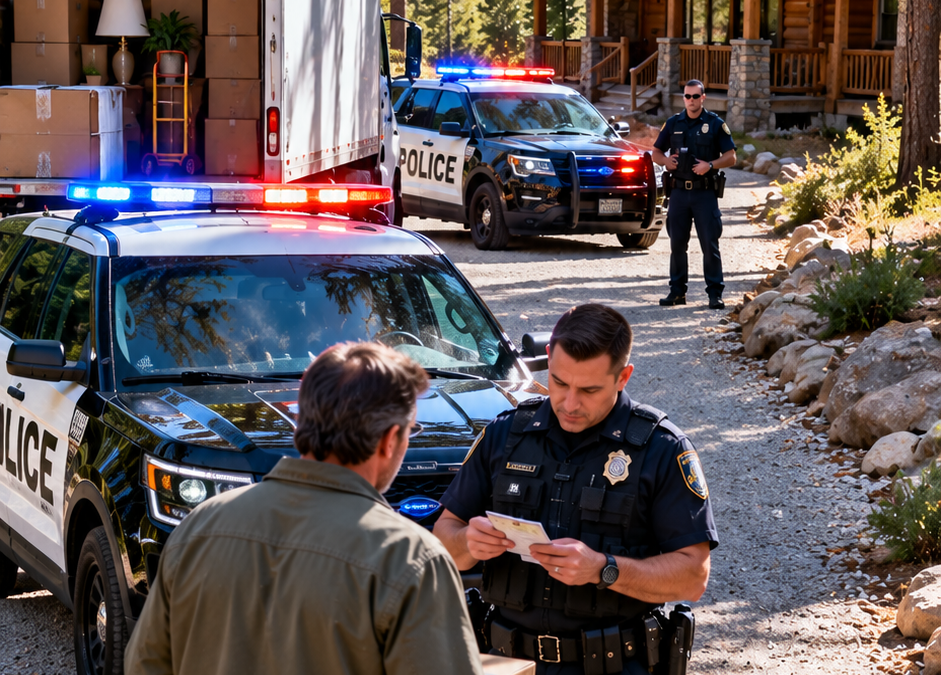
Then saw the cruisers.
Three of them.
One across the drive.
My hands went cold.
For a second, I could hear Margaret’s voice from our first phone call.
The property must be in compliance before occupancy.
I wondered if I had misunderstood everything.
Maybe Priya had missed something.
Maybe the HOA had obtained some emergency order overnight.
Maybe I was about to be told to turn the truck around.
Then Officer Minh Tran approached.
He checked my ID.
Checked my deed.
Then smiled.
“Mr. Lawson, we’ve already been briefed.”
I braced myself.
“We’re not here to stop you.”
He nodded toward the cabin.
“We’re here to make sure nobody else does.”
I looked at him.
“You’re serious?”
“Yes.”
“What did she tell dispatch?”
“That an unauthorized individual was attempting to forcibly occupy a property under active legal dispute.”
I laughed once.
It came out like a breath.
“There is no legal dispute.”
“We know.”
“You know?”
“Your attorney contacted the sheriff’s office yesterday.”
That was when I understood Priya’s call.
Tran continued.
“We reviewed the ownership documents. We also confirmed there’s no court order restricting your access.”
“Then why three cars?”
“Because once someone reports a potentially escalating property confrontation, we’d rather have enough people here to keep it boring.”
Boring.
At that moment, boring sounded wonderful.
A second officer directed the moving truck into the driveway.
The third stayed near the road.
Then Margaret arrived.
Red SUV.
Cream blouse.
Dark sunglasses.
She parked on the shoulder and walked toward Officer Tran.
I had never seen her in person.
She was in her late fifties.
Perfectly arranged hair.
Straight posture.
Folder tucked under one arm.
She looked exactly like her voice sounded.
Controlled.
She stopped beside Tran.
“Officer, this property is under active HOA enforcement.”
Tran nodded.
“Ma’am.”
“The owner has been instructed not to occupy until the violation is resolved.”
“Do you have a court order?”
Margaret’s face barely moved.
“The association has enforcement authority under the covenants.”
“That wasn’t my question.”
I almost smiled.
She opened her folder.
“The property is noncompliant.”
Tran glanced at the documents.
“Is there a county closure order?”
“No, but—”
“Condemnation?”
“No.”
“Court injunction?”
“The HOA has issued formal notice.”
Tran handed the papers back.
“Then this appears to be a civil matter.”
“He is knowingly violating association rules.”
“You can address that through whatever lawful civil process applies.”
Margaret looked toward me.
I was standing beside the moving truck.
For the first time, our eyes met.
The expression on her face was not anger.
It was disbelief.
She had expected the police to function like another HOA department.
They did not.
“Derek,” she said.
Not Mr. Lawson anymore.
“Moving in today will escalate this unnecessarily.”
I felt my pulse rise.
Officer Tran glanced toward me.
I remembered Priya’s instructions.
Do not argue.
So I said only, “I own the cabin.”
Margaret’s jaw tightened.
“You were informed of the violation.”
“And my attorney responded.”
“The board rejected her interpretation.”
“Then you can take that up with her.”
That was all.
No speech.
No shouting.
The movers began unloading.
For twenty minutes, I carried boxes into the cabin while three police officers stood nearby and Margaret watched from the roadside.
It should have felt triumphant.
It did not.
Mostly, it felt humiliating.
This was supposed to be one of the happiest mornings of my life.
Instead, my neighbors were looking through windows while police cruisers sat at my driveway.
I was moving my bed beneath the eyes of a woman who had called 911 to stop me from sleeping in my own house.
Then Paul walked across the road.
He carried a manila envelope.
He did not come to me.
He walked directly to Officer Tran.
“Officer?”
Tran turned.
“I think you should see this.”
Margaret looked toward him.
For the first time that morning, something changed in her face.
“Paul, this doesn’t concern you.”
He ignored her.
He handed the envelope to Tran.
The officer opened it.
Inside were printed emails.
Several pages.
Tran read the first page.
Then the second.
His expression became neutral.
Not shocked.
Not dramatic.
Just careful.
He looked at Paul.
“How did you get these?”
“I was copied accidentally.”
“When?”
“Eight months ago.”
Margaret stepped closer.
“Those are private association communications.”
Paul looked at her.
“No. Some are from your private business account.”
That got my attention.
I walked closer but stayed behind the officers.
Tran continued reading.
“What exactly is this?”
Paul looked at me once.
Then at the officer.
“Emails between Margaret and Carile Group.”
I had never heard the name.
“Who’s Carile Group?” I asked.
Paul answered.
“Developer.”
Margaret spoke sharply.
“Paul.”
He kept going.
“They’ve been trying to acquire several of the older properties around Pinerest Hollow.”
My stomach tightened.
“Why?”
“Vacation rentals.”
Margaret moved toward him.
Officer Tran raised one hand.
“Ma’am, please give him space.”
Paul continued.
“The cabin is one of them.”
Everything around me seemed quieter.
The moving crew.
Truck engine.
Neighbors.
Even the morning birds seemed farther away.
“My cabin?”
Paul nodded.
“Highest lot in the neighborhood.”
I looked toward Margaret.
She said nothing.
Tran asked Paul to explain how the messages came into his possession.
“I served on the board years ago. They never removed me from one distribution list. Margaret accidentally copied me on a thread from her brokerage account.”
“Why didn’t you report it then?”
“I wasn’t sure what I had.”
Paul looked toward me.
“Then I started seeing violation notices going to older properties.”
Margaret interrupted.
“Those owners were in violation.”
Paul finally turned toward her.
“Every single one?”
“That is not your determination.”
“One sold to Carile after six months of fines.”
“Coincidence.”
“Another sold after the board denied three renovation requests.”
“That property had serious issues.”
“And now Derek gets a move-in prohibition over green shutters?”
Margaret’s face hardened.
“You have no idea what you’re talking about.”
Paul looked back at Tran.
“I kept the emails because I knew something was wrong. I didn’t know what to do with them.”
Tran asked, “Do you still have the originals?”
“Yes.”
“Electronic copies?”
“Yes.”
“Do not alter or delete anything.”
Margaret stepped forward again.
“Officer, this is absurd. Private development discussions have nothing to do with today’s occupancy violation.”
Tran closed the envelope.
“I’m not making that determination here.”
“Then return those documents.”
“They were voluntarily provided.”
Margaret’s voice sharpened.
“They were obtained improperly.”
“Then your attorney can address that.”
She looked at me.
That was the first time I saw fear.
Not panic.
Margaret was too controlled for panic.
But fear is not always loud.
Sometimes it is a person realizing that a room is no longer arranged around their authority.
Officer Tran asked Paul to provide his contact information.
Then he asked me whether I wanted to make a statement regarding the repeated attempts to prevent access to my property.
Priya told me over the phone not to speculate.
So I described facts.
Violation notice.
Grandfather clause.
County complaint.
911 call.
Ownership documents.
Nothing more.
Tran said the sheriff’s office would forward the new information to the appropriate county authorities for review.
Nobody put Margaret in handcuffs.
Nobody shouted.
There was no dramatic arrest.
She stood beside her SUV while the movers carried Uncle Ray’s old rocking chair through the front door.
That image stayed with me.
For weeks, Margaret had treated the cabin like an item on her agenda.
A property.
A compliance problem.
A piece of real estate.
Then she had to stand there and watch it become my home.
Paul came inside after the police left.
The cabin looked terrible.
Boxes everywhere.
Dust.
Old furniture.
One mattress leaning against the wall.
I found two mugs.
Neither matched.
Made coffee with Uncle Ray’s old drip machine.
Paul stood by the kitchen counter.
“You okay?”
“I don’t know.”
“That’s fair.”
I looked at the envelope.
“How bad are those emails?”
He exhaled.
“Bad enough.”
“What do they say?”
He hesitated.
Then pulled out copies.
The earliest emails were ordinary development talk.
Carile Group had apparently approached Margaret almost a year earlier.
They wanted to assemble several older lots at the edge of Pinerest Hollow.
Not the newer homes.
The older houses on larger parcels.
My uncle’s cabin was specifically identified.
LOT 14 – RIDGE ELEVATION.
A concept map showed a row of upscale short-term vacation rentals.
My property sat at the highest point.
The rendering proposed a larger structure where the cabin stood.
Deck.
Firepit.
View platform.
I felt sick.
“Uncle Ray never agreed to this.”
“I know.”
Another email discussed acquisition strategy.
Margaret wrote that direct offers might trigger “unrealistic seller expectations.”
Another message suggested that “compliance pressure” could encourage owners of legacy properties to consider voluntary sale.
I read that sentence three times.
Compliance pressure.
The phrase made the shutter letter feel different.
Not enforcement.
Leverage.
Then I found something worse.
Margaret had signed a consulting agreement with Carile Group.
She was being paid for “community coordination, local acquisition strategy, and stakeholder communications.”
The compensation included a monthly consulting fee and a success payment tied to acquisition milestones.
I set the paper down.
“She was getting paid?”
Paul nodded.
“According to this.”
“Did the board know?”
“I didn’t.”
“You weren’t on the board anymore.”
“No, but I still know two people who were. They say they never saw this agreement.”
I felt anger rise.
Not the hot kind.
The slow kind.
The kind that makes you speak quieter.
“So the shutters—”
Paul shook his head.
“I don’t know exactly what she intended in your case.”
“But my property was on their map.”
“Yes.”
“She tried to block my move.”
“Yes.”
“She called the county.”
“Yes.”
“And then 911.”
“Yes.”
I walked toward the back window.
The shutters were visible from inside.
Hunter Green.
Forest Moss.
I could barely remember which one Margaret wanted.
“It was never about the color.”
Paul said nothing.
That silence answered enough.
Priya came to the cabin that afternoon.
She read the documents at my kitchen table.
The same table Uncle Ray and I had once covered with fishing gear.
Her expression grew more serious with every page.
“Do not contact Carile Group.”
“I wasn’t planning to.”
“Do not contact Margaret.”
“Gladly.”
“Do not share these online.”
“Paul already gave copies to police.”
“That’s different.”
“What happens now?”
“Potential conflict-of-interest issues. Possibly board-governance questions. Maybe something involving the county, depending on representations that were made.”
“Criminal?”
Priya looked at me.
“Do not jump ahead.”
I nodded.
“I know.”
“You’re a history teacher. Act like one.”
“What does that mean?”
“Documents first. Conclusions later.”
That was fair.
Within forty-eight hours, county officials opened a review into the HOA’s conduct and its relationship with Carile Group.
The county did not declare everyone guilty.
There was no dramatic raid.
Investigators requested records.
Board minutes.
Emails.
Consulting agreements.
Violation histories.
Communications with the developer.
Residents began hearing about the review almost immediately.
Pinerest Hollow was a small community.
Information traveled faster than the speed limit.
By Thursday evening, cars were slowing near my cabin.
People walked dogs past more often than normal.
Some looked toward the house.
Others avoided eye contact.
Friday morning, the HOA sent a community-wide email.
Margaret called it “misinformation regarding confidential planning discussions.”
She said the association had always acted in the community’s best interests.
She defended the enforcement action against my cabin as routine.
Then something happened that she apparently did not expect.
Residents started comparing their own violation notices.
Paul organized nothing.
Neither did I.
People did it themselves.
A retired woman named Janet brought Priya copies of three violation letters she had received over eighteen months.
One for an aging retaining wall.
One for peeling trim.
One for an unapproved garden shed that had existed for twelve years.
She had eventually sold a narrow strip of land behind her property to Carile.
Another homeowner, Michael Dean, produced emails showing Margaret had repeatedly warned him that major renovations to his older house were unlikely to receive architectural approval.
Months later, Carile offered to buy it.
A third family said they had received fines over parking and landscaping shortly before an unsolicited purchase offer.
None of that alone proved a conspiracy.
Priya reminded everyone of that repeatedly.
But the pattern was enough to keep investigators interested.
Then the board met without Margaret.
According to Paul, it was the first time anyone had done that in years.
Two board members demanded the consulting agreement.
Another asked whether HOA resources had been used to support Carile’s acquisition strategy.
Margaret refused to answer until counsel was present.
By Saturday morning, she resigned as president.
The letter was short.
She said the controversy had become a distraction and she wanted to protect the community from further division.
She did not admit wrongdoing.
She did not apologize to me.
She did not mention the 911 call.
She simply resigned.
Three weeks later, two other board members stepped down after records showed they had known Carile was evaluating properties, although the public record never established that either had participated in Margaret’s private consulting arrangement.
That distinction mattered.
It was easy for angry residents to declare everybody corrupt.
Evidence did not support that.
One of those board members later apologized publicly for failing to ask enough questions.
The other moved away the following year.
Carile Group withdrew its redevelopment interest after local media reported on the county investigation and resident complaints.
The headline was much less dramatic than people imagined.
DEVELOPER ENDS PINEREST HOLLOW ACQUISITION PLAN AMID HOA REVIEW.
No television trucks parked outside my cabin.
No national scandal.
A reporter from the county paper called.
I gave one statement.
“I bought no property from anyone. I simply moved into a cabin I already owned.”
That quote ended up in the article.
My students found it.
By lunch the next day, half the junior class had decided I was secretly famous.
“Mr. Lawson, did you defeat a corporation?”
“No.”
“Did the HOA call the cops on you?”
“Yes.”
“Did they try to steal your house?”
“No.”
“But kind of?”
“No.”
History teachers learn to hate the phrase kind of.
Facts matter.
The developer wanted my property.
Margaret had an undisclosed financial relationship with them.
She also used HOA enforcement aggressively against my cabin and called 911 on move-in day.
Those facts were enough.
I did not need to turn them into something larger.
The strangest part came two months later.
The new HOA board sent me an architectural application.
Not a violation.
An application.
The shutters.
By then, I had lived with them long enough that I actually started disliking the color.
Hunter Green looked almost black in certain light.
Uncle Ray had painted them years ago because he bought leftover exterior paint cheaply from a hardware store going out of business.
I remembered him laughing about that.
“Color’s close enough.”
I could hear his voice.
I filled out the application.
Under proposed color, I wrote:
MIDNIGHT FOREST.
It was darker than Hunter Green.
Darker than Forest Moss.
Technically a completely different category on the county manufacturer’s chart.
Priya stared at me when I showed her.
“You’re enjoying this too much.”
“I’m following the process.”
“You are being annoying within the process.”
“That sounds legal.”
She smiled.
The new board approved it unanimously.
I repainted the shutters myself.
Not because Margaret had demanded it.
Because I wanted the cabin to feel like mine.
That difference mattered more than I expected.
Paul came over the first Saturday after the paint dried.
He brought cedar boards and hardware.
“What are we building?”
“Porch swing.”
“You own one?”
“No.”
“Plans?”
“No.”
“That’s concerning.”
He looked at the porch beam.
“Your uncle reinforced this.”
“For a swing?”
“Probably because he distrusted everything.”
“That sounds like him.”
We spent most of the afternoon building.
Paul measured twice.
I measured three times because I knew he would make fun of me if I cut wrong.
We hung the swing before sunset.
Then sat there with two beers.
The view from the ridge stretched over Pinerest Hollow.
Roofs through trees.
Lake beyond them.
Road curling down toward the clubhouse.
For years, I had imagined owning that view.
I had never imagined fighting for permission to sit in front of it.
Paul rocked the swing gently.
“You know she thought you’d sell.”
I looked at him.
“Margaret?”
“Yeah.”
“Why?”
“You’re a teacher.”
I laughed.
“What does that mean?”
“Single income at the time. Old cabin. Expensive repairs. She figured pressure would make this place feel like a mistake.”
I looked toward the roof.
A section still needed replacement.
The foundation needed work.
The kitchen floor sloped enough that a marble could cross the room by itself.
“She almost succeeded.”
Paul turned toward me.
“Really?”
“First week after the violation letter, I thought maybe taking this place was stupid.”
He said nothing.
“I had savings,” I continued. “But not enough for lawyers and repairs and whatever fines they wanted to invent.”
“You could’ve sold.”
“Yes.”
“Would you?”
I looked toward the workshop.
The door still carried a dent where Uncle Ray once backed his mower into it.
“No.”
Paul nodded.
“That’s why she underestimated you.”
I was not sure.
I think she understood people fairly well.
She understood exhaustion.
Fear.
Cost.
Uncertainty.
She understood that most people do not want conflict.
That was why her methods worked as long as they did.
What she underestimated was paper.
The deed.
The grandfather clause.
The county file.
Her emails.
The consulting agreement.
The 911 recording.
The fact that systems create records even when the people using them believe nobody is paying attention.
As a history teacher, I should have appreciated that sooner.
History is mostly people telling stories about power.
Kings.
Presidents.
Armies.
Movements.
But when you teach long enough, you notice how often the decisive evidence is smaller.
A receipt.
A letter.
A meeting note.
A photograph.
A signature.
One sentence in a law nobody expected anyone to read.
Margaret had authority.
Real authority.
As HOA president, she could call meetings.
Send valid notices.
Enforce actual rules.
Coordinate maintenance.
Represent the association.
The problem began when she treated that limited authority as personal power.
There is a difference.
Legitimate authority depends on boundaries.
Power without boundaries starts inventing reasons to expand.
The shutter dispute taught me that in a way no textbook ever could.
Months after Margaret resigned, I found the original violation notice while organizing paperwork.
I read it again.
Forest Moss.
Hunter Green.
Pre-occupancy compliance required.
It looked almost ridiculous now.
But I remembered how it had felt the first day.
Heavy.
Official.
Final.
That is the danger of formal language.
It can make something uncertain look inevitable.
I almost let it.
I almost repainted the shutters before moving.
If that had been the only issue, maybe that would have been easiest.
But Margaret did not want paint.
She wanted compliance.
Then delay.
Then enough pressure that the cabin became less attractive to keep.
At least, that was the pattern the later documents suggested.
The county review eventually concluded that Margaret’s undisclosed financial relationship created serious conflicts with her HOA duties.
The association amended its ethics rules.
Board members now had to disclose outside financial interests involving properties inside or adjacent to Pinerest Hollow.
Enforcement decisions involving any board member’s business relationship required recusal.
Major architectural disputes received review by more than one person.
The HOA also stopped using language implying it could prevent lawful occupancy based solely on ordinary aesthetic violations.
Those changes mattered more to me than whether Margaret received some dramatic punishment.
People kept asking what she “deserved.”
I never had a satisfying answer.
I wanted consequences tied to what could actually be proven.
Loss of board authority.
Investigation.
Financial review.
Public disclosure.
Whatever civil consequences the evidence supported.
But revenge has never repaired a roof.
It has never fixed a broken system either.
The better ending was changing the structure that let one person act with so little oversight.
A few residents blamed me for months.
One anonymous letter said I had destroyed the reputation of Pinerest Hollow.
I kept it.
Not because it hurt.
Because it fascinated me.
The letter blamed the person who exposed the conflict instead of the conflict itself.
People do that often.
At school, I had taught students about institutions protecting themselves.
I just never expected to watch a miniature version happen over green shutters.
The majority of neighbors eventually moved on.
Some apologized.
Some never mentioned it.
A woman two houses down brought banana bread.
A man I had never met offered to help fix the shed roof.
One Saturday, a family stopped by while walking their dog.
The father said, “We thought you were trying to break every HOA rule when you moved in.”
“Why?”
“That’s what people were saying.”
“What changed your mind?”
He shrugged.
“The police.”
I laughed.
“What about them?”
“When the cops showed up and then let the moving truck through, I figured something wasn’t matching the story.”
That image became the dividing line for a lot of residents.
Margaret had called police expecting enforcement.
Instead, the officers became neutral witnesses that I had every legal right to occupy my own home.
There is something almost poetic about that.
But the moment did not feel poetic while I was sitting behind the steering wheel.
It felt terrifying.
For months afterward, I sometimes dreamed about those three cruisers.
In the dream, Officer Tran would walk toward the truck.
But instead of smiling, he would tell me to turn around.
Then I would wake up in Uncle Ray’s bedroom.
My bedroom.
Look at the ceiling.
Listen to the old furnace.
Remember where I was.
The cabin changed after I moved in.
Slowly.
The first year, I replaced the roof.
The second, I repaired the stone chimney.
I refinished the pine floors room by room.
The kitchen stayed ugly longer than Sarah—my sister, not a spouse—thought was reasonable.
She visited one weekend and said, “Uncle Ray would haunt you over these cabinets.”
“Uncle Ray installed these cabinets.”
“That proves my point.”
Paul helped me rebuild the back steps.
I found Uncle Ray’s initials carved inside one of the old stair stringers.
R.L.
I left that piece in place.
The workshop became my favorite room.
I moved one of my school desks there.
During summer, I wrote lesson plans with the doors open.
Students sometimes came out with parents for local-history projects.
We recorded oral histories with older residents.
Paul became one of the best interviews.
He spoke for forty-three minutes about how Pinerest Hollow had changed.
Then twenty minutes about bad concrete work.
I used twelve.
The porch swing stayed.
Some evenings, I sat there alone.
Sometimes Paul joined me.
Sometimes I graded papers.
Sometimes I did nothing.
Doing nothing at the cabin turned out to be one of the things I had been saving for during those six years.
The best moment came almost exactly one year after move-in day.
I pulled into the driveway after school.
No cruisers.
No moving truck.
No Margaret.
Just late-afternoon sunlight across the trees.
There was an envelope attached to the front door.
For one second, my stomach reacted before my brain did.
HOA.
Then I took it down.
It was the annual community newsletter.
Pool opening.
Road repairs.
Summer picnic.
Fire-safety reminder.
At the bottom was a small note.
Architectural Review Committee applications available online. Homeowners are encouraged to contact the committee before beginning exterior work.
Encouraged.
Not threatened.
I laughed.
Then went inside.
That night, I found Uncle Ray’s old coffee mug in the back of a cabinet.
White ceramic.
Chip on the rim.
Faded red lettering from a farm-equipment company that no longer existed.
I poured coffee into it.
Carried it to the porch.
The sunset turned the trees orange.
Pinerest Hollow looked peaceful.
It had probably always looked peaceful from a distance.
That is another thing history teaches you.
Appearance and reality can live comfortably beside each other for a long
𝗧𝗛𝗘 𝗘𝗡𝗗
The Police Were Waiting at My Cabin Before I Ever Got the Key in the Door
The day I finally moved into my own cabin, three police cruisers were blocking the driveway.
For six years, I had imagined that morning.
I had pictured the rental truck backing beneath the pines.
Boxes stacked on the porch.
A cheap folding chair somewhere in the yard.
Maybe coffee balanced on the hood of my car while I tried to decide which room to unpack first.
I had imagined being exhausted.
Happy.
Overwhelmed.
I had never imagined red-and-blue lights reflecting across the windshield.
My hands went cold around the steering wheel.
The moving truck idled behind me.
For several seconds, I just sat there looking at the cruisers.
One was parked sideways across the gravel entrance.
Another was pulled onto the shoulder.
The third sat farther up the drive near the cabin.
My first thought was that someone had been hurt.
My second was worse.
Margaret had actually done it.
She had spent three weeks telling me I would not be allowed to occupy the property, and apparently she had found a way to make the police enforce it.
The driver behind me tapped his horn once.
Not impatiently.
More like he was asking whether we were still moving.
I lowered my window.
One of the officers walked toward me.
He was maybe forty.
Dark hair.
Calm face.
No hand on his weapon.
No urgency in his walk.
Still, my heart was pounding so hard I could feel it in my throat.
He stopped beside the window.
“Derek?”
“Yes.”
“Derek Lawson?”
“Yes.”
“Can I see your ID and proof that you own the property?”
I had both sitting in a folder on the passenger seat because my attorney had told me not to arrive without them.
I handed them over.
The officer looked at my license.
Then the deed.
Then he looked at me.
And smiled.
“Mr. Lawson, we’ve already been briefed on the situation.”
My stomach dropped another inch.
Then he said something I will probably remember for the rest of my life.
“We’re not here to stop you.”
He glanced toward the moving truck.
“We’re here to make sure nobody else does.”
I nearly cried in front of a police officer at 10:47 on a Tuesday morning.
Not because I was afraid anymore.
Because for three weeks I had been living inside someone else’s version of reality.
A version where a board president could decide my cabin was not mine to enter.
Where a color dispute could become a legal emergency.
Where a person with enough confidence and official stationery could make me question something as basic as whether I had the right to sleep beneath my own roof.
That morning, for the first time, the ground felt solid again.
My name is Derek Lawson.
I teach American history at a public high school in rural Ohio.
The cabin was not some luxury retreat.
It was nine hundred square feet of aging timber, stubborn plumbing, sloping floors, and more repairs than any reasonable person would volunteer for.
It sat on two acres at the edge of a planned community called Pinerest Hollow.
The name sounded like something printed beneath a watercolor of deer and pine trees.
And to be fair, the place was beautiful.
Wooded hills.
Small lake.
Quiet roads.
Older homes mixed with newer custom builds.
My cabin stood above most of it on a ridge where the trees opened just enough to catch the evening sun.
It had belonged to my uncle Raymond.
Uncle Ray was my mother’s older brother.
He never married.
Never had children.
Never owned much that anyone would call impressive.
But he knew how to repair almost anything with an engine, believed coffee should be strong enough to dissolve a spoon, and somehow remembered every birthday in our family without writing one down.
When I was a kid, he was the adult who never talked to me like I was a kid.
If I asked why something worked, he showed me.
If I asked whether I could help, he found a tool light enough for me to carry.
When I was twelve, he taught me to split wood at the cabin.
At fourteen, he showed me how to patch a leaking section of roof.
At sixteen, he let me drive his old pickup down the gravel road long before my mother would have approved.
The cabin had never been fancy.
That was part of why I loved it.
It smelled like pine boards, fireplace ash, and whatever machine oil Uncle Ray had carried in on his jacket.
When I became a teacher, I started visiting more often.
Some summers, I would spend a week there.
Grade essays on the porch.
Walk the old logging trail.
Help him replace things that had been “good for another year” for at least six years.
Then he got sick.
It happened faster than any of us expected.
By the time the doctors understood how serious it was, Uncle Ray understood first.
He called me one afternoon and asked me to drive down.
We sat on the porch.
He looked thinner.
His voice had become softer.
At one point, he nodded toward the cabin.
“You still like this place?”
I laughed.
“You know I do.”
“Good.”
That was all he said.
After he died, I learned he had left it to me.
Not just the building.
The two acres.
The workshop.
The furniture that was worth almost nothing and meant more to me than anything I could have bought.
I thought I would move in within months.
Instead, probate took almost two years.
There were tax questions.
Estate issues.
An old boundary description that had to be updated.
A small lien from a medical bill that had attached to part of the estate.
Nothing dramatic.
Just slow.
I visited during that time.
Cleaned.
Fixed the porch steps.
Replaced broken screens.
Had the septic system inspected.
Tarped one section of roof.
I kept waiting for the day I could finally call it home.
Meanwhile, I saved money.
Teachers are not famous for accumulating large amounts of spare cash.
I stopped renting the apartment I liked and moved into a smaller place.
I drove my car long after the air conditioner became mostly decorative.
I skipped trips.
Did summer tutoring.
Coached academic teams for a stipend.
Every decision started getting measured against the cabin.
Roof.
Furnace.
Plumbing.
Flooring.
Insurance.
Moving costs.
For six years, I built toward one ordinary day.
Move-in day.
By the time the estate finally transferred clear title to me, I had a plan.
Not a glamorous one.
Fix one room at a time.
Live small.
Pay cash where possible.
Keep the original character.
Use the workshop for school projects and furniture repairs.
Maybe someday restore the stone fireplace properly.
That was enough.
Three weeks before I was scheduled to move, a cream-colored envelope appeared in my mailbox.
PINEREST HOLLOW HOMEOWNERS ASSOCIATION.
I assumed it was a welcome packet.
I actually smiled when I opened it.
That smile lasted maybe fifteen seconds.
NOTICE OF ARCHITECTURAL VIOLATION.
I read the first paragraph.
Then the second.
My cabin was in violation of Pinerest Hollow’s aesthetic standards because the exterior window shutters were painted the wrong shade of green.
Not the wrong color.
The wrong shade.
The approved color was listed as Forest Moss.
My shutters were supposedly Hunter Green.
The notice included three photographs.
I stared at them.
Then walked to the window of my apartment as though better light would help.
The difference was barely visible even on the printed examples.
Forest Moss was slightly grayer.
Hunter Green was slightly deeper.
That was apparently enough to stop a man from occupying a house he owned.
The notice said the violation had to be corrected before move-in.
Failure to comply could trigger fines and enforcement action.
I called the HOA office the following morning.
That was the first time I spoke with Margaret Vale.
She answered on the second ring.
“Pinerest Hollow Association.”
“Hi. My name is Derek Lawson. I own the cabin at 14 Ridge Hollow Road.”
A pause.
“Yes, Mr. Lawson.”
That pause told me she already knew who I was.
“I received a violation letter about the shutters.”
“Yes.”
“I’m moving in three weeks.”
“I’m aware.”
“I can repaint them after I move.”
“That will not be acceptable.”
Her voice was calm.
Polished.
Almost pleasant.
But there was something under it.
Like a knife wrapped in silk.
“The property must be in compliance before occupancy.”
I thought I had misunderstood her.
“I already own the property.”
“That is not in dispute.”
“Then what does ‘before occupancy’ mean?”
“It means the violation must be remedied before your move-in.”
“I’m not asking permission to rent the clubhouse. I’m moving into my house.”
“You are entering a deed-restricted community.”
“I know.”
“Then you understand the covenants apply.”
“I read them twice.”
“Good. That should simplify matters.”
Her confidence irritated me.
“The shutters were there when my uncle owned the cabin.”
“That does not make them compliant.”
“They’ve been that color for years.”
“The current board is responsible for current enforcement.”
“I’ll repaint them.”
“Before the move.”
“That’s not practical.”
“That’s your scheduling issue, Mr. Lawson.”
I stopped speaking for a second.
There are moments when another person’s certainty can make you doubt things you know.
She sounded so sure.
So administrative.
As though she were telling me the county required a smoke detector.
I tried again.
“Margaret, the cabin has been sitting empty for two years. I’ve already scheduled movers.”
“I understand.”
“I have utilities transferring.”
“I understand.”
“I have nowhere else to store everything.”
“I understand.”
“Then why are you blocking move-in over shutters that are maybe one shade too dark?”
Her tone hardened slightly.
“Rules lose meaning when they are selectively enforced.”
I almost laughed.
“So the rule is that I cannot sleep in my own house until the shutters are greener?”
“The rule is that properties must meet association standards.”
“And if I move in anyway?”
“The board will consider enforcement.”
“What does that mean?”
“It means I strongly recommend compliance.”
Then she hung up.
I stood in my kitchen holding the phone.
I had spent six years waiting for this move.
Six years.
And suddenly a woman I had never met was speaking as though she controlled the date I was allowed to enter my uncle’s cabin.
I called a real estate attorney that afternoon.
Her name was Priya Shah.
A teacher at my school had used her during a boundary dispute and described her as “the kind of lawyer who reads everything twice and talks once.”
That sounded useful.
Priya’s office was above a bank in town.
I brought the violation letter.
My deed.
The Pinerest Hollow covenants.
The original estate documents.
Photographs of the cabin.
She read quietly.
Then asked, “When were the shutters installed?”
“I don’t know exactly. At least ten years ago.”
“Painted?”
“Same color since before my uncle got sick.”
“Any approval letter?”
“Not that I found.”
She turned several pages in the covenants.
Then stopped.
“What year did the current association standards take effect?”
I looked at the page.
“Five years ago.”
“And your uncle owned the cabin before that?”
“Since the nineties.”
Priya kept reading.
Then she smiled.
Not dramatically.
Just enough for me to notice.
“What?”
“There’s a grandfather clause.”
I leaned forward.
She rotated the document.
Existing exterior conditions predating adoption of revised architectural standards were exempt from retroactive enforcement unless the condition violated county code, created a safety issue, or was materially altered after adoption.
My shutters had not been changed.
They complied with county building rules.
No safety issue.
No alteration.
Priya tapped the paragraph.
“The association can regulate future changes.”
“So if I repaint them—”
“You may need approval.”
“But they can’t force me to repaint the existing shutters?”
“Not based on the language I’m reading.”
“Can they stop me moving in?”
She looked up.
“On this basis? I don’t see how.”
I felt my shoulders loosen.
“Then why send the letter?”
“Maybe they interpreted the clause differently.”
“You sound nicer than I feel.”
“That’s why you hired me.”
She drafted a response.
It cited the grandfather clause.
County compliance.
The deed transfer.
My ownership.
Then it requested that the HOA withdraw the violation notice and cease any effort to interfere with occupancy.
No threats.
No insults.
Just sections, dates, documents.
Priya sent it to the association and its management company.
I thought that would end the problem.
I was wrong.
Two days later, Margaret escalated.
She filed a complaint with the county claiming I intended to occupy a residential structure that was not in compliance with community requirements.
The county inspector called me.
He sounded confused.
“Mr. Lawson, are there habitability issues at the property?”
“No.”
“Unpermitted electrical work?”
“No.”
“Open structural violation?”
“No.”
“Failed septic?”
“No.”
“What exactly is the dispute?”
“My shutters are apparently the wrong green.”
Silence.
Then he said, “I’m sorry?”
“The HOA says Hunter Green. Approved is Forest Moss.”
Another pause.
“That’s not a county occupancy issue.”
“I know.”
He eventually closed the complaint after confirming there were no active code violations.
I should have been relieved.
Instead, I became nervous.
Margaret knew enough to understand that a shutter color was not a county safety issue.
Yet she had tried anyway.
Priya became less charitable.
“This is no longer ordinary architectural enforcement.”
“What is it?”
“I don’t know yet.”
That answer stayed with me.
I kept preparing for the move.
Boxes.
Furniture.
Utilities.
Insurance.
I refused to let Margaret turn the cabin into something I feared.
Still, every time my phone rang from an unknown number, my stomach tightened.
Two days before move-in, Priya called.
“I want you to carry copies of your deed and my letter with you on Tuesday.”
“Why?”
“Because I don’t trust the escalation pattern.”
“You think she’ll sue?”
“Maybe.”
“Before Tuesday?”
“She doesn’t need to win anything before Tuesday to create chaos.”
“What does that mean?”
“It means people sometimes call authorities and describe civil disputes in language that sounds urgent.”
I understood then.
“You think she might call the police.”
“I think we prepare for possibilities instead of predicting them.”
The next morning, Priya contacted the county sheriff’s office.
I did not know that at the time.
She sent them the deed.
The grandfather provision.
Her cease-and-desist letter.
The county’s confirmation that there was no habitability problem.
And a short note explaining that I was scheduled to take possession of my own property and that the association president had threatened to stop the move.
She did not ask police to take sides.
She asked them to have the documents available if someone tried to turn a civil HOA dispute into an emergency call.
That decision probably saved my move-in day.
Tuesday morning, I picked up the rental truck at eight.
Two friends from school followed in another pickup.
My furniture looked pathetic inside the truck.
A couch.
Bed.
Bookshelves.
Too many boxes of history books.
Kitchen stuff.
Uncle Ray’s old workbench was already at the cabin.
That mattered more to me than anything in the truck.
At 9:26, Paul Whitaker texted me.
Paul lived across from the cabin.
Retired contractor.
Former Pinerest Hollow board member.
Late sixties.
The first time we met, he told me exactly which section of the cabin roof would fail next and then apologized for being right about it.
His message said:
She called the cops on you.
I pulled the truck onto the shoulder.
Another message came.
Three cars heading up.
Don’t panic.
I already called someone too.
I typed:
Called who?
No response.
My chest tightened.
I called Priya.
She answered immediately.
“Keep driving.”
“Paul says police are coming.”
“I know.”
“You know?”
“Keep your documents with you. Be calm. Don’t argue with Margaret if she’s there.”
“What did she report?”
“I don’t have the dispatch wording yet.”
“This is insane.”
“Yes.”
“Can she actually stop me?”
“Not by making an unsupported emergency call.”
That sounded reassuring in an office.
Less reassuring behind the wheel of a rental truck.
At 10:47, I turned onto Ridge Hollow Road.
Then saw the cruisers.
Three of them.
One across the drive.
My hands went cold.
For a second, I could hear Margaret’s voice from our first phone call.
The property must be in compliance before occupancy.
I wondered if I had misunderstood everything.
Maybe Priya had missed something.
Maybe the HOA had obtained some emergency order overnight.
Maybe I was about to be told to turn the truck around.
Then Officer Minh Tran approached.
He checked my ID.
Checked my deed.
Then smiled.
“Mr. Lawson, we’ve already been briefed.”
I braced myself.
“We’re not here to stop you.”
He nodded toward the cabin.
“We’re here to make sure nobody else does.”
I looked at him.
“You’re serious?”
“Yes.”
“What did she tell dispatch?”
“That an unauthorized individual was attempting to forcibly occupy a property under active legal dispute.”
I laughed once.
It came out like a breath.
“There is no legal dispute.”
“We know.”
“You know?”
“Your attorney contacted the sheriff’s office yesterday.”
That was when I understood Priya’s call.
Tran continued.
“We reviewed the ownership documents. We also confirmed there’s no court order restricting your access.”
“Then why three cars?”
“Because once someone reports a potentially escalating property confrontation, we’d rather have enough people here to keep it boring.”
Boring.
At that moment, boring sounded wonderful.
A second officer directed the moving truck into the driveway.
The third stayed near the road.
Then Margaret arrived.
Red SUV.
Cream blouse.
Dark sunglasses.
She parked on the shoulder and walked toward Officer Tran.
I had never seen her in person.
She was in her late fifties.
Perfectly arranged hair.
Straight posture.
Folder tucked under one arm.
She looked exactly like her voice sounded.
Controlled.
She stopped beside Tran.
“Officer, this property is under active HOA enforcement.”
Tran nodded.
“Ma’am.”
“The owner has been instructed not to occupy until the violation is resolved.”
“Do you have a court order?”
Margaret’s face barely moved.
“The association has enforcement authority under the covenants.”
“That wasn’t my question.”
I almost smiled.
She opened her folder.
“The property is noncompliant.”
Tran glanced at the documents.
“Is there a county closure order?”
“No, but—”
“Condemnation?”
“No.”
“Court injunction?”
“The HOA has issued formal notice.”
Tran handed the papers back.
“Then this appears to be a civil matter.”
“He is knowingly violating association rules.”
“You can address that through whatever lawful civil process applies.”
Margaret looked toward me.
I was standing beside the moving truck.
For the first time, our eyes met.
The expression on her face was not anger.
It was disbelief.
She had expected the police to function like another HOA department.
They did not.
“Derek,” she said.
Not Mr. Lawson anymore.
“Moving in today will escalate this unnecessarily.”
I felt my pulse rise.
Officer Tran glanced toward me.
I remembered Priya’s instructions.
Do not argue.
So I said only, “I own the cabin.”
Margaret’s jaw tightened.
“You were informed of the violation.”
“And my attorney responded.”
“The board rejected her interpretation.”
“Then you can take that up with her.”
That was all.
No speech.
No shouting.
The movers began unloading.
For twenty minutes, I carried boxes into the cabin while three police officers stood nearby and Margaret watched from the roadside.
It should have felt triumphant.
It did not.
Mostly, it felt humiliating.
This was supposed to be one of the happiest mornings of my life.
Instead, my neighbors were looking through windows while police cruisers sat at my driveway.
I was moving my bed beneath the eyes of a woman who had called 911 to stop me from sleeping in my own house.
Then Paul walked across the road.
He carried a manila envelope.
He did not come to me.
He walked directly to Officer Tran.
“Officer?”
Tran turned.
“I think you should see this.”
Margaret looked toward him.
For the first time that morning, something changed in her face.
“Paul, this doesn’t concern you.”
He ignored her.
He handed the envelope to Tran.
The officer opened it.
Inside were printed emails.
Several pages.
Tran read the first page.
Then the second.
His expression became neutral.
Not shocked.
Not dramatic.
Just careful.
He looked at Paul.
“How did you get these?”
“I was copied accidentally.”
“When?”
“Eight months ago.”
Margaret stepped closer.
“Those are private association communications.”
Paul looked at her.
“No. Some are from your private business account.”
That got my attention.
I walked closer but stayed behind the officers.
Tran continued reading.
“What exactly is this?”
Paul looked at me once.
Then at the officer.
“Emails between Margaret and Carile Group.”
I had never heard the name.
“Who’s Carile Group?” I asked.
Paul answered.
“Developer.”
Margaret spoke sharply.
“Paul.”
He kept going.
“They’ve been trying to acquire several of the older properties around Pinerest Hollow.”
My stomach tightened.
“Why?”
“Vacation rentals.”
Margaret moved toward him.
Officer Tran raised one hand.
“Ma’am, please give him space.”
Paul continued.
“The cabin is one of them.”
Everything around me seemed quieter.
The moving crew.
Truck engine.
Neighbors.
Even the morning birds seemed farther away.
“My cabin?”
Paul nodded.
“Highest lot in the neighborhood.”
I looked toward Margaret.
She said nothing.
Tran asked Paul to explain how the messages came into his possession.
“I served on the board years ago. They never removed me from one distribution list. Margaret accidentally copied me on a thread from her brokerage account.”
“Why didn’t you report it then?”
“I wasn’t sure what I had.”
Paul looked toward me.
“Then I started seeing violation notices going to older properties.”
Margaret interrupted.
“Those owners were in violation.”
Paul finally turned toward her.
“Every single one?”
“That is not your determination.”
“One sold to Carile after six months of fines.”
“Coincidence.”
“Another sold after the board denied three renovation requests.”
“That property had serious issues.”
“And now Derek gets a move-in prohibition over green shutters?”
Margaret’s face hardened.
“You have no idea what you’re talking about.”
Paul looked back at Tran.
“I kept the emails because I knew something was wrong. I didn’t know what to do with them.”
Tran asked, “Do you still have the originals?”
“Yes.”
“Electronic copies?”
“Yes.”
“Do not alter or delete anything.”
Margaret stepped forward again.
“Officer, this is absurd. Private development discussions have nothing to do with today’s occupancy violation.”
Tran closed the envelope.
“I’m not making that determination here.”
“Then return those documents.”
“They were voluntarily provided.”
Margaret’s voice sharpened.
“They were obtained improperly.”
“Then your attorney can address that.”
She looked at me.
That was the first time I saw fear.
Not panic.
Margaret was too controlled for panic.
But fear is not always loud.
Sometimes it is a person realizing that a room is no longer arranged around their authority.
Officer Tran asked Paul to provide his contact information.
Then he asked me whether I wanted to make a statement regarding the repeated attempts to prevent access to my property.
Priya told me over the phone not to speculate.
So I described facts.
Violation notice.
Grandfather clause.
County complaint.
911 call.
Ownership documents.
Nothing more.
Tran said the sheriff’s office would forward the new information to the appropriate county authorities for review.
Nobody put Margaret in handcuffs.
Nobody shouted.
There was no dramatic arrest.
She stood beside her SUV while the movers carried Uncle Ray’s old rocking chair through the front door.
That image stayed with me.
For weeks, Margaret had treated the cabin like an item on her agenda.
A property.
A compliance problem.
A piece of real estate.
Then she had to stand there and watch it become my home.
Paul came inside after the police left.
The cabin looked terrible.
Boxes everywhere.
Dust.
Old furniture.
One mattress leaning against the wall.
I found two mugs.
Neither matched.
Made coffee with Uncle Ray’s old drip machine.
Paul stood by the kitchen counter.
“You okay?”
“I don’t know.”
“That’s fair.”
I looked at the envelope.
“How bad are those emails?”
He exhaled.
“Bad enough.”
“What do they say?”
He hesitated.
Then pulled out copies.
The earliest emails were ordinary development talk.
Carile Group had apparently approached Margaret almost a year earlier.
They wanted to assemble several older lots at the edge of Pinerest Hollow.
Not the newer homes.
The older houses on larger parcels.
My uncle’s cabin was specifically identified.
LOT 14 – RIDGE ELEVATION.
A concept map showed a row of upscale short-term vacation rentals.
My property sat at the highest point.
The rendering proposed a larger structure where the cabin stood.
Deck.
Firepit.
View platform.
I felt sick.
“Uncle Ray never agreed to this.”
“I know.”
Another email discussed acquisition strategy.
Margaret wrote that direct offers might trigger “unrealistic seller expectations.”
Another message suggested that “compliance pressure” could encourage owners of legacy properties to consider voluntary sale.
I read that sentence three times.
Compliance pressure.
The phrase made the shutter letter feel different.
Not enforcement.
Leverage.
Then I found something worse.
Margaret had signed a consulting agreement with Carile Group.
She was being paid for “community coordination, local acquisition strategy, and stakeholder communications.”
The compensation included a monthly consulting fee and a success payment tied to acquisition milestones.
I set the paper down.
“She was getting paid?”
Paul nodded.
“According to this.”
“Did the board know?”
“I didn’t.”
“You weren’t on the board anymore.”
“No, but I still know two people who were. They say they never saw this agreement.”
I felt anger rise.
Not the hot kind.
The slow kind.
The kind that makes you speak quieter.
“So the shutters—”
Paul shook his head.
“I don’t know exactly what she intended in your case.”
“But my property was on their map.”
“Yes.”
“She tried to block my move.”
“Yes.”
“She called the county.”
“Yes.”
“And then 911.”
“Yes.”
I walked toward the back window.
The shutters were visible from inside.
Hunter Green.
Forest Moss.
I could barely remember which one Margaret wanted.
“It was never about the color.”
Paul said nothing.
That silence answered enough.
Priya came to the cabin that afternoon.
She read the documents at my kitchen table.
The same table Uncle Ray and I had once covered with fishing gear.
Her expression grew more serious with every page.
“Do not contact Carile Group.”
“I wasn’t planning to.”
“Do not contact Margaret.”
“Gladly.”
“Do not share these online.”
“Paul already gave copies to police.”
“That’s different.”
“What happens now?”
“Potential conflict-of-interest issues. Possibly board-governance questions. Maybe something involving the county, depending on representations that were made.”
“Criminal?”
Priya looked at me.
“Do not jump ahead.”
I nodded.
“I know.”
“You’re a history teacher. Act like one.”
“What does that mean?”
“Documents first. Conclusions later.”
That was fair.
Within forty-eight hours, county officials opened a review into the HOA’s conduct and its relationship with Carile Group.
The county did not declare everyone guilty.
There was no dramatic raid.
Investigators requested records.
Board minutes.
Emails.
Consulting agreements.
Violation histories.
Communications with the developer.
Residents began hearing about the review almost immediately.
Pinerest Hollow was a small community.
Information traveled faster than the speed limit.
By Thursday evening, cars were slowing near my cabin.
People walked dogs past more often than normal.
Some looked toward the house.
Others avoided eye contact.
Friday morning, the HOA sent a community-wide email.
Margaret called it “misinformation regarding confidential planning discussions.”
She said the association had always acted in the community’s best interests.
She defended the enforcement action against my cabin as routine.
Then something happened that she apparently did not expect.
Residents started comparing their own violation notices.
Paul organized nothing.
Neither did I.
People did it themselves.
A retired woman named Janet brought Priya copies of three violation letters she had received over eighteen months.
One for an aging retaining wall.
One for peeling trim.
One for an unapproved garden shed that had existed for twelve years.
She had eventually sold a narrow strip of land behind her property to Carile.
Another homeowner, Michael Dean, produced emails showing Margaret had repeatedly warned him that major renovations to his older house were unlikely to receive architectural approval.
Months later, Carile offered to buy it.
A third family said they had received fines over parking and landscaping shortly before an unsolicited purchase offer.
None of that alone proved a conspiracy.
Priya reminded everyone of that repeatedly.
But the pattern was enough to keep investigators interested.
Then the board met without Margaret.
According to Paul, it was the first time anyone had done that in years.
Two board members demanded the consulting agreement.
Another asked whether HOA resources had been used to support Carile’s acquisition strategy.
Margaret refused to answer until counsel was present.
By Saturday morning, she resigned as president.
The letter was short.
She said the controversy had become a distraction and she wanted to protect the community from further division.
She did not admit wrongdoing.
She did not apologize to me.
She did not mention the 911 call.
She simply resigned.
Three weeks later, two other board members stepped down after records showed they had known Carile was evaluating properties, although the public record never established that either had participated in Margaret’s private consulting arrangement.
That distinction mattered.
It was easy for angry residents to declare everybody corrupt.
Evidence did not support that.
One of those board members later apologized publicly for failing to ask enough questions.
The other moved away the following year.
Carile Group withdrew its redevelopment interest after local media reported on the county investigation and resident complaints.
The headline was much less dramatic than people imagined.
DEVELOPER ENDS PINEREST HOLLOW ACQUISITION PLAN AMID HOA REVIEW.
No television trucks parked outside my cabin.
No national scandal.
A reporter from the county paper called.
I gave one statement.
“I bought no property from anyone. I simply moved into a cabin I already owned.”
That quote ended up in the article.
My students found it.
By lunch the next day, half the junior class had decided I was secretly famous.
“Mr. Lawson, did you defeat a corporation?”
“No.”
“Did the HOA call the cops on you?”
“Yes.”
“Did they try to steal your house?”
“No.”
“But kind of?”
“No.”
History teachers learn to hate the phrase kind of.
Facts matter.
The developer wanted my property.
Margaret had an undisclosed financial relationship with them.
She also used HOA enforcement aggressively against my cabin and called 911 on move-in day.
Those facts were enough.
I did not need to turn them into something larger.
The strangest part came two months later.
The new HOA board sent me an architectural application.
Not a violation.
An application.
The shutters.
By then, I had lived with them long enough that I actually started disliking the color.
Hunter Green looked almost black in certain light.
Uncle Ray had painted them years ago because he bought leftover exterior paint cheaply from a hardware store going out of business.
I remembered him laughing about that.
“Color’s close enough.”
I could hear his voice.
I filled out the application.
Under proposed color, I wrote:
MIDNIGHT FOREST.
It was darker than Hunter Green.
Darker than Forest Moss.
Technically a completely different category on the county manufacturer’s chart.
Priya stared at me when I showed her.
“You’re enjoying this too much.”
“I’m following the process.”
“You are being annoying within the process.”
“That sounds legal.”
She smiled.
The new board approved it unanimously.
I repainted the shutters myself.
Not because Margaret had demanded it.
Because I wanted the cabin to feel like mine.
That difference mattered more than I expected.
Paul came over the first Saturday after the paint dried.
He brought cedar boards and hardware.
“What are we building?”
“Porch swing.”
“You own one?”
“No.”
“Plans?”
“No.”
“That’s concerning.”
He looked at the porch beam.
“Your uncle reinforced this.”
“For a swing?”
“Probably because he distrusted everything.”
“That sounds like him.”
We spent most of the afternoon building.
Paul measured twice.
I measured three times because I knew he would make fun of me if I cut wrong.
We hung the swing before sunset.
Then sat there with two beers.
The view from the ridge stretched over Pinerest Hollow.
Roofs through trees.
Lake beyond them.
Road curling down toward the clubhouse.
For years, I had imagined owning that view.
I had never imagined fighting for permission to sit in front of it.
Paul rocked the swing gently.
“You know she thought you’d sell.”
I looked at him.
“Margaret?”
“Yeah.”
“Why?”
“You’re a teacher.”
I laughed.
“What does that mean?”
“Single income at the time. Old cabin. Expensive repairs. She figured pressure would make this place feel like a mistake.”
I looked toward the roof.
A section still needed replacement.
The foundation needed work.
The kitchen floor sloped enough that a marble could cross the room by itself.
“She almost succeeded.”
Paul turned toward me.
“Really?”
“First week after the violation letter, I thought maybe taking this place was stupid.”
He said nothing.
“I had savings,” I continued. “But not enough for lawyers and repairs and whatever fines they wanted to invent.”
“You could’ve sold.”
“Yes.”
“Would you?”
I looked toward the workshop.
The door still carried a dent where Uncle Ray once backed his mower into it.
“No.”
Paul nodded.
“That’s why she underestimated you.”
I was not sure.
I think she understood people fairly well.
She understood exhaustion.
Fear.
Cost.
Uncertainty.
She understood that most people do not want conflict.
That was why her methods worked as long as they did.
What she underestimated was paper.
The deed.
The grandfather clause.
The county file.
Her emails.
The consulting agreement.
The 911 recording.
The fact that systems create records even when the people using them believe nobody is paying attention.
As a history teacher, I should have appreciated that sooner.
History is mostly people telling stories about power.
Kings.
Presidents.
Armies.
Movements.
But when you teach long enough, you notice how often the decisive evidence is smaller.
A receipt.
A letter.
A meeting note.
A photograph.
A signature.
One sentence in a law nobody expected anyone to read.
Margaret had authority.
Real authority.
As HOA president, she could call meetings.
Send valid notices.
Enforce actual rules.
Coordinate maintenance.
Represent the association.
The problem began when she treated that limited authority as personal power.
There is a difference.
Legitimate authority depends on boundaries.
Power without boundaries starts inventing reasons to expand.
The shutter dispute taught me that in a way no textbook ever could.
Months after Margaret resigned, I found the original violation notice while organizing paperwork.
I read it again.
Forest Moss.
Hunter Green.
Pre-occupancy compliance required.
It looked almost ridiculous now.
But I remembered how it had felt the first day.
Heavy.
Official.
Final.
That is the danger of formal language.
It can make something uncertain look inevitable.
I almost let it.
I almost repainted the shutters before moving.
If that had been the only issue, maybe that would have been easiest.
But Margaret did not want paint.
She wanted compliance.
Then delay.
Then enough pressure that the cabin became less attractive to keep.
At least, that was the pattern the later documents suggested.
The county review eventually concluded that Margaret’s undisclosed financial relationship created serious conflicts with her HOA duties.
The association amended its ethics rules.
Board members now had to disclose outside financial interests involving properties inside or adjacent to Pinerest Hollow.
Enforcement decisions involving any board member’s business relationship required recusal.
Major architectural disputes received review by more than one person.
The HOA also stopped using language implying it could prevent lawful occupancy based solely on ordinary aesthetic violations.
Those changes mattered more to me than whether Margaret received some dramatic punishment.
People kept asking what she “deserved.”
I never had a satisfying answer.
I wanted consequences tied to what could actually be proven.
Loss of board authority.
Investigation.
Financial review.
Public disclosure.
Whatever civil consequences the evidence supported.
But revenge has never repaired a roof.
It has never fixed a broken system either.
The better ending was changing the structure that let one person act with so little oversight.
A few residents blamed me for months.
One anonymous letter said I had destroyed the reputation of Pinerest Hollow.
I kept it.
Not because it hurt.
Because it fascinated me.
The letter blamed the person who exposed the conflict instead of the conflict itself.
People do that often.
At school, I had taught students about institutions protecting themselves.
I just never expected to watch a miniature version happen over green shutters.
The majority of neighbors eventually moved on.
Some apologized.
Some never mentioned it.
A woman two houses down brought banana bread.
A man I had never met offered to help fix the shed roof.
One Saturday, a family stopped by while walking their dog.
The father said, “We thought you were trying to break every HOA rule when you moved in.”
“Why?”
“That’s what people were saying.”
“What changed your mind?”
He shrugged.
“The police.”
I laughed.
“What about them?”
“When the cops showed up and then let the moving truck through, I figured something wasn’t matching the story.”
That image became the dividing line for a lot of residents.
Margaret had called police expecting enforcement.
Instead, the officers became neutral witnesses that I had every legal right to occupy my own home.
There is something almost poetic about that.
But the moment did not feel poetic while I was sitting behind the steering wheel.
It felt terrifying.
For months afterward, I sometimes dreamed about those three cruisers.
In the dream, Officer Tran would walk toward the truck.
But instead of smiling, he would tell me to turn around.
Then I would wake up in Uncle Ray’s bedroom.
My bedroom.
Look at the ceiling.
Listen to the old furnace.
Remember where I was.
The cabin changed after I moved in.
Slowly.
The first year, I replaced the roof.
The second, I repaired the stone chimney.
I refinished the pine floors room by room.
The kitchen stayed ugly longer than Sarah—my sister, not a spouse—thought was reasonable.
She visited one weekend and said, “Uncle Ray would haunt you over these cabinets.”
“Uncle Ray installed these cabinets.”
“That proves my point.”
Paul helped me rebuild the back steps.
I found Uncle Ray’s initials carved inside one of the old stair stringers.
R.L.
I left that piece in place.
The workshop became my favorite room.
I moved one of my school desks there.
During summer, I wrote lesson plans with the doors open.
Students sometimes came out with parents for local-history projects.
We recorded oral histories with older residents.
Paul became one of the best interviews.
He spoke for forty-three minutes about how Pinerest Hollow had changed.
Then twenty minutes about bad concrete work.
I used twelve.
The porch swing stayed.
Some evenings, I sat there alone.
Sometimes Paul joined me.
Sometimes I graded papers.
Sometimes I did nothing.
Doing nothing at the cabin turned out to be one of the things I had been saving for during those six years.
The best moment came almost exactly one year after move-in day.
I pulled into the driveway after school.
No cruisers.
No moving truck.
No Margaret.
Just late-afternoon sunlight across the trees.
There was an envelope attached to the front door.
For one second, my stomach reacted before my brain did.
HOA.
Then I took it down.
It was the annual community newsletter.
Pool opening.
Road repairs.
Summer picnic.
Fire-safety reminder.
At the bottom was a small note.
Architectural Review Committee applications available online. Homeowners are encouraged to contact the committee before beginning exterior work.
Encouraged.
Not threatened.
I laughed.
Then went inside.
That night, I found Uncle Ray’s old coffee mug in the back of a cabinet.
White ceramic.
Chip on the rim.
Faded red lettering from a farm-equipment company that no longer existed.
I poured coffee into it.
Carried it to the porch.
The sunset turned the trees orange.
Pinerest Hollow looked peaceful.
It had probably always looked peaceful from a distance.
That is another thing history teaches you.
Appearance and reality can live comfortably beside each other for a long

