𝗙𝗨𝗟𝗟 𝗦𝗧𝗢𝗥𝗬 The Police Came to Ask About My Neighbor, but Their German Shepherd Wouldn’t Leave My Grandfather’s Bedroom
𝗙𝗨𝗟𝗟 𝗦𝗧𝗢𝗥𝗬
Then months.
That particular morning began exactly like hundreds before it.
I woke a little after seven.
Made coffee.
Opened the curtains in the living room.
Checked the weather.
Then I carried Grandpa’s breakfast down the hallway.
He was awake, staring toward the window.
“Morning.”
He glanced at me.
“Eggs.”
No reaction.
“Toast.”
Still nothing.
I set the tray down.
“And the coffee you’re technically not supposed to drink this much of.”
That earned me a faint smile.
“There he is.”
Grandpa looked at the cup.
“You want help sitting up?”
He gave a small nod.
I adjusted the bed and helped arrange the pillows behind him.
He seemed tired.
He had seemed tired for months.
“What are we doing today?” I asked.
He raised one eyebrow.
“Don’t look at me like that. We need a schedule.”
He took a sip of coffee.
“Maybe I’ll read you the newspaper.”
His expression said that sounded suspiciously like a threat.
“Fine. Crossword.”
That was our language now.
Half spoken.
Half facial expressions.
After breakfast, I cleaned the kitchen.
At around eleven, someone rang the doorbell.
I wasn’t expecting anyone.
When I opened the door, two police officers stood on the porch.
A woman in her late thirties introduced herself as Officer Olivia Grant.
Beside her was a younger male officer whose name I no longer remember clearly because my attention was immediately taken by the animal standing between them.
A German Shepherd.
Large.
Black and tan.
Beautiful.
He wasn’t restless or overly excited.
He stood beside Olivia with the controlled stillness of a professionally trained dog.
His ears remained upright.
His eyes moved constantly.
Not nervously.
Assessing.
Taking in the porch.
The open doorway.
Me.
Everything.
“This is Max,” Olivia said when she noticed me staring.
“He’s gorgeous.”
Max’s ears twitched at the compliment, but he didn’t move.
Olivia smiled.
“He knows.”
I laughed.
“What can I do for you?”
She explained that they were following up on a minor incident involving one of our neighbors and wanted to know whether we had seen or heard anything the previous evening.
Nothing serious.
Nothing dramatic.
I invited them inside because the morning was cold and I needed a moment to think about what I’d noticed the night before.
Max entered at Olivia’s side.
At first, everything seemed ordinary.
He sniffed lightly near the entrance.
Looked toward the living room.
Then the kitchen.
I answered questions while trying to remember whether I’d heard a vehicle after ten.
“I think there was a truck,” I said. “But I couldn’t tell you whose.”
Olivia wrote something down.
“About what time?”
“Maybe ten thirty? I’m not sure.”
Max suddenly lifted his head.
I noticed because the movement was so sharp.
His entire posture changed.
He turned toward the hallway.
Olivia glanced down.
“Max?”
His nose moved.
Once.
Twice.
Then again.
He stepped away from her.
Not far.
Just enough to make her expression change.
“What’s he doing?” I asked.
“I’m not sure.”
Max took another step toward the hallway.
Then another.
He wasn’t pulling wildly.
He wasn’t barking.
He was following something.
Olivia loosened the leash slightly.
“Easy.”
Max’s nose remained angled forward.
The hallway led to three rooms.
Bathroom.
Guest room.
Grandpa’s bedroom.
Max passed the bathroom without hesitation.
Ignored the guest room.
Then stopped at Grandpa’s doorway.
My stomach tightened.
“That’s my grandfather’s room.”
Olivia looked at me.
“Is he awake?”
“Yes.”
“Would he be comfortable with the dog coming in?”
I hesitated.
Grandpa had always liked animals, but he hadn’t been around a dog in years.
Before I could answer, Max made a low sound.
Not a growl.
More like a quiet whine pushed through closed jaws.
From inside the bedroom, Grandpa turned his head.
He saw Max.
And everything changed.
I had watched my grandfather’s eyes grow dull over two years.
That morning, I watched them come alive in less than a second.
He stared.
Max stared back.
Neither moved.
“Grandpa?”
He didn’t look at me.
His right hand, which had been resting near his hip, slowly tightened against the blanket.
Then his fingers moved toward the side of the bed.
I stepped closer.
“What are you doing?”
He pushed against his elbows.
“Grandpa, wait.”
His arms trembled.
He tried to raise his torso.
I hurried to him.
“You don’t have to sit up.”
He ignored me.
That alone was unusual.
Grandpa had spent months avoiding effort.
Now he was fighting his own body to get upright.
Max stepped farther into the room.
His tail was low.
His ears forward.
The dog wasn’t frightened.
He looked almost solemn.
Grandpa stared at him.
Then his lips moved.
At first, no sound came.
His throat worked.
His eyes filled with tears.
And then I heard one word.
“Napoleon?”
I looked at Olivia.
She looked just as confused as I felt.
“Grandpa?”
Max approached the bed.
Slowly.
He stopped beside it.
Grandpa reached one shaking hand toward him.
Max lifted his muzzle.
Their eyes met.
Grandpa whispered again.
“Napoleon…”
Something about the name seemed to tear open a door inside him.
He moved his legs toward the side of the bed.
That frightened me.
“No.”
I grabbed his arm.
“Grandpa, stop. You’re going to fall.”
He looked at me then.
And there was something in his expression I hadn’t seen for years.
Determination.
Not anger.
Not confusion.
Determination.
He shook his head.
Then looked at Max.
The dog stood absolutely still.
Grandpa planted both hands on the mattress.
His feet touched the floor.
I moved in front of him.
“At least let me help.”
He allowed me to support one arm.
Olivia stepped forward too.
“Sir, take it slowly.”
Grandpa pushed.
His entire body shook.
His legs looked impossibly thin beneath his pajama pants.
For a moment, nothing happened.
Then his hips lifted.
An inch.
Two.
His knees trembled violently.
“Grandpa—”
He made a sound through clenched teeth.
Not pain exactly.
Effort.
He pushed again.
And my eighty-seven-year-old grandfather stood.
Not independently.
Not steadily.
He was holding the bed with one hand and gripping my forearm with the other.
His knees were bent.
His shoulders shook.
Every breath sounded difficult.
But he was upright.
I began crying before I even realized it.
Olivia whispered, “Oh my God.”
Grandpa didn’t look at either of us.
He looked at Max.
Then, with terrible slowness, he released his grip on my arm.
I panicked.
“Grandpa.”
He moved his right hand upward.
His fingers reached his temple.
And he saluted.
The gesture was precise.
Old.
Automatic.
Something stored deeper than muscle weakness.
Max’s ears rose higher.
Grandpa’s face broke.
Tears ran freely down both cheeks.
“Napoleon,” he whispered.
“I knew you’d come back.”
I had no idea what he meant.
But I knew better than to interrupt.
Olivia moved closer to me.
“Let him have the moment,” she said quietly.
Grandpa could stand only a few seconds before his legs began to fail.
We helped him back onto the mattress.
He was breathing hard.
Sweat had appeared across his forehead.
But he was smiling.
Not the polite little smile he sometimes gave me so I would stop worrying.
A real smile.
Max came beside the bed.
Grandpa placed one hand on his head.
His fingers disappeared into the thick fur.
“You’re not him,” he murmured.
He studied Max.
“No.”
Pause.
“But you know.”
I looked at Olivia.
“What does that mean?”
She shook her head.
“I don’t know.”
Max closed his eyes beneath Grandpa’s hand.
Grandpa stroked the dog’s neck.
Then he said something I hadn’t expected.
“He smells it.”
“Smells what?” I asked.
Grandpa looked at me.
“The old life.”
That was the beginning.
The police officers finished their questions eventually.
Honestly, I barely remember answering them.
Nothing about our neighbor mattered anymore.
Before leaving, Olivia asked Grandpa whether Max could visit him again.
Grandpa looked at the dog.
Then at her.
“When?”
It was the longest sentence he’d said all week.
Olivia smiled.
“We’ll arrange it.”
After they left, I helped Grandpa settle back into bed.
He looked exhausted.
But not empty.
There is a difference.
I sat beside him.
For several minutes, neither of us spoke.
Then I asked,
“Who was Napoleon?”
Grandpa’s eyes moved toward me.
I’d heard the name before.
Somewhere.
Years earlier.
Maybe in one of his stories when I was too young to understand.
But I couldn’t place it.
Grandpa turned toward the photograph frame on his nightstand.
It contained a picture of my grandmother.
He stared at it.
Then he began talking.
Really talking.
Not short answers.
Not fragments.
A story.
“When I was young,” he said, “I served in a border unit in the mountains.”
His voice was weak, but there was life in it.
“It was cold.”
I smiled.
“How cold?”
“The kind that makes you question every decision that brought you there.”
That sounded like him.
My grandfather.
The storyteller.
I leaned closer.
He continued.
Snow covered the mountains for months.
The wind could strip warmth from your body in minutes.
Night patrols were long.
Isolation wore men down faster than the weather.
Then someone assigned him a German Shepherd.
Young.
Strong.
Restless.
Brilliant.
His official name had been something forgettable, Grandpa said.
He renamed him Napoleon because, in his words, “he was short on patience and convinced he owned Europe.”
I laughed.
Grandpa smiled.
“There you are,” I whispered.
“What?”
“Nothing.”
He continued.
Napoleon became his working partner.
Then his friend.
Then something harder to define.
“You spend enough nights alone with a dog,” Grandpa said, “you learn there’s silence and then there’s silence.”
I waited.
“Human silence can feel empty.”
His eyes shifted toward the doorway where Max had been.
“A good dog’s silence doesn’t.”
Grandpa told me about patrols.
About checking remote areas in terrible weather.
About nights when he would talk to Napoleon simply because there was nobody else around.
The dog listened.
Always.
Then Grandpa told me about the ravine.
It happened during winter.
He had been moving along a mountain route when his boot lost traction on ice.
One moment he was walking.
The next he was falling.
He tumbled down a steep slope and landed hard.
When he woke, it was already getting dark.
He couldn’t stand.
His back hurt.
One leg barely responded.
Snow was falling.
“I knew the temperature would drop hard after sunset,” Grandpa said.
“What did you do?”
“What could I do?”
He looked at me.
“I yelled.”
“Could anyone hear you?”
“No.”
His expression changed.
“I thought that was it.”
My throat tightened.
“You thought you were going to die?”
“I was pretty convinced.”
He said it calmly.
Too calmly.
“What about Napoleon?”
A smile appeared.
“That fool came down after me.”
The dog found him.
Grandpa said Napoleon barked repeatedly toward the ridge.
Ran uphill.
Returned.
Ran up again.
Trying to attract attention.
But as darkness fell and nobody came, Napoleon did something else.
He lay against Grandpa.
Pressed his body along his chest and side.
Shared his warmth.
Every time Grandpa began drifting toward sleep, Napoleon moved.
Nudged him.
Licked his face.
Refused to let him disappear.
“All night?” I asked.
“All night.”
Grandpa’s eyes grew wet.
“That animal was shaking by morning.”
The rescue team finally located them after sunrise.
“They found me conscious.”
Grandpa looked toward the window.
“They found him lying across me.”
I had known my grandfather nearly my entire life.
I had never heard this story.
“Why didn’t you tell me?”
He shrugged.
“Some things don’t fit at the dinner table.”
He told me another memory.
A night patrol.
Napoleon suddenly stopped.
Wouldn’t move.
Grandpa tried to pull him forward.
The dog growled toward the darkness.
Several yards ahead, partly concealed near the route, was a wild animal.
Grandpa never gave me an exaggerated version.
He didn’t claim Napoleon had fought some giant beast.
He simply said the dog noticed danger before he did.
That was enough.
“He saved your life twice.”
Grandpa considered that.
“More.”
“What other times?”
He tapped one finger against his chest.
“Here.”
I understood.
Loneliness.
Fear.
Things young men pretend don’t affect them.
Napoleon had carried him through those too.
Years passed.
The dog aged.
His muzzle went gray.
His pace slowed.
Grandpa’s assignments changed.
But whenever possible, they remained together.
When Napoleon’s working years ended, Grandpa stayed involved in his care.
Toward the end, they spent hours sitting together.
“Did you talk to him?”
“Constantly.”
“What about?”
“Everything.”
He smiled faintly.
“He never interrupted.”
When Napoleon finally died, Grandpa buried him on a small hill overlooking the valley where they had worked together.
He stayed there until evening.
Then he made himself a promise.
Never another dog.
“Why?”
Grandpa looked down at his hands.
“Because losing him hurt too much.”
I said nothing.
“I figured if I never had another one, I’d never have to feel that again.”
“Did it work?”
He looked at me.
“No.”
That answer sat between us.
Avoiding love had not prevented grief.
It had only preserved it.
Napoleon remained with him anyway.
In memory.
In dreams.
In habits.
Grandpa admitted that sometimes, decades later, he woke in the night believing he’d felt a paw against his hand.
Then age came.
Then illness.
Then two years in bed.
“At some point,” he said, “I decided my useful years were finished.”
My chest tightened.
“Grandpa.”
“Don’t.”
He raised a hand.
“I’m telling you what I thought.”
I nodded.
He stared toward the hallway.
“Then Max walked in.”
His voice softened.
“He looked at me exactly the same way.”
“Like Napoleon?”
“Not the same dog.”
Grandpa shook his head.
“Not that.”
“Then what?”
“Like I was still someone.”
I couldn’t speak.
For two years, everyone who entered Grandpa’s room had treated him carefully.
Doctors.
Nurses.
Therapists.
Family.
We watched his blood pressure.
His pain.
His balance.
His appetite.
We saw an elderly man who needed protection.
Max hadn’t.
Max had simply looked at him.
Alert.
Interested.
Respectful.
Maybe that was what Grandpa meant.
“Why did you stand?” I asked.
He thought for a moment.
“Because he was waiting.”
“For what?”
“For me.”
His eyes filled again.
“I couldn’t salute him from bed.”
The next morning, Grandpa asked to sit up without help.
I almost dropped his breakfast.
“What?”
He gestured toward the bed rail.
“You want to try?”
“Yes.”
I helped only when necessary.
It took him nearly a minute.
His arms shook.
But he got upright.
That afternoon, he asked to place his feet on the floor.
The next day, he tried standing with me beside him.
He lasted three seconds.
The following day, five.
Then seven.
I called his doctor.
The doctor warned us to be careful.
Progress after prolonged immobility had to be managed safely.
So we brought physical therapy back into the house.
Grandpa, who had resisted the same exercises months earlier, now treated them like orders.
“Again,” he’d say.
The therapist would answer, “Arthur, that’s enough.”
“Again.”
“Tomorrow.”
“One more.”
I recognized that stubbornness.
It had been missing.
A week later, Olivia returned with Max.
I had never seen Grandpa prepare for anyone the way he prepared for that dog.
He asked me to help him shave.
Then wanted his hair combed.
Then sent me into the closet.
“For what?”
“Brown jacket.”
“The old one?”
“Yes.”
“You haven’t worn that in years.”
“Today.”
I found it.
The jacket hung loose on him because he had lost weight.
He didn’t care.
I helped him into his chair.
When Olivia’s car pulled into the driveway, Grandpa straightened immediately.
“You’re acting like the president is coming.”
He looked offended.
“Higher rank.”
I laughed.
Max entered the house.
This time, he knew exactly where to go.
He walked down the hallway.
Entered Grandpa’s room.
And placed his head directly on Grandpa’s knee.
Grandpa closed his eyes.
“Hello, soldier.”
Max’s tail struck the floor.
Olivia smiled.
“I think he remembers you.”
“He better.”
Grandpa scratched behind his ears.
“I outrank him.”
Olivia laughed.
“Not in my unit.”
Grandpa looked at Max.
“You hear that? No respect.”
For the next hour, I barely existed.
Grandpa talked to Max.
About Napoleon.
About weather.
About how terrible the coffee had been during service.
About people who had been gone for decades.
Max listened.
Sometimes he looked up.
Sometimes he rested.
At one point, Grandpa started humming.
I stopped in the hallway.
The melody was unfamiliar.
Slow.
Almost like a lullaby.
Olivia heard it too.
“What song is that?” she whispered.
“I don’t know.”
Grandpa hadn’t sung anything in years.
That night, after Max left, Grandpa called me back into his room.
He was sitting upright.
The old photograph albums were on the bed.
“Help me find him.”
“Napoleon?”
He nodded.
We searched for almost an hour.
Most of the pictures were faded.
Family holidays.
Grandma.
My mother as a child.
Cars.
Houses.
Men whose names I didn’t know.
Then Grandpa touched my arm.
“There.”
The photograph was small.
Black and white.
A young soldier stood beside a German Shepherd.
Grandpa.
I recognized the eyes.
He looked impossibly young.
Maybe twenty.
Napoleon stood pressed against his leg.
Grandpa’s hand rested on the dog’s shoulder.
Both were facing the camera.
But the relationship between them was visible even after all those decades.
Grandpa held the photograph carefully.
“That’s him.”
He smiled.
“Arrogant animal.”
“He looks serious.”
“He was.”
“You look happy.”
Grandpa didn’t answer for a moment.
“I was.”
We placed the photograph beside his bed.
Another copy went into his jacket pocket.
The visits with Max continued whenever Olivia’s schedule allowed.
Every visit had the same effect.
Grandpa sat taller.
Talked more.
Worked harder during therapy.
At first, I thought it was simply excitement.
Then I realized Max represented something larger.
He was a bridge.
Not between Grandpa and Napoleon exactly.
Between Grandpa and the man he used to be.
One afternoon, Olivia and I stood in the kitchen while Max stayed beside Grandpa.
“Why did Max react to him like that?” I asked.
She considered the question.
“Service dogs notice things we miss.”
“Like what?”
“Movement. Scent. Posture. Familiar behavior.”
She leaned against the counter.
“People who have spent years around working dogs sometimes move differently around them. They give off different signals.”
“So Max knew Grandpa had handled dogs?”
“Maybe.”
She smiled slightly.
“Or maybe he just liked him.”
I appreciated that answer.
No magic.
No impossible explanation.
Just an extraordinary connection.
Whatever Max had noticed, it was enough.
The doctors were surprised by Grandpa’s renewed motivation, but nobody claimed a miracle cure.
His body was still eighty-seven.
His muscles were weak.
He required careful rehabilitation.
There were bad days.
Days when his knees hurt.
Days when his blood pressure dropped.
Days when he managed three steps one morning and only one in the afternoon.
Once he became so frustrated that he slammed his hand against the bed.
“I was stronger yesterday.”
“Yesterday isn’t today.”
“I know.”
“Then stop punishing yourself.”
He glared.
“That’s an order.”
That made him look at me.
“Since when do you give orders?”
“Since you became unreasonable.”
He grumbled something.
“What?”
“Nothing.”
“I heard you.”
“Good.”
I smiled.
There he was again.
Slowly, his world expanded.
Bed to chair.
Chair to doorway.
Doorway to hallway.
Hallway to living room.
Then came the garden.
The first attempt took nearly twenty minutes.
I stood beside him.
His cane planted carefully before every step.
Left foot.
Pause.
Right foot.
Breathe.
Again.
He reached the back door.
Sunlight hit his face.
Grandpa stopped.
For a second, I thought he was tired.
Then I realized his eyes were closed.
He was feeling the sun.
Two years inside one room.
And suddenly there was warm air on his skin again.
“You okay?”
He nodded.
We continued.
There was an old wooden bench near the back of the garden.
Maybe forty feet from the door.
That became our objective.
Forty feet might as well have been forty miles.
He took one step.
Then another.
Halfway there, he leaned heavily on the cane.
“We can turn around.”
“No.”
“Grandpa.”
“Bench.”
So we reached the bench.
He lowered himself onto it.
His chest rose and fell quickly.
I stood nearby, pretending I wasn’t crying.
He noticed anyway.
“Stop that.”
“I’m not doing anything.”
“You’re leaking.”
I laughed.
“I’m happy.”
He looked at the garden.
“So am I.”
That became his place.
And when Max visited, that was where they sat.
Grandpa on the bench.
Max at his feet.
Olivia sometimes stayed.
Sometimes she let me watch while she checked messages from her car nearby.
Grandpa would wear his best shirt.
I teased him once.
“Max doesn’t care what you’re wearing.”
Grandpa adjusted his collar.
“Professional courtesy.”
“For a dog?”
“Especially for a dog.”
One evening, the sky turned orange over the yard.
Grandpa sat on the bench.
Max lay beside him.
I watched from the kitchen doorway.
Grandpa’s hand moved slowly across the thick fur.
Then he began humming that same old melody.
The song seemed to belong to another time.
Another country.
Another version of him.
Max closed his eyes.
For several minutes, man and dog remained together beneath the fading light.
No drama.
No miracle.
Just quiet.
Later that night, Grandpa asked me to sit with him.
“I thought I was finished,” he said.
I didn’t interrupt.
“Not dying.”
He shook his head.
“Finished.”
“What’s the difference?”
“Big difference.”
He looked down at his hands.
“Being alive and expecting nothing from life aren’t the same thing.”
That hurt.
Because I knew exactly what he meant.
“I stopped expecting anything.”
He looked toward the photograph of Napoleon.
“Then that dog walked in.”
“Max.”
“I know his name.”
I smiled.
Grandpa continued.
“I looked into his eyes and remembered what it was like to be responsible for something.”
“You were responsible for Napoleon?”
“He depended on me.”
“He also saved you.”
“That’s how it works.”
Grandpa looked at me.
“That’s the thing people misunderstand about being needed.”
“What?”
“It goes both ways.”
I thought about that.
Grandpa had spent two years receiving care.
Food brought to him.
Medicine given to him.
Help dressing.
Help sitting.
Help standing.
Everything flowed in one direction.
Then Max entered his room and looked at him not like a patient, but like someone worth approaching.
Someone familiar.
Someone capable of answering.
“I stood because I didn’t want him to see me defeated,” Grandpa said.
“You weren’t defeated.”
He gave me a look.
“You know what I mean.”
I did.
“It wasn’t strength.”
He touched his chest.
“I barely had any.”
“Then what was it?”
“Memory.”
His eyes moved toward Napoleon’s picture.
“I remembered who I had been.”
The months passed.
Grandpa became more independent.
He never returned to the physical strength of his youth.
Of course he didn’t.
That wasn’t the point.
He walked slowly with a cane.
He tired easily.
Some mornings were better than others.
But every morning, he got out of bed.
That alone felt enormous.
He started reading the newspaper at the kitchen table again.
Crossword puzzles returned.
So did his arguments with television news anchors.
He began talking to neighbors through the fence.
Mr. Lewis next door nearly dropped his gardening shears the first time he saw Grandpa outside.
“Arthur?”
Grandpa raised one hand.
“Still here.”
Mr. Lewis stared.
“I can see that.”
Grandpa pointed at his tomatoes.
“Those are terrible.”
Mr. Lewis laughed for nearly a minute.
I stood inside the house listening to them argue over fertilizer.
It was one of the happiest sounds I’d ever heard.
Grandpa also began telling stories again.
I started writing them down.
At first, just notes.
Then entire pages.
He noticed.
“What are you doing?”
“Saving these.”
“For what?”
“Someday you’ll pretend you never said them.”
He nodded.
“Fair.”
I bought a thick notebook.
On the first page I wrote:
Arthur’s Stories
He hated the title.
“Sounds like a children’s book.”
“Do you have a better one?”
“No.”
“Then that’s the title.”
He complained for two weeks.
Then started reminding me when I’d forgotten to bring the notebook.
Napoleon appeared in dozens of stories.
Not always as a hero.
Sometimes as a thief.
Apparently he had once stolen an entire piece of cooked meat from a table while nobody was looking.
“He didn’t steal it,” Grandpa insisted.
“What would you call that?”
“Tactical acquisition.”
“He stole it.”
“Young people have no respect for professional terminology.”
Max remained part of our lives too.
He still belonged to Olivia.
He still had work.
Grandpa understood that.
One afternoon, I asked,
“Would you ever want a dog of your own?”
He looked at me for a long time.
Years earlier, I knew the answer would have been immediate.
No.
Never again.
This time he smiled.
“No.”
I nodded.
Then he continued.
“But not for the reason you think.”
“Why?”
“Max already has his person.”
He looked toward the driveway.
“And I made Napoleon a promise.”
“You still believe that promise matters?”
“Yes.”
I started to speak.
He held up one finger.
“But I understand it differently now.”
I waited.
“A promise to remember someone shouldn’t become a promise never to love anything again.”
That sentence stayed with me.
Grandpa looked at Napoleon’s photograph.
“I thought honoring him meant keeping the door closed.”
“And now?”
“Now I think honoring him means remembering who he taught me to be.”
Six months after the morning the police arrived at our door, Grandpa walked through the garden every day.
Slowly.
Carefully.
But without me holding his arm.
He still used the cane.
He still had to rest on the bench.
Yet he did it.
Every morning.
Sometimes I stood at the kitchen window and watched him.
Step.
Cane.
Step.
Pause.
Breathe.
Continue.
The distance that had once seemed impossible became routine.
His doctor called the improvement remarkable.
The physical therapist credited motivation, consistent exercise, and the fact that Grandpa had finally begun participating fully again.
Grandpa credited Max.
“Medical science,” I told him.
“Dog.”
“Physical therapy.”
“Dog.”
“Exercise.”
“Dog.”
“You’re impossible.”
“Dog.”
I gave up.
Max still visited whenever Olivia could bring him.
The moment Grandpa saw the police vehicle turn onto our street, he became ten years younger.
He straightened his shirt.
Checked his hair.
Sometimes he actually went outside before they reached the door.
Max would step from the vehicle.
Spot him.
Walk over.
And sit directly in front of him.
Grandpa always saluted.
Not because Max was Napoleon.
Grandpa never confused the two after that first morning.
The salute had become something else.
A greeting.
A tribute.
A promise remembered.
Then Max usually placed one paw on Grandpa’s shoe.
“You’re getting sentimental,” Grandpa would tell him.
Max would stare.
“Don’t deny it.”
Olivia and I laughed.
Grandpa never cared.
Sometimes they sat together without speaking for twenty minutes.
I used to think the important part was Grandpa telling stories again.
Now I understood silence differently.
There was the silence of those two years when Grandpa had nothing he wanted from tomorrow.
And there was the silence between him and Max.
Those were not the same thing.
One was emptiness.
The other was companionship.
One afternoon, I asked Grandpa whether he still thought about the day Max first entered his bedroom.
“Every day.”
“Were you scared when you tried to stand?”
“No.”
“Really?”
He considered.
“Maybe a little.”
“A little?”
“My knees felt like wet cardboard.”
I laughed.
“Then why didn’t you stop?”
He looked toward Max, who was lying near the bench.
“Because sometimes your body needs your mind to go first.”
That sounded like one of his old sayings.
I wrote it down later.
Grandpa noticed.
“Don’t quote everything I say.”
“Say fewer quotable things.”
“That’s not how this works.”
By then, the spark had fully returned.
Not youth.
Not perfect health.
Something better.
Interest.
He cared about tomorrow again.
That was what Max had given him.
Or perhaps what Max reminded him he still possessed.
One night, we sat together near the open back door.
The air was warm.
Crickets sounded in the yard.
Grandpa held Napoleon’s old photograph.
I had seen it so many times by then that I knew every detail.
Young Arthur.
Straight back.
Military uniform.
Napoleon at his side.
“You really thought he’d sent Max?” I asked.
Grandpa smiled.
“I was emotional.”
“That’s not an answer.”
He looked at the photograph.
“Do I literally think a dead dog arranged for a police K9 to walk into my bedroom?”
“Yes.”
“No.”
“Okay.”
He paused.
“But.”
I laughed.
“There’s always a but.”
“There is.”
He rubbed the edge of the picture with his thumb.
“I think love leaves instructions.”
I frowned.
“What does that mean?”
“Napoleon taught me things.”
“Like?”
“Loyalty.”
“Patience.”
“Responsibility.”
“How to get up when you’re tired.”
He smiled.
“Apparently I forgot that last one.”
I said nothing.
“Max didn’t bring Napoleon back.”
Grandpa looked toward the dark yard.
“He brought back what Napoleon had already left in me.”
That was the clearest explanation he ever gave.
Today, when I think about that morning, I don’t think first about Grandpa standing.
People always focus on that part.
The impossible-looking moment.
An eighty-seven-year-old man who had spent two years mostly confined to bed pushing himself upright because a German Shepherd was standing beside him.
Yes, it was extraordinary.
I was there.
I saw his knees shake.
I felt his fingers crush my arm.
I watched him raise that trembling hand to salute.
But the standing wasn’t the most important part.
The most important thing happened a second earlier.
His eyes changed.
Before his body moved, something inside him did.
He remembered.
Napoleon lying against him in the snow.
Napoleon warning him in the darkness.
Napoleon growing old beside him.
A young soldier who had once been needed.
A man who had once believed tomorrow contained something worth getting up for.
Max didn’t heal eighty-seven years of age.
He didn’t erase weakness.
He didn’t make two years of physical decline disappear.
He did something simpler.
He gave Grandpa a reason to try again.
The work came afterward.
The exercises.
The pain.
The cane.
The falls we narrowly prevented.
The frustration.
The bad days.
The repetitions nobody would put into an inspirational story because they aren’t dramatic enough.
Those were what actually got him into the garden.
But the beginning was one look.
Sometimes beginnings are like that.
Quiet.
Unexpected.
Disguised as an ordinary interruption.
Two police officers came to our house because they wanted information about a neighbor.
That was all.
If someone had asked me that morning what I expected from the day, I probably would have said coffee, laundry, Grandpa’s medication, and maybe a crossword puzzle.
Instead, a German Shepherd walked down our hallway.
Stopped beside a bed.
And reminded an old man of the version of himself he thought had disappeared forever.
Grandpa still says the same thing whenever I ask what Max gave him.
“He didn’t give me my legs back.”
Then he taps his chest.
“He gave me this back.”
I know what he means.
Not his heart.
His willingness to use it.
And every time Max comes through the gate, Grandpa walks out to meet him.
Cane in one hand.
Back as straight as age allows.
Napoleon’s old photograph still tucked into his favorite jacket.
He stops in front of Max.
Max sits.
Grandpa smiles.
Then the old soldier raises his hand to his temple.
And salutes.
𝗧𝗛𝗘 𝗘𝗡𝗗
The Police Came to Ask About My Neighbor, but Their German Shepherd Wouldn’t Leave My Grandfather’s Bedroom
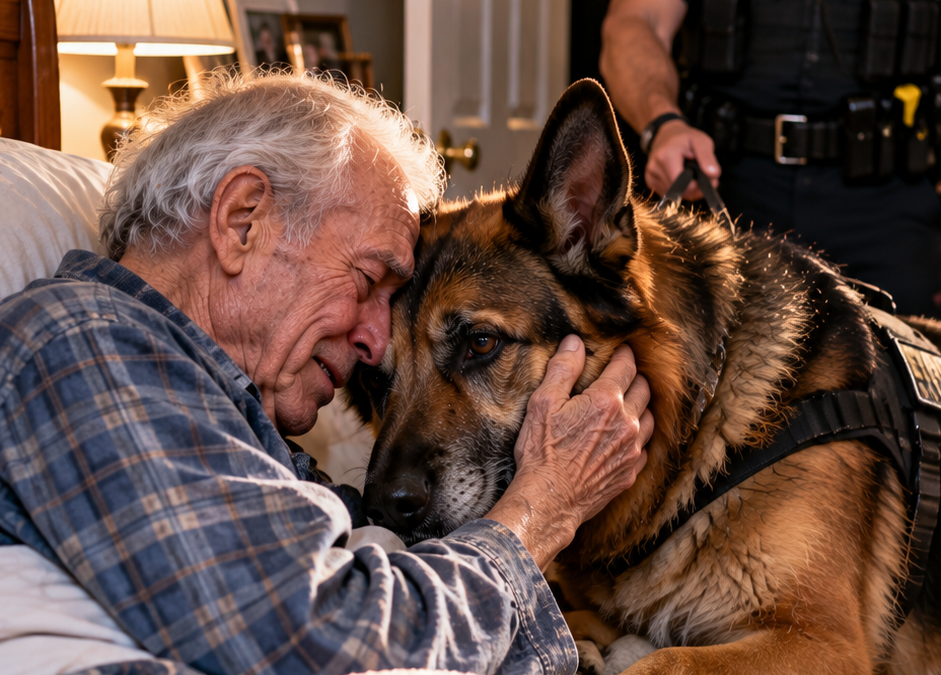
The police had come to our house to ask a few routine questions about a neighbor, but the German Shepherd beside them suddenly ignored everyone and walked straight toward my grandfather’s bedroom.
Grandpa Arthur had been confined to that bed for two years, and the doctors had warned us not to expect him to walk independently again.
Then the dog stopped beside him, and I watched something return to my grandfather’s eyes that I hadn’t seen since long before he became sick.
My grandfather was eighty-seven years old when I began thinking of his bedroom as a waiting room.
I hate admitting that.
But that was what it felt like.
For two years, Arthur had spent most of his days in the same bed beside the same window, under the same faded quilt my grandmother had made before I was born.
He hadn’t always been that way.
The grandfather I remembered from childhood was impossible to keep still.
He repaired fences even when nobody asked him to.
He polished old tools that no longer had any practical use.
He grew tomatoes badly and defended them fiercely.
He argued with television weather forecasts.
He read two newspapers every morning and complained that both had become too expensive.
And he told stories.
So many stories.
Some were from his youth.
Some were about my grandmother.
Some were about military service in a cold mountain region so many decades ago that the photographs looked like they belonged to another century.
But during the last few years, those stories had become less frequent.
Then, after his health declined and his legs weakened, the stories nearly stopped altogether.
He didn’t complain.
That somehow made it harder.
Every morning I brought him breakfast.
Every afternoon I sat near the bed with a book or a newspaper.
Sometimes I played old songs on my phone.
He would listen.
Occasionally he smiled.
But the spark that had once made him seem younger than everyone around him was gone.
His world had slowly shrunk to the size of one room.
Bed.
Chair.
Window.
Medicine.
Meals.
Sleep.
Repeat.
At first, we approached his recovery like a campaign.
Physical therapy.
Exercises.
Specialists.
Home equipment.
Schedules taped to the refrigerator.
I became the kind of granddaughter who knew the names of medications she had never expected to learn and could tell whether he was having a good day by how quickly he reached for his water glass.
For a while, he tried.
Then his progress stalled.
His legs had become extremely weak from age, illness, and long periods of inactivity.
Standing required assistance.
Walking became something discussed in careful language rather than promised.
Eventually, Grandpa stopped asking when he would be able to go outside alone again.
That frightened me more than anything.
The body can weaken slowly.
Hope sometimes disappears faster.
By the second year, he rarely attempted to sit without help.
When I encouraged him, he would wave me away.
“Tomorrow,” I would say.
He would nod.
Tomorrow became weeks.
Then months.
That particular morning began exactly like hundreds before it.
I woke a little after seven.
Made coffee.
Opened the curtains in the living room.
Checked the weather.
Then I carried Grandpa’s breakfast down the hallway.
He was awake, staring toward the window.
“Morning.”
He glanced at me.
“Eggs.”
No reaction.
“Toast.”
Still nothing.
I set the tray down.
“And the coffee you’re technically not supposed to drink this much of.”
That earned me a faint smile.
“There he is.”
Grandpa looked at the cup.
“You want help sitting up?”
He gave a small nod.
I adjusted the bed and helped arrange the pillows behind him.
He seemed tired.
He had seemed tired for months.
“What are we doing today?” I asked.
He raised one eyebrow.
“Don’t look at me like that. We need a schedule.”
He took a sip of coffee.
“Maybe I’ll read you the newspaper.”
His expression said that sounded suspiciously like a threat.
“Fine. Crossword.”
That was our language now.
Half spoken.
Half facial expressions.
After breakfast, I cleaned the kitchen.
At around eleven, someone rang the doorbell.
I wasn’t expecting anyone.
When I opened the door, two police officers stood on the porch.
A woman in her late thirties introduced herself as Officer Olivia Grant.
Beside her was a younger male officer whose name I no longer remember clearly because my attention was immediately taken by the animal standing between them.
A German Shepherd.
Large.
Black and tan.
Beautiful.
He wasn’t restless or overly excited.
He stood beside Olivia with the controlled stillness of a professionally trained dog.
His ears remained upright.
His eyes moved constantly.
Not nervously.
Assessing.
Taking in the porch.
The open doorway.
Me.
Everything.
“This is Max,” Olivia said when she noticed me staring.
“He’s gorgeous.”
Max’s ears twitched at the compliment, but he didn’t move.
Olivia smiled.
“He knows.”
I laughed.
“What can I do for you?”
She explained that they were following up on a minor incident involving one of our neighbors and wanted to know whether we had seen or heard anything the previous evening.
Nothing serious.
Nothing dramatic.
I invited them inside because the morning was cold and I needed a moment to think about what I’d noticed the night before.
Max entered at Olivia’s side.
At first, everything seemed ordinary.
He sniffed lightly near the entrance.
Looked toward the living room.
Then the kitchen.
I answered questions while trying to remember whether I’d heard a vehicle after ten.
“I think there was a truck,” I said. “But I couldn’t tell you whose.”
Olivia wrote something down.
“About what time?”
“Maybe ten thirty? I’m not sure.”
Max suddenly lifted his head.
I noticed because the movement was so sharp.
His entire posture changed.
He turned toward the hallway.
Olivia glanced down.
“Max?”
His nose moved.
Once.
Twice.
Then again.
He stepped away from her.
Not far.
Just enough to make her expression change.
“What’s he doing?” I asked.
“I’m not sure.”
Max took another step toward the hallway.
Then another.
He wasn’t pulling wildly.
He wasn’t barking.
He was following something.
Olivia loosened the leash slightly.
“Easy.”
Max’s nose remained angled forward.
The hallway led to three rooms.
Bathroom.
Guest room.
Grandpa’s bedroom.
Max passed the bathroom without hesitation.
Ignored the guest room.
Then stopped at Grandpa’s doorway.
My stomach tightened.
“That’s my grandfather’s room.”
Olivia looked at me.
“Is he awake?”
“Yes.”
“Would he be comfortable with the dog coming in?”
I hesitated.
Grandpa had always liked animals, but he hadn’t been around a dog in years.
Before I could answer, Max made a low sound.
Not a growl.
More like a quiet whine pushed through closed jaws.
From inside the bedroom, Grandpa turned his head.
He saw Max.
And everything changed.
I had watched my grandfather’s eyes grow dull over two years.
That morning, I watched them come alive in less than a second.
He stared.
Max stared back.
Neither moved.
“Grandpa?”
He didn’t look at me.
His right hand, which had been resting near his hip, slowly tightened against the blanket.
Then his fingers moved toward the side of the bed.
I stepped closer.
“What are you doing?”
He pushed against his elbows.
“Grandpa, wait.”
His arms trembled.
He tried to raise his torso.
I hurried to him.
“You don’t have to sit up.”
He ignored me.
That alone was unusual.
Grandpa had spent months avoiding effort.
Now he was fighting his own body to get upright.
Max stepped farther into the room.
His tail was low.
His ears forward.
The dog wasn’t frightened.
He looked almost solemn.
Grandpa stared at him.
Then his lips moved.
At first, no sound came.
His throat worked.
His eyes filled with tears.
And then I heard one word.
“Napoleon?”
I looked at Olivia.
She looked just as confused as I felt.
“Grandpa?”
Max approached the bed.
Slowly.
He stopped beside it.
Grandpa reached one shaking hand toward him.
Max lifted his muzzle.
Their eyes met.
Grandpa whispered again.
“Napoleon…”
Something about the name seemed to tear open a door inside him.
He moved his legs toward the side of the bed.
That frightened me.
“No.”
I grabbed his arm.
“Grandpa, stop. You’re going to fall.”
He looked at me then.
And there was something in his expression I hadn’t seen for years.
Determination.
Not anger.
Not confusion.
Determination.
He shook his head.
Then looked at Max.
The dog stood absolutely still.
Grandpa planted both hands on the mattress.
His feet touched the floor.
I moved in front of him.
“At least let me help.”
He allowed me to support one arm.
Olivia stepped forward too.
“Sir, take it slowly.”
Grandpa pushed.
His entire body shook.
His legs looked impossibly thin beneath his pajama pants.
For a moment, nothing happened.
Then his hips lifted.
An inch.
Two.
His knees trembled violently.
“Grandpa—”
He made a sound through clenched teeth.
Not pain exactly.
Effort.
He pushed again.
And my eighty-seven-year-old grandfather stood.
Not independently.
Not steadily.
He was holding the bed with one hand and gripping my forearm with the other.
His knees were bent.
His shoulders shook.
Every breath sounded difficult.
But he was upright.
I began crying before I even realized it.
Olivia whispered, “Oh my God.”
Grandpa didn’t look at either of us.
He looked at Max.
Then, with terrible slowness, he released his grip on my arm.
I panicked.
“Grandpa.”
He moved his right hand upward.
His fingers reached his temple.
And he saluted.
The gesture was precise.
Old.
Automatic.
Something stored deeper than muscle weakness.
Max’s ears rose higher.
Grandpa’s face broke.
Tears ran freely down both cheeks.
“Napoleon,” he whispered.
“I knew you’d come back.”
I had no idea what he meant.
But I knew better than to interrupt.
Olivia moved closer to me.
“Let him have the moment,” she said quietly.
Grandpa could stand only a few seconds before his legs began to fail.
We helped him back onto the mattress.
He was breathing hard.
Sweat had appeared across his forehead.
But he was smiling.
Not the polite little smile he sometimes gave me so I would stop worrying.
A real smile.
Max came beside the bed.
Grandpa placed one hand on his head.
His fingers disappeared into the thick fur.
“You’re not him,” he murmured.
He studied Max.
“No.”
Pause.
“But you know.”
I looked at Olivia.
“What does that mean?”
She shook her head.
“I don’t know.”
Max closed his eyes beneath Grandpa’s hand.
Grandpa stroked the dog’s neck.
Then he said something I hadn’t expected.
“He smells it.”
“Smells what?” I asked.
Grandpa looked at me.
“The old life.”
That was the beginning.
The police officers finished their questions eventually.
Honestly, I barely remember answering them.
Nothing about our neighbor mattered anymore.
Before leaving, Olivia asked Grandpa whether Max could visit him again.
Grandpa looked at the dog.
Then at her.
“When?”
It was the longest sentence he’d said all week.
Olivia smiled.
“We’ll arrange it.”
After they left, I helped Grandpa settle back into bed.
He looked exhausted.
But not empty.
There is a difference.
I sat beside him.
For several minutes, neither of us spoke.
Then I asked,
“Who was Napoleon?”
Grandpa’s eyes moved toward me.
I’d heard the name before.
Somewhere.
Years earlier.
Maybe in one of his stories when I was too young to understand.
But I couldn’t place it.
Grandpa turned toward the photograph frame on his nightstand.
It contained a picture of my grandmother.
He stared at it.
Then he began talking.
Really talking.
Not short answers.
Not fragments.
A story.
“When I was young,” he said, “I served in a border unit in the mountains.”
His voice was weak, but there was life in it.
“It was cold.”
I smiled.
“How cold?”
“The kind that makes you question every decision that brought you there.”
That sounded like him.
My grandfather.
The storyteller.
I leaned closer.
He continued.
Snow covered the mountains for months.
The wind could strip warmth from your body in minutes.
Night patrols were long.
Isolation wore men down faster than the weather.
Then someone assigned him a German Shepherd.
Young.
Strong.
Restless.
Brilliant.
His official name had been something forgettable, Grandpa said.
He renamed him Napoleon because, in his words, “he was short on patience and convinced he owned Europe.”
I laughed.
Grandpa smiled.
“There you are,” I whispered.
“What?”
“Nothing.”
He continued.
Napoleon became his working partner.
Then his friend.
Then something harder to define.
“You spend enough nights alone with a dog,” Grandpa said, “you learn there’s silence and then there’s silence.”
I waited.
“Human silence can feel empty.”
His eyes shifted toward the doorway where Max had been.
“A good dog’s silence doesn’t.”
Grandpa told me about patrols.
About checking remote areas in terrible weather.
About nights when he would talk to Napoleon simply because there was nobody else around.
The dog listened.
Always.
Then Grandpa told me about the ravine.
It happened during winter.
He had been moving along a mountain route when his boot lost traction on ice.
One moment he was walking.
The next he was falling.
He tumbled down a steep slope and landed hard.
When he woke, it was already getting dark.
He couldn’t stand.
His back hurt.
One leg barely responded.
Snow was falling.
“I knew the temperature would drop hard after sunset,” Grandpa said.
“What did you do?”
“What could I do?”
He looked at me.
“I yelled.”
“Could anyone hear you?”
“No.”
His expression changed.
“I thought that was it.”
My throat tightened.
“You thought you were going to die?”
“I was pretty convinced.”
He said it calmly.
Too calmly.
“What about Napoleon?”
A smile appeared.
“That fool came down after me.”
The dog found him.
Grandpa said Napoleon barked repeatedly toward the ridge.
Ran uphill.
Returned.
Ran up again.
Trying to attract attention.
But as darkness fell and nobody came, Napoleon did something else.
He lay against Grandpa.
Pressed his body along his chest and side.
Shared his warmth.
Every time Grandpa began drifting toward sleep, Napoleon moved.
Nudged him.
Licked his face.
Refused to let him disappear.
“All night?” I asked.
“All night.”
Grandpa’s eyes grew wet.
“That animal was shaking by morning.”
The rescue team finally located them after sunrise.
“They found me conscious.”
Grandpa looked toward the window.
“They found him lying across me.”
I had known my grandfather nearly my entire life.
I had never heard this story.
“Why didn’t you tell me?”
He shrugged.
“Some things don’t fit at the dinner table.”
He told me another memory.
A night patrol.
Napoleon suddenly stopped.
Wouldn’t move.
Grandpa tried to pull him forward.
The dog growled toward the darkness.
Several yards ahead, partly concealed near the route, was a wild animal.
Grandpa never gave me an exaggerated version.
He didn’t claim Napoleon had fought some giant beast.
He simply said the dog noticed danger before he did.
That was enough.
“He saved your life twice.”
Grandpa considered that.
“More.”
“What other times?”
He tapped one finger against his chest.
“Here.”
I understood.
Loneliness.
Fear.
Things young men pretend don’t affect them.
Napoleon had carried him through those too.
Years passed.
The dog aged.
His muzzle went gray.
His pace slowed.
Grandpa’s assignments changed.
But whenever possible, they remained together.
When Napoleon’s working years ended, Grandpa stayed involved in his care.
Toward the end, they spent hours sitting together.
“Did you talk to him?”
“Constantly.”
“What about?”
“Everything.”
He smiled faintly.
“He never interrupted.”
When Napoleon finally died, Grandpa buried him on a small hill overlooking the valley where they had worked together.
He stayed there until evening.
Then he made himself a promise.
Never another dog.
“Why?”
Grandpa looked down at his hands.
“Because losing him hurt too much.”
I said nothing.
“I figured if I never had another one, I’d never have to feel that again.”
“Did it work?”
He looked at me.
“No.”
That answer sat between us.
Avoiding love had not prevented grief.
It had only preserved it.
Napoleon remained with him anyway.
In memory.
In dreams.
In habits.
Grandpa admitted that sometimes, decades later, he woke in the night believing he’d felt a paw against his hand.
Then age came.
Then illness.
Then two years in bed.
“At some point,” he said, “I decided my useful years were finished.”
My chest tightened.
“Grandpa.”
“Don’t.”
He raised a hand.
“I’m telling you what I thought.”
I nodded.
He stared toward the hallway.
“Then Max walked in.”
His voice softened.
“He looked at me exactly the same way.”
“Like Napoleon?”
“Not the same dog.”
Grandpa shook his head.
“Not that.”
“Then what?”
“Like I was still someone.”
I couldn’t speak.
For two years, everyone who entered Grandpa’s room had treated him carefully.
Doctors.
Nurses.
Therapists.
Family.
We watched his blood pressure.
His pain.
His balance.
His appetite.
We saw an elderly man who needed protection.
Max hadn’t.
Max had simply looked at him.
Alert.
Interested.
Respectful.
Maybe that was what Grandpa meant.
“Why did you stand?” I asked.
He thought for a moment.
“Because he was waiting.”
“For what?”
“For me.”
His eyes filled again.
“I couldn’t salute him from bed.”
The next morning, Grandpa asked to sit up without help.
I almost dropped his breakfast.
“What?”
He gestured toward the bed rail.
“You want to try?”
“Yes.”
I helped only when necessary.
It took him nearly a minute.
His arms shook.
But he got upright.
That afternoon, he asked to place his feet on the floor.
The next day, he tried standing with me beside him.
He lasted three seconds.
The following day, five.
Then seven.
I called his doctor.
The doctor warned us to be careful.
Progress after prolonged immobility had to be managed safely.
So we brought physical therapy back into the house.
Grandpa, who had resisted the same exercises months earlier, now treated them like orders.
“Again,” he’d say.
The therapist would answer, “Arthur, that’s enough.”
“Again.”
“Tomorrow.”
“One more.”
I recognized that stubbornness.
It had been missing.
A week later, Olivia returned with Max.
I had never seen Grandpa prepare for anyone the way he prepared for that dog.
He asked me to help him shave.
Then wanted his hair combed.
Then sent me into the closet.
“For what?”
“Brown jacket.”
“The old one?”
“Yes.”
“You haven’t worn that in years.”
“Today.”
I found it.
The jacket hung loose on him because he had lost weight.
He didn’t care.
I helped him into his chair.
When Olivia’s car pulled into the driveway, Grandpa straightened immediately.
“You’re acting like the president is coming.”
He looked offended.
“Higher rank.”
I laughed.
Max entered the house.
This time, he knew exactly where to go.
He walked down the hallway.
Entered Grandpa’s room.
And placed his head directly on Grandpa’s knee.
Grandpa closed his eyes.
“Hello, soldier.”
Max’s tail struck the floor.
Olivia smiled.
“I think he remembers you.”
“He better.”
Grandpa scratched behind his ears.
“I outrank him.”
Olivia laughed.
“Not in my unit.”
Grandpa looked at Max.
“You hear that? No respect.”
For the next hour, I barely existed.
Grandpa talked to Max.
About Napoleon.
About weather.
About how terrible the coffee had been during service.
About people who had been gone for decades.
Max listened.
Sometimes he looked up.
Sometimes he rested.
At one point, Grandpa started humming.
I stopped in the hallway.
The melody was unfamiliar.
Slow.
Almost like a lullaby.
Olivia heard it too.
“What song is that?” she whispered.
“I don’t know.”
Grandpa hadn’t sung anything in years.
That night, after Max left, Grandpa called me back into his room.
He was sitting upright.
The old photograph albums were on the bed.
“Help me find him.”
“Napoleon?”
He nodded.
We searched for almost an hour.
Most of the pictures were faded.
Family holidays.
Grandma.
My mother as a child.
Cars.
Houses.
Men whose names I didn’t know.
Then Grandpa touched my arm.
“There.”
The photograph was small.
Black and white.
A young soldier stood beside a German Shepherd.
Grandpa.
I recognized the eyes.
He looked impossibly young.
Maybe twenty.
Napoleon stood pressed against his leg.
Grandpa’s hand rested on the dog’s shoulder.
Both were facing the camera.
But the relationship between them was visible even after all those decades.
Grandpa held the photograph carefully.
“That’s him.”
He smiled.
“Arrogant animal.”
“He looks serious.”
“He was.”
“You look happy.”
Grandpa didn’t answer for a moment.
“I was.”
We placed the photograph beside his bed.
Another copy went into his jacket pocket.
The visits with Max continued whenever Olivia’s schedule allowed.
Every visit had the same effect.
Grandpa sat taller.
Talked more.
Worked harder during therapy.
At first, I thought it was simply excitement.
Then I realized Max represented something larger.
He was a bridge.
Not between Grandpa and Napoleon exactly.
Between Grandpa and the man he used to be.
One afternoon, Olivia and I stood in the kitchen while Max stayed beside Grandpa.
“Why did Max react to him like that?” I asked.
She considered the question.
“Service dogs notice things we miss.”
“Like what?”
“Movement. Scent. Posture. Familiar behavior.”
She leaned against the counter.
“People who have spent years around working dogs sometimes move differently around them. They give off different signals.”
“So Max knew Grandpa had handled dogs?”
“Maybe.”
She smiled slightly.
“Or maybe he just liked him.”
I appreciated that answer.
No magic.
No impossible explanation.
Just an extraordinary connection.
Whatever Max had noticed, it was enough.
The doctors were surprised by Grandpa’s renewed motivation, but nobody claimed a miracle cure.
His body was still eighty-seven.
His muscles were weak.
He required careful rehabilitation.
There were bad days.
Days when his knees hurt.
Days when his blood pressure dropped.
Days when he managed three steps one morning and only one in the afternoon.
Once he became so frustrated that he slammed his hand against the bed.
“I was stronger yesterday.”
“Yesterday isn’t today.”
“I know.”
“Then stop punishing yourself.”
He glared.
“That’s an order.”
That made him look at me.
“Since when do you give orders?”
“Since you became unreasonable.”
He grumbled something.
“What?”
“Nothing.”
“I heard you.”
“Good.”
I smiled.
There he was again.
Slowly, his world expanded.
Bed to chair.
Chair to doorway.
Doorway to hallway.
Hallway to living room.
Then came the garden.
The first attempt took nearly twenty minutes.
I stood beside him.
His cane planted carefully before every step.
Left foot.
Pause.
Right foot.
Breathe.
Again.
He reached the back door.
Sunlight hit his face.
Grandpa stopped.
For a second, I thought he was tired.
Then I realized his eyes were closed.
He was feeling the sun.
Two years inside one room.
And suddenly there was warm air on his skin again.
“You okay?”
He nodded.
We continued.
There was an old wooden bench near the back of the garden.
Maybe forty feet from the door.
That became our objective.
Forty feet might as well have been forty miles.
He took one step.
Then another.
Halfway there, he leaned heavily on the cane.
“We can turn around.”
“No.”
“Grandpa.”
“Bench.”
So we reached the bench.
He lowered himself onto it.
His chest rose and fell quickly.
I stood nearby, pretending I wasn’t crying.
He noticed anyway.
“Stop that.”
“I’m not doing anything.”
“You’re leaking.”
I laughed.
“I’m happy.”
He looked at the garden.
“So am I.”
That became his place.
And when Max visited, that was where they sat.
Grandpa on the bench.
Max at his feet.
Olivia sometimes stayed.
Sometimes she let me watch while she checked messages from her car nearby.
Grandpa would wear his best shirt.
I teased him once.
“Max doesn’t care what you’re wearing.”
Grandpa adjusted his collar.
“Professional courtesy.”
“For a dog?”
“Especially for a dog.”
One evening, the sky turned orange over the yard.
Grandpa sat on the bench.
Max lay beside him.
I watched from the kitchen doorway.
Grandpa’s hand moved slowly across the thick fur.
Then he began humming that same old melody.
The song seemed to belong to another time.
Another country.
Another version of him.
Max closed his eyes.
For several minutes, man and dog remained together beneath the fading light.
No drama.
No miracle.
Just quiet.
Later that night, Grandpa asked me to sit with him.
“I thought I was finished,” he said.
I didn’t interrupt.
“Not dying.”
He shook his head.
“Finished.”
“What’s the difference?”
“Big difference.”
He looked down at his hands.
“Being alive and expecting nothing from life aren’t the same thing.”
That hurt.
Because I knew exactly what he meant.
“I stopped expecting anything.”
He looked toward the photograph of Napoleon.
“Then that dog walked in.”
“Max.”
“I know his name.”
I smiled.
Grandpa continued.
“I looked into his eyes and remembered what it was like to be responsible for something.”
“You were responsible for Napoleon?”
“He depended on me.”
“He also saved you.”
“That’s how it works.”
Grandpa looked at me.
“That’s the thing people misunderstand about being needed.”
“What?”
“It goes both ways.”
I thought about that.
Grandpa had spent two years receiving care.
Food brought to him.
Medicine given to him.
Help dressing.
Help sitting.
Help standing.
Everything flowed in one direction.
Then Max entered his room and looked at him not like a patient, but like someone worth approaching.
Someone familiar.
Someone capable of answering.
“I stood because I didn’t want him to see me defeated,” Grandpa said.
“You weren’t defeated.”
He gave me a look.
“You know what I mean.”
I did.
“It wasn’t strength.”
He touched his chest.
“I barely had any.”
“Then what was it?”
“Memory.”
His eyes moved toward Napoleon’s picture.
“I remembered who I had been.”
The months passed.
Grandpa became more independent.
He never returned to the physical strength of his youth.
Of course he didn’t.
That wasn’t the point.
He walked slowly with a cane.
He tired easily.
Some mornings were better than others.
But every morning, he got out of bed.
That alone felt enormous.
He started reading the newspaper at the kitchen table again.
Crossword puzzles returned.
So did his arguments with television news anchors.
He began talking to neighbors through the fence.
Mr. Lewis next door nearly dropped his gardening shears the first time he saw Grandpa outside.
“Arthur?”
Grandpa raised one hand.
“Still here.”
Mr. Lewis stared.
“I can see that.”
Grandpa pointed at his tomatoes.
“Those are terrible.”
Mr. Lewis laughed for nearly a minute.
I stood inside the house listening to them argue over fertilizer.
It was one of the happiest sounds I’d ever heard.
Grandpa also began telling stories again.
I started writing them down.
At first, just notes.
Then entire pages.
He noticed.
“What are you doing?”
“Saving these.”
“For what?”
“Someday you’ll pretend you never said them.”
He nodded.
“Fair.”
I bought a thick notebook.
On the first page I wrote:
Arthur’s Stories
He hated the title.
“Sounds like a children’s book.”
“Do you have a better one?”
“No.”
“Then that’s the title.”
He complained for two weeks.
Then started reminding me when I’d forgotten to bring the notebook.
Napoleon appeared in dozens of stories.
Not always as a hero.
Sometimes as a thief.
Apparently he had once stolen an entire piece of cooked meat from a table while nobody was looking.
“He didn’t steal it,” Grandpa insisted.
“What would you call that?”
“Tactical acquisition.”
“He stole it.”
“Young people have no respect for professional terminology.”
Max remained part of our lives too.
He still belonged to Olivia.
He still had work.
Grandpa understood that.
One afternoon, I asked,
“Would you ever want a dog of your own?”
He looked at me for a long time.
Years earlier, I knew the answer would have been immediate.
No.
Never again.
This time he smiled.
“No.”
I nodded.
Then he continued.
“But not for the reason you think.”
“Why?”
“Max already has his person.”
He looked toward the driveway.
“And I made Napoleon a promise.”
“You still believe that promise matters?”
“Yes.”
I started to speak.
He held up one finger.
“But I understand it differently now.”
I waited.
“A promise to remember someone shouldn’t become a promise never to love anything again.”
That sentence stayed with me.
Grandpa looked at Napoleon’s photograph.
“I thought honoring him meant keeping the door closed.”
“And now?”
“Now I think honoring him means remembering who he taught me to be.”
Six months after the morning the police arrived at our door, Grandpa walked through the garden every day.
Slowly.
Carefully.
But without me holding his arm.
He still used the cane.
He still had to rest on the bench.
Yet he did it.
Every morning.
Sometimes I stood at the kitchen window and watched him.
Step.
Cane.
Step.
Pause.
Breathe.
Continue.
The distance that had once seemed impossible became routine.
His doctor called the improvement remarkable.
The physical therapist credited motivation, consistent exercise, and the fact that Grandpa had finally begun participating fully again.
Grandpa credited Max.
“Medical science,” I told him.
“Dog.”
“Physical therapy.”
“Dog.”
“Exercise.”
“Dog.”
“You’re impossible.”
“Dog.”
I gave up.
Max still visited whenever Olivia could bring him.
The moment Grandpa saw the police vehicle turn onto our street, he became ten years younger.
He straightened his shirt.
Checked his hair.
Sometimes he actually went outside before they reached the door.
Max would step from the vehicle.
Spot him.
Walk over.
And sit directly in front of him.
Grandpa always saluted.
Not because Max was Napoleon.
Grandpa never confused the two after that first morning.
The salute had become something else.
A greeting.
A tribute.
A promise remembered.
Then Max usually placed one paw on Grandpa’s shoe.
“You’re getting sentimental,” Grandpa would tell him.
Max would stare.
“Don’t deny it.”
Olivia and I laughed.
Grandpa never cared.
Sometimes they sat together without speaking for twenty minutes.
I used to think the important part was Grandpa telling stories again.
Now I understood silence differently.
There was the silence of those two years when Grandpa had nothing he wanted from tomorrow.
And there was the silence between him and Max.
Those were not the same thing.
One was emptiness.
The other was companionship.
One afternoon, I asked Grandpa whether he still thought about the day Max first entered his bedroom.
“Every day.”
“Were you scared when you tried to stand?”
“No.”
“Really?”
He considered.
“Maybe a little.”
“A little?”
“My knees felt like wet cardboard.”
I laughed.
“Then why didn’t you stop?”
He looked toward Max, who was lying near the bench.
“Because sometimes your body needs your mind to go first.”
That sounded like one of his old sayings.
I wrote it down later.
Grandpa noticed.
“Don’t quote everything I say.”
“Say fewer quotable things.”
“That’s not how this works.”
By then, the spark had fully returned.
Not youth.
Not perfect health.
Something better.
Interest.
He cared about tomorrow again.
That was what Max had given him.
Or perhaps what Max reminded him he still possessed.
One night, we sat together near the open back door.
The air was warm.
Crickets sounded in the yard.
Grandpa held Napoleon’s old photograph.
I had seen it so many times by then that I knew every detail.
Young Arthur.
Straight back.
Military uniform.
Napoleon at his side.
“You really thought he’d sent Max?” I asked.
Grandpa smiled.
“I was emotional.”
“That’s not an answer.”
He looked at the photograph.
“Do I literally think a dead dog arranged for a police K9 to walk into my bedroom?”
“Yes.”
“No.”
“Okay.”
He paused.
“But.”
I laughed.
“There’s always a but.”
“There is.”
He rubbed the edge of the picture with his thumb.
“I think love leaves instructions.”
I frowned.
“What does that mean?”
“Napoleon taught me things.”
“Like?”
“Loyalty.”
“Patience.”
“Responsibility.”
“How to get up when you’re tired.”
He smiled.
“Apparently I forgot that last one.”
I said nothing.
“Max didn’t bring Napoleon back.”
Grandpa looked toward the dark yard.
“He brought back what Napoleon had already left in me.”
That was the clearest explanation he ever gave.
Today, when I think about that morning, I don’t think first about Grandpa standing.
People always focus on that part.
The impossible-looking moment.
An eighty-seven-year-old man who had spent two years mostly confined to bed pushing himself upright because a German Shepherd was standing beside him.
Yes, it was extraordinary.
I was there.
I saw his knees shake.
I felt his fingers crush my arm.
I watched him raise that trembling hand to salute.
But the standing wasn’t the most important part.
The most important thing happened a second earlier.
His eyes changed.
Before his body moved, something inside him did.
He remembered.
Napoleon lying against him in the snow.
Napoleon warning him in the darkness.
Napoleon growing old beside him.
A young soldier who had once been needed.
A man who had once believed tomorrow contained something worth getting up for.
Max didn’t heal eighty-seven years of age.
He didn’t erase weakness.
He didn’t make two years of physical decline disappear.
He did something simpler.
He gave Grandpa a reason to try again.
The work came afterward.
The exercises.
The pain.
The cane.
The falls we narrowly prevented.
The frustration.
The bad days.
The repetitions nobody would put into an inspirational story because they aren’t dramatic enough.
Those were what actually got him into the garden.
But the beginning was one look.
Sometimes beginnings are like that.
Quiet.
Unexpected.
Disguised as an ordinary interruption.
Two police officers came to our house because they wanted information about a neighbor.
That was all.
If someone had asked me that morning what I expected from the day, I probably would have said coffee, laundry, Grandpa’s medication, and maybe a crossword puzzle.
Instead, a German Shepherd walked down our hallway.
Stopped beside a bed.
And reminded an old man of the version of himself he thought had disappeared forever.
Grandpa still says the same thing whenever I ask what Max gave him.
“He didn’t give me my legs back.”
Then he taps his chest.
“He gave me this back.”
I know what he means.
Not his heart.
His willingness to use it.
And every time Max comes through the gate, Grandpa walks out to meet him.
Cane in one hand.
Back as straight as age allows.
Napoleon’s old photograph still tucked into his favorite jacket.
He stops in front of Max.
Max sits.
Grandpa smiles.
Then the old soldier raises his hand to his temple.
And salutes.

