𝗙𝗨𝗟𝗟 𝗦𝗧𝗢𝗥𝗬 The Pipe Beneath My Fence Was Only the First Thing They Had Buried
𝗙𝗨𝗟𝗟 𝗦𝗧𝗢𝗥𝗬
Nina took the page from her.
“Where is Mesa Crown’s written approval?”
“The easement gives us access.”
“It may give you something,” Nina said. “It does not automatically give you company water.”
Then she looked at me.
“Do you have your father’s complete copy?”
I stared at the signature.
“I don’t know.”
That was the problem.
Five minutes earlier, I had believed I was looking at a simple theft.
Now I was looking at a buried pipe connected to a thirty-year-old document containing my father’s signature and language broad enough to cause trouble.
Felicity slid the document back into her folder.
“Keep your hands off the connection. If you interrupt an emergency supply, Canyon Vista will hold you responsible.”
I did not answer.
Because until I found the rest of that agreement, I did not know whether she was bluffing.
At sunrise, the orchard showed what the meter had only suggested.
Leaves in the north block had begun folding lengthwise.
The soil beneath several emitters was dry two inches down.
That should not have happened during my irrigation turn.
I had seen drought damage before. So had my wife, Elena.
For thirty-seven years, she had understood our orchard in ways I never fully did. I knew water, equipment, pruning, frost protection, and field work.
Elena knew the business.
She knew which loan payment could wait three days and which supplier needed to be paid before lunch. She knew what percentage of a crop we could lose and still make payroll. She could look at our books in March and tell me whether I was allowed to feel optimistic in August.
She had been gone three winters.
Some mornings, I still expected to hear her opening the kitchen door behind me.
Instead, at seven, our daughter Rosa drove into the yard with a cardboard file box in the backseat.
She was thirty-two and worked as a physical therapist in Grand Junction. During harvest she handled online orders, customer emails, and enough paperwork to remind me of her mother.
For nearly a year, she had also been trying to make me discuss selling the orchard.
Not because she hated it.
Because she understood what loving a farm could cost.
She opened the car door.
“I came early because I need to show you something.”
Then she saw the north block.
The curled leaves changed her expression.
“What happened?”
I pointed toward Canyon Vista.
“They put a pump into our lateral.”
She stared at me.
“What?”
“Underground. Twelve-inch line. They say Grandpa authorized drought access in 1996.”
Rosa said nothing for several seconds.
Then she opened the back door of her car.
Inside the file box was a broker’s valuation.
She had planned to show it to me on Sunday.
The offer came from a produce warehouse company interested in our road frontage and packing shed. They would preserve the farmhouse, remove most of the peach trees, and lease whatever acreage remained to another grower.
Rosa watched me read the first page.
“You told me to be honest about the future.”
“So we sell because somebody steals water?”
“This isn’t because of this morning.”
She pointed toward the equipment shed.
“The frost fan needs repairs. Labor went up again. Last year barely covered the operating loan.”
“We survived last year.”
“Mom used to hate when you said that.”
I looked at her.
Rosa swallowed.
“She’d say survival isn’t a business plan.”
That landed because it was true.
I wanted to tell her Navarro Orchard had survived sixty-seven seasons.
My grandfather planted the first peach rows in 1959.
My father expanded them.
Elena and I planted the north block after Rosa was born.
But history did not make payroll.
History did not repair frost fans.
History did not magically replace water.
We checked every distribution box together.
The pressure was too low to irrigate all four blocks.
Keeping the north block alive meant shutting off the younger trees near the packing shed.
Ninety-two of them.
Rosa stood beside the south valve.
“Those are the trees we planted after Mom got sick.”
“I know.”
“If we close them in this heat—”
“They may recover.”
“And the north block?”
“The fruit won’t.”
She looked toward the younger trees.
Then toward the north rows Elena had planted.
There are decisions people imagine farmers make with certainty because we work outside and know how to fix things.
The truth is that sometimes farming means choosing which living thing suffers first.
Rosa put both hands on the valve.
Then she turned it.
The pipe shuddered as the remaining water moved north.
Neither of us spoke.
At ten that morning, our peach buyer called.
The contract required minimum pack size from the north block.
If the fruit stalled under heat and water stress, he could cut Monday’s order.
That gave us five days.
The weather gave us less.
Rosa and I pulled footage from the pump-house camera.
The camera did not show the trench itself, but it showed vehicles.
A Canyon Vista maintenance pickup.
A High Desert Pump and Rental truck.
Three visits after midnight on three consecutive nights.
Then the HOA emailed its legal packet.
The first page was titled Shared Drainage and Landscape Maintenance Easement.
The blue route appeared again.
Behind it was a letter from my father to the original developer.
One paragraph read:
Temporary connection may be used during construction and declared drought conditions subject to the terms on the following page.
The following page was gone.
Felicity’s attorney wrote that the HOA had never received it.
I searched my father’s old files.
I found our copy of the first page.
No second page.
The staple holes showed something had once been attached.
Rosa read the sentence twice.
“What if Grandpa really gave them drought access?”
“Then we find out what the terms were.”
“And while we look?”
Above us, the hidden pump restarted.
Water rushed through the buried line.
The pressure gauge in front of us dropped.
Rosa looked at the broker’s valuation sitting inside her car.
“This is what I meant.”
I turned toward her.
“The farm can be taken apart one emergency at a time,” she said. “A frost. A loan. A bad harvest. Somebody taking water. And we’re always the ones proving what happened after the damage is done.”
I wanted to tell her the land was worth fighting for.
The closed valve behind us made the answer feel cheap.
Canyon Vista called an emergency board meeting that afternoon.
The clubhouse overlooked the ornamental lake.
Eighteen unfinished premium lots curved around a pale rock shoreline. Beyond the glass wall, I could see sprinklers running over landscaping that had no business being green during that kind of heat.
Felicity stood in front of a projection screen.
Behind her was an artist’s rendering of the finished lake.
Children in kayaks.
Mature cottonwoods.
Perfect lawns.
No irrigation pipes.
No orchard below it.
No mention of where millions of gallons were supposed to come from.
“The lake is a critical drought and safety asset,” she began.
Then she looked at me.
“An adjacent landowner is attempting to obstruct water access granted to this community decades ago.”
She displayed my father’s letter.
Then the blue route.
Then she revealed the deadline.
Canyon Vista and its developer had refinanced an $8.6 million construction note.
A lender would inspect the lake, clubhouse landscaping, and eighteen premium lots on Tuesday.
If the amenity package failed inspection, Canyon Vista could lose access to the final $1.9 million construction draw.
Felicity called that a threat to every homeowner’s property value.
Suddenly the hidden pump made more sense.
The subdivision did not simply need water.
It needed a full lake by Tuesday.
A woman near the front stood.
Her name was Melanie Voss. Two children sat beside her.
“If that’s emergency water,” she asked, “are our homes less safe every time the pump is turned off?”
Felicity answered before anyone else could.
“That is exactly the danger Mr. Navarro is creating.”
The room turned toward me.
For one second, I saw how easily the story could become simple.
Eighty-six homes.
Dry summer.
Visible lake.
Old farmer angry about water.
I could have told them their lake was useless.
But I did not know that.
So I said the only thing the documents allowed me to say.
“I have not seen a fire district certification for this lake. If one exists, the board should produce it. But even if firefighters can use the water, that doesn’t answer who owns the water you put in it.”
Melanie sat down slowly.
Fear rarely waits for a title search.
Felicity understood that better than anyone in the room.
Treasurer Harold Kim raised his hand.
“Did we purchase water from Mesa Crown?”
“The association is exercising an existing right,” Felicity said.
“Do we have a current delivery ticket?”
“Our easement predates their current process.”
That was not an answer.
During public comment, I placed photographs on an easel.
The buried connection.
The pump serial number.
The wrong seal.
The wet trench beneath my fence.
Felicity looked at them and gave a thin smile.
“Mr. Navarro is an orchard owner. He is not qualified to audit a regional water system.”
“I worked that system for twenty-two years.”
The room went quiet.
“I was Mesa Crown’s senior ditch rider before Nina Patel. I opened Headgate 14. I inspected seals along this reach. I approved and documented temporary connections.”
I pointed toward the blue line on Felicity’s screen.
“There was never an HOA intake on my private lateral.”
A man near the aisle frowned.
“Then why didn’t you say that from the beginning?”
“Because my old job doesn’t decide what my father signed.”
I held up the incomplete letter.
“This does. And we’re missing a page.”
Felicity seized the opening immediately.
“Even Mr. Navarro admits the agreement may authorize our use.”
“I admit your copy is incomplete.”
Harold asked whether the pump would operate that night.
The HOA attorney said the association would preserve existing conditions pending review.
Everyone understood what that meant.
The pump would keep running.
Rosa waited until we were outside.
“If the second page says they can use the water, what happens?”
“We follow it.”
“Even if we lose the crop?”
“If it’s valid, we negotiate emergency replacement water and damages.”
She looked back through the clubhouse glass.
“They get certainty from half a document.”
Her voice tightened.
“We get dead trees while we search for the other half.”
At 11:46 that night, Nina’s pressure recorder sent an alert.
The pump was drawing harder than before.
Rosa followed me to the north gate.
A Canyon Vista security pickup had been parked across the maintenance path.
Behind it, the pump enclosure vibrated under floodlights.
I walked toward the guard.
“Mesa Crown equipment is behind you.”
He held up one hand.
“Counsel says nobody is allowed to alter shared infrastructure.”
“A company seal has already been altered.”
He did not move.
Rosa took out her phone and started recording.
The blocked path.
The pump noise.
The time.
The pressure alert on my screen.
I called Nina.
She contacted Mesa Crown’s manager and the sheriff’s non-emergency line.
Two deputies arrived twenty minutes later.
They did not arrest anyone.
They did not threaten anyone.
They stood between two groups of tired, angry people and made sure nobody turned a water dispute into something worse.
Felicity arrived carrying the red folder.
Mesa Crown’s manager examined the connection.
Then he made the only immediate decision he believed he could legally defend.
He ordered the upstream control closed until the unapproved draw could be isolated safely.
The pump stopped.
Then the channel stopped.
Every gallon headed toward my orchard stopped with it.
Felicity looked at the silent waterway.
Then at me.
“You wanted control,” she said. “Now nobody gets water tonight.”
I stared at the dry gate.
“Your trees may not have tonight,” she added.
Rosa lowered her phone.
“You knew exactly what this would do.”
Felicity looked at her.
“I know your father chose confrontation over cooperation.”
“Cooperation happens before you bury a pipe.”
Felicity walked away.
The gate remained closed until morning.
I stood beside a dry distribution box while a lake above me held water that had passed through my farm account.
At sunrise, the ninety-two young trees we had shut down the day before had almost no soil moisture left.
By ten, the temperature reached 100.
Rosa called every water supplier within sixty miles.
The first tanker could not arrive until evening.
We stretched temporary shade cloth over the weakest young trees.
The wind pulled at the clips.
At three, one tree dropped nearly every leaf on its western side.
By four, the bark on two new limbs was so hot I could not keep my palm against it.
Rosa drove to the county road twice looking for the tanker.
The second time she came back, she stayed in the truck for almost a minute.
I walked over.
She stared through the windshield.
“What happens if it doesn’t come?”
“We start cutting fruit from the weakest north rows.”
Her head turned.
“Fruit we already sold?”
“Trees first. Contract second.”
She closed her eyes.
Then she got out.
We carried three empty harvest bins into the north block.
For the next two hours, we removed hard green peaches by hand.
Fruit that had taken months to grow.
Fruit Elena would have checked every morning.
Fruit that would never reach a packing line.
Every peach we dropped onto the ground was water the tree no longer had to carry.
I heard the first tanker before I saw it.
Rosa started crying.
Not loudly.
She turned away and wiped her face with the shoulder of her shirt.
I pretended not to notice until she was ready to move again.
Mesa Crown’s preliminary comparison arrived later.
The company gate had released approximately eleven acre-feet of water since Sunday evening.
About 3.6 million gallons.
My downstream totalizer showed only about 1.2 million reaching the orchard.
Approximately 2.4 million gallons were missing.
Enough to account for almost all of our shortfall.
Enough to explain most of the sudden rise in Canyon Vista’s lake.
But Nina refused to call it final proof.
Mesa Crown still needed to eliminate meter error, leakage, and any other possible outlet.
A controlled flow test was scheduled for Tuesday morning.
The lender’s engineer would already be at Canyon Vista.
We invited her to watch.
Friday reached 107 degrees.
The tanker saved sixty-eight of the ninety-two young trees.
Twenty-four showed severe heat damage.
Peaches began dropping in the north block.
They hit the dry soil with small, dull thumps.
Our buyer measured fruit from three rows and reduced Monday’s order by thirty percent.
He did not accuse me of breaking the contract.
He did not need to.
He simply could not pack undersized fruit for customers who had ordered something else.
Rosa picked up one fallen peach.
“Mom planted this row.”
“We both did.”
“And I was going to ask you to sell it.”
“You still can.”
She looked at the broker’s box in her car.
“I don’t know what I want anymore.”
Neither did I.
For the first time, proving Canyon Vista wrong and keeping the orchard alive felt like separate problems.
Then High Desert Pump and Rental produced its job file.
The customer was listed as Canyon Vista HOA.
The job description read:
Temporary fire reservoir fill.
The delivery coordinates were not at the lake.
They were at my north fence.
Foreman Cole Danner agreed to meet us with both attorneys present.
He was a broad-shouldered man who looked as though he had not slept well since learning the job had become evidence.
“Mrs. Crane told us Mesa Crown approved the connection,” he said.
“Did you verify it?” Aaron Walsh asked.
Aaron had handled Elena’s estate and now represented me.
Cole shook his head.
“We were given a route map. It marked the lateral as an existing HOA intake.”
He laid the map on the table.
There it was again.
The same blue line.
Cole pulled up a photograph taken before excavation.
The original company seal was clearly visible.
The correct number.
By Wednesday morning, the wire carried the transposed disc ending in 618.
Now we knew the seal had changed during the installation window.
We did not know who had supplied the replacement.
Aaron stopped me before I could say what I was thinking.
“We preserve the sequence,” he said. “We don’t fill gaps with accusations.”
That became the rule of the next four days.
We knew what the evidence showed.
We refused to claim more.
Mesa Crown searched its paper archive.
The county recorder had the easement exhibit, but not my father’s separate letter.
The original developer had dissolved decades earlier.
Then Rosa found something.
Inside Elena’s tax files was a yellow tab attached to the 1996 folder.
In my wife’s handwriting:
Water letter copy sent to Bell Survey, August 12.
Bell Survey still existed under a different name.
Its archive manager found a microfilm index.
Retrieving the actual page would take until Monday.
The orchard did not have until Monday.
We purchased a partial irrigation turn from a retiring vineyard owner.
Twelve thousand dollars.
Mesa Crown approved the transfer through the proper gate, documented the delivery, and changed the schedule.
Rosa authorized the deposit from the orchard account.
“The broker said buyers like clean numbers,” she said.
“Twelve thousand for emergency water isn’t clean.”
“Neither is a dead block.”
The water reached us after midnight.
Rosa and I walked the rows with flashlights, checking emitters one by one.
The trees did not recover in some dramatic wave.
Leaves did not suddenly uncurl.
Peaches did not grow before our eyes.
The only thing that changed was the soil sensor.
For the first time in days, the number moved in the right direction.
Sometimes hope is not beautiful.
Sometimes it is a moisture reading at two in the morning.
Saturday, Harold Kim called me from the Canyon Vista clubhouse.
The board had approved $42,000 for temporary lake stabilization.
Felicity’s presentation claimed the figure included purchased water from a regional agricultural supplier.
Harold could not find a supplier contract.
High Desert’s pump, trenching, electrical work, landscaping, and security totaled $33,800.
The remaining $8,200 was labeled water acquisition and coordination.
“What did that buy?” I asked.
“That’s what I’m trying to determine.”
Harold sounded exhausted.
“The board voted for a lawful temporary supply. We did not vote to enter Navarro Orchard. We did not vote to connect to Headgate 14.”
Felicity had treated approval of the result as approval of any method used to reach it.
That afternoon, Canyon Vista’s attorney sent Aaron a settlement proposal.
Seventy-five thousand dollars.
Immediate payment.
In exchange, I would allow the bypass to operate through Tuesday’s lender inspection.
The HOA would pay for replacement irrigation water, waive any future claim to my lateral, and negotiate documented crop damages after harvest.
Rosa read the number twice.
“That covers the emergency turn, the tanker, and most of the lost order.”
“Probably.”
“Payroll is Friday.”
“I know.”
“If the packout drops again, what account covers it?”
“The operating line.”
“Which already has the frost fan repair.”
“Yes.”
Seventy-five thousand dollars was not absurd money.
It was dangerous precisely because it was reasonable.
Enough to make a responsible farmer consider helping the other side escape a disaster.
Rosa watched me.
“Taking it wouldn’t make us weak.”
“I know.”
“Then don’t refuse it because you hate her.”
“I won’t.”
Aaron flipped to page four.
“Before either of you decides, read this.”
A sentence near the bottom stated that, for purposes of lender certification, the parties acknowledged the temporary connection as an existing supply arrangement pending transition to a permanent source.
Existing supply arrangement.
Three ordinary words.
Three words that changed everything.
If I signed, Tuesday’s hidden bypass would become part of a recognized supply system.
The incomplete letter would look less incomplete.
The altered map could be dismissed as planning shorthand.
The lender could be shown a full lake and told the source had now been regularized.
Rosa stared at the page.
“They aren’t buying Tuesday’s water.”
“No,” Aaron said.
“They’re buying Wednesday morning.”
She pushed the agreement away.
“No.”
I looked at her.
She had spent months asking me to consider selling.
She had brought a broker’s valuation to the farm that very morning.
And now she was the first person at the table to reject the one document that could put cash in the account immediately.
We countered.
Canyon Vista could buy documented water through Mesa Crown.
The HOA would disclose the disputed source to the lender.
The hidden bypass would remain disconnected until the controlled test.
Felicity rejected the proposal nineteen minutes later.
She wrote that lender disclosure would create unnecessary alarm and make Tuesday’s inspection impossible.
That answered a question I had not known how to ask.
The full lake mattered.
But the story attached to the lake mattered more.
Sunday morning, Canyon Vista sent residents an emergency notice accusing me of attempting to disable a firefighting reservoir during extreme heat.
The message worked because the fear was not invented.
Dry grass lined the county road.
The hills were brown.
Everyone in western Colorado knew how quickly one spark could become a wall of fire.
Aaron requested Canyon Vista’s approved fire protection plan directly from the district.
The written response arrived that afternoon.
The subdivision relied on hydrants, tanker access, defensible space, and the county road network.
The lake had no approved drafting pad.
No tested engine turnaround.
No district certification.
Firefighters could use any available water in a genuine emergency.
That did not make the lake Canyon Vista’s certified emergency system.
Harold forwarded the district response to residents.
Felicity replied that future lake certification was under review.
Future was the important word.
The lake was not the emergency infrastructure she had described.
It was an ornamental amenity trying to become a safety system after its water source was challenged.
Monday morning, the lender’s engineering consultant, Maria Chen, confirmed that she would attend the controlled test.
Then she requested Canyon Vista’s approved completion drawing for the lake.
Harold sent it.
The drawing identified my private lateral as:
PERMANENT COMMUNITY WATER LINE.
The document was dated nine months earlier.
I read the words three times.
The hidden pipe had not been invented as a spontaneous response to that week’s heat.
The route had existed in Canyon Vista’s financial documents before the drought crisis.
Before the pump rental.
Before the supposed emergency.
At 2:12 Monday afternoon, Bell Survey’s archive manager called.
“We found the microfilm.”
The scans arrived one page at a time.
The first showed my father’s signature.
The second was crooked, gray, and almost unreadable near the bottom.
Rosa leaned over my kitchen table.
“I can see ‘separate meter.'”
I pointed lower.
“Written approval.”
The last six lines were blurred.
Rosa called the archive manager.
“Please don’t rescan the whole sheet. Just the lower right corner. Highest resolution you can manage.”
The new image arrived at 2:41.
I opened it.
And for several seconds I could not speak.
The missing page contained three conditions.
Any construction connection had to be separately metered and paid for by the developer.
Any drought use required written approval from Mesa Crown for a limited emergency period.
And the entire temporary privilege expired when the original grading work ended or on October 31, 1997, whichever came first.
My father had never granted a future subdivision permanent drought access.
He had allowed a contractor to use water temporarily while building a road nearly thirty years earlier.
Rosa sat down.
“So it’s over.”
“Not yet.”
I placed the blue-line exhibit beside Bell Survey’s scan.
The archived copy had no blue route.
We checked the county exhibit.
No blue route.
Only Canyon Vista’s version showed a line climbing toward the future lake.
One recovered page did not magically resolve everything.
But now the documents began agreeing with the physical evidence.
No current Mesa Crown approval.
No purchase ticket.
A private lateral mislabeled as HOA infrastructure.
A temporary pump.
A modern lender drawing showing a source that the original recorded exhibits did not.
Aaron sent the complete letter to Canyon Vista at four.
At five, Felicity emailed residents saying the archived language remained subject to legal interpretation.
At six, the lights came on around the pump enclosure.
The motor did not.
Mesa Crown had locked the bypass under a preservation agreement until Tuesday’s test.
Overnight, Canyon Vista’s lake dropped another inch.
Tuesday morning arrived clear and already hot.
By eight, everyone stood beside Headgate 14.
Maria Chen represented the lender.
Harold represented Canyon Vista’s board.
High Desert brought Cole Danner.
Nina Patel represented Mesa Crown.
A neutral irrigation engineer, Dr. Elaine Foster, directed the controlled test.
Felicity stood near the lake in a vivid red suit.
She carried the same folder she had brought to my fence.
Elaine addressed everyone before a valve moved.
“This test will show where the water travels and how flow changes when the pump operates. It will not determine property ownership. It will not establish who altered a seal. It will not replace the governing documents.”
That was exactly what I wanted.
No theater.
No conclusions before measurements.
For the first run, the bypass stayed closed.
Mesa Crown released a measured flow.
The upstream meter and my orchard meter aligned within tolerance.
Pressure in the north block stabilized.
Felicity glanced at Maria.
“Which proves there is no leak.”
Elaine did not look up.
“It establishes a baseline.”
Cole opened the bypass valve without starting the pump.
The readings shifted only slightly.
Then Elaine authorized power.
The pump began with a low hum.
Seconds later, the sound deepened.
I had heard pumps pull water for most of my adult life.
This one sounded different now.
Not because the motor had changed.
Because everyone was finally listening.
The upstream meter held steady.
My orchard meter fell.
Ten percent.
Thirty.
Fifty.
Then sixty-eight percent.
Water surged uphill through the concealed line.
Elaine let the system stabilize for eleven minutes.
She checked the flow.
Then the operating records.
“At this measured rate and the documented operating duration, the bypass can account for approximately 2.4 million gallons.”
Felicity stepped forward.
“Which proves the connection performed as designed.”
Elaine looked at her.
“It proves where the water went.”
She paused.
“Your documents have to prove you were entitled to send it there.”
Then came the part nobody forgot.
Elaine introduced a measured quantity of approved tracing dye downstream of the company gate.
The water disappeared into the system.
For several minutes, nothing happened.
Residents watched from the clubhouse terrace.
The lender’s camera remained aimed at the lake inlet.
Felicity spoke quietly with her attorney.
Then I saw it.
A thin green ribbon appeared beneath the pale shoreline rocks.
At first it was narrow.
Then wider.
Fluorescent green water pushed outward into the blue lake.
The plume spread slowly across the surface.
From the terrace, the route no longer existed as an argument.
It existed as color.
The water entering Canyon Vista had passed through my measured lateral.
Melanie Voss gripped the terrace railing.
“Did the board vote to connect that pipe?”
Harold opened the board minutes on his tablet.
“The board voted to purchase a lawful temporary water supply.”
“Does it mention Headgate 14?”
Harold looked down.
“No.”
“Then why did the emergency message say Jack was disabling our reservoir?”
Felicity turned toward the terrace.
“Because the system was operating under a recorded easement and stopping it created an immediate community risk.”
Nina held up Mesa Crown’s written response.
“There was no approved drought delivery to Canyon Vista.”
The green plume reached the center of the lake.
Maria opened Canyon Vista’s completion drawing.
“This identifies a permanent community water line.”
She looked at Felicity.
“Where is the permanent source agreement?”
Felicity handed her the blue-line exhibit and the first page of my father’s letter.
Aaron placed the archived second page beside them.
Nina added Mesa Crown’s confirmation that Canyon Vista had no drought approval and no water purchase ticket.
Maria compared the documents.
“Bell Survey’s copy has no blue line.”
Nobody spoke.
“The county exhibit has no blue line.”
She looked at the lender drawing.
“This one does.”
Then she asked the question that ended the argument Felicity had been making for nine days.
“Who added the route?”
The project engineer cleared his throat.
“Our office received the exhibit from HOA management approximately nine months ago. We were told property counsel had verified the easement.”
Canyon Vista’s attorney spoke immediately.
“Our firm did not issue that verification.”
For the first time, Felicity stopped arguing about my father’s agreement.
She began arguing about consequences.
“If you delay this draw, every homeowner pays for it. The lake is already built. The system works. Mr. Navarro can be compensated.”
Maria looked toward the green water.
“A working pipe is not the same as a lawful permanent source.”
Then she suspended the inspection.
The lender would not certify the final $1.9 million draw until Canyon Vista disclosed and corrected the source issue.
The eighteen waterfront lots could not be represented as completed lake property.
The lender did not foreclose on the subdivision.
It did not cancel anyone’s mortgage.
It did not seize homes.
It withheld the one thing Felicity had been racing toward.
Tuesday’s money.
Harold called an emergency board session on the terrace.
Four directors voted to suspend Felicity’s authority over contractor instructions, financing certifications, and document control while outside counsel conducted an investigation.
Felicity stood beside the lake as the fluorescent plume spread behind her.
“You are risking millions over a line on an old map,” she told Harold.
He looked at the water.
“No.”
Then he looked at her.
“We risked millions when someone drew it.”
Cole shut down the pump.
Under Mesa Crown supervision, High Desert disconnected the bypass and capped my lateral.
I walked downhill to the orchard meter.
The pressure climbed.
Full delivery.
For the first time in nine days, nobody needed an argument to explain where the missing water had gone.
The investigation answered the remaining question.
Who drew the line?
The original digital file came from a freelance planning technician.
Nine months earlier, Felicity had emailed instructions asking him to add the blue route to the subdivision plan.
The technician replied with a question:
Has the water source been legally verified?
Felicity answered that the route followed existing shared infrastructure and that counsel confirmation would follow.
It never did.
Two months later, the altered exhibit entered the lender package.
The technician’s question did not.
The seal investigation followed the same pattern.
High Desert’s work log showed that a crew member had cut the original wire after Felicity said Mesa Crown had approved the connection.
Canyon Vista maintenance supplied a replacement seal disc in an envelope.
The number was transposed.
The maintenance manager said Felicity told him the disc had come from Mesa Crown.
Nina confirmed Mesa Crown had never issued it.
What criminal, civil, or regulatory consequences might follow was no longer my decision.
I did not need an arrest scene.
I did not need Felicity led from the clubhouse in handcuffs.
By then, I understood what had happened without drama.
She had promised residents that the lake would be completed without another special assessment.
She had tied her reputation to finishing it.
When the permanent water source remained unresolved and drought made legitimate replacement water more expensive, she treated an old temporary letter as permission.
Then one shortcut demanded another.
The incomplete letter supported the blue line.
The blue line supported the lender drawing.
The lender drawing created a deadline.
The deadline justified the pump.
The pump required a seal that appeared official.
The drought made every missing gallon impossible to ignore.
Felicity resigned before the residents completed a recall process.
She did not lose her house.
She did not flee town.
She simply lost control of the record.
And once she lost that, the rest of the story belonged to documents she could no longer edit.
Canyon Vista and its insurer paid for our emergency water transfer, tanker expense, removal of the bypass, fence repair, engineering work, and documented crop damage.
The orchard claim stayed open through harvest.
I insisted on that.
So did Rosa.
We were not going to turn real damage into revenge.
We would count what we could prove.
Nothing more.
The lender required Canyon Vista to submit a corrected site plan and lawful water strategy before releasing the remaining construction funds.
The HOA abandoned the permanent blue-water lake plan.
It was redesigned as a smaller lined stormwater basin surrounded by drought-tolerant landscaping.
The eighteen premium lots were reappraised without guaranteed lake frontage.
Residents paid some of the legal and redesign costs.
That part bothered me.
Most of them had not buried a pipe.
Most had believed what their board told them.
But bad leadership rarely sends the bill only to the person who made the decision.
Melanie organized a resident committee to review future emergency claims before the HOA could use them to enter neighboring land.
Harold required contractor packets to include actual recorded exhibits, not screenshots copied from presentations.
None of those changes sounded dramatic.
That was the point.
The next property owner should not need a midnight confrontation, dying peach trees, and fluorescent dye to make a board ask where its authority ended.
Harvest arrived three weeks later.
The north block did not look destroyed.
That surprised people.
Damage rarely looks the way outsiders expect.
There were no blackened acres.
No rows of dead trees.
No single photograph that captured the cost.
Some peaches remained undersized.
Others dropped before harvest.
The buyer’s thirty-percent reduction never came back.
Twenty-four young trees near the packing shed struggled through the rest of the season.
Eleven eventually had to be replaced.
Rosa and I counted everything.
Actual packout weights.
Emergency water.
Tanker invoices.
Extra labor.
Fruit removed to reduce tree stress.
Reduced sale value.
Fruit we still managed to sell.
When one spreadsheet accidentally counted the same labor twice, Rosa deleted the duplicate before the adjuster could mention it.
I watched her.
“You sound like your mother.”
She looked at the screen.
“Mom would’ve found three more mistakes.”
“She would’ve color-coded them.”
Rosa smiled.
For a second, Elena was in the room with us.
Not as a ghost.
As a habit.
As a standard.
As the part of us that still knew how to keep the books honest when anger gave us every excuse not to.
The final supported loss was lower than my worst fear and higher than Canyon Vista’s first estimate.
The settlement covered what the records proved.
It did not pretend every weak limb, small peach, or bad business decision in my life began with Felicity’s pump.
One evening after harvest, Rosa carried the broker’s valuation into the north block.
For weeks, I had expected her to reopen the argument about selling.
Instead, she removed the unsigned offer page.
She tore it in half.
Then folded the remaining papers back into the box.
“I’m not promising forever.”
I looked at her.
“Forever is a terrible business plan.”
“Your mother would’ve agreed.”
“One season,” Rosa said. “I handle water scheduling, online sales, and the books.”
“And me?”
“You stop pretending sixty-one is thirty-five.”
“Forty.”
She shook her head.
“One season.”
I looked toward the rows we had nearly lost.
“What happened to selling before the farm made the choice for us?”
Rosa was quiet.
Then she said, “It almost did.”
She looked up toward Canyon Vista.
“But the farm didn’t hide that pipe.”
I followed her eyes.
“People did.”
She turned back toward me.
“I want one season where the decisions are actually ours.”
I held out my hand.
She looked at it.
Then she ignored it and hugged me.
Mesa Crown installed a tamper-resistant enclosure at Headgate 14.
The new system included a remote alarm and a two-person access log.
Canyon Vista recorded a formal acknowledgment that the 1996 agreement created no current irrigation right.
The corrected site plan showed the drainage swale.
The property boundary.
The main ditch.
And no blue line climbing toward the lake.
By October, native grasses had replaced most of the HOA’s sod.
Children still rode bicycles around the smaller basin.
People still used the clubhouse.
Homes still stood on the ridge.
Canyon Vista had lost a marketing illusion.
It had not lost its right to exist.
The following spring, Rosa and I opened Headgate 14 for the first full irrigation turn of the season.
White blossoms covered the orchard.
Nina stood beside the upgraded enclosure while the remote system registered the opening.
Water crossed the measuring structure.
Then flowed beneath the rows.
Rosa walked uphill to the first distribution box.
My phone rang.
“Pressure is steady.”
“Reading?”
She gave me the number.
I looked at my gauge.
It matched.
Across the fence, no plywood enclosure hid a pump.
No buried line climbed the slope.
The smaller basin above us reflected a narrow strip of morning sky.
For years, I believed my experience as a ditch rider was what saved the orchard.
It helped.
It helped me recognize the wrong seal.
It helped me hear water moving where it should not.
It taught me what to record before anger made me careless.
But experience did not win the dispute.
Evidence did.
A contractor’s photograph.
A gate log.
A pressure recorder.
A complete letter my wife had quietly preserved through a survey archive.
An original map without a blue line.
A lender drawing with one.
A technician’s email.
And two calibrated meters showing exactly what happened when the pump came on.
Felicity believed that if the lake looked finished on Tuesday, then by Wednesday the water source would become history.
Something accepted.
Something too expensive to question.
Something everyone would learn to live with.
She forgot the one lesson water had spent my entire life teaching me.
Every gallon passes through somewhere.
And somewhere always leaves a record.
What do you think of this story? Please leave a like and share your thoughts in the comments. Your support means a lot to us and inspires us to keep writing more meaningful and powerful stories. Thank you! shar𝗧𝗛𝗘 𝗘𝗡𝗗
The Pipe Beneath My Fence Was Only the First Thing They Had Buried
At 4:18 on a Wednesday morning, I found twelve inches of black pipe carrying my irrigation water uphill.
Water does not climb a dry Colorado slope by accident.
It needs a pump, electricity, and somebody willing to bury the connection before sunrise.
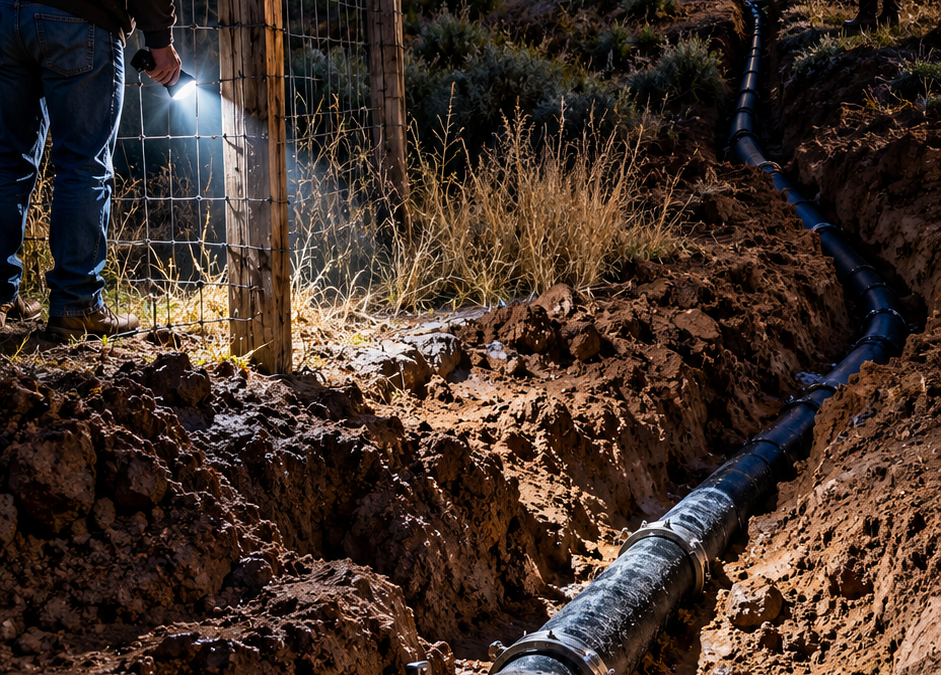
I stood beneath my north fence with a flashlight in one hand and my boots sinking into freshly disturbed soil. The trench had been covered badly. Whoever had done it had been in a hurry. Loose dirt still held the square teeth marks of an excavator bucket, and beneath the ground I could feel a low vibration through the soles of my boots.
I followed it toward the fence.
On my side, the pipe had been cut directly into the private lateral feeding my orchard.
On the other side, it disappeared beneath Canyon Vista, the luxury subdivision that had spent four years building houses on the ridge above my land.
I climbed the slope until the trees thinned and the HOA’s landscaping began.
That was where I saw the sprinklers.
Silver arcs of water swept across brand-new sod in the darkness.
Beyond them, Canyon Vista’s ornamental lake shimmered beneath construction lights, half full and climbing.
Felicity Crane stood beside the trench in a red rain shell.
She did not look surprised to see me.
That told me almost as much as the pipe did.
“Shut it off,” I said.
She folded her arms.
“This is the community’s emergency reservoir.”
“That water is coming through my lateral.”
“Your ditch crosses association property.”
“The main ditch does. This line doesn’t.”
She gave me the patient expression people use when they believe confidence can substitute for documents.
“We’re under drought restrictions, Jack. Interfering with an emergency water supply would be reckless.”
I looked downhill.
The forecast called for 107 degrees by Friday.
My scheduled irrigation turn ended in sixty-eight hours.
Six hundred and twenty peach trees depended on that water, and 186 trees in the north block were carrying fruit three weeks from harvest.
Peach trees do not understand disputes.
They understand heat, moisture, and time.
Miss enough water at the wrong moment and the fruit stops growing first. Then the leaves fold. After that, the roots begin making decisions no apology can reverse.
I walked back toward my gate and checked the pressure.
The flow entering my property was strong enough to look normal.
The current reaching my orchard was not.
At that hour I could not prove how many gallons were missing.
But I could prove where some of them were going.
Headlights appeared on the county road below us.
The pump stopped.
Not slowly.
Instantly.
The buried pipe went quiet before the truck reached my fence.
I looked at Felicity.
She looked toward the headlights.
Someone had been watching for the water company.
Nina Patel parked beside Headgate 14 at 4:43.
She was Mesa Crown Irrigation Company’s senior ditch rider, responsible for measuring scheduled deliveries along twelve miles of channel. I had called her emergency number seven minutes after finding the buried pipe.
She stepped out in work boots, pulled a reflective vest over her sweatshirt, and looked from the wet trench to the silent pump enclosure.
“What did you touch?” she asked.
“Nothing.”
“What did you record?”
“Pump serial number. Pressure at my first distribution box. Time the motor stopped.”
Nina looked at me for a moment.
“You still know what to preserve.”
“Old habits.”
Felicity heard that.
She did not yet understand what it meant.
Nina did.
For twenty-two years, before retirement and before I returned full-time to the orchard, I had worked the same irrigation system she now managed.
I knew what normal sounded like.
I knew what a legal temporary connection looked like.
And I knew that people who stole water rarely began by announcing it.
Nina crouched beside the company gate.
The wire seal appeared intact.
Then she turned the stamped aluminum disc toward her flashlight.
Her expression changed.
Mesa Crown’s current seal number should have ended in 816.
The disc on the wire ended in 618.
Felicity stepped closer.
“Could your office have entered it wrong?”
“Possibly,” Nina said.
I almost smiled.
That was the answer of a professional who knew suspicion was not evidence.
Nina took photographs, logged the number, and added a second seal beside the first.
Then she installed a remote pressure recorder downstream of the buried connection.
Felicity opened a red folder.
“You can’t interfere with this line,” she said. “The HOA has documented access.”
Nina looked up.
“Documented by whom?”
“Our property counsel.”
“Did Mesa Crown approve a temporary diversion?”
“Our easement predates your current procedures.”
“That is not what I asked.”
Felicity removed a scanned document.
It was dated 1996.
My father’s signature appeared on the final page.
For the first time that morning, I felt something colder than anger.
The paper described a drainage maintenance easement between my father and the developer who once owned the empty land above us.
One paragraph referred to a temporary water connection during construction or declared drought conditions.
On the attached exhibit, a blue line ran from the main ditch toward the hillside.
My father’s signature was real.
I knew it immediately.
The blue line looked newer than the rest of the drawing, but looking newer and being fraudulent were two very different things.
Felicity tapped the paragraph.
“Your father authorized this.”
Nina took the page from her.
“Where is Mesa Crown’s written approval?”
“The easement gives us access.”
“It may give you something,” Nina said. “It does not automatically give you company water.”
Then she looked at me.
“Do you have your father’s complete copy?”
I stared at the signature.
“I don’t know.”
That was the problem.
Five minutes earlier, I had believed I was looking at a simple theft.
Now I was looking at a buried pipe connected to a thirty-year-old document containing my father’s signature and language broad enough to cause trouble.
Felicity slid the document back into her folder.
“Keep your hands off the connection. If you interrupt an emergency supply, Canyon Vista will hold you responsible.”
I did not answer.
Because until I found the rest of that agreement, I did not know whether she was bluffing.
At sunrise, the orchard showed what the meter had only suggested.
Leaves in the north block had begun folding lengthwise.
The soil beneath several emitters was dry two inches down.
That should not have happened during my irrigation turn.
I had seen drought damage before. So had my wife, Elena.
For thirty-seven years, she had understood our orchard in ways I never fully did. I knew water, equipment, pruning, frost protection, and field work.
Elena knew the business.
She knew which loan payment could wait three days and which supplier needed to be paid before lunch. She knew what percentage of a crop we could lose and still make payroll. She could look at our books in March and tell me whether I was allowed to feel optimistic in August.
She had been gone three winters.
Some mornings, I still expected to hear her opening the kitchen door behind me.
Instead, at seven, our daughter Rosa drove into the yard with a cardboard file box in the backseat.
She was thirty-two and worked as a physical therapist in Grand Junction. During harvest she handled online orders, customer emails, and enough paperwork to remind me of her mother.
For nearly a year, she had also been trying to make me discuss selling the orchard.
Not because she hated it.
Because she understood what loving a farm could cost.
She opened the car door.
“I came early because I need to show you something.”
Then she saw the north block.
The curled leaves changed her expression.
“What happened?”
I pointed toward Canyon Vista.
“They put a pump into our lateral.”
She stared at me.
“What?”
“Underground. Twelve-inch line. They say Grandpa authorized drought access in 1996.”
Rosa said nothing for several seconds.
Then she opened the back door of her car.
Inside the file box was a broker’s valuation.
She had planned to show it to me on Sunday.
The offer came from a produce warehouse company interested in our road frontage and packing shed. They would preserve the farmhouse, remove most of the peach trees, and lease whatever acreage remained to another grower.
Rosa watched me read the first page.
“You told me to be honest about the future.”
“So we sell because somebody steals water?”
“This isn’t because of this morning.”
She pointed toward the equipment shed.
“The frost fan needs repairs. Labor went up again. Last year barely covered the operating loan.”
“We survived last year.”
“Mom used to hate when you said that.”
I looked at her.
Rosa swallowed.
“She’d say survival isn’t a business plan.”
That landed because it was true.
I wanted to tell her Navarro Orchard had survived sixty-seven seasons.
My grandfather planted the first peach rows in 1959.
My father expanded them.
Elena and I planted the north block after Rosa was born.
But history did not make payroll.
History did not repair frost fans.
History did not magically replace water.
We checked every distribution box together.
The pressure was too low to irrigate all four blocks.
Keeping the north block alive meant shutting off the younger trees near the packing shed.
Ninety-two of them.
Rosa stood beside the south valve.
“Those are the trees we planted after Mom got sick.”
“I know.”
“If we close them in this heat—”
“They may recover.”
“And the north block?”
“The fruit won’t.”
She looked toward the younger trees.
Then toward the north rows Elena had planted.
There are decisions people imagine farmers make with certainty because we work outside and know how to fix things.
The truth is that sometimes farming means choosing which living thing suffers first.
Rosa put both hands on the valve.
Then she turned it.
The pipe shuddered as the remaining water moved north.
Neither of us spoke.
At ten that morning, our peach buyer called.
The contract required minimum pack size from the north block.
If the fruit stalled under heat and water stress, he could cut Monday’s order.
That gave us five days.
The weather gave us less.
Rosa and I pulled footage from the pump-house camera.
The camera did not show the trench itself, but it showed vehicles.
A Canyon Vista maintenance pickup.
A High Desert Pump and Rental truck.
Three visits after midnight on three consecutive nights.
Then the HOA emailed its legal packet.
The first page was titled Shared Drainage and Landscape Maintenance Easement.
The blue route appeared again.
Behind it was a letter from my father to the original developer.
One paragraph read:
Temporary connection may be used during construction and declared drought conditions subject to the terms on the following page.
The following page was gone.
Felicity’s attorney wrote that the HOA had never received it.
I searched my father’s old files.
I found our copy of the first page.
No second page.
The staple holes showed something had once been attached.
Rosa read the sentence twice.
“What if Grandpa really gave them drought access?”
“Then we find out what the terms were.”
“And while we look?”
Above us, the hidden pump restarted.
Water rushed through the buried line.
The pressure gauge in front of us dropped.
Rosa looked at the broker’s valuation sitting inside her car.
“This is what I meant.”
I turned toward her.
“The farm can be taken apart one emergency at a time,” she said. “A frost. A loan. A bad harvest. Somebody taking water. And we’re always the ones proving what happened after the damage is done.”
I wanted to tell her the land was worth fighting for.
The closed valve behind us made the answer feel cheap.
Canyon Vista called an emergency board meeting that afternoon.
The clubhouse overlooked the ornamental lake.
Eighteen unfinished premium lots curved around a pale rock shoreline. Beyond the glass wall, I could see sprinklers running over landscaping that had no business being green during that kind of heat.
Felicity stood in front of a projection screen.
Behind her was an artist’s rendering of the finished lake.
Children in kayaks.
Mature cottonwoods.
Perfect lawns.
No irrigation pipes.
No orchard below it.
No mention of where millions of gallons were supposed to come from.
“The lake is a critical drought and safety asset,” she began.
Then she looked at me.
“An adjacent landowner is attempting to obstruct water access granted to this community decades ago.”
She displayed my father’s letter.
Then the blue route.
Then she revealed the deadline.
Canyon Vista and its developer had refinanced an $8.6 million construction note.
A lender would inspect the lake, clubhouse landscaping, and eighteen premium lots on Tuesday.
If the amenity package failed inspection, Canyon Vista could lose access to the final $1.9 million construction draw.
Felicity called that a threat to every homeowner’s property value.
Suddenly the hidden pump made more sense.
The subdivision did not simply need water.
It needed a full lake by Tuesday.
A woman near the front stood.
Her name was Melanie Voss. Two children sat beside her.
“If that’s emergency water,” she asked, “are our homes less safe every time the pump is turned off?”
Felicity answered before anyone else could.
“That is exactly the danger Mr. Navarro is creating.”
The room turned toward me.
For one second, I saw how easily the story could become simple.
Eighty-six homes.
Dry summer.
Visible lake.
Old farmer angry about water.
I could have told them their lake was useless.
But I did not know that.
So I said the only thing the documents allowed me to say.
“I have not seen a fire district certification for this lake. If one exists, the board should produce it. But even if firefighters can use the water, that doesn’t answer who owns the water you put in it.”
Melanie sat down slowly.
Fear rarely waits for a title search.
Felicity understood that better than anyone in the room.
Treasurer Harold Kim raised his hand.
“Did we purchase water from Mesa Crown?”
“The association is exercising an existing right,” Felicity said.
“Do we have a current delivery ticket?”
“Our easement predates their current process.”
That was not an answer.
During public comment, I placed photographs on an easel.
The buried connection.
The pump serial number.
The wrong seal.
The wet trench beneath my fence.
Felicity looked at them and gave a thin smile.
“Mr. Navarro is an orchard owner. He is not qualified to audit a regional water system.”
“I worked that system for twenty-two years.”
The room went quiet.
“I was Mesa Crown’s senior ditch rider before Nina Patel. I opened Headgate 14. I inspected seals along this reach. I approved and documented temporary connections.”
I pointed toward the blue line on Felicity’s screen.
“There was never an HOA intake on my private lateral.”
A man near the aisle frowned.
“Then why didn’t you say that from the beginning?”
“Because my old job doesn’t decide what my father signed.”
I held up the incomplete letter.
“This does. And we’re missing a page.”
Felicity seized the opening immediately.
“Even Mr. Navarro admits the agreement may authorize our use.”
“I admit your copy is incomplete.”
Harold asked whether the pump would operate that night.
The HOA attorney said the association would preserve existing conditions pending review.
Everyone understood what that meant.
The pump would keep running.
Rosa waited until we were outside.
“If the second page says they can use the water, what happens?”
“We follow it.”
“Even if we lose the crop?”
“If it’s valid, we negotiate emergency replacement water and damages.”
She looked back through the clubhouse glass.
“They get certainty from half a document.”
Her voice tightened.
“We get dead trees while we search for the other half.”
At 11:46 that night, Nina’s pressure recorder sent an alert.
The pump was drawing harder than before.
Rosa followed me to the north gate.
A Canyon Vista security pickup had been parked across the maintenance path.
Behind it, the pump enclosure vibrated under floodlights.
I walked toward the guard.
“Mesa Crown equipment is behind you.”
He held up one hand.
“Counsel says nobody is allowed to alter shared infrastructure.”
“A company seal has already been altered.”
He did not move.
Rosa took out her phone and started recording.
The blocked path.
The pump noise.
The time.
The pressure alert on my screen.
I called Nina.
She contacted Mesa Crown’s manager and the sheriff’s non-emergency line.
Two deputies arrived twenty minutes later.
They did not arrest anyone.
They did not threaten anyone.
They stood between two groups of tired, angry people and made sure nobody turned a water dispute into something worse.
Felicity arrived carrying the red folder.
Mesa Crown’s manager examined the connection.
Then he made the only immediate decision he believed he could legally defend.
He ordered the upstream control closed until the unapproved draw could be isolated safely.
The pump stopped.
Then the channel stopped.
Every gallon headed toward my orchard stopped with it.
Felicity looked at the silent waterway.
Then at me.
“You wanted control,” she said. “Now nobody gets water tonight.”
I stared at the dry gate.
“Your trees may not have tonight,” she added.
Rosa lowered her phone.
“You knew exactly what this would do.”
Felicity looked at her.
“I know your father chose confrontation over cooperation.”
“Cooperation happens before you bury a pipe.”
Felicity walked away.
The gate remained closed until morning.
I stood beside a dry distribution box while a lake above me held water that had passed through my farm account.
At sunrise, the ninety-two young trees we had shut down the day before had almost no soil moisture left.
By ten, the temperature reached 100.
Rosa called every water supplier within sixty miles.
The first tanker could not arrive until evening.
We stretched temporary shade cloth over the weakest young trees.
The wind pulled at the clips.
At three, one tree dropped nearly every leaf on its western side.
By four, the bark on two new limbs was so hot I could not keep my palm against it.
Rosa drove to the county road twice looking for the tanker.
The second time she came back, she stayed in the truck for almost a minute.
I walked over.
She stared through the windshield.
“What happens if it doesn’t come?”
“We start cutting fruit from the weakest north rows.”
Her head turned.
“Fruit we already sold?”
“Trees first. Contract second.”
She closed her eyes.
Then she got out.
We carried three empty harvest bins into the north block.
For the next two hours, we removed hard green peaches by hand.
Fruit that had taken months to grow.
Fruit Elena would have checked every morning.
Fruit that would never reach a packing line.
Every peach we dropped onto the ground was water the tree no longer had to carry.
I heard the first tanker before I saw it.
Rosa started crying.
Not loudly.
She turned away and wiped her face with the shoulder of her shirt.
I pretended not to notice until she was ready to move again.
Mesa Crown’s preliminary comparison arrived later.
The company gate had released approximately eleven acre-feet of water since Sunday evening.
About 3.6 million gallons.
My downstream totalizer showed only about 1.2 million reaching the orchard.
Approximately 2.4 million gallons were missing.
Enough to account for almost all of our shortfall.
Enough to explain most of the sudden rise in Canyon Vista’s lake.
But Nina refused to call it final proof.
Mesa Crown still needed to eliminate meter error, leakage, and any other possible outlet.
A controlled flow test was scheduled for Tuesday morning.
The lender’s engineer would already be at Canyon Vista.
We invited her to watch.
Friday reached 107 degrees.
The tanker saved sixty-eight of the ninety-two young trees.
Twenty-four showed severe heat damage.
Peaches began dropping in the north block.
They hit the dry soil with small, dull thumps.
Our buyer measured fruit from three rows and reduced Monday’s order by thirty percent.
He did not accuse me of breaking the contract.
He did not need to.
He simply could not pack undersized fruit for customers who had ordered something else.
Rosa picked up one fallen peach.
“Mom planted this row.”
“We both did.”
“And I was going to ask you to sell it.”
“You still can.”
She looked at the broker’s box in her car.
“I don’t know what I want anymore.”
Neither did I.
For the first time, proving Canyon Vista wrong and keeping the orchard alive felt like separate problems.
Then High Desert Pump and Rental produced its job file.
The customer was listed as Canyon Vista HOA.
The job description read:
Temporary fire reservoir fill.
The delivery coordinates were not at the lake.
They were at my north fence.
Foreman Cole Danner agreed to meet us with both attorneys present.
He was a broad-shouldered man who looked as though he had not slept well since learning the job had become evidence.
“Mrs. Crane told us Mesa Crown approved the connection,” he said.
“Did you verify it?” Aaron Walsh asked.
Aaron had handled Elena’s estate and now represented me.
Cole shook his head.
“We were given a route map. It marked the lateral as an existing HOA intake.”
He laid the map on the table.
There it was again.
The same blue line.
Cole pulled up a photograph taken before excavation.
The original company seal was clearly visible.
The correct number.
By Wednesday morning, the wire carried the transposed disc ending in 618.
Now we knew the seal had changed during the installation window.
We did not know who had supplied the replacement.
Aaron stopped me before I could say what I was thinking.
“We preserve the sequence,” he said. “We don’t fill gaps with accusations.”
That became the rule of the next four days.
We knew what the evidence showed.
We refused to claim more.
Mesa Crown searched its paper archive.
The county recorder had the easement exhibit, but not my father’s separate letter.
The original developer had dissolved decades earlier.
Then Rosa found something.
Inside Elena’s tax files was a yellow tab attached to the 1996 folder.
In my wife’s handwriting:
Water letter copy sent to Bell Survey, August 12.
Bell Survey still existed under a different name.
Its archive manager found a microfilm index.
Retrieving the actual page would take until Monday.
The orchard did not have until Monday.
We purchased a partial irrigation turn from a retiring vineyard owner.
Twelve thousand dollars.
Mesa Crown approved the transfer through the proper gate, documented the delivery, and changed the schedule.
Rosa authorized the deposit from the orchard account.
“The broker said buyers like clean numbers,” she said.
“Twelve thousand for emergency water isn’t clean.”
“Neither is a dead block.”
The water reached us after midnight.
Rosa and I walked the rows with flashlights, checking emitters one by one.
The trees did not recover in some dramatic wave.
Leaves did not suddenly uncurl.
Peaches did not grow before our eyes.
The only thing that changed was the soil sensor.
For the first time in days, the number moved in the right direction.
Sometimes hope is not beautiful.
Sometimes it is a moisture reading at two in the morning.
Saturday, Harold Kim called me from the Canyon Vista clubhouse.
The board had approved $42,000 for temporary lake stabilization.
Felicity’s presentation claimed the figure included purchased water from a regional agricultural supplier.
Harold could not find a supplier contract.
High Desert’s pump, trenching, electrical work, landscaping, and security totaled $33,800.
The remaining $8,200 was labeled water acquisition and coordination.
“What did that buy?” I asked.
“That’s what I’m trying to determine.”
Harold sounded exhausted.
“The board voted for a lawful temporary supply. We did not vote to enter Navarro Orchard. We did not vote to connect to Headgate 14.”
Felicity had treated approval of the result as approval of any method used to reach it.
That afternoon, Canyon Vista’s attorney sent Aaron a settlement proposal.
Seventy-five thousand dollars.
Immediate payment.
In exchange, I would allow the bypass to operate through Tuesday’s lender inspection.
The HOA would pay for replacement irrigation water, waive any future claim to my lateral, and negotiate documented crop damages after harvest.
Rosa read the number twice.
“That covers the emergency turn, the tanker, and most of the lost order.”
“Probably.”
“Payroll is Friday.”
“I know.”
“If the packout drops again, what account covers it?”
“The operating line.”
“Which already has the frost fan repair.”
“Yes.”
Seventy-five thousand dollars was not absurd money.
It was dangerous precisely because it was reasonable.
Enough to make a responsible farmer consider helping the other side escape a disaster.
Rosa watched me.
“Taking it wouldn’t make us weak.”
“I know.”
“Then don’t refuse it because you hate her.”
“I won’t.”
Aaron flipped to page four.
“Before either of you decides, read this.”
A sentence near the bottom stated that, for purposes of lender certification, the parties acknowledged the temporary connection as an existing supply arrangement pending transition to a permanent source.
Existing supply arrangement.
Three ordinary words.
Three words that changed everything.
If I signed, Tuesday’s hidden bypass would become part of a recognized supply system.
The incomplete letter would look less incomplete.
The altered map could be dismissed as planning shorthand.
The lender could be shown a full lake and told the source had now been regularized.
Rosa stared at the page.
“They aren’t buying Tuesday’s water.”
“No,” Aaron said.
“They’re buying Wednesday morning.”
She pushed the agreement away.
“No.”
I looked at her.
She had spent months asking me to consider selling.
She had brought a broker’s valuation to the farm that very morning.
And now she was the first person at the table to reject the one document that could put cash in the account immediately.
We countered.
Canyon Vista could buy documented water through Mesa Crown.
The HOA would disclose the disputed source to the lender.
The hidden bypass would remain disconnected until the controlled test.
Felicity rejected the proposal nineteen minutes later.
She wrote that lender disclosure would create unnecessary alarm and make Tuesday’s inspection impossible.
That answered a question I had not known how to ask.
The full lake mattered.
But the story attached to the lake mattered more.
Sunday morning, Canyon Vista sent residents an emergency notice accusing me of attempting to disable a firefighting reservoir during extreme heat.
The message worked because the fear was not invented.
Dry grass lined the county road.
The hills were brown.
Everyone in western Colorado knew how quickly one spark could become a wall of fire.
Aaron requested Canyon Vista’s approved fire protection plan directly from the district.
The written response arrived that afternoon.
The subdivision relied on hydrants, tanker access, defensible space, and the county road network.
The lake had no approved drafting pad.
No tested engine turnaround.
No district certification.
Firefighters could use any available water in a genuine emergency.
That did not make the lake Canyon Vista’s certified emergency system.
Harold forwarded the district response to residents.
Felicity replied that future lake certification was under review.
Future was the important word.
The lake was not the emergency infrastructure she had described.
It was an ornamental amenity trying to become a safety system after its water source was challenged.
Monday morning, the lender’s engineering consultant, Maria Chen, confirmed that she would attend the controlled test.
Then she requested Canyon Vista’s approved completion drawing for the lake.
Harold sent it.
The drawing identified my private lateral as:
PERMANENT COMMUNITY WATER LINE.
The document was dated nine months earlier.
I read the words three times.
The hidden pipe had not been invented as a spontaneous response to that week’s heat.
The route had existed in Canyon Vista’s financial documents before the drought crisis.
Before the pump rental.
Before the supposed emergency.
At 2:12 Monday afternoon, Bell Survey’s archive manager called.
“We found the microfilm.”
The scans arrived one page at a time.
The first showed my father’s signature.
The second was crooked, gray, and almost unreadable near the bottom.
Rosa leaned over my kitchen table.
“I can see ‘separate meter.'”
I pointed lower.
“Written approval.”
The last six lines were blurred.
Rosa called the archive manager.
“Please don’t rescan the whole sheet. Just the lower right corner. Highest resolution you can manage.”
The new image arrived at 2:41.
I opened it.
And for several seconds I could not speak.
The missing page contained three conditions.
Any construction connection had to be separately metered and paid for by the developer.
Any drought use required written approval from Mesa Crown for a limited emergency period.
And the entire temporary privilege expired when the original grading work ended or on October 31, 1997, whichever came first.
My father had never granted a future subdivision permanent drought access.
He had allowed a contractor to use water temporarily while building a road nearly thirty years earlier.
Rosa sat down.
“So it’s over.”
“Not yet.”
I placed the blue-line exhibit beside Bell Survey’s scan.
The archived copy had no blue route.
We checked the county exhibit.
No blue route.
Only Canyon Vista’s version showed a line climbing toward the future lake.
One recovered page did not magically resolve everything.
But now the documents began agreeing with the physical evidence.
No current Mesa Crown approval.
No purchase ticket.
A private lateral mislabeled as HOA infrastructure.
A temporary pump.
A modern lender drawing showing a source that the original recorded exhibits did not.
Aaron sent the complete letter to Canyon Vista at four.
At five, Felicity emailed residents saying the archived language remained subject to legal interpretation.
At six, the lights came on around the pump enclosure.
The motor did not.
Mesa Crown had locked the bypass under a preservation agreement until Tuesday’s test.
Overnight, Canyon Vista’s lake dropped another inch.
Tuesday morning arrived clear and already hot.
By eight, everyone stood beside Headgate 14.
Maria Chen represented the lender.
Harold represented Canyon Vista’s board.
High Desert brought Cole Danner.
Nina Patel represented Mesa Crown.
A neutral irrigation engineer, Dr. Elaine Foster, directed the controlled test.
Felicity stood near the lake in a vivid red suit.
She carried the same folder she had brought to my fence.
Elaine addressed everyone before a valve moved.
“This test will show where the water travels and how flow changes when the pump operates. It will not determine property ownership. It will not establish who altered a seal. It will not replace the governing documents.”
That was exactly what I wanted.
No theater.
No conclusions before measurements.
For the first run, the bypass stayed closed.
Mesa Crown released a measured flow.
The upstream meter and my orchard meter aligned within tolerance.
Pressure in the north block stabilized.
Felicity glanced at Maria.
“Which proves there is no leak.”
Elaine did not look up.
“It establishes a baseline.”
Cole opened the bypass valve without starting the pump.
The readings shifted only slightly.
Then Elaine authorized power.
The pump began with a low hum.
Seconds later, the sound deepened.
I had heard pumps pull water for most of my adult life.
This one sounded different now.
Not because the motor had changed.
Because everyone was finally listening.
The upstream meter held steady.
My orchard meter fell.
Ten percent.
Thirty.
Fifty.
Then sixty-eight percent.
Water surged uphill through the concealed line.
Elaine let the system stabilize for eleven minutes.
She checked the flow.
Then the operating records.
“At this measured rate and the documented operating duration, the bypass can account for approximately 2.4 million gallons.”
Felicity stepped forward.
“Which proves the connection performed as designed.”
Elaine looked at her.
“It proves where the water went.”
She paused.
“Your documents have to prove you were entitled to send it there.”
Then came the part nobody forgot.
Elaine introduced a measured quantity of approved tracing dye downstream of the company gate.
The water disappeared into the system.
For several minutes, nothing happened.
Residents watched from the clubhouse terrace.
The lender’s camera remained aimed at the lake inlet.
Felicity spoke quietly with her attorney.
Then I saw it.
A thin green ribbon appeared beneath the pale shoreline rocks.
At first it was narrow.
Then wider.
Fluorescent green water pushed outward into the blue lake.
The plume spread slowly across the surface.
From the terrace, the route no longer existed as an argument.
It existed as color.
The water entering Canyon Vista had passed through my measured lateral.
Melanie Voss gripped the terrace railing.
“Did the board vote to connect that pipe?”
Harold opened the board minutes on his tablet.
“The board voted to purchase a lawful temporary water supply.”
“Does it mention Headgate 14?”
Harold looked down.
“No.”
“Then why did the emergency message say Jack was disabling our reservoir?”
Felicity turned toward the terrace.
“Because the system was operating under a recorded easement and stopping it created an immediate community risk.”
Nina held up Mesa Crown’s written response.
“There was no approved drought delivery to Canyon Vista.”
The green plume reached the center of the lake.
Maria opened Canyon Vista’s completion drawing.
“This identifies a permanent community water line.”
She looked at Felicity.
“Where is the permanent source agreement?”
Felicity handed her the blue-line exhibit and the first page of my father’s letter.
Aaron placed the archived second page beside them.
Nina added Mesa Crown’s confirmation that Canyon Vista had no drought approval and no water purchase ticket.
Maria compared the documents.
“Bell Survey’s copy has no blue line.”
Nobody spoke.
“The county exhibit has no blue line.”
She looked at the lender drawing.
“This one does.”
Then she asked the question that ended the argument Felicity had been making for nine days.
“Who added the route?”
The project engineer cleared his throat.
“Our office received the exhibit from HOA management approximately nine months ago. We were told property counsel had verified the easement.”
Canyon Vista’s attorney spoke immediately.
“Our firm did not issue that verification.”
For the first time, Felicity stopped arguing about my father’s agreement.
She began arguing about consequences.
“If you delay this draw, every homeowner pays for it. The lake is already built. The system works. Mr. Navarro can be compensated.”
Maria looked toward the green water.
“A working pipe is not the same as a lawful permanent source.”
Then she suspended the inspection.
The lender would not certify the final $1.9 million draw until Canyon Vista disclosed and corrected the source issue.
The eighteen waterfront lots could not be represented as completed lake property.
The lender did not foreclose on the subdivision.
It did not cancel anyone’s mortgage.
It did not seize homes.
It withheld the one thing Felicity had been racing toward.
Tuesday’s money.
Harold called an emergency board session on the terrace.
Four directors voted to suspend Felicity’s authority over contractor instructions, financing certifications, and document control while outside counsel conducted an investigation.
Felicity stood beside the lake as the fluorescent plume spread behind her.
“You are risking millions over a line on an old map,” she told Harold.
He looked at the water.
“No.”
Then he looked at her.
“We risked millions when someone drew it.”
Cole shut down the pump.
Under Mesa Crown supervision, High Desert disconnected the bypass and capped my lateral.
I walked downhill to the orchard meter.
The pressure climbed.
Full delivery.
For the first time in nine days, nobody needed an argument to explain where the missing water had gone.
The investigation answered the remaining question.
Who drew the line?
The original digital file came from a freelance planning technician.
Nine months earlier, Felicity had emailed instructions asking him to add the blue route to the subdivision plan.
The technician replied with a question:
Has the water source been legally verified?
Felicity answered that the route followed existing shared infrastructure and that counsel confirmation would follow.
It never did.
Two months later, the altered exhibit entered the lender package.
The technician’s question did not.
The seal investigation followed the same pattern.
High Desert’s work log showed that a crew member had cut the original wire after Felicity said Mesa Crown had approved the connection.
Canyon Vista maintenance supplied a replacement seal disc in an envelope.
The number was transposed.
The maintenance manager said Felicity told him the disc had come from Mesa Crown.
Nina confirmed Mesa Crown had never issued it.
What criminal, civil, or regulatory consequences might follow was no longer my decision.
I did not need an arrest scene.
I did not need Felicity led from the clubhouse in handcuffs.
By then, I understood what had happened without drama.
She had promised residents that the lake would be completed without another special assessment.
She had tied her reputation to finishing it.
When the permanent water source remained unresolved and drought made legitimate replacement water more expensive, she treated an old temporary letter as permission.
Then one shortcut demanded another.
The incomplete letter supported the blue line.
The blue line supported the lender drawing.
The lender drawing created a deadline.
The deadline justified the pump.
The pump required a seal that appeared official.
The drought made every missing gallon impossible to ignore.
Felicity resigned before the residents completed a recall process.
She did not lose her house.
She did not flee town.
She simply lost control of the record.
And once she lost that, the rest of the story belonged to documents she could no longer edit.
Canyon Vista and its insurer paid for our emergency water transfer, tanker expense, removal of the bypass, fence repair, engineering work, and documented crop damage.
The orchard claim stayed open through harvest.
I insisted on that.
So did Rosa.
We were not going to turn real damage into revenge.
We would count what we could prove.
Nothing more.
The lender required Canyon Vista to submit a corrected site plan and lawful water strategy before releasing the remaining construction funds.
The HOA abandoned the permanent blue-water lake plan.
It was redesigned as a smaller lined stormwater basin surrounded by drought-tolerant landscaping.
The eighteen premium lots were reappraised without guaranteed lake frontage.
Residents paid some of the legal and redesign costs.
That part bothered me.
Most of them had not buried a pipe.
Most had believed what their board told them.
But bad leadership rarely sends the bill only to the person who made the decision.
Melanie organized a resident committee to review future emergency claims before the HOA could use them to enter neighboring land.
Harold required contractor packets to include actual recorded exhibits, not screenshots copied from presentations.
None of those changes sounded dramatic.
That was the point.
The next property owner should not need a midnight confrontation, dying peach trees, and fluorescent dye to make a board ask where its authority ended.
Harvest arrived three weeks later.
The north block did not look destroyed.
That surprised people.
Damage rarely looks the way outsiders expect.
There were no blackened acres.
No rows of dead trees.
No single photograph that captured the cost.
Some peaches remained undersized.
Others dropped before harvest.
The buyer’s thirty-percent reduction never came back.
Twenty-four young trees near the packing shed struggled through the rest of the season.
Eleven eventually had to be replaced.
Rosa and I counted everything.
Actual packout weights.
Emergency water.
Tanker invoices.
Extra labor.
Fruit removed to reduce tree stress.
Reduced sale value.
Fruit we still managed to sell.
When one spreadsheet accidentally counted the same labor twice, Rosa deleted the duplicate before the adjuster could mention it.
I watched her.
“You sound like your mother.”
She looked at the screen.
“Mom would’ve found three more mistakes.”
“She would’ve color-coded them.”
Rosa smiled.
For a second, Elena was in the room with us.
Not as a ghost.
As a habit.
As a standard.
As the part of us that still knew how to keep the books honest when anger gave us every excuse not to.
The final supported loss was lower than my worst fear and higher than Canyon Vista’s first estimate.
The settlement covered what the records proved.
It did not pretend every weak limb, small peach, or bad business decision in my life began with Felicity’s pump.
One evening after harvest, Rosa carried the broker’s valuation into the north block.
For weeks, I had expected her to reopen the argument about selling.
Instead, she removed the unsigned offer page.
She tore it in half.
Then folded the remaining papers back into the box.
“I’m not promising forever.”
I looked at her.
“Forever is a terrible business plan.”
“Your mother would’ve agreed.”
“One season,” Rosa said. “I handle water scheduling, online sales, and the books.”
“And me?”
“You stop pretending sixty-one is thirty-five.”
“Forty.”
She shook her head.
“One season.”
I looked toward the rows we had nearly lost.
“What happened to selling before the farm made the choice for us?”
Rosa was quiet.
Then she said, “It almost did.”
She looked up toward Canyon Vista.
“But the farm didn’t hide that pipe.”
I followed her eyes.
“People did.”
She turned back toward me.
“I want one season where the decisions are actually ours.”
I held out my hand.
She looked at it.
Then she ignored it and hugged me.
Mesa Crown installed a tamper-resistant enclosure at Headgate 14.
The new system included a remote alarm and a two-person access log.
Canyon Vista recorded a formal acknowledgment that the 1996 agreement created no current irrigation right.
The corrected site plan showed the drainage swale.
The property boundary.
The main ditch.
And no blue line climbing toward the lake.
By October, native grasses had replaced most of the HOA’s sod.
Children still rode bicycles around the smaller basin.
People still used the clubhouse.
Homes still stood on the ridge.
Canyon Vista had lost a marketing illusion.
It had not lost its right to exist.
The following spring, Rosa and I opened Headgate 14 for the first full irrigation turn of the season.
White blossoms covered the orchard.
Nina stood beside the upgraded enclosure while the remote system registered the opening.
Water crossed the measuring structure.
Then flowed beneath the rows.
Rosa walked uphill to the first distribution box.
My phone rang.
“Pressure is steady.”
“Reading?”
She gave me the number.
I looked at my gauge.
It matched.
Across the fence, no plywood enclosure hid a pump.
No buried line climbed the slope.
The smaller basin above us reflected a narrow strip of morning sky.
For years, I believed my experience as a ditch rider was what saved the orchard.
It helped.
It helped me recognize the wrong seal.
It helped me hear water moving where it should not.
It taught me what to record before anger made me careless.
But experience did not win the dispute.
Evidence did.
A contractor’s photograph.
A gate log.
A pressure recorder.
A complete letter my wife had quietly preserved through a survey archive.
An original map without a blue line.
A lender drawing with one.
A technician’s email.
And two calibrated meters showing exactly what happened when the pump came on.
Felicity believed that if the lake looked finished on Tuesday, then by Wednesday the water source would become history.
Something accepted.
Something too expensive to question.
Something everyone would learn to live with.
She forgot the one lesson water had spent my entire life teaching me.
Every gallon passes through somewhere.
And somewhere always leaves a record.

