The Photograph Inside That Sealed Envelope Made Me Question Everything I Knew About My Father
The Photograph Inside That Sealed Envelope Made Me Question Everything I Knew About My Father
My name is Claire Parker, and before six black SUVs rolled through the gates of my military base looking for me, my life could be measured in very small numbers.
How many days until payday.
How many pills Ethan had left.
How much gas remained in my car.
How many dollars I could move from groceries without risking the electric bill.
How many hours of sleep I could lose before morning formation.
I was twenty-four years old, serving in the United States Army, and carrying another responsibility that mattered even more to me.
Keeping my younger brother alive.
Ethan was seventeen.
He had a chronic heart condition that required medication every month, regular specialist visits, and the kind of careful monitoring that made ordinary teenagers feel as though their own bodies were probation officers.
Our parents were gone.
Mom had died first.
Dad followed years later, when I was nineteen and Ethan was twelve.
After that, there was no wealthy grandparent, no insurance windfall, no mysterious account waiting for us.
There was me.
I signed papers I barely understood.
I learned how to talk to insurance companies.
I learned which pharmacy technicians would quietly tell me when a discount program might save us thirty dollars.
I learned to stretch a military paycheck until numbers stopped behaving like numbers and became choices.
Medicine or groceries.
Car repair or specialist copay.
Dental appointment or electricity.
People sometimes imagine struggle as something dramatic.
It usually isn’t.
It is opening your banking app at 11:43 at night and staring at $186.12 as if the extra twelve cents might change the answer.
It is telling your brother you already ate because there is only enough food left for one full plate.
It is hearing him cough in the next room and wondering whether the sound is normal.
It is pretending not to notice when he pretends not to notice what things cost.
Ethan hated being a burden.
I hated that he knew enough to feel like one.
“You don’t have to keep doing all this,” he told me once when he was sixteen.
We were sitting in my car outside a pharmacy.
Rain streaked the windshield.
His prescription bag sat between us.
“Doing what?”
“Paying for everything.”
“You’re seventeen kinds of annoying,” I said. “But expensive is only one of them.”
He smiled despite himself.
“I’m serious, Claire.”
“So am I.”
“What if I get a job?”
“You have school.”
“I could work weekends.”
“You have a heart condition.”
“I’m not made of glass.”
“No. Glass is quieter.”
He rolled his eyes.
I reached across the console and squeezed the back of his neck.
“You get through school. You take your medicine. You go to your appointments. I handle the rest.”
He looked down.
“That’s not fair.”
Maybe it wasn’t.
But fairness had stopped being useful to me a long time earlier.
Responsibility was simpler.
Someone had to do it.
So I did.
That was my life before the Thursday at St. Jude Medical Center.
It had been raining since noon.
Not the soft kind.
Cold sheets of water hammered the roads hard enough to blur brake lights.
I had finished duty tired, hungry, and irritated because Ethan had texted me twice reminding me not to forget his prescription.
As though I had ever forgotten his medication.
I sent back:
I KNOW.
He replied:
You forgot bread last week.
I wrote:
Bread will not keep your heart beating.
He answered:
Depends how good the bread is.
I smiled despite myself.
That was Ethan.
He had spent years living with a body capable of frightening everyone who loved him, and somehow he remained the funniest person I knew.
I stopped at St. Jude because the pharmacy there could fill one of his prescriptions at a price almost forty dollars lower than our usual place.
Forty dollars mattered.
I walked through the hospital doors still wearing part of my duty uniform beneath a rain jacket.
The emergency department was chaos.
A gurney flew past.
A nurse shouted for respiratory.
Someone pushed an equipment cart so fast one wheel bounced off a wall.
Then I heard a voice from farther down the corridor.
“We’re losing him!”
Another voice answered.
“We need AB-negative now.”
A nurse yelled back, “Blood bank says they’re out.”
I stopped.
AB-negative.
My blood type.
There was no noble thought.
No movie moment.
No internal debate.
I simply turned.
“I’m AB-negative.”
The nurse looked at me.
“What?”
“I have AB-negative blood.”
“You’re certain?”
“Yes.”
She was already moving.
“Come with me.”
Five minutes later, someone was confirming my information.
Ten minutes later, I was in a donation chair with a needle in my arm.
I never saw the patient.
I never asked his name.
All I knew was that somewhere nearby, a human being was in trouble and my body happened to carry something he needed.
The nurse checked on me twice.
“You doing okay?”
“Fine.”
“You came in for someone?”
“My brother’s prescription.”
She smiled.
“Busy night.”
“You could say that.”
When the donation finished, they gave me juice and crackers.
I ate both because military training teaches many things, including never rejecting free food when you have skipped dinner.
Then I went to the pharmacy.
Picked up Ethan’s medication.
Drove home.
He met me at the door.
“You’re late.”
“I donated blood.”
He blinked.
“What?”
“Hospital emergency.”
“You just randomly gave blood?”
“They needed my type.”
He took the prescription bag from me.
“You’re weird.”
“You’re alive because I’m weird.”
“Fair.”
That was it.
No dramatic music.
No wealthy stranger waking up and demanding to know my name.
No news crews.
No reward.
By the next morning, I was back on duty.
Within a few days, I barely thought about it.
Three weeks later, everything changed.
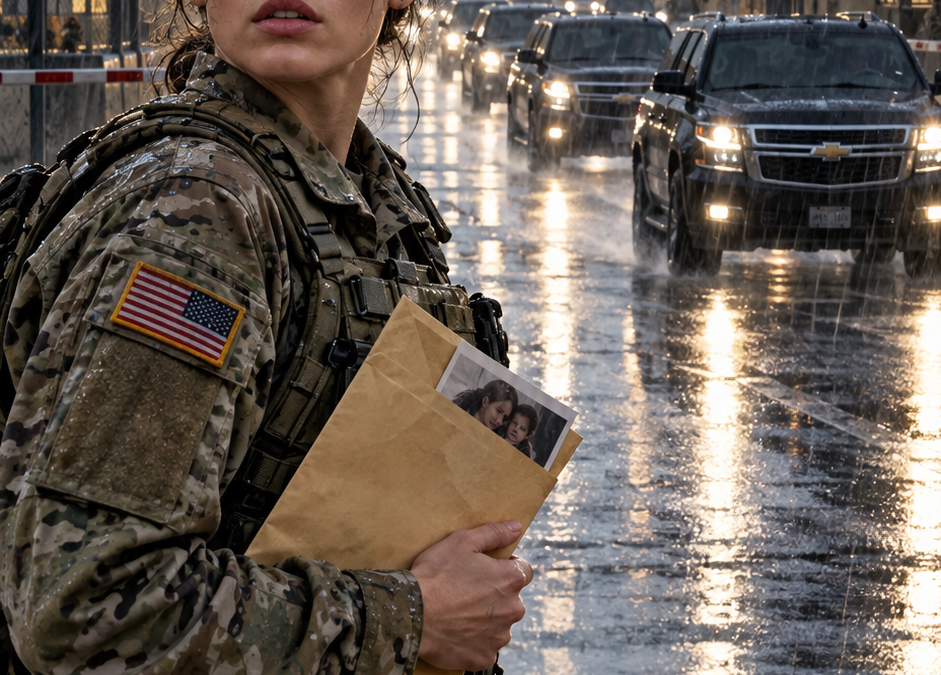
I was reporting for morning duty when the first black SUV came through the gate.
Then the second.
Then another.
Six in total.
Even on a military installation, a convoy like that attracts attention.
These were not tactical vehicles.
They were polished, black, civilian SUVs with dark windows and the kind of spacing that told you security professionals were inside.
Military police moved.
Senior officers appeared outside buildings.
Soldiers nearby slowed down without technically stopping.
I heard someone behind me mutter, “Who the hell is that?”
The vehicles stopped.
Men in dark suits exited first.
Then one rear door opened.
The man who stepped out was immediately recognizable.
Harrison Cole.
You could not watch financial news without seeing him.
His companies built everything from industrial systems to aerospace components.
His face appeared on magazine covers.
Depending on the publication, he was described as visionary, ruthless, brilliant, difficult, revolutionary, arrogant, philanthropic, obsessive, or some combination of all seven.
He was also worth more money than I could comprehend.
I stared.
A soldier beside me whispered, “That’s Harrison Cole.”
“I know.”
“What is he doing here?”
“No idea.”
One of the suited men walked directly toward me.
That got my attention.
“Specialist Claire Parker?”
My spine straightened.
“Yes.”
“Mr. Cole would like to speak with you.”
I honestly thought I was in trouble.
Not because I had done anything wrong.
That is simply the natural response when a billionaire arrives at your military base with enough security to invade a small country and asks for you by name.
I walked toward him.
Harrison studied me for several seconds.
He looked different from television.
Older.
More tired.
There were faint marks near his collar that made me wonder whether he had recently been hospitalized.
Then he smiled.
“You donated blood at St. Jude Medical Center three weeks ago.”
It was not a question.
I nodded.
“Yes.”
“You saved my life.”
I stared at him.
Of every explanation I had imagined while crossing that parking area, that had not been one of them.
“You were the patient?”
“Yes.”
I did not know what to say.
So I said the truth.
“I only did what anyone should do.”
His expression changed.
Not offended.
Sad, maybe.
“No,” he said. “You did much more than that.”
He reached toward one of his people.
A sealed envelope was placed in his hand.
Then he gave it to me.
It was heavier than I expected.
I opened it.
Photographs.
Legal documents.
Copies of records.
My name appeared on the first page.
CLAIRE ELIZABETH PARKER.
My date of birth.
Ethan’s.
Then our parents.
Daniel Parker.
Rebecca Parker.
I looked up.
“I don’t understand.”
Harrison’s face became serious.
“There are things about your family that were hidden from you for many years.”
The sentence frightened me more than the convoy.
Before I could ask what he meant, someone approached from behind me.
A senior military officer.
He looked at Harrison.
Stopped.
Straightened.
Then saluted.
“Good morning, Colonel.”
I froze.
Another officer saluted.
Then another.
Colonel?
I slowly turned toward Harrison.
He gave the smallest smile.
“I suppose it’s time you knew.”
“Knew what?”
“The businessman the public sees is only one part of my life.”
He paused.
“I’m also Colonel Harrison Cole.”
For several seconds, I simply stared.
“You’re in the Army?”
“Yes.”
“And you’re a colonel?”
“Yes.”
“And somehow nobody thought to mention that on television?”
He almost laughed.
“My business career is more interesting to financial reporters.”
I looked at the officers around us.
Clearly, his military position was real enough for them.
Then Harrison’s expression changed again.
“But that isn’t why I came.”
He looked directly at me.
“Claire, your family has been living with a secret for decades.”
My fingers tightened around the envelope.
“And someone worked very hard to make sure you never discovered it.”
Ten minutes later, I sat inside a conference room on base that I had passed hundreds of times without noticing.
Harrison sat across from me.
Two other people joined us.
The first was Margaret Shaw, an attorney in her sixties with silver hair, precise speech, and the kind of calm expression that made me assume she had spent decades watching people panic over documents.
The second was Samuel Reed.
Retired Army command sergeant major.
Broad shoulders.
Gray beard.
Hands that looked as if they had spent a lifetime repairing equipment and correcting young soldiers.
He kept staring at me.
Not rudely.
Worse.
Like he knew me.
Or was trying to see someone else inside my face.
I opened the envelope again.
One photograph lay near the top.
I picked it up.
Four soldiers stood in a dusty landscape.
They were young.
Armed.
Exhausted.
Smiling.
One was Harrison.
Much younger.
No billionaire suit.
No black SUVs.
Army uniform.
Rifle hanging across his chest.
Beside him stood my father.
I stopped breathing.
Dad looked maybe thirty.
Strong.
Sunburned.
Alive.
Smiling in a way I had almost forgotten.
My fingers touched his face in the photograph.
“He knew you.”
Harrison nodded.
“Yes.”
I looked at him.
“How?”
“We served together.”
“That’s impossible.”
“It isn’t.”
“My father did six years in the Army.”
“He did more than you know.”
Dad rarely talked about his service.
As far as Ethan and I understood, he had spent several years in uniform, left the Army, and eventually worked industrial maintenance.
He fixed generators.
Factory equipment.
Air-conditioning systems.
Anything mechanical enough to challenge him.
The man in the photograph did not look like the quiet father who complained about milk prices and made pancakes shaped like countries he could not identify.
He looked like he belonged with those soldiers.
“What did he do?”
Harrison glanced at Reed.
Then back at me.
“He was one of the finest soldiers I ever served with.”
My throat tightened.
I looked at the photograph again.
“What happened?”
Reed answered.
“Convoy incident.”
His voice was rough.
“Bad one.”
I waited.
“Your father pulled three men out.”
“One was Harrison?”
“Yes.”
Harrison nodded.
“I would have died without Daniel.”
I looked between them.
“Dad saved your life?”
“Twenty-six years ago.”
I laughed once.
Not because anything was funny.
Because my mind had run out of acceptable reactions.
“So my father saved your life, and then I donated blood to you by accident.”
Harrison smiled faintly.
“Apparently your family has a pattern.”
“Why didn’t Dad ever mention you?”
Harrison’s smile vanished.
“Because I asked him not to.”
That made no sense.
“Why?”
“The public version of my life is incomplete, Claire.”
“You already said that.”
“And so was your father’s.”
I looked at Margaret.
She opened another folder.
Harrison continued.
“Daniel and I stayed close after our deployments.”
“How close?”
“He was there when I started my first company.”
I stared at him.
“My father?”
“Yes.”
“The man who drove a twelve-year-old pickup with one working speaker?”
Harrison laughed.
“That sounds exactly like Daniel.”
“He complained when cereal went up thirty cents.”
“Yes.”
“He fixed our toaster with electrical tape.”
“That sounds less safe.”
“It was.”
For one brief moment, Dad returned to the room exactly as I remembered him.
Then Harrison said, “He helped build the company.”
My smile disappeared.
“With what?”
“Operations. Equipment. Logistics. Hiring.”
He leaned back.
“Mostly telling me when my ideas were stupid.”
“That definitely sounds like him.”
“I offered him equity.”
My heart skipped.
“He refused.”
I exhaled.
Of course he did.
Dad could be painfully stubborn about money.
“He said it was your company,” Harrison continued. “He didn’t want what he hadn’t earned.”
“Also sounds like him.”
“So I created another arrangement.”
Margaret turned a document toward me.
“A private investment account was created for Daniel Parker.”
I looked down.
The first numbers were small.
Then came additional shares.
Reinvested distributions.
Transfers.
Trust documents.
My eyes moved toward the figure at the bottom.
I stared at it.
Then looked again.
“This is wrong.”
Margaret said, “The statement you’re looking at is historical.”
“How old?”
“Twenty-two years.”
I flipped pages.
More records.
More numbers.
My chest tightened.
“Where is this money?”
Nobody answered immediately.
That silence terrified me.
I looked at Harrison.
“Where is it?”
His jaw tightened.
“That is why I came here.”
I stood.
The chair scraped behind me.
“No.”
“Claire—”
“I don’t want a dramatic story.”
He stopped.
“My brother needs heart medication every month.”
Nobody spoke.
“I spend almost everything I earn keeping him stable.”
Margaret lowered her eyes.
“I’ve worked extra duty whenever I could.”
My voice began to crack.
I hated that.
“I delayed dental work for more than a year because Ethan had another cardiology bill.”
Harrison said nothing.
“I drive a car that makes a noise nobody can identify because replacing it would take money away from him.”
I pointed at the documents.
“So if you are about to tell me there has been money somewhere this entire time, I need you to say it clearly.”
Harrison met my eyes.
“There has been money.”
For a second, every sound in the room disappeared.
“How much?”
“The exact current value needs independent verification.”
I shook my head.
“Don’t give me billionaire language.”
Margaret spoke gently.
“That isn’t billionaire language. It is the legally accurate answer.”
I looked at her.
She continued.
“Our records indicate the trust currently holds several million dollars in diversified assets.”
I sat down.
Not because I wanted to.
Because my legs stopped feeling reliable.
Several million.
My mind did not go to houses.
Cars.
Vacations.
Luxury.
It went to medication.
Pharmacy counters.
Insurance denials.
Late notices.
Twenty-dollar bills.
The winter Ethan was fourteen when we were twenty-three dollars short for a prescription.
I had sold Mom’s necklace.
Not expensive.
But hers.
I got forty dollars.
Bought the medicine.
Then sat inside my car and cried because I had just exchanged one of the last things my mother gave me for pills that would be gone in thirty days.
Several million dollars.
“Why?”
Harrison looked angry.
Not at me.
Margaret answered.
“After your father’s death, the trust should have been disclosed according to its terms.”
“To me?”
“To you once you reached the required age, and to the appropriate guardian arrangements concerning Ethan.”
“Mom was already dead.”
“Yes.”
“Then who handled it?”
Margaret opened another document.
“Your father’s brother.”
I stared.
“Uncle Raymond?”
“Yes.”
I almost laughed.
Raymond Parker.
The man who helped arrange Dad’s funeral.
The man who sat at our kitchen table and told me there was almost nothing left after bills.
The man who said, Daniel didn’t leave much, Claire. You’ll have to be strong.
The man who sent us Christmas cards.
Who called on birthdays.
Who attended my Army graduation.
“He was trustee?”
“Co-trustee for a limited period.”
“Why?”
“Your father trusted him.”
My stomach turned.
“What happened?”
Margaret’s answer was careful.
“We do not yet know everything.”
Good.
I respected that.
No dramatic accusation without evidence.
“But records show required notices were not properly delivered.”
“To us?”
“Yes.”
“How?”
“Contact information associated with you changed.”
She slid documents toward me.
An Ohio address.
I had never lived in Ohio.
A phone number.
Not mine.
An email account containing my name.
Also not mine.
I stared.
“Someone created this?”
“That is one possibility.”
“One possibility?”
“We need more records before we identify who created or controlled it.”
I looked at Harrison.
“When did you discover this?”
“After the hospital.”
That stopped me.
“What does donating blood have to do with my father’s trust?”
“Nothing directly.”
I frowned.
“I was unconscious when you donated,” Harrison said. “Two days later, I asked whether there was a lawful way to thank the donor.”
“The hospital shouldn’t give you my information.”
“They didn’t.”
I relaxed slightly.
“The hospital contacted you through its own process.”
I remembered an email asking whether I consented to being contacted by the recipient.
I had ignored it.
“Eventually,” Harrison continued, “through the proper process, I learned the donor was Claire Parker.”
“Parker.”
He nodded.
“That caught my attention.”
“Then?”
“I asked how old you were.”
“Why?”
“Daniel had a daughter named Claire.”
He looked toward the photograph.
“And a son named Ethan.”
My heart pounded harder.
“You searched for us.”
“Yes.”
“Using Army systems?”
“No.”
His answer was immediate.
“I would never use military databases for a personal search.”
Margaret nodded.
“My office searched public estate and probate records connected to Daniel Parker.”
“And?”
“That is where we found inconsistencies.”
Harrison looked at me.
“I believed you and Ethan had received everything years ago.”
“We received nothing.”
“I know that now.”
“Why didn’t you check?”
The words came sharper than I intended.
He did not defend himself.
“I should have.”
I waited.
“I trusted the structure Daniel created.”
Silence.
“I trusted the people around it.”
He looked down.
“And I was wrong.”
That answer mattered more than an excuse would have.
I looked at the documents again.
“So you came here because I saved your life?”
“No.”
I looked up.
“I came because your blood donation caused me to discover that Daniel Parker’s daughter was standing ten feet from me after I had spent twenty years believing she and her brother were financially protected.”
I swallowed.
“And the six SUVs?”
For the first time, Harrison looked almost embarrassed.
“Not my idea.”
Reed snorted.
Harrison shot him a look.
“Security overreacts.”
“Six SUVs?”
“Five would have been adequate.”
I stared at him.
Then I laughed.
I could not stop it.
After dead parents, hidden millions, secret military service, a billionaire colonel, and a fraudulent address in Ohio, six unnecessarily dramatic SUVs finally broke me.
Harrison laughed too.
The tension disappeared for four seconds.
Then I remembered Ethan.
“I need to call my brother.”
Margaret’s expression changed.
“Before you do, there are precautions we recommend.”
I stiffened.
“Why?”
“If someone intentionally interfered with this trust, records need to be preserved before anyone connected to the situation is alerted.”
“Ethan isn’t involved.”
“We are not suggesting he is.”
“Then I’m telling him.”
“You can.”
She paused.
“But we recommend first confirming current trust authority and securing your personal records.”
I sat back.
My entire life had taught me that protecting Ethan meant acting immediately.
Solve.
Move.
Fix.
But the Army had taught me something else.
Sometimes moving without understanding the terrain gets people hurt.
“Okay.”
That afternoon, nothing miraculous happened.
No one handed me a check.
No one deposited millions into my account.
I did not resign from the Army.
I went back to work.
Because I was still a soldier and still had responsibilities.
Harrison left.
The SUVs left.
By the next morning, half the base had created its own explanation.
Apparently, I was secretly Harrison Cole’s daughter.
His bodyguard.
His illegitimate heir.
One especially creative rumor decided I was his fiancée.
My squad leader found me organizing equipment.
“You going to explain the billionaire convoy?”
“No.”
“Cool.”
He waited.
“Can I borrow fifty bucks?”
I threw a glove at him.
Normal life returned surprisingly fast.
The investigation did not.
Margaret’s firm obtained archived trust records.
Independent counsel was appointed.
Old corporate trustees produced correspondence.
Accountants began reconstructing years of transactions.
Slowly, the truth became clearer.
Dad’s trust had never vanished.
The assets survived.
They continued growing.
That was the good news.
The extraordinary news was that by then, the trust was worth far more than Dad could ever have imagined.
The terrible news concerned Ethan.
I was sitting in Margaret’s office when she told me.
“The trust permitted medical distributions for dependent beneficiaries.”
I stared at her.
“You mean Ethan.”
“Yes.”
“How long?”
“Several years.”
My hands became cold.
“Someone could have been paying for his medicine?”
“Yes.”
I closed my eyes.
I thought of Mom’s necklace.
Twenty-three dollars.
Forty dollars from a pawn counter.
A pharmacy receipt.
My hands shaking inside my car.
I opened my eyes.
“Why weren’t payments made?”
Margaret turned a document toward me.
“Annual beneficiary certifications listed Ethan as no longer dependent.”
“He was fourteen.”
“I know.”
“Who certified that?”
Her finger moved downward.
Raymond Parker.
My uncle.
That was the moment suspicion became something heavier.
More records followed.
Raymond repeatedly claimed he could not locate me.
Yet he sent birthday cards.
He called me.
He attended my Army graduation.
He once asked me to help him move a refrigerator.
He knew exactly where I lived.
But reality was not as simple as discovering that Raymond had stolen six million dollars and spent it on yachts.
The truth was uglier because it was more ordinary.
He collected trustee fees he did not appear entitled to.
Approved loans to a business in which he held an interest.
Delayed beneficiary notices.
Directed certain distributions toward investments he controlled.
Some transactions were traceable.
Some disputed.
Some clearly improper.
Others might have been terrible administration rather than deliberate fraud.
The attorneys refused to use the word theft before the evidence justified it.
So did I.
Anger does not make evidence stronger.
Then we discovered Raymond’s explanation.
He claimed he had been protecting us.
Margaret arranged a meeting months later.
Raymond was sixty-three.
He looked older than I remembered.
Smaller too.
Gray hair.
Shaking hands.
He started crying before I sat down.
“Claire.”
I felt almost nothing.
That frightened me more than rage would have.
I sat.
“Why?”
No greeting.
No small talk.
Only why.
He wiped his face.
“Your father didn’t understand money.”
I nearly laughed.
“He created a trust that became worth millions.”
“With Harrison’s help.”
“So?”
“He wanted you to have access too young.”
“I’m twenty-four.”
“You were nineteen when Daniel died.”
“And?”
“You were taking care of Ethan.”
“Yes.”
“You would have spent everything.”
My chair scraped backward.
Harrison sat beside counsel.
He said nothing.
Good.
This conversation belonged to me.
“You mean I would have spent money from Ethan’s medical trust on Ethan’s medical care?”
Raymond looked down.
“When you say it like that—”
“How else would you like me to say it?”
He talked about preserving principal.
Some documents showed Dad did want long-term protection.
But the trust clearly allowed health and education distributions.
Raymond had taken Dad’s desire for caution and converted it into permission to control everything.
Worse, he benefited from that control.
Fees.
Loans.
Investments.
Maybe it began as fear.
Maybe greed came later.
Maybe both existed from the beginning.
Human beings rarely wake up and announce that today will be the day they become villains.
They make one convenient decision.
Then another.
Then they build a story explaining why each decision was necessary.
Eventually, protecting that story becomes more important than protecting the people paying for it.
I looked directly at Raymond.
“Did you know Ethan was sick?”
He cried harder.
“Yes.”
“Did you know how expensive his medication was?”
“Yes.”
“Did you know I was paying for it?”
He hesitated.
“Yes.”
That answer emptied the room.
“How?”
“You told me.”
I remembered.
A Christmas call.
I had complained about insurance denying one of Ethan’s medications.
Raymond had sighed sympathetically.
You’re a good sister, Claire.
I gripped the table.
“You knew.”
“Yes.”
“And you let me keep paying.”
“I thought hardship was making you responsible.”
Harrison shifted beside me.
A tiny movement.
The first sign that he was barely controlling his anger.
I raised my hand without looking at him.
He remained silent.
This was mine.
“Hardship?”
Raymond looked at me.
“I was twenty.”
Nothing.
“I was raising a thirteen-year-old.”
Nothing.
“I was serving.”
Nothing.
“I was trying to keep our electricity on.”
His shoulders shook.
“And you watched because you thought suffering was educational?”
“I didn’t know it was that bad.”
“You never asked.”
Silence.
“You had my number.”
Nothing.
“You had my address.”
Nothing.
“You knew exactly where I was.”
His face folded.
“Yes.”
There it was.
The truth I needed.
Not because it repaired anything.
Because lies lose power once they have nowhere left to hide.
The legal process lasted almost two years.
That is the part nobody enjoys when a story gets retold.
People like the billionaire.
The secret colonel.
The convoy.
The hidden trust.
The revelation.
Nobody likes depositions.
Forensic accounting.
Tax records.
Mediation.
Document production.
Fiduciary hearings.
Trustee removal.
But that was reality.
Raymond was removed from every fiduciary role connected to the trust.
He repaid substantial fees and benefits through settlement arrangements.
Certain disputed transactions were resolved financially.
Other claims were handled through counsel.
Not every dollar came back.
I will not pretend it did.
Real life rarely restores everything neatly.
But the trust survived.
And when control was finally restructured properly, the assets were worth a little more than six million dollars.
I stared at that number for a long time.
Then looked at Margaret.
“What do I do?”
She smiled.
“For once?”
I waited.
“Nothing today.”
Best financial advice anyone ever gave me.
By then, Ethan was eighteen.
When I finally explained everything, we sat in my kitchen.
I showed him the photograph first.
Dad.
Harrison.
Reed.
The others.
He stared.
“That’s Dad?”
“Yes.”
“He looks cool.”
“He would hate you saying that.”
Then I told him about the trust.
The money.
Raymond.
The investigation.
Everything.
Ethan listened without interrupting.
When I finished, he sat quietly for almost a minute.
Then he asked the first question.
Not, “How much money?”
Not, “Are we rich?”
Not, “Can we buy a house?”
He asked, “Does this mean you can stop paying for my medicine?”
I laughed.
Then I cried.
Then I hugged him.
“Yes.”
He held me tighter.
“Good.”
That was Ethan.
We did not buy sports cars.
We did not move into a mansion.
I replaced my car.
With a three-year-old Toyota.
When Harrison saw it, he stared at me.
“You have access to substantial assets.”
“Yes.”
“And you bought this?”
“It runs.”
“It is an insult to capitalism.”
“You’re a billionaire. You’re free to suffer.”
He shook his head.
Ethan’s medical expenses were finally covered properly through the trust.
His education was funded under the terms Dad intended.
I established an emergency reserve.
Met independent advisers.
Learned taxes.
Learned investments.
Learned the difference between having access to money and controlling money responsibly.
Most importantly, I stopped living one pharmacy bill away from panic.
Then Monday came.
I returned to work.
People found that confusing.
“You’re rich now.”
“Not exactly.”
The trust had beneficiaries.
Rules.
Purpose.
It was not a six-million-dollar checking account.
But yes, I had something I had never known before.
Security.
“Why stay in the Army?”
Because I had never joined solely because I needed a paycheck.
Service mattered to me.
Money removed desperation.
It did not remove purpose.
That difference changed the way I understood almost everything.
Harrison remained in my life.
Not as a benefactor.
Not as some substitute father.
As a friend.
An extremely irritating friend.
He called too early in the morning.
Sent books I had not requested.
Criticized my investment allocation even though I had repeatedly informed him that nobody had appointed him my financial adviser.
When Ethan mentioned that he might study medicine, Harrison mailed him a stethoscope.
Ethan texted him:
I said maybe.
Harrison replied:
Commitment begins with equipment.
I told Ethan to ignore him.
He did not.
The greatest gift Harrison gave me had nothing to do with money.
He knew Dad.
Really knew him.
He told us stories we had never heard.
Dad singing horribly during convoy maintenance.
Dad cheating at cards.
Dad carrying hot sauce in places no reasonable human being would carry hot sauce.
Dad repairing a generator using parts Harrison insisted could not possibly work.
“They shouldn’t have worked,” Harrison told me.
“But they did?”
“For eleven months.”
“That sounds exactly like Dad.”
“It was.”
Those stories mattered more to me than the trust.
Money secured the future.
Harrison gave back pieces of the past.
Years later, I finally asked the question that had stayed with me since the first photograph.
“Why didn’t Dad tell us about you?”
Harrison and I were sitting on his porch.
No security convoy.
No uniforms.
No lawyers.
Just coffee.
He stared toward the trees.
“Pride.”
“Dad’s?”
“Mine too.”
He thought for a moment.
“Daniel didn’t want his children growing up believing powerful friends were a substitute for building their own lives.”
“That sounds like him.”
“And I was becoming wealthy.”
Harrison smiled.
“Insufferably so.”
“Becoming?”
He ignored me.
“He worried people would treat you differently if they knew our connection.”
I looked into my coffee.
“Raymond certainly did.”
“Yes.”
“Dad trusted the wrong person.”
Harrison nodded.
“So did I.”
I appreciated that.
He never protected himself by placing every mistake on a dead man.
Then his expression changed.
“Daniel made me promise something.”
“What?”
“That I wouldn’t rescue you.”
I turned toward him.
“You had millions connected to my family and promised not to rescue me?”
“Not exactly.”
He sighed.
“Daniel believed the trust would protect you without controlling you.”
I listened.
“He didn’t want me appearing every time you struggled. He wanted you and Ethan to build independent lives.”
“And when the trust stopped working?”
His face tightened.
“I didn’t know.”
He looked down.
“That is the part I have to live with.”
I believed him.
There was a time when I wanted someone to blame completely.
One person.
One decision.
One clean source for every difficult night.
Life rarely gives us that.
Dad created a structure he believed would protect us.
Harrison trusted that structure.
Raymond abused the authority Dad gave him.
I was too young to know what questions to ask.
And for years, the system failed quietly while Ethan and I adapted to hardship until hardship felt normal.
I often thought about the hospital.
AB-negative.
Rain.
Chaos.
A stranger bleeding somewhere I could not see.
If I had walked past, Harrison might still have survived.
Another donor might have arrived.
The hospital might have located blood elsewhere.
Or maybe not.
I will never know.
But I know why I stopped.
I did not know the patient was Harrison Cole.
I did not know he was wealthy.
I did not know he was a colonel.
I did not know he had once served beside my father.
I donated because someone needed something I had.
That became important to me later.
Because once people learned pieces of the story, they began reducing it to something I hated.
“Claire saved a billionaire and became rich.”
No.
That was not what happened.
I did not receive six million dollars as a reward for donating blood.
The trust existed before I entered the hospital.
Dad’s connection to Harrison existed before I was old enough to understand it.
The assets already belonged within a structure created for our family.
Harrison did not make me wealthy because I helped him.
He helped uncover what should have reached us years earlier.
That distinction mattered.
Otherwise kindness becomes a lottery ticket.
It isn’t.
Years passed.
I am thirty-one now.
Ethan is twenty-four.
His heart condition is stable.
He finished college.
Not medicine.
Engineering.
Harrison complained dramatically.
Then invested in the company that hired him.
I called immediately.
“You cheated.”
“I invest in good companies.”
“Two weeks after Ethan accepted their offer?”
“Coincidence.”
“Billionaires are terrible liars.”
“Successful billionaires are selective truth-tellers.”
“That is somehow worse.”
I stayed in the Army.
I promoted.
Transferred.
Led soldiers who knew nothing about Harrison, the SUVs, Raymond, or the trust.
Good.
I preferred it that way.
One day, a young private came to me.
His mother needed surgery.
He was trying to send almost his entire paycheck home.
I recognized the panic immediately.
It looked different on him.
But I knew it.
The need to sacrifice everything because somebody you love is suffering.
I did not write him a check.
That would have fixed one bill and perhaps created ten new problems.
Instead, I connected him with every legitimate assistance program available.
Helped him meet finance.
Made sure he understood emergency relief.
Then I told him something I wish someone had told me when I was twenty.
“You do not have to destroy your future to prove you love your family.”
He cried.
I did not.
At least not there.
I waited until later.
Officers have reputations.
Raymond and I never rebuilt a real relationship.
He wrote letters.
I read some.
Ignored others.
Eventually, I answered one.
Three sentences.
I understand that you believed you were protecting the trust.
I also understand that you benefited from denying Ethan and me access to help Dad intended us to receive.
Both things can be true.
That was all.
Forgiveness, if it eventually came, was private.
Access was different.
I never trusted Raymond with my life again.
Dad’s trust documents now sit in a secure file.
So does the photograph Harrison handed me that first morning.
Four soldiers.
Dust.
Young Harrison.
My father smiling beside him.
Reed later wrote the date and location on the back.
Nothing dramatic.
Just enough information so Ethan and I would never have to wonder where it came from.
I keep that photograph beside another one.
Dad underneath our kitchen sink.
Old T-shirt.
Wrench in one hand.
Expression suggesting the plumbing had insulted him personally.
Same man.
That matters to me.
The soldier was not more valuable than the father.
The man who once saved a future billionaire was not more important than the man who taught me how to change a tire in the rain.
Big revelations distort memory if you let them.
Suddenly, every ordinary thing starts looking too small.
I refused to let that happen to Dad.
His secret service history did not make him better.
His friendship with Harrison did not make him more important.
The trust did not make his life more meaningful.
He was already Dad.
That was enough.
People still ask about the day Harrison arrived at my base.
“Were there really six SUVs?”
Yes.
“Did everyone salute?”
The officers who recognized the colonel did.
“Did you know?”
Absolutely not.
“Did you faint?”
No.
I was a soldier on duty.
I waited until that night to have my existential crisis like a professional.
But the moment I remember most happened before Harrison left that first day.
After the salutes.
After the photograph.
After learning that my father had saved his life.
After hearing the first hints about a hidden trust.
My entire understanding of Dad had started collapsing and rebuilding at the same time.
I asked Harrison one question.
“If I hadn’t donated that blood, would you ever have found us?”
He looked at me for a long time.
“I don’t know.”
That hurt.
But it was honest.
He could have told me yes.
Could have created a comforting story about fate eventually bringing us together.
He did not.
“I spent years believing your father had protected you,” he said.
I waited.
“You spent years protecting Ethan.”
His voice softened.
“And three weeks ago, without knowing my name, you protected me.”
He smiled.
“I think Daniel would have found that very funny.”
“Why?”
“He used to say Parkers were incapable of minding their own business when somebody needed help.”
I laughed.
That sounded exactly like Dad.
For years, I believed my life was small.
Barracks.
Duty.
Bills.
Ethan.
Pharmacy.
Repeat.
I imagined important lives belonged to people like Harrison Cole.
People with magazine covers.
Security convoys.
Billions of dollars.
People whose arrival made senior officers walk outside.
I was wrong.
A life does not become important because powerful people finally notice it.
Mine mattered before the SUVs.
It mattered when no one was watching.
When I sat beside Ethan during appointments.
When I used almost my entire paycheck to keep our lights on.
When I stood duty exhausted.
When I sold Mom’s necklace because my brother needed medication.
When I gave blood to a stranger.
No cameras.
No billionaire.
No colonel.
No hidden millions.
Just a human being who needed help and another human being who happened to be there.
That is the part I refuse to let the dramatic version of this story erase.
Harrison changed my life.
But he did not change it by giving me money.
The money was already connected to our family.
He gave me something else.
Truth.
Truth about my father.
Truth about Raymond.
Truth about the trust.
And eventually, truth about myself.
I had spent years believing I was alone because nobody powerful had come to rescue me.
What I finally understood was that during those years, I had already become the person doing the rescuing.
I had become the person Ethan depended on.
The person who kept moving when things were unfair.
The person who could be frightened and exhausted and still do what needed to be done.
The trust changed our finances.
It did not create that woman.
Hard years had already done that.
Three weeks after I gave blood to a dying stranger, six black SUVs came looking for me.
Inside one of them was a billionaire colonel who carried a photograph of my father and a truth that had been buried for years.
But when I look back now, I do not think the most important discovery was that Dad had once saved Harrison Cole.
It was not the six-million-dollar trust.
It was not Raymond’s betrayal.
It was not even learning that my father had lived a military life Ethan and I had barely understood.
The most important discovery was realizing that I had spent years carrying Dad’s legacy without knowing it.
He saw someone in danger and helped.
I had done the same.
Not because there was a reward waiting.
Not because anyone important would notice.
Because somebody needed what I had.
And when Harrison stood across from me that morning and told me my father used to say Parkers could never mind their own business when somebody needed help, I finally understood why the words felt so familiar.
All those years, I had thought Dad had left us with almost nothing.
I was wrong.
He had left us money I did not know existed.
He had left us stories I had not yet heard.
But long before either of those things reached me, he had left something deeper.
A way of living.
A reflex toward people in trouble.
A stubborn belief that responsibility mattered more than convenience.
A refusal to walk past someone who needed help.
That inheritance had reached me right on time.
I had simply mistaken it for who I was.
What do you think of this story? Please leave a like and share your thoughts in the comments. Your support means a lot to us and inspires us to keep writing more meaningful and powerful stories. Thank you! 👍
𝗧𝗛𝗘 𝗘𝗡𝗗
The Photograph Inside That Sealed Envelope Made Me Question Everything I Knew About My Father
My name is Claire Parker, and before six black SUVs rolled through the gates of my military base looking for me, my life could be measured in very small numbers.
How many days until payday.
How many pills Ethan had left.
How much gas remained in my car.
How many dollars I could move from groceries without risking the electric bill.
How many hours of sleep I could lose before morning formation.
I was twenty-four years old, serving in the United States Army, and carrying another responsibility that mattered even more to me.
Keeping my younger brother alive.
Ethan was seventeen.
He had a chronic heart condition that required medication every month, regular specialist visits, and the kind of careful monitoring that made ordinary teenagers feel as though their own bodies were probation officers.
Our parents were gone.
Mom had died first.
Dad followed years later, when I was nineteen and Ethan was twelve.
After that, there was no wealthy grandparent, no insurance windfall, no mysterious account waiting for us.
There was me.
I signed papers I barely understood.
I learned how to talk to insurance companies.
I learned which pharmacy technicians would quietly tell me when a discount program might save us thirty dollars.
I learned to stretch a military paycheck until numbers stopped behaving like numbers and became choices.
Medicine or groceries.
Car repair or specialist copay.
Dental appointment or electricity.
People sometimes imagine struggle as something dramatic.
It usually isn’t.
It is opening your banking app at 11:43 at night and staring at $186.12 as if the extra twelve cents might change the answer.
It is telling your brother you already ate because there is only enough food left for one full plate.
It is hearing him cough in the next room and wondering whether the sound is normal.
It is pretending not to notice when he pretends not to notice what things cost.
Ethan hated being a burden.
I hated that he knew enough to feel like one.
“You don’t have to keep doing all this,” he told me once when he was sixteen.
We were sitting in my car outside a pharmacy.
Rain streaked the windshield.
His prescription bag sat between us.
“Doing what?”
“Paying for everything.”
“You’re seventeen kinds of annoying,” I said. “But expensive is only one of them.”
He smiled despite himself.
“I’m serious, Claire.”
“So am I.”
“What if I get a job?”
“You have school.”
“I could work weekends.”
“You have a heart condition.”
“I’m not made of glass.”
“No. Glass is quieter.”
He rolled his eyes.
I reached across the console and squeezed the back of his neck.
“You get through school. You take your medicine. You go to your appointments. I handle the rest.”
He looked down.
“That’s not fair.”
Maybe it wasn’t.
But fairness had stopped being useful to me a long time earlier.
Responsibility was simpler.
Someone had to do it.
So I did.
That was my life before the Thursday at St. Jude Medical Center.
It had been raining since noon.
Not the soft kind.
Cold sheets of water hammered the roads hard enough to blur brake lights.
I had finished duty tired, hungry, and irritated because Ethan had texted me twice reminding me not to forget his prescription.
As though I had ever forgotten his medication.
I sent back:
I KNOW.
He replied:
You forgot bread last week.
I wrote:
Bread will not keep your heart beating.
He answered:
Depends how good the bread is.
I smiled despite myself.
That was Ethan.
He had spent years living with a body capable of frightening everyone who loved him, and somehow he remained the funniest person I knew.
I stopped at St. Jude because the pharmacy there could fill one of his prescriptions at a price almost forty dollars lower than our usual place.
Forty dollars mattered.
I walked through the hospital doors still wearing part of my duty uniform beneath a rain jacket.
The emergency department was chaos.
A gurney flew past.
A nurse shouted for respiratory.
Someone pushed an equipment cart so fast one wheel bounced off a wall.
Then I heard a voice from farther down the corridor.
“We’re losing him!”
Another voice answered.
“We need AB-negative now.”
A nurse yelled back, “Blood bank says they’re out.”
I stopped.
AB-negative.
My blood type.
There was no noble thought.
No movie moment.
No internal debate.
I simply turned.
“I’m AB-negative.”
The nurse looked at me.
“What?”
“I have AB-negative blood.”
“You’re certain?”
“Yes.”
She was already moving.
“Come with me.”
Five minutes later, someone was confirming my information.
Ten minutes later, I was in a donation chair with a needle in my arm.
I never saw the patient.
I never asked his name.
All I knew was that somewhere nearby, a human being was in trouble and my body happened to carry something he needed.
The nurse checked on me twice.
“You doing okay?”
“Fine.”
“You came in for someone?”
“My brother’s prescription.”
She smiled.
“Busy night.”
“You could say that.”
When the donation finished, they gave me juice and crackers.
I ate both because military training teaches many things, including never rejecting free food when you have skipped dinner.
Then I went to the pharmacy.
Picked up Ethan’s medication.
Drove home.
He met me at the door.
“You’re late.”
“I donated blood.”
He blinked.
“What?”
“Hospital emergency.”
“You just randomly gave blood?”
“They needed my type.”
He took the prescription bag from me.
“You’re weird.”
“You’re alive because I’m weird.”
“Fair.”
That was it.
No dramatic music.
No wealthy stranger waking up and demanding to know my name.
No news crews.
No reward.
By the next morning, I was back on duty.
Within a few days, I barely thought about it.
Three weeks later, everything changed.
I was reporting for morning duty when the first black SUV came through the gate.
Then the second.
Then another.
Six in total.
Even on a military installation, a convoy like that attracts attention.
These were not tactical vehicles.
They were polished, black, civilian SUVs with dark windows and the kind of spacing that told you security professionals were inside.
Military police moved.
Senior officers appeared outside buildings.
Soldiers nearby slowed down without technically stopping.
I heard someone behind me mutter, “Who the hell is that?”
The vehicles stopped.
Men in dark suits exited first.
Then one rear door opened.
The man who stepped out was immediately recognizable.
Harrison Cole.
You could not watch financial news without seeing him.
His companies built everything from industrial systems to aerospace components.
His face appeared on magazine covers.
Depending on the publication, he was described as visionary, ruthless, brilliant, difficult, revolutionary, arrogant, philanthropic, obsessive, or some combination of all seven.
He was also worth more money than I could comprehend.
I stared.
A soldier beside me whispered, “That’s Harrison Cole.”
“I know.”
“What is he doing here?”
“No idea.”
One of the suited men walked directly toward me.
That got my attention.
“Specialist Claire Parker?”
My spine straightened.
“Yes.”
“Mr. Cole would like to speak with you.”
I honestly thought I was in trouble.
Not because I had done anything wrong.
That is simply the natural response when a billionaire arrives at your military base with enough security to invade a small country and asks for you by name.
I walked toward him.
Harrison studied me for several seconds.
He looked different from television.
Older.
More tired.
There were faint marks near his collar that made me wonder whether he had recently been hospitalized.
Then he smiled.
“You donated blood at St. Jude Medical Center three weeks ago.”
It was not a question.
I nodded.
“Yes.”
“You saved my life.”
I stared at him.
Of every explanation I had imagined while crossing that parking area, that had not been one of them.
“You were the patient?”
“Yes.”
I did not know what to say.
So I said the truth.
“I only did what anyone should do.”
His expression changed.
Not offended.
Sad, maybe.
“No,” he said. “You did much more than that.”
He reached toward one of his people.
A sealed envelope was placed in his hand.
Then he gave it to me.
It was heavier than I expected.
I opened it.
Photographs.
Legal documents.
Copies of records.
My name appeared on the first page.
CLAIRE ELIZABETH PARKER.
My date of birth.
Ethan’s.
Then our parents.
Daniel Parker.
Rebecca Parker.
I looked up.
“I don’t understand.”
Harrison’s face became serious.
“There are things about your family that were hidden from you for many years.”
The sentence frightened me more than the convoy.
Before I could ask what he meant, someone approached from behind me.
A senior military officer.
He looked at Harrison.
Stopped.
Straightened.
Then saluted.
“Good morning, Colonel.”
I froze.
Another officer saluted.
Then another.
Colonel?
I slowly turned toward Harrison.
He gave the smallest smile.
“I suppose it’s time you knew.”
“Knew what?”
“The businessman the public sees is only one part of my life.”
He paused.
“I’m also Colonel Harrison Cole.”
For several seconds, I simply stared.
“You’re in the Army?”
“Yes.”
“And you’re a colonel?”
“Yes.”
“And somehow nobody thought to mention that on television?”
He almost laughed.
“My business career is more interesting to financial reporters.”
I looked at the officers around us.
Clearly, his military position was real enough for them.
Then Harrison’s expression changed again.
“But that isn’t why I came.”
He looked directly at me.
“Claire, your family has been living with a secret for decades.”
My fingers tightened around the envelope.
“And someone worked very hard to make sure you never discovered it.”
Ten minutes later, I sat inside a conference room on base that I had passed hundreds of times without noticing.
Harrison sat across from me.
Two other people joined us.
The first was Margaret Shaw, an attorney in her sixties with silver hair, precise speech, and the kind of calm expression that made me assume she had spent decades watching people panic over documents.
The second was Samuel Reed.
Retired Army command sergeant major.
Broad shoulders.
Gray beard.
Hands that looked as if they had spent a lifetime repairing equipment and correcting young soldiers.
He kept staring at me.
Not rudely.
Worse.
Like he knew me.
Or was trying to see someone else inside my face.
I opened the envelope again.
One photograph lay near the top.
I picked it up.
Four soldiers stood in a dusty landscape.
They were young.
Armed.
Exhausted.
Smiling.
One was Harrison.
Much younger.
No billionaire suit.
No black SUVs.
Army uniform.
Rifle hanging across his chest.
Beside him stood my father.
I stopped breathing.
Dad looked maybe thirty.
Strong.
Sunburned.
Alive.
Smiling in a way I had almost forgotten.
My fingers touched his face in the photograph.
“He knew you.”
Harrison nodded.
“Yes.”
I looked at him.
“How?”
“We served together.”
“That’s impossible.”
“It isn’t.”
“My father did six years in the Army.”
“He did more than you know.”
Dad rarely talked about his service.
As far as Ethan and I understood, he had spent several years in uniform, left the Army, and eventually worked industrial maintenance.
He fixed generators.
Factory equipment.
Air-conditioning systems.
Anything mechanical enough to challenge him.
The man in the photograph did not look like the quiet father who complained about milk prices and made pancakes shaped like countries he could not identify.
He looked like he belonged with those soldiers.
“What did he do?”
Harrison glanced at Reed.
Then back at me.
“He was one of the finest soldiers I ever served with.”
My throat tightened.
I looked at the photograph again.
“What happened?”
Reed answered.
“Convoy incident.”
His voice was rough.
“Bad one.”
I waited.
“Your father pulled three men out.”
“One was Harrison?”
“Yes.”
Harrison nodded.
“I would have died without Daniel.”
I looked between them.
“Dad saved your life?”
“Twenty-six years ago.”
I laughed once.
Not because anything was funny.
Because my mind had run out of acceptable reactions.
“So my father saved your life, and then I donated blood to you by accident.”
Harrison smiled faintly.
“Apparently your family has a pattern.”
“Why didn’t Dad ever mention you?”
Harrison’s smile vanished.
“Because I asked him not to.”
That made no sense.
“Why?”
“The public version of my life is incomplete, Claire.”
“You already said that.”
“And so was your father’s.”
I looked at Margaret.
She opened another folder.
Harrison continued.
“Daniel and I stayed close after our deployments.”
“How close?”
“He was there when I started my first company.”
I stared at him.
“My father?”
“Yes.”
“The man who drove a twelve-year-old pickup with one working speaker?”
Harrison laughed.
“That sounds exactly like Daniel.”
“He complained when cereal went up thirty cents.”
“Yes.”
“He fixed our toaster with electrical tape.”
“That sounds less safe.”
“It was.”
For one brief moment, Dad returned to the room exactly as I remembered him.
Then Harrison said, “He helped build the company.”
My smile disappeared.
“With what?”
“Operations. Equipment. Logistics. Hiring.”
He leaned back.
“Mostly telling me when my ideas were stupid.”
“That definitely sounds like him.”
“I offered him equity.”
My heart skipped.
“He refused.”
I exhaled.
Of course he did.
Dad could be painfully stubborn about money.
“He said it was your company,” Harrison continued. “He didn’t want what he hadn’t earned.”
“Also sounds like him.”
“So I created another arrangement.”
Margaret turned a document toward me.
“A private investment account was created for Daniel Parker.”
I looked down.
The first numbers were small.
Then came additional shares.
Reinvested distributions.
Transfers.
Trust documents.
My eyes moved toward the figure at the bottom.
I stared at it.
Then looked again.
“This is wrong.”
Margaret said, “The statement you’re looking at is historical.”
“How old?”
“Twenty-two years.”
I flipped pages.
More records.
More numbers.
My chest tightened.
“Where is this money?”
Nobody answered immediately.
That silence terrified me.
I looked at Harrison.
“Where is it?”
His jaw tightened.
“That is why I came here.”
I stood.
The chair scraped behind me.
“No.”
“Claire—”
“I don’t want a dramatic story.”
He stopped.
“My brother needs heart medication every month.”
Nobody spoke.
“I spend almost everything I earn keeping him stable.”
Margaret lowered her eyes.
“I’ve worked extra duty whenever I could.”
My voice began to crack.
I hated that.
“I delayed dental work for more than a year because Ethan had another cardiology bill.”
Harrison said nothing.
“I drive a car that makes a noise nobody can identify because replacing it would take money away from him.”
I pointed at the documents.
“So if you are about to tell me there has been money somewhere this entire time, I need you to say it clearly.”
Harrison met my eyes.
“There has been money.”
For a second, every sound in the room disappeared.
“How much?”
“The exact current value needs independent verification.”
I shook my head.
“Don’t give me billionaire language.”
Margaret spoke gently.
“That isn’t billionaire language. It is the legally accurate answer.”
I looked at her.
She continued.
“Our records indicate the trust currently holds several million dollars in diversified assets.”
I sat down.
Not because I wanted to.
Because my legs stopped feeling reliable.
Several million.
My mind did not go to houses.
Cars.
Vacations.
Luxury.
It went to medication.
Pharmacy counters.
Insurance denials.
Late notices.
Twenty-dollar bills.
The winter Ethan was fourteen when we were twenty-three dollars short for a prescription.
I had sold Mom’s necklace.
Not expensive.
But hers.
I got forty dollars.
Bought the medicine.
Then sat inside my car and cried because I had just exchanged one of the last things my mother gave me for pills that would be gone in thirty days.
Several million dollars.
“Why?”
Harrison looked angry.
Not at me.
Margaret answered.
“After your father’s death, the trust should have been disclosed according to its terms.”
“To me?”
“To you once you reached the required age, and to the appropriate guardian arrangements concerning Ethan.”
“Mom was already dead.”
“Yes.”
“Then who handled it?”
Margaret opened another document.
“Your father’s brother.”
I stared.
“Uncle Raymond?”
“Yes.”
I almost laughed.
Raymond Parker.
The man who helped arrange Dad’s funeral.
The man who sat at our kitchen table and told me there was almost nothing left after bills.
The man who said, Daniel didn’t leave much, Claire. You’ll have to be strong.
The man who sent us Christmas cards.
Who called on birthdays.
Who attended my Army graduation.
“He was trustee?”
“Co-trustee for a limited period.”
“Why?”
“Your father trusted him.”
My stomach turned.
“What happened?”
Margaret’s answer was careful.
“We do not yet know everything.”
Good.
I respected that.
No dramatic accusation without evidence.
“But records show required notices were not properly delivered.”
“To us?”
“Yes.”
“How?”
“Contact information associated with you changed.”
She slid documents toward me.
An Ohio address.
I had never lived in Ohio.
A phone number.
Not mine.
An email account containing my name.
Also not mine.
I stared.
“Someone created this?”
“That is one possibility.”
“One possibility?”
“We need more records before we identify who created or controlled it.”
I looked at Harrison.
“When did you discover this?”
“After the hospital.”
That stopped me.
“What does donating blood have to do with my father’s trust?”
“Nothing directly.”
I frowned.
“I was unconscious when you donated,” Harrison said. “Two days later, I asked whether there was a lawful way to thank the donor.”
“The hospital shouldn’t give you my information.”
“They didn’t.”
I relaxed slightly.
“The hospital contacted you through its own process.”
I remembered an email asking whether I consented to being contacted by the recipient.
I had ignored it.
“Eventually,” Harrison continued, “through the proper process, I learned the donor was Claire Parker.”
“Parker.”
He nodded.
“That caught my attention.”
“Then?”
“I asked how old you were.”
“Why?”
“Daniel had a daughter named Claire.”
He looked toward the photograph.
“And a son named Ethan.”
My heart pounded harder.
“You searched for us.”
“Yes.”
“Using Army systems?”
“No.”
His answer was immediate.
“I would never use military databases for a personal search.”
Margaret nodded.
“My office searched public estate and probate records connected to Daniel Parker.”
“And?”
“That is where we found inconsistencies.”
Harrison looked at me.
“I believed you and Ethan had received everything years ago.”
“We received nothing.”
“I know that now.”
“Why didn’t you check?”
The words came sharper than I intended.
He did not defend himself.
“I should have.”
I waited.
“I trusted the structure Daniel created.”
Silence.
“I trusted the people around it.”
He looked down.
“And I was wrong.”
That answer mattered more than an excuse would have.
I looked at the documents again.
“So you came here because I saved your life?”
“No.”
I looked up.
“I came because your blood donation caused me to discover that Daniel Parker’s daughter was standing ten feet from me after I had spent twenty years believing she and her brother were financially protected.”
I swallowed.
“And the six SUVs?”
For the first time, Harrison looked almost embarrassed.
“Not my idea.”
Reed snorted.
Harrison shot him a look.
“Security overreacts.”
“Six SUVs?”
“Five would have been adequate.”
I stared at him.
Then I laughed.
I could not stop it.
After dead parents, hidden millions, secret military service, a billionaire colonel, and a fraudulent address in Ohio, six unnecessarily dramatic SUVs finally broke me.
Harrison laughed too.
The tension disappeared for four seconds.
Then I remembered Ethan.
“I need to call my brother.”
Margaret’s expression changed.
“Before you do, there are precautions we recommend.”
I stiffened.
“Why?”
“If someone intentionally interfered with this trust, records need to be preserved before anyone connected to the situation is alerted.”
“Ethan isn’t involved.”
“We are not suggesting he is.”
“Then I’m telling him.”
“You can.”
She paused.
“But we recommend first confirming current trust authority and securing your personal records.”
I sat back.
My entire life had taught me that protecting Ethan meant acting immediately.
Solve.
Move.
Fix.
But the Army had taught me something else.
Sometimes moving without understanding the terrain gets people hurt.
“Okay.”
That afternoon, nothing miraculous happened.
No one handed me a check.
No one deposited millions into my account.
I did not resign from the Army.
I went back to work.
Because I was still a soldier and still had responsibilities.
Harrison left.
The SUVs left.
By the next morning, half the base had created its own explanation.
Apparently, I was secretly Harrison Cole’s daughter.
His bodyguard.
His illegitimate heir.
One especially creative rumor decided I was his fiancée.
My squad leader found me organizing equipment.
“You going to explain the billionaire convoy?”
“No.”
“Cool.”
He waited.
“Can I borrow fifty bucks?”
I threw a glove at him.
Normal life returned surprisingly fast.
The investigation did not.
Margaret’s firm obtained archived trust records.
Independent counsel was appointed.
Old corporate trustees produced correspondence.
Accountants began reconstructing years of transactions.
Slowly, the truth became clearer.
Dad’s trust had never vanished.
The assets survived.
They continued growing.
That was the good news.
The extraordinary news was that by then, the trust was worth far more than Dad could ever have imagined.
The terrible news concerned Ethan.
I was sitting in Margaret’s office when she told me.
“The trust permitted medical distributions for dependent beneficiaries.”
I stared at her.
“You mean Ethan.”
“Yes.”
“How long?”
“Several years.”
My hands became cold.
“Someone could have been paying for his medicine?”
“Yes.”
I closed my eyes.
I thought of Mom’s necklace.
Twenty-three dollars.
Forty dollars from a pawn counter.
A pharmacy receipt.
My hands shaking inside my car.
I opened my eyes.
“Why weren’t payments made?”
Margaret turned a document toward me.
“Annual beneficiary certifications listed Ethan as no longer dependent.”
“He was fourteen.”
“I know.”
“Who certified that?”
Her finger moved downward.
Raymond Parker.
My uncle.
That was the moment suspicion became something heavier.
More records followed.
Raymond repeatedly claimed he could not locate me.
Yet he sent birthday cards.
He called me.
He attended my Army graduation.
He once asked me to help him move a refrigerator.
He knew exactly where I lived.
But reality was not as simple as discovering that Raymond had stolen six million dollars and spent it on yachts.
The truth was uglier because it was more ordinary.
He collected trustee fees he did not appear entitled to.
Approved loans to a business in which he held an interest.
Delayed beneficiary notices.
Directed certain distributions toward investments he controlled.
Some transactions were traceable.
Some disputed.
Some clearly improper.
Others might have been terrible administration rather than deliberate fraud.
The attorneys refused to use the word theft before the evidence justified it.
So did I.
Anger does not make evidence stronger.
Then we discovered Raymond’s explanation.
He claimed he had been protecting us.
Margaret arranged a meeting months later.
Raymond was sixty-three.
He looked older than I remembered.
Smaller too.
Gray hair.
Shaking hands.
He started crying before I sat down.
“Claire.”
I felt almost nothing.
That frightened me more than rage would have.
I sat.
“Why?”
No greeting.
No small talk.
Only why.
He wiped his face.
“Your father didn’t understand money.”
I nearly laughed.
“He created a trust that became worth millions.”
“With Harrison’s help.”
“So?”
“He wanted you to have access too young.”
“I’m twenty-four.”
“You were nineteen when Daniel died.”
“And?”
“You were taking care of Ethan.”
“Yes.”
“You would have spent everything.”
My chair scraped backward.
Harrison sat beside counsel.
He said nothing.
Good.
This conversation belonged to me.
“You mean I would have spent money from Ethan’s medical trust on Ethan’s medical care?”
Raymond looked down.
“When you say it like that—”
“How else would you like me to say it?”
He talked about preserving principal.
Some documents showed Dad did want long-term protection.
But the trust clearly allowed health and education distributions.
Raymond had taken Dad’s desire for caution and converted it into permission to control everything.
Worse, he benefited from that control.
Fees.
Loans.
Investments.
Maybe it began as fear.
Maybe greed came later.
Maybe both existed from the beginning.
Human beings rarely wake up and announce that today will be the day they become villains.
They make one convenient decision.
Then another.
Then they build a story explaining why each decision was necessary.
Eventually, protecting that story becomes more important than protecting the people paying for it.
I looked directly at Raymond.
“Did you know Ethan was sick?”
He cried harder.
“Yes.”
“Did you know how expensive his medication was?”
“Yes.”
“Did you know I was paying for it?”
He hesitated.
“Yes.”
That answer emptied the room.
“How?”
“You told me.”
I remembered.
A Christmas call.
I had complained about insurance denying one of Ethan’s medications.
Raymond had sighed sympathetically.
You’re a good sister, Claire.
I gripped the table.
“You knew.”
“Yes.”
“And you let me keep paying.”
“I thought hardship was making you responsible.”
Harrison shifted beside me.
A tiny movement.
The first sign that he was barely controlling his anger.
I raised my hand without looking at him.
He remained silent.
This was mine.
“Hardship?”
Raymond looked at me.
“I was twenty.”
Nothing.
“I was raising a thirteen-year-old.”
Nothing.
“I was serving.”
Nothing.
“I was trying to keep our electricity on.”
His shoulders shook.
“And you watched because you thought suffering was educational?”
“I didn’t know it was that bad.”
“You never asked.”
Silence.
“You had my number.”
Nothing.
“You had my address.”
Nothing.
“You knew exactly where I was.”
His face folded.
“Yes.”
There it was.
The truth I needed.
Not because it repaired anything.
Because lies lose power once they have nowhere left to hide.
The legal process lasted almost two years.
That is the part nobody enjoys when a story gets retold.
People like the billionaire.
The secret colonel.
The convoy.
The hidden trust.
The revelation.
Nobody likes depositions.
Forensic accounting.
Tax records.
Mediation.
Document production.
Fiduciary hearings.
Trustee removal.
But that was reality.
Raymond was removed from every fiduciary role connected to the trust.
He repaid substantial fees and benefits through settlement arrangements.
Certain disputed transactions were resolved financially.
Other claims were handled through counsel.
Not every dollar came back.
I will not pretend it did.
Real life rarely restores everything neatly.
But the trust survived.
And when control was finally restructured properly, the assets were worth a little more than six million dollars.
I stared at that number for a long time.
Then looked at Margaret.
“What do I do?”
She smiled.
“For once?”
I waited.
“Nothing today.”
Best financial advice anyone ever gave me.
By then, Ethan was eighteen.
When I finally explained everything, we sat in my kitchen.
I showed him the photograph first.
Dad.
Harrison.
Reed.
The others.
He stared.
“That’s Dad?”
“Yes.”
“He looks cool.”
“He would hate you saying that.”
Then I told him about the trust.
The money.
Raymond.
The investigation.
Everything.
Ethan listened without interrupting.
When I finished, he sat quietly for almost a minute.
Then he asked the first question.
Not, “How much money?”
Not, “Are we rich?”
Not, “Can we buy a house?”
He asked, “Does this mean you can stop paying for my medicine?”
I laughed.
Then I cried.
Then I hugged him.
“Yes.”
He held me tighter.
“Good.”
That was Ethan.
We did not buy sports cars.
We did not move into a mansion.
I replaced my car.
With a three-year-old Toyota.
When Harrison saw it, he stared at me.
“You have access to substantial assets.”
“Yes.”
“And you bought this?”
“It runs.”
“It is an insult to capitalism.”
“You’re a billionaire. You’re free to suffer.”
He shook his head.
Ethan’s medical expenses were finally covered properly through the trust.
His education was funded under the terms Dad intended.
I established an emergency reserve.
Met independent advisers.
Learned taxes.
Learned investments.
Learned the difference between having access to money and controlling money responsibly.
Most importantly, I stopped living one pharmacy bill away from panic.
Then Monday came.
I returned to work.
People found that confusing.
“You’re rich now.”
“Not exactly.”
The trust had beneficiaries.
Rules.
Purpose.
It was not a six-million-dollar checking account.
But yes, I had something I had never known before.
Security.
“Why stay in the Army?”
Because I had never joined solely because I needed a paycheck.
Service mattered to me.
Money removed desperation.
It did not remove purpose.
That difference changed the way I understood almost everything.
Harrison remained in my life.
Not as a benefactor.
Not as some substitute father.
As a friend.
An extremely irritating friend.
He called too early in the morning.
Sent books I had not requested.
Criticized my investment allocation even though I had repeatedly informed him that nobody had appointed him my financial adviser.
When Ethan mentioned that he might study medicine, Harrison mailed him a stethoscope.
Ethan texted him:
I said maybe.
Harrison replied:
Commitment begins with equipment.
I told Ethan to ignore him.
He did not.
The greatest gift Harrison gave me had nothing to do with money.
He knew Dad.
Really knew him.
He told us stories we had never heard.
Dad singing horribly during convoy maintenance.
Dad cheating at cards.
Dad carrying hot sauce in places no reasonable human being would carry hot sauce.
Dad repairing a generator using parts Harrison insisted could not possibly work.
“They shouldn’t have worked,” Harrison told me.
“But they did?”
“For eleven months.”
“That sounds exactly like Dad.”
“It was.”
Those stories mattered more to me than the trust.
Money secured the future.
Harrison gave back pieces of the past.
Years later, I finally asked the question that had stayed with me since the first photograph.
“Why didn’t Dad tell us about you?”
Harrison and I were sitting on his porch.
No security convoy.
No uniforms.
No lawyers.
Just coffee.
He stared toward the trees.
“Pride.”
“Dad’s?”
“Mine too.”
He thought for a moment.
“Daniel didn’t want his children growing up believing powerful friends were a substitute for building their own lives.”
“That sounds like him.”
“And I was becoming wealthy.”
Harrison smiled.
“Insufferably so.”
“Becoming?”
He ignored me.
“He worried people would treat you differently if they knew our connection.”
I looked into my coffee.
“Raymond certainly did.”
“Yes.”
“Dad trusted the wrong person.”
Harrison nodded.
“So did I.”
I appreciated that.
He never protected himself by placing every mistake on a dead man.
Then his expression changed.
“Daniel made me promise something.”
“What?”
“That I wouldn’t rescue you.”
I turned toward him.
“You had millions connected to my family and promised not to rescue me?”
“Not exactly.”
He sighed.
“Daniel believed the trust would protect you without controlling you.”
I listened.
“He didn’t want me appearing every time you struggled. He wanted you and Ethan to build independent lives.”
“And when the trust stopped working?”
His face tightened.
“I didn’t know.”
He looked down.
“That is the part I have to live with.”
I believed him.
There was a time when I wanted someone to blame completely.
One person.
One decision.
One clean source for every difficult night.
Life rarely gives us that.
Dad created a structure he believed would protect us.
Harrison trusted that structure.
Raymond abused the authority Dad gave him.
I was too young to know what questions to ask.
And for years, the system failed quietly while Ethan and I adapted to hardship until hardship felt normal.
I often thought about the hospital.
AB-negative.
Rain.
Chaos.
A stranger bleeding somewhere I could not see.
If I had walked past, Harrison might still have survived.
Another donor might have arrived.
The hospital might have located blood elsewhere.
Or maybe not.
I will never know.
But I know why I stopped.
I did not know the patient was Harrison Cole.
I did not know he was wealthy.
I did not know he was a colonel.
I did not know he had once served beside my father.
I donated because someone needed something I had.
That became important to me later.
Because once people learned pieces of the story, they began reducing it to something I hated.
“Claire saved a billionaire and became rich.”
No.
That was not what happened.
I did not receive six million dollars as a reward for donating blood.
The trust existed before I entered the hospital.
Dad’s connection to Harrison existed before I was old enough to understand it.
The assets already belonged within a structure created for our family.
Harrison did not make me wealthy because I helped him.
He helped uncover what should have reached us years earlier.
That distinction mattered.
Otherwise kindness becomes a lottery ticket.
It isn’t.
Years passed.
I am thirty-one now.
Ethan is twenty-four.
His heart condition is stable.
He finished college.
Not medicine.
Engineering.
Harrison complained dramatically.
Then invested in the company that hired him.
I called immediately.
“You cheated.”
“I invest in good companies.”
“Two weeks after Ethan accepted their offer?”
“Coincidence.”
“Billionaires are terrible liars.”
“Successful billionaires are selective truth-tellers.”
“That is somehow worse.”
I stayed in the Army.
I promoted.
Transferred.
Led soldiers who knew nothing about Harrison, the SUVs, Raymond, or the trust.
Good.
I preferred it that way.
One day, a young private came to me.
His mother needed surgery.
He was trying to send almost his entire paycheck home.
I recognized the panic immediately.
It looked different on him.
But I knew it.
The need to sacrifice everything because somebody you love is suffering.
I did not write him a check.
That would have fixed one bill and perhaps created ten new problems.
Instead, I connected him with every legitimate assistance program available.
Helped him meet finance.
Made sure he understood emergency relief.
Then I told him something I wish someone had told me when I was twenty.
“You do not have to destroy your future to prove you love your family.”
He cried.
I did not.
At least not there.
I waited until later.
Officers have reputations.
Raymond and I never rebuilt a real relationship.
He wrote letters.
I read some.
Ignored others.
Eventually, I answered one.
Three sentences.
I understand that you believed you were protecting the trust.
I also understand that you benefited from denying Ethan and me access to help Dad intended us to receive.
Both things can be true.
That was all.
Forgiveness, if it eventually came, was private.
Access was different.
I never trusted Raymond with my life again.
Dad’s trust documents now sit in a secure file.
So does the photograph Harrison handed me that first morning.
Four soldiers.
Dust.
Young Harrison.
My father smiling beside him.
Reed later wrote the date and location on the back.
Nothing dramatic.
Just enough information so Ethan and I would never have to wonder where it came from.
I keep that photograph beside another one.
Dad underneath our kitchen sink.
Old T-shirt.
Wrench in one hand.
Expression suggesting the plumbing had insulted him personally.
Same man.
That matters to me.
The soldier was not more valuable than the father.
The man who once saved a future billionaire was not more important than the man who taught me how to change a tire in the rain.
Big revelations distort memory if you let them.
Suddenly, every ordinary thing starts looking too small.
I refused to let that happen to Dad.
His secret service history did not make him better.
His friendship with Harrison did not make him more important.
The trust did not make his life more meaningful.
He was already Dad.
That was enough.
People still ask about the day Harrison arrived at my base.
“Were there really six SUVs?”
Yes.
“Did everyone salute?”
The officers who recognized the colonel did.
“Did you know?”
Absolutely not.
“Did you faint?”
No.
I was a soldier on duty.
I waited until that night to have my existential crisis like a professional.
But the moment I remember most happened before Harrison left that first day.
After the salutes.
After the photograph.
After learning that my father had saved his life.
After hearing the first hints about a hidden trust.
My entire understanding of Dad had started collapsing and rebuilding at the same time.
I asked Harrison one question.
“If I hadn’t donated that blood, would you ever have found us?”
He looked at me for a long time.
“I don’t know.”
That hurt.
But it was honest.
He could have told me yes.
Could have created a comforting story about fate eventually bringing us together.
He did not.
“I spent years believing your father had protected you,” he said.
I waited.
“You spent years protecting Ethan.”
His voice softened.
“And three weeks ago, without knowing my name, you protected me.”
He smiled.
“I think Daniel would have found that very funny.”
“Why?”
“He used to say Parkers were incapable of minding their own business when somebody needed help.”
I laughed.
That sounded exactly like Dad.
For years, I believed my life was small.
Barracks.
Duty.
Bills.
Ethan.
Pharmacy.
Repeat.
I imagined important lives belonged to people like Harrison Cole.
People with magazine covers.
Security convoys.
Billions of dollars.
People whose arrival made senior officers walk outside.
I was wrong.
A life does not become important because powerful people finally notice it.
Mine mattered before the SUVs.
It mattered when no one was watching.
When I sat beside Ethan during appointments.
When I used almost my entire paycheck to keep our lights on.
When I stood duty exhausted.
When I sold Mom’s necklace because my brother needed medication.
When I gave blood to a stranger.
No cameras.
No billionaire.
No colonel.
No hidden millions.
Just a human being who needed help and another human being who happened to be there.
That is the part I refuse to let the dramatic version of this story erase.
Harrison changed my life.
But he did not change it by giving me money.
The money was already connected to our family.
He gave me something else.
Truth.
Truth about my father.
Truth about Raymond.
Truth about the trust.
And eventually, truth about myself.
I had spent years believing I was alone because nobody powerful had come to rescue me.
What I finally understood was that during those years, I had already become the person doing the rescuing.
I had become the person Ethan depended on.
The person who kept moving when things were unfair.
The person who could be frightened and exhausted and still do what needed to be done.
The trust changed our finances.
It did not create that woman.
Hard years had already done that.
Three weeks after I gave blood to a dying stranger, six black SUVs came looking for me.
Inside one of them was a billionaire colonel who carried a photograph of my father and a truth that had been buried for years.
But when I look back now, I do not think the most important discovery was that Dad had once saved Harrison Cole.
It was not the six-million-dollar trust.
It was not Raymond’s betrayal.
It was not even learning that my father had lived a military life Ethan and I had barely understood.
The most important discovery was realizing that I had spent years carrying Dad’s legacy without knowing it.
He saw someone in danger and helped.
I had done the same.
Not because there was a reward waiting.
Not because anyone important would notice.
Because somebody needed what I had.
And when Harrison stood across from me that morning and told me my father used to say Parkers could never mind their own business when somebody needed help, I finally understood why the words felt so familiar.
All those years, I had thought Dad had left us with almost nothing.
I was wrong.
He had left us money I did not know existed.
He had left us stories I had not yet heard.
But long before either of those things reached me, he had left something deeper.
A way of living.
A reflex toward people in trouble.
A stubborn belief that responsibility mattered more than convenience.
A refusal to walk past someone who needed help.
That inheritance had reached me right on time.
I had simply mistaken it for who I was.

